
Ezra 9:4

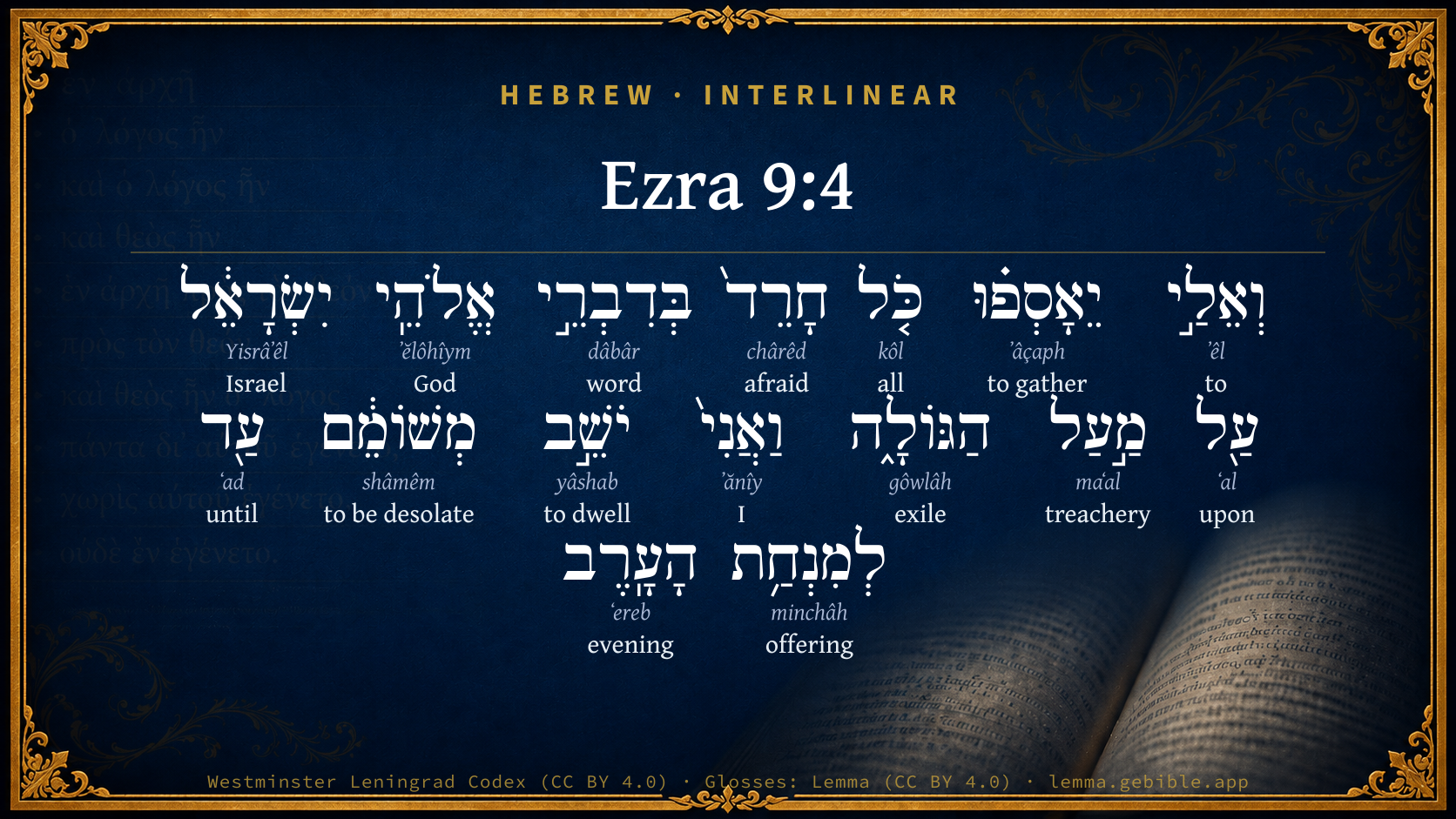
Hebrew (Westminster Leningrad Codex) Ezra 9:4 appears in the Hebrew Old Testament. The text above is from the Westminster Leningrad Codex. Each word links to its Strong’s number, a concise gloss, and parsing drawn from the Open Scriptures Hebrew Bible morphology. Click any word for its full Brown-Driver-Briggs (BDB) entry.
Download image
Cite this verse

Ezra 9:4 (World English Bible). Public Domain. Lemma interlinear Bible study tool, https://lemma.gebible.app/v/ezra/9/4.

Show BibTeX & RIS
BibTeX
RIS
English Translation
Then were assembled to me everyone who trembled at the words of the God of Israel, because of the trespass of them of the captivity; and I sat confounded until the evening offering.
World English Bible · Public Domain
Download a study sheet

One document with this verse’s original text, its word-by-word gloss line, the meaning frame, cross-references with their text, attributed commentary, and full source and license credits — printable, and it pastes into notes with its structure intact.

This verse Autodidact and up

Study sheet (.html) Plain text (.txt)

A passage Seminary Student

Up to 50 verses in one chapter. A passage sheet keeps up to 6 commentary sources and 12 cross-references per verse, in the order this page ranks them, and says so on the sheet whenever that leaves anything out. Ask for a single verse and you get the Autodidact verse sheet above.

Everything on this page stays free to read, with no account — the sheet is a download of what is already on screen, not access to it.

Want to remove ads? Support Godless Engineer
Compare translations 3

The same verse in 3 English versions, stacked beneath the original-language interlinear above. Click any original word for its lexicon entry.

Each is an independent rendering of the whole verse — the interlinear is not word-aligned to these translations.

Highlighted words mark where these versions differ — a whole-verse word diff, not a word-by-word alignment.

  • World English Bible Public Domain
    Then were assembled to me everyone who trembled at the words of the God of Israel, because of the trespass of them of the captivity; and I sat confounded until the evening offering.
  • King James Version Public Domain
    Then were assembled unto me every one that trembled at the words of the God of Israel, because of the transgression of those that had been carried away; and I sat astonied until the evening sacrifice.
  • unfoldingWord Literal Text CC BY-SA 4.0
    And all who trembled at the words of the God of Israel on account of the unfaithfulness of the exiles were gathered to me. And I was sitting appalled until the offering of the evening.

unfoldingWord Literal Text — © unfoldingWord, licensed CC BY-SA 4.0. Word-aligned USFM3 via Door43 (git.door43.org/unfoldingWord/en_ult).

Versions to compare (up to 4)

3 of 4 selected

Show all 18 translations

Every available English version of this verse, each an independent rendering of the whole verse.

  • World English Bible Public Domain
    Then were assembled to me everyone who trembled at the words of the God of Israel, because of the trespass of them of the captivity; and I sat confounded until the evening offering.
  • Berean Standard Bible Public Domain
    Then everyone who trembled at the words of the God of Israel gathered around me because of the unfaithfulness of the exiles, while I sat there in horror until the evening offering.
  • Majority Standard Bible Public Domain
    Then everyone who trembled at the words of the God of Israel gathered around me because of the unfaithfulness of the exiles, while I sat there in horror until the evening offering.
  • King James Version Public Domain
    Then were assembled unto me every one that trembled at the words of the God of Israel, because of the transgression of those that had been carried away; and I sat astonied until the evening sacrifice.
  • American Standard Version (1901) Public Domain
    Then were assembled unto me every one that trembled at the words of the God of Israel, because of the trespass of them of the captivity; and I sat confounded until the evening oblation.
  • Revised Version (1885) Public Domain
    Then were assembled unto me every one that trembled at the words of the God of Israel, because of the trespass of them of the captivity; and I sat astonied until the evening oblation.
  • Geneva Bible (1599) Public Domain
    And there assembled vnto me all that feared the words of the God of Israel, because of the transgression of them of the captiuitie. And I sate downe astonied vntil the euening sacrifice.
  • Douay-Rheims (1899) Public Domain
    And there were assembled to me all that feared the God of Israel, because of the transgression of those that were come from the captivity, and I sat sorrowful, until the evening sacrifice.
  • Young's Literal Translation Public Domain
    and unto me are gathered every one trembling at the words of the God of Israel, because of the trespass of the removal, and I am sitting astonished till the present of the evening.
  • Literal Standard Version CC BY-SA 4.0
    and to me are gathered everyone trembling at the words of the God of Israel, because of the trespass of the expulsion, and I am sitting astonished until the present of the evening.
  • Unlocked Literal Bible CC BY-SA 4.0
    All those who trembled at the words of the God of Israel about this faithlessness gathered to me while I was sitting ashamed until the evening offering.
  • unfoldingWord Literal Text CC BY-SA 4.0
    And all who trembled at the words of the God of Israel on account of the unfaithfulness of the exiles were gathered to me. And I was sitting appalled until the offering of the evening.
  • Darby Bible Public Domain
    Then were assembled to me every one that trembled at the words of the God of Israel, because of the unfaithfulness of those that had been carried away; and I sat overwhelmed until the evening oblation.
  • World Messianic Bible Public Domain
    Then everyone who trembled at the words of the God of Israel were assembled to me because of the trespass of the exiles; and I sat confounded until the evening offering.
  • Webster's Bible Public Domain
    Then were assembled to me every one that trembled at the words of the God of Israel, because of the transgression of those that had been carried away; and I sat confounded until the evening sacrifice.
  • Free Bible Version CC BY-SA 4.0
    Everyone who respected the instructions of the God of Israel gathered around me because of this sin on the part of the exiles. I sat there shocked and appalled until the evening sacrifice.
  • Bible in Basic English Public Domain
    Then everyone who went in fear of the words of the God of Israel, because of the sin of those who had come back, came together to me; and I kept where I was, overcome with grief, till the evening offering.
  • JPS Tanakh (1917) Public Domain
    Then were assembled unto me every one that trembled at the words of the God of Israel, because of the faithlessness of them of the captivity; and I sat appalled until the evening offering.

Literal Standard Version (2020), Covenant Press — licensed CC BY-SA 4.0. Text via the HelloAO Bible API (eBible.org). Unlocked Literal Bible (unfoldingWord) — licensed CC BY-SA 4.0. Text via the HelloAO Bible API (eBible.org). unfoldingWord Literal Text — © unfoldingWord, licensed CC BY-SA 4.0. Word-aligned USFM3 via Door43 (git.door43.org/unfoldingWord/en_ult). Free Bible Version, Dr. Jonathan Gallagher — licensed CC BY-SA 4.0. Text via the HelloAO Bible API (eBible.org).

Word by word

More ways to search: Search by grammar → Find every occurrence → Compare this word →

Practice this passage: Drill this verse → Learn its vocabulary →

חָרֵד֙
chârêd
H2730
“afraid”
Adjective, Adjective, Masculine, Singular, Absolute
Part of Speech
Adjective
Type
Adjective
Gender
Masculine
Number
Singular
State
Absolute
Full BDB Definition

Origin: from H2729

TWOT: 735a

trembling, fearful, afraid
  1. וְאֵלַ֣י ʼêl H413 “and · to · me” Conjunction + Preposition + Suffix, Personal, 1st Person, Common, Singular
  2. יֵאָסְפ֗וּ ʼâçaph H622 “to gather” Verb, Niphal, Imperfect, 3rd Person, Masculine, Plural
  3. כֹּ֤ל kôl H3605 “all” Noun, Common, Masculine, Singular, Absolute
  4. בְּדִבְרֵ֣י dâbâr H1697 “in/at · words of” Preposition + Noun, Common, Masculine, Plural, Construct
  5. אֱלֹהֵֽי ʼĕlôhîym H430 “God(s) of” Noun, Common, Masculine, Plural, Construct
  6. יִשְׂרָאֵ֔ל Yisrâʼêl H3478 “Israel” Noun, Proper
  7. עַ֖ל ʻal H5921 “upon” Preposition
  8. מַ֣עַל maʻal H4604 “treachery of” Noun, Common, Masculine, Singular, Construct
  9. הַגּוֹלָ֑ה gôwlâh H1473 “the · exile” Particle, Definite Article + Noun, Common, Feminine, Singular, Absolute
  10. וַאֲנִי֙ ʼănîy H589 “and · I” Conjunction + Pronoun, Personal, 1st Person, Common, Singular
  11. יֹשֵׁ֣ב yâshab H3427 “dwelling” Verb, Qal, Participle Active, Masculine, Singular, Absolute
  12. מְשׁוֹמֵ֔ם shâmêm H8074 “desolate” Verb, Poel, Participle Passive, Masculine, Singular, Absolute
  13. עַ֖ד ʻad H5704 “until” Preposition
  14. לְמִנְחַ֥ת minchâh H4503 “to/for · offering of” Preposition + Noun, Common, Feminine, Singular, Construct
  15. הָעָֽרֶב ʻereb H6153 “the · evening” Particle, Definite Article + Noun, Common, Masculine, Singular, Absolute

About this verse

These counts appear in no published source. They are computed here, from the morphology-tagged text and Lemma’s own curated glosses. What Lemma adds →

16
words
16
distinct lemmas
Historical
section

Notable vocabulary

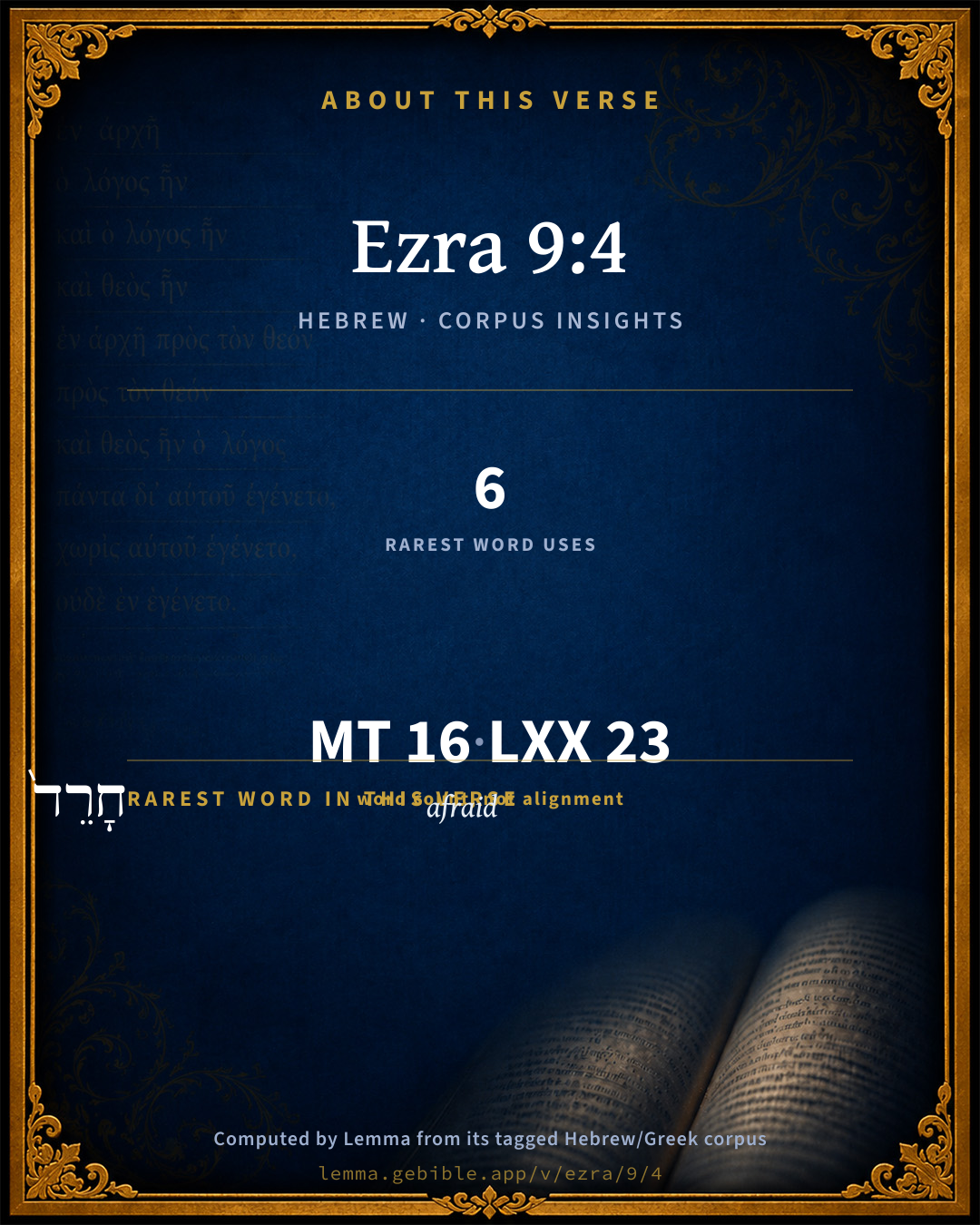
The rarest word here is חָרֵד֙ afraid H2730 — appearing just 6 times in the whole Hebrew Bible.

Shared distinctive vocabulary

חָרֵד֙ afraid H2730 occurs in 6 verses of the Hebrew Bible. Also found in:

Grammatical profile

  • 3 verbs
  • 8 nouns
  • 1 adjective
  • 1 pronoun
  • 3 prepositions

Verb forms

  • יֵאָסְפ֗וּ Niphal · Imperfect
  • יֹשֵׁ֣ב Qal · Participle Active
  • מְשׁוֹמֵ֔ם Poel · Participle Passive

Hebrew & Septuagint length

In English translation the verse runs 33 words from the Hebrew and 31 from the Septuagint (LXX English) — closely comparable.

A rough comparison of the two English renderings, which tokenize alike — not a word-level alignment.

Word counts can differ between the Hebrew and the Greek without any difference in meaning — e.g. the Hebrew direct-object marker אֵת has no separate Greek word, and Greek often adds the article ὁ.

In the original languages it is 16 Hebrew tokens and 23 Greek tokens — but the two are counted differently (Hebrew bundles its prefixes and suffixes into one token; the Greek is in lemma form), so that isn’t a like-for-like length.

Cross-references

8

Topical passages linked to Ezra 9:4 in the Treasury of Scripture Knowledge — connected by theme and wording, ordered by reader-vote popularity; previews shown in the World English Bible.

  • Ezra 10:3 Now therefore let us make a covenant with our God to put away all the wives, and such as are born of them, according to the counsel of my lord, and of those who tremble at the commandment of our God; and let it be done according to the law.
  • Isaiah 66:2 For all these things has my hand made, and [so] all these things came to be, says Yahweh: but to this man will I look, even to him who is poor and of a contrite spirit, and who trembles at my word.
  • Exodus 29:39 The one lamb you shall offer in the morning; and the other lamb you shall offer at evening:
  • 2 Chronicles 34:27 because your heart was tender, and you did humble yourself before God, when you heard his words against this place, and against the inhabitants of it, and have humbled yourself before me, and have torn your clothes, and wept before me; I also have heard you, says Yahweh.
  • Psalms 119:136 Streams of tears run down my eyes, Because they don't observe your law.
  • Ezekiel 9:4 Yahweh said to him, Go through the midst of the city, through the midst of Jerusalem, and set a mark on the foreheads of the men that sigh and that cry over all the abominations that are done in the midst of it.
  • Daniel 9:21 yes, while I was speaking in prayer, the man Gabriel, whom I had seen in the vision at the beginning, being caused to fly swiftly, touched me about the time of the evening offering.
  • Acts 3:1 Peter and John were going up into the temple at the hour of prayer, the ninth hour.

Cross-references courtesy of OpenBible.info (CC BY 4.0).

Hebrew and Greek witnesses Masoretic Hebrew ↔ Greek Septuagint

The same verse in the two great witnesses to the Old Testament, shown verse-for-verse.

These are two independent witnesses, not word-aligned to each other, and the Septuagint is shown in lemma (dictionary) form.

Hebrew Ezra 9:4 Masoretic · Westminster Leningrad Codex

וְאֵלַ֣י יֵאָסְפ֗וּ כֹּ֤ל חָרֵד֙ בְּדִבְרֵ֣י אֱלֹהֵֽי יִשְׂרָאֵ֔ל עַ֖ל מַ֣עַל הַגּוֹלָ֑ה וַאֲנִי֙ יֹשֵׁ֣ב מְשׁוֹמֵ֔ם עַ֖ד לְמִנְחַ֥ת הָעָֽרֶב

Then were assembled to me everyone who trembled at the words of the God of Israel, because of the trespass of them of the captivity; and I sat confounded until the evening offering.

World English Bible · Public Domain

Greek LXX Ezra 9:4 Septuagint · lemma form

καί συνἄγω πρός ἐγώ πᾶς ὁ διώκω λόγος θεός ἰσραήλ ἐπί ἀσυνθεσία ὁ ἀποικία καί ἐγώ καταἧμαι ἠρεμάζων ἕως ὁ θυσία ὁ ἑσπερινός

Then there assembled to me all that followed the word of the God of Israel, on account of the transgression of the captivity; and I remained mourning until the evening sacrifice.

LXX2012 (modern English Septuagint) · Public Domain

In the Septuagint this is one book — Esdras B (2 Esdras): Ezra is chapters 1–10, Nehemiah 11–23.

Hebrew: Westminster Leningrad Codex (CC BY 4.0). Greek: Septuagint (public domain); English from LXX2012 (modern English Septuagint) (Public Domain). How the Septuagint differs from the Hebrew →

Commentary

Notes on Ezra 9:4 from classic Christian and Jewish commentators (each source and its license shown beneath its notes). The classic Christian expositions comment on the surrounding passage and are grouped to its opening verse, so a note may address several verses; the Jewish commentaries on the Tanakh (Rashi and others) are per-verse, so they appear only where the commentator wrote on this verse.

Lemma curates 59 commentaries, every one of them public domain or Creative Commons licensed, each selected and text-cleaned for this edition rather than reprinted as found. About our sources →

Trapp's Complete Commentary

John Trapp

Ezr 9:4 Then were assembled unto me every one that trembled at the words of the God of Israel, because of the transgression of those that had been carried away; and I sat astonied until the evening sacrifice.

Ver. 4. Then were assembled unto me] It was soon noised and noticed among the godly party how exceedingly Ezra was troubled; they therefore trouble themselves, as our Saviour is said to have done, Joh 11:33, and as Paul felt twinges when others were hurt. "Who is offended," saith he, "and I burn not?" 2Co 11:29. Sheep, when frighted, will get together; swine, when lugged, will grunt together. What should saints do (in case of national sins or judgments) but assemble and tremble together, as here; but vow and perform reformation to the Lord their God, as in the next chapter.

Every one that trembled at the words] At the judgments of God whilst they yet hang in the threatenings. To such looketh the Lord with special intimations of his love, Isa 66:2. When as those that tremble not in hearing shall be crushed to pieces in feeling, said Mr Bradford the martyr.

That had been carried away] But had not learned by the things that they had suffered, were as bad as before, if not worse, having lost the fruit of their afflictions, παθηματα μαθηματα. This is fearful; a bad sign of an incorrigible castaway, Jer 6:30.

Until the evening sacrifice] This time of the day good people usually took to pray at; that, together with the sacrifice, their prayers might come up for a memorial before God in those pillars of smoke, Son 3:6 Act 10:4. See Luk 1:10 Act 3:11.

John Trapp, A Commentary or Exposition upon All the Books of the Old and New Testament (1647–1656) — public domain. Text from a community e-Sword module.

Joseph Benson's Commentary

Ezr 9:4. Then were assembled unto me — To join with me, both in lamenting the sin, and in endeavouring to effect the redress of it; every one that trembled at the words of the God of Israel — Who stood in awe of God and of his word, and durst not violate his commands; or who feared his threatenings against those that did so, and trembled for fear of God’s judgments upon them, and upon the whole land for their sakes, as the following words imply. Compare Isa 66:2; Isa 66:5. Because of the transgression of those that had been carried away — To wit, into captivity, and were safely returned from it, but yet were little amended, either by their former banishment, or their late restoration. He speaks not of those who had lately come back with himself, but of those who had returned with Zerubbabel, and of their children. And I sat astonied until the evening sacrifice — When the people used to assemble together. All good people ought to own those that appear and act for God against vice and profaneness. Every one that fears God ought to stand by them, and do what he can to strengthen their hands.

Joseph Benson's Commentary on the Old and New Testaments (1811–1818) — public domain. Text from a community e-Sword module.

Tyndale Open Study Notes

Tyndale Open Resources

9:4 The time of the evening sacrifice was around 3:00 pm.

Tyndale Open Study Notes — © Tyndale Open Resources, licensed CC BY-SA 4.0. Text via the HelloAO Bible API.

Jamieson, Fausset & Brown

Robert Jamieson, A. R. Fausset & David Brown

Then were assembled unto me every one that trembled at the words of the God of Israel, &c.--All the pious people who reverenced God's word and dreaded its threatenings and judgments joined with Ezra in bewailing the public sin, and devising the means of redressing it.

I sat astonied until the evening sacrifice--The intelligence of so gross a violation of God's law by those who had been carried into captivity on account of their sins, and who, though restored, were yet unreformed, produced such a stunning effect on the mind of Ezra that he remained for a while incapable either of speech or of action. The hour of the evening sacrifice was the usual time of the people assembling; and at that season, having again rent his hair and garments, he made public prayer and confession of sin.

Jamieson, Fausset & Brown — Commentary Critical and Explanatory on the Whole Bible (1871) — public domain (CC PDM 1.0). Text via the HelloAO Bible API.

Adam Clarke's Commentary

Verse 4. Those that had been carried away] Those that had returned long before with Zerubbabel; see Ezr 9:1.

Until the evening sacrifice.] The morning sacrifice was the first of all the offerings of the day, the evening sacrifice the last. As the latter was offered between the two evenings, i.e., between sunset and the end of twilight, so the former was offered between break of day and sunrise. Ezra sat astonied-confounded in his mind, distressed in his soul, and scarcely knowing what to do. He probably had withdrawn himself into some sequestered place, or into some secret part of the temple, spending the time in meditation and reflection.

Adam Clarke's Commentary on the Bible (1810–1826) — public domain. Text from a community e-Sword/MySword module.

The Cambridge Bible for Schools and Colleges

gen. ed. J. J. S. Perowne

4. There are, collected unto Ezra those who believed in the word of God and dreaded the displeasure consequent upon such transgression. Perhaps the reference is especially to the threats contained in the Law. Cf. Deu_7:1-4.

every one that trembled at the words &c.] cf. Ezr_10:3, ‘those that tremble at the commandment of our God’. Isa_66:2, ‘to him that is poor and of a contrite spirit, and that trembleth at my word’, and Ezr_9:5, ‘Hear the word of God, ye that tremble at his word’. The dread of the consequences of disobedience rather than horror at the nature of the offence seems here depicted. But if the nature of sin was not yet realised, the sovereignty of a Higher Law was recognised, and ‘sin is lawlessness’ (1Jn_3:4).

of those that had been carried away] R.V. of them of the captivity. Heb. ‘haggôlah’, the collective abstract name for those who had shared the captivity.

until the evening sacrifice] R.V. until the evening oblation. This is the daily evening minkhah or meal offering. See note on Neh_10:33.

It is here mentioned as a common division of the day, as in 1Ki_18:29. Cf. Jdt_9:1, ‘about the time that the incense of that evening was offered in Jerusalem’. Ezra probably spent the greater part of the day in this posture.

The Cambridge Bible for Schools and Colleges (gen. ed. J. J. S. Perowne; Cambridge University Press, 1878–1918) — public domain. Text from a community e-Sword module.

John Gill's Exposition

There were assembled unto me everyone that trembled at the words of the God of Israel,.... That had a reverence for the word of God, and the things contained in it; feared to break the laws of God, and trembled at his judgments, which they might apprehend would come upon transgressors, see Isa 46:2,

because of the transgression of those that had been carried away; into Babylon, and were now returned, and which was an aggravation of their transgression:

and I sat astonished until the evening sacrifice: or until the ninth hour, as the Syriac version, which was about our three o'clock in the afternoon, at which time the evening sacrifice was offered; perhaps it was in the morning when Ezra first received his information from the princes.

John Gill's Exposition of the Whole Bible (1746–1763) — public domain (CC PDM 1.0). Text via the HelloAO Bible API.

Haydock's Catholic Bible Commentary

To me, in the court of the temple, chap. x. 1. (Menochius) --- Sacrifice, which was offered last of all, about sun-set, Exodus xxix. 38. The Jews commonly protract their fasts till the stars appear. (Leo, p. 3, art. 8.)

George Leo Haydock (1774–1849), Haydock's Catholic Family Bible and Commentary, 1859 edition — public domain. Excludes Psalms (Douay-Rheims chapter numbering differs from Protestant) and Deuterocanonical books (Catholic canon only).

Matthew Poole's English Annotations

Then were assembled unto me; to join with me both in lamenting the sin, and in endeavouring the redress of it.

Every one that trembled at the words of the God of Israel, i.e. who stood in awe of God, and of his word, and durst not violate his commands; or who feared his threatenings against those that did so, and trembled for fear of God’s judgments upon them, and upon the whole land for their sakes, as the following words imply. Compare Isa 66:2,5.

Those that had been carried away, to wit, into captivity, and were safely returned from it, and yet were not reformed either by their former affliction, or by their latter deliverance.

Until the evening sacrifice, when the people used to assemble together. See Psa 141:2; Act 3:1.

Matthew Poole's English Annotations on the Holy Bible (1683–1685) — public domain. Text from a community e-Sword/MySword module.

Whedon's Commentary on the Bible

Daniel D. Whedon

4. Every one that trembled — Ezra was not alone in grief and dismay over the sins of the people. Others with him realized the peril of the hour, and trembled with a profound sense of their danger. For should Divine vengeance burst upon the camp, the innocent and guilty would suffer together. Among those that trembled at the words of the God of Israel were also, doubtless, some of the transgressors who had been brought to realize their guilt and danger.

The evening sacrifice — The law ordained that a lamb should be offered each day, morning and evening, and these offerings were called respectively the morning and evening sacrifices. See Exo_29:38-41. Comp. also 1Ki_18:29, note. While the people mingled with the heathen, and openly transgressed, they continued to sacrifice to Jehovah, thus apparently forgetting that obedience is better than sacrifice.

Daniel D. Whedon (gen. ed.), Commentary on the Old and New Testaments (1874–1909) — public domain. Text from a community e-Sword module.

The Pulpit Commentary

Then were assembled unto me. The open manifestation by Ezra of his grief and horror produced an immediate effect. A crowd assembled around him, attracted by the unusual sight partly sympathizing, partly no doubt curious. Every one came that trembled at the words of the God of Israel; by which is meant not so much all God-fearing persons. (see Isa_66:2) as all who were alarmed at the transgression of the commands of God, (Ezr_10:3) and at the threats which the Law contained against transgressors. (Deu_7:4) Because of the transgression of those that had been carried away. The transgression of "the children of the captivity" (Ezr_4:1) of those who had been removed to Babylon and had returned under Zerubbabel. I sat astonied until the evening sacrifice. As morning is the time for business in the East, we may assume that the princes had waited upon Ezra tolerably early in the day before noon, at any rate to communicate their intelligence. The evening sacrifice took place at three in the afternoon. Ezra must, therefore, either from the intensity of his own feelings or with the view of impressing the people, have "sat astonied speechless and motionless for several hours.

Vers. 4-15.

Sensibility.

Ezra was a man not only of vigorous mind and strong will, with whom things soon took shape and form, but also of keen sensibility, into whose heart things cut deeply, and whose soul was stirred with strong emotion. Therefore he knew not only great joys, but great sorrows also.

Dearly bought the hidden treasure Finer feelings can bestow; Chords that vibrate deepest pleasure Thrill the deepest notes of woe.

When he learnt how the children of Israel had gone astray in the matter of the mixed marriages, he was overwhelmed with strong and profound feeling. There was

I DISMAY AT THE PRESENCE OF SIN (ver. 5). He sat "astonished until the evening sacrifice" (ver. 4), having just given way to an Oriental exhibition of extreme agitation (ver. 3). This blow seems to have stunned him. He was simply dismayed, appalled. After a burst of grief he sat overwhelmed with a sense of the exceeding great folly and iniquity of the people.

II SHAME UNDER A SENSE OF SIN (vers. 5, 6, 15). Placing himself in penitential attitude, he addressed himself to God, and said, "0 my God, I am ashamed and blush to lift up my face to thee "(ver. 6). He went on to identify himself (though personally guiltless) with his people: "Our iniquities," etc. (ver. 6). "We are before thee in our trespasses" (ver. 15). And he concluded by saying, "We cannot stand before thee because of this" (ver. 15). Such was his intense fellow-feeling and sympathy with those whom he was serving, that he felt overwhelmed with shame under a consciousness of their guilt. Sin, the sin of our family, of our city, of our country, of our race quite apart from our personal share in it is a shameful thing, something to humiliate us and cause us "confusion of face.

III FEAR OF THE CONSEQUENCES OF SIN. "Wouldest thou not be angry with us till thou hadst consumed us," etc. (ver. 14). He lamented that the brief sunshine they were enjoying would probably disappear, in God"s rekindled wrath, in utter darkness. God"s mercy was for a space encompassing them, and now they were going to throw it, desperately and wantonly, away. No sooner were they out of bondage than they were inviting the great Disposer, in his righteousness, to send them back into captivity. Sin had ruined them before, and would surely ruin them again, and this time utterly and completely (vers. 7, 8, 9, 14). What insensate folly!

We may look at sensibility in respect of sin as it relates to

1. Our Divine Lord himself. He became man in order that he might suffer in our stead; in order that, as man, he might bear the penalty we must otherwise have borne. The Sinless One was never conscious of sin, nor yet of shame as we know it; but by becoming a member of our race, thus entering into perfect fellowship and intense sympathy with us, he could be affected, sorrowfully and sadly, by a sense of human sin. He did, in a way necessarily mysterious to us, thus suffer for us. It was to his soul a dreadful, horrible, shameful thing that mankind to whose family he belonged, and of which he was a member should have sinned so grievously as it had.

2. Our own souls. It is well for us indeed when we have come to feel the shamefulness of our own sin. The heart that, thus affected, can say, "O my God, I am ashamed and blush to lift up my face unto thee" (ver. 6), is in that state of contrition, of poverty of spirit, "of which is the kingdom of heaven". (Mat_5:3) Sin is shameful because

(1) it is the act of those who owe everything they are and have to God, and

(2) it is directed against him who has

(a) multiplied his mercies unto us in so many ways, and

(b) borne so long with us, and

(c) done and suffered, in Christ, so much to reclaim us; and because

(3) it is continued in spite of our knowledge of what is right, reasonable, and beneficial.

3. Our fellows. We may well be sympathetically affected by the sins of others our kindred, our fellow-citizens, our fellow-men. Rivers of water should run down our eyes because men keep not his law. We may well be ashamed and appalled, and pour out our souls to God, under a sense of the guilt of the world. C.

The Pulpit Commentary (1880–1919), ed. H.D.M. Spence-Jones & Joseph S. Exell — public domain. Text from a community e-Sword module.

John Wesley's Explanatory Notes

Evening sacrifice - When the people used to assemble together. All good people ought to own those that appear and act for God against vice and profaneness. Everyone that fears God, ought to stand by them, and do what he can to strengthen their hands.

John Wesley, Explanatory Notes Upon the Whole Bible (1754–1765) — public domain. Text via the GEBible commentary corpus.

Lesson kit

Teaching starters — assembled from the data on this page, not authored interpretation. Every prompt links to the verse data it draws on. Edit before teaching.

Ezra, in the Historical, opens this verse with 16 words (16 distinct Hebrew lemmas). Its most distinctive word is chârêd (“afraid”). A historical commentator’s framing appears above. Read the whole chapter for the surrounding context.

Discussion questions

  1. How does “afraid” (chârêd) shape what this verse is saying?
  2. How does Judges 7:3, which shares the word «afraid», read alongside this verse?
  3. The translations on this page render this verse differently — a whole-verse word diff, not a word-by-word alignment. What might account for the different wordings?
  4. «יֵאָסְפ֗וּ» is a Niphal Imperfect verb. How does that grammatical form shape the action described?
  5. Compare how Trapp's Complete Commentary and Joseph Benson's Commentary read this verse. Where do they agree or differ?

Things to notice

Reading settings

Reading text

Shown beneath each verse's original-language words.

Old Testament
Old Testament edition

Read the OT as the Masoretic Hebrew (MT) or the Greek Septuagint (LXX).

English shown for the Greek Septuagint (in the Hebrew ↔ Greek comparison).

Comparing translations? Open the Compare panel on any verse page to stack up to four side by side.