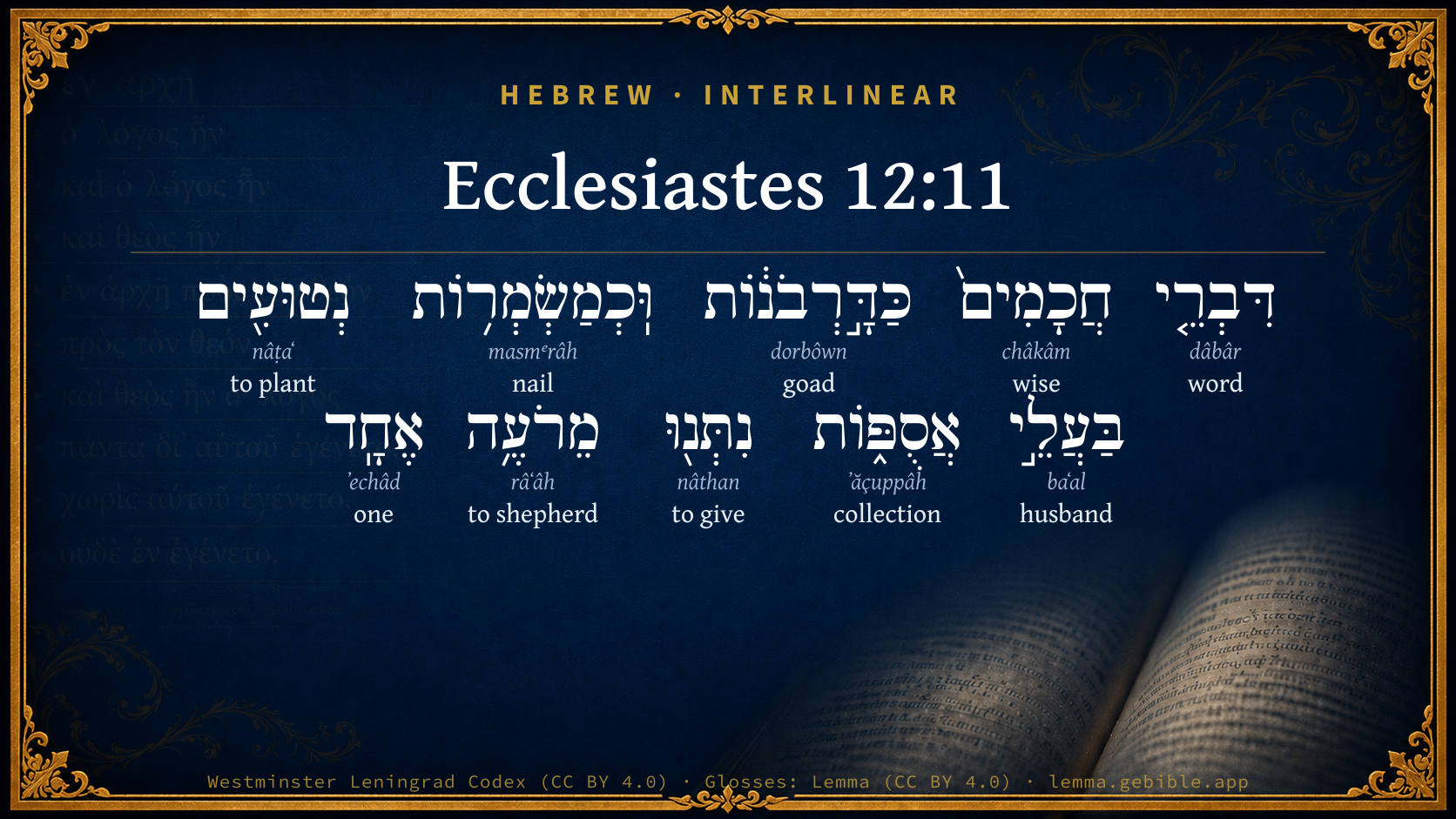
Ecclesiastes 12:11

Hebrew (Westminster Leningrad Codex) Ecclesiastes 12:11 appears in the Hebrew Old Testament. The text above is from the Westminster Leningrad Codex. Each word links to its Strong’s number, a concise gloss, and parsing drawn from the Open Scriptures Hebrew Bible morphology. Click any word for its full Brown-Driver-Briggs (BDB) entry.
Download image
Cite this verse

Ecclesiastes 12:11 (World English Bible). Public Domain. Lemma interlinear Bible study tool, https://lemma.gebible.app/v/ecclesiastes/12/11.

Show BibTeX & RIS
BibTeX
RIS
English Translation
The words of the wise are like goads; and like nails well fastened are words from the masters of assemblies, which are given from one shepherd.
World English Bible · Public Domain
Highlights
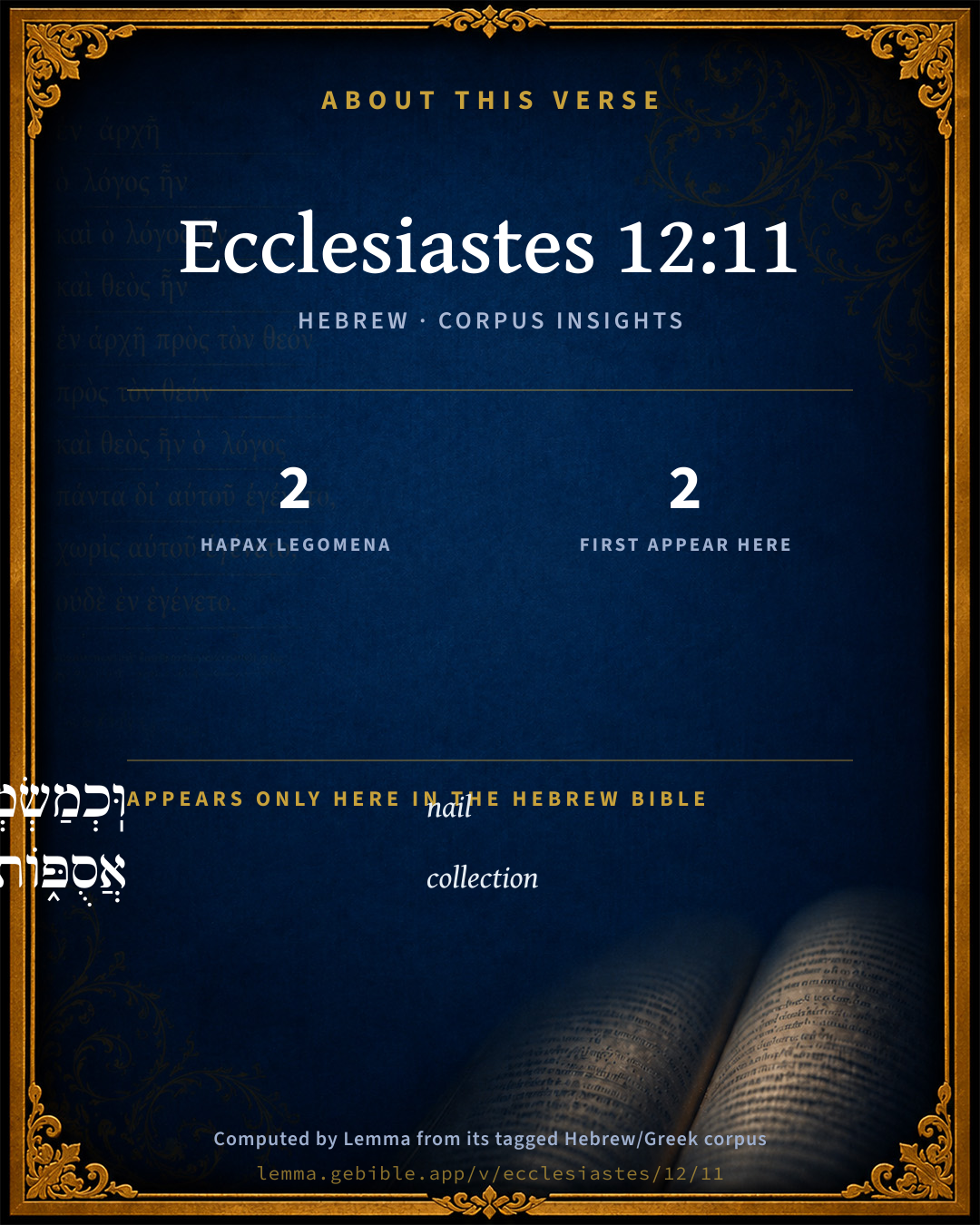
  • 2 hapax legomena — only here in the Hebrew Bible
  • 2 first appearances in the Hebrew Bible
Full analysis ↓
Download a study sheet

One document with this verse’s original text, its word-by-word gloss line, the meaning frame, cross-references with their text, attributed commentary, and full source and license credits — printable, and it pastes into notes with its structure intact.

This verse Autodidact and up

Study sheet (.html) Plain text (.txt)

A passage Seminary Student

Up to 50 verses in one chapter. A passage sheet keeps up to 6 commentary sources and 12 cross-references per verse, in the order this page ranks them, and says so on the sheet whenever that leaves anything out. Ask for a single verse and you get the Autodidact verse sheet above.

Everything on this page stays free to read, with no account — the sheet is a download of what is already on screen, not access to it.

Want to remove ads? Support Godless Engineer
Compare translations 3

The same verse in 3 English versions, stacked beneath the original-language interlinear above. Click any original word for its lexicon entry.

Each is an independent rendering of the whole verse — the interlinear is not word-aligned to these translations.

Highlighted words mark where these versions differ — a whole-verse word diff, not a word-by-word alignment.

  • World English Bible Public Domain
    The words of the wise are like goads; and like nails well fastened are words from the masters of assemblies, which are given from one shepherd.
  • King James Version Public Domain
    The words of the wise are as goads, and as nails fastened by the masters of assemblies, which are given from one shepherd.
  • unfoldingWord Literal Text CC BY-SA 4.0
    words of wise like goads, and like nails implanted masters of collections. They are given by one Shepherd.

unfoldingWord Literal Text — © unfoldingWord, licensed CC BY-SA 4.0. Word-aligned USFM3 via Door43 (git.door43.org/unfoldingWord/en_ult).

Versions to compare (up to 4)

3 of 4 selected

Show all 18 translations

Every available English version of this verse, each an independent rendering of the whole verse.

  • World English Bible Public Domain
    The words of the wise are like goads; and like nails well fastened are words from the masters of assemblies, which are given from one shepherd.
  • Berean Standard Bible Public Domain
    The words of the wise are like goads, and the anthologies of the masters are like firmly embedded nails driven by a single Shepherd.
  • Majority Standard Bible Public Domain
    The words of the wise are like goads, and the anthologies of the masters are like firmly embedded nails driven by a single Shepherd.
  • King James Version Public Domain
    The words of the wise are as goads, and as nails fastened by the masters of assemblies, which are given from one shepherd.
  • American Standard Version (1901) Public Domain
    The words of the wise are as goads; and as nails well fastened are `the words of' the masters of assemblies, `which' are given from one shepherd.
  • Revised Version (1885) Public Domain
    The words of the wise are as goads, and as nails well fastened are the words of the masters of assemblies, which are given from one shepherd.
  • Geneva Bible (1599) Public Domain
    The wordes of the wise are like goads, and like nailes fastened by the masters of the assemblies, which are giuen by one pastour.
  • Douay-Rheims (1899) Public Domain
    The words of the wise are as goads, and as nails deeply fastened in, which by the counsel of masters are given from one shepherd.
  • Young's Literal Translation Public Domain
    Words of the wise `are' as goads, and as fences planted `by' the masters of collections, they have been given by one shepherd.
  • Literal Standard Version CC BY-SA 4.0
    Words of the wise [are] as the goads, and as nails planted [by] the masters of collections, they have been given by one Shepherd.
  • Unlocked Literal Bible CC BY-SA 4.0
    The words of wise people are like goads. Like nails driven deeply are the words of the masters in collections of their proverbs, which are taught by one shepherd.
  • unfoldingWord Literal Text CC BY-SA 4.0
    words of wise like goads, and like nails implanted masters of collections. They are given by one Shepherd.
  • Darby Bible Public Domain
    The words of the wise are as goads, and the collections [of them] as nails fastened in: they are given from one shepherd.
  • World Messianic Bible Public Domain
    The words of the wise are like goads; and like nails well fastened are words from the masters of assemblies, which are given from one shepherd.
  • Webster's Bible Public Domain
    The words of the wise are as goads, and as nails fastened by the masters of assemblies, which are given from one shepherd.
  • Free Bible Version CC BY-SA 4.0
    The words of the wise are like cattle prods. Their collected sayings are like nails driven home, given by one shepherd.
  • Bible in Basic English Public Domain
    The words of the wise are pointed, and sayings grouped together are like nails fixed with a hammer; they are given by one guide.
  • JPS Tanakh (1917) Public Domain
    The words of the wise are as goads, and as nails well fastened are those that are composed in collections; they are given from one shepherd.

Literal Standard Version (2020), Covenant Press — licensed CC BY-SA 4.0. Text via the HelloAO Bible API (eBible.org). Unlocked Literal Bible (unfoldingWord) — licensed CC BY-SA 4.0. Text via the HelloAO Bible API (eBible.org). unfoldingWord Literal Text — © unfoldingWord, licensed CC BY-SA 4.0. Word-aligned USFM3 via Door43 (git.door43.org/unfoldingWord/en_ult). Free Bible Version, Dr. Jonathan Gallagher — licensed CC BY-SA 4.0. Text via the HelloAO Bible API (eBible.org).

Word by word

More ways to search: Search by grammar → Find every occurrence → Compare this word →

Practice this passage: Drill this verse → Learn its vocabulary →

וּֽכְמַשְׂמְר֥וֹת
masmᵉrâh
H4930
“and · like/as · nails”
Conjunction + Preposition + Noun, Common, Both, Plural, Absolute
Part of Speech
Conjunction + Preposition + Noun
Type
Common
Gender
Both
Number
Plural
State
Absolute
Full BDB Definition

Origin: for H4548

TWOT: 1518b

nail
  1. דִּבְרֵ֤י dâbâr H1697 “words of” Noun, Common, Masculine, Plural, Construct
  2. חֲכָמִים֙ châkâm H2450 “wise” Adjective, Adjective, Masculine, Plural, Absolute
  3. כַּדָּ֣רְבֹנ֔וֹת dorbôwn H1861 “like/as the · goads” Preposition, Determined + Noun, Common, Both, Plural, Absolute
  4. נְטוּעִ֖ים nâṭaʻ H5193 “planted” Verb, Qal, Participle Passive, Masculine, Plural, Absolute
  5. בַּעֲלֵ֣י baʻal H1167 “husbands of” Noun, Common, Masculine, Plural, Construct
  6. אֲסֻפּ֑וֹת ʼăçuppâh H627 “collections” Noun, Common, Feminine, Plural, Absolute
  7. נִתְּנ֖וּ nâthan H5414 “to give” Verb, Niphal, Perfect, 3rd Person, Common, Plural
  8. מֵרֹעֶ֥ה râʻâh H7462 “from · shepherding” Preposition + Verb, Qal, Participle Active, Masculine, Singular, Absolute
  9. אֶחָֽד ʼechâd H259 “one” Adjective, Cardinal number, Masculine, Singular, Absolute

About this verse

These counts appear in no published source. They are computed here, from the morphology-tagged text and Lemma’s own curated glosses. What Lemma adds →

10
words
10
distinct lemmas
Wisdom
section

Notable vocabulary

2 hapax legomena — words that appear only here in the entire Hebrew Bible:

  • וּֽכְמַשְׂמְר֥וֹת nail H4930
  • אֲסֻפּ֑וֹת collection H627

First appearance in Scripture

These words make their first canonical appearance in the Hebrew Bible here:

  • וּֽכְמַשְׂמְר֥וֹת nail H4930
  • אֲסֻפּ֑וֹת collection H627

Shared distinctive vocabulary

כַּדָּ֣רְבֹנ֔וֹת goad H1861 occurs in 2 verses of the Hebrew Bible. Also found in:

Grammatical profile

  • 3 verbs
  • 5 nouns
  • 2 adjectives

Verb forms

  • נְטוּעִ֖ים Qal · Participle Passive
  • נִתְּנ֖וּ Niphal · Perfect
  • מֵרֹעֶ֥ה Qal · Participle Active

Hebrew & Septuagint length

In English translation the verse runs 26 words from the Hebrew and 22 from the Septuagint (LXX English) — closely comparable.

A rough comparison of the two English renderings, which tokenize alike — not a word-level alignment.

Word counts can differ between the Hebrew and the Greek without any difference in meaning — e.g. the Hebrew direct-object marker אֵת has no separate Greek word, and Greek often adds the article ὁ.

Cross-references

18

Topical passages linked to Ecclesiastes 12:11 in the Treasury of Scripture Knowledge — connected by theme and wording, ordered by reader-vote popularity; previews shown in the World English Bible.

  • Jeremiah 23:29 Isn't my word like fire? says Yahweh; and like a hammer that breaks the rock in pieces?
  • Acts 2:37 Now when they heard this, they were cut to the heart, and said to Peter and the rest of the apostles, "Brothers, what shall we do?"
  • Hebrews 4:12 For the word of God is living, and active, and sharper than any two-edged sword, and piercing even to the dividing of soul and spirit, of both joints and marrow, and is able to discern the thoughts and intentions of the heart.
  • Ezekiel 34:23 I will set up one shepherd over them, and he shall feed them, even my servant David; he shall feed them, and he shall be their shepherd.
  • Proverbs 1:6 To understand a proverb, and parables, The words and riddles of the wise.
  • Proverbs 22:17 Turn your ear, and listen to the words of the wise. Apply your heart to my teaching.
  • Isaiah 40:11 He will feed his flock like a shepherd, he will gather the lambs in his arm, and carry them in his bosom, [and] will gently lead those who have their young.
  • John 3:10 Jesus answered him, "Are you the teacher of Israel, and don't understand these things?
  • 2 Corinthians 10:4 for the weapons of our warfare are not of the flesh, but mighty before God to the throwing down of strongholds,
  • Psalms 23:1 Yahweh is my shepherd: I shall lack nothing.
  • Psalms 80:1 Hear us, Shepherd of Israel, You who lead Joseph like a flock, You who sit above the cherubim, shine forth.
  • Isaiah 22:23 I will fasten him as a nail in a sure place; and he shall be for a throne of glory to his father's house.
  • Matthew 3:7 But when he saw many of the Pharisees and Sadducees coming for his baptism, he said to them, "You offspring of vipers, who warned you to flee from the wrath to come?
  • John 10:14 I am the good shepherd. I know my own, and I'm known by my own;
  • Genesis 49:24 But his bow abode in strength, The arms of his hands were made strong, By the hands of the Mighty One of Jacob, (From there is the shepherd, the stone of Israel),
  • Ezra 9:8 Now for a little moment grace has been shown from Yahweh our God, to leave us a remnant to escape, and to give us a nail in his holy place, that our God may lighten our eyes, and give us a little reviving in our bondage.
  • Hebrews 13:20 Now may the God of peace, who brought again from the dead the great shepherd of the sheep with the blood of an eternal covenant, our Lord Jesus,
  • 1 Peter 5:4 When the chief Shepherd is revealed, you will receive the crown of glory that doesn't fade away.

Cross-references courtesy of OpenBible.info (CC BY 4.0).

Hebrew and Greek witnesses Masoretic Hebrew ↔ Greek Septuagint

The same verse in the two great witnesses to the Old Testament, shown verse-for-verse.

These are two independent witnesses, not word-aligned to each other, and the Septuagint is shown in lemma (dictionary) form.

Hebrew Ecclesiastes 12:11 Masoretic · Westminster Leningrad Codex

דִּבְרֵ֤י חֲכָמִים֙ כַּדָּ֣רְבֹנ֔וֹת וּֽכְמַשְׂמְר֥וֹת נְטוּעִ֖ים בַּעֲלֵ֣י אֲסֻפּ֑וֹת נִתְּנ֖וּ מֵרֹעֶ֥ה אֶחָֽד

The words of the wise are like goads; and like nails well fastened are words from the masters of assemblies, which are given from one shepherd.

World English Bible · Public Domain

Greek LXX Ecclesiastes 12:11 Septuagint · lemma form

λόγος σοφός ὡς ὁ βούκεντρον καί ὡς ἧλος φυτεύω ὅς παρά ὁ σύναγμα δίδωμι ἐκ ποιμήν εἷς καί περισσόν ἐκ αὐτός

The words of the wise are as goads, and as nails firmly fastened, which have been given from one shepherd by agreement.

LXX2012 (modern English Septuagint) · Public Domain

On this verse, Keil & Delitzsch discusses the Septuagint’s reading. Read the note in Commentary ↓

Hebrew: Westminster Leningrad Codex (CC BY 4.0). Greek: Septuagint (public domain); English from LXX2012 (modern English Septuagint) (Public Domain). How the Septuagint differs from the Hebrew →

Commentary

Notes on Ecclesiastes 12:11 from classic Christian and Jewish commentators (each source and its license shown beneath its notes). The classic Christian expositions comment on the surrounding passage and are grouped to its opening verse, so a note may address several verses; the Jewish commentaries on the Tanakh (Rashi and others) are per-verse, so they appear only where the commentator wrote on this verse.

Lemma curates 59 commentaries, every one of them public domain or Creative Commons licensed, each selected and text-cleaned for this edition rather than reprinted as found. About our sources →

Trapp's Complete Commentary

John Trapp

Ecc 12:11 The words of the wise [are] as goads, and as nails fastened [by] the masters of assemblies, [which] are given from one shepherd.

Ver. 11. The words of the wise are like goads.] To rouse up men’s drowsy and drossy spirits; to drive them, as the eagle doth her young ones with her talons, out of the nest of carnal security; to awaken them out of the snare of the devil, who hath cast many into such a dead lethargy, such a dedolent disposition, that, like Dionysius the Heracleot, they can hardly feel sharpest goads, or needles thrust into their fat hearts - "fat as grease." {Psa 119:70} St Peter so preached that his hearers were "pricked at heart." {Act 2:37} St Stephen so galled his adversaries that they were "cut to the heart." {Act 7:54} And before them both, how barely and boldly dealt John Baptist and our Saviour Christ with those enemies of all righteousness, the Pharisees, qui toties puncti ac repuncti, nunquam tamen ad resipiscentiam compuncti, as one saith of them (who like those bears in Pliny, or asses of Tuscany, that have fed on hemlock), were so stupified that no sharp words would work upon them or take impression in their hearts, so brawny were their breasts, so horny their heart strings!

And as nails.] Such as shepherds fastened their tents to the ground with. Jael drove one of these tent nails through Sisera’s temples, and laid his body as it were listening what was become of the soul. {Jdg 4:21} Now, as nails driven into pales do fasten them to their rails, so the godly and grave sentences of teachers - those "masters of assemblies" - do pierce into men’s hearts, to unite them unto God by faith, and one to another in love. Our exhortations truly should be strong and well pointed, not only to wound as arrows, but to stick by the people as forked arrows, that they may prove, as those of Joash, "the arrows of the Lord’s deliverance." And surely it were to be wished, in these unsettled and giddy times especially, that people would suffer such words of exhortation, as, like goads, might prick them on to pious practice, and, like nails, might fix their wild conceits, that they might be steadfast and immoveable, stablished in the truth, and not whiffied about with every wind of doctrine. But we can look for no better, so long as they have so mean an esteem of the ministers, those "masters of the assemblies" (whose office it is to congregate the people, and to preside in the congregations), which are given from one shepherd, the arch-shepherd {1Pe 2:25} of his sheep, Jesus Christ, who in the days of his solemn inauguration into his kingdom, "gave these gifts unto men" - viz., "some to be apostles, some evangelists, some pastors, some teachers," &c. {Eph 4:11} What a mouth of blasphemy then opens that schismatical pamphleteer, {a} that makes this precious gift of Christ to his spouse, this sacred and tremendous function of the ministry, to be as mere an imposture, as very a mystery of iniquity, as arrant a fraud as the Papacy itself!

{a} The Compas. Samarit.

John Trapp, A Commentary or Exposition upon All the Books of the Old and New Testament (1647–1656) — public domain. Text from a community e-Sword module.

The Biblical Illustrator

Joseph S. Exell

Ecc_12:11

The words of the wise are as goads.

A wise preacher aims to move his hearers

I. A wise preacher will aim to impress the minds of his hearers.

1. Every wise preacher knows that unless he impresses the minds of his hearers, he can do them no good by his preaching. Hearers must feel what they hear, or what they hear will be like sounding brass, or a tinkling cymbal.

2. Every wise preacher knows that his hearers will not feel the truth and importance of what he says unless he makes them feel it. Hearers look upon it as the part of the preacher to make them feel. They mean to be passive in hearing, unless he makes them active.

II. How he will preach in order to attain this desirable object. When any person proposes a certain end, the end which he proposes naturally suggests the proper means to accomplish it. This holds with respect to a wise preacher, who makes it his object to penetrate and impress the minds of his hearers.

1. This end will naturally lead him to use the most proper style in preaching. He will choose the best words, and place them in the best order, to enlighten the mind and affect the heart.

2. His design to penetrate and impress the minds of his hearers will lead him to exhibit great and interesting truths. He will bring much of the character, perfections and designs of God into his public discourses. He will preach Christ in the greatness of His nature, and in the glory and grace of His mediatorial character and works. He will exhibit man in the dignity of his nature, and in the importance of his destination. And he will unfold the scenes of a general judgment, and of a boundless eternity, in their own native awful solemnity.

3. For the same purpose he will explain Divine truths and describe Divine objects.

4. The wise preacher, who intends to impress the minds of his hearers, will arrange Divine truths, and exhibit Divine objects, in such an order as to reach every power and faculty of the soul, in its proper turn. Instruction should always go before declamation. It can answer no valuable purpose to inflame the passions before light is thrown into the understanding and conscience; but rather serves, on the other hand, to produce the most fatal effects.

5. The wise preacher, who means to impress the minds of his hearers, will always apply his discourse according to their particular characters. What belongs to saints, he will apply to saints; and what belongs to sinners, he will apply to sinners.

III. Improvement.

1. We learn from what has been said, the importance of ministers being good men. Piety is necessary, both to dispose and enable them to penetrate and impress the minds of their hearers.

2. We learn from what has been said, the importance of ministers giving themselves wholly to their work. If they mean to penetrate and impress the minds of their hearers, they must exhibit, in the course of their preaching, a rich variety of Divine truths. But they will soon lose a variety, and fall into a sameness in preaching, unless they constantly improve their minds in the knowledge of the doctrines and duties of religion by reading, meditation and prayer.

3. We learn from what has been said, the manner in which a minister should appear and speak in the pulpit. His voice, his looks, his gestures, and his whole deportment, should be wholly governed by his ultimate end, which is to penetrate and impress the minds of his hearers.

4. We learn from what has been said that it is not very material whether a minister preaches with notes, or without. If he aims to impress the minds of his hearers, he may attain his end by either of these modes of preaching.

5. We learn from what has been said, the great absurdity of those ministers who studiously avoid penetrating and impressing the minds of their hearers. Solomon and Christ, the prophets and apostles meant to penetrate and impress the minds of their hearers; and, by the manifestation of the truth, to commend themselves to every mans conscience in the sight of God. These are examples, which it is wise in preachers to follow, though it Should give pain and even offence to their hearers.

6. If it be the wisdom and duty of ministers to penetrate and impress the minds of their hearers, then they have no reason to complain of the most close and pungent preaching. They always desire such plainness and fidelity in other men, whom they employ to promote their temporal good. They wish their attorney to examine their cause with care, discover every flaw, and tell them the plain, naked truth. And they heartily desire their surgeon to probe their wounds to the bottom, and apply the moss effectual remedies, though ever so painful and distressing to endure. Why, then, should they complain of their minister for dealing plainly and faithfully with their souls? This is an absurdity in its own nature, an injury to their minister, and may be eternal destruction to themselves.

7. If it ought to be the aim of the minister to penetrate and impress the minds of his hearers, then there is blame somewhere if their minds are not penetrated and impressed. Either the minister does not aim to impress their minds, or they mean to resist the impressions of Divine truth. (N. Emmons, D. D.)

The words of the wise

I. They are stimulating, as goads. Wise teaching, however attractive (Ecc_12:10), is never pointless. It is penetrating, incisive. It stimulates to--

1. Hatred and opposition. Ahab. (1Ki_21:20; 1Ki_22:8). The Pharisees (Mar_12:12).

2. Conversion. Saul of Tarsus (Act_9:5. See also Psa_45:2; Psa_45:5).

3. Progress and effort (2Pe_1:12; 2Pe_3:1-18 :l).

II. They are abiding, as nails, etc. Masters of assemblies, either those who assemble persons together to hear them, or perhaps masters of collections, those who collect and arrange wise words. In either case they are teachers, by word of mouth or in writing. A nail fastened or planted, not only penetrates, but abides. The impression made by wise teaching is lasting. It abides--

1. To be pondered. The Blessed Virgin (Luk_2:19; Luk_2:51. See also Luk_1:66, and Gen_37:11).

2. To be acted upon, as fixed principles, regulating the conduct. Having heard the word, keep it, and bring forth fruit, etc. (Luk_8:15; see Psa_119:11).

3. To be added to; a nail (a peg, as we say) on which to hang much else. Compare the promise to Eliakim (Isa_22:23-25).

III. They have essential unity, given from one shepherd.

1. The human teacher making his own (so giving harmony and unity to words of the wise), drawn from many sources.

2. God, the Author of all wisdom (Pro_2:6), the Great Prophet and Teacher of the Church (Joh_16:13; 1Co_2:9-13). Harmony and unity of truth, as taught by inspired writers, and those whose teaching accords with them.

IV. Conclusion. In this description we have a rule by which--

1. The teacher should guide himself.

2. The hearer should try himself. (Archdeacon Perowne.)

The Christian ministry of literary men

There is a Christian ministry wider than that to which men are consecrated through ecclesiastical offices. They also belong to the great company of preachers, or teachers, who explore the heavens, or who decipher the records graven on rocks, or who analyze material forms, or who trace the evolutions of life, with those who delineate or embody the beautiful in art; all these are co-workers with the apostles and prophets in the service and worship of God the Father. Some of Gods servants stand nearer to the altar than others, but the sacrifice and service of these in the outermost range are ever and everywhere acceptable to Him when offered or done in an honest and true heart. And among these diverse gifts of Gods Spirit, who divides to men severally as He will, we may surely count the gift of the genius which has enriched the world with so many sweet and inspiring thoughts in the varied forms of literature. Charles Lamb has said, in his own quiet, quaint way, I am disposed to say grace upon twenty other occasions in the course of the day besides my dinner. I want a form for setting out upon a pleasant walk, for a moonlight ramble, for a friendly meeting, for a solved problem. Why have we none for books, those spiritual repasts--a grace before Milton, a grace before Shakespeare, a devotional exercise proper to be said before reading the Faery Queen? For literature, even in its lowlier forms, has been a ministry of comfort and help to millions. It has filled days in the lives of multitudes with solace or with sunshine which otherwise had been dark and dreary. Many devout people have a horror, I know, of what they call works of fiction: nor am I insensible of the demoralizing influence of the baser sort of such literature. But let us discriminate here, as we do in music and in painting and in poetry, nor condemn that which is wholesome with that which is vicious in books of amusement or recreation; for the greatest writers of so-called fiction have done good and blessed service often in the cause of morality and religion. There is more pure gospel, in the substantial sense of that cant phrase, in the writings of Charles Dickens, for instance, than in seven-tenths of our prinked sermons. Think of the gentleness, the pathos, the Divine charity which pervade his books! while even the homely, the ludicrous and the seemingly profane are always friendly to virtue. What a power he has been in the regeneration of English manners! Then think of a similar service done by his great compeer in English letters; by him who lashed the follies and the vices of Vanity Fair, doing a work which the pulpit was impotent or afraid to do in rebuking the fashionable extravagance and profligacy of the age; for literature could find audience in circles which were closed to homilies and Episcopal pastorals, insinuating truths which had been resented coming in dogmatic shape. And the results are marked in every sphere of English life, for it is not to an increase of ecclesiastical activity that the improved manners and morals of the English people are to be solely or chiefly traced. The influence of the press has become supreme; our greatest prophets speak through books. No man can estimate the debt which modern civilization owes to the men the weapon of whose warfare has been the pen. They have been ever forward to expose hypocrisy, to resist the tyranny of power, to plead the cause of the oppressed, and sometimes at a bitter cost. Of all powers merely human, poetry has been the most potent over the cultivated thought and feeling of the world. It holds more condensed wisdom, it speaks more directly to the primal affections, it incites the soul to grander aims, it is more nearly akin to the unction of the Divine Spirit than any other instrument or influence controlled by man. The art of making verses may be acquired, but the true poet is inspired, having deeper insight into men and things with finer faculties of interpretation: the teacher at whose feet all other men sit to catch the flow of harmonious wisdom. All gifts of genius are from heaven, but the brightest and the best is the vision and the faculty Divine of the poet. He is the teacher of teachers. The best thoughts of the cultivated world had birth in poetry. Every other species of intellectual power has been inspired by it. Religion, morals, government have all been penetrated and purified by it. Take one name and all it represents out of the literary annals of England, and what a void would be visible wherever the English tongue has gone! Take the entire range of English literature, says the late Canon Wordsworth; put together our best authors who have written upon subjects not professedly religious or theological, and we Shall not find, I believe, in them all united so much evidence of the Bible having been read and used as we have found in Shakespeare alone. Who can take his thoughts and reflections into the study or the closet without coming forth with deeper and diviner feelings in him--without a more awful estimate of life and its great issues? (J. H. Rylance, D. D.)

The Biblical Illustrator, edited by Joseph S. Exell (c. 1880s–1900s) — public domain. Text from a community e-Sword module.

Keil & Delitzsch

C. F. Keil & F. Delitzsch

From the words of Koheleth the author comes to the words of the wise man in general; so that what he says of the latter finds its application to himself and his book: "Words of the wise are as like goads, and like fastened nails which are put together in collections - they are given by one shepherd." The lxx, Aq., and Theod. translate darvonoth by βούκεντρα, the Venet. by βουπλῆγες; and that is also correct. The word is one of three found in the Jerus. Gemara, Sanhedrin x. 1, to designate a rod for driving (oxen) - דרבן (from דרב, to sharpen, to point), מלמד (from למד, to adjust, teach, exercise), and מרדּע (from רדע, to hold back, repellere); we read ka-dārevonoth; Gesen., Ewald, Hitz., and others are in error in reading dorvonoth; for the so-called light Metheg, which under certain circumstances can be changed into an accent, and the Kametz chatuph exclude one another.

(Note: The Kametz is the Kametz gadhol (opp. Kametz chatuph), and may for this reason have the accent Munach instead of Metheg. Vid., Michlol 153b, 182b. The case is the same as at Gen 39:3, where mimmachoraath is to be read. Cf. Baer's Metheg-Setz. 27 and 18.)

If דרבן is the goad, the point of comparison is that which is to be excited intellectually and morally. Incorrectly, Gesen., Hitz., and others: like goads, because easily and deeply impressing themselves on the heart as well as on the memory. For goads, aculei, the Hebrews use the word קוצים; darevonoth also are goads, but designed for driving on, thus stimuli (Jerome); and is there a more natural commendation for the proverbs of the wise men than that they incite to self-reflection, and urge to all kinds of noble effort? Divre and darevonoth have the same three commencing consonants, and, both for the ear and the eye, form a paronomasia. In the following comparison, it is a question whether ba'ale asuppoth (plur. of ba'al asuppoth, or of the double plur. ba'al asuppah, like e.g., sare missim, Exo 1:11, of sar mas) is meant of persons, like ba'al hallashon, Ecc 10:11, cf. ba'al kenaphayim, Ecc 10:20, or of things, as ba'al piphiyoth, Isa 41:15; and thus, whether it is a designation parallel to חכמים or to דברי. The Talm. Jer. Sanhedrin x. 1, wavers, for there it is referred first to the members of the assemblies (viz., of the Sanedrium), and then is explained by "words which are spoken in the assembly." If we understand it of persons, as it was actually used in the Talm., then by asuppoth we must understand the societies of wise men, and by ba'ale asuppoth, of the academicians (Venet.: δεσπόται ξυναγμάτων; Luther: "masters of assemblies") belonging to such academies. But an appropriate meaning of this second comparison is not to be reached in this way. For if we translate: and as nails driven in are the members of the society, it is not easy to see what this wonderful comparison means; and what is then further said: they are given from one shepherd, reminds us indeed of Eph 4:11, but, as said of this perfectly unknown great one, is for us incomprehensible. Or if we translate, after Isa 28:1 : and (the words of the wise are) like the fastened nails of the members of the society, it is as tautological as if I should say: words of wise men are like fastened nails of wise men bound together in a society (as a confederacy, union). Quite impossible are the translations: like nails driven in by the masters of assemblies (thus e.g., Lightfoot, and recently Bullock), for the accus. with the pass. particip. may express some nearer definition, but not (as of the genit.) the effective cause; and: like a nail driven in are the (words) of the masters of assemblies (Tyler: "those of editors of collections"), for ellipt. genit., dependent on a governing word carrying forward its influence, are indeed possible, e.g., Isa 61:7, but that a governing word itself, as ba'ale, may be the governed genit. of one omitted, as here divre, is without example.

(Note: Regarding this omission of the muḍâf the governing noun, where this is naturally supplied before a genitive from the preceding, cf. Samachschari's Mufaṣṣal, p. 43, l. 8-13.)

It is also inconsistent to understand ba'ale asuppoth after the analogy of ba'ale masoreth (the Masoretes) and the like. It will not be meant of the persons of the wise, but of the proverbs of the wise. So far we agree with Lang and Hoelem. Lang (1874) thinks to come to a right understanding of the "much abused" expression by translating, "lords of troops," - a designation of proverbs which, being by many acknowledged and kept in remembrance, possess a kind of lordship over men's minds; but that is already inadmissible, because asuppoth designates not any multitude of men, but associations with a definite end and aim. Hoelem. is content with this idea; for he connects together "planted as leaders of assemblies," and finds therein the thought, that the words of the wise serve as seeds and as guiding lights for the expositions in the congregation; but ba'ale denotes masters, not in the sense of leaders, but of possessors; and as ba'ale berith, Gen 14:13, signifies "the confederated," ba'ale shevu'ah, Neh 6:18, "the sworn," and the frequently occurring ba'ale ha'ir, "the citizens;" so ba'ale asuppoth means, the possessors of assemblies and of the assembled themselves, or the possessors of collections and of the things collected. Thus ba'ale asuppoth will be a designation of the "words of the wise" (as in shalishim, choice men = choice proverbs, Pro 22:20, in a certain measure personified), also of those which form or constitute collections, and which stand together in order and rank (Hitz., Ewald, Elst., Zckl., and others). Of such it may properly be said, that they are like nails driven in, for they are secured against separations, - they are, so to speak, made nail-feast, they stand on one common ground; and their being fixed in such connection not only is a help to the memory, but also to the understanding of them. The Book of Koheleth itself is such an asuppah; for it contains a multitude of separate proverbs, which are thoughtfully ranged together, and are introduced into the severe, critical sermon on the nothingness of all earthly things as oases affording rest and refreshment; as similarly, in the later Talmudic literature, Haggadic parts follow long stretches of hair-splitting dialectics, and afford to the reader an agreeable repose.

And when he says of the "proverbs of the wise," individually and as formed into collections: אחד נתּנוּ מרעה, i.e., they are the gift of one shepherd, he gives it to be understood that his "words of Koheleth," if not immediately written by Solomon himself, have yet one fountain with the Solomonic Book of Proverbs, - God, the one God, who guides and cares as a shepherd for all who fear Him, and suffers them to want nothing which is necessary to their spiritual support and advancement (Psa 23:1; Psa 28:9). "Mēro'eh ehad," says Grtz, "is yet obscure, since it seldom, and that only poetically, designates the Shepherd of Israel. It cannot certainly refer to Moses." Not to Moses, it is true (Targ.), nor to Solomon, as the father, the pattern, and, as it were, the patron of "the wise," but to God, who is here named the ἀρχιποίμην as spiritual preserver (provider), not without reference to the figure of a shepherd from the goad, and the figure of household economy from the nails; for רעה, in the language of the Chokma (Pro 5:21), is in meaning cogn. to the N.T. conception of edification.

(Note: Vid., my Heb. Rmerbrief, p. 97.)

Regarding masmeroth (iron nails), the word is not used of tent spikes (Spohn, Ginsb.), - it is masc., the sing. is משׂמר (מסמר), Arab. mismâr. נטוּעים is = תּקוּעים (cf. Dan 11:45 with Gen 31:25), post-bibl. (vid., Jer. Sanhedrin) קבוּעים (Jerome, in altum defixi). Min with the pass., as at Job 21:1; Job 28:4; Psa 37:23 (Ewald, 295b), is not synonymous with the Greek ὑπό. The lxx well: "given by those of the counsel from one shepherd." Hitzig reads מרעה, and accordingly translates: "which are given united as a pasture," but in mēro'eh ehad there lies a significant apologetic hint in favour of the collection of proverbs by the younger Solomon (Koheleth) in relation to that of the old. This is the point of the verse, and it is broken off by Hitzig's conjecture.

(Note: J. F. Reimmann, in the preface to his Introduction to the Historia Litterarum antediluviana, translates, Ecc 12:11 : "The words of the wise are like hewn-out marble, and the beautiful collectanea like set diamonds, which are presented by a good friend." A Disputatio philologica by Abr. Wolf, Knigsberg 1723, contends against this παρερμεενεία.)

Keil & Delitzsch — Biblical Commentary on the Old Testament (1861–1891) — public domain (CC PDM 1.0). Text via the HelloAO Bible API. (Old Testament only.)

Tyndale Open Study Notes

Tyndale Open Resources

12:11 cattle prods . . . nail-studded stick: Painful lessons are sometimes required to direct us into paths that we would rather not take. • a shepherd: This word is possibly an allusion to God as the shepherd of his people (Ps 23:1; Isa 40:11). The sentence might also just be comparing the words of the wise to the work that any shepherd does in taking care of his flock.

Tyndale Open Study Notes — © Tyndale Open Resources, licensed CC BY-SA 4.0. Text via the HelloAO Bible API.

Geneva Bible (1599)

Geneva Bible translators

That is, by God.

Which are well applied by the ministers, whom he calleth masters.

Geneva Bible (1599) marginal notes — public domain. Text via Bolls.life.

Jamieson, Fausset & Brown

Robert Jamieson, A. R. Fausset & David Brown

goads--piercing deeply into the mind (Act 2:37; Act 9:5; Heb 4:12); evidently inspired words, as the end of the verse proves.

fastened--rather, on account of the Hebrew genders, (The words) "are fastened (in the memory) like nails" [HOLDEN].

masters of assemblies--rather, "the masters of collections (that is, collectors of inspired sayings, Pro 25:1), are given ('have published them as proceeding' [HOLDEN]) from one Shepherd," namely, the Spirit of Jesus Christ [WEISS], (Eze 37:24). However, the mention of "goads" favors the English Version, "masters of assemblies," namely, under-shepherds, inspired by the Chief Shepherd (Pe1 5:2-4). SCHMIDT translates, "The masters of assemblies are fastened (made sure) as nails," so Isa 22:23.

Jamieson, Fausset & Brown — Commentary Critical and Explanatory on the Whole Bible (1871) — public domain (CC PDM 1.0). Text via the HelloAO Bible API.

Adam Clarke's Commentary

Verse 11. The words of the wise] Doctrines of faith, illustrated by suitable language, are as nails fastened by the masters of assemblies, בעלי אספות baaley asuphoth, the masters of collections, those who had made the best collections of this kind, the matter of which was of the most excellent nature; every saying sinking as deeply into the mind, by the force of the truth contained in it, as a nail well pointed does into a board, when impelled by the hammer's force. These masters of collections have been supposed to be public persons appointed by the prince himself, the sole shepherd, to see that nothing was put into the people's hands but what would be profitable for them to read; and that, when any wise man gave public instructions, a good scribe sat by to take down the words; and then the master examined what he had written, to see that it was upright, and that the words were doctrines of truth. These were something like our licensers of the press; but the existence of such is little more than conjecture.

After all, masters of assemblies may mean public teachers; that which was written, the oracles of God, out of which they instructed the people; the one Shepherd, GOD ALMIGHTY, from whom they received their authority and unction to preach the truth; and by the energy of whose Spirit the heavenly teaching was fastened in their hearts, as a well-driven nail in a sound piece of wood.

Adam Clarke's Commentary on the Bible (1810–1826) — public domain. Text from a community e-Sword/MySword module.

Ellicott's Commentary for English Readers

(11) Words of the wise.—In this and the next verse the weighty words of sages, such as was Kohéleth, are contrasted with the volubility of modern bookmakers. Though the general purpose of the verses is plain, the words used are enigmatical, and one cannot feel great confidence in assigning their precise meaning. The translation of our version fairly represents the original, if it is observed that the words “by” and “which,” which determine the meaning, are in italics. With regard to the “nail,” compare Ezr_9:8; Isa_22:23. The word “masters” we have had twice in this book already in the sense of possessor, “master of the tongue” (Ecc_10:11), “master of wings” (Ecc_10:20). “Assemblies” is a word not coming from the same root as that from which Kohéleth is derived. It might mean collections of sayings as well as of people. It is difficult to affix any meaning to the last clause, except that the sages, of whom the verse speaks, have been given for the instruction of the people by Israel’s great Shepherd (Psa_80:1).

A Bible Commentary for English Readers, edited by Charles John Ellicott (1878–1897) — public domain. Text from a community e-Sword module.

The Cambridge Bible for Schools and Colleges

gen. ed. J. J. S. Perowne

11. The words of the wise are as goads] The general fact is, of course, stated in special connexion with the book which furnishes the writer’s theme. They assert that its words also, sweet as they seem, are not without their sting, though, like the prick of the goad, it is for good and not for evil, urging men on to strong and vigorous labour in the fields of thought and action. The comparison was a natural one in any country, but we are reminded of what was said of the words of Pericles that his eloquence “left a sting (κέντρον) in the minds of his hearers (Eupolis, quoted by Liddell and Scott, s. v. κέντρον), and in part also of the Greek proverb, consecrated for us by a yet higher application (Act_9:5; Act_26:14) that “it is hard to kick against the pricks,” as applicable to resisting wisdom as well as to defying power (Æsch. Agam. 1633, Pindar, Pyth, ii. 173).

as nails fastened by the masters of assemblies] The word for “nails” is found in this, or a cognate form, with that meaning in Isa_41:7; Jer_10:4; 1Ch_22:3; 2Ch_3:9; and there is no adequate reason for taking it here, as some have done (Ginsburg), in the sense of the “stakes” of a tent. The word “by” however is an interpolation, and the words taken as they stand would run as nails fastened are the masters of assemblies. The whole analogy of the Hebrew is against our referring the last words to any but persons, and we must therefore reject the interpretation that the “words of the wise are as goads, as fastened nails which are put together in collections” (Delitzsch). The “masters of assemblies” (not, as it has been rendered (Tyler) “editors of collections”,) can be none else than the heads or leaders of a body of learned men, like the Great Synagogue of the traditions of the time of Ezra and Nehemiah, or the Sanhedrin of a later date. In “the fastened nail” we have a symbolism like that of Isa_22:23; Ezr_9:8, and seen also in the Rabbinic proverb, “Well for the man who has a nail to hang things on” (Dukes, Rabbin. Blumenlese, p. 121). In both these cases, it will be noted, the word refers to persons. It is the fitting emblem of fixity and permanence, and forms the natural complement to that of the goads. As it has been well put (Ginsburg), the two words express the several aspects of Truth as progressive and conservative.

which are given from one shepherd] The noun is used often in the O. T. both in its literal sense, and of kings and rulers as the shepherds of their people (Jer_2:8; Jer_3:15; Jer_49:19; Jer_50:44; Ezekiel 34 passim), and of God as the great Shepherd of Israel (Psa_23:1; Psa_80:1, and by implication, Eze_34:23). We have to choose accordingly between the two latter meanings. The words either assert that all the varied forms of the wisdom of the wise come from God, or that all the opinions, however diversified, which are uttered by “the masters of assemblies,” are subject to the authority of the President of the assembly. The first gives, it is believed, the most satisfactory meaning, and so taken, the words express the truth declared, without symbolism, in 1Co_12:1-11. It was not, perhaps, without some reference to this thought, though scarcely to this passage, that our Lord claimed for Himself as the one true Guide and Teacher of mankind the title of the “Good Shepherd,” and condemned all that had come before Him, assuming that character, as thieves and robbers (Joh_10:8; Joh_10:11), and that St Peter speaks of Him as the “chief Shepherd” (1Pe_5:4) over all who exercise a pastoral office in the Church of Christ.

The Cambridge Bible for Schools and Colleges (gen. ed. J. J. S. Perowne; Cambridge University Press, 1878–1918) — public domain. Text from a community e-Sword module.

John Gill's Exposition

The words of the wise are as goads,.... As the goad teacheth the ox; so the Targum. Not the words of the wise philosophers of that age, or of ages before, or since; but of the inspired penmen of the Scriptures, as Moses, David, Solomon, and of others since; and of all good men, whose doctrines are agreeably to them; these are like "goads" or "pricks", sharp pointed sticks or staves, with which men push and prick their cattle, when driving them from place to place, or ploughing with them: and of a similar use are the doctrines of the word, when attended with a divine efficacy; these are a means of pricking sinners to the heart; and of laying open their vileness and sinfulness to them; and of repentance and contrition; and of awakening them from a sleep in sin to a sense of their danger; and even of killing them, as to their own sense and apprehension of things, and, with respect to their hopes of life, by their own works; as the Philistines were slain by Shamgar with an ox goad, Jdg 3:31; see Act 2:37; and these are also of use to the saints, as goads, to stir them up, when slothful, to the discharge of duty; and to awaken them, when drowsy, out of their carnal security; and to correct them for their faults, by sharp reproofs and rebukes; as well as to excite them to go on to perfection, who are apt to sit still and lie down; and to direct them to walk straight on, without turning to the right hand or left;

and as nails fastened by the masters of assemblies; like these are the truths and doctrines of the word, when they have a place in the heart, and become the "ingrafted word" there; when they are "planted" (e) in the soul, as the word signifies; when they are fixed in the mind and memory, and dwell and abide there: and when as nails, driven into anything, fasten what they are drove into; so these are the means of fastening souls; of causing them to cleave to God and Christ; to the church, and his people, and to one another; and to the Gospel, and their profession of it; hence they are not like children, tossed to and fro, wavering and unstable: of all which "the masters of the assemblies" are the instruments; that is, ministers and pastors of churches. As there were assemblies for religious worship under the law, in which the prophets, priests, and Levites, assisted; so there are assemblies or churches under the Gospel dispensation, which are gathered and meet together for the service of God, and over these the ministers of the word preside; these are set over the churches in the Lord, and have the rule of them; though they are not to lord it over God's heritage, or have the dominion over their faith; but are helpers of their joy, and useful in the above things, through their ministry. Some choose to render "masters of collections", or "gatherings" (f); and think it may respect their gathering truths out of the sacred writings, as the bee gathers honey out of the flowers; in allusion to those that gathered together the choice and pithy sentences and sayings of others, like the men of Hezekiah, Pro 25:1; or to undershepherds, gathering the sheep into the fold (g), by the order of the principal one; who made use of goads, to drive away thieves or wild beasts; and nails, to preserve the sheepfold whole. And others think that not the words, but the of the assemblies themselves, are compared to "nails", and read them, "and the masters of the assemblies are as nails fastened" (h); are well established, firm and sure; see Isa 22:23; and others take it to be no other than an epithet of the nails themselves, and render it, "as nails fixed, which are binders"; that is, great binding nails, which, being fixed in boards, bind, compact, and hold them together; to which the words of the wise may be compared, being the means of compacting and holding together the church of God, comparable to a sheepfold; hence mention is made of the shepherd in the next clause: or of fixing the attention of the minds of men unto them, and of retaining them in memory, and to which they speak of as first principles, and never swerve from them (i); but, that not ministers, the instruments, but the principal and efficient cause, may have the glory, is added,

which are given from one Shepherd; not Zerubbabel, as Grotius; nor Moses, as the Targum, Jarchi, and Alshech; but Christ, the one Shepherd, set over the flock; and under whom the masters of assemblies, or pastors of churches, are, Eze 37:23; from whom they have their gifts and qualifications, their mission and commissions; and are given to the churches, as pastors and teachers, to feed them, Eph 4:10; and from whom they have their food, the Gospel and the doctrines of it, to feed the flocks with, assigned to their care, Joh 17:8; though this is to be understood not to the exclusion of God, the Father of Christ, by whom all Scripture is inspired; nor of the Spirit, by whom holy men of God spake as they were moved, Ti2 3:16.

(e) "plantati", Pagninus, Montanus, Tigurine version, Rambachius. (f) "auctores, vel dominos collectionum", Montanus, Vatablus, Mercerus, Gejerus. (g) Vid. Lightfoot, vol. 2. p. 575. (h) "Veluti clavi. infixi sunt domini, vel magistri congregationum", Schmidt. (i) Vid. De Dieu & Cocceium in loc. & Vitringam de Synag. Vet. l. 1. par 2. c. 8. p. 377. & Hyde Not. in Peritzol. Itinera Mundi, p. 94.

John Gill's Exposition of the Whole Bible (1746–1763) — public domain (CC PDM 1.0). Text via the HelloAO Bible API.

Haydock's Catholic Bible Commentary

In. The ground, (Haydock) to keep a tent in its proper place. He seemed before to have placed the wise on the same level with fools, chap. vi. 8, 11., and vii. 1. (Calmet) --- Shepherd. God, or Solomon. The Jews explain it of Moses, and his successors, who taught the people.

George Leo Haydock (1774–1849), Haydock's Catholic Family Bible and Commentary, 1859 edition — public domain. Excludes Psalms (Douay-Rheims chapter numbering differs from Protestant) and Deuterocanonical books (Catholic canon only).

Matthew Poole's English Annotations

The words of the wise; not of secularly or politicly wise men, but of the spiritually wise and holy men of God; of which, and not of the former, this whole context treats.

As goads, and as nails, piercing into men’s dull minds and hard hearts, and quickening and provoking them to the practice of all their duties.

Fastened; which do not only amuse and startle men for the present, as the wise and grave counsels of moral philosophers frequently do, but make powerful and abiding impressions in them; which is the peculiar effect of God’s word.

By the masters of assemblies; by the teachers of God’s church and people, whether prophets or others, appointed by God for that work.

Which are given from one shepherd; from God, or from Jesus Christ, the great Shepherd and Teacher of the church in all ages, by whose Spirit the ancient prophets, as well as other succeeding teachers, were inspired and taught, Jer 3:15; 1Pe 1:11; 2Pe 1:21. And this clause seems to be added partly as the reason of that admirable harmony and agreement which is amongst all the men of God in all ages and places, because they are all taught by one Master, and guided by the same hand; and partly to oblige us to the greater attention and reverence to all their doctrines and counsels, which we are to receive as the word of God, and not of men only, as it is said, 1Th 2:13.

Matthew Poole's English Annotations on the Holy Bible (1683–1685) — public domain. Text from a community e-Sword/MySword module.

Whedon's Commentary on the Bible

Daniel D. Whedon

11. The words of the wise are as goads — The writer gives the reason of his undertaking, suggesting, too, his ideal of what such work should be, as if his toil would be repaid should these words prove such.

And as nails — Better, And as stakes firmly set, are those (words) of the masters of assemblies. The stakes are those to which the tent ropes are fastened, firmly holding the tent in its place.

Which are given — Referring to “the words of the wise.” The savings of true wisdom, whether they are radical and arousing, like goads, or conservative and supporting, like tent stakes, are from the inspiration of one Shepherd, the Allwise, who, in manifold ways, aims at the correction and instruction of his creatures. “All true wisdom is from One Wise.”

Daniel D. Whedon (gen. ed.), Commentary on the Old and New Testaments (1874–1909) — public domain. Text from a community e-Sword module.

The Pulpit Commentary

The words of the wise are as goads. The connection of this verse with the preceding is maintained by the fact that the "acceptable words," etc., are words of the wise, emanate from the same persons. Herewith he proceeds to characterize them, with especial reference to his own work. The goad was a rod with an iron spike, or sharpened at the end, used in driving oxen. (see Jud_1:3:31; 1Sa_13:21; Act_9:5) Words of wisdom are called goads because they rouse to exertion, promote reflection and action, restrain from error, impel to right; if they hurt and sting, the pain which they inflict is healthful, for good and not for evil. And as nails fastened by the masters of assemblies. The proposition "by" is an interpolation, and the sentence should run: Ant/ like nails fastened are the, etc. masmeroth, "nails," Isa_41:7. There is much difficulty in explaining the next words, twOpsua yliB (baale asuppoth ). We have had similar expressions applied to possessors in Ecc_10:11, "lord of the tongue," and "lord of wings"; (Ecc_10:20) and analogy might lead us to apply the phrase here to-persons, and not things; but in Isa_41:15 we find athreshing-instrument termed "lord of teeth;" and in 2Sa_5:20 a town is called Baal-Perazim, "Lord of breaches;" so we must be guided by other considerations in our exposition. The Septuagint, taking the whole sentence together, and regarding baals as a preposition, renders, "As nails firmly planted, (oitwn para twn sunqema) ejdoqhsan ejk poimenov eJnov) which from the collections were given from one shepherd." Schleusher takes oi paratwn to mean, Ii quibus munus datum erat collectionem faciendi," i.e. the author, of collections. The Vulgate has, Verba quae per magistrorum consilium data sunt a pastore uno. The "masters of assemblies" can only be the chiefs of some learned conclaves, like the great synagogue supposed to exist in the time of Ezra and later. The clause would then assert that these pundits are like fastened nails, which seems rather unmeaning. One might say that their uttered sentiments became fixed in the mind as nails firmly driven in, but one could not properly say this of the men themselves. A late editor, Gietmann, suggests that "lords of collection" may mean "brave men, heroes, gathered in line of battle," serried ranks, just as in Pro_22:20 the term shalishim, chariot-fighters, chieftains, is applied to choice proverbs. Thus he would say that the words of the wise are as goads because they stimulate the intellect, as nails because they readily find entrance, and like men in battle array when they are reduced to writing and marshaled in a book. This is certainly ingenious, but somewhat too artificial to be regarded as the genuine intention of the writer. It seems best to take the word translated "assemblies" as denoting collections, not of people, but of proverbs; and the compound phrase would thus mean proverbs of an excellent character, the best of their sort gathered together in writing. Such words are well compared to nails; they are no longer floating loosely about, they are fixed in the memory, they secure other knowledge, and, though they are separate utterances, they have a certain unity and purpose. Nails are often used proverbially as emblems of what is fixed and unalterable. Thus Aeschyl., "Suppl.," 944

Twn d ejfhlwtai torwv Gomfov diampanein ajrarotwv

Through them a nail is firmly fixed, that they May rest immovable.

Cicero, "Verr.," 2:5.21, "Ut hoc beneficium, quemadmodum dicitur, trabali clave figeret;" i.e. to make it sure and steadfast (comp. Horace, "Carm.," 1:35. 17, et seq.). Which are given from one shepherd. All these words of the wise, collections, etc., proceed from one source, or are set forth by one authority. Who is this shepherd? Some say that he is the archisynagogus, the president of the assemblies of wise men, to whose authority all these public utterances are subjected. But we do not know that such supervision existed or was exercised at the time when Koheleth wrote; and, as we saw above, there is probably no reference to any such assemblies in the passage. The "one shepherd" is doubtless Jehovah, who is called the Shepherd of Israel, who feeds his people like a flock, etc.. (see Gen_48:15 Gen_49:24; Psa_23:1 Psa_80:1, etc.) The appellation is here used as concinnous with the thought of the ox-goad, intimating that God watches and leads his people like a tender shepherd and a skilful farmer. This is an important claim to inspiration. All these varied utterances, whatever form they take, whether his own or his predecessor"s, are outcomes of wisdom, and proceed from him who is only wise, Almighty God. It is no disparagement of this work to imply that it is not the production of the true Solomon; Koheleth is ready to avow himself the writer, and yet claims a hearing as being equally moved by heavenly influence. It is like St. Paul"s assertion, (1Co_7:40) "I think that I also have the Spirit of God.

Vers. 11, 12.

Reading, writing, speaking.

I "READING MAKES A FULL MAN.

1. Pushed to excess, it becomes hurtful to the body. "Much study is a weariness to the flesh," and as a consequence, reflexively, injurious to the mind.

2. Pursued in moderation, it first enlightens the understanding, next quickens the whole spiritual nature, and finally tends to stimulate the health of the body. "A man"s wisdom maketh his face to shine". (Ecc_8:1)

II "WRITING MAKES A CORRECT MAN." If professional authorship in the Preacher"s day was a nuisance, much more is it so in ours. Yet in book-writing lie advantages as well as disadvantages. If, on the one band, the multiplication of books often signifies nothing more than an accumulation of literary rubbish, and a terrible infliction to those who must read them, on the other hand it secures the preservation and distribution of much valuable knowledge; while if the knowledge is not valuable, the formal deposition of it in a book, which may be quietly consigned to a library, secures that it shall not roam at large, to the disquieting of peace-loving minds. But, apart from the multiplication of volumes, the habit of setting down one"s thoughts in writing is attended by distinct advantages. It promotes:

1. Clearness of thought. One who intends to write, more especially for the information of his fellows, must know what he purposes to say. The effort of putting one"s ideas on paper imparts to them a definiteness of outline they might not otherwise possess.

2. Order in arrangement. No writer will, voluntarily, fling his thoughts together into a confused heap, but will strive to render them as lucid and luminous as possible. If for no other reason than this, the practice of preparing for public speech by means of writing is to be commended.

3. Brevity in expression. If brevity is the soul of wit, and loquacity the garment of dullness, then the sure way of attaining to the former, and avoiding the latter, is to write.

III "SPEAKING MAKES A READY MAZE." "The words of the wise are as goads, and as nails." Though designed to apply to the wise man"s written words," the clause may be accepted as correct also with reference to his spoken words." Like the former, the latter are as goads and nails.

1. They stimulate. The words of a practiced speaker, always supposing him to be a wise man, incite the minds and quicken the hearts of his hearer. The true preacher should be progressive, not only in his own discovery of truth, but in conducting his hearers into fresh fields of instruction, leading them out into regions beyond," causing them to forget the things that are behind, and reach forward unto those things that are before," persuading them to leave the first principles of Christ, and to go on unto perfection.

2. They abide. They lodge themselves in the understanding and affections so firmly that they cannot be removed. Facility in arousing and fixing conviction can only be attained by diligent and wise cultivation of the art of speech.

The Pulpit Commentary (1880–1919), ed. H.D.M. Spence-Jones & Joseph S. Exell — public domain. Text from a community e-Sword module.

John Wesley's Explanatory Notes

Nails - Piercing into men's dull minds, which make powerful and abiding impressions in them. Masters - By the teachers of God's church, appointed of God for that work. Shepherd - From Christ, the great Shepherd of the church in all ages.

John Wesley, Explanatory Notes Upon the Whole Bible (1754–1765) — public domain. Text via the GEBible commentary corpus.

Rashi

Rabbi Shlomo Yitzchaki (Rashi)

The words of the wise They made a fence for the Torah with decrees to distance a person from sin, e.g., eating hallowed things until dawn, and they said “Until midnight,” and likewise, the evening recitation of the Shema [which the Sages limit to midnight].

are like goads Just as this goad directs the cow to its furrows, so do their words direct a person to the ways of life.

and like well-fastened nails Just as this nail is fastened, so are their words fastened [i.e., permanent], and just as a sapling (נְטִיעָה) is fruitful and multiplies, so are their words fruitful and multiply, to find for them a reason.

with large heads Heb. אֲסֻפּוֹת, nails that have a large and thick head, grosse in French, large. So did Dunash the son of Labrat explain it (Teshuvoth Dunash, p. 44).

given from one shepherd All their words are the words of the living God. He said them, and one shepherd gave them, viz. Moses from God.

וּכְמַשְׂמְרוֹת This is written with a “sin,” for the Torah (Tenach), with the twenty-four books coincide with the number of the watches (מִשְׁמָרוֹת) of the priests and the Levites.

Rashi on the Tanakh — English translations: “The Judaica Press complete Tanach with Rashi, translated by A. J. Rosenberg” (CC BY 4.0); “Pentateuch with Rashi's commentary by M. Rosenbaum and A.M. Silbermann, 1929-1934” (public domain); “The Metsudah Tanach series, Lakewood, N.J” (CC BY 4.0); and “The Book of Joshua, Metsudah Publications, 1997” (CC BY 4.0). Text via Sefaria.

Lesson kit

Teaching starters — assembled from the data on this page, not authored interpretation. Every prompt links to the verse data it draws on. Edit before teaching.

Ecclesiastes, in the Wisdom, opens this verse with 10 words (10 distinct Hebrew lemmas). Its most distinctive word is masmᵉrâh (“nail”). A historical commentator’s framing appears above. Read the whole chapter for the surrounding context.

Discussion questions

  1. How does “nail” (masmᵉrâh) shape what this verse is saying?
  2. 2 words here appear nowhere else in the Hebrew Bible. Why might the author reach for such rare wording?
  3. 2 words make their first appearance in Scripture here. What does this debut establish?
  4. How does 1 Samuel 13:21, which shares the word «goad», read alongside this verse?
  5. These translations render this verse differently; the difference is in the English rendering, not the original. What questions does that raise?
  6. «נְטוּעִ֖ים» is a Qal Participle Passive verb. How does that grammatical form shape the action described?
  7. Compare how Trapp's Complete Commentary and The Biblical Illustrator read this verse. Where do they agree or differ?

Things to notice

  • 2 words in this verse appear nowhere else in the Hebrew Bible.
  • 2 words make their first canonical appearance in Scripture here.
  • These translations choose different wording for 7 words in this verse.
  • 10 distinct Hebrew lemmas span 10 words in this verse.

Reading settings

Reading text

Shown beneath each verse's original-language words.

Old Testament
Old Testament edition

Read the OT as the Masoretic Hebrew (MT) or the Greek Septuagint (LXX).

English shown for the Greek Septuagint (in the Hebrew ↔ Greek comparison).

Comparing translations? Open the Compare panel on any verse page to stack up to four side by side.