
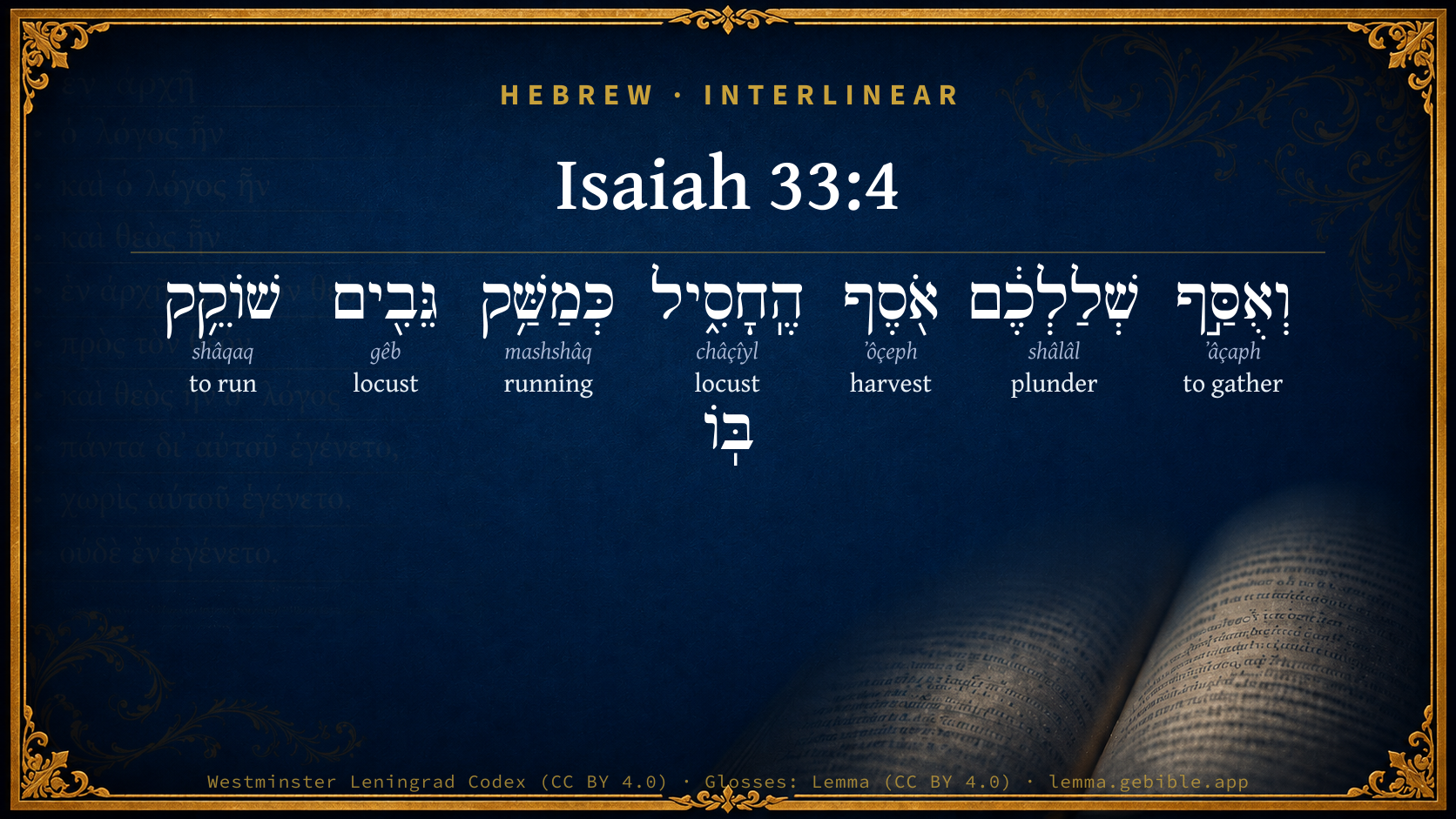
Isaiah 33:4

Hebrew (Westminster Leningrad Codex) Isaiah 33:4 appears in the Hebrew Old Testament. The text above is from the Westminster Leningrad Codex. Each word links to its Strong’s number, a concise gloss, and parsing drawn from the Open Scriptures Hebrew Bible morphology. Click any word for its full Brown-Driver-Briggs (BDB) entry.
Download image
Cite this verse

Isaiah 33:4 (World English Bible). Public Domain. Lemma interlinear Bible study tool, https://lemma.gebible.app/v/isaiah/33/4.

Show BibTeX & RIS
BibTeX
RIS
English Translation
Your spoil shall be gathered as the caterpillar gathers: as locusts leap shall men leap on it.
World English Bible · Public Domain
Highlights
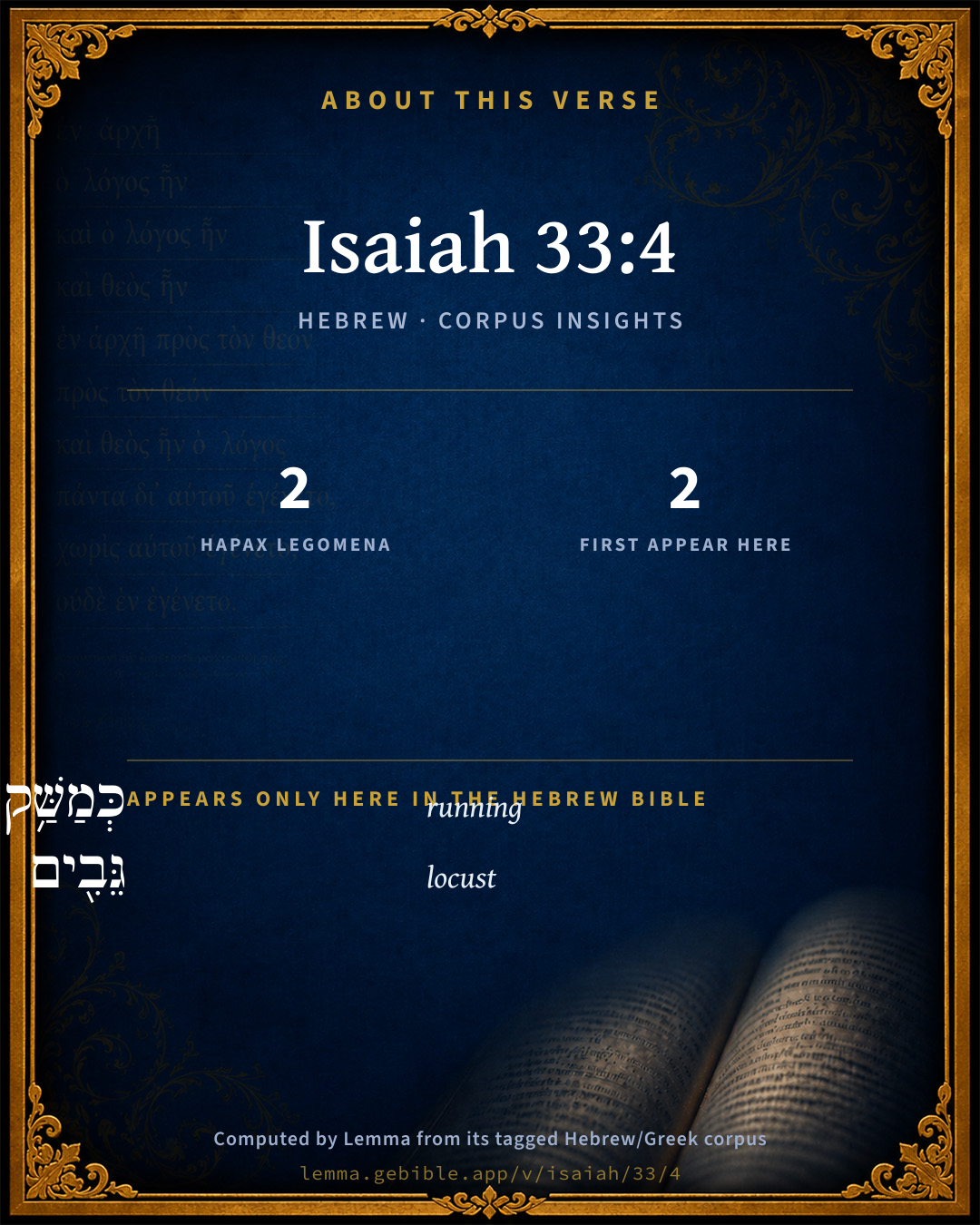
  • 2 hapax legomena — only here in the Hebrew Bible
  • 2 first appearances in the Hebrew Bible
Full analysis ↓
Download a study sheet

One document with this verse’s original text, its word-by-word gloss line, the meaning frame, cross-references with their text, attributed commentary, and full source and license credits — printable, and it pastes into notes with its structure intact.

This verse Autodidact and up

Study sheet (.html) Plain text (.txt)

A passage Seminary Student

Up to 50 verses in one chapter. A passage sheet keeps up to 6 commentary sources and 12 cross-references per verse, in the order this page ranks them, and says so on the sheet whenever that leaves anything out. Ask for a single verse and you get the Autodidact verse sheet above.

Everything on this page stays free to read, with no account — the sheet is a download of what is already on screen, not access to it.

Want to remove ads? Support Godless Engineer
Compare translations 3

The same verse in 3 English versions, stacked beneath the original-language interlinear above. Click any original word for its lexicon entry.

Each is an independent rendering of the whole verse — the interlinear is not word-aligned to these translations.

Highlighted words mark where these versions differ — a whole-verse word diff, not a word-by-word alignment.

  • World English Bible Public Domain
    Your spoil shall be gathered as the caterpillar gathers: as locusts leap shall men leap on it.
  • King James Version Public Domain
    And your spoil shall be gathered like the gathering of the caterpiller: as the running to and fro of locusts shall he run upon them.
  • unfoldingWord Literal Text CC BY-SA 4.0
    And your spoil will be gathered the gathering of the caterpillar; like the rushing of locusts, one is rushing upon it.

unfoldingWord Literal Text — © unfoldingWord, licensed CC BY-SA 4.0. Word-aligned USFM3 via Door43 (git.door43.org/unfoldingWord/en_ult).

Versions to compare (up to 4)

3 of 4 selected

Show all 18 translations

Every available English version of this verse, each an independent rendering of the whole verse.

  • World English Bible Public Domain
    Your spoil shall be gathered as the caterpillar gathers: as locusts leap shall men leap on it.
  • Berean Standard Bible Public Domain
    Your spoil, O nations, is gathered as by locusts; like a swarm of locusts men sweep over it.
  • Majority Standard Bible Public Domain
    Your spoil, O nations, is gathered as by locusts; like a swarm of locusts men sweep over it.
  • King James Version Public Domain
    And your spoil shall be gathered like the gathering of the caterpiller: as the running to and fro of locusts shall he run upon them.
  • American Standard Version (1901) Public Domain
    And your spoil shall be gathered as the caterpillar gathereth: as locusts leap shall men leap upon it.
  • Revised Version (1885) Public Domain
    And your spoil shall be gathered as the caterpiller gathereth: as locusts leap shall they leap upon it.
  • Geneva Bible (1599) Public Domain
    And your spoyle shall be gathered like the gathering of caterpillers: and he shall go against him like the leaping of grashoppers.
  • Douay-Rheims (1899) Public Domain
    And your spoils shall be gathered together as the locusts are gathered, as when the ditches are full of them.
  • Young's Literal Translation Public Domain
    And gathered hath been your spoil, A gathering of the caterpillar, As a running to and fro of locusts is he running on it.
  • Literal Standard Version CC BY-SA 4.0
    And Your spoil has been gathered, || A gathering of the caterpillar, || As a running to and fro of locusts || He is running on it.
  • Unlocked Literal Bible CC BY-SA 4.0
    Your spoil is gathered as the locusts gather; as locusts leap, men leap on it.
  • unfoldingWord Literal Text CC BY-SA 4.0
    And your spoil will be gathered the gathering of the caterpillar; like the rushing of locusts, one is rushing upon it.
  • Darby Bible Public Domain
    And your spoil shall be gathered [like] the gathering of the caterpillar: as the running of locusts shall they run upon it.
  • World Messianic Bible Public Domain
    Your plunder will be gathered as the caterpillar gathers. Men will leap on it as locusts leap.
  • Webster's Bible Public Domain
    And your spoil shall be gathered like the gathering of the caterpillar: as the running to and fro of locusts shall he run upon them.
  • Free Bible Version CC BY-SA 4.0
    You plunder defeated enemy armies like caterpillars eating up plants; like an attack of swarming locusts.
  • Bible in Basic English Public Domain
    And the goods taken in war will be got together like the massing of young locusts; men will be rushing on them like the rushing of locusts.
  • JPS Tanakh (1917) Public Domain
    And your spoil is gathered as the caterpillar gathereth; as locusts leap do they leap upon it.

Literal Standard Version (2020), Covenant Press — licensed CC BY-SA 4.0. Text via the HelloAO Bible API (eBible.org). Unlocked Literal Bible (unfoldingWord) — licensed CC BY-SA 4.0. Text via the HelloAO Bible API (eBible.org). unfoldingWord Literal Text — © unfoldingWord, licensed CC BY-SA 4.0. Word-aligned USFM3 via Door43 (git.door43.org/unfoldingWord/en_ult). Free Bible Version, Dr. Jonathan Gallagher — licensed CC BY-SA 4.0. Text via the HelloAO Bible API (eBible.org).

Word by word

More ways to search: Search by grammar → Find every occurrence → Compare this word →

Practice this passage: Drill this verse → Learn its vocabulary →

About this verse

These counts appear in no published source. They are computed here, from the morphology-tagged text and Lemma’s own curated glosses. What Lemma adds →

8
words
7
distinct lemmas
Prophets
section

Notable vocabulary

2 hapax legomena — words that appear only here in the entire Hebrew Bible:

  • כְּמַשַּׁ֥ק running H4944
  • גֵּבִ֖ים locust H1357

First appearance in Scripture

These words make their first canonical appearance in the Hebrew Bible here:

  • כְּמַשַּׁ֥ק running H4944
  • גֵּבִ֖ים locust H1357

Shared distinctive vocabulary

אֹ֖סֶף harvest H625 occurs in 3 verses of the Hebrew Bible. Also found in:

Grammatical profile

  • 2 verbs
  • 5 nouns
  • 1 preposition

Verb forms

  • וְאֻסַּ֣ף Pual · Sequential Perfect
  • שׁוֹקֵ֥ק Qal · Participle Active

Hebrew & Septuagint length

In English translation the verse runs 17 words from the Hebrew and 23 from the Septuagint (LXX English) — closely comparable.

A rough comparison of the two English renderings, which tokenize alike — not a word-level alignment.

Word counts can differ between the Hebrew and the Greek without any difference in meaning — e.g. the Hebrew direct-object marker אֵת has no separate Greek word, and Greek often adds the article ὁ.

Cross-references

6

Topical passages linked to Isaiah 33:4 in the Treasury of Scripture Knowledge — connected by theme and wording, ordered by reader-vote popularity; previews shown in the World English Bible.

  • 2 Chronicles 14:13 Asa and the people who were with him pursued them to Gerar: and there fell of the Ethiopians so many that they could not recover themselves; for they were destroyed before Yahweh, and before his host; and they carried away very much booty.
  • 2 Chronicles 20:25 When Jehoshaphat and his people came to take the spoil of them, they found among them in abundance both riches and dead bodies, and precious jewels, which they stripped off for themselves, more than they could carry away: and they were three days in taking the spoil, it was so much.
  • Isaiah 33:23 Your rigging is untied; they could not strengthen the foot of their mast, they could not spread the sail: then was the prey of a great spoil divided; the lame took the prey.
  • Joel 2:9 They rush on the city. They run on the wall. They climb up into the houses. They enter in at the windows like thieves.
  • Joel 2:25 I will restore to you the years that the swarming locust has eaten, The great locust, the grasshopper, and the caterpillar, My great army, which I sent among you.
  • 2 Kings 7:15–16 They went after them to the Jordan: and, behold, all the way was full of garments and vessels, which the Syrians had cast away in their haste. The messengers returned, and told the king.

Cross-references courtesy of OpenBible.info (CC BY 4.0).

Hebrew and Greek witnesses Masoretic Hebrew ↔ Greek Septuagint

The same verse in the two great witnesses to the Old Testament, shown verse-for-verse.

These are two independent witnesses, not word-aligned to each other, and the Septuagint is shown in lemma (dictionary) form.

Hebrew Isaiah 33:4 Masoretic · Westminster Leningrad Codex

וְאֻסַּ֣ף שְׁלַלְכֶ֔ם אֹ֖סֶף הֶֽחָסִ֑יל כְּמַשַּׁ֥ק גֵּבִ֖ים שׁוֹקֵ֥ק בּֽוֹ

Your spoil shall be gathered as the caterpillar gathers: as locusts leap shall men leap on it.

World English Bible · Public Domain

Greek LXX Isaiah 33:4 Septuagint · lemma form

νῦν δέ συνἄγω ὁ σκῦλον σύ μικρός καί μέγας ὅς τρόπος ἐάν τις συνἄγω ἀκρίς οὕτως ἐνπαίζω σύ

And now shall the spoils of your small and great be gathered: as if one should gather locusts, so shall they mock you.

LXX2012 (modern English Septuagint) · Public Domain

On this verse, Albert Barnes' Notes on the Bible discusses the Septuagint’s reading. Read the note in Commentary ↓

Hebrew: Westminster Leningrad Codex (CC BY 4.0). Greek: Septuagint (public domain); English from LXX2012 (modern English Septuagint) (Public Domain). How the Septuagint differs from the Hebrew →

Targum (Aramaic paraphrase)

1

The Targum is the ancient Jewish Aramaic paraphrase of the Hebrew Scriptures — an interpretive translation, not the Hebrew text itself. Onkelos (literal) and Pseudo-Jonathan (expansive) render the Torah, and Jonathan the Prophets. Coverage is partial: where no permissively-licensed English translation exists for a verse, only the Aramaic is shown. This is verse-level text, not a word-by-word alignment to the Hebrew.

  1. Targum Jonathan Prophets (Joshua–Malachi)
    וְיִכְנְשׁוּן בֵּית יִשְׂרָאֵל נִכְסֵי עַמְמַיָא סַנְאֵיהוֹן כְּמָא דְכִינְשִׁין יַת זַחְלָא וְאָזַן בְּמָאנֵי זְיָנָא כְּמָא דְאָזָן בְּזִירְקְתָא:

    And the house of Israel shall gather the treasures of the people, their enemies, as they gather the locusts. They shall be armed with the instruments of warfare, as they that are armed with a sling.

    Targum Jonathan — Aramaic: “Mikraot Gedolot” (public domain). English: “Sefaria Community Translation” (CC0 1.0 (public-domain dedication)); “London "Chaldee Paraphrase," 1871” (public domain). Text via Sefaria.

Commentary

Notes on Isaiah 33:4 from classic Christian and Jewish commentators (each source and its license shown beneath its notes). The classic Christian expositions comment on the surrounding passage and are grouped to its opening verse, so a note may address several verses; the Jewish commentaries on the Tanakh (Rashi and others) are per-verse, so they appear only where the commentator wrote on this verse.

Lemma curates 59 commentaries, every one of them public domain or Creative Commons licensed, each selected and text-cleaned for this edition rather than reprinted as found. About our sources →

Trapp's Complete Commentary

John Trapp

Isa 33:4 And your spoil shall be gathered [like] the gathering of the caterpiller: as the running to and fro of locusts shall he run upon them.

Ver. 4. And your spoils shall be gathered.] The spoil of the Assyrian’s camp now become yours. {as 1Sa 30:20}

Like the gathering of caterpillars.] Quae ad hominum concursum omnes repente disperguntur, which are soon rid, when men set themselves to destroy them.

John Trapp, A Commentary or Exposition upon All the Books of the Old and New Testament (1647–1656) — public domain. Text from a community e-Sword module.

Geneva Bible (1599)

Geneva Bible translators

Ye that as caterpillars destroyed with your number the whole world, shall have no strength to resist your enemies the Chaldeans: but shall be gathered on an heap and destroyed.

Meaning, the Medes and Persians against the Chaldeans.

Geneva Bible (1599) marginal notes — public domain. Text via Bolls.life.

Jamieson, Fausset & Brown

Robert Jamieson, A. R. Fausset & David Brown

The invaders' "spoil" shall be left behind by them in their flight, and the Jews shall gather it.

caterpillar--rather, "the wingless locust"; as it gathers; the Hebrew word for "gathers" is properly used of the gathering of the fruits of harvest (Isa 32:10).

running to and fro--namely, in gathering harvest fruits.

he--rather, "they."

them--rather, "it," that is, the prey.

Jamieson, Fausset & Brown — Commentary Critical and Explanatory on the Whole Bible (1871) — public domain (CC PDM 1.0). Text via the HelloAO Bible API.

Ellicott's Commentary for English Readers

(4) Your spoil . . .—The words are addressed to the invader. He who came to spoil should find himself spoiled. As caterpillars and locusts devour the green herbage, so should he (or they, the indefinite pronoun standing for the people of Jerusalem) strip his camp of all its treasures.

A Bible Commentary for English Readers, edited by Charles John Ellicott (1878–1897) — public domain. Text from a community e-Sword module.

The Cambridge Bible for Schools and Colleges

gen. ed. J. J. S. Perowne

4. like the gathering of the caterpillar] i.e. “as the caterpillar gathers.” The last word (meaning “devourer”) is one of many names for the locust. It is sometimes taken as gen. of obj. (“as men gather locusts”), the creature being an article of diet among the poorer classes in the East; but this is opposed to the next clause. On the “running” of the locust, see Joe_2:9, where the same verb is employed. The locusts in the figure represent the Israelites (Isa_33:23).

The Cambridge Bible for Schools and Colleges (gen. ed. J. J. S. Perowne; Cambridge University Press, 1878–1918) — public domain. Text from a community e-Sword module.

John Gill's Exposition

And your spoil shall be gathered like the gathering of the caterpillar,.... This is the answer of the Lord to the prayer of his church, signifying that their enemies should flee, be scattered, and perish, and that they should be victorious, and enjoy the spoils of them; which they should gather as easily as the caterpillar or locust, as some render it, gathers and consumes herbs, and every green thing; or as easily as they are gathered, and laid on heaps, being weak and unable to defend themselves: most understand it of the Jews going into the camp of the Assyrians, after the destruction of them by the angel, and gathering their spoil. The Targum is,

"and the house of Israel shall gather the substance of the people, their enemies, as they gather a locust:''

the antichristian locusts or caterpillars are here meant, whose substance shall fall into the hands of the followers of Christ, when they shall have got the victory of them; this is the flesh of the whore, her worldly substance, which the kings of the earth, the Christian kings, shall eat or enjoy, Rev 17:16,

as the running to and fro of locusts shall he run upon them: or "upon it"; the spoil; as these locusts, of which see Rev 9:3 run to and fro, and pillaged them in times past, as the creatures, to whom they are compared, run to and fro and destroy the fruits of the earth, so now everyone of the followers of Christ shall run and seize upon the spoil of the antichristian states.

John Gill's Exposition of the Whole Bible (1746–1763) — public domain (CC PDM 1.0). Text via the HelloAO Bible API.

Albert Barnes' Notes on the Bible

And your spoil - The booty that the Assyrian army bad gathered in their march toward Jerusalem, and which would now be left by them to be collected by the Jews.

Shall be gathered like the gathering of the caterpillar - The grammatical construction here is such that this may admit of two interpretations. It may either mean, as the caterpillar or the locust is gathered; or it may mean, as the caterpillar gathers its spoil. It often occurred that in countries where the locust was an article of food, they were scraped together in large quantities, and thrown into ditches, or into reservoirs, and retained to be eaten. This is the custom in some parts of Africa. But the meaning here is, undoubtedly, that the plunder of the Assyrian army would be collected by the Jews, as the locust gathered its food. The sense is, that as locusts spread themselves out over a land, as they go to and fro without rule and without molestation, gathering whatever is in their way, and consuming everything, so the Jews in great numbers, and without regular military array, would run to and fro collecting the spoils of the Assyrian army. In a country where such devastation was made by the caterpillar and locust as in Palestine, this was a very striking figure. The word rendered ‘caterpillar’ here חסיל châseyl from חסל châsal to cut off, consume), properly denotes the devourer, and is applied usually to a species of locust. So it is understood here by most of the versions. The Septuagint renders it, ‘As if one were gathering locusts, so will they insult you.’

Albert Barnes' Notes on the Bible (1834–1885) — public domain. Text from a community e-Sword/MySword module.

Haydock's Catholic Bible Commentary

Them. The neglect of burying these insects has often brought on the plague. (St. Augustine, City of God iii. 31.)

George Leo Haydock (1774–1849), Haydock's Catholic Family Bible and Commentary, 1859 edition — public domain. Excludes Psalms (Douay-Rheims chapter numbering differs from Protestant) and Deuterocanonical books (Catholic canon only).

Matthew Poole's English Annotations

Your spoil, that treasure which you have raked together by spoiling divers people,

shall be gathered by the Jews at Jerusalem, when you shall be forced to flee away with all possible speed, leaving your spoils behind you.

Like the gathering of the caterpillar; either,

1. Passively, with as much ease, and in as great numbers, as caterpillars are gathered and destroyed. Or rather,

2. Actively, as appears from the next clause; as caterpillars or locusts (for the word signifies either) gather and devour all the fruits of the earth; which was a common plague in those countries.

As the running to and fro of locusts; as locusts, especially when they are sent and armed by commission from God, come with great force, and run hither and thither, devouring all the fruits of the earth, wheresoever they find them.

Matthew Poole's English Annotations on the Holy Bible (1683–1685) — public domain. Text from a community e-Sword/MySword module.

The Pulpit Commentary

Your spoil shall be gathered. The "spoiling" of Assyria would commence with the discomfiture of the great host. In the historical narrative (2Ki_19:35 Isa_37:36) nothing is said of it; but, beyond a doubt, when the host was to a largo extent destroyed, and the remainder fled, there must have been an enormous booty left behind, which the enemies of the Assyrians would naturally seize. A further spoiling of the fugitives probably followed; and, the prestige of the great king being gone, marauding bands would probably on all sides ravage the Assyrian territory. Like the gathering of the caterpillar. The "caterpillar" (khasil) is probably the grub out of which the locust develops a very destructive insect. Shall he run. It would be better to render, shall they run. The word, indeed, is in the singular; but it is used distributively, of the various spoilers.

The Pulpit Commentary (1880–1919), ed. H.D.M. Spence-Jones & Joseph S. Exell — public domain. Text from a community e-Sword module.

John Wesley's Explanatory Notes

Your spoil - That treasure which you have raked together, by spoiling divers people. Gathered - By the Jews at Jerusalem, when you flee away. Like the caterpillar - As caterpillars gather and devour the fruits of the earth. As locusts - As locusts, especially when they are armed by commission from God, come with great force, and run hither and thither.

John Wesley, Explanatory Notes Upon the Whole Bible (1754–1765) — public domain. Text via the GEBible commentary corpus.

J. A. Alexander on Isaiah

Joseph Addison Alexander

“And your spoil shall be gathered (like) the gathering of the devourer; like the running of locusts running on it.” By another apostrophe, the Prophet here addresses the enemy collectively. The word translated devourer is a descriptive name of the locust. (See the verb in Deu 28:38) As locusts gather, (i.e., greedily and thoroughly, not leaving a tree or a field till they have stripped it). The construction of the last clause is: ‘like the running of locusts (shall one be) running on it (i.e., on the spoil)’. The verb denotes specifically the act of running eagerly or with a view to satisfy the appetite. It is sometimes used to denote desire itself.

Joseph Addison Alexander, The Prophecies of Isaiah (1846–1847; New York: Scribner, 1870–1878) — public domain. Text from a community e-Sword module.

Rashi

Rabbi Shlomo Yitzchaki (Rashi)

And your booty shall be gathered This refers back to “when you finish dealing treacherously, they shall deal treacherously with you,” and your booty, you, who spoil My people, when your reckoning comes, the remnant of My people shall plunder you and gather your booty like the gathering of locusts, each one of whom gathers grain for himself in summer; here too, each one will plunder for himself.

like the roaring of the cisterns Like the sound of the roar of water gathering and falling into the cisterns in the river, so will those coming to plunder and pillage, roar. מַשַּׁק is an expression of roaring. Comp. (Prov. 28:15) “A roaring lion and a growling (שׁוֹקֵק) bear.” Also (Zeph. 2:9), “The noise (מִמְשַׁק) of the thorns.” When the wind blows on the thorns, and they knock against one another, they produce a sound. Comp. also, (Joel 2:9) “In the city they roar (יָשֹׁקּוּ).”

cisterns (גֵּבִים) like (supra 30: 14) “or to scoop water from a cistern (מִגֶּבֶא).” Our Sages expounded it in the Aggadah of Chapter Chelek (San. 94b) as referring to the booty of Sennacherib’s soldiers.

Rashi on the Tanakh — English translations: “The Judaica Press complete Tanach with Rashi, translated by A. J. Rosenberg” (CC BY 4.0); “Pentateuch with Rashi's commentary by M. Rosenbaum and A.M. Silbermann, 1929-1934” (public domain); “The Metsudah Tanach series, Lakewood, N.J” (CC BY 4.0); and “The Book of Joshua, Metsudah Publications, 1997” (CC BY 4.0). Text via Sefaria.

Ibn Ezra

Rabbi Abraham ibn Ezra

Your spoil. Those of you that have become a spoil of the nations; the possessive pronoun your refers to the Israelites, of whom the king of Assyria carried a part away into captivity.

גבים Locusts. Comp. גובא in Chaldee, meaning the same as ארבה locusts in Hebrew.

שוקק Gathering. Some think that משק the steward (Gen. 15:2) is of the same root. I compare it rather with ישתקשקון they gather themselves (Nah. 2:5), which expression is likewise used of locusts.

Ibn Ezra on the Tanakh — English translations: “Sefaria Community Translation” (CC0 1.0 (public-domain dedication)); “Yalkut, Sifsei Chachomim Chumash, Metsudah Publications, 2009” (CC BY 4.0); and “Commentary of Ibn Ezra on Isaiah - trans. by M. Friedlander, 1873” (public domain). Text via Sefaria.

Lesson kit

Teaching starters — assembled from the data on this page, not authored interpretation. Every prompt links to the verse data it draws on. Edit before teaching.

Isaiah, in the Prophets, opens this verse with 8 words (7 distinct Hebrew lemmas). Its most distinctive word is mashshâq (“running”). A historical commentator’s framing appears above. Read the whole chapter for the surrounding context.

Discussion questions

  1. What does “running” (mashshâq) contribute to the verse as a whole?
  2. 2 words here appear nowhere else in the Hebrew Bible. Why might the author reach for such rare wording?
  3. 2 words make their first appearance in Scripture here. What does this debut establish?
  4. How does Isaiah 32:10, which shares the word «harvest», read alongside this verse?
  5. These translations render this verse differently. What is at stake in choosing one wording over another?
  6. «וְאֻסַּ֣ף» is a Pual Sequential Perfect verb. How does that grammatical form shape the action described?
  7. Compare how Trapp's Complete Commentary and Geneva Bible (1599) read this verse. Where do they agree or differ?

Things to notice

  • 2 words in this verse appear nowhere else in the Hebrew Bible.
  • 2 words make their first canonical appearance in Scripture here.
  • These translations choose different wording for 15 words in this verse.
  • 7 distinct Hebrew lemmas span 8 words in this verse.

Reading settings

Reading text

Shown beneath each verse's original-language words.

Old Testament
Old Testament edition

Read the OT as the Masoretic Hebrew (MT) or the Greek Septuagint (LXX).

English shown for the Greek Septuagint (in the Hebrew ↔ Greek comparison).

Comparing translations? Open the Compare panel on any verse page to stack up to four side by side.