
1 Samuel 5:8

Hebrew (Westminster Leningrad Codex) 1 Samuel 5:8 appears in the Hebrew Old Testament. The text above is from the Westminster Leningrad Codex. Each word links to its Strong’s number, a concise gloss, and parsing drawn from the Open Scriptures Hebrew Bible morphology. Click any word for its full Brown-Driver-Briggs (BDB) entry.
Download image
Cite this verse

1 Samuel 5:8 (World English Bible). Public Domain. Lemma interlinear Bible study tool, https://lemma.gebible.app/v/1-samuel/5/8.

Show BibTeX & RIS
BibTeX
RIS
English Translation
They sent therefore and gathered all the lords of the Philistines to them, and said, What shall we do with the ark of the God of Israel? They answered, Let the ark of the God of Israel be carried about to Gath. They carried the ark of the God of Israel [there].
World English Bible · Public Domain
Download a study sheet

One document with this verse’s original text, its word-by-word gloss line, the meaning frame, cross-references with their text, attributed commentary, and full source and license credits — printable, and it pastes into notes with its structure intact.

This verse Autodidact and up

Study sheet (.html) Plain text (.txt)

A passage Seminary Student

Up to 50 verses in one chapter. A passage sheet keeps up to 6 commentary sources and 12 cross-references per verse, in the order this page ranks them, and says so on the sheet whenever that leaves anything out. Ask for a single verse and you get the Autodidact verse sheet above.

Everything on this page stays free to read, with no account — the sheet is a download of what is already on screen, not access to it.

Want to remove ads? Support Godless Engineer
Compare translations 3

The same verse in 3 English versions, stacked beneath the original-language interlinear above. Click any original word for its lexicon entry.

Each is an independent rendering of the whole verse — the interlinear is not word-aligned to these translations.

Highlighted words mark where these versions differ — a whole-verse word diff, not a word-by-word alignment.

  • World English Bible Public Domain
    They sent therefore and gathered all the lords of the Philistines to them, and said, What shall we do with the ark of the God of Israel? They answered, Let the ark of the God of Israel be carried about to Gath. They carried the ark of the God of Israel [there].
  • King James Version Public Domain
    They sent therefore and gathered all the lords of the Philistines unto them, and said, What shall we do with the ark of the God of Israel? And they answered, Let the ark of the God of Israel be carried about unto Gath. And they carried the ark of the God of Israel about thither.
  • unfoldingWord Literal Text CC BY-SA 4.0
    So they sent and gathered all of the lords of the Philistines to them, and they said, “What shall we do with the Box of the God of Israel?” And they said, “Let the Box of the God of Israel go around Gath.” So they brought around the Box of the God of Israel.

unfoldingWord Literal Text — © unfoldingWord, licensed CC BY-SA 4.0. Word-aligned USFM3 via Door43 (git.door43.org/unfoldingWord/en_ult).

Versions to compare (up to 4)

3 of 4 selected

Show all 18 translations

Every available English version of this verse, each an independent rendering of the whole verse.

  • World English Bible Public Domain
    They sent therefore and gathered all the lords of the Philistines to them, and said, What shall we do with the ark of the God of Israel? They answered, Let the ark of the God of Israel be carried about to Gath. They carried the ark of the God of Israel [there].
  • Berean Standard Bible Public Domain
    So they called together all the rulers of the Philistines and asked, “What shall we do with the ark of the God of Israel?” “It must be moved to Gath,” they replied. So they carried away the ark of the God of Israel.
  • Majority Standard Bible Public Domain
    So they called together all the rulers of the Philistines and asked, “What shall we do with the ark of the God of Israel?” “It must be moved to Gath,” they replied. So they carried away the ark of the God of Israel.
  • King James Version Public Domain
    They sent therefore and gathered all the lords of the Philistines unto them, and said, What shall we do with the ark of the God of Israel? And they answered, Let the ark of the God of Israel be carried about unto Gath. And they carried the ark of the God of Israel about thither.
  • American Standard Version (1901) Public Domain
    They sent therefore and gathered all the lords of the Philistines unto them, and said, What shall we do with the ark of the God of Israel? And they answered, Let the ark of the God of Israel be carried about unto Gath. And they carried the ark of the God of Israel `thither'.
  • Revised Version (1885) Public Domain
    They sent therefore and gathered all the lords of the Philistines unto them, and said, What shall we do with the ark of the God of Israel? And they answered, Let the ark of the God of Israel be carried about unto Gath. And they carried the ark of the God of Israel about thither.
  • Geneva Bible (1599) Public Domain
    They sent therefore and gathered all the princes of the Philistims vnto them, and sayde, What shall we doe with the Arke of the God of Israel? And they answered, Let the Arke of the God of Israel be caried about vnto Gath: and they caried the Arke of the God of Israel about.
  • Douay-Rheims (1899) Public Domain
    And sending, they gathered together all the lords of the Philistines to them, and said: What shall we do with the ark of the God of Israel? And the Gethrites answered: Let the ark of the God of Israel be carried about. And they carried the ark of the God of Israel about.
  • Young's Literal Translation Public Domain
    And they send and gather all the princes of the Philistines unto them, and say, `What do we do to the ark of the God of Israel?' and they say, `To Gath let the ark of the God of Israel be brought round;' and they bring round the ark of the God of Israel;
  • Literal Standard Version CC BY-SA 4.0
    And they send and gather all the princes of the Philistines to them, and say, “What do we do to the Ark of the God of Israel?” And they say, “Let the Ark of the God of Israel be brought around to Gath”; and they bring around the Ark of the God of Israel;
  • Unlocked Literal Bible CC BY-SA 4.0
    So they sent for and gathered together all of the rulers of the Philistines; they said to them, “What should we do with the ark of the God of Israel?” They answered, “Let the ark of the God of Israel be brought around to Gath.” So they carried the ark of the God of Israel there.
  • unfoldingWord Literal Text CC BY-SA 4.0
    So they sent and gathered all of the lords of the Philistines to them, and they said, “What shall we do with the Box of the God of Israel?” And they said, “Let the Box of the God of Israel go around Gath.” So they brought around the Box of the God of Israel.
  • Darby Bible Public Domain
    And they sent and gathered all the lords of the Philistines unto them, and said, What shall we do with the ark of the God of Israel? And they said, Let the ark of the God of Israel be carried about to Gath. And they carried the ark of the God of Israel about [thither].
  • World Messianic Bible Public Domain
    They sent therefore and gathered together all the lords of the Philistines, and said, “What shall we do with the ark of the God of Israel?” They answered, “Let the ark of the God of Israel be carried over to Gath.” They carried the ark of the God of Israel there.
  • Webster's Bible Public Domain
    They sent therefore, and gathered all the lords of the Philistines to them, and said, What shall we do with the ark of the God of Israel? And they answered, Let the ark of the God of Israel be carried about to Gath. And they carried the ark of the God of Israel thither.
  • Free Bible Version CC BY-SA 4.0
    So they sent for all the Philistine rulers and asked them, “What should we do with the Ark of the God of Israel?” “Take the Ark of the God of Israel to Gath,” they replied. So they moved it to Gath.
  • Bible in Basic English Public Domain
    So they sent for all the lords of the Philistines to come together there, and said, What are we to do with the ark of the God of Israel? And their answer was, Let the ark of the God of Israel be taken away to Gath. So they took the ark of the God of Israel away.
  • JPS Tanakh (1917) Public Domain
    They sent therefore and gathered all the lords of the Philistines unto them, and said: 'What shall we do with the ark of the God of Israel?' And they answered: 'Let the ark of the God of Israel be carried about unto Gath.' And they carried the ark of the God of Israel about thither.

Literal Standard Version (2020), Covenant Press — licensed CC BY-SA 4.0. Text via the HelloAO Bible API (eBible.org). Unlocked Literal Bible (unfoldingWord) — licensed CC BY-SA 4.0. Text via the HelloAO Bible API (eBible.org). unfoldingWord Literal Text — © unfoldingWord, licensed CC BY-SA 4.0. Word-aligned USFM3 via Door43 (git.door43.org/unfoldingWord/en_ult). Free Bible Version, Dr. Jonathan Gallagher — licensed CC BY-SA 4.0. Text via the HelloAO Bible API (eBible.org).

Word by word

More ways to search: Search by grammar → Find every occurrence → Compare this word →

Practice this passage: Drill this verse → Learn its vocabulary →

סַרְנֵ֨י
çeren
H5633
“lords of”
Noun, Common, Masculine, Plural, Construct
Part of Speech
Noun
Type
Common
Gender
Masculine
Number
Plural
State
Construct
Full BDB Definition

Origin: from an unused root of uncertain meaning

TWOT: 1546 , 1547

lord, ruler, tyrant - axle
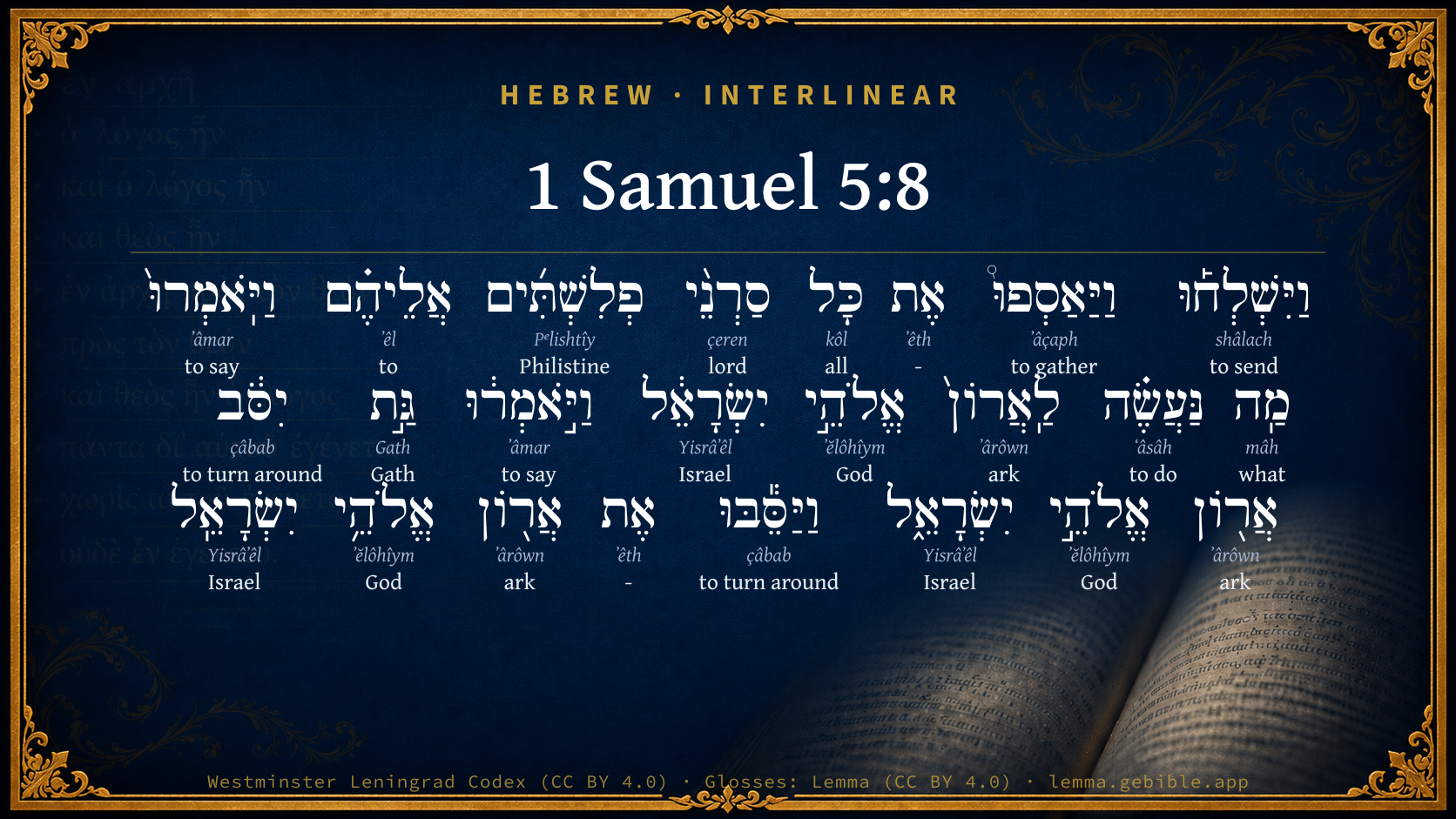
  1. וַיִּשְׁלְח֡וּ shâlach H7971 “and · to send” Conjunction + Verb, Qal, Sequential Imperfect, 3rd Person, Masculine, Plural
  2. וַיַּאַסְפוּ֩ ʼâçaph H622 “and · to gather” Conjunction + Verb, Qal, Sequential Imperfect, 3rd Person, Masculine, Plural
  3. אֶת ʼêth H853 “-” Particle, Direct Object
  4. כָּל kôl H3605 “all of” Noun, Common, Masculine, Singular, Construct
  5. פְלִשְׁתִּ֜ים Pᵉlishtîy H6430 “Philistines” Noun, Gentilic, Masculine, Plural, Absolute
  6. אֲלֵיהֶ֗ם ʼêl H413 “to · them” Preposition + Suffix, Personal, 3rd Person, Masculine, Plural
  7. וַיֹּֽאמְרוּ֙ ʼâmar H559 “and · to say” Conjunction + Verb, Qal, Sequential Imperfect, 3rd Person, Masculine, Plural
  8. מַֽה mâh H4100 “what” Particle, Interrogative
  9. נַּעֲשֶׂ֗ה ʻâsâh H6213 “to do” Verb, Qal, Imperfect, 1st Person, Common, Plural
  10. לַֽאֲרוֹן֙ ʼârôwn H727 “to/for · ark of” Preposition + Noun, Common, Both, Singular, Construct
  11. אֱלֹהֵ֣י ʼĕlôhîym H430 “God(s) of” Noun, Common, Masculine, Plural, Construct
  12. יִשְׂרָאֵ֔ל Yisrâʼêl H3478 “Israel” Noun, Proper
  13. וַיֹּ֣אמְר֔וּ ʼâmar H559 “and · to say” Conjunction + Verb, Qal, Sequential Imperfect, 3rd Person, Masculine, Plural
  14. גַּ֣ת Gath H1661 “Gath” Noun, Proper
  15. יִסֹּ֔ב çâbab H5437 “to turn around” Verb, Qal, Imperfect, 3rd Person, Masculine, Singular
  16. אֲר֖וֹן ʼârôwn H727 “ark of” Noun, Common, Both, Singular, Construct
  17. אֱלֹהֵ֣י ʼĕlôhîym H430 “God(s) of” Noun, Common, Masculine, Plural, Construct
  18. יִשְׂרָאֵ֑ל Yisrâʼêl H3478 “Israel” Noun, Proper
  19. וַיַּסֵּ֕בּוּ çâbab H5437 “and · to turn around” Conjunction + Verb, Hiphil, Sequential Imperfect, 3rd Person, Masculine, Plural
  20. אֶת ʼêth H853 “-” Particle, Direct Object
  21. אֲר֖וֹן ʼârôwn H727 “ark of” Noun, Common, Both, Singular, Construct
  22. אֱלֹהֵ֥י ʼĕlôhîym H430 “God(s) of” Noun, Common, Masculine, Plural, Construct
  23. יִשְׂרָאֵֽל Yisrâʼêl H3478 “Israel” Noun, Proper

About this verse

These counts appear in no published source. They are computed here, from the morphology-tagged text and Lemma’s own curated glosses. What Lemma adds →

24
words
15
distinct lemmas
Historical
section

Notable vocabulary

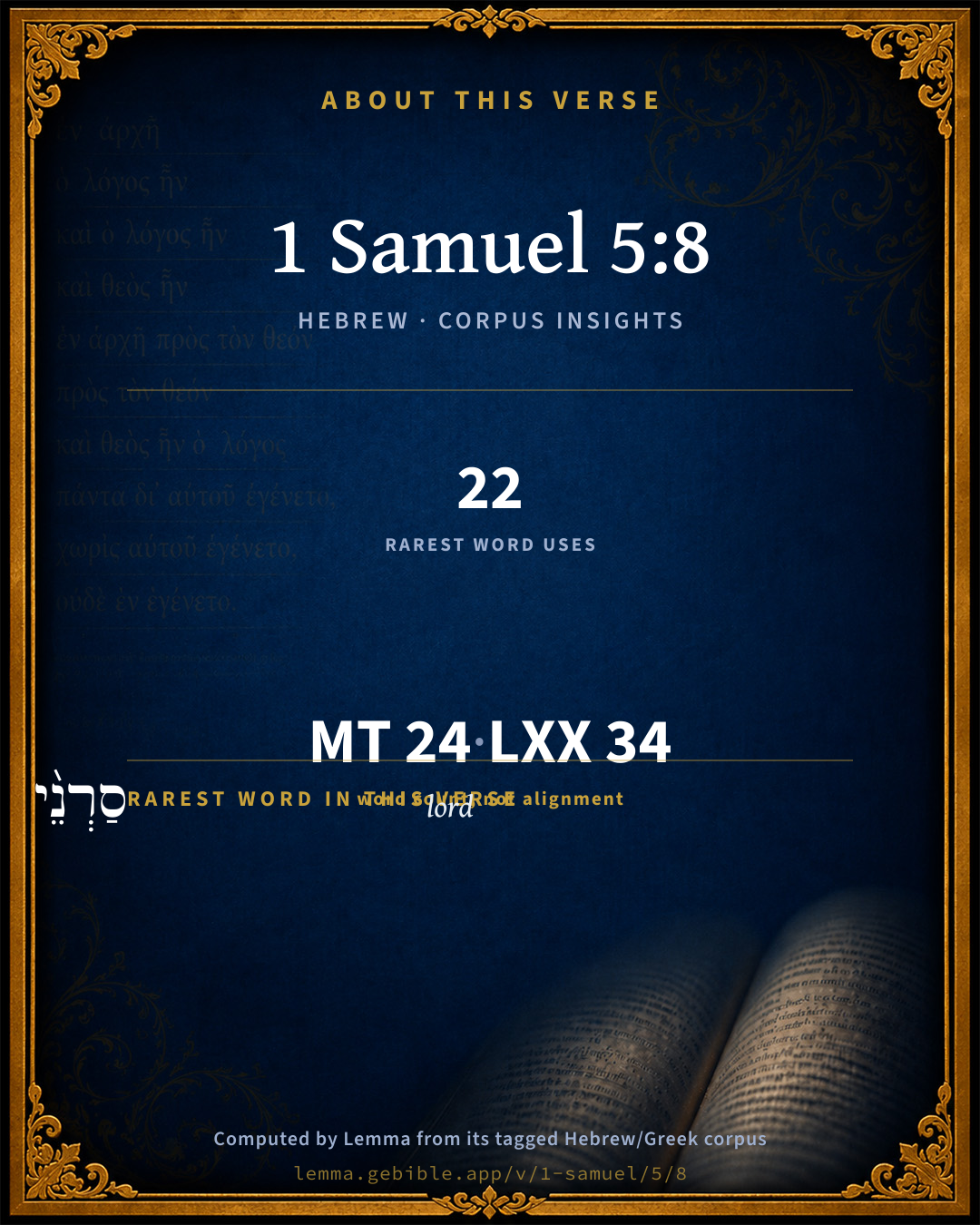
The rarest word here is סַרְנֵ֨י lord H5633 — appearing just 22 times in the whole Hebrew Bible.

Shared distinctive vocabulary

סַרְנֵ֨י lord H5633 occurs in 20 verses of the Hebrew Bible. Also found in:

Grammatical profile

  • 7 verbs
  • 13 nouns
  • 1 preposition
  • 3 particles

Verb forms

  • וַיִּשְׁלְח֡וּ Qal · Sequential Imperfect
  • וַיַּאַסְפוּ֩ Qal · Sequential Imperfect
  • וַיֹּֽאמְרוּ֙ Qal · Sequential Imperfect
  • נַּעֲשֶׂ֗ה Qal · Imperfect
  • וַיֹּ֣אמְר֔וּ Qal · Sequential Imperfect
  • יִסֹּ֔ב Qal · Imperfect
  • וַיַּסֵּ֕בּוּ Hiphil · Sequential Imperfect

Repetition

Words recur within this verse — often emphatic in Hebrew:

  • לַֽאֲרוֹן֙ ark H727 ×3
  • אֱלֹהֵ֣י God H430 ×3
  • יִשְׂרָאֵ֔ל Israel H3478 ×3
  • וַיֹּֽאמְרוּ֙ to say H559 ×2
  • יִסֹּ֔ב to turn around H5437 ×2

Hebrew & Septuagint length

In English translation the verse runs 52 words from the Hebrew and 50 from the Septuagint (LXX English) — closely comparable.

A rough comparison of the two English renderings, which tokenize alike — not a word-level alignment.

Word counts can differ between the Hebrew and the Greek without any difference in meaning — e.g. the Hebrew direct-object marker אֵת has no separate Greek word, and Greek often adds the article ὁ.

In the original languages it is 24 Hebrew tokens and 34 Greek tokens — but the two are counted differently (Hebrew bundles its prefixes and suffixes into one token; the Greek is in lemma form), so that isn’t a like-for-like length.

Cross-references

4

Topical passages linked to 1 Samuel 5:8 in the Treasury of Scripture Knowledge — connected by theme and wording, ordered by reader-vote popularity; previews shown in the World English Bible.

  • 1 Samuel 5:11 They sent therefore and gathered together all the lords of the Philistines, and they said, Send away the ark of the God of Israel, and let it go again to its own place, that it not kill us and our people. For there was a deadly confusion throughout all the city; the hand of God was very heavy there.
  • 1 Samuel 17:4 There went out a champion out of the camp of the Philistines, named Goliath, of Gath, whose height was six cubits and a span.
  • Amos 6:2 Go to Calneh, and see; And from there go to Hamath the great; Then go down to Gath of the Philistines. Are they better than these kingdoms? Or is their border greater than your border?
  • Zechariah 12:3 It will happen in that day, that I will make Jerusalem a burdensome stone for all the peoples. All who burden themselves with it will be severely wounded, and all the nations of the earth will be gathered together against it.

Cross-references courtesy of OpenBible.info (CC BY 4.0).

Hebrew and Greek witnesses Masoretic Hebrew ↔ Greek Septuagint

The same verse in the two great witnesses to the Old Testament, shown verse-for-verse.

These are two independent witnesses, not word-aligned to each other, and the Septuagint is shown in lemma (dictionary) form.

Hebrew 1 Samuel 5:8 Masoretic · Westminster Leningrad Codex

וַיִּשְׁלְח֡וּ וַיַּאַסְפוּ֩ אֶת כָּל סַרְנֵ֨י פְלִשְׁתִּ֜ים אֲלֵיהֶ֗ם וַיֹּֽאמְרוּ֙ מַֽה נַּעֲשֶׂ֗ה לַֽאֲרוֹן֙ אֱלֹהֵ֣י יִשְׂרָאֵ֔ל וַיֹּ֣אמְר֔וּ גַּ֣ת יִסֹּ֔ב אֲר֖וֹן אֱלֹהֵ֣י יִשְׂרָאֵ֑ל וַיַּסֵּ֕בּוּ אֶת אֲר֖וֹן אֱלֹהֵ֥י יִשְׂרָאֵֽל

They sent therefore and gathered all the lords of the Philistines to them, and said, What shall we do with the ark of the God of Israel? They answered, Let the ark of the God of Israel be carried about to Gath. They carried the ark of the God of Israel [there].

World English Bible · Public Domain

Greek LXX 1 Samuel 5:8 Septuagint · lemma form

καί ἀποστέλλω καί συνἄγω ὁ σατράπης ὁ ἀλλόφυλος πρός αὐτός καί λέγω τίς ποιέω κιβωτός θεός ἰσραήλ καί λέγω ὁ γεθθαῖος μεταἔρχομαι κιβωτός ὁ θεός πρός ἐγώ καί μεταἔρχομαι κιβωτός ὁ θεός εἰς γεθθα

And they send and gather the lords of the Philistines to them, and say, What shall we do to the ark of the God of Israel? and the Gittites say, Let the ark of God come over to us; and the ark of the God of Israel came to Geth.

LXX2012 (modern English Septuagint) · Public Domain

On this verse, Adam Clarke's Commentary discusses the Septuagint’s reading. Read the note in Commentary ↓

Hebrew: Westminster Leningrad Codex (CC BY 4.0). Greek: Septuagint (public domain); English from LXX2012 (modern English Septuagint) (Public Domain). How the Septuagint differs from the Hebrew →

Targum (Aramaic paraphrase)

1

The Targum is the ancient Jewish Aramaic paraphrase of the Hebrew Scriptures — an interpretive translation, not the Hebrew text itself. Onkelos (literal) and Pseudo-Jonathan (expansive) render the Torah, and Jonathan the Prophets. Coverage is partial: where no permissively-licensed English translation exists for a verse, only the Aramaic is shown. This is verse-level text, not a word-by-word alignment to the Hebrew.

  1. Targum Jonathan Prophets (Joshua–Malachi)
    וּשְׁלָחוּ וּכְנָשׁוּ יַת כָּל טוּרְנֵי פְּלִשְׁתָּאֵי לְוַתְהוֹן וַאֲמָרוּ מָה נַעְבֵּיד לַאֲרוֹן אֱלָהָא דְיִשְׂרָאֵל וַאֲמָרוּ לְגַת יִסְתַּחַר אֲרוֹן אֱלָהָא דְיִשְׂרָאֵל וְאַסְחָרוּ יַת אֲרוֹן אֱלָהָא דְיִשְׂרָאֵל:

    (no public-domain English translation for this verse)

    Targum Jonathan — Aramaic: “Mikraot Gedolot” (public domain). English: “Sefaria Community Translation” (CC0 1.0 (public-domain dedication)); “London "Chaldee Paraphrase," 1871” (public domain). Text via Sefaria.

Commentary

Notes on 1 Samuel 5:8 from classic Christian and Jewish commentators (each source and its license shown beneath its notes). The classic Christian expositions comment on the surrounding passage and are grouped to its opening verse, so a note may address several verses; the Jewish commentaries on the Tanakh (Rashi and others) are per-verse, so they appear only where the commentator wrote on this verse.

Lemma curates 59 commentaries, every one of them public domain or Creative Commons licensed, each selected and text-cleaned for this edition rather than reprinted as found. About our sources →

Trapp's Complete Commentary

John Trapp

1Sa 5:8 They sent therefore and gathered all the lords of the Philistines unto them, and said, What shall we do with the ark of the God of Israel? And they answered, Let the ark of the God of Israel be carried about unto Gath. And they carried the ark of the God of Israel about [thither].

Ver. 8. What shall we do with the ark of the God of Israel?] Vexation should have given them understanding: and they should have consulted in this case with the priests and people of God, who could best have directed them what to do: but this they were farthest from. Afflictions, God’s hammers, without the Holy Ghost and his fire, do but beat upon cold iron.

Let the ark of the God of Israel be carried about.] It was so, by a providence, through all the five cities of the Philistines, Veluti tributum per singulas poenam violatae religionis exigens, {a} thus exacting the tribute of just punishment upon them all, for religion violated.

{a} Joseph., lib. vi. cap. 1.

John Trapp, A Commentary or Exposition upon All the Books of the Old and New Testament (1647–1656) — public domain. Text from a community e-Sword module.

The Biblical Illustrator

Joseph S. Exell

1Sa_5:8

What shall we do with the ark of the God of Israel.

The ark of God

It often happens that when a person has at last obtained that which he most desired he does not know what to do with it. This may be said of money after a life of economy and strict attention to business; of repose after a life of toil; and of many other aims and objects in life. Now in the passage quoted you find the Philistines in a similar difficulty: they had obtained possession of that which they considered the greatest prize of warfare. It was a mighty spoil; it caused no little joy to the Philistines; but his loss was a terrible and crushing blow to Israel. The ark had changed hands. The Philistines had now in their custody the Ark of God. It was a sore trouble to them. That material construction is now long ago broken up and destroyed: the wood and gold have perished; but the Divine Presence still lives on. The Church preserves her identity under all adverse circumstances: the Ark remained the same sacred witness to Gods Truth wherever carried. (2Co_2:15-16.) It is wonderful to notice how Gods Spirit forces this fact upon the world. The world is compelled to recognise the presence of religion, however it may recoil from the claims of religion. The history of the world ever since the Christian era commenced is a proof of this: what would become of any record of the first three centuries which failed to take account of the religious element? The history of the Roman Empire at that time is, in fact, the history of the Church. History tells you how Christianity springing up in the Roman provinces perplexed the authorities; how at last it spread; how outbreaks of persecution only tended to strengthen and deepen its roots; but yet all proves how the world had begun to ask this question as to the religion of the day: What shall we do with the Ark of God? Then, again: how much more attentively the action of the Church is now watched by the public, than used to be the case formerly. Whatever it be which relates to religion, there is the same watchfulness from without. Again and again the world enquires, at moments the most trivial, at social parties, at merry meetings, just for the sake of saying something, or to start a subject, What shall we do with the Ark of God? And see only how religion is employed to puff literature. Some periodical or magazine is started: it will not sell unless there be an element of religion in it. It is only one other instance of the editor eyeing religion, considering what he can get out of the religious element which will find him readers: he only says, What shall we do with the Ark of God? And further. Consider the prejudices of the present day. Mark the obvious success of attempts which at first were regarded cynically or coldly. The world has been convinced that Church principles cannot easily be laughed out of court, and that conscientious convictions are worthy of respect; that blameless lives conduce to the welfare of society. So gradually the world tempers its opposition; it wishes to moderate religious enthusiasm; it desires to reduce the Church to its own level; it would like to enjoy all successes which the Church achieves in fashioning well-ordered citizens; but at the same time the world would tie down the action of the Church to the limits of the popular will. What shall we do to these men? For that a notable miracle hath been done by them is manifest to all those that dwell in Jerusalem. What shall we do with the Ark of God? But with regard to your own relation to holy things; does not this perplexity of the Philistines find an answer in your own hearts? You have lived many years with the light of truth burning brightly before you, God has cast your lot in a Christian land, not in a land of idols. God has blessed you with a religious home, with serious parents. How have you regarded holy things? Have not you sometimes felt them irksome? as if you did not quite know what to do with religion; as if the things of God stood in your way; as if they shackled you; as if they dwarfed the development of your life, and paralysed somewhat the hopes of your career? And yet you did not like to send the Ark away; you would not give up religion; you recognised its value too highly; you were afraid to east off God and to disown Him; yet a secret wish sprang up that you had never known so much of truth; you almost deemed the heathen happy, because you fancied that he could have no embarrassing scruples. What were you to do with the Ark of God! It so often came across your path; every now and then disputing the way; telling you that you must not do this or that. At such moments did not religion seem unwelcome? somewhat as an intruder? For thus it is that religious scruples do harass men when they least like it. Gods mercy sends the Angel to bar the way: and such is Gods love, the Angel moves further and further into narrow places, where there is no way to turn either to the right hand or to the left; narrow places where the choice more directly confronts the sinner; where he may see more evidently the blackness of sin in contrast with the pure white light of holiness. There is nothing more contemptible, or more miserable, than shifting about between two opinions. The Philistines were never more wretched than when they were employed in passing on the Ark from one city to another. Shame and disease marked that period of seven months indecision. It was far better when they sent the Ark back to its rightful owners. At least it was a decided step; there was no halting between two opinions if you want to insult God, then, use religion as a tool for your own convenience and not as a principle of life. The sin of the world has lain chiefly in this prostitution of religion. It has proved the curse and downfall of nations; the deterioration and ruin of man. Heathen ignorance is better than Christian indifference; depend upon it, nothing is so prolific of infidelity as indecision. Balaam tampering with the commands of God; Ahab sending for, but not obeying, Micaiah; Herod hearing John gladly, but persisting in his adultery; Judas following Jesus, but selling Him for silver; Demas beginning well, but falling away to self-indulgence; these are the emissaries which the devil employs to deceive mankind. Rather learn by Gods grace to regard religion and truths claims not as a moral intrusion, but as affording a principle on which to rule your life. Religion is not a subject to be handled at our will; it is not just now and then to serve our turn, and then to be laid aside for some possible future use; but it is a principle to enter into all our ways. (C. A. Raymond, M. A.)

The Biblical Illustrator, edited by Joseph S. Exell (c. 1880s–1900s) — public domain. Text from a community e-Sword module.

Tyndale Open Study Notes

Tyndale Open Resources

5:8 rulers (or overlords): Each of the five major Philistine cities had its own ruler (6:16-18). • Move it: Despite the obvious danger, the Philistines relished their captured trophy enough to relocate it rather than return it. • Gath, one of the five major Philistine cities, was nearby.

Tyndale Open Study Notes — © Tyndale Open Resources, licensed CC BY-SA 4.0. Text via the HelloAO Bible API.

Geneva Bible (1599)

Geneva Bible translators

Though they had felt God’s power, and were afraid thereof, yet they would further try him, which thing God turned to their destruction and his glory.

Geneva Bible (1599) marginal notes — public domain. Text via Bolls.life.

Adam Clarke's Commentary

Verse 8. The lords of the Philistines] The word סרני sarney, which we translate lords, is rendered by the Chaldee טורני tureney, tyrants. The Syriac is the same. By the Vulgate and Septuagint, satrapae, satraps. Palestine was divided into five satrapies: Ashdod, Ekron, Askelon, Gath, and Gaza. See Jos 13:8. But these were all federates and acted under one general government, for which they assembled in council.

Let the ark - be carried about] They probably thought that their affliction rose from some natural cause; and therefore they wished the ark to be carried about from place to place, to see what the effects might be. If they found the same evil produced wherever it came, then they must conclude that it was a judgment from the God of Israel.

Adam Clarke's Commentary on the Bible (1810–1826) — public domain. Text from a community e-Sword/MySword module.

Ellicott's Commentary for English Readers

(8) Gathered all the lords of the Philistines unto them.—The Philistine federation seems to have been a very powerful one, and owing to the disinclination of the Israelites to maritime pursuits and foreign commerce—[the foreign commercial expeditions of King Solomon were apparently quite exceptional]—held in their hands a large proportion of the Mediterranean trade—the Mediterranean being the great highway between Eastern and Western nations; hence, no doubt, the worship of Dagon, the fish-god. It seems to have been something more than mere “Nature worship,” the devotion of the Phœnician settlers on the sea-board of Syria and Canaan to a marine deity. The constitution of Philistia was oligarchical: that is, the government was in the hands of a College of Princes, whose decision no individual could oppose. The princes (seranim) are the heads of the several city districts, which formed a confederation, each one of the five chief cities holding a number of places, country cities, or “daughter” cities, as its special district. (See Erdmann in Lange’s Commentary.) Dr. Payne Smith (Dean of Canterbury) has an ingenious and scholarly derivation for the titular designation of these lords (Hebrew, seranim), in which, rejecting the usual root sar, a prince, he connects the word with seren, a hinge; “just,” he says, “as the cardinals of the Church of Rome take their name from cardo, which has the same meaning.”

A Bible Commentary for English Readers, edited by Charles John Ellicott (1878–1897) — public domain. Text from a community e-Sword module.

The Cambridge Bible for Schools and Colleges

gen. ed. J. J. S. Perowne

8. all the lords of the Philistines] A peculiar term Seren is used exclusively to denote the five ‘lords’ who ruled in the five cities of the Philistine confederacy. In all probability it preserves their native title. They had all equal rights, for though Achish is called “king of Gath” in ch. 1Sa_21:10, 1Sa_27:2, this is only from a foreign point of view, and he could not overrule the decision of his colleagues (1Sa_29:6-11). Here we find one city appealing to the rest for counsel in the calamity which had befallen it.

unto Gath] Gath may have been chosen because there was no Dagon-temple there, the Philistines attributing the plague to the antagonism between Jehovah and Dagon.

The site of Gath cannot be fixed with certainty, but Mr Porter and Lieut. Conder agree in the conclusion that it probably stood on the conspicuous hill now called Tell-es-Sâfi, 12 miles E. of Ashdod, at the foot of the mountains of Judah. “The position is one of immense strength, guarding the mouth of the valley of Elah.” Hence its importance as a border fortress, commanding one of the main approaches from Philistia to Judaea. It was captured by David (1Ch_18:1), fortified by Rehoboam (2Ch_11:8), taken by Hazael (2Ki_12:17), retaken and dismantled by Uzziah (2Ch_26:6). There is no further notice of it in the Bible: but the Crusaders occupied Tell-es-Sâfi, and built the fortress of Blanche Garde upon it.

Gath was the native place of Goliath (ch. 1Sa_17:4): and the refuge of David from the persecutions of Saul (ch. 1Sa_21:10, 1Sa_27:3).

The Cambridge Bible for Schools and Colleges (gen. ed. J. J. S. Perowne; Cambridge University Press, 1878–1918) — public domain. Text from a community e-Sword module.

John Gill's Exposition

They sent therefore and gathered all the lords of the Philistines unto them,.... The other four lords, for there were five with this; see Jos 13:3,

and said, what shall we do with the ark of the God of Israel? they no doubt told them what they and their idol had suffered on account of it, and the resolution they were come to that it should be no longer with them; and therefore desire to know what must be done with it, whether they should return it to the people of Israel, or dispose of it somewhere else; it is probable some might be for the former, but the greater part were not, and were for keeping it in their possession somewhere or another:

and they answered, let the ark of the God of Israel be carried about unto Gath; which was another of the five principalities of the Philistines, and not far from Ashdod; according to Jerom (x), it is included in the remnant of Ashdod, Jer 25:20 and according to Bunting (y) but four miles from it. The Septuagint and Vulgate Latin versions make this to be the answer of the men of Gath, the one reading it,"and they of Gath said, let the ark of God come to us;''and the other,"they of Gath answered, let the ark of the God of Israel be carried about;''for they suspected, as Procopius Gazaeus observes, that the destruction did not come from God, but was a disease arising from some pestilential cause. They perhaps imagined it was in the air in and about Ashdod, or that though the situation of the ark was not liked, in another place it might be otherwise, and more agreeable:

and they carried the ark of the God of Israel about thither; they seem not to carry it directly to the place, but carried it in a round about way, as if they had a mind to give it an airing, before they fixed it any where.

(x) Comment. in Hierem. c. 25. fol. 151. B. (y) Travels of the Patriarchs, &c. p. 123.

John Gill's Exposition of the Whole Bible (1746–1763) — public domain (CC PDM 1.0). Text via the HelloAO Bible API.

Albert Barnes' Notes on the Bible

The “lords” (see Jdg 3:3) were very unwilling to give up their triumph, and, with the common pagan superstition, imagined that some local bad luck was against them at Ashdod. The result was to bring the whole Philistine community under the same calamity.

Albert Barnes' Notes on the Bible (1834–1885) — public domain. Text from a community e-Sword/MySword module.

Haydock's Catholic Bible Commentary

Lords, next in dignity to a king, like the Persian surena, Judges iii. 3., and xvi. 5. --- About. Hebrew, "and they answered, let the ark....be carried unto Geth," in which sense the Septuagint seem to have taken it. But the Vulgate is more natural. Theodoret (q. 10,) concludes, that the people imagined the mortality proceeded from some natural cause; (Calmet) otherwise it would have been very absurd to give such advice, as the ark would spread the contagion throughout the country, by being removed. From Geth it was sent to Accaron, when the magistrates of the city objected to its being admitted, ver. 10. Jospehus says, however, that it visited all the five principal cities, as if to punish them for their impiety. (Haydock)

George Leo Haydock (1774–1849), Haydock's Catholic Family Bible and Commentary, 1859 edition — public domain. Excludes Psalms (Douay-Rheims chapter numbering differs from Protestant) and Deuterocanonical books (Catholic canon only).

Matthew Poole's English Annotations

Supposing that this plague was confined to Ashdod for some particular reasons, or that it came upon them by chance, or from some bad influence of the air, or of the stars, or for putting it into Dagon’s temple, which they resolved they would not do.

Matthew Poole's English Annotations on the Holy Bible (1683–1685) — public domain. Text from a community e-Sword/MySword module.

Whedon's Commentary on the Bible

Daniel D. Whedon

8. They sent — Feeling now that, though they had vanquished the Israelites, they could not endure the severe hand of their God, the lords of the Philistines come together in solemn convocation, and the great question before them is:

What shall we do with the ark of the God of Israel — Their prize has become a sore burden on their hands, and they know not how to dispose of it. At length they decide:

Let the ark… be carried about unto Gath — They seem to have imagined that the difficulty might have arisen from some local cause, and that a change of place might disarm the ark of its power. The site of Gath has long remained unknown. In 1857 Revelation J.L. Porter explored Philistia in special search of it, and supposes he has identified it with Tell-es-Safieh, which is situated ten miles east of Ashdod, and nearly the same distance south of Ekron.

Daniel D. Whedon (gen. ed.), Commentary on the Old and New Testaments (1874–1909) — public domain. Text from a community e-Sword module.

The Pulpit Commentary

The lords of the Philistines. Philistia was governed by a council of five princes, but whether they were elective or hereditary in the several towns is by no means clear. They are called "seranim," from seren, "a hinge," just as the cardinals of the Church of Rome take their name from the Latin word cardo, which has the same meaning. There is no ground for connecting the word with sar, "a prince." When Ewald did so he probably forgot that the two words begin with different letters seren with samech, and sar with shin. Seranim is the word constantly used of the lords of the Philistines (Jos_13:3; Jud_1:3:3 16:5, 8, etc.; 1Ch_12:9) though after being correctly so styled in 1Sa_29:2, they are popularly called in vers. 3, 4, 9, sarim, "princes." Let the ark of the God of Israel be carried about unto Gath. Unwilling to part with so signal a proof of their victory, the lords of the Philistines determine to remove the ark to another locality, but thereby only made the miraculous nature of what was taking place more evident to all. Of Gath but little is known; but Jerome describes it as still a large village in his days, and as situated near the border of Judaea, on the road from Eleutheropolis to Gaza.

The Pulpit Commentary (1880–1919), ed. H.D.M. Spence-Jones & Joseph S. Exell — public domain. Text from a community e-Sword module.

John Wesley's Explanatory Notes

To Gath - Supposing that this plague was confined to Ashdod for some particular reasons, or that it came upon them by chance, or for putting it into Dagon's temple, which they resolved they would not do.

John Wesley, Explanatory Notes Upon the Whole Bible (1754–1765) — public domain. Text via the GEBible commentary corpus.

Kretzmann's Popular Commentary

Paul E. Kretzmann

The Ark in Gath and Ekron

v. 8. They sent, therefore, and gathered all the lords of the Philistines, the heads of their five city-states, unto them and said, What shall we do with the ark of the God of Israel? As eager as they were to have the ark in their city as a trophy of their great victory, so eager were they now to get rid of the unlucky piece of furniture. And they answered, Let the ark of the God of Israel be carried about unto Gath. The princes of the Philistines intended to make an experiment, in order to determine whether the misfortunes which struck Ashdod were really to be attributed to the ark or were the result of chance. And they carried the ark of the God of Israel about thither, farther to the east.

v. 9. And it was so that, after they had carried it about, caused it to be taken in the indicated direction, to this second city, the hand of the Lord was against the city with a very great destruction, disquietude, consternation taking hold upon all the inhabitants, a feeling of impending disaster; and He smote the men of the city, both small and great, and they had emerods in their secret parts, they were plagued with the same eruption of boils as the people of Ashdod had been, and the boils apparently broke open, causing painful ulcers.

v. 10. Therefore they sent the ark of God to Ekron, the chief city in the northwestern part of the Philistine country. And it came to pass, as the ark of God came to Ekron, by the command of the Philistine chiefs, that the Ekronites cried out, for they had been informed of the plague which had struck Ashdod and Gath, saying, They have brought about the ark of the God of Israel to us to slay us and our people. But their protest was ignored, and the ark was brought into their city.

v. 11. So they sent and gathered together all the lords of the Philistines, for a second conference, and said, Send away the ark of the God of Israel, and let it go again to his own place, that it slay us not and our people. The plague was not only generally prevalent, but also especially malignant, the effects being exceptionally deadly; for there was a deadly destruction, a consternation of terror on account of the sudden death of so many people, throughout all the city; the hand of God was very heavy there, the severity of the plague here reached its greatest height.

v. 12. And the men that died not were smitten with the emerods, being extremely ill with the boil-sickness; and the cry of the city went up to heaven, for the Philistines were forced to acknowledge that in this place the almighty hand of the God of Israel was revealed. Thus the Lord revenged the sacrilege of the heathen in laying their hands upon the ark consecrated to Him. When unbelievers presume to attack the Word of God, to blaspheme and persecute the Word of Salvation, and, in addition, refuse to bow under the chastening hand of God, He often visits them with very severe plagues and terrors.

Paul E. Kretzmann, Popular Commentary of the Bible (1921–1924) — public domain. Text from a community e-Sword module.

unfoldingWord translationNotes

Door43 World Missions Community

Yahweh's hand was against

This is an idiom. AT: "Yahweh punished" (See: Idiom)

both small and great

Possible meanings are 1) this is a merism that refers to age. AT: "men of all ages" or 2) this is a merism that refers social class. AT: "from the poorest and weakest men to the richest and most powerful men" (See: Merism)

tumors

Possible meanings are 1) painful swelling under the skin or 2) hemorrhoids. See how you translated this in 1 Samuel 5:6

translationWords

rule

Philistines

Gath

unfoldingWord translationNotes — © Distant Shores Media and the Door43 World Missions Community, licensed CC BY-SA 4.0. Source: git.door43.org/Door43/en_tn.

Lesson kit

Teaching starters — assembled from the data on this page, not authored interpretation. Every prompt links to the verse data it draws on. Edit before teaching.

1 Samuel, in the Historical, opens this verse with 24 words (15 distinct Hebrew lemmas). Its most distinctive word is çeren (“lord”). A historical commentator’s framing appears above. Read the whole chapter for the surrounding context.

Discussion questions

  1. How does “lord” (çeren) shape what this verse is saying?
  2. How does Joshua 13:3, which shares the word «lord», read alongside this verse?
  3. What does the repetition of “ark” (3× in this one verse) do in this verse?
  4. These translations render this verse differently; the difference is in the English rendering, not the original. What questions does that raise?
  5. «וַיִּשְׁלְח֡וּ» is a Qal Sequential Imperfect verb. How does that grammatical form shape the action described?
  6. Compare how Trapp's Complete Commentary and The Biblical Illustrator read this verse. Where do they agree or differ?

Things to notice

Reading settings

Reading text

Shown beneath each verse's original-language words.

Old Testament
Old Testament edition

Read the OT as the Masoretic Hebrew (MT) or the Greek Septuagint (LXX).

English shown for the Greek Septuagint (in the Hebrew ↔ Greek comparison).

Comparing translations? Open the Compare panel on any verse page to stack up to four side by side.