
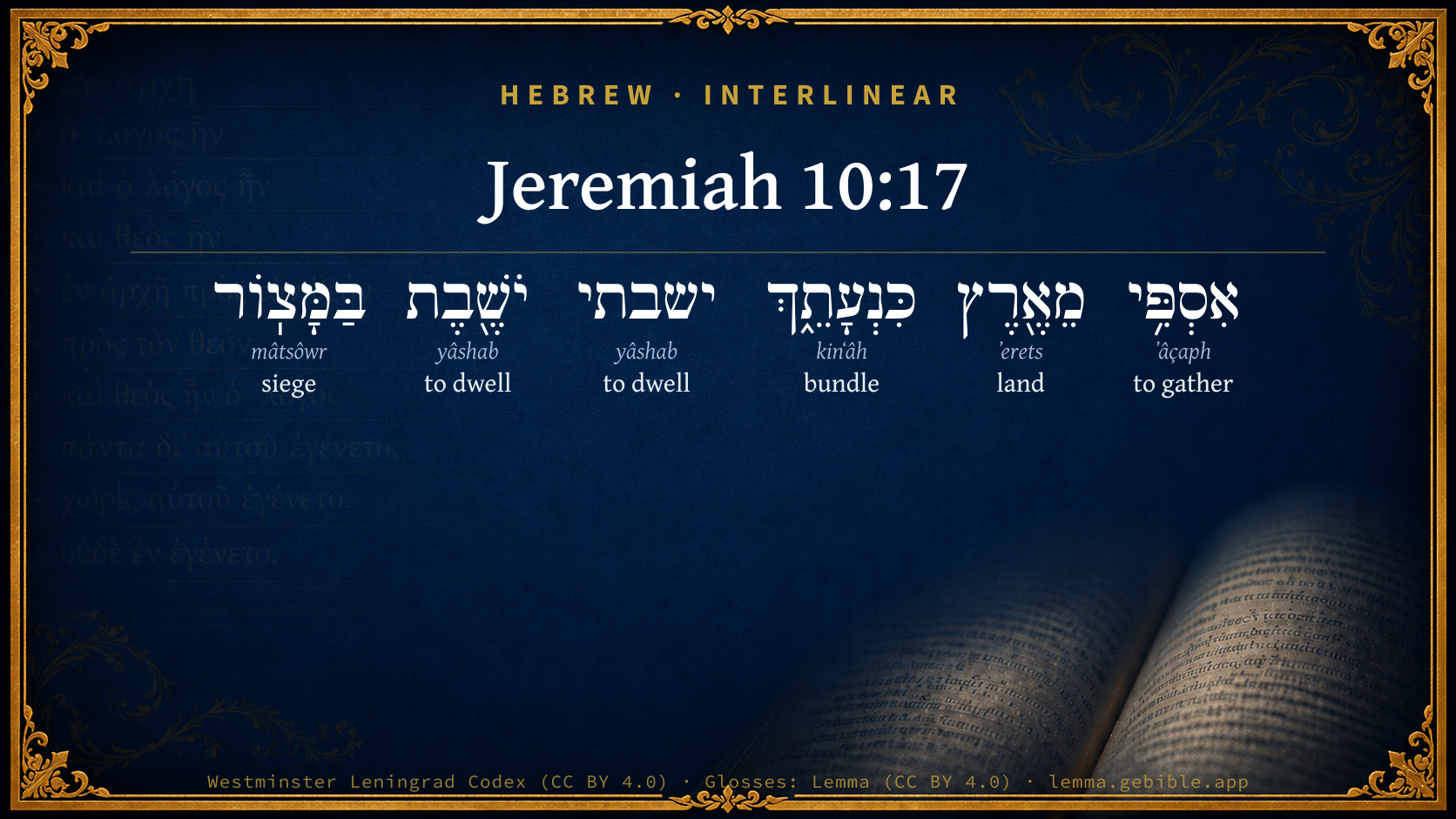
Jeremiah 10:17

Hebrew (Westminster Leningrad Codex) Jeremiah 10:17 appears in the Hebrew Old Testament. The text above is from the Westminster Leningrad Codex. Each word links to its Strong’s number, a concise gloss, and parsing drawn from the Open Scriptures Hebrew Bible morphology. Click any word for its full Brown-Driver-Briggs (BDB) entry.
Download image
Cite this verse

Jeremiah 10:17 (World English Bible). Public Domain. Lemma interlinear Bible study tool, https://lemma.gebible.app/v/jeremiah/10/17.

Show BibTeX & RIS
BibTeX
RIS
English Translation
Gather up your wares out of the land, you who abide in the siege.
World English Bible · Public Domain
Highlights
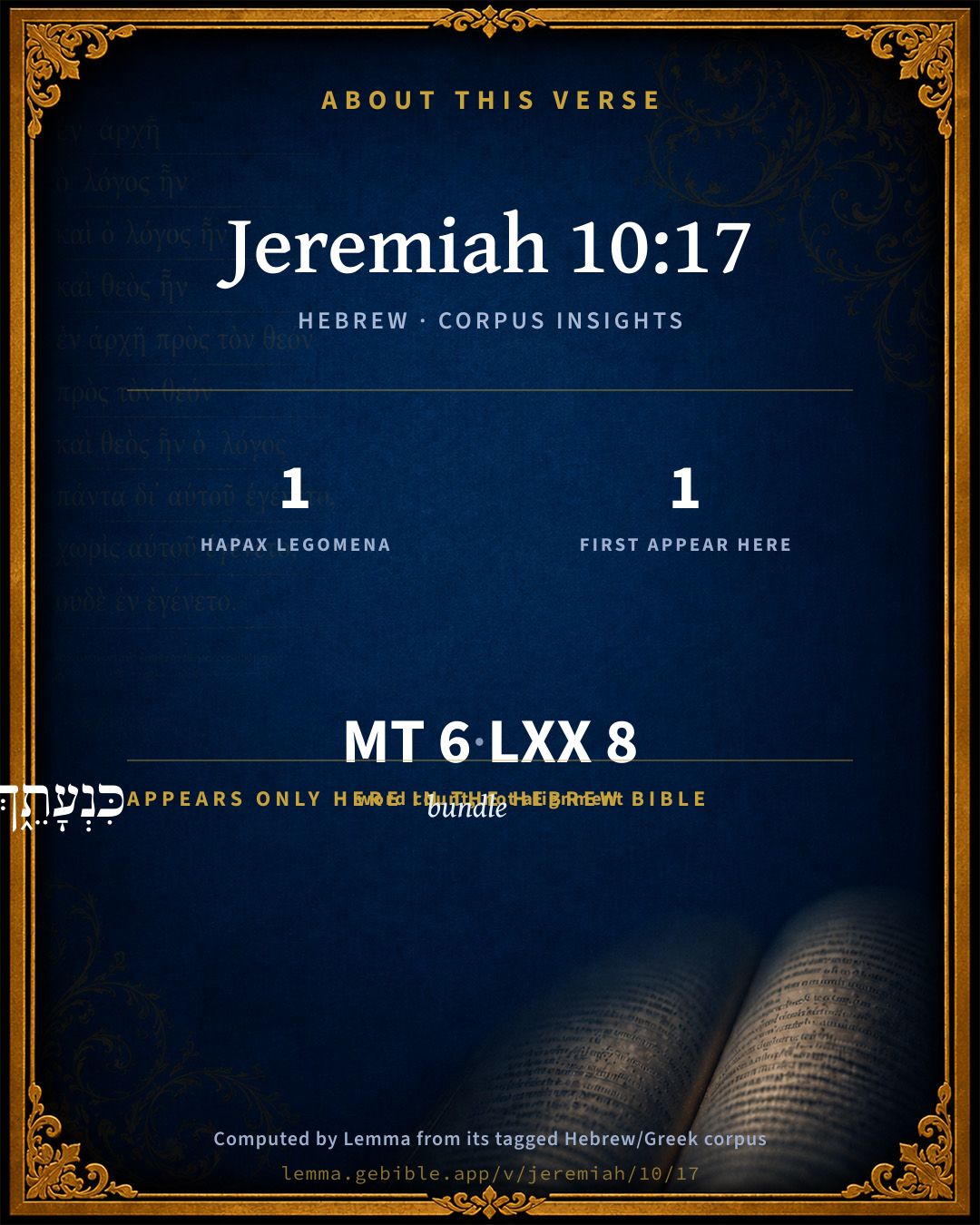
  • 1 hapax legomenon — only here in the Hebrew Bible
  • 1 first appearance in the Hebrew Bible
Full analysis ↓
Download a study sheet

One document with this verse’s original text, its word-by-word gloss line, the meaning frame, cross-references with their text, attributed commentary, and full source and license credits — printable, and it pastes into notes with its structure intact.

This verse Autodidact and up

Study sheet (.html) Plain text (.txt)

A passage Seminary Student

Up to 50 verses in one chapter. A passage sheet keeps up to 6 commentary sources and 12 cross-references per verse, in the order this page ranks them, and says so on the sheet whenever that leaves anything out. Ask for a single verse and you get the Autodidact verse sheet above.

Everything on this page stays free to read, with no account — the sheet is a download of what is already on screen, not access to it.

Want to remove ads? Support Godless Engineer
Compare translations 3

The same verse in 3 English versions, stacked beneath the original-language interlinear above. Click any original word for its lexicon entry.

Each is an independent rendering of the whole verse — the interlinear is not word-aligned to these translations.

Highlighted words mark where these versions differ — a whole-verse word diff, not a word-by-word alignment.

  • World English Bible Public Domain
    Gather up your wares out of the land, you who abide in the siege.
  • King James Version Public Domain
    Gather up thy wares out of the land, O inhabitant of the fortress.
  • unfoldingWord Literal Text CC BY-SA 4.0
    Gather from the land your bundle, you one who dwells in the seige.

unfoldingWord Literal Text — © unfoldingWord, licensed CC BY-SA 4.0. Word-aligned USFM3 via Door43 (git.door43.org/unfoldingWord/en_ult).

Versions to compare (up to 4)

3 of 4 selected

Show all 18 translations

Every available English version of this verse, each an independent rendering of the whole verse.

  • World English Bible Public Domain
    Gather up your wares out of the land, you who abide in the siege.
  • Berean Standard Bible Public Domain
    Gather up your belongings from this land, you who live under siege.
  • Majority Standard Bible Public Domain
    Gather up your belongings from this land, you who live under siege.
  • King James Version Public Domain
    Gather up thy wares out of the land, O inhabitant of the fortress.
  • American Standard Version (1901) Public Domain
    Gather up thy wares out of the land, O thou that abidest in the siege.
  • Revised Version (1885) Public Domain
    Gather up thy wares out of the land, O thou that abidest in the siege.
  • Geneva Bible (1599) Public Domain
    Gather vp thy wares out of the land, O thou that dwellest in the strong place.
  • Douay-Rheims (1899) Public Domain
    Gather up thy shame out of the land, thou that dwellest in a siege.
  • Young's Literal Translation Public Domain
    Gather from the land thy merchandise, O dweller in the bulwark,
  • Literal Standard Version CC BY-SA 4.0
    Gather your merchandise from the land, || O dweller in the bulwark,
  • Unlocked Literal Bible CC BY-SA 4.0
    Gather your bundle and leave the land, you people who have been living under the siege.
  • unfoldingWord Literal Text CC BY-SA 4.0
    Gather from the land your bundle, you one who dwells in the seige.
  • Darby Bible Public Domain
    Gather up thy baggage out of the land, O inhabitress of the fortress.
  • World Messianic Bible Public Domain
    Gather up your wares out of the land, you who live under siege.
  • Webster's Bible Public Domain
    Gather up thy wares out of the land, O inhabitant of the fortress.
  • Free Bible Version CC BY-SA 4.0
    You people living in Jerusalem under siege, get all your things together ready to leave,
  • Bible in Basic English Public Domain
    Get your goods together and go out of the land, O you who are shut up in the walled town.
  • JPS Tanakh (1917) Public Domain
    Gather up thy wares from the ground, O thou that abidest in the siege.

Literal Standard Version (2020), Covenant Press — licensed CC BY-SA 4.0. Text via the HelloAO Bible API (eBible.org). Unlocked Literal Bible (unfoldingWord) — licensed CC BY-SA 4.0. Text via the HelloAO Bible API (eBible.org). unfoldingWord Literal Text — © unfoldingWord, licensed CC BY-SA 4.0. Word-aligned USFM3 via Door43 (git.door43.org/unfoldingWord/en_ult). Free Bible Version, Dr. Jonathan Gallagher — licensed CC BY-SA 4.0. Text via the HelloAO Bible API (eBible.org).

Word by word

More ways to search: Search by grammar → Find every occurrence → Compare this word →

Practice this passage: Drill this verse → Learn its vocabulary →

About this verse

These counts appear in no published source. They are computed here, from the morphology-tagged text and Lemma’s own curated glosses. What Lemma adds →

6
words
5
distinct lemmas
Prophets
section

Notable vocabulary

1 hapax legomenon — a word that appears only here in the entire Hebrew Bible:

  • כִּנְעָתֵ֑ךְ bundle H3666

First appearance in Scripture

This word makes its first canonical appearance in the Hebrew Bible here:

  • כִּנְעָתֵ֑ךְ bundle H3666

Shared distinctive vocabulary

בַּמָּצֽוֹר siege H4692 occurs in 26 verses of the Hebrew Bible. Also found in:

Grammatical profile

  • 3 verbs
  • 3 nouns

Verb forms

  • אִסְפִּ֥י Qal · Imperative
  • ישבתי Qal · Participle Active
  • יֹשֶׁ֖בֶת Qal · Participle Active

Repetition

A word recurs within this verse — often emphatic in Hebrew:

  • ישבתי to dwell H3427 ×2

Hebrew & Septuagint length

In the original languages it is 6 Hebrew tokens and 8 Greek tokens — but the two are counted differently (Hebrew bundles its prefixes and suffixes into one token; the Greek is in lemma form), so that isn’t a like-for-like length.

Cross-references

5

Topical passages linked to Jeremiah 10:17 in the Treasury of Scripture Knowledge — connected by theme and wording, ordered by reader-vote popularity; previews shown in the World English Bible.

  • Ezekiel 12:3–12 Therefore, you son of man, prepare you stuff for removing, and remove by day in their sight; and you shall remove from your place to another place in their sight: it may be they will consider, though they are a rebellious house.
  • Jeremiah 6:1 Flee for safety, you children of Benjamin, out of the midst of Jerusalem, and blow the trumpet in Tekoa, and raise up a signal on Beth Haccherem; for evil looks forth from the north, and a great destruction.
  • Micah 2:10 Arise, and depart! For this is not your resting place, Because of uncleanness that destroys, Even with a grievous destruction.
  • Matthew 24:15 "When, therefore, you see the abomination of desolation, which was spoken of through Daniel the prophet, standing in the holy place (let the reader understand),
  • Jeremiah 21:13 Behold, I am against you, O inhabitant of the valley, [and] of the rock of the plain, says Yahweh; you that say, Who shall come down against us? or who shall enter into our habitations?

Cross-references courtesy of OpenBible.info (CC BY 4.0).

Hebrew and Greek witnesses Masoretic Hebrew ↔ Greek Septuagint

The same verse in the two great witnesses to the Old Testament, shown verse-for-verse.

These are two independent witnesses, not word-aligned to each other, and the Septuagint is shown in lemma (dictionary) form.

Hebrew Jeremiah 10:17 Masoretic · Westminster Leningrad Codex

אִסְפִּ֥י מֵאֶ֖רֶץ כִּנְעָתֵ֑ךְ ישבתי יֹשֶׁ֖בֶת בַּמָּצֽוֹר

Gather up your wares out of the land, you who abide in the siege.

World English Bible · Public Domain

Greek LXX Structure differs

In the Septuagint, Jeremiah is about an eighth shorter than the Hebrew and arranges its material differently — the Oracles Against the Nations (Hebrew chapters 46–51) appear in the middle of the Greek book, after 25:13. Because the chapter and verse boundaries do not line up, a verse-for-verse comparison with the Hebrew is not shown.

A verse-for-verse comparison isn’t shown here because the chapters and verses don’t line up. Switch to the LXX edition with the MT / LXX toggle above to read the Greek directly.

On this verse, John Gill's Exposition discusses the Septuagint’s reading. Read the note in Commentary ↓

Hebrew: Westminster Leningrad Codex (CC BY 4.0). Greek: Septuagint (public domain); English from a public-domain English Septuagint. How the Septuagint differs from the Hebrew →

Targum (Aramaic paraphrase)

1

The Targum is the ancient Jewish Aramaic paraphrase of the Hebrew Scriptures — an interpretive translation, not the Hebrew text itself. Onkelos (literal) and Pseudo-Jonathan (expansive) render the Torah, and Jonathan the Prophets. Coverage is partial: where no permissively-licensed English translation exists for a verse, only the Aramaic is shown. This is verse-level text, not a word-by-word alignment to the Hebrew.

  1. Targum Jonathan Prophets (Joshua–Malachi)
    כְּנוּשִׁי מֵאַרְעָא סְחוֹרְתִּיךְ דְיַתְבָא בְתוּקְפָא בְּקִרְוִין כְּרִיכָן:

    (no public-domain English translation for this verse)

    Targum Jonathan — Aramaic: “Mikraot Gedolot” (public domain). English: “Sefaria Community Translation” (CC0 1.0 (public-domain dedication)); “London "Chaldee Paraphrase," 1871” (public domain). Text via Sefaria.

Commentary

Notes on Jeremiah 10:17 from classic Christian and Jewish commentators (each source and its license shown beneath its notes). The classic Christian expositions comment on the surrounding passage and are grouped to its opening verse, so a note may address several verses; the Jewish commentaries on the Tanakh (Rashi and others) are per-verse, so they appear only where the commentator wrote on this verse.

Lemma curates 59 commentaries, every one of them public domain or Creative Commons licensed, each selected and text-cleaned for this edition rather than reprinted as found. About our sources →

Matthew Henry's Commentary

In these verses,

I. The prophet threatens, in God's name, the approaching ruin of Judah and Jerusalem, Jer 10:17, Jer 10:18. The Jews that continued in their own land, after some were carried into captivity, were very secure; they thought themselves inhabitants of a fortress; their country was their strong hold, and, in their own conceit, impregnable; but they are here told to think of leaving it: they must prepare to go after their brethren, and pack up their effects in expectation of it: "Gather up thy wares out of the land; contract your affairs, and bring them into as small a compass as you can. Arise, depart, this is not your rest," Mic 2:10. Let not what you have lie scattered, for the Chaldeans will be upon you again, to be the executioners of the sentence God has passed upon you (Jer 10:18): "Behold, I will sling out the inhabitants of the land at this once; they have hitherto dropped out, by a few at a time, but one captivity more shall make a thorough riddance, and they shall be slung out as a stone out of a sling, so easily, so thoroughly shall they be cast out; nothing of them shall remain. they shall be thrown out with violence, and driven to a place at a great distance off, in a little time." See this comparison used to signify an utter destruction, Sa1 25:29. Yet once more God will shake their land, and shake the wicked out of it, Heb 12:26. He adds, And I will distress them, that they may find it so. He will not only throw them out hence (that he may do and yet they may be easy elsewhere); but, whithersoever they go, trouble shall follow them; they shall be continually perplexed and straitened, and at a loss within themselves: and who or what can make those easy whom God will distress, whom he will distress that they may find it so, that they may feel that which they would not believe? They were often told of the weight of God's wrath and their utter inability to make head against it, or bear up under it. They were told that their sin would be their ruin, and they would not regard nor credit what was told them; but now they shall find it so; and therefore God will pursue them with his judgments, that they may find it so, and be forced to acknowledge it. Note, sooner or later sinners will find it just as the word of God has represented things to them, and no better, and that the threatenings were not bugbears.

II. He brings in the people sadly lamenting their calamities (Jer 10:19): Woe is me for my hurt! Some make this the prophet's own lamentation, not for himself, but for the calamities and desolations of his country. He mourned for those that would not be persuaded to mourn for themselves; and, since there were none that had so much sense as to join with them, he weeps in secret, and cries out, Woe is me! In mournful times it becomes us to be of a mournful spirit. But it may be taken as the language of the people, considered as a body, and therefore speaking as a single person. The prophet puts into their mouths the words they should say; whether they would say them or no, they should have cause to say them. Some among them would thus bemoan themselves, and all of them, at last, would be forced to do it. 1. They lament that the affliction is very great, and it is very hard to them to bear it, the more hard because they had not been used to trouble and now did not expect it: "Woe is me for my hurt, not for what I fear, but for what I feel;" for they are not, as some are, worse frightened than hurt. Nor is it a slight hurt, but a wound, a wound that is grievous, very painful, and very threatening. 2. That there is no remedy but patience. They cannot help themselves, but must sit still, and abide it: But I said, when I was about to complain of my wound, To what purpose is it to complain? This is a grief, and I must bear it as well as I can. This is the language rather of a sullen than of a gracious submission, of a patience per force, not a patience by principle. When I am in affliction I should say, "This is an evil, and I will bear it, because it is the will of God that I should, because his wisdom has appointed this for me and his grace will make it work for good to me." This is receiving evil at the hand of God, Job 2:10. But to say, "This is an evil, and I must bear it, because I cannot help it," is but a brutal patience, and argues a want of those good thoughts of God which we should always have, even under our afflictions, saying, not only, God can and will do what he pleases, but, Let him do what he pleases. 3. That the country was quite ruined and wasted (Jer 10:20): My tabernacle is spoiled. Jerusalem, though a strong city, now proves as weak and moveable as a tabernacle or tent, when it is taken down, and all its cords, that should keep it together, are broken. Or by the tabernacle here may be meant the temple, the sanctuary, which at first was but a tabernacle, and is now called so, as then it was sometimes called a temple. Their church is ruined, and all the supports of it fail. It was a general destruction of church and state, city and country, and there were none to repair these desolations. "My children have gone forth of me; some have fled, others are slain, others carried into captivity, so that as to me, they are not; I am likely to be an outcast, and to perish for want of shelter; for there is none to stretch forth my tent any more, none of my children that used to do it for me, none to set up my curtains, none to do me any service." Jerusalem has none to guide her of all her sons, Isa 51:18. 4. That the rulers took no care, nor any proper measures, for the redress of their grievances and the re-establishing of heir ruined state (Jer 10:21): The pastors have become brutish. When the tents, the shepherds' tents, were spoiled (Jer 10:20), it concerned the shepherds to look after them; but they were foolish shepherds. Their kings and princes had no regard at all for the public welfare, seemed to have no sense of the desolations of the land, but were quite besotted and infatuated. The priests, the pastors of God's tabernacle, did a great deal towards the ruin of religion, but nothing towards the repair of it. They are brutish indeed, for they have not sought the Lord; they have neither made their peace with him nor their prayer to him; they had no eye to him and his providence, in their management of affairs; they neither acknowledged the judgment, nor expected the deliverance, to come from his hand. Note, Those are brutish people that do not seek the Lord, that live without prayer, and live without God in the world. Every man is either a saint or a brute. But it is sad indeed with a people when their pastors, that should feed them with knowledge and understanding, are themselves thus brutish. And what comes of it? Therefore they shall not prosper; none of their attempts for the public safety shall succeed. Note, Those cannot expect to prosper who do not by faith and prayer take God along with them in all their ways. And, when the pastors are brutish, what else can be expected but that all their flocks should be scattered? For, if the blind lead the blind, both will fall into the ditch. The ruin of a people is often owing to the brutishness of their pastors. 5. That the report of the enemy's approach was very dreadful (Jer 10:22): The noise of the bruit has come, of the report which at first was but whispered and bruited abroad, as wanting confirmation. It now proves too true: A great commotion arises out of the north country, which threatens to make all the cities of Judah desolate and a den of dragons; for they must all expect to be sacrificed to the avarice and fury of the Chaldean army. And what else can that place expect but to be made a den of dragons which has by sin made itself a den of thieves?

III. He turns to God, and addresses himself to him, finding it to little purpose to speak to the people. It is some comfort to poor ministers that, if men will not hear them, God will; and to him they have liberty of access at all times. Let them close their preaching with prayer, as the prophet, and then they shall have no reason to say that they have laboured in vain.

1. The prophet here acknowledges the sovereignty and dominion of the divine Providence, that by it, and not by their own will and wisdom, the affairs both of nations and particular persons are directed and determined, Jer 10:23. This is an article of our faith which it is very proper for us to make confession of at the throne of grace when we are complaining of an affliction or suing for a mercy: "O Lord, I know, and believe, that the way of man is not in himself; Nebuchadnezzar did not come of himself against our land, but by the direction of a divine Providence." We cannot of ourselves do any thing for our own relief, unless God work with us and command deliverance for us; for it is not in man that walketh to direct his steps, though he seem in his walking to be perfectly at liberty and to choose his own way. Those that had promised themselves a long enjoyment of their estates and possessions were made to know, by sad experience, when they were thrown out by the Chaldeans, that the way of man is not in himself; he designs which men lay deep, and think well-formed, are dashed to pieces in a moment. We must all apply this to ourselves, and mix faith with it, that we are not at our own disposal, but under a divine direction; the event is often overruled so as to be quite contrary to our intention and expectation. We are not masters of our own way, nor can we think that every thing should be according to our mind; we must therefore refer ourselves to God and acquiesce in his will. Some think that the prophet here mentions this with a design to make this comfortable use of it, that, the way of the Chaldean army being not in themselves, they can do no more than God permits them; he can set bounds to thee proud waves, and say, Hitherto they shall come, and no further. And a quieting consideration it is that the most formidable enemies have no power against us but what is given them from above.

2. He deprecates the divine wrath, that it might not fall upon God's Israel, Jer 10:24. He speaks not for himself only, but on the behalf of his people: O Lord, correct me, but with judgment (in measure and with moderation, and in wisdom, no more than is necessary for driving out of the foolishness that is bound up in our hearts), not in thy anger (how severe soever the correction be, let it come from thy love, and be designed for our good and made to work for good), not to bring us to nothing, but to bring us home to thyself. Let it not be according to the desert of our sins, but according to the design of thy grace. Note, (1.) We cannot pray in faith that we may never be corrected, while we are conscious to ourselves that we need correction and deserve it, and know that as many as God loves he chastens. (2.) The great thing we should dread in affliction is the wrath of God. Say not, Lord, do not correct me, but, Lord, do not correct me in anger; for that will infuse wormwood and gall into the affliction and misery that will bring us to nothing. We may bear the smart of his rod, but we cannot bear the weight of his wrath.

3. He imprecates the divine wrath against the oppressors and persecutors of Israel (Jer 10:25): Pour out thy fury upon the heathen that know thee not. This prayer does not come from a spirit of malice or revenge, nor is it intended to prescribe to God whom he should execute his judgments upon, or in what order; but, (1.) It is an appeal to his justice. As if he had said, "Lord, we are a provoking people; but are there not other nations that are more so? And shall we only be punished? We are thy children, and may expect a fatherly correction; but they are thy enemies, and against them we have reason to think thy indignation should be, not against us." This is God's usual method. The cup put into the hands of God's people is full of mixtures, mixtures of mercy; but the dregs of the cup are reserved for the wicked of the earth, let them wring them out, Psa 75:8. (2.) It is a prediction of God's judgments upon all the impenitent enemies of his church and kingdom. If judgment begin thus at the house of God, what shall be the end of those that obey not his gospel? Pe1 4:17. See how the heathen are described, on whom God's fury shall be poured out. [1.] They are strangers to God, and are content to be so. they know him not, nor desire to know him. They are families that live without prayer, that have nothing of religion among them; they call not on God's name. Those that restrain prayer prove that they know not God; for those that know him will seek to him and entreat his favour. [2.] They are persecutors of the people of God and are resolved to be so. They have eaten up Jacob with as much greediness as those that are hungry eat their necessary food; nay, with more, they have devoured him, and consumed him, and made his habitation desolate, that is, the land in which he lives, or the temple of God, which is his habitation among them. Note, What the heathen, in their rage and malice, do against the people of God, though therein he makes use of them as the instruments of his correction, yet he will, for that, make them the objects of his indignation. This prayer is taken from Psa 79:6, Psa 79:7.

Matthew Henry's Commentary on the Whole Bible (1708–1710) — public domain (CC PDM 1.0). Text via the HelloAO Bible API.

Trapp's Complete Commentary

John Trapp

Jer 10:17 Gather up thy wares out of the land, O inhabitant of the fortress.

Ver. 17. Gather up thy wares out of the land.] Make up thy pack, and prevent a plundering. Reculas tuas et sarcinas compone.

John Trapp, A Commentary or Exposition upon All the Books of the Old and New Testament (1647–1656) — public domain. Text from a community e-Sword module.

Joseph Benson's Commentary

Jer 10:17-18. Gather up thy wares, &c. — That is, as some explain it, “Collect to Jerusalem all that you have valuable in the country; flee thither for refuge with your best effects; for the enemy will soon extend himself over all your land, and render it desolate.” Or, rather, the prophet, returning to his former denunciations against Jerusalem, warns her to move her effects, and prepare for going into captivity; for, though she thought herself secure, as dwelling in a place of great strength and well fortified, yet her enemies should prevail and take it: compare Eze 12:3. Behold, I will sling out the inhabitants at this once — I will, at one stroke, remove the whole body of this people out of their native country: see 1Sa 25:29. And I will distress them that they may find it so — Or, that they may find my threatenings to be true. This implies, that though they had been often saved by God’s providence from hostile attacks, they would, however, on this occasion, find it otherwise.

Joseph Benson's Commentary on the Old and New Testaments (1811–1818) — public domain. Text from a community e-Sword module.

Whedon's Commentary on the Bible

Daniel D. Whedon

MISERY OF THE PEOPLE, Jer_10:17-25.

17. Gather up, etc. — From the presentation of idolatry the prophet now returns to the main subject. With characteristic abruptness he calls upon the people to get ready for their march into captivity.

Thy wares — Literally, thy bundle; not articles of merchandise, but articles for necessary use, such as could be hastily caught up and carried about the person.

Inhabitant of the fortress — Rather, thou that sittest in siege.

Daniel D. Whedon (gen. ed.), Commentary on the Old and New Testaments (1874–1909) — public domain. Text from a community e-Sword module.

Keil & Delitzsch

C. F. Keil & F. Delitzsch

The captivity of the people, their lamentation for the devastation of the land, and entreaty that the punishment may be mitigated. - Jer 10:17. "Gather up thy bundle out of the land, thou that sittest in the siege. Jer 10:18. For thus hath Jahveh spoken: Behold, I hurl forth the inhabitants of the land this time, and press them hard, that they may find them. Jer 10:19. Woe is me for my hurt! grievous is my stroke! yet I think: This is my suffering, and I will bear it! Jer 10:20. My tent is despoiled, and all my cords are rent asunder. My sons have forsaken me, and are gone: none stretches forth my tent any more, or hangs up my curtains. Jer 10:21. For the shepherds are become brutish, and have not sought Jahveh; therefore they have not dealt wisely, and the whole flock is scattered. - Jer 10:22. Hark! a rumour: behold, it comes, and great commotion from the land of midnight, to make the cities of Judah a desolation, an abode of jackals. - Jer 10:23. I know, Jahveh, that the way of man is not in himself, nor in the man that walketh to fix his step. Jer 10:24. Chasten me, Jahveh, but according to right; not in Thine anger, lest Thou make me little. Jer 10:25. Pour out Thy fury upon the peoples that know Thee not, and upon the races that call not upon Thy name! for they have devoured Jacob, have devoured him and made an end of him, and laid his pastures waste."

Jer 10:17-20

In Jer 10:17 the congregation of the people is addressed, and captivity in a foreign land is announced to them. This announcement stands in connection with Jer 9:25, in so far as captivity is the accomplishment of the visitation of Judah threatened in Jer 9:24. That connection is not, however, quite direct; the announcement is led up to by the warning against idolatry of vv. 1-16, inasmuch as it furnishes confirmation of the threat uttered in Jer 10:15, that the idols shall perish in the day of their visitation, and shows besides how, by its folly in the matter of idolatry, Judah has drawn judgment down on itself. The confession in Jer 10:21 : the shepherds are become brutish, points manifestly back to the description in Jer 10:14 of the folly of the idolaters, and exhibits the connection of Jer 10:17-25 with the preceding warning against idolatry. For "gather up," etc., Hitz. translates: gather thy trumpery from the ground; so that the expression would have a contemptuous tone. But the meaning of rubbish cannot be proved to belong to כּנעה; and the mockery that would lie in the phrase is out of place. כּנעה, from Arab. kǹ, contrahere, constipare, means that which is put together, packed up, one's bundle. The connection of אסף and מארץ is pregnant: put up thy bundle and carry it forth of the land. As N. G. Schroeder suspected, there is about the expression something of the nature of a current popular phrase, like the German Schnr dein Bndel, pack up, i.e., make ready fore the road. She who sits in the siege. The daughter of Zion is meant, but we must not limit the scope to the population of Jerusalem; as is clear from "inhabitants of the land," Jer 10:18, the population of the whole land are comprised in the expression. As to the form יושׁבתי, see at Jer 22:23. אספּי with dag. lene after the sibilant, as in Isa 47:2. "I hurl forth" expresses the violent manner of the captivity; cf. Isa 22:17. "This time;" hitherto hostile invasions ended with plundering and the imposition of a tribute: Kg2 14:14; Kg2 16:5; Kg2 18:13. - And I press them hard, or close them in, למען ימצאוּ. These words are variously explained, because there is no object expressed, and there may be variety of opinion as to what is the subject. Hitz., Umbr., Ng., take the verb find in the sense of feel, and so the object צרה would easily be supplied from the verb הצרתי: so that they may feel it, i.e., I will press them sensibly. But we cannot make sure of this meaning for מצא either from Jer 17:9 or from Ecc 8:17, where know (ידע) and מצא are clearly identical conceptions. Still less is Graf entitled to supply as object: that which they seek and are to find, namely, God. His appeal in support of this to passages like Psa 32:6; Deu 4:27 and Deu 4:29, proves nothing; for in such the object is manifestly suggested by the contest, which is not the case here. A just conclusion is obtained when we consider that הצרתי contains a play on בּמּצור in Jer 10:17, and cannot be understood otherwise than as a hemming in by means of a siege. The aim of the siege is to bring those hemmed in under the power of the besiegers, to get at, reach them, or find them. Hence we must take the enemy as subject to "find," while the object is given in להם: so that they (the enemy) may find them (the besieged). Thus too Jerome, who translates the disputed verb passively: et tribulabo eos ut inveniantur; while he explains the meaning thus: sic eos obsideri faciam, sicque tribulabo et coangustabo, ut omnes in urbe reperiantur et effugere nequeant malum. Taken thus, the second clause serves to strengthen the first: I will hurl forth the inhabitants of this land into a foreign land, and none shall avoid this fate, for I will so hem them in that none shall be able to escape.

This harassment will bring the people to their senses, so that they shall humble themselves under the mighty hand of God. Such feelings the prophet utters at Jer 10:19., in the name of the congregation, as he did in the like passage Jer 4:19. As from the hearts of those who had been touched by their affliction, he exclaims: Woe is me for my breach! i.e., my crushing overthrow. The breach is that sustained by the state in its destruction, see at Jer 4:6. נחלה, grown sick, i.e., grievous, incurable is the stroke that has fallen upon me. For this word we have in Jer 15:18 אנוּשׁה, which is explained by "refuseth to be healed." ואני introduces an antithesis: but I say, sc. in my heart, i.e., I think. Hitz. gives אך the force of a limitation = nothing further than this, but wrongly; and, taking the perf. אמרתּי as a preterite, makes out the import to be: "in their state of careless security they had taken the matter lightly, saying as it were, If no further calamity than this menace us, we may be well content;" a thought quite foreign to the context. For "this my suffering" can be nothing else than the "hurt" on account of which the speaker laments, or the stroke which he calls dangerous, incurable. אך has, besides, frequently the force of positive asseveration: yea, certainly (cf. Ew. 354, a), a force readily derived from that of only, nothing else than. And so here: only this, i.e., even this is my suffering. חלי, sickness, here suffering in general, as in Hos 5:13; Isa 53:3., etc. The old translators took the Yod as pronoun (my suffering), whence it would be necessary to point חלי, like גּוי, Zep 2:9; cf. Ew. 293, b, Rem. - The suffering which the congregation must bear consists in the spoliation of the land and the captivity of the people, represented in Jer 10:20 under the figure of a destruction of their tent and the disappearance of their sons. The Chald. has fairly paraphrased the verse thus: my land is laid waste and all my cities are plundered, my people has gone off (into exile) and is no longer here. יצאני construed with the accus. like egredi urbem; cf. Ge. 54:4, etc. - From "my sons have forsaken me" Ng. draws the inference that Jer 10:19 and Jer 10:20 are the words of the country personified, since neither the prophet could so speak, nor the people, the latter being indeed identical with the sons, and so not forsaken, but forsaking. This inference rests on a mistaken view of the figure of the daughter of Zion, in which is involved the conception of the inhabitants of a land as the children of the land when personified as mother. Nor is there any evidence that the land is speaking in the words: I think, This is my suffering, etc. It is besides alleged that the words give no expression to any sense of guilt; they are said, on the contrary, to give utterance to a consolation which only an innocent land draws from the fact that a calamity is laid upon it, a calamity which must straightway be borne. This is neither true in point of fact, nor does it prove the case. The words, This is my suffering, etc., indicate resignation to the inevitable, not innocence or undeserved suffering. Hereon Graf remarks: "The suffering was unmerited, in so far as the prophet and the godly amongst the people were concerned; but it was inevitable that he and they should take it upon their shoulders, along with the rest." Asserted with so great width, this statement cannot be admitted. The present generation bears the punishment not only for the sins of many past generations, but for its own sins; nor were the godly themselves free from sin and guilt, for they acknowledge the justice of God's chastisement, and pray God to chasten them בּמשׁפּט, not in anger (Jer 10:24). Besides, we cannot take the words as spoken by the prophet or by the godly as opposed to the ungodly, since it is the sons of the speaker ("my sons") that are carried captive, who can certainly not be the sons of the godly alone.

Jer 10:21-25

The cause of this calamity is that the shepherds, i.e., the princes and leaders of the people (see on Jer 2:8; Jer 3:15), are become brutish, have not sought Jahveh, i.e., have not sought wisdom and guidance from the Lord. And so they could not deal wisely, i.e., rule the people with wisdom. השׂכּיל is here not merely: have prosperity, but: show wisdom, deal wisely, securing thus the blessed results of wisdom. This is shown both by the contrasted "become brutish" and by the parallel passage, Jer 3:15. מרעיתם, their pasturing, equivalent to "flock of their pasturing," their flock, Jer 23:1.

The calamity over which the people mourns is drawing near, Jer 10:22. Already is heard the tremendous din of a mighty host which approaches from the north to make the cities of Judah a wilderness. קול שׁמוּעה is an exclamation: listen to the rumour, it is coming near. From a grammatical point of view the subject to "comes" is "rumour," but in point of sense it is that of which the rumour gives notice. Graf weakens the sense by gathering the words into one assertory clause: "They hear a rumour come." The "great commotion" is that of an army on the march, the clattering of the weapons, the stamping and neighing of the war-horses; cf. Jer 6:23; Jer 8:16. From the land of midnight, the north, cf. Jer 1:14; Jer 4:6, etc. "To make the cities," etc., cf. Jer 4:7; Jer 9:10. - The rumour of the enemy's approach drives the people to prayer, Jer 10:23-25. The prayer of these verses is uttered in the name of the congregation. It begins with the confession: Not with man is his way, i.e., it is not within man's power to arrange the course of his life, nor in the power of the man who walks to fix his step (וbefore הכין merely marking the connection of the thought: cf. Ew. 348, a). The antithesis to לאדם and לאישׁ is ליהוה, with God; cf. Psa 37:23; Pro 16:9 : Man's heart deviseth his way, but Jahveh establisheth the steps. The thought is not: it is not in man's option to walk in straight or crooked, good or evil ways, but: the directing of man, the way by which he must go, lies not in his own but in God's power. Hitz. justly finds here the wisdom that admits: "Mit unserer Macht ist nichts getan," - man's destiny is ordained not by himself, but by God. Upon this acquiescence in God's dispensation of events follows the petition: Chasten me, for I have deserved punishment, but chasten בּמשׁפּט, acc. to right, not in Thine anger; cf. Psa 6:2; Psa 38:2. A chastening in anger is the judgment of wrath that shall fall on obstinate sinners and destroy them. A chastening acc. to right is one such as is demanded by right (judgment), as the issue of God's justice, in order to the reclamation and conversion of the repentant sinner. "Lest Thou make me little," insignificant, puny; not merely, diminish me, make me smaller than I now am. For such a decrease of the people would result even from a gentle chastisement. There is no comparative force in the words. To make small, in other words, reduce to a small, insignificant people. This would be at variance with "right," with God's ordained plan in regard to His people. The expression is not equivalent to: not to make an utter end, Jer 30:11, etc. The people had no call to pray that they might escape being made an utter end of; thus much had been promised by God, Jer 4:27; Jer 5:10. - God is asked to pour forth His fury upon the heathen who know not the Lord nor call upon His name, because they seek to extirpate Jacob (the people of Israel) as the people of God, at this time found in Judah alone. The several words in Jer 10:25 suggest the fury with which the heathen proceed to the destruction of Israel. The present verse is reproduced in Psa 79:6-7, a psalm written during the exile, or at least after the destruction of Jerusalem by the Chaldeans; but in the reproduction the energetic expansion of the "devoured" is omitted.

Keil & Delitzsch — Biblical Commentary on the Old Testament (1861–1891) — public domain (CC PDM 1.0). Text via the HelloAO Bible API. (Old Testament only.)

Tyndale Open Study Notes

Tyndale Open Resources

10:17-22 An announcement of judgment (10:17-18) is followed by a lament over what that judgment would mean (10:19-22).

10:17-18 This short decree about the coming exile is probably related to the first invasion of Judah by the Babylonians in 605 BC (see study note on Dan 1:1); however, it could also have applied to the invasions of 597, 586, or 581 BC, when some of the people of Judah were taken into exile (see Jer 52:28-30). • I will fling out all you: This expression might include the refugees who fled to nearby countries as well as the exiles taken to Babylon.

Tyndale Open Study Notes — © Tyndale Open Resources, licensed CC BY-SA 4.0. Text via the HelloAO Bible API.

Geneva Bible (1599)

Geneva Bible translators

The Prophet willeth the Jews to prepare themselves to this captivity, showing that it was now at hand that they should feel the things whereof he had told them.

Geneva Bible (1599) marginal notes — public domain. Text via Bolls.life.

Jamieson, Fausset & Brown

Robert Jamieson, A. R. Fausset & David Brown

wares--thine effects or movable goods (Eze 12:3). Prepare for migrating as captives to Babylon. The address is to Jerusalem, as representative of the whole people.

inhabitant of the fortress--rather, "inhabitress of the fortress." Though thou now seemest to inhabit an impregnable fortress, thou shalt have to remove. "The land" is the champaign region opposed to the "fortified" cities. The "fortress" being taken, the whole "land" will share the disaster. HENDERSON translates, "Gather up thy packages from the ground." ROSENMULLER, for "fortress," translates, "siege," that is, the besieged city. The various articles, in this view, are supposed to be lying about in confusion on the ground during the siege.

Jamieson, Fausset & Brown — Commentary Critical and Explanatory on the Whole Bible (1871) — public domain (CC PDM 1.0). Text via the HelloAO Bible API.

Adam Clarke's Commentary

Verse 17. Gather up thy wares] Pack up your goods, or what necessaries of life your enemies will permit you to carry away; for,-

Adam Clarke's Commentary on the Bible (1810–1826) — public domain. Text from a community e-Sword/MySword module.

John Calvin's Commentaries

The first verse which we have recited, the Rabbins think, is addressed to the Chaldeans, but in my view very incorrectly. Jeremiah had indeed said that all the nations who devised gods of stone and of other corruptible materials, were very foolish; but we have seen for what purpose he said this, even to confirm the Israelites, who were captives, and in addition to the disgrace of exile were greatly hated by the Chaldeans and the Assyrians; it was, I say, to confirm them, lest they should depart from the true worship of God, but constantly defend the honor of their God, from whom they expected restoration. It is, therefore, absurd for the Rabbins to explain this verse of the Chaldeans; for the two verses ought to be connected, gather thy merchandise, because thus saith Jehovah It is then strange that these interpreters apply the second verse to the Israelites, while they read the first by itself, as though they were not connected: yet a reason is given why he bids all wages to be gathered.

But the meaning is simply this, — that the whole country would be exposed to the will of their enemies, that they might plunder it: as then devastation was nigh at hand, the Prophet bids those in fortified places to gather their wages, or to gather a gathering, (we shall hereafter speak of this expression.) Now, we have already stated in several places, that the Prophets ironically touched on the torpidity of the people; for plain truth would have had no effect, except it was urged on them as it were vehemently The Prophet then undertakes the character of a man, who brings warlike tidings, as we shall more clearly see presently. But in this place, as in some other places, he declares that nowhere in Judea would there be safety, except in fortresses; which yet would not be able to resist the attacks of enemies, as we shall hereafter see.

As to the words, some give this rendering, “gather thy humiliation,” as כנעcano, means to be humble; but they apply the words to Babylon, as though the Prophet had said, “Now cease to subdue the remaining nations.” Thus they take the verb אסף asaph, in the sense of contraction, when some moderation is observed. But I have already said that this verse cannot refer to Babylon or to the Chaldeans. As then the Prophet addresses the Jews, and speaks of their effects, or of their merchandise, or precious things, which were wont to be gathered and laid up; as though he had said, “Gather thy gathering;” for the word כנע cano, means also to collect or to gather: and this is a suitable meaning, it being taken afterwards for doing business. But as to the subject itself there is no obscurity; for the Prophet shews that in a short time the whole of Judea would be laid waste by enemies; and as it was to be exposed to plunder, what is usual was to be done, that is, to gather whatever was valuable into fortified cities. In short, the Prophet here declares that war and ruin would come on the Jews, which would extend through the whole land; for by land he means the country, as distinguished from fortified towns.

John Calvin's Commentaries (1540-1563) — public domain. Text from the Calvin Translation Society English edition (1840s-50s) via the Christian Classics Ethereal Library (ccel.org). Calvin's coverage is partial (roughly two-thirds of the Bible); uncommented books and verses are honest gaps, never fabricated. The 19th-century editor's footnotes and remarks are omitted so the notes are faithfully Calvin's own voice.

Ellicott's Commentary for English Readers

(17) Gather up thy wares.—The section from Jer_10:1-16 inclusive had been as a long parenthesis, reproving Israel for the sin which placed it among the “uncircumcised in the heart” (Jer_9:26). Now the prophet returns to his main theme, the devastation of the land of Israel as the penalty of that sin. He begins with a vivid touch in the picture of utter misery. The daughter of Israel (the word “inhabitant” is feminine), sitting as in a besieged fortress, is to gather up her goods and chattels into one small bundle (the English “wares” suggests the idea of trade, which is foreign to the context), and with that as the sole remnant of her possessions, to go forth into exile. Probably, indeed, the word may mean simply the travelling carpet or mantle which the exile was to take with him. The whole phrase has something of a proverbial type, like our “bag and baggage” or the collige sarcinulas et exi (“take up your packages and begone”) of Juven. Sat. vi. 146.

A Bible Commentary for English Readers, edited by Charles John Ellicott (1878–1897) — public domain. Text from a community e-Sword module.

The Cambridge Bible for Schools and Colleges

gen. ed. J. J. S. Perowne

17. thy wares out of the land] the Hebrew word occurs here only, and is of doubtful meaning. This rendering connects it with the Hebrew root of Canaanite; the Canaanites being the merchants best known to the Hebrews. It seems to mean a few articles gathered together, rather than any considerable amount or burden. Hence it suggests hasty flight. The mg. thy bundle from the ground, derives it from a root found in Arabic and meaning, to be contracted or folded in; hence to be done up tightly. See Dr. pp. 354 f.

O thou, etc.] fem. and so collective. See on Jer_4:11, Jer_7:29.

O thou that abidest in the siege] i.e. thou who art in a besieged city. This is to be preferred to the reading in mg.

17, 18. Du. and Co. omit these vv., Du. rejecting 20, 21 also, while Gi. omits Jer_10:18. See note on it.

17–25. Exile is at hand. Appeal to Jehovah in His wrath to remember mercy

The utterances, interrupted by Jer_9:23-26, and Jer_10:1-16, are now continued. The passage has apparently suffered both by corruption of MT. and by marginal glosses, afterwards incorporated with the text. It may be summarized thus.

(i) 17–22. The city is bidden hastily to prepare to be cast forth into exile as the result of impending siege. The country laments, as it lies waste. The inhabitants are carried captive, because of the folly of their rulers. The report of the invasion of the northern foe presages desolation.

(ii) 23–25. The prophet, pleading the weakness of man’s nature, prays that there may be a mitigation of Judah’s punishment, and that God’s wrath may be poured instead upon heathen nations.

The Cambridge Bible for Schools and Colleges (gen. ed. J. J. S. Perowne; Cambridge University Press, 1878–1918) — public domain. Text from a community e-Sword module.

John Gill's Exposition

Gather up thy wares out of the land,.... Or thy merchandise, as the Targum; or thy substance, as the Septuagint; all valuable effects and goods that are movable, which might be carried from place to place. The meaning is, that the Jews would gather up their riches from the several parts of the land of Judea, and bring them to Jerusalem, a fortified place; or they would be in danger of falling into the hands of the enemy. Kimchi interprets the words as if spoken of Babylon, and directed to the Chaldeans, not to be elated with the captivity of Israel; and because the word signifies "to humble and subdue" he takes the sense to be,

"gather in or contract thine humiliation or subjection;''

that is, of other nations; refrain thyself, or cease from subduing kingdoms; that is now at an end, it shall be no more so; but the words manifestly respect the people of the Jews, as is clear from the next verse.

O inhabitant of the fortress; of the fortress of Zion, or the fortified city, Jerusalem. The Targum is,

"O thou that dwellest in the strong place, in the fortified cities.''

It may be rendered, "that dwellest in the siege" (y); in the besieged city, Jerusalem.

(y) "quae habitas in obsidione", V. L. Cocceius, Schmidt.

John Gill's Exposition of the Whole Bible (1746–1763) — public domain (CC PDM 1.0). Text via the HelloAO Bible API.

Albert Barnes' Notes on the Bible

The prophet now returns to the main subject of his sermon, the conquest of Judaea.

Thy wares - Rather, thy bundle, which could contain a few articles for necessary use, and be carried in the hand. They are going into exile.

O inhabitant of the fortress - i. e., thou that art besieged, that inhabitest a besieged town.

Albert Barnes' Notes on the Bible (1834–1885) — public domain. Text from a community e-Sword/MySword module.

Haydock's Catholic Bible Commentary

Shame. Idols. See if they will keep thee. Hebrew, "thy merchandise," or most precious effects.

George Leo Haydock (1774–1849), Haydock's Catholic Family Bible and Commentary, 1859 edition — public domain. Excludes Psalms (Douay-Rheims chapter numbering differs from Protestant) and Deuterocanonical books (Catholic canon only).

Matthew Poole's English Annotations

The prophet now enters upon another subject, and probably begins another sermon.

Gather up thy wares, i.e. every thing thou hast any advantage by, not only thy domestic concerns, but all thy traffic and merchandise, wherever thou hast any concerns in the land, as men use to do in case of invasion by an enemy, to secure them. It seems to be a sarcasm, or kind of military derision.

O inhabitant of the fortress: this is understood by some as spoken to the Babylonians, that they should make provision for their escape, their idols being not able to save them; but this seems to be remote from the prophet’s meaning. It is rather therefore directed to the inhabitants of Jerusalem, that being the chief place of security in Judea, and by a synecdoche to all other places that they promised themselves security in; the approaching destruction being to pass through the whole country.

Matthew Poole's English Annotations on the Holy Bible (1683–1685) — public domain. Text from a community e-Sword/MySword module.

The Pulpit Commentary

Vers. 17-22. This passage connects itself immediately with Jer 9, where the invasion of Judah and the dispersion of its inhabitants have been foretold. Here, after describing dramatically the departure of the latter into exile, the prophet reports a distinct revelation of the same fact, so that this can no longer be assumed to be mere imaginative rhetoric. The Jewish people is then introduced, lamenting her sad fate, but expressing resignation.

Gather up thy wares. "Wares" should rather be bundle. There is no allusion to trafficking. O inhabitant of the fortress; rather, thou that dwellest besieged.

Vers. 17, 18. Wherefore God doth judge the world.

It is not of the world at large, but of Judah and Jerusalem, that the prophet is here speaking. But nevertheless the judgments of God and the design wherewith they were sent, though having reference only to one people, are true examples of all like judgments, whenever, wherever, and however they come. Therefore note

I THE JUDGMENTS FORETOLD. The people are to be driven forth into exile and captivity. The whole book tells of their sorrows. Jeremiah"s prophecy is one long denunciation of the wrath of God about to come on the guilty land. He was sent to declare this in the hope that those to whom he spoke might yet turn to the Lord and live; like Noah, that "preacher of righteousness" who warned the godless of his day of the judgment that was coming upon them. More particularly in these verses Jeremiah declares (Ver. 17) that not even the meanest and poorest will escape. The "wares" spoken of tell rather of the few mean possessions, the small trifling properties, of a poor man, which in his haste he would gather together in a bundle and so endeavor to save (cf. Exposition). In former judgments it was mainly the high and lofty, those of wealth and station, who had suffered; but now all, from the highest to the lowest, should be included in the overwhelming desolations about to be poured forth. And so the prophet represents the poor and wretched hastily gathering up their little effects, and making off" with them as best they may. And Ver. 18 adds yet other terrible features to this delineation of the judgment that is coming: "Behold, I will sling out," etc. This, therefore, shows how ready they must have been for such treatment. David selected smooth stones from the brook, such as were fit and apt for his sling, and with them he went forth to meet Goliath. Not any missile, not any stone, would serve. And so if it were possible, as it was, for a people to be "slung out" of a land, they must have made themselves fit for such judgment, or else they would not have been subjected to it. And this they had been doing for many a long year. "When the husbandman seeth that the harvest is come, he putteth in the sickle." This is true of the visitation of judgment as well as of grace. The violence of the people"s expulsion from their land is also indicated: as a stone is hurled forth from the sling. And the completeness of the judgment: "at this once," i.e. completely, thoroughly, at one blow. Former judgments had been partial, temporary, long drawn out. This was to be complete, perpetual, and "at once" as a stone is in a moment driven forth from the sling. And their far-distant destination is suggested. God intended that they should be carried far off into the land of their exile. (cf. Isa_22:18) But note

II THE FACT THAT THESE JUDGMENTS ARE DECLARED TO HAVE A PURPOSE BEYOND THEMSELVES. All was to be done "that they may find." It is plain, therefore, however we supply what must come after the word "find," that there was a definite Divine purpose in all these calamities. They were not to be an end in themselves, but to lead on to one beyond. And surely this must be the purpose of all God"s judgments; he can have no satisfaction in them simply as punishment. His heart is set on what is to come forth out of them, and the result has regard to them. "That they may find;" they who have sinned so terribly, they shall learn by these judgments that he sends.

III WHAT THAT PURPOSE IS. What is it that they may find? Our translators have simply added the words "it so," thus leaving undetermined what the finding is to be. But surely that which God would have them find is all that which hitherto they could not be persuaded to believe in, e.g. the bitterness of disobedience, the vanity of idols, the sure truth of God"s word, the uselessness of all religion that is not from the heart, etc. But all this to the intent that they may find, as at last many of them did, the way of repentance and return to God. God had made them for himself, as he has made us all for himself. It is blasphemy to think of him as creating human souls, endued as they all are with such vast capacities, with any other design. And hence it is that the heart of man is unquiet, has no rest, until it find rest in God. God will not suffer it to be otherwise, blessed be his Name. And since for Judah and Jerusalem nothing else would do, they should go into bitter exile, and suffer as in the very fire, that they might find" God; that they might come to themselves, and say, "I wilt arise and go to my father," etc. "God will have all men to be saved, and to come to the knowledge of the truth;" and for the persistently impenitent a most awful will it is. As the late Duke of Wellington was wont to say, "There is only one thing worse than a great victory, and that is a great defeat;" so we may say there is only one thing worse for the ungodly than this set will of God for their salvation, and that is that his will should not be as it is.

IV WHAT, THEREFORE, WE ARE TO LEARN FROM THIS.

1. Give thanks and praise to the Lord God for his most gracious purpose concerning men, that they should find him (cf. Psalm 100, "Oh be joyful in the Lord, all ye lands... for it is he that hath made us, and not we ourselves; we are his people, and the sheep of his pasture").

2. Compel him not, as Judah did, to resort to sore judgments ere we will seek and "find" him.

3. At once take Christ"s yoke and learn of him, and so find rest in our souls by finding him. C.

The Pulpit Commentary (1880–1919), ed. H.D.M. Spence-Jones & Joseph S. Exell — public domain. Text from a community e-Sword module.

John Wesley's Explanatory Notes

Gather up - The prophet now enters upon another subject. Thy wares - Every thing thou hast any advantage by, all thy merchandise, as men use to do in case of invasion by an enemy. The fortress - The inhabitants of Jerusalem, the chief place of security in Judea.

John Wesley, Explanatory Notes Upon the Whole Bible (1754–1765) — public domain. Text via the GEBible commentary corpus.

Kretzmann's Popular Commentary

Paul E. Kretzmann

The Prophet’s Lamentation and Prayer

v. 17. Gather up thy wares out of the land, O inhabitant of the fortress, literally, "Collect thy bundle from the earth, thou that sittest in the distress of the siege," the summons being issued to the entire nation of the Jews, in preparation for their being led into exile.

v. 18. For thus saith the Lord, Behold, I will sling out the inhabitants of the land at this once, both the suddenness and the violence of their removal to Babylon being brought out, and will distress them, bring them into dire straits, that they may find it so, feel and experience the bitterness of His oppression.

v. 19. Woe is me for my hurt! so the prophet cries out in the name of Judah, bewailing its calamity. My wound is grievous, incurable! But I said. Truly, this is a grief, the desolation of the land and the captivity of the people being the suffering which Judah now had to endure, and I must bear it. This is a yielding to the inevitable, not a frank declaration of guilt.

v. 20. My tabernacle is spoiled, and all my cords are broken, the picture being that of a tent which is being ruined, due to the fact that its guy-ropes are torn, all setting forth the desolation of the land; my children are gone forth of me, and they are not, this bereavement being the height of Judah’s visitation on the part of the Lord; there is none to stretch forth my tent any more and to set up my curtains, the reference being to the pitching of the tent by extending and coupling its individual covers, a further description of the desolation of the land.

v. 21. For the pastors, the rulers and leaders of the people, are become brutish, gone down to the level of irrational beasts, and have not sought the Lord, this fact explaining their growing stupidity; therefore they shall not prosper, they could not rule or effect any reforms with the proper wisdom, and all their flocks shall be scattered, their subjects dispersed in exile.

v. 22. Behold, the noise of the bruit is come, the report that the threatened invasion is about to begin, and a great commotion out of the north country, the tumult of an advancing army, to make the cities of Judah desolate and a den of dragons, a habitation of jackals. With this situation facing Judah, the prophet utters a prayer in the name of the congregation.

v. 23. O Lord, I know that the way of man is not in himself, it is not in the power of any person to determine his way and manner of living nor the trend of his life’s vicissitudes; it is not in man that walketh to direct his steps. The heart of man plans his way, but the Lord directs it; man proposes, but God disposes.

v. 24. O Lord, correct me, but with judgment, with a moderation guided by the exact demands of the case, in order to lead the repentant sinner on the way of righteousness; not in Thine anger, as in the case of obstinate sinners, lest Thou bring me to nothing.

v. 25. Pour out Thy fury upon the heathen that know Thee not, although they are now God’s instruments in the punishment of Israel, and upon the families that call not on Thy name, all the nations which have joined hands against Israel; for they have eaten up Jacob and devoured him and consumed him, the heaping of synonyms picturing the intense hatred with which they set about to destroy the Lord’s people, and have made his habitation desolate. Believers will at all times humble themselves under the chastisement of the Lord, trusting firmly that He intends not their destruction, but their salvation.

Paul E. Kretzmann, Popular Commentary of the Bible (1921–1924) — public domain. Text from a community e-Sword module.

unfoldingWord translationNotes

Door43 World Missions Community

Gather your bundle

"Gather your belongings"

who have been living under the siege

"whose city has been surrounded by your enemies' army" or "who have been living in your city while an enemy army surrounds it"

See

Yahweh uses this word here to draw the peoples' attention to what he says next. AT: "Listen" (See: Idiom)

I am about to throw the inhabitants of the land out this time

Here Yahweh speaks of causing the people to leave the land as if they were objects that he were throwing out of a container. AT: "I will cause the people living in the land to leave that land" (See: Metaphor)

inhabitants of the land

"people who live in the land"

distress

great pain or suffering

translationWords

siege

unfoldingWord translationNotes — © Distant Shores Media and the Door43 World Missions Community, licensed CC BY-SA 4.0. Source: git.door43.org/Door43/en_tn.

Rashi

Rabbi Shlomo Yitzchaki (Rashi)

Gather in from the land your merchandise Heb. כנעתך. Hide, gather in from the land your merchandise. Comp. (Hos. 12:8) “The trafficker (כּנען) in his hand are deceitful scales.” Menahem explains כנעתך as an expression of humility (הכנעה) and lowliness. And אספי is an expression of bending down. Bend down and humble yourself more than the lowliness of the earth, you Jerusalem, that dwells now in a fortified city (Machbereth p. 107).

Rashi on the Tanakh — English translations: “The Judaica Press complete Tanach with Rashi, translated by A. J. Rosenberg” (CC BY 4.0); “Pentateuch with Rashi's commentary by M. Rosenbaum and A.M. Silbermann, 1929-1934” (public domain); “The Metsudah Tanach series, Lakewood, N.J” (CC BY 4.0); and “The Book of Joshua, Metsudah Publications, 1997” (CC BY 4.0). Text via Sefaria.

Lesson kit

Teaching starters — assembled from the data on this page, not authored interpretation. Every prompt links to the verse data it draws on. Edit before teaching.

Jeremiah, in the Prophets, opens this verse with 6 words (5 distinct Hebrew lemmas). Its most distinctive word is kinʻâh (“bundle”). A historical commentator’s framing appears above. Read the whole chapter for the surrounding context.

Discussion questions

  1. The word kinʻâh carries the sense “bundle.” How does it shape the verse?
  2. This verse holds 1 word here found nowhere else in the Hebrew Bible. What might the rare word draw attention to?
  3. The word “bundle” first appears here in Scripture. What is being introduced at this debut?
  4. Deuteronomy 20:19 shares the word «siege» with this verse. How do the two illuminate each other?
  5. “to dwell” occurs 2× in this one verse. What is the effect of the repetition?
  6. These translations render this verse differently. What is at stake in choosing one wording over another?
  7. The verb «אִסְפִּ֥י» is Qal Imperative. How does its form color the action?
  8. Reading how Matthew Henry's Commentary and Trapp's Complete Commentary read this verse, where do the two commentators agree and where do they part?

Things to notice

  • 1 word in this verse appears nowhere else in the Hebrew Bible.
  • 1 word makes its first canonical appearance in Scripture here.
  • This verse counts 6 Hebrew ↔ 8 Greek words.
  • These translations choose different wording for 14 words in this verse.
  • “to dwell” occurs 2× in this single verse.

Reading settings

Reading text

Shown beneath each verse's original-language words.

Old Testament
Old Testament edition

Read the OT as the Masoretic Hebrew (MT) or the Greek Septuagint (LXX).

English shown for the Greek Septuagint (in the Hebrew ↔ Greek comparison).

Comparing translations? Open the Compare panel on any verse page to stack up to four side by side.