
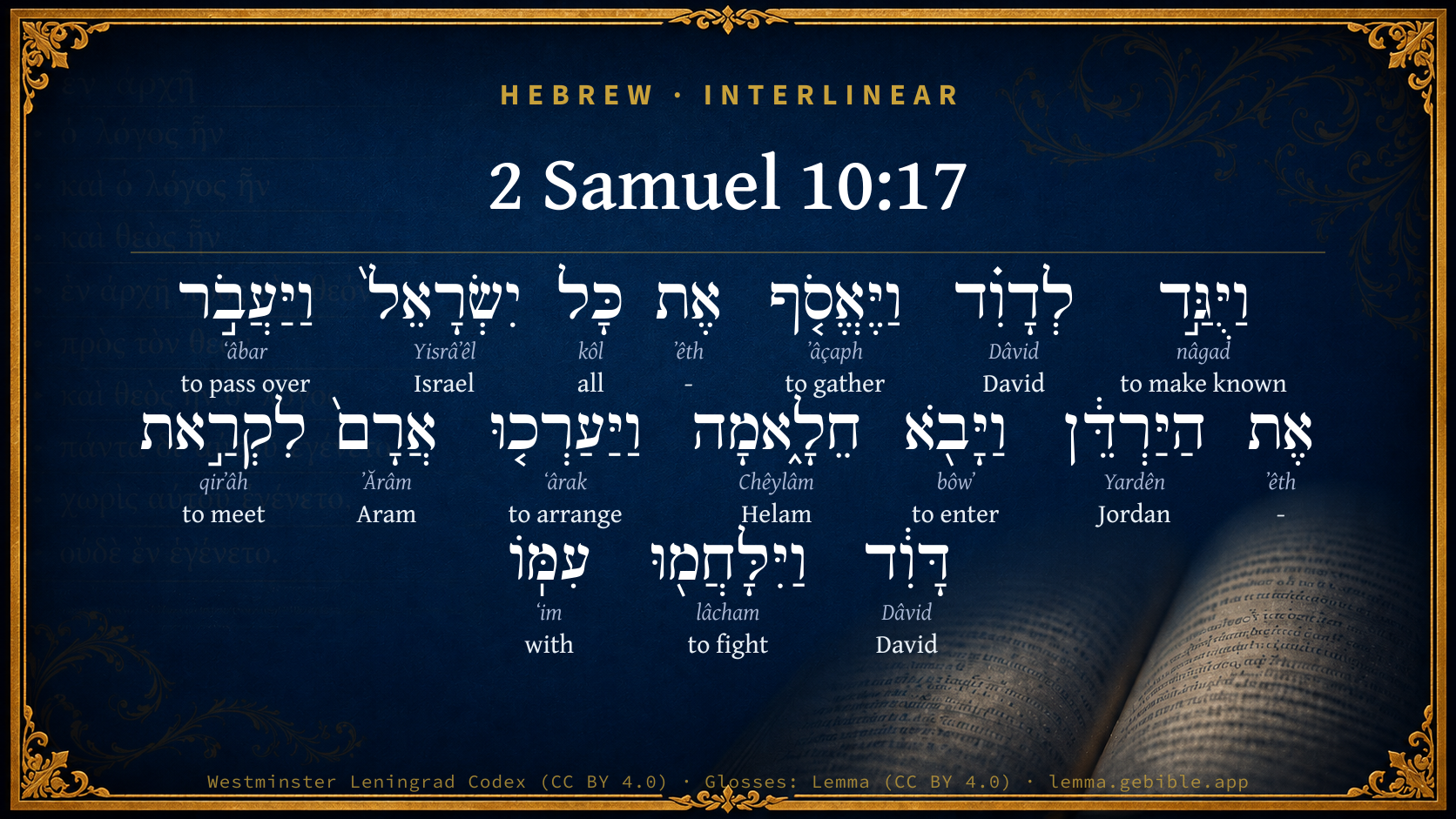
2 Samuel 10:17

Hebrew (Westminster Leningrad Codex) 2 Samuel 10:17 appears in the Hebrew Old Testament. The text above is from the Westminster Leningrad Codex. Each word links to its Strong’s number, a concise gloss, and parsing drawn from the Open Scriptures Hebrew Bible morphology. Click any word for its full Brown-Driver-Briggs (BDB) entry.
Download image
Cite this verse

2 Samuel 10:17 (World English Bible). Public Domain. Lemma interlinear Bible study tool, https://lemma.gebible.app/v/2-samuel/10/17.

Show BibTeX & RIS
BibTeX
RIS
English Translation
It was told David; and he gathered all Israel together, and passed over the Jordan, and came to Helam. The Syrians set themselves in array against David, and fought with him.
World English Bible · Public Domain
Download a study sheet

One document with this verse’s original text, its word-by-word gloss line, the meaning frame, cross-references with their text, attributed commentary, and full source and license credits — printable, and it pastes into notes with its structure intact.

This verse Autodidact and up

Study sheet (.html) Plain text (.txt)

A passage Seminary Student

Up to 50 verses in one chapter. A passage sheet keeps up to 6 commentary sources and 12 cross-references per verse, in the order this page ranks them, and says so on the sheet whenever that leaves anything out. Ask for a single verse and you get the Autodidact verse sheet above.

Everything on this page stays free to read, with no account — the sheet is a download of what is already on screen, not access to it.

Want to remove ads? Support Godless Engineer
Compare translations 3

The same verse in 3 English versions, stacked beneath the original-language interlinear above. Click any original word for its lexicon entry.

Each is an independent rendering of the whole verse — the interlinear is not word-aligned to these translations.

Highlighted words mark where these versions differ — a whole-verse word diff, not a word-by-word alignment.

  • World English Bible Public Domain
    It was told David; and he gathered all Israel together, and passed over the Jordan, and came to Helam. The Syrians set themselves in array against David, and fought with him.
  • King James Version Public Domain
    And when it was told David, he gathered all Israel together, and passed over Jordan, and came to Helam. And the Syrians set themselves in array against David, and fought with him.
  • unfoldingWord Literal Text CC BY-SA 4.0
    And it was declared to David, and he gathered all of Israel, and he crossed the Jordan, and he came toward Helam. And Aram arrayed themselves to meet David, and they fought with him.

unfoldingWord Literal Text — © unfoldingWord, licensed CC BY-SA 4.0. Word-aligned USFM3 via Door43 (git.door43.org/unfoldingWord/en_ult).

Versions to compare (up to 4)

3 of 4 selected

Show all 18 translations

Every available English version of this verse, each an independent rendering of the whole verse.

  • World English Bible Public Domain
    It was told David; and he gathered all Israel together, and passed over the Jordan, and came to Helam. The Syrians set themselves in array against David, and fought with him.
  • Berean Standard Bible Public Domain
    When this was reported to David, he gathered all Israel, crossed the Jordan, and went to Helam. Then the Arameans arrayed themselves against David and fought against him.
  • Majority Standard Bible Public Domain
    When this was reported to David, he gathered all Israel, crossed the Jordan, and went to Helam. Then the Arameans arrayed themselves against David and fought against him.
  • King James Version Public Domain
    And when it was told David, he gathered all Israel together, and passed over Jordan, and came to Helam. And the Syrians set themselves in array against David, and fought with him.
  • American Standard Version (1901) Public Domain
    And it was told David; and he gathered all Israel together, and passed over the Jordan, and came to Helam. And the Syrians set themselves in array against David, and fought with him.
  • Revised Version (1885) Public Domain
    And it was told David; and he gathered all Israel together, and passed over Jordan, and came to Helam. And the Syrians set themselves in array against David, and fought with him.
  • Geneva Bible (1599) Public Domain
    When it was shewed Dauid, then he gathered all Israel together, and passed ouer Iorden and came to Helam: and the Aramites set themselues in aray against Dauid, and fought with him:
  • Douay-Rheims (1899) Public Domain
    And when this was told David, he gathered all Israel together, and passed over the Jordan, and came to Helam: and the Syrians set themselves in array against David, and fought against him.
  • Young's Literal Translation Public Domain
    And it is declared to David, and he gathereth all Israel, and passeth over the Jordan, and cometh in to Helam, and Aram setteth itself in array to meet David, and they fight with him;
  • Literal Standard Version CC BY-SA 4.0
    And it is declared to David, and he gathers all Israel, and passes over the Jordan, and comes to Helam, and Aram sets itself in array to meet David, and they fight with him;
  • Unlocked Literal Bible CC BY-SA 4.0
    When David was told this, he gathered all Israel together, crossed the Jordan, and arrived at Helam. The Arameans arranged themselves in battle lines against David and fought him.
  • unfoldingWord Literal Text CC BY-SA 4.0
    And it was declared to David, and he gathered all of Israel, and he crossed the Jordan, and he came toward Helam. And Aram arrayed themselves to meet David, and they fought with him.
  • Darby Bible Public Domain
    And it was told David; and he gathered all Israel, and passed over the Jordan, and came to Helam. And the Syrians set themselves in array against David, and fought with him.
  • World Messianic Bible Public Domain
    David was told that; and he gathered all Israel together, passed over the Jordan, and came to Helam. The Syrians set themselves in array against David and fought with him.
  • Webster's Bible Public Domain
    And when it was told David, he assembled all Israel, and passed over Jordan, and came to Helam. And the Syrians set themselves in array against David, and fought with him.
  • Free Bible Version CC BY-SA 4.0
    When this was reported to David, he assembled all Israel together. He crossed the Jordan and advanced on Helam. The Arameans positioned themselves in battle line against David and fought him.
  • Bible in Basic English Public Domain
    And word of this was given to David: and he got all Israel together and went over Jordan and came to Helam. And the Aramaeans put their forces in position against David, and made an attack on him.
  • JPS Tanakh (1917) Public Domain
    And it was told David; and he gathered all Israel together, and passed over the Jordan, and came to Helam. And the Arameans set themselves in array against David, and fought with him.

Literal Standard Version (2020), Covenant Press — licensed CC BY-SA 4.0. Text via the HelloAO Bible API (eBible.org). Unlocked Literal Bible (unfoldingWord) — licensed CC BY-SA 4.0. Text via the HelloAO Bible API (eBible.org). unfoldingWord Literal Text — © unfoldingWord, licensed CC BY-SA 4.0. Word-aligned USFM3 via Door43 (git.door43.org/unfoldingWord/en_ult). Free Bible Version, Dr. Jonathan Gallagher — licensed CC BY-SA 4.0. Text via the HelloAO Bible API (eBible.org).

Word by word

More ways to search: Search by grammar → Find every occurrence → Compare this word →

Practice this passage: Drill this verse → Learn its vocabulary →

חֵלָ֑אמָה
Chêylâm
H2431
“Helam · toward”
Noun, Proper + Suffix, Demonstrative
Part of Speech
Noun
Type
Proper
Full BDB Definition

Origin: from H2428

TWOT: None

Helam = "stronghold" - a place east of the Jordan, west of the Euphrates, in Gilead, at which the Syrians under Hadarezer were defeated by David
  1. וַיֻּגַּ֣ד nâgad H5046 “and · to make known” Conjunction + Verb, Hophal, Sequential Imperfect, 3rd Person, Masculine, Singular
  2. לְדָוִ֗ד Dâvid H1732 “to/for · David” Preposition + Noun, Proper
  3. וַיֶּאֱסֹ֤ף ʼâçaph H622 “and · to gather” Conjunction + Verb, Qal, Sequential Imperfect, 3rd Person, Masculine, Singular
  4. אֶת ʼêth H853 “-” Particle, Direct Object
  5. כָּל kôl H3605 “all of” Noun, Common, Masculine, Singular, Construct
  6. יִשְׂרָאֵל֙ Yisrâʼêl H3478 “Israel” Noun, Proper
  7. וַיַּעֲבֹ֣ר ʻâbar H5674 “and · to pass over” Conjunction + Verb, Qal, Sequential Imperfect, 3rd Person, Masculine, Singular
  8. אֶת ʼêth H853 “-” Particle, Direct Object
  9. הַיַּרְדֵּ֔ן Yardên H3383 “the · Jordan” Particle, Definite Article + Noun, Proper
  10. וַיָּבֹ֖א bôwʼ H935 “and · to enter” Conjunction + Verb, Qal, Sequential Imperfect, 3rd Person, Masculine, Singular
  11. וַיַּעַרְכ֤וּ ʻârak H6186 “and · to arrange” Conjunction + Verb, Qal, Sequential Imperfect, 3rd Person, Masculine, Plural
  12. אֲרָם֙ ʼĂrâm H758 “Aram” Noun, Proper
  13. לִקְרַ֣את qirʼâh H7125 “to meet” Preposition + Verb, Qal, Infinitive Construct
  14. דָּוִ֔ד Dâvid H1732 “David” Noun, Proper
  15. וַיִּלָּחֲמ֖וּ lâcham H3898 “and · to fight” Conjunction + Verb, Niphal, Sequential Imperfect, 3rd Person, Masculine, Plural
  16. עִמּֽוֹ ʻim H5973 “with · him” Preposition + Suffix, Personal, 3rd Person, Masculine, Singular

About this verse

These counts appear in no published source. They are computed here, from the morphology-tagged text and Lemma’s own curated glosses. What Lemma adds →

17
words
15
distinct lemmas
Historical
section

Notable vocabulary

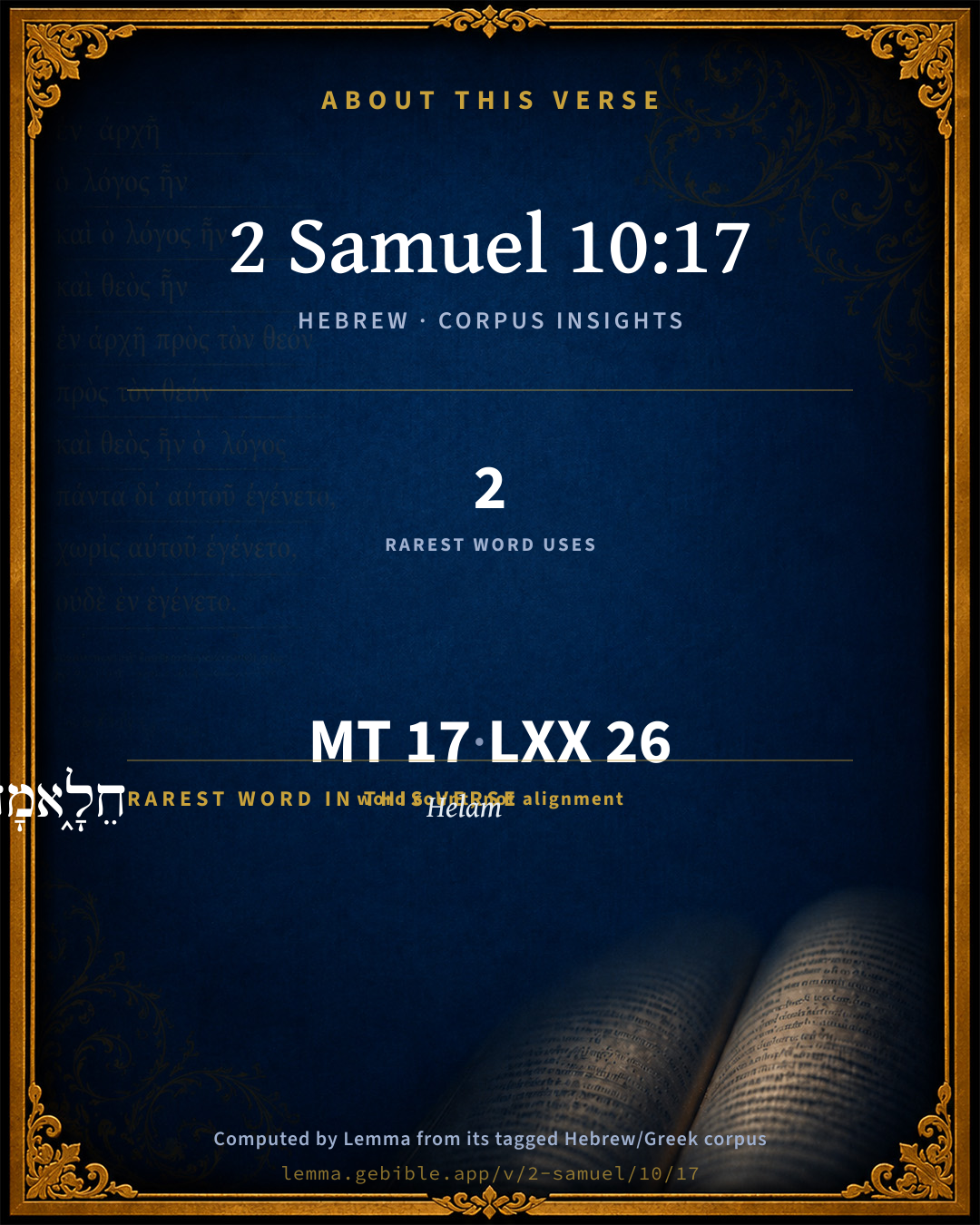
The rarest word here is חֵלָ֑אמָה Helam H2431 — appearing just 2 times in the whole Hebrew Bible.

Shared distinctive vocabulary

חֵלָ֑אמָה Helam H2431 occurs in 2 verses of the Hebrew Bible. Also found in:

Grammatical profile

  • 7 verbs
  • 7 nouns
  • 1 preposition
  • 2 particles

Verb forms

  • וַיֻּגַּ֣ד Hophal · Sequential Imperfect
  • וַיֶּאֱסֹ֤ף Qal · Sequential Imperfect
  • וַיַּעֲבֹ֣ר Qal · Sequential Imperfect
  • וַיָּבֹ֖א Qal · Sequential Imperfect
  • וַיַּעַרְכ֤וּ Qal · Sequential Imperfect
  • לִקְרַ֣את Qal · Infinitive Construct
  • וַיִּלָּחֲמ֖וּ Niphal · Sequential Imperfect

Repetition

A word recurs within this verse — often emphatic in Hebrew:

  • לְדָוִ֗ד David H1732 ×2

Hebrew & Septuagint length

In English translation the verse runs 31 words from the Hebrew and 33 from the Septuagint (LXX English) — closely comparable.

A rough comparison of the two English renderings, which tokenize alike — not a word-level alignment.

Word counts can differ between the Hebrew and the Greek without any difference in meaning — e.g. the Hebrew direct-object marker אֵת has no separate Greek word, and Greek often adds the article ὁ.

In the original languages it is 17 Hebrew tokens and 26 Greek tokens — but the two are counted differently (Hebrew bundles its prefixes and suffixes into one token; the Greek is in lemma form), so that isn’t a like-for-like length.

Cross-references

1

Topical passages linked to 2 Samuel 10:17 in the Treasury of Scripture Knowledge — connected by theme and wording, ordered by reader-vote popularity; previews shown in the World English Bible.

  • 1 Chronicles 19:17 It was told David; and he gathered all Israel together, and passed over the Jordan, and came on them, and set the battle in array against them. So when David had put the battle in array against the Syrians, they fought with him.

Cross-references courtesy of OpenBible.info (CC BY 4.0).

Hebrew and Greek witnesses Masoretic Hebrew ↔ Greek Septuagint

The same verse in the two great witnesses to the Old Testament, shown verse-for-verse.

These are two independent witnesses, not word-aligned to each other, and the Septuagint is shown in lemma (dictionary) form.

Hebrew 2 Samuel 10:17 Masoretic · Westminster Leningrad Codex

וַיֻּגַּ֣ד לְדָוִ֗ד וַיֶּאֱסֹ֤ף אֶת כָּל יִשְׂרָאֵל֙ וַיַּעֲבֹ֣ר אֶת הַיַּרְדֵּ֔ן וַיָּבֹ֖א חֵלָ֑אמָה וַיַּעַרְכ֤וּ אֲרָם֙ לִקְרַ֣את דָּוִ֔ד וַיִּלָּחֲמ֖וּ עִמּֽוֹ

It was told David; and he gathered all Israel together, and passed over the Jordan, and came to Helam. The Syrians set themselves in array against David, and fought with him.

World English Bible · Public Domain

Greek LXX 2 Samuel 10:17 Septuagint · lemma form

καί ἀναἀγγέλλω ὁ δαυίδ καί συνἄγω ὁ πᾶς ἰσραήλ καί διαβαίνω ὁ ἰορδάνης καί παραγίγνομαι εἰς αιλαμ καί παρατάσσω συρία ἀπέναντι δαυίδ καί πολεμέω μετά αὐτός

And it was reported to David, and he gathered all Israel, and went over Jordan, and came to Aelam: and the Syrians set the battle in array against David, and fought with him.

LXX2012 (modern English Septuagint) · Public Domain

Hebrew: Westminster Leningrad Codex (CC BY 4.0). Greek: Septuagint (public domain); English from LXX2012 (modern English Septuagint) (Public Domain). How the Septuagint differs from the Hebrew →

Targum (Aramaic paraphrase)

1

The Targum is the ancient Jewish Aramaic paraphrase of the Hebrew Scriptures — an interpretive translation, not the Hebrew text itself. Onkelos (literal) and Pseudo-Jonathan (expansive) render the Torah, and Jonathan the Prophets. Coverage is partial: where no permissively-licensed English translation exists for a verse, only the Aramaic is shown. This is verse-level text, not a word-by-word alignment to the Hebrew.

  1. Targum Jonathan Prophets (Joshua–Malachi)
    וְאִיתְחַוָא לְדָוִד וּכְנַשׁ יַת כָּל יִשְׂרָאֵל וַעֲבַר יַת יַרְדְנָא וַאֲתוֹ לְחֵלָם וְסַדָרוּ אֱנַשׁ אֲרָם לְקֳדָמוּת דָוִד וְאַגִיחוּ קְרָבָא עִמֵיהּ:

    (no public-domain English translation for this verse)

    Targum Jonathan — Aramaic: “Mikraot Gedolot” (public domain). English: “Sefaria Community Translation” (CC0 1.0 (public-domain dedication)); “London "Chaldee Paraphrase," 1871” (public domain). Text via Sefaria.

Commentary

Notes on 2 Samuel 10:17 from classic Christian and Jewish commentators (each source and its license shown beneath its notes). The classic Christian expositions comment on the surrounding passage and are grouped to its opening verse, so a note may address several verses; the Jewish commentaries on the Tanakh (Rashi and others) are per-verse, so they appear only where the commentator wrote on this verse.

Lemma curates 59 commentaries, every one of them public domain or Creative Commons licensed, each selected and text-cleaned for this edition rather than reprinted as found. About our sources →

Trapp's Complete Commentary

John Trapp

2Sa 10:17 And when it was told David, he gathered all Israel together, and passed over Jordan, and came to Helam. And the Syrians set themselves in array against David, and fought with him.

Ver. 17. He gathered all Israel together.] The best of all, and fittest for his purpose; leading them forth himself. See 2Sa 8:6. This put life into his soldiers, as Queen Elizabeth also did by her personal presence at Tilbury Camp; and as the thrice valiant King of Sweden did.

And fought with him.] Very desperately, no doubt; for they had no hope of having quarter, since they had before this rebelled and joined with the Ammonites, to make war against him.

John Trapp, A Commentary or Exposition upon All the Books of the Old and New Testament (1647–1656) — public domain. Text from a community e-Sword module.

Joseph Benson's Commentary

2Sa 10:17-18. David passed over Jordan — In this expedition David seems to have commanded his army in his own person. But, notwithstanding, the Syrians appear to have begun the fight. David slew the men of seven hundred chariots, &c. — The parallel place, 1Ch 19:18, reads, seven thousand men that fought in chariots, and forty thousand footmen, and not horsemen, as here. It is probable, either that horse and foot were mixed together, and that, in all, there were slain forty thousand of them, part horsemen and part footmen; or, as many learned men suppose, that some error has crept into the text in one of the places. Houbigant is of opinion, that the text here, corrected from the parallel passage, should be read, David destroyed seven thousand horsemen, seven hundred chariots, and forty thousand footmen.

Joseph Benson's Commentary on the Old and New Testaments (1811–1818) — public domain. Text from a community e-Sword module.

Geneva Bible (1599)

Geneva Bible translators

Meaning, the greatest part.

Geneva Bible (1599) marginal notes — public domain. Text via Bolls.life.

Adam Clarke's Commentary

Verse 17. David - gathered all Israel together] He thought that such a war required his own presence.

Adam Clarke's Commentary on the Bible (1810–1826) — public domain. Text from a community e-Sword/MySword module.

Ellicott's Commentary for English Readers

(17) He gathered . . . and passed.—David, hearing of the great Syrian rally, now took the field in person. Joab may have been with him, but more probably was employed at the south in holding the Ammonites in check and preventing their forming a junction with their confederates.

A Bible Commentary for English Readers, edited by Charles John Ellicott (1878–1897) — public domain. Text from a community e-Sword module.

John Gill's Exposition

And when it was told David,.... What preparations the Syrians were making to fight him, and where they were:

he gathered all Israel together; all the fighting men in the country:

and passed over Jordan, and came to Helam: which, according to Bunting (b), was twenty miles from Jerusalem. David seems to have gone himself in person to this war:

and the Syrians set themselves in array against David, and fought with him; they formed themselves in a line of battle, and attacked him first, being eager to fight, and perhaps confident of victory, because of their numbers.

(b) Travels, &c. p. 140, 141.

John Gill's Exposition of the Whole Bible (1746–1763) — public domain (CC PDM 1.0). Text via the HelloAO Bible API.

Haydock's Catholic Bible Commentary

Helam. Ptolemy mentions Alamata, on the Euphrates. But perhaps we ought to read the Hebrew Lehem, "he came upon them." See 1 Paralipomenon xix. 17. Some translate, "he came to their army."

George Leo Haydock (1774–1849), Haydock's Catholic Family Bible and Commentary, 1859 edition — public domain. Excludes Psalms (Douay-Rheims chapter numbering differs from Protestant) and Deuterocanonical books (Catholic canon only).

Matthew Poole's English Annotations

All Israel, i.e. the chosen and valiant men picked out of all Israel.

Matthew Poole's English Annotations on the Holy Bible (1683–1685) — public domain. Text from a community e-Sword/MySword module.

The Pulpit Commentary

David gathered all Israel together. Some commentators see in this an indication of dissatisfaction with Joab. Really it was a matter of course that in so great a war the king should place himself at the head of his levies. For not only was he possessed of great military genius, but his personal presence would make the men of Israel, a race of sturdy free men, assemble in greater numbers, and would give them confidence. If David himself went there would be no shirking the war and finding excuses to stay at home, and in the camp there would be prompt alacrity and zeal.

The Pulpit Commentary (1880–1919), ed. H.D.M. Spence-Jones & Joseph S. Exell — public domain. Text from a community e-Sword module.

Keil & Delitzsch

C. F. Keil & F. Delitzsch

David went with all Israel (all the Israelitish forces) against the foe, and smote the Aramaeans at Helam, where they had placed themselves in battle array, slaying seven hundred charioteers and forty thousand horsemen, and so smiting (or wounding) the general Shobach that he died there, i.e., that he did not survive the battle (Thenius). With regard to the different account given in the corresponding text of the Chronicles as to the number of the slain, see the remarks on Sa2 10:6. It is a fact worthy of notice, that the number of men who fell in the battle (seven hundred receb and forty thousand parashim, according to the text before us; seven thousand receb and forty thousand ragli, according to the Chronicles) agrees quite as well with the number of Aramaeans reported to be taken prisoners or slain, according to Sa2 8:4 and Ch1 18:4-5 (viz., seventeen hundred parashim or a thousand receb, and seven thousand parashim and twenty thousand ragli of Aram-Zoba, and twenty-two thousand of Aram-Damascus), as could possibly be expected considering the notorious corruption in the numbers as we possess them; so that there is scarcely any doubt that the number of Aramaeans who fell was the same in both accounts (2 Samuel 8 and 10), and that in the chapter before us we have simply a more circumstantial account of the very same war of which the result is given in 2 Samuel 8 and Ch1 13:1-14.

Keil & Delitzsch — Biblical Commentary on the Old Testament (1861–1891) — public domain (CC PDM 1.0). Text via the HelloAO Bible API. (Old Testament only.)

unfoldingWord translationNotes

Door43 World Missions Community

When David was told this

This can be stated in active form. AT: "When David heard about this" (See: Active or Passive)

gathered all Israel together

Here "Israel" represents the army of Israel. AT: "assembled all the army of Israel together" (See: Metonymy)

Helam

See how you translated this man's name in 2 Samuel 10:16.

against David and fought him

Here David represents himself and his soldiers. AT: "against David and his soldiers and fought them" (See: Synecdoche)

David killed

Here David represents himself and his soldiers. AT: "David and his soldiers killed" (See: Synecdoche)

seven hundred ... forty thousand

"700 ... 40,000" (See: Numbers)

Shobak the commander of their army was wounded and died there

This can be stated in active form. AT: "The Israelites wounded Shobak the commander of the Aramean army, and he died there" (See: Active or Passive)

Shobak ... Hadarezer

See how you translated these men's names in 2 Samuel 10:16.

saw that they were defeated by Israel

This can be stated in active form. AT: "realized that the Israelites had defeated them" (See: Active or Passive)

translationWords

Jordan River

Aram

chariot

horse

die

peace

Israel

fear

unfoldingWord translationNotes — © Distant Shores Media and the Door43 World Missions Community, licensed CC BY-SA 4.0. Source: git.door43.org/Door43/en_tn.

Lesson kit

Teaching starters — assembled from the data on this page, not authored interpretation. Every prompt links to the verse data it draws on. Edit before teaching.

2 Samuel, in the Historical, opens this verse with 17 words (15 distinct Hebrew lemmas). Its most distinctive word is Chêylâm (“Helam”). A historical commentator’s framing appears above. Read the whole chapter for the surrounding context.

Discussion questions

  1. How does “Helam” (Chêylâm) shape what this verse is saying?
  2. 2 Samuel 10:16 shares the word «Helam» with this verse. How do the two illuminate each other?
  3. “David” occurs 2× in this one verse. What is the effect of the repetition?
  4. These translations render this verse differently. What is at stake in choosing one wording over another?
  5. The verb «וַיֻּגַּ֣ד» is Hophal Sequential Imperfect. How does its form color the action?
  6. Reading how Trapp's Complete Commentary and Joseph Benson's Commentary read this verse, where do the two commentators agree and where do they part?

Things to notice

Reading settings

Reading text

Shown beneath each verse's original-language words.

Old Testament
Old Testament edition

Read the OT as the Masoretic Hebrew (MT) or the Greek Septuagint (LXX).

English shown for the Greek Septuagint (in the Hebrew ↔ Greek comparison).

Comparing translations? Open the Compare panel on any verse page to stack up to four side by side.