
2 Kings 5:6

Hebrew (Westminster Leningrad Codex) 2 Kings 5:6 appears in the Hebrew Old Testament. The text above is from the Westminster Leningrad Codex. Each word links to its Strong’s number, a concise gloss, and parsing drawn from the Open Scriptures Hebrew Bible morphology. Click any word for its full Brown-Driver-Briggs (BDB) entry.
Download image
Cite this verse

2 Kings 5:6 (World English Bible). Public Domain. Lemma interlinear Bible study tool, https://lemma.gebible.app/v/2-kings/5/6.

Show BibTeX & RIS
BibTeX
RIS
English Translation
He brought the letter to the king of Israel, saying, Now when this letter is come to you, behold, I have sent Naaman my servant to you, that you may recover him of his leprosy.
World English Bible · Public Domain
Download a study sheet

One document with this verse’s original text, its word-by-word gloss line, the meaning frame, cross-references with their text, attributed commentary, and full source and license credits — printable, and it pastes into notes with its structure intact.

This verse Autodidact and up

Study sheet (.html) Plain text (.txt)

A passage Seminary Student

Up to 50 verses in one chapter. A passage sheet keeps up to 6 commentary sources and 12 cross-references per verse, in the order this page ranks them, and says so on the sheet whenever that leaves anything out. Ask for a single verse and you get the Autodidact verse sheet above.

Everything on this page stays free to read, with no account — the sheet is a download of what is already on screen, not access to it.

Want to remove ads? Support Godless Engineer
Compare translations 3

The same verse in 3 English versions, stacked beneath the original-language interlinear above. Click any original word for its lexicon entry.

Each is an independent rendering of the whole verse — the interlinear is not word-aligned to these translations.

Highlighted words mark where these versions differ — a whole-verse word diff, not a word-by-word alignment.

  • World English Bible Public Domain
    He brought the letter to the king of Israel, saying, Now when this letter is come to you, behold, I have sent Naaman my servant to you, that you may recover him of his leprosy.
  • King James Version Public Domain
    And he brought the letter to the king of Israel, saying, Now when this letter is come unto thee, behold, I have therewith sent Naaman my servant to thee, that thou mayest recover him of his leprosy.
  • unfoldingWord Literal Text CC BY-SA 4.0
    And he brought the letter to, the king of Israel, saying, “And now, when this letter comes to you, behold, I have sent to you Naaman my servant, and you shall remove him from his leprosy.”

unfoldingWord Literal Text — © unfoldingWord, licensed CC BY-SA 4.0. Word-aligned USFM3 via Door43 (git.door43.org/unfoldingWord/en_ult).

Versions to compare (up to 4)

3 of 4 selected

Show all 18 translations

Every available English version of this verse, each an independent rendering of the whole verse.

  • World English Bible Public Domain
    He brought the letter to the king of Israel, saying, Now when this letter is come to you, behold, I have sent Naaman my servant to you, that you may recover him of his leprosy.
  • Berean Standard Bible Public Domain
    And the letter that he took to the king of Israel stated: “With this letter I am sending my servant Naaman, so that you may cure him of his leprosy.”
  • Majority Standard Bible Public Domain
    And the letter that he took to the king of Israel stated: “With this letter I am sending my servant Naaman, so that you may cure him of his leprosy.”
  • King James Version Public Domain
    And he brought the letter to the king of Israel, saying, Now when this letter is come unto thee, behold, I have therewith sent Naaman my servant to thee, that thou mayest recover him of his leprosy.
  • American Standard Version (1901) Public Domain
    And he brought the letter to the king of Israel, saying, And now when this letter is come unto thee, behold, I have sent Naaman my servant to thee, that thou mayest recover him of his leprosy.
  • Revised Version (1885) Public Domain
    And he brought the letter to the king of Israel, saying, And now when this letter is come unto thee, behold, I have sent Naaman my servant to thee, that thou mayest recover him of his leprosy.
  • Geneva Bible (1599) Public Domain
    And brought the letter to the King of Israel to this effect, Now when this letter is come vnto thee, vnderstand, that I haue sent thee Naaman my seruant, that thou maiest heale him of his leprosie.
  • Douay-Rheims (1899) Public Domain
    And brought the letter to the king of Israel, in these words: When thou shalt receive this letter, know that I have sent to thee Naaman my servant, that thou mayest heal him of his leprosy.
  • Young's Literal Translation Public Domain
    And he bringeth in the letter unto the king of Israel, saying, `And now, at the coming in of this letter unto thee, lo, I have sent unto thee Naaman my servant, and thou hast recovered him from his leprosy.'
  • Literal Standard Version CC BY-SA 4.0
    And he brings in the letter to the king of Israel, saying, “And now, at the coming in of this letter to you, behold, I have sent my servant Naaman to you, and you have recovered him from his leprosy.”
  • Unlocked Literal Bible CC BY-SA 4.0
    He also took the letter to the king of Israel that said, “Now when this letter is brought to you, you will see that I have sent Naaman my servant to you, so that you may cure him of his leprosy.”
  • unfoldingWord Literal Text CC BY-SA 4.0
    And he brought the letter to, the king of Israel, saying, “And now, when this letter comes to you, behold, I have sent to you Naaman my servant, and you shall remove him from his leprosy.”
  • Darby Bible Public Domain
    And he brought the letter to the king of Israel, saying, And now, when this letter comes to thee, behold, I have sent Naaman my servant to thee, that thou mayest cure him of his leprosy.
  • World Messianic Bible Public Domain
    He brought the letter to the king of Israel, saying, “Now when this letter has come to you, behold, I have sent Naaman my servant to you, that you may heal him of his leprosy.”
  • Webster's Bible Public Domain
    And he brought the letter to the king of Israel, saying, Now when this letter hath come to thee, behold, I have with this sent Naaman my servant to thee, that thou mayest recover him of his leprosy.
  • Free Bible Version CC BY-SA 4.0
    The letter he took to the king of Israel read: “This letter accompanies my servant Naaman, sent to you so you can heal him of his leprosy.”
  • Bible in Basic English Public Domain
    And he took the letter to the king of Israel, in which the king of Aram had said, See, I have sent my servant Naaman to you to be made well, for he is a leper.
  • JPS Tanakh (1917) Public Domain
    And he brought the letter to the king of Israel, saying: 'And now when this letter is come unto thee, behold, I have sent Naaman my servant to thee, that thou mayest recover him of his leprosy.'

Literal Standard Version (2020), Covenant Press — licensed CC BY-SA 4.0. Text via the HelloAO Bible API (eBible.org). Unlocked Literal Bible (unfoldingWord) — licensed CC BY-SA 4.0. Text via the HelloAO Bible API (eBible.org). unfoldingWord Literal Text — © unfoldingWord, licensed CC BY-SA 4.0. Word-aligned USFM3 via Door43 (git.door43.org/unfoldingWord/en_ult). Free Bible Version, Dr. Jonathan Gallagher — licensed CC BY-SA 4.0. Text via the HelloAO Bible API (eBible.org).

Word by word

More ways to search: Search by grammar → Find every occurrence → Compare this word →

Practice this passage: Drill this verse → Learn its vocabulary →

נַעֲמָ֣ן
Naʻămân
H5283
“Naaman”
Noun, Proper
Part of Speech
Noun
Type
Proper
Full BDB Definition

Origin: the same as H5282

TWOT: None

Naaman = "pleasantness" - son of Bela of the family of Benjamin; he was among the family of Jacob that went down to Egypt - commander-in-chief of the army of Syria; stricken with leprosy he went to Elisha, eventually followed his instructions, and was cured
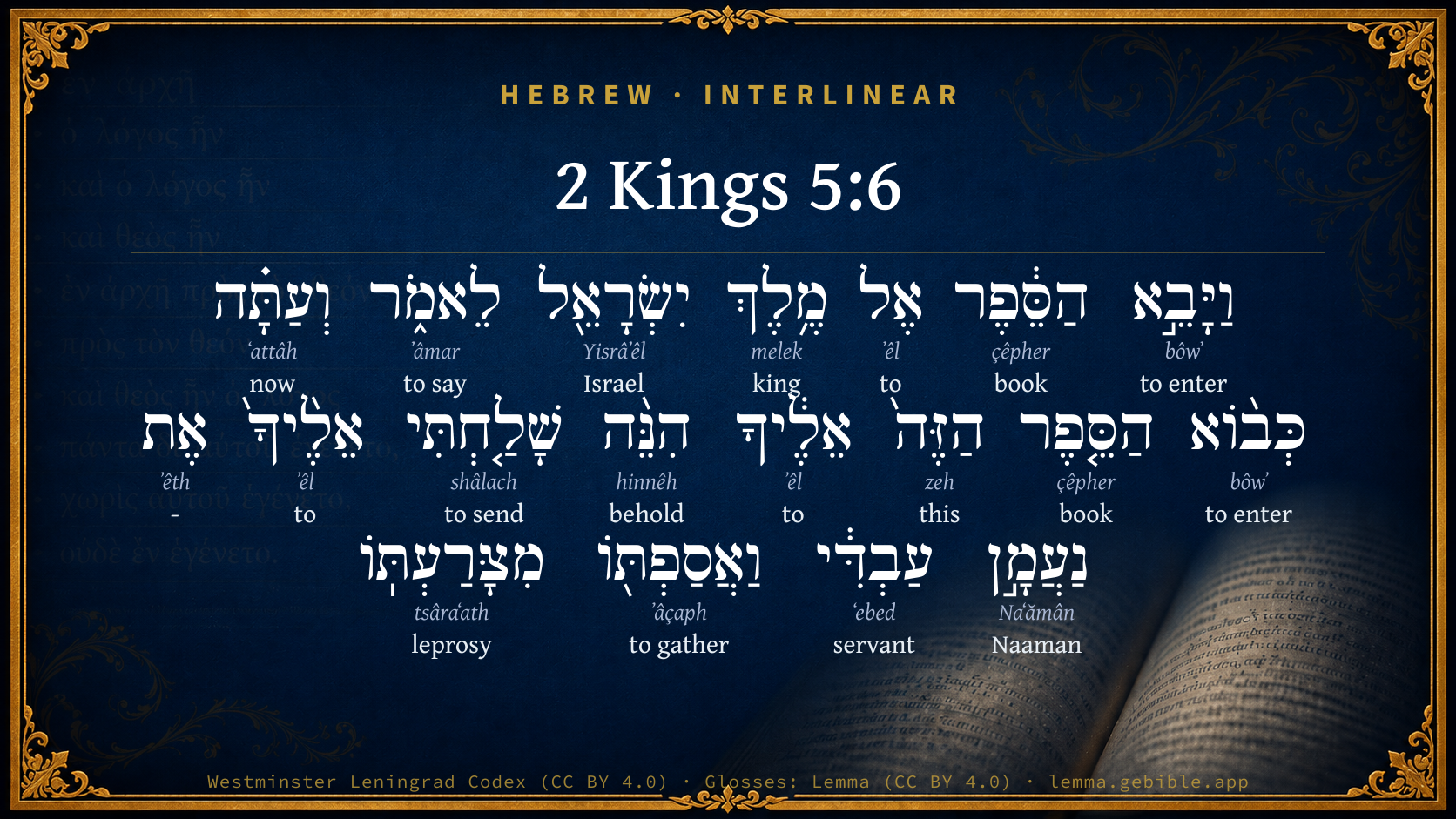
  1. וַיָּבֵ֣א bôwʼ H935 “and · to enter” Conjunction + Verb, Hiphil, Sequential Imperfect, 3rd Person, Masculine, Singular
  2. הַסֵּ֔פֶר çêpher H5612 “the · book” Particle, Definite Article + Noun, Common, Masculine, Singular, Absolute
  3. אֶל ʼêl H413 “to” Preposition
  4. מֶ֥לֶךְ melek H4428 “king of” Noun, Common, Masculine, Singular, Construct
  5. יִשְׂרָאֵ֖ל Yisrâʼêl H3478 “Israel” Noun, Proper
  6. לֵאמֹ֑ר ʼâmar H559 “to say” Preposition + Verb, Qal, Infinitive Construct
  7. וְעַתָּ֗ה ʻattâh H6258 “and · now” Conjunction + Adverb
  8. כְּב֨וֹא bôwʼ H935 “like/as · to enter” Preposition + Verb, Qal, Infinitive Construct
  9. הַסֵּ֤פֶר çêpher H5612 “the · book” Particle, Definite Article + Noun, Common, Masculine, Singular, Absolute
  10. הַזֶּה֙ zeh H2088 “the · this” Particle, Definite Article + Pronoun, Demonstrative, Masculine, Singular
  11. אֵלֶ֔יךָ ʼêl H413 “to · you” Preposition + Suffix, Personal, 2nd Person, Masculine, Singular
  12. הִנֵּ֨ה hinnêh H2009 “behold” Particle, Demonstrative
  13. שָׁלַ֤חְתִּי shâlach H7971 “to send” Verb, Qal, Perfect, 1st Person, Common, Singular
  14. אֵלֶ֨יךָ֙ ʼêl H413 “to · you” Preposition + Suffix, Personal, 2nd Person, Masculine, Singular
  15. אֶת ʼêth H853 “-” Particle, Direct Object
  16. עַבְדִּ֔י ʻebed H5650 “servant · my” Noun, Common, Masculine, Singular, Construct + Suffix, Personal, 1st Person, Common, Singular
  17. וַאֲסַפְתּ֖וֹ ʼâçaph H622 “and · to gather · him” Conjunction + Verb, Qal, Sequential Perfect, 2nd Person, Masculine, Singular + Suffix, Personal, 3rd Person, Masculine, Singular
  18. מִצָּרַעְתּֽוֹ tsâraʻath H6883 “from · leprosy · his” Preposition + Noun, Common, Feminine, Singular, Construct + Suffix, Personal, 3rd Person, Masculine, Singular

About this verse

These counts appear in no published source. They are computed here, from the morphology-tagged text and Lemma’s own curated glosses. What Lemma adds →

19
words
15
distinct lemmas
Historical
section

Notable vocabulary

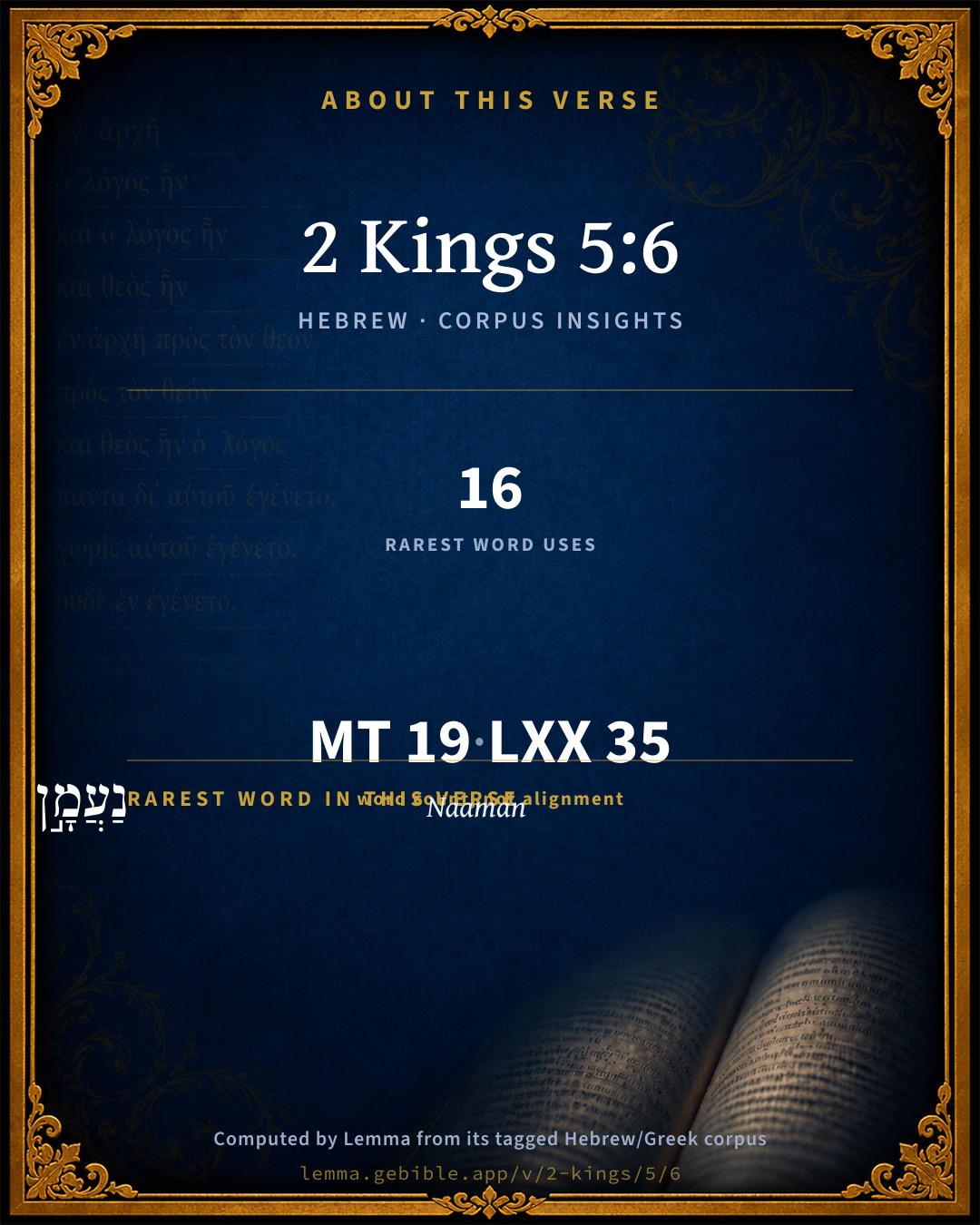
The rarest word here is נַעֲמָ֣ן Naaman H5283 — appearing just 16 times in the whole Hebrew Bible.

Shared distinctive vocabulary

נַעֲמָ֣ן Naaman H5283 occurs in 14 verses of the Hebrew Bible. Also found in:

Grammatical profile

  • 5 verbs
  • 7 nouns
  • 1 pronoun
  • 3 prepositions
  • 1 adverb
  • 2 particles

Verb forms

  • וַיָּבֵ֣א Hiphil · Sequential Imperfect
  • לֵאמֹ֑ר Qal · Infinitive Construct
  • כְּב֨וֹא Qal · Infinitive Construct
  • שָׁלַ֤חְתִּי Qal · Perfect
  • וַאֲסַפְתּ֖וֹ Qal · Sequential Perfect

Repetition

Words recur within this verse — often emphatic in Hebrew:

  • וַיָּבֵ֣א to enter H935 ×2
  • הַסֵּ֔פֶר book H5612 ×2
  • אֶל to H413 ×3

Hebrew & Septuagint length

In English translation the verse runs 35 words from the Hebrew and 38 from the Septuagint (LXX English) — closely comparable.

A rough comparison of the two English renderings, which tokenize alike — not a word-level alignment.

Word counts can differ between the Hebrew and the Greek without any difference in meaning — e.g. the Hebrew direct-object marker אֵת has no separate Greek word, and Greek often adds the article ὁ.

In the original languages it is 19 Hebrew tokens and 35 Greek tokens — but the two are counted differently (Hebrew bundles its prefixes and suffixes into one token; the Greek is in lemma form), so that isn’t a like-for-like length.

Hebrew and Greek witnesses Masoretic Hebrew ↔ Greek Septuagint

The same verse in the two great witnesses to the Old Testament, shown verse-for-verse.

These are two independent witnesses, not word-aligned to each other, and the Septuagint is shown in lemma (dictionary) form.

Hebrew 2 Kings 5:6 Masoretic · Westminster Leningrad Codex

וַיָּבֵ֣א הַסֵּ֔פֶר אֶל מֶ֥לֶךְ יִשְׂרָאֵ֖ל לֵאמֹ֑ר וְעַתָּ֗ה כְּב֨וֹא הַסֵּ֤פֶר הַזֶּה֙ אֵלֶ֔יךָ הִנֵּ֨ה שָׁלַ֤חְתִּי אֵלֶ֨יךָ֙ אֶת נַעֲמָ֣ן עַבְדִּ֔י וַאֲסַפְתּ֖וֹ מִצָּרַעְתּֽוֹ

He brought the letter to the king of Israel, saying, Now when this letter is come to you, behold, I have sent Naaman my servant to you, that you may recover him of his leprosy.

World English Bible · Public Domain

Greek LXX 2 Kings 5:6 Septuagint · lemma form

καί φέρω ὁ βιβλίον πρός ὁ βασιλεύς ἰσραήλ λέγω καί νῦν ὡς ἄν ἔρχομαι ὁ βιβλίον οὗτος πρός σύ ἰδού ἀποστέλλω πρός σύ ναιμαν ὁ δοῦλος ἐγώ καί ἀπο συνἄγω αὐτός ἀπό ὁ λέπρα αὐτός

And he brought the letter to the king of Israel, saying, Now then, as soon as this letter shall reach you, behold, I have sent to you my servant Naiman, and you shall recover him from his leprosy.

LXX2012 (modern English Septuagint) · Public Domain

Hebrew: Westminster Leningrad Codex (CC BY 4.0). Greek: Septuagint (public domain); English from LXX2012 (modern English Septuagint) (Public Domain). How the Septuagint differs from the Hebrew →

Targum (Aramaic paraphrase)

1

The Targum is the ancient Jewish Aramaic paraphrase of the Hebrew Scriptures — an interpretive translation, not the Hebrew text itself. Onkelos (literal) and Pseudo-Jonathan (expansive) render the Torah, and Jonathan the Prophets. Coverage is partial: where no permissively-licensed English translation exists for a verse, only the Aramaic is shown. This is verse-level text, not a word-by-word alignment to the Hebrew.

  1. Targum Jonathan Prophets (Joshua–Malachi)
    וְאַיְתֵי אִגַרְתָּא לְמַלְכָּא דְיִשְׂרָאֵל לְמֵימָר וְכֵן כְּתִיב בָּהּ וּכְעַן כְּמֵיתֵי אִגַרְתָּא הָדָא לְוָתָךְ הָא שַׁדְרִית לָךְ יַת נַעֲמָן עַבְדִי וְתַסִינֵיהּ מִסְגִירוּתֵיהּ:

    (no public-domain English translation for this verse)

    Targum Jonathan — Aramaic: “Mikraot Gedolot” (public domain). English: “Sefaria Community Translation” (CC0 1.0 (public-domain dedication)); “London "Chaldee Paraphrase," 1871” (public domain). Text via Sefaria.

Commentary

Notes on 2 Kings 5:6 from classic Christian and Jewish commentators (each source and its license shown beneath its notes). The classic Christian expositions comment on the surrounding passage and are grouped to its opening verse, so a note may address several verses; the Jewish commentaries on the Tanakh (Rashi and others) are per-verse, so they appear only where the commentator wrote on this verse.

Lemma curates 59 commentaries, every one of them public domain or Creative Commons licensed, each selected and text-cleaned for this edition rather than reprinted as found. About our sources →

Trapp's Complete Commentary

John Trapp

2Ki 5:6 And he brought the letter to the king of Israel, saying, Now when this letter is come unto thee, behold, I have [therewith] sent Naaman my servant to thee, that thou mayest recover him of his leprosy.

Ver. 6. That thou mayest recover him of his leprosy,] sc., By commending him to thy prophet, so famous for his miracles; and by commanding him to cure him.

John Trapp, A Commentary or Exposition upon All the Books of the Old and New Testament (1647–1656) — public domain. Text from a community e-Sword module.

Joseph Benson's Commentary

2Ki 5:6. Now when this letter is come unto thee, &c. — The beginning of the letter, which, it is likely, contained the usual compliments, is omitted, as not pertinent to the matter in hand. That thou mayest recover him of his leprosy — Or, That, by thy command, the prophet that is with thee may cleanse him; for kings are often said to do those things which they command to be done: in which view, there is no ambiguity in this letter of the king of Syria. But this not being plainly expressed, the king of Israel apprehended that the intention of this demand was only to pick a quarrel with him, and seek an occasion, or rather a pretence, for a war with him.

Joseph Benson's Commentary on the Old and New Testaments (1811–1818) — public domain. Text from a community e-Sword module.

Ellicott's Commentary for English Readers

(6) Now.—Heb., And now, continuing an omitted passage. Only the principal sentence of the letter is given. The message pre-supposes a not altogether hostile relation between the two kings; and the words of the next verse, “He seeketh a quarrel against me,” point to the time of comparative lull which ensued after the luckless expedition to Ramoth-gilead (1. Kings 22), and the short reign of the invalid Ahaziah; i.e., to the reign of Jehoram, not to that of Jehoahaz, in which Israel was wholly crushed by Syria (2Ki_13:3-7). Schenkel thinks the Syrian inroads (2Ki_5:2) indicate the reign of Jehu, and that Hazael was the king who wrote the letter, as he was personally acquainted with Elisha (2Ki_5:5, seq.). But, as Thenius remarks, he forgets that the relations between Jehu and Syria were throughout strained to the last degree, so that such a friendly passage between the two kings as is here described is not to be thought of.

A Bible Commentary for English Readers, edited by Charles John Ellicott (1878–1897) — public domain. Text from a community e-Sword module.

The Cambridge Bible for Schools and Colleges

gen. ed. J. J. S. Perowne

6. he brought the letter to the king of Israel] The Syrian king would conclude that the prophet was at the king’s command, and so he had only to write to the king, and all would be done that could be done.

Now [R.V. And now] when this letter] This is not the commencement of the letter. The writer only extracts from it the sentence which contains the request. The insertion of the copula ‘And’ by R.V. shews this, and so represents the Hebrew more exactly.

that thou mayest recover him of his leprosy] The Syrian king speaks as though the cure were to be Jehoram’s work. But of course he only required of the king that he should use his power with the mighty prophet. This however can hardly have been made plain in the body of the letter, or Jehoram’s thoughts would have turned to Elisha.

The Cambridge Bible for Schools and Colleges (gen. ed. J. J. S. Perowne; Cambridge University Press, 1878–1918) — public domain. Text from a community e-Sword module.

John Gill's Exposition

And he brought the letter to the king of Israel, saying,.... The contents of which were, so far as it concerned Naaman and his case, which are only observed, these:

now when this letter is come unto thee; was received by him:

behold, I have therewith sent Naaman my servant unto thee; the bearer of it:

that thou mayest recover him of his leprosy; meaning not he himself, but that he would recommend him to the care of a proper person, his prophet, and enjoin him to do the best he could for him; but the king of Israel mistook his meaning, as appears by what follows.

John Gill's Exposition of the Whole Bible (1746–1763) — public domain (CC PDM 1.0). Text via the HelloAO Bible API.

Albert Barnes' Notes on the Bible

That thou mayest recover him - literally, “And thou shalt recover him.” The Syrian king presumes that, if there is a cure for leprosy to be had in Israel, the mode of obtaining it will be well known to his royal brother.

Albert Barnes' Notes on the Bible (1834–1885) — public domain. Text from a community e-Sword/MySword module.

Matthew Poole's English Annotations

i.e. Procure his recovery by the means of Elisha, 2Ki 5:3,4, whom thou mayest command to use his utmost skill and power herein.

Matthew Poole's English Annotations on the Holy Bible (1683–1685) — public domain. Text from a community e-Sword/MySword module.

Whedon's Commentary on the Bible

Daniel D. Whedon

6. That thou mayest recover him of his leprosy — The letter made no mention of the prophet Elisha. The king of Syria presumed that Elisha’s fame and power to work miracles was known throughout Samaria, and especially to Jehoram, and he seems to have imagined that the king of Israel had entire control over his prophets, and their miraculous powers.

Daniel D. Whedon (gen. ed.), Commentary on the Old and New Testaments (1874–1909) — public domain. Text from a community e-Sword module.

The Pulpit Commentary

And he brought the letter to the King of Israel, saying. The hostile relations between Syria and Israel would not interfere with the coming and going of a messenger from either king to the other, who would be invested with an ambassadorial character. Now when this letter is come unto thee. We must not suppose that we have here the whole letter, which, no doubt, began with the customary Eastern formalities and elaborate compliments. The historian omits these, and hastens to, communicate to us the main point of the epistle, or rather, perhaps, its main drift, which he states somewhat baldly and bluntly. Behold, I have therewith sent Naaman my servant to thee, that thou mayest recover him literally, and thou shalt recover himof his leprosy. The letter made no mention of Elisha. Ben-hadad assumed that, if the King of Israel had in his dominions a person able to cure leprosy, he would be fully cognizant of the fact, and would at once send for him, and call upon him for an exertion of his gift or art. He is not likely to have comprehended the relations in which Kings of Israel stood towards the Jehovistic prophets, but may probably have thought of Elisha "as a sort of chief magus, or as the Israelitish high priest" (Menken), whom the king would have at his beck and call, and whose services would be completely at his disposal.

The Pulpit Commentary (1880–1919), ed. H.D.M. Spence-Jones & Joseph S. Exell — public domain. Text from a community e-Sword module.

Rashi

Rabbi Shlomo Yitzchaki (Rashi)

Saying, “Now when this letter reaches, etc.” The letter said to him, “And now, when this letter reaches, etc.”

Arrange to cure him of this tzora’as. ‘אֲסֵפָה’ [=gathering], pertaining to a metzora, is an expression of his cure, because when he is cured, he is [once again] gathered in among people, but during his illness, everyone stays away from him. to dwell within the camp of Yisroel. See Vayikra 13:46. However, even among the other nations a metzora is excluded from the general community until he is cured.

Rashi on the Tanakh — English translations: “The Judaica Press complete Tanach with Rashi, translated by A. J. Rosenberg” (CC BY 4.0); “Pentateuch with Rashi's commentary by M. Rosenbaum and A.M. Silbermann, 1929-1934” (public domain); “The Metsudah Tanach series, Lakewood, N.J” (CC BY 4.0); and “The Book of Joshua, Metsudah Publications, 1997” (CC BY 4.0). Text via Sefaria.

Lesson kit

Teaching starters — assembled from the data on this page, not authored interpretation. Every prompt links to the verse data it draws on. Edit before teaching.

2 Kings, in the Historical, opens this verse with 19 words (15 distinct Hebrew lemmas). Its most distinctive word is Naʻămân (“Naaman”). A historical commentator’s framing appears above. Read the whole chapter for the surrounding context.

Discussion questions

  1. The word Naʻămân carries the sense “Naaman.” How does it shape the verse?
  2. How does Genesis 46:21, which shares the word «Naaman», read alongside this verse?
  3. What does the repetition of “to enter” (2× in this one verse) do in this verse?
  4. These translations render this verse differently. What is at stake in choosing one wording over another?
  5. «וַיָּבֵ֣א» is a Hiphil Sequential Imperfect verb. How does that grammatical form shape the action described?
  6. Compare how Trapp's Complete Commentary and Joseph Benson's Commentary read this verse. Where do they agree or differ?

Things to notice

Reading settings

Reading text

Shown beneath each verse's original-language words.

Old Testament
Old Testament edition

Read the OT as the Masoretic Hebrew (MT) or the Greek Septuagint (LXX).

English shown for the Greek Septuagint (in the Hebrew ↔ Greek comparison).

Comparing translations? Open the Compare panel on any verse page to stack up to four side by side.