
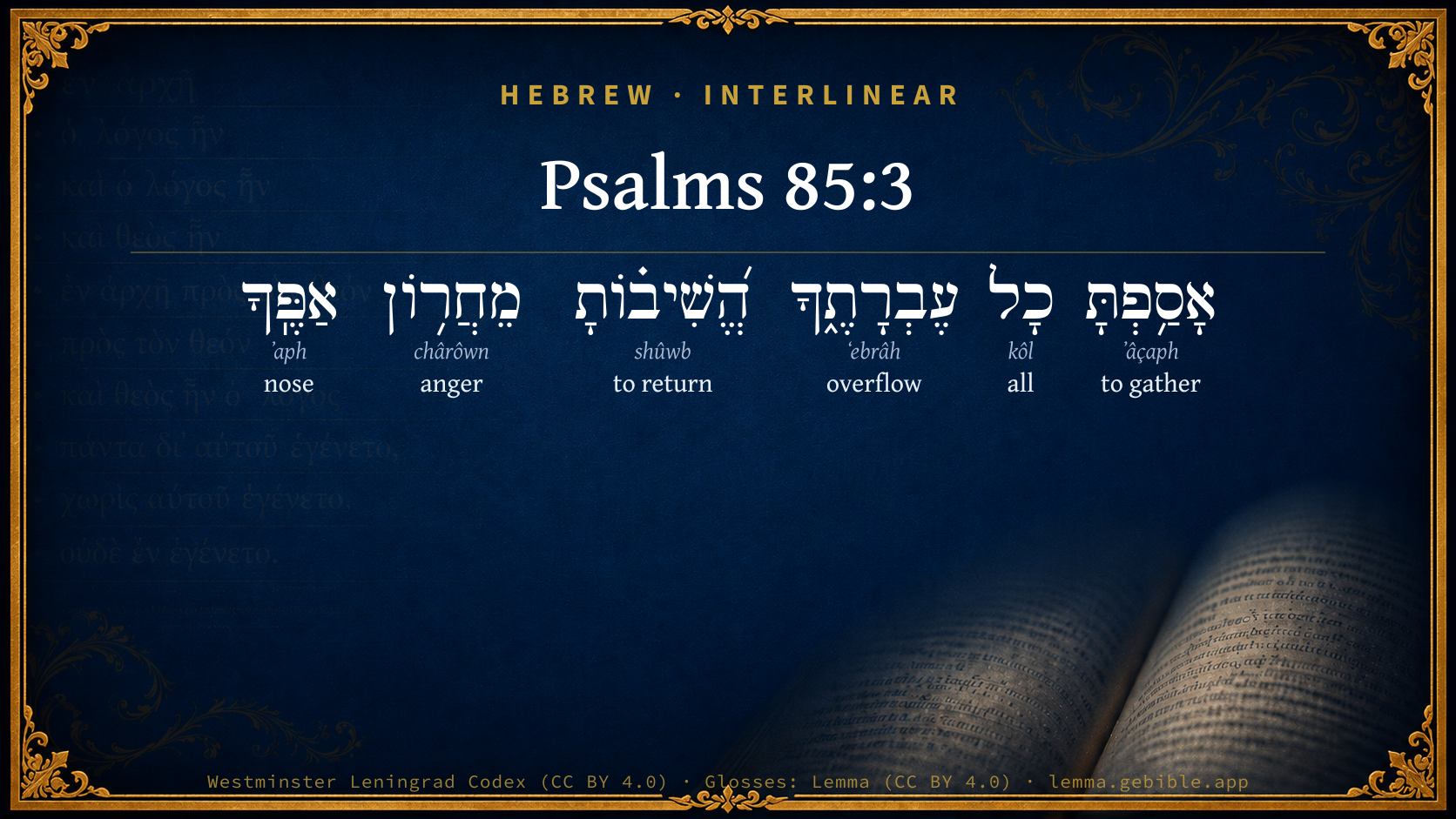
Psalms 85:3

Hebrew (Westminster Leningrad Codex) Psalms 85:3 appears in the Hebrew Old Testament. The text above is from the Westminster Leningrad Codex. Each word links to its Strong’s number, a concise gloss, and parsing drawn from the Open Scriptures Hebrew Bible morphology. Click any word for its full Brown-Driver-Briggs (BDB) entry.
Download image
Cite this verse

Psalms 85:3 (World English Bible). Public Domain. Lemma interlinear Bible study tool, https://lemma.gebible.app/v/psalms/85/3.

Show BibTeX & RIS
BibTeX
RIS
English Translation
You have taken away all your wrath. You have turned from the fierceness of your anger.
World English Bible · Public Domain
Download a study sheet

One document with this verse’s original text, its word-by-word gloss line, the meaning frame, cross-references with their text, attributed commentary, and full source and license credits — printable, and it pastes into notes with its structure intact.

This verse Autodidact and up

Study sheet (.html) Plain text (.txt)

A passage Seminary Student

Up to 50 verses in one chapter. A passage sheet keeps up to 6 commentary sources and 12 cross-references per verse, in the order this page ranks them, and says so on the sheet whenever that leaves anything out. Ask for a single verse and you get the Autodidact verse sheet above.

Everything on this page stays free to read, with no account — the sheet is a download of what is already on screen, not access to it.

Want to remove ads? Support Godless Engineer
Compare translations 3

The same verse in 3 English versions, stacked beneath the original-language interlinear above. Click any original word for its lexicon entry.

Each is an independent rendering of the whole verse — the interlinear is not word-aligned to these translations.

Highlighted words mark where these versions differ — a whole-verse word diff, not a word-by-word alignment.

  • World English Bible Public Domain
    You have taken away all your wrath. You have turned from the fierceness of your anger.
  • King James Version Public Domain
    Thou hast taken away all thy wrath: thou hast turned thyself from the fierceness of thine anger.
  • unfoldingWord Literal Text CC BY-SA 4.0
    You gathered up all of your wrath; you turned back from the burning of your nose.

unfoldingWord Literal Text — © unfoldingWord, licensed CC BY-SA 4.0. Word-aligned USFM3 via Door43 (git.door43.org/unfoldingWord/en_ult).

Versions to compare (up to 4)

3 of 4 selected

Show all 18 translations

Every available English version of this verse, each an independent rendering of the whole verse.

  • World English Bible Public Domain
    You have taken away all your wrath. You have turned from the fierceness of your anger.
  • Berean Standard Bible Public Domain
    You withheld all Your fury; You turned from Your burning anger.
  • Majority Standard Bible Public Domain
    You withheld all Your fury; You turned from Your burning anger.
  • King James Version Public Domain
    Thou hast taken away all thy wrath: thou hast turned thyself from the fierceness of thine anger.
  • American Standard Version (1901) Public Domain
    Thou hast taken away all thy wrath; Thou hast turned `thyself' from the fierceness of thine anger.
  • Revised Version (1885) Public Domain
    Thou hast taken away all thy wrath: thou hast turned thyself from the fierceness of thine anger.
  • Geneva Bible (1599) Public Domain
    Thou hast withdrawen all thine anger, and hast turned backe from the fiercenes of thy wrath.
  • Douay-Rheims (1899) Public Domain
    Thou hast forgiven the iniquity of thy people: thou hast covered all their sins.
  • Young's Literal Translation Public Domain
    Thou hast gathered up all Thy wrath, Thou hast turned back from the fierceness of Thine anger.
  • Literal Standard Version CC BY-SA 4.0
    You have gathered up all Your wrath, || You have turned back from the fierceness of Your anger.
  • Unlocked Literal Bible CC BY-SA 4.0
    You have withdrawn all your wrath; you have turned back from your hot anger.
  • unfoldingWord Literal Text CC BY-SA 4.0
    You gathered up all of your wrath; you turned back from the burning of your nose.
  • Darby Bible Public Domain
    Thou hast withdrawn all thy wrath; thou hast turned from the fierceness of thine anger.
  • World Messianic Bible Public Domain
    You have taken away all your wrath. You have turned from the fierceness of your anger.
  • Webster's Bible Public Domain
    \\85:2\\Thou hast forgiven the iniquity of thy people, thou hast covered all their sin. Selah.
  • Free Bible Version CC BY-SA 4.0
    You took back your fury; you turned away from your fierce anger.
  • Bible in Basic English Public Domain
    You were no longer angry: you were turned from the heat of your wrath.
  • JPS Tanakh (1917) Public Domain
    (85-4) Thou hast withdrawn all Thy wrath; Thou hast turned from the fierceness of Thine anger.

Literal Standard Version (2020), Covenant Press — licensed CC BY-SA 4.0. Text via the HelloAO Bible API (eBible.org). Unlocked Literal Bible (unfoldingWord) — licensed CC BY-SA 4.0. Text via the HelloAO Bible API (eBible.org). unfoldingWord Literal Text — © unfoldingWord, licensed CC BY-SA 4.0. Word-aligned USFM3 via Door43 (git.door43.org/unfoldingWord/en_ult). Free Bible Version, Dr. Jonathan Gallagher — licensed CC BY-SA 4.0. Text via the HelloAO Bible API (eBible.org).

Word by word

More ways to search: Search by grammar → Find every occurrence → Compare this word →

Practice this passage: Drill this verse → Learn its vocabulary →

About this verse

These counts appear in no published source. They are computed here, from the morphology-tagged text and Lemma’s own curated glosses. What Lemma adds →

6
words
6
distinct lemmas
Wisdom
section

Shared distinctive vocabulary

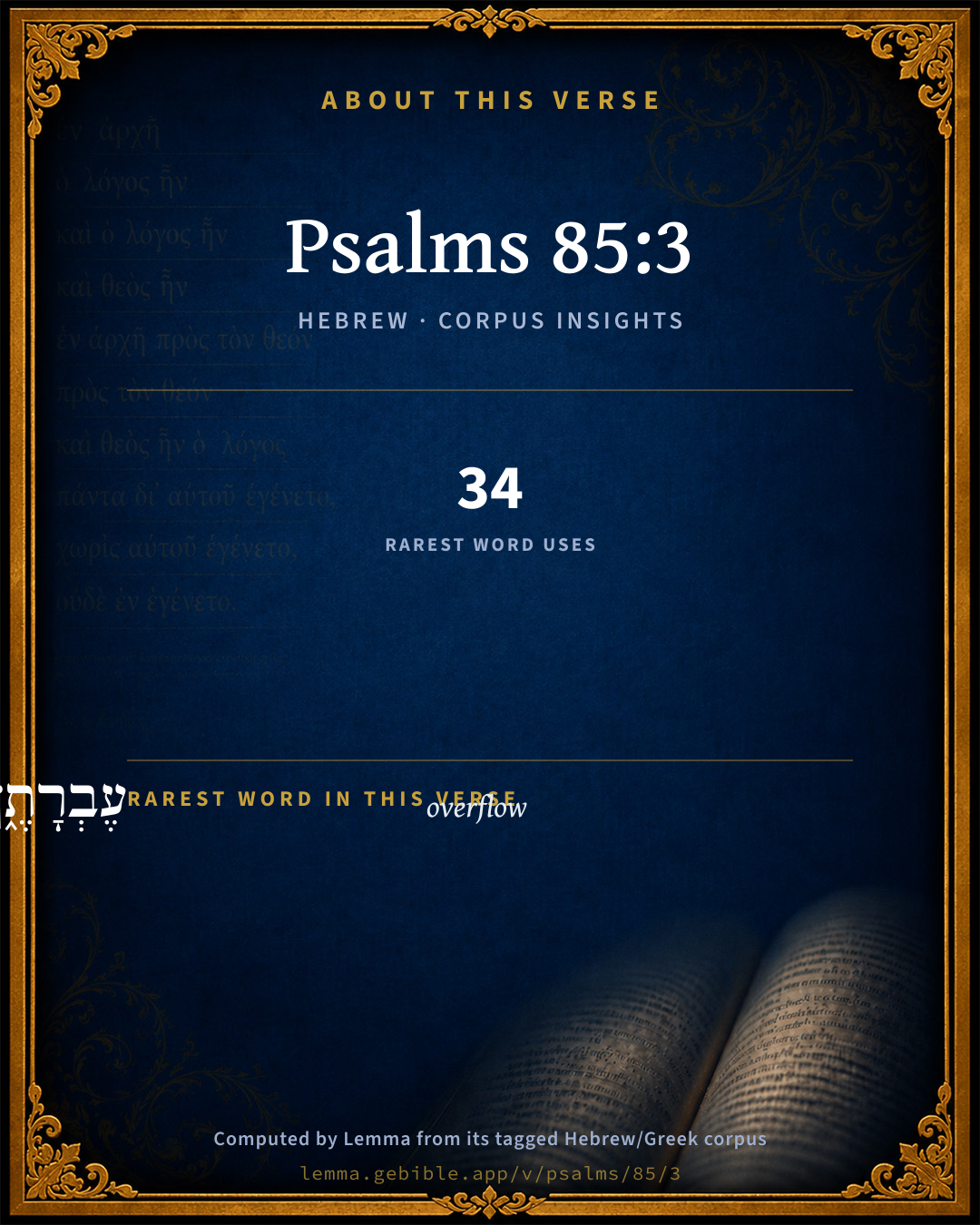
עֶבְרָתֶ֑ךָ overflow H5678 occurs in 34 verses of the Hebrew Bible. Also found in:

Grammatical profile

  • 2 verbs
  • 4 nouns

Verb forms

  • אָסַ֥פְתָּ Qal · Perfect
  • הֱ֝שִׁיב֗וֹתָ Hiphil · Perfect

Hebrew & Septuagint length

In English translation the verse runs 16 words from the Hebrew and 15 from the Septuagint (LXX English) — closely comparable.

A rough comparison of the two English renderings, which tokenize alike — not a word-level alignment.

Word counts can differ between the Hebrew and the Greek without any difference in meaning — e.g. the Hebrew direct-object marker אֵת has no separate Greek word, and Greek often adds the article ὁ.

Cross-references

10

Topical passages linked to Psalms 85:3 in the Treasury of Scripture Knowledge — connected by theme and wording, ordered by reader-vote popularity; previews shown in the World English Bible.

  • Deuteronomy 13:17 There shall cleave nothing of the devoted thing to your hand; that Yahweh may turn from the fierceness of his anger, and show you mercy, and have compassion on you, and multiply you, as he has sworn to your fathers;
  • Psalms 106:23 Therefore he said that he would destroy them, Had Moses, his chosen, not stood before him in the breach, To turn away his wrath, so that he wouldn't destroy them.
  • Isaiah 12:1 In that day you will say, "I will give thanks to you, Yahweh; for though you were angry with me, your anger has turned away and you comfort me.
  • Jonah 3:9 Who knows whether God will not turn and repent, and turn away from his fierce anger, so that we might not perish?"
  • Psalms 78:38 But he, being merciful, forgave iniquity, and didn't destroy them. Yes, many times he turned his anger away, And didn't stir up all his wrath.
  • Isaiah 6:7 He touched my mouth with it, and said, "Behold, this has touched your lips; and your iniquity is taken away, and your sin forgiven."
  • Exodus 32:11–12 Moses begged Yahweh his God, and said, "Yahweh, why does your wrath burn hot against your people, that you have brought forth out of the land of Egypt with great power and with a mighty hand?
  • Exodus 32:22 Aaron said, "Don't let the anger of my lord grow hot. You know the people, that they are set on evil.
  • Isaiah 54:7–10 For a small moment have I forsaken you; but with great mercies will I gather you.
  • John 1:29 The next day, he saw Jesus coming to him, and said, "Behold, the Lamb of God, who takes away the sin of the world!

Cross-references courtesy of OpenBible.info (CC BY 4.0).

Hebrew and Greek witnesses Masoretic Hebrew ↔ Greek Septuagint

The same verse in the two great witnesses to the Old Testament, shown verse-for-verse.

You’re reading Greek Psalm 84 (Hebrew Psalm 85). The Septuagint counts the superscription, so verse numbers can differ from the Hebrew — chapter-level alignment, not verse-by-verse. Numbering follows Rahlfs.

These are two independent witnesses, not word-aligned to each other, and the Septuagint is shown in lemma (dictionary) form.

Hebrew Psalms 85:3 Masoretic · Westminster Leningrad Codex

אָסַ֥פְתָּ כָל עֶבְרָתֶ֑ךָ הֱ֝שִׁיב֗וֹתָ מֵחֲר֥וֹן אַפֶּֽךָ

You have taken away all your wrath. You have turned from the fierceness of your anger.

World English Bible · Public Domain

Greek LXX Greek Psalm 84:3 Septuagint · lemma form

ἀποἵημι ὁ ἀνομία ὁ λαός σύ καλύπτω πᾶς ὁ ἁμαρτία αὐτός διάψαλμα

You have caused all your wrath to cease: you have turned from your fierce anger.

LXX2012 (modern English Septuagint) · Public Domain

Hebrew: Westminster Leningrad Codex (CC BY 4.0). Greek: Septuagint (public domain); English from LXX2012 (modern English Septuagint) (Public Domain). How the Septuagint differs from the Hebrew →

Commentary

Notes on Psalms 85:3 from classic Christian and Jewish commentators (each source and its license shown beneath its notes). The classic Christian expositions comment on the surrounding passage and are grouped to its opening verse, so a note may address several verses; the Jewish commentaries on the Tanakh (Rashi and others) are per-verse, so they appear only where the commentator wrote on this verse.

Lemma curates 59 commentaries, every one of them public domain or Creative Commons licensed, each selected and text-cleaned for this edition rather than reprinted as found. About our sources →

Trapp's Complete Commentary

John Trapp

Psa 85:3 Thou hast taken away all thy wrath: thou hast turned [thyself] from the fierceness of thine anger.

Ver. 3. Thou hast taken away all thy wrath] Heb. thou hast gathered it, thou hast recollected it, that we might not bear it; when sin is once remitted, wrath is soon removed.

Thou hast turned thyself from the fierceness, &c.] Here are six hasts drawing in the next turn, Psa 85:4. God hath, and therefore God will, is a strong medium of hope, if not a demonstration of Scripture logics. See 2Co 1:10.

John Trapp, A Commentary or Exposition upon All the Books of the Old and New Testament (1647–1656) — public domain. Text from a community e-Sword module.

Geneva Bible (1599)

Geneva Bible translators

Not only in withdrawing thy rod, but in forgiving of sins, and in touching our hearts to confess them.

Geneva Bible (1599) marginal notes — public domain. Text via Bolls.life.

Adam Clarke's Commentary

Verse 3. Thou hast taken away] אספת asaphta, "Thou hast gathered up all thy wrath." This carries on the metaphor in the second verse: "Thou hast collected all thy wrath, and carried it away with all our iniquities."

Adam Clarke's Commentary on the Bible (1810–1826) — public domain. Text from a community e-Sword/MySword module.

The Cambridge Bible for Schools and Colleges

gen. ed. J. J. S. Perowne

3. Thou hast taken away] Lit. withdrawn, or drawn in, the wrath which was let loose against us.

from the fierceness of thine anger] Poured out upon Israel for its sin. See Jer_30:24; Lam_1:12; Lam_4:11. Cp. Exo_32:12.

The Cambridge Bible for Schools and Colleges (gen. ed. J. J. S. Perowne; Cambridge University Press, 1878–1918) — public domain. Text from a community e-Sword module.

John Gill's Exposition

Thou hast taken away all thy wrath,.... Or "gathered" (n) it; sin occasions wrath, and the people of God are as deserving of it as others; but the Lord has gathered it up, and poured it forth upon his Son, and their surety; hence nothing of this kind shall ever fall upon them, either here or hereafter; and it is taken away from them, so as to have no sense, apprehension, or conscience of it, which before the law had wrought in them, when pardon is applied unto them, which is what is here meant; see Isa 12:1,

thou hast turned thyself from the fierceness of thine anger; the anger of God is very fierce against sin and sinners; it is poured forth like fire, and there is no abiding it; but, with respect to the Lord's people, it is pacified by the death of his Son; or he is pacified towards them for all that they have done, for the sake of his righteousness and sacrifice; and which appears to them when he manifests his love and pardoning grace to their souls; see Eze 16:63.

(n) "collegisti", Montanus, Gejerus, Michaelis.

John Gill's Exposition of the Whole Bible (1746–1763) — public domain (CC PDM 1.0). Text via the HelloAO Bible API.

Albert Barnes' Notes on the Bible

Thou hast taken away all thy wrath - That is, formerly; on the occasion referred to. Thou didst so deal with thy people as to make it evident that thou didst cherish no anger or displeasure against them.

Thou hast turned thyself ... - Margin, “thine anger from waxing hot.” Literally, Thou didst turn from the heat of thine anger. His indignation was withdrawn, and he was again at peace with them. It is this fact, drawn from the former history of the people, which constitutes the basis of the appeal which follows.

Albert Barnes' Notes on the Bible (1834–1885) — public domain. Text from a community e-Sword/MySword module.

Matthew Poole's English Annotations

All thy wrath; those calamities which were the effects of thy just wrath conceived against us.

Matthew Poole's English Annotations on the Holy Bible (1683–1685) — public domain. Text from a community e-Sword/MySword module.

The Treasury of David

Charles H. Spurgeon

Ver. 3. Thou hast taken away all thy wrath. Having removed the sin, the anger is removed also. How often did the longsuffering of God take away from Israel the punishments which had been justly laid upon them! How often also has the Lord's chastising hand been removed from us when our waywardness called for heavier strokes!

Thou hast turned thyself from the fierceness of thine anger. Even when judgments had been most severe, the Lord had in mercy stayed his hand. In mid volley he had restrained his thunder. When ready to destroy, he had averted his face from his purpose of judgment and allowed mercy to interpose. The book of Judges is full of illustrations of this, and the psalmist does well to quote them while he interceded. Is not our experience equally studded with instances in which judgment has been stayed and tenderness has ruled? What a difference between the fierce anger which is feared and deprecated here, and the speaking of peace which is foretold in verse 8. There are many changes in Christian experience, and therefore we must not despair when we are undergoing the drearier portion of the spiritual life, for soon, very soon, it may be transformed into gladness.

"The Lord can clear the darkest skies,

Can give us day for night.

Make drops of sacred sorrow rise

To rivers of delight."

Ver. 3. Thou hast taken away all thy wrath. Or gathered it; sin occasions wrath, and the people of God are as deserving of it as others; but the Lord has gathered it up, and poured it forth upon his Son, and their Surety; hence nothing of this kind shall ever fall upon them, either here or hereafter; and it is taken away from them, so as to have no sense, apprehension, or conscience of it, which before the law had wrought in them, when pardon is applied unto them, which is what is here meant. John Gill.

Ver. 3. Thou hast turned thyself. Here are six hasts drawing in the next turn, Ps 85:4. God hath, and therefore God will is a strong medium of hope, if not a demonstration of Scripture logic. See 2Co 1:10. John Trapp.

Ver. 3.

I. The language of penitence. It is implied here that

the wrath was,

(a) Great:

(b) Just thy wrath.

II. The language of faith.

(a) In the grace of pardon: Thou hast turned away

wrath. We could not, by anything we could do or

suffer.

(b) In the method of pardon: Turned away. Turned

it from us to our Surety.

III. The language of praise: Thou hastthou hast.

Psalms 85:4*

Charles H. Spurgeon's The Treasury of David (1869–1885) — public domain. Psalms only. Text from a community e-Sword/MySword module.

Whedon's Commentary on the Bible

Daniel D. Whedon

3. Taken away all thy wrath—Thou hast gathered in all thy wrath. It was an emanation from God, and, having accomplished its end, it is now recalled.

Daniel D. Whedon (gen. ed.), Commentary on the Old and New Testaments (1874–1909) — public domain. Text from a community e-Sword module.

The Pulpit Commentary

Thou hast taken away all thy wrath. Forgiveness of sins implies the cessation of wrath, though it does not necessarily imply the cessation of punishment. Thou hast turned thyself from the fierceness of thine anger. This expresses the meaning better than the marginal rendering.

Vers. 3-5. Incomplete redempt ions.

While thankfully acknowledging all that God has done for his people, the psalmist clearly sees that it was but the "fierceness" of God"s wrath from which he had turned, and that some of his wrath remained, seeing that the work of national recovery was incomplete, and heavy burdens still pressed on the people. Perowne recalls the circumstances of the exiles as Nehemiah found them. They were "in great affliction and reproach." "It was only in the midst of perpetual opposition and. discouragement that he was able to carry on his work. The bright prospect which was opening before the exiles had been quickly dashed. They had returned, indeed, but it was to a desert land and a forsaken city, whose wails were cast down, and her gates burned with fire; whilst jealous and hostile tribes were ever on the watch to assail and vex them. Hence it is that the entreaty for mercy follows so hard upon the acknowledgment that mercy has been vouchsafed." As a person might look, in a depressed mood, on the returned exiles, God"s redemption was incomplete. Their restoration to their own land had brought them apparently no rest, no consolation, no hope for the future.

I THERE IS A SENSE IN WHICH GOD"S REDEMPTIONS ARE NEVER COMPLETE. They are always redemptions from some calamities, not redemptions from all calamities. Every redemption is a beginning, holding within it the promise of something more that God is about to do. Open this fully out by showing that a spiritual redemption is to be followed by a bodily redemption. Christ wins the soul, and then proceeds to win the whole human sphere, and eventually all creation. The great redemption removes the soul penalties of sin; but it is not a perfect redemption until it has removed all the bodily penalties and disabilities of sin also. As a matter of Christian experience, we always feel, with the apostle, as if redemption were something yet to come. As we read our lives, they are still spheres for a divinely redemptive work. The full salvation "is ready to be revealed in the last time." Redemption thought of as complete checks a living dependence. Redemption thought of as incomplete keeps us in close reliance on the present and ever-working Redeemer.

II THERE IS A SENSE IN WHICH GOD"S REDEMPTIONS ARE EVER IN PROGRESS. They are only incomplete as the building at which the workmen are working. Those exiles would be comforted as they realized God with them, delivering and rescuing, and carrying, in practical detail, to its perfection his gracious redemptive thought. R.T.

The Pulpit Commentary (1880–1919), ed. H.D.M. Spence-Jones & Joseph S. Exell — public domain. Text from a community e-Sword module.

unfoldingWord translationNotes

Door43 World Missions Community

You have withdrawn all your wrath

God no longer punishing the Israelites is spoken of as if wrath were an object that Yahweh could take away from the Israelites. (See: Metaphor)

you have turned back from your hot anger

God no longer being angry with the Israelites is spoken of as if anger were a fire that God from which God turned away. (See: Metaphor)

God of our salvation

The abstract noun "salvation" can be stated as a verb. AT: "God who saves us" (See: Abstract Nouns)

let go of your displeasure with us

Asking God to stop being angry with the Israelites is spoken of as if displeasure were an object the writer wants God to let go of. (See: Metaphor)

Will you be angry with us forever? Will you remain angry throughout future generations?

The writer uses these questions to emphasize that he is requesting God to stop being angry with them. These rhetorical questions can be translated as a statement. AT: "Please do not stay angry at us forever." (See: Rhetorical Question)

translationWords

wrath

turn

anger

restore

God

save

eternity

generation

unfoldingWord translationNotes — © Distant Shores Media and the Door43 World Missions Community, licensed CC BY-SA 4.0. Source: git.door43.org/Door43/en_tn.

Lesson kit

Teaching starters — assembled from the data on this page, not authored interpretation. Every prompt links to the verse data it draws on. Edit before teaching.

Psalms, in the Wisdom, opens this verse with 6 words (6 distinct Hebrew lemmas). Its most distinctive word is ʻebrâh (“overflow”). A historical commentator’s framing appears above. Read the whole chapter for the surrounding context.

Discussion questions

  1. How does “overflow” (ʻebrâh) shape what this verse is saying?
  2. Genesis 49:7 shares the word «overflow» with this verse. How do the two illuminate each other?
  3. The translations on this page render this verse differently — a whole-verse word diff, not a word-by-word alignment. What might account for the different wordings?
  4. The verb «אָסַ֥פְתָּ» is Qal Perfect. How does its form color the action?
  5. Reading how Trapp's Complete Commentary and Geneva Bible (1599) read this verse, where do the two commentators agree and where do they part?

Things to notice

Reading settings

Reading text

Shown beneath each verse's original-language words.

Old Testament
Old Testament edition

Read the OT as the Masoretic Hebrew (MT) or the Greek Septuagint (LXX).

English shown for the Greek Septuagint (in the Hebrew ↔ Greek comparison).

Comparing translations? Open the Compare panel on any verse page to stack up to four side by side.