Judges 3:13

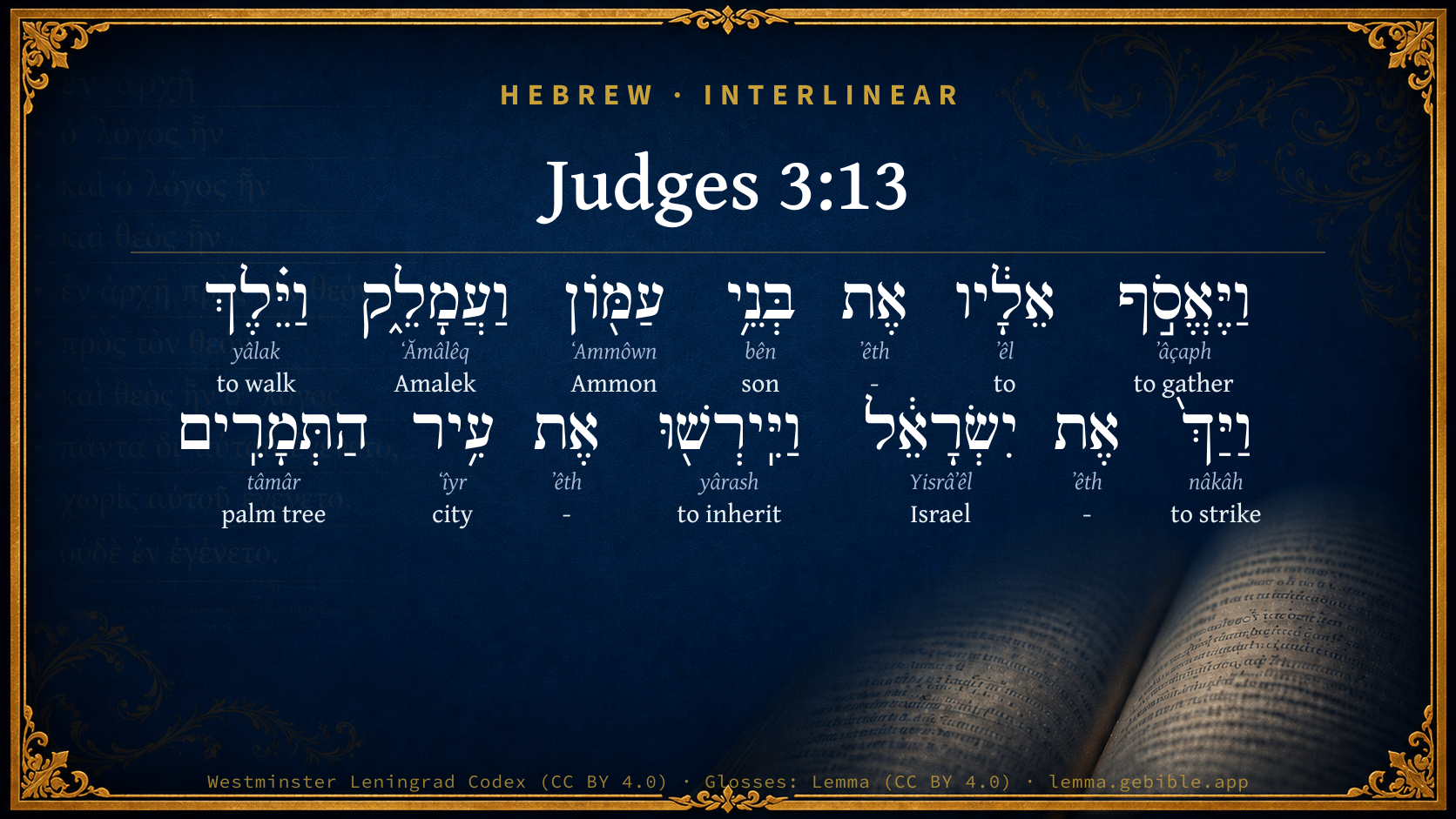
Hebrew (Westminster Leningrad Codex) Judges 3:13 appears in the Hebrew Old Testament. The text above is from the Westminster Leningrad Codex. Each word links to its Strong’s number, a concise gloss, and parsing drawn from the Open Scriptures Hebrew Bible morphology. Click any word for its full Brown-Driver-Briggs (BDB) entry.
Download image
Cite this verse

Judges 3:13 (World English Bible). Public Domain. Lemma interlinear Bible study tool, https://lemma.gebible.app/v/judges/3/13.

Show BibTeX & RIS
BibTeX
RIS
English Translation
He gathered to him the children of Ammon and Amalek; and he went and struck Israel, and they possessed the city of palm trees.
World English Bible · Public Domain
Download a study sheet

One document with this verse’s original text, its word-by-word gloss line, the meaning frame, cross-references with their text, attributed commentary, and full source and license credits — printable, and it pastes into notes with its structure intact.

This verse Autodidact and up

Study sheet (.html) Plain text (.txt)

A passage Seminary Student

Up to 50 verses in one chapter. A passage sheet keeps up to 6 commentary sources and 12 cross-references per verse, in the order this page ranks them, and says so on the sheet whenever that leaves anything out. Ask for a single verse and you get the Autodidact verse sheet above.

Everything on this page stays free to read, with no account — the sheet is a download of what is already on screen, not access to it.

Want to remove ads? Support Godless Engineer
Compare translations 3

The same verse in 3 English versions, stacked beneath the original-language interlinear above. Click any original word for its lexicon entry.

Each is an independent rendering of the whole verse — the interlinear is not word-aligned to these translations.

Highlighted words mark where these versions differ — a whole-verse word diff, not a word-by-word alignment.

  • World English Bible Public Domain
    He gathered to him the children of Ammon and Amalek; and he went and struck Israel, and they possessed the city of palm trees.
  • King James Version Public Domain
    And he gathered unto him the children of Ammon and Amalek, and went and smote Israel, and possessed the city of palm trees.
  • unfoldingWord Literal Text CC BY-SA 4.0
    And he gathered to him the sons of Ammon and Amalek, and he went and struck Israel, and they possessed the City of Palms.

unfoldingWord Literal Text — © unfoldingWord, licensed CC BY-SA 4.0. Word-aligned USFM3 via Door43 (git.door43.org/unfoldingWord/en_ult).

Versions to compare (up to 4)

3 of 4 selected

Show all 18 translations

Every available English version of this verse, each an independent rendering of the whole verse.

  • World English Bible Public Domain
    He gathered to him the children of Ammon and Amalek; and he went and struck Israel, and they possessed the city of palm trees.
  • Berean Standard Bible Public Domain
    After enlisting the Ammonites and Amalekites to join forces with him, Eglon attacked and defeated Israel, taking possession of the City of Palms.
  • Majority Standard Bible Public Domain
    After enlisting the Ammonites and Amalekites to join forces with him, Eglon attacked and defeated Israel, taking possession of the City of Palms.
  • King James Version Public Domain
    And he gathered unto him the children of Ammon and Amalek, and went and smote Israel, and possessed the city of palm trees.
  • American Standard Version (1901) Public Domain
    And he gathered unto him the children of Ammon and Amalek; and he went and smote Israel, and they possessed the city of palm-trees.
  • Revised Version (1885) Public Domain
    And he gathered unto him the children of Ammon and Amalek; and went and smote Israel, and they possessed the city of palm trees.
  • Geneva Bible (1599) Public Domain
    And he gathered vnto him the children of Ammon, and Amalek, and went and smote Israel, and they possessed the citie of palme trees.
  • Douay-Rheims (1899) Public Domain
    And he joined to him the children of Ammon, and Amalec: and he went and overthrew Israel, and possessed the city of palm trees.
  • Young's Literal Translation Public Domain
    and he gathereth unto him the Bene-Ammon and Amalek, and goeth and smiteth Israel, and they possess the city of palms;
  • Literal Standard Version CC BY-SA 4.0
    and he gathers the sons of Ammon and Amalek to himself, and goes and strikes Israel, and they possess the city of palms;
  • Unlocked Literal Bible CC BY-SA 4.0
    Eglon joined with the Ammonites and the Amalekites and they went and defeated Israel, and they took possession of the City of Palms.
  • unfoldingWord Literal Text CC BY-SA 4.0
    And he gathered to him the sons of Ammon and Amalek, and he went and struck Israel, and they possessed the City of Palms.
  • Darby Bible Public Domain
    He gathered to himself the Ammonites and the Amal'ekites, and went and defeated Israel; and they took possession of the city of palms.
  • World Messianic Bible Public Domain
    He gathered the children of Ammon and Amalek to himself; and he went and struck Israel, and they possessed the city of palm trees.
  • Webster's Bible Public Domain
    And he gathered to him the children of Ammon and Amalek, and went and smote Israel, and possessed the city of palm-trees.
  • Free Bible Version CC BY-SA 4.0
    Eglon had the Ammonites and the Amalekite join him, and then attacked and defeated Israel, taking possession of the City of Palms.
  • Bible in Basic English Public Domain
    And Eglon got together the people of Ammon and Amalek, and they went and overcame Israel and took the town of palm-trees.
  • JPS Tanakh (1917) Public Domain
    And he gathered unto him the children of Ammon and Amalek; and he went and smote Israel, and they possessed the city of palm-trees.

Literal Standard Version (2020), Covenant Press — licensed CC BY-SA 4.0. Text via the HelloAO Bible API (eBible.org). Unlocked Literal Bible (unfoldingWord) — licensed CC BY-SA 4.0. Text via the HelloAO Bible API (eBible.org). unfoldingWord Literal Text — © unfoldingWord, licensed CC BY-SA 4.0. Word-aligned USFM3 via Door43 (git.door43.org/unfoldingWord/en_ult). Free Bible Version, Dr. Jonathan Gallagher — licensed CC BY-SA 4.0. Text via the HelloAO Bible API (eBible.org).

Word by word

More ways to search: Search by grammar → Find every occurrence → Compare this word →

Practice this passage: Drill this verse → Learn its vocabulary →

הַתְּמָרִֽים
tâmâr
H8558
“the · palm trees”
Particle, Definite Article + Noun, Common, Masculine, Plural, Absolute
Part of Speech
Particle + Noun
Type
Common
Gender
Masculine
Number
Plural
State
Absolute
Full BDB Definition

Origin: from an unused root meaning to be erect

TWOT: 2523

palm tree, date palm
  1. וַיֶּאֱסֹ֣ף ʼâçaph H622 “and · to gather” Conjunction + Verb, Qal, Sequential Imperfect, 3rd Person, Masculine, Singular
  2. אֵלָ֔יו ʼêl H413 “to · him” Preposition + Suffix, Personal, 3rd Person, Masculine, Singular
  3. אֶת ʼêth H853 “-” Particle, Direct Object
  4. בְּנֵ֥י bên H1121 “sons of” Noun, Common, Masculine, Plural, Construct
  5. עַמּ֖וֹן ʻAmmôwn H5983 “Ammon” Noun, Proper
  6. וַעֲמָלֵ֑ק ʻĂmâlêq H6002 “and · Amalek” Conjunction + Noun, Proper
  7. וַיֵּ֗לֶךְ yâlak H3212 “and · to walk” Conjunction + Verb, Qal, Sequential Imperfect, 3rd Person, Masculine, Singular
  8. וַיַּךְ֙ nâkâh H5221 “and · to strike” Conjunction + Verb, Hiphil, Sequential Imperfect, 3rd Person, Masculine, Singular
  9. אֶת ʼêth H853 “-” Particle, Direct Object
  10. יִשְׂרָאֵ֔ל Yisrâʼêl H3478 “Israel” Noun, Proper
  11. וַיִּֽירְשׁ֖וּ yârash H3423 “and · to inherit” Conjunction + Verb, Qal, Sequential Imperfect, 3rd Person, Masculine, Plural
  12. אֶת ʼêth H853 “-” Particle, Direct Object
  13. עִ֥יר ʻîyr H5892 “city of” Noun, Common, Feminine, Singular, Construct

About this verse

These counts appear in no published source. They are computed here, from the morphology-tagged text and Lemma’s own curated glosses. What Lemma adds →

14
words
12
distinct lemmas
Historical
section

Notable vocabulary

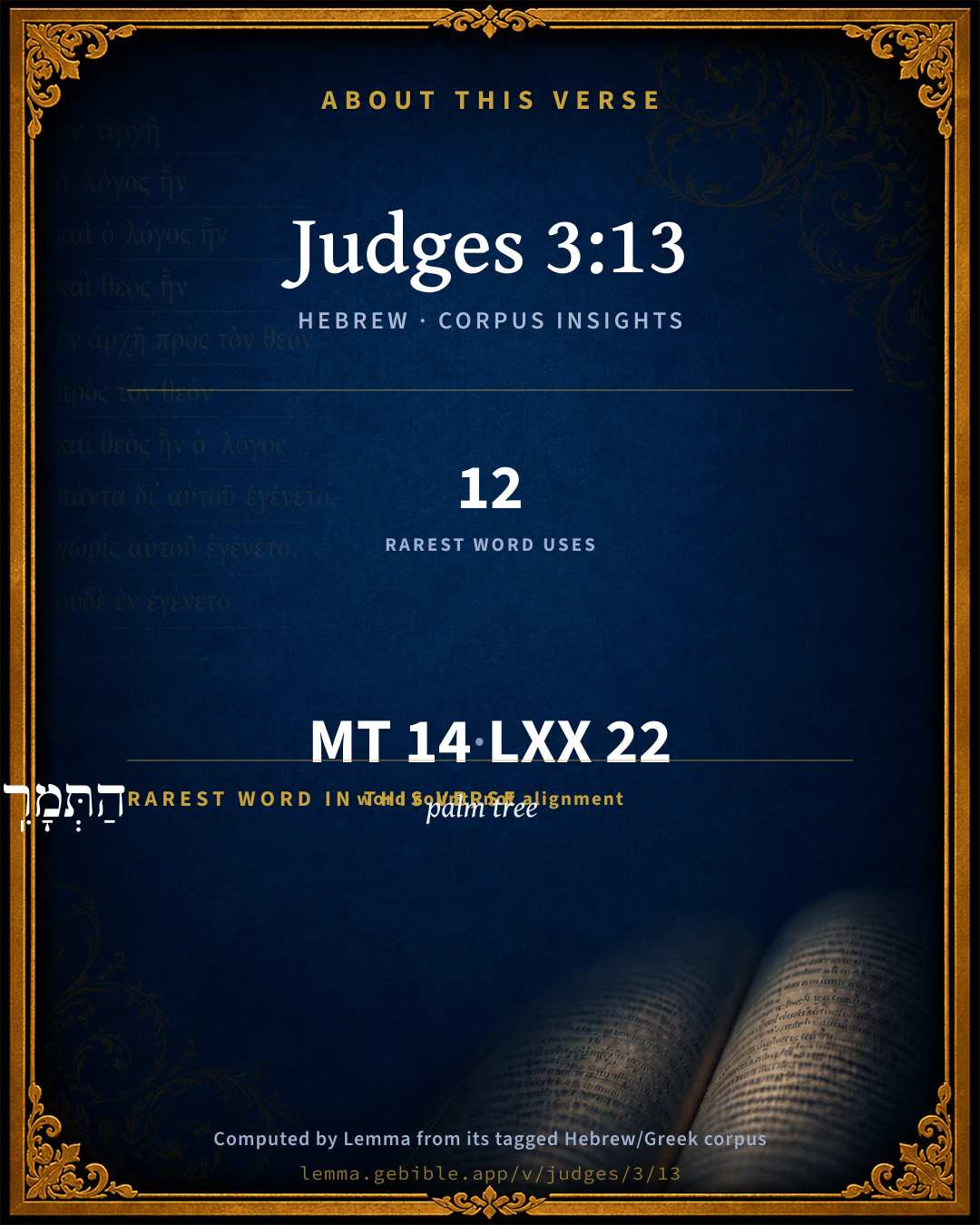
The rarest word here is הַתְּמָרִֽים palm tree H8558 — appearing just 12 times in the whole Hebrew Bible.

Shared distinctive vocabulary

הַתְּמָרִֽים palm tree H8558 occurs in 12 verses of the Hebrew Bible. Also found in:

Grammatical profile

  • 4 verbs
  • 6 nouns
  • 1 preposition
  • 3 particles

Verb forms

  • וַיֶּאֱסֹ֣ף Qal · Sequential Imperfect
  • וַיֵּ֗לֶךְ Qal · Sequential Imperfect
  • וַיַּךְ֙ Hiphil · Sequential Imperfect
  • וַיִּֽירְשׁ֖וּ Qal · Sequential Imperfect

Hebrew & Septuagint length

In English translation the verse runs 24 words from the Hebrew and 25 from the Septuagint (LXX English) — closely comparable.

A rough comparison of the two English renderings, which tokenize alike — not a word-level alignment.

Word counts can differ between the Hebrew and the Greek without any difference in meaning — e.g. the Hebrew direct-object marker אֵת has no separate Greek word, and Greek often adds the article ὁ.

In the original languages it is 14 Hebrew tokens and 22 Greek tokens — but the two are counted differently (Hebrew bundles its prefixes and suffixes into one token; the Greek is in lemma form), so that isn’t a like-for-like length.

Cross-references

4

Topical passages linked to Judges 3:13 in the Treasury of Scripture Knowledge — connected by theme and wording, ordered by reader-vote popularity; previews shown in the World English Bible.

  • Judges 1:16 The children of the Kenite, Moses' brother-in-law, went up out of the city of palm trees with the children of Judah into the wilderness of Judah, which is in the south of Arad; and they went and lived with the people.
  • Deuteronomy 34:3 and the South, and the Plain of the valley of Jericho the city of palm trees, to Zoar.
  • Judges 5:14 Out of Ephraim [came down] they whose root is in Amalek; After you, Benjamin, among your peoples; Out of Machir came down governors, Out of Zebulun those who handle the marshal's staff.
  • Psalms 83:6–7 The tents of Edom and the Ishmaelites; Moab, and the Hagrites;

Cross-references courtesy of OpenBible.info (CC BY 4.0).

Hebrew and Greek witnesses Masoretic Hebrew ↔ Greek Septuagint

The same verse in the two great witnesses to the Old Testament, shown verse-for-verse.

These are two independent witnesses, not word-aligned to each other, and the Septuagint is shown in lemma (dictionary) form.

Hebrew Judges 3:13 Masoretic · Westminster Leningrad Codex

וַיֶּאֱסֹ֣ף אֵלָ֔יו אֶת בְּנֵ֥י עַמּ֖וֹן וַעֲמָלֵ֑ק וַיֵּ֗לֶךְ וַיַּךְ֙ אֶת יִשְׂרָאֵ֔ל וַיִּֽירְשׁ֖וּ אֶת עִ֥יר הַתְּמָרִֽים

He gathered to him the children of Ammon and Amalek; and he went and struck Israel, and they possessed the city of palm trees.

World English Bible · Public Domain

Greek LXX Judges 3:13 Septuagint · lemma form

καί συνἄγω πρός ἑαυτοῦ πᾶς ὁ υἱός αμμων καί αμαληκ καί πορεύομαι καί πατάσσω ὁ ἰσραήλ καί κληρονομέω ὁ πόλις ὁ φοῖνιξ

And he gathered to himself all the children of Ammon and Amalec, and went and struck Israel, and took possession of the city of Palm-trees.

LXX2012 (modern English Septuagint) · Public Domain

Hebrew: Westminster Leningrad Codex (CC BY 4.0). Greek: Septuagint (public domain); English from LXX2012 (modern English Septuagint) (Public Domain). How the Septuagint differs from the Hebrew →

Targum (Aramaic paraphrase)

1

The Targum is the ancient Jewish Aramaic paraphrase of the Hebrew Scriptures — an interpretive translation, not the Hebrew text itself. Onkelos (literal) and Pseudo-Jonathan (expansive) render the Torah, and Jonathan the Prophets. Coverage is partial: where no permissively-licensed English translation exists for a verse, only the Aramaic is shown. This is verse-level text, not a word-by-word alignment to the Hebrew.

  1. Targum Jonathan Prophets (Joshua–Malachi)
    וּכְנַשׁ לְוָתֵיה יַת בְּנֵי עַמוֹן וַעֲמָלֵק וַאֲזַל וּמְחָא יַת יִשְׂרָאֵל וִירִיתוּ יַת קַרְתָּא יְרִיחוֹ:

    (no public-domain English translation for this verse)

    Targum Jonathan — Aramaic: “Mikraot Gedolot” (public domain). English: “Sefaria Community Translation” (CC0 1.0 (public-domain dedication)); “London "Chaldee Paraphrase," 1871” (public domain). Text via Sefaria.

Commentary

Notes on Judges 3:13 from classic Christian and Jewish commentators (each source and its license shown beneath its notes). The classic Christian expositions comment on the surrounding passage and are grouped to its opening verse, so a note may address several verses; the Jewish commentaries on the Tanakh (Rashi and others) are per-verse, so they appear only where the commentator wrote on this verse.

Lemma curates 59 commentaries, every one of them public domain or Creative Commons licensed, each selected and text-cleaned for this edition rather than reprinted as found. About our sources →

Trapp's Complete Commentary

John Trapp

Jdg 3:13 And he gathered unto him the children of Ammon and Amalek, and went and smote Israel, and possessed the city of palm trees.

Ver. 13. And possessed the city of palm trees.] A poor city now, but there, belike, he had built some forts and earthworks; namely at Jericho, famous for palm trees, as Justin also testifieth.

John Trapp, A Commentary or Exposition upon All the Books of the Old and New Testament (1647–1656) — public domain. Text from a community e-Sword module.

Joseph Benson's Commentary

Jdg 3:13-14. City of palm-trees — That is, Jericho. Not the city which was demolished, but the territory belonging to it. Here he fixed his camp, for the fertility of that soil, and because of its nearness to the passage over Jordan, which was most commodious both for the conjunction of his own forces, which lay on both sides of Jordan, to prevent the conjunction of the Israelites in Canaan with their brethren beyond Jordan, and to secure his retreat into his own country. Eighteen years — The former servitude lasted but eight years; this eighteen; for if smaller troubles do not the work, God will send greater.

Joseph Benson's Commentary on the Old and New Testaments (1811–1818) — public domain. Text from a community e-Sword module.

Adam Clarke's Commentary

Verse 13. The city of palm trees.] This the Targum renders the city of Jericho; but Jericho had been destroyed by Joshua, and certainly was not rebuilt till the reign of Ahab, long after this, 1Kg 16:34. However, as Jericho is expressly called the city of palm trees, De 34:3, the city in question must have been in the vicinity or plain of Jericho, and the king of Moab had seized it as a frontier town contiguous to his own estates. Calmet supposes that the city of palm trees means En-gaddi.

Adam Clarke's Commentary on the Bible (1810–1826) — public domain. Text from a community e-Sword/MySword module.

Ellicott's Commentary for English Readers

(13) The children of Ammon.—They were closely allied with the Moabites by affinities of race and character. (Gen_19:37-38.) We find them united with Moab against Jehoshaphat in 2Ch_20:1. (See Jdg_11:24.) It has been supposed that Chepharhaammonai (Jos_18:24), or “the village of the Ammonites,” is a memorial of this conquest (Stanley, Jewish Church, ii. 316).

Amalek.—The wild desert clans, which are united under this name, had been from the first the bitterest enemies of Israel. They had attacked the sick and feeble of their rearguard in the wilderness, and, after the battle of Rephidim, had called down on themselves the internecine anger of Israel (Exo_17:8-16; Deu_25:17), which finally found expression in the reign of Saul (1Sa_15:2-8). They are first mentioned in Gen_14:7, and it is probable that there was a tribe of Amalekites older than those descended from Eliphaz.

The city of palm trees.—No doubt Jericho. (See Jdg_1:16.) The verb “possessed” by no means implies that the whole city was necessarily re-built, still less that it was fortified. The “palace” of king Eglon was probably a wooden structure.

A Bible Commentary for English Readers, edited by Charles John Ellicott (1878–1897) — public domain. Text from a community e-Sword module.

The Cambridge Bible for Schools and Colleges

gen. ed. J. J. S. Perowne

13. Ammon and Amalek] Moab and Ammon appear in alliance against Israel in 2Ch_20:1; Psa_83:6 f. includes Amalek also. The Amalekites were Bedouin of the deserts S. of Palestine, in the N. of the Sinaitic peninsula, cf. Num_13:29 and ch. Jdg_1:16 n., Jdg_6:3. The Dtc. editor generalizes the invasion (‘and smote Israel’); perhaps he also enlarges the forces of the enemy.

the city of palm trees] i.e. Jericho, see Jdg_1:16. The district was once famous for its palms, balsam woods, and gardens (cf. the glowing description of Josephus, War iv. 8, 3); now ‘a dozen isolated palms represent the splendid groves of the past,’ Bliss in DB. ii. 581. At this period the possession of Jericho enabled Eglon to pursue his conquests W. of the Jordan; the city evidently commanded the district; later on it belonged to the kingdom of David, 2Sa_10:5. But according to Jos_6:24-26 JE Jericho was burnt to the ground and laid under a curse by Joshua, while 1Ki_16:34 records the rebuilding of the city and the fulfilment of the curse in the time of Ahab. We must reconcile as best we can these conflicting statements.

The Cambridge Bible for Schools and Colleges (gen. ed. J. J. S. Perowne; Cambridge University Press, 1878–1918) — public domain. Text from a community e-Sword module.

John Gill's Exposition

And he gathered unto him the children of Ammon and Amalek,.... Either the Lord gathered them to Eglon, inclined them to enter into a confederacy with him, to assist in the war against Israel; or the king of Moab got them to join with him in it, they being his neighbours, and enemies to Israel, and especially Amalek:

and went and smote Israel; first the two tribes and a half, which lay on that side Jordan Moab did, whom it is reasonable to suppose he would attack first; and having defeated them, he came over Jordan:

and possessed the city of the palm trees; Jericho, as the Targum, which was set with palm trees; see Deu 34:3; not the city itself, for that was destroyed by Joshua, and not rebuilt until the time of Ahab; but the country, about it, or, as Abarbinel thinks, a city that was near it; here Josephus says (t) he had his royal palace; it is probable he built a fort or garrison here, to secure the fords of Jordan, and his own retreat; as well as to keep up a communication with his own people, and prevent the tribes of the other side giving any assistance to their brethren, if able and disposed to do it.

(t) Antiqu. l. 5. c. 4. sect. 1.

John Gill's Exposition of the Whole Bible (1746–1763) — public domain (CC PDM 1.0). Text via the HelloAO Bible API.

Albert Barnes' Notes on the Bible

The children of Ammon (Bent-Ammon), almost always so spoken of from their ancestor Ben-ammi Gen 19:38, seem to be under the leadership of the king of Moab, as do also the Amlekites: this is perhaps the strengthening spoken of in Jdg 3:12. In Judg. 6 the combination is Midianites, Amalekites, and children of the East, or Arab tribes. In the narrative of Jephthah’s judgeship, the Ammonites alone are mentioned; but with a reference to the Moabites, and as if they were one people Jdg 11:24. The Amalekites appear as the constant and bitter foes of the Israelites (Exo 17:8 notes and references); and the naming a mountain in Ephraim, “the mount of the Amalekites” Jdg 12:15 is probably a memorial of this joint invasion of Moabites and Amalekites, and marks the scene either of their occupation, or of some signal victory over them.

The city of palm trees: i. e. Jericho Jdg 1:16, having been utterly destroyed by Joshua, and not rebuilt until the time of Ahab Jos 6:24-26; 1Ki 16:34, can only have existed at this time as an unwalled village, - like Jerusalem after its destruction by Nebuzaradan, until Nehemiah rebuilt its waits - and like its modern representative er-Riha, a village with a fortress for the Turkish garrison. This occupation of Jericho should be compared with the invasion in Jdg 10:9, where two out of the three tribes named, Benjamin and Ephraim, are the same as those here concerned, and where Jdg 10:7 the Philistines are coupled with the Ammonites, just as here Jdg 3:31 the Philistines are mentioned in near connection with the Moabites. See Introduction.

Albert Barnes' Notes on the Bible (1834–1885) — public domain. Text from a community e-Sword/MySword module.

Matthew Poole's English Annotations

i.e. Jericho, as may be gathered from Deu 24:3; Jdg 1:16; 2Ch 28:15. Not the city, which was demolished, but the territory belonging to it. Here he fixed his camp, partly for the admirable fertility of that soil; and partly because of its nearness to the passage over Jordan, which was most commodious, both for the conjunction of his own forces, which lay on both sides of Jordan; and to prevent the conjunction of the Israelites in Canaan with their brethren beyond Jordan; and to secure his retreat into his own country, which therefore the Israelites prevented, Jdg 3:28.

Matthew Poole's English Annotations on the Holy Bible (1683–1685) — public domain. Text from a community e-Sword/MySword module.

Whedon's Commentary on the Bible

Daniel D. Whedon

13. And he gathered — Not the Lord, but Eglon gathered unto himself, (see Sept.,) and went and smote, and possessed. Ammon was an incestuous child of Lot by his younger, as Moab was by his elder, daughter. These two nations were intimately related through their entire biblical history. The Ammonites cannot be very exactly located. They seem to have been migratory and predatory, like the modern Bedouins, and hence ready to join the Moabites in a war with Israel. See on Jos_12:2.

Amalek — A nomadic tribe occupying the peninsula of Sinai and the wilderness stretching away to the hill country of Southern Palestine. They dwindled into a band of robbers, and were destroyed by David at Ziklag. 1Sa_30:16-19. See more on Jdg_6:3; Gen_14:7; Exo_17:8.

The city of palm trees — Jericho was so called because of the groves of palms in its vicinity. See on Jos_2:1. According to Josephus, the course of Eglon’s conquest was first to gain dominion over the eastern tribes, a portion of whose land had been wrested from his ancestors, then to make a sudden incursion into Western Palestine, establishing his headquarters at Jericho, the key of the whole country. Here, according to Josephus, he built a royal palace, and at this place he was assassinated by Ehud.

Daniel D. Whedon (gen. ed.), Commentary on the Old and New Testaments (1874–1909) — public domain. Text from a community e-Sword module.

The Pulpit Commentary

The children of Ammon. The technical name of the Ammonite people. (see Gen_19:38 Deu_2:19, 37 Jud_1:10:6, 11, 17, etc.) Sometimes, however, they are called Ammon, or Ammonites. (see Deu_23:3 1Sa_11:11, etc.) Amalek, or the Amalekites, were the hereditary enemies of Israel. (see Exo_17:8-16 Jud_1:5:14 6:3, 33 7:12 1Sa_15:2, etc.) The Amalekites appear, from Gen_36:12, to have been a branch of the Edomites, and the latest mention of them in the Bible finds a remnant of them in the neighbourhood of Mount Seir in the days of Hezekiah. (1Ch_4:41-43) The city of palm trees, i.e. Jericho, Deu_34:3 Jud_1:16. Jericho was the first city in Canaan which any one crossing the fords of the Jordan would come to. (see Jos_2:1 Jos_6:1, etc.) Though no longer a fenced city, it was important from the fertility of the plain, and from its commanding the fords.

The Pulpit Commentary (1880–1919), ed. H.D.M. Spence-Jones & Joseph S. Exell — public domain. Text from a community e-Sword module.

John Wesley's Explanatory Notes

City of Palm-trees - That is, Jericho. Not the city which was demolished, but the territory belonging to it. Here he fixed his camp, for the fertility of that soil, and because of its nearness to the passage over Jordan, which was most commodious both for the conjunction of his own forces which lay on both sides of Jordan; to prevent the conjunction of the Israelites in Canaan with their brethren beyond Jordan; and to secure his retreat into his own country.

John Wesley, Explanatory Notes Upon the Whole Bible (1754–1765) — public domain. Text via the GEBible commentary corpus.

Rashi

Rabbi Shlomo Yitzchaki (Rashi)

The city of dates. Yericho.

Rashi on the Tanakh — English translations: “The Judaica Press complete Tanach with Rashi, translated by A. J. Rosenberg” (CC BY 4.0); “Pentateuch with Rashi's commentary by M. Rosenbaum and A.M. Silbermann, 1929-1934” (public domain); “The Metsudah Tanach series, Lakewood, N.J” (CC BY 4.0); and “The Book of Joshua, Metsudah Publications, 1997” (CC BY 4.0). Text via Sefaria.

Lesson kit

Teaching starters — assembled from the data on this page, not authored interpretation. Every prompt links to the verse data it draws on. Edit before teaching.

Judges, in the Historical, opens this verse with 14 words (12 distinct Hebrew lemmas). Its most distinctive word is tâmâr (“palm tree”). A historical commentator’s framing appears above. Read the whole chapter for the surrounding context.

Discussion questions

  1. The word tâmâr carries the sense “palm tree.” How does it shape the verse?
  2. How does Exodus 15:27, which shares the word «palm tree», read alongside this verse?
  3. These translations render this verse differently; the difference is in the English rendering, not the original. What questions does that raise?
  4. «וַיֶּאֱסֹ֣ף» is a Qal Sequential Imperfect verb. How does that grammatical form shape the action described?
  5. Compare how Trapp's Complete Commentary and Joseph Benson's Commentary read this verse. Where do they agree or differ?

Things to notice

Reading settings

Reading text

Shown beneath each verse's original-language words.

Old Testament
Old Testament edition

Read the OT as the Masoretic Hebrew (MT) or the Greek Septuagint (LXX).

English shown for the Greek Septuagint (in the Hebrew ↔ Greek comparison).

Comparing translations? Open the Compare panel on any verse page to stack up to four side by side.