
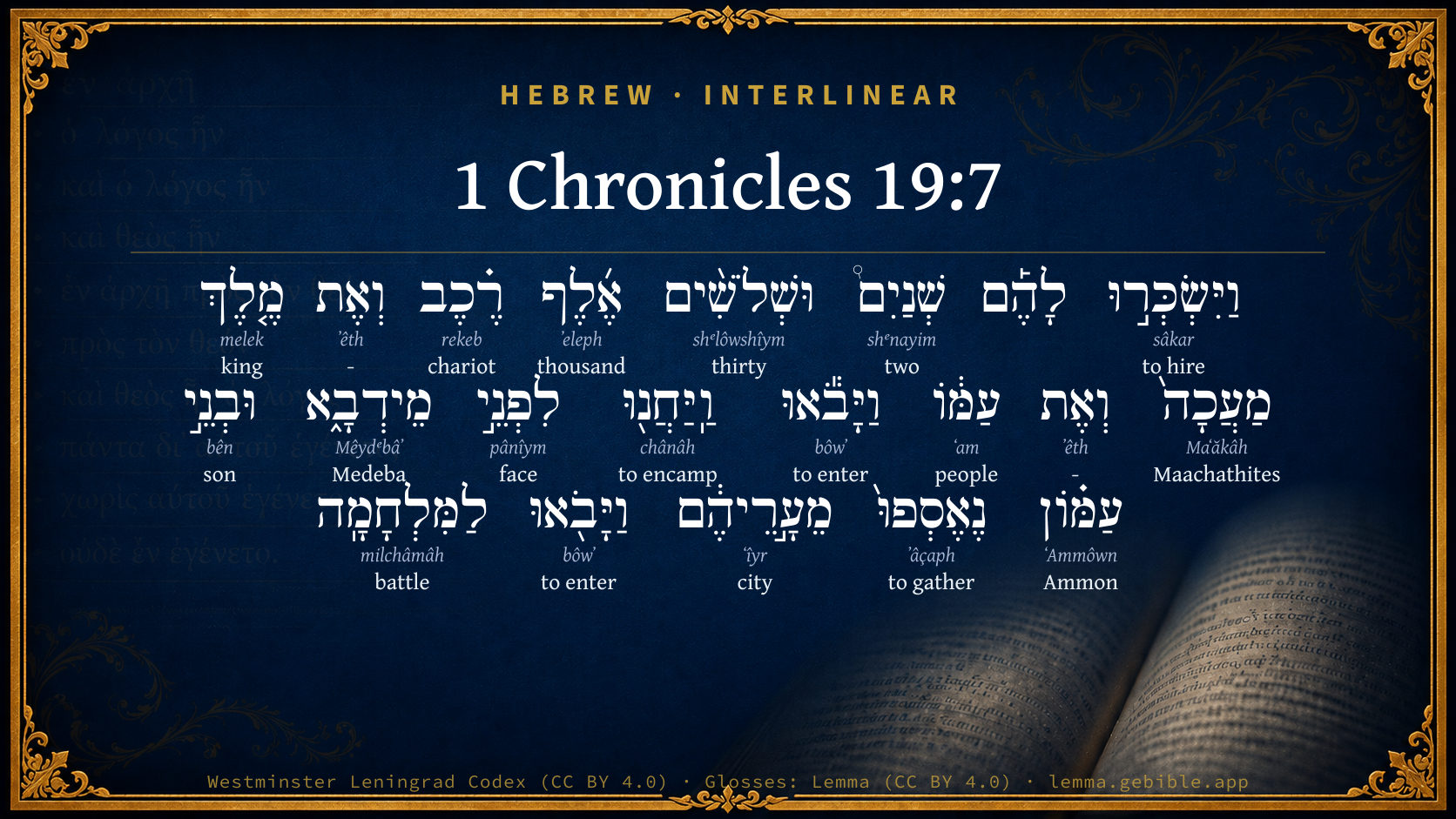
1 Chronicles 19:7

Hebrew (Westminster Leningrad Codex) 1 Chronicles 19:7 appears in the Hebrew Old Testament. The text above is from the Westminster Leningrad Codex. Each word links to its Strong’s number, a concise gloss, and parsing drawn from the Open Scriptures Hebrew Bible morphology. Click any word for its full Brown-Driver-Briggs (BDB) entry.
Download image
Cite this verse

1 Chronicles 19:7 (World English Bible). Public Domain. Lemma interlinear Bible study tool, https://lemma.gebible.app/v/1-chronicles/19/7.

Show BibTeX & RIS
BibTeX
RIS
English Translation
So they hired them thirty-two thousand chariots, and the king of Maacah and his people, who came and encamped before Medeba. The children of Ammon gathered themselves together from their cities, and came to battle.
World English Bible · Public Domain
Download a study sheet

One document with this verse’s original text, its word-by-word gloss line, the meaning frame, cross-references with their text, attributed commentary, and full source and license credits — printable, and it pastes into notes with its structure intact.

This verse Autodidact and up

Study sheet (.html) Plain text (.txt)

A passage Seminary Student

Up to 50 verses in one chapter. A passage sheet keeps up to 6 commentary sources and 12 cross-references per verse, in the order this page ranks them, and says so on the sheet whenever that leaves anything out. Ask for a single verse and you get the Autodidact verse sheet above.

Everything on this page stays free to read, with no account — the sheet is a download of what is already on screen, not access to it.

Want to remove ads? Support Godless Engineer
Compare translations 3

The same verse in 3 English versions, stacked beneath the original-language interlinear above. Click any original word for its lexicon entry.

Each is an independent rendering of the whole verse — the interlinear is not word-aligned to these translations.

Highlighted words mark where these versions differ — a whole-verse word diff, not a word-by-word alignment.

  • World English Bible Public Domain
    So they hired them thirty-two thousand chariots, and the king of Maacah and his people, who came and encamped before Medeba. The children of Ammon gathered themselves together from their cities, and came to battle.
  • King James Version Public Domain
    So they hired thirty and two thousand chariots, and the king of Maachah and his people; who came and pitched before Medeba. And the children of Ammon gathered themselves together from their cities, and came to battle.
  • unfoldingWord Literal Text CC BY-SA 4.0
    And they hired for themselves 32,000 chariots and the king of Maacah and his people. And they came, and they encamped to the face of Medeba. And the sons of Ammon assembled themselves from their cities, and they came for battle.

unfoldingWord Literal Text — © unfoldingWord, licensed CC BY-SA 4.0. Word-aligned USFM3 via Door43 (git.door43.org/unfoldingWord/en_ult).

Versions to compare (up to 4)

3 of 4 selected

Show all 18 translations

Every available English version of this verse, each an independent rendering of the whole verse.

  • World English Bible Public Domain
    So they hired them thirty-two thousand chariots, and the king of Maacah and his people, who came and encamped before Medeba. The children of Ammon gathered themselves together from their cities, and came to battle.
  • Berean Standard Bible Public Domain
    So they hired for themselves thirty-two thousand chariots, as well as the king of Maacah with his troops, who came and camped near Medeba while the Ammonites came from their cities and marched out for battle.
  • Majority Standard Bible Public Domain
    So they hired for themselves thirty-two thousand chariots, as well as the king of Maacah with his troops, who came and camped near Medeba while the Ammonites were mustered from their cities and marched out for battle.
  • King James Version Public Domain
    So they hired thirty and two thousand chariots, and the king of Maachah and his people; who came and pitched before Medeba. And the children of Ammon gathered themselves together from their cities, and came to battle.
  • American Standard Version (1901) Public Domain
    So they hired them thirty and two thousand chariots, and the king of Maacah and his people, who came and encamped before Medeba. And the children of Ammon gathered themselves together from their cities, and came to battle.
  • Revised Version (1885) Public Domain
    So they hired them thirty and two thousand chariots, and the king of Maacah and his people; who came and pitched before Medeba. And the children of Ammon gathered themselves together from their cites, and came to battle.
  • Geneva Bible (1599) Public Domain
    And they hired them two and thirty thousande charets, and the King of Maachah and his people, which came and pitched before Medeba: and the children of Ammon gathered themselues together from their cities, and came to the battell.
  • Douay-Rheims (1899) Public Domain
    And they hired two and thirty thousand chariots, and the king of Maacha, with his people. And they came and camped over against Medaba. And the children of Ammon gathered themselves together out of their cities, and came to battle.
  • Young's Literal Translation Public Domain
    and they hire to them two and thirty thousand chariots, and the king of Maachah and his people, and they come in and encamp before Medeba, and the sons of Ammon have been gathered out of their cities, and come in to the battle.
  • Literal Standard Version CC BY-SA 4.0
    and they hire for themselves thirty-two thousand chariots, and the king of Maachah and his people, and they come in and encamp before Medeba, and the sons of Ammon have been gathered out of their cities, and come to the battle.
  • Unlocked Literal Bible CC BY-SA 4.0
    They hired thirty-two thousand chariots and the king of Maacah and his army, who came and encamped before Medeba. Then the Ammonites gathered themselves together from their cities and came out to battle.
  • unfoldingWord Literal Text CC BY-SA 4.0
    And they hired for themselves 32,000 chariots and the king of Maacah and his people. And they came, and they encamped to the face of Medeba. And the sons of Ammon assembled themselves from their cities, and they came for battle.
  • Darby Bible Public Domain
    And they hired thirty-two thousand chariots, and the king of Maacah and his people; and they came and encamped before Medeba. And the children of Ammon gathered together from their cities, and came to battle.
  • World Messianic Bible Public Domain
    So they hired for themselves thirty-two thousand chariots, and the king of Maacah with his people, who came and encamped near Medeba. The children of Ammon gathered themselves together from their cities, and came to battle.
  • Webster's Bible Public Domain
    So they hired thirty and two thousand chariots, and the king of Maachah and his people, who came and encamped before Medeba. And the children of Ammon assembled from their cities, and came to battle.
  • Free Bible Version CC BY-SA 4.0
    They also hired 32,000 chariots and the king of Maacah with his army. They came set up camp near Medeba. The Ammonites were also called up from their towns and prepared for battle.
  • Bible in Basic English Public Domain
    So with this money they got thirty-two thousand war-carriages, and the help of the king of Maacah and his people, who came and took up their position in front of Medeba. And the children of Ammon came together from their towns for the fight.
  • JPS Tanakh (1917) Public Domain
    So they hired them thirty and two thousand chariots, and the king of Maacah and his people; who came and encamped before Medeba. And the children of Ammon gathered themselves together from their cities, and came to battle.

Literal Standard Version (2020), Covenant Press — licensed CC BY-SA 4.0. Text via the HelloAO Bible API (eBible.org). Unlocked Literal Bible (unfoldingWord) — licensed CC BY-SA 4.0. Text via the HelloAO Bible API (eBible.org). unfoldingWord Literal Text — © unfoldingWord, licensed CC BY-SA 4.0. Word-aligned USFM3 via Door43 (git.door43.org/unfoldingWord/en_ult). Free Bible Version, Dr. Jonathan Gallagher — licensed CC BY-SA 4.0. Text via the HelloAO Bible API (eBible.org).

Word by word

More ways to search: Search by grammar → Find every occurrence → Compare this word →

Practice this passage: Drill this verse → Learn its vocabulary →

מֵידְבָ֑א
Mêydᵉbâʼ
H4311
“Medeba”
Noun, Proper
Part of Speech
Noun
Type
Proper
Full BDB Definition

Origin: from H4325 and H1679

TWOT: None

Medeba = "water of rest" - a town in Moab assigned to Reuben and located 4 miles (6 kilometers) southwest of Heshbon; still extant
  1. וַיִּשְׂכְּר֣וּ sâkar H7936 “and · to hire” Conjunction + Verb, Qal, Sequential Imperfect, 3rd Person, Masculine, Plural
  2. שְׁנַיִם֩ shᵉnayim H8147 “two” Adjective, Cardinal number, Masculine, Dual, Absolute
  3. וּשְׁלֹשִׁ֨ים shᵉlôwshîym H7970 “and · thirty” Conjunction + Adjective, Cardinal number, Both, Plural, Absolute
  4. אֶ֜לֶף ʼeleph H505 “thousand” Adjective, Cardinal number, Both, Singular, Absolute
  5. רֶ֗כֶב rekeb H7393 “chariot” Noun, Common, Masculine, Singular, Absolute
  6. וְאֶת ʼêth H853 “and · -” Conjunction + Particle, Direct Object
  7. מֶ֤לֶךְ melek H4428 “king of” Noun, Common, Masculine, Singular, Construct
  8. מַעֲכָה֙ Maʻăkâh H4601 “Maachathites” Noun, Proper
  9. וְאֶת ʼêth H853 “and · -” Conjunction + Particle, Direct Object
  10. עַמּ֔וֹ ʻam H5971 “people · his” Noun, Common, Masculine, Singular, Construct + Suffix, Personal, 3rd Person, Masculine, Singular
  11. וַיָּבֹ֕אוּ bôwʼ H935 “and · to enter” Conjunction + Verb, Qal, Sequential Imperfect, 3rd Person, Masculine, Plural
  12. וַֽיַּחֲנ֖וּ chânâh H2583 “and · to encamp” Conjunction + Verb, Qal, Sequential Imperfect, 3rd Person, Masculine, Plural
  13. לִפְנֵ֣י pânîym H6440 “to/for · face(s) of” Preposition + Noun, Common, Both, Plural, Construct
  14. וּבְנֵ֣י bên H1121 “and · sons of” Conjunction + Noun, Common, Masculine, Plural, Construct
  15. עַמּ֗וֹן ʻAmmôwn H5983 “Ammon” Noun, Proper
  16. נֶאֶסְפוּ֙ ʼâçaph H622 “to gather” Verb, Niphal, Perfect, 3rd Person, Common, Plural
  17. מֵעָ֣רֵיהֶ֔ם ʻîyr H5892 “from · cities · their” Preposition + Noun, Common, Feminine, Plural, Construct + Suffix, Personal, 3rd Person, Masculine, Plural
  18. וַיָּבֹ֖אוּ bôwʼ H935 “and · to enter” Conjunction + Verb, Qal, Sequential Imperfect, 3rd Person, Masculine, Plural
  19. לַמִּלְחָמָֽה milchâmâh H4421 “to/for the · battle” Preposition, Determined + Noun, Common, Feminine, Singular, Absolute

About this verse

These counts appear in no published source. They are computed here, from the morphology-tagged text and Lemma’s own curated glosses. What Lemma adds →

21
words
18
distinct lemmas
Historical
section

Notable vocabulary

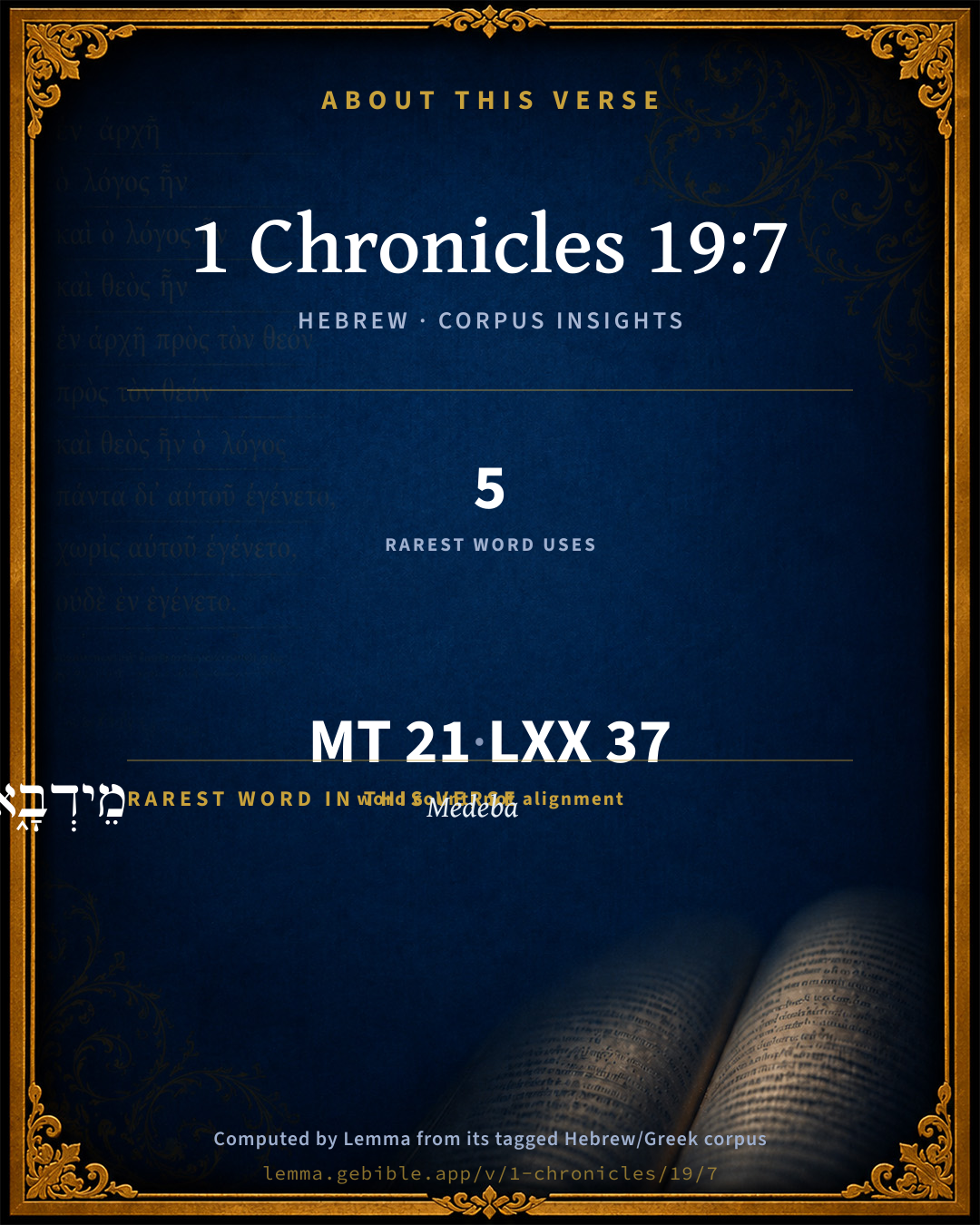
The rarest word here is מֵידְבָ֑א Medeba H4311 — appearing just 5 times in the whole Hebrew Bible.

Shared distinctive vocabulary

מֵידְבָ֑א Medeba H4311 occurs in 5 verses of the Hebrew Bible. Also found in:

Grammatical profile

  • 5 verbs
  • 10 nouns
  • 3 adjectives
  • 1 preposition
  • 2 particles

Verb forms

  • וַיִּשְׂכְּר֣וּ Qal · Sequential Imperfect
  • וַיָּבֹ֕אוּ Qal · Sequential Imperfect
  • וַֽיַּחֲנ֖וּ Qal · Sequential Imperfect
  • נֶאֶסְפוּ֙ Niphal · Perfect
  • וַיָּבֹ֖אוּ Qal · Sequential Imperfect

Repetition

A word recurs within this verse — often emphatic in Hebrew:

  • וַיָּבֹ֕אוּ to enter H935 ×2

Hebrew & Septuagint length

In English translation the verse runs 35 words from the Hebrew and 39 from the Septuagint (LXX English) — closely comparable.

A rough comparison of the two English renderings, which tokenize alike — not a word-level alignment.

Word counts can differ between the Hebrew and the Greek without any difference in meaning — e.g. the Hebrew direct-object marker אֵת has no separate Greek word, and Greek often adds the article ὁ.

In the original languages it is 21 Hebrew tokens and 37 Greek tokens — but the two are counted differently (Hebrew bundles its prefixes and suffixes into one token; the Greek is in lemma form), so that isn’t a like-for-like length.

Cross-references

11

Topical passages linked to 1 Chronicles 19:7 in the Treasury of Scripture Knowledge — connected by theme and wording, ordered by reader-vote popularity; previews shown in the World English Bible.

  • Numbers 21:30 We have shot at them; Heshbon is perished even to Dibon, We have laid waste even to Nophah, Which [reaches] to Medeba.
  • Joshua 13:9 from Aroer, that is on the edge of the valley of the Arnon, and the city that is in the middle of the valley, and all the plain of Medeba to Dibon;
  • Joshua 13:16 Their border was from Aroer, that is on the edge of the valley of the Arnon, and the city that is in the middle of the valley, and all the plain by Medeba;
  • Exodus 14:9 The Egyptians pursued after them: all the horses and chariots of Pharaoh, his horsemen, and his army; and overtook them encamping by the sea, beside Pihahiroth, before Baal Zephon.
  • Judges 4:3 The children of Israel cried to Yahweh: for he had nine hundred chariots of iron; and twenty years he mightily oppressed the children of Israel.
  • 1 Samuel 13:5 The Philistines assembled themselves together to fight with Israel, thirty thousand chariots, and six thousand horsemen, and people as the sand which is on the sea-shore in multitude: and they came up, and encamped in Michmash, eastward of Beth Aven.
  • 2 Samuel 10:6 When the children of Ammon saw that they were become odious to David, the children of Ammon sent and hired the Syrians of Beth Rehob, and the Syrians of Zobah, twenty thousand footmen, and the king of Maacah with one thousand men, and the men of Tob twelve thousand men.
  • 1 Chronicles 18:4 David took from him one thousand chariots, and seven thousand horsemen, and twenty thousand footmen; and David hamstrung all the chariot horses, but reserved of them for one hundred chariots.
  • 2 Chronicles 14:9 There came out against them Zerah the Ethiopian with an army of a million troops, and three hundred chariots; and he came to Mareshah.
  • Psalms 20:7–9 Some trust in chariots, and some in horses, But we trust the name of Yahweh our God.
  • Isaiah 15:2 They are gone up to Bayith, and to Dibon, to the high places, to weep: Moab wails over Nebo, and over Medeba; on all their heads is baldness, every beard is cut off.

Cross-references courtesy of OpenBible.info (CC BY 4.0).

Hebrew and Greek witnesses Masoretic Hebrew ↔ Greek Septuagint

The same verse in the two great witnesses to the Old Testament, shown verse-for-verse.

These are two independent witnesses, not word-aligned to each other, and the Septuagint is shown in lemma (dictionary) form.

Hebrew 1 Chronicles 19:7 Masoretic · Westminster Leningrad Codex

וַיִּשְׂכְּר֣וּ לָהֶ֡ם שְׁנַיִם֩ וּשְׁלֹשִׁ֨ים אֶ֜לֶף רֶ֗כֶב וְאֶת מֶ֤לֶךְ מַעֲכָה֙ וְאֶת עַמּ֔וֹ וַיָּבֹ֕אוּ וַֽיַּחֲנ֖וּ לִפְנֵ֣י מֵידְבָ֑א וּבְנֵ֣י עַמּ֗וֹן נֶאֶסְפוּ֙ מֵעָ֣רֵיהֶ֔ם וַיָּבֹ֖אוּ לַמִּלְחָמָֽה

So they hired them thirty-two thousand chariots, and the king of Maacah and his people, who came and encamped before Medeba. The children of Ammon gathered themselves together from their cities, and came to battle.

World English Bible · Public Domain

Greek LXX 1 Chronicles 19:7 Septuagint · lemma form

καί μισθόω ἑαυτοῦ δύο καί τριάκοντα χιλιάς ἅρμα καί ὁ βασιλεύς μωχα καί ὁ λαός αὐτός καί ἔρχομαι καί παρα ἐνβάλλω κατέναντι μαιδαβα καί ὁ υἱός αμμων συνἄγω ἐκ ὁ πόλις αὐτός καί ἔρχομαι εἰς ὁ πολεμέω

And they hired for themselves two and thirty thousand chariots, and the king of Maacha and his people; and they came and encamped before Medaba: and the children of Ammon assembled out of their cities, and came to fight.

LXX2012 (modern English Septuagint) · Public Domain

Hebrew: Westminster Leningrad Codex (CC BY 4.0). Greek: Septuagint (public domain); English from LXX2012 (modern English Septuagint) (Public Domain). How the Septuagint differs from the Hebrew →

Commentary

Notes on 1 Chronicles 19:7 from classic Christian and Jewish commentators (each source and its license shown beneath its notes). The classic Christian expositions comment on the surrounding passage and are grouped to its opening verse, so a note may address several verses; the Jewish commentaries on the Tanakh (Rashi and others) are per-verse, so they appear only where the commentator wrote on this verse.

Lemma curates 59 commentaries, every one of them public domain or Creative Commons licensed, each selected and text-cleaned for this edition rather than reprinted as found. About our sources →

Albert Barnes' Notes on the Bible

They hired thirty and two thousand chariots - The reading is corrupt. Such a number as 32,000 chariots alone was never brought into battle on any occasion. Compare the numbers in Exo 14:7; 1Ki 10:26; 2Ch 12:3. The largest force which an Assyrian king ever speaks of encountering is 3,940. The words “and horsemen” have probably fallen out of the text after the word “chariots” (compare 1Ch 19:6). The 32,000 would be the number of the warriors serving on horseback or in chariots; and this number would agree closely with 2Sa 10:6, as the following table shows:

2Sa 10:6

Men

Syrians of Beth-rehob and Zobah

20,000

Syrians of Ish-tob

12,000

Syrians of Maachah

1,000

Total

33,000

1Ch 19:7

Men

Syrians of Zobah, etc.

32,000

Syrians of Machah ( number not given)

1,000

Total

33,000

Albert Barnes' Notes on the Bible (1834–1885) — public domain. Text from a community e-Sword/MySword module.

Geneva Bible (1599)

Geneva Bible translators

Which was a city of the tribe of Reuben beyond Jordan.

Geneva Bible (1599) marginal notes — public domain. Text via Bolls.life.

Jamieson, Fausset & Brown

Robert Jamieson, A. R. Fausset & David Brown

So they hired thirty and two thousand chariots--Hebrew, "riders," or "cavalry," accustomed to fight either on horseback or in chariots, and occasionally on foot. Accepting this as the true rendering, the number of hired auxiliaries mentioned in this passage agrees exactly with the statement in Sa2 10:6 : twenty thousand (from Syria), twelve thousand (from Tob), equal to thirty-two thousand, and one thousand with the king of Maachah.

Jamieson, Fausset & Brown — Commentary Critical and Explanatory on the Whole Bible (1871) — public domain (CC PDM 1.0). Text via the HelloAO Bible API.

Adam Clarke's Commentary

Verse 7. Thirty and two thousand] The whole number mentioned in Samuel is, Syrians, of Beth-rehob, and of Zoba, twenty thousand; of King Maacah, one thousand; of Ish-tob, twelve thousand; in all thirty-three thousand. Of chariots or cavalry there is no mention. These could not have been the whole army.

Adam Clarke's Commentary on the Bible (1810–1826) — public domain. Text from a community e-Sword/MySword module.

Ellicott's Commentary for English Readers

(7) So they hired thirty and two thousand chariots, and the king of Maachah and his people.—The account which the chronicler has followed here did not state the relative strength of the contingents, yet its estimate of the total number of the allied forces is in substantial accord with that of Samuel. The chronicler puts the total at 32,000 + the Maachathite contingent; Samuel at 32,000 + 1,000 Maachathites. The expression “32,000 chariotry” (rèkeb) is not to be pressed. The writer wished to lay proper stress on the chariots and cavalry as the chief arm of the Aramæan states, and at the same time to be as concise as possible. That he was not thinking of 32,000 chariots in the literal sense is clear, (1) because he must have known that an army would not consist of chariots only; (2) in 1Ch_18:4 he had already assigned to the army of Zobah its natural proportions of chariots, cavalry, and infantry. (Comp. 1Ch_19:18, below.) The present text of Samuel can hardly be right, as it makes the whole army consist of infantry. (Comp. 2Sa_8:4.) The great plains of Aram were a natural training-ground for horsemen and charioteers.

Who came and pitched (their camp) before Medeba.—Another detail peculiar to the Chronicles. Medeba, the meeting-place of the Aramæan forces, lay south-east of Heshbon, on a site now known as Madibiya.

And the children of Ammon gathered themselves . . .—The muster of the Ammonites is not mentioned in Samuel.

A Bible Commentary for English Readers, edited by Charles John Ellicott (1878–1897) — public domain. Text from a community e-Sword module.

The Cambridge Bible for Schools and Colleges

gen. ed. J. J. S. Perowne

7. thirty and two thousand chariots] Cp. 2Sa_10:6, which reckons the army (including Maacah) at 33,000, of whom 20,000 are expressly described as footmen. The word “chariots” has probably slipped in from 1Ch_19:6 instead of “men.”

Medeba] In the territory of Reuben; Jos_13:16. The country round is a table-land suited for the manœuvres of chariots. The place of the rendezvous of the allies is not mentioned in 2 Samuel 10, some words having probably fallen out of the text.

The Cambridge Bible for Schools and Colleges (gen. ed. J. J. S. Perowne; Cambridge University Press, 1878–1918) — public domain. Text from a community e-Sword module.

Haydock's Catholic Bible Commentary

Chariots. This number seems excessive, and it may have been put for infantry; the number of which, specified [in] 2 Kings, was 33,000. But the troops of Mesopotamia are not there mentioned, and this supplies what was left defective. (Calmet) --- The chariots may signify those who fought upon them, (Menochius) ver. 18., and Isaias xxi. 7. (Tirinus) --- Sometimes the whole number is specified; at others only a part.

George Leo Haydock (1774–1849), Haydock's Catholic Family Bible and Commentary, 1859 edition — public domain. Excludes Psalms (Douay-Rheims chapter numbering differs from Protestant) and Deuterocanonical books (Catholic canon only).

Matthew Poole's English Annotations

Thirty and two thousand chariots, i. e. thirty-two thousand men fighting from or with chariots, as that word is elsewhere used; of which see my notes on 1Sa 13:5. And this interpretation seems the more probable by comparing this place with 2Sa 10:6, where this army is said to consist of twenty thousand footmen, and twelve thousand men of Ish-tob; which make up these thirty-two thousand men, who fought partly from chariots, and partly on foot with chariots, or attending upon the chariots, as the ancient manner of fighting was. And here, 1Ch 19:6, this army is made up of chariots and horsemen; where, except the chariots be understood of footmen, there were no footmen in the army, which is unusual and incredible.

Matthew Poole's English Annotations on the Holy Bible (1683–1685) — public domain. Text from a community e-Sword/MySword module.

The Pulpit Commentary

Thirty and two thousand chariots. The reading in the parallel place is evidently what is intended (comp. 1Ch_18:4 with its parallel. (2Sa_8:4) Clearly a stop should follow the numeral, which designates the number of the men under arms. Medeba. Some four miles south-cast of Heshbon (Num_21:30; Jos_13:9, Jos_13:16; Isa_15:2) or others give it as nine miles. It is not given in Samuel.

The Pulpit Commentary (1880–1919), ed. H.D.M. Spence-Jones & Joseph S. Exell — public domain. Text from a community e-Sword module.

John Wesley's Explanatory Notes

Chariots - Thirty two thousand men, who fought partly from chariots, and partly on foot with chariots, or attending upon the chariots, as the ancient manner of fighting was.

John Wesley, Explanatory Notes Upon the Whole Bible (1754–1765) — public domain. Text via the GEBible commentary corpus.

Lesson kit

Teaching starters — assembled from the data on this page, not authored interpretation. Every prompt links to the verse data it draws on. Edit before teaching.

1 Chronicles, in the Historical, opens this verse with 21 words (18 distinct Hebrew lemmas). Its most distinctive word is Mêydᵉbâʼ (“Medeba”). A historical commentator’s framing appears above. Read the whole chapter for the surrounding context.

Discussion questions

  1. The word Mêydᵉbâʼ carries the sense “Medeba.” How does it shape the verse?
  2. Numbers 21:30 shares the word «Medeba» with this verse. How do the two illuminate each other?
  3. “to enter” occurs 2× in this one verse. What is the effect of the repetition?
  4. The translations on this page render this verse differently — a whole-verse word diff, not a word-by-word alignment. What might account for the different wordings?
  5. The verb «וַיִּשְׂכְּר֣וּ» is Qal Sequential Imperfect. How does its form color the action?
  6. Reading how Albert Barnes' Notes on the Bible and Geneva Bible (1599) read this verse, where do the two commentators agree and where do they part?

Things to notice

Reading settings

Reading text

Shown beneath each verse's original-language words.

Old Testament
Old Testament edition

Read the OT as the Masoretic Hebrew (MT) or the Greek Septuagint (LXX).

English shown for the Greek Septuagint (in the Hebrew ↔ Greek comparison).

Comparing translations? Open the Compare panel on any verse page to stack up to four side by side.