
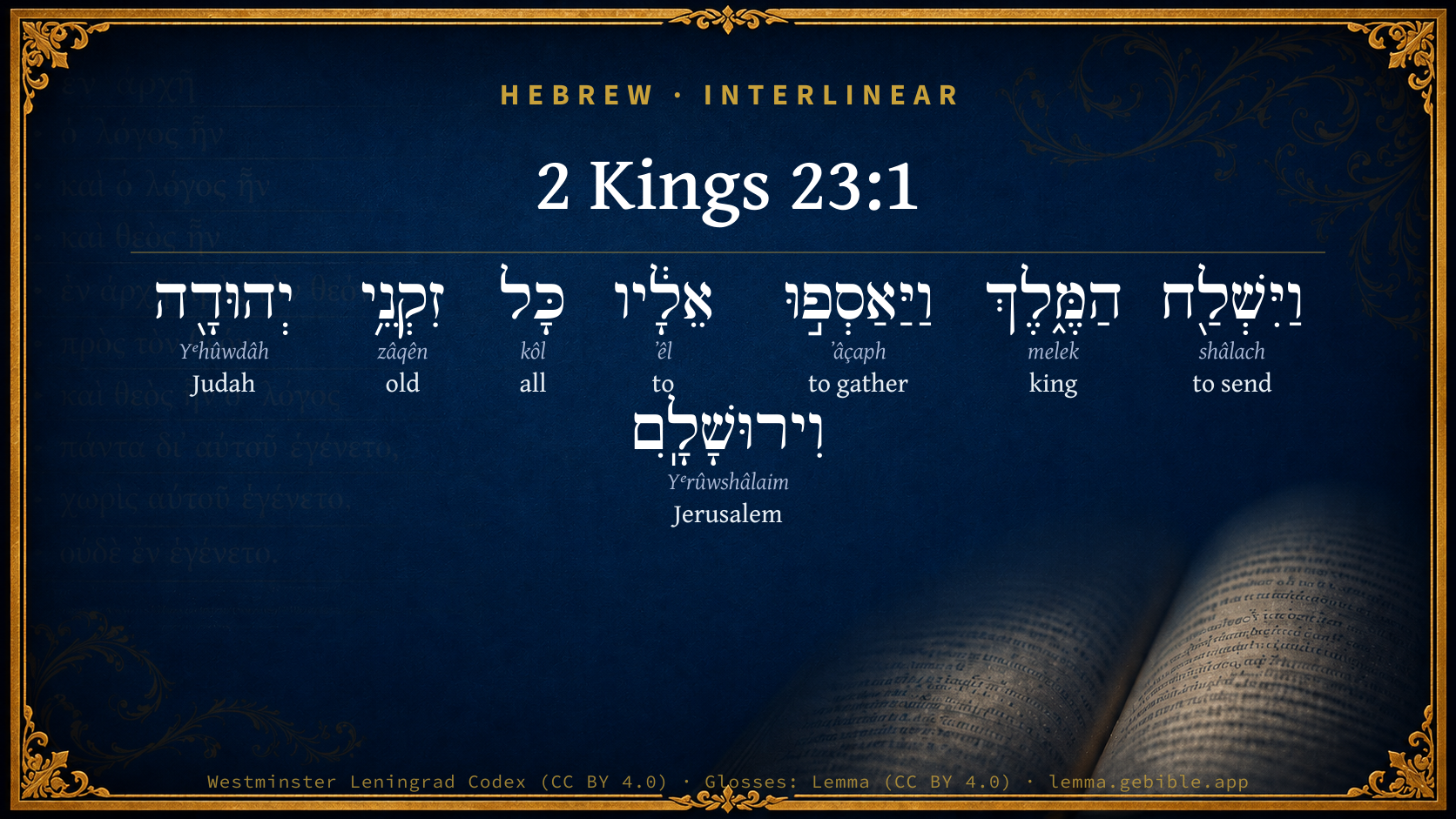
2 Kings 23:1

Hebrew (Westminster Leningrad Codex) 2 Kings 23:1 appears in the Hebrew Old Testament. The text above is from the Westminster Leningrad Codex. Each word links to its Strong’s number, a concise gloss, and parsing drawn from the Open Scriptures Hebrew Bible morphology. Click any word for its full Brown-Driver-Briggs (BDB) entry.
Download image
Cite this verse

2 Kings 23:1 (World English Bible). Public Domain. Lemma interlinear Bible study tool, https://lemma.gebible.app/v/2-kings/23/1.

Show BibTeX & RIS
BibTeX
RIS
English Translation
The king sent, and they gathered to him all the elders of Judah and of Jerusalem.
World English Bible · Public Domain
Download a study sheet

One document with this verse’s original text, its word-by-word gloss line, the meaning frame, cross-references with their text, attributed commentary, and full source and license credits — printable, and it pastes into notes with its structure intact.

This verse Autodidact and up

Study sheet (.html) Plain text (.txt)

A passage Seminary Student

Up to 50 verses in one chapter. A passage sheet keeps up to 6 commentary sources and 12 cross-references per verse, in the order this page ranks them, and says so on the sheet whenever that leaves anything out. Ask for a single verse and you get the Autodidact verse sheet above.

Everything on this page stays free to read, with no account — the sheet is a download of what is already on screen, not access to it.

Want to remove ads? Support Godless Engineer
Compare translations 3

The same verse in 3 English versions, stacked beneath the original-language interlinear above. Click any original word for its lexicon entry.

Each is an independent rendering of the whole verse — the interlinear is not word-aligned to these translations.

Highlighted words mark where these versions differ — a whole-verse word diff, not a word-by-word alignment.

  • World English Bible Public Domain
    The king sent, and they gathered to him all the elders of Judah and of Jerusalem.
  • King James Version Public Domain
    And the king sent, and they gathered unto him all the elders of Judah and of Jerusalem.
  • unfoldingWord Literal Text CC BY-SA 4.0
    And the king sent, and they gathered to him all of the elders of Judah and Jerusalem.

unfoldingWord Literal Text — © unfoldingWord, licensed CC BY-SA 4.0. Word-aligned USFM3 via Door43 (git.door43.org/unfoldingWord/en_ult).

Versions to compare (up to 4)

3 of 4 selected

Show all 18 translations

Every available English version of this verse, each an independent rendering of the whole verse.

  • World English Bible Public Domain
    The king sent, and they gathered to him all the elders of Judah and of Jerusalem.
  • Berean Standard Bible Public Domain
    Then the king summoned all the elders of Judah and Jerusalem.
  • Majority Standard Bible Public Domain
    Then the king summoned all the elders of Judah and Jerusalem.
  • King James Version Public Domain
    And the king sent, and they gathered unto him all the elders of Judah and of Jerusalem.
  • American Standard Version (1901) Public Domain
    And the king sent, and they gathered unto him all the elders of Judah and of Jerusalem.
  • Revised Version (1885) Public Domain
    And the king sent, and they gathered unto him all the elders of Judah and of Jerusalem.
  • Geneva Bible (1599) Public Domain
    Then the King sent, and there gathered vnto him all the Elders of Iudah and of Ierusalem.
  • Douay-Rheims (1899) Public Domain
    And they brought the king word again what she had said. And he sent: and all the ancients of Juda and Jerusalem were assembled to him.
  • Young's Literal Translation Public Domain
    And the king sendeth, and they gather unto him all the elders of Judah and Jerusalem,
  • Literal Standard Version CC BY-SA 4.0
    And the king sends, and they gather all [the] elderly of Judah and Jerusalem to him,
  • Unlocked Literal Bible CC BY-SA 4.0
    So the king sent messengers who gathered to him all the elders of Judah and of Jerusalem.
  • unfoldingWord Literal Text CC BY-SA 4.0
    And the king sent, and they gathered to him all of the elders of Judah and Jerusalem.
  • Darby Bible Public Domain
    And the king sent, and they gathered to him all the elders of Judah and of Jerusalem.
  • World Messianic Bible Public Domain
    The king sent, and they gathered to him all the elders of Judah and of Jerusalem.
  • Webster's Bible Public Domain
    And the king sent, and they gathered to him all the elders of Judah and of Jerusalem.
  • Free Bible Version CC BY-SA 4.0
    Then the king summoned all the elders of Judah and Jerusalem.
  • Bible in Basic English Public Domain
    Then the king sent and got together all the responsible men of Judah and of Jerusalem.
  • JPS Tanakh (1917) Public Domain
    And the king sent, and they gathered unto him all the elders of Judah and of Jerusalem.

Literal Standard Version (2020), Covenant Press — licensed CC BY-SA 4.0. Text via the HelloAO Bible API (eBible.org). Unlocked Literal Bible (unfoldingWord) — licensed CC BY-SA 4.0. Text via the HelloAO Bible API (eBible.org). unfoldingWord Literal Text — © unfoldingWord, licensed CC BY-SA 4.0. Word-aligned USFM3 via Door43 (git.door43.org/unfoldingWord/en_ult). Free Bible Version, Dr. Jonathan Gallagher — licensed CC BY-SA 4.0. Text via the HelloAO Bible API (eBible.org).

Word by word

More ways to search: Search by grammar → Find every occurrence → Compare this word →

Practice this passage: Drill this verse → Learn its vocabulary →

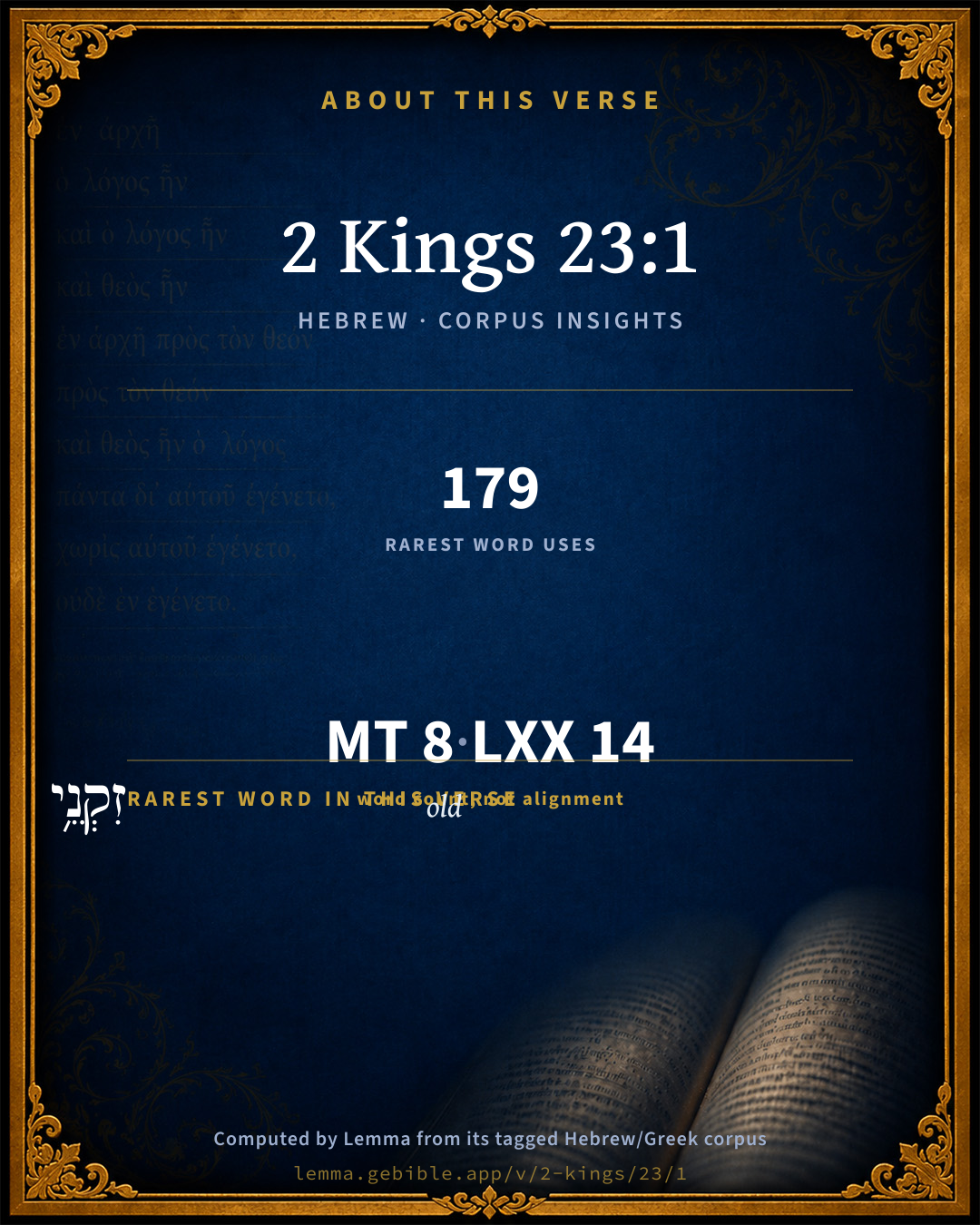
About this verse

These counts appear in no published source. They are computed here, from the morphology-tagged text and Lemma’s own curated glosses. What Lemma adds →

8
words
8
distinct lemmas
Historical
section

Grammatical profile

  • 2 verbs
  • 4 nouns
  • 1 adjective
  • 1 preposition

Verb forms

  • וַיִּשְׁלַ֖ח Qal · Sequential Imperfect
  • וַיַּאַסְפ֣וּ Qal · Sequential Imperfect

Hebrew & Septuagint length

In English translation the verse runs 16 words from the Hebrew and 23 from the Septuagint (LXX English) — the Septuagint runs noticeably longer here. See the side-by-side →

A rough comparison of the two English renderings, which tokenize alike — not a word-level alignment.

Word counts can differ between the Hebrew and the Greek without any difference in meaning — e.g. the Hebrew direct-object marker אֵת has no separate Greek word, and Greek often adds the article ὁ.

In the original languages it is 8 Hebrew tokens and 14 Greek tokens — but the two are counted differently (Hebrew bundles its prefixes and suffixes into one token; the Greek is in lemma form), so that isn’t a like-for-like length.

Cross-references

5

Topical passages linked to 2 Kings 23:1 in the Treasury of Scripture Knowledge — connected by theme and wording, ordered by reader-vote popularity; previews shown in the World English Bible.

  • 2 Chronicles 34:29–33 Then the king sent and gathered together all the elders of Judah and Jerusalem.
  • Deuteronomy 31:28 Assemble to me all the elders of your tribes, and your officers, that I may speak these words in their ears, and call heaven and earth to witness against them.
  • 2 Chronicles 29:20 Then Hezekiah the king arose early, and gathered the princes of the city, and went up to the house of Yahweh.
  • 2 Chronicles 30:2 For the king had taken counsel, and his princes, and all the assembly in Jerusalem, to keep the Passover in the second month.
  • 2 Samuel 6:1 David again gathered together all the chosen men of Israel, thirty thousand.

Cross-references courtesy of OpenBible.info (CC BY 4.0).

Hebrew and Greek witnesses Masoretic Hebrew ↔ Greek Septuagint

The same verse in the two great witnesses to the Old Testament, shown verse-for-verse.

Here the Septuagint runs noticeably longer than the Hebrew — LXX2012 (modern English Septuagint) 23 words vs World English Bible 16. A rough length comparison of the two English translations, not a word-level alignment — read both below.

These are two independent witnesses, not word-aligned to each other, and the Septuagint is shown in lemma (dictionary) form.

Hebrew 2 Kings 23:1 Masoretic · Westminster Leningrad Codex

וַיִּשְׁלַ֖ח הַמֶּ֑לֶךְ וַיַּאַסְפ֣וּ אֵלָ֔יו כָּל זִקְנֵ֥י יְהוּדָ֖ה וִירוּשָׁלִָֽם

The king sent, and they gathered to him all the elders of Judah and of Jerusalem.

World English Bible · Public Domain

Greek LXX 2 Kings 23:1 Septuagint · lemma form

καί ἀποστέλλω ὁ βασιλεύς καί συνἄγω πρός ἑαυτοῦ πᾶς ὁ πρεσβύτερος ιουδα καί ἰερουσαλήμ

So they reported the word to the king: and the king sent and gathered all the elders of Juda and Jerusalem to himself.

LXX2012 (modern English Septuagint) · Public Domain

On this verse, Keil & Delitzsch discusses the Septuagint’s reading. Read the note in Commentary ↓

Hebrew: Westminster Leningrad Codex (CC BY 4.0). Greek: Septuagint (public domain); English from LXX2012 (modern English Septuagint) (Public Domain). How the Septuagint differs from the Hebrew →

Targum (Aramaic paraphrase)

1

The Targum is the ancient Jewish Aramaic paraphrase of the Hebrew Scriptures — an interpretive translation, not the Hebrew text itself. Onkelos (literal) and Pseudo-Jonathan (expansive) render the Torah, and Jonathan the Prophets. Coverage is partial: where no permissively-licensed English translation exists for a verse, only the Aramaic is shown. This is verse-level text, not a word-by-word alignment to the Hebrew.

  1. Targum Jonathan Prophets (Joshua–Malachi)
    וּשְׁלַח מַלְכָּא וּכְנָשׁוּ לְוָתֵיהּ כָּל סָבֵי יְהוּדָה וִירוּשְׁלֵם:

    (no public-domain English translation for this verse)

    Targum Jonathan — Aramaic: “Mikraot Gedolot” (public domain). English: “Sefaria Community Translation” (CC0 1.0 (public-domain dedication)); “London "Chaldee Paraphrase," 1871” (public domain). Text via Sefaria.

Commentary

Notes on 2 Kings 23:1 from classic Christian and Jewish commentators (each source and its license shown beneath its notes). The classic Christian expositions comment on the surrounding passage and are grouped to its opening verse, so a note may address several verses; the Jewish commentaries on the Tanakh (Rashi and others) are per-verse, so they appear only where the commentator wrote on this verse.

Lemma curates 59 commentaries, every one of them public domain or Creative Commons licensed, each selected and text-cleaned for this edition rather than reprinted as found. About our sources →

Matthew Henry's Commentary

Josiah had received a message from God that there was no preventing the ruin of Jerusalem, but that he should deliver only his own soul; yet he did not therefore sit down in despair, and resolve to do nothing for his country because he could not do all he would. No, he would do his duty, and then leave the event to God. A public reformation was the thing resolved on; if any thing could prevent the threatened ruin it must be that; and here we have the preparations for that reformation. 1. He summoned a general assembly of the states, the elders, the magistrates or representatives of Judah and Jerusalem, to meet him in the house of the Lord, with the priests and prophets, the ordinary and extraordinary ministers, that, they all joining in it, it might become a national act and so be the more likely to prevent national judgments; they were all called to attend (Kg2 23:1, Kg2 23:2), that the business might be done with the more solemnity, that they might all advise and assist in it, and that those who were against it might be discouraged from making any opposition. Parliaments are no diminution at all to the honour and power of good princes, but a great support to them. 2. Instead of making a speech to this convention, he ordered the book of the law to be read to them; nay, it should seem, he read it himself (Kg2 23:2), as one much affected with it and desirous that they should be so too. Josiah thinks it not below him to be a reader, any more than Solomon did to be a preacher, nay, and David himself to be a door-keeper in the house of God. Besides the convention of the great men, he had a congregation of the men of Judah and the inhabitants of Jerusalem to hear the law read. It is really the interest of princes to promote the knowledge of the scriptures in their dominions. If the people be but as stedfastly resolved to obey by law as he is to govern by law, the kingdom will be happy. All people are concerned to know the scripture, and all in authority to spread the knowledge of it. 3. Instead of proposing laws for the confirming of them in their duty, he proposed an association by which they should all jointly engage themselves to God, Kg2 23:3. The book of the law was the book of the covenant, that, if they would be to God a people, he would be to them a God; they here engage themselves to do their part, not doubting but that then God would do his. (1.) The covenant was that they should walk after the Lord, in compliance with his will, in his ordinances and his providences, should answer all his calls and attend all his motions - that they should make conscience of all his commandments, moral, ceremonial, and judicial, and should carefully observe them with all their heart and all their soul, with all possible care and caution, sincerity, vigour, courage, and resolution, and so fulfil the conditions of this covenant, in dependence upon the promises of it. (2.) The covenanters were, in the first place, the king himself, who stood by his pillar (Kg2 11:14) and publicly declared his consent to this covenant, to set them an example, and to assure them not only of his protection but of his presidency and all the furtherance his power could give them in their obedience. It is no abridgment of the liberty even of princes themselves to be in bonds to God. All the people likewise stood to the covenant, that is, they signified their consent to it and promised to abide by it. It is of good use to oblige ourselves to our duty with all possible solemnity, and this is especially seasonable after notorious backslidings to sin and decays in that which is good. He that bears an honest mind does not shrink from positive engagements: fast bind, fast find.

Matthew Henry's Commentary on the Whole Bible (1708–1710) — public domain (CC PDM 1.0). Text via the HelloAO Bible API.

The Cambridge Bible for Schools and Colleges

gen. ed. J. J. S. Perowne

Chap. 2Ki_23:1-14. Josiah’s covenant to serve the Lord. Destruction of idolatry, and removal of idolatrous priests (2Ch_34:3-7; 2Ch_34:29-33)

1. And the king sent, and they gathered] The whole proceeding described in the first three verses of this chapter may be compared with the similar covenant-making in the reign of Joash (2Ki_11:14-17). That was also followed by a destruction of the objects of idolatry.

The Cambridge Bible for Schools and Colleges (gen. ed. J. J. S. Perowne; Cambridge University Press, 1878–1918) — public domain. Text from a community e-Sword module.

Trapp's Complete Commentary

John Trapp

2Ki 23:1 And the king sent, and they gathered unto him all the elders of Judah and of Jerusalem.

Ver. 1. And the king sent.] This he did, that he might the better insure the promise made to himself; and avert, if possible, the judgments threatened against the people by Huldah the prophetess.

John Trapp, A Commentary or Exposition upon All the Books of the Old and New Testament (1647–1656) — public domain. Text from a community e-Sword module.

The Biblical Illustrator

Joseph S. Exell

2Ki_23:1-28

And the King sent, and they gathered unto him all the elders of Judah and of Jerusalem.

Good aims and bad methods

The verses I have selected record and illustrate good alms and bad methods.

I. Good aims. Josiahs aims, as here presented, Were confessedly high, noble, and good.

1. To reduce his people to a loyal obedience to heaven.

2. Generated within him by the discovery of the Divine will.

II. Bad methods. How did Josiah now seek to realise his purpose, to sweep idolatry from the face of his country? Not by argument, suasion, and moral influence, but by brute force and violence (2Ki_23:4-28). I offer two remarks concerning his method.

1. It was unphilosophic. Morals evil cannot be put down by force; coercion cannot travel to a mans soul.

2. It was mischievous. The evil was not extinguished; it burnt with fiercer flame. Persecution has always propagated the errors it has sought to crush. He that taketh the Sword shall perish by the sword. (David Thomas, D. D.)

A revival of religion

A young and active king now sits on Judahs throne. Our text finds him at the age of six-and-twenty, in the midst of reforms which might have appalled many a man of twice his age. The earlier years of his reign he has occupied in many and various reforms, Now we find him in the midst of a revival of religion, the like of which the world has but seldom seen. The king, the court, the elders, the rulers, and the people all felt its power. Beginning at the house of God, it thrilled through all classes, and changed the whole religious life and thought of the land. And it is this revival of religion that I desire now to consider.

I. This revival began at the house of God. And surely that was the best place. In Gods house, in Gods presence, we are to assemble and look for Him. It is there we may expect the Shekinah fire, no longer visible over the ark between the cherubim, but felt in force and power in human hearts. It is there we must seek for renewed vigour and Divine influence. It is there we must look for the Lord Himself, and pray Him to strengthen and quicken us. It is there we must come for the deepening of our faith in the Eternal, enlarging of our courage and zeal, and the expansion of cur Christian hope. It is there all revival must begin. If, then, we are to have a revival, it must begin at Gods house. Votes of the House of Commons cannot do it, Acts of Parliament will never make men religious. Decrees of State will not fill empty churches with men and women full of the Holy Ghost and fire. All this has been tried. Some two or three hundred years ago soldiers were stationed at the doors of the parish churches, not so much to see who attended as to note who was absent. Fine, imprisonment, exile and worse, fell to the lot of those who did not fill their places. These things did not succeed. They never can. Fine, sword, fire, and persecution failed, and always will. They are the instruments of a past and barbarous age. But if we are to have a revival in which the people shall flock to Gods house, Gods house itself must be revived. There must be live men in the Church, if it is to save men alive. A cold Church but seldom warms cold hearts.

II. In this revival men came back to the word of God. The long-lost book was found. The Word of the Lord hid, slighted, neglected, lost, was discovered and brought to the young king. What a discovery Hilkiah made when he found the Bible! What a treasure he dug up! What a mine of precious ore! What a valuable find! The young king was quick to see its importance, value, and worth. It was read; its warnings heeded, its promises believed. And it was read to all the people. What an effect that book produced. Even so. I have no faith in any revival without the Word of God. Read the history of the great revivals in the Church, and you will find the Word of God in it all. Beginning with the Bereans right down to our day you will find it so. John Wycliffe was a great power in his day. He is rightly called the Morning Star of the Reformation. He Sent his Lollard preachers through the lend to tell the story of Gods love. As he translated the Bible into the language of the people, his preachers went and read it and preached it to common folk. Read the history of the Reformation, and what will you find there? Martin Luther is its hero. That marvellous man, like his Lord and Master, was a son of the people, and began life in a poor and comfortless home. Reared in the faith and practice of the Romish Church, he came to know it well, and early saw its weakness. What was it made him take his reforming action? Have we not read that he found a copy of the Scriptures--the neglected, deserted, forsaken Bible? He read it. It did its work. It was the Bible made him the great reformer. It was the Bible which the reformers accepted as a sufficient rule of faith and life. We, too, need to pay more attention to the living Word of God. We are apt to look for and depend upon the word of man. If that is not eloquent, if that is not such as to tickle our fancy, we often return from Gods house displeased, dissatisfied, and unblessed. What a mistake! Let us look for the God-sent message; let us hearken for the voice of the living God; let us hear what He has to say to us.

III. A revived Church will make itself felt in the world. This assembling at the house of God, and the solemn and reverent reading of the Bible, made a deep impression upon the people. The king dedicated himself to God. And surely that is the right thing for a king to do. The king should lead in all good things. All the people felt the influence, and there was a national movement. Public life was affected, the power of God was felt, men pat away their idols, and came back to the faith of their fathers. The Church, the Temple, religion became a greater force in the national life. (C. Leach, D. D.)

The Biblical Illustrator, edited by Joseph S. Exell (c. 1880s–1900s) — public domain. Text from a community e-Sword module.

Joseph Benson's Commentary

2Ki 23:1. The king sent and gathered unto him all the elders — Although he had received a message from God, that there was no preventing the ruin of Jerusalem, and that he only should deliver his own soul; yet he does not therefore sit down in despair, and resolve to do nothing for his country, because he could not do all he would. But he will endeavour to do his duty, and then leave the event to God. He knew, if any thing could prevent, delay, or alleviate the threatened ruin, it must be a public reformation. He therefore makes preparations for this, by summoning a general assembly of the magistrates, or representatives of the people, with the priests and prophets, the ordinary and extraordinary ministers of God: that, these all joining in it, what was done might become a national act, and so be the more likely to prevent national judgments; and that so many principal persons advising and assisting in it, the whole business might be transacted with more solemnity, and such as were against it might be discouraged from making any opposition.

Joseph Benson's Commentary on the Old and New Testaments (1811–1818) — public domain. Text from a community e-Sword module.

Whedon's Commentary on the Bible

Daniel D. Whedon

THE GREAT REFORMATION UNDER JOSIAH, 2Ki_23:1-25.

1. The king sent — Instructed by the law and by the prophetess, the king does not rest in security, feeling that the evil will not come in his day, but takes immediate measures to instruct the people in the law, and to destroy idolatry throughout the land.

Daniel D. Whedon (gen. ed.), Commentary on the Old and New Testaments (1874–1909) — public domain. Text from a community e-Sword module.

The Preacher's Complete Homiletical Commentary

Joseph S. Exell (gen. ed.)

THE DESTRUCTION OF IDOLATRY BY JOSIAH

CRITICAL AND EXPLANATORY NOTES.—

2Ki_23:1. The king sent and gathered all the elders of Judah—Not content to hide from coming ill under God’s promise of immunity to himself personally, Josiah’s patriotism led him to a fervent effort to recall his nation to the Lord, and turn aside impending doom.

2Ki_23:6. He brought out the grove from the house of the Lord (see on 2Ki_21:7). Cast the powder thereof on the graves of the children of the people—In 2Ch_34:4 it is rendered, “upon the graves of them that had sacrificed unto them,” thus profaning the sepulchres of those idolaters.

2Ki_23:7. He brake down the houses of the Sodomites—Concerning these “Sodomites” see Notes on 1Ki_14:24. These booths were scenes of lustful revelry; these “women who wove hangings for Asherah,” being debased creatures, who, together with others of their sex, prostituted themselves in homage of this goddess. All this “in the house of the Lord.”

2Ki_23:9. Did eat of the unleavened bread—The phrase means that they lived upon the altar offerings; they came not near God’s altar, but stayed at home enjoying the fruit of their profession “among their brethren.”

2Ki_23:10. He defiled Topheth—The spot in the valley of Hinnon where children were sacrificed to Molech. “Tophet” is variously interpreted, as from תּוף to spit out, detest, an abomination, therefore; or from תוֹף, a drum, the dominating interpretation of Jewish writers being that the cries of the perishing children were drowned by that instrument.

2Ki_23:11. Took away the horses—Not figures of horses, but living, kept for drawing the sun-chariot in the idolatrous processions. Horses were also sacrificed in the worship of the sun.

2Ki_23:13. On the right hand of the mount of corruption—The hilly range on the east of Jerusalem, called the Mount of Olives, has three summits, whose central or southernmost peak is named the “Mount of Corruption.” from the idol temples there reared by Solomon.

2Ki_23:15. Altar that was at Bethel—In Samaria; so that he traversed the land to sweep away every vestige of idolatry.

Note—A literal and remarkable fulfilment of prophecy at Bethel—Against that very altar at Bethel, where the guilty Jeroboam burned odious idolatrous incense, a man of God, 326 years before Josiah’s birth, came forth and cried, “O, altar, altar! thus saith the Lord, Behold a child shall be born unto the house of David, Josiah by name, and upon thee shall he offer the priests of the high places that burn incense upon thee, and men’s bones shall be burnt upon thee” (see the narrative 1Ki_13:1-8). No more emphatic verification of prophecy is contained in Scripture.

2Ki_23:21-23. The revival of the passover festival—Not only were the king’s own subjects called to this august celebration of this most sacred festival, but many of the remnant of Israel also came to the solemnity (see 2Ch_35:18); not even Hezekiah’s celebration of this feast was so complete and imposing as that of Josiah.

HOMILETICS OF 2Ki_23:1-24

CHARACTERISTICS OF A GREAT RELIGIOUS REFORM

I. It is suggested by a clearer understanding of the Divine Word (2Ki_23:1). Josiah had begun his reforming work before the discovery of the law, but when he read the very words of God his views were expanded, and his zeal newly inflamed concerning the work he had to do. The effect on the king was like that produced on Luther by his finding an old Latin Bible in the library of the Augustine convent at Erfurt. In both cases, the character and life-work of the reformers were irresistibly influenced by what they read. The best and loftiest work we do, is that which is inspired and sustained by our study of the Divine Word. It is the light and teacher for all time.

A glory gilds the sacred page

Majestic, like the sun;

It gives a light to every age;

It gives, but borrows none.—Cowper.

II. It seeks to interest and, by solemn covenant, secure the co-operation of all classes of the community (2Ki_23:1-2). All genuine reform must be based on intelligence. The people Josiah sought to benefit he sought first to instruct. Too much publicity cannot be given to principles which threaten to change the existing order of things. If they will not bear the light of day, and the freest public criticism, they are unworthy our adherence. Josiah set the example. It was a striking scene—the more highly dramatic because so utterly unconscious—to see the youthful king publicly entering into solemn covenant to obey the Divine commands. The people followed. In the East, whatever the king initiates and champions, the people readily accept. The broader and more searching the reform, the more important is it to interest all classes and engage all legitimate agencies. The most gigantic efforts of the reformer would be fruitless if unsupported by public opinion. He is shrewd enough to see that the first thing he has to do is to mould and educate public opinion. Hume once observed, “All power, even the most despotic, rests ultimately on opinion.”

III. It aims at the utter destruction of the system, with all its degrading practices, that had led the people astray (2Ki_23:4-20; 2Ki_23:24). Josiah attacked the idolatry of his kingdom with a promptness, zeal, and vigour that amounted almost to fierceness. The evil must be torn out, root and branch. The high places, the images, the vessels, were not only broken in pieces, but defiled, and their ashes scattered on the stream to be borne away for ever. The reformer warmed to his work, and grew fiercer still. He slew the idolatrous priests. He violated the graves of the dead, and burnt their bones on the altar. The reformer became a persecutor. Judging Josiah from the standard of his times, much might be said in palliation of this violence. Idolatry was the oppressive curse under which his kingdom lay crushed. As a theocratic king, he could admit no rival to Jehovah; idolatry must be utterly stamped out. Much may be forgiven a man for the excesses into which he may be betrayed in the heat of his reforming zeal. But no reforming work can be permanently advantaged by violence and persecution. Tyranny never cures tyranny; it only provokes endless reprisals.

IV. It restores the pure worship of God in its most imposing features (2Ki_23:21-23). The festival of the Passover was held on an unexampled scale of magnificence and publicity, and in a faithful adhesion to the minute details required by the Divine law that had not been recognized for years. The iconoclastic reformer should be careful to have something to put in place of what he destroys. Man will worship, and every facility should be afforded him in keeping up fellowship with the Highest and Holiest, else he will seek inferior and degrading objects of worship, as did the Hebrews. We must not mistake the reverent and decorous observance of an elaborate ritual for true worship. Acceptable worship must be intelligent, sincere, and spiritual. “If a person were to attend the levee of an earthly prince every court day, and pay his obeisance punctually and respectfully, but at other times speak and act in opposition to his sovereign, the king would justly deem such an one a hypocrite and an enemy. Nor will a solemn and stated attendance on the means of grace in the House of God prove us to be God’s children and friends.”—Salter.

LESSONS:—

1. A genuine reformer regulates his zeal by sound discretion.

2. It is difficult to avoid excesses in carrying out great reforms.

3. The best reforms are those suggested and carried out by the teachings and spirit of the Divine Word.

4. It is an unspeakable gain to the moral life and power of a nation when the true God is better known and worshipped.

GERM NOTES ON THE VERSES

2Ki_23:1-3. The public reading of God’s Word.—

1. An important and time-honoured institution—instructing the ignorant, and being a testimony to all.

2. A serious loss and injury to a people where neglected.

3. Worthy of the most careful study to do it with efficiency.

4. Stimulates the formation of the best resolves towards God and His service.

—This pious and patriotic king, not content with the promise of his own security, felt, after Huldah’s response, an increased desire to avert the threatened calamities from his kingdom and people. Knowing the richness of the Divine clemency and grace to the penitent, he convened the elders of the people, and, placing himself at their head, accompanied by the collective body of the inhabitants, went in solemn procession to the temple, where he ordered the book of the law to be read to the assembled audience, and covenanted, with the unanimous concurrence of his subjects, to adhere steadfastly to all the commandments of the Lord. It was an occasion of solemn interest, closely connected with a great national crisis, and the beautiful example of piety in the highest quarter would exert a salutary influence over all classes of the people, in animating their devotions and encouraging their return to the faith of their fathers.—Jamieson.

2Ki_23:1. Instructed by the law and by the prophetess, the king does rest in security, feeling that the evil will not come in his day, but takes immediate measures to instruct the people in the law, and to destroy idolatry throughout the land.

2Ki_23:2. Woe be to them that hide God’s book from the people, as they would do ratsbane from the eyes of children! Ignorant souls cannot perish without their murder. There is no fear of knowing too much; there is too much fear of practising too little.—Bp. Hall.

2Ki_23:4-24. A violent persecution like that of Manasseh must have produced terror, bitterness, stubborn though concealed opposition, and a relentless purpose, on the part of those who had all the law and traditions of their nation, together with patriotism, on their side and who could compare with pride the moral purity of their religion with those abominations of heathenism which were shocking and abhorrent to the simplest instincts of human nature, to repay their persecutors at the first opportunity. Where those abominations were the only religious observances taught, education might avail to make them pass without protest; but where there was any, even a slight, knowledge of a purer religion and a better morality, the protest could never entirely die out. The Jehovah religion was, as compared with heathen things, austere. It warred against the base passions of men and the vices which they produce. Heathenism therefore seemed to represent enjoyment of life, while the Jehovah religion seemed to repress pleasure. It is remarkable that a boy-king should have chosen the latter. Judaism certainly had intolerance as one of its fundamental principles. Violence in the support of the Jehovah-religion was the duty of a Jewish king. In attempting to account for and understand the conduct of Josiah, it would be senseless to expect him to see and practise toleration, as to expect him to use fire-arms against Necho. We can never carry back modern principles into ancient times, and judge men by the standards of to-day.—Lange.

2Ki_23:4. The Kedron winds along the east and south of the city, the channel of which is, throughout a large portion of the year, almost or wholly dry, except after heavy rains, when it suddenly swells and overflows. There were emptied all the impurities of the temple (2Ch_29:15-16) and the city. His reforming predecessors had ordered the mutilated relics of idolatry to be thrown into that place of graves and receptacle of filth (1Ki_15:13; 2Ch_15:16; 2Ch_30:14); but Josiah, while he imitated their piety, far outstripped them in zeal, for he caused the ashes of the burnt wood, and the fragments of the broken metal, to be collected and conveyed to Bethel, in order thenceforth to associate ideas of horror and aversion with that place, as odious for the worst pollutions.

2Ki_23:7. Sin—

1. Has depths of infamy which the beginner would shudder to contemplate.

2. Finds its readiest and most zealous votaries in idolators.

3. Reigns supreme when God is abandoned.

4. Can be cured only by being thoroughly rooted out.

2Ki_23:8. “The gate of Joshua, the governor of the city.”—A great man, but none of the best. He had a good name; but Josiah might have said to him, as Alexander did to a soldier of his own name, but a coward, Either change thy name, or put on more courage; so, more piety.—Trapp.

2Ki_23:11. “And burned the chariots of the sun.”—Chrysostom saith that Peter, for his zeal, was like a man made all of fire walking among stubble. Josiah was surely so. Angelomus saith, that herein he represented Christ, who, by the fire of the last day, shall destroy all impiety, and not suffer any defiled one to enter into his kingdom.—Ibid.

2Ki_23:14. Every monument of idolatry in his dominions was in like manner destroyed, and the places where they stood he defiled by strewing them with dead men’s bones. The presence of a dead carcase rendered both persons and places unclean in the eyes both of Jews and heathens.—Jamieson.

—He was resolved to make a hand with them all. We may give peace to buy truth, but we may not give truth to buy peace.—Trapp.

2Ki_23:15-16. The unerring certitude of the Divine word.—l. Its threats and promises are faithfully and minutely fulfilled.

2. The flux of time strengthens rather than weakens its authority—350 years had elapsed since the prophecy was uttered.

3. The instrument of accomplishing the Divine word may himself be unconscious of it—Josiah was more intent in destroying idolatry than in fulfilling a Divine prediction.

2Ki_23:15. His zeal as a theocratic sovereign was specially directed against “the high places” reared and consecrated by Israelitish monarchs in all the Samaritan cities, as being indications of the same spirit of disloyalty to Jehovah which the policy of Jeroboam had inaugurated at Bethel and at Dan. But the altar at Bethel which had been sumptuously and elaborately fitted up in the Egyptian style of architecture, and at which the worship of the golden calf was performed with a splendour that rivalled or surpassed the pure ritual celebrated at Jerusalem, was the special object of his abhorrence, both on account of its vicinity to his own kingdom, and the outrage which its establishment, on a spot hallowed by the memory of the patriarch Jacob, inflicted on the feelings of all the pious in Judah.—Jamieson.

2Ki_23:16. Intervention of time breaks no square in the Divine decrees; our purblind eyes see nothing but that which touches their lids; the quick sight of God’s prescience sees that, as present, which is a world off.—Bp. Hall.

2Ki_23:17. Compare with 1 Kings 13. Lessons from an old tombstone. As we stand by the sepulchre of the man of God, many admonitory lessons press themselves home upon us.

I. That the path of duty is the way of safety. So long as the man of God continued in the path of duty, he was safe. The anger of the king and his command to the bystanders could not harm him a whit. No moral or spiritual danger will befall us if we continue in the path which God marks out for us. “They that be with us are more than they that be with them.”

II. That the path of duty is the path of power. So long as the man of God was faithful in the discharge of his duty, he had great moral influence. When King Jeroboam’s hand withered and his arm became rigid, he had no faith either in his false god, or in the priests who were sacrificing to him. “Entreat the Lord for me,” cried the frightened, horror-stricken king. So it is still. The good man may be persecuted and ridiculed, but often it is seen that the devout man, who continues, despite all trials, “the even tenor of his way,” is requested to intercede with God on behalf of those who would have harmed him. But power is lost the moment the good man departs from the right way.

III. The danger of tarrying upon forbidden ground. The command to the man of God was clear and decisive. He must so appear before the false priests of Jeroboam and deliver his message, and leave the place, that his appearance and disappearance may be startling in their suddenness. He must not return by the same way that he went. But he lingered in the way not far from Bethel. He was upon dangerous ground, and the temptation presented by his seducer was fitted to his physical need and circumstances, as all strong temptation is. He yielded, and we know his fate. Banyan very quaintly says, after Christian and Hopeful wandered from the right path and found themselves in Doubting Castle, “So I saw it was easier going out of the way when in, than going in when out.”

IV. The fearful crime of an enlightened man ruining another. The old prophet might take up the corpse of the disobedient man of God and attend to its interment, and mourn over him, saying, “Alas, my brother!” but he could not bring back again the lost life. He might charge his sons to bury him with the men of God, adding that the prediction which had been uttered would certainly be fulfilled; but this made no atonement, no separation. The man who will ruin another is a baser man than he who will ruin himself. And be it that this act of disobedience on the part of the man of God was a sin unto the death of the body only—as perhaps the entire context warrants—yet little did he think, when he journeyed from Judah, that he would never return again; and that being entrusted with such a message, and charged with such responsibilities, he should fail in part. Let him, therefore, who stands by his sepulchre, remember the judgment which arrested the man of God, and he will find another illustration of the need of heeding the warning, “Let him that assuredly standeth, take heed lest he fall.”—Hom. Quarterly.

—This is one of the most remarkable prophecies contained in the Bible. Had the prediction referred to the entire suppression of idolatry throughout the kingdom of Israel, and its reunion with that of Judah in the common celebration of national worship at Jerusalem, the spirit of patriotism would assuredly have kept alive the remembrance of the announcement both in the court and throughout the country, making a consummation so devoutly to be wished the favourite and distinguishing policy of the best kings. But the demolition of the single altar at Bethel was too limited an enterprise, too trivial an act, to stimulate the ambition of a Jewish king, or to continue a subject of interest in the councils of his cabinet; and hence the prophecy seems to have fallen into comparative neglect or oblivion. But not one jot nor tittle of the Divine word ever fails to be fulfilled. God chooses his own time, as well as his own accomplishments of His providential purposes; and although no king of Judah before Manasseh had an opportunity of passing the confines of his kingdom; although Manasseh, with Amon, had not, probably, the slightest knowledge of the prophecy, and was influenced solely by motives of humble penitence and devout gratitude for his own temporal and spiritual deliverance in bestowing the name of Josiah upon his grandson; he was unconsciously, but by an unseen overruling power, led to do what verified the word of the Lord which the man of God proclaimed to Jeroboam, regarding the overthrow of the altar at Bethel.—Jamieson.

2Ki_23:21-24. The building up of a new life must follow upon the eradication of sin. The Passover cannot be celebrated until all the old leaven is removed. The Passover was the feast with which each new year begun; we also have a Passover or Easter lamb (1Co_5:7-8). The festivals and fasts are the framework of the common life of the congregation; where they are neglected this life is decaying. If Israel had kept up the celebration of its appointed feast, it would never have fallen so low.—Lange.

2Ki_23:24. The Bible and reform.

1. The Bible exposes the dangers and abuses of all false systems.

2. Supplies clear and authoritative ideas of what is right, and the most powerful motives to act up to those ideas.

3. Demands that all efforts of reform shall be thorough and complete.

The Preacher's Complete Homiletical Commentary (gen. ed. Joseph S. Exell; Funk & Wagnalls, c. 1892) — public domain (pre-1929). A full-Bible homiletical/sermon-outline anthology covering 65 of 66 books (2 John is absent from the source module). Text from a community e-Sword module.

Keil & Delitzsch

C. F. Keil & F. Delitzsch

Instead of resting content with the fact that he was promised deliverance from the approaching judgment, Josiah did everything that was in his power to lead the whole nation to true conversion to the Lord, and thereby avert as far as possible the threatened curse of rejection, since the Lord in His word had promised forgiveness and mercy to the penitent. He therefore gathered together the elders of the nation, and went with them, with the priests and prophets and the assembled people, into the temple, and there had the book of the law read to those who were assembled, and concluded a covenant with the Lord, into which the people also entered. After this he had all the remnants of idolatry eradicated, not only in Jerusalem and Judah, but also in Bethel and the other cities of Samaria, and directed the people to strengthen themselves in their covenant fidelity towards the Lord by the celebration of a solemn passover.

Kg2 23:1-2

Reading of the law in the temple, and renewal of the covenant (cf. Ch2 34:29-32). Beside the priests, Josiah also gathered together the prophets, including perhaps Jeremiah and Zedekiah, that he might carry out the solemn conclusion of the covenant with their co-operation, and, as is evident from Jer 1-11, that they might then undertake the task, by their impressive preaching in Jerusalem and the cities of Judah, of making the people conscious of the earnestness of the covenant duties which they had so recently undertaken (see Oehler in Herzog's Cycl.). Instead of the prophets, the Levites are mentioned in the Chronicles, probably only because the Levites are mentioned along with the priests in other cases of a similar kind. ויּקרא, he read, i.e., had it read; for the duty of reading the law in the temple devolved upon the priests as the keepers of the law (Deu 31:9.).

Kg2 23:3

The king stood העמּוּד על, as in Kg2 11:14. For וגו ויּכרת see Kg2 11:17. ללכת, i.e., he bound himself solemnly to walk after the Lord, that is to say, in his walk to follow the Lord and keep His commandments (see at Kg1 2:3). - בּבּרית...ויּעמוד, all the people entered into the covenant (Luther and others); not perstitit, stood firm, continued in the covenant (Maurer, Ges.), which would be at variance with Jer 11:9-10; Jer 25:3., and other utterances of the prophets.

2 Kings 23:4-20

The eradication of idolatry. - According to Ch2 34:3-7, this had already begun, and was simply continued and carried to completion after the renewal of the covenant.

Kg2 23:4-14

In Jerusalem and Judah. Kg2 23:4. The king commanded the high priest and the other priests, and the Levites who kept the door, to remove from the temple everything that had been made for Baal and Asherah, and to burn it in the valley of Kidron. המּשׁנה כּהני, sacerdotes secundi ordinis (Vulg., Luth., etc.), are the common priests as distinguished from הגּדול הכּהן, the high priest. The Rabbins are wrong in their explanation vicarii summi sacerdotis, according to which Thenius would alter the text and read כּהן for כּהני. הסּף שׁמרי, the keepers of the threshold, are the Levites whose duty it was to watch the temple, as in Kg2 22:4 (cf. Ch1 23:5). כּל־הכּלים (alles Zeug, Luth.), i.e., all the apparatus, consisting of altars, idols, and other things, that had been provided for the worship of Baal and Astarte. Josiah had these things burned, according to the law in Deu 7:25, and that outside Jerusalem in the fields of the Kidron valley. The קדרון שׁדמות (fields of Kidron) are probably to be sought for to the north-east of Jerusalem, where the Kidron valley is broader than between the city and the Mount of Olives, and spreads out into a basin of considerable size, which is now cultivated and contains plantations of olive and other fruit-trees (Rob. Pal. i. p. 405). "And he had their dust carried to Bethel," i.e., the ashes of the wooden objects which were burned, and the dust of those of stone and metal which were ground to powder, to defile the idolatrous place of worship at Bethel as the chief seat of idolatry and false worship.

Kg2 23:5

"He abolished the high priests." כּמרים are also mentioned in Hos 10:5 and Zac 1:4 : they were not idolatrous priests or prophets of Baal, but priests whom the kings of Judah had appointed to offer incense upon the altars of the high places; for they are distinguished from the idolatrous priests, or those who burnt incense to Baal, the sun, etc. In Hos 10:5 the priests appointed in connection with the golden calf at Bethel are called כמרים; and in Zep 1:4 the כמרים are not exclusively idolatrous priests, but such as did service sometimes for Jehovah, who had been degraded into a Baal, and sometimes to actual idols. Now as כּהנים who burnt incense upon high places are also mentioned in Kg2 23:8, we must understand by the כמרים non-Levitical priests, and by the כהנים in Kg2 23:8 Levitical priests who were devoted to the worship on the high places. The primary signification of כּמר is disputed. In Syriac the word signifies the priest, in Hebrew spurious priests, probably from כּמר in the sense of to bring together, or complete, as the performers of sacrifice, like ἕρδων, the sacrificer (Dietr.); whereas the connection suggested by Hitzig (on Zeph.) with (Arabic) kfr, to be unbelieving, in the opposite sense of the religious, is very far-fetched, and does not answer either to the Hebrew or the Syriac use of the word.

(Note: In any case the derivation from כמר, to be black (Ges. Thes. p. 693), and the explanation given by Frst from vi occultandi magicasque, h. e. arcanas et reconditas artes exercendi, and others given in Iden's Dissertatt. theol. philol. i. diss. 12, are quite untenable.)

The singular ויקטּר is striking, inasmuch as if the imperf. c. Vav rel. were a continuation of נתנוּ, we should expect the plural, "and who had burnt incense," as it is given in the Chaldee. The lxx, Vulg., and Syr. have rendered לקטּר, from which ויקטּר has probably arisen by a mistake in copying. In the following clause, "and those who had burnt incense to Baal, to the sun and to the moon," etc., Baal is mentioned as the deity worshipped in the sun, the moon, and the stars (see at Kg2 21:3). מזּלות, synonymous with מזּרות in Job 38:32, does not mean the twenty-eight naxatra, or Indian stations of the moon,

(Note: According to A. Weber, Die vedischen Nachrichten von den naxatra, in the Abhandlungen der Berl. Acad. d. Wiss. 1860 and 1861. Compare, on the other hand, Steinschneider, Hebr. Bibliographie, 1861, No. 22, pp. 93, 94, his article in the Deutsch. morgld. Zeitschrift, 1864, p. 118ff.)

but the twelve signs or constellations of the zodiac, which were regarded by the Arabs as menâzil, i.e., station-houses, in which the sun took up its abode in succession when describing the circuit of the year (cf. Ges. Thes. p. 869, and Delitzsch on Job 38:32).

Kg2 23:6

The image of Asherah (האשׁרה = הא פּסל, Kg2 21:3, Kg2 21:7), which Manasseh placed in the temple and then removed after his return from Babylon (Ch2 33:15), but which Amon had replaced, Josiah ordered to be burned and ground to powder in the valley of Kidron, and the dust to be thrown upon the graves of the common people. ויּדק, from דקק, to make fine, to crush, refers to the metal covering of the image (see at Exo 32:10). Asa had already had an idol burned in the Kidron valley (Kg1 15:13), and Hezekiah had ordered the idolatrous abominations to be taken out of the city and carried thither (Ch2 29:16); so that the valley had already been defiled. There was a burial-place there for העם בּני, i.e., the common people (cf. Jer 26:23), who had no graves of their own, just as at the present day the burial-ground of the Jews there lies to the north of Kefr Silwn. Josiah ordered the ashes to be cast upon these graves, probably in order to defile them as the graves of idolaters.

Kg2 23:7

הקּדשׁים בּתּי, the houses (places of abode) of the paramours (for הקדשים see at Kg1 14:24), were probably only tents or huts, which were erected in the court of the temple for the paramours to dwell in, and in which there were also women who wove tent-temples (בּתּים) for Asherah (see at Kg2 17:30).

(Note: On this worship Movers has the following among other remarks (Phn. i. p. 686): "The mutilated Gallus (קדש) fancies that he is a woman: negant se viros esse ... muleires se volunt credi (Firmic.). He lives in close intimacy with the women, and they again are drawn towards the Galli by peculiar affection." He also expresses a conjecture "that the women of Jerusalem gave themselves up in honour of the goddess in the tents of the Galli which were pitched in the temple circle, on which account the כלב מחיר went to the temple treasury.")

Kg2 23:8

All the (Levitical) priests he sent for from the cities of Judah to Jerusalem, and defiled the altars of the high places, upon which they had offered incense, from Geba to Beersheba, i.e., throughout the whole kingdom. Geba, the present Jeba, about three hours to the north of Jerusalem (see at Jos 18:24), was the northern frontier of the kingdom of Judah, and Beersheba (Bir-seba: see the Comm. on Gen 21:31) the southern frontier of Canaan. It is evident from Kg2 23:9 that כּהנים are Levitical priests. He ordered them to come to Jerusalem, that they might not carry on illegal worship any longer in the cities of Judah. He then commanded that the unlawful high places should be defiled throughout the whole land, for the purpose of suppressing this worship altogether. He also destroyed "the altars of the high places at the gates, (both that) which was at the entrance of the gate of Joshua the governor of the city, (and also that) which was at the left of every one (entering) by the city gate." The two clauses beginning with אשׁר contain a more precise description of השּׁערים בּמות. The gate of Joshua the governor of the city is not mentioned anywhere else, but it was probably near to his home, i.e., near the citadel of the city; but whether it was the future gate of Gennath, as Thenius supposes, or some other, it is impossible to determine. This also applies to the opinion that העיר שׁער is the valley gate or Joppa gate (Thenius) as being the gate of greatest traffic; for the traffic through the northern or Ephraim gate was certainly not less. אישׁ על־שׂמאול, at the left of every one, sc. going into the city.

Kg2 23:9

"Only the priests of the high places did not sacrifice, ... but ate unleavened bread in the midst of their brethren." The אך is connected with Kg2 23:8 : Josiah did not allow the priests, whom he had brought out of the cities of Judah to Jerusalem, to offer sacrifice upon the altar of Jehovah in the temple, i.e., to perform the sacrificial service of the law, though he did allow them "to eat that which was unleavened," i.e., to eat of the sacred altar-gifts intended for the priests (Lev 6:9-10 and Lev 6:22); only they were not allowed to consume this at a holy place, but simply in the midst of their brethren, i.e., at home in the family. They were thus placed on a par with the priests who were rendered incapable of service on account of a bodily defect (Lev 21:17-22).

Kg2 23:10

He also defiled the place of sacrifice in the valley of Benhinnom, for the purpose of exterminating the worship of Moloch. Moloch's place of sacrifice is called התּפת, as an object of abhorrence, or one to be spat at (תּפת: Job 17:6), from תּוּף, to spit, or spit out (cf. Roediger in Ges. thes. p. 1497, where the other explanations are exploded).

(Note: Jerome (on Jer 7:31) says: Thophet, quae est in valle filiorum Enom, illum locum significat, qui Silo fontibus irrigatur et est amoenus atque nemorosus, hodieque hortorum praebet delicias. From the name Gehinnom the Rabbins formed the name Γέεννα, Gehenna (Mat 5:22, Mat 5:29, etc.), with special reference to the children burnt here to Moloch, to signify hell and hell-fire.)

On the valley Bne or Ben-hinnom, at the south side of Mount Zion, see at Jos 15:8.

Kg2 23:11

He cleared away the horses dedicated to the sun, and burned up the chariots of the sun. As the horses were only cleared away (ויּשׁבּת), whereas the chariots were burned, we have not to think of images of horses (Selden, de Diis Syr. ii. 8), but of living horses, which were given to the sun, i.e., kept for the worship of the sun. Horses were regarded as sacred to the sun by many nations, viz., the Armenians, Persians, Massagetae, Ethiopians, and Greeks, and were sacrificed to it (for proofs see Bochart, Hieroz. i. lib. ii. c. 10); and there is no doubt that the Israelites received this worship first of all from Upper Asia, along with the actual sun-worship, possibly through the Assyrians. "The kings of Judah" are Ahaz, Manasseh, and Amon. These horses were hardly kept to be offered to the sun in sacrifice (Bochart and others), but, as we must infer from the "chariots of the sun," were used for processions in connection with the worship of the sun, probably, according to the unanimous opinion of the Rabbins, to drive and meet the rising sun. The definition יי בּית מבּא, "from the coming into the house of Jehovah," i.e., near the entrance into the temple, is dependent upon נתנוּ, "they had given (placed) the horses of the sun near the temple entrance," אל־לשׁכּת, "in the cell of Nethanmelech." אל does not mean at the cell, i.e., in the stable by the cell (Thenius), because the ellipsis is too harsh, and the cells built in the court of the temple were intended not merely as dwelling-places for the priests and persons engaged in the service, but also as a dept for the provisions and vessels belonging to the temple (Neh 10:38.; Ch1 9:26). One of these depts was arranged and used as a stable for the sacred horses. This cell, which derived its name from Nethanmelech, a chamberlain (סריס), of whom nothing further is known, possibly the builder or founder of it, was בּפּרורים, in the Pharvars. פּרורים, the plural of פּרור, is no doubt identical with פּרבּר in Ch1 26:18. This was the name given to a building at the western or hinder side of the outer temple-court by the gate Shalleket at the ascending road, i.e., the road which led up from the city standing in the west into the court of the temple (Ch1 26:16 and Ch1 26:18). The meaning of the word פרור is uncertain. Gesenius (thes. p. 1123) explains it by porticus, after the Persian frwâr, summer-house, an open kiosk. Bttcher (Proben, p. 347), on the other hand, supposes it to be "a separate spot resembling a suburb," because in the Talmud פרורין signifies suburbia, loca urbi vicinia.

Kg2 23:12

The altars built upon the roof of the aliyah of Ahaz were dedicated to the host of heaven (Zep 1:5; Jer 19:13; Jer 32:29), and certainly built by Ahaz; and inasmuch as Hezekiah had undoubtedly removed them when he reformed the worship, they had been restored by Manasseh and Amon, so that by "the kings of Judah" we are to understand these three kings as in Kg2 23:11. We are unable to determine where the עליּה, the upper chamber, of Ahaz really was. But since the things spoken of both before and afterwards are the objects of idolatry found in the temple, this aliyah was probably also an upper room of one of the buildings in the court of the temple (Thenius), possibly at the gate, which Ahaz had built when he removed the outer entrance of the king into the temple (Kg2 16:18), since, according to Jer 35:4, the buildings at the gate had upper stories. The altars built by Manasseh in the two courts of the temple (see Kg2 21:5) Josiah destroyed, משּׁם ויּרץ, "and crushed them to powder from thence," and cast their dust into the Kidron valley. yaarots, not from רוּץ, to run, but from רצץ, to pound or crush to pieces. The alteration proposed by Thenius into ויּרץ, he caused to run and threw = he had them removed with all speed, is not only arbitrary, but unsuitable, because it is impossible to see why Josiah should merely have hurried the clearing away of the dust of these altars, whereas רצץ, to pound or grind to powder, was not superfluous after נתץ, to destroy, but really necessary, if the dust was to be thrown into the Kidron. ויּרץ is substantially equivalent to ויּדק in Kg2 23:6.

Kg2 23:13-14

The places of sacrifice built by Solomon upon the southern height of the Mount of Olives (see at Kg1 11:7) Josiah defiled, reducing to ruins the monuments, cutting down the Asherah idols, and filling their places with human bones, which polluted a place, according to Num 19:16. Kg2 23:14 gives a more precise definition of טמּא in Kg2 23:13 in the form of a simple addition (with Vav cop.). הר־המּשׁחית, mountain of destruction (not unctionis = המּשׁחה, Rashi and Cler.), is the southern peak of the Mount of Olives, called in the tradition of the Church mons offensionis or scandali (see at Kg1 11:7). For מצּבוה and אשׁרים see at Kg1 14:23. מקומם are the places where the Mazzeboth and Asherim stood by the altars that were dedicated to Baal and Astarte, so that by defiling them the altar-places were also defiled.

Kg2 23:15-20

Extermination of idolatry in Bethel and the cities of Samaria. - In order to suppress idolatry as far as possible, Josiah did not rest satisfied with the extermination of it in his own kingdom Judah, but also destroyed the temples of the high places and altars and idols in the land of the former kingdom of the ten tribes, slew all the priests of the high places that were there, and burned their bones upon the high places destroyed, in order to defile the ground. The warrant for this is not to be found, as Hess supposes, in the fact that Josiah, as vassal of the king of Assyria, had a certain limited power over these districts, and may have looked upon them as being in a certain sense his own territory, a power which the Assyrians may have allowed him the more readily, because they were sure of his fidelity in relation to Egypt. For we cannot infer that Josiah was a vassal of the Assyrians from the imprisonment and release of Manasseh by the king of Assyria, nor is there any historical evidence whatever to prove it. The only reason that can have induced Josiah to do this, must have been that after the dissolution of the kingdom of the ten tribes he regarded himself as the king of the whole of the covenant-nation, and availed himself of the approaching or existing dissolution of the Assyrian empire to secure the friendship of the Israelites who were left behind in the kingdom of the ten tribes, to reconcile them to his government, and to win them over to his attempt to reform; and there is no necessity whatever to assume, as Thenius does, that he asked permission to do so of the newly arisen ruler Nabopolassar. For against this assumption may be adduced not only the improbability that Nabopolassar would give him any such permission, but still more the circumstance that at a still earlier period, even before Nabopolassar became king of Babylon, Josiah had had taxes collected of the inhabitants of the kingdom of Israel for the repairing of the temple (Ch2 34:9), from which we may see that the Israelites who were left behind in the land were favourably disposed towards his reforms, and were inclined to attach themselves in religious matters to Judah (just as, indeed, even the Samaritans were willing after the captivity to take part in the building of the temple, Ezr 4:2.), which the Assyrians at that time were no longer in a condition to prevent.

Kg2 23:15

"Also the altar at Bethel, the high place which Jeroboam had made-this altar also and the high place he destroyed." It is grammatically impossible to take הבּמה as an accusative of place (Thenius); it is in apposition to המּזבּח, serving to define it more precisely: the altar at Bethel, namely the high place; for which we have afterwards the altar and the high place. By the appositional הבּמה the altar at Bethel is described as an illegal place of worship. "He burned the בּמה," i.e., the buildings of this sanctuary, ground to powder everything that was made of stone or metal, i.e., both the altar and the idol there. This is implied in what follows: "and burned Asherah," i.e., a wooden idol of Astarte found there, according to which there would no doubt be also an idol of Baal, a מצּבה of stone. The golden calf, which had formerly been set up at Bethel, may, as Hos 10:5-6 seems to imply, have been removed by the Assyrians, and, after the settlement of heathen colonists in the land, have been supplanted by idols of Baal and Astarte (cf. Kg2 17:29).

Kg2 23:16-18

In order to desecrate this idolatrous site for all time, Josiah had human bones taken out of the graves that were to be found upon the mountain, and burned upon the altar, whereby the prophecy uttered in the reign of Jeroboam by the prophet who came out of Judah concerning this idolatrous place of worship was fulfilled; but he spared the tomb of that prophet himself (cf. Kg1 13:26-32). The mountain upon which Josiah saw the graves was a mountain at Bethel, which was visible from the bamah destroyed. ציּוּן, a sepulchral monument, probably a stone erected upon the grave. וימלּטוּ: "so they rescued (from burning) his bones (the bones of the prophet who had come from Judah), together with the bones of the prophet who had come from Samaria," i.e., of the old prophet who sprang from the kingdom of the ten tribes and had come to Bethel (Kg1 13:11). משּׁמרון בּא in antithesis to מיהוּדה ot sisehtit בּא denotes simply descent from the land of Samaria.

(Note: Kg2 23:16-18 are neither an interpolation of the editor, i.e., of the author of our books of Kings (Staehelin), nor an interpolation from a supplement to the account in 1 Kings 13:1-32 (Thenius). The correspondence between the וגם in Kg2 23:15 and the וגם in Kg2 23:18 does not require this assumption; and the pretended discrepancy, that after Josiah had already reduced the altar to ruins (Kg2 23:15) he could not possibly defile it by burning human bones upon it (Kg2 23:16), is removed by the very natural solution, that המזבח in Kg2 23:16 does not mean the altar itself, but the site of the altar that had been destroyed.)

Kg2 23:19-20

All the houses of the high places that were in the (other) cities of Samaria Josiah also destroyed in the same way as that at Bethel, and offered up the priests of the high places upon the altars, i.e., slew them upon the altars on which they had offered sacrifice, and burned men's bones upon them (the altars) to defile them. The severity of the procedure towards these priests of the high places, as contrasted with the manner in which the priests of the high places in Judah were treated (Kg2 23:8 and Kg2 23:9), may be explained partly from the fact that the Israelitish priests of the high places were not Levitical priests, but chiefly from the fact that they were really idolatrous priests.

Kg2 23:21-23

The passover is very briefly noticed in our account, and is described as such an one as had not taken place since the days of the judges. Kg2 23:21 simply mentions the appointment of this festival on the part of the king, and the execution of the king's command has to be supplied. Kg2 23:22 contains a remark concerning the character of the passover. In 2 Chron 35:1-19 we have a very elaborate description of it. What distinguished this passover above every other was, (1) that "all the nation," not merely Judah and Benjamin, but also the remnant of the ten tribes, took part in it, or, as it is expressed in Ch2 35:18, "all Judah and Israel;" (2) that it was kept in strict accordance with the precepts of the Mosaic book of the law, whereas in the passover instituted by Hezekiah there were necessarily many points of deviation from the precepts of the law, more especially in the fact that the feast had to be transferred from the first month, which was the legal time, to the second month, because the priests had not yet purified themselves in sufficient numbers and the people had not yet gathered together at Jerusalem, and also that even then a number of the people had inevitably been allowed to eat the passover without the previous purification required by the law (Ch2 30:2-3, Ch2 30:17-20). This is implied in the words, "for there was not holden such a passover since the days of the judges and all the kings of Israel and Judah." That this remark does not preclude the holding of earlier passovers, as Thenius follows De Wette in supposing, without taking any notice of the refutations of this opinion, was correctly maintained by the earlier commentators. Thus Clericus observes: "I should have supposed that what the sacred writer meant to say was, that during the times of the kings no passover had ever been kept so strictly by every one, according to all the Mosaic laws. Before this, even under the pious kings, they seem to have followed custom rather than the very words of the law; and since this was the case, many things were necessarily changed and neglected." Instead of "since the days of the judges who judged Israel," we find in Ch2 35:18, "since the days of Samuel the prophet," who is well known to have closed the period of the judges.

Kg2 23:24-25

Conclusion of Josiah's reign. - Kg2 23:24. As Josiah had the passover kept in perfect accordance with the precepts of the law, so did he also exterminate the necromancers, the teraphim and all the abominations of idolatry, throughout all Judah and Jerusalem, to set up the words of the law in the book of the law that had been found, i.e., to carry them out and bring them into force. For האבות and היּדּענים see at Kg2 21:6. תּרפים, penates, domestic gods, which were worshipped as the authors of earthly prosperity and as oracular deities (see at Gen 31:19). גּלּלים and שׁקּצים, connected together, as in Deu 29:16, as a contemptuous description of idols in general. - In Kg2 23:25 the account of the efforts made by Josiah to restore the true worship of Jehovah closes with a general verdict concerning his true piety. See the remarks on this point at Kg2 18:5. He turned to Jehovah with all his heart, etc.: there is an evident allusion here to Deu 6:5. Compare with this the sentence of the prophet Jeremiah concerning his reign (Jer 22:15-16).

Kg2 23:26

Nevertheless the Lord turned not from the great fierceness of His wrath, wherewith He had burned against Judah on account of all the provocations "with which Manasseh had provoked Him." With this sentence, in which שבּ לא אך forms an unmistakeable word-play upon יי אל שבּ אשׁר, the historian introduces the account not merely of the end of Josiah's reign, but also of the destruction of the kingdom of Judah. Manasseh is mentioned here and at Kg2 24:3 and Jer 15:4 as the person who, by his idolatry and his unrighteousness, with which he provoked God to anger, had brought upon Judah and Jerusalem the unavoidable judgment of rejection. It is true that Josiah had exterminated outward and gross idolatry throughout the land by his sincere conversion to the Lord, and by his zeal for the restoration of the lawful worship of Jehovah, and had persuaded the people to enter into covenant with its God once more; but a thorough conversion of the people to the Lord he had not been able to effect. For, as Clericus has correctly observed, "although the king was most religious, and the people obeyed him through fear, yet for all that the mind of the people was not changed, as is evident enough from the reproaches of Jeremiah, Zephaniah, and other prophets, who prophesied about that time and a little after." With regard to this point compare especially the first ten chapters of Jeremiah, which contain a resum of his labours in the reign of Josiah, and bear witness to the deep inward apostasy of the people from the Lord, not only before and during Josiah's reform of worship, but also afterwards. As the Holy One of Israel, therefore, God could not forgive any more, but was obliged to bring upon the people and kingdom, after the death of Josiah, the judgment already foretold to Manasseh himself (Kg2 21:12.).

Kg2 23:27-28

The Lord said: I will also put away Judah (in the same manner as Israel: cf. Kg2 17:20, Kg2 17:23) from my face, etc. ויּאמר expresses the divine decree, which was announced to the people by the prophets, especially Jeremiah and Zephaniah.

Kg2 23:29-30

Compare Ch2 35:20-24. The predicted catastrophe was brought to pass by the expedition of Necho the king of Egypt against Assyria. "In his days (i.e., towards the end of Josiah's reign) Pharaoh Necho the king of Egypt went up against the king of Asshur to the river Euphrates." Necho (נכה or נכו, Ch2 35:20; Jer 46:2; called Νεχαώ by Josephus, Manetho in Jul. Afric., and Euseb., after the lxx; and Νεκώς by Herod. ii. 158,159, iv. 42, and Diod. Sic. i. 33; according to Brugsch, hist. d'Eg. i. p. 252, Nekou) was, according to Man., the sixth king of the twenty-sixth (Saitic) dynasty, the second Pharaoh of that name, the son of Psammetichus I and grandson of Necho I; and, according to Herodotus, he was celebrated for a canal which he proposed to have cut in order to connect the Nile with the Red Sea, as well as for the circumnavigation of Africa (compare Brugsch, l.c., according to whom he reigned from 611 to 595 b.c.). Whether "the king of Asshur" against whom Necho marched was the last ruler of the Assyrian empire, Asardanpal (Sardanapal), Saracus according to the monuments (see Brandis, Ueber den Gewinn, p. 55; M. v. Niebuhr, Gesch. Assurs, pp. 110ff. and 192), or the existing ruler of the Assyrian empire which had already fallen, Nabopolassar the king of Babylon, who put an end to the Assyrian monarchy in alliance with the Medes by the conquest and destruction of Nineveh, and founded the Chaldaean or Babylonian empire, it is impossible to determine, because the year in which Nineveh was taken cannot be exactly decided, and all that is certain is that Nineveh had fallen before the battle of Carchemish in the year 606 b.c. Compare M. v. Niebuhr, Gesch. Assurs, pp. 109ff. and 203, 204. - King Josiah went against the Egyptian, and "he (Necho) slew him at Megiddo when he saw him," i.e., caught sight of him. This extremely brief notice of the death of Josiah is explained thus in the Chronicles: that Necho sent ambassadors to Josiah, when he was taking the field against him, with an appeal that he would not fight against him, because his only intention was to make war upon Asshur, but that Josiah did not allow himself to be diverted from his purpose, and fought a battle with Necho in the valley of Megiddo, in which he was mortally wounded by the archers. What induced Josiah to oppose with force of arms the advance of the Egyptian to the Euphrates, notwithstanding the assurance of Necho that he had no wish to fight against Judah, is neither to be sought for in the fact that Josiah was dependent upon Babylon, which is at variance with history, nor in the fact that the kingdom of Judah had taken possession of all the territory of the ancient inheritance of Israel, and Josiah was endeavouring to restore all the ancient glory of the house of David over the surrounding nations (Ewald, Gesch. iii. p. 707), but solely in Josiah's conviction that Judah could not remain neutral in the war which had broken out between Egypt and Babylon, and in the hope that by attacking Necho, and frustrating his expedition to the Euphrates, he might be able to avert great distress from his own land and kingdom.

(Note: M. v. Niebuhr (Gesch. Ass. p. 364) also calls Josiah's enterprise "a perfectly correct policy. Nineveh was falling (if not already fallen), and the Syrian princes, both those who had remained independent, like Josiah, and also the vassals of Asshur, might hope that, after the fall of Nineveh, they would succeed in releasing Syria from every foreign yoke. Now well-founded this hope was, is evident from the strenuous exertions which Nabukudrussur was afterwards obliged to make, in order to effect the complete subjugation of Syria. It was therefore necessary to hinder at any price the settlement of the Egyptians now. Even though Necho assured Josiah that he was not marching against him (Ch2 35:21), Josiah knew that if once the Egyptians were lords of Coele-Syria, his independence would be gone.")

This battle is also mentioned by Herodotus (ii. 159); but he calls the place where it was fought Μάγδολον, i.e., neither Migdol, which was twelve Roman miles to the south of Pelusium (Forbiger, Hdb. d. alten Geogr. ii. p. 695), nor the perfectly apocryphal Magdala or Migdal Zebaiah mentioned by the Talmudists (Reland, Pal. p. 898,899), as Movers supposes. We might rather think with Ewald (Gesch. iii. p. 708) of the present Mejdel, to the south-east of Acca, at a northern source of the Kishon, and regard this as the place where the Egyptian camp was pitched, whereas Isr

Keil & Delitzsch — Biblical Commentary on the Old Testament (1861–1891) — public domain (CC PDM 1.0). Text via the HelloAO Bible API. (Old Testament only.)

The Annotated Bible

Arno C. Gaebelein

2. The Results of the Revival and the Death of Josiah

CHAPTER 23:1-30

1. The People hear the law (2Ki 23:1-2; 2 Chron. 34)

2. Josiah makes a covenant (2Ki 23:3)

3. The great reformations (2Ki 23:4-20)

4. The Passover celebrated (2Ki 23:21-23; 2 Chron. 35)

5. Further statements concerning Josiah (2Ki 23:24-27)

6. The death of Josiah (2Ki 23:29-30)

It is a great scene with which this chapter opens. The king feels now his responsibility towards the people. All the elders of Judah and Jerusalem were called together by him. Then there was a great procession of people headed by the king, followed by the elders, the priests and the prophets and all the people both small and great. The king read before this vast assembly all the words of the book of the covenant. The king standing on a pillar, or Platform, made a solemn covenant to walk after the LORD and to keep His commandments. All the people stood by it. But it did not last very long. As far as the king was concerned there can be no question that it was real with him. However, if we read the opening chapters of Jeremiah we find that the people’s consecration was but skin-deep. They did not turn unto the LORD with the whole heart, but in falsehood (Jer 3:10).

The description of the cleansing of Judah and Jerusalem of all the abominable things (verses 4-20) shows the awful depths of vileness and wickedness into which the professing people of God had sunk. All the abominations of the flesh connected with the worship of Baal and Ashera and a host of other things flourished in the land. “And he slew all the priests of the high places that were there upon the altars, and burned men’s bones upon them and returned to Jerusalem” (verse 20).

The keeping of the Passover, the blessed feast of remembrance of what Jehovah had done, follows immediately after the cleansing of the land. The full account we find in Chronicles where we give further comment (2Ch 35:1-19). But the record declares that “there was not holden such a passover from the days of the judges that judged Israel, nor in all the days of the kings of Israel, nor of the kings of Judah.” The same was said of Hezekiah’s passover (2Ch 30:26). Hezekiah’s passover was greater than any previous one and Josiah’s feast was even greater than that of his great-grandfather.

And all the workers with familiar spirits (the demon possessed mediums) and other wickedness he cut off. In all this Josiah pleased Jehovah and the Spirit of God testifies to it. “And like unto him was there no king before him, that turned to the Lord with all his heart and with all his soul, and with all his might, according to all the law of Moses; neither after him arose there any like him.” Yet after these words there stands written once more the judgment message so soon to be accomplished upon Judah and Jerusalem.

Josiah died, having been shot on the battlefield at Megiddo. The Chronicles contains the details of his death (2Ch 35:20-27).

Arno C. Gaebelein, The Annotated Bible (1913–1922) — public domain. Text from a community e-Sword module.

The Sermon Bible

William Robertson Nicoll (ed.)

2Ki 23:3-4, 2Ki 23:25-26

The lesson we learn from this chapter is that we may repent and yet be punished.

I. People do not like to believe that; it is much more convenient to fancy that when a man repents and, as he says, turns over a new leaf, he need trouble himself no more about his past sins. But it is a mistake; he may not choose to trouble himself about his past sins, but he will find that his past sins trouble him, whether he chooses or not.

II. After the forgiveness of sin must come the cure of sin. And that cure, like most cures, is a long and painful process. Heavy, and bitter, and shameful is the burden which many a man has to bear after he has turned from self to God, from sin to holiness. He is haunted, as it were, by the ghosts of his own follies. The good that he would do he does not do, and the evil that he would not do he does.

III. Christ, the great Healer, the great Physician, can deliver us, and will deliver us, from the remains of our old sins, the consequences of our own follies. Not, indeed, at once, or by miracle, but by slow education in new and nobler motives, in purer and more unselfish habits. And better for us perhaps that He should not cure us at once, lest we should fancy that sin was a light thing, which we could throw off whenever we chose, not what it is: an inward disease, corroding and corrupting, the wages whereof are death. Provided we attain at last to the truly heroic and Divine life, which is the life of virtue, it will matter little to us by what wild and weary ways or by what painful and humiliating processes we have arrived thither.

C. Kingsley, All Saints’ Day, and Other Sermons, p. 292.

References: 2Ki 23:1, 2Ki 23:2.—G. Moberly, Plain Sermons, p. 157. 2Ki 23:6.—Preacher’s Monthly, vol. iv., p. 249. 2Ki 23:17.—Homiletic Quarterly, vol. iv., p. 248. 2Ki 23:22.—R. W. Evans, Parochial Sermons, p. 276. 2Ki 23:25.—Clergyman’s Magazine, vol. xi., p. 81. 2Ki 23:25, 2Ki 23:26.—Bishop Temple, Rugby Sermons, 2nd series, p. 305.

2Ki 23:29-30

I. The striking feature of this story is the picture it gives us of the quiet manner in which God’s servants are sometimes allowed to pass away when they have finished their work. The history of the death of Josiah, as compared with that of his life, puts things in their right order: his life active, hard-working, zealous; his death quiet, unexciting, what we should call inglorious. The history seems fitted to check that tendency which exists in men’s minds to lay too much stress upon the circumstances of a man’s death, to be fond of exciting deathbed scenes, to delight in religious books which describe very vividly the last moments of departing souls. He who will stand least reprovable at the last day will be he who has worked here the most earnestly and vigorously in the cause of holiness and of Christ when all the temptations of the world and the strength of Satan have been opposed to him.

II. The moral we may draw from the text is that he who does his work in the proper time, who does not put off till old age the work of youth, nor to the hour of death the labour of life, may be quiet and unconcerned for the way in which God may be pleased to call him. If he is called by some sudden providence when engaged in his work or summoned by some speedy sickness, he may be of good cheer and of a quiet mind, knowing that God will do all things well.

Bishop Harvey Goodwin, Parish Sermons, 3rd series, p. 93.

References: 2Ki 23—Parker, vol. viii., p. 302. 2Ki 24—Ibid., p. 305. 2Ki 25:30.—Spurgeon, Morning by Morning, p. 45.

The Sermon Bible, ed. William Robertson Nicoll (1888–1900) — public domain. Text from a community e-Sword module.

Tyndale Open Study Notes

Tyndale Open Resources

23:1-2 In the spirit of the instructions of Deuteronomy (Deut 31:10-13) and like Joshua before him (Josh 8:34-35), Josiah summoned . . . all the people to hear the reading of the entire Book of the Covenant.

Tyndale Open Study Notes — © Tyndale Open Resources, licensed CC BY-SA 4.0. Text via the HelloAO Bible API.

Geneva Bible (1599)

Geneva Bible translators

Because he saw the great plagues of God that were threatened, he knew no more speedy way to avoid them, than to turn to God by repentance which cannot come but of faith, and faith by hearing of the word of God.

Geneva Bible (1599) marginal notes — public domain. Text via Bolls.life.

Adam Clarke's Commentary

CHAPTER XXIII

Josiah reads in the temple to the elders of Judah, the priests,

the prophets, and the people, the book of the covenant which

had been found, 1, 2.

He makes a covenant, and the people stand to it, 3.

He destroys the vessels of Baal and Asherah, and puts down the

idolatrous priests; breaks down the houses of the sodomites,

and the high places; defiles Topheth; takes away the horses of

the sun; destroys the altars of Ahaz; breaks in pieces the

images; and breaks down and burns Jeroboam's altar at Beth-el,

4-15.

Fulfils the word of the prophet, who cried against the altar at

Beth-el, 16-18.

Destroys the high places in Samaria, slays the idolatrous

priests, and celebrates a great passover, 19-23;

and puts away all the dealers with familiar spirits, c., 24.

His eminent character he is mortally wounded at Megiddo, and

buried at Jerusalem, 25-30.

Jehoahaz reigns in his stead, and does evil in the sight of the

Lord, 31, 32.

Is dethroned by Pharaoh-nechoh; and Eliakim, his brother, called

also Jehoiakim, made king in his stead; the land is laid under

tribute by the king of Egypt, and Jehoiakim reigns wickedly,

33-37.

NOTES ON CHAP. XXIII

Adam Clarke's Commentary on the Bible (1810–1826) — public domain. Text from a community e-Sword/MySword module.

Ellicott's Commentary for English Readers

XXIII.

JOSIAH RENEWS THE COVENANT, ROOTS OUT IDOLTARY, AND HOLDS A SOLEMEN PASSOVER.HIS END.

(1) They gathered.—The right reading is probably that of the Syriac and Vulg., there gathered. Chron., LXX., and Arabic have he gathered.

All the elders.—The representatives of the nation.

A Bible Commentary for English Readers, edited by Charles John Ellicott (1878–1897) — public domain. Text from a community e-Sword module.

John Gill's Exposition

And the king sent, and they gathered unto him all the elders of Judah and of Jerusalem. Josiah sent messengers throughout the land, and convened all the principal men in it at Jerusalem.

And the king sent, and they gathered unto him all the elders of Judah and of Jerusalem. Josiah sent messengers throughout the land, and convened all the principal men in it at Jerusalem.

2 Kings 23:2

kg2 23:2

kg2 23:2

kg2 23:2And the king went up into the house of the Lord,.... To the temple, from his palace:

and all the men of Judah and all the inhabitants of Jerusalem with him: they met him there:

and the priests, and the prophets; the prophets Jeremiah, Zephaniah, and Uriah, who, though they might not be at Jerusalem when the book of the law was found, yet, upon this message of the king's, might come up thither from the countries where they were; the Targum interprets the word "scribes": and some take them to be the sons of the prophets, their disciples; in Ch2 34:30 they are called Levites:

and all the people, both small and great; a very numerous assembly:

and he read in their ears all the words of the book of the covenant which was found in the house of the Lord: that is, he caused it to be read by others, and perhaps by more than one, the congregation being so large.

John Gill's Exposition of the Whole Bible (1746–1763) — public domain (CC PDM 1.0). Text via the HelloAO Bible API.

Matthew Poole's English Annotations

The chief governors both of church and state.

Matthew Poole's English Annotations on the Holy Bible (1683–1685) — public domain. Text from a community e-Sword/MySword module.

Dummelow's Commentary on the Holy Bible

J. R. Dummelow

Religious Reform. Josiah's Death

2. The prophets] Jeremiah, Habakkuk, and Zephaniah lived about this time. Read in their ears] cp. the similar proceeding related in Neh_8:4.;

3. By a pillar] or, 'upon a platform': cp. Neh_11:14

4. The priests of the second order] probably to be corrected into 'the second priest' (as in 2Ki_25:18), i.e. the high priest's deputy. Grove] see on 2Ki_21:7.

5. The planets] or, 'the signs of the zodiac' The word is said to mean 'mansions,' the stars being the abodes of gods.

6. Of the children of the people] RV 'of the common people': cp. Jer_26:23. The graves of the poorer classes were probably made in the ground, whereas the tombs of the wealthy were constructed in the rocks, and were not so available for the purpose here described—viz. the defilement of the idolatrous emblems: cp. 2Ki_23:14.

7. Sodomites] The suppression of such is directed in Deu_23:17, Deu_23:18. Hangings] lit. 'houses,' i.e. tents which sheltered the Asherah (or emblem of Ashtoreth).

8. Defiled the high places] That some of these were dedicated to the worship of the Lord appears from the following v., which implies that the priests who served them were priests of the Lord. The destruction of these sanctuaries thus resulted in confining the public rites of worship to the Temple at Jerusalem (according to the law of Deu_12:5-14), and the removal of the priests who had previously ministered at them. From Geba to Beer-sheba] the northern and southern borders of the kingdom. Of the gates] Probably an error for 'of the satyrs' or 'he-goats,' which were objects of worship and called 'devils' in Lev_17:7; 2Ch_11:15. The Heb. words closely resemble one another.

9. Did eat.. bread] It is not clear whether they were maintained by the offerings of their kinsfolk in their several localities or whether they shared the offerings made to the priests at Jerusalem, but were debarred from ministering in the Temple (as was the case with priests who were otherwise disqualified, Lev_21:21-23): cp. Deu_18:6-8. By unleavened bread is probably meant the priestly dues generally.

10. Topheth] The name literally means 'spittle' or 'spitting,' and so designates the locality as a place of abhorrence. The valley.. Hinnom] usually identified with the valley that flanks the modern city of Jerusalem on the W.; but if the ancient city occupied only the eastern of the two hills upon which the present city stands, the valley here mentioned may have been the depression between them (subsequently called the 'Tyropaeon'). Topheth, however, was in any case situated in the broad space formed by the junction of the three valleys immediately S. of the city. It was from the sacrificial fires lighted there for human sacrifices, as well as from those that were afterwards kindled in the same place to destroy the refuse of the city deposited in it that the Heb. name Ge Hinnom in the form Gehenna came to be used to denote the place of punishment for the unrepentant after death. Molech] see 1Ki_11:7; The rite here referred to is prohibited in Deu_18:10.

11. The horses] A chariot was similarly dedicated to the sun at Sippar in Babylonia; and it is probable that it was connected in idea with the sun's course through the sky. The kings of Judah] presumably Manasseh and Amon: see 2Ki_21:3, 2Ki_21:5. Of the house.. by the chamber] better, 'from the house.. to the chamber,' marking the extent of the stables.

12. On the top of the upper chamber] These altars were probably connected with the worship of the host of heaven: see on 2Ki_21:3.

13. Before Jerusalem] i.e. E. of the city. It is surprising that these, dating from the time of Solomon (see 1Ki_11:1-8), had not been destroyed by Hezekiah; but see on 2Ki_18:4.

Mount of corruption] i.e. the Mt. of Olives, the later 'mount of offence.'

14. The bones of men] i.e. to desecrate them, since dead bodies communicated uncleanness: cp. Num_19:16.

15. The altar that was at Beth-el] see 1Ki_12:32, 1Ki_12:33. Burned the high place] probably the shrine erected upon it, which elsewhere is styled a 'house of high places.'

16. In the mount] presumably some adjoining elevation. According to the word of the Lord] see 1Ki_13:2.

17. Title] RV 'monument': marking the place of burial.

18. Samaria] here used of the country rather than the city, since the prophet alluded to belonged to Bethel.

21. The passover] Of this passover details are given in 2Ch_35:1-19.

22. There was not holden, etc.] On this occasion not only were the injunctions of the Law more strictly followed than had been the case previously, but exceptionally large numbers took part in the festival.

24. Images] RV 'teraphim,' which were probably models of the human figure representing household deities and used in divination: see Gen_31:19; 1Sa_19:13; Eze_21:21.

29. Pharaoh-nechoh] i.e. Nechoh II, a king of the 26th dynasty (610-595 b.c.), whose father Psammetichus, at one time a tributary of the Assyrians, had secured independence for Egypt in 664 b.c.

The king of Assyria] i.e. the king of Babylon. Nineveh, the capital of Assyria, fell in 607 before the united forces of the Median Cyaxares and the Babylonian Nabopolassar; and it was to dispute the spoils of the fallen empire with Nabopolassar that Nechoh advanced northward through Palestine. The king of Babylon is here called by the name of Assyria, the country he had conquered (cp. Ezr_6:22, where a Persian king is likewise styled 'king of Assyria,' the Persians having subdued and dispossessed the Babylonians).

Josiah went against him] Josiah's motives can only be conjectured, but it is probable that in the downfall of Assyria's power he hoped to extend his authority over what had once been the northern kingdom, and feared that his designs would be foiled by the Egyptian advance. At Megiddo] see on 2Ki_9:27. Josiah took up his position here to dispute the passage across Carmel. The Greek historian Herodotus probably alludes to this battle when he states that Nechoh defeated the Syrians at Magdolus. When he had seen him] i.e. when he encountered him in battle: cp. 2Ki_14:8. For the sorrow occasioned by Josiah's death see 2Ch_35:25; Sir_49:2, Sir_49:8.

30. Jehoahaz] also called Shallum (Jer_22:11; 1Ch_3:15). He was the younger brother of Jehoiakim who succeeded him (2Ki_23:36).

33. Riblah] on the Orontes, between Damascus and Hamath. Nechoh, after his success at Megiddo, had marched northward to meet the Babylonians, who eventually defeated him at Carchemish (Jer_46:2).

34. Made Eliakim.. king] Jehoahaz had been chosen by the people without the sanction of Nechoh, who therefore asserted his authority by deposing him, and substituting his brother. In the room of Josiah] Nechoh did not recognise Jehoahaz. Turned his name to Jehoiakim] The bestowal of a new name by Nechoh upon Eliakim indicated that the latter was a subject or vassal prince of the Egyptian king. For a similar change cp. 2Ki_24:17, and see Gen_41:45; Dan_1:7 (where, however, the new names are foreign, not, as here, Hebrew).

J. R. Dummelow, A Commentary on the Holy Bible (Macmillan, 1909) — public domain. Text from a community e-Sword module.

The Pulpit Commentary

Vers. 1-37. JOSIAH"S RENEWAL OF THE COVENANT. HIS REFORMS AND DEATH. REIGN OF JEHOAHAZ. ACCESSION OF JEHOIAKIM.

Vers. 1-3. Josiah"s renewal of the covenant. The first care of Josiah, on receiving Huldah"s message, which stamped the book found as the true "book of the covenant," was to call together a great assembly of the nation, which should be sufficiently representative of it, and renew the covenant between God and his people made originally at Horeb, (Exo_19:5-8 Exo_24:3-8) which it was apparent, by the words of the book, that he and his people had broken. His proceedings may be fitly compared with those of Jehoiada, the high priest after the reign of the idolatrous Athaliah, recorded in 2Ki_11:17; but they were still more formal and solemn, inasmuch as the recent alienation of the people from Jehovah had been so much more prolonged, and so much more complete, than the alienation under Athaliah.

And the king sent, and they gathered unto him all the elders of Judah and of Jerusalem; i.e. all the elders of Jerusalem and of the rest of Judah. (On the important position held by "the elders" in the undivided kingdom, see 1Ki_8:1, and the comment ad loc.; and on their position in the divided kingdoms of Israel and Judah, see (1Ki_20:7, 8 21:8, 11; 2Ki_10:1, etc.)

Vers. 1-3. Standing to the covenant.

With a heart stirred up to intense zeal for God by the words which he had heard read out of the newly found book the precious "book of the Law," thrust into temporary oblivion by his wicked grandfather and father Josiah felt that a greet act of national repentance and national professionof faith was called for; and summoning "the men of Judah" by their representatives, and all the whole mass of the people of Jerusalem, he proceeded to call upon them to "stand to the covenant." The idea was well conceived and well carried out. After a national apostasy an open, evident, and flagrant turning away from God, and adoption of idolatrous worships most abominable in his sight it was only fitting, only decent, that there should be a sort of public reparation of the wrong done a turning to God as open, evident, and manifest as the turning away had been. Accordingly, this was what Josiah determined-on; and the public act of reparation resolved itself into three parts.

I A PUBLIC RECITATION OF THE COVENANT. As the Law had been put out of sight, neglected, forgotten, during the space of two reigns, or the greater part of them, so now it was solemnly and publicly recited, proclaimed, declared to be the basis of the national life, the law of the community. The utmost possible honor was done to it by the king reading it himself in the ears of the people reading it from first to last, "all the words of it," while the priests and the prophets and "all the people" stood attent, listening to the words so long unheard, so long forgotten, so long treated with contempt.

II A DECLARATION OF ASSENT AND CONSENT TO THE WORDS OF THE COVENANT BY THE KING. The king was the federal head of the nation, and, in pledging himself to the keeping of the covenant, performed not a mere personal, but a representative and federal act. He pledged the nation as a whole to the acceptance and performance of the covenant, undertaking for them that they should "walk after the Lord, and keep his commandments and his testimonies and his statutes with all their heart and all their soul.

III A DECLARATION OF ASSENT AND CONSENT TO THE WORDS OF THE COVENANT BY THE PEOPLE THEMSELVES INDIVIDUALLY. Nations cannot be saved in the lump. It is necessary that each individual come into personal relations with his Maker and Redeemer and Savior. So "all the people," each of them severally, with one accord and one acclaim, "stood to the covenant pledged themselves to keep all the words of it henceforth with all their heart and with all their soul. A great wave of religious feeling seems to have passed over the people, and with a sincerity that was for the moment quite real and unfeigned, they declared their willing acceptance of the whole covenant, of its terrible threats as well as of its gracious promises, of its stern commands no less than of its comforting assurances. They bound themselves individually to observe all the words that were written in the book; so renewing their federal relation with God, and again becoming what they had well-nigh ceased to be his people. But something more was wanting. It is in no case enough to make a resolution unless we keep to it.

Performance must follow upon promise. The people were bound, not merely to "stand to the covenant," in the way of profession, just once in their lives, but to stand to it, in the way of action, thenceforward perpetually. It was here that they failed; and it is here that men most commonly fail. To resolve is easy; to stick to our resolutions, difficult. The writings of Jeremiah prove to us that, within a very few years of their acceptance of the covenant in the eighteenth year of Josiah, the people of Judah cast it behind them, became a backsliding people, returned to their idolatries and abominations, forsook God, and sware by them that were no gods, committed adultery, assembled themselves by troops in the harlots" houses were "as fed horses in the morning, every one neighing after his neighbor"s wife". (Jer_5:7, Jer_5:8) A righteous God could not but "visit for these things could not but "be avenged upon such a nation as. (Jer_5:29)

HOMILIES BY D. THOMAS

Vers. 1-25. Good aims and bad methods.

the king sent," etc. Did the world ever contain a people more morally corrupt than that of the Jews? When we mark them journeying in the wilderness forty years, a more murmuring, disorderly, rebellious set of men where else could we discover? When settled in Palestine, a "land flowing with milk and honey" we find them committing every crime of which humanity is capable adulteries, suicides, murders, ruthless wars, gross idolatries, their priests impostors, their kings bloody tyrants. Even David, who is praised the most, was guilty of debauchery, falsehood, and blood. They were a nation steeped in depravity. They were stiff-necked and uncircumcised in heart and ears;" they did always resist the Holy Ghost". (Act_7:51) No doubt there was always a true "Church of God" within the nation; (1Ki_19:18) but to call the whole nation "the Jewish Church" is a misnomer, and far from a harmless one. It has encouraged Christian nations to fashion their communities after the Jewish model instead of after the Christian one. The verses I have selected record and illustrate good aims and bad methods.

I GOOD AIMS. Josiah"s aims, as here presented, were confessedly high, noble, and good. I offer two remarks concerning his purposes as presented in these verses.

1. To reduce his people to a loyal obedience to Heaven. His aim was to sweep every vestige of religious error and moral crime from his dominion. Truly, what more laudable purpose could any man have than this, to crush all evil within his domain, to crush it not only in its form but in its essence? This was indeed the great end of Christ"s mission to the world. He came "to put away sin by the sacrifice of himself.

2. Generated within him by the discovery of the Divine will. Somehow or other, as was seen in the last chapter, the book of the Law which was to regulate the lives of the Jewish people had been lost in the temple, lost probably for many years, but Hilkiah the high priest had just discovered it, and Josiah becomes acquainted with its contents. What is the result? He is seized with the burning conviction that the whole nation is gone wrong, and forthwith he seeks to flash the same conviction into the souls of his people. "And the king sent, and they gathered unto him all the elders of Judah and of Jerusalem. And the king went up into the house of the Lord, and all the men of Judah and all the inhabitants of Jerusalem with him, and the priests, and the prophets, and all the people, both small and great: and he read in their ears all the words of the book of the covenant which was found in the house of the Lord. And the king stood by a pillar, and made a covenant before the Lord, to walk after the Lord, and to keep his commandments and his testimonies and his statutes with all their heart and all their soul, to perform the words of this covenant that were written in this book. And all the people stood to the covenant." Thus sprang his noble purpose. It was not a capricious whim or the outcome of a sudden and fitful impulse; it was rooted in an enlightened conviction. A noble purpose must be righteously founded.

II BAD METHODS. Real good work requires not only a good purpose, but a good method also. Saul sought to honor the God of his fathers, and this was good; but his method, viz. that of persecuting the Christians, was bad. How did Josiah now seek to realize his purpose to sweep idolatry from the face of his country? Not by argument, suasion, and moral influence, but by brute force and violence (vers. 4-28). "All the vessels that were made for Baal, and for the grove" (ver. 4), that is, all the apparatus for idol-worship, these he ordered to be burnt outside Jerusalem, "in the fields of Kidron." He "stamped it small to powder, and cast the powder thereof upon the graves of the children of the people. And he brake down the houses of the sodomites" (vers. 6, 7). He also "brake in pieces the images, and cut down the groves, and filled their places with the bones of men" (ver. 14). Moreover, "he slew all the priests of the high places that were there upon the altars, and burned men"s bones upon them" (ver. 20). In this way, the way of force and violence, he essayed to work out his grand purpose. I offer two remarks concerning his method.

1. It was unphilosophic. Moral evils cannot be put down by force; coercion cannot travel to a man"s soul. The fiercest wind, the most vivid lightnings, cannot reach the moral Elijah in his cave. The "still small voice" alone can touch him, and bring him out to light and truth. After all this, were the people less idolatrous? Before Josiah was cold in his grave idolatry was as rife as ever. You may destroy to-day all heathen temples and priests on the face of the earth, but in doing this you have done nothing towards quenching the spirit of idolatry that will remain as rampant as ever; phoenix-like, it will rise with new vitality and vigor from the ashes into which material fires have consumed its temples, its books, and its feasts. Ay, and you might destroy all the monastic orders and theological tomes of the Roman Catholic Church, and leave the spirit of popery as strong, nay, stronger than ever. Truth alone can conquer error, love alone can conquer wrath, right alone can conquer wrong.

2. It was mischievous. The evil was not extinguished; it burnt with fiercer flame. Persecution has always propagated the opinions it has sought to crush. The crucified Malefactor became the moral Conqueror and Commander of the people. Violence begets violence, anger begets anger, war begets war. "He that taketh the sword shall perish by the sword. D.T.

HOMILIES BY J. ORR Vers. 1-14. Josiah"s great reformation.

The narrative of Josiah"s reforms contained in this chapter incorporates several particulars which, if the Book of Chronicles is to be regarded as giving the true chronology, belong to an earlier period. It is next to incredible that, after Jehovah"s worship had been regularly established, such scandals as the prostitution alluded to in ver. 7, and the horses and chariots of the sun in ver. 11, should have Been allowed to continue. The narrative in Kings seems specially designed to bring all Josiah"s reforms into one view. We have

I SOLEMN COVENANTING. After the example of Jehoiada in the reign of Joash, (2Ch_23:16) and the still more ancient example of Moses, (De 29) Josiah convened the people together to renew the covenant made with them by God at Sinai. (Exo_24:1-8) The covenanting took place appropriately in the house of the Lord another evidence that the worst abominations had by this time been removed from the temple. All classes were assembled, high and low, priests, prophets, and people. In proposing to them to enter on this solemn engagement, in which he set them the example:

1. The king asked them to do a right thing. It was Israel"s distinction among the peoples of the earth that they stood in covenant with God. God had chosen them as a people for himself, that they should serve him alone in the land he had given them. If they had failed to do this, and, now relented of their disobedience, it was meet that they should acknowledge their transgressions, and anew pledge themselves to be the Lord"s. This was what Josiah desired Judah and Jerusalem remnant of God"s inheritance to do. Standing on a raised platform, he set them the example of covenant. It is a good thing when nations have leaders who are themselves conspicuous examples of godliness, and who point the way in what is right to their people. The propriety of national covenants is a question to be settled by the circumstances of each particular age. The individual Christian, at least, is called to frequent renewal of his vows to God, and such an exercise is peculiarly suitable after seasons of backsliding.

2. He did it on a right basis. The covenant was based on the declarations of "the book of the covenant," the words of which were first read in the hearing of all the people. Then the people, following the example of their monarch, pledged themselves to walk after the Lord, to keep his commandments and his testimonies and his statutes with all their heart and soul, and to perform the words that were written in the book. Their covenant thus rested on the right foundation, viz. God"s Word. It is God who, in his Word, draws near to us, declares to us his will, holds out his promises, invites us to engagement with himself, and lays down the rule of our obedience. A covenant means nothing save as it springs from faith in, acceptance of, and submission to the revealed Word of God. Our covenanting is to be

(1) intelligent based on the study of God"s Word, and understanding of its requirements;

(2) cordial with all the heart and soul; and

(3) dutiful in the spirit of obedience, "to perform the words of this covenant that were written in this book.

3. Yet the engagement was not sincere. It was so in the case of Josiah, but not in the case of the people generally, though it is written, "All the people stood to the covenant." In lip they honored God, but in heart they were far from him. (Isa_29:13) This is evident from the descriptions in theprophets. The movement was not a spontaneous one originating in the hearts of the people themselves, but came down to them from above through the king"s command. The formal ceremonies of covenanting were gone through, and some temporary, and perhaps genuine, enthusiasm was awakened. But there was no real heart-change of the people. Their goodness was like the morning cloud and the early dew. (Hos_6:4) This is too often the fats of movements originating with kings, princes, and those in high positions, and not springing from the people"s own initiative. They are popular and fashionable, and draw many after them who have no real sympathy with their aims. But the effects do not endure. Rank, fashion, royalty, the adhesion of the great and mighty and noble of this world, (1Co_1:26) do not of themselves make a movement religious, though they may secure for it eclat. The Lord looketh on the heart, (1Sa_16:7) and if the essence of religion is wanting, imposing external forms count for little.

II THE TEMPLE CLEANSED. In the covenant they had just made, the people bound themselves in the most solemn manner to rid the land of all visible traces of idolatry (Exo_23:24; Deu_12:1-3) Josiah took this work in hand more systematically than any king who had gone before" him (ver. 25). He began with the temple, the thorough purification of which had probably been left over till the repairs above referred to (2Ki 22) could be overtaken. Similar zeal for the destruction of idols was manifested at the conclusion of the previous covenant under Joash. (2Ch_23:17)

1. A cleansing away of the traces of Baal-worship. In the first place, a careful clearing out was made of all the vessels and utensils that had been used in the service of Baal, or of the Asherah, or of the host of heaven. These were burned in the valley of Kidron, and the ashes of them carried to Bethel, as the appropriate source of this idolatry. The sacred tree itself the Asherah was then cut down, burned in the same valley, and its ashes sprinkled on the graves of the people, many of whom had shared in the guilt of its worship. Afterwards the altars erected to Baal in the temple courts were broken down, and the dust of them cast also into the valley of Kidron (ver. 12). Possibly the Asherah and these altars had been removed, and treated as described, at an earlier date.

2. A cleansing away of the traces of Venus-worship. The Asherah was devoted to the licentious Astarte, and rites the most shameless and abominable had been conducted in the temple courts in honor of this goddess. Houses, even, had been reared close to the sacred enclosure for the bands of depraved men and women who took part in these orgies. Doubtless the worship ere this had been stopped, and the filthy actors driven out, but the houses which remained as a reminder of its existence were now broken down.

3. A cleansing away of the traces of sun-worship. To the worship of the sun and of the host of heaven belonged the sacred horses and chariots (ver. 11), probably ere this removed, and the chariots burned; and the altars on the top of the upper chamber of Ahaz, which successive kings had set up. These, like the altars of Manasseh, were broken down, and their dust scattered in the adjoining valley. Every vestige of idolatry was thus cleansed out of the house of which the Lord had said, "In Jerusalem will I put my Name". (2Ki_21:4)

III IDOLATRY PUT AWAY. Judgment began at the house of God, (1Pe_4:17) but it spread thence throughout the whole land.

1. Degradation of the priests. The land apparently had been already "purged" of the idols, Asherahs, and sun-images, which were worshipped at the high places. (2Ch_34:3, 2Ch_34:4) Measures were now taken to degrade the priests who had ministered at these forbidden altars, and through whom, perhaps, the worship was still in many places carried on. These priests were of different kinds.

(1) Some were "idolatrous priests chemarim after the fashion of the priests of the northern kingdom. They do not appear to have been of Levitical descent at all, but were "ordained" of the kings of Judah to burn incense in the high places, and may have been drawn, like Jeroboam"s chemarim, from "the lowest of the people". (1Ki_12:31) Some of them were ostensibly priests of Jehovah, serving him, probably, with idolatrous symbols; others served Baal, and the sun, moon, and planets. The whole of this illegitimate class of priests Josiah put sternly down suppressing their order as contrary to the Law of Moses.

(2) The second class of priests were true Levites, but they ministered at the high places. These were brought from their several cities to Jerusalem, and there provided for out of the temple revenues. They were not, however, permitted to minister at the altar of Jehovah, though, like the other priests, they received their support from the temple offerings. These stringent regulations effectually broke the power of this class throughout the country. God must be served by a pure ministry.

2. Defilement of the high places. The next part of Josiah"s policy was to destroy and defile the high places themselves. One way in which this was done was by covering them with dead men"s bones, or burning dead bones upon them. The high places were thus rendered unclean, and became hateful to the people. Two special acts of defilement are mentioned in addition to that of "the mount of corruption" next referred to, viz.

(1) the defilement of the high places at the entrance of the gate of Joshua; and

(2) the defilement of Topheth in the valley of Hinnom. The real defilement was in the idolatrous and murderous rites with which these places were associated, but Josiah put a special brand of pollution on them, and stamped them as spots to be held in abhorrence for their vileness.

3. The defilement of "the mount of corruption." Such was the appropriate name given to the hill on which Solomon, long before, had reared altars to the heathen gods worshipped by his wives Ashtoreth, Chemosh, Moloch, etc. The high places of that mount, which directly overlooked Jerusalem, did Josiah now defile. Idolatry is none the less pernicious that it has the sanction of a great name, and flaunts itself under the guise of a spurious toleration. Any spot where God is not worshipped, but idols are set up in his place, soon becomes a mount of corruption. Heathenism is a mount of corruption. Godless civilization will become a mount of corruption. Our very hearts will turn to mounts of corruption if we allow God to be dethroned in them.

IV LESSONS OF THE REFORMATION.

1. From what it did accomplish. Josiah"s was a true zeal for the Lord." He was actuated by a right motive, guided himself strictly by God"s Word, and directed his efforts unswervingly to execute God"s will. He wrought earnestly to purify his state from the evils that afflicted it, and to restore the influence of pure and undefiled religion. He deserves our highest admiration for the

(1) determination,

(2) energy,

(3) method, and

(4) thoroughness with which he did God"s work.

Externally, his work was a success. He cleansed the land from idolatry, we, too, have a call to labor for the purification of society, the dethronement of idols, and the spread of true religion. The age of idolatry is not past. Church, state, literature, science, art, have all their idols. There is self-idolatry, nature-idolatry, wealth-idolatry, art-idolatry, the idolatry of genius, and many more worships besides. Our own hearts are abodes of idols. We do well to imitate Josiah in the energy and thoroughness with which he labored to uproot these false gods. We should be unsparing in our judgment Of whatever vice, error, evil lusts, or passions, or inclinations, or tendencies, we discover in ourselves. Let high thoughts be mercilessly brought low, and proud imaginations abased. (2Co_10:5) Wherever sin is detected, let it be yourselves, yea, what indignation, yea, what fear, yea, what vehement desire, yea, what zeal, yea, what revenge!

2. From what it did not accomplish. This reformation of Josiah wrought, after all, only on the exterior of the nation"s life. It lacked power to reach the heart. Therefore it failed to regenerate or save the nation. We are thus pointed to the need of a better covenant, that which Jeremiah predicts in 2Ki 31 of his prophecies, "Behold, the days come, saith the Lord, that I will make a new covenant with the house of Israel, and with the house of Judah I will put my Law in their inward parts, and write it in their hearts," etc. J.O.

The Pulpit Commentary (1880–1919), ed. H.D.M. Spence-Jones & Joseph S. Exell — public domain. Text from a community e-Sword module.

John Wesley's Explanatory Notes

Josiah reads the law to all the people, ver. 1, 2. Renews the covenant between God and them, ver. 3. Cleanses the temple, ver. 4. Roots out idolatry, ver. 5-20. Keeps a solemn passover, ver. 21- 23. Clears the land of witches, ver. 24. A general commendation of him, ver. 25. His untimely death, ver. 26-30. The reigns of Jehoahaz and Jehoiakim, ver. 31-37.

John Wesley, Explanatory Notes Upon the Whole Bible (1754–1765) — public domain. Text via the GEBible commentary corpus.

Kretzmann's Popular Commentary

Paul E. Kretzmann

The Covenant Renewed

v. 1. And the king sent, solicitous of the welfare of all his people, and they gathered unto him all the elders of Judah and of Jerusalem, as representatives of the nation.

v. 2. And the king went up into the house of the Lord, and all the men of Judah, and all the inhabitants of Jerusalem with him, in a great assembly of the people, and the priests, and the prophets, the word here probably referring to all those whose duty it was to preach and explain the Law in public, and all the people, both small and great, the lower classes as well as the people of distinction and wealth; and he read in their ears all the words of the Book of the Covenant which was found in the house of the Lord, the covenant to which the nation had been pledged by Moses.

v. 3. And the king stood by a pillar, probably a raised dais or platform, and made a covenant before the Lord to walk after the Lord, in obeying Him and doing His will, and to keep His commandments and His testimonies and His statutes, the precepts of the covenant as well as the more general obligations toward God and the neighbor, with all their heart and all their soul, to perform the words of this covenant that were written in this book, he vowed or pledged the allegiance of all the people, of the entire nation. And all the people stood to the covenant, declaring their willingness to abide by its provisions.

v. 4. And the king commanded Hilkiah, the high priest, and the priests of the second order, those ordinarily having charge of the sacrifices, and the keepers of the door, the Levites whose duty it was to guard the Temple, to bring forth out of the Temple of the Lord all the vessels that were made for Baal and for the grove, for the Asherah statues, and for all the host of heaven, whatever apparatus and equipment in altars and vessels consecrated to idolatry was found there; and he burned them without Jerusalem in the fields of Kidron, as material under the Lord’s curse, and carried the ashes of them unto Bethel, an act which rendered that ancient place of idolatry unclean in the eyes of all worshipers.

v. 5. And be put down the idolatrous priests, he put a stop to their pernicious activities, whom the kings of Judah had ordained to burn incense in the high places in the cities of Judah, for to that extent idolatry had been sanctioned under Manasseh and Amon, and in the places round about Jerusalem; them also that burned incense unto Baal, to the sun, and to the moon, and to the planets, the twelve constellations of the zodiac, and to all the host of heaven, for the idolatry practiced in those days was a strange mixture of Canaanitish and Chaldean worship.

v. 6. And he brought out the grove from the house of the Lord, the Asherah-statues installed by Manasseh, without Jerusalem, unto the brook Kidron, which flowed between the city and the Mount of Olives, and burned it at the brook Kidron, and stamped it, the burned metal, small to powder, and cast the powder thereof upon the graves of the children of the people, the cemeteries of the common people, in order to dishonor still more the ashes of the destroyed idols.

v. 7. And he brake down the houses of the sodomites, the male prostitutes, that were by the house of the Lord, where the women, those who were associated with these lewd practices, wove hangings for the grove, tent-cloth as coverings for the Asherah idols.

v. 8. And he brought all the priests out of the cities of Judah, where they wore engaged in local worship, and defiled the high places where the priests had burned incense, from Geba, on the northern boundary of Judah, to Beersheba, on its extreme southern boundary, and brake down the high places of the gates that were in the entering in of the gate of Joshua, the governor of the city, that which was near Millo, the citadel of Jerusalem, which were, or, that also which was, on a man’s left hand at the gate of the city, this second altar and place of worship being near a gate where many foreigners passed in and out, the object probably being to afford these people an opportunity to worship their own gods.

v. 9. Nevertheless, the priests of the high places, who had partaken in worship forbidden by the Lord, came not up to the altar of the Lord in Jerusalem, they were not permitted to officiate in the pure worship of Jehovah, but they did eat of the unleavened bread among their brethren, they, like the priests disabled by reason of some bodily disfigurement, Lev 21:17-22, were given a part of the gifts brought for the sacrifices.

v. 10. And he, Josiah, defiled Topheth, which is in the valley of the children of Hinnom, south of the city, where children had been sacrificed to Moloch, Isa 30:33, that no man might make his son or his daughter to pass through the fire to Molech.

v. 11. And he took away the horses that the kings of Judah had given to the sun, those kept in the Temple for the use of the cult of the sun, at the entering in of the house of the Lord, by the chamber of Nathan-melech, the chamberlain, the eunuch charged with the care of these horses, which was in the suburbs, in the colonnade, or flight, of cells which served for the keeping of various materials used in the Temple worship, and burned the chariots of the sun, which were used in solemn processions in honor of the sun, with fire.

v. 12. And the altars that were on the top of the upper chamber of Ahaz, on the roof of the royal palace, as they had been restored by Manasseh and Amon, which the kings of Judah had made, and the altars which Manasseh had made in the two courts of the house of the Lord, all devoted to idolatry, 2Ki 21:5, did the king beat down, giving orders to remove them with all haste, probably by dumping them into the valley of the Kidron, and brake them down from thence, and cast the dust of them, as they were burned at the foot of the precipice, into the brook Kidron.

v. 13. And the high places that were before Jerusalem, which were on the right hand of the Mount of Corruption, the southern summit of the Mount of Olives, also known as the Mount of offenses, which Solomon, the king of Israel, had builded for Ashtoreth, the abomination of the Zidonians, the goddess whose worship was connected with gross immoral practices, and for Chemosh, the abomination of the Moabites, and for Milcom, the abomination of the children of Ammon, did the king defile.

v. 14. And he brake in pieces the images, the stone statues of the idols, and cut down the groves, the wooden pillars dedicated to Asherah-Astarte, and filled their places with the bones of men, thus defiling the very places where they had stood.

v. 15. Moreover, the altar that was at Bethel, within the former boundaries of Israel, now near the southern border of Samaria, and the high place which Jeroboam, the son of Nehat, who made Israel to sin, had made, both that altar and the high place he brake down, destroying the entire place of worship, and burned the high place, evidently a house built on this elevation, and stamped it small to powder, and burned the grove, the Asherah idol, which had taken the place of the calf or had been erected in addition to that.

v. 16. And as Josiah turned himself, looking about for further abominations, he spied the sepulchers that were there in the mount, the neighborhood having been used as a burial-place, and sent, and took the bones out of the sepulchers, and burned them upon the altar, and polluted it, for the contact with human bones and their ashes defiled it, according to the word of the Lord which the man of God proclaimed who proclaimed these words, telling Jeroboam the very name of the man who would overthrow the place of his idolatry, 1Ki 13:2.

v. 17. Then he said, What title is that that I see? He referred to the gravestone, or monument, of a sepulcher in the neighborhood. And the men of the city told him, It is the sepulcher of the man of God which came from Judah and proclaimed these things that thou hast done against the altar of Bethel, one of the most remarkable prophecies of the entire Old Testament.

v. 18. And he, Josiah, said, Let him alone; let no man move his bones; his bones were not to be used in defiling the sanctuary of idolatry. So they let his bones alone, they saved them from the general defilement, with the bones of the prophet that came out of Samaria, 1Ki 13:11.

v. 19. And all the houses also of the high places that were in the cities of Samaria, all the shrines erected for idolatrous purposes, which the kings of Israel had made to provoke the Lord to anger, Josiah took away, and did to them according to all the acts that he had done in Bethel, he destroyed and defiled them all.

v. 20. And he slew all the priests of the high places that were there, heathen priests who had established themselves in the country, upon the altars, which thus became their places of execution, and burned men’s bones upon them, and returned to Jerusalem. Although militant methods of this kind are no longer permitted by the Lord, the spirit which prompted them is still needed. It is the duty of every Christian congregation to put away all offenses out of its midst, not to tolerate ungodliness or worldliness in any form. The conservative reformation of Luther and his coworkers shows us in what manner we ought to proceed.

Paul E. Kretzmann, Popular Commentary of the Bible (1921–1924) — public domain. Text from a community e-Sword module.

unfoldingWord translationNotes

Door43 World Missions Community

all the men of Judah and all the inhabitants of Jerusalem

This is a generalization. AT: "many other people" (See: Hyperbole and Generalization)

from small to great

This merism includes everyone in between. AT: "from the least important to the most important" (See: Merism)

He then read in their hearing

"Then the king read aloud so that they could hear"

that had been found

In 2 Kings 22:8 it states that Hilkiah found the book. This can be translated in active form. AT: "that Hilkiah had found" or "that they had found" (See: Active or Passive)

translationWords

king

send

messenger

elder

kingdom of Judah

Jerusalem

house of God

priest

prophet

word

covenant

unfoldingWord translationNotes — © Distant Shores Media and the Door43 World Missions Community, licensed CC BY-SA 4.0. Source: git.door43.org/Door43/en_tn.

Lesson kit

Teaching starters — assembled from the data on this page, not authored interpretation. Every prompt links to the verse data it draws on. Edit before teaching.

2 Kings, in the Historical, opens this verse with 8 words (8 distinct Hebrew lemmas). Its most distinctive word is zâqên (“old”). The Greek Septuagint runs longer here. A historical commentator’s framing appears above. Read the whole chapter for the surrounding context.

Discussion questions

  1. The word zâqên carries the sense “old.” How does it shape the verse?
  2. 2 Chronicles 34:29–33 shares this passage’s theme. How do the two illuminate each other?
  3. Compared with the Hebrew, the Septuagint runs longer here. What questions does that raise?
  4. The verb «וַיִּשְׁלַ֖ח» is Qal Sequential Imperfect. How does its form color the action?
  5. Reading how Matthew Henry's Commentary and The Cambridge Bible for Schools and Colleges read this verse, where do the two commentators agree and where do they part?

Things to notice

Reading settings

Reading text

Shown beneath each verse's original-language words.

Old Testament
Old Testament edition

Read the OT as the Masoretic Hebrew (MT) or the Greek Septuagint (LXX).

English shown for the Greek Septuagint (in the Hebrew ↔ Greek comparison).

Comparing translations? Open the Compare panel on any verse page to stack up to four side by side.