
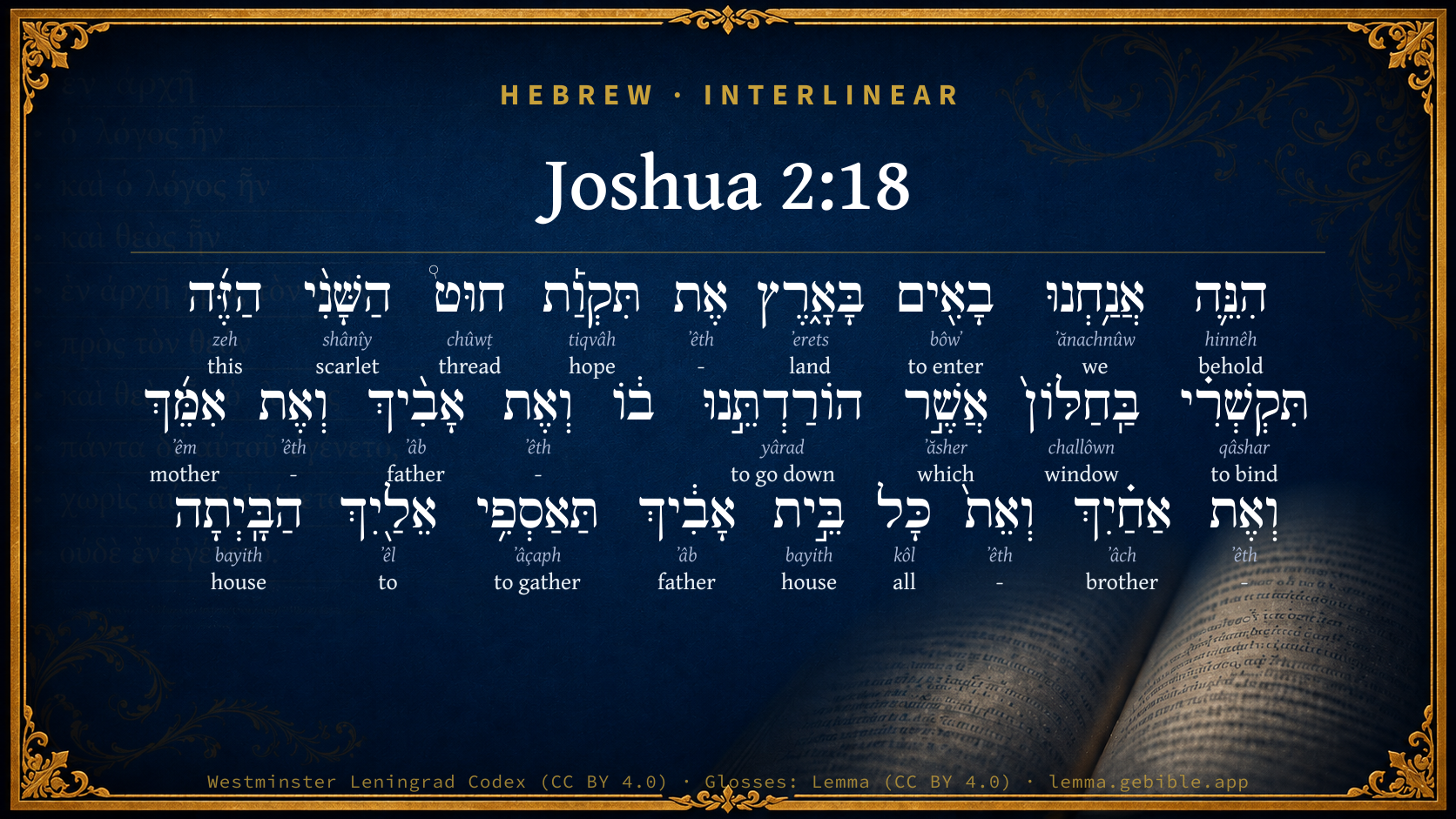
Joshua 2:18

Hebrew (Westminster Leningrad Codex) Joshua 2:18 appears in the Hebrew Old Testament. The text above is from the Westminster Leningrad Codex. Each word links to its Strong’s number, a concise gloss, and parsing drawn from the Open Scriptures Hebrew Bible morphology. Click any word for its full Brown-Driver-Briggs (BDB) entry.
Download image
Cite this verse

Joshua 2:18 (World English Bible). Public Domain. Lemma interlinear Bible study tool, https://lemma.gebible.app/v/joshua/2/18.

Show BibTeX & RIS
BibTeX
RIS
English Translation
Behold, when we come into the land, you shall bind this line of scarlet thread in the window which you did let us down by: and you shall gather to you into the house your father, and your mother, and your brothers, and all your father's household.
World English Bible · Public Domain
Highlights
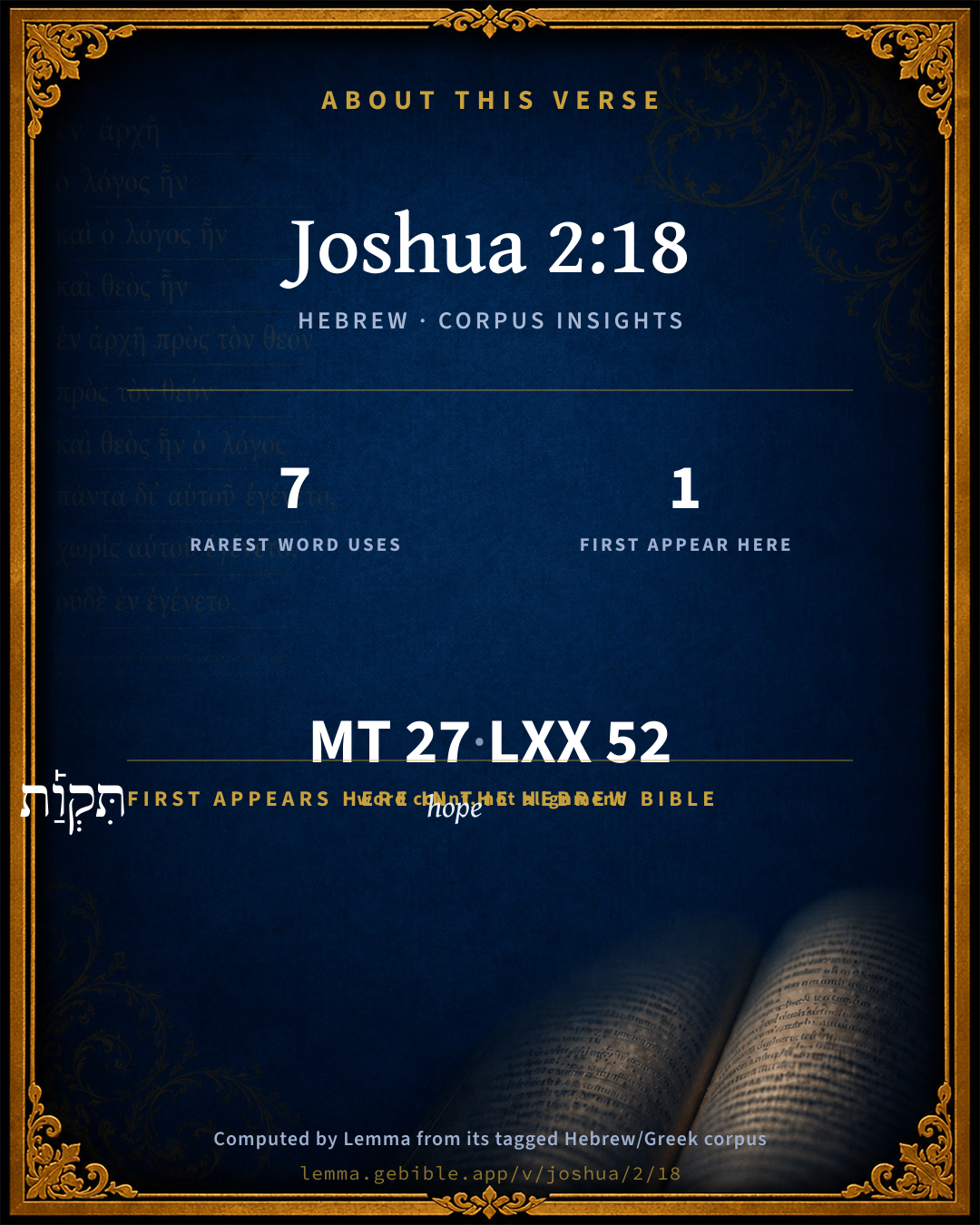
  • 1 first appearance in the Hebrew Bible
Full analysis ↓
Download a study sheet

One document with this verse’s original text, its word-by-word gloss line, the meaning frame, cross-references with their text, attributed commentary, and full source and license credits — printable, and it pastes into notes with its structure intact.

This verse Autodidact and up

Study sheet (.html) Plain text (.txt)

A passage Seminary Student

Up to 50 verses in one chapter. A passage sheet keeps up to 6 commentary sources and 12 cross-references per verse, in the order this page ranks them, and says so on the sheet whenever that leaves anything out. Ask for a single verse and you get the Autodidact verse sheet above.

Everything on this page stays free to read, with no account — the sheet is a download of what is already on screen, not access to it.

Want to remove ads? Support Godless Engineer
Compare translations 3

The same verse in 3 English versions, stacked beneath the original-language interlinear above. Click any original word for its lexicon entry.

Each is an independent rendering of the whole verse — the interlinear is not word-aligned to these translations.

Highlighted words mark where these versions differ — a whole-verse word diff, not a word-by-word alignment.

  • World English Bible Public Domain
    Behold, when we come into the land, you shall bind this line of scarlet thread in the window which you did let us down by: and you shall gather to you into the house your father, and your mother, and your brothers, and all your father's household.
  • King James Version Public Domain
    Behold, when we come into the land, thou shalt bind this line of scarlet thread in the window which thou didst let us down by: and thou shalt bring thy father, and thy mother, and thy brethren, and all thy father's household, home unto thee.
  • unfoldingWord Literal Text CC BY-SA 4.0
    Behold us, coming into the land! You shall tie this cord of thread of scarlet in the window through which you lower us down, and your father and your mother and your brothers and all of the house of your father, you shall gather to you at the house.

unfoldingWord Literal Text — © unfoldingWord, licensed CC BY-SA 4.0. Word-aligned USFM3 via Door43 (git.door43.org/unfoldingWord/en_ult).

Versions to compare (up to 4)

3 of 4 selected

Show all 18 translations

Every available English version of this verse, each an independent rendering of the whole verse.

  • World English Bible Public Domain
    Behold, when we come into the land, you shall bind this line of scarlet thread in the window which you did let us down by: and you shall gather to you into the house your father, and your mother, and your brothers, and all your father's household.
  • Berean Standard Bible Public Domain
    unless, when we enter the land, you have tied this scarlet cord in the window through which you let us down, and unless you have brought your father and mother and brothers and all your family into your house.
  • Majority Standard Bible Public Domain
    unless, when we enter the land, you have tied this scarlet cord in the window through which you let us down, and unless you have brought your father and mother and brothers and all your family into your house.
  • King James Version Public Domain
    Behold, when we come into the land, thou shalt bind this line of scarlet thread in the window which thou didst let us down by: and thou shalt bring thy father, and thy mother, and thy brethren, and all thy father's household, home unto thee.
  • American Standard Version (1901) Public Domain
    Behold, when we come into the land, thou shalt bind this line of scarlet thread in the window which thou didst let us down by: and thou shalt gather unto thee into the house thy father, and thy mother, and thy brethren, and all thy father's household.
  • Revised Version (1885) Public Domain
    Behold, when we come into the land, thou shalt bind this line of scarlet thread in the window which thou didst let us down by: and thou shalt gather unto thee into the house thy father, and thy mother, and thy brethren, and all thy father’s household.
  • Geneva Bible (1599) Public Domain
    Behold, when we come into the land, thou shalt bind this cord of red threde in the window, whereby thou lettest vs downe, and thou shalt bring thy father and thy mother, and thy brethren, and all thy fathers houshold home to thee.
  • Douay-Rheims (1899) Public Domain
    And she said to them: Get ye up to the mountains, lest perhaps they meet you as they return: and there lie ye hid three days, till they come back, and so you shall go on your way.
  • Young's Literal Translation Public Domain
    lo, we are coming into the land, this line of scarlet thread thou dost bind to the window by which thou hast caused us to go down, and thy father, and thy mother, and thy brethren, and all the house of thy father thou dost gather unto thee, to the house;
  • Literal Standard Version CC BY-SA 4.0
    behold, we are coming into the land, bind this line of scarlet thread to the window by which you have caused us to go down, and gather your father, and your mother, and your brothers, and all the house of your father to you, to the house;
  • Unlocked Literal Bible CC BY-SA 4.0
    When we come into the land, you must tie this scarlet rope in the window through which you let us down, and you will gather into the house your father and mother, your brothers and all your father's household.
  • unfoldingWord Literal Text CC BY-SA 4.0
    Behold us, coming into the land! You shall tie this cord of thread of scarlet in the window through which you lower us down, and your father and your mother and your brothers and all of the house of your father, you shall gather to you at the house.
  • Darby Bible Public Domain
    Behold, when we come into the land, thou shalt bind in the window this line of scarlet thread by which thou hast let us down; and thou shalt gather to thee in the house thy father, and thy mother, and thy brethren, and all thy father's household;
  • World Messianic Bible Public Domain
    Behold, when we come into the land, tie this line of scarlet thread in the window which you used to let us down. Gather to yourself into the house your father, your mother, your brothers, and all your father’s household.
  • Webster's Bible Public Domain
    Behold, when we come into the land, thou shalt bind this line of scarlet thread in the window by which thou didst let us down: and thou shalt bring thy father, and thy mother, and thy brethren, and all thy father's household home to thee.
  • Free Bible Version CC BY-SA 4.0
    unless when we enter this land, you hang a scarlet cord in the window through which you lowered us. You must gather together in the house your father and mother and brothers—all the family.
  • Bible in Basic English Public Domain
    If, when we come into the land, you put this cord of bright red thread in the window from which you let us down; and get your father and mother and your brothers and all your family into the house;
  • JPS Tanakh (1917) Public Domain
    Behold, when we come into the land, thou shalt bind this line of scarlet thread in the window which thou didst let us down by; and thou shalt gather unto thee into the house thy father, and thy mother, and thy brethren, and all thy father's household.

Literal Standard Version (2020), Covenant Press — licensed CC BY-SA 4.0. Text via the HelloAO Bible API (eBible.org). Unlocked Literal Bible (unfoldingWord) — licensed CC BY-SA 4.0. Text via the HelloAO Bible API (eBible.org). unfoldingWord Literal Text — © unfoldingWord, licensed CC BY-SA 4.0. Word-aligned USFM3 via Door43 (git.door43.org/unfoldingWord/en_ult). Free Bible Version, Dr. Jonathan Gallagher — licensed CC BY-SA 4.0. Text via the HelloAO Bible API (eBible.org).

Word by word

More ways to search: Search by grammar → Find every occurrence → Compare this word →

Practice this passage: Drill this verse → Learn its vocabulary →

חוּט֩
chûwṭ
H2339
“thread of”
Noun, Common, Masculine, Singular, Construct
Part of Speech
Noun
Type
Common
Gender
Masculine
Number
Singular
State
Construct
Full BDB Definition

Origin: from an unused root probably meaning to sew

TWOT: 621a

a thread, cord, line, string
  1. הִנֵּ֛ה hinnêh H2009 “behold” Particle, Demonstrative
  2. אֲנַ֥חְנוּ ʼănachnûw H587 “we” Pronoun, Personal, 1st Person, Common, Plural
  3. בָאִ֖ים bôwʼ H935 “entering” Verb, Qal, Participle Active, Masculine, Plural, Absolute
  4. בָּאָ֑רֶץ ʼerets H776 “in/at the · land” Preposition, Determined + Noun, Common, Both, Singular, Absolute
  5. אֶת ʼêth H853 “-” Particle, Direct Object
  6. תִּקְוַ֡ת tiqvâh H8615 “hope of” Noun, Common, Feminine, Singular, Construct
  7. הַשָּׁנִ֨י shânîy H8144 “the · scarlet” Particle, Definite Article + Noun, Common, Masculine, Singular, Absolute
  8. הַזֶּ֜ה zeh H2088 “the · this” Particle, Definite Article + Pronoun, Demonstrative, Masculine, Singular
  9. תִּקְשְׁרִ֗י qâshar H7194 “to bind” Verb, Qal, Imperfect, 2nd Person, Feminine, Singular
  10. בַּֽחַלּוֹן֙ challôwn H2474 “in/at the · window” Preposition, Determined + Noun, Common, Both, Singular, Absolute
  11. אֲשֶׁ֣ר ʼăsher H834 “which” Particle, Relative
  12. הוֹרַדְתֵּ֣נוּ yârad H3381 “to go down · us” Verb, Hiphil, Perfect, 2nd Person, Feminine, Singular + Suffix, Personal, 1st Person, Common, Plural
  13. וְאֶת ʼêth H853 “and · -” Conjunction + Particle, Direct Object
  14. אָבִ֨יךְ ʼâb H1 “father · your” Noun, Common, Masculine, Singular, Construct + Suffix, Personal, 2nd Person, Feminine, Singular
  15. וְאֶת ʼêth H853 “and · -” Conjunction + Particle, Direct Object
  16. אִמֵּ֜ךְ ʼêm H517 “mother · your” Noun, Common, Feminine, Singular, Construct + Suffix, Personal, 2nd Person, Feminine, Singular
  17. וְאֶת ʼêth H853 “and · -” Conjunction + Particle, Direct Object
  18. אַחַ֗יִךְ ʼâch H251 “brothers · your” Noun, Common, Masculine, Plural, Construct + Suffix, Personal, 2nd Person, Feminine, Singular
  19. וְאֵת֙ ʼêth H853 “and · -” Conjunction + Particle, Direct Object
  20. כָּל kôl H3605 “all of” Noun, Common, Masculine, Singular, Construct
  21. בֵּ֣ית bayith H1004 “house of” Noun, Common, Masculine, Singular, Construct
  22. אָבִ֔יךְ ʼâb H1 “father · your” Noun, Common, Masculine, Singular, Construct + Suffix, Personal, 2nd Person, Feminine, Singular
  23. תַּאַסְפִ֥י ʼâçaph H622 “to gather” Verb, Qal, Imperfect, 2nd Person, Feminine, Singular
  24. אֵלַ֖יִךְ ʼêl H413 “to · you” Preposition + Suffix, Personal, 2nd Person, Feminine, Singular
  25. הַבָּֽיְתָה bayith H1004 “the · house · toward” Particle, Definite Article + Noun, Common, Masculine, Singular, Absolute + Suffix, Demonstrative

About this verse

These counts appear in no published source. They are computed here, from the morphology-tagged text and Lemma’s own curated glosses. What Lemma adds →

27
words
20
distinct lemmas
Historical
section

Notable vocabulary

The rarest word here is חוּט֩ thread H2339 — appearing just 7 times in the whole Hebrew Bible.

First appearance in Scripture

This word makes its first canonical appearance in the Hebrew Bible here:

  • תִּקְוַ֡ת hope H8615

Shared distinctive vocabulary

חוּט֩ thread H2339 occurs in 7 verses of the Hebrew Bible. Also found in:

Grammatical profile

  • 4 verbs
  • 12 nouns
  • 2 pronouns
  • 2 prepositions
  • 7 particles

Verb forms

  • בָאִ֖ים Qal · Participle Active
  • תִּקְשְׁרִ֗י Qal · Imperfect
  • הוֹרַדְתֵּ֣נוּ Hiphil · Perfect
  • תַּאַסְפִ֥י Qal · Imperfect

Repetition

Words recur within this verse — often emphatic in Hebrew:

  • אָבִ֨יךְ father H1 ×2
  • בֵּ֣ית house H1004 ×2

Hebrew & Septuagint length

In English translation the verse runs 47 words from the Hebrew and 57 from the Septuagint (LXX English) — closely comparable.

A rough comparison of the two English renderings, which tokenize alike — not a word-level alignment.

Word counts can differ between the Hebrew and the Greek without any difference in meaning — e.g. the Hebrew direct-object marker אֵת has no separate Greek word, and Greek often adds the article ὁ.

In the original languages it is 27 Hebrew tokens and 52 Greek tokens — but the two are counted differently (Hebrew bundles its prefixes and suffixes into one token; the Greek is in lemma form), so that isn’t a like-for-like length.

Cross-references

16

Topical passages linked to Joshua 2:18 in the Treasury of Scripture Knowledge — connected by theme and wording, ordered by reader-vote popularity; previews shown in the World English Bible.

  • Joshua 6:23 The young men the spies went in, and brought out Rahab, and her father, and her mother, and her brothers, and all that she had; all her relatives also they brought out; and they set them outside of the camp of Israel.
  • Joshua 2:21 She said, According to your words, so be it. She sent them away, and they departed: and she bound the scarlet line in the window.
  • Joshua 2:12–13 Now therefore, please swear to me by Yahweh, since I have dealt kindly with you, that you also will deal kindly with my father's house, and give me a true token;
  • Genesis 19:12–17 The men said to Lot, "Do you have anybody else here? Sons-in-law, your sons, your daughters, and whoever you have in the city, bring them out of the place:
  • Leviticus 14:4 then the priest shall command them to take for him who is to be cleansed two living clean birds, and cedar wood, and scarlet, and hyssop.
  • Acts 10:33 Therefore I sent to you at once, and it was good of you to come. Now therefore we are all here present in the sight of God to hear all things that have been commanded you by God."
  • Hebrews 9:19 For when every commandment had been spoken by Moses to all the people according to the law, he took the blood of the calves and the goats, with water and scarlet wool and hyssop, and sprinkled both the book itself and all the people,
  • Genesis 7:1 Yahweh said to Noah, "Come with all of your household into the ark, for I have seen your righteousness before me in this generation.
  • Genesis 12:2 I will make of you a great nation. I will bless you, and make your name great. You will be a blessing.
  • Numbers 4:8 They shall spread on them a scarlet cloth, and cover the same with a covering of sealskin, and shall put in its poles.
  • Numbers 19:6 and the priest shall take cedar-wood, and hyssop, and scarlet, and cast it into the midst of the burning of the heifer.
  • Luke 19:9 Jesus said to him, "Today, salvation has come to this house, because he also is a son of Abraham.
  • Acts 10:27 As he talked with him, he went in and found many gathered together.
  • Acts 11:14 who will speak to you words by which you will be saved, you and all your house.'
  • 2 Timothy 1:16 May the Lord grant mercy to the house of Onesiphorus, for he often refreshed me, and was not ashamed of my chain,
  • Esther 8:6 for how can I endure to see the evil that shall come to my people? or how can I endure to see the destruction of my relatives?

Cross-references courtesy of OpenBible.info (CC BY 4.0).

Hebrew and Greek witnesses Masoretic Hebrew ↔ Greek Septuagint

The same verse in the two great witnesses to the Old Testament, shown verse-for-verse.

These are two independent witnesses, not word-aligned to each other, and the Septuagint is shown in lemma (dictionary) form.

Hebrew Joshua 2:18 Masoretic · Westminster Leningrad Codex

הִנֵּ֛ה אֲנַ֥חְנוּ בָאִ֖ים בָּאָ֑רֶץ אֶת תִּקְוַ֡ת חוּט֩ הַשָּׁנִ֨י הַזֶּ֜ה תִּקְשְׁרִ֗י בַּֽחַלּוֹן֙ אֲשֶׁ֣ר הוֹרַדְתֵּ֣נוּ ב֔וֹ וְאֶת אָבִ֨יךְ וְאֶת אִמֵּ֜ךְ וְאֶת אַחַ֗יִךְ וְאֵת֙ כָּל בֵּ֣ית אָבִ֔יךְ תַּאַסְפִ֥י אֵלַ֖יִךְ הַבָּֽיְתָה

Behold, when we come into the land, you shall bind this line of scarlet thread in the window which you did let us down by: and you shall gather to you into the house your father, and your mother, and your brothers, and all your father's household.

World English Bible · Public Domain

Greek LXX Joshua 2:18 Septuagint · lemma form

ἰδού ἐγώ εἰςπορεύομαι εἰς μέρος ὁ πόλις καί τίθημι ὁ σημεῖον ὁ σπαρτίον ὁ κόκκινος οὗτος ἐκδέω εἰς ὁ θυρίς διά ὅς καταβιβάζω ἐγώ διά αὐτός ὁ δέ πατήρ σύ καί ὁ μήτηρ σύ καί ὁ ἀδελφός σύ καί πᾶς ὁ οἶκος ὁ πατήρ σύ συνἄγω πρός σεαυτοῦ εἰς ὁ οἰκία σύ

Behold, we shall enter into a part of the city, and you shall set a sign; you shall bind this scarlet cord in the window, by which you have let us down, and you shall bring in to yourself, into your house, your father, and your mother, and your brethren, and all the family of your father.

LXX2012 (modern English Septuagint) · Public Domain

On this verse, John Gill's Exposition discusses the Septuagint’s reading. Read the note in Commentary ↓

Hebrew: Westminster Leningrad Codex (CC BY 4.0). Greek: Septuagint (public domain); English from LXX2012 (modern English Septuagint) (Public Domain). How the Septuagint differs from the Hebrew →

Targum (Aramaic paraphrase)

1

The Targum is the ancient Jewish Aramaic paraphrase of the Hebrew Scriptures — an interpretive translation, not the Hebrew text itself. Onkelos (literal) and Pseudo-Jonathan (expansive) render the Torah, and Jonathan the Prophets. Coverage is partial: where no permissively-licensed English translation exists for a verse, only the Aramaic is shown. This is verse-level text, not a word-by-word alignment to the Hebrew.

  1. Targum Jonathan Prophets (Joshua–Malachi)
    הָא אֲנַחְנָא עָלִין בְּאַרְעָא יַת תּוֹרָא דְחוּט זְהוֹרִיתָא הָדֵין תִקְטְרִי בַּחֲרַכָּא דְשַׁלְשַלְתָּנָא בֵּיהּ וְיַת אֲבוּךְ וְיַת אִמֵךְ וְיַת אֲחָיְכִי וְיַת כָּל בֵּית אָבוּךְ תִּכְנְשִׁין לְוָתֵיךְ לְבֵיתָא:

    (no public-domain English translation for this verse)

    Targum Jonathan — Aramaic: “Mikraot Gedolot” (public domain). English: “Sefaria Community Translation” (CC0 1.0 (public-domain dedication)); “London "Chaldee Paraphrase," 1871” (public domain). Text via Sefaria.

Commentary

Notes on Joshua 2:18 from classic Christian and Jewish commentators (each source and its license shown beneath its notes). The classic Christian expositions comment on the surrounding passage and are grouped to its opening verse, so a note may address several verses; the Jewish commentaries on the Tanakh (Rashi and others) are per-verse, so they appear only where the commentator wrote on this verse.

Lemma curates 59 commentaries, every one of them public domain or Creative Commons licensed, each selected and text-cleaned for this edition rather than reprinted as found. About our sources →

Trapp's Complete Commentary

John Trapp

Jos 2:18 Behold, [when] we come into the land, thou shalt bind this line of scarlet thread in the window which thou didst let us down by: and thou shalt bring thy father, and thy mother, and thy brethren, and all thy father’s household, home unto thee.

Ver. 18. And thou shalt bring thy father, &c.] Who, if not there found when we storm the town, shall perish at their own peril. So shall all not found to be of the family of faith, and within God’s doors. The devil sweeps all that are out of the covenant.

John Trapp, A Commentary or Exposition upon All the Books of the Old and New Testament (1647–1656) — public domain. Text from a community e-Sword module.

Joseph Benson's Commentary

Jos 2:18. When we come into the land — That is, over Jordan, and near the city. This line of scarlet — The Hebrew word, תקות, tickvath, more properly means, rope, riband, or web. Probably the same with which she was about to let them down. Window — That it may be easily discerned by our soldiers.

Joseph Benson's Commentary on the Old and New Testaments (1811–1818) — public domain. Text from a community e-Sword module.

Adam Clarke's Commentary

Verse 18. This line of scarlet thread] תקות חוט השני tikvath chut hashshani. Probably this may mean, this piece of scarlet cloth, or, this cloth (made) of scarlet thread. When the Israelites took the city this piece of red cloth seems to have been hung out of the window by way of flag; and this was the sign on which she and the spies had agreed.

Adam Clarke's Commentary on the Bible (1810–1826) — public domain. Text from a community e-Sword/MySword module.

Ellicott's Commentary for English Readers

(18) The window which thou didst let us down by.—It seems almost needless to observe that the scarlet line and the cord by which the men were lowered are not the same thing, but described by different words in the original. It would have been preposterous to require Rahab to display in her window the means by which the spies had escaped. It would at once have declared the tale to all beholders—the very thing Rahab was pledged not to do. The “line of scarlet thread” and the “stalks of flax” on the roof were probably parts of the same business, and thus there would be nothing unusual in what was exhibited at the window, although it would be a sufficient token to those who were in the secret, to enable them to identify the house.

A Bible Commentary for English Readers, edited by Charles John Ellicott (1878–1897) — public domain. Text from a community e-Sword module.

The Cambridge Bible for Schools and Colleges

gen. ed. J. J. S. Perowne

18. this line of scarlet thread] The line was spun out of crimson thread, the crimson colour produced by the coccus ilicis, Linn., a cochineal insect, living on the holm oak, the larvæ of which yield the crimson dye.

The Cambridge Bible for Schools and Colleges (gen. ed. J. J. S. Perowne; Cambridge University Press, 1878–1918) — public domain. Text from a community e-Sword module.

John Gill's Exposition

Behold, when we come into the land,.... The land of Canaan, and into this city, into that part of it, as the Septuagint, where her house was, meaning not themselves only, but the people of Israel they belonged to:

thou shall bind this line of scarlet thread in the window which thou didst let us down by; the word by refers either to the scarlet thread they were let down by, said to be a cord, Jos 2:15; and therefore must be a line twisted with various scarlet threads, as Kimchi; who observes, that according to the Targum, it was the border of a red garment; or to the window through which they were let down, as the Septuagint version; it may refer to both, and the sense be, that the same twisted cord of scarlet thread they were let down by should be bound to the same window they were let down through; only this objection there is to the same window, that it was not towards the city, and so not to be seen when they came into it, but looked over the wall without the city: now as Rahab was an instance of the salvation of sinners by the grace of God, for she was a sinner by birth, by practice, and a notorious one; she was an instance of distinguishing grace, of free and efficacious grace, a singular instance of it; and became a true penitent, a real believer, was a justified person, and saved: so the scarlet thread was an emblem of the blood of Christ, by which salvation is; redemption and all the blessings of grace are through it; justification, remission of sin, reconciliation, and atonement, and safety, and protection from avenging justice, and wrath to come, are only by it: likewise the spies, who are also called "messengers", Jam 2:25; may represent the ministers of the Gospel, who are the messengers of Christ, and the churches, are sent out by him the antitypical Joshua, men of wisdom, courage, and valour, and are sent as spies to bring to light men and things, who direct to the way of salvation and give the same token of it, Mar 16:16,

and thou shall bring thy father, and thy mother, and thy brethren, and all thy father's household home unto thee; into her house, where the scarlet thread was bound, and where only they would be safe, as the Israelites were in the houses where the blood of the paschal lamb was sprinkled, Exo 12:23; and so they are safe, and they only, who are under the blood of sprinkling, and partake of the virtue of it.

John Gill's Exposition of the Whole Bible (1746–1763) — public domain (CC PDM 1.0). Text via the HelloAO Bible API.

Albert Barnes' Notes on the Bible

The “line” or cord was spun of threads dyed with cochineal: i. e., of a deep and bright scarlet color. The color would catch the eye at once, and supplied an obvious token by which the house of Rahab might be distinguished. The use of scarlet in the Levitical rites, especially in those more closely connected with the idea of putting away of sin and its consequences (compare e. g., Lev 14:4, Lev 14:6,Lev 14:51; Num 19:6), naturally led the fathers, from Clement of Rome onward, to see in this scarlet thread, no less than in the blood of the Passover (Exo 12:7, Exo 12:13, etc.), an emblem of salvation by the Blood of Christ; a salvation common alike to Christ’s messengers and to those whom they visit.

Albert Barnes' Notes on the Bible (1834–1885) — public domain. Text from a community e-Sword/MySword module.

Haydock's Catholic Bible Commentary

CHAPTER II.

Ver 1. Sent, or as many translate, "had sent," as if Josue had dismissed the spies immediately after the mourning of Moses was ended, (Calmet) on the 1st of Nisan. On the second day they examined the city, and were obliged to flee in the night. But they only returned to their brethren on the 6th. On the following day Josue gave orders to make all necessary preparations for their departure, and crossed the Jordan on the 10th of the month. (Salien, B.C. 1469.) --- Setim was about eight or nine miles from the river, "or sixty stadia." (Josephus, [Antiquities?] v. 1.) --- Two men. Septuagint intimate that they were young. See chap. vi. 23. (Haydock) --- The Rabbins assert, without reason, that Caleb and Phinees were chosen, and that they pretended that they were deaf, (eross) a word which the Vulgate translates, secretly. (Calmet) --- Jericho. Josue had himself examined the country some time before. But there might have been many changes, and he might not know the present disposition of the people of Jericho. (Haydock) --- This city was built in a delightful plain, surrounded by mountains, (Calmet) except on the east side, chap. iv. 13. (Haydock) --- Harlot. Hebrew zona may also signify an "innkeeper," as such places were under the direction of women, who were commonly of a very loose character. Hence the Greeks deemed it a dishonour to enter into a public house. Isocrates says, that "even an honest servant will not dare to enter into an ale-house, to eat or drink." (Atheneus Dipn. 13.) --- Rahab might have been formerly addicted to pleasure, as the Scripture and the Fathers agree; (Hebrews xi. 31., and James ii. 25.) (Calmet) though she might at this time be very discreet, being awakened by the account of the miracles which God had wrought in favour of his people, who, she knew, were approaching to take possession of the country. The spies might, therefore, take shelter in her house with the least suspicion, and without danger of injuring their character. (Haydock) --- The woman was not very old, as she was afterwards married to Salmon. (St. Matthew i. 5.) --- With her. they spent the first night in her house, entering the city in the dusk of the evening, so that they had not time to make any observations till the following day. (Salien) --- Others think that they were suspected by the people of the town almost immediately, and denounced to the king. Hence they were forced to flee that same night, without having accomplished their design, and were only informed by Rahab of the dismay which had seized the inhabitants, ver. 11.

By which window or cord. (Calmet) --- The cord was left as a signal. (Menochius)

George Leo Haydock (1774–1849), Haydock's Catholic Family Bible and Commentary, 1859 edition — public domain. Excludes Psalms (Douay-Rheims chapter numbering differs from Protestant) and Deuterocanonical books (Catholic canon only).

Matthew Poole's English Annotations

Into the land, i.e. over Jordan, and near the city.

Bind this line of scarlet thread in the window, that it may be easily discerned by our soldiers.

Matthew Poole's English Annotations on the Holy Bible (1683–1685) — public domain. Text from a community e-Sword/MySword module.

Whedon's Commentary on the Bible

Daniel D. Whedon

18. Thou shalt bind this line of scarlet thread in the window — A small rope or cord composed of crimson threads. The English version conveys the idea that this cord was used in letting down the spies. But the Hebrew, Septuagint, and Vulgate make the window the antecedent of which, thus — the window through which thou didst let us down. The scarlet cord was probably the token (Jos_2:12) given to Rahab in proof of their oath. But the scarlet of the thread by which she and her house were to be saved, though a suggestive emblem of the blood of the atonement, (as advanced by St. Clement,) can hardly be considered, like the blood of the paschal lamb on the door post, an appointed type.

And thou shall bring thy father — The persons to whom deliverance is pledged must be separated front the mass of the people and gathered within the house of Rahab, otherwise they must perish in the impending universal destruction. So must those who hope to escape the general doom of this sinful world be gathered into the house of God, the Church of Jesus Christ.

Daniel D. Whedon (gen. ed.), Commentary on the Old and New Testaments (1874–1909) — public domain. Text from a community e-Sword module.

The Pulpit Commentary

This line of scarlet thread. Rather, this rope, from hwq to twist. It is described as made of sewing thread (fWh), because no doubt it was formed of several such threads twisted into a rope. The scarlet (yni or rather crimson, was produced from the dried bodies as well as the eggs of the cochineal insect, called in Arabic, kermes (whence our word crimson, and the German karmesin). This line of scarlet thread is regarded by the Fathers generally, and by our own divines, as Bishop Hall and Bishop Wordsworth, as symbolical of the blood of Christ (see Clement of Rome, "Epistle to Corinthians," 12; Justin Martyr, "Dial. Tryph." 111; Iren., "Adv. Haer.," 4:37; Orig., "Hom. 2 on Joshua." "Coccineum, quod sanguinis formam gerebat." See also Bp. Hall, "Contemplations," Book 8: Lev_14:4, Lev_14:6, Lev_14:42, Lev_14:51).

The Pulpit Commentary (1880–1919), ed. H.D.M. Spence-Jones & Joseph S. Exell — public domain. Text from a community e-Sword module.

John Wesley's Explanatory Notes

Into the land - That is, over Jordan, and near the city. This line of scarlet - Probably the same with which she was about to let them down. Window - That it may be easily discerned by our soldiers.

John Wesley, Explanatory Notes Upon the Whole Bible (1754–1765) — public domain. Text via the GEBible commentary corpus.

unfoldingWord translationNotes

Door43 World Missions Community

Connecting Statement:

The Israelite spies clarify the condition they expressed in Joshua 2:15.

General Information:

The Israelite spies continue talking to Rahab.

Whoever goes out of the doors of your house

This phrase expresses a condition, creating a hypothetical situation. (See: Hypothetical Situations)

blood will be upon their own heads

Here "blood" represents a person's death. To be responsible for their own death is spoken of as if their blood would be on their heads. AT: "their death will be their own fault" (See: Metonymy and Metaphor)

we will be guiltless

"we will be innocent"

if a hand is laid upon any

Here "a hand is laid upon" is a polite way of referring to causing someone injury. AT: "if we cause injury to any" (See: Euphemism)

translationWords

house

ancestor

brother

household

blood

unfoldingWord translationNotes — © Distant Shores Media and the Door43 World Missions Community, licensed CC BY-SA 4.0. Source: git.door43.org/Door43/en_tn.

Rashi

Rabbi Shlomo Yitzchaki (Rashi)

The line of red string. תִּקְוַת means a line or rope.

Rashi on the Tanakh — English translations: “The Judaica Press complete Tanach with Rashi, translated by A. J. Rosenberg” (CC BY 4.0); “Pentateuch with Rashi's commentary by M. Rosenbaum and A.M. Silbermann, 1929-1934” (public domain); “The Metsudah Tanach series, Lakewood, N.J” (CC BY 4.0); and “The Book of Joshua, Metsudah Publications, 1997” (CC BY 4.0). Text via Sefaria.

Lesson kit

Teaching starters — assembled from the data on this page, not authored interpretation. Every prompt links to the verse data it draws on. Edit before teaching.

Joshua, in the Historical, opens this verse with 27 words (20 distinct Hebrew lemmas). Its most distinctive word is chûwṭ (“thread”). A historical commentator’s framing appears above. Read the whole chapter for the surrounding context.

Discussion questions

  1. The word chûwṭ carries the sense “thread.” How does it shape the verse?
  2. This is the first place “hope” appears in Scripture (first appears here). What does its debut here establish?
  3. How does Genesis 14:23, which shares the word «thread», read alongside this verse?
  4. What does the repetition of “father” (2× in this one verse) do in this verse?
  5. These translations render this verse differently. What is at stake in choosing one wording over another?
  6. «בָאִ֖ים» is a Qal Participle Active verb. How does that grammatical form shape the action described?
  7. Compare how Trapp's Complete Commentary and Joseph Benson's Commentary read this verse. Where do they agree or differ?

Things to notice

Reading settings

Reading text

Shown beneath each verse's original-language words.

Old Testament
Old Testament edition

Read the OT as the Masoretic Hebrew (MT) or the Greek Septuagint (LXX).

English shown for the Greek Septuagint (in the Hebrew ↔ Greek comparison).

Comparing translations? Open the Compare panel on any verse page to stack up to four side by side.