
1 Samuel 5:11

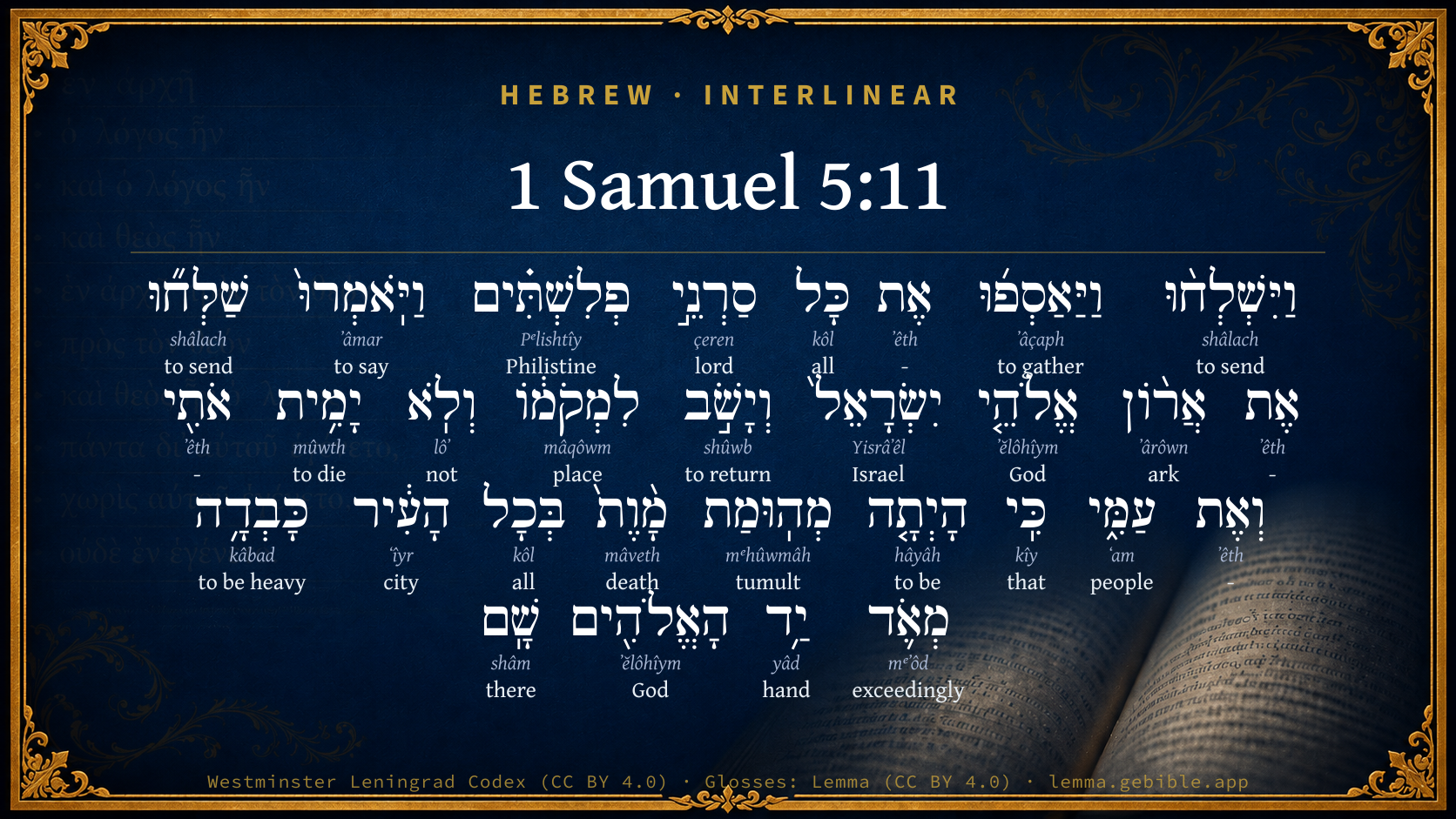
Hebrew (Westminster Leningrad Codex) 1 Samuel 5:11 appears in the Hebrew Old Testament. The text above is from the Westminster Leningrad Codex. Each word links to its Strong’s number, a concise gloss, and parsing drawn from the Open Scriptures Hebrew Bible morphology. Click any word for its full Brown-Driver-Briggs (BDB) entry.
Download image
Cite this verse

1 Samuel 5:11 (World English Bible). Public Domain. Lemma interlinear Bible study tool, https://lemma.gebible.app/v/1-samuel/5/11.

Show BibTeX & RIS
BibTeX
RIS
English Translation
They sent therefore and gathered together all the lords of the Philistines, and they said, Send away the ark of the God of Israel, and let it go again to its own place, that it not kill us and our people. For there was a deadly confusion throughout all the city; the hand of God was very heavy there.
World English Bible · Public Domain
Download a study sheet

One document with this verse’s original text, its word-by-word gloss line, the meaning frame, cross-references with their text, attributed commentary, and full source and license credits — printable, and it pastes into notes with its structure intact.

This verse Autodidact and up

Study sheet (.html) Plain text (.txt)

A passage Seminary Student

Up to 50 verses in one chapter. A passage sheet keeps up to 6 commentary sources and 12 cross-references per verse, in the order this page ranks them, and says so on the sheet whenever that leaves anything out. Ask for a single verse and you get the Autodidact verse sheet above.

Everything on this page stays free to read, with no account — the sheet is a download of what is already on screen, not access to it.

Want to remove ads? Support Godless Engineer
Compare translations 3

The same verse in 3 English versions, stacked beneath the original-language interlinear above. Click any original word for its lexicon entry.

Each is an independent rendering of the whole verse — the interlinear is not word-aligned to these translations.

Highlighted words mark where these versions differ — a whole-verse word diff, not a word-by-word alignment.

  • World English Bible Public Domain
    They sent therefore and gathered together all the lords of the Philistines, and they said, Send away the ark of the God of Israel, and let it go again to its own place, that it not kill us and our people. For there was a deadly confusion throughout all the city; the hand of God was very heavy there.
  • King James Version Public Domain
    So they sent and gathered together all the lords of the Philistines, and said, Send away the ark of the God of Israel, and let it go again to his own place, that it slay us not, and our people: for there was a deadly destruction throughout all the city; the hand of God was very heavy there.
  • unfoldingWord Literal Text CC BY-SA 4.0
    And they sent and gathered all of the lords of the Philistines, and they said, “Send away the Box of the God of Israel that it may return to its place, and it will not kill me and my people!” For there was a tumult of death in all of the city. The hand of God very heavy there.

unfoldingWord Literal Text — © unfoldingWord, licensed CC BY-SA 4.0. Word-aligned USFM3 via Door43 (git.door43.org/unfoldingWord/en_ult).

Versions to compare (up to 4)

3 of 4 selected

Show all 18 translations

Every available English version of this verse, each an independent rendering of the whole verse.

  • World English Bible Public Domain
    They sent therefore and gathered together all the lords of the Philistines, and they said, Send away the ark of the God of Israel, and let it go again to its own place, that it not kill us and our people. For there was a deadly confusion throughout all the city; the hand of God was very heavy there.
  • Berean Standard Bible Public Domain
    Then the Ekronites assembled all the rulers of the Philistines and said, “Send away the ark of the God of Israel. It must return to its place, so that it will not kill us and our people!” For a deadly confusion had pervaded the city; the hand of God was heavy upon it.
  • Majority Standard Bible Public Domain
    Then the Ekronites called together all the rulers of the Philistines and said, “Send away the ark of the God of Israel. It must return to its place, so that it will not kill us and our people!” For a deadly confusion had pervaded the city; the hand of God was very heavy upon it.
  • King James Version Public Domain
    So they sent and gathered together all the lords of the Philistines, and said, Send away the ark of the God of Israel, and let it go again to his own place, that it slay us not, and our people: for there was a deadly destruction throughout all the city; the hand of God was very heavy there.
  • American Standard Version (1901) Public Domain
    They sent therefore and gathered together all the lords of the Philistines, and they said, Send away the ark of the God of Israel, and let it go again to its own place, that is slay us not, and our people. For there was a deadly discomfiture throughout all the city; the hand of God was very heavy there.
  • Revised Version (1885) Public Domain
    They sent therefore and gathered together all the lords of the Philistines, and they said, Send away the ark of the God of Israel, and let it go again to its own place, that it slay us not, and our people: for there was a deadly discomfiture throughout all the city, the hand of God was very heavy there.
  • Geneva Bible (1599) Public Domain
    Therefore they sent, and gathered together all the princes of the Philistims and sayd, Sende away the Arke of the God of Israel, and let it returne to his owne place, that it slay vs not and our people: for there was a destruction and death throughout all the citie, and the hand of God was very sore there.
  • Douay-Rheims (1899) Public Domain
    They sent therefore and gathered together all the lords of the Philistines: and they said: Send away the ark of the God of Israel, and let it return into its own place, and not kill us and our people.
  • Young's Literal Translation Public Domain
    And they send and gather all the princes of the Philistines, and say, `Send away the ark of the God of Israel, and it turneth back to its place, and it doth not put us to death -- and our people;' for there hath been a deadly destruction throughout all the city, very heavy hath the hand of God been there,
  • Literal Standard Version CC BY-SA 4.0
    And they send and gather all the princes of the Philistines, and say, “Send the Ark of the God of Israel away, and it turns back to its place, and it does not put us and our people to death”; for there has been a deadly destruction throughout all the city, the hand of God has been very heavy there,
  • Unlocked Literal Bible CC BY-SA 4.0
    So they sent for and gathered together all of the rulers of the Philistines; they said to them, “Send away the ark of the God of Israel, and let it return to its own place, so that it does not kill us and our people.” For there was a deathly panic throughout the city; the hand of God was very heavy there.
  • unfoldingWord Literal Text CC BY-SA 4.0
    And they sent and gathered all of the lords of the Philistines, and they said, “Send away the Box of the God of Israel that it may return to its place, and it will not kill me and my people!” For there was a tumult of death in all of the city. The hand of God very heavy there.
  • Darby Bible Public Domain
    And they sent and gathered all the lords of the Philistines, and said, Send away the ark of the God of Israel, and let it go again to its own place, that it kill us not, and our people. For there was deadly alarm throughout the city: the hand of God was very heavy there;
  • World Messianic Bible Public Domain
    They sent therefore and gathered together all the lords of the Philistines, and they said, “Send the ark of the God of Israel away, and let it go again to its own place, that it not kill us and our people.” For there was a deadly panic throughout all the city. The hand of God was very heavy there.
  • Webster's Bible Public Domain
    So they sent and convened all the lords of the Philistines, and said, Send away the ark of the God of Israel, and let it go again to its own place, that it slay us not, and our people: for there was a deadly destruction throughout all the city; the hand of God was very heavy there.
  • Free Bible Version CC BY-SA 4.0
    So they sent for all the Philistine rulers and said, “Send the Ark of the God of Israel away, back to where it came from, otherwise it's going to kill us and our people.” People were dying throughout the town, creating terrible panic, for God's punishment was very hard.
  • Bible in Basic English Public Domain
    So they sent and got together all the lords of the Philistines, and they said, Send away the ark of the God of Israel, and let it go back to its place, so that it may not be the cause of death to us and to our people: for there was a great fear of death through all the town; the hand of God was very hard on them there.
  • JPS Tanakh (1917) Public Domain
    They sent therefore and gathered together all the lords of the Philistines, and they said: 'Send away the ark of the God of Israel, and let it go back to its own place, that it slay us not, and our people'; for there was a deadly discomfiture throughout all the city; the hand of God was very heavy there.

Literal Standard Version (2020), Covenant Press — licensed CC BY-SA 4.0. Text via the HelloAO Bible API (eBible.org). Unlocked Literal Bible (unfoldingWord) — licensed CC BY-SA 4.0. Text via the HelloAO Bible API (eBible.org). unfoldingWord Literal Text — © unfoldingWord, licensed CC BY-SA 4.0. Word-aligned USFM3 via Door43 (git.door43.org/unfoldingWord/en_ult). Free Bible Version, Dr. Jonathan Gallagher — licensed CC BY-SA 4.0. Text via the HelloAO Bible API (eBible.org).

Word by word

More ways to search: Search by grammar → Find every occurrence → Compare this word →

Practice this passage: Drill this verse → Learn its vocabulary →

מְהֽוּמַת
mᵉhûwmâh
H4103
“tumult of”
Noun, Common, Feminine, Singular, Construct
Part of Speech
Noun
Type
Common
Gender
Feminine
Number
Singular
State
Construct
Full BDB Definition

Origin: from H1949

TWOT: 486a

tumult, confusion, disquietude, discomfiture, destruction, trouble, vexed, vexation - tumult, confusion, disturbance, turmoil, disquietude, panic - discomfiture
  1. וַיִּשְׁלְח֨וּ shâlach H7971 “and · to send” Conjunction + Verb, Qal, Sequential Imperfect, 3rd Person, Masculine, Plural
  2. וַיַּאַסְפ֜וּ ʼâçaph H622 “and · to gather” Conjunction + Verb, Qal, Sequential Imperfect, 3rd Person, Masculine, Plural
  3. אֶת ʼêth H853 “-” Particle, Direct Object
  4. כָּל kôl H3605 “all of” Noun, Common, Masculine, Singular, Construct
  5. סַרְנֵ֣י çeren H5633 “lords of” Noun, Common, Masculine, Plural, Construct
  6. פְלִשְׁתִּ֗ים Pᵉlishtîy H6430 “Philistines” Noun, Gentilic, Masculine, Plural, Absolute
  7. וַיֹּֽאמְרוּ֙ ʼâmar H559 “and · to say” Conjunction + Verb, Qal, Sequential Imperfect, 3rd Person, Masculine, Plural
  8. שַׁלְּח֞וּ shâlach H7971 “send” Verb, Piel, Imperative, 2nd Person, Masculine, Plural
  9. אֶת ʼêth H853 “-” Particle, Direct Object
  10. אֲר֨וֹן ʼârôwn H727 “ark of” Noun, Common, Both, Singular, Construct
  11. אֱלֹהֵ֤י ʼĕlôhîym H430 “God(s) of” Noun, Common, Masculine, Plural, Construct
  12. יִשְׂרָאֵל֙ Yisrâʼêl H3478 “Israel” Noun, Proper
  13. וְיָשֹׁ֣ב shûwb H7725 “and · to return” Conjunction + Verb, Qal, Jussive, 3rd Person, Masculine, Singular
  14. לִמְקֹמ֔וֹ mâqôwm H4725 “to/for · place · his” Preposition + Noun, Common, Masculine, Singular, Construct + Suffix, Personal, 3rd Person, Masculine, Singular
  15. וְלֹֽא lôʼ H3808 “and · not” Conjunction + Particle, Negative
  16. יָמִ֥ית mûwth H4191 “to die” Verb, Hiphil, Imperfect, 3rd Person, Masculine, Singular
  17. אֹתִ֖י ʼêth H853 “- · me” Particle, Direct Object + Suffix, Personal, 1st Person, Common, Singular
  18. וְאֶת ʼêth H853 “and · -” Conjunction + Particle, Direct Object
  19. עַמִּ֑י ʻam H5971 “people · my” Noun, Common, Masculine, Singular, Construct + Suffix, Personal, 1st Person, Common, Singular
  20. כִּֽי kîy H3588 “that” Conjunction
  21. הָיְתָ֤ה hâyâh H1961 “to be” Verb, Qal, Perfect, 3rd Person, Feminine, Singular
  22. מָ֨וֶת֙ mâveth H4194 “death” Noun, Common, Masculine, Singular, Absolute
  23. בְּכָל kôl H3605 “in/at · all of” Preposition + Noun, Common, Masculine, Singular, Construct
  24. הָעִ֔יר ʻîyr H5892 “the · city” Particle, Definite Article + Noun, Common, Feminine, Singular, Absolute
  25. כָּבְדָ֥ה kâbad H3513 “to be heavy” Verb, Qal, Perfect, 3rd Person, Feminine, Singular
  26. מְאֹ֛ד mᵉʼôd H3966 “exceedingly” Adverb
  27. יַ֥ד yâd H3027 “hand of” Noun, Common, Both, Singular, Construct
  28. הָאֱלֹהִ֖ים ʼĕlôhîym H430 “the · God(s)” Particle, Definite Article + Noun, Common, Masculine, Plural, Absolute
  29. שָֽׁם shâm H8033 “there” Adverb

About this verse

These counts appear in no published source. They are computed here, from the morphology-tagged text and Lemma’s own curated glosses. What Lemma adds →

30
words
24
distinct lemmas
Historical
section

Notable vocabulary

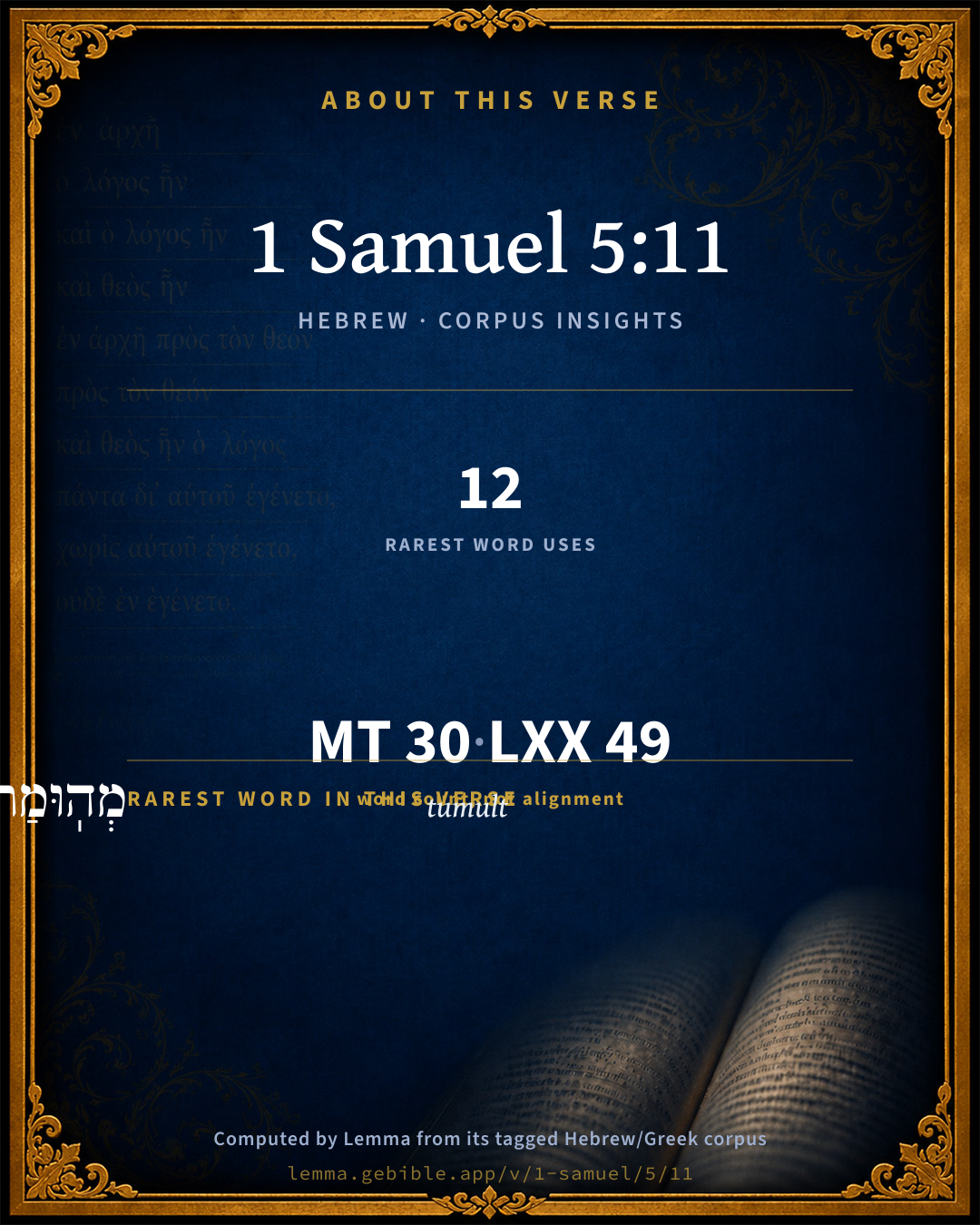
The rarest word here is מְהֽוּמַת tumult H4103 — appearing just 12 times in the whole Hebrew Bible.

Shared distinctive vocabulary

מְהֽוּמַת tumult H4103 occurs in 12 verses of the Hebrew Bible. Also found in:

Grammatical profile

  • 8 verbs
  • 14 nouns
  • 1 conjunction
  • 2 adverbs
  • 5 particles

Verb forms

  • וַיִּשְׁלְח֨וּ Qal · Sequential Imperfect
  • וַיַּאַסְפ֜וּ Qal · Sequential Imperfect
  • וַיֹּֽאמְרוּ֙ Qal · Sequential Imperfect
  • שַׁלְּח֞וּ Piel · Imperative
  • וְיָשֹׁ֣ב Qal · Jussive
  • יָמִ֥ית Hiphil · Imperfect
  • הָיְתָ֤ה Qal · Perfect
  • כָּבְדָ֥ה Qal · Perfect

Repetition

Words recur within this verse — often emphatic in Hebrew:

  • וַיִּשְׁלְח֨וּ to send H7971 ×2
  • כָּל all H3605 ×2
  • אֱלֹהֵ֤י God H430 ×2

Hebrew & Septuagint length

In English translation the verse runs 59 words from the Hebrew and 38 from the Septuagint (LXX English) — the Septuagint runs noticeably shorter here. See the side-by-side →

A rough comparison of the two English renderings, which tokenize alike — not a word-level alignment.

Word counts can differ between the Hebrew and the Greek without any difference in meaning — e.g. the Hebrew direct-object marker אֵת has no separate Greek word, and Greek often adds the article ὁ.

In the original languages it is 30 Hebrew tokens and 49 Greek tokens — but the two are counted differently (Hebrew bundles its prefixes and suffixes into one token; the Greek is in lemma form), so that isn’t a like-for-like length.

Cross-references

4

Topical passages linked to 1 Samuel 5:11 in the Treasury of Scripture Knowledge — connected by theme and wording, ordered by reader-vote popularity; previews shown in the World English Bible.

  • 1 Samuel 5:6 But the hand of Yahweh was heavy on them of Ashdod, and he destroyed them, and struck them with tumors, even Ashdod and the borders of it.
  • 1 Samuel 5:8–9 They sent therefore and gathered all the lords of the Philistines to them, and said, What shall we do with the ark of the God of Israel? They answered, Let the ark of the God of Israel be carried about to Gath. They carried the ark of the God of Israel [there].
  • Isaiah 13:7–9 Therefore shall all hands be feeble, and every heart of man shall melt:
  • Jeremiah 48:42–44 Moab shall be destroyed from being a people, because he has magnified himself against Yahweh.

Cross-references courtesy of OpenBible.info (CC BY 4.0).

Hebrew and Greek witnesses Masoretic Hebrew ↔ Greek Septuagint

The same verse in the two great witnesses to the Old Testament, shown verse-for-verse.

Here the Septuagint runs noticeably shorter than the Hebrew — LXX2012 (modern English Septuagint) 38 words vs World English Bible 59. A rough length comparison of the two English translations, not a word-level alignment — read both below.

These are two independent witnesses, not word-aligned to each other, and the Septuagint is shown in lemma (dictionary) form.

Hebrew 1 Samuel 5:11 Masoretic · Westminster Leningrad Codex

וַיִּשְׁלְח֨וּ וַיַּאַסְפ֜וּ אֶת כָּל סַרְנֵ֣י פְלִשְׁתִּ֗ים וַיֹּֽאמְרוּ֙ שַׁלְּח֞וּ אֶת אֲר֨וֹן אֱלֹהֵ֤י יִשְׂרָאֵל֙ וְיָשֹׁ֣ב לִמְקֹמ֔וֹ וְלֹֽא יָמִ֥ית אֹתִ֖י וְאֶת עַמִּ֑י כִּֽי הָיְתָ֤ה מְהֽוּמַת מָ֨וֶת֙ בְּכָל הָעִ֔יר כָּבְדָ֥ה מְאֹ֛ד יַ֥ד הָאֱלֹהִ֖ים שָֽׁם

They sent therefore and gathered together all the lords of the Philistines, and they said, Send away the ark of the God of Israel, and let it go again to its own place, that it not kill us and our people. For there was a deadly confusion throughout all the city; the hand of God was very heavy there.

World English Bible · Public Domain

Greek LXX 1 Samuel 5:11 Septuagint · lemma form

καί ἐκ ἀποστέλλω καί συνἄγω ὁ σατράπης ὁ ἀλλόφυλος καί εἶπον ἐκ ἀποστέλλω ὁ κιβωτός ὁ θεός ἰσραήλ καί καταἵζω εἰς ὁ τόπος αὐτός καί οὐ μή θανατόω ἐγώ καί ὁ λαός ἐγώ ὅτι γίγνομαι σύγχυσις θάνατος ἐν ὅλος ὁ πόλις βαρύς σφόδρα ὡς εἰςἔρχομαι κιβωτός θεός ἰσραήλ ἐκεῖ

And they send and gather the lords of the Philistines, and they said, Send away the ark of the God of Israel, and let it lodge in its place; and let it not kill us and our people.

LXX2012 (modern English Septuagint) · Public Domain

Hebrew: Westminster Leningrad Codex (CC BY 4.0). Greek: Septuagint (public domain); English from LXX2012 (modern English Septuagint) (Public Domain). How the Septuagint differs from the Hebrew →

Targum (Aramaic paraphrase)

1

The Targum is the ancient Jewish Aramaic paraphrase of the Hebrew Scriptures — an interpretive translation, not the Hebrew text itself. Onkelos (literal) and Pseudo-Jonathan (expansive) render the Torah, and Jonathan the Prophets. Coverage is partial: where no permissively-licensed English translation exists for a verse, only the Aramaic is shown. This is verse-level text, not a word-by-word alignment to the Hebrew.

  1. Targum Jonathan Prophets (Joshua–Malachi)
    וּשְׁלַחוּ וּכְנָשׁוּ יַת כָּל טוּרְנֵי פְלִשְׁתָּאֵי וַאֲמַרוּ שַׁלְחוּ יַת אֲרוֹן אֱלָהָא דְיִשְׂרָאֵל וִיתוּב לְאַתְרֵיהּ וְלָא יִקְטוֹל יָתִי וְיַת עַמִי אֲרֵי הֲוַת שִׁיגוּשׁ קְטָלָא בְּכָל קַרְתָּא תְּקֵיפַת לַחֲדָא מֲחָתָא דַייָ תַּמָן:

    (no public-domain English translation for this verse)

    Targum Jonathan — Aramaic: “Mikraot Gedolot” (public domain). English: “Sefaria Community Translation” (CC0 1.0 (public-domain dedication)); “London "Chaldee Paraphrase," 1871” (public domain). Text via Sefaria.

Commentary

Notes on 1 Samuel 5:11 from classic Christian and Jewish commentators (each source and its license shown beneath its notes). The classic Christian expositions comment on the surrounding passage and are grouped to its opening verse, so a note may address several verses; the Jewish commentaries on the Tanakh (Rashi and others) are per-verse, so they appear only where the commentator wrote on this verse.

Lemma curates 59 commentaries, every one of them public domain or Creative Commons licensed, each selected and text-cleaned for this edition rather than reprinted as found. About our sources →

Trapp's Complete Commentary

John Trapp

1Sa 5:11 So they sent and gathered together all the lords of the Philistines, and said, Send away the ark of the God of Israel, and let it go again to his own place, that it slay us not, and our people: for there was a deadly destruction throughout all the city; the hand of God was very heavy there.

Ver. 11. Let it go again to his own place.] Hoc magno mercentur Hebraei. It is reported of the people in the East Indies, in the isle Ceylon; that having an ape’s tooth got from them, which was a consecrated thing by them, they offered an incredible mass of treasure to recover it. But what an ape’s face was the devil {a} to set Herodotus {b} the historian a-work, to say that at Ascalon, a city of the Philistines, Venus had a temple, - Dagon is by some thought to be Venus, - which when certain thieves robbed, they were smitten with emerods!

{a} Satan est Dei Simia.

{b} Joseph., lib. x. cap. 1.

John Trapp, A Commentary or Exposition upon All the Books of the Old and New Testament (1647–1656) — public domain. Text from a community e-Sword module.

Joseph Benson's Commentary

1Sa 5:11-12. There was a deadly destruction through all the city — That is, in every city where the ark of God came, some were struck with the pestilence and died, and others lingered under intolerable pains, which made them cry out in an inexpressible manner. The cry of the city went up to heaven — A hyperbolical speech; things that are exceeding great, beyond expression, being often said to reach to heaven, Deu 1:28.

Joseph Benson's Commentary on the Old and New Testaments (1811–1818) — public domain. Text from a community e-Sword module.

Geneva Bible (1599)

Geneva Bible translators

The wicked when they feel the hand of God, grudge and reject him, where the godly humble themselves, and cry for mercy.

Geneva Bible (1599) marginal notes — public domain. Text via Bolls.life.

Jamieson, Fausset & Brown

Robert Jamieson, A. R. Fausset & David Brown

they sent--that is, the magistrates of Ekron.

Jamieson, Fausset & Brown — Commentary Critical and Explanatory on the Whole Bible (1871) — public domain (CC PDM 1.0). Text via the HelloAO Bible API.

Adam Clarke's Commentary

Verse 11. Send away the ark] It appears that it had been received at Ekron, for there was a deadly destruction through the whole city. They therefore concluded that the ark should be sent back to Shiloh.

Adam Clarke's Commentary on the Bible (1810–1826) — public domain. Text from a community e-Sword/MySword module.

Ellicott's Commentary for English Readers

(11) Send away the ark.—The lords of the Philistines were a long time before they could make up their minds to get rid of this deadly trophy of their victory. They had grown up with an undefined awe of the “golden chest,” which, as they supposed, had so often in the days of the famous Hebrew conqueror, Joshua, led the armies of Israel to victory; and now at last it was their own. It was indeed a sore trouble for them to yield it up to their enemies again; to see the historical sacred treasure of Israel, so long veiled in awful mystery, at the feet of their fish-god idol, was a perpetual renewal for Philistia of the glorious triumph of Aphek, which avenged so many years of bitter humiliation. The plague and misery which afflicted the cities of Philistia in the day when the sacred Ark dwelt an unhonoured guest in their midst suggest many and grave thoughts. Is there not an unseen power ever protecting God’s institutions, His ordinances, and His ritual, the sacred House dedicated to His solemn worship, the vessels of the sanctuary, the very lands and gold consecrated to His service, even though all these things, owing to the faults and errors of His servants, have lost apparently their holy and beneficial influence over the hearts and homes of men?

Does not this old loved story warn rash and careless souls against laying rough hands on any ark of the Lord, though the ark in question seem to be abandoned by God, and destitute of power and dignity?

A Bible Commentary for English Readers, edited by Charles John Ellicott (1878–1897) — public domain. Text from a community e-Sword module.

The Cambridge Bible for Schools and Colleges

gen. ed. J. J. S. Perowne

11. and gathered together all the lords] A second council of state was held, but the protest of the Ekronites was not listened to. The league was unwilling to part with the trophy of its victory.

a deadly destruction] A deadly panic: dismay caused by the fatal character of the disease.

The Cambridge Bible for Schools and Colleges (gen. ed. J. J. S. Perowne; Cambridge University Press, 1878–1918) — public domain. Text from a community e-Sword module.

John Gill's Exposition

So they sent and gathered together all the lords of the Philistines,.... As the men of Ashdod had done before on the same account, Sa1 5:8.

and said, send away the ark of the God of Israel; as these lords were united in their government, and made one common cause of it against Israel, one could not dispose of this capture without the consent of the rest; otherwise the lord of Ekron, with his princes, were clearly in it that it was right and best to send it away out of any of their principalities:

and let it go again to its own place; to the land of Israel and Shiloh there, though to that it never returned more:

that it slay us not, and our people; that is, all of them, for great numbers had been slain already, as follows:

for there was a deadly destruction throughout all the city; a mortal disease went through the whole city, and swept away a multitude of people:

the hand of God was very heavy there; it seems by the expression to haste been heavier on the inhabitants of this city than upon those of Ashdod and Gath, which made them the more pressing to get rid of the ark.

John Gill's Exposition of the Whole Bible (1746–1763) — public domain (CC PDM 1.0). Text via the HelloAO Bible API.

Matthew Poole's English Annotations

Throughout all the city, to wit, the city of Ekron, during its short stay there. Or, in every city, to wit, where the ark of God came; for it came also to Gaza and Askelon, and produced the same effects there, as may be gathered from 1Sa 6:4,17, though for brevity sake it be here omitted.

Matthew Poole's English Annotations on the Holy Bible (1683–1685) — public domain. Text from a community e-Sword/MySword module.

Whedon's Commentary on the Bible

Daniel D. Whedon

11. A deadly destruction throughout all the city — מהומה מות, confusion of death in all the city; that is, consternation caused by many sudden deaths. Ekron, as well as Gath and Ashdod, is smitten with the plague, and many die. Therefore they abandon all hopes of keeping their prize within their borders, and at once resolve to send it away to its own place.

Daniel D. Whedon (gen. ed.), Commentary on the Old and New Testaments (1874–1909) — public domain. Text from a community e-Sword module.

John Wesley's Explanatory Notes

The city - In every city, where the ark of God came.

John Wesley, Explanatory Notes Upon the Whole Bible (1754–1765) — public domain. Text via the GEBible commentary corpus.

unfoldingWord translationNotes

Door43 World Missions Community

the ark of the God of Israel

See how you translated similar words in 1 Samuel 3:3. This is the a same as the "ark of the covenant of God" in 1 Samuel 4:3-4.

the God of Israel

Possible meanings are 1) they were speaking the proper name of the God of Israel or 2) they believed that Israel worshiped one of many gods, "the god of Israel." See how you translated this in 1 Samuel 5:7.

there was a deathly panic throughout the city

"people all over the city were afraid that they were going to die"

the hand of God was very heavy there

The hand is a metonym for God punishing the people. "Yahweh was punishing the people there very severely" (See: Metonymy)

The men who did not die

This implies that many men actually died. (See: Assumed Knowledge and Implicit Information)

tumors

Possible meanings are 1) painful swelling under the skin or 2) hemorrhoids. See how you translated this in 1 Samuel 5:6.

the cry of the city went up to the heavens

The word "city" is a metonym for the people of the city. Possible meanings are 1) the words "went up to the heavens" is an idiom for "was very great." AT: "the people of the city cried out very loudly" or 2) the words "the heavens" is a metonym for the people's gods. AT: "the people of the city cried out to their gods" (See: Metonymy and Idiom)

translationWords

Philistines

ark of the covenant

die

hand

heaven

unfoldingWord translationNotes — © Distant Shores Media and the Door43 World Missions Community, licensed CC BY-SA 4.0. Source: git.door43.org/Door43/en_tn.

Rashi

Rabbi Shlomo Yitzchaki (Rashi)

Deadly upheaval. All upheavals [mentioned in Scripture] are caused by thunder. The following is the origin: "Adonoy thundered with a great noise on that day against the Philistines, making them panic. It is so explained in the Aggadah of Thirty-Two Rules of R. Eliezer, the son of R. Yose Haglili.

Rashi on the Tanakh — English translations: “The Judaica Press complete Tanach with Rashi, translated by A. J. Rosenberg” (CC BY 4.0); “Pentateuch with Rashi's commentary by M. Rosenbaum and A.M. Silbermann, 1929-1934” (public domain); “The Metsudah Tanach series, Lakewood, N.J” (CC BY 4.0); and “The Book of Joshua, Metsudah Publications, 1997” (CC BY 4.0). Text via Sefaria.

Lesson kit

Teaching starters — assembled from the data on this page, not authored interpretation. Every prompt links to the verse data it draws on. Edit before teaching.

1 Samuel, in the Historical, opens this verse with 30 words (24 distinct Hebrew lemmas). Its most distinctive word is mᵉhûwmâh (“tumult”). The Greek Septuagint runs shorter here. A historical commentator’s framing appears above. Read the whole chapter for the surrounding context.

Discussion questions

  1. How does “tumult” (mᵉhûwmâh) shape what this verse is saying?
  2. How does Deuteronomy 7:23, which shares the word «tumult», read alongside this verse?
  3. What does the repetition of “to send” (2× in this one verse) do in this verse?
  4. The Septuagint runs shorter here than the Hebrew. What might account for the difference?
  5. These translations render this verse differently; the difference is in the English rendering, not the original. What questions does that raise?
  6. «וַיִּשְׁלְח֨וּ» is a Qal Sequential Imperfect verb. How does that grammatical form shape the action described?
  7. Compare how Trapp's Complete Commentary and Joseph Benson's Commentary read this verse. Where do they agree or differ?

Things to notice

Reading settings

Reading text

Shown beneath each verse's original-language words.

Old Testament
Old Testament edition

Read the OT as the Masoretic Hebrew (MT) or the Greek Septuagint (LXX).

English shown for the Greek Septuagint (in the Hebrew ↔ Greek comparison).

Comparing translations? Open the Compare panel on any verse page to stack up to four side by side.