Jeremiah 12:9

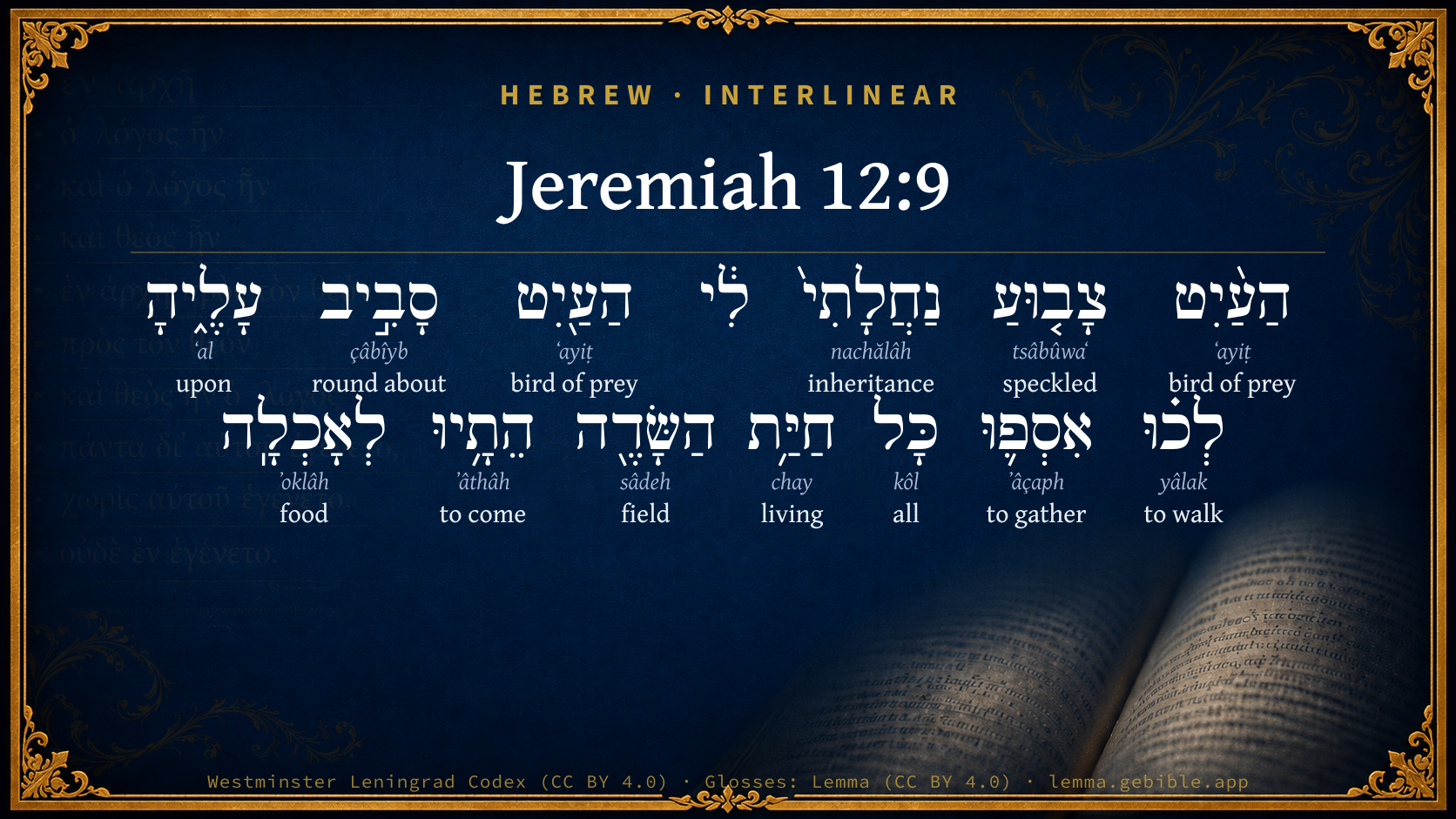
Hebrew (Westminster Leningrad Codex) Jeremiah 12:9 appears in the Hebrew Old Testament. The text above is from the Westminster Leningrad Codex. Each word links to its Strong’s number, a concise gloss, and parsing drawn from the Open Scriptures Hebrew Bible morphology. Click any word for its full Brown-Driver-Briggs (BDB) entry.
Download image
Cite this verse

Jeremiah 12:9 (World English Bible). Public Domain. Lemma interlinear Bible study tool, https://lemma.gebible.app/v/jeremiah/12/9.

Show BibTeX & RIS
BibTeX
RIS
English Translation
Is my heritage to me as a speckled bird of prey? are the birds of prey against her round about? go you, assemble all the animals of the field, bring them to devour.
World English Bible · Public Domain
Highlights
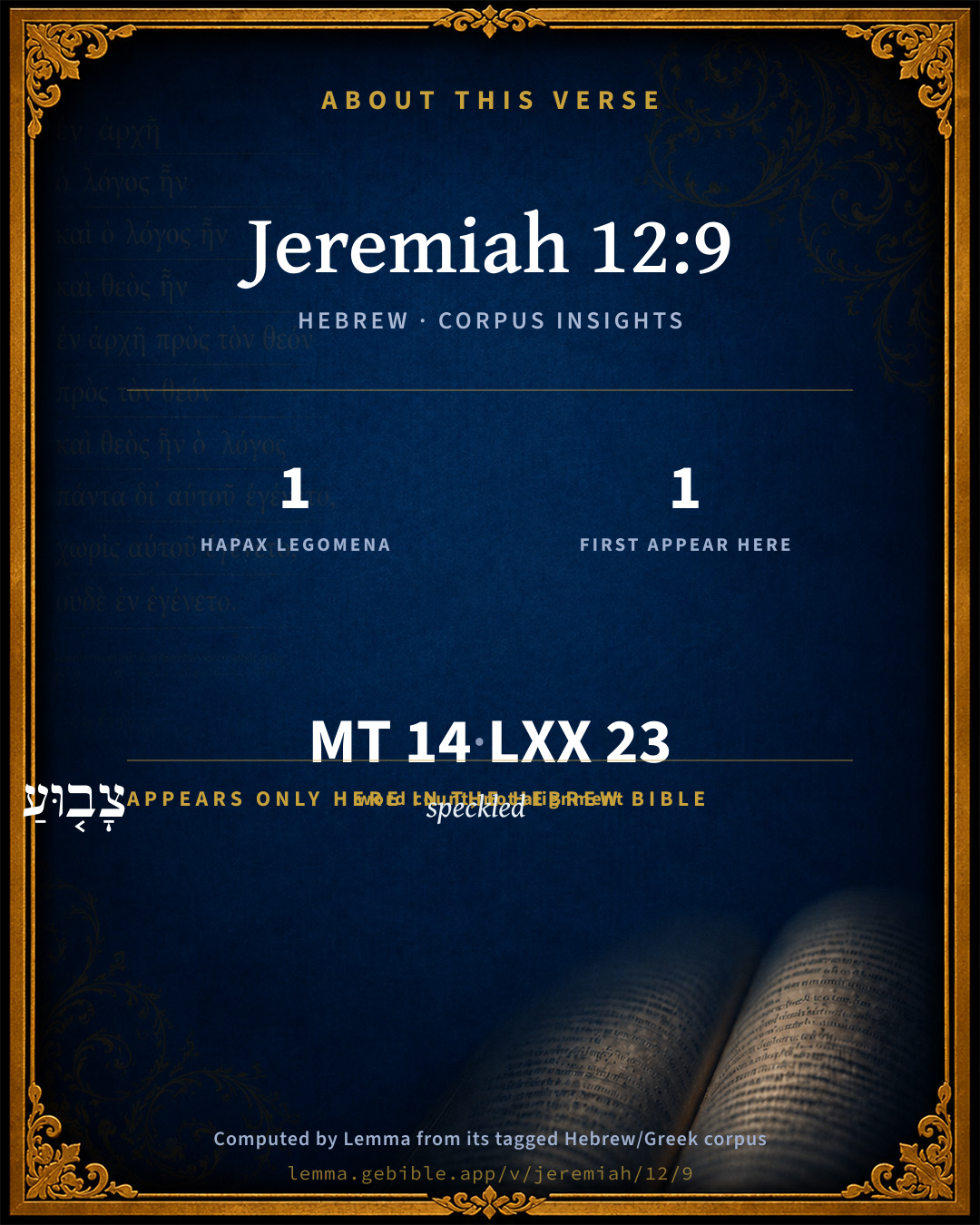
  • 1 hapax legomenon — only here in the Hebrew Bible
  • 1 first appearance in the Hebrew Bible
Full analysis ↓
Download a study sheet

One document with this verse’s original text, its word-by-word gloss line, the meaning frame, cross-references with their text, attributed commentary, and full source and license credits — printable, and it pastes into notes with its structure intact.

This verse Autodidact and up

Study sheet (.html) Plain text (.txt)

A passage Seminary Student

Up to 50 verses in one chapter. A passage sheet keeps up to 6 commentary sources and 12 cross-references per verse, in the order this page ranks them, and says so on the sheet whenever that leaves anything out. Ask for a single verse and you get the Autodidact verse sheet above.

Everything on this page stays free to read, with no account — the sheet is a download of what is already on screen, not access to it.

Want to remove ads? Support Godless Engineer
Compare translations 3

The same verse in 3 English versions, stacked beneath the original-language interlinear above. Click any original word for its lexicon entry.

Each is an independent rendering of the whole verse — the interlinear is not word-aligned to these translations.

Highlighted words mark where these versions differ — a whole-verse word diff, not a word-by-word alignment.

  • World English Bible Public Domain
    Is my heritage to me as a speckled bird of prey? are the birds of prey against her round about? go you, assemble all the animals of the field, bring them to devour.
  • King James Version Public Domain
    Mine heritage is unto me as a speckled bird, the birds round about are against her; come ye, assemble all the beasts of the field, come to devour.
  • unfoldingWord Literal Text CC BY-SA 4.0
    Is my inheritance a speckled bird of prey to me, are a bird of prey all around against her? Go, assemble all of the beast of the field, bring them for food.

unfoldingWord Literal Text — © unfoldingWord, licensed CC BY-SA 4.0. Word-aligned USFM3 via Door43 (git.door43.org/unfoldingWord/en_ult).

Versions to compare (up to 4)

3 of 4 selected

Show all 18 translations

Every available English version of this verse, each an independent rendering of the whole verse.

  • World English Bible Public Domain
    Is my heritage to me as a speckled bird of prey? are the birds of prey against her round about? go you, assemble all the animals of the field, bring them to devour.
  • Berean Standard Bible Public Domain
    Is not My inheritance to Me like a speckled bird of prey with other birds of prey circling against her? Go, gather all the beasts of the field; bring them to devour her.
  • Majority Standard Bible Public Domain
    Is not My inheritance to Me like a speckled bird of prey with other birds of prey circling against her? Go, gather all the beasts of the field; bring them to devour her.
  • King James Version Public Domain
    Mine heritage is unto me as a speckled bird, the birds round about are against her; come ye, assemble all the beasts of the field, come to devour.
  • American Standard Version (1901) Public Domain
    Is my heritage unto me as a speckled bird of prey? are the birds of prey against her round about? go ye, assemble all the beasts of the field, bring them to devour.
  • Revised Version (1885) Public Domain
    Is mine heritage unto me as a speckled bird of prey? are the birds of prey against her round about? go ye, assemble all the beasts of the field, bring them to devour.
  • Geneva Bible (1599) Public Domain
    Shall mine heritage bee vnto mee, as a bird of diuers colours? are not the birdes about her, saying, Come, assemble all ye beastes of the fielde, come to eate her?
  • Douay-Rheims (1899) Public Domain
    Is my inheritance to me as a speckled bird? Is it as a bird died throughout? come ye, assemble yourselves, all the beasts of the earth, make haste to devour.
  • Young's Literal Translation Public Domain
    A speckled fowl `is' Mine inheritance to Me? Is the fowl round about against her? Come, assemble, every beast of the field, Come ye for food.
  • Literal Standard Version CC BY-SA 4.0
    [Is] My inheritance a speckled bird to Me? Is the bird around against her? Come, assemble, every beast of the field, || Come for food.
  • Unlocked Literal Bible CC BY-SA 4.0
    Has not my prized possession become a speckled bird, that other birds of prey go against her all around? Go and gather all the wild beasts and bring them to devour her.
  • unfoldingWord Literal Text CC BY-SA 4.0
    Is my inheritance a speckled bird of prey to me, are a bird of prey all around against her? Go, assemble all of the beast of the field, bring them for food.
  • Darby Bible Public Domain
    My heritage is unto me [as] a speckled bird of prey; the birds of prey round about are against her. Go, assemble all the beasts of the field, bring them to devour.
  • World Messianic Bible Public Domain
    Is my heritage to me as a speckled bird of prey? Are the birds of prey against her all around? Go, assemble all the animals of the field. Bring them to devour.
  • Webster's Bible Public Domain
    My heritage is to me as a speckled bird, the birds around are against her; come ye, assemble all the beasts of the field, come to devour.
  • Free Bible Version CC BY-SA 4.0
    My people are like a spotted bird of prey to me with other birds of prey circling to attack it. Go and bring all the wild animals to eat up the carcass.
  • Bible in Basic English Public Domain
    My heritage is like a brightly coloured bird to me; the cruel birds are attacking her on every side: go, get together all the beasts of the field, make them come for destruction.
  • JPS Tanakh (1917) Public Domain
    Is My heritage unto Me as a speckled bird of prey? Are the birds of prey against her round about? Come ye, assemble all the beasts of the field, bring them to devour.

Literal Standard Version (2020), Covenant Press — licensed CC BY-SA 4.0. Text via the HelloAO Bible API (eBible.org). Unlocked Literal Bible (unfoldingWord) — licensed CC BY-SA 4.0. Text via the HelloAO Bible API (eBible.org). unfoldingWord Literal Text — © unfoldingWord, licensed CC BY-SA 4.0. Word-aligned USFM3 via Door43 (git.door43.org/unfoldingWord/en_ult). Free Bible Version, Dr. Jonathan Gallagher — licensed CC BY-SA 4.0. Text via the HelloAO Bible API (eBible.org).

Word by word

More ways to search: Search by grammar → Find every occurrence → Compare this word →

Practice this passage: Drill this verse → Learn its vocabulary →

צָב֤וּעַ
tsâbûwaʻ
H6641
“speckled”
Adjective, Adjective, Masculine, Singular, Absolute
Part of Speech
Adjective
Type
Adjective
Gender
Masculine
Number
Singular
State
Absolute
Full BDB Definition

Origin: pass part of the same as H6648

TWOT: 1872b

coloured, variegated, speckled
  1. הַעַ֨יִט ʻayiṭ H5861 “the · bird of prey” Particle, Definite Article + Noun, Common, Masculine, Singular, Absolute
  2. נַחֲלָתִי֙ nachălâh H5159 “inheritance · my” Noun, Common, Feminine, Singular, Construct + Suffix, Personal, 1st Person, Common, Singular
  3. הַעַ֖יִט ʻayiṭ H5861 “the · bird of prey” Particle, Definite Article + Noun, Common, Masculine, Singular, Absolute
  4. סָבִ֣יב çâbîyb H5439 “round about” Noun, Common, Both, Singular, Absolute
  5. עָלֶ֑יהָ ʻal H5921 “upon · her” Preposition + Suffix, Personal, 3rd Person, Feminine, Singular
  6. לְכ֗וּ yâlak H3212 “walk” Verb, Qal, Imperative, 2nd Person, Masculine, Plural
  7. אִסְפ֛וּ ʼâçaph H622 “gather” Verb, Qal, Imperative, 2nd Person, Masculine, Plural
  8. כָּל kôl H3605 “all of” Noun, Common, Masculine, Singular, Construct
  9. חַיַּ֥ת chay H2416 “living of” Noun, Common, Feminine, Singular, Construct
  10. הַשָּׂדֶ֖ה sâdeh H7704 “the · field” Particle, Definite Article + Noun, Common, Masculine, Singular, Absolute
  11. הֵתָ֥יוּ ʼâthâh H857 “come” Verb, Hiphil, Imperative, 2nd Person, Masculine, Plural
  12. לְאָכְלָֽה ʼoklâh H402 “to/for · food” Preposition + Noun, Common, Feminine, Singular, Absolute

About this verse

These counts appear in no published source. They are computed here, from the morphology-tagged text and Lemma’s own curated glosses. What Lemma adds →

14
words
12
distinct lemmas
Prophets
section

Notable vocabulary

1 hapax legomenon — a word that appears only here in the entire Hebrew Bible:

  • צָב֤וּעַ speckled H6641

First appearance in Scripture

This word makes its first canonical appearance in the Hebrew Bible here:

  • צָב֤וּעַ speckled H6641

Shared distinctive vocabulary

הַעַ֨יִט bird of prey H5861 occurs in 6 verses of the Hebrew Bible. Also found in:

Grammatical profile

  • 3 verbs
  • 8 nouns
  • 1 adjective
  • 2 prepositions

Verb forms

  • לְכ֗וּ Qal · Imperative
  • אִסְפ֛וּ Qal · Imperative
  • הֵתָ֥יוּ Hiphil · Imperative

Repetition

A word recurs within this verse — often emphatic in Hebrew:

  • הַעַ֨יִט bird of prey H5861 ×2

Hebrew & Septuagint length

In the original languages it is 14 Hebrew tokens and 23 Greek tokens — but the two are counted differently (Hebrew bundles its prefixes and suffixes into one token; the Greek is in lemma form), so that isn’t a like-for-like length.

Cross-references

10

Topical passages linked to Jeremiah 12:9 in the Treasury of Scripture Knowledge — connected by theme and wording, ordered by reader-vote popularity; previews shown in the World English Bible.

  • Isaiah 56:9 All you animals of the field, come to devour, [yes], all you animals in the forest.
  • Jeremiah 7:33 The dead bodies of this people shall be food for the birds of the sky, and for the animals of the earth; and none shall frighten them away.
  • 2 Kings 24:2 Yahweh sent against him bands of the Chaldeans, and bands of the Syrians, and bands of the Moabites, and bands of the children of Ammon, and sent them against Judah to destroy it, according to the word of Yahweh, which he spoke by his servants the prophets.
  • Ezekiel 23:22–25 Therefore, Oholibah, thus says the Lord Yahweh: Behold, I will raise up your lovers against you, from whom your soul is alienated, and I will bring them against you on every side:
  • Revelation 19:17–18 I saw an angel standing in the sun. He cried with a loud voice, saying to all the birds that fly in the sky, "Come! Be gathered together to the great supper of God,
  • Jeremiah 2:15 The young lions have roared on him, and yelled; and they have made his land waste: his cities are burned up, without inhabitant.
  • Jeremiah 15:3 I will appoint over them four kinds, says Yahweh: the sword to kill, and the dogs to tear, and the birds of the sky, and the animals of the earth, to devour and to destroy.
  • Ezekiel 16:36–37 Thus says the Lord Yahweh, Because your filthiness was poured out, and your nakedness uncovered through your prostitution with your lovers; and because of all the idols of your abominations, and for the blood of your children, that you gave to them;
  • Ezekiel 39:17–20 You, son of man, thus says the Lord Yahweh: Speak to the birds of every sort, and to every animal of the field, Assemble yourselves, and come; gather yourselves on every side to my sacrifice that I do sacrifice for you, even a great sacrifice on the mountains of Israel, that you may eat flesh and drink blood.
  • Revelation 17:16 The ten horns which you saw, and the beast, these will hate the prostitute, and will make her desolate, and will make her naked, and will eat her flesh, and will burn her utterly with fire.

Cross-references courtesy of OpenBible.info (CC BY 4.0).

Hebrew and Greek witnesses Masoretic Hebrew ↔ Greek Septuagint

The same verse in the two great witnesses to the Old Testament, shown verse-for-verse.

These are two independent witnesses, not word-aligned to each other, and the Septuagint is shown in lemma (dictionary) form.

Hebrew Jeremiah 12:9 Masoretic · Westminster Leningrad Codex

הַעַ֨יִט צָב֤וּעַ נַחֲלָתִי֙ לִ֔י הַעַ֖יִט סָבִ֣יב עָלֶ֑יהָ לְכ֗וּ אִסְפ֛וּ כָּל חַיַּ֥ת הַשָּׂדֶ֖ה הֵתָ֥יוּ לְאָכְלָֽה

Is my heritage to me as a speckled bird of prey? are the birds of prey against her round about? go you, assemble all the animals of the field, bring them to devour.

World English Bible · Public Domain

Greek LXX Structure differs

In the Septuagint, Jeremiah is about an eighth shorter than the Hebrew and arranges its material differently — the Oracles Against the Nations (Hebrew chapters 46–51) appear in the middle of the Greek book, after 25:13. Because the chapter and verse boundaries do not line up, a verse-for-verse comparison with the Hebrew is not shown.

A verse-for-verse comparison isn’t shown here because the chapters and verses don’t line up. Switch to the LXX edition with the MT / LXX toggle above to read the Greek directly.

On this verse, Jamieson, Fausset & Brown discusses the Septuagint’s reading. Read the note in Commentary ↓

Hebrew: Westminster Leningrad Codex (CC BY 4.0). Greek: Septuagint (public domain); English from a public-domain English Septuagint. How the Septuagint differs from the Hebrew →

Targum (Aramaic paraphrase)

1

The Targum is the ancient Jewish Aramaic paraphrase of the Hebrew Scriptures — an interpretive translation, not the Hebrew text itself. Onkelos (literal) and Pseudo-Jonathan (expansive) render the Torah, and Jonathan the Prophets. Coverage is partial: where no permissively-licensed English translation exists for a verse, only the Aramaic is shown. This is verse-level text, not a word-by-word alignment to the Hebrew.

  1. Targum Jonathan Prophets (Joshua–Malachi)
    כְּעוֹפָא דְמִתְבַּדַר כֵּן אִתְבְּדָרַת אַחְסַנְתִּי קֳדָמַי וּכְעוֹפָא דְמִשְׁתְּדֵי כֵּן יִתְכַּנְשׁוּן עֲלָהּ דְקַטִלִין בְּחַרְבָּא מִסְחוֹר סְחוֹר מַלְכֵי עַמְמַיָא וּמַשִׁרְיָתֵיהוֹן יֵיתוּן עֲלָהּ לְמִבְזָהּ:

    (no public-domain English translation for this verse)

    Targum Jonathan — Aramaic: “Mikraot Gedolot” (public domain). English: “Sefaria Community Translation” (CC0 1.0 (public-domain dedication)); “London "Chaldee Paraphrase," 1871” (public domain). Text via Sefaria.

Commentary

Notes on Jeremiah 12:9 from classic Christian and Jewish commentators (each source and its license shown beneath its notes). The classic Christian expositions comment on the surrounding passage and are grouped to its opening verse, so a note may address several verses; the Jewish commentaries on the Tanakh (Rashi and others) are per-verse, so they appear only where the commentator wrote on this verse.

Lemma curates 59 commentaries, every one of them public domain or Creative Commons licensed, each selected and text-cleaned for this edition rather than reprinted as found. About our sources →

Trapp's Complete Commentary

John Trapp

Jer 12:9 Mine heritage [is] unto me [as] a speckled bird, the birds round about [are] against her; come ye, assemble all the beasts of the field, come to devour.

Ver. 9. Mine heritage is unto me as a speckled bird.] As an owl, say some, that loveth not the light; as a peacock, say others, proud and inconstant, all in changeable colours, as oft changed as moved. God, that could not endure miscellany seed, nor linsey woolsey, in Israel, can less endure that his people should be as a "speckled bird," here of one colour, and there of another; or as a cake not turned. {Hos 7:4-10}

John Trapp, A Commentary or Exposition upon All the Books of the Old and New Testament (1647–1656) — public domain. Text from a community e-Sword module.

The Biblical Illustrator

Joseph S. Exell

Jer_12:9

Mine heritage is unto Me as a speckled bird.

A speckled bird

Mine (Gods) heritage is unto Me as a speckled bird. As an owl, say some, that loveth not the light; as a peacock, say others, as oft changed as moved. God, that could not endure miscellany seed, nor linsey-woolsey, in Israel, can less endure that His people should be as a speckled bird, here of one colour, and there of another; or as a cake not turned (Hos_5:4). (John Trapp.)

Gods people as speckled birds

Mine heritage (the godly mans) is unto me as a speckled bird. When living at Cambridge Mr. Spurgeon was appointed to preach at a village lust outside the city, and during the day, after much reading and meditation, he was unable to light upon a suitable text, and was, as Bunyan would say, much tumbled up and down in his thoughts. Rising from prayer and the reading of the Scriptures he walked to the window, and, looking out, espied on the other side of the narrow street a solitary canary upon the roof ridge, surrounded by a crowd of sparrows that were all pecking at it. At that moment the verse quoted flashed into his mind, and he started off upon his country walk, restful in heart and mind, and composed his sermon as he journeyed, the main points of his discourse being the peculiarity of Gods people and the persecutions they suffer in consequence. He thus speaks of the episode himself: I preached with freedom and ease to myself, and, I believe, with comfort to my rustic audience. The text was sent to me, and if the ravens did not bring it, certainly the sparrows did. (Chas. Spurgeon.)

.

The Biblical Illustrator, edited by Joseph S. Exell (c. 1880s–1900s) — public domain. Text from a community e-Sword module.

Tyndale Open Study Notes

Tyndale Open Resources

12:9 The people of Judah would become prey to huge flocks of speckled vultures. The people would soon be corpses that wild animals would pick . . . clean.

Tyndale Open Study Notes — © Tyndale Open Resources, licensed CC BY-SA 4.0. Text via the HelloAO Bible API.

Geneva Bible (1599)

Geneva Bible translators

Instead of bearing my livery, and wearing only my colors, they have change and diversity of colors of their idols and superstitions, therefore their enemies as thick as the fowls of the air shall come about them to destroy them.

Geneva Bible (1599) marginal notes — public domain. Text via Bolls.life.

Jamieson, Fausset & Brown

Robert Jamieson, A. R. Fausset & David Brown

speckled bird--Many translate, "a ravenous beast, the hyena"; the corresponding Arabic word means hyena; so the Septuagint. But the Hebrew always elsewhere means "a bird of prey." The Hebrew for "speckled" is from a root "to color"; answering to the Jewish blending together with paganism the altogether diverse Mosaic ritual. The neighboring nations, birds of prey like herself (for she had sinfully assimilated herself to them), were ready to pounce upon her.

assemble . . . beasts of . . . field--The Chaldeans are told to gather the surrounding heathen peoples as allies against Judah (Isa 56:9; Eze 34:5).

Jamieson, Fausset & Brown — Commentary Critical and Explanatory on the Whole Bible (1871) — public domain (CC PDM 1.0). Text via the HelloAO Bible API.

Adam Clarke's Commentary

Verse 9. Is unto me as a speckled bird] A bird of divers colours. This is a people who have corrupted the worship of the true God with heathenish rites and ceremonies; therefore, the different nations, (see Jer 12:10,) whose gods and forms of worship they have adopted, shall come and spoil them. As far as you have followed the surrounding nations in their worship, so far shall they prevail over your state. Every one shall take that which is his own; and wherever he finds his own gods, he will consider the land consecrated to them, and take it as his property, because those very gods are the objects of his worship. The fable of the daw and borrowed plumes is no mean illustration of this passage.

Dahler translates the whole verse thus: -

Birds of prey! inundate with blood my heritage.

Birds of prey! come against her from all sides.

Run together in crowds, ye savage beasts!

Come to the carnage!

Adam Clarke's Commentary on the Bible (1810–1826) — public domain. Text from a community e-Sword/MySword module.

John Calvin's Commentaries

The beginning of this verse is variously explained, Some think that a kind of bird is here meant, which has various colors, one variegated, which excites all other birds against itself; but this is without meaning. Others are of the opinion, and the greater part too, that birds tinged with blood were against his heritage. They hence thus explain the words, “Is a bird, tinged,” that is; with blood, “my heritage,” that is, about my heritage; “is there a bird around it? They consider both clauses to be of the same meaning; and hence they think that the same thing is repeated in different words, that birds were flying against the Jews, like those which are drawn by the smell of carcases, and which come in great numbers, that each may have a part; and then, wild beasts follow them. But I approve of neither of these explanations; nor indeed have they even the appearance of being correct.

I therefore think that the people are now compared to foreign birds, as they were before to lions; as though he had said, — “I had chosen this people for myself, that they might be my friends, as birds which are wont to be gathered into their own cages, as sheep into their own folds, and as oxen, and other animals which are tamed, keep within their own enclosures. So when I gathered this people, I thought that they would be to me like domesticated sheep; but now they are like speckled birds; that is, like wild birds, or birds of the wood.” For I have no doubt but that by a speckled or colored bird is to be understood a strange bird, which by its novel appearance excites the attention of men. Is then a variegated bird, or a bird of the wood, become mine heritage? Questions, we know, were often used by the Hebrews; and the Prophet here simply affirms the fact; and as God had said before, that his heritage was become like a lion in the forest, so he adds now, that his heritage was like a speckled bird. A question has much more power and force than a simple declaration; for God assumes here the character of one in astonishment, — “What does this mean, that my heritage should become to me like some bird from the wood, or a foreign bird?” He then adds, All birds then shall be around and all beasts of the field

We now see how fitly the words of the Prophet run; God had complained that his heritage was like a lion in the forest, and also like a wild and foreign bird; and now he says, Then all birds wiIl fly to the prey and all the beasts of the field; as though he had said, — “Since they have dared to act thus wantonly, and have dared to assail my servants like wild beasts, and have also become wild birds which cannot be tamed, I will shew what they will gain by their ferocity; for I will now send for all the birds of the air, and the wild beasts of the wood:, that they may fly together quickly, and that they may come together to the prey.” That we must thus understand the Prophet’s meaning, we learn from the very words; for God not only says, “A speckled bird has mine heritage become,” but he adds, to me, as he had before said, that his heritage had become to him as a lion, so he says now, Is not mine heritage become to me? etc This pronoun then ought to be carefully noticed; for we hence learn, as I have said already, that the intractable disposition of the people is here condemned, for they could by no means be tamed.

But the latter clause ought also to be especially observed; for it imports as much as though God had said, “As then your wickedness is such that ye are to me lions and wild birds, take your course; but I will yet check this your barbarous and untameable ferocity; for I have under my command all the birds of the air and all the wild beasts of the field; let them then come together to this one bird, and to this one beast. Ye are but one bird; ye are indeed terrible at the first view, for ye are worse than all the hawks; but ye are only one bird, and around you shall come all birds, which shall make war on you. Ye are as one lion in a forest, or one boar, or one wolf; but all the savage beasts of the wood shall come together against you, and shall come together to devour you.”

This place deserves special notice; for we hence learn how foolishly men deceive themselves when they oppose God and perversely shake off his yoke, and suffer not, themselves to be corrected by his word; they are lions, they are savage birds; but the Lord can easily destroy them, for all birds and all wild beasts are ready to obey him; and hence it follows: —

John Calvin's Commentaries (1540-1563) — public domain. Text from the Calvin Translation Society English edition (1840s-50s) via the Christian Classics Ethereal Library (ccel.org). Calvin's coverage is partial (roughly two-thirds of the Bible); uncommented books and verses are honest gaps, never fabricated. The 19th-century editor's footnotes and remarks are omitted so the notes are faithfully Calvin's own voice.

Ellicott's Commentary for English Readers

(9) Mine heritage is unto me as a speckled bird.—The Hebrew is interrogative, Is mine heritage . . .? Are the birds come round about against her? The word for “bird” in both cases means a “bird of prey” (Isa_46:11; Gen_15:11), and the “speckled bird” is probably, but not certainly, some less common species of vulture. The image was probably suggested by something the prophet had observed, birds of prey of one species collecting and attacking a solitary stranger of another, joined by the “beasts of the field,” the wolves and jackals and hyænas, who scent their prey. The word “speckled,” perhaps, points to the bird attacked as being of more goodly plumage than the others (one, it may be, of the kingfishers that abound in Palestine), and therefore treated as a stranger and an enemy. The fact is one which strikes every observer of bird life (Tac. Ann. vi. 28; Sueton. Cæs. c. 81).

A Bible Commentary for English Readers, edited by Charles John Ellicott (1878–1897) — public domain. Text from a community e-Sword module.

The Cambridge Bible for Schools and Colleges

gen. ed. J. J. S. Perowne

9. bird of prey? are the birds of prey, etc.] The change of one consonant (reading ki for li) would enable us to unite the two questions into one, and read (without “unto me”) bird of prey, that the birds of prey are, etc. For the figure see introd. note, and for the method of expressing mingled amazement and pain cp. Jer_2:14.

The Cambridge Bible for Schools and Colleges (gen. ed. J. J. S. Perowne; Cambridge University Press, 1878–1918) — public domain. Text from a community e-Sword module.

John Gill's Exposition

Mine heritage is unto me as a speckled bird,.... Or, "is not mine heritage unto me as a speckled bird?" (b) as a bird of various colours, delightful to look at, as the peacock, so Jerom interprets it here; it was so formerly, but not so now; or as a bird of various colours, and unusual, which other birds get about, look on, hate, and peck at. Some think this refers to the motley party coloured religion the Jews had embraced, consisting of various rites and ceremonies of the Heathens; on which account they thought they looked beautiful and comely, when they were hated and rejected of God for them; but the word signifies rather to be dipped or stained, as with blood, and so denotes a bird of prey that is stained with the blood of others; a fit emblem of the cruelty of the Jews, in shedding the blood of the prophets. Some, because a word near akin to this signifies a finger, render it a "fingered bird" (c); that is, a bird with talons or claws; like fingers, a ravenous bird, and it comes to the same sense as before. But the Septuagint take it, to be not a bird, but a beast, and render it by the hyena; and which Bochart (d) approves of, since the word in the Arabic language signifies such a creature; and Schindler observes, that with the Arabians, is the name of a creature between a wolf and a middling dog, which agrees with the hyena. The word here used, in the Talmudic (e) language signifies a she leopard or panther, so called from its variety of spots; and is the same, as Maimonides says (f), which, in the Arabic language, is called with the Targumists it is used for a kind of serpents or vipers. So the valley of Tzeboim is rendered, in the Targum, the valley of vipers, Sa1 13:18. And it is said (g), the word in the text,

"this is from a white drop (or seed), and yet it has three hundred and sixty five kinds of colours, according to the number of the days of a solar year.''

The birds round about are against her; or, "are not the birds round about against her?" the birds of prey? they are; meaning the neighbouring nations, that under Nebuchadnezzar came up against Jerusalem to take and destroy it.

Come ye, assemble all ye beasts of the field, come to devour; this is an invitation to the enemies of the people of the Jews, comparable for their fierceness and savageness to the beasts of the field, to come and destroy them; and shows that their destruction was by divine permission, and according to the will of God. Compare with this Rev 19:18. The Targum interprets it of those that kill with the sword; kings of the earth, and their armies.

(b) So V. L. Pagninus, Montanus, Calvin, Jarchi, and Kimchi. (c) "avis digtata", Junius & Tremellius, Piscator, Gusetius; "ales unguibus praedita", Cocceius. (d) Hierozoic. par. 1. l. 3. c. 11. col. 830, 838, 839. (e) T. Bab. Bava Kama, fol. 16. 1. (f) In Misn. Bava Kama, c. 1. sect. 4. (g) Bereshit Rabba, sect. 7. fol. 6. 2.

John Gill's Exposition of the Whole Bible (1746–1763) — public domain (CC PDM 1.0). Text via the HelloAO Bible API.

Haydock's Catholic Bible Commentary

As a. Septuagint, "a den of the hyena:" Alexandrian, "robbers." Grabe inserts, "or a den around it?" (Haydock) --- They have read auss, "a den," instead of hait, "a bird." Bochart, (iii. 11.) however, shews that the latter word denotes various wild beasts, and nearly follows the Septuagint. Though the inheritance be most charming, it shall not pass unpunished. (Calmet)

George Leo Haydock (1774–1849), Haydock's Catholic Family Bible and Commentary, 1859 edition — public domain. Excludes Psalms (Douay-Rheims chapter numbering differs from Protestant) and Deuterocanonical books (Catholic canon only).

Matthew Poole's English Annotations

Mine heritage is unto me as a speckled bird: the word in the Hebrew signifies to dye, or colour, and interpreters are here divided, whether to interpret it of a bird coloured by nature (so our translators understood it, and therefore have translated it speckled) or by accident, as ravenous birds are coloured by the blood of other birds killed by them. Hence some interpret the text as a reflection upon the Jews for their cruelty, coloured by their oppression and innocent bloodshed. Others, of their tincture by a variety of superstition and idolatry. The latter seemeth to me most probable, because of what follows, it being what is usual and natural for other birds to flock about a strange-coloured bird, such as they have not been used to see, but rather to fly from, than to come at a bird of prey, that hath already stained her feathers with the blood of other birds. But it may be understood of either, for the Jews were notoriously guilty of both, and it is God that causeth the birds to come against her, and the beasts of the field to devour.

Matthew Poole's English Annotations on the Holy Bible (1683–1685) — public domain. Text from a community e-Sword/MySword module.

Whedon's Commentary on the Bible

Daniel D. Whedon

9. A speckled bird, etc. — The first two clauses in this verse are in the original questions, but they involve real affirmations. The fact that a strange-looking bird is sure to be set upon by all the others is appropriated by the prophet as an instrument of expression and illustration. Then comes the summons to all the wild beasts to gather round Judah and devour her.

Daniel D. Whedon (gen. ed.), Commentary on the Old and New Testaments (1874–1909) — public domain. Text from a community e-Sword module.

The Pulpit Commentary

The first part of this verse is mistranslated. Instead of Mine heritage is unto me, etc., it should be, Is mine heritage unto me (i.e. to my sorrow, a dativus ethics) a colored bird of prey? Are birds of prey round about her? The passage is difficult, but the following seems the most plausible explanation: Jehovah is represented as surprised to see his chosen people a prey to the heathen (a strongly anthropomorphic description, as if Jehovah had not anticipated that his "giving up" his people would have such sad results). It seems to him (adopting human modes of speech) as if Israel were "a colored bird of prey," the bright plumage of which excites the animosity of its less brilliant comrades, who gather round it and pull it to pieces. It is an allusion to the phenomenon, well-known to the ancients (Tacit., "Ann." 6:28; Suet., "Caes.," 81; Plin.," Hist. Nat.," 10:19), of birds gathering round and attacking a strange-looking bird appearing in their midst. The prophet might have simply said "a bird;" why does he say "a bird of prey (ayit)"? Probably because he has just described the hostile attitude of Israel towards Jehovah under the figure of a lion. Some particular, rare kind of vulture seems to be intended. Sennacherib apparently uses a cognate word (it) for the vulture ("Taylor Cylinder," 3. 68). Bochart and Gesenius, following the Septuagint, think "hyena," and not "bird of prey," is the right rendering in the first clause; but Gesenius does not offer any other passage for the meaning bestia rapax. Come ye, assemble all the beasts of the field. There is a parallel passage in Isa_56:9, where, as here, the "beasts of the field (i.e. the wild beasts of the open country) are the heathen powers employed as God"s instruments for chastising Israel (comp. also Eze_34:5, where the same figure occurs). "The prophet adopts the strongest way of expressing that Israel, utterly bereft of his natural defenders, lies at the mercy of the great heathen empire". (note on Isa_56:9) Come to devour; rather, bring them to devour.

The speckled bird.

A great preacher relates the following incident: He says, "I had during my early ministry to preach one evening at a neighboring village, to which I had to walk. After reading and meditating all day, I could not meet with the right text. Do what I would, no response came from the sacred oracle, no light flashed from the Urim and Thummim. I prayed, I meditated, I turned from one verse to another; but the mind would not take hold, or I was, as John Bunyan would say, "much tumbled up and down in my thoughts." Just then I walked to the window and looked out. On the other side of the narrow street in which I lived I saw a poor, solitary canary bird upon the slates, surrounded by a crowd of sparrows, who were all pecking at it as if they would tear it to pieces. At that moment the verse came into my mind, "Mine heritage is unto me as a speckled bird; the birds round about are against her." I walked off with the greatest possible composure, considered the passage during my long and lonely walk, and preached upon the peculiar people and the persecutions of their-enemies, with freedom and ease to myself, and I believe with comfort to my rustic audience. The text was sent to me, and if the ravens did not bring it, certainly the sparrows did." But while the use here made of the text is a legitimate one, it certainly is not its meaning. That, therefore, as in all cases, has the priority of claim to be considered, and we note how it tells

I OF WHAT MAY BE THE RELATION OF GOD"S HERITAGE TO HIMSELF. He who had once so loved them as to call them by all endearing names, "the dearly beloved of my soul" (Ver. 7), "mine heritage" (Ver. 8), "my portion," "my pleasant portion" (Ver. 10), and whose hand had been wont to follow the dictates of his heart, had now completely changed towards them. HIS love had departed, and in place.thereof had come aversion and anger (cf. Homily on Vers. 7-13). Sad as it is, this similitude snows what may come to be the relation between God and his people. "Therefore have I hated it" (Ver. 8), saith God. We cannot but inquire the cause of so terrible a change. It was because "no man layeth it to heart" (Ver. 11); no man, i.e. would give heed to God"s words and signs of warning, but went on in sin just the same. They would not repent, but persisted in their evil ways. But we may take the words also as suggesting

II WHAT WILL BE THE RELATION OF GOD"S PEOPLE TO THE WORLD. The world will hate the Church. "The birds around" will come "against her." Sometimes it seems as if it were not so. For unquestionably there are many portions of God"s heritage that the world does not persecute. The age of martyrdom is over. God has shut the lions" mouths. He puts his fear upon the world; they see that God is with his people; or they are partly in sympathy with them. But at other times it is true as it was with that poor bird amongst the sparrows. "Well may we pity a godly wife bound to an ungodly husband; alas! full often a drunkard, whose opposition amounts to brutality. A tender, loving spirit, that ought to have been cherished like a tender flower, is bruised and trodden underfoot, and made to suffer till the heart cries out in grief. We little know what lifelong martyrdoms many pious women endure. Children also have to bear the same when they are singled out by Divine grace from depraved and wicked families. Only the other day there came under my notice one who loves the Lord. I thought if she had been a daughter of mine I should have rejoiced beyond all things in her sweet and gentle piety; but the parent said, "You must leave our house if you attend such and such a place of worship. We do not believe in such things, and we cannot have you about us if you do." And nobody knows what godly working men often have to put up with from those among whom they labor. Frequently the working men are great tyrants in matters of religion. If a man will drink with them and swear with them, they will make him their companion; but when a man comes out to fear God, they make it very hard for him." Yes; God"s heritage is in the eyes of the world "as a speckled bird," etc. But let God"s servants remember, when they are thus tried, that they have fellowship with Christ. They were forewarned of it; Christ did not conceal the cross from them. "Behold," he said, "I send you forth as sheep amongst wolves." But they cannot do you much harm (cf. Matthew 10). The day is soon coming when their power will be forever destroyed. Meanwhile, keep away from them as much as you lawfully may. Do not needlessly provoke them; whilst harmless as doves, be wise as serpents also. Do not be like them, and do not be afraid of them. Go not alone with them; have the Lord Jesus ever with you, and you will be able to meet them in all holy and courageous wisdom and meekness. If the persecution be very great, ask the Lord to place you somewhere else, if so it may be. And till he does, and always, pray for them Sauls may become Pauls.

III IT IS A RELATION IN WHICH GOD"S HERITAGE MUST STAND EITHER TO GOD OR TO THE WORLD. There cannot be compromise. "No man can serve two masters." If any man love the world, the love of the Father is not in him." "The friendship of the world is enmity against God." "Ye cannot serve God and mammon." Whose aversion, then, will you have, since that of God or of the world you must have? Your peril is not that you should deliberately choose to have the aversion of God rather than that of the world, but that you should seek to compromise. But that also is impossible. In coming to a decision be sure you take eternity into view, and may God who compels you to make this great choice help you as he will if you seek his grace to choose, like Moses, "rather to suffer affliction with," etc. C.

The Pulpit Commentary (1880–1919), ed. H.D.M. Spence-Jones & Joseph S. Exell — public domain. Text from a community e-Sword module.

John Wesley's Explanatory Notes

The birds round about - It is usual for other birds to flock about a strange coloured bird, such as they have not been used to see.

John Wesley, Explanatory Notes Upon the Whole Bible (1754–1765) — public domain. Text via the GEBible commentary corpus.

Rashi

Rabbi Shlomo Yitzchaki (Rashi)

Is...a speckled bird of prey? The ‘heh’ is that of the interrogative. Therefore, it is vowelized with a ‘pattah.’ Are they like a speckled bird of prey, stained with blood, around which other birds gather? Another explanation:

Is...a speckled bird of prey One bird is speckled, and all the birds gather around it to eat it because they hate it.

Are there birds of prey around her? Are these armies fowl of the heavens, the swift troops that are around her?

Rashi on the Tanakh — English translations: “The Judaica Press complete Tanach with Rashi, translated by A. J. Rosenberg” (CC BY 4.0); “Pentateuch with Rashi's commentary by M. Rosenbaum and A.M. Silbermann, 1929-1934” (public domain); “The Metsudah Tanach series, Lakewood, N.J” (CC BY 4.0); and “The Book of Joshua, Metsudah Publications, 1997” (CC BY 4.0). Text via Sefaria.

Lesson kit

Teaching starters — assembled from the data on this page, not authored interpretation. Every prompt links to the verse data it draws on. Edit before teaching.

Jeremiah, in the Prophets, opens this verse with 14 words (12 distinct Hebrew lemmas). Its most distinctive word is tsâbûwaʻ (“speckled”). A historical commentator’s framing appears above. Read the whole chapter for the surrounding context.

Discussion questions

  1. How does “speckled” (tsâbûwaʻ) shape what this verse is saying?
  2. 1 word here appears nowhere else in the Hebrew Bible. Why might the author reach for such rare wording?
  3. This is the first place “speckled” appears in Scripture (first appears here). What does its debut here establish?
  4. How does Genesis 15:11, which shares the word «bird of prey», read alongside this verse?
  5. What does the repetition of “bird of prey” (2× in this one verse) do in this verse?
  6. The translations on this page render this verse differently — a whole-verse word diff, not a word-by-word alignment. What might account for the different wordings?
  7. «לְכ֗וּ» is a Qal Imperative verb. How does that grammatical form shape the action described?
  8. Compare how Trapp's Complete Commentary and The Biblical Illustrator read this verse. Where do they agree or differ?

Things to notice

  • 1 word in this verse appears nowhere else in the Hebrew Bible.
  • 1 word makes its first canonical appearance in Scripture here.
  • This verse counts 14 Hebrew ↔ 23 Greek words.
  • These translations choose different wording for 17 words in this verse.
  • “bird of prey” occurs 2× in this single verse.

Reading settings

Reading text

Shown beneath each verse's original-language words.

Old Testament
Old Testament edition

Read the OT as the Masoretic Hebrew (MT) or the Greek Septuagint (LXX).

English shown for the Greek Septuagint (in the Hebrew ↔ Greek comparison).

Comparing translations? Open the Compare panel on any verse page to stack up to four side by side.