Psalms 35:15

Hebrew (Westminster Leningrad Codex) Psalms 35:15 appears in the Hebrew Old Testament. The text above is from the Westminster Leningrad Codex. Each word links to its Strong’s number, a concise gloss, and parsing drawn from the Open Scriptures Hebrew Bible morphology. Click any word for its full Brown-Driver-Briggs (BDB) entry.
Download image
Cite this verse

Psalms 35:15 (World English Bible). Public Domain. Lemma interlinear Bible study tool, https://lemma.gebible.app/v/psalms/35/15.

Show BibTeX & RIS
BibTeX
RIS
English Translation
But in my adversity, they rejoiced, and gathered themselves together. The attackers gathered themselves together against me, and I didn't know it. They tore at me, and didn't cease.
World English Bible · Public Domain
Highlights
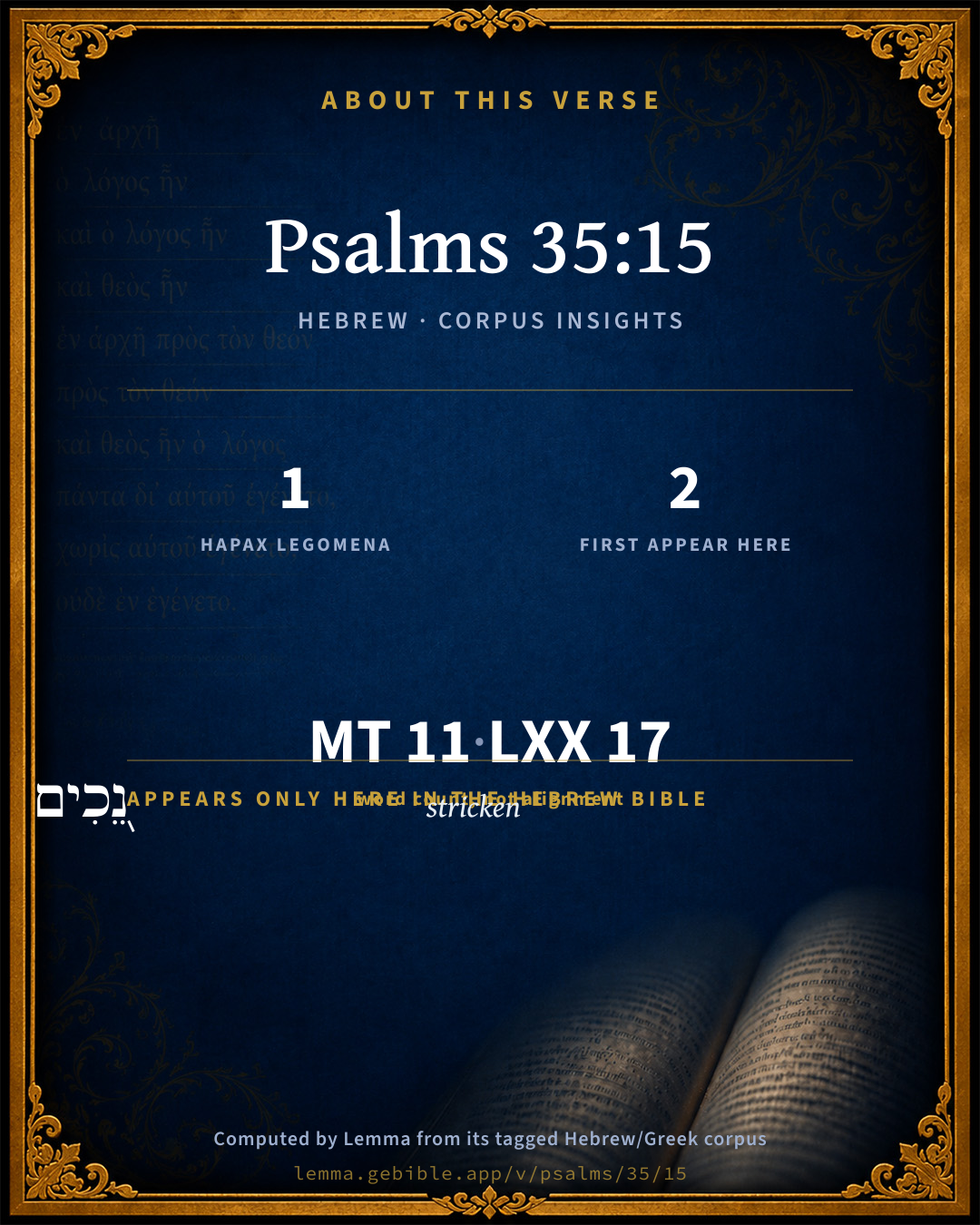
  • 1 hapax legomenon — only here in the Hebrew Bible
  • 2 first appearances in the Hebrew Bible
Full analysis ↓
Download a study sheet

One document with this verse’s original text, its word-by-word gloss line, the meaning frame, cross-references with their text, attributed commentary, and full source and license credits — printable, and it pastes into notes with its structure intact.

This verse Autodidact and up

Study sheet (.html) Plain text (.txt)

A passage Seminary Student

Up to 50 verses in one chapter. A passage sheet keeps up to 6 commentary sources and 12 cross-references per verse, in the order this page ranks them, and says so on the sheet whenever that leaves anything out. Ask for a single verse and you get the Autodidact verse sheet above.

Everything on this page stays free to read, with no account — the sheet is a download of what is already on screen, not access to it.

Want to remove ads? Support Godless Engineer
Compare translations 3

The same verse in 3 English versions, stacked beneath the original-language interlinear above. Click any original word for its lexicon entry.

Each is an independent rendering of the whole verse — the interlinear is not word-aligned to these translations.

Highlighted words mark where these versions differ — a whole-verse word diff, not a word-by-word alignment.

  • World English Bible Public Domain
    But in my adversity, they rejoiced, and gathered themselves together. The attackers gathered themselves together against me, and I didn't know it. They tore at me, and didn't cease.
  • King James Version Public Domain
    But in mine adversity they rejoiced, and gathered themselves together: yea, the abjects gathered themselves together against me, and I knew it not; they did tear me, and ceased not:
  • unfoldingWord Literal Text CC BY-SA 4.0
    But at my stumbling they rejoiced and gathered together; they gathered together against me, the stricken, and I did not know. They tore and did not cease.

unfoldingWord Literal Text — © unfoldingWord, licensed CC BY-SA 4.0. Word-aligned USFM3 via Door43 (git.door43.org/unfoldingWord/en_ult).

Versions to compare (up to 4)

3 of 4 selected

Show all 18 translations

Every available English version of this verse, each an independent rendering of the whole verse.

  • World English Bible Public Domain
    But in my adversity, they rejoiced, and gathered themselves together. The attackers gathered themselves together against me, and I didn't know it. They tore at me, and didn't cease.
  • Berean Standard Bible Public Domain
    But when I stumbled, they assembled in glee; they gathered together against me. Assailants I did not know slandered me without ceasing.
  • Majority Standard Bible Public Domain
    But when I stumbled, they assembled in glee; they gathered together against me. Assailants I did not know slandered me without ceasing.
  • King James Version Public Domain
    But in mine adversity they rejoiced, and gathered themselves together: yea, the abjects gathered themselves together against me, and I knew it not; they did tear me, and ceased not:
  • American Standard Version (1901) Public Domain
    But in mine adversity they rejoiced, and gathered themselves together: The abjects gathered themselves together against me, and I knew `it' not; They did tear me, and ceased not:
  • Revised Version (1885) Public Domain
    But when I halted they rejoiced, and gathered themselves together: the abjects gathered themselves together against me, and I knew it not; they did tear me, and ceased not:
  • Geneva Bible (1599) Public Domain
    But in mine aduersitie they reioyced, and gathered them selues together: the abiects assembled themselues against me, and knewe not: they tare me and ceased not,
  • Douay-Rheims (1899) Public Domain
    But they rejoiced against me, and came together: scourges were gathered together upon me, and I knew not.
  • Young's Literal Translation Public Domain
    And -- in my halting they have rejoiced, And have been gathered together, Gathered against me were the smiters, And I have not known, They have rent, and they have not ceased;
  • Literal Standard Version CC BY-SA 4.0
    And they have rejoiced in my halting, || And have been gathered together, || The strikers were gathered against me, || And I have not known, || They have torn, and they have not ceased;
  • Unlocked Literal Bible CC BY-SA 4.0
    But when I stumbled, they rejoiced and gathered together; they gathered together against me, and I was surprised by them. They tore at me without stopping.
  • unfoldingWord Literal Text CC BY-SA 4.0
    But at my stumbling they rejoiced and gathered together; they gathered together against me, the stricken, and I did not know. They tore and did not cease.
  • Darby Bible Public Domain
    But at my halting they rejoiced, and gathered together: the slanderers gathered themselves together against me, and I knew [it] not; they did tear [me], and ceased not:
  • World Messianic Bible Public Domain
    But in my adversity, they rejoiced, and gathered themselves together. The attackers gathered themselves together against me, and I didn’t know it. They tore at me, and didn’t cease.
  • Webster's Bible Public Domain
    But in my adversity they rejoiced, and assembled themselves: yes, the abjects assembled themselves against me, and I knew it not; they did tear me, and ceased not:
  • Free Bible Version CC BY-SA 4.0
    But when I was in trouble, they gathered around and laughed at me. Even strangers I don't know attacked me, constantly tearing me apart.
  • Bible in Basic English Public Domain
    But they took pleasure in my trouble, and came together, yes, low persons came together against me without my knowledge; they never came to an end of wounding me.
  • JPS Tanakh (1917) Public Domain
    But when I halt they rejoice, and gather themselves together; the abjects gather themselves together against me, and those whom I know not; they tear me, and cease not;

Literal Standard Version (2020), Covenant Press — licensed CC BY-SA 4.0. Text via the HelloAO Bible API (eBible.org). Unlocked Literal Bible (unfoldingWord) — licensed CC BY-SA 4.0. Text via the HelloAO Bible API (eBible.org). unfoldingWord Literal Text — © unfoldingWord, licensed CC BY-SA 4.0. Word-aligned USFM3 via Door43 (git.door43.org/unfoldingWord/en_ult). Free Bible Version, Dr. Jonathan Gallagher — licensed CC BY-SA 4.0. Text via the HelloAO Bible API (eBible.org).

Word by word

More ways to search: Search by grammar → Find every occurrence → Compare this word →

Practice this passage: Drill this verse → Learn its vocabulary →

נֵ֭כִים
nêkeh
H5222
“stricken”
Adjective, Adjective, Masculine, Plural, Absolute
Part of Speech
Adjective
Type
Adjective
Gender
Masculine
Number
Plural
State
Absolute
Full BDB Definition

Origin: from H5221

TWOT: 1364b

stricken, smitten
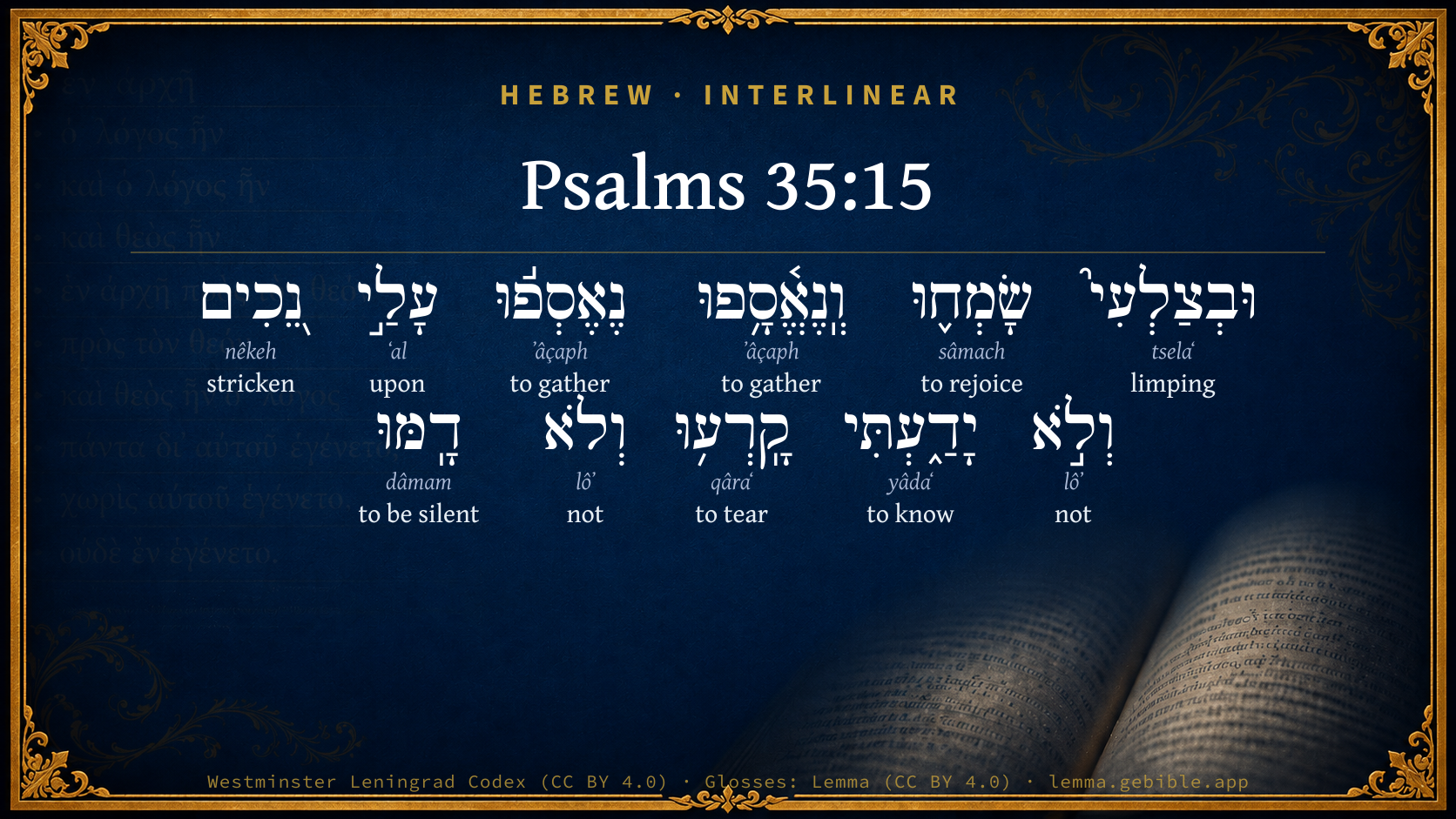
  1. וּבְצַלְעִי֮ tselaʻ H6761 “and · in/at · limping · my” Conjunction + Preposition + Noun, Common, Masculine, Singular, Construct + Suffix, Personal, 1st Person, Common, Singular
  2. שָׂמְח֪וּ sâmach H8055 “to rejoice” Verb, Qal, Perfect, 3rd Person, Common, Plural
  3. וְֽנֶאֱ֫סָ֥פוּ ʼâçaph H622 “and · to gather” Conjunction + Verb, Niphal, Perfect, 3rd Person, Common, Plural
  4. נֶאֶסְפ֬וּ ʼâçaph H622 “to gather” Verb, Niphal, Perfect, 3rd Person, Common, Plural
  5. עָלַ֣י ʻal H5921 “upon · me” Preposition + Suffix, Personal, 1st Person, Common, Singular
  6. וְלֹ֣א lôʼ H3808 “and · not” Conjunction + Particle, Negative
  7. יָדַ֑עְתִּי yâdaʻ H3045 “to know” Verb, Qal, Perfect, 1st Person, Common, Singular
  8. קָֽרְע֥וּ qâraʻ H7167 “to tear” Verb, Qal, Perfect, 3rd Person, Common, Plural
  9. וְלֹא lôʼ H3808 “and · not” Conjunction + Particle, Negative
  10. דָֽמּוּ dâmam H1826 “to be silent” Verb, Qal, Perfect, 3rd Person, Common, Plural

About this verse

These counts appear in no published source. They are computed here, from the morphology-tagged text and Lemma’s own curated glosses. What Lemma adds →

11
words
9
distinct lemmas
Wisdom
section

Notable vocabulary

1 hapax legomenon — a word that appears only here in the entire Hebrew Bible:

  • נֵ֭כִים stricken H5222

First appearance in Scripture

These words make their first canonical appearance in the Hebrew Bible here:

  • וּבְצַלְעִי֮ limping H6761
  • נֵ֭כִים stricken H5222

Shared distinctive vocabulary

וּבְצַלְעִי֮ limping H6761 occurs in 3 verses of the Hebrew Bible. Also found in:

Grammatical profile

  • 6 verbs
  • 1 noun
  • 1 adjective
  • 1 preposition
  • 2 particles

Verb forms

  • שָׂמְח֪וּ Qal · Perfect
  • וְֽנֶאֱ֫סָ֥פוּ Niphal · Perfect
  • נֶאֶסְפ֬וּ Niphal · Perfect
  • יָדַ֑עְתִּי Qal · Perfect
  • קָֽרְע֥וּ Qal · Perfect
  • דָֽמּוּ Qal · Perfect

Repetition

Words recur within this verse — often emphatic in Hebrew:

  • וְֽנֶאֱ֫סָ֥פוּ to gather H622 ×2
  • וְלֹ֣א not H3808 ×2

Hebrew & Septuagint length

In English translation the verse runs 29 words from the Hebrew and 23 from the Septuagint (LXX English) — closely comparable.

A rough comparison of the two English renderings, which tokenize alike — not a word-level alignment.

Word counts can differ between the Hebrew and the Greek without any difference in meaning — e.g. the Hebrew direct-object marker אֵת has no separate Greek word, and Greek often adds the article ὁ.

In the original languages it is 11 Hebrew tokens and 17 Greek tokens — but the two are counted differently (Hebrew bundles its prefixes and suffixes into one token; the Greek is in lemma form), so that isn’t a like-for-like length.

Cross-references

20

Topical passages linked to Psalms 35:15 in the Treasury of Scripture Knowledge — connected by theme and wording, ordered by reader-vote popularity; previews shown in the World English Bible.

  • Mark 14:65 Some began to spit on him, and to cover his face, and to beat him with fists, and to tell him, "Prophesy!" The officers struck him with the palms of their hands.
  • Psalms 7:2 Lest they tear apart my soul like a lion, Ripping it in pieces, while there is none to deliver.
  • Psalms 71:10–11 For my enemies talk about me. Those who watch for my soul conspire together,
  • Jeremiah 20:10 For I have heard the defaming of many, terror on every side. Denounce, and we will denounce him, [say] all my familiar friends, those who watch for my fall; peradventure he will be persuaded, and we shall prevail against him, and we shall take our revenge on him.
  • Matthew 27:27–30 Then the governor's soldiers took Jesus into the Praetorium, and gathered the whole garrison together against him.
  • Matthew 27:39–44 Those who passed by blasphemed him, wagging their heads,
  • Job 16:9 He has torn me in his wrath, and persecuted me; He has gnashed on me with his teeth: My adversary sharpens his eyes on me.
  • Job 30:1–12 "But now those who are younger than I, have me in derision, Whose fathers I would have disdained to put with my sheep dogs.
  • Job 31:29 "If I have rejoiced at the destruction of him who hated me, Or lifted up myself when evil found him;
  • Psalms 22:16 For dogs have surrounded me. A company of evil-doers have enclosed me. They pierced my hands and my feet.
  • Psalms 35:8 Let destruction come on him unawares. Let his net that he has hidden catch himself. Let him fall into that destruction.
  • Psalms 35:25–26 Don't let them say in their heart, "Aha! That's the way we want it!" Don't let them say, "We have swallowed him up!"
  • Psalms 38:17 For I am ready to fall. My pain is continually before me.
  • Psalms 41:8 "An evil disease," they say, "has afflicted him. Now that he lies he shall rise up no more."
  • Psalms 57:4 My soul is among lions. I lie among those who are set on fire, Even the sons of men, whose teeth are spears and arrows, And their tongue a sharp sword.
  • Psalms 69:12 Those who sit in the gate talk about me. I am the song of the drunkards.
  • Proverbs 17:5 Whoever mocks the poor reproaches his Maker. He who is glad at calamity shall not be unpunished.
  • Proverbs 24:17–18 Don't rejoice when your enemy falls. Don't let your heart be glad when he is overthrown;
  • Acts 17:5 But the unpersuaded Jews took along some wicked men from the marketplace, and gathering a crowd, set the city in an uproar. Assaulting the house of Jason, they sought to bring them out to the people.
  • 1 Corinthians 13:6 doesn't rejoice in unrighteousness, but rejoices with the truth;

Cross-references courtesy of OpenBible.info (CC BY 4.0).

Hebrew and Greek witnesses Masoretic Hebrew ↔ Greek Septuagint

The same verse in the two great witnesses to the Old Testament, shown verse-for-verse.

You’re reading Greek Psalm 34 (Hebrew Psalm 35). The Septuagint counts the superscription, so verse numbers can differ from the Hebrew — chapter-level alignment, not verse-by-verse. Numbering follows Rahlfs.

These are two independent witnesses, not word-aligned to each other, and the Septuagint is shown in lemma (dictionary) form.

Hebrew Psalms 35:15 Masoretic · Westminster Leningrad Codex

וּבְצַלְעִי֮ שָׂמְח֪וּ וְֽנֶאֱ֫סָ֥פוּ נֶאֶסְפ֬וּ עָלַ֣י נֵ֭כִים וְלֹ֣א יָדַ֑עְתִּי קָֽרְע֥וּ וְלֹא דָֽמּוּ

But in my adversity, they rejoiced, and gathered themselves together. The attackers gathered themselves together against me, and I didn't know it. They tore at me, and didn't cease.

World English Bible · Public Domain

Greek LXX Greek Psalm 34:15 Septuagint · lemma form

καί κατά ἐγώ εὐφραίνω καί συνἄγω συνἄγω ἐπί ἐγώ μάστιξ καί οὐ γιγνώσκω διασχίζω καί οὐ κατανύσσω

Yet they rejoiced against me, and plagues were plentifully brought against me, and I knew it not: they were scattered, but repented not.

LXX2012 (modern English Septuagint) · Public Domain

On this verse, The Treasury of David discusses the Septuagint’s reading. Read the note in Commentary ↓

Hebrew: Westminster Leningrad Codex (CC BY 4.0). Greek: Septuagint (public domain); English from LXX2012 (modern English Septuagint) (Public Domain). How the Septuagint differs from the Hebrew →

Commentary

Notes on Psalms 35:15 from classic Christian and Jewish commentators (each source and its license shown beneath its notes). The classic Christian expositions comment on the surrounding passage and are grouped to its opening verse, so a note may address several verses; the Jewish commentaries on the Tanakh (Rashi and others) are per-verse, so they appear only where the commentator wrote on this verse.

Lemma curates 59 commentaries, every one of them public domain or Creative Commons licensed, each selected and text-cleaned for this edition rather than reprinted as found. About our sources →

John Gill's Exposition

But in mine adversity they rejoiced,.... Or "at my halting" (u), either by means of falling into sin; good men are subject to slips and falls, and that to the dislocating or breaking of their bones, which cause them to go halting all their days; wicked men watch for their halting, as Jeremiah's familiars did for his, Jer 20:10; and rejoice at it; see Psa 38:16; or by falling into some misfortune or calamity; hence we render it "adversity", and may design some affliction or other, as in Mic 4:6, at which wicked men rejoice; see Eze 35:15; so David's enemies rejoiced at his afflictions; and the enemies of his son and antitype, the Lord Jesus Christ, were glad when Judas offered to betray him to them; more so when they had got him into their hands; and most of all when he was condemned and crucified: and so do the enemies of his people, as the Philistines sported with Samson when he was in his adversity, and as the antichristian party will rejoice and send gifts one to another when the two witnesses are slain; but the saints have a gracious God, who knows their souls in adversity; a sympathizing high priest, who is touched with a feeling of their infirmities; and fellow saints that are afflicted with them in all their afflictions, and bear a part of their burdens;

and gathered themselves together; not to pity him, but to insult him; not to help him in his distress, but to add to it;

yea, the abjects gathered themselves together against me; mean persons, the refuse and scum of the earth; such as Job describes, Job 30:1; the word may be rendered "smitten" (w), either in spirit, as in Isa 66:2; they pretending sorrow of heart for his troubles; or rather smitten in body, in their feet, as Mephibosheth was; yet as lame as they were, and notwithstanding their lameness, they got together to rejoice at David's halting: or it may be best of all to understand it of their being smitten of God and afflicted; and the sense may be, that though the hand of God was upon them, this did not deter them from gathering together to insult David in his afflictions; some render the word "smiters" (x), that is, with their tongues, and so the Targum, "the wicked who smite with their words"; see Jer 18:18; and such sort of persons were they that gathered together against Christ: it is true indeed that some of them were men of rank and figure, were the princes of this world, as Herod and Pontius Pilate, and the Jewish rulers, Act 4:27, compared with Psa 2:1; but the greater part of them were the meaner sort of people; particularly the Roman soldiers that gathered about him, and sported with him in Pilate's hall, and that surrounded him with scoffs when upon the cross; these also were literally "smiters" of him, both with words and with their hands, and are so called, Isa 50:6;

and I knew it not; David knew his enemies, or he could not have shown so much concern for them, as he did in the preceding verses; but either he knew not of their gathering together against him; until he saw them in great numbers about him; or he was not conscious to himself of any evil he had done them, that should be the reason of it; and this was the case of his son the Messiah, he who they were that gathered about him, even those that blindfolded him, and bid him prophesy who smote him; but he knew no sin he had done why he should be treated in the manner he was;

they did tear me, and ceased not; not their own garments, as some supply it, pretending great grief of heart for him; nor their mouth with laughing at him, as others; see Psa 35:21; but either his character and reputation, with hard sayings and reproachful words, or his flesh with blows; and this they did incessantly; and which was literally true of Christ, whose enemies tore his flesh, by plucking off the hair, by buffeting and scourging him, and by piercing his hands and his feet with nails, when they crucified him; and they ceased not, even after death, to pierce his side with a spear.

(u) "in claudicatione mea", Pagninus, Montanus, Vatablus, Gejerus, Michaelis; so Ainsworth. (w) "percussi", Pagninus, Montanus, Vatablus, Cocceius. (x) So Ainsworth.

John Gill's Exposition of the Whole Bible (1746–1763) — public domain (CC PDM 1.0). Text via the HelloAO Bible API.

Trapp's Complete Commentary

John Trapp

Psa 35:15 But in mine adversity they rejoiced, and gathered themselves together: [yea], the abjects gathered themselves together against me, and I knew [it] not; they did tear [me], and ceased not:

Ver. 15. But in mine adversity] Heb. in my halting; when through weakness I could not but halt before my best friends, as we say. Morbus est sic dictus quia incedere nequit nisi cum doloro quasi claudicando (Aben-Ezra).

Yea, the abjects gathered themselves together] Claudi congregati sunt, et secundum claudicationem meam claudicabant, ut me deriderent, so the Syriac senseth it. They halted, as I did, by way of derision; but they should have known, first, that mocking is catching, as we say. Cicero confesseth that while he laughed at one Hircus, a very ridiculous man, he became as bad almost himself: Dum illum rideo, pene factus sum ille (Epist. 9, lib. 2). Secondly, that such cruel mockings are grievous sins, and such as God will severely punish. Some render it the smiters, that is, the tongue smiters, as Jer 18:18. Others, the smitten, that is, the abjects, the vile persons: the basest can mock, as did Tobiah the servant, Neh 2:19, and those pests, Psa 1:1.

And I knew not] Or, such as I knew not, took no notice of, they were so base. See the like, Job 30:8.

They did tear me] sc. With their tongues, as dogs toss and tear carrion with their teeth, Scindunt illud quod reparare nequeunt, non per pcenitentiam, saith Kimchi. They tear that which they cannot make good again, no, not by repentance, viz. my good name. Or, they rent, sc. their garments, as if they had been very sorry for me, as Gen 37:36 Job 2:12. This they did, as Austin speaketh, simulatione miseriae, non compassione misericordiae, out of deep dissimulation.

John Trapp, A Commentary or Exposition upon All the Books of the Old and New Testament (1647–1656) — public domain. Text from a community e-Sword module.

The Treasury of David

Charles H. Spurgeon

Ver. 15. But in mine adversity they rejoiced. In my halting they were delighted. My lameness was sport to them. Danger was near, and they sang songs over my expected defeat. How glad are the wicked to see a good man limp! "Now, "say they, "he will meet with his downfall." And gathered themselves together, like kites and vultures around a dying sheep. They found a common joy in my ruin, and a recreation in my sorrow, and therefore met together to keep the feast. They laid their heads together to devise, and their tongues to deceive. Yea, the abjects gathered themselves together against me. Those who deserved horsewhipping, fellows the soles of whose feet were needing the bastinado, came together to plot, and held hole and corner meetings. Like curs around a sick lion, the mean wretches taunted and insulted one whose name had been their terror. The very cripples hobbled out to join the malicious crew. How unanimous are the powers of evil; how heartily do men serve the devil; and none decline his service because they are not endowed with great abilities! I knew it not. It was all done behind my back. What a fluster the world may be in, and the cause of it all may not even know that he has given offence. They did tear me, and ceased not. It is such dainty work to tear to pieces a good man's character, that when slanderers have their hand in they are loath to leave off. A pack of dogs tearing their prey is nothing compared with a set of malicious gossips mauling the reputation of a worthy man. That lovers of the gospel are not at this time rent and torn as in the old days of Mary, is to be attributed to the providence of God rather than to the gentleness of men.

Ver. 15. But in mine adversity they rejoiced. etc. Do not glory in your neighbour's ruins. The firefly leaps and dances in the fire, and so do many wicked men rejoice in the sufferings of others. Such as rejoice in the sufferings of others are sick of the devil's disease; but from that disease the Lord deliver all your souls. It is sad to insult over those whom God hath humbled; it is high wickedness to triumph over those to whom God hath given a cup of astonishment to drink. Such as make the desolations of their neighbours to be the matter either of their secret repast, or open exultation, such may fear that the very dregs of divine wrath are reserved for them. It is bad playing upon the harp because others have been put to hang their harps upon the willows. We must not pray with him in the tragedy, that it may rain calamities; nor with Clemens' Gnostic, Give me calamities that I may glory in them. There cannot be a greater evidence of a wicked heart, than for a man to be merry because others are in misery. "He that is glad at calamities (that is, at the calamities of others) shall not be unpunished" Pr 17:5. If God be God, such as congratulate our miseries instead of condoling them, shall be sure to be punished with the worst of punishments; for such do not only sin against the law of grace, but also against the very law of nature; the law of nature teaching men to sympathise with those that are in misery, and not to rejoice over them because of their miseries. O sirs, do not make other's mourning your music, do not make other's tears your wine; as you would not be made drunk at last with the wine of astonishment. Thomas Brooks.

Ver. 15. But in mine adversity they rejoiced, etc. Marvellous prophecy of the cross! second only, if indeed second, to that in the twenty-second Psalm. Still closer to the history if we take the Vulgate: the scourges were gathered together upon me. Even so, O Lord Jesus, the ploughers ploughed upon thy back, and made long furrows: precious furrows for us, where are sown patience for the present life, and glory in the next; where are sown hope that maketh not ashamed, and love that many waters cannot quench. "The very abjects." Even those worst of abjects, who said, "God, I thank thee that I am not as other men are; "who had set the poor sinner before the Lord, with their "Moses in the law commanded that such should be stoned." "Making mouths at me." And is it not wonderful that, well knowing the prophecy, yet the chief priests and scribes should have so fulfilled it, as that it should be written concerning them, "They that passed by mocked him, wagging their heads." Lewis de Grenada, 1504-1588.

Ver. 15. In mine adversity they rejoiced. Now, as men often relent at seeing the misfortunes of their enemies, so that they cease to hate or persecute those who are already miserably wretched, it was an evidence of the very cruel and fierce spirit by which David's former friends were actuated against him, when, upon seeing him cast down and afflicted, they were rather by this incited furiously and insolently to assail him. John Calvin.

Ver. 15. The abjects. The very abjects (Prayer Book Version). The Hebrew word Nechim, thus translated, comes from a verb signifying to be smitten. Hence, in the Septuagint it is rendered scourges. But it may also be rendered, with Jerome, smiters, and may mean smiting with the tongue. Compare Jer 18:18. Another of its meanings is, according to Buxtorf, the wry legged, the lame; and so it is used in 2Sa 4:4 9:3 whence the epithet of Necho was given to one of the Pharaohs who halted in his gait. Our translators seem to have understood the word in this last sense, as a term of contempt. Daniel Cresswell.

Ver. 15. David, having showed how compassionate he was to his enemies in their affliction Ps 35:14, he presently shows Ps 35:15, how uncompassionate, or barbarously cruel rather, his enemies were to him in his. Abjects are vile persons, men smitten in their estates and credits; yea, often as slaves or ill servants smitten with cudgels or whips. So a learned translator renders the Psalm, The smitten gathered against me; that is, vile men who deserve to be beaten and cudgelled. Joseph Caryl.

Ver. 15. The shameful conspiracy of men against our Lord Jesus at his passion.

Psalms 35:16*

Charles H. Spurgeon's The Treasury of David (1869–1885) — public domain. Psalms only. Text from a community e-Sword/MySword module.

Joseph Benson's Commentary

Psa 35:15-16. But in mine adversity — Hebrew, בצלעי, betzalgni, in my halting, that is, when I was in great danger of falling into mischief. When I had any sickness or ill success in my affairs, and was almost lost, for such are often said to halt, in the Scripture; they rejoiced and gathered themselves together — These very men (such was their inhumanity!) could not dissemble the joy they conceived when the news was brought of any evil that befell me, but ran to tell one another, and assembled themselves together that they might publicly testify how glad they were to hear it. Yea, the very abjects — Hebrew, נכים, neechim, loripedes, the bow-legged, or, lame. It means, properly, percussi aut læsi pedibus, persons wounded or hurt in their feet. The sense is, vile persons, the very scum of the people, persons so mean that I did not so much as know there were such men in the world, met together to revile me; nay, the cripples, who could not walk without trouble and pain, were as forward as any others to go to these meetings on this occasion. They did tear me — That is, my good name, with scoffs, and calumnies, and reproaches, and curses; and ceased not — Hebrew, ולא דמו, velo damu, were not silent, that is, they acted thus unweariedly and continually; with hypocritical, or profane, mockers — Whose common practice it was to scoff at, and deride, others; in feasts — Hebrew, לעגי מעוג, sanniones placentæ, vel cibi, buffoons, or jesters, for a cake, or morsel of bread; namely, parasites, qui gulæ causa aliis adulantur, says Buxtorf, who flatter others for the sake of their belly. They made themselves buffoons and jesters, and accustomed themselves to mock and deride David, that they might gain admittance to the tables of great men, where they might fill their bellies, which was all that they sought, or got by such conduct. They gnashed upon me with their teeth — They used all expressions of rage and hatred against me, which they did to curry favour with my great and powerful adversaries. The indignities and outrage which the Lord Jesus endured from the Jews seem to be plainly foretold in these two verses. See Mar 14:65.

Joseph Benson's Commentary on the Old and New Testaments (1811–1818) — public domain. Text from a community e-Sword module.

J. A. Alexander on Psalms

Joseph Addison Alexander

15. (Psa 35:15) And (yet) in my limping they rejoiced, and were gathered together; there were gathered together against me cripples, and I did not know (it): they did tear and were not silent. With his behaviour to them in their affliction he contrasts theirs to him. As disease in general is a common figure for distress, so lameness in particular is so used here and in Psa 38:18 (17), Jer 20:10. They assembled not to comfort but to mock him and revile him.—The obscure Herbrew wording has been variously explained to mean smiters with the tongue (Jer 18:18), i.e. slanderers—whipped (Job 39:8), i.e. degraded criminals—and smitten (Isa 53:4), i.e. afflicted. But Luther's explanation, which connects the word with the cognate form (2Sa 4:4; 2Sa 9:3), smitten in the feet, lame, crippled, not only yields a good sense, but agrees best with the figure of the first clause. 'When I limped cripples mocked at me'—i. e. those who were themselves contemptible treated me with contempt. I did not know it. It was done behind my back, and while I was entirely unsuspicious. See above, on Psa 35:8. This is a more natural construction than whom I did not know, Which is, moreover, inconsistent with what goes before.—They rent or tore me by their slanders.

Joseph Addison Alexander, The Psalms Translated and Explained (1850) — public domain. Text from a community e-Sword module.

Geneva Bible (1599)

Geneva Bible translators

When they saw me ready to slip, and as one that halted for infirmity.

With their railing words.

Geneva Bible (1599) marginal notes — public domain. Text via Bolls.life.

Jamieson, Fausset & Brown

Robert Jamieson, A. R. Fausset & David Brown

On the contrary, they rejoiced in his affliction. Halting, or, "lameness," as in Psa 38:17 for any distress.

abjects--either as cripples (compare Sa2 4:4), contemptible; or, degraded persons, such as had been beaten (compare Job 30:1-8).

I knew it not--either the persons, or, reasons of such conduct.

tear me, and ceased not--literally, "were not silent"--showing that the tearing meant slandering.

Jamieson, Fausset & Brown — Commentary Critical and Explanatory on the Whole Bible (1871) — public domain (CC PDM 1.0). Text via the HelloAO Bible API.

Adam Clarke's Commentary

Verse 15. But in mine adversity they rejoiced] How David was mocked and insulted in the case of Absalom's rebellion by Shimei and others, is well known.

The abjects] נכים nechim, the smiters, probably hired assassins. They were everywhere lying in wait, to take away my life.

Adam Clarke's Commentary on the Bible (1810–1826) — public domain. Text from a community e-Sword/MySword module.

John Calvin's Commentaries

15. But they rejoiced at my halting. I see no reason why interpreters should trouble themselves as they do about the word halting. Some conjecture that David had his leg put out of joint, and others suppose that he halted from some disease. But when we consider carefully the whole passage, nothing is more evident than that he refers by this expression to the calamities which befell him; as if he had said, As soon as they saw me begin to stagger and ready to fall, they did as it were gather together against me, and endeavored entirely to overthrow me. There is, therefore, in this expression almost the same metaphor as we have already seen in the word sickness. Now, as men often relent at seeing the misfortunes of their enemies, so that they cease to hate or persecute those who are already miserably wretched, it was an evidence of the very cruel and fierce spirit by which David’s former friends were actuated against him, when, upon seeing him cast down and afflicted, they were rather by this incited furiously and insolently to assail him. At the commencement he speaks only of a few; but immediately after, in order to show still farther the indignity which had been done to him, he adds to them the base and ignoble of the common people; not that he blames all alike, but that he may the better show with what bitter hostility he was assailed on all sides. It is probable that those who were then in power were as it were firebrands, who endeavored to kindle every where the flame of hatred against David, that the people every where might rise up to destroy him, and strive with each other in this enterprise. And he repeats twice that they gathered themselves together, in order to show how resolute and determined they were in their opposition to him; unless, perhaps, some would prefer to explain the words thus: They gathered themselves together, not only those who had some pretext for doing so, but even the lowest of the people. The Hebrew word נכים, nekim, literally signifies the whipped, or beaten, The word is derived from נכה, nakah, to strike or to smite. The LXX. render it μαστιγες, scourges; and Jerome reads percutientes, smiters, in which he is followed by Ainsworth, who understands the word as meaning smiters with the tongue, or calumniators, and who thinks that the LXX., in translating it scourges, alluded to the scourge of the tongue, as in Job 5:21; and if smiters is the proper rendering, we may certainly conclude, that as this smiting is represented as done upon the person who was its object in his absence, it was a smiting by the tongue. At the same time, this critic observes, that the word may be read the smitten, that is, abjects, vile persons, as in Job 30:8 Dr Kennicott translates it by verbcrones, whipt slaves, vile scoundrels. Another meaning of the word, according to Buxtorff, is, the wry-legged, the lame. In this sense it is used in 2 Samuel 4:4, and 9:3; and hence the epithet of Necho was given to one of the Pharaohs, who halted in his gait. Thus it easily came to be employed as a term of contempt. Calvin and the translators of our English Bible agree in the meaning which they attach to this word.

The verb קרע, kara, for cut, “is significant of tearing or rending, and by an easy metaphor, is applicable to wounds inflicted by evil speaking and slander.” — Walford.

John Calvin's Commentaries (1540-1563) — public domain. Text from the Calvin Translation Society English edition (1840s-50s) via the Christian Classics Ethereal Library (ccel.org). Calvin's coverage is partial (roughly two-thirds of the Bible); uncommented books and verses are honest gaps, never fabricated. The 19th-century editor's footnotes and remarks are omitted so the notes are faithfully Calvin's own voice.

Ellicott's Commentary for English Readers

(15) In mine adversity.—Better, at my fall.

The abjects . . .—The Hebrew word occurs only here. It is derived from a root meaning to smite, but its form is perplexing. The ancient versions all give it an active sense. LXX. and Vulg. “whips”; Symmachus, “smiters”; Chaldee, “the wicked who smite me with their words,” probably a correct paraphrase. The passive, “these smitten,” or “objects,” is due to R. Kimchi.

And I knew it not—i.e., either (1) “unawares,” as in Psa_35:8; (2) “for what reason I knew not”; (3) “whom I knew not”; (4) “and I was innocent.” Of these possible explanations (2) is to be preferred.

A Bible Commentary for English Readers, edited by Charles John Ellicott (1878–1897) — public domain. Text from a community e-Sword module.

The Cambridge Bible for Schools and Colleges

gen. ed. J. J. S. Perowne

15. But at my halting they rejoice, and gather themselves together. Limping, like stumbling, is a figure for misfortune. Cp. Psa_38:17; Jer_20:10.

Yea, the abjects] The word rendered abjects is of doubtful meaning and possibly corrupt. (1) According to the rendering of A.V., retained by R.V., the sense is, that with his other enemies were associated the lowest outcasts, a rabble of men whom he knew not (Job_30:8 ff.); for the last words of the line must be rendered with R.V. marg., and those whom I knew not. (2) But the form of the sentence rather points to a description of the conduct of the men who have been mentioned already: so (retaining or slightly altering the present text), they gather themselves together smiting me unawares, or, for things that I know not. The wounds of slander are meant (Jer_18:18). So the Targum: wicked men who smite me with their words. (3) Various emendations have been proposed. One that has found some favour, strangers, is foreign to the rest of the Psalm.

they did tear me &c.] They rend me, and cease not. Like beasts of prey (Hos_13:8); or as we talk of tearing a man’s reputation to shreds. ‘Making mouths’ in P.B.V. is a modernisation of ‘making mowes’, i.e. grimaces, which is found in the Great Bible and the early editions of the Prayer Book.

The Cambridge Bible for Schools and Colleges (gen. ed. J. J. S. Perowne; Cambridge University Press, 1878–1918) — public domain. Text from a community e-Sword module.

Albert Barnes' Notes on the Bible

But in mine adversity they rejoiced - Margin, as in Hebrew, “halting.” That is, when reverses and troubles came upon me; when, in my journey of life, I seemed to stumble.

And gathered themselves together - Not to help me, but to oppose me, and to deride me.

Yea, the abjects gathered themselves together against me - The word rendered “abjects” - נכים nēkiym - has been very variously rendered. The Septuagint renders it: μάστιγις mastiges, “scourges;” so the Vulgate, “flagella.” Our translators evidently regarded it as meaning the low, the vile, the outcasts of society; but this idea is not necessarily implied in the Hebrew word. The word used here is derived from a verb - נכה nâkâh - which means to smite, to strike, to beat; and it would be correctly rendered in this place, “those smiting,” or “beating:” - “the smiters.” But probably the allusion is to the “tongue” - to those who, as it were, smite or beat with the tongue; that is, who rail or revile: those who are slanderous. Compare Jer 18:18; Gesenius (Lexicon). Others have supposed that it means “lame;” that is, those who limp or halt - meaning that all classes of persons gathered themselves together. But probably the true idea is that which is expressed above, that he was surrounded by slanderers and revilers.

And I knew it not - Hebrew, “I knew not;” that is, I knew nothing of what they accused me of; I was wholly ignorant of the charges brought against me. See the notes at Psa 35:11.

They did tear me - See the notes at Job 16:9. The idea here is that they “tore” or “rent” with words; or, as we say in English, they “tore him in pieces;” that is, they railed at, or reviled him, tearing his character in pieces.

And ceased not - It was not one act only; it was continuous and unceasing. They did it when alone; and they gathered themselves together to do it; they countenanced and encouraged one another.

Albert Barnes' Notes on the Bible (1834–1885) — public domain. Text from a community e-Sword/MySword module.

Matthew Poole's English Annotations

In mine adversity, Heb. in my halting, i.e. when I was in great danger of falling into mischief; when I had any sickness, or ill success in my affairs, and was almost lost; for such are said to halt, Mic 4:6,7; Zep 3:19. See also Psa 38:17; Jer 20:10.

Gathered themselves together, to wit, against me, as it is expressed in the next clause; either because they were so full of joy at the tidings, that they could not contain it in their own breasts, but sought to communicate it to others; or that they might insult over me, and please and recreate themselves and one another with discourses about it; or that they might consult how to improve the advantage which they now had against me, to my utter destruction. The objects; or, vile persons; either for the meanness of their condition, of for their wickedness, for which they were worthy to be beaten, as the phrase is, Deu 25:2; where the Hebrew word is of the same root with this. Or, the lame, as this very word is rendered, 2Sa 4:4; 9:3, to wit, of their feet, as it is there expressed. The cripples that could not walk without trouble and pain, were as forward as any to go to these meetings upon this occasion.

I knew it not: this may be added to express either their hypocrisy and pretences of respect and affection to him, by reason whereof he had no suspicion of them, nor of any such practices of theirs; or his own danger, that he did not know, and therefore could not prevent, their plots and conspiracies against him. Heb. and I knew not; which is by others, and well may be, rendered thus, even they whom I knew not, they whom I was so far from provoking by any injury, that I never saw their faces, nor heard of their names.

Tear me, i.e. my good name, with scoffs, and calumnies, and reproaches, and curses.

Ceased not, Heb. were not silent, i.e. did thus unweariedly and continually.

Matthew Poole's English Annotations on the Holy Bible (1683–1685) — public domain. Text from a community e-Sword/MySword module.

Whedon's Commentary on the Bible

Daniel D. Whedon

15. But in mine adversity—In my halting, or fall. It is evident that the courtiers of Saul had all along taken part with the king against David, though their conduct to him was not openly rude or hostile until his fall, or the time he was forced to flee from Saul for his life.

They rejoiced, and gathered… together—Now their true character appears. They assemble for gratulations and joy. David’s popularity with the people had been an impediment to the ambition of these men; now it seems removed.

Abjects—The dregs of the populace, who are always ready to please the party in power. The radical sense of the term nekeem (abjects) is “smitten-men, men who are brought low or reduced,” (Hengstenberg, Delitzsch,) which suggests the idea of disappointed office-seekers. And

I knew it not—Literally, And I knew not. These who now assemble to rejoice at my calamity “I knew not,” being men with whom, on account of their low condition, I could have no intercourse. Compare Job_30:1

Daniel D. Whedon (gen. ed.), Commentary on the Old and New Testaments (1874–1909) — public domain. Text from a community e-Sword module.

The Pulpit Commentary

But in mine adversity they rejoiced, and gathered themselves together; rather, in my fall, or in my halting; "when I halted" (Revised Version). "The word implies a sudden slip and overthrow," such as is represented in 1Sa_18:8-29. Yea, the objects gathered themselves together against me. Compare the case of Job. (Job_30:1-14) It is a matter of common experience that when men fall from a high position into misfortune, the base vulgar crowd always turns against them with scoffs and jeers and every sort of contumely. And I knew it not; rather, and I knew them not; men, i.e., of so low a condition, that I had no acquaintance with them (see the margin of the Revised Version). They did tear me, and ceased not. (comp. Job_16:9)

The Pulpit Commentary (1880–1919), ed. H.D.M. Spence-Jones & Joseph S. Exell — public domain. Text from a community e-Sword module.

John Wesley's Explanatory Notes

Gathered - They were so full of joy, that they could not contain it in their own breasts, but sought to communicate it to others. Abjects - Or, vile persons, either for the meanness of their condition, or for their wickedness. Knew not - While I had no suspicion of them. Tear me - My good name with calumnies, and reproaches and curses.

John Wesley, Explanatory Notes Upon the Whole Bible (1754–1765) — public domain. Text via the GEBible commentary corpus.

unfoldingWord translationNotes

Door43 World Missions Community

gathered together

"assembled together" or "came together"

against me

This means they came together for the purpose of attacking the writer. AT: "to make plans against me" or "to plan my destruction" (See: Idiom)

They tore at me

Here the treated the writer as if he were a piece of cloth that they could tear to pieces. AT: "They attacked me" (See: Metaphor)

With no respect at all they mocked me

"With the worthless people they ridiculed me" or 2) "Without respect they made fun of me"

they grind their teeth at me in rage

This is a sign of anger and hate. "they made grinding noises with their teeth at me" (See: Symbolic Action)

translationWords

stumble

joy

unfoldingWord translationNotes — © Distant Shores Media and the Door43 World Missions Community, licensed CC BY-SA 4.0. Source: git.door43.org/Door43/en_tn.

Rashi

Rabbi Shlomo Yitzchaki (Rashi)

And, when I limped, they rejoiced and gathered And when I limped because I suffered a fracture, they rejoiced and gathered [around me].

lame people gathered about me Heb. נכים, lame people, as we translate “Pharaoh-neco,” חגירא, lame. Menachem (p. 122f.) associated it with (Isa. 16: 7), נכאים, broken-hearted, amenuyze in Old French, crushed.

Were they to tear, they would not draw blood Were they to tear my flesh, my blood would not flow to the ground when they embarrass me [lit. make my face white].

Rashi on the Tanakh — English translations: “The Judaica Press complete Tanach with Rashi, translated by A. J. Rosenberg” (CC BY 4.0); “Pentateuch with Rashi's commentary by M. Rosenbaum and A.M. Silbermann, 1929-1934” (public domain); “The Metsudah Tanach series, Lakewood, N.J” (CC BY 4.0); and “The Book of Joshua, Metsudah Publications, 1997” (CC BY 4.0). Text via Sefaria.

Lesson kit

Teaching starters — assembled from the data on this page, not authored interpretation. Every prompt links to the verse data it draws on. Edit before teaching.

Psalms, in the Wisdom, opens this verse with 11 words (9 distinct Hebrew lemmas). Its most distinctive word is nêkeh (“stricken”). A historical commentator’s framing appears above. Read the whole chapter for the surrounding context.

Discussion questions

  1. The word nêkeh carries the sense “stricken.” How does it shape the verse?
  2. This verse holds 1 word here found nowhere else in the Hebrew Bible. What might the rare word draw attention to?
  3. 2 words here appear for the first time in Scripture. What is being introduced at this debut?
  4. Psalms 38:17 shares the word «limping» with this verse. How do the two illuminate each other?
  5. “to gather” occurs 2× in this one verse. What is the effect of the repetition?
  6. The translations on this page render this verse differently — a whole-verse word diff, not a word-by-word alignment. What might account for the different wordings?
  7. The verb «שָׂמְח֪וּ» is Qal Perfect. How does its form color the action?
  8. Reading how John Gill's Exposition and Trapp's Complete Commentary read this verse, where do the two commentators agree and where do they part?

Things to notice

  • 1 word in this verse appears nowhere else in the Hebrew Bible.
  • 2 words make their first canonical appearance in Scripture here.
  • This verse counts 11 Hebrew ↔ 17 Greek words.
  • These translations choose different wording for 16 words in this verse.
  • “to gather” occurs 2× in this single verse.

Reading settings

Reading text

Shown beneath each verse's original-language words.

Old Testament
Old Testament edition

Read the OT as the Masoretic Hebrew (MT) or the Greek Septuagint (LXX).

English shown for the Greek Septuagint (in the Hebrew ↔ Greek comparison).

Comparing translations? Open the Compare panel on any verse page to stack up to four side by side.