2 Samuel 21:13

Hebrew (Westminster Leningrad Codex) 2 Samuel 21:13 appears in the Hebrew Old Testament. The text above is from the Westminster Leningrad Codex. Each word links to its Strong’s number, a concise gloss, and parsing drawn from the Open Scriptures Hebrew Bible morphology. Click any word for its full Brown-Driver-Briggs (BDB) entry.
Download image
Cite this verse

2 Samuel 21:13 (World English Bible). Public Domain. Lemma interlinear Bible study tool, https://lemma.gebible.app/v/2-samuel/21/13.

Show BibTeX & RIS
BibTeX
RIS
English Translation
and he brought up from there the bones of Saul and the bones of Jonathan his son: and they gathered the bones of those who were hanged.
World English Bible · Public Domain
Download a study sheet

One document with this verse’s original text, its word-by-word gloss line, the meaning frame, cross-references with their text, attributed commentary, and full source and license credits — printable, and it pastes into notes with its structure intact.

This verse Autodidact and up

Study sheet (.html) Plain text (.txt)

A passage Seminary Student

Up to 50 verses in one chapter. A passage sheet keeps up to 6 commentary sources and 12 cross-references per verse, in the order this page ranks them, and says so on the sheet whenever that leaves anything out. Ask for a single verse and you get the Autodidact verse sheet above.

Everything on this page stays free to read, with no account — the sheet is a download of what is already on screen, not access to it.

Want to remove ads? Support Godless Engineer
Compare translations 3

The same verse in 3 English versions, stacked beneath the original-language interlinear above. Click any original word for its lexicon entry.

Each is an independent rendering of the whole verse — the interlinear is not word-aligned to these translations.

Highlighted words mark where these versions differ — a whole-verse word diff, not a word-by-word alignment.

  • World English Bible Public Domain
    and he brought up from there the bones of Saul and the bones of Jonathan his son: and they gathered the bones of those who were hanged.
  • King James Version Public Domain
    And he brought up from thence the bones of Saul and the bones of Jonathan his son; and they gathered the bones of them that were hanged.
  • unfoldingWord Literal Text CC BY-SA 4.0
    And he brought up from there the bones of Saul and the bones of Jonathan his son, and they gathered the bones of the hanged ones.

unfoldingWord Literal Text — © unfoldingWord, licensed CC BY-SA 4.0. Word-aligned USFM3 via Door43 (git.door43.org/unfoldingWord/en_ult).

Versions to compare (up to 4)

3 of 4 selected

Show all 18 translations

Every available English version of this verse, each an independent rendering of the whole verse.

  • World English Bible Public Domain
    and he brought up from there the bones of Saul and the bones of Jonathan his son: and they gathered the bones of those who were hanged.
  • Berean Standard Bible Public Domain
    So David had the bones of Saul and his son Jonathan brought from there, along with the bones of those who had been hanged.
  • Majority Standard Bible Public Domain
    So David had the bones of Saul and his son Jonathan brought from there, and they also gathered the bones of those who had been hanged.
  • King James Version Public Domain
    And he brought up from thence the bones of Saul and the bones of Jonathan his son; and they gathered the bones of them that were hanged.
  • American Standard Version (1901) Public Domain
    and he brought up from thence the bones of Saul and the bones of Jonathan his son: and they gathered the bones of them that were hanged.
  • Revised Version (1885) Public Domain
    and he brought up from thence the bones of Saul and the bones of Jonathan his son; and they gathered the bones of them that were hanged.
  • Geneva Bible (1599) Public Domain
    So hee brought thence the bones of Saul and the bones of Ionathan his sonne, and they gathered the bones of them that were hanged.
  • Douay-Rheims (1899) Public Domain
    And he brought from thence the bones of Saul, and the bones of Jonathan his son, and they gathered up the bones of them that were crucified,
  • Young's Literal Translation Public Domain
    and he bringeth up thence the bones of Saul, and the bones of Jonathan his son, and they gather the bones of those hanged,
  • Literal Standard Version CC BY-SA 4.0
    and he brings up there the bones of Saul, and the bones of his son Jonathan, and they gather the bones of those hanged,
  • Unlocked Literal Bible CC BY-SA 4.0
    David took away from there the bones of Saul and the bones of Jonathan his son, and they gathered the bones of the seven men who had been hanged, as well.
  • unfoldingWord Literal Text CC BY-SA 4.0
    And he brought up from there the bones of Saul and the bones of Jonathan his son, and they gathered the bones of the hanged ones.
  • Darby Bible Public Domain
    and he brought up from thence the bones of Saul and the bones of Jonathan his son; and they gathered the bones of them that were hanged.
  • World Messianic Bible Public Domain
    and he brought up from there the bones of Saul and the bones of Jonathan his son. They also gathered the bones of those who were hanged.
  • Webster's Bible Public Domain
    And he brought up from thence the bones of Saul and the bones of Jonathan his son; and they gathered the bones of them that were hanged.
  • Free Bible Version CC BY-SA 4.0
    David had the bones of Saul and his son Jonathan brought back, and also had the bones of those who had been hanged gathered up.
  • Bible in Basic English Public Domain
    And he took the bones of Saul and his son Jonathan from that place; and they got together the bones of those who had been put to death by hanging.
  • JPS Tanakh (1917) Public Domain
    and he brought up from thence the bones of Saul and the bones of Jonathan his son; and they gathered the bones of them that were hanged.

Literal Standard Version (2020), Covenant Press — licensed CC BY-SA 4.0. Text via the HelloAO Bible API (eBible.org). Unlocked Literal Bible (unfoldingWord) — licensed CC BY-SA 4.0. Text via the HelloAO Bible API (eBible.org). unfoldingWord Literal Text — © unfoldingWord, licensed CC BY-SA 4.0. Word-aligned USFM3 via Door43 (git.door43.org/unfoldingWord/en_ult). Free Bible Version, Dr. Jonathan Gallagher — licensed CC BY-SA 4.0. Text via the HelloAO Bible API (eBible.org).

Word by word

More ways to search: Search by grammar → Find every occurrence → Compare this word →

Practice this passage: Drill this verse → Learn its vocabulary →

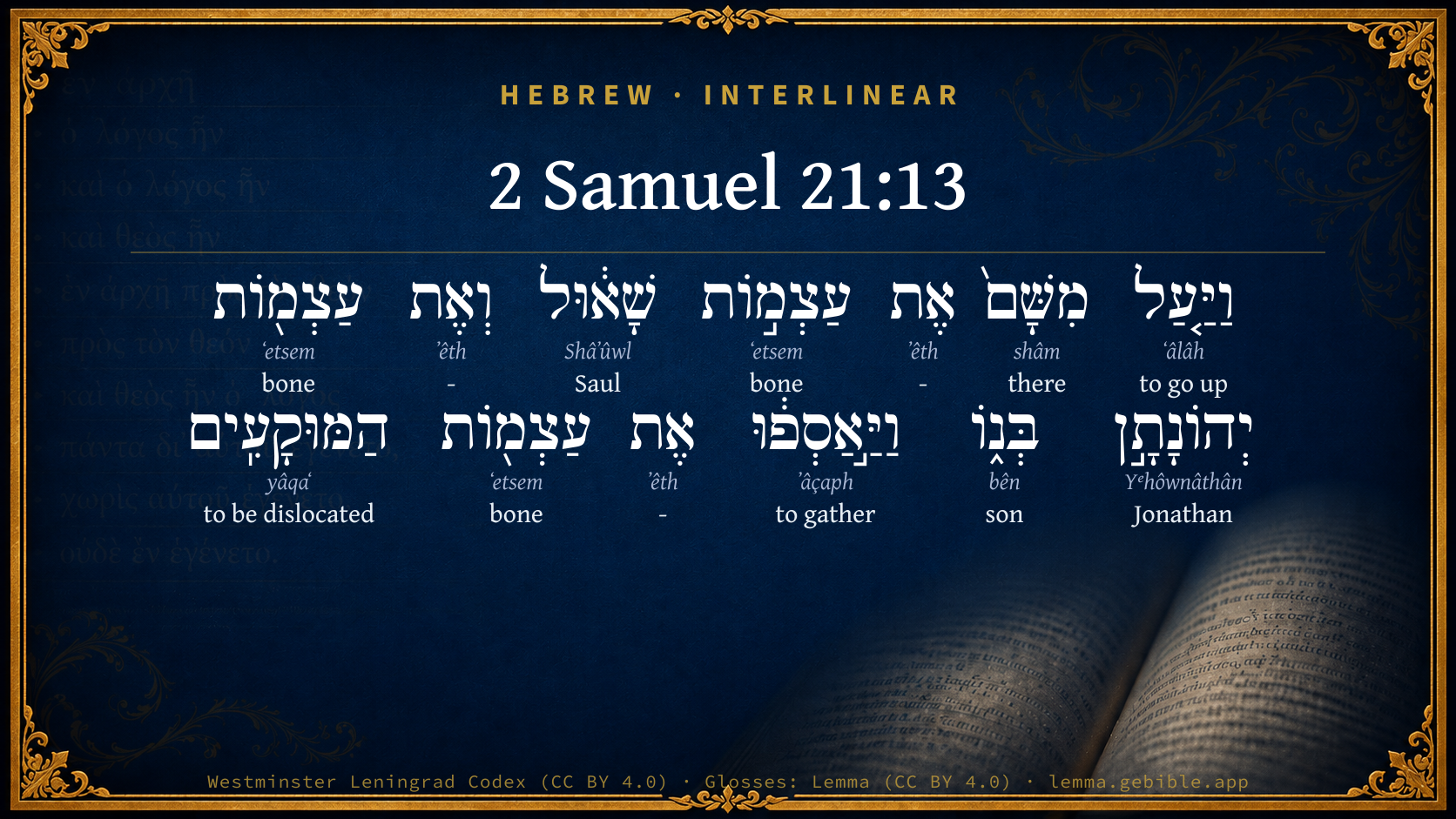
הַמּוּקָעִֽים
yâqaʻ
H3363
“the · dislocated”
Particle, Definite Article + Verb, Hophal, Participle Passive, Masculine, Plural, Absolute
Part of Speech
Particle + Verb
Stem
Hophal
Form
Participle Passive
Gender
Masculine
Number
Plural
State
Absolute
Full BDB Definition

Origin: a primitive root

TWOT: 903

to be dislocated, be alienated - (Qal) to be dislocated, be torn away, be alienated - (Hiphil) - to execute slowly (by exposure or impalation) - to hang - (Hophal) to be executed
  1. וַיַּ֤עַל ʻâlâh H5927 “and · to go up” Conjunction + Verb, Hiphil, Sequential Imperfect, 3rd Person, Masculine, Singular
  2. מִשָּׁם֙ shâm H8033 “from · there” Preposition + Adverb
  3. אֶת ʼêth H853 “-” Particle, Direct Object
  4. עַצְמ֣וֹת ʻetsem H6106 “bones of” Noun, Common, Feminine, Plural, Construct
  5. שָׁא֔וּל Shâʼûwl H7586 “Saul” Noun, Proper
  6. וְאֶת ʼêth H853 “and · -” Conjunction + Particle, Direct Object
  7. עַצְמ֖וֹת ʻetsem H6106 “bones of” Noun, Common, Feminine, Plural, Construct
  8. יְהוֹנָתָ֣ן Yᵉhôwnâthân H3083 “Jonathan” Noun, Proper
  9. בְּנ֑וֹ bên H1121 “son · his” Noun, Common, Masculine, Singular, Construct + Suffix, Personal, 3rd Person, Masculine, Singular
  10. וַיַּ֣אַסְפ֔וּ ʼâçaph H622 “and · to gather” Conjunction + Verb, Qal, Sequential Imperfect, 3rd Person, Masculine, Plural
  11. אֶת ʼêth H853 “-” Particle, Direct Object
  12. עַצְמ֖וֹת ʻetsem H6106 “bones of” Noun, Common, Feminine, Plural, Construct

About this verse

These counts appear in no published source. They are computed here, from the morphology-tagged text and Lemma’s own curated glosses. What Lemma adds →

13
words
9
distinct lemmas
Historical
section

Notable vocabulary

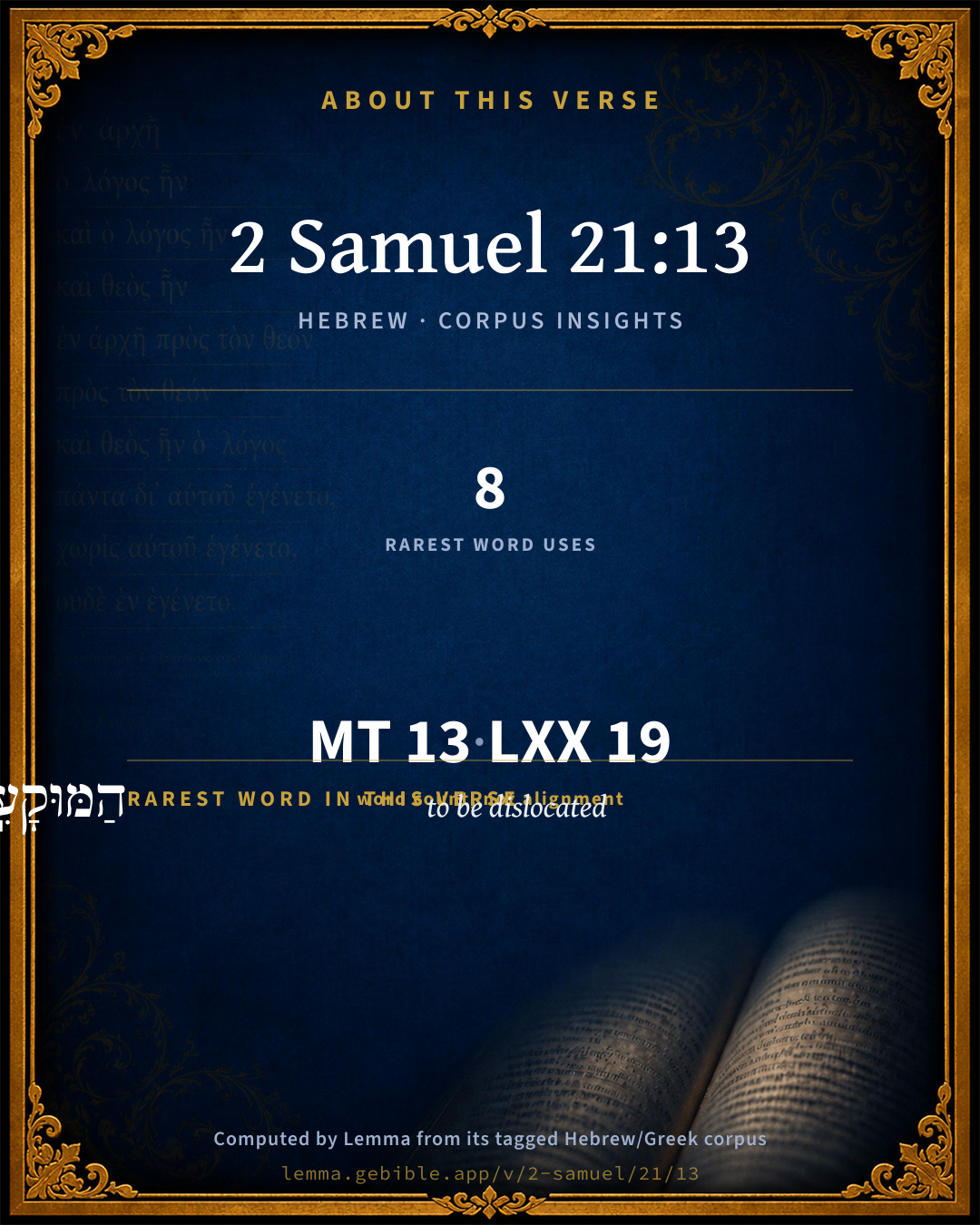
The rarest word here is הַמּוּקָעִֽים to be dislocated H3363 — appearing just 8 times in the whole Hebrew Bible.

Shared distinctive vocabulary

הַמּוּקָעִֽים to be dislocated H3363 occurs in 8 verses of the Hebrew Bible. Also found in:

Grammatical profile

  • 3 verbs
  • 6 nouns
  • 1 adverb
  • 3 particles

Verb forms

  • וַיַּ֤עַל Hiphil · Sequential Imperfect
  • וַיַּ֣אַסְפ֔וּ Qal · Sequential Imperfect
  • הַמּוּקָעִֽים Hophal · Participle Passive

Repetition

A word recurs within this verse — often emphatic in Hebrew:

  • עַצְמ֣וֹת bone H6106 ×3

Hebrew & Septuagint length

In English translation the verse runs 27 words from the Hebrew and 26 from the Septuagint (LXX English) — closely comparable.

A rough comparison of the two English renderings, which tokenize alike — not a word-level alignment.

Word counts can differ between the Hebrew and the Greek without any difference in meaning — e.g. the Hebrew direct-object marker אֵת has no separate Greek word, and Greek often adds the article ὁ.

In the original languages it is 13 Hebrew tokens and 19 Greek tokens — but the two are counted differently (Hebrew bundles its prefixes and suffixes into one token; the Greek is in lemma form), so that isn’t a like-for-like length.

Hebrew and Greek witnesses Masoretic Hebrew ↔ Greek Septuagint

The same verse in the two great witnesses to the Old Testament, shown verse-for-verse.

These are two independent witnesses, not word-aligned to each other, and the Septuagint is shown in lemma (dictionary) form.

Hebrew 2 Samuel 21:13 Masoretic · Westminster Leningrad Codex

וַיַּ֤עַל מִשָּׁם֙ אֶת עַצְמ֣וֹת שָׁא֔וּל וְאֶת עַצְמ֖וֹת יְהוֹנָתָ֣ן בְּנ֑וֹ וַיַּ֣אַסְפ֔וּ אֶת עַצְמ֖וֹת הַמּוּקָעִֽים

and he brought up from there the bones of Saul and the bones of Jonathan his son: and they gathered the bones of those who were hanged.

World English Bible · Public Domain

Greek LXX 2 Samuel 21:13 Septuagint · lemma form

καί ἀναφέρω ἐκεῖθεν ὁ ὀστέον σαούλ καί ὁ ὀστέον ιωναθαν ὁ υἱός αὐτός καί συνἄγω ὁ ὀστέον ὁ ἐξηλιάζω

And he carried up thence the bones of Saul and the bones of Jonathan his son, and gathered the bones of them that had been hanged.

LXX2012 (modern English Septuagint) · Public Domain

Hebrew: Westminster Leningrad Codex (CC BY 4.0). Greek: Septuagint (public domain); English from LXX2012 (modern English Septuagint) (Public Domain). How the Septuagint differs from the Hebrew →

Targum (Aramaic paraphrase)

1

The Targum is the ancient Jewish Aramaic paraphrase of the Hebrew Scriptures — an interpretive translation, not the Hebrew text itself. Onkelos (literal) and Pseudo-Jonathan (expansive) render the Torah, and Jonathan the Prophets. Coverage is partial: where no permissively-licensed English translation exists for a verse, only the Aramaic is shown. This is verse-level text, not a word-by-word alignment to the Hebrew.

  1. Targum Jonathan Prophets (Joshua–Malachi)
    וְאַסִיק מִתַּמָן יַת גַרְמֵי שָׁאוּל וְיַת גַרְמֵי יְהוֹנָתָן בְּרֵיהּ וּכְנָשׁוּ יַת גַרְמֵי צְלִיבַיָא:

    (no public-domain English translation for this verse)

    Targum Jonathan — Aramaic: “Mikraot Gedolot” (public domain). English: “Sefaria Community Translation” (CC0 1.0 (public-domain dedication)); “London "Chaldee Paraphrase," 1871” (public domain). Text via Sefaria.

Commentary

Notes on 2 Samuel 21:13 from classic Christian and Jewish commentators (each source and its license shown beneath its notes). The classic Christian expositions comment on the surrounding passage and are grouped to its opening verse, so a note may address several verses; the Jewish commentaries on the Tanakh (Rashi and others) are per-verse, so they appear only where the commentator wrote on this verse.

Lemma curates 59 commentaries, every one of them public domain or Creative Commons licensed, each selected and text-cleaned for this edition rather than reprinted as found. About our sources →

Trapp's Complete Commentary

John Trapp

2Sa 21:13 And he brought up from thence the bones of Saul and the bones of Jonathan his son; and they gathered the bones of them that were hanged.

Ver. 13. And they gathered the bones of them that were hanged.] This was some comfort to their afflicted mother. Some of Christ’s martyrs were denied this honour.

John Trapp, A Commentary or Exposition upon All the Books of the Old and New Testament (1647–1656) — public domain. Text from a community e-Sword module.

Joseph Benson's Commentary

2Sa 21:13-14. He brought up the bones of Saul, &c. — From under the tree where they were buried in Jabesh, 1Sa 31:13. They gathered the bones of them that were hanged — Having first burned off the flesh which remained upon them: or, perhaps, this was done some time after they were taken down, when nothing but bones remained; and then they had all seven an honourable interment. The bones of Saul and Jonathan — Together with those now mentioned. And after that — After those things were done which were before related; that is, after they were hanged up; for by that God was pacified, and not by the burial. God was entreated — When satisfaction was given to the Gibeonites, God restored plenty to the country.

2Sa 21:13-14. Three of the thirty chief — Mentioned afterward: three captains over the thirty. Came to David in the harvest-time — Or rather, as the Hebrew is, at harvest. That is, saith Abarbinel, the Philistines came to destroy the fruits of the earth, that they might famish the Israelites: whereupon David raised an army to protect and defend them in reaping of their harvest, when they went about it. Unto the cave of Adullam — Where he had hid himself under the persecution of Saul; and where he now fortified himself against the Philistines; who in the beginning of his reign, came with great forces against him. And David was then in the hold — Namely, the cave of Adullam, a place very strong by its natural situation! The garrison of the Philistines was in Beth-lehem — They had possessed themselves of this place and put a garrison in it.

Joseph Benson's Commentary on the Old and New Testaments (1811–1818) — public domain. Text from a community e-Sword module.

John Gill's Exposition

And the bones of Saul and Jonathan his son,.... Together with those who had been hanged:

buried they in the country of Benjamin in Zelah; a city in the tribe of Benjamin, Jos 18:28,

in the sepulchre of Kish his father; the father of Saul, Sa1 9:1; and which, according to Fuller (w), and the position of it in his map, was not far from the hill on which the seven sons of Saul were hanged:

and they performed all that the king commanded; that is, David's messengers and servants did; they fetched the bones of Saul and Jonathan from Jabeshgilead, and buried them with those of his seven sons hanged, in the burying place of his father Kish, and made a general mourning for them; for the Jews say (x), that by David's order Saul's coffin was carried through every tribe, and men, women, and children, came out and expressed concern:

and after that God was entreated for the land; not after the burial of the said persons, but after the seven men were hanged up; by this the wrath of God was appeased, which was seen by his sending rain and fruitful seasons, so that the famine ceased.

(w) Pisgah-Sight, B. 2. c. 12. p. 258. (x) Bemidbar Rabba, ut supra. (fol. 190. 1.)

John Gill's Exposition of the Whole Bible (1746–1763) — public domain (CC PDM 1.0). Text via the HelloAO Bible API.

Matthew Poole's English Annotations

Having first burnt off the flesh which remained upon them when they were taken down. Compare 1Sa 31:10, &c.

Matthew Poole's English Annotations on the Holy Bible (1683–1685) — public domain. Text from a community e-Sword/MySword module.

John Wesley's Explanatory Notes

The bones - Having first burnt off the flesh which remained upon them when they were taken down. Compare 1 Sam. xxxi, 10, &c.

John Wesley, Explanatory Notes Upon the Whole Bible (1754–1765) — public domain. Text via the GEBible commentary corpus.

Rashi

Rabbi Shlomo Yitzchaki (Rashi)

They gathered the bones. Of the seven people that were hung there.

Rashi on the Tanakh — English translations: “The Judaica Press complete Tanach with Rashi, translated by A. J. Rosenberg” (CC BY 4.0); “Pentateuch with Rashi's commentary by M. Rosenbaum and A.M. Silbermann, 1929-1934” (public domain); “The Metsudah Tanach series, Lakewood, N.J” (CC BY 4.0); and “The Book of Joshua, Metsudah Publications, 1997” (CC BY 4.0). Text via Sefaria.

Lesson kit

Teaching starters — assembled from the data on this page, not authored interpretation. Every prompt links to the verse data it draws on. Edit before teaching.

2 Samuel, in the Historical, opens this verse with 13 words (9 distinct Hebrew lemmas). Its most distinctive word is yâqaʻ (“to be dislocated”). A historical commentator’s framing appears above. Read the whole chapter for the surrounding context.

Discussion questions

  1. How does “to be dislocated” (yâqaʻ) shape what this verse is saying?
  2. Genesis 32:25 shares the word «to be dislocated» with this verse. How do the two illuminate each other?
  3. “bone” occurs 3× in this one verse. What is the effect of the repetition?
  4. These translations render this verse differently; the difference is in the English rendering, not the original. What questions does that raise?
  5. The verb «וַיַּ֤עַל» is Hiphil Sequential Imperfect. How does its form color the action?
  6. Reading how Trapp's Complete Commentary and Joseph Benson's Commentary read this verse, where do the two commentators agree and where do they part?

Things to notice

Reading settings

Reading text

Shown beneath each verse's original-language words.

Old Testament
Old Testament edition

Read the OT as the Masoretic Hebrew (MT) or the Greek Septuagint (LXX).

English shown for the Greek Septuagint (in the Hebrew ↔ Greek comparison).

Comparing translations? Open the Compare panel on any verse page to stack up to four side by side.