
1 Chronicles 23:2

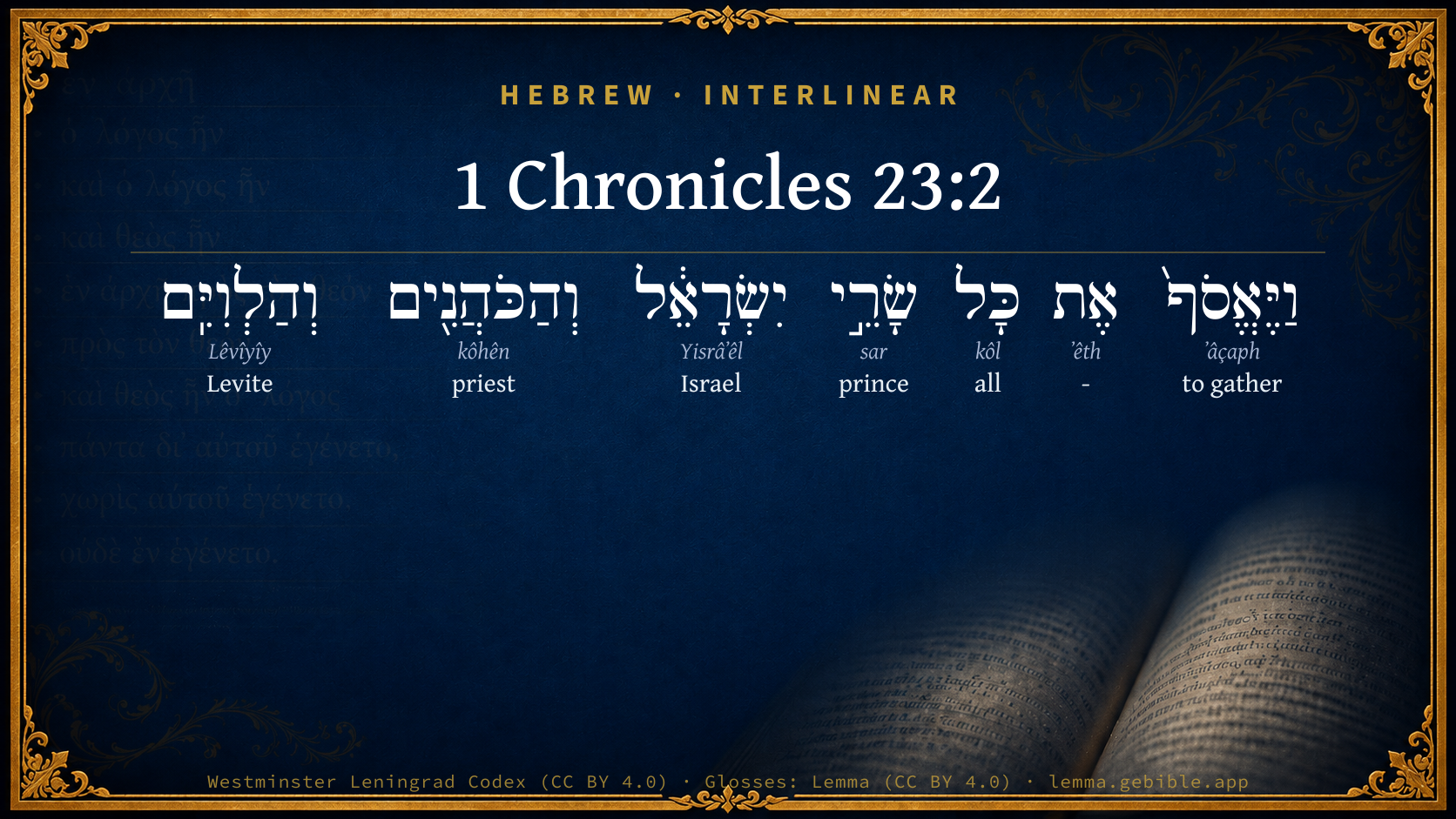
Hebrew (Westminster Leningrad Codex) 1 Chronicles 23:2 appears in the Hebrew Old Testament. The text above is from the Westminster Leningrad Codex. Each word links to its Strong’s number, a concise gloss, and parsing drawn from the Open Scriptures Hebrew Bible morphology. Click any word for its full Brown-Driver-Briggs (BDB) entry.
Download image
Cite this verse

1 Chronicles 23:2 (World English Bible). Public Domain. Lemma interlinear Bible study tool, https://lemma.gebible.app/v/1-chronicles/23/2.

Show BibTeX & RIS
BibTeX
RIS
English Translation
He gathered together all the princes of Israel, with the priests and the Levites.
World English Bible · Public Domain
Download a study sheet

One document with this verse’s original text, its word-by-word gloss line, the meaning frame, cross-references with their text, attributed commentary, and full source and license credits — printable, and it pastes into notes with its structure intact.

This verse Autodidact and up

Study sheet (.html) Plain text (.txt)

A passage Seminary Student

Up to 50 verses in one chapter. A passage sheet keeps up to 6 commentary sources and 12 cross-references per verse, in the order this page ranks them, and says so on the sheet whenever that leaves anything out. Ask for a single verse and you get the Autodidact verse sheet above.

Everything on this page stays free to read, with no account — the sheet is a download of what is already on screen, not access to it.

Want to remove ads? Support Godless Engineer
Compare translations 3

The same verse in 3 English versions, stacked beneath the original-language interlinear above. Click any original word for its lexicon entry.

Each is an independent rendering of the whole verse — the interlinear is not word-aligned to these translations.

Highlighted words mark where these versions differ — a whole-verse word diff, not a word-by-word alignment.

  • World English Bible Public Domain
    He gathered together all the princes of Israel, with the priests and the Levites.
  • King James Version Public Domain
    And he gathered together all the princes of Israel, with the priests and the Levites.
  • unfoldingWord Literal Text CC BY-SA 4.0
    And he gathered all of the rulers of Israel and the priests and the Levites.

unfoldingWord Literal Text — © unfoldingWord, licensed CC BY-SA 4.0. Word-aligned USFM3 via Door43 (git.door43.org/unfoldingWord/en_ult).

Versions to compare (up to 4)

3 of 4 selected

Show all 18 translations

Every available English version of this verse, each an independent rendering of the whole verse.

  • World English Bible Public Domain
    He gathered together all the princes of Israel, with the priests and the Levites.
  • Berean Standard Bible Public Domain
    Then he gathered all the leaders of Israel, as well as the priests and Levites.
  • Majority Standard Bible Public Domain
    Then he gathered all the leaders of Israel, as well as the priests and Levites.
  • King James Version Public Domain
    And he gathered together all the princes of Israel, with the priests and the Levites.
  • American Standard Version (1901) Public Domain
    And he gathered together all the princes of Israel, with the priests and the Levites.
  • Revised Version (1885) Public Domain
    And he gathered together all the princes of Israel, with the priests and the Levites.
  • Geneva Bible (1599) Public Domain
    And hee gathered together all the princes of Israel with the Priestes and the Leuites.
  • Douay-Rheims (1899) Public Domain
    And he gathered together all the princes of Israel, and the priests and Levites.
  • Young's Literal Translation Public Domain
    and gathereth all the heads of Israel, and the priests, and the Levites;
  • Literal Standard Version CC BY-SA 4.0
    and gathers all the heads of Israel, and the priests, and the Levites;
  • Unlocked Literal Bible CC BY-SA 4.0
    He gathered together all the leaders of Israel, with the priests and Levites.
  • unfoldingWord Literal Text CC BY-SA 4.0
    And he gathered all of the rulers of Israel and the priests and the Levites.
  • Darby Bible Public Domain
    And he gathered together all the princes of Israel, with the priests and the Levites.
  • World Messianic Bible Public Domain
    He gathered together all the princes of Israel, with the priests and the Levites.
  • Webster's Bible Public Domain
    And he assembled all the princes of Israel, with the priests and the Levites.
  • Free Bible Version CC BY-SA 4.0
    He also summoned all the leaders of Israel, the priests, and the Levites.
  • Bible in Basic English Public Domain
    And he got together all the chiefs of Israel, with the priests and the Levites.
  • JPS Tanakh (1917) Public Domain
    And he gathered together all the princes of Israel, with the priests and the Levites.

Literal Standard Version (2020), Covenant Press — licensed CC BY-SA 4.0. Text via the HelloAO Bible API (eBible.org). Unlocked Literal Bible (unfoldingWord) — licensed CC BY-SA 4.0. Text via the HelloAO Bible API (eBible.org). unfoldingWord Literal Text — © unfoldingWord, licensed CC BY-SA 4.0. Word-aligned USFM3 via Door43 (git.door43.org/unfoldingWord/en_ult). Free Bible Version, Dr. Jonathan Gallagher — licensed CC BY-SA 4.0. Text via the HelloAO Bible API (eBible.org).

Word by word

More ways to search: Search by grammar → Find every occurrence → Compare this word →

Practice this passage: Drill this verse → Learn its vocabulary →

וַיֶּאֱסֹף֙
ʼâçaph
H622
“and · to gather”
Conjunction + Verb, Qal, Sequential Imperfect, 3rd Person, Masculine, Singular
Part of Speech
Conjunction + Verb
Stem
Qal
Form
Sequential Imperfect
Person
3rd Person
Gender
Masculine
Number
Singular
Full BDB Definition

Origin: a primitive root

TWOT: 140

to gather, receive, remove, gather in - (Qal) - to gather, collect - to gather (an individual into company of others) - to bring up the rear - to gather and take away, remove, withdraw - (Niphal) - to assemble, be gathered - (passive of Qal 1a2) - to be gathered to one's fathers - to be brought in or into (association with others) - (passive of Qal 1a4) - to be taken away, removed, perish - (Piel) - to gather (harvest) - to take in, receive into - rearguard, rearward (substantive) - (Pual) to be gathered - (Hithpael) to gather oneself or themselves
  1. אֶת ʼêth H853 “-” Particle, Direct Object
  2. כָּל kôl H3605 “all of” Noun, Common, Masculine, Singular, Construct
  3. שָׂרֵ֣י sar H8269 “princes of” Noun, Common, Masculine, Plural, Construct
  4. יִשְׂרָאֵ֔ל Yisrâʼêl H3478 “Israel” Noun, Proper
  5. וְהַכֹּהֲנִ֖ים kôhên H3548 “and · the · priests” Conjunction + Particle, Definite Article + Noun, Common, Masculine, Plural, Absolute
  6. וְהַלְוִיִּֽם Lêvîyîy H3881 “and · the · Levites” Conjunction + Particle, Definite Article + Noun, Gentilic, Masculine, Plural, Absolute

About this verse

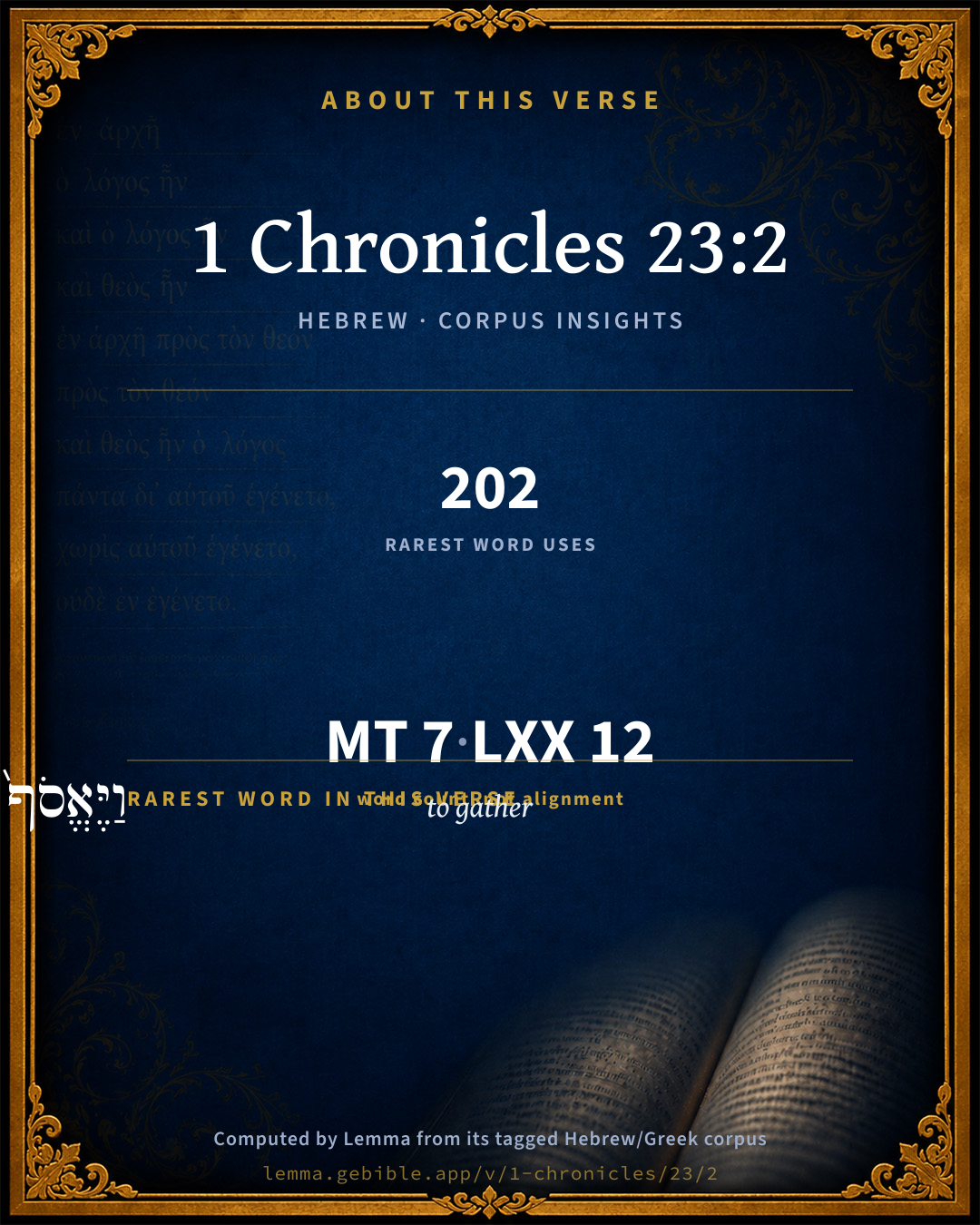
These counts appear in no published source. They are computed here, from the morphology-tagged text and Lemma’s own curated glosses. What Lemma adds →

7
words
7
distinct lemmas
Historical
section

Grammatical profile

  • 1 verb
  • 5 nouns
  • 1 particle

Verb forms

  • וַיֶּאֱסֹף֙ Qal · Sequential Imperfect

Hebrew & Septuagint length

In English translation the verse runs 14 words from the Hebrew and 15 from the Septuagint (LXX English) — closely comparable.

A rough comparison of the two English renderings, which tokenize alike — not a word-level alignment.

Word counts can differ between the Hebrew and the Greek without any difference in meaning — e.g. the Hebrew direct-object marker אֵת has no separate Greek word, and Greek often adds the article ὁ.

In the original languages it is 7 Hebrew tokens and 12 Greek tokens — but the two are counted differently (Hebrew bundles its prefixes and suffixes into one token; the Greek is in lemma form), so that isn’t a like-for-like length.

Cross-references

5

Topical passages linked to 1 Chronicles 23:2 in the Treasury of Scripture Knowledge — connected by theme and wording, ordered by reader-vote popularity; previews shown in the World English Bible.

  • Joshua 23:2 that Joshua called for all Israel, for their elders and for their heads, and for their judges and for their officers, and said to them, I am old and well stricken in years:
  • Joshua 24:1 Joshua gathered all the tribes of Israel to Shechem, and called for the elders of Israel, and for their heads, and for their judges, and for their officers; and they presented themselves before God.
  • 1 Chronicles 13:1 David consulted with the captains of thousands and of hundreds, even with every leader.
  • 1 Chronicles 28:1 David assembled all the princes of Israel, the princes of the tribes, and the captains of the companies who served the king by division, and the captains of thousands, and the captains of hundreds, and the rulers over all the substance and possessions of the king and of his sons, with the officers, and the mighty men, even all the mighty men of valor, to Jerusalem.
  • 2 Chronicles 34:29–30 Then the king sent and gathered together all the elders of Judah and Jerusalem.

Cross-references courtesy of OpenBible.info (CC BY 4.0).

Hebrew and Greek witnesses Masoretic Hebrew ↔ Greek Septuagint

The same verse in the two great witnesses to the Old Testament, shown verse-for-verse.

These are two independent witnesses, not word-aligned to each other, and the Septuagint is shown in lemma (dictionary) form.

Hebrew 1 Chronicles 23:2 Masoretic · Westminster Leningrad Codex

וַיֶּאֱסֹף֙ אֶת כָּל שָׂרֵ֣י יִשְׂרָאֵ֔ל וְהַכֹּהֲנִ֖ים וְהַלְוִיִּֽם

He gathered together all the princes of Israel, with the priests and the Levites.

World English Bible · Public Domain

Greek LXX 1 Chronicles 23:2 Septuagint · lemma form

καί συνἄγω ὁ πᾶς ἄρχων ἰσραήλ καί ὁ ἱερεύς καί ὁ λευίτης

And he assembled all the chief men of Israel, and the priests, and the Levites.

LXX2012 (modern English Septuagint) · Public Domain

Hebrew: Westminster Leningrad Codex (CC BY 4.0). Greek: Septuagint (public domain); English from LXX2012 (modern English Septuagint) (Public Domain). How the Septuagint differs from the Hebrew →

Commentary

Notes on 1 Chronicles 23:2 from classic Christian and Jewish commentators (each source and its license shown beneath its notes). The classic Christian expositions comment on the surrounding passage and are grouped to its opening verse, so a note may address several verses; the Jewish commentaries on the Tanakh (Rashi and others) are per-verse, so they appear only where the commentator wrote on this verse.

Lemma curates 59 commentaries, every one of them public domain or Creative Commons licensed, each selected and text-cleaned for this edition rather than reprinted as found. About our sources →

Jamieson, Fausset & Brown

Robert Jamieson, A. R. Fausset & David Brown

NUMBER AND DISTRIBUTION OF THE LEVITES. (Ch1 23:2-6)

he gathered together all the princes of Israel--All important measures relating to the public interest were submitted for consideration to a general assembly of the representatives of the tribes (Ch1 13:1; Ch1 15:25; Ch1 22:17; 1Ch. 26:1-32).

Jamieson, Fausset & Brown — Commentary Critical and Explanatory on the Whole Bible (1871) — public domain (CC PDM 1.0). Text via the HelloAO Bible API.

Trapp's Complete Commentary

John Trapp

1Ch 23:2 And he gathered together all the princes of Israel, with the priests and the Levites.

Ver. 2. With the priests and the Levites.] These were most of all concerned in the following charge: but the princes and people were to be informed of it. And albeit this and the three following chapters may seem to be of little use unto us, yet we are to hold that "every word of God is pure"; and "all Scripture is profitable to instruct." Here we may learn that there should still be a supply of faithful ministers; and these to be ordered by the supreme authority of the land; that there are different offices of ministers; that order is to be observed in the Church; that each one is to do his own work with utmost diligence, &c.

John Trapp, A Commentary or Exposition upon All the Books of the Old and New Testament (1647–1656) — public domain. Text from a community e-Sword module.

Joseph Benson's Commentary

1Ch 23:2. He gathered together all the princes, &c. — Partly to declare God’s will, and his own desire, that Solomon should be his successor; and so to cut off the claims and pretences which others of his sons might have made to the crown; and partly to acquaint them with those directions which he had received from God, by the Spirit, as appears from 1Ch 28:11, &c., concerning the establishment of a new order and method in the ministration of the priests and Levites in the temple.

Joseph Benson's Commentary on the Old and New Testaments (1811–1818) — public domain. Text from a community e-Sword module.

Ellicott's Commentary for English Readers

(2) And he gathered together all the princes of Israel.—The form of the verb (the imperfect with waw conversive) implies that this was done in connection with the transfer of the kingdom to Solomon. The following chapters, therefore, relate to arrangements made by David towards the close of his life. (Comp. 1Ch_26:30, “the fortieth year of the reign of David.”)

The princes of Israel.—Comp. 1Ch_13:1; 1Ch_15:25; 1Ch_22:17. “The princes and the priests and the Levites” together constituted, in the conception of the chronicler, the three estates of the realm: the representatives of all spiritual and temporal authority. David consults with the national assembly in a matter of national concern.

(2-5) The numbering of the Levites and their appointments.

A Bible Commentary for English Readers, edited by Charles John Ellicott (1878–1897) — public domain. Text from a community e-Sword module.

The Cambridge Bible for Schools and Colleges

gen. ed. J. J. S. Perowne

2–23. Organisation of the Levites (first account)

Two accounts are given of David’s organisation of the Levites. According to the first the Levites were admitted to service at thirty years of age; 1Ch_23:3; cp. Num_4:3; Num_4:23; Num_4:30, where the period from thirty to fifty is fixed as the period for service. According to the second account (Num_4:24; Num_4:47) the Levites were taken from twenty years old and upwards; this was apparently the later custom; cp. 2Ch_31:17; Ezr_3:8. The discrepancy probably arises from an actual variation in practice. The original age of admission for Levites was probably thirty, but owing to the scarcity of their numbers it seems to have been necessary to reduce the limit of age to twenty. On the Levites see Ryle (Ezra and Nehemiah p. liii. ff.). See also on 1Ch_23:27.

The Cambridge Bible for Schools and Colleges (gen. ed. J. J. S. Perowne; Cambridge University Press, 1878–1918) — public domain. Text from a community e-Sword module.

John Gill's Exposition

And he gathered together all the princes of Israel,.... Ordered them to be assembled, partly to acquaint them with his will and pleasure, that Solomon should succeed him in the kingdom; and partly to settle the order of the work and service of the temple; and therefore these were convened

with the priests and Levites; to assign to them their respective places and offices.

John Gill's Exposition of the Whole Bible (1746–1763) — public domain (CC PDM 1.0). Text via the HelloAO Bible API.

Haydock's Catholic Bible Commentary

Princes, heads of families, or officers of the army, chap. xxv. 1. (Menochius)

George Leo Haydock (1774–1849), Haydock's Catholic Family Bible and Commentary, 1859 edition — public domain. Excludes Psalms (Douay-Rheims chapter numbering differs from Protestant) and Deuterocanonical books (Catholic canon only).

Matthew Poole's English Annotations

Partly to declare God’s mind and his own will, that Solomon should be his successor; and so to cut off the claims and pretences which others of his sons might make to the crown; and partly to acquaint them with those directions which he had received from God by the Spirit, as appears from 1Ch 28:11, &c., concerning the establishment of a new order and method in the ministration of the priests and Levites in the temple.

Matthew Poole's English Annotations on the Holy Bible (1683–1685) — public domain. Text from a community e-Sword/MySword module.

The Pulpit Commentary

He gathered together all the princes of Israel, with the priests and the Levites. As on an occasion of supreme importance, David, in view of his own death and of his son"s succession at the present time, calls together the full council, and the highest possible representative council of the nation. So. 1Ch_22:17 1Ch_24:6 1Ch_25:1; in which last passage the word "captains" should have have been rendered "princes" (yric) The arrangement of the Levites, and the distribution of their functions in the presence of the princes, as here described, and as it is even more strongly put, (1Ch_25:1) "by" them, simply points to the fact that the ultimate outer authority, as between Church and state, lay with the state. The Church was made for it, not it for the Church. And it was the duty of the state to defend the Church.

HOMILIES BY R. TUCK Vers. 2, 3.

The mission of the Levites.

They were called to service which men might call "menial," but which was truly "honourable," and might be made "more honourable by the loyal, devout, and loving spirit in which it was done. But there are indications that the Levites were tempted to undervalue their place and their work; they sometimes envied the priests, and fretfully wanted to be other than they were. (see Num_16:9) Confusion and difficulty are sure to arise when men undervalue the positions in which they are set, and the work that is entrusted to them to do, and begin to envy other people"s positions and other people"s work. We treat here the mission of the Levites as introducing the subject of our separation unto God"s service. What is called the Divine election may be fittingly called the Divine selection, for it really is God, in his infinite foreknowledge, selecting fitting agents, and, in the ordering of his providences, separating them unto the work for which he has chosen them. The sacred Word is full of instances of these Divine selectings and separatings. The race of Seth is separated from the other descendants of Adam. Noah is separated from the ungodly world. Japheth is separated from the new races coming from Noah. Abraham is separated from the idolatrous Chaldeans. Isaac is separated as the sole heir of the covenant. Jacob, Judah, and Ephraim are separated by Divine interference with the right of eldest sons. The nation of Israel is separated from all nations to be the repository of God"s revelation. The tribe of Levi is separated to special service in the Divine tabernacle. Saul is separated to be the first king. David is separated from the sheepfolds. Our Lord separates twelve from among his disciples. Barnabas and Saul are separated unto the work of the ministry. Fixing our attention on the senses in which the Levites were separated from the congregation, we may learn some of the ways in which we should regard ourselves now as "separated unto God." The Levites were not made a distinct class, dwelling together; they lived about among the people, and shared the common life. They worked for a part at least of their living; their families grew up around them; they joined in the local feast as well as in the yearly festival. Their pleasures and their daily interests were precisely those of the people about them. And yet they were God"s by special call and consecration. Wheresoever they went the stamp of the Holy rested upon them. Their very presence tended to check sin, and to purify the social atmospheres. The distinctness of the Levites belonged to their character, spirit, and tone of conduct. And they were called to a particular service. They were to attend on the worship of the tabernacle, taking their orderly turns. They were selected by God for this one life-work, "to bear the vessels of the Lord." They were called to receive a trust, and called to manifest the spirit which was becoming to that "trust." Still we find separation unto God quite compatible with taking our place among our fellow-men, and entering heartily into everything that properly belongs to family and social and national life. The world in which we live is God"s world. In it there is nothing unclean, save to him who makes a thing unclean. Work is holy; rest is holy; pleasure is holy; friendship is holy. The Christian and the Christian Church stand out from all the world, and are set "in the world"s eye;" and yet it is equally true that the Christian and the Christian Church blend and mingle in every sphere of life. They force no distinctions upon men"s notice, and yet they are "separate" everywhere. Their distinction comes out of their first and ruling principles. The thought of God, the reference of all things to the will of God, and the effort to be in full harmony with the mind of God, are so essential to the Christian, and so characteristic of him, that he must bring the sense of God"s presence into every life-association. And just in this lies his peculiarity and his mission. When a Jew looked upon a Levite in the midst of the people, he thought of Jehovah. When a Jew talked to a Levite, if he was a true Levite, he would make the man feel God"s relation to the matter in hand. And so it is the Christian"s mission to be an open "epistle of Christ." Levites failed from their duty, and from the joy of their duty, when they began to count their separation unto God a light thing. And this came about by their not putting their hearts into their work; by their nourishing jealousies and envyings; and by their failing to recognize how their work fitted into the great whole of God"s service. Do we think it a small thing to have been separated unto God? Do we think unworthily of the talent committed to our trust? Can it be a little thing to be God"s priests and Levites in his great world, ministering his truth, his will, his love, to men? Can it be a little thing to be the "candlestick" that holds out the light of God"s holiness and God"s gospel to men? Here is one chief root of the Christian evils which we deplore under-valuing our Christian standing; under-estimating our Divine call, and the mission which is given us to fulfil. "Ye have not chosen me, but I have chosen you, and ordained you, that you should go and bring forth fruit, and that your fruit should remain.

R.T.

The Pulpit Commentary (1880–1919), ed. H.D.M. Spence-Jones & Joseph S. Exell — public domain. Text from a community e-Sword module.

John Wesley's Explanatory Notes

Gathered, &c. - To declare God's mind and his own will, that Solomon should be his successor: and to acquaint them with those directions which he had received from God by the spirit.

John Wesley, Explanatory Notes Upon the Whole Bible (1754–1765) — public domain. Text via the GEBible commentary corpus.

Keil & Delitzsch

C. F. Keil & F. Delitzsch

And he gathered together all the princes of Israel,.... Ordered them to be assembled, partly to acquaint them with his will and pleasure, that Solomon should succeed him in the kingdom; and partly to settle the order of the work and service of the temple; and therefore these were convened

with the priests and Levites; to assign to them their respective places and offices.

Keil & Delitzsch — Biblical Commentary on the Old Testament (1861–1891) — public domain (CC PDM 1.0). Text via the HelloAO Bible API. (Old Testament only.)

Lesson kit

Teaching starters — assembled from the data on this page, not authored interpretation. Every prompt links to the verse data it draws on. Edit before teaching.

1 Chronicles, in the Historical, opens this verse with 7 words (7 distinct Hebrew lemmas). Its most distinctive word is ʼâçaph (“to gather”). A historical commentator’s framing appears above. Read the whole chapter for the surrounding context.

Discussion questions

  1. How does “to gather” (ʼâçaph) shape what this verse is saying?
  2. Joshua 23:2 shares this passage’s theme. How do the two illuminate each other?
  3. These translations render this verse differently; the difference is in the English rendering, not the original. What questions does that raise?
  4. The verb «וַיֶּאֱסֹף֙» is Qal Sequential Imperfect. How does its form color the action?
  5. Reading how Jamieson, Fausset & Brown and Trapp's Complete Commentary read this verse, where do the two commentators agree and where do they part?

Things to notice

Reading settings

Reading text

Shown beneath each verse's original-language words.

Old Testament
Old Testament edition

Read the OT as the Masoretic Hebrew (MT) or the Greek Septuagint (LXX).

English shown for the Greek Septuagint (in the Hebrew ↔ Greek comparison).

Comparing translations? Open the Compare panel on any verse page to stack up to four side by side.