
Jeremiah 8:13

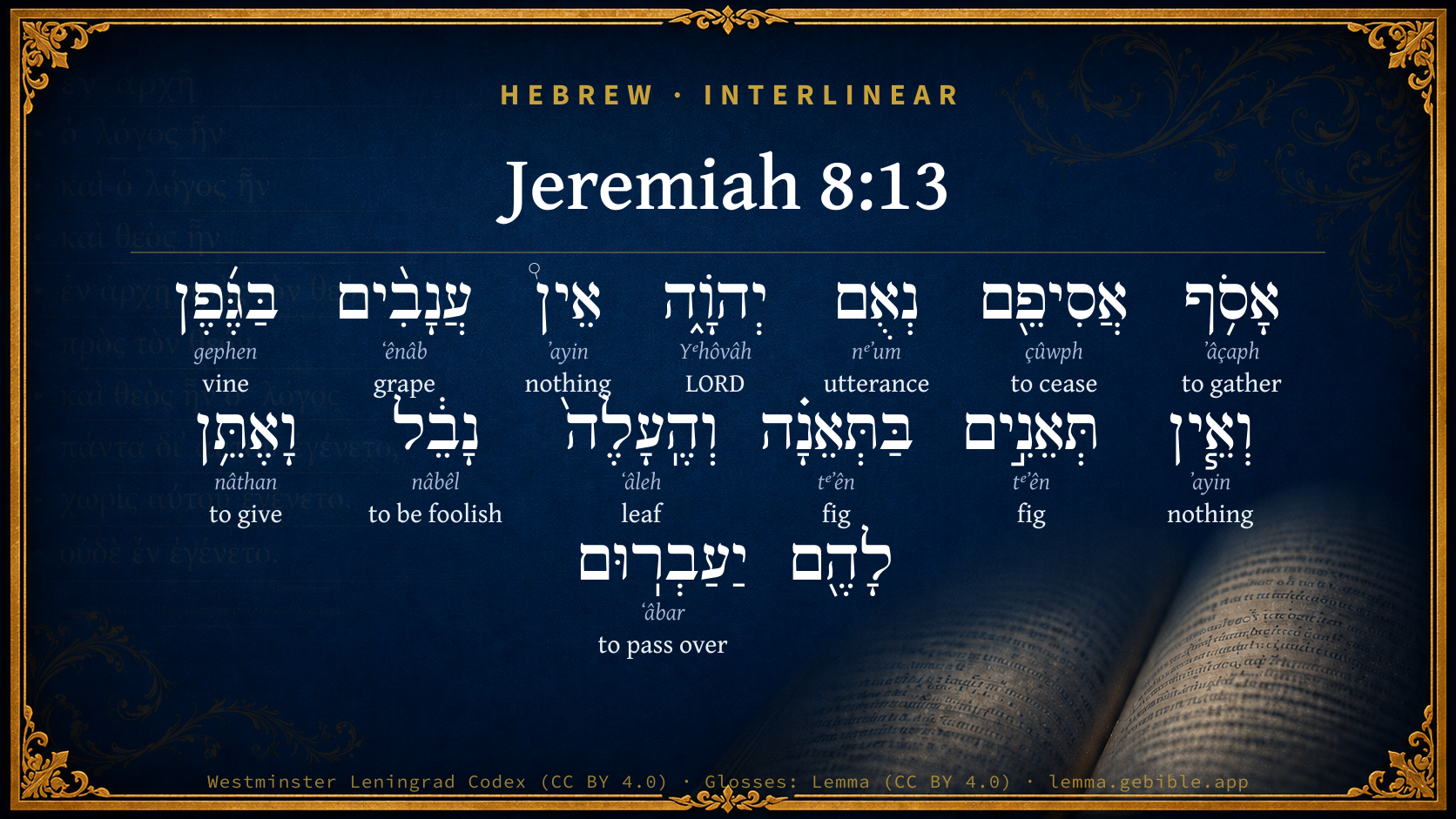
Hebrew (Westminster Leningrad Codex) Jeremiah 8:13 appears in the Hebrew Old Testament. The text above is from the Westminster Leningrad Codex. Each word links to its Strong’s number, a concise gloss, and parsing drawn from the Open Scriptures Hebrew Bible morphology. Click any word for its full Brown-Driver-Briggs (BDB) entry.
Download image
Cite this verse

Jeremiah 8:13 (World English Bible). Public Domain. Lemma interlinear Bible study tool, https://lemma.gebible.app/v/jeremiah/8/13.

Show BibTeX & RIS
BibTeX
RIS
English Translation
I will utterly consume them, says Yahweh: there shall be no grapes on the vine, nor figs on the fig tree, and the leaf shall fade; and [the things that] I have given them shall pass away from them.
World English Bible · Public Domain
Download a study sheet

One document with this verse’s original text, its word-by-word gloss line, the meaning frame, cross-references with their text, attributed commentary, and full source and license credits — printable, and it pastes into notes with its structure intact.

This verse Autodidact and up

Study sheet (.html) Plain text (.txt)

A passage Seminary Student

Up to 50 verses in one chapter. A passage sheet keeps up to 6 commentary sources and 12 cross-references per verse, in the order this page ranks them, and says so on the sheet whenever that leaves anything out. Ask for a single verse and you get the Autodidact verse sheet above.

Everything on this page stays free to read, with no account — the sheet is a download of what is already on screen, not access to it.

Want to remove ads? Support Godless Engineer
Compare translations 3

The same verse in 3 English versions, stacked beneath the original-language interlinear above. Click any original word for its lexicon entry.

Each is an independent rendering of the whole verse — the interlinear is not word-aligned to these translations.

Highlighted words mark where these versions differ — a whole-verse word diff, not a word-by-word alignment.

  • World English Bible Public Domain
    I will utterly consume them, says Yahweh: there shall be no grapes on the vine, nor figs on the fig tree, and the leaf shall fade; and [the things that] I have given them shall pass away from them.
  • King James Version Public Domain
    I will surely consume them, saith the LORD: there shall be no grapes on the vine, nor figs on the fig tree, and the leaf shall fade; and the things that I have given them shall pass away from them.
  • unfoldingWord Literal Text CC BY-SA 4.0
    Gathering I will gather them”—the declaration of Yahweh—“there are not grapes on the vine, and there are not figs on the fig tree, and the leaf withered, and I gave to them, they have passed away them.”

unfoldingWord Literal Text — © unfoldingWord, licensed CC BY-SA 4.0. Word-aligned USFM3 via Door43 (git.door43.org/unfoldingWord/en_ult).

Versions to compare (up to 4)

3 of 4 selected

Show all 18 translations

Every available English version of this verse, each an independent rendering of the whole verse.

  • World English Bible Public Domain
    I will utterly consume them, says Yahweh: there shall be no grapes on the vine, nor figs on the fig tree, and the leaf shall fade; and [the things that] I have given them shall pass away from them.
  • Berean Standard Bible Public Domain
    I will take away their harvest, declares the LORD. There will be no grapes on the vine, nor figs on the tree, and even the leaf will wither. Whatever I have given them will be lost to them.”
  • Majority Standard Bible Public Domain
    I will take away their harvest, declares the LORD. There will be no grapes on the vine, nor figs on the tree, and even the leaf will wither. Whatever I have given them will be lost to them.”
  • King James Version Public Domain
    I will surely consume them, saith the LORD: there shall be no grapes on the vine, nor figs on the fig tree, and the leaf shall fade; and the things that I have given them shall pass away from them.
  • American Standard Version (1901) Public Domain
    I will utterly consume them, saith Jehovah: there shall be no grapes on the vine, nor figs on the fig-tree, and the leaf shall fade; and `the things that' I have given them shall pass away from them.
  • Revised Version (1885) Public Domain
    I will utterly consume them, saith the LORD: there shall be no grapes on the vine, nor figs on the fig tree, and the leaf shall fade; and the things that I have given them shall pass away from them.
  • Geneva Bible (1599) Public Domain
    I wil surely consume them, sayth the Lord: there shalbe no grapes on the vine, nor figges on the figtree, and the leafe shall fade, and the things that I haue giuen them, shall depart from them.
  • Douay-Rheims (1899) Public Domain
    Gathering I will gather them together, saith the Lord, there is no grape on the vines, and there are no figs on the fig tree, the leaf is fallen: and I have given them the things that are passed away.
  • Young's Literal Translation Public Domain
    I utterly consume them, an affirmation of Jehovah, There are no grapes in the vine, Yea, there are no figs in the fig-tree, And the leaf hath faded, And the strength they have passeth from them.
  • Literal Standard Version CC BY-SA 4.0
    I utterly consume them,” || A declaration of YHWH, || “There are no grapes in the vine, || Indeed, there are no figs in the fig tree, || And the leaf has faded, || And the strength they have passes from them.
  • Unlocked Literal Bible CC BY-SA 4.0
    I will remove them completely—this is Yahweh's declaration—there will be no grapes on the vine, nor will there be figs on the fig trees. For the leaf will wither, and what I have given to them will pass away.
  • unfoldingWord Literal Text CC BY-SA 4.0
    Gathering I will gather them”—the declaration of Yahweh—“there are not grapes on the vine, and there are not figs on the fig tree, and the leaf withered, and I gave to them, they have passed away them.”
  • Darby Bible Public Domain
    I will utterly take them away, saith Jehovah: there are no grapes on the vine, nor figs on the fig-tree; and the leaf is faded: and I will give them up to those that shall pass over them.
  • World Messianic Bible Public Domain
    “‘I will utterly consume them, says the LORD. No grapes will be on the vine, no figs on the fig tree, and the leaf will fade. The things that I have given them will pass away from them.’”
  • Webster's Bible Public Domain
    I will surely consume them, saith the LORD: there shall be no grapes on the vine, nor figs on the fig-tree, and the leaf shall fade; and the things that I have given to them shall pass away from them.
  • Free Bible Version CC BY-SA 4.0
    I'm going to destroy them, declares the Lord. There will be no grapes left on the vines, no figs on the trees—even the leaves will wither. They will lose whatever I gave them.
  • Bible in Basic English Public Domain
    I will put an end to them completely, says the Lord: there are no grapes on the vine and no figs on the fig-tree, and the leaf is dry.
  • JPS Tanakh (1917) Public Domain
    I will utterly consume them, saith the LORD; there are no grapes on the vine, nor figs on the fig-tree, and the leaf is faded; and I gave them that which they transgress.

Literal Standard Version (2020), Covenant Press — licensed CC BY-SA 4.0. Text via the HelloAO Bible API (eBible.org). Unlocked Literal Bible (unfoldingWord) — licensed CC BY-SA 4.0. Text via the HelloAO Bible API (eBible.org). unfoldingWord Literal Text — © unfoldingWord, licensed CC BY-SA 4.0. Word-aligned USFM3 via Door43 (git.door43.org/unfoldingWord/en_ult). Free Bible Version, Dr. Jonathan Gallagher — licensed CC BY-SA 4.0. Text via the HelloAO Bible API (eBible.org).

Word by word

More ways to search: Search by grammar → Find every occurrence → Compare this word →

Practice this passage: Drill this verse → Learn its vocabulary →

אֲסִיפֵ֖ם
çûwph
H5486
“to cease · them”
Verb, Hiphil, Imperfect, 1st Person, Common, Singular + Suffix, Personal, 3rd Person, Masculine, Plural
Part of Speech
Verb
Stem
Hiphil
Form
Imperfect
Person
1st Person
Gender
Common
Number
Singular
Full BDB Definition

Origin: a primitive root

TWOT: 1478

to cease, come to an end - (Qal) to come to an end - (Hiphil) to make an end
  1. אָסֹ֥ף ʼâçaph H622 “to gather” Verb, Qal, Infinitive Absolute
  2. נְאֻם nᵉʼum H5002 “utterance of” Noun, Common, Masculine, Singular, Construct
  3. יְהֹוָ֑ה Yᵉhôvâh H3068 “LORD” Noun, Proper
  4. אֵין֩ ʼayin H369 “nothing” Particle, Negative
  5. עֲנָבִ֨ים ʻênâb H6025 “grapes” Noun, Common, Masculine, Plural, Absolute
  6. בַּגֶּ֜פֶן gephen H1612 “in/at the · vine” Preposition, Determined + Noun, Common, Both, Singular, Absolute
  7. וְאֵ֧ין ʼayin H369 “and · nothing” Conjunction + Particle, Negative
  8. תְּאֵנִ֣ים tᵉʼên H8384 “figs” Noun, Common, Feminine, Plural, Absolute
  9. בַּתְּאֵנָ֗ה tᵉʼên H8384 “in/at the · fig” Preposition, Determined + Noun, Common, Feminine, Singular, Absolute
  10. וְהֶֽעָלֶה֙ ʻâleh H5929 “and · the · leaf” Conjunction + Particle, Definite Article + Noun, Common, Masculine, Singular, Absolute
  11. נָבֵ֔ל nâbêl H5034 “to be foolish” Verb, Qal, Perfect, 3rd Person, Masculine, Singular
  12. וָאֶתֵּ֥ן nâthan H5414 “and · to give” Conjunction + Verb, Qal, Sequential Imperfect, 1st Person, Common, Singular
  13. יַעַבְרֽוּם ʻâbar H5674 “to pass over · them” Verb, Qal, Imperfect, 3rd Person, Masculine, Plural + Suffix, Personal, 3rd Person, Masculine, Plural

About this verse

These counts appear in no published source. They are computed here, from the morphology-tagged text and Lemma’s own curated glosses. What Lemma adds →

15
words
12
distinct lemmas
Prophets
section

Notable vocabulary

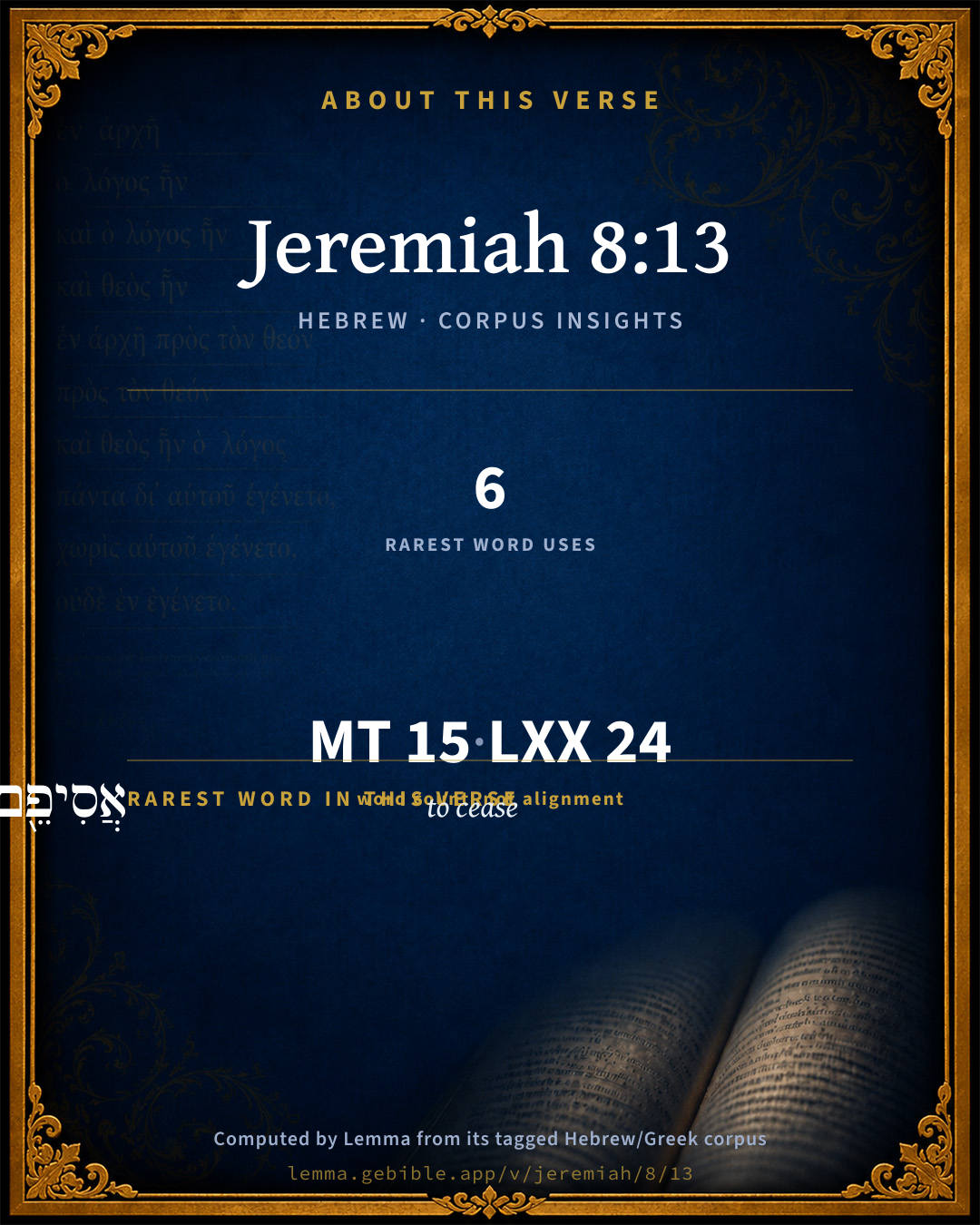
The rarest word here is אֲסִיפֵ֖ם to cease H5486 — appearing just 6 times in the whole Hebrew Bible.

Shared distinctive vocabulary

אֲסִיפֵ֖ם to cease H5486 occurs in 6 verses of the Hebrew Bible. Also found in:

Grammatical profile

  • 5 verbs
  • 7 nouns
  • 1 preposition
  • 2 particles

Verb forms

  • אָסֹ֥ף Qal · Infinitive Absolute
  • אֲסִיפֵ֖ם Hiphil · Imperfect
  • נָבֵ֔ל Qal · Perfect
  • וָאֶתֵּ֥ן Qal · Sequential Imperfect
  • יַעַבְרֽוּם Qal · Imperfect

Repetition

Words recur within this verse — often emphatic in Hebrew:

  • אֵין֩ nothing H369 ×2
  • תְּאֵנִ֣ים fig H8384 ×2

Hebrew & Septuagint length

In the original languages it is 15 Hebrew tokens and 24 Greek tokens — but the two are counted differently (Hebrew bundles its prefixes and suffixes into one token; the Greek is in lemma form), so that isn’t a like-for-like length.

Cross-references

19

Topical passages linked to Jeremiah 8:13 in the Treasury of Scripture Knowledge — connected by theme and wording, ordered by reader-vote popularity; previews shown in the World English Bible.

  • Matthew 21:19 Seeing a fig tree by the road, he came to it, and found nothing on it but leaves. He said to it, "Let there be no fruit from you forever!" Immediately the fig tree withered away.
  • Joel 1:7 He has laid my vine waste, And stripped my fig tree. He has stripped its bark, and thrown it away. Its branches are made white.
  • Psalms 1:3–4 He will be like a tree planted by the streams of water, That brings forth its fruit in its season, Whose leaf also does not wither. Whatever he does shall prosper.
  • Jeremiah 17:8 For he shall be as a tree planted by the waters, who spreads out its roots by the river, and shall not fear when heat comes, but its leaf shall be green; and shall not be careful in the year of drought, neither shall cease from yielding fruit.
  • Haggai 2:17 I struck you with blight, mildew, and hail in all the work of your hands; yet you didn't turn to me,' says Yahweh.
  • Leviticus 26:20 and your strength will be spent in vain; for your land won't yield its increase, neither will the trees of the land yield their fruit.
  • Deuteronomy 28:39–42 You shall plant vineyards and dress them, but you shall neither drink of the wine, nor gather [the grapes]; for the worm shall eat them.
  • Isaiah 5:4–6 What could have been done more to my vineyard, that I have not done in it? Why, when I looked for it to yield grapes, did it yield wild grapes?
  • Isaiah 5:10 For ten acres of vineyard shall yield one bath, And a homer of seed shall yield an ephah."
  • Isaiah 24:21–22 It shall happen in that day, that Yahweh will punish the host of the high ones on high, and the kings of the earth on the earth.
  • Jeremiah 5:17 They shall eat up your harvest, and your bread, [which] your sons and your daughters should eat; they shall eat up your flocks and your herds; they shall eat up your vines and your fig trees; they shall beat down your fortified cities, in which you trust, with the sword.
  • Ezekiel 22:19–21 Therefore thus says the Lord Yahweh: Because you are all become dross, therefore, behold, I will gather you into the midst of Jerusalem.
  • Ezekiel 24:3–11 Utter a parable to the rebellious house, and tell them, Thus says the Lord Yahweh, Set on the caldron, set it on, and also pour water into it:
  • Hosea 2:8–9 For she did not know that I gave her the grain, the new wine, and the oil, And multiplied to her silver and gold, which they used for Baal.
  • Joel 1:10–12 The field is laid waste. The land mourns, for the grain is destroyed, The new wine has dried up, And the oil languishes.
  • Habakkuk 3:17 For though the fig tree doesn't flourish, Nor fruit be in the vines; The labor of the olive fails, The fields yield no food; The flocks are cut off from the fold, And there is no herd in the stalls:
  • Luke 13:6–9 He spoke this parable. "A certain man had a fig tree planted in his vineyard, and he came seeking fruit on it, and found none.
  • James 1:11 For the sun arises with the scorching wind, and withers the grass, and the flower in it falls, and the beauty of its appearance perishes. So also will the rich man fade away in his pursuits.
  • Haggai 1:11 I called for a drought on the land, on the mountains, on the grain, on the new wine, on the oil, on that which the ground brings forth, on men, on cattle, and on all the labor of the hands."

Cross-references courtesy of OpenBible.info (CC BY 4.0).

Hebrew and Greek witnesses Masoretic Hebrew ↔ Greek Septuagint

The same verse in the two great witnesses to the Old Testament, shown verse-for-verse.

These are two independent witnesses, not word-aligned to each other, and the Septuagint is shown in lemma (dictionary) form.

Hebrew Jeremiah 8:13 Masoretic · Westminster Leningrad Codex

אָסֹ֥ף אֲסִיפֵ֖ם נְאֻם יְהֹוָ֑ה אֵין֩ עֲנָבִ֨ים בַּגֶּ֜פֶן וְאֵ֧ין תְּאֵנִ֣ים בַּתְּאֵנָ֗ה וְהֶֽעָלֶה֙ נָבֵ֔ל וָאֶתֵּ֥ן לָהֶ֖ם יַעַבְרֽוּם

I will utterly consume them, says Yahweh: there shall be no grapes on the vine, nor figs on the fig tree, and the leaf shall fade; and [the things that] I have given them shall pass away from them.

World English Bible · Public Domain

Greek LXX Structure differs

In the Septuagint, Jeremiah is about an eighth shorter than the Hebrew and arranges its material differently — the Oracles Against the Nations (Hebrew chapters 46–51) appear in the middle of the Greek book, after 25:13. Because the chapter and verse boundaries do not line up, a verse-for-verse comparison with the Hebrew is not shown.

A verse-for-verse comparison isn’t shown here because the chapters and verses don’t line up. Switch to the LXX edition with the MT / LXX toggle above to read the Greek directly.

On this verse, The Cambridge Bible for Schools and Colleges discusses the Septuagint’s reading. Read the note in Commentary ↓

Hebrew: Westminster Leningrad Codex (CC BY 4.0). Greek: Septuagint (public domain); English from a public-domain English Septuagint. How the Septuagint differs from the Hebrew →

Targum (Aramaic paraphrase)

1

The Targum is the ancient Jewish Aramaic paraphrase of the Hebrew Scriptures — an interpretive translation, not the Hebrew text itself. Onkelos (literal) and Pseudo-Jonathan (expansive) render the Torah, and Jonathan the Prophets. Coverage is partial: where no permissively-licensed English translation exists for a verse, only the Aramaic is shown. This is verse-level text, not a word-by-word alignment to the Hebrew.

  1. Targum Jonathan Prophets (Joshua–Malachi)
    שֵׁצָאָה אֲשֵׁיצִינוּן אֲמַר יְיָ וִיסוּפוּן כְּמֵיסַף עִנְבִין מִגֶפֶן וּכְנִבְלָא מִתֵּינָא וּכְטֶרֶף מֵאִילַן עַל דִיהָבֵית לְהוֹן אוֹרַיְתִי מִסִינַי וַעֲבָרוּ עֲלָהּ:

    (no public-domain English translation for this verse)

    Targum Jonathan — Aramaic: “Mikraot Gedolot” (public domain). English: “Sefaria Community Translation” (CC0 1.0 (public-domain dedication)); “London "Chaldee Paraphrase," 1871” (public domain). Text via Sefaria.

Commentary

Notes on Jeremiah 8:13 from classic Christian and Jewish commentators (each source and its license shown beneath its notes). The classic Christian expositions comment on the surrounding passage and are grouped to its opening verse, so a note may address several verses; the Jewish commentaries on the Tanakh (Rashi and others) are per-verse, so they appear only where the commentator wrote on this verse.

Lemma curates 59 commentaries, every one of them public domain or Creative Commons licensed, each selected and text-cleaned for this edition rather than reprinted as found. About our sources →

Matthew Henry's Commentary

In these verses we have,

I. God threatening the destruction of a sinful people. He has borne long with them, but they are still more and more provoking, and therefore now their ruin is resolved on: I will surely consume them (Jer 8:13), consuming I will consume them, not only surely, but utterly, consume them, will follow them with one judgment after another, till they are quite consumed; it is a consumption determined, Isa 10:23. 1. They shall be quite stripped of all their comforts (Jer 8:13): There shall be no grapes on the vine. Some understand this as intimating their sin; God came looking for grapes from this vineyard, seeking fruit upon this fig-tree, but he found none (as Isa 5:2, Luk 13:6); nay, they had not so much as leaves, Mat 21:19. But it is rather to be understood of God's judgments upon them, and may be meant literally - The enemy shall seize the fruits of the earth, shall pluck the grapes and figs for themselves and beat down the very leaves with them; or, rather, figuratively - They shall be deprived of all their comforts and shall have nothing left them wherewith to make glad their hearts. It is expounded in the last clause: The things that I have given them shall pass away from them. Note, God's gifts are upon condition, and revocable upon non-performance of the condition. Mercies abused are forfeited, and it is just with God to take the forfeiture. 2. They shall be set upon by all manner of grievances, and surrounded with calamities (Jer 8:17): I will send serpents among you, the Chaldean army, fiery serpents, flying serpents, cockatrices; these shall bite them with their venomous teeth, give them wounds that shall be mortal; and they shall not be charmed, as some serpents used to be, with music. These are serpents of another nature, that are not so wrought upon, or they are as the deaf adder, that stops her ear, and will not hear the voice of the charmer. The enemies are so intent upon making slaughter that it will be to no purpose to accost them gently, or offer any thing to pacify them, or mollify them, or to bring them to a better temper. No peace with God, therefore none with them.

II. The people sinking into despair under the pressure of those calamities. Those that were void of fear (when the trouble was at a distance) and set it at defiance, are void of hope now that it breaks in upon them, and have no heart either to make head against it or to bear up under it, Jer 8:14. They cannot think themselves safe in the open villages: Why do we sit still here? Let us assemble, and go into a body into the defenced cities. Though they could expect no other than to be surely cut off there at last, yet not so soon as in the country, and therefore, "Let us go, and be silent there; let us attempt nothing, nor so much as make a complaint; for to what purpose?" It is not a submissive, but a sullen silence, that they here condemn themselves to. Those that are most jovial in their prosperity commonly despond most, and are most melancholy, in trouble. Now observe what it is that sinks them.

1. They are sensible that God is angry with them: "'The Lord our God has put us to silence, has struck us with astonishment, and given us water of gall to drink, which is both bitter and stupifying, or intoxicating. Psa 60:3, Thou hast made us to drink the wine of astonishment. We had better sit still than rise up and fall; better say nothing than say nothing to the purpose. To what purpose is it to contend with our fate when God himself has become our enemy and fights against us? Because we have sinned against the Lord, therefore we are brought to the plunge." This may be taken as the language, (1.) Of their indignation. They seem to quarrel with God as if he had dealt hardly with them in putting them to silence, not permitting them to speak for themselves, and then telling them that it was because they had sinned against him. Thus men's foolishness perverts their way, and then their hearts fret against the Lord. Or rather, (2.) Of their convictions. At length they begin to see the hand of God lifted up against them, and stretched out in the calamities under which they are now groaning, and to own that they have provoked him to contend with them. Note, Sooner or later God will bring the most obstinate to acknowledge both his providence and his justice in all the troubles they are brought into, to see and say both that it is his hand and that he is righteous.

2. They are sensible that the enemy is likely to be too hard for them, Jer 8:16. They are soon apprehensive that it is to no purpose to make head against such a mighty force; they and their people are quite dispirited; and, when the courage of a nation is gone, their numbers will stand them in little stead. The snorting of the horses was heard from Dan, that is, the report of the formidable strength of their cavalry was soon carried all the nation over and every body trembled at the sound of the neighing of his steeds; for they have devoured the land and all that is in the city; both town and country are laid waste before them, not only the wealth, but the inhabitants, of both, those that dwell therein. Note, When God appears against us, every thing else that is against us appears very formidable; whereas, if he be for us, every thing appears very despicable, Rom 8:31.

3. They are disappointed in their expectations of deliverance out of their troubles, as they had been surprised when their troubles came upon them; and this double disappointment very much aggravated their calamity. (1.) The trouble came when they little expected it (Jer 8:15): We looked for peace, the continuance of our peace, but no good came, no good news from abroad; we looked for a time of health and prosperity to our nation, but, behold, trouble, the alarms of war; for, as it follows (Jer 8:16), the noise of the enemies' horses was heard from Dan. Their false prophets had cried Peace, peace, to them, which made it the more terrible when the scene of war opened on a sudden. This complaint will occur again, ch. 14:19. (2.) The deliverance did not come when they had long expected it (Jer 8:20): The harvest is past, the summer is ended; that is, there is a great deal of time gone. Harvest and summer are parts of the year, and when they are gone the year draws towards a conclusion; so the meaning is, "One year passes after another, one campaign after another, and yet our affairs are in as bad a posture as ever they were; no relief comes, nor is any thing done towards it: We are not saved." Nay, there is a great deal of opportunity lost, the season of action is over and slipped, the summer and harvest are gone, and a cold and melancholy winter succeeds. Note, The salvation of God's church and people often goes on very slowly, and God keeps his people long in the expectation of it, for wise and holy ends. Nay, they stand in their own light, and put a bar in their own door, and are not saved because they are not ready for salvation.

4. They are deceived in those things which were their confidence and which they thought would have secured their peace to them (Jer 8:19): The daughter of my people cries, cries aloud, because of those that dwell in a far country, because of the foreign enemy that invades them, that comes from a far country to take possession of ours; this occasions the cry; and what is the cry? It is this: Is not the Lord in Zion? Is not her king in her? These were the two things that they had all along buoyed up themselves with and depended upon, (1.) That they had among them the temple of God, and the tokens of his special presence with them. The common cant was, "Is not the Lord in Zion? What danger then need we fear?" And they held by this when the trouble was breaking in upon them. "Surely we shall do well enough, for have we not God among us?" But, when it grew to an extremity, it was an aggravation of their misery that they had thus flattered themselves. (2.) That they had the throne of the house of David. As they had a temple, so they had a monarchy, jure divino - by divine right: Is not Zion's king in her? And will not Zion's God protect Zion's king and his kingdom? Surely he will; but why does he not? "What" (say they) "has Zion neither a God nor a king to stand by her and help her, that she is thus run down and likely to be ruined?" This outcry of theirs reflects upon God, as if his power and promise were broken or weakened; and therefore he returns an answer to it immediately: Why have they provoked me to anger with their graven images? They quarrel with God as if he had dealt unkindly by them in forsaking them, whereas they by their idolatry had driven him from them; they have withdrawn from their allegiance to him, and so have thrown themselves out of this protection. They fret themselves, and curse their king and their God (Isa 8:21), when it is their own sin that separates between them and God (Isa 59:2); they feared not the Lord, and then what can a king do for them? Hos 10:3.

III. We have here the prophet himself bewailing the calamity and ruin of his people; for there were more of the lamentations of Jeremiah than those we find in the book that bears that title. Observe here, 1. How great his griefs were. He was an eyewitness of the desolations of his country, and saw those things which by the spirit of prophecy he had foreseen. In the foresight, much more in the sight, of them, he cries out, "My heart is faint in me, I sink, I die away at the consideration of it, Jer 8:18. When I would comfort myself against my sorrow, I do but labour in vain; nay, every attempt to alleviate the grief does but aggravate it." It is our wisdom and duty, under mournful events, to do what we can to comfort ourselves against our sorrow, by suggesting to ourselves such considerations as are proper to allay the grief and balance the grievance. But sometimes the sorrow is such that the more it is repressed the more strongly it recoils. This may sometimes be the case of very good men, as of the prophet here, whose soul refused to be comforted and fainted at the cordial, Psa 77:2, Psa 77:3. He tells us (Jer 8:21) what was the matter: "It is for the hurt of the daughter of my people that I am thus hurt; it is for their sin, and the miseries they have brought upon themselves by it; it is for this that I am black, that I look black, that I go in black as mourners do, and that astonishment has taken hold on me, so that I know not what to do nor which way to turn." Note, The miseries of our country ought to be very much the grief of our souls. A gracious spirit will be a public spirit, a tender spirit, a mourning spirit. It becomes us to lament the miseries of our fellow-creatures, much more to lay to heart the calamities of our country, and especially of the church of God, to grieve for the affliction of Joseph. Jeremiah had prophesied the destruction of Jerusalem, and, though the truth of his prophecy was questioned, yet he did not rejoice in the proof of the truth of his prophecy was questioned, yet he did not rejoice in the proof of the truth of it by the accomplishment of it, preferring the welfare of his country before his own reputation. If Jerusalem had repented and been spared, he would have been far from fretting as Jonah did. Jeremiah had many enemies in Judah and Jerusalem, that hated, and reproached, and persecuted him; and in the judgments brought upon them God reckoned with them for it and pleaded his prophet's cause; yet he was far from rejoicing in it, so truly did he forgive his enemies and desire that God would forgive them. 2. How small his hopes were (Jer 8:22): "Is there no balm in Gilead - no medicine proper for a sick and dying kingdom? Is there no physician there - no skilful faithful hand to apply the medicine?" He looks upon the case to be deplorable and past relief. There is no balm in Gilead that can cure the disease of sin, no physician there that can restore the health of a nation quite overrun by such a foreign army as that of the Chaldeans. The desolations made are irreparable, and the disease has presently come to such a height that there is no checking it. Or this verse may be understood as laying all the blame of the incurableness of their disease upon themselves; and so the question must be answered affirmatively: Is there no balm in Gilead - no physician there? Yes, certainly there is; God is able to help and heal them, there is a sufficiency in him to redress all their grievances. Gilead was a place in their own land, not far off. They had among themselves God's law and his prophets, with the help of which they might have been brought to repentance, and their ruin might have been prevented. They had princes and priests, whose business it was to reform the nation and redress their grievances. What could have been done more than had been done for their recovery? Why then was not their health restored? Certainly it was not owing to God, but to themselves; it was not for want of balm and a physician, but because they would not admit the application nor submit to the methods of cure. The physician and physic were both ready, but the patient was wilful and irregular, would not be tied to rules, but must be humoured. Note, If sinners die of their wounds, their blood is upon their own heads. The blood of Christ is balm in Gilead, his Spirit is the physician there, both sufficient, all-sufficient, so that they might have been healed, but would not.

Matthew Henry's Commentary on the Whole Bible (1708–1710) — public domain (CC PDM 1.0). Text via the HelloAO Bible API.

Trapp's Complete Commentary

John Trapp

Jer 8:13 I will surely consume them, saith the LORD: [there shall be] no grapes on the vine, nor figs on the fig tree, and the leaf shall fade; and [the things that] I have given them shall pass away from them.

Ver. 13. I will surely consume them, saith the Lord.] Texitur hic quasi tragoediae scena. Constructed here just as a theatre tragedy. Here followeth a kind of tragedy, saith an expositor; God is brought in threatening, the prophet bewailing, the people despairing, and yet bethinking themselves of some shelter and safeguard, if they knew where to find it, &c.

There shall be no grapes on the vine, nor figs.] But instead thereof I will "give them waters of gall to drink." {Jer 8:14} Tremeliius and Piscator read it thus: There are no grapes on the vine, nor figs on the fig tree, yea, the leaves are fallen; that is, say they, there is no power of godliness found among them, no, not so much as any profession, neither fruit nor leaf.

And the things that I have given them shall pass away.] I will "curse their blessings," {Mal 2:2} and destroy them after that I have done them good. {Jos 24:2-13}

John Trapp, A Commentary or Exposition upon All the Books of the Old and New Testament (1647–1656) — public domain. Text from a community e-Sword module.

Joseph Benson's Commentary

Jer 8:13. There shall be no grapes on the vine — A figurative expression, to signify that there should be none of them left. And the leaf shall fade, &c. — As both leaves and fruit wither and fade when a tree is blasted or killed, so will I utterly deprive this people of all the blessings I had given them, of those which are for use, as well as those which are for ornament.

Joseph Benson's Commentary on the Old and New Testaments (1811–1818) — public domain. Text from a community e-Sword module.

Whedon's Commentary on the Bible

Daniel D. Whedon

THE HORRORS OF THE VISITATION, Jer_8:13-17.

13. There shall be no grapes — The italic words in the Authorized Version, as is indeed often the case, pervert the sense. The middle portion of the verse is not a threat, but a descriptive statement. The whole verse may be rendered: I will utterly sweep them away, (literally, I will gather, I will sweep,) saith Jehovah; there are no grapes on the vines, and no figs on the fig tree, and the leaf is withered. So I will appoint unto them those that shall pass over them.

Daniel D. Whedon (gen. ed.), Commentary on the Old and New Testaments (1874–1909) — public domain. Text from a community e-Sword module.

Tyndale Open Study Notes

Tyndale Open Resources

8:13 Having presented the evidence (see study note on 8:4-7), the Lord now decreed the punishment of the elite sinners. They would be consumed, along with the land’s produce. • I, the Lord, have spoken: The Lord placed his authority behind his decree.

Tyndale Open Study Notes — © Tyndale Open Resources, licensed CC BY-SA 4.0. Text via the HelloAO Bible API.

Jamieson, Fausset & Brown

Robert Jamieson, A. R. Fausset & David Brown

surely consume--literally, "gathering I will gather," or "consuming I will consume."

no grapes . . . nor figs-- (Joe 1:7; Mat 21:19).

things that I have given . . . shall pass away--rather, "I will appoint to them those who shall overwhelm (pass over) them," that is, I will send the enemy upon them [MAURER]. English Version accords well with the context; Though their grapes and figs ripen, they shall not be allowed to enjoy them.

Jamieson, Fausset & Brown — Commentary Critical and Explanatory on the Whole Bible (1871) — public domain (CC PDM 1.0). Text via the HelloAO Bible API.

John Calvin's Commentaries

He confirms, as I have said, what he had declared in the last verse, tie had said, that there would be the ruin of the whole people: for the same purpose he now adds, Destroying I will destroy them The verb אסף, asaph, properly means “to collect, “but metaphorically, “to destroy;” as we say in our language, Trousser; Je les trousserai tous ensemble. And hence it more fully appears, that the Prophet explains what he had said, that destruction was nigh them all, so that none would remain, that is, with regard to the people as a body, as a community; for God ever preserved a remnant. We have, indeed, said elsewhere, and we shall have to notice the same thing often again, that the prophets, regarding the people as a body, threatened them all with destruction; but when they addressed the elect, and the faithful, they added a modification: Destroying I will then destroy them

He afterwards shews the manner: No grapes shall be on the vines, and no figs on the fig — trees The word for “fig” means the fruit as well as the tree, as it is well known. And that he might more fully set forth God’s vengeance, he says, that the very leaves would wither. The meaning is, that God would soon come as an avenger, however securely the Jews might be resting in their sins: and he shews the kind of vengeance that awaited them, — that God would deprive them of all sustenance and support; by mentioning a part for the whole, he includes everything necessary for life. He speaks not of wine, and of corn, and of oil; but by figs and grapes, as I have said, he comprehends every kind of sustenance; and even the leaves would wither and fall.

In the second place, he adds, Even, what I shall give them shall pass away from them Some apply this to the fruit in the granaries and cellars, as though he had said, “Even if they should have provisions in their storehouses and cellars, and be furnished with plenty, all this shall yet avail them nothing, for it shall be all taken away; for to pass away has often this meaning; and the מ, mem, affixed, is the same as though it was מהם, meem, from them. Others render the words, “they shall pass over them;” but this is too strained. They refer to the precepts granted to the Jews, which they had rendered void or neglected: but this cannot suit the passage. And as to the first explanation, it seems to me too limited. I therefore take this to be the meaning, — “Even if the grapes and figs come to maturity, yet what they shall consider as already prepared shall be taken away.” The Prophet then means, that there would be various ways by which the Jews would be reduced to penury and want; for either the enemies would rob them of their grapes and figs, or he himself would send sterility; or, when they thought their provisions secured to them, they would not yet be allowed to enjoy them. This is the import of the whole. It follows —

John Calvin's Commentaries (1540-1563) — public domain. Text from the Calvin Translation Society English edition (1840s-50s) via the Christian Classics Ethereal Library (ccel.org). Calvin's coverage is partial (roughly two-thirds of the Bible); uncommented books and verses are honest gaps, never fabricated. The 19th-century editor's footnotes and remarks are omitted so the notes are faithfully Calvin's own voice.

Ellicott's Commentary for English Readers

(13) I will surely consume.—Literally, Gathering, I will sweep away—i.e., I will gather and sweep away, the two verbs being all but identical in sound and spelling, so that the construction has almost the force of the emphatic Hebrew reduplication.

There shall be.—These words are not in the Hebrew, and the verse describes, not the judgment of Jehovah on the state of Israel, but that state itself. There are no grapes on the vine, no figs on the fig-tree, the leaf fadeth. The words are figurative rather than literal, after the manner of Jer_2:21; Isa_5:2. Israel is a degenerate vine, a barren fig-tree. Here, again, we find an echo of the teaching of Jeremiah in that of Jesus (Mat_21:19; Luk_13:6-9). In Mic_7:1 we have another example of the same figurative language.

The things that I have given them . . .—The words have been differently rendered, (1) I gave them that which they transgress—i.e., the divine law of righteousness; and (2) therefore I will appoint those that shall pass over them—i.e., the invaders who shall overrun their country. The former seems on the whole best suited to the context.

A Bible Commentary for English Readers, edited by Charles John Ellicott (1878–1897) — public domain. Text from a community e-Sword module.

The Cambridge Bible for Schools and Colleges

gen. ed. J. J. S. Perowne

13. there shall be] better, there are. The people in their present state are likened to a lifeless vine or fig tree. We are reminded of the comparison of the righteous man, Jer_17:8; Psa_1:1 ff. The last clause can scarcely bear the sense given it either in the text or mg. (I have appointed them those that shall pass over them), and it is not in LXX. As it stands it is perhaps the corruption of an interpolation. There is, however, some reason for conjecturing, if it be genuine, that its original form ran, I will not give them their produce (i.e. the yield of the ground).

13–17. See summary at commencement of section.

The Cambridge Bible for Schools and Colleges (gen. ed. J. J. S. Perowne; Cambridge University Press, 1878–1918) — public domain. Text from a community e-Sword module.

John Gill's Exposition

Why do we sit still?.... In the country, where were barrenness and want of provisions; in the villages and unwalled towns, where they were exposed to the spoils and ravages of the enemy. These words, with what follow, are the words of the prophet, in the language of the Israelites, as Kimchi observes.

Assemble yourselves; this is the gathering together, in order to be consumed, before threatened, which they themselves were made to do:

and let us enter into the defenced cities; such as Jerusalem, where they thought they should be safe from their enemies:

and let us be silent there; either promising themselves rest, quietness, and security; or suggesting that it would be right in them to say nothing by way of complaint; having no reason to murmur at their afflictions, since they were no other than what their own sins had brought upon them:

for the Lord our God hath put us to silence; stopped their mouths that they could not complain, being convicted in their consciences of their sins; and brought them into a state of destruction and death, which makes silent:

and given us water of gall to drink; afflictions bitter and deadly. The Targum is,

"and hath made us drink the cup of an evil curse, as the heads of serpents;''

a poisonous and deadly potion:

because we have sinned against the Lord; which they were obliged to own; though it does not appear that they had true repentance for their sins, or amended their ways; sometimes confession of sin is made without either of these.

John Gill's Exposition of the Whole Bible (1746–1763) — public domain (CC PDM 1.0). Text via the HelloAO Bible API.

Albert Barnes' Notes on the Bible

Or, “I will gather and sweep them away, saith Jehovah: there are no grapes on the vine, and no figs on the fig-tree, and the leaf is dry: therefore will I appoint those that shall pass over them.” Judah is a vine which bears no fruit: a tree which makes even no profession of life, for her leaf is dry. Many explain the last words of an army sweeping over the land like a flood.

Albert Barnes' Notes on the Bible (1834–1885) — public domain. Text from a community e-Sword/MySword module.

Haydock's Catholic Bible Commentary

Gather into Jerusalem, to be butchered. (Calmet) --- Away. They are now in the greatest distress. (Haydock) --- This probably happened a little before the last siege, chap. xiv.

George Leo Haydock (1774–1849), Haydock's Catholic Family Bible and Commentary, 1859 edition — public domain. Excludes Psalms (Douay-Rheims chapter numbering differs from Protestant) and Deuterocanonical books (Catholic canon only).

Matthew Poole's English Annotations

I will surely consume them; or, In gathering I will consume them: q.d. I will so gather them together into their several cities to be besieged, that it shall be no hard matter to destroy them, Jer 8:16, viz. the body of the people; not every one, for there was a remnant that did escape.

There shall be no grapes on the vine, nor figs on the fig tree: these fruits, grapes and figs, it is probable, were of greatest account and use among them, Isa 36:16, and so may be put for all other things, either for necessity or delight, which God threatens he will deprive them of by reason of the siege, which a famine shall succeed, Jer 5:17 Joe 1:7; Hab 3:17. See the like Zep 1:2,3. Or possibly it may be spoken by way of similitude: q.d. They shall be wasted, as when there is no grapes on the vine, &c.; the land shall be left as bare as when by tempests or other violence there is neither leaf nor fruit left upon the tree, Psa 78:47.

And the things that I have given them shall pass away: if this refer to the further punishment, as some, then it is as much as to say, what they have already received from me and laid up, they shall also be deprived of, Hos 2:8,9; or, though I have given it to them, yet they shall not enjoy it, it shall be taken away by their enemies: if it relate.to the reason of the punishment, as others, then the copulative is put for the causal: q.d. Because the things that I gave them, viz. my laws, pass away, i.e. they have transgressed, Isa 24:4,5; either sense lies fair.

Matthew Poole's English Annotations on the Holy Bible (1683–1685) — public domain. Text from a community e-Sword/MySword module.

The Pulpit Commentary

Ver. 13-Jer_2:21) here the vine does not even pretend to bear fruit. Another figure is that of a barren fig tree. (comp. Mat_21:19) And the things that I have given them, etc.; rather, and I gave them that which they transgress (viz. laws). The construction, however, which this rendering implies is not perfectly natural, though supported by most of the ancient versions (except the Septuagint, which omits the words), and it is better to alter a single vowel-point, and render "And I will give them to those who shall pass over them." The phrase to pass away is constantly used of an invading host; e.g. Isa_8:7 Dan_11:10, Dan_11:40.

Vers. 13-15. False hopes ministering despair.

The lessons of life are not readily learned by most men. They require to be frequently repeated ere they produce an impression. God, therefore, deals severely with his people, whose delusion is the more unpardonable because of the piety of their fathers and the light of revelation which had been given. He will, therefore, make to "pass away from them" one by one the things that he had given: the fruits of the earth shall be cut off; the comforts of life shall be at an end; trouble and sorrow shall seize upon them.

I HOW HARD IT IS FOR MEN TO REALIZE THAT THE OUTWARD BLESSINGS OF LIFE DO NOT OF THEMSELVES SATISFY, AND CANNOT BE RELIED UPON! Each of US can remember how, one by one, the things of life had to be taken from him ere he learnt their real littleness and insufficiency. This is often the way God seeks to bless us. He takes away the object whose possession is misunderstood and whose properties are abused, that he may remove the temptation from the heart and leave it free for heavenly affections. "We can do without happiness, and instead thereof find blessedness." But to only a few is it given to know this. The multitude are as foolish scholars, "ever learning, and never able to come to a knowledge of the truth.

II HOPE WHICH HAS BEEN SO MISPLACED AND BETRAYED TOO FREQUENTLY INTRODUCES TO DESPAIR. AS the lesson has not been learned, there is no perception of the real mistake. The old blunders are repeated until, in the sweeping away of all that we had held dear, we feel that life itself is not worth living, because we can see no real good within our reach. "Who will show us any good?" We are convicted, too, of unpardonable folly. The dissatisfaction with the things of life is gradually equaled, if not surpassed, by dissatisfaction with ourselves. We are conscious of needs that are not met and yearnings that refuse to be stilled. And beneath all these is the miserable consciousness that, in pursuits so trifling and tastes so mean, our true nature is being degraded. We grieve over our shattered idols and our vanished comforts, and yet more, are angry with ourselves that we should so grieve. The question will at last come, "If these things be our chief good, what security is left of ultimate happiness? If the real end of life has not been sought, we are not only unfortunate we must be culpable." For to seek the truth, etc., of life is not only a possible enjoyment we have missed, but a duty we have neglected. And yet of our own selves we feel unable to retrace our steps. Having the desires we have, which have been strengthened by years of indulgence, we cannot all at once or of our own motion replace them with better ones. A feeling of helplessness, convicted folly and sin, and indefinite denudation gradually dawns upon our affrighted conscience. How shall we escape from the consequences of our own actions? Whither shall we flee who, in seeking our good always in material things, have been living in practical atheism? We can do nothing else but, like the smitten Israelites, betake ourselves to our closets and sit still.

III BUT THE JUDGMENTS OF HEAVEN UPON THE SINNER, HOWEVER TERRIBLE IN THEMSELVES, ARE NOT MEANT TO PRODUCE THIS DESPAIR. The false trust is removed, that we may find the true one. The worst calamities of life, and its grievous disappointments, will be more than compensated for if they lead us to the Savior. The prophet, speaking representatively for Israel, says, "Let us submit to God"s judgment, and confess our sin as its cause." "Silence before the Lord" is the sure way to his restored favor and help. M.

The Pulpit Commentary (1880–1919), ed. H.D.M. Spence-Jones & Joseph S. Exell — public domain. Text from a community e-Sword module.

John Wesley's Explanatory Notes

Pass away - Shall be taken away by their enemies.

John Wesley, Explanatory Notes Upon the Whole Bible (1754–1765) — public domain. Text via the GEBible commentary corpus.

Keil & Delitzsch

C. F. Keil & F. Delitzsch

The warning of coming punishment, reiterated from a former discourse, is strengthened by the threatening that God will sweep them utterly away, because Judah has become an unfruitful vine and fig-tree. In אסף we have a combination of אסף, gather, glean, carry away, and הסיף, Niph. of סוּף, make an end, sweep off, so as to heighten the sense, as in Zep 1:1. - a passage which was doubtless in the prophet's mind: wholly will I sweep them away. The circumstantial clauses: no grapes - and the leaves are withered, show the cause of the threatening: The people is become an unfruitful vine and fig-tree, whose leaves are withered. Israel was a vineyard the Lord had planted with noble vines, but which brought forth sour grapes, Jer 2:21; Isa 5:2. In keeping with this figure, Israel is thought of as a vine on which are no grapes. With this is joined the like figure of a fig-tree, to which Micah in Mic 7:1 makes allusion, and which is applied by Christ to the degenerate race of His own time in His symbolical act of cursing the fig-tree (Mat 21:19). To exhaust the thought that Judah is ripe for judgment, it is further added that the leaves are withered. The tree whose leaves are withered, is near being parched throughout. Such a tree was the people of Judah, fallen away from its God, spurning at the law of the Lord; in contrast with which, the man who trusts in the Lord, and has delight in the law of the Lord, is like the tree planted by the water, whose leaves are ever green, and which bringeth forth fruit in his season, Jer 17:8; Psa 1:1-3. Ros. and Mov. are quite wrong in following the Chald., and in taking the circumstantial clauses as a description of the future; Mov. even proceeds to change אסף אסיפם into אסף . The interpretation of the last clause is a disputed point. Ew., following the old translators (Chald., Syr., Aq., Symm., Vulg.; in the lxx they are omitted), understands the words of the transgression of the commands of God, which they seem to have received only in order to break them. ואתּן seems to tell in favour of this, and it may be taken as praeter. with the translation: and I gave to them that which they transgress. But unless we are to admit that the idea thus obtained stands quite abruptly, we must follow the Chald., and take it as the reason of what precedes: They are become an unfruitful tree with faded leaves, because they have transgressed my law which I gave them. But ואתּן with ו consec. goes directly against this construction. Of less weight is the other objection against this view, that the plural suffix in יעברוּם has no suitable antecedent; for there could be no difficulty in supplying "judgments" (cf. Jer 8:8). But the abrupt appearance of the thought, wholly unlooked for here, is sufficient to exclude that interpretation. We therefore prefer the other interpretation, given with various modifications by Ven., Rose., and Maur., and translate: so I appoint unto them those that shall pass over them. The imperf. c. ו consec. attaches itself to the circumstantial clauses, and introduces the resulting consequence; it is therefore to be expressed in English by the present, not by the praeter.: therefore I gave them (Ng.). נתן in the general sig. appoint, and the second verb with the pron. rel. omitted: illos qui eos invadent. עבר, to overrun a country or people, of a hostile army swarming over it, as e.g., Isa 8:8; Isa 28:15. For the construction c. accus. cf. Jer 23:9; Jer 5:22. Hitz.'s and Graf's mode of construction is forced: I deliver them up to them (to those) who pass over them; for then we must not only supply an object to אתּן, but adopt the unusual arrangement by which the pronoun להם is made to stand before the words that explain it.

Keil & Delitzsch — Biblical Commentary on the Old Testament (1861–1891) — public domain (CC PDM 1.0). Text via the HelloAO Bible API. (Old Testament only.)

Kretzmann's Popular Commentary

Paul E. Kretzmann

Further Description of the Impending Punishment

v. 13. I will surely consume them, saith the Lord, making a clean sweep of them all; there shall be no grapes on the vine nor figs on the fig-tree, both of these plants representing unfruitful Israel, and the leaf shall fade. As it had been at the time of Isaiah, Isa 5:2, and as it later was at the time of Christ, Mat 21:19, so it was emphatically stated of Israel in the last years before the Chaldean invasion that the Lord was deeply disappointed in the fruit which He expected of the people as such. And the things that I have given them shall pass away from them, rather, "I will give them to those who shall overrun them," overwhelming and subduing them in the invasion which was here predicted.

v. 14. Why do we sit still? So the prophet hears the people of Judah cry out in view of the impending calamity. Assemble yourselves, so they are represented as urging one another, and let us enter into the defensed cities, seeking security behind their buttressed walls, and let us be silent there, to perish after but a little respite; for the Lord, our God, hath put us to silence, having definitely determined their destruction, and given us water of gall to drink, a poisonous draught, which would surely result in their extermination, because we have sinned against the Lord, a realization which came to them when it was too late.

v. 15. We looked for peace, still expecting deliverance, but no good came, their hope of blessing being utterly vain; and for a time of health, when healing would come to them, and behold trouble! So all the promises of the false prophets upon which the people had depended were found to be vain.

v. 16. The snorting of his, the invader’s, horses was heard from Dan, on the extreme northern border of Canaan, the prophet here seeing the Chaldean hordes advancing to subdue the country; the whole land trembled at the sound of the neighing of his strong ones, of the proud chargers of the Chaldean cavalry; for they are come and have devoured the land and all that is in it, the food and the treasures and everything of value, the city and those that dwell therein.

v. 17. For, behold, I will send serpents, cockatrices, among you, reptiles of a most poisonous kind, which will not be charmed, rendered harmless by soothing music, and they shall bite you, saith the Lord. The Chaldeans are here represented as cruel and destructive enemies, whose power no means could counteract. With this fate of his beloved nation before his eyes, the prophet breaks forth in a bitter lamentation.

v. 18. When I would comfort myself against sorrow, my heart is faint in me, literally, "O my exhilaration in sorrow! My heart very ill!" His sorrow was so great that he despaired of finding consolation. He hears the bitter complaint of his people,

v. 19. Behold the voice of the cry of the daughter of My people because of them that dwell in a far country, a lament from the people in exile in distant lands: Is not the Lord in Zion? Is not her King in her? namely, to deliver His people from their captivity and to lead them back to Jerusalem. But the divine justice asks in turn. Why have they provoked Me to anger with their graven images and with strange vanities, with foreign gods? so that He was compelled, as it were, to carry out His punishment upon them.

v. 20. The harvest is past, so the people continue to lament, the summer is ended, and we are not saved. As the farmer who expects a good harvest and is disappointed sees only failure and ruin before his eyes, so Israel despaired of deliverance.

v. 21. For the hurt of the daughter of my people am I hurt, so the prophet once more cries out in bitter grief; I am black, deeply sad and mournful, his face expressing dark despair; astonishment hath taken hold on me, a horror and dread of the ultimate consequences.

v. 22. Is there no balm in Gilead? the reference being to a balsam which was in wide use in the Orient for the cooling and healing of wounds. Is there no physician there? Because this balsam, found chiefly in the country east of Jordan, drawn from the terebinth-tree and similar plants, was considered so very healthful, many persons established themselves in that territory and practiced the profession of physician. But for the wound of the daughter of Zion no physician of the body was sufficient. Why, then, is not the health of the daughter of My people recovered? Why could not the healing of her illness proceed? For the wounds of the soul, for the illness of sin, there is no healing except by the Word of God’s grace.

Paul E. Kretzmann, Popular Commentary of the Bible (1921–1924) — public domain. Text from a community e-Sword module.

Rashi

Rabbi Shlomo Yitzchaki (Rashi)

I will utterly consume them This is an expression of destruction. Comp. (Zeph. 1:2) “I will utterly consume (אסף אסף) everything from upon the face of the earth.”

There shall be no grapes on the vine Nothing will be left over.

even the leaves will be withered Heb. נבל, an expression of withering (fleirit in French). Comp. (Isa. 34:4) “and as a withered fig (וּכנבלת) from a fig tree.” Also (ibid. 1:30), “like an elm whose leaves are wilting (נבלת).”

for what I gave them they transgressed All this shall befall them because I gave them statutes and they transgressed them.

Rashi on the Tanakh — English translations: “The Judaica Press complete Tanach with Rashi, translated by A. J. Rosenberg” (CC BY 4.0); “Pentateuch with Rashi's commentary by M. Rosenbaum and A.M. Silbermann, 1929-1934” (public domain); “The Metsudah Tanach series, Lakewood, N.J” (CC BY 4.0); and “The Book of Joshua, Metsudah Publications, 1997” (CC BY 4.0). Text via Sefaria.

Lesson kit

Teaching starters — assembled from the data on this page, not authored interpretation. Every prompt links to the verse data it draws on. Edit before teaching.

Jeremiah, in the Prophets, opens this verse with 15 words (12 distinct Hebrew lemmas). Its most distinctive word is çûwph (“to cease”). A historical commentator’s framing appears above. Read the whole chapter for the surrounding context.

Discussion questions

  1. The word çûwph carries the sense “to cease.” How does it shape the verse?
  2. How does Esther 9:28, which shares the word «to cease», read alongside this verse?
  3. What does the repetition of “nothing” (2× in this one verse) do in this verse?
  4. The translations on this page render this verse differently — a whole-verse word diff, not a word-by-word alignment. What might account for the different wordings?
  5. «אָסֹ֥ף» is a Qal Infinitive Absolute verb. How does that grammatical form shape the action described?
  6. Compare how Matthew Henry's Commentary and Trapp's Complete Commentary read this verse. Where do they agree or differ?

Things to notice

Reading settings

Reading text

Shown beneath each verse's original-language words.

Old Testament
Old Testament edition

Read the OT as the Masoretic Hebrew (MT) or the Greek Septuagint (LXX).

English shown for the Greek Septuagint (in the Hebrew ↔ Greek comparison).

Comparing translations? Open the Compare panel on any verse page to stack up to four side by side.