
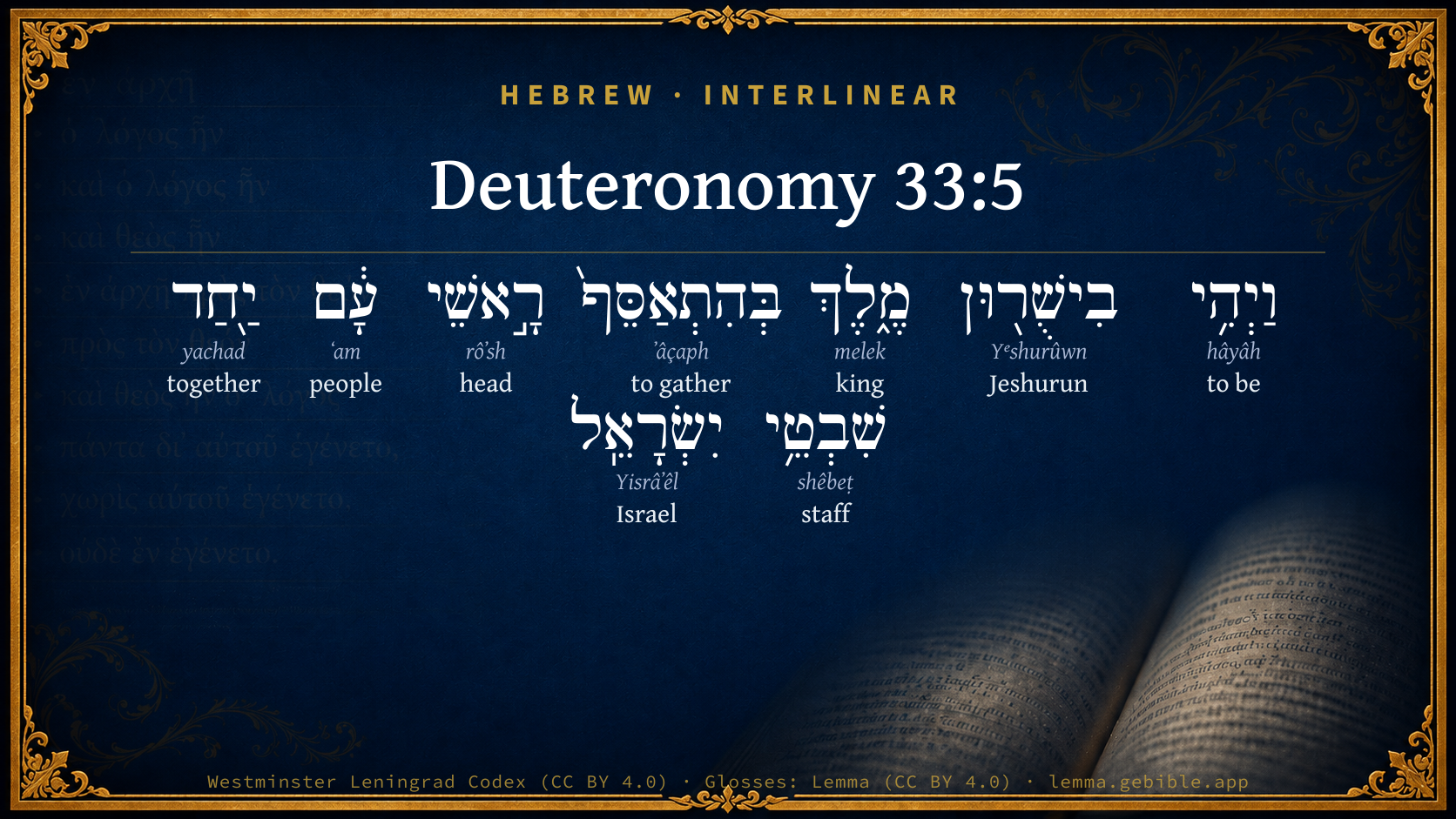
Deuteronomy 33:5

Hebrew (Westminster Leningrad Codex) Deuteronomy 33:5 appears in the Hebrew Old Testament. The text above is from the Westminster Leningrad Codex. Each word links to its Strong’s number, a concise gloss, and parsing drawn from the Open Scriptures Hebrew Bible morphology. Click any word for its full Brown-Driver-Briggs (BDB) entry.
Download image
Cite this verse

Deuteronomy 33:5 (World English Bible). Public Domain. Lemma interlinear Bible study tool, https://lemma.gebible.app/v/deuteronomy/33/5.

Show BibTeX & RIS
BibTeX
RIS
English Translation
He was king in Jeshurun, When the heads of the people were gathered, All the tribes of Israel together.
World English Bible · Public Domain
Download a study sheet

One document with this verse’s original text, its word-by-word gloss line, the meaning frame, cross-references with their text, attributed commentary, and full source and license credits — printable, and it pastes into notes with its structure intact.

This verse Autodidact and up

Study sheet (.html) Plain text (.txt)

A passage Seminary Student

Up to 50 verses in one chapter. A passage sheet keeps up to 6 commentary sources and 12 cross-references per verse, in the order this page ranks them, and says so on the sheet whenever that leaves anything out. Ask for a single verse and you get the Autodidact verse sheet above.

Everything on this page stays free to read, with no account — the sheet is a download of what is already on screen, not access to it.

Want to remove ads? Support Godless Engineer
Compare translations 3

The same verse in 3 English versions, stacked beneath the original-language interlinear above. Click any original word for its lexicon entry.

Each is an independent rendering of the whole verse — the interlinear is not word-aligned to these translations.

Highlighted words mark where these versions differ — a whole-verse word diff, not a word-by-word alignment.

  • World English Bible Public Domain
    He was king in Jeshurun, When the heads of the people were gathered, All the tribes of Israel together.
  • King James Version Public Domain
    And he was king in Jeshurun, when the heads of the people and the tribes of Israel were gathered together.
  • unfoldingWord Literal Text CC BY-SA 4.0
    And he became a king in Jeshurun, when the heads of the people had gathered together, the tribes of Israel. ts\*

unfoldingWord Literal Text — © unfoldingWord, licensed CC BY-SA 4.0. Word-aligned USFM3 via Door43 (git.door43.org/unfoldingWord/en_ult).

Versions to compare (up to 4)

3 of 4 selected

Show all 18 translations

Every available English version of this verse, each an independent rendering of the whole verse.

  • World English Bible Public Domain
    He was king in Jeshurun, When the heads of the people were gathered, All the tribes of Israel together.
  • Berean Standard Bible Public Domain
    So the LORD became King in Jeshurun when the leaders of the people gathered, when the tribes of Israel came together.
  • Majority Standard Bible Public Domain
    So the LORD became King in Jeshurun when the leaders of the people gathered, when the tribes of Israel came together.
  • King James Version Public Domain
    And he was king in Jeshurun, when the heads of the people and the tribes of Israel were gathered together.
  • American Standard Version (1901) Public Domain
    And he was king in Jeshurun, When the heads of the people were gathered, All the tribes of Israel together.
  • Revised Version (1885) Public Domain
    And he was king in Jeshurun, When the heads of the people were gathered, All the tribes of Israel together.
  • Geneva Bible (1599) Public Domain
    Then he was among the righteous people, as King, when the heades of the people, and the tribes of Israel were assembled.
  • Douay-Rheims (1899) Public Domain
    He shall be king with the most right, the princes of the people being assembled with the tribes of Israel.
  • Young's Literal Translation Public Domain
    And he is in Jeshurun king, In the heads of the people gathering together, The tribes of Israel!
  • Literal Standard Version CC BY-SA 4.0
    And He is King in Yeshurun, || In the heads of the people gathering together, || The tribes of Israel!
  • Unlocked Literal Bible CC BY-SA 4.0
    Then there was a king in Jeshurun, when the heads of the people had gathered, all the tribes of Israel together.
  • unfoldingWord Literal Text CC BY-SA 4.0
    And he became a king in Jeshurun, when the heads of the people had gathered together, the tribes of Israel. ts\*
  • Darby Bible Public Domain
    And he was king in Jeshurun, When the heads of the people And the tribes of Israel were gathered together.
  • World Messianic Bible Public Domain
    He was king in Jeshurun, when the heads of the people were gathered, all the tribes of Israel together.
  • Webster's Bible Public Domain
    And he was king in Jeshurun, when the heads of the people and the tribes of Israel were assembled.
  • Free Bible Version CC BY-SA 4.0
    The Lord became King in Israel when the people's leaders gathered, when the tribes of Israel assembled.
  • Bible in Basic English Public Domain
    And there was a king in Jeshurun, when the heads of the people and the tribes of Israel came together.
  • JPS Tanakh (1917) Public Domain
    And there was a king in Jeshurun, when the heads of the people were gathered, all the tribes of Israel together.

Literal Standard Version (2020), Covenant Press — licensed CC BY-SA 4.0. Text via the HelloAO Bible API (eBible.org). Unlocked Literal Bible (unfoldingWord) — licensed CC BY-SA 4.0. Text via the HelloAO Bible API (eBible.org). unfoldingWord Literal Text — © unfoldingWord, licensed CC BY-SA 4.0. Word-aligned USFM3 via Door43 (git.door43.org/unfoldingWord/en_ult). Free Bible Version, Dr. Jonathan Gallagher — licensed CC BY-SA 4.0. Text via the HelloAO Bible API (eBible.org).

Word by word

More ways to search: Search by grammar → Find every occurrence → Compare this word →

Practice this passage: Drill this verse → Learn its vocabulary →

About this verse

These counts appear in no published source. They are computed here, from the morphology-tagged text and Lemma’s own curated glosses. What Lemma adds →

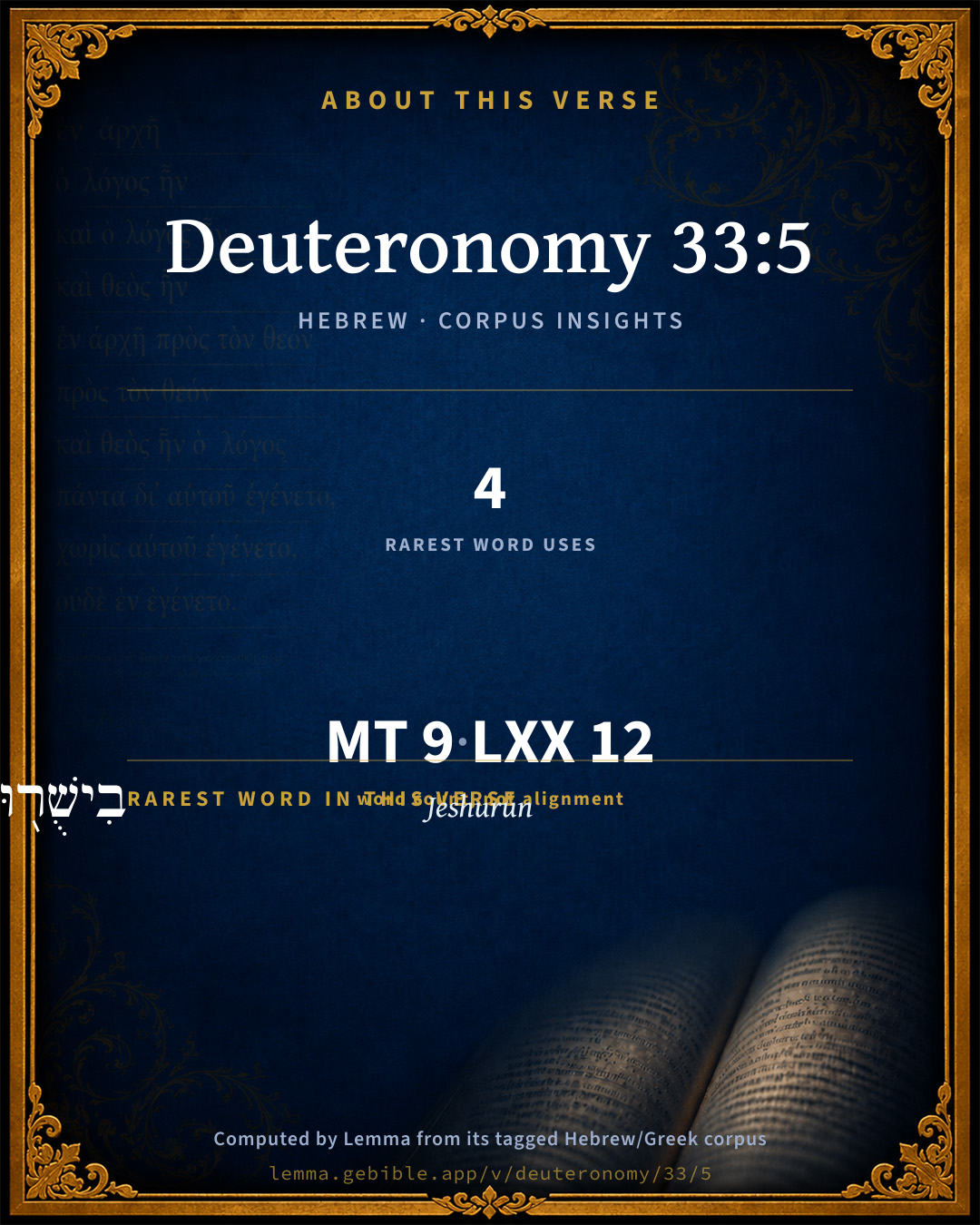
9
words
9
distinct lemmas
Pentateuch
section

Notable vocabulary

The rarest word here is בִישֻׁר֖וּן Jeshurun H3484 — appearing just 4 times in the whole Hebrew Bible.

Shared distinctive vocabulary

בִישֻׁר֖וּן Jeshurun H3484 occurs in 4 verses of the Hebrew Bible. Also found in:

Grammatical profile

  • 2 verbs
  • 6 nouns
  • 1 adverb

Verb forms

  • וַיְהִ֥י Qal · Sequential Imperfect
  • בְּהִתְאַסֵּף֙ Hithpael · Infinitive Construct

Hebrew & Septuagint length

In English translation the verse runs 19 words from the Hebrew and 23 from the Septuagint (LXX English) — closely comparable.

A rough comparison of the two English renderings, which tokenize alike — not a word-level alignment.

Word counts can differ between the Hebrew and the Greek without any difference in meaning — e.g. the Hebrew direct-object marker אֵת has no separate Greek word, and Greek often adds the article ὁ.

In the original languages it is 9 Hebrew tokens and 12 Greek tokens — but the two are counted differently (Hebrew bundles its prefixes and suffixes into one token; the Greek is in lemma form), so that isn’t a like-for-like length.

Cross-references

9

Topical passages linked to Deuteronomy 33:5 in the Treasury of Scripture Knowledge — connected by theme and wording, ordered by reader-vote popularity; previews shown in the World English Bible.

  • Deuteronomy 32:15 But Jeshurun grew fat, and kicked: You have grown fat, you are grown thick, you are become sleek; Then he forsook God who made him, Lightly esteemed the Rock of his salvation.
  • Judges 17:6 In those days there was no king in Israel: every man did that which was right in his own eyes.
  • Genesis 36:31 These are the kings who reigned in the land of Edom, before any king reigned over the children of Israel.
  • Exodus 18:16 When they have a matter, they come to me, and I judge between a man and his neighbor, and I make them know the statutes of God, and his laws."
  • Exodus 18:19 Listen now to my voice. I will give you counsel, and God be with you. You represent the people before God, and bring the causes to God.
  • Numbers 16:13–15 is it a small thing that you have brought us up out of a land flowing with milk and honey, to kill us in the wilderness, but you must needs make yourself also a prince over us?
  • Numbers 23:21 He has not saw iniquity in Jacob; Neither has he seen perverseness in Israel: Yahweh his God is with him, The shout of a king is among them.
  • Judges 8:22 Then the men of Israel said to Gideon, Rule you over us, both you, and your son, and your son's son also; for you have saved us out of the hand of Midian.
  • Judges 9:2 Please speak in the ears of all the men of Shechem, Whether is better for you, that all the sons of Jerubbaal, who are seventy persons, rule over you, or that one rule over you? Remember also that I am your bone and your flesh.

Cross-references courtesy of OpenBible.info (CC BY 4.0).

Hebrew and Greek witnesses Masoretic Hebrew ↔ Greek Septuagint

The same verse in the two great witnesses to the Old Testament, shown verse-for-verse.

These are two independent witnesses, not word-aligned to each other, and the Septuagint is shown in lemma (dictionary) form.

Hebrew Deuteronomy 33:5 Masoretic · Westminster Leningrad Codex

וַיְהִ֥י בִישֻׁר֖וּן מֶ֑לֶךְ בְּהִתְאַסֵּף֙ רָ֣אשֵׁי עָ֔ם יַ֖חַד שִׁבְטֵ֥י יִשְׂרָאֵֽל

He was king in Jeshurun, When the heads of the people were gathered, All the tribes of Israel together.

World English Bible · Public Domain

Greek LXX Deuteronomy 33:5 Septuagint · lemma form

καί εἰμί ἐν ὁ ἀγαπάω ἄρχων συνἄγω ἄρχων λαός ἅμα φυλή ἰσραήλ

And he shall be prince with the beloved one, when the princes of the people are gathered together with the tribes of Israel.

LXX2012 (modern English Septuagint) · Public Domain

On this verse, Haydock's Catholic Bible Commentary discusses the Septuagint’s reading. Read the note in Commentary ↓

Hebrew: Westminster Leningrad Codex (CC BY 4.0). Greek: Septuagint (public domain); English from LXX2012 (modern English Septuagint) (Public Domain). How the Septuagint differs from the Hebrew →

Targum (Aramaic paraphrase)

2

The Targum is the ancient Jewish Aramaic paraphrase of the Hebrew Scriptures — an interpretive translation, not the Hebrew text itself. Onkelos (literal) and Pseudo-Jonathan (expansive) render the Torah, and Jonathan the Prophets. Coverage is partial: where no permissively-licensed English translation exists for a verse, only the Aramaic is shown. This is verse-level text, not a word-by-word alignment to the Hebrew.

  1. Targum Onkelos Torah (Genesis–Deuteronomy)
    וַהֲוָה בְיִשְׂרָאֵל מַלְכָּא בְּאִתְכַּנָשׁוּת רֵישֵׁי עַמָא כַּחֲדָא שִׁבְטַיָא דְיִשְׂרָאֵל

    (no public-domain English translation for this verse)

    Targum Onkelos — Aramaic: “Onkelos Genesis” (public domain); “Onkelos Exodus” (public domain); “Onkelos Leviticus” (public domain); “Onkelos Numbers” (public domain); “Onkelos Deuteronomy” (public domain). English: “Sefaria Community Translation” (CC0 1.0 (public-domain dedication)); “J.W. Etheridge. The Targums of Onkelos and Jonathan Ben Uzziel on the Pentateuch. London: Longmans, Green, 1862” (public domain). Text via Sefaria.

  2. Targum Pseudo-Jonathan Torah (Genesis–Deuteronomy)
    וְהוּא הֲוָה מַלְכָּא בְּיִשְרָאֵל בְּאִתְכַּנָשׁוּת רֵישֵׁי עַמָא כַּחֲדָא מִשְׁתַּמְעִין לֵיהּ שִׁבְטַיָא דְיִשְרָאֵל

    And he was king in Israel: when the chiefs of the people were gathered together, the tribes of Israel were obedient to him.

    Targum Pseudo-Jonathan — Aramaic: “Targum Jonathan on Genesis” (public domain); “Targum Jonathan on Exodus” (public domain); “Targum Jonathan on Leviticus” (public domain); “Targum Jonathan on Numbers” (public domain); “Targum Jonathan on Deuteronomy” (public domain). English: “The Targum of Jonathan ben Uzziel, trans. J. W. Etheridge, London, 1862” (public domain). Text via Sefaria.

Commentary

Notes on Deuteronomy 33:5 from classic Christian and Jewish commentators (each source and its license shown beneath its notes). The classic Christian expositions comment on the surrounding passage and are grouped to its opening verse, so a note may address several verses; the Jewish commentaries on the Tanakh (Rashi and others) are per-verse, so they appear only where the commentator wrote on this verse.

Lemma curates 59 commentaries, every one of them public domain or Creative Commons licensed, each selected and text-cleaned for this edition rather than reprinted as found. About our sources →

Trapp's Complete Commentary

John Trapp

Deu 33:5 And he was king in Jeshurun, when the heads of the people [and] the tribes of Israel were gathered together.

Ver. 5. And he was king in Jeshurun.] A heroic king, reigning by virtue and justice only, not by force and violence: one that said not, εξεστι, but καηνκει; This I can do, but this is fit for me to do.

When the heads of the people, and the tribes.] Here was a government made up of king, lords, and commons. The best of governments, doubtless, so that the beam be kept right between sovereignty and subjection. The contention between prince and people, about command and obedience, ceased not till the Magna Charta, first obtained of King John, after of his son Henry III, though observed truly of neither, was in the maturity of a judicial prince, Edward I, freely ratified after fourscore years.

John Trapp, A Commentary or Exposition upon All the Books of the Old and New Testament (1647–1656) — public domain. Text from a community e-Sword module.

Joseph Benson's Commentary

Deu 33:5. And — Or, for, he was king — Not indeed in title, but, in reality, being under God their supreme governor and lawgiver; and therefore, by his authority, required them to observe these laws. When the tribes were gathered together — When the princes and people met together, for the management of public affairs, Moses was owned by them as their king and lawgiver. Le Clerc, however, and many others, think that God, and not Moses, is here intended, he being indeed the king and lawgiver of the Jews especially, and not Moses. Moses elsewhere sufficiently intimates that he was not their king, Deu 17:14. And so does Samuel, who acted in a character similar to that of Moses, 1Sa 8:7.

Joseph Benson's Commentary on the Old and New Testaments (1811–1818) — public domain. Text from a community e-Sword module.

Geneva Bible (1599)

Geneva Bible translators

Or, Moses.

Or, Israel.

Geneva Bible (1599) marginal notes — public domain. Text via Bolls.life.

The Cambridge Bible for Schools and Colleges

gen. ed. J. J. S. Perowne

5. And he became king in Jeshurun] i.e. Jehovah. Graf, Wellh., Stade render and there was a king, i.e. Saul, but Saul is not relevant here. On Yeshurun see Deu_32:15.

The Cambridge Bible for Schools and Colleges (gen. ed. J. J. S. Perowne; Cambridge University Press, 1878–1918) — public domain. Text from a community e-Sword module.

John Gill's Exposition

Let Reuben live, and not die,.... As a tribe, continue and not be extinct, though they should not excel, because of the sin of their progenitor; and it may have a special regard to the preservation of them, of their families on the other side Jordan, while they passed over it with their brethren into Canaan, and of them in that expedition to help the other tribes in the conquest of the country and the settlement of them in it; which Jacob by a spirit of prophecy foresaw, and in a prayer of faith petitioned for their safety: all the three Targums refer the words to a future state, as a wish for them, that they might live and enjoy an eternal life, and not die the death of the wicked in the world to come; and which they call the second death, and from whom the Apostle John seems to have borrowed the phrase, Rev 2:11 Rev 20:6; Reuben signifies, "see the Son"; and all that see the Son of God in a spiritual manner, and believe in him with a true faith, as they live spiritually now, shall live eternally hereafter, and never die the second or eternal death; on them that shall have no power, see Joh 6:40,

and let not his men be few; or, "though his men be few?" as Bishop Patrick chooses to render the words, and as they will bear, "vau", being sometimes so used, of which Noldius (h) gives instances; and the number of men in this tribe were but few in comparison of some others; and so those that see the Son of God and believe in him are but a small number; for all men have not faith. Th2 3:2

(h) Concord. part. Ebr. p. 292.

John Gill's Exposition of the Whole Bible (1746–1763) — public domain (CC PDM 1.0). Text via the HelloAO Bible API.

Albert Barnes' Notes on the Bible

He was king - i. e., not Moses but the Lord became king.

Albert Barnes' Notes on the Bible (1834–1885) — public domain. Text from a community e-Sword/MySword module.

Haydock's Catholic Bible Commentary

He shall, &c. Erit rex, may perhaps be as well rendered indefinitely, "There shall be a king;" or, with the Septuagint, "And there shall be over the beloved a ruler," as (Haydock) some understand this of Moses, others of Saul, though it most probably refers to God himself, who gave the law, and was acknowledged, in the most solemn manner, for the king of Israel. --- Right. Hebrew yishurun, a term which St. Jerome translates, with the Septuagint, (Calmet) chap. xxxii. 15, the beloved, as it is supposed to be a diminutive of Israel, to express greater tenderness. Thus Cicero called his daughter Tulliola. (Haydock)

George Leo Haydock (1774–1849), Haydock's Catholic Family Bible and Commentary, 1859 edition — public domain. Excludes Psalms (Douay-Rheims chapter numbering differs from Protestant) and Deuterocanonical books (Catholic canon only).

Matthew Poole's English Annotations

Moses was their king, not in title, but in reality, being under God their supreme and uncontrollable governor and lawgiver: though the word oft signifies only a prince or chief ruler, as Jdg 19:1; Jer 19:3; 46:25.

In Jeshurun, i.e. in Israel, so called Deu 32:15.

When the heads of the people and the tribes of Israel were gathered together: when the princes and people met together for the management of public affairs, Moses was owned by them as their king and lawgiver, and he directed and ruled them as their superior. This he saith to show that the people approved and consented to the authority and law of Moses.

Matthew Poole's English Annotations on the Holy Bible (1683–1685) — public domain. Text from a community e-Sword/MySword module.

Whedon's Commentary on the Bible

Daniel D. Whedon

5. And he was king in Jeshurun — That is, Jehovah became king over the righteous nation. Comp. Deu_32:15.

Were gathered together — This refers to the assembling around Sinai to receive the law.

Daniel D. Whedon (gen. ed.), Commentary on the Old and New Testaments (1874–1909) — public domain. Text from a community e-Sword module.

The Pulpit Commentary

Some refer this to Moses, but Moses was never recognized as king in Israel: he "was faithful in all his house as a servant"; (Heb_3:5) but Jehovah alone was King. (Exo_15:18; Psa_47:6, Psa_47:7) Jeshurun. (cf. Deu_32:5) The gathering together refers to the assembling of the people at Sinai, when Jehovah came forth as their King to give them his Law.

The Pulpit Commentary (1880–1919), ed. H.D.M. Spence-Jones & Joseph S. Exell — public domain. Text from a community e-Sword module.

John Wesley's Explanatory Notes

He was king in Jeshurun - Moses was their king not in title, but in reality, being under God, their supreme governor, and law giver. Gathered together - When the princes and people met together for the management of public affairs, Moses was owned by them as their king and lawgiver. 6. Let Reuben live - Though Reuben deserve to be cut off or greatly diminished and obscured, according to Jacob's prediction, Gen. xlix, 4, yet God will spare them and give them a name and portion among the tribes of Israel, and bless them with increase of their numbers. All the ancient paraphrasts refer this to the other world, so far were they from expecting temporal blessings only. Let Reuben live in life eternal, says Onkelos, and not die the second death. Let Reuben live in this world, so Jonathan and the Jerusalem Targum, and not die that death which the wicked die in the world to come.

John Wesley, Explanatory Notes Upon the Whole Bible (1754–1765) — public domain. Text via the GEBible commentary corpus.

unfoldingWord translationNotes

Door43 World Missions Community

General Information:

Moses continues to bless the tribes of Israel, which he began to do in Deuteronomy 33:2. The blessings are short poems. (See: Parallelism)

General Information:

Verse 5 is difficult to understand.

there was a king

"Yahweh became king"

Jeshurun

This is another name for Israel. Translated as in Deuteronomy 32:15.

Let Reuben live

This begins Moses' blessings to the individual tribes of Israel.

but may his men be few

Other possible meanings are 1) "and may his men not be few" or 2) "even though his men are few."

translationWords

Yahweh

king

head

tribe

Reuben

life

die

unfoldingWord translationNotes — © Distant Shores Media and the Door43 World Missions Community, licensed CC BY-SA 4.0. Source: git.door43.org/Door43/en_tn.

Rashi

Rabbi Shlomo Yitzchaki (Rashi)

ויהי AND HE WAS — i.e. the Holy One, blessed be He, was

בישרון מלך KING IN JESHURUN — constantly was the yoke of His sovereignty upon them at all times.

בהתאסף When there gathered the head (בהתאסף ראשי), i.e., the total number (the whole) of their assembly.

ראשי — The word ראשי has the same meaning as (Exodus 30:12) “When you take the count (רֹאשׁ) of the children of Israel”. Consequently they are worthy that I should bless them (and so I shall now begin the blessing: May Reuben live, etc.). — Another explanation of בהתאסף: When they assemble together in one band and there is peace between them, only then is He their King, but not when there is dissension among them (Sifrei Devarim 346:1).

Rashi on the Tanakh — English translations: “The Judaica Press complete Tanach with Rashi, translated by A. J. Rosenberg” (CC BY 4.0); “Pentateuch with Rashi's commentary by M. Rosenbaum and A.M. Silbermann, 1929-1934” (public domain); “The Metsudah Tanach series, Lakewood, N.J” (CC BY 4.0); and “The Book of Joshua, Metsudah Publications, 1997” (CC BY 4.0). Text via Sefaria.

Ramban (Nachmanides)

Rabbi Moshe ben Nachman (Ramban / Nachmanides)

AND THERE WAS A KING IN JESHURUN. This alludes to the aforementioned Name [in Verse 2: ‘The Eternal’ came from Sinai], Who was King over Israel when they were upright and all the heads of the people and all tribes of Israel were gathered together. Now this verse, too, is connected [with the above theme — the Revelation at Sinai], and the sense thereof is that Israel will always say: “The Torah which Moses commanded us will forever be an inheritance to the entire congregation of Jacob. We shall never alter it or change it.” And they will further say that “G-d became King over Israel when our leaders, our elders, our judges and all tribes of Israel gathered, for we all, together, accepted His reign upon ourselves for all generations, and we are obligated to keep His Law and [acknowledge] His Kingdom forever.” This commandment is the precept of I am the Eternal thy G-d, and it constitutes “the acknowledgment of the Kingdom of Heaven,” as I have explained there. Thus he mentioned the Torah in general, and the Kingdom of Heaven in partizcular, for whoever acknowledges the Kingdom of Heaven denies the idols and acknowledges the entire Torah. 6. The people thus intimated that they and their leaders accepted [the commandment to acknowledge] the Kingdom of Heaven [directly] from the mouth of the Almighty and saw that He is King of Israel and his Redeemer. They accepted the Torah from the mouth of Moses for they took upon them, and upon their seed to believe in him and to do whatever he commands in behalf of the King, just as they said [to Moses], and thou shalt speak unto us all that the Eternal our G-d may speak unto thee, and we will hear it, and do it. This interpretation of the verse is clear and well founded. It accords with the rendering of the Rabbis in the Gemara of Tractate Rosh Hashanah:. Now, each unit of ten verses is composed of three verses from the Pentateuch, three from the Prophets, three from the Writings, with one concluding verse from the Pentateuch. On these four verses from the Pentateuch concerning the Sovereignty of G-d the Rabbis in the Gemara asked: “But only three verses referring to Sovereignty etc.” “But only three verses referring to Sovereignty [of G-d] are found [in the Five Books of Moses]! The Eternal shall reign for ever and ever; The Eternal his G-d is with him, and the ‘t’ruah’ (shouting) for the King is among them; And there was a King in Jeshurun.” (above 6:4) is also a statement of Sovereignty even though the word “King” is not mentioned. In our Additional Service on the New Year this is indeed the verse we cite as the concluding expression of G-d’s Sovereignty. We have also been taught so in the Sifre: 347. “When the elders [of Israel] sit in council on earth, His Great Name is praised on high, as it is said, And there was a King in Jeshurun, when the heads of the people were gathered, all the tribes of Israel together. The term ‘gathering’ applies only to the elders, as it is said, Gather unto Me seventy men of the elders of Israel. All the tribes of Israel together — when there is but one brotherhood [then there is a King in Israel] but not when they become numerous factions. And so it is also said, It is He that buildeth His upper chambers in the heaven, [and hath founded His band upon the earth]. And in the Midrash Rabbah they also stated, ‘His throne is firmly set, as it were, on high, when Israel is formed into a single association; therefore it is stated, It is He that buildeth His upper chambers in the heaven, and hath founded His band upon the earth.’ And there was a King in Jeshurun, when the heads of the people were gathered, etc.” This also accords with the manner in which I have explained, for the Rabbis interpreted: there was a King over them because they were gathered and all of them together took His Kingdom upon themselves, and so shall it be an inheritance of the congregation of Jacob. “The King” [mentioned in the verse] is thus the Holy One, blessed be He, and so it is our custom to recite [this verse: And there was a King in Jeshurun etc.] in the New Year’s [Additional] Prayers composed by Rav [as one of the verses of His Sovereignty].However, in some Agadoth [homilies] they explain the term “king” with reference to Moses. Thus they say: “Moses was king, for it is said, And there was a king in Jeshurun, when the heads of the people were gathered.” And if so, Scripture is stating: “Moses commanded us a Law that it be an inheritance of the congregation of Jacob, and he was king over us and all our tribes together, and it behooves us to obey his words and his commandments for he was a great and wise king over us.” Scripture also tells in honor of the emissary [Moses] that he was great and trustworthy. The correct and true interpretation is what we have explained [above]. Thus he mentions that G-d dwells in Israel, and that they — all their tribes together — accepted His Torah and His reign upon themselves and upon their seed for [all] their generations. If so, they are worthy of blessing.

Ramban (Nachmanides) on the Tanakh — English translation: “Commentary on the Torah by Ramban (Nachmanides). Translated and annotated by Charles B. Chavel. New York, Shilo Pub. House, 1971-1976” (CC BY 4.0). Text via Sefaria.

Lesson kit

Teaching starters — assembled from the data on this page, not authored interpretation. Every prompt links to the verse data it draws on. Edit before teaching.

Deuteronomy, in the Pentateuch, opens this verse with 9 words (9 distinct Hebrew lemmas). Its most distinctive word is Yᵉshurûwn (“Jeshurun”). A historical commentator’s framing appears above. Read the whole chapter for the surrounding context.

Discussion questions

  1. What does “Jeshurun” (Yᵉshurûwn) contribute to the verse as a whole?
  2. Deuteronomy 32:15 shares the word «Jeshurun» with this verse. How do the two illuminate each other?
  3. The translations on this page render this verse differently — a whole-verse word diff, not a word-by-word alignment. What might account for the different wordings?
  4. The verb «וַיְהִ֥י» is Qal Sequential Imperfect. How does its form color the action?
  5. Reading how Trapp's Complete Commentary and Joseph Benson's Commentary read this verse, where do the two commentators agree and where do they part?

Things to notice

Reading settings

Reading text

Shown beneath each verse's original-language words.

Old Testament
Old Testament edition

Read the OT as the Masoretic Hebrew (MT) or the Greek Septuagint (LXX).

English shown for the Greek Septuagint (in the Hebrew ↔ Greek comparison).

Comparing translations? Open the Compare panel on any verse page to stack up to four side by side.