
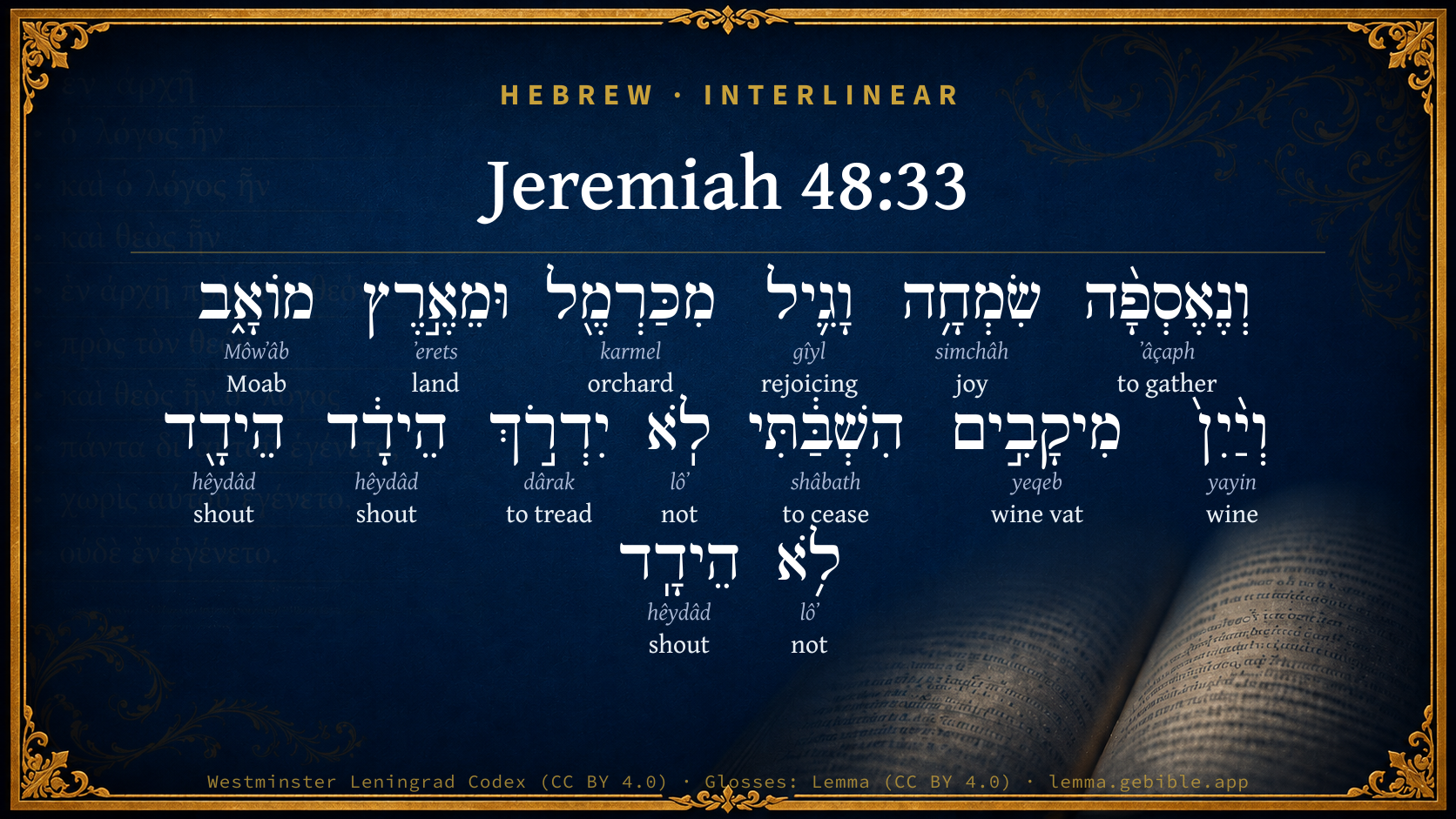
Jeremiah 48:33

Hebrew (Westminster Leningrad Codex) Jeremiah 48:33 appears in the Hebrew Old Testament. The text above is from the Westminster Leningrad Codex. Each word links to its Strong’s number, a concise gloss, and parsing drawn from the Open Scriptures Hebrew Bible morphology. Click any word for its full Brown-Driver-Briggs (BDB) entry.
Download image
Cite this verse

Jeremiah 48:33 (World English Bible). Public Domain. Lemma interlinear Bible study tool, https://lemma.gebible.app/v/jeremiah/48/33.

Show BibTeX & RIS
BibTeX
RIS
English Translation
Gladness and joy is taken away from the fruitful field and from the land of Moab; and I have caused wine to cease from the wine presses: none shall tread with shouting; the shouting shall be no shouting.
World English Bible · Public Domain
Download a study sheet

One document with this verse’s original text, its word-by-word gloss line, the meaning frame, cross-references with their text, attributed commentary, and full source and license credits — printable, and it pastes into notes with its structure intact.

This verse Autodidact and up

Study sheet (.html) Plain text (.txt)

A passage Seminary Student

Up to 50 verses in one chapter. A passage sheet keeps up to 6 commentary sources and 12 cross-references per verse, in the order this page ranks them, and says so on the sheet whenever that leaves anything out. Ask for a single verse and you get the Autodidact verse sheet above.

Everything on this page stays free to read, with no account — the sheet is a download of what is already on screen, not access to it.

Want to remove ads? Support Godless Engineer
Compare translations 3

The same verse in 3 English versions, stacked beneath the original-language interlinear above. Click any original word for its lexicon entry.

Each is an independent rendering of the whole verse — the interlinear is not word-aligned to these translations.

Highlighted words mark where these versions differ — a whole-verse word diff, not a word-by-word alignment.

  • World English Bible Public Domain
    Gladness and joy is taken away from the fruitful field and from the land of Moab; and I have caused wine to cease from the wine presses: none shall tread with shouting; the shouting shall be no shouting.
  • King James Version Public Domain
    And joy and gladness is taken from the plentiful field, and from the land of Moab, and I have caused wine to fail from the winepresses: none shall tread with shouting; their shouting shall be no shouting.
  • unfoldingWord Literal Text CC BY-SA 4.0
    So celebration and rejoicing have been taken away from the fruit trees and the land of Moab. I have put an end to the wine from their winepresses. They will not tread with joyful shouts. Any shouts will not be shouts of joy.

unfoldingWord Literal Text — © unfoldingWord, licensed CC BY-SA 4.0. Word-aligned USFM3 via Door43 (git.door43.org/unfoldingWord/en_ult).

Versions to compare (up to 4)

3 of 4 selected

Show all 18 translations

Every available English version of this verse, each an independent rendering of the whole verse.

  • World English Bible Public Domain
    Gladness and joy is taken away from the fruitful field and from the land of Moab; and I have caused wine to cease from the wine presses: none shall tread with shouting; the shouting shall be no shouting.
  • Berean Standard Bible Public Domain
    Joy and gladness are removed from the orchard and from the fields of Moab. I have stopped the flow of wine from the presses; no one treads them with shouts of joy; their shouts are not for joy.
  • Majority Standard Bible Public Domain
    Joy and gladness are removed from the orchard and from the fields of Moab. I have stopped the flow of wine from the presses; no one treads them with shouts of joy; their shouts are not for joy.
  • King James Version Public Domain
    And joy and gladness is taken from the plentiful field, and from the land of Moab, and I have caused wine to fail from the winepresses: none shall tread with shouting; their shouting shall be no shouting.
  • American Standard Version (1901) Public Domain
    And gladness and joy is taken away from the fruitful field and from the land of Moab; and I have caused wine to cease from the winepresses: none shall tread with shouting; the shouting shall be no shouting.
  • Revised Version (1885) Public Domain
    And gladness and joy is taken away, from the fruitful field and from the land of Moab; and I have caused wine to cease from the winepresses: none shall tread with shouting; the shouting shall be no shouting.
  • Geneva Bible (1599) Public Domain
    And ioye, and gladnesse is taken from the plentifull fielde, and from the land of Moab: and I haue caused wine to faile from the winepresse: none shall treade with shouting: their shouting shall be no shouting.
  • Douay-Rheims (1899) Public Domain
    Joy and gladness is taken away from Carmel, and from the land of Moab, and I have taken away the wine out of the presses: the treader of the grapes shall not sing the accustomed cheerful tune.
  • Young's Literal Translation Public Domain
    And removed hath been joy and gladness From the fruitful field, Even from the land of Moab, And wine from wine-presses I have caused to cease, Shouting doth not proceed, The shouting `is' no shouting!
  • Literal Standard Version CC BY-SA 4.0
    And joy and gladness have been removed from the fruitful field, || Even from the land of Moab, || And I have caused wine to cease from winepresses, || Shouting does not proceed, || The shouting [is] not shouting!
  • Unlocked Literal Bible CC BY-SA 4.0
    So celebration and rejoicing have been taken away from the fruit trees and the land of Moab. I have put an end to the wine from their winepresses. They will not tread with joyful shouts. Any shouts will not be shouts of joy.
  • unfoldingWord Literal Text CC BY-SA 4.0
    So celebration and rejoicing have been taken away from the fruit trees and the land of Moab. I have put an end to the wine from their winepresses. They will not tread with joyful shouts. Any shouts will not be shouts of joy.
  • Darby Bible Public Domain
    And joy and gladness is taken away from the fruitful field and from the land of Moab; and I have caused wine to fail from the winepresses: they shall no more tread with shouting; the shouting shall be no shouting.
  • World Messianic Bible Public Domain
    Gladness and joy is taken away from the fruitful field and from the land of Moab. I have caused wine to cease from the wine presses. No one will tread with shouting. The shouting will be no shouting.
  • Webster's Bible Public Domain
    And joy and gladness is taken from the plentiful field, and from the land of Moab; and I have caused wine to fail from the wine-presses: none shall tread with shouting; their shouting shall be no shouting.
  • Free Bible Version CC BY-SA 4.0
    There's no more celebration and happiness in Moab's orchards and fields. I have stopped the grape juice flowing from the winepresses. No one shouts for joy as they tread out the grapes. No, their shouts now are not because of joy!
  • Bible in Basic English Public Domain
    All joy is gone; no longer are they glad for the fertile field and for the land of Moab; I have made the wine come to an end from the crushing vessels: no longer will the grapes be crushed with the sound of glad voices.
  • JPS Tanakh (1917) Public Domain
    And gladness and joy is taken away from the fruitful field, and from the land of Moab; and I have caused wine to cease from the winepresses; none shall tread with shouting; the shouting shall be no shouting.

Literal Standard Version (2020), Covenant Press — licensed CC BY-SA 4.0. Text via the HelloAO Bible API (eBible.org). Unlocked Literal Bible (unfoldingWord) — licensed CC BY-SA 4.0. Text via the HelloAO Bible API (eBible.org). unfoldingWord Literal Text — © unfoldingWord, licensed CC BY-SA 4.0. Word-aligned USFM3 via Door43 (git.door43.org/unfoldingWord/en_ult). Free Bible Version, Dr. Jonathan Gallagher — licensed CC BY-SA 4.0. Text via the HelloAO Bible API (eBible.org).

Word by word

More ways to search: Search by grammar → Find every occurrence → Compare this word →

Practice this passage: Drill this verse → Learn its vocabulary →

הֵידָ֔ד
hêydâd
H1959
“shout”
Noun, Common, Masculine, Singular, Absolute
Part of Speech
Noun
Type
Common
Gender
Masculine
Number
Singular
State
Absolute
Full BDB Definition

Origin: from an unused root (meaning to shout)

TWOT: 471a

a shout, cheer, shouting - shouting - shout (of the foe)
  1. וְנֶאֶסְפָ֨ה ʼâçaph H622 “and · to gather” Conjunction + Verb, Niphal, Perfect, 3rd Person, Feminine, Singular
  2. שִׂמְחָ֥ה simchâh H8057 “joy” Noun, Common, Feminine, Singular, Absolute
  3. וָגִ֛יל gîyl H1524 “and · rejoicing” Conjunction + Noun, Common, Masculine, Singular, Absolute
  4. מִכַּרְמֶ֖ל karmel H3759 “from · orchard” Preposition + Noun, Common, Masculine, Singular, Absolute
  5. וּמֵאֶ֣רֶץ ʼerets H776 “and · from · land of” Conjunction + Preposition + Noun, Common, Both, Singular, Construct
  6. מוֹאָ֑ב Môwʼâb H4124 “Moab” Noun, Proper
  7. וְיַ֨יִן֙ yayin H3196 “and · wine” Conjunction + Noun, Common, Masculine, Singular, Absolute
  8. מִיקָבִ֣ים yeqeb H3342 “from · wine vats” Preposition + Noun, Common, Masculine, Plural, Absolute
  9. הִשְׁבַּ֔תִּי shâbath H7673 “to cease” Verb, Hiphil, Perfect, 1st Person, Common, Singular
  10. לֹֽא lôʼ H3808 “not” Particle, Negative
  11. יִדְרֹ֣ךְ dârak H1869 “to tread” Verb, Qal, Imperfect, 3rd Person, Masculine, Singular
  12. הֵידָ֖ד hêydâd H1959 “shout” Noun, Common, Masculine, Singular, Absolute
  13. לֹ֥א lôʼ H3808 “not” Particle, Negative
  14. הֵידָֽד hêydâd H1959 “shout” Noun, Common, Masculine, Singular, Absolute

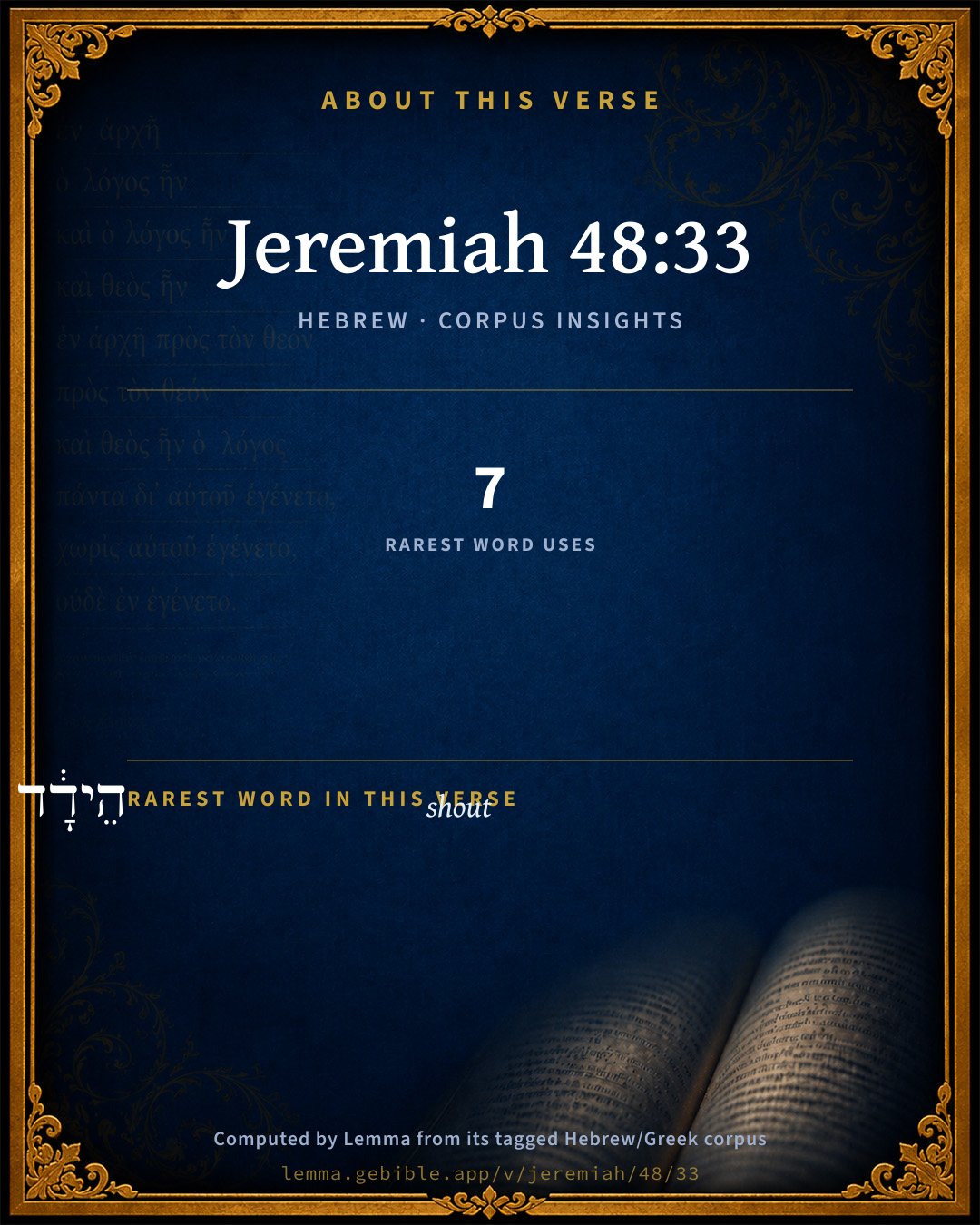
About this verse

These counts appear in no published source. They are computed here, from the morphology-tagged text and Lemma’s own curated glosses. What Lemma adds →

15
words
12
distinct lemmas
Prophets
section

Notable vocabulary

The rarest word here is הֵידָ֔ד shout H1959 — appearing just 7 times in the whole Hebrew Bible.

Shared distinctive vocabulary

הֵידָ֔ד shout H1959 occurs in 5 verses of the Hebrew Bible. Also found in:

Grammatical profile

  • 3 verbs
  • 10 nouns
  • 2 particles

Verb forms

  • וְנֶאֶסְפָ֨ה Niphal · Perfect
  • הִשְׁבַּ֔תִּי Hiphil · Perfect
  • יִדְרֹ֣ךְ Qal · Imperfect

Repetition

Words recur within this verse — often emphatic in Hebrew:

  • הֵידָ֔ד shout H1959 ×3
  • לֹֽא not H3808 ×2

Cross-references

12

Topical passages linked to Jeremiah 48:33 in the Treasury of Scripture Knowledge — connected by theme and wording, ordered by reader-vote popularity; previews shown in the World English Bible.

  • Isaiah 5:10 For ten acres of vineyard shall yield one bath, And a homer of seed shall yield an ephah."
  • Haggai 2:16 Through all that time, when one came to a heap of twenty measures, there were only ten. When one came to the wine vat to draw out fifty, there were only twenty.
  • Isaiah 7:23 It will happen in that day that every place where there were a thousand vines at a thousand silver shekels, shall be for briers and thorns.
  • Isaiah 9:3 You have multiplied the nation, you have increased their joy: they joy before you according to the joy in harvest, as men rejoice when they divide the spoil.
  • Isaiah 16:9–10 Therefore I will weep with the weeping of Jazer for the vine of Sibmah; I will water you with my tears, Heshbon, and Elealeh: for on your summer fruits and on your harvest the [battle] shout is fallen.
  • Isaiah 24:7–12 The new wine mourns, the vine languishes, all the merry-hearted do sigh.
  • Isaiah 32:9–14 Rise up, you women who are at ease, [and] hear my voice; you careless daughters, give ear to my speech.
  • Jeremiah 25:9–10 behold, I will send and take all the families of the north, says Yahweh, and [I will send] to Nebuchadrezzar the king of Babylon, my servant, and will bring them against this land, and against the inhabitants of it, and against all these nations round about; and I will utterly destroy them, and make them an astonishment, and a hissing, and perpetual desolations.
  • Joel 1:5 Wake up, you drunkards, and weep! Wail, all you drinkers of wine, because of the sweet wine; For it is cut off from your mouth.
  • Joel 1:12–13 The vine has dried up, and the fig tree withered; the pomegranate tree, the palm tree also, and the apple tree, Even all of the trees of the field are withered; For joy has withered away from the sons of men.
  • Joel 1:16 Isn't the food cut off before our eyes; Joy and gladness from the house of our God?
  • Revelation 18:22–23 The voice of harpists, minstrels, flute players, and trumpeters will be heard no more at all in you. No craftsman, of whatever craft, will be found any more at all in you. The sound of a mill will be heard no more at all in you.

Cross-references courtesy of OpenBible.info (CC BY 4.0).

Hebrew and Greek witnesses Masoretic Hebrew ↔ Greek Septuagint

The same verse in the two great witnesses to the Old Testament, shown verse-for-verse.

These are two independent witnesses, not word-aligned to each other, and the Septuagint is shown in lemma (dictionary) form.

Hebrew Jeremiah 48:33 Masoretic · Westminster Leningrad Codex

וְנֶאֶסְפָ֨ה שִׂמְחָ֥ה וָגִ֛יל מִכַּרְמֶ֖ל וּמֵאֶ֣רֶץ מוֹאָ֑ב וְיַ֨יִן֙ מִיקָבִ֣ים הִשְׁבַּ֔תִּי לֹֽא יִדְרֹ֣ךְ הֵידָ֔ד הֵידָ֖ד לֹ֥א הֵידָֽד

Gladness and joy is taken away from the fruitful field and from the land of Moab; and I have caused wine to cease from the wine presses: none shall tread with shouting; the shouting shall be no shouting.

World English Bible · Public Domain

Greek LXX Structure differs

In the Septuagint, Jeremiah is about an eighth shorter than the Hebrew and arranges its material differently — the Oracles Against the Nations (Hebrew chapters 46–51) appear in the middle of the Greek book, after 25:13. Because the chapter and verse boundaries do not line up, a verse-for-verse comparison with the Hebrew is not shown.

A verse-for-verse comparison isn’t shown here because the chapters and verses don’t line up. Switch to the LXX edition with the MT / LXX toggle above to read the Greek directly.

Hebrew: Westminster Leningrad Codex (CC BY 4.0). Greek: Septuagint (public domain); English from a public-domain English Septuagint. How the Septuagint differs from the Hebrew →

Targum (Aramaic paraphrase)

1

The Targum is the ancient Jewish Aramaic paraphrase of the Hebrew Scriptures — an interpretive translation, not the Hebrew text itself. Onkelos (literal) and Pseudo-Jonathan (expansive) render the Torah, and Jonathan the Prophets. Coverage is partial: where no permissively-licensed English translation exists for a verse, only the Aramaic is shown. This is verse-level text, not a word-by-word alignment to the Hebrew.

  1. Targum Jonathan Prophets (Joshua–Malachi)
    וְתִתְכְּנֵישׁ בִּיעַ וְחֶדְוָא מִכַּרְמְלָא וּמֵאֲרַע מוֹאָב וַחֲמַר מִמַעַצְרַיָא אֲבַטְלֵית לָא יַעְצְרוּן עִיצוּרִין וְלָא יְרִימוּן בְּקָלְהוֹן:

    (no public-domain English translation for this verse)

    Targum Jonathan — Aramaic: “Mikraot Gedolot” (public domain). English: “Sefaria Community Translation” (CC0 1.0 (public-domain dedication)); “London "Chaldee Paraphrase," 1871” (public domain). Text via Sefaria.

Commentary

Notes on Jeremiah 48:33 from classic Christian and Jewish commentators (each source and its license shown beneath its notes). The classic Christian expositions comment on the surrounding passage and are grouped to its opening verse, so a note may address several verses; the Jewish commentaries on the Tanakh (Rashi and others) are per-verse, so they appear only where the commentator wrote on this verse.

Lemma curates 59 commentaries, every one of them public domain or Creative Commons licensed, each selected and text-cleaned for this edition rather than reprinted as found. About our sources →

Trapp's Complete Commentary

John Trapp

Jer 48:33 And joy and gladness is taken from the plentiful field, and from the land of Moab; and I have caused wine to fail from the winepresses: none shall tread with shouting; [their] shouting [shall be] no shouting.

Ver. 33. And joy and gladness is taken.] See Isa 16:10.

Their shouting shall be no shouting.] Their cheer shall be changed, their note altered from what it was wont to be at their gathering in the vintage. So it shall one day fare with the drunkards and belly gods, whose laetitia vertetur in luctum, plausus in planctum, &c., mirth shall be turned into mourning, clapping of hands into wringing of hands, hallooing into howling.

John Trapp, A Commentary or Exposition upon All the Books of the Old and New Testament (1647–1656) — public domain. Text from a community e-Sword module.

Jamieson, Fausset & Brown

Robert Jamieson, A. R. Fausset & David Brown

the plentiful field--rather, "Carmel": as the parallel "land of Moab" requires, though in Isa 16:10, it is "the plentiful field." Joy is taken away as from the nearer regions (Canaan and Palestine), so from the farther "land of Moab"; what has happened to Judah shall befall Moab, too (Jer 48:26-27) [MAURER]. However, Moab alone seems to be spoken of here; nor does the parallelism forbid "plentiful field" answering to "Moab." English Version is therefore better.

shouting--repeated; as at the conclusion of the vintage, men sing over and over again the same cry of joy. A shouting shall be heard, but not the joyous shouting of laborers treading the grapes, but the terrible battle cry of the foe.

Jamieson, Fausset & Brown — Commentary Critical and Explanatory on the Whole Bible (1871) — public domain (CC PDM 1.0). Text via the HelloAO Bible API.

John Calvin's Commentaries

He pursues the same metaphor or comparison; for he says that all places would be laid waste and desolate, which before had been valuable and highly regarded on account of their fruitfulness. Cease then shall all rejoicing from the land of Moab, however fruitful it might have been. And then he adds, I will make the wine to cease from the presses; that is, no one shall press the grapes, that from them the wine may flow. And he adds, הידד הידד, eidad, eidad, shouting, shouting, for there will be no shouting Some render הידד, eidad, “signal,” celeuma, (vel celeusma,) a Greek word, but used also in Latin: κέλευμα is said by the Greeks to be the shouting of sailors, especially when they drive to the shore; they then rouse one another in rowing, and also congratulate one another, because they are nigh to land; for to see the harbor is a cause of special joy to sailors, as though it were a restoration to life and safety. But this word κέλευμα is applied to other things, as it may be said that reapers sing a celeusma when they finish their work. The vine-dressers had also their songs; and they were sung by heathen nations, as Virgil says. “Now the worn-out vine-dresser sings at the extreme rows of vines.” By extreme rows or ranks he seems to mean the extreme parts of the vines; for extreme rows (antes) are properly prominences or overhanging stones. Now when they had come to the end, they sang and congratulated themselves as to the vintage. It was then a common custom among all nations.

The Prophet, now alluding to this, says, “They who shall tread in the winepress shall not be as usual joyful, so as to have their shouting, shouting, הידד הידד, eidad, eidad.” He repeats the word, because men greatly exult at the vintage, and are excessive in their rejoicings. This is the reason why the Prophet mentions the word twice. He then adds, there shall be no shouting, לא הידד, la eidad, because there would be no vineyards. Isaiah uses other expressions, but the meaning is the same. It now follows, —

John Calvin's Commentaries (1540-1563) — public domain. Text from the Calvin Translation Society English edition (1840s-50s) via the Christian Classics Ethereal Library (ccel.org). Calvin's coverage is partial (roughly two-thirds of the Bible); uncommented books and verses are honest gaps, never fabricated. The 19th-century editor's footnotes and remarks are omitted so the notes are faithfully Calvin's own voice.

Ellicott's Commentary for English Readers

(33) None shall tread with shouting.—The words bring before us the vintage-song of those who trod out the grapes (Jer_25:30; Isa_16:10). Of this the prophet says, in a form which reminds us of the δωρα αδωρα (“gifts that are no gifts”) of Soph. Aias. 674, that it shall be “no shouting,” i.e., that it shall be turned to wailing and lamentation, or the shout and tumult of battle shall have taken its place.

A Bible Commentary for English Readers, edited by Charles John Ellicott (1878–1897) — public domain. Text from a community e-Sword module.

The Cambridge Bible for Schools and Colleges

gen. ed. J. J. S. Perowne

33. This v. is taken with modifications from Isa_16:10.

And gladness … Moab] probably genuine. From “and I have caused” to the end of Jer_48:34 seems again an expansion.

none shall tread with shouting] read rather, with Isaiah, no treader shall tread.

the shouting shall be no shouting] The Hebrew noun is used for both the joyous shout of the grape-treaders and for a battle-cry. Thus the clause means that the former shall be transformed into the latter. Cp. Jer_25:30.

The Cambridge Bible for Schools and Colleges (gen. ed. J. J. S. Perowne; Cambridge University Press, 1878–1918) — public domain. Text from a community e-Sword module.

John Gill's Exposition

From the cry of Heshbon even unto Elealeh,.... Two cities in the land of Moab; of which see Isa 15:4. Heshbon being destroyed, a cry was made by the inhabitants of it, which either reached from thence to Elealeh; or the destruction being carried on to that city, the cry was continued there:

and even unto Jahaz, have they uttered their voice; another city of Moab; see Isa 15:4; which also was laid waste, and where the Moabites uttered their voice of lamentation on account of it:

from Zoar even unto Horonaim, as an heifer of three years old: that is, as the destruction should go on to Zoar, and so to Horonaim; of which places see Isa 15:5; so the cry of the distressed, and of those that flee, should also go from place to place; and be as loud, and as strong, and heard as far, as the lowing of a heifer of three years old. Naturalists (l) observe, that the voice in all female creatures is smaller and shriller, excepting the ox; for the voices of the females of that creature is stronger than in the males; and also that the taming of these creatures is when they are three years old, that is the proper time; before it is too soon, and afterwards too late (m); and then it is their voice is fuller, and their strength firmer, to which the allusion here is; See Gill on Isa 15:5;

for the waters also of Nimrim shall be desolate; being disturbed by the Chaldean army, their horses treading them with their feet, and so fouling them; or being mixed with the blood of the slain, and so unfit to drink. A sad case this, to have neither wine nor water; See Gill on Isa 15:6; to which may be added, that Jerom also makes mention of a village in his time called Benamerium, to the north of Zoar; and seems rather the place intended.

(l) Aristotel. Hist. Animal. l. 4. c. 11. Plin. Nat. Hist. l. 11. c. 51. (m) Plin. Nat. Hist. l. 8. c. 45.

John Gill's Exposition of the Whole Bible (1746–1763) — public domain (CC PDM 1.0). Text via the HelloAO Bible API.

Albert Barnes' Notes on the Bible

Winepresses - Rather, “wine-vats,” into which the wine runs from the presses.

Their shouting shall be no shouting - The vintage shout is - silence. For the vines have been destroyed, and desolation reigns where once was the joyful cry of those who tread the grapes.

Albert Barnes' Notes on the Bible (1834–1885) — public domain. Text from a community e-Sword/MySword module.

Haydock's Catholic Bible Commentary

Carmel, which here denotes any fruitful vineyard or place. --- The, &c. Protestants, "none shall tread with shouting, their shouting shall be no shouting." Hebrew hedad, "the cry" of the people in the vintage. (Calmet)

George Leo Haydock (1774–1849), Haydock's Catholic Family Bible and Commentary, 1859 edition — public domain. Excludes Psalms (Douay-Rheims chapter numbering differs from Protestant) and Deuterocanonical books (Catholic canon only).

Matthew Poole's English Annotations

The time of harvest and vintage being times when the husbandmen were wont to reap the fruit of all their labours the preceding year, were times of great joy ordinarily; but the prophet foretells them of a year when there should be no such rejoicing, for they should have no wine from the winepresses, there should be no shouting as used to be in the time of harvest and of vintage.

Matthew Poole's English Annotations on the Holy Bible (1683–1685) — public domain. Text from a community e-Sword/MySword module.

The Pulpit Commentary

Nearly identical with Isa_16:10. The plentiful field; rather, the garden land; i.e. land planted with "noble" plants, especially vines and olives. Wine. Here clearly sweet and unfermented wine. (comp. Amo_9:13, Amo_9:14) None shall tread with shouting. This involves a very harsh construction of the Hebrew, and it is better (considering the numerous other errors of the same kind in the received text) to correct in accordance with Isa_16:10," the treader shall not tread." Their shouting shall be no shouting. "Shouting" (Hebrew, hedad) may be taken in two senses:

(1) the cheerful, musical cry with which "the treaders" pressed out the juice of the grapes; (comp. Jer_25:30)

(2) the wild cry (Jer_51:14) with which the enemy "fell upon the summer fruits and upon the vintage" (ver. 32), reducing the inhabitants to abject misery. In Isa_16:9, 10 an allusion is made to this double meaning, and so, perhaps, it may be here ("There shall be shouting, but not that of the peaceful vintagers at their work"). Or, as others, we may explain "no shouting" as equivalent to "the opposite of shouting," i.e. either silence or lamentation. (comp. Isa_10:15, "not wood" equivalent to "that which is specifically different from wood;" and Isa_31:3, "not God," equivalent to "the very opposite of Divine

The Pulpit Commentary (1880–1919), ed. H.D.M. Spence-Jones & Joseph S. Exell — public domain. Text from a community e-Sword module.

unfoldingWord translationNotes

Door43 World Missions Community

So celebration and rejoicing have been taken away from the fruit trees and the land of Moab

The abstract nouns "celebration" and "rejoicing" can be stated as verbs. The phrase "have been taken away" can be stated in active form. AT: "The people of Moab will no longer celebrate and rejoice because of their fruit trees" (See: Abstract Nouns and Active or Passive)

I have put an end to the wine from their winepresses

"I have stopped the wine from their winepresses" or "I have stopped the people from making wine"

I have put an end

Here "I" refers to Yahweh.

They will not tread

The wine makers would stomp on the grapes to squeeze out the juice. AT: "The wine makers will not stomp the grapes" (See: Assumed Knowledge and Implicit Information)

translationWords

joy

Moab

wine

winepress

joy

unfoldingWord translationNotes — © Distant Shores Media and the Door43 World Missions Community, licensed CC BY-SA 4.0. Source: git.door43.org/Door43/en_tn.

Rashi

Rabbi Shlomo Yitzchaki (Rashi)

shall be taken away Heb. ונאספה, shall be ended that it shall not be seen.

one shall not tread grapes with a voice of shouting, “Hedad!” with joy as they were wont to do.

The shouting shall be no shouting The shouting that they will cry will not be the first shouting, but the shouting of fleeing the sword.

Rashi on the Tanakh — English translations: “The Judaica Press complete Tanach with Rashi, translated by A. J. Rosenberg” (CC BY 4.0); “Pentateuch with Rashi's commentary by M. Rosenbaum and A.M. Silbermann, 1929-1934” (public domain); “The Metsudah Tanach series, Lakewood, N.J” (CC BY 4.0); and “The Book of Joshua, Metsudah Publications, 1997” (CC BY 4.0). Text via Sefaria.

Lesson kit

Teaching starters — assembled from the data on this page, not authored interpretation. Every prompt links to the verse data it draws on. Edit before teaching.

Jeremiah, in the Prophets, opens this verse with 15 words (12 distinct Hebrew lemmas). Its most distinctive word is hêydâd (“shout”). A historical commentator’s framing appears above. Read the whole chapter for the surrounding context.

Discussion questions

  1. How does “shout” (hêydâd) shape what this verse is saying?
  2. How does Isaiah 16:9, which shares the word «shout», read alongside this verse?
  3. What does the repetition of “shout” (3× in this one verse) do in this verse?
  4. These translations render this verse differently. What is at stake in choosing one wording over another?
  5. «וְנֶאֶסְפָ֨ה» is a Niphal Perfect verb. How does that grammatical form shape the action described?
  6. Compare how Trapp's Complete Commentary and Jamieson, Fausset & Brown read this verse. Where do they agree or differ?

Things to notice

Reading settings

Reading text

Shown beneath each verse's original-language words.

Old Testament
Old Testament edition

Read the OT as the Masoretic Hebrew (MT) or the Greek Septuagint (LXX).

English shown for the Greek Septuagint (in the Hebrew ↔ Greek comparison).

Comparing translations? Open the Compare panel on any verse page to stack up to four side by side.