
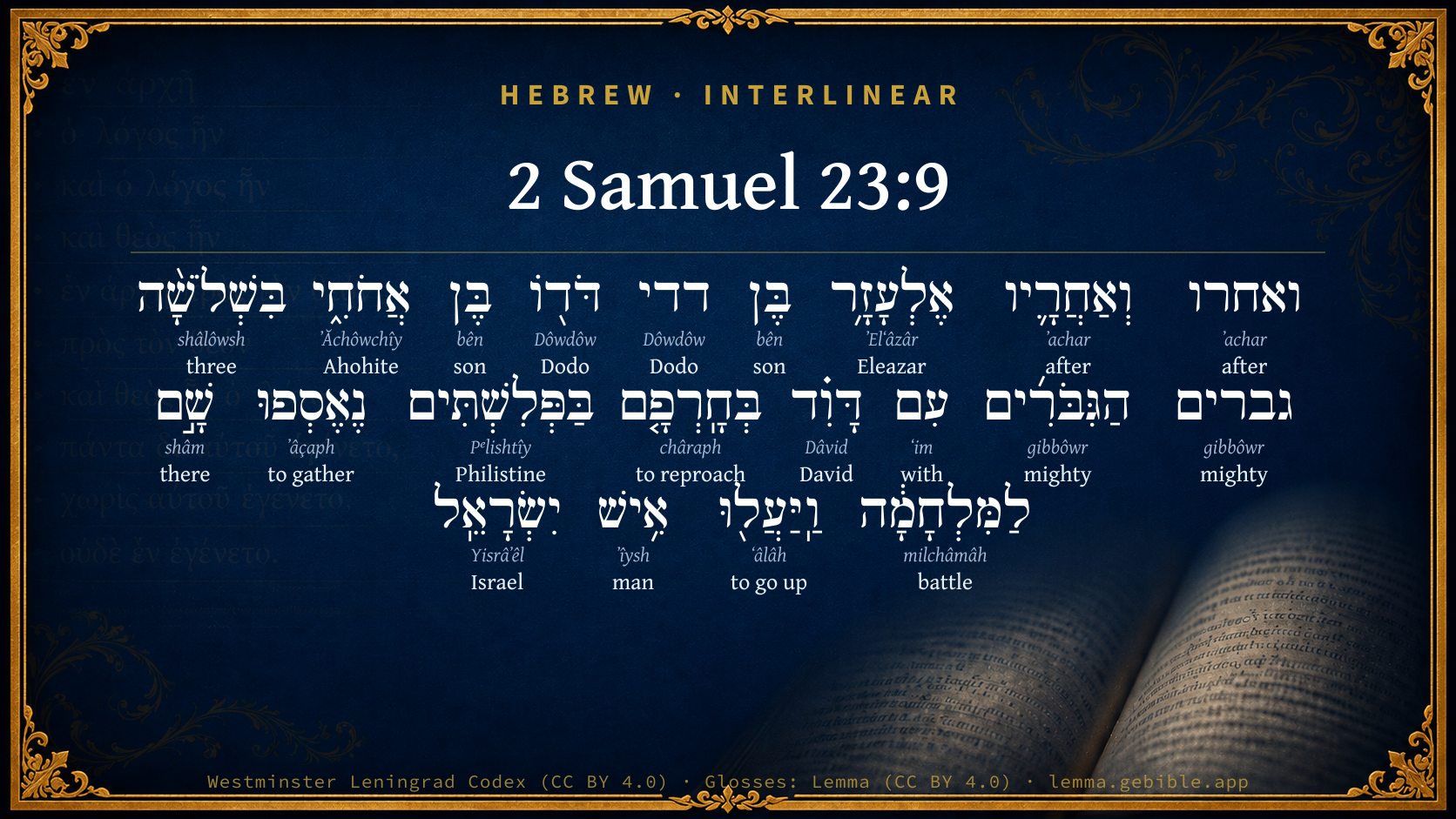
2 Samuel 23:9

Hebrew (Westminster Leningrad Codex) 2 Samuel 23:9 appears in the Hebrew Old Testament. The text above is from the Westminster Leningrad Codex. Each word links to its Strong’s number, a concise gloss, and parsing drawn from the Open Scriptures Hebrew Bible morphology. Click any word for its full Brown-Driver-Briggs (BDB) entry.
Download image
Cite this verse

2 Samuel 23:9 (World English Bible). Public Domain. Lemma interlinear Bible study tool, https://lemma.gebible.app/v/2-samuel/23/9.

Show BibTeX & RIS
BibTeX
RIS
English Translation
After him was Eleazar the son of Dodai the son of an Ahohite, one of the three mighty men with David, when they defied the Philistines who were there gathered together to battle, and the men of Israel were gone away.
World English Bible · Public Domain
Highlights
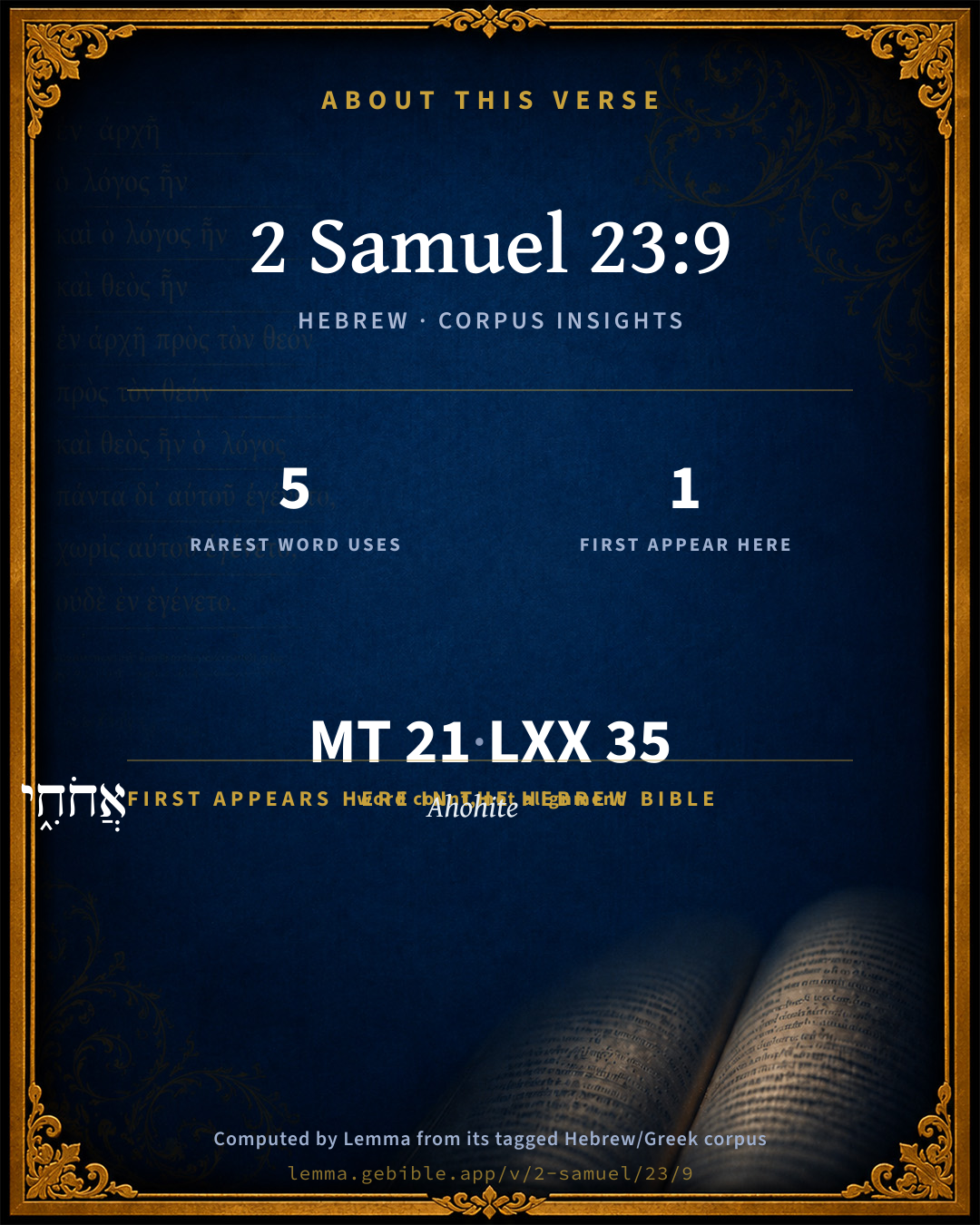
  • 1 first appearance in the Hebrew Bible
Full analysis ↓
Download a study sheet

One document with this verse’s original text, its word-by-word gloss line, the meaning frame, cross-references with their text, attributed commentary, and full source and license credits — printable, and it pastes into notes with its structure intact.

This verse Autodidact and up

Study sheet (.html) Plain text (.txt)

A passage Seminary Student

Up to 50 verses in one chapter. A passage sheet keeps up to 6 commentary sources and 12 cross-references per verse, in the order this page ranks them, and says so on the sheet whenever that leaves anything out. Ask for a single verse and you get the Autodidact verse sheet above.

Everything on this page stays free to read, with no account — the sheet is a download of what is already on screen, not access to it.

Want to remove ads? Support Godless Engineer
Compare translations 3

The same verse in 3 English versions, stacked beneath the original-language interlinear above. Click any original word for its lexicon entry.

Each is an independent rendering of the whole verse — the interlinear is not word-aligned to these translations.

Highlighted words mark where these versions differ — a whole-verse word diff, not a word-by-word alignment.

  • World English Bible Public Domain
    After him was Eleazar the son of Dodai the son of an Ahohite, one of the three mighty men with David, when they defied the Philistines who were there gathered together to battle, and the men of Israel were gone away.
  • King James Version Public Domain
    And after him was Eleazar the son of Dodo the Ahohite, one of the three mighty men with David, when they defied the Philistines that were there gathered together to battle, and the men of Israel were gone away:
  • unfoldingWord Literal Text CC BY-SA 4.0
    And after him Eleazar the son of Dodo, the son of Ahohi, among the three warriors with David. When they taunted the Philistines, they had gathered themselves there for battle, and the men of Israel went up,

unfoldingWord Literal Text — © unfoldingWord, licensed CC BY-SA 4.0. Word-aligned USFM3 via Door43 (git.door43.org/unfoldingWord/en_ult).

Versions to compare (up to 4)

3 of 4 selected

Show all 18 translations

Every available English version of this verse, each an independent rendering of the whole verse.

  • World English Bible Public Domain
    After him was Eleazar the son of Dodai the son of an Ahohite, one of the three mighty men with David, when they defied the Philistines who were there gathered together to battle, and the men of Israel were gone away.
  • Berean Standard Bible Public Domain
    Next in command was Eleazar son of Dodo the Ahohite. As one of the three mighty men, he went with David to taunt the Philistines who had gathered for battle at Pas-dammim. The men of Israel retreated,
  • Majority Standard Bible Public Domain
    Next in command was Eleazar son of Dodo the Ahohite. As one of the three mighty men, he went with David to taunt the Philistines who had gathered for battle at Pas-dammim. The men of Israel retreated,
  • King James Version Public Domain
    And after him was Eleazar the son of Dodo the Ahohite, one of the three mighty men with David, when they defied the Philistines that were there gathered together to battle, and the men of Israel were gone away:
  • American Standard Version (1901) Public Domain
    And after him was Eleazar the son of Dodai the son of an Ahohite, one of the three mighty men with David, when they defied the Philistines that were there gathered together to battle, and the men of Israel were gone away.
  • Revised Version (1885) Public Domain
    And after him was Eleazar the son of Dodai the son of an Ahohite, one of the three mighty men with David, when they defied the Philistines that were there gathered together to battle, and the men of Israel were gone away:
  • Geneva Bible (1599) Public Domain
    And after him was Eleazar the sonne of Dodo, the sonne of Ahohi, one of the three worthies with Dauid, when they defied the Philistims gathered there to battel, when the men of Israel were gone vp.
  • Douay-Rheims (1899) Public Domain
    After him was Eleazar the son of Dodo the Ahohite, one of the three valiant men that were with David when they defied the Philistines, and they were there gathered together to battle.
  • Young's Literal Translation Public Domain
    And after him `is' Eleazar son of Dodo, son of Ahohi, of the three mighty men with David; in their exposing themselves among the Philistines -- they have been gathered there to battle, and the men of Israel go up --
  • Literal Standard Version CC BY-SA 4.0
    And after him [is] Eleazar son of Dodo, son of Ahohi, of the three mighty men with David; in their exposing themselves among the Philistines—they have been gathered there to battle, and the men of Israel go up—
  • Unlocked Literal Bible CC BY-SA 4.0
    After him was Eleazar son of Dodai the Ahohite, one of the three mighty men. He was with David when they taunted the Philistines who had gathered together to do battle, and when the men of Israel had retreated.
  • unfoldingWord Literal Text CC BY-SA 4.0
    And after him Eleazar the son of Dodo, the son of Ahohi, among the three warriors with David. When they taunted the Philistines, they had gathered themselves there for battle, and the men of Israel went up,
  • Darby Bible Public Domain
    And after him, Eleazar the son of Dodo the son of an Ahohite: he was one of the three mighty men with David, when they had defied the Philistines that were there gathered together to battle, and the men of Israel were gone up.
  • World Messianic Bible Public Domain
    After him was Eleazar the son of Dodai the son of an Ahohite, one of the three mighty men with David when they defied the Philistines who were there gathered together to battle, and the men of Israel had gone away.
  • Webster's Bible Public Domain
    And after him was Eleazar the son of Dodo the Ahohite, one of the three mighty men with David, when they defied the Philistines that were there assembled to battle, and the men of Israel had gone away:
  • Free Bible Version CC BY-SA 4.0
    After him came Eleazar, son of Dodai, the Ahohite, one of the Three leading warriors. He was with David when they defied the Philistines gathered for battle at Pas-dammin. The Israelites retreated,
  • Bible in Basic English Public Domain
    After him was Eleazar, the son of Dodai the Ahohite, one of the three great fighters, who was with David in Pas-dammim when the Philistines came together there for the fight; and when the men of Israel had gone in flight,
  • JPS Tanakh (1917) Public Domain
    And after him was Eleazar the son of Dodo the son of an Ahohite, one of the three mighty men with David, when they jeoparded their lives against the Philistines that were there gathered together to battle, and the men of Israel were gone away;

Literal Standard Version (2020), Covenant Press — licensed CC BY-SA 4.0. Text via the HelloAO Bible API (eBible.org). Unlocked Literal Bible (unfoldingWord) — licensed CC BY-SA 4.0. Text via the HelloAO Bible API (eBible.org). unfoldingWord Literal Text — © unfoldingWord, licensed CC BY-SA 4.0. Word-aligned USFM3 via Door43 (git.door43.org/unfoldingWord/en_ult). Free Bible Version, Dr. Jonathan Gallagher — licensed CC BY-SA 4.0. Text via the HelloAO Bible API (eBible.org).

Word by word

More ways to search: Search by grammar → Find every occurrence → Compare this word →

Practice this passage: Drill this verse → Learn its vocabulary →

אֲחֹחִ֑י
ʼĂchôwchîy
H266
“Ahohite”
Noun, Gentilic, Masculine, Singular, Absolute
Part of Speech
Noun
Type
Gentilic
Gender
Masculine
Number
Singular
State
Absolute
Full BDB Definition

Origin: patronymic from H264

TWOT: None

Ahohite = "brother of rest" - one of the clan of Ahoah
  1. ואחרו ʼachar H310 “and · after · him” Conjunction + Preposition + Suffix, Personal, 3rd Person, Masculine, Singular
  2. וְאַחֲרָ֛יו ʼachar H310 “and · after · him” Conjunction + Preposition + Suffix, Personal, 3rd Person, Masculine, Singular
  3. אֶלְעָזָ֥ר ʼElʻâzâr H499 “Eleazar” Noun, Proper
  4. בֶּן bên H1121 “son of” Noun, Common, Masculine, Singular, Construct
  5. דדי Dôwdôw H1734 “Dodo” Noun, Proper
  6. דֹּד֖וֹ Dôwdôw H1734 “Dodo” Noun, Proper
  7. בֶּן bên H1121 “son of” Noun, Common, Masculine, Singular, Construct
  8. בִּשְׁלֹשָׁ֨ה shâlôwsh H7969 “in/at · three” Preposition + Adjective, Cardinal number, Masculine, Singular, Absolute
  9. גברים gibbôwr H1368 “mighty” Adjective, Adjective, Masculine, Plural, Absolute
  10. הַגִּבֹּרִ֜ים gibbôwr H1368 “the · mighty” Particle, Definite Article + Adjective, Adjective, Masculine, Plural, Absolute
  11. עִם ʻim H5973 “with” Preposition
  12. דָּוִ֗ד Dâvid H1732 “David” Noun, Proper
  13. בְּחָֽרְפָ֤ם châraph H2778 “in/at · to reproach · them” Preposition + Verb, Piel, Infinitive Construct + Suffix, Personal, 3rd Person, Masculine, Plural
  14. בַּפְּלִשְׁתִּים Pᵉlishtîy H6430 “in/at the · Philistines” Preposition, Determined + Noun, Gentilic, Masculine, Plural, Absolute
  15. נֶאֶסְפוּ ʼâçaph H622 “to gather” Verb, Niphal, Perfect, 3rd Person, Common, Plural
  16. שָׁ֣ם shâm H8033 “there” Adverb
  17. לַמִּלְחָמָ֔ה milchâmâh H4421 “to/for the · battle” Preposition, Determined + Noun, Common, Feminine, Singular, Absolute
  18. וַֽיַּעֲל֖וּ ʻâlâh H5927 “and · to go up” Conjunction + Verb, Qal, Sequential Imperfect, 3rd Person, Masculine, Plural
  19. אִ֥ישׁ ʼîysh H376 “man of” Noun, Common, Masculine, Singular, Construct
  20. יִשְׂרָאֵֽל Yisrâʼêl H3478 “Israel” Noun, Proper

About this verse

These counts appear in no published source. They are computed here, from the morphology-tagged text and Lemma’s own curated glosses. What Lemma adds →

21
words
17
distinct lemmas
Historical
section

Notable vocabulary

The rarest word here is אֲחֹחִ֑י Ahohite H266 — appearing just 5 times in the whole Hebrew Bible.

First appearance in Scripture

This word makes its first canonical appearance in the Hebrew Bible here:

  • אֲחֹחִ֑י Ahohite H266

Shared distinctive vocabulary

אֲחֹחִ֑י Ahohite H266 occurs in 5 verses of the Hebrew Bible. Also found in:

Grammatical profile

  • 3 verbs
  • 11 nouns
  • 3 adjectives
  • 3 prepositions
  • 1 adverb

Verb forms

  • בְּחָֽרְפָ֤ם Piel · Infinitive Construct
  • נֶאֶסְפוּ Niphal · Perfect
  • וַֽיַּעֲל֖וּ Qal · Sequential Imperfect

Repetition

Words recur within this verse — often emphatic in Hebrew:

  • ואחרו after H310 ×2
  • בֶּן son H1121 ×2
  • דדי Dodo H1734 ×2
  • גברים mighty H1368 ×2

Hebrew & Septuagint length

In English translation the verse runs 41 words from the Hebrew and 40 from the Septuagint (LXX English) — closely comparable.

A rough comparison of the two English renderings, which tokenize alike — not a word-level alignment.

Word counts can differ between the Hebrew and the Greek without any difference in meaning — e.g. the Hebrew direct-object marker אֵת has no separate Greek word, and Greek often adds the article ὁ.

In the original languages it is 21 Hebrew tokens and 35 Greek tokens — but the two are counted differently (Hebrew bundles its prefixes and suffixes into one token; the Greek is in lemma form), so that isn’t a like-for-like length.

Cross-references

11

Topical passages linked to 2 Samuel 23:9 in the Treasury of Scripture Knowledge — connected by theme and wording, ordered by reader-vote popularity; previews shown in the World English Bible.

  • 1 Chronicles 11:12–14 After him was Eleazar the son of Dodo, the Ahohite, who was one of the three mighty men.
  • 1 Chronicles 27:4 Over the division of the second month was Dodai the Ahohite, and his division; and Mikloth the ruler: and in his division were twenty-four thousand.
  • 1 Samuel 17:26 David spoke to the men who stood by him, saying, What shall be done to the man who kills this Philistine, and takes away the reproach from Israel? for who is this uncircumcised Philistine, that he should defy the armies of the living God?
  • Numbers 23:7–8 He took up his parable, and said, From Aram has Balak brought me, The king of Moab from the mountains of the East: Come, curse me Jacob, Come, defy Israel.
  • 1 Samuel 17:10 The Philistine said, I defy the armies of Israel this day; give me a man, that we may fight together.
  • 1 Samuel 17:36 Your servant struck both the lion and the bear: and this uncircumcised Philistine shall be as one of them, seeing he has defied the armies of the living God.
  • 1 Samuel 17:45–46 Then said David to the Philistine, You come to me with a sword, and with a spear, and with a javelin: but I come to you in the name of Yahweh of hosts, the God of the armies of Israel, whom you have defied.
  • Isaiah 63:3 I have trodden the winepress alone; and of the peoples there was no man with me: yes, I trod them in my anger, and trampled them in my wrath; and their lifeblood is sprinkled on my garments, and I have stained all my clothing.
  • Isaiah 63:5 I looked, and there was none to help; and I wondered that there was none to uphold: therefore my own arm brought salvation to me; and my wrath, it upheld me.
  • Mark 14:50 They all left him, and fled.
  • 1 Chronicles 8:4 and Abishua, and Naaman, and Ahoah,

Cross-references courtesy of OpenBible.info (CC BY 4.0).

Hebrew and Greek witnesses Masoretic Hebrew ↔ Greek Septuagint

The same verse in the two great witnesses to the Old Testament, shown verse-for-verse.

These are two independent witnesses, not word-aligned to each other, and the Septuagint is shown in lemma (dictionary) form.

Hebrew 2 Samuel 23:9 Masoretic · Westminster Leningrad Codex

ואחרו וְאַחֲרָ֛יו אֶלְעָזָ֥ר בֶּן דדי דֹּד֖וֹ בֶּן אֲחֹחִ֑י בִּשְׁלֹשָׁ֨ה גברים הַגִּבֹּרִ֜ים עִם דָּוִ֗ד בְּחָֽרְפָ֤ם בַּפְּלִשְׁתִּים נֶאֶסְפוּ שָׁ֣ם לַמִּלְחָמָ֔ה וַֽיַּעֲל֖וּ אִ֥ישׁ יִשְׂרָאֵֽל

After him was Eleazar the son of Dodai the son of an Ahohite, one of the three mighty men with David, when they defied the Philistines who were there gathered together to battle, and the men of Israel were gone away.

World English Bible · Public Domain

Greek LXX 2 Samuel 23:9 Septuagint · lemma form

καί μετά αὐτός ελεαζαρ υἱός πατράδελφος αὐτός υἱός σουσίτης ἐν ὁ τρεῖς δυνατός οὗτος εἰμί μετά δαυίδ ἐν σερραν καί ἐν ὁ ὀνειδίζω αὐτός ἐν ὁ ἀλλόφυλος συνἄγω ἐκεῖ εἰς πόλεμος καί ἀναβαίνω ἀνήρ ἰσραήλ

And after him Eleanan the son of his uncle, son of Dudi who was among the three mighty men with David; and when he defied the Philistines they were gathered there to war, and the men of Israel went up.

LXX2012 (modern English Septuagint) · Public Domain

On this verse, Ellicott's Commentary for English Readers discusses the Septuagint’s reading. Read the note in Commentary ↓

Hebrew: Westminster Leningrad Codex (CC BY 4.0). Greek: Septuagint (public domain); English from LXX2012 (modern English Septuagint) (Public Domain). How the Septuagint differs from the Hebrew →

Targum (Aramaic paraphrase)

1

The Targum is the ancient Jewish Aramaic paraphrase of the Hebrew Scriptures — an interpretive translation, not the Hebrew text itself. Onkelos (literal) and Pseudo-Jonathan (expansive) render the Torah, and Jonathan the Prophets. Coverage is partial: where no permissively-licensed English translation exists for a verse, only the Aramaic is shown. This is verse-level text, not a word-by-word alignment to the Hebrew.

  1. Targum Jonathan Prophets (Joshua–Malachi)
    וּבַתְרוֹהִי אֶלְעָזָר בַּר דוֹדוֹ בַּר אֲחוּהִי בִּתְלָתָא גִבָּרַיָא עִם דָוִד כַּד חֲסִידוּ פְּלִשְׁתָּאֵי וְאִתְכְּנִישׁוּ תַמָן לַאֲגָחָא קְרָבָא וּסְלִיקוּ אֱנַשׁ יִשְׂרָאֵל:

    (no public-domain English translation for this verse)

    Targum Jonathan — Aramaic: “Mikraot Gedolot” (public domain). English: “Sefaria Community Translation” (CC0 1.0 (public-domain dedication)); “London "Chaldee Paraphrase," 1871” (public domain). Text via Sefaria.

Commentary

Notes on 2 Samuel 23:9 from classic Christian and Jewish commentators (each source and its license shown beneath its notes). The classic Christian expositions comment on the surrounding passage and are grouped to its opening verse, so a note may address several verses; the Jewish commentaries on the Tanakh (Rashi and others) are per-verse, so they appear only where the commentator wrote on this verse.

Lemma curates 59 commentaries, every one of them public domain or Creative Commons licensed, each selected and text-cleaned for this edition rather than reprinted as found. About our sources →

Trapp's Complete Commentary

John Trapp

2Sa 23:9 And after him [was] Eleazar the son of Dodo the Ahohite, [one] of the three mighty men with David, when they defied the Philistines [that] were there gathered together to battle, and the men of Israel were gone away:

Ver. 9. When they defied the Philistines,] viz., At Pasdammim. {1Ch 11:13}

And the men of Israel were gone away.] Fled, and forsook their captains; a shame to forsake such a captain, of whom it might be said, as was once of Fabius Maximus,

“ Hic patria est, murique urbis stant pectore in uno. ” - Silius.

John Trapp, A Commentary or Exposition upon All the Books of the Old and New Testament (1647–1656) — public domain. Text from a community e-Sword module.

Joseph Benson's Commentary

2Sa 23:9-10. The men of Israel were gone away — Had fled from before the Philistines, as it is explained, 1Ch 11:13, being dismayed at the sight of them. And his hand clave unto the sword — Being all besmeared with blood. The Lord wrought a great victory that day — Like that of Shamgar and of Samson; God inspiring him with wonderful courage, and striking a terror into the Philistines. The people returned after him only to spoil — They that had fled, rallied again when they saw the wonders he did; and followed after him, not to fight, but only to partake of the spoil.

Joseph Benson's Commentary on the Old and New Testaments (1811–1818) — public domain. Text from a community e-Sword module.

Geneva Bible (1599)

Geneva Bible translators

Or, assailed with danger of their lives.

Meaning, fled from the battle.

Geneva Bible (1599) marginal notes — public domain. Text via Bolls.life.

Adam Clarke's Commentary

Verse 9. When they defied the Philistines that were there gathered] This is supposed to refer to the war in which David slew Goliath.

Adam Clarke's Commentary on the Bible (1810–1826) — public domain. Text from a community e-Sword/MySword module.

Ellicott's Commentary for English Readers

(9) Dodo the Ahohite.—So in the Hebrew margin here, and so also in 1Ch_11:12; the text here has Dodai, as in 1Ch_27:4, where he is mentioned as the general for the second month. The name is the same under slightly differing forms. “Ahohite” is a patronymic derived from Ahoah, son of Bela, Benjamin’s son (1Ch_8:4).

When they defied . . . there gathered.—The words “there gathered” require the mention of some place, and the construction of the word for “defied” is unusual. The parallel passage in Chronicles reads, “He was with David at Pas-dammim, and there the Philistines,” &c. The difference between the two readings is not great in the original, and the latter is better. Pas-dammim is the Ephes-dammim of 1Sa_17:1, where Goliath defied the armies of Israel, and was slain by David.

Were gone away—Rather, were gathered to battle. So it is translated in the LXX., Vulg., and Syriac, and so the Hebrew requires. The error is a curious one, and seems to have arisen in this way: In 1Ch_11:13 the mention of the battle in which Shammah was engaged (2Sa_23:11) is altogether omitted, and the expression “the people fled from before the Philistines” therefore becomes connected with this battle. Josephus follows that text, and our translators were probably misled by him. Several lines have dropped out from the text in Chronicles.

A Bible Commentary for English Readers, edited by Charles John Ellicott (1878–1897) — public domain. Text from a community e-Sword module.

The Cambridge Bible for Schools and Colleges

gen. ed. J. J. S. Perowne

9. Dodo] The Kthîbh may be read Dodai, as the name is given in 1Ch_27:4, where we learn that Dodai, as next in rank to Jashobeam, was general of the second division of the army.

the Ahohite] A patronymic derived from Ahoah, the son of Benjamin’s eldest son Bela (1Ch_8:4). Perhaps Dodo, like Jashobeam, was one of the Benjamites who joined David at Ziklag (1Ch_12:1-2).

that were there gathered together] There implies the previous mention of the name of some place, and certain anomalies of construction also indicate that the text is defective. 1Ch_11:13 reads: “Eleazar … one of the three mighty men. He was with David at Pas-dammim, and there the Philistines were gathered together to battle.” Pas-dammim, or Ephesdammim, where David slew Goliath, was in the valley of Elah, between Shochoh and Azekah. The name, signifying “boundary of blood,” was probably due to its being the scene of frequent skirmishes with the Philistines. See 1Sa_17:1.

were gone away] Rather, went up to battle. The words “and the people fled from before the Philistines,” which appear to correspond to this in 1Ch_11:13, really belong to Shammah’s exploit (2Sa_23:11). Several lines have been lost from the text there.

The Cambridge Bible for Schools and Colleges (gen. ed. J. J. S. Perowne; Cambridge University Press, 1878–1918) — public domain. Text from a community e-Sword module.

John Gill's Exposition

And after him was Eleazar the son of Dodo the Ahohite,.... Or the son of Ahohi, perhaps the same with Ahoah, a descendant of Benjamin, Ch1 8:4; this Eleazar was the next to the Tachmonite, the second worthy of the first class:

one of the three mighty men with David; the second of the three valiant men that were with David in his wars, and fought with him, and for him:

when they defied the Philistines; clapped their hands at them, gloried over them, daring them to come and light them; so did David and his mighty men, as Goliath had defied them before:

that were there gathered together to battle; at Pasdammim, as appears from Ch1 11:13,

and the men of Israel were gone away; fled when they saw the Philistines gather together to fight them, notwithstanding they had defied them; and so David, and his three mighty men, were left alone to combat with the Philistines.

John Gill's Exposition of the Whole Bible (1746–1763) — public domain (CC PDM 1.0). Text via the HelloAO Bible API.

Albert Barnes' Notes on the Bible

Gone away - Rather, went up to battle (2Sa 5:19; 2Ki 3:21, etc.) against them. These words and what follows as far as “troop” 2Sa 23:11 have fallen out of the text in Chronicles. The effect of this is to omit EIeazar’s feat, as here described, to attribute to him Shammah’s victory, to misplace the flight of the Israelites, and to omit Shammah altogether from the list of David’s mighty men.

Albert Barnes' Notes on the Bible (1834–1885) — public domain. Text from a community e-Sword/MySword module.

Haydock's Catholic Bible Commentary

Dodo. In Latin, Patrui ejus, which is the interpretation of the Hebrew name Dodo. The same occurs in ver. 24, (Challoner) and signifies, "of his paternal uncle." (Haydock) --- Septuagint read Dudia, (Calmet) "of his father’s brother." He, or his father, is styled Dudai, 1 Paralipomenon xxvii. 4. (Calmet) --- Septuagint (Alexandrian) translates both Dodo and Dodi, "the son of his father’s brother," the son of Sousei, or (Vatican) Doudei. Dodi seems to be the more accurate here, as he is thus more distinguished from Dodo, ver. 24., and Chronicles v. 26.[1 Paralipomenon xi. 26.?] --- Defied. Hebrew is incorrect, and ought to be a proper name as is evident from the word there. Josephus calls it, Greek: arasamo, (perhaps originally, Greek: aphasdamo) Chronicles, Pasdammim, or Ephesdammim, 1 Kings xvii. 1. It is hardly probable that the Hebrews should defy or upbraid the Philistines, and immediately run away. We should therefore translate with 1 Paralipomenon men. "He was with David at Pasdammim. And when the Philistines were there gathered together to battle, and the men of Israel were gone away, he arose," &c. (Kennicott)

George Leo Haydock (1774–1849), Haydock's Catholic Family Bible and Commentary, 1859 edition — public domain. Excludes Psalms (Douay-Rheims chapter numbering differs from Protestant) and Deuterocanonical books (Catholic canon only).

Matthew Poole's English Annotations

The Ahohite; of the children of Ahoah, 1Ch 8:4.

One of the three, i. e. one of the first three, 2Sa 23:19.

Mighty men with David; who were with David at this time, or who usually attended upon David.

When they defied the Philistines; when he either in the name of all the Israelites, or with the countenance and help of some of them, challenged the Philistines to fight. Or, when some of, or among, the Philistines defied them, i. e. the Israelites, according to their manner, and the example of their great Goliath, 1Sa 17:25,36. Or, in Harpam (for some make it a proper name of a place) among the Philistines. Gone away, i. e. fled away, 1Ch 11:13, being dismayed at the approach of their enemies. Heb. ascended, i. e. vanished away like smoke, which ascends, and so disappears, as that verb is oft used.

Matthew Poole's English Annotations on the Holy Bible (1683–1685) — public domain. Text from a community e-Sword/MySword module.

Whedon's Commentary on the Bible

Daniel D. Whedon

9. Of the three mighty men — Referring, doubtless, to the three of this first class, namely, Jashobeam, Eleazar, and Shammah.

When they defied the Philistines — According to Chronicles this encounter took place at Pas-dammim, doubtless the same as Ephes-dammim of 1Sa_17:1, but it was not the same battle as there described.

The men of Israel were gone away — Retreated from him, so that he was left singlehanded before the enemy.

Daniel D. Whedon (gen. ed.), Commentary on the Old and New Testaments (1874–1909) — public domain. Text from a community e-Sword module.

The Pulpit Commentary

Dodo. The Hebrew has Dodai, and "Dodo" is a mere correction of the Massorites to bring the name into verbal agreement with 1Ch_11:12; but in 1Ch_27:4 he is called Dodai, and we there find him in command of the second division of the army. For "Dodai," however, we ought to read there "Eleazar the son of Dodai." Ahohite; Hebrew, the son of an Ahohite, and probably a member of the family descended from Ahoah, a son of Benjamin. (1Ch_8:4) He would thus belong to the most warlike tribe of Israel, though not mentioned among the Benjamites who joined David at Ziklag. (1Ch_12:1-7) He joined him, apparently, at an earlier date. That were there gathered together. The word "there" implies the previous mention of some place, and though the text in the parallel passage in Chronicles is more corrupt than that before us, it has, nevertheless, preserved the name of the spot where the encounter took place. In Chronicles the name of Shammah is omitted, and his achievement is mixed up in a strange fashion with that of Eleazar. Here the two heroes have each his separate record, and it is only on minor matters that the text there is more correct. Restored from the readings in Chronicles, the narrative is as follows: "He was with David at Pas-dammim, and the Philistines were gathered there to battle, and the men of Israel were gone up: and he stood (that is, made a stand) and smote," etc. Pas-dammim is called Ephes-dammim in 1Sa_17:1. It was situated in the valley of Elah, and, as being upon the border, was the scene of numerous conflicts, whence its name, "the boundary of blood." It was there that David slew Goliath. Were gone away; Hebrew, went up; that is, to battle. The idea that the Israelites had fled is taken from the parallel place in Chronicles, where, however, it refers to Shammah"s exploit. In vers. 9 and 11 there, the phrase, "the Philistines were gathered together," occurs twice, and the scribe, having accidentally omitted the intervening words, has confused together the exploits of Eleazar and Shammah. In this battle Eleazar withstood the Philistine onset, and smote them till his hand clave to his sword hilt. Many such instances of cramp are recorded, and Mr. Kirkpatrick, in his commentary, quotes one in which the muscles of a warrior"s hand could be relaxed, after hard fighting, only by fomentations of hot water.

The Pulpit Commentary (1880–1919), ed. H.D.M. Spence-Jones & Joseph S. Exell — public domain. Text from a community e-Sword module.

John Wesley's Explanatory Notes

Gone away - That is, fled away, 1 Chron. xi, 13, being dismayed at the approach of their enemies.

John Wesley, Explanatory Notes Upon the Whole Bible (1754–1765) — public domain. Text via the GEBible commentary corpus.

unfoldingWord translationNotes

Door43 World Missions Community

General Information:

This continues the list of David's greatest soldiers. (See: How to Translate Names)

The army returned after Eleazar

This means that the army returned after Eleazar returned from battle. AT: "The Israeli army returned to the battle field after Eleazer had already won the battle" (See: Assumed Knowledge and Implicit Information)

only to strip the bodies

"only to take what they wanted from the dead bodies of the enemies"

translationWords

might

Philistines

sword

Yahweh

body

unfoldingWord translationNotes — © Distant Shores Media and the Door43 World Missions Community, licensed CC BY-SA 4.0. Source: git.door43.org/Door43/en_tn.

Rashi

Rabbi Shlomo Yitzchaki (Rashi)

The son of Dodo. This was his name.

One of the three mighty men. Of the best of the mighty men.

When they humiliated the Pelishtim. They made an agreement with each other to fight them and to vanquish them.

Rashi on the Tanakh — English translations: “The Judaica Press complete Tanach with Rashi, translated by A. J. Rosenberg” (CC BY 4.0); “Pentateuch with Rashi's commentary by M. Rosenbaum and A.M. Silbermann, 1929-1934” (public domain); “The Metsudah Tanach series, Lakewood, N.J” (CC BY 4.0); and “The Book of Joshua, Metsudah Publications, 1997” (CC BY 4.0). Text via Sefaria.

Lesson kit

Teaching starters — assembled from the data on this page, not authored interpretation. Every prompt links to the verse data it draws on. Edit before teaching.

2 Samuel, in the Historical, opens this verse with 21 words (17 distinct Hebrew lemmas). Its most distinctive word is ʼĂchôwchîy (“Ahohite”). A historical commentator’s framing appears above. Read the whole chapter for the surrounding context.

Discussion questions

  1. What does “Ahohite” (ʼĂchôwchîy) contribute to the verse as a whole?
  2. This is the first place “Ahohite” appears in Scripture (first appears here). What does its debut here establish?
  3. How does 2 Samuel 23:28, which shares the word «Ahohite», read alongside this verse?
  4. What does the repetition of “after” (2× in this one verse) do in this verse?
  5. The translations on this page render this verse differently — a whole-verse word diff, not a word-by-word alignment. What might account for the different wordings?
  6. «בְּחָֽרְפָ֤ם» is a Piel Infinitive Construct verb. How does that grammatical form shape the action described?
  7. Compare how Trapp's Complete Commentary and Joseph Benson's Commentary read this verse. Where do they agree or differ?

Things to notice

Reading settings

Reading text

Shown beneath each verse's original-language words.

Old Testament
Old Testament edition

Read the OT as the Masoretic Hebrew (MT) or the Greek Septuagint (LXX).

English shown for the Greek Septuagint (in the Hebrew ↔ Greek comparison).

Comparing translations? Open the Compare panel on any verse page to stack up to four side by side.