2 Chronicles 29:20

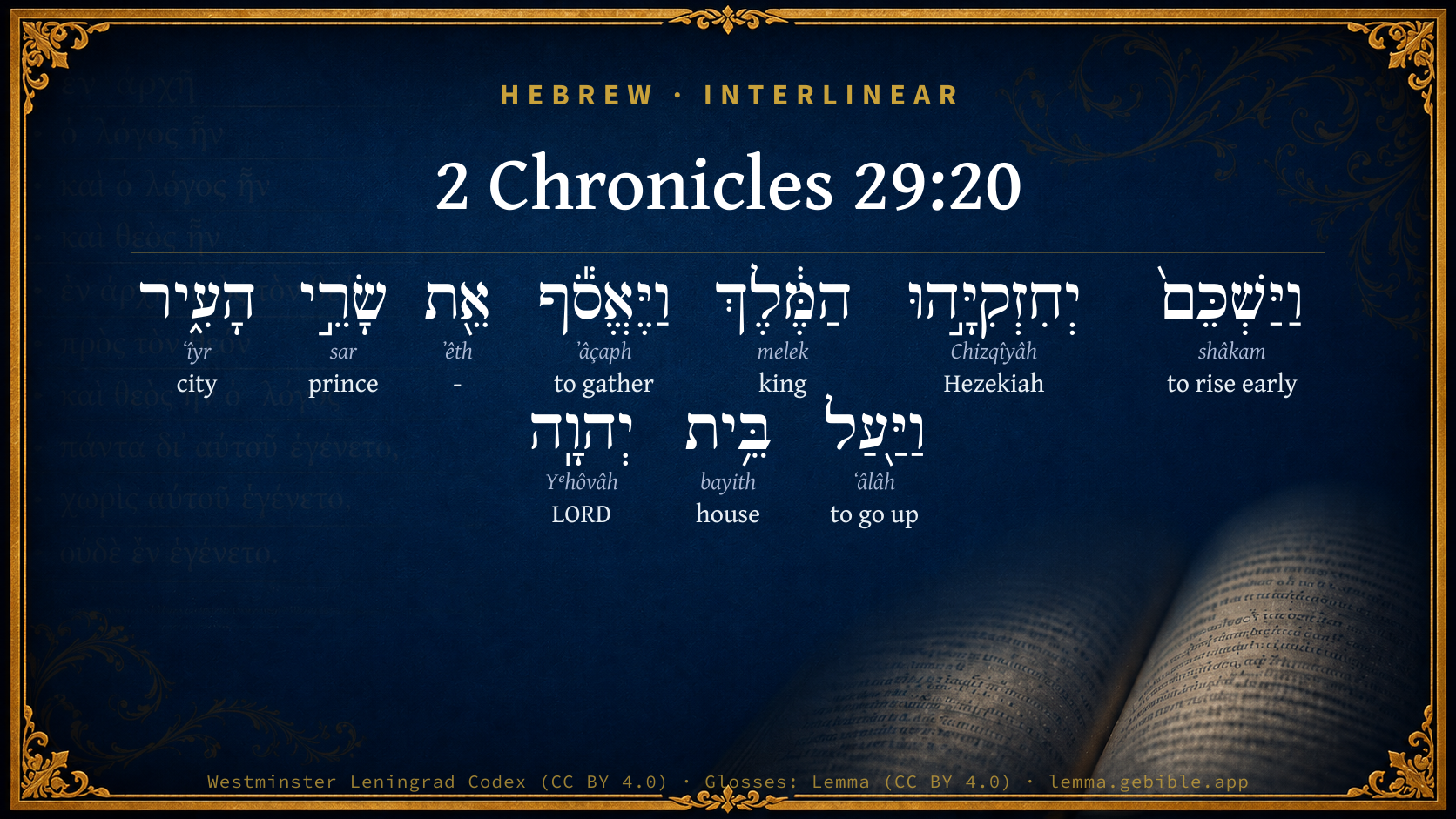
Hebrew (Westminster Leningrad Codex) 2 Chronicles 29:20 appears in the Hebrew Old Testament. The text above is from the Westminster Leningrad Codex. Each word links to its Strong’s number, a concise gloss, and parsing drawn from the Open Scriptures Hebrew Bible morphology. Click any word for its full Brown-Driver-Briggs (BDB) entry.
Download image
Cite this verse

2 Chronicles 29:20 (World English Bible). Public Domain. Lemma interlinear Bible study tool, https://lemma.gebible.app/v/2-chronicles/29/20.

Show BibTeX & RIS
BibTeX
RIS
English Translation
Then Hezekiah the king arose early, and gathered the princes of the city, and went up to the house of Yahweh.
World English Bible · Public Domain
Download a study sheet

One document with this verse’s original text, its word-by-word gloss line, the meaning frame, cross-references with their text, attributed commentary, and full source and license credits — printable, and it pastes into notes with its structure intact.

This verse Autodidact and up

Study sheet (.html) Plain text (.txt)

A passage Seminary Student

Up to 50 verses in one chapter. A passage sheet keeps up to 6 commentary sources and 12 cross-references per verse, in the order this page ranks them, and says so on the sheet whenever that leaves anything out. Ask for a single verse and you get the Autodidact verse sheet above.

Everything on this page stays free to read, with no account — the sheet is a download of what is already on screen, not access to it.

Want to remove ads? Support Godless Engineer
Compare translations 3

The same verse in 3 English versions, stacked beneath the original-language interlinear above. Click any original word for its lexicon entry.

Each is an independent rendering of the whole verse — the interlinear is not word-aligned to these translations.

Highlighted words mark where these versions differ — a whole-verse word diff, not a word-by-word alignment.

  • World English Bible Public Domain
    Then Hezekiah the king arose early, and gathered the princes of the city, and went up to the house of Yahweh.
  • King James Version Public Domain
    Then Hezekiah the king rose early, and gathered the rulers of the city, and went up to the house of the LORD.
  • unfoldingWord Literal Text CC BY-SA 4.0
    And Hezekiah the king rose early and gathered the chiefs of the city. And he went up to the house of Yahweh.

unfoldingWord Literal Text — © unfoldingWord, licensed CC BY-SA 4.0. Word-aligned USFM3 via Door43 (git.door43.org/unfoldingWord/en_ult).

Versions to compare (up to 4)

3 of 4 selected

Show all 18 translations

Every available English version of this verse, each an independent rendering of the whole verse.

  • World English Bible Public Domain
    Then Hezekiah the king arose early, and gathered the princes of the city, and went up to the house of Yahweh.
  • Berean Standard Bible Public Domain
    Early the next morning King Hezekiah gathered the city officials and went up to the house of the LORD.
  • Majority Standard Bible Public Domain
    Early the next morning King Hezekiah gathered the city officials and went up to the house of the LORD.
  • King James Version Public Domain
    Then Hezekiah the king rose early, and gathered the rulers of the city, and went up to the house of the LORD.
  • American Standard Version (1901) Public Domain
    Then Hezekiah the king arose early, and gathered the princes of the city, and went up to the house of Jehovah.
  • Revised Version (1885) Public Domain
    Then Hezekiah the king arose early, and gathered the princes of the city, and went up to the house of the LORD.
  • Geneva Bible (1599) Public Domain
    And Hezekiah the King rose early, and gathered the princes of the citie, and went vp to the house of the Lord.
  • Douay-Rheims (1899) Public Domain
    And king Ezechias rising early, assembled all the rulers of the city, and went up into the house of the Lord:
  • Young's Literal Translation Public Domain
    And Hezekiah the king riseth early, and gathereth the heads of the city, and goeth up to the house of Jehovah;
  • Literal Standard Version CC BY-SA 4.0
    And Hezekiah the king rises early, and gathers the heads of the city, and goes up to the house of YHWH;
  • Unlocked Literal Bible CC BY-SA 4.0
    Then Hezekiah the king rose early in the morning and gathered the leaders of the city; he went up to the house of Yahweh.
  • unfoldingWord Literal Text CC BY-SA 4.0
    And Hezekiah the king rose early and gathered the chiefs of the city. And he went up to the house of Yahweh.
  • Darby Bible Public Domain
    And Hezekiah the king arose early, and gathered the princes of the city, and went up to the house of Jehovah.
  • World Messianic Bible Public Domain
    Then Hezekiah the king arose early, gathered the princes of the city, and went up to the LORD’s house.
  • Webster's Bible Public Domain
    Then Hezekiah the king rose early, and convened the rulers of the city, and went up to the house of the LORD.
  • Free Bible Version CC BY-SA 4.0
    King Hezekiah got up early, summoned the city officials, and went to the Lord's Temple.
  • Bible in Basic English Public Domain
    Then Hezekiah the king got up early, and got together the great men of the town, and went up to the house of the Lord.
  • JPS Tanakh (1917) Public Domain
    Then Hezekiah the king arose early, and gathered the princes of the city, and went up to the house of the LORD.

Literal Standard Version (2020), Covenant Press — licensed CC BY-SA 4.0. Text via the HelloAO Bible API (eBible.org). Unlocked Literal Bible (unfoldingWord) — licensed CC BY-SA 4.0. Text via the HelloAO Bible API (eBible.org). unfoldingWord Literal Text — © unfoldingWord, licensed CC BY-SA 4.0. Word-aligned USFM3 via Door43 (git.door43.org/unfoldingWord/en_ult). Free Bible Version, Dr. Jonathan Gallagher — licensed CC BY-SA 4.0. Text via the HelloAO Bible API (eBible.org).

Word by word

More ways to search: Search by grammar → Find every occurrence → Compare this word →

Practice this passage: Drill this verse → Learn its vocabulary →

וַיַּשְׁכֵּם֙
shâkam
H7925
“and · to rise early”
Conjunction + Verb, Hiphil, Sequential Imperfect, 3rd Person, Masculine, Singular
Part of Speech
Conjunction + Verb
Stem
Hiphil
Form
Sequential Imperfect
Person
3rd Person
Gender
Masculine
Number
Singular
Full BDB Definition

Origin: a primitive root

TWOT: 2386

to rise or start early - (Hiphil) - to rise early, make an early start - early (as adverb)
  1. יְחִזְקִיָּ֣הוּ Chizqîyâh H2396 “Hezekiah” Noun, Proper
  2. הַמֶּ֔לֶךְ melek H4428 “the · king” Particle, Definite Article + Noun, Common, Masculine, Singular, Absolute
  3. וַיֶּאֱסֹ֕ף ʼâçaph H622 “and · to gather” Conjunction + Verb, Qal, Sequential Imperfect, 3rd Person, Masculine, Singular
  4. אֵ֖ת ʼêth H853 “-” Particle, Direct Object
  5. שָׂרֵ֣י sar H8269 “princes of” Noun, Common, Masculine, Plural, Construct
  6. הָעִ֑יר ʻîyr H5892 “the · city” Particle, Definite Article + Noun, Common, Feminine, Singular, Absolute
  7. וַיַּ֖עַל ʻâlâh H5927 “and · to go up” Conjunction + Verb, Qal, Sequential Imperfect, 3rd Person, Masculine, Singular
  8. בֵּ֥ית bayith H1004 “house of” Noun, Common, Masculine, Singular, Construct
  9. יְהוָֽה Yᵉhôvâh H3068 “LORD” Noun, Proper

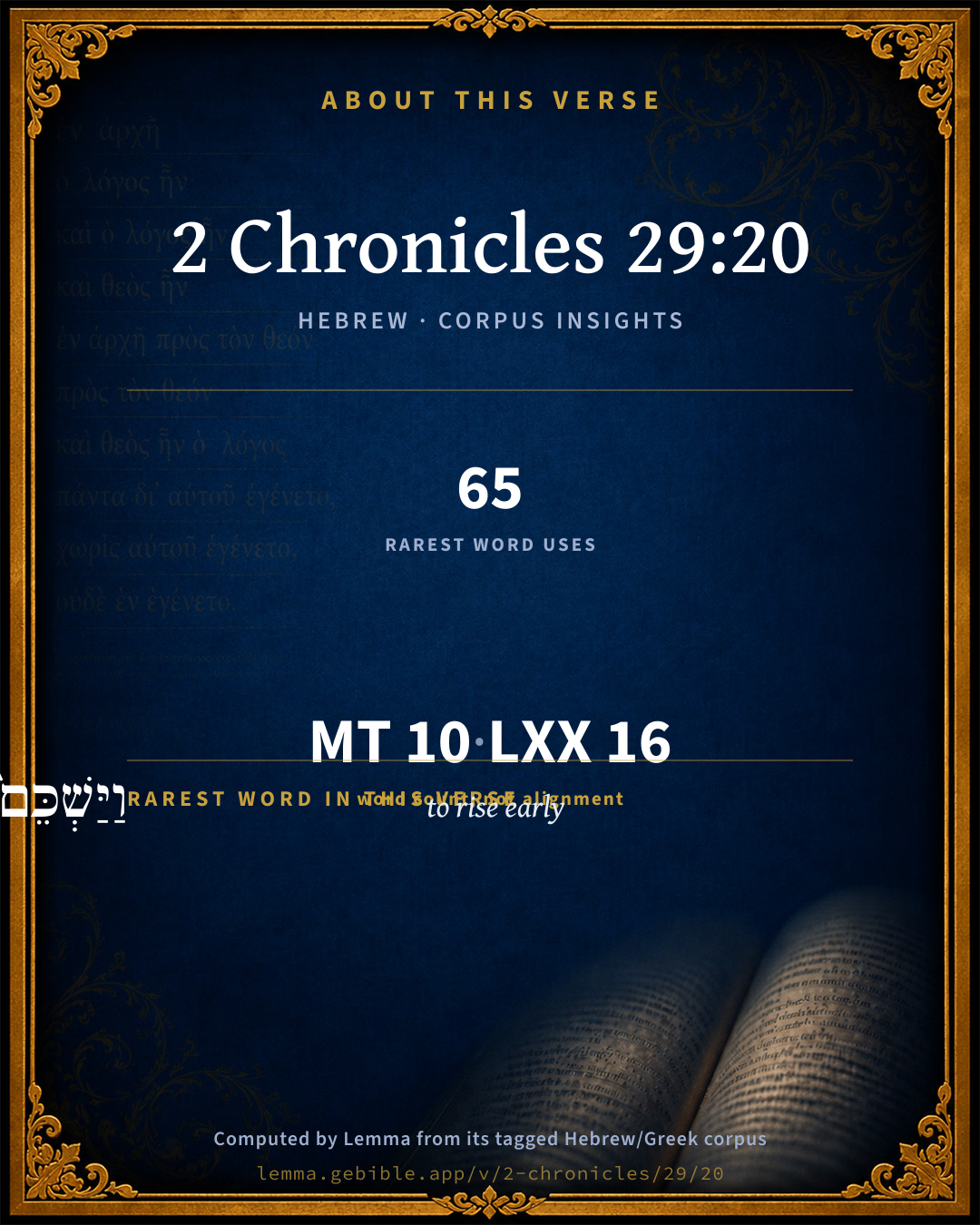
About this verse

These counts appear in no published source. They are computed here, from the morphology-tagged text and Lemma’s own curated glosses. What Lemma adds →

10
words
10
distinct lemmas
Historical
section

Grammatical profile

  • 3 verbs
  • 6 nouns
  • 1 particle

Verb forms

  • וַיַּשְׁכֵּם֙ Hiphil · Sequential Imperfect
  • וַיֶּאֱסֹ֕ף Qal · Sequential Imperfect
  • וַיַּ֖עַל Qal · Sequential Imperfect

Hebrew & Septuagint length

In English translation the verse runs 21 words from the Hebrew and 25 from the Septuagint (LXX English) — closely comparable.

A rough comparison of the two English renderings, which tokenize alike — not a word-level alignment.

Word counts can differ between the Hebrew and the Greek without any difference in meaning — e.g. the Hebrew direct-object marker אֵת has no separate Greek word, and Greek often adds the article ὁ.

In the original languages it is 10 Hebrew tokens and 16 Greek tokens — but the two are counted differently (Hebrew bundles its prefixes and suffixes into one token; the Greek is in lemma form), so that isn’t a like-for-like length.

Cross-references

4

Topical passages linked to 2 Chronicles 29:20 in the Treasury of Scripture Knowledge — connected by theme and wording, ordered by reader-vote popularity; previews shown in the World English Bible.

  • Genesis 22:3 Abraham rose early in the morning, and saddled his donkey, and took two of his young men with him, and Isaac his son. He split the wood for the burnt offering, and rose up, and went to the place of which God had told him.
  • Exodus 24:4 Moses wrote all the words of Yahweh, and rose up early in the morning, and built an altar under the mountain, and twelve pillars for the twelve tribes of Israel.
  • Joshua 6:12 Joshua rose early in the morning, and the priests took up the ark of Yahweh.
  • Jeremiah 25:4 Yahweh has sent to you all his servants the prophets, rising up early and sending them, (but you have not listened, nor inclined your ear to hear),

Cross-references courtesy of OpenBible.info (CC BY 4.0).

Hebrew and Greek witnesses Masoretic Hebrew ↔ Greek Septuagint

The same verse in the two great witnesses to the Old Testament, shown verse-for-verse.

These are two independent witnesses, not word-aligned to each other, and the Septuagint is shown in lemma (dictionary) form.

Hebrew 2 Chronicles 29:20 Masoretic · Westminster Leningrad Codex

וַיַּשְׁכֵּם֙ יְחִזְקִיָּ֣הוּ הַמֶּ֔לֶךְ וַיֶּאֱסֹ֕ף אֵ֖ת שָׂרֵ֣י הָעִ֑יר וַיַּ֖עַל בֵּ֥ית יְהוָֽה

Then Hezekiah the king arose early, and gathered the princes of the city, and went up to the house of Yahweh.

World English Bible · Public Domain

Greek LXX 2 Chronicles 29:20 Septuagint · lemma form

καί ὀρθρίζω εζεκιας ὁ βασιλεύς καί συνἄγω ὁ ἄρχων ὁ πόλις καί ἀναβαίνω εἰς οἶκος κύριος

And king Ezekias rose early in the morning, and gathered the chief men of the city, and went up to the house of the Lord.

LXX2012 (modern English Septuagint) · Public Domain

Hebrew: Westminster Leningrad Codex (CC BY 4.0). Greek: Septuagint (public domain); English from LXX2012 (modern English Septuagint) (Public Domain). How the Septuagint differs from the Hebrew →

Commentary

Notes on 2 Chronicles 29:20 from classic Christian and Jewish commentators (each source and its license shown beneath its notes). The classic Christian expositions comment on the surrounding passage and are grouped to its opening verse, so a note may address several verses; the Jewish commentaries on the Tanakh (Rashi and others) are per-verse, so they appear only where the commentator wrote on this verse.

Lemma curates 59 commentaries, every one of them public domain or Creative Commons licensed, each selected and text-cleaned for this edition rather than reprinted as found. About our sources →

Matthew Henry's Commentary

The temple being cleansed, we have here an account of the good use that was immediately made of it. A solemn assembly was called to meet the king at the temple, the very next day (Ch2 29:20); and very glad, no doubt, all the good people in Jerusalem were, when it was said, Let us go up to the house of the Lord, Psa 122:1. As soon as Hezekiah heard that the temple was ready for him he lost no time, but made it appear that he was ready for it. He rose early to go up to the house of the Lord, earlier on that day than on other days, to show that his heart was upon his work there. Now this day's work was to look two ways: -

I. Atonement must be made for the sins of the last reign. They thought it not enough to lament and forsake those sins, but they brought a sin-offering. Even our repentance and reformation will not obtain pardon but in and through Christ, who was made sin (that is, a sin-offering) for us. No peace but through his blood, no, not for penitents. Observe, 1. The sin-offering was for the kingdom, for the sanctuary, and for Judah (Ch2 29:21), that is, to make atonement for the sins of princes, priests, and people, for they had all corrupted their way. The law of Moses appointed sacrifices to make atonement for the sins of the whole congregation (Lev 4:13, Lev 4:14; Num 15:24, Num 15:25), that the national judgments which their national sins deserved might be turned away. For this purpose we must now have an eye to Christ the great propitiation, as well as for the remission and salvation of particular persons. 2. The law appointed only one goat for a sin-offering, as on the day of atonement (Lev 16:15) and on such extraordinary occasions as this, Num 15:24. But they here offered seven (Ch2 29:21), because the sins of the congregation had been very great and long continued in. Seven is a number of perfection. Our great sin-offering is but one, yet that one perfects for ever those that are sanctified. 3. The king and the congregation (that is, the representatives of the congregation) laid their hands on the heads of the goats that were for the sin-offering (Ch2 29:23), thereby owning themselves guilty before God and expressing their desire that the guilt of the sinner might be transferred to the sacrifice. By faith we lay our hands on the Lord Jesus, and so receive the atonement, Rom 5:11. 4. Burnt-offerings were offered with the sin-offerings, seven bullocks, seven rams, and seven lambs. The intention of the burnt-offerings was to give glory to the God of Israel, whom they owned as the only true God, which it was proper to do at the same time that they were by the sin-offering making atonement for their offences. The blood of those, as well as of the sin-offering, was sprinkled upon the altar (Ch2 29:22), to make reconciliation for all Israel (Ch2 29:24), and not for Judah only. Christ is a propitiation, not for the sins of Israel only, but of the whole world, Jo1 2:1, Jo1 2:2. 5. While the offerings were burning upon the altar the Levites sang the song of the Lord (Ch2 29:27), the Psalms composed by David and Asaph (Ch2 29:30), accompanied by the musical instruments which God by his prophets had commanded the use of (Ch2 29:25), and which had been long neglected. Even sorrow for sin must not put us out of tune for praising God. By faith we must rejoice in Christ Jesus as our righteousness; and our prayers and praises must ascend with his offering, to be accepted only in virtue of it. 6. The king and all the congregation testified their consent to and concurrence in all that was done, by bowing their heads and worshipping, expressing an awful veneration of the divine Majesty, by postures of adoration. This is taken notice of, Ch2 29:28-30. It is not enough for us to be where God is worshipped, if we do not ourselves worship him, and that not with bodily exercise only, which profits little, but with the heart.

II. The solemnities of this day did likewise look forward. The temple service was to be set up again, that it might be continually kept up; and this Hezekiah calls them to, Ch2 29:31. "Now that you have consecrated yourselves to the Lord - have both made an atonement and made a covenant by sacrifice, are solemnly reconciled and engaged to him - now come near, and bring sacrifices." Note, Our covenant with God must be pursued and improved in communion with him. Having consecrated ourselves, in the first place, to the Lord, we must bring the sacrifices of prayer, and praise, and alms, to his house. Now, in this work, it was found.

1. That the people were free. Being called to it by the king, they brought in their offerings, though not in such abundance as in the glorious days of Solomon (for Judah was now diminished, impoverished, and brought low), but according to what they had, and as much as one could expect considering their poverty and the great decay of piety among them. (1.) Some were so generous as to bring burnt-offerings, which were wholly consumed to the honour of God, and of which the offerer had no part. Of this sort there were seventy bullocks, 100 rams, and 200 lambs, Ch2 29:32. (2.) Others brought peace-offerings and thank-offerings, the fat of which was burnt upon the altar, and the flesh divided between the priests and the offerers, Ch2 29:35. Of this sort there were 600 oxen and 3000 sheep, Ch2 29:33. Perhaps the remembrance of their sin in sacrificing on the high places made them more willing to bring their sacrifices now to God's altar.

2. That the priests were few, too few for the service, Ch2 29:34. Many of them, it is likely, were suspended and laid aside as polluted and uncanonical, for having sacrificed to idols in the last reign, and the rest had not the zeal that one might have expected upon such an occasion. They thought that the king needed not to be so forward, that there was no necessity for such haste in opening the doors of the temple, and therefore they took no care to sanctify themselves, and being unsanctified, and so unqualified, they made that their excuse for being absent from the service; as if their offence would be their defence. It is recorded here, to the perpetual shame of the priests, that, though they were so well provided for out of the offerings of the Lord made by fire, yet they did not mind their business. Here was work to do, and there wanted proper hands to do it.

3. That the Levites were forward. They had been more upright in heart to sanctify themselves than the priests (Ch2 29:34), were better affected to the work and better prepared and qualified for it. This was their praise, and, in recompence for it, they had the honour to be employed in that which was the priests' work: they helped them to flay the offerings. This was not according to the law (Lev 1:5, Lev 1:6), but the irregularity was dispensed with in cases of necessity, and thus encouragement was given to the faithful zealous Levites and a just disgrace put upon the careless priests. What the Levites wanted in the ceremonial advantages of their birth and consecration was abundantly made up in their eminent qualifications of skill and will to do the work.

4. That all were pleased. The king and all the people rejoiced in this blessed turn of affairs and the new face of religion which the kingdom had put on, Ch2 29:36. Two things in this matter pleased them: - (1.) That it was soon brought about: The thing was done suddenly, in a little time, with a great deal of ease, and without any opposition. Those that go about the work of God in faith and with resolution will find that there is not that difficulty in it which they sometimes imagine, but it will be a pleasing surprise to them to see how soon it is done. (2.) That the hand of God was plainly in it: God had prepared the people by the secret influences of his grace, so that many of those who had in the last reign doted on the idolatrous altars were now as much in love with God's altar. This change, which God wrought on their minds, did very much expedite and facilitate the work. Let magistrates and ministers do their part towards the reforming of a land, and ascribe to him the glory of what is done, especially when it is done suddenly and is a pleasing surprise. This is the Lord's doing, and it is marvellous.

Matthew Henry's Commentary on the Whole Bible (1708–1710) — public domain (CC PDM 1.0). Text via the HelloAO Bible API.

Ellicott's Commentary for English Readers

THE CONSECRATION SACRIFICES (2Ch_29:20-30).

(20) Rose early.—Comp. Psa_5:3 : “Early in the j morning will I direct my prayer unto Thee.”

Gathered the rulers of the city.—Hezekiah assembled the chief men of Jerusalem, because there was no time to send out a general summons to the country, as he wished to proceed at once with the sacrifices of expiation.

Went up to the house.—So 2Ki_19:14; 2Ch_9:4, and often.

A Bible Commentary for English Readers, edited by Charles John Ellicott (1878–1897) — public domain. Text from a community e-Sword module.

Trapp's Complete Commentary

John Trapp

2Ch 29:20 Then Hezekiah the king rose early, and gathered the rulers of the city, and went up to the house of the LORD.

Ver. 20. Then Hezekiah the king rose early.] His zeal for God’s glory made his obedience prompt and present, ready and speedy. He could not rest till he had reformed, calling a Parliament here for the purpose.

John Trapp, A Commentary or Exposition upon All the Books of the Old and New Testament (1647–1656) — public domain. Text from a community e-Sword module.

Geneva Bible (1599)

Geneva Bible translators

By this manner of speech the Hebrews mean a certain diligence and speed to do a thing: and when there is no delay.

Geneva Bible (1599) marginal notes — public domain. Text via Bolls.life.

Jamieson, Fausset & Brown

Robert Jamieson, A. R. Fausset & David Brown

Then Hezekiah the king rose early, and gathered the rulers of the city--His anxiety to enter upon the expiatory service with all possible despatch, now that the temple had been properly prepared for it, prevented his summoning all the representatives of Israel. The requisite number of victims having been provided, and the officers of the temple having sanctified themselves according to the directions of the law, the priests were appointed to offer sacrifices of atonement successively, for "the kingdom," that is, for the sins of the king and his predecessors; for "the sanctuary," that is, for the sins of the priests themselves and for the desecration of the temple; "and for Judah," that is, for the people who, by their voluntary consent, were involved in the guilt of the national apostasy. Animals of the kinds used in sacrifice were offered by sevens, that number indicating completeness. The Levites were ordered to praise God with musical instruments, which, although not originally used in the tabernacle, had been enlisted in the service of divine worship by David on the advice of the prophets Gad and Nathan, as well calculated to animate the devotions of the people. At the close of the special services of the occasion, namely, the offering of atonement sacrifices, the king and all civic rulers who were present joined in the worship. A grand anthem was sung (Ch2 29:30) by the choir, consisting of some of the psalms of David and Asaph, and a great number of thank offerings, praise offerings, and freewill burnt offerings were presented at the invitation of the king.

Jamieson, Fausset & Brown — Commentary Critical and Explanatory on the Whole Bible (1871) — public domain (CC PDM 1.0). Text via the HelloAO Bible API.

The Cambridge Bible for Schools and Colleges

gen. ed. J. J. S. Perowne

20. the rulers of the city] R.V. the princes of the city.

20–30 (not in 2 Kin.). The Sevenfold Sacrifice for the Reconciliation of the People

The ritual of the sin offering is fully given in Leviticus 4. Ahaz had broken the covenant and Hezekiah’s sin offering was intended to atone for the breach.

The Cambridge Bible for Schools and Colleges (gen. ed. J. J. S. Perowne; Cambridge University Press, 1878–1918) — public domain. Text from a community e-Sword module.

John Gill's Exposition

So they killed the bullocks,.... The seven bullocks, that is, the priests killed them:

and the priests received the blood; into basins provided for that purpose:

and sprinkled it on the altar; according to the law of Moses, Lev 1:5 and so they did with the rams and lambs.

John Gill's Exposition of the Whole Bible (1746–1763) — public domain (CC PDM 1.0). Text via the HelloAO Bible API.

The Pulpit Commentary

The rulers of the city are its chief citizens Hebrew, ryih (2Ch_24:17 2Ch_30:1-4) who bring contributions of sacrificial victims, the word being generally rendered "princes,

Vers. 20-24.

Confession, propitiation, consecration.

By the sacrifices now offered to Jehovah, by the sin offerings and the burnt offerings, the king and the representatives of the people laying their hands upon the heads of the slain animals (ver. 23), three distinct sentiments were expressed, three several spiritual states were passed through confession of sin, atonement offered for sin, consecration of themselves to the service of God. Here was made the most public and solemn acknowledgment that could be made of the guilt which the nation had incurred by its apostasy; here was an appeal made to the mercy of God in his appointed way of sacrificing the goats and of laying the hand upon their heads; and here was, through the burnt offerings, a formal and deliberate dedication of themselves to Jehovah for the future. These three experiences are the radical and essential experiences through which penitent and godly men must always pass.

I CONFESSION. Not always, not often national, as on this occasion (text). Net always, not often now, admission of idolatrous reaction. But always confession of sin of departure from God, of the neglect of his holy will, of a rebellious exalting of our will against his, of unlikeness to him in the spirit we have been breathing and in the principles on which we have been acting, of doing or saying or being that which has grieved his Holy Spirit. And our confession of sin is likely to be heard and accepted, not because it is couched in the most approved language, but because it is the most simple and honest utterance of our hearts.

II PROPITIATION. Not that God asks now of us a sacrifice for sin. There has been "one sacrifice offered for sins for ever." He is "the Propitiation for the sins of the whole world." But we come to plead that one Sacrifice as offered for our sins; we come to God to pray that that one Propitiation may be accepted on our behalf. We come to "lay our hand on that dear head" of Christ, the Lamb of God. We ask that the abounding and abiding mercy of God may, for his sake, cover our guilt and rest upon our soul And thus, by a living faith, we apply and appropriate to ourselves "the common salvation that "righteousness which is through the faith of Christ." Thus is our sin "borne away" into the land of utter forgetfulness, and we ourselves are "brought nigh by the blood of Christ.

III CONSECRATION. The consumption of the entire animal in the burnt offering symbolized the entire consecration of the offerer to the Lord. This was the significance of those offerings now presented (ver. 24). Hezekiah and his people now offered themselves anew unto the Lord God of their fathers. Their sin being purged, themselves having been forgiven and accepted, they dedicated themselves to God for the coming time. With us:

1. Consecration attends our entrance upon the Divine life; when we seekthe mercy of God in Christ Jesus, we "yield ourselves unto God as those alive from the dead.

1. Consecration is a spiritual act continually renewed. It should be an act inwhich we offer to our Divine Redeemer our whole selves;

1. our entire nature (body and spirit);

2. our whole life, thenceforwards at all times, in every sphere, under all conditions. C,

Vers. 20-36.

The re-dedication of the temple.

I THE TIME OF THE CEREMONY. Early on the following morning. Hezekiah lost not a moment in entering upon the good work his heart contemplated (ver. 10), rising up with next day"s dawn, gathering the rulers of the city, and proceeding with them to the house of the Lord. In this he acted in accordance with Jehovah"s instructions to Moses at Sinai; (Exo_34:2) with the example of Abraham, (Gen_22:2) Jacob, (Gen_28:18) Moses, (Exo_24:4) Joshua, (Jos_3:1) (Job_1:5) and other good men who selected the morning hours for executing good resolutions, and especially for acts of devotion; with the practice of God himself, who had been ever forward in blessing his people by sending to them his messengers the prophets (2Ch_36:15; Jer_7:13, 25 25:3, 4) Perhaps Hezekiah also felt that if wicked men rose up with the dawn and even "prevented" the daylight in order to prosecute their nefarious works, (Job_24:14) yea, that his own subjects had risen up early to corrupt themselves, (Zep_3:7) much more ought he to bestir himself and awake up early to begin the splendid work of temple-dedication on which he had resolved.

II THE PARTIES TO THE CEREMONY.

1. The king himself. Hezekiah, as the vicegerent of Jehovah and head of Jehovah"s people, led the way. This the sort of kingship after which sovereigns should aspire kingship in works of faith and labours of love.

2. The princes of the city again, in their individual capacities and in their representative characters joined in the ceremonial. So had they done at, (Exo_24:11) and in the wilderness; (Num_21:18) in the days of Solomon, (2Ch_5:2) and in those of Jehoiada. (2Ch_23:20) Happy is that nation whose nobility are ever foremost in noble deeds!

3. The priests and the Levites were present to do their respective offices, to sacrifice upon the altars of Jehovah, and to play upon the instruments of David; two necessary parts in all Old Testament worship the former to make atonement, the latter to express that which should ever be its fruit. (Rom_5:11)

4. The people, or a portion of them, were there as assenting parties to the transaction.

III THE STEPS IN THE CEREMONY.

1. The presentation of sacrifice.

(1) Burnt offerings. Seven bullocks, seven rams, and seven lambs were slain in succession upon the altar in the fore court, the blood of the slain victims being caught up by the priests in a basin and sprinkled on the altar, while their carcases were retained to be consumed by fire upon the altar after all the other victims had been slain.

(2) Sin offerings. Seven he-goats were next presented before the king and the congregation, the priests" hands laid upon them if not with formal confession of sin, at least symbolizing its transference to the animals their lives taken, and their blood sprinkled by the priests upon the altar. This done, the carcases of the burnt offerings were consumed by fire.

2. The accompaniment of music. Hezekiah reinstituted the Levitical service of music, according to the Divine ordinance communicated through David, Gad, and Nathan; (1Ch_23:5) and on this particular occasion "he set the Levites in the house of the Lord with cymbals, with psalteries, and with harps;" and "the priests with the trumpets". (1Ch_15:16, 1Ch_15:24) When the burnt offering began, i.e. either when the slaying of the victims commenced, or when the carcases were lifted to the altar to be consumed, the temple courts rang with the strains of instrumental and vocal music singers sang, and the trumpeters sounded until the offering was finished, until the last ember died upon the altar, and the last wreath of smoke vanished in the air. Meanwhile the congregation, standing round in the court as spectators, "worshipped.

IV THE MEANING OF THE CEREMONY.

1. Confession of sin. This idea was generally comprehended in the presentation of sin offerings, and particularly set" forth in the imposition of the officiating priest"s hands upon the victim"s head. The sin thus confessed was the sin of the nation as represented by its royal house, its sanctuary, and its people. All of these, the occupants of the throne and the members of the royal family, the ministers of the sanctuary, the priestly order and the Levitical alike, the common people of the realm, both in Israel and in Judah, had been guilty of trespass and apostasy.

2. Propitiation for guilt. The blood of the sin offering, when poured out before and sprinkled on the horns of the altar in particular when done in the holy of holies was designed to make atonement for the people"s sins, to cover up from the eyes of a holy God the wickedness of which they had been guilty, and so to reconcile them to God. (Lev_6:30)

3. Expression of self-surrender. This was symbolized by the burning of the carcases of both the sin and the burnt offerings. As the bodies of the animals whose blood had been brought within the sanctuary for reconciliation were all devoted to Heaven or given up as food to Jehovah, so the nation whose guilt had been put away by that same blood of atonement surrendered itself to Jehovah to be consumed by the fire of a new zeal for his glory.

4. Utterance of thanksgiving. This the significance of the musical accompaniment to the sacrificial ritual. It gave an outlet to the gratitude and joy of the reconciled and pardoned worshipper.

V THE CLOSE OF THE CEREMONY.

1. A national act of worship. The king and all that were present with him bowed themselves, and worshipped" (ver. 29). It was worship of the right sort:

(1) unanimous sovereign and subjects were of one mind;

(2) humble they bowed themselves;

(3) joyous they sang praises to the Lord, the Levites leading, in the words of David and Asaph.

1. A royal word of invitation. "Hezekiah answered and said" (ver. 31) declaring the fact of their consecration to Jehovah, and desiring them to show their acquiescence in the same by personal acts of worship and sacrifice near, and bring sacrifices and thank offerings unto the

2. Lord." Practice the best vindication of profession; obedience (Jam_2:14) the only true justification of faith; (Rom_16:19) the sacrifice of one"s wealth the most reliable index that one has consecrated his heart.

3. A popular outburst of liberality. "The congregation brought in sacrifices and thank offerings.

(1) Promptly, on the spot, without delay, as if they had been only waiting for such an invitation. It is well to be prepared for giving before the opportunity of giving comes. Preparation makes giving easy. (1Co_16:2)

(2) Freely: "as many as were of a willing heart brought burnt offerings." Considering the number of these latter, the people generally must have been well disposed towards the movement. Voluntariness indispensable to all acceptable religious giving. (2Co_8:12)

(3) Largely: "the number of the burnt offerings was seventy bullocks, a hundred rams, and two hundred lambs," while the consecrated things," or other offerings, were six hundred oxen and three thousand sheep." Indeed, so abundant were the sacrificial victims that the few priests who had taken part in the ceremonial were unable to cope with the task of preparing them for the altar, and had to call in the assistance of the Levites until more priests were sanctified. Extraordinary emergencies in Church as in state call for and allow extraordinary measures. Where the services of unordained pastors and teachers cannot by obtained, those of unordained may be lawfully employed. Cf. the liberality exemplified by the Israelites at the erection of the tabernacle (Exo_35:21-29; Num_7:1-89 Num_31:48-54) and the temple. (1Ch_29:6-9, 1Ch_29:16, 1Ch_29:17)

Lessons.

1. Union is strength, in religion as in other things.

2. The inspiration of all acts connected with religion should be the glory ofGod.

3. In religion all things are of God, the preparation of the heart no less thanthe direction of the hand. W.

The Pulpit Commentary (1880–1919), ed. H.D.M. Spence-Jones & Joseph S. Exell — public domain. Text from a community e-Sword module.

Kretzmann's Popular Commentary

Paul E. Kretzmann

The Service of the Temple Set in Order

v. 20. Then Hezekiah the king rose early, full of anxious zeal to complete the cleansing of the Temple, and gathered the rulers of the city, and went up to the house of the Lord. Since all the people of his kingdom could not be reached, he wanted at least the princes of Jerusalem to be the representatives of the people.

v. 21. And they brought seven bullocks, and seven rams, and seven lambs, and seven he-goats, the number seven being the sacred number, for a sin offering for the kingdom, for the sins of the king and his predecessors, and for the Sanctuary, for the priests themselves and for the desecration of the Sanctuary, and for Judah, for all the members of the nation who had consented to the introduction of idolatry. And he commanded the priests, the sons of Aaron, to offer them on the altar of the Lord, to make an atonement for all the trespasses and sins as indicated.

v. 22. So they killed the bullocks, and the priests received the blood and sprinkled it on the altar, as the ritual of sacrifices required, Lev 8:14-24; likewise, when they had killed the rams, they sprinkled the blood upon the altar. They killed also the lambs, and they sprinkled the blood upon the altar.

v. 23. And they brought forth the he-goats for the sin-offering before the king and the congregation; and they laid their hands upon them, thus signifying that the act of atonement, while made directly by the princes, was done for the entire nation.

v. 24. And the priests killed them; and they made reconciliation with their blood upon the altar, for the purpose of obtaining a purification for sin, Lev 14:20, to make an atonement for all Israel; for the king commanded that the burnt offering and the sin-offering should be made for all Israel. The sacrifices agreed, in general, with the precepts of Leviticus 4.

v. 25. And he set the Levites, those designated for that work, 1Ch 16:4; 1Ch 25:6, in the house of the Lord with cymbals, with psalteries, and with harps, the former being a guitarlike zither or lute, and the latter a small harp, according to the commandment of David and of Gad, the king’s seer, and Nathan, the prophet, for the latter two had advised and assisted David in arranging the Temple service; for so was the commandment of the Lord by His prophets, the Lord Himself having acted through the agency of His prophets.

v. 26. And the Levites stood with the instruments of David, those invented and introduced by David, and the priests with the trumpets, for the blowing of these was their special privilege, Numbers 10.

v. 27. And Hezekiah commanded to offer the burnt offering upon the altar, when everything was in readiness for the service. And when the burnt offering began, the song of the Lord began also with the trumpets, and with the instruments ordained by David, king of Israel, the instruments of David governed and led the entire orchestra as it played with full force in the intervals of the psalm or psalms.

v. 28. And all the congregation worshiped, and the singers sang, the psalm was intoned, and the trumpeters sounded; and all this continued until the burnt offering was finished, the musical performance of praise being continued during the whole time of the offering.

v. 29. And when they had made an end of offering, the king and all that were present with him bowed themselves and worshiped, in grateful adoration.

v. 30. Moreover, Hezekiah the king and the princes commanded, they had done so before the beginning of the service, the Levites to sing praise unto the Lord with the words of David, some of the psalms composed by the royal singer, and of Asaph, the seer. And they sang praises with gladness, literally, "unto gladness," until their hearts were lifted up in ecstasy; and they bowed their heads and worshiped.

v. 31. Then Hezekiah answered and said, Now ye have consecrated yourselves unto the Lord, by having filled their hands with the sacrifices of atonement; come near and bring sacrifices and thank-offerings into the house of the Lord. The sin and trespass-offerings having been made in order to remove the guilt of the king and the people, peace-offerings were now in order to establish the relation of the covenant between Jehovah and His people once more. And the congregation brought in sacrifices and thank offerings, with which sacrificial meals were connected; and as many as were of a free heart, in making vows to Jehovah, burnt offerings.

v. 32. And the number of the burnt offerings which the congregation brought was threescore and ten bullocks, an hundred rams, and two hundred lambs; all these were for a burnt offering to the Lord, presented by the rulers of the people for the nation or congregation.

v. 33. And the consecrated things, the animals presented as thank-offerings, were six hundred oxen and three thousand sheep.

v. 34. But the priests were too few, so that they could not flay all the burnt offerings, a task which they were supposed to perform themselves; wherefore their brethren, the Levites, did help them, it being a case of unavoidable necessity, of an emergency, till the work was ended, and until the other priests, those who came in from the outlying cities, had sanctified themselves; for the Levites were more upright in heart to sanctify themselves than the priests, they displayed greater alacrity than the priests, probably because the latter had become more deeply involved in idolatry under Ahaz.

v. 35. And also the burnt offerings were in abundance, that was the second reason why the Levites were drafted into service, with the fat of the peace-offerings and the drink-offerings for every burnt offering. So the service of the house of the Lord was set in order, the newly consecrated Temple reopened for the service of Jehovah.

v. 36. And Hezekiah rejoiced, and all the people, that God had prepared the people, had made their hearts willing with such promptness; for the thing was done suddenly, with unexpected readiness on the part of the majority of the nation. One of the surest proofs of true piety is the rejection of idolatry in every form and the eager participation in the worship of the true God.

Paul E. Kretzmann, Popular Commentary of the Bible (1921–1924) — public domain. Text from a community e-Sword module.

unfoldingWord translationNotes

Door43 World Missions Community

the house of Yahweh

The word "house" represents the temple. AT: "the temple of Yahweh" (See: Metonymy)

translationWords

cow

ewe

goat

sin offering

kingdom

command

Aaron

altar

unfoldingWord translationNotes — © Distant Shores Media and the Door43 World Missions Community, licensed CC BY-SA 4.0. Source: git.door43.org/Door43/en_tn.

Lesson kit

Teaching starters — assembled from the data on this page, not authored interpretation. Every prompt links to the verse data it draws on. Edit before teaching.

2 Chronicles, in the Historical, opens this verse with 10 words (10 distinct Hebrew lemmas). Its most distinctive word is shâkam (“to rise early”). A historical commentator’s framing appears above. Read the whole chapter for the surrounding context.

Discussion questions

  1. How does “to rise early” (shâkam) shape what this verse is saying?
  2. How does Genesis 22:3, which shares this passage’s theme, read alongside this verse?
  3. The translations on this page render this verse differently — a whole-verse word diff, not a word-by-word alignment. What might account for the different wordings?
  4. «וַיַּשְׁכֵּם֙» is a Hiphil Sequential Imperfect verb. How does that grammatical form shape the action described?
  5. Compare how Matthew Henry's Commentary and Ellicott's Commentary for English Readers read this verse. Where do they agree or differ?

Things to notice

Reading settings

Reading text

Shown beneath each verse's original-language words.

Old Testament
Old Testament edition

Read the OT as the Masoretic Hebrew (MT) or the Greek Septuagint (LXX).

English shown for the Greek Septuagint (in the Hebrew ↔ Greek comparison).

Comparing translations? Open the Compare panel on any verse page to stack up to four side by side.