Numbers 21:16

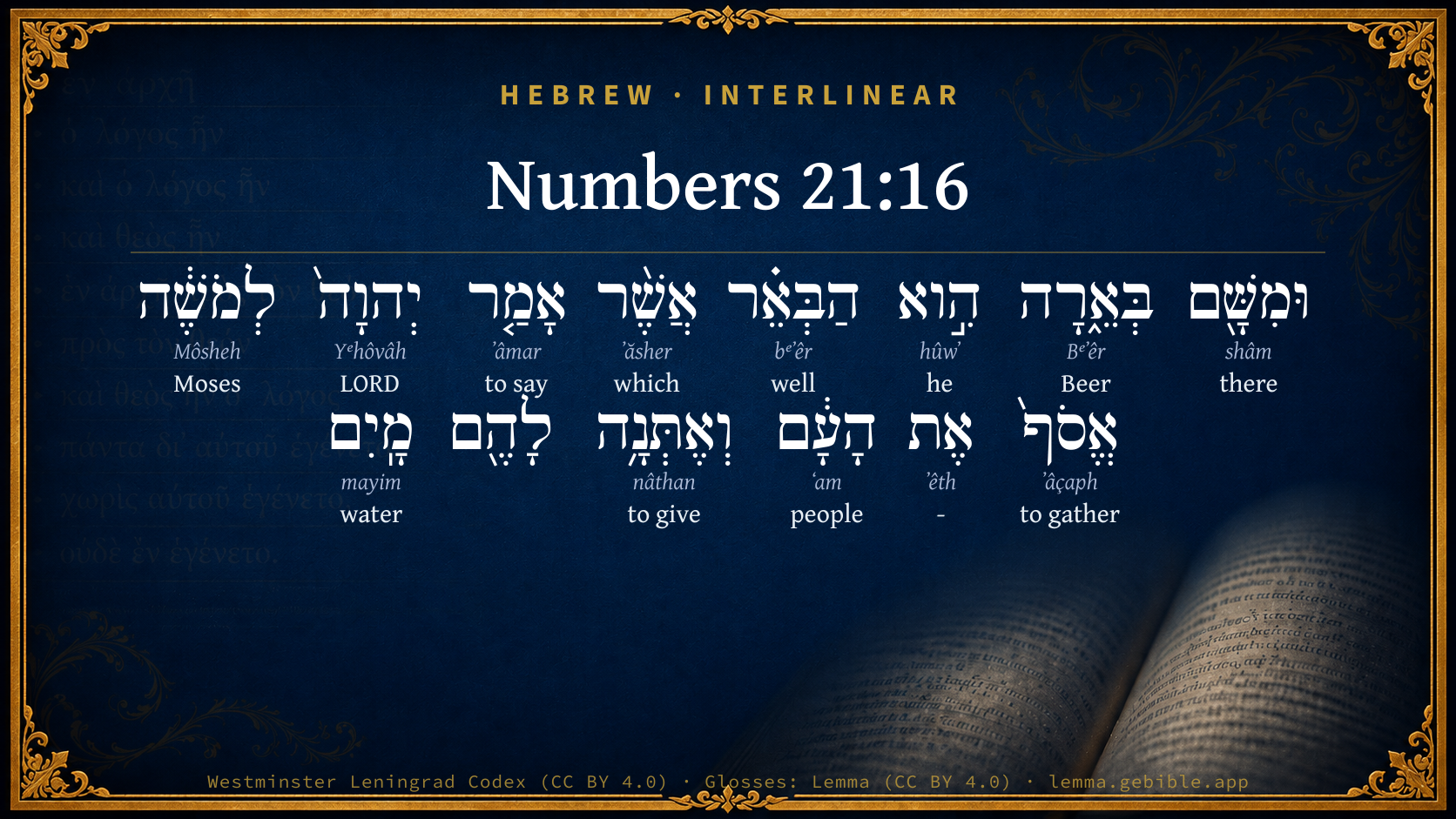
Hebrew (Westminster Leningrad Codex) Numbers 21:16 appears in the Hebrew Old Testament. The text above is from the Westminster Leningrad Codex. Each word links to its Strong’s number, a concise gloss, and parsing drawn from the Open Scriptures Hebrew Bible morphology. Click any word for its full Brown-Driver-Briggs (BDB) entry.
Download image
Cite this verse

Numbers 21:16 (World English Bible). Public Domain. Lemma interlinear Bible study tool, https://lemma.gebible.app/v/numbers/21/16.

Show BibTeX & RIS
BibTeX
RIS
English Translation
From there they traveled to Beer: that is the well of which Yahweh said to Moses, Gather the people together, and I will give them water.
World English Bible · Public Domain
Highlights
  • 1 first appearance in the Hebrew Bible
Full analysis ↓
Download a study sheet

One document with this verse’s original text, its word-by-word gloss line, the meaning frame, cross-references with their text, attributed commentary, and full source and license credits — printable, and it pastes into notes with its structure intact.

This verse Autodidact and up

Study sheet (.html) Plain text (.txt)

A passage Seminary Student

Up to 50 verses in one chapter. A passage sheet keeps up to 6 commentary sources and 12 cross-references per verse, in the order this page ranks them, and says so on the sheet whenever that leaves anything out. Ask for a single verse and you get the Autodidact verse sheet above.

Everything on this page stays free to read, with no account — the sheet is a download of what is already on screen, not access to it.

Want to remove ads? Support Godless Engineer
Compare translations 3

The same verse in 3 English versions, stacked beneath the original-language interlinear above. Click any original word for its lexicon entry.

Each is an independent rendering of the whole verse — the interlinear is not word-aligned to these translations.

Highlighted words mark where these versions differ — a whole-verse word diff, not a word-by-word alignment.

  • World English Bible Public Domain
    From there they traveled to Beer: that is the well of which Yahweh said to Moses, Gather the people together, and I will give them water.
  • King James Version Public Domain
    And from thence they went to Beer: that is the well whereof the LORD spake unto Moses, Gather the people together, and I will give them water.
  • unfoldingWord Literal Text CC BY-SA 4.0
    And from there Beer. It the well where Yahweh said to Moses, “Gather the people, and I will give water to them.”

unfoldingWord Literal Text — © unfoldingWord, licensed CC BY-SA 4.0. Word-aligned USFM3 via Door43 (git.door43.org/unfoldingWord/en_ult).

Versions to compare (up to 4)

3 of 4 selected

Show all 18 translations

Every available English version of this verse, each an independent rendering of the whole verse.

  • World English Bible Public Domain
    From there they traveled to Beer: that is the well of which Yahweh said to Moses, Gather the people together, and I will give them water.
  • Berean Standard Bible Public Domain
    From there they went on to Beer, the well where the LORD said to Moses, “Gather the people so that I may give them water.”
  • Majority Standard Bible Public Domain
    From there they went on to Beer, the well where the LORD said to Moses, “Gather the people so that I may give them water.”
  • King James Version Public Domain
    And from thence they went to Beer: that is the well whereof the LORD spake unto Moses, Gather the people together, and I will give them water.
  • American Standard Version (1901) Public Domain
    And from thence `they journeyed' to Beer: that is the well whereof Jehovah said unto Moses, Gather the people together, and I will give them water.
  • Revised Version (1885) Public Domain
    And from thence they journeyed to Beer: that is the well whereof the LORD said unto Moses, Gather the people together, and I will give them water.
  • Geneva Bible (1599) Public Domain
    And from thence they turned to Beer: the same is the well where the Lord said vnto Moses, Assemble the people, and I wil giue them water.
  • Douay-Rheims (1899) Public Domain
    When they went from that place, the well appeared whereof the Lord said to Moses: Gather the people together, and I will give them water.
  • Young's Literal Translation Public Domain
    And from thence `they journeyed' to Beer; it `is' the well `concerning' which Jehovah said to Moses, `Gather the people, and I give to them -- water.'
  • Literal Standard Version CC BY-SA 4.0
    And from there [they journeyed] to Beer; it [is] the well [concerning] which YHWH said to Moses, “Gather the people, and I give water to them.”
  • Unlocked Literal Bible CC BY-SA 4.0
    From there they traveled to Beer, the well where Yahweh said to Moses, “Gather the people together for me to give them water.”
  • unfoldingWord Literal Text CC BY-SA 4.0
    And from there Beer. It the well where Yahweh said to Moses, “Gather the people, and I will give water to them.”
  • Darby Bible Public Domain
    And from thence to Beer: that is the well of which Jehovah spoke to Moses, Assemble the people, and I will give them water.
  • World Messianic Bible Public Domain
    From there they traveled to Beer; that is the well of which the LORD said to Moses, “Gather the people together, and I will give them water.”
  • Webster's Bible Public Domain
    And from thence they went to Beer: that is the well of which the LORD spoke to Moses, Assemble the people, and I will give them water.
  • Free Bible Version CC BY-SA 4.0
    From there they moved on to Beer, the well where the Lord told Moses, “Have the people gather together so I can give them water.”
  • Bible in Basic English Public Domain
    From there they went on to Beer, the water-spring of which the Lord said to Moses, Make the people come together and I will give them water.
  • JPS Tanakh (1917) Public Domain
    And from thence to Beer; that is the well whereof the LORD said unto Moses: 'Gather the people together, and I will give them water.'

Literal Standard Version (2020), Covenant Press — licensed CC BY-SA 4.0. Text via the HelloAO Bible API (eBible.org). Unlocked Literal Bible (unfoldingWord) — licensed CC BY-SA 4.0. Text via the HelloAO Bible API (eBible.org). unfoldingWord Literal Text — © unfoldingWord, licensed CC BY-SA 4.0. Word-aligned USFM3 via Door43 (git.door43.org/unfoldingWord/en_ult). Free Bible Version, Dr. Jonathan Gallagher — licensed CC BY-SA 4.0. Text via the HelloAO Bible API (eBible.org).

Word by word

More ways to search: Search by grammar → Find every occurrence → Compare this word →

Practice this passage: Drill this verse → Learn its vocabulary →

בְּאֵ֑רָה
Bᵉʼêr
H876
“Beer · toward”
Noun, Proper + Suffix, Demonstrative
Part of Speech
Noun
Type
Proper
Full BDB Definition

Origin: the same as H875

TWOT: None

Beer = "well" - an oasis rest in desert during the Exodus - a city west of Hebron
  1. וּמִשָּׁ֖ם shâm H8033 “and · from · there” Conjunction + Preposition + Adverb
  2. הִ֣וא hûwʼ H1931 “he” Pronoun, Personal, 3rd Person, Feminine, Singular
  3. הַבְּאֵ֗ר bᵉʼêr H875 “the · well” Particle, Definite Article + Noun, Common, Feminine, Singular, Absolute
  4. אֲשֶׁ֨ר ʼăsher H834 “which” Particle, Relative
  5. אָמַ֤ר ʼâmar H559 “to say” Verb, Qal, Perfect, 3rd Person, Masculine, Singular
  6. יְהוָה֙ Yᵉhôvâh H3068 “LORD” Noun, Proper
  7. לְמֹשֶׁ֔ה Môsheh H4872 “to/for · Moses” Preposition + Noun, Proper
  8. אֱסֹף֙ ʼâçaph H622 “gather” Verb, Qal, Imperative, 2nd Person, Masculine, Singular
  9. אֶת ʼêth H853 “-” Particle, Direct Object
  10. הָעָ֔ם ʻam H5971 “the · people” Particle, Definite Article + Noun, Common, Masculine, Singular, Absolute
  11. וְאֶתְּנָ֥ה nâthan H5414 “and · to give” Conjunction + Verb, Qal, Cohortative, 1st Person, Common, Singular
  12. מָֽיִם mayim H4325 “water(s)” Noun, Common, Masculine, Plural, Absolute

About this verse

These counts appear in no published source. They are computed here, from the morphology-tagged text and Lemma’s own curated glosses. What Lemma adds →

14
words
13
distinct lemmas
Pentateuch
section

Notable vocabulary

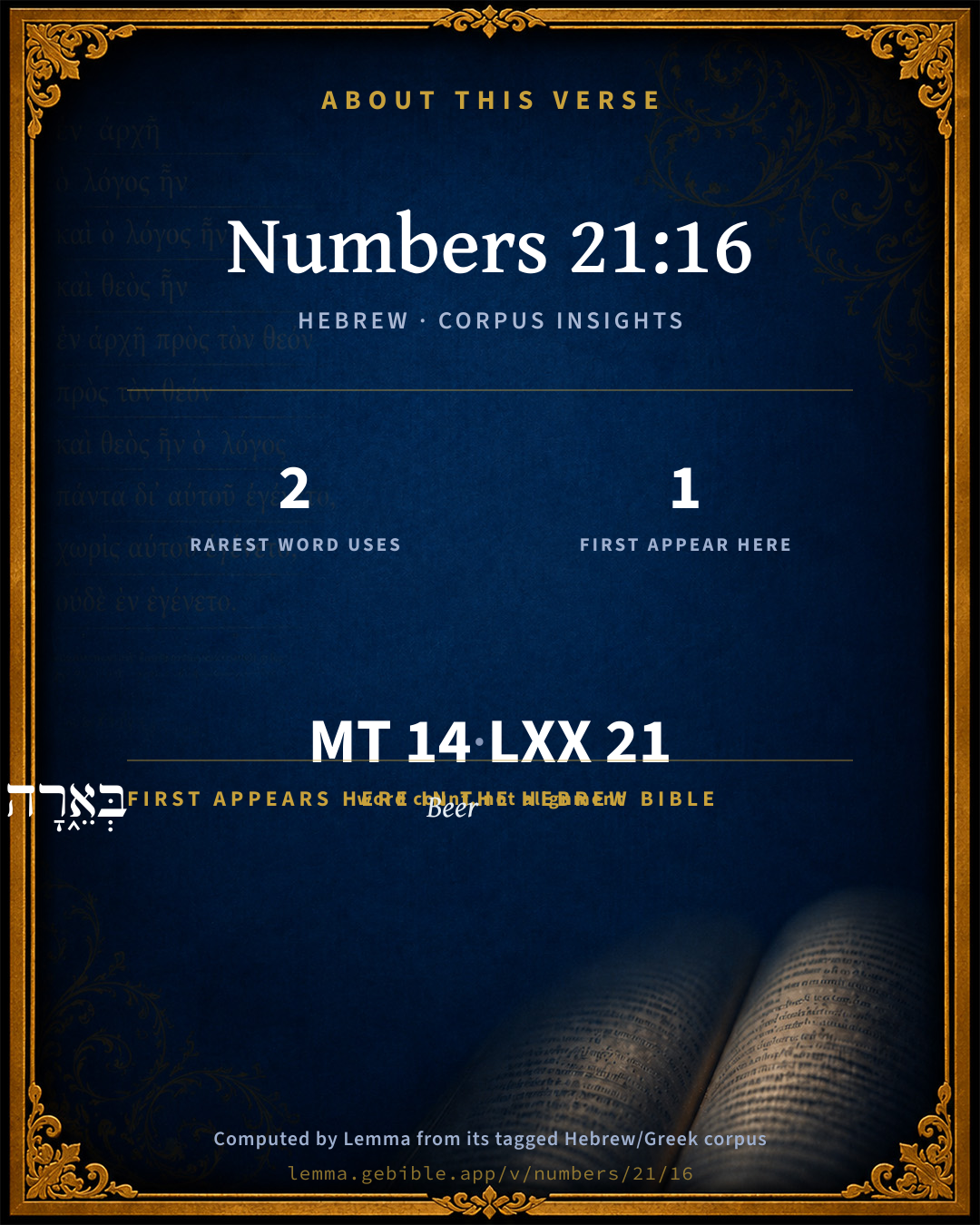
The rarest word here is בְּאֵ֑רָה Beer H876 — appearing just 2 times in the whole Hebrew Bible.

First appearance in Scripture

This word makes its first canonical appearance in the Hebrew Bible here:

  • בְּאֵ֑רָה Beer H876

Shared distinctive vocabulary

בְּאֵ֑רָה Beer H876 occurs in 2 verses of the Hebrew Bible. Also found in:

Grammatical profile

  • 3 verbs
  • 6 nouns
  • 1 pronoun
  • 1 preposition
  • 1 adverb
  • 2 particles

Verb forms

  • אָמַ֤ר Qal · Perfect
  • אֱסֹף֙ Qal · Imperative
  • וְאֶתְּנָ֥ה Qal · Cohortative

Hebrew & Septuagint length

In English translation the verse runs 26 words from the Hebrew and 29 from the Septuagint (LXX English) — closely comparable.

A rough comparison of the two English renderings, which tokenize alike — not a word-level alignment.

Word counts can differ between the Hebrew and the Greek without any difference in meaning — e.g. the Hebrew direct-object marker אֵת has no separate Greek word, and Greek often adds the article ὁ.

In the original languages it is 14 Hebrew tokens and 21 Greek tokens — but the two are counted differently (Hebrew bundles its prefixes and suffixes into one token; the Greek is in lemma form), so that isn’t a like-for-like length.

Cross-references

13

Topical passages linked to Numbers 21:16 in the Treasury of Scripture Knowledge — connected by theme and wording, ordered by reader-vote popularity; previews shown in the World English Bible.

  • Numbers 20:8 Take the rod, and assemble the congregation, you, and Aaron your brother, and speak you to the rock before their eyes, that it give forth its water; and you shall bring forth to them water out of the rock; so you shall give the congregation and their cattle drink.
  • Isaiah 12:3 Therefore with joy you shall draw water out of the wells of salvation.
  • Isaiah 41:17–18 The poor and needy seek water, and there is none, and their tongue fails for thirst; I, Yahweh, will answer them, I, the God of Israel, will not forsake them.
  • Exodus 17:6 Behold, I will stand before you there on the rock in Horeb. You shall strike the rock, and water will come out of it, that the people may drink." Moses did so in the sight of the elders of Israel.
  • Judges 9:21 Jotham ran away, and fled, and went to Beer, and lived there, for fear of Abimelech his brother.
  • Isaiah 43:20 The animals of the field shall honor me, the jackals and the ostriches; because I give waters in the wilderness, and rivers in the desert, to give drink to my people, my chosen,
  • Revelation 21:6 He said to me, "It is done! I am the Alpha and the Omega, the Beginning and the End. I will give freely to him who is thirsty from the spring of the water of life.
  • Revelation 22:1 He showed me a river of water of life, clear as crystal, proceeding out of the throne of God and of the Lamb,
  • Revelation 22:17 The Spirit and the bride say, "Come!" He who hears, let him say, "Come!" He who is thirsty, let him come. He who desires, let him take the water of life freely.
  • Isaiah 49:10 They shall not hunger nor thirst; neither shall the heat nor sun strike them: for he who has mercy on them will lead them, even by springs of water will he guide them.
  • John 4:10 Jesus answered her, "If you knew the gift of God, and who it is who says to you, 'Give me a drink,' you would have asked him, and he would have given you living water."
  • John 4:14 but whoever drinks of the water that I will give him will never thirst again; but the water that I will give him will become in him a well of water springing up to eternal life."
  • John 7:37–39 Now on the last and greatest day of the feast, Jesus stood and cried out, "If anyone is thirsty, let him come to me and drink!

Cross-references courtesy of OpenBible.info (CC BY 4.0).

Hebrew and Greek witnesses Masoretic Hebrew ↔ Greek Septuagint

The same verse in the two great witnesses to the Old Testament, shown verse-for-verse.

These are two independent witnesses, not word-aligned to each other, and the Septuagint is shown in lemma (dictionary) form.

Hebrew Numbers 21:16 Masoretic · Westminster Leningrad Codex

וּמִשָּׁ֖ם בְּאֵ֑רָה הִ֣וא הַבְּאֵ֗ר אֲשֶׁ֨ר אָמַ֤ר יְהוָה֙ לְמֹשֶׁ֔ה אֱסֹף֙ אֶת הָעָ֔ם וְאֶתְּנָ֥ה לָהֶ֖ם מָֽיִם

From there they traveled to Beer: that is the well of which Yahweh said to Moses, Gather the people together, and I will give them water.

World English Bible · Public Domain

Greek LXX Numbers 21:16 Septuagint · lemma form

καί ἐκεῖθεν ὁ φρέαρ οὗτος εἰμί ὁ φρέαρ ὅς εἶπον κύριος πρός μωυσῆς συνἄγω ὁ λαός καί δίδωμι αὐτός ὕδωρ πίνω

And thence they came to the well; this is the well of which the Lord said to Moses, Gather the people, and I will give them water to drink.

LXX2012 (modern English Septuagint) · Public Domain

Hebrew: Westminster Leningrad Codex (CC BY 4.0). Greek: Septuagint (public domain); English from LXX2012 (modern English Septuagint) (Public Domain). How the Septuagint differs from the Hebrew →

Targum (Aramaic paraphrase)

2

The Targum is the ancient Jewish Aramaic paraphrase of the Hebrew Scriptures — an interpretive translation, not the Hebrew text itself. Onkelos (literal) and Pseudo-Jonathan (expansive) render the Torah, and Jonathan the Prophets. Coverage is partial: where no permissively-licensed English translation exists for a verse, only the Aramaic is shown. This is verse-level text, not a word-by-word alignment to the Hebrew.

  1. Targum Onkelos Torah (Genesis–Deuteronomy)
    וּמִתַּמָן אִתְיְהִיבַת לְהוֹן בֵּירָא הִיא בֵירָא דִי אֲמַר יְיָ לְמשֶׁה כְּנוֹשׁ יָת עַמָא וְאֶתֵּן לְהוֹן מַיָא

    (no public-domain English translation for this verse)

    Targum Onkelos — Aramaic: “Onkelos Genesis” (public domain); “Onkelos Exodus” (public domain); “Onkelos Leviticus” (public domain); “Onkelos Numbers” (public domain); “Onkelos Deuteronomy” (public domain). English: “Sefaria Community Translation” (CC0 1.0 (public-domain dedication)); “J.W. Etheridge. The Targums of Onkelos and Jonathan Ben Uzziel on the Pentateuch. London: Longmans, Green, 1862” (public domain). Text via Sefaria.

  2. Targum Pseudo-Jonathan Torah (Genesis–Deuteronomy)
    וּמִתַּמָן אִתְיְהִיבַת לְהוֹן בֵּירָא הִיא בֵּירָא דְאָמַר יְיָ לְמשֶׁה כְּנוֹשׁ יַת עַמָא וְאֶתֵּן לְהוֹן מוֹי

    And from thence was given to them (the Israelites) the living well, the well concerning which the Lord said to Mosheh, Assemble the people and give them water.

    Targum Pseudo-Jonathan — Aramaic: “Targum Jonathan on Genesis” (public domain); “Targum Jonathan on Exodus” (public domain); “Targum Jonathan on Leviticus” (public domain); “Targum Jonathan on Numbers” (public domain); “Targum Jonathan on Deuteronomy” (public domain). English: “The Targum of Jonathan ben Uzziel, trans. J. W. Etheridge, London, 1862” (public domain). Text via Sefaria.

Commentary

Notes on Numbers 21:16 from classic Christian and Jewish commentators (each source and its license shown beneath its notes). The classic Christian expositions comment on the surrounding passage and are grouped to its opening verse, so a note may address several verses; the Jewish commentaries on the Tanakh (Rashi and others) are per-verse, so they appear only where the commentator wrote on this verse.

Lemma curates 59 commentaries, every one of them public domain or Creative Commons licensed, each selected and text-cleaned for this edition rather than reprinted as found. About our sources →

Trapp's Complete Commentary

John Trapp

Num 21:16 And from thence [they went] to Beer: that [is] the well whereof the LORD spake unto Moses, Gather the people together, and I will give them water.

Ver. 16. And I will give them water.] Now that they murmured not, they might have anything. {Psa 34:10} Only we must be content to wait God’s time (is it fit to send for the prince by a post?), or to want that particular mercy, if God see it meet, being content that God be glorified, though we be not gratified. Surely if God saw us thus studying his share more than our own, we might have what we would, and God even think himself beholden to us, as one phraseth it.

John Trapp, A Commentary or Exposition upon All the Books of the Old and New Testament (1647–1656) — public domain. Text from a community e-Sword module.

The Biblical Illustrator

Joseph S. Exell

Num_21:16-20

Spring up, O well.

A song of the pilgrimage

I. The needs of human pilgrimage.

1. How indispensable are the things which we need.

2. How many are the things which we need.

3. How constant are our needs. We may change our place and our circumstances, but we never change our dependent condition.

II. The divine provision for the needs of human pilgrimage.

1. Promised by God.

2. Bestowed in connection with human effort.

3. Enkindled human joy, which was expressed in this song.

4. Suitably commemorated. Let us be eager to perpetuate the memory of our mercies.

III. The continuousness of human pilgrimage. The well was not the goal: a place to halt, but not to settle. (W. Jones.)

A song at the well-head

I. These people required water as we greatly need grace, and there was a promise given concerning the supply. The Lord spake unto Moses, Gather the people together, and I will give them water. Beloved, we have a promise. A promise? nay, a thousand promises! Gods people were never in any plight whatever but what there was a promise to meet that condition.

1. The supply promised here was a Divine supply: I will give them water. Who else could satisfy those flocks and herds? By what mechanism or by what human toil could all those multitudes of people have received enough to drink? God can do it, and He will. The supply of grace that you are to receive in your time of need is a Divine supply. You are not to look to man for grace.

2. As it was a Divine supply, so also it was a suitable one. The people were thirsty, and the promise was, I will give them water. What dost thou want? Go and lay open thy needs before the Lord. Tell Him what it is thou requirest, if thou knowest, and then add to thy prayer, And what I know not that I need, yet give me, for Thou art able to do exceeding abundantly above all that I can ask or even think: not according to my apprehension of my necessities, but according to Thy perception of my needs, deal with Thy servant, O Lord, and grant me that which is most suitable to my case. Gather the people together, and I will give them water.

3. Observe, too, that the supply promised was an abundant supply. No child of God shall be left to perish for want of the necessary supplies. I will give them water.

4. As it was a Divine supply, a suitable supply, and an abundant supply, so also it was a sure supply. I will give them water. It is not, I may, perhaps, do it; possibly there shall be refreshment for them; but, I will give them water. Oh! the splendour of the Lords shalls and wills! They never fail.

II. Observe the song. These people had not been singing for years; ever since the day when they had sung at the Red Sea, Sing unto the Lord, for He hath triumphed gloriously, the minstrelsy of Israel had been hushed, except when they danced before the calf of gold; but for their God they had had little or no music. But now they come together to the digging of the well, and the children of Israel sing this song, Spring up, O well; sing ye unto it.

1. This song may be looked upon as the voice of cheerfulness. There was no water, but they were still in good spirits. Supplies were short, but their courage was still great. Cheerfulness in want, cheerfulness upon the bed of pain, cheerfulness under slander, singing, like the nightingale, in the night, praising God when the thorn is at the breast, this is a high Christian attainment, which we should seek after, and not be content without.

2. I like, too, the look of these children of Israel, singing to the Lord before the water came, praising Him while they were yet thirsty, living for a little while upon the recollections of the past, believing that He who smote the rock, and the waters gushed out, and who gave them bread from heaven, would surely supply their needs. Let us pitch a tune and join with them, however low our estate may be.

3. Note, again, that this song was the voice not so much of natural cheerfulness as of cheerfulness sustained by faith. They believed the promise, Gather the people together, and I will give them water. They sang the song of expectation. I think this is one of the peculiar enjoyments of faith, to be the substance of things hoped for. The joy of hope, who shall measure it?

4. This song, also, was no doubt greatly increased in its volume, and more elevated in its tone, when the water did begin to spring. After the elders of the people had digged for awhile, the flowing crystal began to leap into the air; they saw it run over the margin of the well, the multitude pressed around to quench their thirst, and then they sang, Spring up, O well! Flow on, flow on, perennial fount! Flow on, thou wondrous stream Divinely given! Flow on, and let the praises of those who drink, flow also! Sing ye unto it, and ye that drink lift up your songs, and ye that mark your neighbours as their eyes flash with delight as they receive the needed refreshment, let your song increase as you see the joy of others. All ye who have received anything of Divine grace, sing ye unto it! Bless God by singing and praising His name while you are receiving His favours.

III. The song was a prayer. Spring up, O well, was virtually a prayer to God that He would make the well spring up, only it was faiths way of singing her prayer.

1. We would remark of this prayer, that it went at once to the work, and sought for that which was required. What was needed? Not a well, bat water; not mere digging in the sand, but the obtaining and the drinking of the water. Let me remind you that it is very easy for us to forget what it is that we want, and to be satisfied with something short of it. Now, what we need is not the means of grace, but the grace of the means. Strive after vital godliness, real soul-work, the life-giving operation of the Spirit of God in your hearts, or else you may have the well, but you will not have any springings therefrom. Remember, then, it went direct to the point.

2. Notice, also, that this prayer was the prayer of faith, like the song. Now, without faith it is impossible to please God: this is emphatically true with regard to prayer. He who pleads with God in unbelief really insults Hind, and will get no blessing.

3. Notice, further, that it was united prayer. All the people prayed, Spring up, O well! I daresay that was a prayer-meeting at which everybody prayed, for they were all thirsty, and therefore they all said, Spring up, O well! What blessed meetings those are when the souls of all present are in it!

IV. They began with a promise; they turned the promise into a song and into a prayer, and they did not stop there, but then they went to work. God helps them that help themselves, is an old proverb, and it is true with Gods people as well as true of Providence. If we want to have Gods blessing, we must not expect to receive it by lying passive.

1. When God intends to bless a people, effort is always esteemed to be honourable. The princes digged the well, the nobles of the people digged it. They were not ashamed of the work: And when God shall bless a Church and people, they must all feel that it is a very great honour to do anything in the service of God.

2. But it was also effort which was accomplished by very feeble means. They digged the well, and they digged it with their staves--not very first-class tools. Would not the mattock and the spade have been better? Ay, but they did as they were told. They digged with their staves. These, I suppose, were simply their rods, which, like the sheiks in the East, they carried in their hands as an emblem of government, somewhat similar to the crook of the shepherd. These they used, according as they were commanded. Well, we must dig with our staves. We must dig as we can. We must use what abilities we have.

3. It was effort in Gods order. They digged the well by the direction of the lawgiver. We must not serve God according to our fancies. Let us keep close to the good old paths which are laid down in Holy Writ, and, digging the well, we shall get the water.

4. It was effort made in faith. They digged the well, but as they digged it they felt so certain that the water would come that they sang at the work, Spring up, O well! This is the true way to work if we would get a blessing. We must preach in faith, believing that the Word cannot return unto our Master void. We must teach in the Sabbath-school in faith, believing that the children will be led to seek Christ early, and to find Him. We must distribute the tract in faith, believing that if we cast our bread upon the waters, we shall find it after many days. You must take care that you have this faith. (C. H. Spurgeon.)

The song at the well

I. The well of salvation choked up with rubbish of superstition and ignorance, technical theologies, dry dissertations, dogmatic controversies, &c.

II. The well of salvation cleared out. A princely and noble work.

III. The work of opening up the well of salvation to men should be done with joyfulness. (Hom. Monthly.)

The song of the well

What is celebrated with such sparkling joy in this little burst of melody is the happy union among all ranks, and the spirit of universal goodwill and co-operation in the work--giving cheerful angury for the future of the tribes in entering on the promised land, and a lively demonstration of popular confidence in their leaders.

1. There is a personal lesson respecting the spirit in which we ought to do our work. When the people were called to bore for water in a novel fashion, how inspiriting it is to read, Then Israel sang this song! This lightened their toil, and helped to prosper the issue. Thank God, He gives us songs in the very night. Let us remember how our Lord Himself, on the eve of His betrayal, and in full view of the bitter Cross, alleviated His sorrows and braced His spirit for the task--He sang a hymn. What a lesson for this work-a-day world, when nothing worth doing can be undertaken without something being endured! But a cheerful heart doeth good like a medicine. And singing is infectious. They sang the song, and they digged the well. So work, and so sing.

2. A social lesson--the blessings of united effort. We are to mark how zealously all ranks joined in the work, and how the leaders led in Israel. When Israel thus laboured, we hear of no disorder. Murmurings were stilled. High and low were full of heart and full of hope, because full of love.

3. A philanthropic lesson--dig a well. This well became a lasting blessing, celebrated in immortal song. A disciple of Mohammed, it is said, came to the prophet one day and asked, What shall I best do as a memorial to my mother who is dead? to which he replied, Dig a well, and call it by her name, and put upon it, This well is for my mother. Beautiful idea! a monument truly serviceable, and therefore sure to last. Some memories are writ in water, but here a mothers name is blissfully perpetuated in supplying the pure refreshing draught to weary wayfarers. This form of good endures like a joy for ever, trickling down from age to age. Dig a well. Whoso giveth a cup of cold water shall in no wise lose his reward.

4. A spiritual lesson. Gather the people to Me; I will give them water. The point here emphasised is the connection between promise, preparation, and prayer, if we would win the privilege of drawing water with joy from the wells of salvation. (A. H. Drysdale, M. A.)

The springing well

This rising fountain may be viewed as a beautiful emblem of the springing up of grace in the heart, when it becomes the subject of the life-giving influences of the Holy Spirit, and which Christ Himself takes occasion to illustrate by the same kind of allusion, when conversing with the Samaritan woman. The water that He will give to them that ask Him is admirably descriptive of the vitality, purity, and perpetuity of grace. The ministers of Christ, as these princes of the people, at the command of God, and under the superintendence of His providence, move the ground, where the water of life springs up and yields the purest satisfaction, and the heart becomes as if itself an inward source of good. How many hearts, through the gift of Christ, have become as wells of living water, rising fountains of spiritual thoughts, and of heavenly affections, sweet and refreshing! It was under the direction of His providence, and the influences of His Spirit, that they have become so. And now, it is only for time to bring forth His eternal purposes, and at the word of His grace the result will be, where least looked for or thought of, as when the fountain of Beer, not before known of, rose at the command, Spring up, O well! This it is that, seen amidst the barren wastes of nature, delights the eye and cheers the heart of every Christian, who not less longs and prays for the life of souls, and the communications of living streams from Christ, than those at this station longed for the cooling spring. (W. Seaton.)

The Biblical Illustrator, edited by Joseph S. Exell (c. 1880s–1900s) — public domain. Text from a community e-Sword module.

Tyndale Open Study Notes

Tyndale Open Resources

21:16-18 The location of Beer is unknown (cp. Isa 15:8). The poetic fragment describes the excavation of a new well and reflects the joy that this occasioned in a semiarid region. That the laborers were princes and leaders and the tools were scepters and staffs may indicate that digging the well included a festive ceremony.

Tyndale Open Study Notes — © Tyndale Open Resources, licensed CC BY-SA 4.0. Text via the HelloAO Bible API.

Jamieson, Fausset & Brown

Robert Jamieson, A. R. Fausset & David Brown

from thence they went to Beer--that is, a "well." The name was probably given to it afterwards [see Jdg 9:21], as it is not mentioned (Num. 33:1-56).

Jamieson, Fausset & Brown — Commentary Critical and Explanatory on the Whole Bible (1871) — public domain (CC PDM 1.0). Text via the HelloAO Bible API.

The Cambridge Bible for Schools and Colleges

gen. ed. J. J. S. Perowne

16. The journey in a westerly, or north-westerly, direction is here begun.

Beer] The name means a ‘well’ (R.V. marg.). It is probably an abbreviation of a compound name; cf. Beer-sheba. A place called Beer-elim in Moab is mentioned in Isa_15:8, but whether Beer is to be identified with that is not known.

The Cambridge Bible for Schools and Colleges (gen. ed. J. J. S. Perowne; Cambridge University Press, 1878–1918) — public domain. Text from a community e-Sword module.

John Gill's Exposition

Then Israel sang this song,.... Being affected with the free favour and good will of God towards them:

spring up, O well; for the springing up of which they prayed in faith, believing in the promise of God, that it would spring up; and so encouraged one another not only to believe it, but even to sing on account of it before it actually did:

sing ye unto it; or on account of it praise the Lord for it; or "answer to it" (m), it being their manner to sing their songs by responses, or alternately.

(m) "respondete ei", Montanus; "alternis canite ei", Tigurine version, Piscator.

John Gill's Exposition of the Whole Bible (1746–1763) — public domain (CC PDM 1.0). Text via the HelloAO Bible API.

Albert Barnes' Notes on the Bible

Beer is probably the “Well,” afterward known as Beer-elim, the “well of heroes” Isa 15:8.

Albert Barnes' Notes on the Bible (1834–1885) — public domain. Text from a community e-Sword/MySword module.

Haydock's Catholic Bible Commentary

Well. Hebrew Beer. (Haydock) --- This station is not mentioned under the same name at least, chap. xxxiii. Probably the inhabitants had covered up this well with sand, and God having discovered it to Moses, he informed the princes, who pushed their staves down. Upon which the waters appearing, the people sung a hymn of thanksgiving and joy. Water is very scarce, and, of course, of course, of great value in those deserts, where even still the Arabs conceal their wells, and often fight to hinder passengers from taking any of the water. (Calmet)

George Leo Haydock (1774–1849), Haydock's Catholic Family Bible and Commentary, 1859 edition — public domain. Excludes Psalms (Douay-Rheims chapter numbering differs from Protestant) and Deuterocanonical books (Catholic canon only).

Matthew Poole's English Annotations

Beer, and Mattanah, Nahaliel, and Bamoth named here, Num 21:19, are not mentioned among those places where they pitched or encamped, Num 33. Either therefore they did not pitch or encamp in these places, but only pass by or through them, nor indeed is it here said they pitched or encamped in these places, which is said of those places, Num 33, but only that they went to them, Num 21:18; or, these are stations omitted there, and to be supplied from hence; for though it be there said they went from such a place, and pitched in such a place, yet it is not said they went immediately from the one place to the other, and therefore they might take these places in their way.

Will give them water, to wit, in a miraculous manner.

Matthew Poole's English Annotations on the Holy Bible (1683–1685) — public domain. Text from a community e-Sword/MySword module.

Whedon's Commentary on the Bible

Daniel D. Whedon

16. Beer, so called because of the well which was there dug by the princes, is possibly the modern Beer-elim, or “well of heroes.” Isa_15:8.

Gather the people together — They were to be witnesses of the last miraculous production of water. According to Jewish tradition a spot, dry and sandy, was pointed out by Moses. The princes surrounded with their staves the place where the water was to burst forth. The parched soil was pierced by the staves and a cooling stream gushed forth. Later commentators think that there is no trace of a miracle in this account. I will give them water — According to the tradition in part adopted by St. Paul, this was one of the appearances, the last before crossing the Jordan, of the water which had “followed” the people from Rephidim through their wanderings. After Miriam’s death special acts were necessary to evoke the water. See especially 1Co_10:4, note.

Daniel D. Whedon (gen. ed.), Commentary on the Old and New Testaments (1874–1909) — public domain. Text from a community e-Sword module.

The Pulpit Commentary

And from thence...to Beer. A well; so named, no doubt, from the circumstance here recorded. That they were told to dig for water instead of receiving it from the rock showed the end to be at hand, and the transition shortly to be made from miraculous to natural supplies.

The Pulpit Commentary (1880–1919), ed. H.D.M. Spence-Jones & Joseph S. Exell — public domain. Text from a community e-Sword module.

John Wesley's Explanatory Notes

Beer - This place and Mattanah, Nahaliel, and Bamoth named here, ver. 19, are not mentioned among those places where they pitched or encamped, chap. xxxiii, 1-49. Probably they did not pitch or encamp in these places, but only pass by or through them. I will give them water - In a miraculous manner. Before they prayed, God granted, and prevented them with the blessings of goodness. And as the brasen serpent was the figure of Christ, so is this well a figure of the spirit, who is poured forth for our comfort, and from him flow rivers of living waters.

John Wesley, Explanatory Notes Upon the Whole Bible (1754–1765) — public domain. Text via the GEBible commentary corpus.

unfoldingWord translationNotes

Door43 World Missions Community

to Beer, the well

This can be stated as two sentences. AT: "to Beer. There was a well there"

where Yahweh said to Moses, "Gather the people together for me to give them water."

This can be stated as an indirect quote. AT: "where Yahweh told Moses to gather the people together for him to give them water" (See: Direct and Indirect Quotations)

translationWords

cistern

Moses

unfoldingWord translationNotes — © Distant Shores Media and the Door43 World Missions Community, licensed CC BY-SA 4.0. Source: git.door43.org/Door43/en_tn.

Rashi

Rabbi Shlomo Yitzchaki (Rashi)

ומשם בארה AND FROM THENCE TO THE WELL — from there the flow of blood ran to the well. How? The Holy One, blessed be He, said: Who will inform my children of those miracles? — The proverb says: If you have given bread to a child let its mother know (i.e., since the mother has, to an extent, benefitted by this, and the child cannot tell her, you should do so) (Shabbat 10b). After they (the Israelites) had passed by, the mountains returned to their original positions, and the well that followed the Israelites flowed down into the valley and brought up from there the blood and the arms and other limbs of those who had been thus killed, and carried them around the camp, so that Israel saw them, and they sang a song of triumph, as follows (Midrash Tanchuma, Chukat 20):

Rashi on the Tanakh — English translations: “The Judaica Press complete Tanach with Rashi, translated by A. J. Rosenberg” (CC BY 4.0); “Pentateuch with Rashi's commentary by M. Rosenbaum and A.M. Silbermann, 1929-1934” (public domain); “The Metsudah Tanach series, Lakewood, N.J” (CC BY 4.0); and “The Book of Joshua, Metsudah Publications, 1997” (CC BY 4.0). Text via Sefaria.

Ramban (Nachmanides)

Rabbi Moshe ben Nachman (Ramban / Nachmanides)

And from thence to B’eir, The meaning of this is connected with the previous [Verse 13], saying that they pitched on the other side of the Arnon, and from there they set forth on their journey and went round about B’eir since they did not enter the Arnon or any [area] beyond it, because it continued [to be] the border of Moab. Scripture called here the name of the place [“B’eir”, which means “a well”] on account of the miracle [which happened there], but in the [section enumerating the stages of their] journeys [in the wilderness] it is not called by that name.

Ramban (Nachmanides) on the Tanakh — English translation: “Commentary on the Torah by Ramban (Nachmanides). Translated and annotated by Charles B. Chavel. New York, Shilo Pub. House, 1971-1976” (CC BY 4.0). Text via Sefaria.

Lesson kit

Teaching starters — assembled from the data on this page, not authored interpretation. Every prompt links to the verse data it draws on. Edit before teaching.

Numbers, in the Pentateuch, opens this verse with 14 words (13 distinct Hebrew lemmas). Its most distinctive word is Bᵉʼêr (“Beer”). A historical commentator’s framing appears above. Read the whole chapter for the surrounding context.

Discussion questions

  1. The word Bᵉʼêr carries the sense “Beer.” How does it shape the verse?
  2. The word “Beer” first appears here in Scripture. What is being introduced at this debut?
  3. Judges 9:21 shares the word «Beer» with this verse. How do the two illuminate each other?
  4. These translations render this verse differently. What is at stake in choosing one wording over another?
  5. The verb «אָמַ֤ר» is Qal Perfect. How does its form color the action?
  6. Reading how Trapp's Complete Commentary and The Biblical Illustrator read this verse, where do the two commentators agree and where do they part?

Things to notice

Reading settings

Reading text

Shown beneath each verse's original-language words.

Old Testament
Old Testament edition

Read the OT as the Masoretic Hebrew (MT) or the Greek Septuagint (LXX).

English shown for the Greek Septuagint (in the Hebrew ↔ Greek comparison).

Comparing translations? Open the Compare panel on any verse page to stack up to four side by side.