Jeremiah 47:6

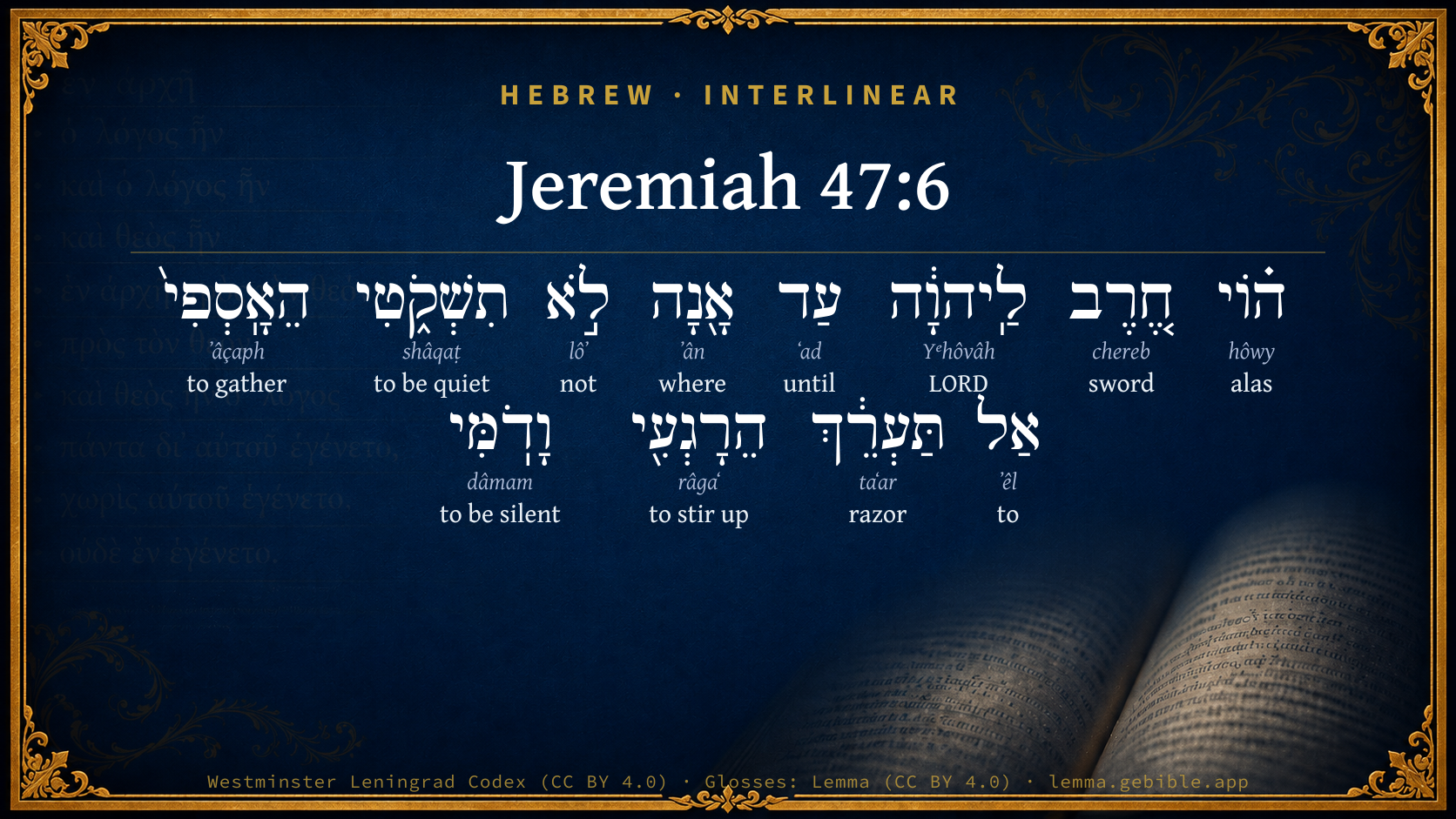
Hebrew (Westminster Leningrad Codex) Jeremiah 47:6 appears in the Hebrew Old Testament. The text above is from the Westminster Leningrad Codex. Each word links to its Strong’s number, a concise gloss, and parsing drawn from the Open Scriptures Hebrew Bible morphology. Click any word for its full Brown-Driver-Briggs (BDB) entry.
Download image
Cite this verse

Jeremiah 47:6 (World English Bible). Public Domain. Lemma interlinear Bible study tool, https://lemma.gebible.app/v/jeremiah/47/6.

Show BibTeX & RIS
BibTeX
RIS
English Translation
You sword of Yahweh, how long will it be before you be quiet? put up yourself into your scabbard; rest, and be still.
World English Bible · Public Domain
Download a study sheet

One document with this verse’s original text, its word-by-word gloss line, the meaning frame, cross-references with their text, attributed commentary, and full source and license credits — printable, and it pastes into notes with its structure intact.

This verse Autodidact and up

Study sheet (.html) Plain text (.txt)

A passage Seminary Student

Up to 50 verses in one chapter. A passage sheet keeps up to 6 commentary sources and 12 cross-references per verse, in the order this page ranks them, and says so on the sheet whenever that leaves anything out. Ask for a single verse and you get the Autodidact verse sheet above.

Everything on this page stays free to read, with no account — the sheet is a download of what is already on screen, not access to it.

Want to remove ads? Support Godless Engineer
Compare translations 3

The same verse in 3 English versions, stacked beneath the original-language interlinear above. Click any original word for its lexicon entry.

Each is an independent rendering of the whole verse — the interlinear is not word-aligned to these translations.

Highlighted words mark where these versions differ — a whole-verse word diff, not a word-by-word alignment.

  • World English Bible Public Domain
    You sword of Yahweh, how long will it be before you be quiet? put up yourself into your scabbard; rest, and be still.
  • King James Version Public Domain
    O thou sword of the LORD, how long will it be ere thou be quiet? put up thyself into thy scabbard, rest, and be still.
  • unfoldingWord Literal Text CC BY-SA 4.0
    Woe, sword of Yahweh! How long will it be until you become silent? Go back to your scabbard! Stop and be silent.

unfoldingWord Literal Text — © unfoldingWord, licensed CC BY-SA 4.0. Word-aligned USFM3 via Door43 (git.door43.org/unfoldingWord/en_ult).

Versions to compare (up to 4)

3 of 4 selected

Show all 18 translations

Every available English version of this verse, each an independent rendering of the whole verse.

  • World English Bible Public Domain
    You sword of Yahweh, how long will it be before you be quiet? put up yourself into your scabbard; rest, and be still.
  • Berean Standard Bible Public Domain
    ‘Alas, O sword of the LORD, how long until you rest? Return to your sheath; cease and be still!’
  • Majority Standard Bible Public Domain
    ‘Alas, O sword of the LORD, how long until you rest? Return to your sheath; cease and be still!’
  • King James Version Public Domain
    O thou sword of the LORD, how long will it be ere thou be quiet? put up thyself into thy scabbard, rest, and be still.
  • American Standard Version (1901) Public Domain
    O thou sword of Jehovah, how long will it be ere thou be quiet? put up thyself into thy scabbard; rest, and be still.
  • Revised Version (1885) Public Domain
    O thou sword of the LORD, how long will it be ere thou be quiet? put up thyself into thy scabbard; rest, and be still.
  • Geneva Bible (1599) Public Domain
    O thou sword of the Lord, how long will it be or thou cease! turne againe into thy scaberd, rest and be still.
  • Douay-Rheims (1899) Public Domain
    O thou sword of the Lord, how long wilt thou not be quiet? Go into thy scabbard, rest, and be still.
  • Young's Literal Translation Public Domain
    Ho, sword of Jehovah, till when art thou not quiet? Be removed unto thy sheath, rest and cease.
  • Literal Standard Version CC BY-SA 4.0
    Behold, sword of YHWH, until when are you not quiet? Be removed to your sheath, rest and cease.
  • Unlocked Literal Bible CC BY-SA 4.0
    Woe, sword of Yahweh! How long will it be until you become silent? Go back to your scabbard! Stop and be silent.
  • unfoldingWord Literal Text CC BY-SA 4.0
    Woe, sword of Yahweh! How long will it be until you become silent? Go back to your scabbard! Stop and be silent.
  • Darby Bible Public Domain
    Alas! sword of Jehovah, how long wilt thou not be quiet? Withdraw into thy scabbard, rest, and be still.
  • World Messianic Bible Public Domain
    “‘You sword of the LORD, how long will it be before you are quiet? Put yourself back into your scabbard; rest, and be still.’
  • Webster's Bible Public Domain
    O thou sword of the LORD, how long will it be ere thou be quiet? put up thyself into thy scabbard, rest, and be still.
  • Free Bible Version CC BY-SA 4.0
    Oh sword of the Lord, when are you going to stop killing? Go back in your sheath. Stop killing and stay there!
  • Bible in Basic English Public Domain
    O sword of the Lord, how long will you have no rest? put yourself back into your cover; be at peace, be quiet.
  • JPS Tanakh (1917) Public Domain
    O thou sword of the LORD, how long will it be ere thou be quiet? Put up thyself into thy scabbard, rest, and be still.

Literal Standard Version (2020), Covenant Press — licensed CC BY-SA 4.0. Text via the HelloAO Bible API (eBible.org). Unlocked Literal Bible (unfoldingWord) — licensed CC BY-SA 4.0. Text via the HelloAO Bible API (eBible.org). unfoldingWord Literal Text — © unfoldingWord, licensed CC BY-SA 4.0. Word-aligned USFM3 via Door43 (git.door43.org/unfoldingWord/en_ult). Free Bible Version, Dr. Jonathan Gallagher — licensed CC BY-SA 4.0. Text via the HelloAO Bible API (eBible.org).

Word by word

More ways to search: Search by grammar → Find every occurrence → Compare this word →

Practice this passage: Drill this verse → Learn its vocabulary →

תַּעְרֵ֔ךְ
taʻar
H8593
“razor · your”
Noun, Common, Both, Singular, Construct + Suffix, Personal, 2nd Person, Feminine, Singular
Part of Speech
Noun
Type
Common
Gender
Both
Number
Singular
State
Construct
Full BDB Definition

Origin: from H6168

TWOT: 1692e

razor, sheath (making naked) - razor - sheath (of sword)
  1. ה֗וֹי hôwy H1945 “alas” Particle, Interjection
  2. חֶ֚רֶב chereb H2719 “sword” Noun, Common, Feminine, Singular, Absolute
  3. לַֽיהוָ֔ה Yᵉhôvâh H3068 “to/for · LORD” Preposition + Noun, Proper
  4. עַד ʻad H5704 “until” Preposition
  5. אָ֖נָה ʼân H575 “where” Adverb
  6. לֹ֣א lôʼ H3808 “not” Particle, Negative
  7. תִשְׁקֹ֑טִי shâqaṭ H8252 “to be quiet” Verb, Qal, Imperfect, 2nd Person, Feminine, Singular
  8. הֵאָֽסְפִי֙ ʼâçaph H622 “gather” Verb, Niphal, Imperative, 2nd Person, Feminine, Singular
  9. אַל ʼêl H413 “to” Particle, Negative
  10. הֵרָגְעִ֖י râgaʻ H7280 “stir up” Verb, Niphal, Imperative, 2nd Person, Feminine, Singular
  11. וָדֹֽמִּי dâmam H1826 “and · be silent” Conjunction + Verb, Qal, Imperative, 2nd Person, Feminine, Singular

About this verse

These counts appear in no published source. They are computed here, from the morphology-tagged text and Lemma’s own curated glosses. What Lemma adds →

12
words
12
distinct lemmas
Prophets
section

Notable vocabulary

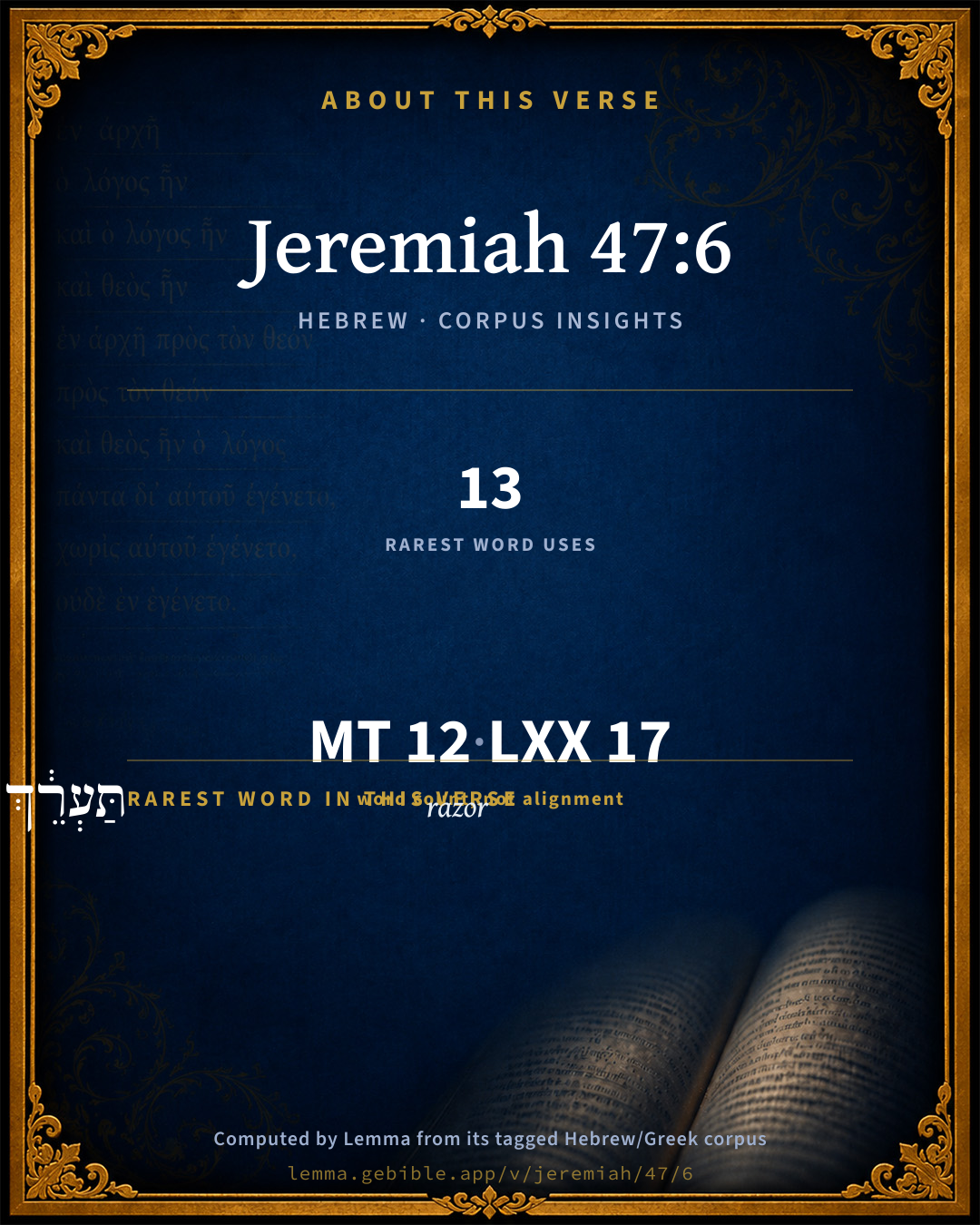
The rarest word here is תַּעְרֵ֔ךְ razor H8593 — appearing just 13 times in the whole Hebrew Bible.

Shared distinctive vocabulary

תַּעְרֵ֔ךְ razor H8593 occurs in 13 verses of the Hebrew Bible. Also found in:

Grammatical profile

  • 4 verbs
  • 3 nouns
  • 1 preposition
  • 1 adverb
  • 3 particles

Verb forms

  • תִשְׁקֹ֑טִי Qal · Imperfect
  • הֵאָֽסְפִי֙ Niphal · Imperative
  • הֵרָגְעִ֖י Niphal · Imperative
  • וָדֹֽמִּי Qal · Imperative

Hebrew & Septuagint length

In the original languages it is 12 Hebrew tokens and 17 Greek tokens — but the two are counted differently (Hebrew bundles its prefixes and suffixes into one token; the Greek is in lemma form), so that isn’t a like-for-like length.

Cross-references

16

Topical passages linked to Jeremiah 47:6 in the Treasury of Scripture Knowledge — connected by theme and wording, ordered by reader-vote popularity; previews shown in the World English Bible.

  • Jeremiah 12:12 Destroyers are come on all the bare heights in the wilderness; for the sword of Yahweh devours from the one end of the land even to the other end of the land: no flesh has peace.
  • Ezekiel 21:3–5 and tell the land of Israel, Thus says Yahweh: Behold, I am against you, and will draw forth my sword out of its sheath, and will cut off from you the righteous and the wicked.
  • Ezekiel 21:30 Cause it to return into its sheath. In the place where you were created, in the land of your birth, will I judge you.
  • John 18:11 Jesus therefore said to Peter, "Put the sword into its sheath. The cup which the Father has given me, shall I not surely drink it?"
  • Deuteronomy 32:41–42 If I whet my glittering sword, My hand take hold on judgment; I will render vengeance to my adversaries, Will recompense those who hate me.
  • 2 Samuel 2:26 Then Abner called to Joab, and said, "Shall the sword devour forever? Don't you know that it will be bitterness in the latter end? How long shall it be then, before you bid the people return from following their brothers?"
  • 1 Chronicles 21:27 Yahweh commanded the angel; and he put up his sword again into the sheath of it.
  • Psalms 17:13 Arise, Yahweh, Confront him, cast him down. Deliver my soul from the wicked by your sword;
  • Isaiah 10:5 Ho Assyrian, the rod of my anger, the staff in whose hand is my indignation!
  • Isaiah 10:15 Shall the axe boast itself against him who hews therewith? Shall the saw magnify itself against him who wields it? as if a rod should wield those who lift it up, [or] as if a staff should lift up [him who is] not wood.
  • Jeremiah 4:21 How long shall I see the standard, and hear the sound of the trumpet?
  • Jeremiah 12:4 How long shall the land mourn, and the herbs of the whole country wither? for the wickedness of those who dwell therein, the animals are consumed, and the birds; because they said, He shall not see our latter end.
  • Jeremiah 15:3 I will appoint over them four kinds, says Yahweh: the sword to kill, and the dogs to tear, and the birds of the sky, and the animals of the earth, to devour and to destroy.
  • Jeremiah 25:27 You shall tell them, Thus says Yahweh of Hosts, the God of Israel: Drink you, and be drunken, and spew, and fall, and rise no more, because of the sword which I will send among you.
  • Jeremiah 51:20–23 You are my battle-axe and weapons of war: and with you will I break in pieces the nations; and with you will I destroy kingdoms;
  • Ezekiel 14:17 Or if I bring a sword on that land, and say, Sword, go through the land; so that I cut off from it man and animal;

Cross-references courtesy of OpenBible.info (CC BY 4.0).

Hebrew and Greek witnesses Masoretic Hebrew ↔ Greek Septuagint

The same verse in the two great witnesses to the Old Testament, shown verse-for-verse.

These are two independent witnesses, not word-aligned to each other, and the Septuagint is shown in lemma (dictionary) form.

Hebrew Jeremiah 47:6 Masoretic · Westminster Leningrad Codex

ה֗וֹי חֶ֚רֶב לַֽיהוָ֔ה עַד אָ֖נָה לֹ֣א תִשְׁקֹ֑טִי הֵאָֽסְפִי֙ אַל תַּעְרֵ֔ךְ הֵרָגְעִ֖י וָדֹֽמִּי

You sword of Yahweh, how long will it be before you be quiet? put up yourself into your scabbard; rest, and be still.

World English Bible · Public Domain

Greek LXX Structure differs

In the Septuagint, Jeremiah is about an eighth shorter than the Hebrew and arranges its material differently — the Oracles Against the Nations (Hebrew chapters 46–51) appear in the middle of the Greek book, after 25:13. Because the chapter and verse boundaries do not line up, a verse-for-verse comparison with the Hebrew is not shown.

A verse-for-verse comparison isn’t shown here because the chapters and verses don’t line up. Switch to the LXX edition with the MT / LXX toggle above to read the Greek directly.

Hebrew: Westminster Leningrad Codex (CC BY 4.0). Greek: Septuagint (public domain); English from a public-domain English Septuagint. How the Septuagint differs from the Hebrew →

Targum (Aramaic paraphrase)

1

The Targum is the ancient Jewish Aramaic paraphrase of the Hebrew Scriptures — an interpretive translation, not the Hebrew text itself. Onkelos (literal) and Pseudo-Jonathan (expansive) render the Torah, and Jonathan the Prophets. Coverage is partial: where no permissively-licensed English translation exists for a verse, only the Aramaic is shown. This is verse-level text, not a word-by-word alignment to the Hebrew.

  1. Targum Jonathan Prophets (Joshua–Malachi)
    וַי חַרְבָּא דִשְׁלִיחָא מִן קֳדָם יְיָ עַד אֵימָתַי לָא תְנוּחִין אִתְכַּנְשִׁי לְנִדְנָךְ לְבֵית זִמְנָא תְנוּחִין:

    (no public-domain English translation for this verse)

    Targum Jonathan — Aramaic: “Mikraot Gedolot” (public domain). English: “Sefaria Community Translation” (CC0 1.0 (public-domain dedication)); “London "Chaldee Paraphrase," 1871” (public domain). Text via Sefaria.

Commentary

Notes on Jeremiah 47:6 from classic Christian and Jewish commentators (each source and its license shown beneath its notes). The classic Christian expositions comment on the surrounding passage and are grouped to its opening verse, so a note may address several verses; the Jewish commentaries on the Tanakh (Rashi and others) are per-verse, so they appear only where the commentator wrote on this verse.

Lemma curates 59 commentaries, every one of them public domain or Creative Commons licensed, each selected and text-cleaned for this edition rather than reprinted as found. About our sources →

Trapp's Complete Commentary

John Trapp

Jer 47:6 O thou sword of the LORD, how long [will it be] ere thou be quiet? put up thyself into thy scabbard, rest, and be still.

Ver. 6. O thou sword of the Lord.] So called because whencesoever it cometh it is bathed in heaven. {Isa 34:5} See Jer 25:29 Jdg 7:18; Jdg 7:20.

How long will it be ere thou be quiet?] Erisne in opere semper? Wilt thou ever be eating flesh and drinking blood? War, the shorter the better. Of the pirates’ war, as the Romans called it, Augustine {a} reporteth to the just commendation of Pompey, that it was by him incredibill celeritate et temporls brevitate eonfectum, quickly despatched and made an end of.

{a} Aug., De Civit. Dei.

John Trapp, A Commentary or Exposition upon All the Books of the Old and New Testament (1647–1656) — public domain. Text from a community e-Sword module.

The Biblical Illustrator

Joseph S. Exell

Jer_47:6

Put up thyself into thy scabbard, rest, and be still.

War overruled for Gods glory

Notwithstanding all the boasted improvements of modem times, in knowledge and refinement, wars have not been less frequent than formerly, when mankind were in a rude and barbarous state. In making this reflection, the philosopher may profess his astonishment, but the genuine Christian will weep. Such are the mournful and ruinous effects which sin has produced in the world. Not only has it filled mens minds with enmity against God, but also with implacable enmity and revenge against one another.

I. Whence it is that the sword of war may be called the sword of the Lord.

1. Because the seasons in which this sword is drawn are governed or appointed by the Lord. The kindling of war, or the settling of peace, are appointed by the providence of that God who ruleth over all the earth. The direction of cabinets, the ambition of princes, of governors, of statesmen, are only the instruments which God employs with a powerful and a holy hand, to execute His will.

2. Because it receives its direction from the Lord. When God gives the commission, when He opens the brazen gates of destruction, no country, no city is secured against the ravages of war; and when His providence forms a wall of protection around a country, no army can prevail, no weapon formed against it can prosper, for the Almighty God Himself is its fortress, its pillar, and its strength.

3. Because the execution done by it is of the Lord. It is a saying of King William, who had himself been in many battles, that every bullet had its billet; intimating that it was under Gods direction whom to miss and whom to strike.

4. Because God sanctifies and glorifies Himself in its operation. In the management of war, the reputation of kings and statesmen, of generals or soldiers, is considered, but this is only a secondary consideration. The glory of the Lord, whom the Scriptures call a Man of War, is illustrated and made conspicuous in the eyes of the world. The slayer and those who are slain are His creatures and subjects, and the instruments which defend the one and kill the other are His sword.

II. The reason why all Gods people so ardently long to see the sword of war sheathed and at rest.

1. Conviction that the wrath of God bringeth upon man the punishment of the sword, will cause the saints to long earnestly for its being sheathed and at rest.

2. All Gods people will earnestly long to see the sword of war in -its scabbard and at rest, when they reflect what multitudes of men are hurried by it into eternity without thought or preparation.

3. Gods people earnestly long to see the sword of war sheathed and at rest, when they reflect on the unparalleled distresses and miseries inflicted on those countries which are the seat of war. Gracious persons are deeply affected with the miseries of their fellow-creatures, even though they he enemies.

4. Gods people earnestly desire to see the sword of war sheathed and at rest, that Christs Gospel may be propagated throughout the whole world, and its Divine power and influence felt by all nations. (James Hay, D. D.)

The sword of the warrior the sword of the Lord

As patriots, prophets felt the miseries which they denounced; as mourners, they lamented the sins which brought on these miseries; and as men, they wept over the graves of the enemies by whom their country had been harassed and wasted.

I. The sword of the warrior is the sword of the Lord.

1. The seasons in which the sword is drawn and sheathed are appointed by the Lord. The direction of cabinets, the ambition of princes, and the caprices of statesmen in these affairs, are subordinated by His invisible influence to His own will, without violating the order of second causes, or breaking in upon the freedom of rational agents.

2. The sword of the warrior is put in commission by the Lord.

3. The direction of the sword of the warrior is from the Lord. The seat of war is marked out, and its bounds circumscribed, in the purpose of the will of God; and thither the warrior marches without mistaking his way, whether it he to the shore of Tyrus, the valley of Jehoshaphat, the plains of Blenheim, the heights of Saratoga, or the mountains of Armageddon.

4. The execution done by the sword of the warrior is of the Lord. A sparrow falleth not to the ground without our heavenly Father, and in the day of battle, no soldier loses his life without His knowledge and predetermination.

5. By the sword of the warrior the Lord sanctifies and magnifies Himself. According to the states of the sufferers wars of conquest and extirpation are corrections and punishments, and whichever of the sides gains or loses the victory, the supremacy of Jehovah over all is main, rained, and the glory of His justice and holiness displayed and magnified. The cause in which the sword is drawn is always sinful on one side, and frequently sinful on both sides. But whatever be the quality of the cause, the views of men, or the issues of the contest, the Lord will not lose His end. He rules in the seat of war, and commands on the day of battle.

II. The reasons for which mourners in Zion long to see this sword sheathed.

1. Compassion for those who are delivered to the sword, or subjected to the insolence and rage of fierce and lawless men whose tender mercies are cruelty.

2. Knowledge of the consequences of driving men unprepared into eternity.

3. The peace of God, which rules in the hearts of mourners in Zion, inclines and constrains them to cry for the sheathing of the sword of the warrior.

4. Convictions that the wrath of God bringeth upon men the punishment of the sword, dispose mourners in Zion to long for its being put up into the scabbard. (A. Shanks.)

The means of terminating war

I. The evils of protracted war.

1. War is a tremendous evil.

2. Well might the prophet desire its speedy termination.

II. The reason of its continuance.

1. War is one of those judgments with which God punishes the sins of men.

2. Till He has effected His purposes by it, no human efforts can bring it to a close.

III. Means of its termination.

1. The intention of Gods chastisements is to bring us to repentance.

2. On the attainment of this end He will instantly remove HIS judgments from us.

IV. Some hints respecting those heavy judgments which God has denounced against sinners in another world, and respecting the best means of averting them from our souls. (C. Simeon, M. A.)

.

The Biblical Illustrator, edited by Joseph S. Exell (c. 1880s–1900s) — public domain. Text from a community e-Sword module.

Joseph Benson's Commentary

Jer 47:6-7. O thou sword of the Lord — By the sword of the Lord, war is here intended, with which, as a great instrument of calamity and destruction, God punishes the crimes of his enemies, and pleads the cause of his people. Some have understood the prophet as speaking in the words of the Philistines, complaining of the havoc which the sword made among them; but however weary they might be of the war, and desirous of its ceasing, it is not likely they should see the hand of God in it, or term it his sword. The words are rather to be considered as the lamentation of the prophet, (and it is a most pathetic and animated one,) over the miseries with which God, in his just displeasure, was punishing the nations for their sins. How can it be quiet, seeing the Lord hath, given it a charge against Ashkelon, &c. — Here the prophet returns an answer to the foregoing inquiry, importing, that the havoc made by the sword was the effect of God’s irreversible purpose and decree. He gives the sword its commission, and it slays when and where he appoints, and continues to destroy a longer or shorter time, as he determines. When it is drawn, it will not be sheathed till it has fulfilled its charge. As God’s word, so his rod and his sword shall accomplish that for which he sends them.

Joseph Benson's Commentary on the Old and New Testaments (1811–1818) — public domain. Text from a community e-Sword module.

MacLaren's Expositions of Holy Scripture

Alexander MacLaren

Jeremiah

THE SWORD OF THE LORD

Jer 47:6 - Jer 47:7.

The prophet is here in the full tide of his prophecies against the nations round about. This paragraph is entirely occupied with threatenings. Bearing the cup of woes, he turns to one after another of the ancestral enemies of Israel, Egypt and Philistia on the south and west, Moab on the south and east, then northwards to Ammon, south to Edom, north to Damascus, Kedar, Hagor, Elam, and finally to the great foe-Babylon. In the hour of Israel’s lowest fortunes and the foe’s proudest exultation these predictions are poured out. Jeremiah stands as if wielding the sword of which our text speaks, and whirls and points the flashing terror of its sharpened edge against the ring of foes. It turns every way, like the weapon of the angelic guard before the lost paradise, and wherever it turns a kingdom falls.

In the midst of his stern denunciations he checks himself to utter this plaintive cry of pity and longing. A tender gleam of compassion breaks through the heart of the thunder-cloud. It is very beautiful to note that the point at which the irrepressible welling up of sweet waters breaks the current of his prophecy is the prediction against Israel’s bitterest, because nearest, foe, ‘these uncircumcised Philistines.’ He beholds the sea of wrath drowning the great Philistine plain, its rich harvests trampled under foot by ‘stamping of hoofs of his strong ones,’ and that desolation wrings from his heart the words of our text. I take them to be spoken by the prophet. That, of course, is doubtful. It may be that they are meant to give in a vivid dramatic form the effect of the judgments on the sufferers. They recognise these as ‘the sword of the Lord.’ Their only thought is an impatient longing that the judgments would cease,-no confession of sin, no humbling of them selves, but only-’remove Thy hand from us.’

And the answer is either the prophet’s or the divine voice; spoken in the one case to himself, in the other to the Philistines; but in either setting forth the impossibility that the sweeping sword should rest, since it is the instrument in God’s hand, executing His charge and fulfilling His appointment.

I. The shrinking from the unsheathed sword of the Lord.

We may deal with the words as representing very various states of mind.

They may express the impatience of sufferers. Afflictions are too often wasted. Whatever the purpose of chastisement, the true lesson of it is so seldom learned, even in regard to the lowest wisdom it is adapted to teach. In an epidemic, how few people learn to take precautions, such as cleanliness or attention to diet! In hard times commercially, how slow most are to learn the warning against luxury, over-trading, haste to be rich! And in regard to higher lessons, men have a dim sense sometimes that the blow comes from God, but, like Balaam, go on their way in spite of the angel with the sword. It does not soften, nor restrain, nor drive to God. The main result is, impatient longing for its removal.

The text may express the rooted dislike to the thought and the fact of punishment as an element in divine government. This is a common phase of feeling always, and especially so now. There is a present tendency, good in many aspects, but excessive, to soften away the thought of punishment; or to suppose that God’s punishments must have the same purposes as men’s. We cannot punish by way of retribution, for no balance of ours is fine enough to weigh motives or to determine criminality. Our punishments can only be deterrent or reformatory, but this is by reason of our weakness. He has other objects in view.

Current ideas of the love of God distort it by pitting it against His retributive righteousness. Current ideas of sin diminish its gravity by tracing it to heredity or environment, or viewing it as a necessary stage in progress. The sense of God’s judicial action is paralysed and all but dead in multitudes.

All these things taken together set up a strong current of opinion against any teaching of punitive energy in God.

The text may express the pitying reluctance of the prophet.

Jeremiah is remarkable for the weight with which ‘the burden of the Lord’ pressed upon him. The true prophet feels the pang of the woes which he is charged to announce more than his hearers do.

Unfair charges are made against gospel preachers, as if they delighted in the thought of the retribution which they have to proclaim.

II. The solemn necessity for the unsheathing of the sword.

The judgments must go on. In the text the all-sufficient reason given is that God has willed it so. But we must take into account all that lies in that name of ‘Lord’ before we understand the message, which brought patience to the heart of the prophet. If a Jewish prophet believed anything, he believed that the will of the Lord was absolutely good. Jeremiah’s reason for the flashing sword is no mere beating down human instincts, by alleging a will which is sovereign, and there an end. We have to take into account the whole character of Him who has willed it, and then we can discern it to be inevitable that God should punish evil.

His character makes it inevitable. God’s righteousness cannot but hate sin and fight against it. To leave it unpunished stains His glory.

God’s love cannot but draw and wield the sword. It is unsheathed in the interests of all that is ‘lovely and of good report.’ If God is God at all, and not an almighty devil, He must hate sin. The love and the righteousness, which in deepest analysis are one, must needs issue in punishment. There would be a blight over the universe if they did not.

The very order of the universe makes it inevitable. All things, as coming from Him, must work for His lovers and against His enemies, as ‘the stars in their courses fought against Sisera.’

The constitution of men makes it inevitable. Sin brings its own punishment, in gnawing conscience, defiled memories, incapacity for good, and many other penalties.

It is to be remembered that the text originally referred to retribution on nations for national sins, and that what Jeremiah regarded as the strokes of the Lord might be otherwise regarded as political catastrophes. Let us not overlook that application of the principles of the text. Scripture regards the so-called ‘natural consequences’ of a nation’s sins as God’s judgments on them. The Christian view of the government of the world looks on all human affairs as moved by God, though done by men. It takes full account of the responsibility of men the doers, but above all, recognises ‘the rod and Him who hath appointed it.’ We see exemplified over and over again in the world’s history the tragic truth that the accumulated consequences of a nation’s sins fall on the heads of a single generation. Slowly, drop by drop, the cup is filled. Slowly, moment by moment, the hand moves round the dial, and then come the crash and boom of the hammer on the deep-toned bell. Good men should pray not, ‘Put up thyself into thy scabbard,’ but, ‘Gird Thy sword on Thy thigh, O thou most mighty. . . on behalf of truth and meekness and righteousness.’

III. The sheathing of the sword.

The passionate appeal in the text, which else is vain, has in large measure its satisfaction in the work of Christ.

God does not delight in punishment. He has provided a way. Christ bears the consequence of man’s sin, the sense of alienation, the pains and sorrows, the death. He does not bear them for Himself. His bearing them accomplishes the ends at which punishment aims, in expressing the divine hatred of sin and in subduing the heart. Trusting in Him, the sword does not fall on us. In some measure indeed it still does. But it is no longer a sword to smite, but a lancet to inflict a healing wound. And the worst punishment does not fall on us. God’s sword was sheathed in Christ’s breast. So trust in Him, then shall you have ‘boldness in the day of judgment.’

Alexander MacLaren, Expositions of Holy Scripture (1904–1910) — public domain. Text from a community e-Sword module.

Tyndale Open Study Notes

Tyndale Open Resources

47:6 O sword of the Lord: God used the Babylonians to enact his justice. This request might have come from the Philistine cities being attacked by the Babylonians. The people were eager for the attacks against them to stop.

Tyndale Open Study Notes — © Tyndale Open Resources, licensed CC BY-SA 4.0. Text via the HelloAO Bible API.

Jamieson, Fausset & Brown

Robert Jamieson, A. R. Fausset & David Brown

Jeremiah, in the person of the Philistines afflicting themselves (Jer 47:5), apostrophizes the "sword of the Lord," entreating mercy (compare Deu 32:41; Eze 21:3-5, Eze 21:9-10).

up thyself--Hebrew, "Gather thyself," that is, retire or return.

Jamieson, Fausset & Brown — Commentary Critical and Explanatory on the Whole Bible (1871) — public domain (CC PDM 1.0). Text via the HelloAO Bible API.

Adam Clarke's Commentary

Verse 6. O thou sword of the Lord] This is a most grand prosopopoeia-a dialogue between the sword of the Lord and the prophet. Nothing can be imagined more sublime.

Put up thyself into thy scabbard, rest, and be still.] Shed no more blood, destroy no more lives, erase no more cities, desolate no more countries. Rest:-hast thou not been long enough at this work of judgment? O be still:-let wars and desolations cease for ever.

Adam Clarke's Commentary on the Bible (1810–1826) — public domain. Text from a community e-Sword/MySword module.

John Calvin's Commentaries

Here Jeremiah turns to address the sword of God; and it is a happy apostrophe. It is very striking and forcible, when the Prophet at one time addresses the land of the Philistines, and at another, the sword of God; and he had no other object but to confirm his prophecy, of which otherwise, the Jews might have doubted.

He then says, Ho! sword of Jehovah! Though he puts here the preposition ל, lamed, which designates the dative case; yet it is often redundant. There is, in the meantime, no doubt but that he intimates that the slaughter of which he speaks would be, as it were, by God’s sword, or by a sword hired by him. Thus he shews that the Chaldeans would do the work of God in destroying the land of the Philistines.

How long, he says, ere thou restest! Hide thyself in thy sheath, rest and be still Here the Prophet assumes the character of another, as though he wished to soothe with blandishments the sword of God, and mitigate its fury. “O sword,” he says, “spare them, leave off to rage against the Philistines.” The Prophet, it is certain, had no such feeling; but, as we have said elsewhere, it was a common thing with the Prophets to assume different characters while endeavor-ing more fully to confirm their doctrine. It is the same, then, as though he represented here the Philistines; and the Prophets speak also often in the person of those on whom they denounce the vengeance of God. It is here as though he had said, “The Philistines will humbly ask pardon of God’s sword, but it will be without advantage or profit; for when they seek to mitigate the wrath of God, the answer will be, How can it rest?” Here the Prophet, as it were, reproves himself, “I act foolishly in wishing to repress the sword of God; for how canst thou rest?” It could not be; and why? because God hath commanded it against Ashkelon He now changes the person, but without any injury to the sense. God, then, hath commanded it, therefore the whole world would intercede in vain; in vain also will the Philistines deprecate it; for it will not be in their power to mitigate God’s wrath, when it shall burn against them and against Ashkelon.

John Calvin's Commentaries (1540-1563) — public domain. Text from the Calvin Translation Society English edition (1840s-50s) via the Christian Classics Ethereal Library (ccel.org). Calvin's coverage is partial (roughly two-thirds of the Bible); uncommented books and verses are honest gaps, never fabricated. The 19th-century editor's footnotes and remarks are omitted so the notes are faithfully Calvin's own voice.

Ellicott's Commentary for English Readers

(6) O thou sword of the Lord . . .—This is the question and entreaty of the Philistines, “When will there be an end of war?” And the prophet has but one answer: the sword must do its work till it has done what Jehovah had appointed it to do.

A Bible Commentary for English Readers, edited by Charles John Ellicott (1878–1897) — public domain. Text from a community e-Sword module.

The Cambridge Bible for Schools and Colleges

gen. ed. J. J. S. Perowne

6, 7. These vv. have been suspected, but on insufficient (partly metrical) grounds. They contain (a) the cry of the Philistines for mercy, (b) the prophet’s reply.

The Cambridge Bible for Schools and Colleges (gen. ed. J. J. S. Perowne; Cambridge University Press, 1878–1918) — public domain. Text from a community e-Sword module.

John Gill's Exposition

O thou sword of the Lord,.... For though it was the sword of the Chaldeans, yet being appointed and sent by the Lord, and having a commission from him, and being ordered and directed in his providence to do his will, it is called his sword:

how long will it be ere thou be quiet? and cease from destroying men; wilt thou not cease till thou hast no more to destroy?

put up thyself into thy scabbard, rest, and be still; and make no more havoc among the people: these are either the words of the Philistines, entreating a stop might be put to the ravages of the sword, and that the war might cease, and the desolations of it; or rather of the prophet, commiserating their state as a man, though they had been the avowed enemies of his people; to which the following words of him are an answer, either to the Philistines, showing why their request could not be granted, or as correcting himself.

John Gill's Exposition of the Whole Bible (1746–1763) — public domain (CC PDM 1.0). Text via the HelloAO Bible API.

Haydock's Catholic Bible Commentary

Sword. He is moved with pity to see so much carnage, but reflects that such is the will of God. Nabuchodonosor was his sword or scourge. (Calmet)

George Leo Haydock (1774–1849), Haydock's Catholic Family Bible and Commentary, 1859 edition — public domain. Excludes Psalms (Douay-Rheims chapter numbering differs from Protestant) and Deuterocanonical books (Catholic canon only).

Whedon's Commentary on the Bible

Daniel D. Whedon

6. O thou sword… how long — As if it may no longer be endured. The prayer is in behalf of Philistia and in behalf of humanity for respite and mercy.

Daniel D. Whedon (gen. ed.), Commentary on the Old and New Testaments (1874–1909) — public domain. Text from a community e-Sword module.

The Pulpit Commentary

O thou sword, etc.; rather, alas! thou sword of the Lord.. It is the mystic sword of which we have heard already. (see on Jer_12:10 Jer_46:10)

Vers. 6, 7. The sword of the Lord.

I THE TERROR OF MAN BEFORE THE SWORD OF THE LORD. (Ver. 6)

1. God wields a sword. There are terrors in some of the doings of the God of love. "Our God is a consuming fire." It is foolish and wrong to. blind ourselves to the stern side of God"s government, and to represent him as almost soft and weak in his indulgence of his children.

2. God"s sword may be seen in earthly calamities. It does not flash before us as when it was held by cherubim at the gates of Eden. It works in the form of natural calamities. It also makes use of human actions, wars, etc. Above the sword of man there glitters this terrible, irresistible sword. Thus calamities in this world are sent by God or overruled by God.

3. God"s sword may be restlessly active. It is not displayed for one fearful moment and then sheathed. Often there comes blow upon blow. Thus Job cries out beneath the wearying strokes, "How long wilt thou not depart from me, nor let me alone till I swallow down my spittle?". (Job_7:19)

4. We cannot see the reason for the terrible work of the sword of the Lord. We cry out in dismay before it. From a human point of view it may appear cruel and relentless.

5. We may naturally fed pity for those who suffer from this terrible sword. It is right, too, that we should intercede for them if it be possible for the judgment of Heaven to be stayed.

II THE DIVINE MISSION OF THE SWORD OF THE LORD. (Ver. 7)

1. The wielding of the sword is necessary. "How can it be quiet?" There are moral necessities which even the Almighty God freely accepts. Justice must be done. Right must be established. Evil must be suppressed. The process may be painful, and such as God would not choose on its own account and can take no delight in. Yet for these high requirements, though his children suffer and his own heart is wrung with commiseration, he cannot sheathe the sword till its work is done.

2. The wielding of the sword is for a good purpose. The necessity is not blind and objectless. The sword has its mission. To us who are in the thick of the battle this may not be discernible. The dust and heat, the rush and noise and confusion, the mingled cries of triumph and pain, are all we can observe; the plan of the commander cannot be read through all the turmoil of the field. But he has a plan, and the whole battle is converging to it.

3. The sword cannot be sheathed till its mission is accomplished. The mission is more important than the temporary comfort arising out of the immediate quieting of the sword. If this were to be done before the end were obtained, where would be the use of all that was already suffered? If the sword is stayed before victory is won, every drop of blood spilt is wasted, every pang suffered is suffered in vain. If the discipline of life were to cease before its great purpose were accomplished, its earlier stages would be stultified.

4. When the mission of the sword is accomplished the sword will be sheathed. It is drawn for a definite object. "The Lord is a man of war" for a season and for a purpose, not by delight nor perpetually. He is essentially the God of peace. No one is more anxious to see the sword laid aside than he who wields it. His joy is in peace and in benediction. Judgment is temporary. The victory and rest that follow will be eternal.

Vers. 6, 7. The sword of Jehovah.

I A PERSONIFICATION OF DIVINE WRATH. "Sword of Jehovah" is an expression that seems to suggest the Philistines as the sneakers: "for though not bad Hebrew, it has a foreign sound, and makes the impression that the speakers attribute the sword raging against them only unwillingly and hesitatingly to Jehovah" (Naegelsbach). God in his true character is still unknown, but conscience witnesses to him as a dimly realized agent of moral recompense. Such language tells:

1. How ceaseless and terrible is the judgment of the heathen world. Ezekiel uses the same figure in relation to the Amorites. (Eze_21:30) "There is no peace, saith my God, to the wicked;" "Surely thou wilt slay the wicked, O God"; (Psa_139:19) "When they shall say, Peace and safety; then sudden destruction cometh upon them," etc. (1Th_5:3)

2. Of ignorance and moral distance from God. He is only conceived of as a God of vengeance an all but impersonal fate.

3. Of the helplessness and superstitious dread of sinners. An imperfect knowledge is eked out and distorted by a diseased imagination. All moral strength seems to have gone out of them.

II EXPLAINED AND JUSTIFIED AS A DIVINE APPOINTMENT. At first the answer of the prophet appears little other than a repetition of the Philistines" thought; but it is far more.

1. This is not blind fate, but judgment strictly meted out and determined.

2. It declares, in effect, that the wicked cannot be suffered to remain on the earth. They must be subjects of continual and exterminating judgment. There is no escape. Is this so? Yes, so long as they remain impenitent and at a distance from him. Is it contradictory, then, for Zechariah to prophecy the conversion of the Philistines? The rightful end of judgment is mercy. The sinner is driven into the arms of the Divine love. Our helplessness prepares for the reception of his salvation. M.

HOMILIES BY D. YOUNG Vers. 6, 7. Apostrophe to the sword.

I WHAT IS MEANT BY THE SWORD OF JEHOVAH. Any man, or army of men, or any inanimate thing even, may be as a sword in the hand of God. Men are restricted in their agents to injure and destroy, and well it is so, though in old and superstitious times some of them were believed to control the powers of nature so that they could raise winds and tempests. But God, with his real and complete control over all natural forces, can turn them against rebellious man whenever and to whatever extent it may be necessary. It is not a case of a strong arm and a weak weapon, or a weak arm and a strong weapon beyond what the arm can wield. God smites, and not imperfectly; nor does he need to smite twice.

II WHAT IS SUGGESTED BY THE APOSTROPHE.

1. The thought of God"s enemies. Here the Philistines are mentioned, so long the troublesome and jealous neighbours of Israel. But they are only types. There are still enemies numerous enough and active enough to keep the sword of God from lying quiet in its scabbard. Why were these Philistines reckoned enemies? Simply because of their wickedness. God is hostile to nothing but wickedness in man, and to that he is always hostile. There are Philistines still against whom a charge has to be given to the sword of God. And such must ever be destroyed, that is, not the men themselves must be destroyed, but that in them which selfishly upholds evil and profits by it. And even they themselves, if they continue the foolish war against God, must perish in the end.

2. The thought of God"s opposing activity to his enemies. Wherever there is emnity to God, Divine opposition to it becomes manifest. Hard as it may be to fight for God, it is harder still to fight against him. In being on God"s side against evil all the difficulties are at the beginning; in being on the evil side against God the difficulties, though they may look as nothing to start with, soon multiply and increase to the end. A charge is given to all God"s servants to be resolute and uncompromising in their opposition to all wickedness.

3. The thought of ultimate cessation of the sword"s activity. Surely the time is to come when the sword will lie quietly in the scabbard. He who came not to bring peace but a sword has peace for his ultimate aim. He will not say, "Peace, peace," when there is no peace; and when at last he will say, "Peace," we may be sure of the reality corresponding with the word. Y.

The Pulpit Commentary (1880–1919), ed. H.D.M. Spence-Jones & Joseph S. Exell — public domain. Text from a community e-Sword module.

John Wesley's Explanatory Notes

O thou sword - Perhaps they are the words of the prophet, lamenting the havock which he made among the Philistines by the Chaldeans.

John Wesley, Explanatory Notes Upon the Whole Bible (1754–1765) — public domain. Text via the GEBible commentary corpus.

Rashi

Rabbi Shlomo Yitzchaki (Rashi)

sword of the Lord Which the Holy One, Blessed be He, brings to the world.

rest Heb. הרגעי, an expression of מרגועַ rest.

Rashi on the Tanakh — English translations: “The Judaica Press complete Tanach with Rashi, translated by A. J. Rosenberg” (CC BY 4.0); “Pentateuch with Rashi's commentary by M. Rosenbaum and A.M. Silbermann, 1929-1934” (public domain); “The Metsudah Tanach series, Lakewood, N.J” (CC BY 4.0); and “The Book of Joshua, Metsudah Publications, 1997” (CC BY 4.0). Text via Sefaria.

Lesson kit

Teaching starters — assembled from the data on this page, not authored interpretation. Every prompt links to the verse data it draws on. Edit before teaching.

Jeremiah, in the Prophets, opens this verse with 12 words (12 distinct Hebrew lemmas). Its most distinctive word is taʻar (“razor”). A historical commentator’s framing appears above. Read the whole chapter for the surrounding context.

Discussion questions

  1. What does “razor” (taʻar) contribute to the verse as a whole?
  2. Numbers 6:5 shares the word «razor» with this verse. How do the two illuminate each other?
  3. The translations on this page render this verse differently — a whole-verse word diff, not a word-by-word alignment. What might account for the different wordings?
  4. The verb «תִשְׁקֹ֑טִי» is Qal Imperfect. How does its form color the action?
  5. Reading how Trapp's Complete Commentary and The Biblical Illustrator read this verse, where do the two commentators agree and where do they part?

Things to notice

Reading settings

Reading text

Shown beneath each verse's original-language words.

Old Testament
Old Testament edition

Read the OT as the Masoretic Hebrew (MT) or the Greek Septuagint (LXX).

English shown for the Greek Septuagint (in the Hebrew ↔ Greek comparison).

Comparing translations? Open the Compare panel on any verse page to stack up to four side by side.