Joel 2:10

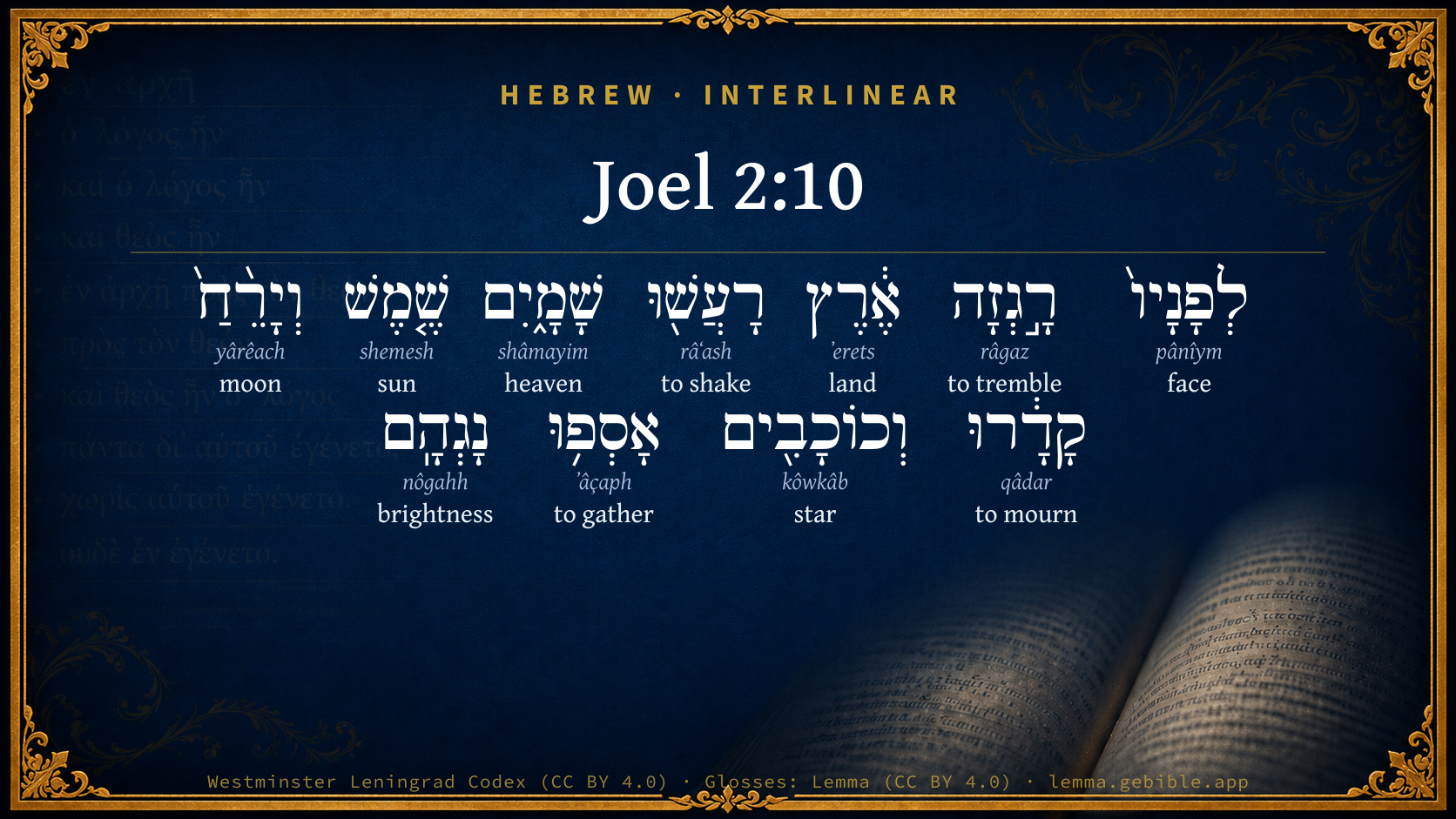
Hebrew (Westminster Leningrad Codex) Joel 2:10 appears in the Hebrew Old Testament. The text above is from the Westminster Leningrad Codex. Each word links to its Strong’s number, a concise gloss, and parsing drawn from the Open Scriptures Hebrew Bible morphology. Click any word for its full Brown-Driver-Briggs (BDB) entry.
Download image
Cite this verse

Joel 2:10 (World English Bible). Public Domain. Lemma interlinear Bible study tool, https://lemma.gebible.app/v/joel/2/10.

Show BibTeX & RIS
BibTeX
RIS
English Translation
The earth quakes before them. The heavens tremble. The sun and the moon are darkened, And the stars withdraw their shining.
World English Bible · Public Domain
Download a study sheet

One document with this verse’s original text, its word-by-word gloss line, the meaning frame, cross-references with their text, attributed commentary, and full source and license credits — printable, and it pastes into notes with its structure intact.

This verse Autodidact and up

Study sheet (.html) Plain text (.txt)

A passage Seminary Student

Up to 50 verses in one chapter. A passage sheet keeps up to 6 commentary sources and 12 cross-references per verse, in the order this page ranks them, and says so on the sheet whenever that leaves anything out. Ask for a single verse and you get the Autodidact verse sheet above.

Everything on this page stays free to read, with no account — the sheet is a download of what is already on screen, not access to it.

Want to remove ads? Support Godless Engineer
Compare translations 3

The same verse in 3 English versions, stacked beneath the original-language interlinear above. Click any original word for its lexicon entry.

Each is an independent rendering of the whole verse — the interlinear is not word-aligned to these translations.

Highlighted words mark where these versions differ — a whole-verse word diff, not a word-by-word alignment.

  • World English Bible Public Domain
    The earth quakes before them. The heavens tremble. The sun and the moon are darkened, And the stars withdraw their shining.
  • King James Version Public Domain
    The earth shall quake before them; the heavens shall tremble: the sun and the moon shall be dark, and the stars shall withdraw their shining:
  • unfoldingWord Literal Text CC BY-SA 4.0
    The earth shakes to their face, the heavens tremble, the sun and the moon become dark, and the stars withdraw their brightness.

unfoldingWord Literal Text — © unfoldingWord, licensed CC BY-SA 4.0. Word-aligned USFM3 via Door43 (git.door43.org/unfoldingWord/en_ult).

Versions to compare (up to 4)

3 of 4 selected

Show all 18 translations

Every available English version of this verse, each an independent rendering of the whole verse.

  • World English Bible Public Domain
    The earth quakes before them. The heavens tremble. The sun and the moon are darkened, And the stars withdraw their shining.
  • Berean Standard Bible Public Domain
    Before them the earth quakes; the heavens tremble. The sun and moon grow dark, and the stars lose their brightness.
  • Majority Standard Bible Public Domain
    Before them the earth quakes; the heavens tremble. The sun and moon grow dark, and the stars lose their brightness.
  • King James Version Public Domain
    The earth shall quake before them; the heavens shall tremble: the sun and the moon shall be dark, and the stars shall withdraw their shining:
  • American Standard Version (1901) Public Domain
    The earth quaketh before them; the heavens tremble; the sun and the moon are darkened, and the stars withdraw their shining.
  • Revised Version (1885) Public Domain
    The earth quaketh before them; the heavens tremble: the sun and the moon are darkened, and the stars withdraw their shining:
  • Geneva Bible (1599) Public Domain
    The earth shall tremble before him, ye heauens shall shake, the sunne and the moone shalbe darke, and the starres shall withdraw their shining,
  • Douay-Rheims (1899) Public Domain
    At their presence the earth hath trembled, the heavens are moved: the sun and moon are darkened, and the stars have withdrawn their shining.
  • Young's Literal Translation Public Domain
    At their face trembled hath the earth, Shaken have the heavens, Sun and moon have been black, And stars have gathered up their shining.
  • Literal Standard Version CC BY-SA 4.0
    At their face the earth has trembled, || The heavens have shaken, || Sun and moon have been black, || And stars have gathered up their shining.
  • Unlocked Literal Bible CC BY-SA 4.0
    The earth shakes in front of them, the heavens tremble, the sun and the moon are darkened, and the stars stop shining.
  • unfoldingWord Literal Text CC BY-SA 4.0
    The earth shakes to their face, the heavens tremble, the sun and the moon become dark, and the stars withdraw their brightness.
  • Darby Bible Public Domain
    The earth quaketh before them; the heavens tremble; the sun and the moon are darkened, and the stars withdraw their shining.
  • World Messianic Bible Public Domain
    The earth quakes before them. The heavens tremble. The sun and the moon are darkened, and the stars withdraw their shining.
  • Webster's Bible Public Domain
    The earth shall quake before them; the heavens shall tremble: the sun and the moon shall be dark, and the stars shall withdraw their shining:
  • Free Bible Version CC BY-SA 4.0
    The earth quakes before them, the heavens tremble, the sun and the moon grow dark, the stars stop shining.
  • Bible in Basic English Public Domain
    The earth is troubled before them and the heavens are shaking: the sun and the moon have become dark, and the stars keep back their shining:
  • JPS Tanakh (1917) Public Domain
    Before them the earth quaketh, the heavens tremble; the sun and the moon are become black, and the stars withdraw their shining.

Literal Standard Version (2020), Covenant Press — licensed CC BY-SA 4.0. Text via the HelloAO Bible API (eBible.org). Unlocked Literal Bible (unfoldingWord) — licensed CC BY-SA 4.0. Text via the HelloAO Bible API (eBible.org). unfoldingWord Literal Text — © unfoldingWord, licensed CC BY-SA 4.0. Word-aligned USFM3 via Door43 (git.door43.org/unfoldingWord/en_ult). Free Bible Version, Dr. Jonathan Gallagher — licensed CC BY-SA 4.0. Text via the HelloAO Bible API (eBible.org).

Word by word

More ways to search: Search by grammar → Find every occurrence → Compare this word →

Practice this passage: Drill this verse → Learn its vocabulary →

קָדָ֔רוּ
qâdar
H6937
“to mourn”
Verb, Qal, Perfect, 3rd Person, Common, Plural
Part of Speech
Verb
Stem
Qal
Form
Perfect
Person
3rd Person
Gender
Common
Number
Plural
Full BDB Definition

Origin: a primitive root

TWOT: 1989

to mourn, be dark - (Qal) to be dark - (Hiphil) - to darken - to cause to mourn - (Hithpael) to grow dark
  1. לְפָנָיו֙ pânîym H6440 “to/for · face(s) · his” Preposition + Noun, Common, Both, Plural, Construct + Suffix, Personal, 3rd Person, Masculine, Singular
  2. רָ֣גְזָה râgaz H7264 “to tremble” Verb, Qal, Perfect, 3rd Person, Feminine, Singular
  3. אֶ֔רֶץ ʼerets H776 “land” Noun, Common, Both, Singular, Absolute
  4. רָעֲשׁ֖וּ râʻash H7493 “to shake” Verb, Qal, Perfect, 3rd Person, Common, Plural
  5. שָׁמָ֑יִם shâmayim H8064 “heaven(s)” Noun, Common, Masculine, Plural, Absolute
  6. שֶׁ֤מֶשׁ shemesh H8121 “sun” Noun, Common, Both, Singular, Absolute
  7. וְיָרֵ֨חַ֙ yârêach H3394 “and · moon” Conjunction + Noun, Common, Masculine, Singular, Absolute
  8. וְכוֹכָבִ֖ים kôwkâb H3556 “and · stars” Conjunction + Noun, Common, Masculine, Plural, Absolute
  9. אָסְפ֥וּ ʼâçaph H622 “to gather” Verb, Qal, Perfect, 3rd Person, Common, Plural
  10. נָגְהָֽם nôgahh H5051 “brightness · their” Noun, Common, Feminine, Singular, Construct + Suffix, Personal, 3rd Person, Masculine, Plural

About this verse

These counts appear in no published source. They are computed here, from the morphology-tagged text and Lemma’s own curated glosses. What Lemma adds →

11
words
11
distinct lemmas
Prophets
section

Notable vocabulary

The rarest word here is קָדָ֔רוּ to mourn H6937 — appearing just 17 times in the whole Hebrew Bible.

Shared distinctive vocabulary

קָדָ֔רוּ to mourn H6937 occurs in 17 verses of the Hebrew Bible. Also found in:

Grammatical profile

  • 4 verbs
  • 7 nouns

Verb forms

  • רָ֣גְזָה Qal · Perfect
  • רָעֲשׁ֖וּ Qal · Perfect
  • קָדָ֔רוּ Qal · Perfect
  • אָסְפ֥וּ Qal · Perfect

Hebrew & Septuagint length

In English translation the verse runs 21 words from the Hebrew and 28 from the Septuagint (LXX English) — closely comparable.

A rough comparison of the two English renderings, which tokenize alike — not a word-level alignment.

Word counts can differ between the Hebrew and the Greek without any difference in meaning — e.g. the Hebrew direct-object marker אֵת has no separate Greek word, and Greek often adds the article ὁ.

Cross-references

13

Topical passages linked to Joel 2:10 in the Treasury of Scripture Knowledge — connected by theme and wording, ordered by reader-vote popularity; previews shown in the World English Bible.

  • Matthew 24:29 But immediately after the oppression of those days, the sun will be darkened, the moon will not give its light, the stars will fall from the sky, and the powers of the heavens will be shaken;
  • Isaiah 13:10 For the stars of the sky and the constellations of it shall not give their light; the sun shall be darkened in its going forth, and the moon shall not cause its light to shine.
  • Joel 3:15–16 The sun and the moon are darkened, And the stars withdraw their shining."
  • Psalms 18:7 Then the earth shook and trembled. The foundations also of the mountains quaked and were shaken, Because he was angry.
  • Acts 2:20 The sun will be turned into darkness, And the moon into blood, Before the great and glorious day of the Lord comes.
  • Ezekiel 32:7–8 When I shall extinguish you, I will cover the heavens, and make the stars of it dark; I will cover the sun with a cloud, and the moon shall not give its light.
  • Mark 13:24–25 But in those days, after that oppression, the sun will be darkened, the moon will not give its light,
  • Jeremiah 4:23 I saw the earth, and, behold, it was waste and void; and the heavens, and they had no light.
  • Revelation 6:12 I saw when he opened the sixth seal, and there was a great earthquake. The sun became black as sackcloth made of hair, and the whole moon became as blood.
  • Isaiah 34:4 All the host of the sky shall be dissolved, and the heavens shall be rolled together as a scroll; and all their host shall fade away, as the leaf fades from off the vine, and as a fading [leaf] from the fig tree.
  • Joel 2:31 The sun will be turned into darkness, And the moon into blood, Before the great and terrible day of Yahweh comes.
  • Nahum 1:5 The mountains quake before him, and the hills melt away. The earth trembles at his presence, yes, the world, and all who dwell in it.
  • Revelation 8:12 The fourth angel sounded, and one third of the sun was struck, and one third of the moon, and one third of the stars; so that one third of them would be darkened, and the day wouldn't shine for one third of it, and the night in the same way.

Cross-references courtesy of OpenBible.info (CC BY 4.0).

Hebrew and Greek witnesses Masoretic Hebrew ↔ Greek Septuagint

The same verse in the two great witnesses to the Old Testament, shown verse-for-verse.

These are two independent witnesses, not word-aligned to each other, and the Septuagint is shown in lemma (dictionary) form.

Hebrew Joel 2:10 Masoretic · Westminster Leningrad Codex

לְפָנָיו֙ רָ֣גְזָה אֶ֔רֶץ רָעֲשׁ֖וּ שָׁמָ֑יִם שֶׁ֤מֶשׁ וְיָרֵ֨חַ֙ קָדָ֔רוּ וְכוֹכָבִ֖ים אָסְפ֥וּ נָגְהָֽם

The earth quakes before them. The heavens tremble. The sun and the moon are darkened, And the stars withdraw their shining.

World English Bible · Public Domain

Greek LXX Joel 2:10 Septuagint · lemma form

πρό πρόσωπον αὐτός συνχέω ὁ γῆ καί σείω ὁ οὐρανός ὁ ἥλιος καί ὁ σελήνη συνσκοτάζω καί ὁ ἄστρον δύω ὁ φέγγος αὐτός

Before them the earth shall be confounded, and the sky shall be shaken: the sun and the moon shall be darkened, and the stars shall withdraw their light.

LXX2012 (modern English Septuagint) · Public Domain

Hebrew: Westminster Leningrad Codex (CC BY 4.0). Greek: Septuagint (public domain); English from LXX2012 (modern English Septuagint) (Public Domain). How the Septuagint differs from the Hebrew →

Targum (Aramaic paraphrase)

1

The Targum is the ancient Jewish Aramaic paraphrase of the Hebrew Scriptures — an interpretive translation, not the Hebrew text itself. Onkelos (literal) and Pseudo-Jonathan (expansive) render the Torah, and Jonathan the Prophets. Coverage is partial: where no permissively-licensed English translation exists for a verse, only the Aramaic is shown. This is verse-level text, not a word-by-word alignment to the Hebrew.

  1. Targum Jonathan Prophets (Joshua–Malachi)
    קֳדָמוֹהִי חֲרוֹבַת אַרְעָא זָעוּ שְׁמַיָא שִׁמְשָׁא וְסִיהַרָא קָבָלוּ וְכוֹכְבַיָא כְּנָשׁוּ זְהוֹרְהוֹן:

    (no public-domain English translation for this verse)

    Targum Jonathan — Aramaic: “Mikraot Gedolot” (public domain). English: “Sefaria Community Translation” (CC0 1.0 (public-domain dedication)); “London "Chaldee Paraphrase," 1871” (public domain). Text via Sefaria.

Commentary

Notes on Joel 2:10 from classic Christian and Jewish commentators (each source and its license shown beneath its notes). The classic Christian expositions comment on the surrounding passage and are grouped to its opening verse, so a note may address several verses; the Jewish commentaries on the Tanakh (Rashi and others) are per-verse, so they appear only where the commentator wrote on this verse.

Lemma curates 59 commentaries, every one of them public domain or Creative Commons licensed, each selected and text-cleaned for this edition rather than reprinted as found. About our sources →

Trapp's Complete Commentary

John Trapp

Joe 2:10 The earth shall quake before them; the heavens shall tremble: the sun and the moon shall be dark, and the stars shall withdraw their shining:

Ver. 10. The earth shall quake before them, &c.] Tragicis figuris calamitatem amplificat, saith Luther here. By such tragic terms the prophets used to set forth a horrible desolation, such as first the Assyrians and afterwards the Romans brought upon the Jews; the Turks and Saracens upon the Christian Churches. Whether there were any such earthquake or stupendous concussions of the heavenly bodies as is here described, is uncertain. Strange forerunners there were both in heaven and earth of the last destruction of Jerusalem, as Christ also had foretold. In the days of Justinian the emperor, the sun for the greatest part of a year gave so little light that it was but equal to the light of the moon, the sky being clear without clouds or anything to shadow it; after which, there followed a great famine, and much war and bloodshed.

The sun and the moon shall be dark] Wondrous expressions to meet with their wondrous stupidity. The Hebrew doctors (and Oecolampadius much disliketh it not) allegorize the text; and by the earth understand the common people, by the heavens the grandees, by the sun and moon the king and kingdom, as by the stars those of indifferent rank, all which are woe begone (as they say) by reason of the present calamities; as when upon the death of Prince Henry, Great Britain was said to be all in black; and as Demades was wont to say of the Athenians, nunquam eos sapere nisi pullis vestibus indutos, that they were never so wise as when they were in mourning weeds (Plutarch).

John Trapp, A Commentary or Exposition upon All the Books of the Old and New Testament (1647–1656) — public domain. Text from a community e-Sword module.

Keil & Delitzsch

C. F. Keil & F. Delitzsch

The whole universe trembles at this judgment of God. Joe 2:10. "Before it the earth quakes, the heavens tremble: sun and moon have turned black, and the stars have withdrawn their shining. Joe 2:11. And Jehovah thunders before His army, for His camp is very great, for the executor of His word is strong; for the day of Jehovah is great and very terrible, and who can endure it?" The remark of Jerome on Joe 2:10, viz., that "it is not that the strength of the locusts is so great that they can move the heavens and shake the earth, but that to those who suffer from such calamities, from the amount of their own terror, the heavens appear to shake and the earth to reel," is correct enough so far as the first part is concerned, but it by no means exhausts the force of the words. For, as Hitzig properly observes, the earth could only quake because of the locusts when they had settled, and the heavens could only tremble and be darkened when they were flying, so that the words would in any case be very much exaggerated. But it by no means follows from this, that לפניו is not to be taken as referring to the locusts, like מפּניו in Joe 2:6, but to the coming of Jehovah in a storm, and that it is to be understood in this sense: "the earth quakes, the air roars at the voice of Jehovah, i.e., at the thunder, and storm-clouds darken the day." For although nâthan qōlō (shall utter His voice) in Joe 2:11 is to be understood as referring to the thunder, Joel is not merely describing a storm, which came when the trouble had reached its height and put an end to the plague of locusts (Credner, Hitzig, and others). לפניו cannot be taken in any other sense than that in which it occurs in Joe 2:3; that is to say, it can only refer to "the great people and strong," viz., the army of locusts, like מפּניו. Heaven and earth tremble at the army of locusts, because Jehovah comes with them to judge the world (cf. Isa 13:13; Nah 1:5-6; Jer 10:10). The sun and moon become black, i.e., dark, and the stars withdraw their brightness ('âsaph, withdraw, as in Sa1 14:19), i.e., they let their light shine no more. That these words affirm something infinitely greater than the darkening of the lights of heaven by storm-clouds, is evident partly from the predictions of the judgment of the wrath of the Lord that is coming upon the whole earth and upon the imperial power (Isa 13:10; Eze 32:7), at which the whole fabric of the universe trembles and nature clothes itself in mourning, and partly from the adoption of this particular feature by Christ in His description of the last judgment (Mat 24:29; Mar 13:24-25). Compare, on the other hand, the poetical description of a storm in Psa 18:8., where this feature is wanting. (For further remarks, see at Joe 3:4.) At the head of the army which is to execute His will, the Lord causes His voice of thunder to sound (nâthan qōl, to thunder; cf. Psa 18:14, etc.). The reason for this is given in three sentences that are introduced by kı̄. Jehovah does this because His army is very great; because this powerful army executes His word, i.e., His command; and because the day of judgment is so great and terrible, that no one can endure it, i.e., no one can stand before the fury of the wrath of the Judge (cf. Jer 10:10; Mal 3:1).

Keil & Delitzsch — Biblical Commentary on the Old Testament (1861–1891) — public domain (CC PDM 1.0). Text via the HelloAO Bible API. (Old Testament only.)

Tyndale Open Study Notes

Tyndale Open Resources

2:10 The quaking of the earth and the heavens is a typical sign of theophany, an appearance of God (see Exod 19:16-19; Isa 13:13; Nah 1:5-6). The darkening of the sun and moon symbolizes divine judgment (Isa 13:9-11).

Tyndale Open Study Notes — © Tyndale Open Resources, licensed CC BY-SA 4.0. Text via the HelloAO Bible API.

Geneva Bible (1599)

Geneva Bible translators

Read Joel 2:31 and Isa. 13:10; Ezek. 32:7; Joel 3:15; Matt. 24:29.

Geneva Bible (1599) marginal notes — public domain. Text via Bolls.life.

Jamieson, Fausset & Brown

Robert Jamieson, A. R. Fausset & David Brown

earth . . . quake before them--that is, the inhabitants of the earth quake with fear of them.

heavens . . . tremble--that is, the powers of heaven (Mat 24:29); its illumining powers are disturbed by the locusts which intercept the sunlight with their dense flying swarms. These, however, are but the images of revolutions of states caused by such foes as were to invade Judea.

Jamieson, Fausset & Brown — Commentary Critical and Explanatory on the Whole Bible (1871) — public domain (CC PDM 1.0). Text via the HelloAO Bible API.

Adam Clarke's Commentary

Verse 10. The earth shall quake - the heavens shall tremble] Poetical expressions, to point out universal consternation and distress. The earth quaked to see itself deprived of its verdure; the heavens trembled to find themselves deprived of their light.

The sun and the moon shall be dark] Bochart relates that "their multitude is sometimes so immense as to obscure the heavens for the space of twelve miles!" - Ibid. p. 479.

Adam Clarke's Commentary on the Bible (1810–1826) — public domain. Text from a community e-Sword/MySword module.

John Calvin's Commentaries

Then he adds, Before their face shall the earth tremble, and in anguish shall be the heavens; the sun and the moon shall become dark, and the stars shall withdraw their brightness. The Prophet speaks here more hyperbolically; but we must ever remember that he addressed men extremely stupid: it then behaved him to speak in an unusual manner, that he might touch their feelings; for it avails nothing to speak in all ordinary way to perverse men, especially to those who have divested themselves of all shame, and whom Satan has fascinated, so that they fear nothing and grieve at nothing. When therefore each stupidity lays hold on the minds of men, God must thunder that his word may be heard. As then the listlessness of the people was monstrous, so it was necessary, so to speak, for the Prophet to utter monstrous words. This is the reason why he now says, Before their face (namely, that of the enemies) shall the land tremble; and then he adds, The heavens also shall be in anguish; not that the heavens would fear the Assyrians; but the Prophet intimates that such would be the vengeance, that it would terrify the whole world; and this he intimates, that the Jews might cease to expect any subterfuges, for they flattered themselves, as though they could fly on the clouds, or could find for themselves some hiding-places or some corners at a distance. The Prophet gives them to understand that the whole world would be full of horror, when the Lord would come furnished with his army. He speaks also of the sun and the moon; as though he said, “There will be no more any hope of aid from created things; for the vital light itself shall fail, when the Lord shall pour forth the flood of his fury: The sun and the moon, he says, shall become dark; and the stars shall withhold their brightness. Though then ye lift up your eyes, not even a spark of light will there be to comfort you, for darkness on every side will cover you; and ye shall know by heaven as well as by earth that God is angry with you. Here, in short, he shuts up against the Jews every avenue to hope; for not only the Assyrian will rage on earth, but God will also give signs of vengeance from heaven, so that the sun will be constrained to show such a sign, as well as the moon and all the stars.

John Calvin's Commentaries (1540-1563) — public domain. Text from the Calvin Translation Society English edition (1840s-50s) via the Christian Classics Ethereal Library (ccel.org). Calvin's coverage is partial (roughly two-thirds of the Bible); uncommented books and verses are honest gaps, never fabricated. The 19th-century editor's footnotes and remarks are omitted so the notes are faithfully Calvin's own voice.

Ellicott's Commentary for English Readers

(10) The earth shall quake before them.—Some commentators call this description “a specimen of the highly-wrought hyperbolical features of Hebrew poetry,” but it is the presence and judgment, the voice of the Lord in the thunder, which causes this trepidation. The signs in the heavens will be manifested at the judgment day.

A Bible Commentary for English Readers, edited by Charles John Ellicott (1878–1897) — public domain. Text from a community e-Sword module.

The Cambridge Bible for Schools and Colleges

gen. ed. J. J. S. Perowne

10, 11. The locusts of Joe_2:2-9, as was remarked on Joe_2:1, are to a certain extent idealized, and pictured as more alarming and formidable than ordinary locusts; and in these two verses, other extraordinary, awe-inspiring concomitants of their approach are signalized. Earth and heaven tremble before them; sun, moon, and stars withdraw their light; Jehovah at their head utters His voice in thunder. For the preternatural cosmical phenomena accompanying Jehovah’s Day, comp. Joe_2:31, Joe_3:15; Isa_13:10; Isa_13:13 (of the day on which Babylon is to be captured by the Medes); also Amo_8:9; Eze_32:7 f.

Before them the earth trembleth] Amo_8:8; Psa_77:18; and figuratively 1Sa_14:15; Pro_30:21.

before them] לפניו, not, as in Joe_2:6, מפניו (implying causality): the phenomena here described are not caused by the locusts, but simply herald their approach.

the heavens quake] The heavens being conceived as a solid vault resting upon the earth (comp. on Amo_8:6). Cf. 2Sa_22:8 (“And the earth shook and quaked, the foundations of the heavens trembled”); Isa_13:13 (“Therefore will I make the heavens to tremble, and the earth shall quake out of its place”).

are dark] are black, clothed, as it were in mourning, of which the word (קדר) is often used. Cp. 1Ki_18:45 (“and the heavens grew black with clouds and rain”); Isa_50:3 (“I clothe the heavens with blackness”); Eze_32:7 (“I will make their stars black”).

and the stars withdraw their shining] Joe_3:15.

The Cambridge Bible for Schools and Colleges (gen. ed. J. J. S. Perowne; Cambridge University Press, 1878–1918) — public domain. Text from a community e-Sword module.

John Gill's Exposition

The earth shall quake before them,.... The inhabitants of it, because of the desolating judgments they bring with them, and those enemies that are signified by them:

the heavens shall tremble; being obscured by them:

the sun and moon shall be dark; the locusts sometimes come in such large numbers as to intercept the rays of the sun. Pliny (t) says they sometimes darken it; and though some thought they did not fly in the night, because of the cold; this he observes is owing to their ignorance, not considering that they pass over wide seas to distant countries; and this will account for it how the moon also may be darkened by them, and the stars, as follows:

and the stars shall withdraw their shining; though all this may be understood in a figurative sense of the great consternation that all sorts of persons should be in at such calamities coming upon the land, either by locusts, or by enemies; as the king, queen, nobles, and the common people of the land, signified by sun, moon, and stars, heaven and earth.

(t) Ibid. (Nat. Hist. l. 11. c. 29.)

John Gill's Exposition of the Whole Bible (1746–1763) — public domain (CC PDM 1.0). Text via the HelloAO Bible API.

Albert Barnes' Notes on the Bible

The earth shall quake before them - “Not,” says Jerome, “as though locusts or enemies had power to move the heavens or to shake the earth; but because, to those under trouble, for their exceeding terror, the heaven seems to fall and the earth to reel. But indeed, for the multitude of the locusts which cover the heavens, sun and moon shall be turned into darkness, and the stars shall withdraw their shining, while the cloud of locusts interrupts the light, and allows it not to reach the earth.” Yet the mention of moon and stars rather suggests that something more is meant than the locusts, who, not flying by night except when they cross the sea, do not obscure either. Rather, as the next verse speaks of God’s immediate, sensible, presence, this verse seems to pass from the image of the locusts to the full reality, and to say that heaven and earth should shake at the judgments of God, before He appeareth. Our Lord gives the same description of the forerunners of the Day of Judgment; “there shall be signs in the sun and in the moon and in the stars; and upon the earth distress of nations with perplexity; the sea and the waves roaring, people’s hearts failing them for fear and for looking after those things which are coming on the earth, for the powers of heaven shall be shaken” Luk 21:25-26.

Albert Barnes' Notes on the Bible (1834–1885) — public domain. Text from a community e-Sword/MySword module.

Haydock's Catholic Bible Commentary

Shining. The cloud of locusts intercepts the light; or, people in distress think all nature is in confusion. (St. Jerome; Ezechiel xxxii.; Jeremias iv. 23.) --- Aloysius (13.) saw locusts in the air for the space of twelve miles; and among the Cossacks, clouds of them may be found six leagues in length and three in breadth. They frequently occasion a famine in Ethiopia. (Calmet)

George Leo Haydock (1774–1849), Haydock's Catholic Family Bible and Commentary, 1859 edition — public domain. Excludes Psalms (Douay-Rheims chapter numbering differs from Protestant) and Deuterocanonical books (Catholic canon only).

Matthew Poole's English Annotations

Literally taken, this verse is an elegant description of most unparalleled armies of locusts, sent of God to waste this sinful people, in the description whereof the prophet shows his lofty style, and in a divine hyperbole warns the people: but there is another sense of the words we must look to; these locusts in this prophecy are hieroglyphics and emblems, and so are the earth, heaven, sun, moon, and stars. By

earth, thus considered, the vulgar, mean multitudes are many times set forth; here, the common people among the Jews.

Shall quake before them; locusts first, and armies of foreign enemies afterwards, and that ere long.

The heavens shall tremble; grandees, rulers, and counsellors, or the whole frame of the kingdom and government, shall shake and tremble, their hearts shall sink within them who should be a support to others.

The sun, their king,

and the moon, their queen, who may as particularly be here pointed at as the queen of Nineveh is Nah 2:7,

shall be dark; overwhelmed with amazement from the greatness of their troubles. The stars shall withdraw their shining; the courtiers and men of eminency, that were as stars for glory and brightness, shall be covered with clouds, and these thick and black; all this miserable confusion threatened against them for their sins, and in this emblem of vast multitudes of locusts presented to their thoughts.

Matthew Poole's English Annotations on the Holy Bible (1683–1685) — public domain. Text from a community e-Sword/MySword module.

The Pulpit Commentary

Vers. 10, 11. These verses picture the dreadful consequences of the then present and temporary visitation of the locusts, and of the future and final judgment of which it was a type. The earth shall quake before them;

(1) the locusts. The heavens tremble. The alighting of the locusts on the earth would make it quake, and their flight through the heavens would make it tremulous. As applied to the visitation o! locusts, the language would be hyperbolical, unless we accept Jerome"s explanation as follows: "It is not that the strength of the locusts is so great that they can move the heavens and shake the earth, but that to those who suffer from such calamities, from the amount of their own terror the heavens appear to shake and the earth to reel.

(2) Before him; i.e. Jehovah himself amid the storm; and all in accordance with fact. But a greater judgment than that of the locusts is typified by the language of the prophet. Kimchi observes on this (tenth)verse that "all the expressions are parabolical, or figurative, to set forth the greatness of a calamity; for this is the usage of Scripture, as, "The sun shall be darkened in his going forth," and the like." So also Abarbauel on this verse: "Which all is a parabolical expression of the calamities of the Jews." Aben Ezra understands it differently: "Men of the earthquake." Rashi: "The heavens quake and tremble because of the punishment that comes upon Israel." The second part of the verse, as also the verse following, appear to us to indicate this. The sun and the moon shall be dark, and the stars shall withdraw their shining: and the Lord shall utter his voice before his army. That a storm succeeded and put an end to the plague of locusts, and that the darkening of the sun and moon and stars signified the obscuration of the heavenly luminaries by the storm-clouds that overspread the heavens and darkened the face of day, would fall short of expressions of such solemn grandeur as are here employed by the prophet, Besides, our Lord applies language of the same import to the last judgment in the Gospels: "The sun shall be darkened, and the moon shall not give her light, and the stars shall fall from heaven, and the powers of the heavens shall be shaken: and then shall appear the sign of the Son of man in heaven." Thunder, no doubt, is the voice of the Lord, which he utters while marching at the head of his army to execute judgment and manifest his wrath against his enemies. For his camp is very great: for he is strong that executeth his word: for the day of the Lord is great and very terrible; and who can abide it? Three reasons are here assigned for the preceding sublime description of Jehovah coming to judgment at the head of his hosts. These are the following: the greatness of his army in number and might; the power with which his army executes his word of command; and the terrible character of the day of judgment when the vials of Divine wrath shall be poured forth.

The Pulpit Commentary (1880–1919), ed. H.D.M. Spence-Jones & Joseph S. Exell — public domain. Text from a community e-Sword module.

John Wesley's Explanatory Notes

The earth - A divine hyperbole. But this also may have a reference to the great day.

John Wesley, Explanatory Notes Upon the Whole Bible (1754–1765) — public domain. Text via the GEBible commentary corpus.

unfoldingWord translationNotes

Door43 World Missions Community

The earth shakes in front of them, the heavens tremble

Joel speaks of the earth and heavens as if they were people who are shaking with fear. This can be translated as either a hyperbole, that the army is so frightening that even things that are not alive are afraid, or as metonymy, that the earth and the heavens are metonyms for the beings who live there. AT: "Everyone on earth and in the heavens is very afraid" (See: Personification and Hyperbole and Generalization)

the sun and the moon are darkened, and the stars stop shining

This exaggeration claims that there are so many locusts that people cannot see the sun, moon, or stars. (See: Hyperbole and Generalization)

Yahweh raises his voice

"Yahweh speaks loudly" to give commands.

great and very terrible

In this phrase both descriptions mean basically the same thing. AT: "greatly terrible" (See: Hendiadys)

Who can survive it?

This can be translated as a statement. AT: "No one will be strong enough to survive Yahweh's judgment." (See: Rhetorical Question)

translationWords

earth

heaven

Yahweh

command

day of the Lord

unfoldingWord translationNotes — © Distant Shores Media and the Door43 World Missions Community, licensed CC BY-SA 4.0. Source: git.door43.org/Door43/en_tn.

Rashi

Rabbi Shlomo Yitzchaki (Rashi)

the heavens tremble—Because of the retribution coming upon Israel, they quake and tremble.

withdraw their shining—Take in their light.

Rashi on the Tanakh — English translations: “The Judaica Press complete Tanach with Rashi, translated by A. J. Rosenberg” (CC BY 4.0); “Pentateuch with Rashi's commentary by M. Rosenbaum and A.M. Silbermann, 1929-1934” (public domain); “The Metsudah Tanach series, Lakewood, N.J” (CC BY 4.0); and “The Book of Joshua, Metsudah Publications, 1997” (CC BY 4.0). Text via Sefaria.

Lesson kit

Teaching starters — assembled from the data on this page, not authored interpretation. Every prompt links to the verse data it draws on. Edit before teaching.

Joel, in the Prophets, opens this verse with 11 words (11 distinct Hebrew lemmas). Its most distinctive word is qâdar (“to mourn”). A historical commentator’s framing appears above. Read the whole chapter for the surrounding context.

Discussion questions

  1. How does “to mourn” (qâdar) shape what this verse is saying?
  2. How does 1 Kings 18:45, which shares the word «to mourn», read alongside this verse?
  3. The translations on this page render this verse differently — a whole-verse word diff, not a word-by-word alignment. What might account for the different wordings?
  4. «רָ֣גְזָה» is a Qal Perfect verb. How does that grammatical form shape the action described?
  5. Compare how Trapp's Complete Commentary and Keil & Delitzsch read this verse. Where do they agree or differ?

Things to notice

Reading settings

Reading text

Shown beneath each verse's original-language words.

Old Testament
Old Testament edition

Read the OT as the Masoretic Hebrew (MT) or the Greek Septuagint (LXX).

English shown for the Greek Septuagint (in the Hebrew ↔ Greek comparison).

Comparing translations? Open the Compare panel on any verse page to stack up to four side by side.