
Jeremiah 4:5

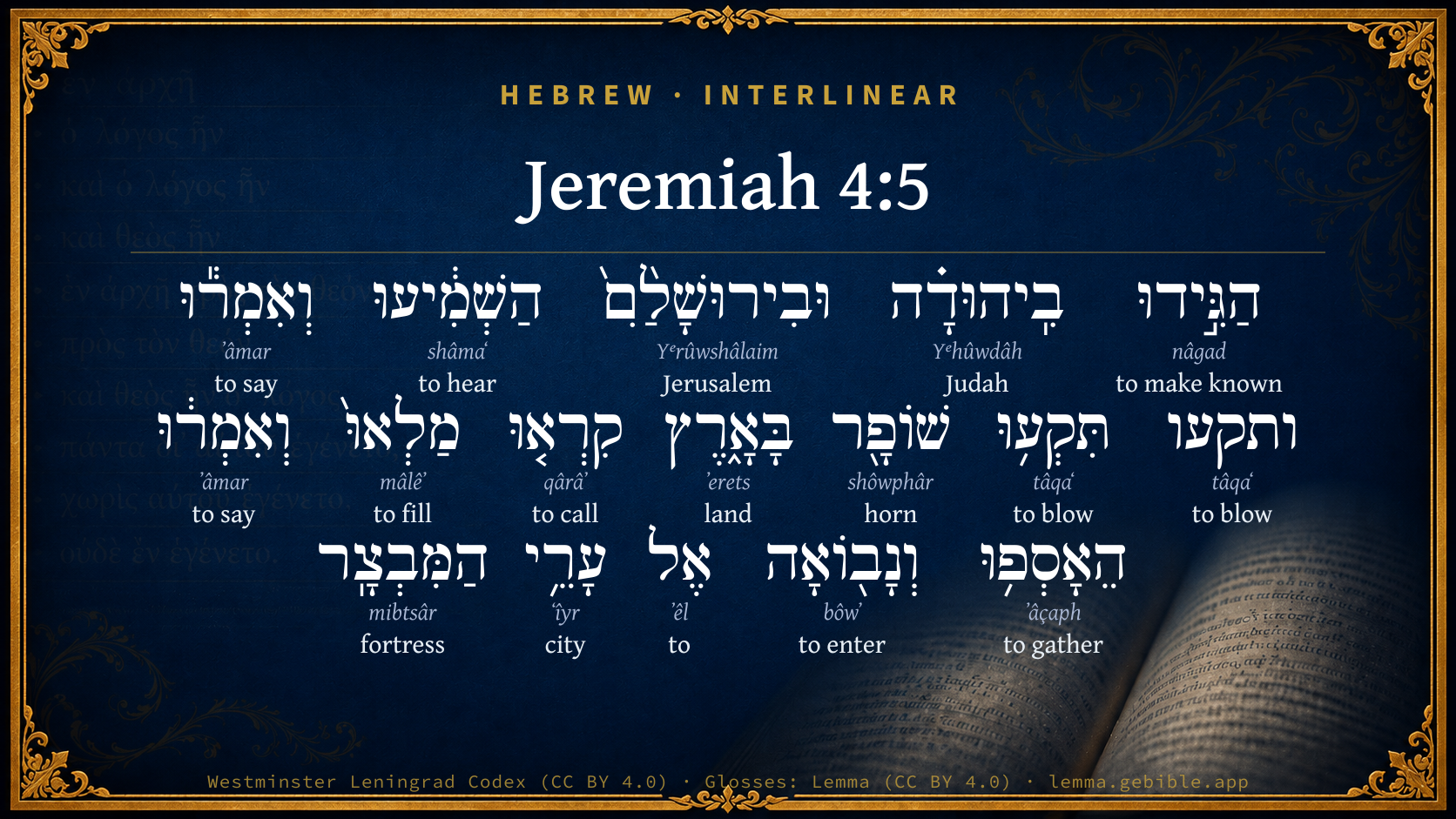
Hebrew (Westminster Leningrad Codex) Jeremiah 4:5 appears in the Hebrew Old Testament. The text above is from the Westminster Leningrad Codex. Each word links to its Strong’s number, a concise gloss, and parsing drawn from the Open Scriptures Hebrew Bible morphology. Click any word for its full Brown-Driver-Briggs (BDB) entry.
Download image
Cite this verse

Jeremiah 4:5 (World English Bible). Public Domain. Lemma interlinear Bible study tool, https://lemma.gebible.app/v/jeremiah/4/5.

Show BibTeX & RIS
BibTeX
RIS
English Translation
Declare you in Judah, and publish in Jerusalem; and say, Blow you the trumpet in the land: cry aloud and say, Assemble yourselves, and let us go into the fortified cities.
World English Bible · Public Domain
Download a study sheet

One document with this verse’s original text, its word-by-word gloss line, the meaning frame, cross-references with their text, attributed commentary, and full source and license credits — printable, and it pastes into notes with its structure intact.

This verse Autodidact and up

Study sheet (.html) Plain text (.txt)

A passage Seminary Student

Up to 50 verses in one chapter. A passage sheet keeps up to 6 commentary sources and 12 cross-references per verse, in the order this page ranks them, and says so on the sheet whenever that leaves anything out. Ask for a single verse and you get the Autodidact verse sheet above.

Everything on this page stays free to read, with no account — the sheet is a download of what is already on screen, not access to it.

Want to remove ads? Support Godless Engineer
Compare translations 3

The same verse in 3 English versions, stacked beneath the original-language interlinear above. Click any original word for its lexicon entry.

Each is an independent rendering of the whole verse — the interlinear is not word-aligned to these translations.

Highlighted words mark where these versions differ — a whole-verse word diff, not a word-by-word alignment.

  • World English Bible Public Domain
    Declare you in Judah, and publish in Jerusalem; and say, Blow you the trumpet in the land: cry aloud and say, Assemble yourselves, and let us go into the fortified cities.
  • King James Version Public Domain
    Declare ye in Judah, and publish in Jerusalem; and say, Blow ye the trumpet in the land: cry, gather together, and say, Assemble yourselves, and let us go into the defenced cities.
  • unfoldingWord Literal Text CC BY-SA 4.0
    Declare in Judah, and in Jerusalem announce, and say, “Blow the horn in the land!” Call out fully and say, “Assemble, and let us go into the cities of fortification.”

unfoldingWord Literal Text — © unfoldingWord, licensed CC BY-SA 4.0. Word-aligned USFM3 via Door43 (git.door43.org/unfoldingWord/en_ult).

Versions to compare (up to 4)

3 of 4 selected

Show all 18 translations

Every available English version of this verse, each an independent rendering of the whole verse.

  • World English Bible Public Domain
    Declare you in Judah, and publish in Jerusalem; and say, Blow you the trumpet in the land: cry aloud and say, Assemble yourselves, and let us go into the fortified cities.
  • Berean Standard Bible Public Domain
    Announce in Judah, proclaim in Jerusalem, and say: “Blow the ram’s horn throughout the land. Cry aloud and say, ‘Assemble yourselves and let us flee to the fortified cities.’
  • Majority Standard Bible Public Domain
    Announce in Judah, proclaim in Jerusalem, and say: “Blow the ram’s horn throughout the land. Cry aloud and say, ‘Assemble yourselves and let us flee to the fortified cities.’
  • King James Version Public Domain
    Declare ye in Judah, and publish in Jerusalem; and say, Blow ye the trumpet in the land: cry, gather together, and say, Assemble yourselves, and let us go into the defenced cities.
  • American Standard Version (1901) Public Domain
    Declare ye in Judah, and publish in Jerusalem; and say, Blow ye the trumpet in the land: cry aloud and say, Assemble yourselves, and let us go into the fortified cities.
  • Revised Version (1885) Public Domain
    Declare ye in Judah, and publish in Jerusalem; and say, Blow ye the trumpet in the land: cry aloud and say? Assemble yourselves, and let us go into the fenced cities.
  • Geneva Bible (1599) Public Domain
    Declare in Iudah, and shewe forth in Ierusalem, and say, Blowe the trumpet in the lande: cry, and gather together, and say, Assemble your selues, and let vs goe into strong cities.
  • Douay-Rheims (1899) Public Domain
    Declare ye in Juda, and make it heard in Jerusalem: speak, and sound with the trumpet in the land: cry aloud, and say: Assemble yourselves, and let us go into strong cities.
  • Young's Literal Translation Public Domain
    Declare in Judah, and in Jerusalem sound, And say ye, `Blow a trumpet in the land,' Call ye fully, and say ye: `Be gathered, and we go in to the fenced city.'
  • Literal Standard Version CC BY-SA 4.0
    Declare in Judah, and sound in Jerusalem, and say: “Blow a horn in the land, || Call, Fill up together, || And say, Assemble yourselves and let us go into the fortified cities.
  • Unlocked Literal Bible CC BY-SA 4.0
    Report in Judah and let it be heard in Jerusalem. Say, “Blow the trumpet in the land.” Proclaim, “Gather together. Let us go to the fortified cities.”
  • unfoldingWord Literal Text CC BY-SA 4.0
    Declare in Judah, and in Jerusalem announce, and say, “Blow the horn in the land!” Call out fully and say, “Assemble, and let us go into the cities of fortification.”
  • Darby Bible Public Domain
    Declare ye in Judah, and cause it to be heard in Jerusalem, and say,... and blow the trumpet in the land, cry aloud and say, Assemble yourselves, and let us enter into the fenced cities.
  • World Messianic Bible Public Domain
    Declare in Judah, and publish in Jerusalem; and say, ‘Blow the shofar in the land!’ Cry aloud and say, ‘Assemble yourselves! Let’s go into the fortified cities!’
  • Webster's Bible Public Domain
    Declare ye in Judah, and publish in Jerusalem; and say, Blow ye the trumpet in the land: cry, Gather together, and say, Assemble yourselves, and let us go into the fortified cities.
  • Free Bible Version CC BY-SA 4.0
    Announce this warning throughout Judah and Jerusalem! Tell them: Blow the trumpet everywhere in the country! Shout out, “Hurry! Let's run to the fortified towns for protection!”
  • Bible in Basic English Public Domain
    Say openly in Judah, give it out in Jerusalem, and say, Let the horn be sounded in the land: crying out in a loud voice, Come together, and let us go into the walled towns.
  • JPS Tanakh (1917) Public Domain
    Declare ye in Judah, and publish in Jerusalem, and say: 'Blow ye the horn in the land'; cry aloud and say: 'Assemble yourselves, and let us go into the fortified cities.'

Literal Standard Version (2020), Covenant Press — licensed CC BY-SA 4.0. Text via the HelloAO Bible API (eBible.org). Unlocked Literal Bible (unfoldingWord) — licensed CC BY-SA 4.0. Text via the HelloAO Bible API (eBible.org). unfoldingWord Literal Text — © unfoldingWord, licensed CC BY-SA 4.0. Word-aligned USFM3 via Door43 (git.door43.org/unfoldingWord/en_ult). Free Bible Version, Dr. Jonathan Gallagher — licensed CC BY-SA 4.0. Text via the HelloAO Bible API (eBible.org).

Word by word

More ways to search: Search by grammar → Find every occurrence → Compare this word →

Practice this passage: Drill this verse → Learn its vocabulary →

הַמִּבְצָֽר
mibtsâr
H4013
“the · fortress”
Particle, Definite Article + Noun, Common, Masculine, Singular, Absolute
Part of Speech
Particle + Noun
Type
Common
Gender
Masculine
Number
Singular
State
Absolute
Full BDB Definition

Origin: from H1219

TWOT: 270g

fortification, fortress, fortified city, stronghold
  1. הַגִּ֣ידוּ nâgad H5046 “make known” Verb, Hiphil, Imperative, 2nd Person, Masculine, Plural
  2. בִֽיהוּדָ֗ה Yᵉhûwdâh H3063 “in/at · Judah” Preposition + Noun, Proper
  3. וּבִירוּשָׁלִַ֨ם֙ Yᵉrûwshâlaim H3389 “and · in/at · Jerusalem” Conjunction + Preposition + Noun, Proper
  4. הַשְׁמִ֔יעוּ shâmaʻ H8085 “hear” Verb, Hiphil, Imperative, 2nd Person, Masculine, Plural
  5. וְאִמְר֕וּ ʼâmar H559 “and · say” Conjunction + Verb, Qal, Imperative, 2nd Person, Masculine, Plural
  6. ותקעו tâqaʻ H8628 “and · blow” Conjunction + Verb, Qal, Imperative, 2nd Person, Masculine, Plural
  7. תִּקְע֥וּ tâqaʻ H8628 “blow” Verb, Qal, Imperative, 2nd Person, Masculine, Plural
  8. שׁוֹפָ֖ר shôwphâr H7782 “horn” Noun, Common, Masculine, Singular, Absolute
  9. בָּאָ֑רֶץ ʼerets H776 “in/at the · land” Preposition, Determined + Noun, Common, Both, Singular, Absolute
  10. קִרְא֤וּ qârâʼ H7121 “call” Verb, Qal, Imperative, 2nd Person, Masculine, Plural
  11. מַלְאוּ֙ mâlêʼ H4390 “fill” Verb, Piel, Imperative, 2nd Person, Masculine, Plural
  12. וְאִמְר֔וּ ʼâmar H559 “and · say” Conjunction + Verb, Qal, Imperative, 2nd Person, Masculine, Plural
  13. הֵאָסְפ֥וּ ʼâçaph H622 “gather” Verb, Niphal, Imperative, 2nd Person, Masculine, Plural
  14. וְנָב֖וֹאָה bôwʼ H935 “and · to enter” Conjunction + Verb, Qal, Cohortative, 1st Person, Common, Plural
  15. אֶל ʼêl H413 “to” Preposition
  16. עָרֵ֥י ʻîyr H5892 “cities of” Noun, Common, Feminine, Plural, Construct

About this verse

These counts appear in no published source. They are computed here, from the morphology-tagged text and Lemma’s own curated glosses. What Lemma adds →

17
words
15
distinct lemmas
Prophets
section

Shared distinctive vocabulary

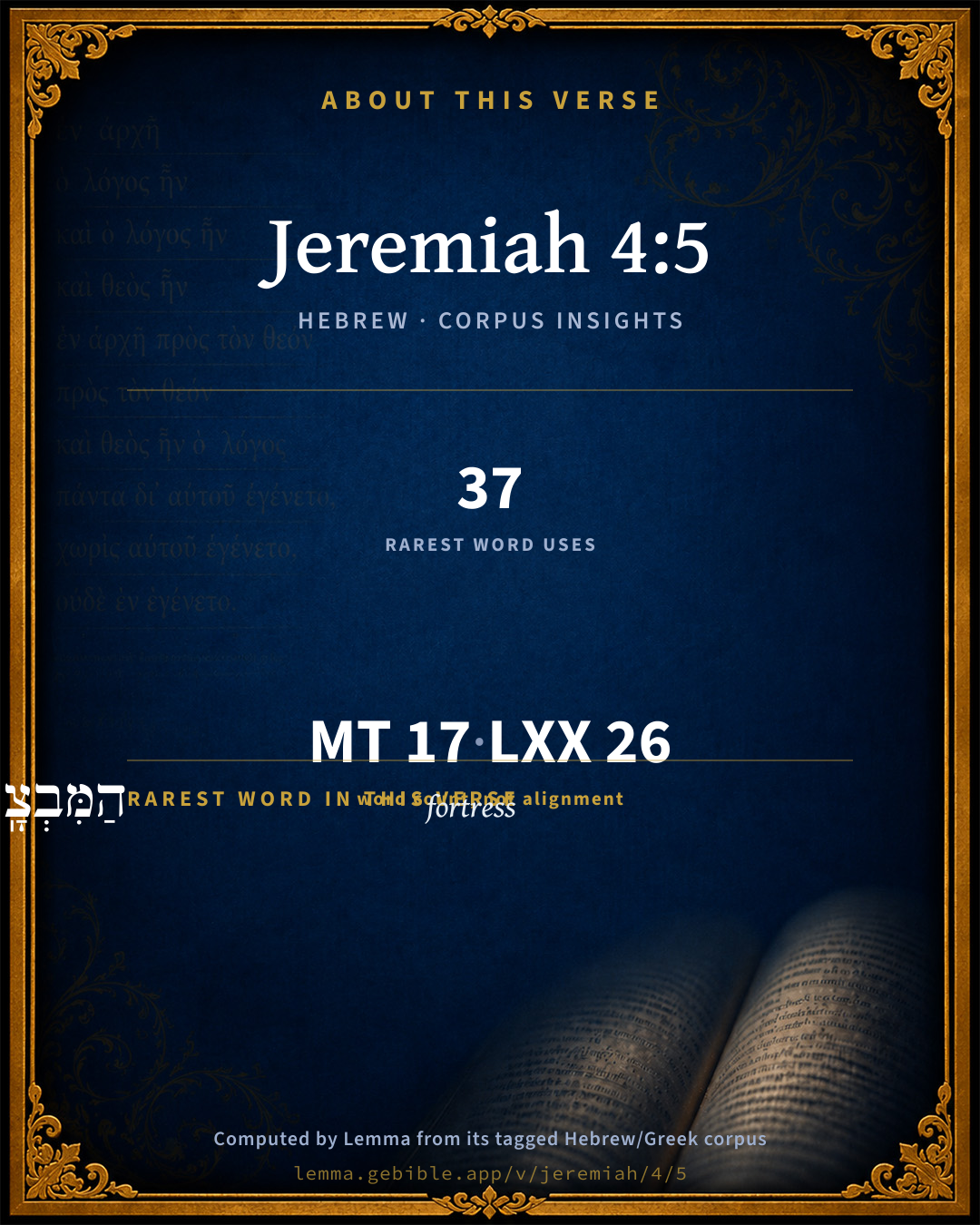
הַמִּבְצָֽר fortress H4013 occurs in 37 verses of the Hebrew Bible. Also found in:

Grammatical profile

  • 10 verbs
  • 6 nouns
  • 1 preposition

Verb forms

  • הַגִּ֣ידוּ Hiphil · Imperative
  • הַשְׁמִ֔יעוּ Hiphil · Imperative
  • וְאִמְר֕וּ Qal · Imperative
  • ותקעו Qal · Imperative
  • תִּקְע֥וּ Qal · Imperative
  • קִרְא֤וּ Qal · Imperative
  • מַלְאוּ֙ Piel · Imperative
  • וְאִמְר֔וּ Qal · Imperative
  • הֵאָסְפ֥וּ Niphal · Imperative
  • וְנָב֖וֹאָה Qal · Cohortative

Repetition

Words recur within this verse — often emphatic in Hebrew:

  • וְאִמְר֕וּ to say H559 ×2
  • ותקעו to blow H8628 ×2

Hebrew & Septuagint length

In the original languages it is 17 Hebrew tokens and 26 Greek tokens — but the two are counted differently (Hebrew bundles its prefixes and suffixes into one token; the Greek is in lemma form), so that isn’t a like-for-like length.

Cross-references

11

Topical passages linked to Jeremiah 4:5 in the Treasury of Scripture Knowledge — connected by theme and wording, ordered by reader-vote popularity; previews shown in the World English Bible.

  • Jeremiah 8:14 Why do we sit still? assemble yourselves, and let us enter into the fortified cities, and let us be silent there; for Yahweh our God has put us to silence, and given us water of gall to drink, because we have sinned against Yahweh.
  • Joshua 10:20 It happened, when Joshua and the children of Israel had made an end of killing them with a very great slaughter, until they were consumed, and the remnant which remained of them had entered into the fortified cities,
  • Jeremiah 6:1 Flee for safety, you children of Benjamin, out of the midst of Jerusalem, and blow the trumpet in Tekoa, and raise up a signal on Beth Haccherem; for evil looks forth from the north, and a great destruction.
  • Hosea 8:1 "Put the trumpet to your lips! Something like an eagle is over Yahweh's house, Because they have broken my covenant, And rebelled against my law.
  • Jeremiah 5:20 Declare you this in the house of Jacob, and publish it in Judah, saying,
  • Jeremiah 9:12 Who is the wise man, that may understand this? and [who is] he to whom the mouth of Yahweh has spoken, that he may declare it? why is the land perished and burned up like a wilderness, so that none passes through?
  • Jeremiah 11:2 Hear you the words of this covenant, and speak to the men of Judah, and to the inhabitants of Jerusalem;
  • Jeremiah 35:11 But it happened, when Nebuchadrezzar king of Babylon came up into the land, that we said, Come, and let us go to Jerusalem for fear of the army of the Chaldeans, and for fear of the army of the Syrians; so we dwell at Jerusalem.
  • Ezekiel 33:2–6 Son of man, speak to the children of your people, and tell them, When I bring the sword on a land, and the people of the land take a man from among them, and set him for their watchman;
  • Amos 3:6 Does the trumpet alarm sound in a city, Without the people being afraid? Does evil happen to a city, And Yahweh hasn't done it?
  • Amos 3:8 The lion has roared. Who will not fear? The Lord Yahweh has spoken. Who can but prophesy?

Cross-references courtesy of OpenBible.info (CC BY 4.0).

Hebrew and Greek witnesses Masoretic Hebrew ↔ Greek Septuagint

The same verse in the two great witnesses to the Old Testament, shown verse-for-verse.

These are two independent witnesses, not word-aligned to each other, and the Septuagint is shown in lemma (dictionary) form.

Hebrew Jeremiah 4:5 Masoretic · Westminster Leningrad Codex

הַגִּ֣ידוּ בִֽיהוּדָ֗ה וּבִירוּשָׁלִַ֨ם֙ הַשְׁמִ֔יעוּ וְאִמְר֕וּ ותקעו תִּקְע֥וּ שׁוֹפָ֖ר בָּאָ֑רֶץ קִרְא֤וּ מַלְאוּ֙ וְאִמְר֔וּ הֵאָסְפ֥וּ וְנָב֖וֹאָה אֶל עָרֵ֥י הַמִּבְצָֽר

Declare you in Judah, and publish in Jerusalem; and say, Blow you the trumpet in the land: cry aloud and say, Assemble yourselves, and let us go into the fortified cities.

World English Bible · Public Domain

Greek LXX Structure differs

In the Septuagint, Jeremiah is about an eighth shorter than the Hebrew and arranges its material differently — the Oracles Against the Nations (Hebrew chapters 46–51) appear in the middle of the Greek book, after 25:13. Because the chapter and verse boundaries do not line up, a verse-for-verse comparison with the Hebrew is not shown.

A verse-for-verse comparison isn’t shown here because the chapters and verses don’t line up. Switch to the LXX edition with the MT / LXX toggle above to read the Greek directly.

On this verse, Keil & Delitzsch discusses the Septuagint’s reading. Read the note in Commentary ↓

Hebrew: Westminster Leningrad Codex (CC BY 4.0). Greek: Septuagint (public domain); English from a public-domain English Septuagint. How the Septuagint differs from the Hebrew →

Targum (Aramaic paraphrase)

1

The Targum is the ancient Jewish Aramaic paraphrase of the Hebrew Scriptures — an interpretive translation, not the Hebrew text itself. Onkelos (literal) and Pseudo-Jonathan (expansive) render the Torah, and Jonathan the Prophets. Coverage is partial: where no permissively-licensed English translation exists for a verse, only the Aramaic is shown. This is verse-level text, not a word-by-word alignment to the Hebrew.

  1. Targum Jonathan Prophets (Joshua–Malachi)
    חַווּ בִיהוּדָה וּבִירוּשְׁלֵם בַּסְרוּ וַאֲמַרוּ תִּקְעוּ שׁוֹפָרָא בְּאַרְעָא אַכְלוּ אַסְנוּ וֶאֱמָרוּ אִתְכְּנָשׁוּ וְנֵיעוּל לְקִרְוִין כְּרִיכָן:

    (no public-domain English translation for this verse)

    Targum Jonathan — Aramaic: “Mikraot Gedolot” (public domain). English: “Sefaria Community Translation” (CC0 1.0 (public-domain dedication)); “London "Chaldee Paraphrase," 1871” (public domain). Text via Sefaria.

Commentary

Notes on Jeremiah 4:5 from classic Christian and Jewish commentators (each source and its license shown beneath its notes). The classic Christian expositions comment on the surrounding passage and are grouped to its opening verse, so a note may address several verses; the Jewish commentaries on the Tanakh (Rashi and others) are per-verse, so they appear only where the commentator wrote on this verse.

Lemma curates 59 commentaries, every one of them public domain or Creative Commons licensed, each selected and text-cleaned for this edition rather than reprinted as found. About our sources →

Matthew Henry's Commentary

God's usual method is to warn before he wounds. In these verses, accordingly, God gives notice to the Jews of the general desolation that would shortly be brought upon them by a foreign invasion. This must be declared and published in all the cities of Judah and streets of Jerusalem, that all might hear and fear, and by this loud alarm be either brought to repentance or left inexcusable. The prediction of this calamity is here given very largely, and in lively expressions, which one would think should have awakened and affected the most stupid. Observe,

I. The war proclaimed, and general notice given of the advance of the enemy. It is published now, some years before, by the prophet; but, since this will be slighted, it shall be published after another manner when the judgment is actually breaking in, Jer 4:5, Jer 4:6. The trumpet must be blown, the standard must be set up, a summons must be issued out to the people to gather together and to draw towards Zion, either to guard it or expecting to be guarded by it. There must be a general rendezvous. The militia must be raised and all the forces mustered. Those that are able men, and fit for service, must go into the defenced cities, to garrison them; those that are weak, and would lessen their provisions, but not increase their strength, must retire, and not stay.

II. An express arrived with intelligence of the approach of the king of Babylon and his army. It is an evil that God will bring from the north (as he had said, Jer 1:15), even a great destruction, beyond all that had yet come upon the nation of the Jews. The enemy is here compared, 1. To a lion that comes up from his thicket, when he is hungry, to seek his prey, Jer 4:7. The helpless beasts are so terrified with his roaring (as some report) that they cannot flee from him, and so become an easy prey to him. Nebuchadnezzar is this roaring tearing lion, the destroyer of the nations, that has laid many countries waste, and now is on his way in full speed towards the land of Judah. The destroyer of the Gentiles shall be the destroyer of the Jews too, when they have by their idolatry made themselves like the Gentiles. "He has gone forth from his place, from Babylon, or the place of the rendezvous of his army, on purpose against this land; that is the prey he has now his eye upon, not to plunder it only, but to make it desolate, and herein he shall succeed to such a degree that the cities shall be laid waste, without inhabitants, shall be overgrown with grass as a field;" so some read it. 2. To a drying blasting wind (Jer 4:11), a parching scorching wind, which spoils the fruits of the earth and withers them, not a wind which brings rain, but such as comes out of the north, which drives away rain (Pro 25:23), but brings something worse instead of it; such shall this evil out of the north be to this people, a black freezing wind, which they can neither fence against nor flee from, but, wherever they go, it shall surround and pursue them; and they cannot see it before it comes, but, when it comes, they shall feel it. It is a wind of the high places in the wilderness, or plain, that beats upon the tops of the hills or that carries all before it in the plain, where there is no shelter, but the ground is all champaign. It shall come in its full force towards the daughters of my people, that have been brought up so tenderly and delicately that they could not endure to have the wind blow upon them. Now this fierce wind shall come against them, not to fan, nor cleanse them, not such a gentle wind as is used in winnowing corn, but a full wind (Jer 4:12), a strong and violent wind, blowing full upon them. This shall come to me, or rather for me; it shall come with commission from God and shall accomplish that for which he sends it; for this, as other stormy winds, fulfills his word. 3. To clouds and whirlwinds for swiftness, Jer 4:13. The Chaldean army shall come up as clouds driven with the wind, so thick shall they stand, so fast shall they march, and it shall be to no purpose to offer to stop them or make head against them, any more than to arrest a cloud or give check to a whirlwind. The horses are swifter than eagles when they fly upon their prey; it is in vain to think either of opposing them or of outrunning them. 4. To watchers and the keepers of a field, Jer 4:15-17. The voice declares from Dan, a city which lay furthest north of all the cities of Canaan, and therefore received the first tidings of this evil from the north and hastened it to Mount Ephrain, that part of the land of Israel which lay next to Judea; they received the news of the affliction and transmitted it to Jerusalem. Ill news flies apace; and an impenitent people, that hates to be reformed, can expect no other that ill news. Now, what is the news? "Tell the nations, those mixed nations that now inhabit the cities of the ten tribes, mention it to them, that they may provide for their own safety; but publish it against Jerusalem, that is the place aimed at, the game shot at, let them know that watchers have come from a far country, that is, soldiers, that will watch all opportunities to do mischief." Private soldiers we call private sentinels, or watchmen. "They are coming in full career, and give out their voice against the cities of Judah; they design to invest them, to make themselves masters of them, and to attack them with loud shouts, as sure of victory. As keepers of a field surround it, to keep all out from it, so shall they surround the cities of Judah, to keep all in them, till they be constrained to surrender at discretion; they are against her round about, compassing her in on every side." See Luk 19:43. As formerly the good angels, those watchers, and holy ones, were like keepers of a field to Jerusalem, watching about it, that nothing might go in to its prejudice, so now their enemies were as watchers and keepers of a field, surrounding it that nothing might go in to its relief and succour.

III. The lamentable cause of this judgment. How is it that Judah and Jerusalem come to be thus abandoned to ruin? See how it came to this. 1. They sinned against God; it was all owing to themselves: She has been rebellious against me, saith the Lord, Jer 4:17. Their enemies surrounded them as keepers of a field, because they had taken up arms against their rightful Lord and sovereign, and were to be seized as rebels. The Chaldeans were breaking in upon them, and it was sin that opened the gap at which they entered: Thy way and thy doings have procured these things unto thee (Jer 4:18), thy evil way and thy doings that have not been good. It was not a false step or two that did them this mischief, but their way and course of living were bad. Note, Sin is the procuring cause of all our troubles. Those that go on in sin while they are endeavouring to ward off mischiefs with one hand are at the same time pulling them upon their own heads with the other. 2. God was angry with them for their sin. It is the fierce anger of the Lord that makes the army of the Chaldeans thus fierce, thus furious; that is kindled against us, and is not turned back from us, Jer 4:8. Note, In men's anger against us, and the violence of that, we must see and own God's anger and the power of that. If that were turned back from us, our enemies could not come forward against us. 3. In his just and holy anger he condemned them to this dreadful punishment: Now also will I give sentence against them, Jer 4:12. The execution was done, not in a heat, but in pursuance of a sentence solemnly passed, according to equity, and upon mature deliberation. Some read it, Now will I do execution upon them, according to the doom formerly passed; and we are sure that the judgment of God is according to the truth, and the execution of that judgment.

IV. The lamentable effects of this judgment, upon the first alarm given of it. 1. The people that should fight shall quite despair and shall not have a heart to make the least stand against the enemy (Jer 4:8): "For this gird yourself with sackcloth, lament and howl," that is, "you will do so. When the cry is made through the kingdom, Arm, arm! all will be seized with a consternation, and all put into confusion. Instead of girding on the sword, they will gird on the sackcloth; instead of animating one another to a vigorous resistance, they will lament and howl, and so dishearten one another. While the enemy is yet at a distance they will give up all for gone, and cry, Woe unto us! for we are spoiled, Jer 4:13. We are all undone, the spoilers will certainly carry the day, and it is in vain to make head against them." Judah and Jerusalem had been famed for valiant men; but see what is the effect of sin: by depriving men of their confidence towards God, it deprives them of their courage towards men. 2. Their great men, who should contrive for the public safety, shall be at their wits' end (Jer 4:9): At that day the heart of the king shall perish, both his wisdom and his courage. Despairing of success, he shall have no spirit to do any thing, and, if he had, he will not know what to do. His princes and privy-counselors, who should animate and advise him, shall be as much at a loss and as much in despair as he. See how easily, how effectually, God can bring ruin upon a people that are doomed to it, merely by dispiriting them, taking away the heart of the chief of them (Job 12:20, Job 12:24), cutting off the spirit of princes, Psa 76:12. The business of the priests was to encourage the people in the time of war; they were to say to the people, Fear not, and let not your hearts faint, Deu 20:2, Deu 20:3. They were to blow the trumpets, for an assurance to them that in the day of battle they should be remembered before the Lord their God, Num 10:9. But now the priests themselves shall be astonished, and shall have no heart themselves to do their office, and therefore shall not be likely to put spirit into the people. The prophets too, the false prophets, who had cried peace to them, shall be put into the greatest amazement imaginable, seeing their own guilty blood ready to be shed by that sword which they had often told the people there was no danger of. Note, God's judgments come with the greatest terror upon those that have been most secure. Our Saviour foretels that at the last destruction of Jerusalem men's hearts should fail them for fear, Luk 21:26. And it is common for those who have cheated and flattered people into a carnal security not only to fail them, but to discourage them, when the trouble comes.

V. The prophet's complaint of the people's being deceived, Jer 4:10. It is expressed strangely, as we read it: Ah! Lord God, surely thou hast greatly deceived this people, saying, You shall have peace. We are sure that God deceives none. Let no man say, when he is tempted or deluded, that God has tempted or deluded him. But, 1. The people deceived themselves with the promises that God had made in general of his favour to that nation, and the many peculiar privileges with which they were dignified, building upon them, though they took no care to perform the conditions on which the accomplishment of those promises and the continuance of those privileges did depend; and they had no regard to the threatenings which in the law were set over-against those promises. Thus they cheated themselves and then wickedly complained that God had cheated them. 2. The false prophets deceived them with promises of peace, which they made them in God's name. Jer 23:17; Jer 27:9. If God had sent them, he had indeed greatly deceived the people, but he had not. It was the people's fault that they gave them credit; and here also they deceived themselves. 3. God had permitted the false prophets to deceive, and the people to be deceived by them, giving both up to strong delusions, to punish them for not receiving the truth in the love of it. Herein the Lord was righteous; but the prophet complains of it as the sorest judgment of all, for by this means they had been hardened in their sins. 4. It may be read with an interrogation, "Hast thou indeed thus deceived this people? It is plain that they are greatly deceived, for they expect peace, whereas the sword reaches unto the soul; that is, it is a killing sword, abundance of lives are lost, and more likely to be." Now, was it God that deceived them? No, he had often given them warning of judgments in general and of this in particular; but their own prophets deceive them, and cry peace to those to whom the God of heaven does not speak peace. It is a pitiable thing, and that which every good man greatly laments, to see people flattered into their own ruin, and promising themselves peace when war is at the door; and this we should complain of to God, who alone can prevent such a fatal delusion.

VI. The prophet's endeavour to undeceive them. When the prophets they loved and caressed dealt falsely with them, he whom they hated and persecuted dealt faithfully. 1. He shows them their wound. They were loth to see it, very loth to have it searched into; but, if they will allow themselves the liberty of a free thought, they might discover their punishment in their sin (Jer 4:18): "This is thy wickedness because it is bitter. Now thou seest that it is a bitter thing to depart from God, and will certainly be bitterness in the latter end, Jer 2:19. It produces bitter effects, and grief that reaches unto the heart, touches to the quick, and in the most tender part; the sword reaches to the soul," Jer 4:10. God can make trouble reach the heart even of those that would lay nothing to heart. "And by this thou mayest see what is thy wickedness, that it is a bitter thing, a root of bitterness, that bears gall and wormwood, and that it has reached to the heart; it is the corruption of the soul, of the imagination of the thought of the heart." If the heart were not polluted with sin, it would not be disturbed and disquieted as it is with trouble. 2. He shows them the cure, Jer 4:14. "Since thy wickedness reaches to the heart, there the application must be made. O Jerusalem! wash thy heart from wickedness, that thou mayest be saved." By Jerusalem he means each one of the inhabitants of Jerusalem; for every man has a heart of his own to take care of, and it is personal reformation that must help the public. Every one must return from his own evil way, and, in order to that, cleanse his own evil heart. "And let the heart of the city too be purified, not the suburbs only, the outskirts of it." The vitals of a state must be amended by the reformation of those that have the commanding influence upon it. Note, (1.) Reformation is absolutely necessary to salvation. There is no other way of preventing judgments, or turning them away when we are threatened with them, but taking away the sin by which we have procured them to ourselves. (2.) No reformation is saving but that which reaches the heart. There is heart-wickedness that is defiling to the soul, from which we must wash ourselves. By repentance and faith we must wash our hearts from the guilt we have contracted by spiritual wickedness, by those sins which begin and end in the heart and go no further; and by mortification and watchfulness we must suppress and prevent this heart-wickedness for the future. The tree must be made good, else the fruit will not. Jerusalem was all overspread with the leprosy of sin. Now as the physicians agree with respect to the body when afflicted with leprosy that external applications will do no good, unless physic be taken inwardly to carry off the humours that lurk there and to change the mass of the blood, so it is with the soul, so it is with the state: there will be no effectual reformation of the manners without a reformation of the mind; the mistakes there must be rectified, the corruptions there must be mortified, and the evil dispositions there changed. "Though thou art Jerusalem, called a holy city, that will not save thee, unless thou wash thy heart from wickedness." In the latter part of the verse he reasons with them: How long shall thy vain thoughts lodge within thee? He complains here [1.] Of the delays of their reformation: "How long shall that filthy heart of thine continue unwashed? When shall it once be?" Note, The God of heaven thinks the time long that his room is usurped, and his interest opposed, in our souls, Jer 13:27. [2.] Of the root of their corruption, the vain thoughts that lodged within them and defiled their hearts, from which they must wash their hearts. Thoughts of iniquity or mischief, these are the evil thoughts that are the spawn of the evil heart, from which all other wickedness is produced, Mat 15:19. These are our own, the conceptions of our own lusts (Jam 1:15), and they are the most dangerous when they lodge within us, when they are admitted and entertained as guests, and are suffered to continue. Some read it thoughts of affliction, such thoughts as will bring nothing but affliction and misery. Some by the vain thoughts here understand all those frivolous pleas and excuses with which they turned off the reproofs and calls of the word and rendered them ineffectual, and bolstered themselves up in their wickedness. Wash thy heart from wickedness, and think not to say, We are not polluted (Mat 2:23), or, "We are Jerusalem; we have Abraham to our father," Mat 3:8, Mat 3:9.

Matthew Henry's Commentary on the Whole Bible (1708–1710) — public domain (CC PDM 1.0). Text via the HelloAO Bible API.

The Cambridge Bible for Schools and Colleges

gen. ed. J. J. S. Perowne

5. in Jerusalem] But a proclamation that people should take refuge within cities would not be needed there. It is probable that the words should be omitted. Moreover, by a very slight change in the Hebrew, the first “and say” may be read “saith Jehovah.” Thus we may with probability emend, Declare ye in Judah, and publish, saith Jehovah, Blow, etc.

trumpet] horn, as a signal of danger.

let us go, etc.] Cp. the crowding of the inhabitants of Attica within the walls of Athens on the occasion of a Spartan invasion (Thuc. II. 52).

5–10. Flee without delay, if so be that walls can save you. The foe from the north threatens ruin to town and country alike. Terror shall seize the greatest in the land, and dismay the priests and prophets.

Ch. Jer_4:5-31. Impending judgements. National disaster

This section and the two that follow it (viz. chs. 5 and 6) are somewhat later than the preceding, as presenting a more definite description of the punishment there threatened. They picture the excitement and dismay caused throughout the defenceless portions of the land by the approach of the enemy, and the hasty retreat to walled towns on the part of the country people.

No doubt as originally uttered these sections referred to the threatened invasion of Palestine by the Scythian hordes. (See Introd. i. § 3 and on Jer_1:13.) On being reproduced in the Roll of b.c. 604 (ch. 36), when the Chaldaeans had become the formidable enemy, the language may have been modified here and there to suit the new political aspect of affairs. Thus “lion” and “destroyer of nations” (Jer_4:7) are epithets more appropriate to an individual leader such as Nebuchadnezzar than to a hostile multitude. Neither do we know that the Scythians had “chariots” (Jer_4:13).

The present section may be summarized as follows.

The Cambridge Bible for Schools and Colleges (gen. ed. J. J. S. Perowne; Cambridge University Press, 1878–1918) — public domain. Text from a community e-Sword module.

Trapp's Complete Commentary

John Trapp

Jer 4:5 Declare ye in Judah, and publish in Jerusalem; and say, Blow ye the trumpet in the land: cry, gather together, and say, Assemble yourselves, and let us go into the defenced cities.

Ver. 5. Declare ye in Judah.] As if the prophet should say, I do but lose my labour in calling upon you to mortify your corruptions and to cast away all your transgressions. Uncircumcised ye are in heart and ears, and so will be. Now therefore stand upon your guard against the approaching enemy, and defend yourselves, if at least you are able, from the evil that is coming upon you. Moat up yourselves against God’s fire. {Jer 4:4}

John Trapp, A Commentary or Exposition upon All the Books of the Old and New Testament (1647–1656) — public domain. Text from a community e-Sword module.

Joseph Benson's Commentary

Jer 4:5-6. Blow ye the trumpet — The Lord, being now about to bring enemies upon them, speaks in martial language, warning them of the nature of their approaching judgment. It is the beginning of a new discourse, in which the prophet describes the dreadful preparations of war, such as blowing a trumpet, and setting up a standard, for the assembling men together, in order to their leaving the open country, and retiring with their families and goods into the defenced cities, both for their own safety, and that they might maintain those garrisons against the power of the enemy. Retire, stay not — Make haste away. I will bring evil from the north — I am about to bring a great destruction upon you from Chaldea.

Joseph Benson's Commentary on the Old and New Testaments (1811–1818) — public domain. Text from a community e-Sword module.

Keil & Delitzsch

C. F. Keil & F. Delitzsch

From the north destruction approaches. - Jer 4:5. "Proclaim in Judah, and in Jerusalem let it be heard, and say, Blow the trumpet in the land; cry with a loud voice, and say, Assemble, and let us go into the defenced cities. Jer 4:6. Raise a standard toward Zion: save yourselves by flight, linger not; for from the north I bring evil and great destruction. Jer 4:7. A lion comes up from his thicket, and a destroyer of the nations is on his way, comes forth from his place, to make they land a waste, that thy cities be destroyed, without an inhabitant. Jer 4:8. For this gird you in sackcloth, lament and howl, for the heat of Jahveh's anger hath not turned itself from us. Jer 4:9. And it cometh to pass on that day, saith Jahveh, the heart of the king and the heart of the princes shall perish, and the priests shall be confounded and the prophets amazed." The invasion of a formidable foe is here represented with poetic animation; the inhabitants being called upon to publish the enemy's approach throughout the land, so that every one may hide himself in the fortified cities.

(Note: By this dreaded foe the older commentators understand the Chaldeans; but some of the moderns will have it that the Scythians are meant. Among the latter are Dahler, Hitz., Ew., Bertheau (z. Gesch. der Isr.), Movers, and others; and they have been preceded by Eichhorn (Hebr. Proph. ii. 96 f), Cramer (in the Comm. on Zephaniah, under the title Scythische Denkmler in Palstina, 1777). On the basis of their hypothesis, M. Duncker (Gesch. des Alterth. S. 751ff.) has sketched out a minute picture of the inundation of Palestine by hordes of Scythian horsemen in the year 626, according to the prophecies of Jeremiah and Zephaniah. For this there is absolutely no historical support, although Roesch in his archaeological investigations on Nabopolassar (Deutsch-morgld. Ztschr. xv. S. 502ff.), who, according to him, was a Scythian king, alleges that "pretty nearly all (?) exegetical authorities" understand these prophecies of the Scythians (S. 536). For this view can be neither justified exegetically nor made good historically, as has been admitted and proved by A. Kueper (Jerem. libr. ss. int. p. 13f.), and Ad. Strauss (Vaticin. Zeph. p. 18f.), and then by Tholuck (die Propheten u. ihre Weiss, S. 94ff.), Graf (Jer. S. 16ff.), Ng., and others. On exegetical grounds the theory is untenable; for in the descriptions of the northern foe, whose invasion of Judah Zephaniah and Jeremiah threaten, there is not the faintest hint that can be taken to point to the Scythian squadrons, and, on the contrary, there is much that cannot be suitable to these wandering hordes. The enemies approaching like clouds, their chariots like the whirlwind, with horses swifter than eagles (Jer 4:13), every city fleeing from the noise of the horsemen and of the bowmen (Jer 4:29), and the like, go to form a description obviously founded on Deu 28:49., and on the account of the Chaldeans ( כּשׂדּים) in Hab 1:7-11 - a fact which leads Roesch to suppose Habakkuk meant Scythian by כּשׂדּים. All the Asiatic world-powers had horsemen, war-chariots, and archers, and we do not know that the Scythians fought on chariots. Nor was it at all according to the plan of Scythian hordes to besiege cities and carry the vanquished people into exile, as Jeremiah prophesies of these enemies. Again, in Jer 25, where he expressly names Nebuchadnezzar the king of Babel as the fulfiller of judgment foretold, Jeremiah mentions the enemy in the same words as in Jer 1:15, ּכל־משׁפּחות צפון (Jer 25:9), and represents the accomplishment of judgment by Nebuchadnezzar as the fulfilment of all the words he had been prophesying since the 13th year of Josiah. This makes it as clear as possible that Jeremiah regarded the Chaldeans as the families of the peoples of the north who were to lay Judah waste, conquer Jerusalem, and scatter its inhabitants amongst the heathen. In a historical reference, also, the Scythian theory is quite unfounded. The account in Herod. i. 103-105 of the incursion of the Scythians into Media and of dominion exercised over Asia for 28 years by them, does say that they came to Syrian Palestine and advanced on Egypt, but by means of presents were induced by King Psammetichus to withdraw, that they marched back again without committing any violence, and that only ὀλίγοι τινὲς αὐτῶν plundered the temple of Venus Urania at Ascalon on the way back. But these accounts, taken at their strict historical value, tell us nothing more than that one swarm of the Scythian hordes, which overspread Media and Asia Minor, entered Palestine and penetrated to the borders of Egypt, passing by the ancient track of armies across the Jordan at Bethshan, and through the plain of Jezreel along the Philistine coast; that here they were bought off by Psammetichus and retired without even so much as touching on the kingdom of Judah on their way. The historical books of the Old Testament have no knowledge whatever of any incursion into Judah of Scythians or other northern nations during the reign of Josiah. On the other hand, we give no weight to the argument that the march of the Scythians through Syria against Egypt had taken place in the 7th or 8th year of Josiah, a few years before Jeremiah's public appearance, and so could be no subject for his prophecies (Thol., Graf, Ng.). For the chronological data of the ancients as to the Scythian invasion are not so definite that we can draw confident conclusions from them; cf. M. v. Niebuhr, Ges. Assurs u. Babels, S. 67ff.

All historical evidence for a Scythian inroad into Judah being thus entirely wanting, the supporters of this hypothesis can make nothing of any point save the Greek name Scythopolis for Bethshan, which Dunck. calls "a memorial for Judah of the Scythian raid." We find the name in Jdg 1:27 of the lxx, Βαιθσάν ἥ ἐστι Σκυθῶν πόλις, and from this come the Σκυθόπολις of Judith 3:10, 2 Macc. 12:29, and in Joseph. Antt. v. 1. 22, xii. 8. 5, etc. Even if we do not hold, as Reland, Pal. ill. p. 992, does, that the gloss, ἥ ἐστι Σκυθῶν πόλις, Jdg 1:27, has been interpolated late into the lxx; even if we admit that it originated with the translator, the fact that the author of the lxx, who lived 300 years after Josiah, interpreted Σκυθόπολις by Σκυθῶν πόλις, does by no means prove that the city had received this Greek name from a Scythian invasion of Palestine, or from a colony of those Scythians who had settled down there. The Greek derivation of the name shows that it could not have originated before the extension of Greek supremacy in Palestine - not before Alexander the Great. But there is no historical proof that Scythians dwelt in Bethshan. Duncker e.g., makes the inference simply from the name Σκυθῶν πόλις and Σκυθοπολίται, 2 Macc. 12:29f. His statement: "Josephus (Antt. xii. 5. 8) and Pliny (Hist. n. v. 16) affirm that Scythians had settled down there," is wholly unfounded. In Joseph. l.c. there is no word of it; nor will a critical historian accept as sufficient historical evidence of an ancient Scythian settlement in Bethshan, Pliny's l.c. aphoristic notice: Scythopolin (antea Nysam a Libero Patre, spulta nutrice ibi) Scythis deducts. The late Byzantine author, George Syncellus, is the first to derive the name Scythopolis from the incursion of the Scythians into Palestine; cf. Reland, p. 993. The origin of the name is obscure, but is not likely to be found, as by Reland, Gesen., etc., in the neighbouring Succoth. More probably it comes from a Jewish interpretation of the prophecy of Ezekiel, Eze 39:11, regarding the overthrow of Gog in the valley of the wanderers eastwards from the sea. This is Hvernick's view, suggested by Bochart.

Taking all into consideration, we see that the reference of our prophecy to the Scythians is founded neither on exegetical results nor on historical evidence, but wholly on the rationalistic prejudice that the prophecies of the biblical prophets are nothing more than either disguised descriptions of historical events or threatenings of results that lay immediately before the prophet's eyes, which is the view of Hitz., Ew., and others.)

The ו before תּקעוּ in the Chet. has evidently got into the text through an error in transcription, and the Keri, according to which all the old versions translate, is the only correct reading. "Blow the trumpet in the land," is that which is to be proclaimed or published, and the blast into the far-sounding שׁופר is the signal of alarm by which the people was made aware of the danger that threatened it; cf. Joe 2:1; Hos 5:8. The second clause expresses the same matter in an intensified form and with plainer words. Cry, make full (the crying), i.e., cry with a full clear voice; gather, and let us go into the fortified cities; cf. Jer 8:14. This was the meaning of the trumpet blast. Raise a banner pointing towards Zion, i.e., showing the fugitives the way to Zion as the safest stronghold in the kingdom. נס, a lofty pole with a waving flag (Isa 33:23; Eze 27:7), erected upon mountains, spread the alarm farther than even the sound of the pealing trumpet; see in Isa 5:26. העיזוּ, secure your possessions by flight; cf. Isa 10:31. The evil which Jahveh is bringing on the land is specified by שׁבר גּדול, after Zep 1:10, but very frequently used by Jeremiah; cf. Jer 6:1; Jer 48:3; Jer 50:22; Jer 51:54. שׁבר, breaking (of a limb), Lev 21:19, then the upbreaking of what exists, ruin, destruction. In Jer 4:7 the evil is yet more fully described. A lion is come up from his thicket (סבּכו with dag. forte dirim., from שׂובך[ סבך, Sa2 18:9], or from סבך, Psa 74:5; cf. Ew. 255, d, and Olsh. 155, b), going forth for prey. This lion is a destroyer of the nations (not merely of individual persons as the ordinary lion); he has started (נסע, or striking tents for the march), and is come out to waste the land and to destroy the cities. The infin. is continued by the temp. fin. תּצּינה, and the Kal of נצה is here used in a passive sense: to be destroyed by war.

Keil & Delitzsch — Biblical Commentary on the Old Testament (1861–1891) — public domain (CC PDM 1.0). Text via the HelloAO Bible API. (Old Testament only.)

Tyndale Open Study Notes

Tyndale Open Resources

4:5-6 God was opening the pot of boiling water (see 1:13-14) and pouring out a cruel army upon the people (8:14; 50:2; Josh 10:20; Isa 62:10).

Tyndale Open Study Notes — © Tyndale Open Resources, licensed CC BY-SA 4.0. Text via the HelloAO Bible API.

Geneva Bible (1599)

Geneva Bible translators

He warneth them of the great dangers that shall come upon them by the Chaldeans, except, they repent and turn to the Lord.

Geneva Bible (1599) marginal notes — public domain. Text via Bolls.life.

Jamieson, Fausset & Brown

Robert Jamieson, A. R. Fausset & David Brown

cry, gather together--rather, "cry fully" that is, loudly. The Jews are warned to take measures against the impending Chaldean invasion (compare Jer 8:14).

Jamieson, Fausset & Brown — Commentary Critical and Explanatory on the Whole Bible (1871) — public domain (CC PDM 1.0). Text via the HelloAO Bible API.

Adam Clarke's Commentary

Verse 5. Blow ye the trumpet] Give full information to all parts of the land, that the people may assemble together and defend themselves against their invaders.

Adam Clarke's Commentary on the Bible (1810–1826) — public domain. Text from a community e-Sword/MySword module.

John Calvin's Commentaries

Jeremiah treats his own people here with more severity, for he saw that they were refractory, and so obstinate in their vices, that they could not by wise counsels be restored to the way of safety. Hence he addresses them here as men wholly irreclaimable, and to whom instruction proved useless. But though according to the manner of the prophets, he sounds a trumpet for the sake of filling them with terror, he seems yet to speak tauntingly, when he bids them to proclaim in Judah, and to publish in Jerusalem; as though he had said, When distress shall seize you, you will then by experience perceive that God is angry with you: though to — day ye believe not my warnings; yet that God may not, indeed, by a violent hand, bring you back to himself, and as ye seek evasions for yourselves, ye shall sound the trumpet, and proclaim, “The enemies are coming, and are nigh at hand; let, therefore, every one flee to Jerusalem, and enter into the city, and resort unto Zion: “that is, “If we cannot secure our safety in the city, we shall at least be safe in the fortress of Sion.” But God, he says, brings an evil on you from the north; and whatever ye may think will be for your safety will be wholly useless. It is, however, proper, especially to regard the Prophet as God’s herald proclaiming war; and that though he exults over their perverseness, he yet declares that such would be everywhere the terror, that they would seek safety by flight.

Sound, he says, in Judah, and publish, or proclaim, in Jerusalem, (הגידו, egidu, announce, literally.) He speaks not here for the same purpose as Joel did, (Joel 1:1, 15,) when he bade them to sound the trumpet; for the latter exhorted the people to repent; but Jeremiah, as I have already said, tauntingly reproves here the people for their obstinacy and perverseness; as though he had said, “I see what ye will do, when God’s vengeance shall come upon you, that ye may not even then repent; for ye will sound the trumpet through the whole land, ‘Let all resort to Sion;’ as though ye could resist there your enemies, and preserve your lives.” He does not, then, bid them to sound the trumpet, but, on the contrary, shews what they would do.

Some improperly give this rendering, “Fulfill ye, “but the common version is, “Assemble yourselves.” But interpreters seem not to me to have regarded the etymology of the word; for it is of the same meaning in Hebrew as when we say, Amassez-vous, Gather yourselves. And say, Be ye assembled, and let us go into fortified cities It will, indeed, be announced to you to seek hiding — places to protect you from the assaults of your enemies; if so, Raise a banner in Sion, and flee; but God will at the same time bring evil on you from the north

John Calvin's Commentaries (1540-1563) — public domain. Text from the Calvin Translation Society English edition (1840s-50s) via the Christian Classics Ethereal Library (ccel.org). Calvin's coverage is partial (roughly two-thirds of the Bible); uncommented books and verses are honest gaps, never fabricated. The 19th-century editor's footnotes and remarks are omitted so the notes are faithfully Calvin's own voice.

Ellicott's Commentary for English Readers

(5) Declare.—i.e., proclaim as a herald proclaims. The cry is that of an alarm of war. The prophet sees, as it were, the invading army, and calls the people to leave their villages and to take refuge in the fortified cities.

A Bible Commentary for English Readers, edited by Charles John Ellicott (1878–1897) — public domain. Text from a community e-Sword module.

John Gill's Exposition

Declare ye in Judah, and publish in Jerusalem, and say,.... Exhortations to repentance being without effect in general, though they might have an influence on some few particular persons, the Lord directs the prophet to lay before the people a view of their destruction as near at hand; who calls upon some persons as a sort of heralds, to publish and declare in the land of Judea, and in Jerusalem the metropolis of it, what follows:

blow ye the trumpet in the land; as an alarm of an approaching enemy, and of an invasion by him, and of danger from him; and this was to be done, not in order to gather together, and put themselves in a posture of defence, to meet the enemy, and give him battle; but to get together, that were in the fields, and in country villages, and hide themselves from him:

cry, gather together, and say; or cry with a full mouth, with a loud voice, that all might hear; which shows imminent danger:

assemble yourselves and let us go into the defenced cities; such as Jerusalem, and others, where they might think themselves safe and secure; see Mat 24:16.

John Gill's Exposition of the Whole Bible (1746–1763) — public domain (CC PDM 1.0). Text via the HelloAO Bible API.

Albert Barnes' Notes on the Bible

Rather, Make proclamation “in Judah, and in Jerusalem” bid them hear, “and say, Blow the trumpet” throughout “the land:” cry aloud “and say etc.” The prophecy begins with a loud alarm of war. The verse sets forth well, in its numerous commands, the excitement and confusion of such a time.

Albert Barnes' Notes on the Bible (1834–1885) — public domain. Text from a community e-Sword/MySword module.

Haydock's Catholic Bible Commentary

Cities. Nabuchodonosor is at hand.

George Leo Haydock (1774–1849), Haydock's Catholic Family Bible and Commentary, 1859 edition — public domain. Excludes Psalms (Douay-Rheims chapter numbering differs from Protestant) and Deuterocanonical books (Catholic canon only).

Matthew Poole's English Annotations

The Lord being now about to bring enemies upon them, he bespeaks them in martial language, by stirring them to a speedy provision, and warning of them of the nature of their approaching judgment; not famine or plague within them, but a foreign enemy from without, Jer 6 1, viz. the coming of Nebuchadnezzar and the Chaldeans.

Cry, that your voice may be heard afar off, that all may hear.

Gather together; either to unite your forces, or to take counsel what to do, that you may be in safety; the same thing with

Assemble yourselves; implying that the calamity was general.

Let us go into the defenced cities, to secure from these invasions that are coming upon us.

Matthew Poole's English Annotations on the Holy Bible (1683–1685) — public domain. Text from a community e-Sword/MySword module.

Dummelow's Commentary on the Holy Bible

J. R. Dummelow

Jeremiah's Fourth Prophecy (or Group of Prophecies). God's Judgment upon the Unrepentant

When the check which Josiah's personal character and influence put upon idolatry was removed, Jeremiah foresaw that the condition of the nation would become well-nigh desperate.

5-10. Destruction approaches Jerusalem.

6. Set up the standard] to mark out the safest route to those who were seeking the shelter of the walls of Jerusalem. Evil from the north] The enemy (see Jer_4:13) used chariots, and were therefore probably the Chaldeans, not (as some have supposed) Scythians.

7. The lion] i.e. the enemy. Of the Gentiles] RV 'of nations.'

10. Jeremiah here struggles against the fate announced for the nation. After all its glorious history and the many promises of coming glory that prophets like Isaiah had made to it, was this to be the end? The prophet was 'in a strait betwixt two,' sorrowing for the doom of the nation and anxious to avert it, and yet desirous to vindicate Jehovah's ways to them. Hence this exceeding bitter cry. Some, however, regard the v. as a reference to the mischief done by the false prophets, who had promised peace in the name of the Lord.

11-18. Description of the attack.

11. A dry wind] the Chaldean army coming like a sirocco from the E.

15. Dan was on the northern border of Palestine. Mount Ephraim was the range immediately N. of Judah, only about 10 m. from 'Jerusalem itself. Thus the enemy's approach is rapid.

16. The nations summoned to witness the vengeance on the chosen people. The watchers are the Chaldean besiegers.

17. The besiegers' tents compared to the booths of shepherds or husbandmen.

19-31. The prophet expresses horror at the approaching calamity.

19. My bowels] supposed to be the seat of emotions.

21. See Jer_4:6.

22. God's answer to the implied appeal to know why the invasion was permitted. It is not without cause, for, etc.

24. Lightly] RV 'to and fro.'

27. Yet will I not make a full end] The destruction will not be complete: a remnant shall return: cp. Amo_9:8.

30. And when thou art spoiled] better, 'and thou, spoiled one,' i.e. Jerusalem. Rentest thy face with painting] RV 'enlargest thine eyes with paint.' The Eastern custom was to paint black the border of the eyes, so as to give the effect of size and brilliancy. So Jezebel in 2Ki_9:30.

J. R. Dummelow, A Commentary on the Holy Bible (Macmillan, 1909) — public domain. Text from a community e-Sword module.

Whedon's Commentary on the Bible

Daniel D. Whedon

5. Blow ye the trumpet, etc. — The invasion of a hostile army is proclaimed. The cry of alarm resounds throughout the land. The inhabitants are called to betake themselves to their cities. From the first, the most fundamental notion of a city was that of a covert from danger; — a place fortified and thus protected from hostile incursions, and so supplying the conditions of possible culture and development. Thus the “city” which Cain built was simply a natural stronghold selected and built up in such a way as to become a starting point and centre of that world-culture which so eminently characterized the Cainitic race.

Daniel D. Whedon (gen. ed.), Commentary on the Old and New Testaments (1874–1909) — public domain. Text from a community e-Sword module.

The Pulpit Commentary

Vers. 5-31. A revelation of grievous purport has suddenly reached the prophet. See how the foe draws nearer and nearer, and how alarm drives the scattered population to seek for refuge in the fortified cities. Can such be the issue of the promises of peace with which Jehovah has encouraged his people? Such are the contents of the first paragraph (vers. 5-10). Next, in short, detached figures the prophet sets forth the sin of the people and its punishment. Like a scorching simoom is the former; like swift clouds, and like a whirlwind, is the onward march of the instruments of the latter. Swift, indeed, must repentance be, if it is to outrun punishment. For the northern peoples are already here (vers. 11-18). The impression is so strong on the mind of the prophet that he vents himself in language such as the last man might employ on the morrow of the final judgment day (vers. 19-26). And now, "lest what precedes might seem only poetry" (Payne Smith), the Divine decree is solemnly announced. The judgment is irrevocable; but there is a gleam of hope: "I will not make a full end." On the question whether the Scythians or the Babylonians are mainly alluded to, (see Introduction.)

Cry, gather together; rather, cry aloud.

Vers. 5-31. The proclamation of woe.

Such is the character of this entire section, and we observe upon this proclamation

I THAT, LIKE ALL SUCH, IT IS PROMPTED BY DIVINE LOVE. The most fearful judgments contained in the whole Bible are those denounced by our Lord Jesus Christ. The most awful words ever spoken are those which proceeded out of the mouth of him at whose graciousness all-men wondered. It is evident, therefore, that they were the utterances, as is this one here, of Divine love. They are beacon-lights set up as a warning, that men may not suffer their vessels to run on those rocks against which they warn, and of whose peril they are the evidence and sign. There was time for those to whom Jeremiah spoke to turn unto the Lord and find salvation, though indeed it was the eleventh hour. And that they might be driven to this, morally compelled to come in to the mercy of God, is the object of these terrible threatenings, these blasts of the alarm-trumpet of God"s love. And in keeping with this intent, this proclamation

II SETS FORTH IN A VIVID, STRIKING FORM THE JUDGMENTS THAT IT DENOUNCES.

1. Under the emblem of a lion bursting forth from its thicket upon its defenseless prey (vers. 7, 8).

2. Under that of a terrible tempest (vers. 11-13).

3. Under that of a cordon of "watchers," who guard every corner and the entire circumference of a field in which the game they are hunting for has taken refuge. So should Judah and Jerusalem Be beleaguered and hemmed in until captured and destroyed (vers. 16, 17). They who would lead men away from sin to God must not shun to set forth in the most impressive way possible to them the dread evil of that which they would have them forsake. Hence the lurid pictures of the unquenchable flame and the undying worm which our Savior presents to us, and hence these vivid representations of the prophet Jeremiah.

III IS INTERMINGLED, AS IT HAS BEEN PRECEDED, WITH EXHORTATIONS TO THAT REPENTANCE BY WHICH THE THREATENED JUDGMENTS WOULD BE TURNED ASIDE: (Vers. 8, 14) So in declaring the judgments of God against sin, we should never let it be forgotten how God hath said, "As I live, saith the Lord God, I have no pleasure in the death of the wicked; but rather," etc. This section is a model of the method in which the more awful portions of our message to men should be declared. Hence note how it

IV IS A BURDEN OF THE LORD ON THOSE WHO ARE CHARGED WITH IT. (Vers. 19-31) Jeremiah could not refrain from delivering his message, and could not but know that to many it would be delivered in vain; but it was with grief and pain of heart he foretold what he knew must come. See our Savior"s tears over Jerusalem. Listen to St. Paul, "Of whom I tell you even weeping." Would that we all knew how to combine this faithfulness and this yearning tenderness in the delivery of this message! Then would men be aroused, as too often they are not now, to "flee from the wrath to come.

V IS CERTAIN TO BE FULFILLED IF THE SIN WHICH IS THE CAUSE OF IT RE NOT FORSAKEN. Few things are more solemnizing to the careless soul than to have plainly brought before him the sure fact that God has never gone from his word, awful though that word might have been. He did not here. All that Jeremiah foretold came to pass. The anguish of his heart was not caused, any more than were the Redeemer"s tears, by a merely fancied calamity. We are not able to tell what will be all the characteristics and elements of the Divine retribution on sin, but of its reality none who read the book of God"s written records, or the book of his providence as seen in historic facts, can for one moment doubt. Oh for a far deeper conviction of these soul-subduing truths on the part of all who preach and all who hear God"s holy Word! C.

The Pulpit Commentary (1880–1919), ed. H.D.M. Spence-Jones & Joseph S. Exell — public domain. Text from a community e-Sword module.

John Wesley's Explanatory Notes

The trumpet - The Lord being now about to bring enemies upon them, speaks in martial language, warning them of the nature of their approaching judgment.

John Wesley, Explanatory Notes Upon the Whole Bible (1754–1765) — public domain. Text via the GEBible commentary corpus.

Kretzmann's Popular Commentary

Paul E. Kretzmann

Description of The Judgment under three Emblems

v. 5. Declare ye in Judah, announcing it, making it known widely, and publish in Jerusalem and say, Blow ye the trumpet in the land, as a signal calling the inhabitants to arms; cry, gather together, and say, rather, "cry fully," that is, with a loud voice, shouting. Assemble yourselves and let us go into the defensed cities, into their strongest fortresses.

v. 6. Set up the standard toward Zion, raising their banners as a signal to make the city of God their refuge; retire, stay not, flee, do not try to make a stand! For I will bring evil from the North and a great destruction, namely, by the invasion of the enemy.

v. 7. The lion is come up from his thicket, Nebuchadnezzar, like an angry lion, leaving his lair, Babylon, with his army of Chaldean soldiers, and the destroyer of the Gentiles, he who subdued many nations, is on his way; he is gone forth from his place to make thy land desolate, by ravaging it with fire and sword; and thy cities shall be laid waste, without an inhabitant. Cf. Jer 2:15.

v. 8. For this, on account of the impending destruction, gird you with sackcloth, the garment of deep mourning, lament and howl; for the fierce anger of the Lord is not turned back from us. Cf Isa 9:12; Isaiah 17-21. The people who had expected to return to the Lord on the basis of their hypocritical behavior, their feigned repentance, would find themselves sorely disappointed.

v. 9. And it shall come to pass at that day, saith the Lord, at the time when this judgment would come upon Judah, that the heart of the king shall perish, the rulers whose position demanded that they devise means of defense would be utterly at a loss in this emergency, unable to provide help, and the heart of the princes; and the priests shall be astonished, amazed at the turn of events, and the prophets shall wonder, be filled with horror. So all the leaders are helpless and without presence of mind.

v. 10. Then said I, Ah, Lord God! the prophet here recording the impression which the declaration of the Lord made upon him; surely Thou hast greatly deceived this people and Jerusalem, in permitting the false prophets to lead the people astray, willing as they were to be duped, saying, Ye shall have peace, that being the common assurance of the deceiving prophets, whereas the sword reacheth unto the soul. Cf 1Ki 22:22. If people persist in opposing Him, the Lord finally delivers them to the certain consequences of such opposition and brings their punishment upon them in this manner.

v. 11. At that time, when the judgment of the Lord will strike the idolaters, shall it be said to this people and to Jerusalem, the center of Jewish religious life, A dry wind, the simoom, or desert wind, with its destructive breath, of the high places in the wilderness, sweeping down from the high places and across the desert, toward the daughter of My people, the children of God’s chosen nation, not to fan nor to cleanse, not the gentle breeze which ordinarily carried off the chaff as the threshed grain was winnowed,

v. 12. Even a full wind from those places, more violent than any such light breezes, shall come unto Me, as the Lord’s instrument for working His punishment; now also will I give sentence against them, passing judgment upon the idolaters and executing the same.

v. 13. Behold, he, the enemy with his army, shall come up as clouds, those of sand and dust blown up by the tempest, and his chariots shall be as a whirlwind; his horses are swifter than eagles, in bringing destruction to the land of Israel. Woe unto us! for we are spoiled, thus the exclamations of the despairing Israelites are recorded. But the Lord has still another emblem of the expected judgment, which He proceeds to hold before the eyes of Judah and Jerusalem.

v. 14. O Jerusalem, wash thine heart from wickedness, for a mere outward change of behavior is not sufficient, heart and mind and soul must undergo a complete transformation, that thou mayest be saved, for only he who truly repents may partake of the Lord’s deliverance. How long shall thy vain thoughts lodge within thee? It was high time for all sinful thoughts to be dismissed.

v. 15. For a voice declareth from Dan, in the extreme northern part of Canaan, where the advance of the enemy would be felt first, and publisheth affliction from Mount Ephraim, this being an evidence that the foe is coming nearer and nearer, and that there is great danger in delaying repentance.

v. 16. Make ye mention to the nations, calling the attention of the neighbors to the Lord’s judgment. Behold, publish against Jerusalem that watchers come from a far country, people who would witness the catastrophe upon Jerusalem, and give out their voice against the cities of Judah, in a shout of triumph or derision.

v. 17. As keepers of a field, the men whose duty it was to frighten away wild animals from the cultivated land, lest they work harm, are they against her round about, as watchers who have surrounded a harmful animal and are making ready to dispatch it, because she hath been rebellious against Me, saith the Lord. This God further affirms by turning directly to Judah once more.

v. 18. Thy way and thy doings have procured these things unto thee, she had only herself to blame if the punishment struck her with full force; this is thy wickedness, the fruit and consequence of her evil doing, because it is bitter, in its effect upon others as well as upon the sinners themselves, because it reacheth unto thine heart, inflicting deadly wounds. Such is ever the result of sin: sweet and attractive as it seems at first, it strikes deadly wounds, as the sinner usually finds out to his great regret.

Paul E. Kretzmann, Popular Commentary of the Bible (1921–1924) — public domain. Text from a community e-Sword module.

Rashi

Rabbi Shlomo Yitzchaki (Rashi)

and say, “Sound a shophar...” Warn the inhabitants of the land that they sound the shophar to flee.

assemble Heb. מלאו. An expression of gathering, and there are many in the Scriptures: (Isaiah 31: 4) “Although a band of (מְלֹא) shepherds gather against him,” Also (infra 12:6) “They called after you a band (מָלֵא).” Also (Job 16:10) “Together they gather (יתמלאוּן) against me.”

Rashi on the Tanakh — English translations: “The Judaica Press complete Tanach with Rashi, translated by A. J. Rosenberg” (CC BY 4.0); “Pentateuch with Rashi's commentary by M. Rosenbaum and A.M. Silbermann, 1929-1934” (public domain); “The Metsudah Tanach series, Lakewood, N.J” (CC BY 4.0); and “The Book of Joshua, Metsudah Publications, 1997” (CC BY 4.0). Text via Sefaria.

Lesson kit

Teaching starters — assembled from the data on this page, not authored interpretation. Every prompt links to the verse data it draws on. Edit before teaching.

Jeremiah, in the Prophets, opens this verse with 17 words (15 distinct Hebrew lemmas). Its most distinctive word is mibtsâr (“fortress”). A historical commentator’s framing appears above. Read the whole chapter for the surrounding context.

Discussion questions

  1. The word mibtsâr carries the sense “fortress.” How does it shape the verse?
  2. Numbers 13:19 shares the word «fortress» with this verse. How do the two illuminate each other?
  3. “to say” occurs 2× in this one verse. What is the effect of the repetition?
  4. These translations render this verse differently. What is at stake in choosing one wording over another?
  5. The verb «הַגִּ֣ידוּ» is Hiphil Imperative. How does its form color the action?
  6. Reading how Matthew Henry's Commentary and The Cambridge Bible for Schools and Colleges read this verse, where do the two commentators agree and where do they part?

Things to notice

Reading settings

Reading text

Shown beneath each verse's original-language words.

Old Testament
Old Testament edition

Read the OT as the Masoretic Hebrew (MT) or the Greek Septuagint (LXX).

English shown for the Greek Septuagint (in the Hebrew ↔ Greek comparison).

Comparing translations? Open the Compare panel on any verse page to stack up to four side by side.