
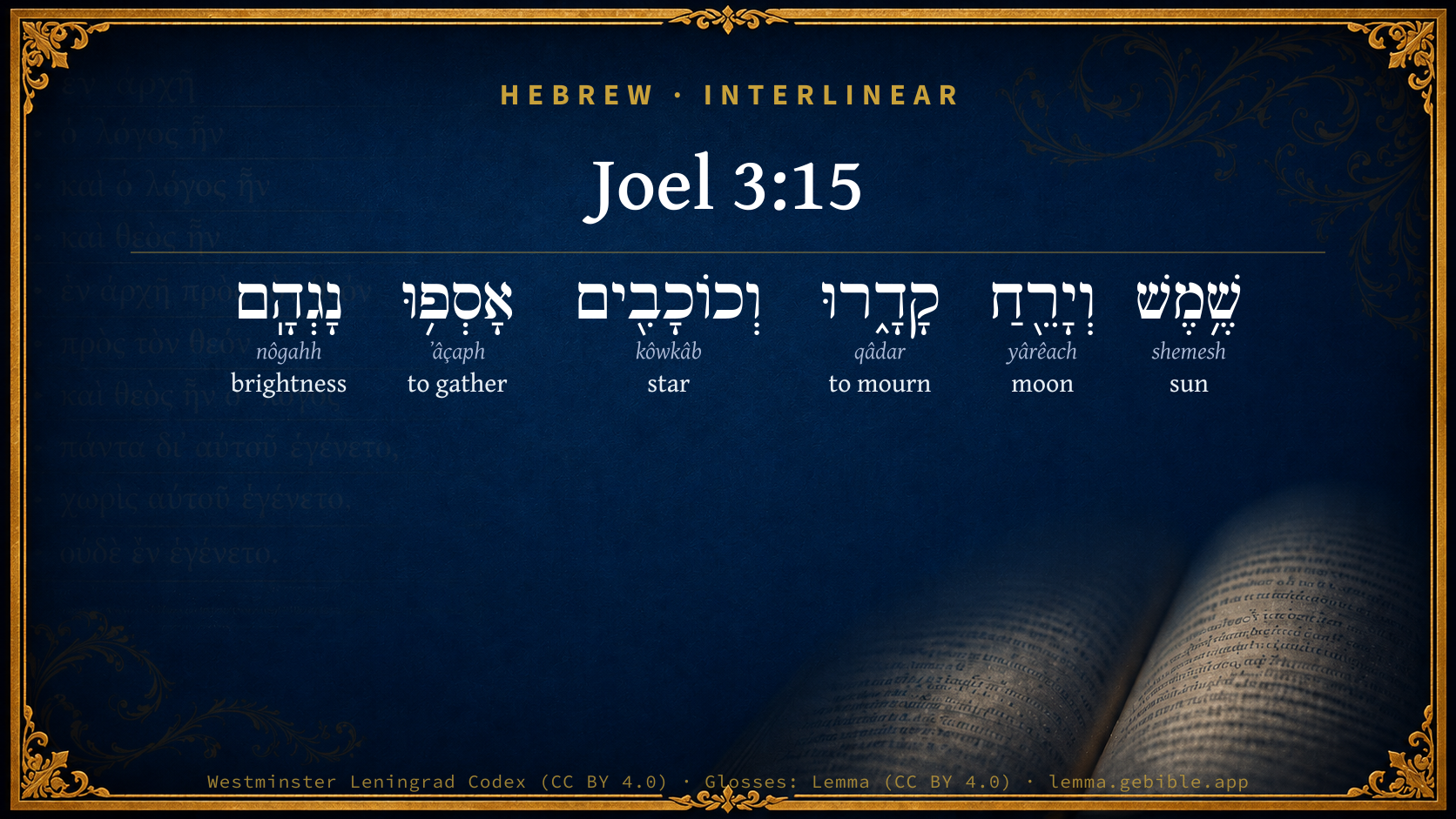
Joel 3:15

Hebrew (Westminster Leningrad Codex) Joel 3:15 appears in the Hebrew Old Testament. The text above is from the Westminster Leningrad Codex. Each word links to its Strong’s number, a concise gloss, and parsing drawn from the Open Scriptures Hebrew Bible morphology. Click any word for its full Brown-Driver-Briggs (BDB) entry.
Download image
Cite this verse

Joel 3:15 (World English Bible). Public Domain. Lemma interlinear Bible study tool, https://lemma.gebible.app/v/joel/3/15.

Show BibTeX & RIS
BibTeX
RIS
English Translation
The sun and the moon are darkened, And the stars withdraw their shining."
World English Bible · Public Domain
Download a study sheet

One document with this verse’s original text, its word-by-word gloss line, the meaning frame, cross-references with their text, attributed commentary, and full source and license credits — printable, and it pastes into notes with its structure intact.

This verse Autodidact and up

Study sheet (.html) Plain text (.txt)

A passage Seminary Student

Up to 50 verses in one chapter. A passage sheet keeps up to 6 commentary sources and 12 cross-references per verse, in the order this page ranks them, and says so on the sheet whenever that leaves anything out. Ask for a single verse and you get the Autodidact verse sheet above.

Everything on this page stays free to read, with no account — the sheet is a download of what is already on screen, not access to it.

Want to remove ads? Support Godless Engineer
Compare translations 3

The same verse in 3 English versions, stacked beneath the original-language interlinear above. Click any original word for its lexicon entry.

Each is an independent rendering of the whole verse — the interlinear is not word-aligned to these translations.

Highlighted words mark where these versions differ — a whole-verse word diff, not a word-by-word alignment.

  • World English Bible Public Domain
    The sun and the moon are darkened, And the stars withdraw their shining."
  • King James Version Public Domain
    The sun and the moon shall be darkened, and the stars shall withdraw their shining.
  • unfoldingWord Literal Text CC BY-SA 4.0
    The sun and the moon become dark, and the stars withdraw their brightness.

unfoldingWord Literal Text — © unfoldingWord, licensed CC BY-SA 4.0. Word-aligned USFM3 via Door43 (git.door43.org/unfoldingWord/en_ult).

Versions to compare (up to 4)

3 of 4 selected

Show all 18 translations

Every available English version of this verse, each an independent rendering of the whole verse.

  • World English Bible Public Domain
    The sun and the moon are darkened, And the stars withdraw their shining."
  • Berean Standard Bible Public Domain
    The sun and moon will grow dark, and the stars will no longer shine.
  • Majority Standard Bible Public Domain
    The sun and moon will grow dark, and the stars will no longer shine.
  • King James Version Public Domain
    The sun and the moon shall be darkened, and the stars shall withdraw their shining.
  • American Standard Version (1901) Public Domain
    The sun and the moon are darkened, and the stars withdraw their shining.
  • Revised Version (1885) Public Domain
    The sun and the moon are darkened, and the stars withdraw their shining.
  • Geneva Bible (1599) Public Domain
    The sunne and moone shalbe darkened, and the starres shall withdrawe their light.
  • Douay-Rheims (1899) Public Domain
    The sun and the moon are darkened, and the stars have withdrawn their shining.
  • Young's Literal Translation Public Domain
    Sun and moon have been black, And stars have gathered up their shining.
  • Literal Standard Version CC BY-SA 4.0
    Sun and moon have been black, || And stars have gathered up their shining.
  • Unlocked Literal Bible CC BY-SA 4.0
    The sun and the moon become dark, the stars keep back their brightness.
  • unfoldingWord Literal Text CC BY-SA 4.0
    The sun and the moon become dark, and the stars withdraw their brightness.
  • Darby Bible Public Domain
    The sun and the moon shall be darkened, and the stars shall withdraw their shining.
  • World Messianic Bible Public Domain
    The sun and the moon are darkened, and the stars withdraw their shining.
  • Webster's Bible Public Domain
    \\3:10\\Beat your plow-shares into swords, and your pruning-hooks into spears: let the weak say, I am strong.
  • Free Bible Version CC BY-SA 4.0
    The sun and moon will become dark, and the stars will stop shining.
  • Bible in Basic English Public Domain
    Get your plough-blades hammered into swords, and your vine-knives into spears: let the feeble say, I am strong.
  • JPS Tanakh (1917) Public Domain
    (4-15) The sun and the moon are become black, and the stars withdraw their shining.

Literal Standard Version (2020), Covenant Press — licensed CC BY-SA 4.0. Text via the HelloAO Bible API (eBible.org). Unlocked Literal Bible (unfoldingWord) — licensed CC BY-SA 4.0. Text via the HelloAO Bible API (eBible.org). unfoldingWord Literal Text — © unfoldingWord, licensed CC BY-SA 4.0. Word-aligned USFM3 via Door43 (git.door43.org/unfoldingWord/en_ult). Free Bible Version, Dr. Jonathan Gallagher — licensed CC BY-SA 4.0. Text via the HelloAO Bible API (eBible.org).

Word by word

More ways to search: Search by grammar → Find every occurrence → Compare this word →

Practice this passage: Drill this verse → Learn its vocabulary →

About this verse

These counts appear in no published source. They are computed here, from the morphology-tagged text and Lemma’s own curated glosses. What Lemma adds →

6
words
6
distinct lemmas
Prophets
section

Notable vocabulary

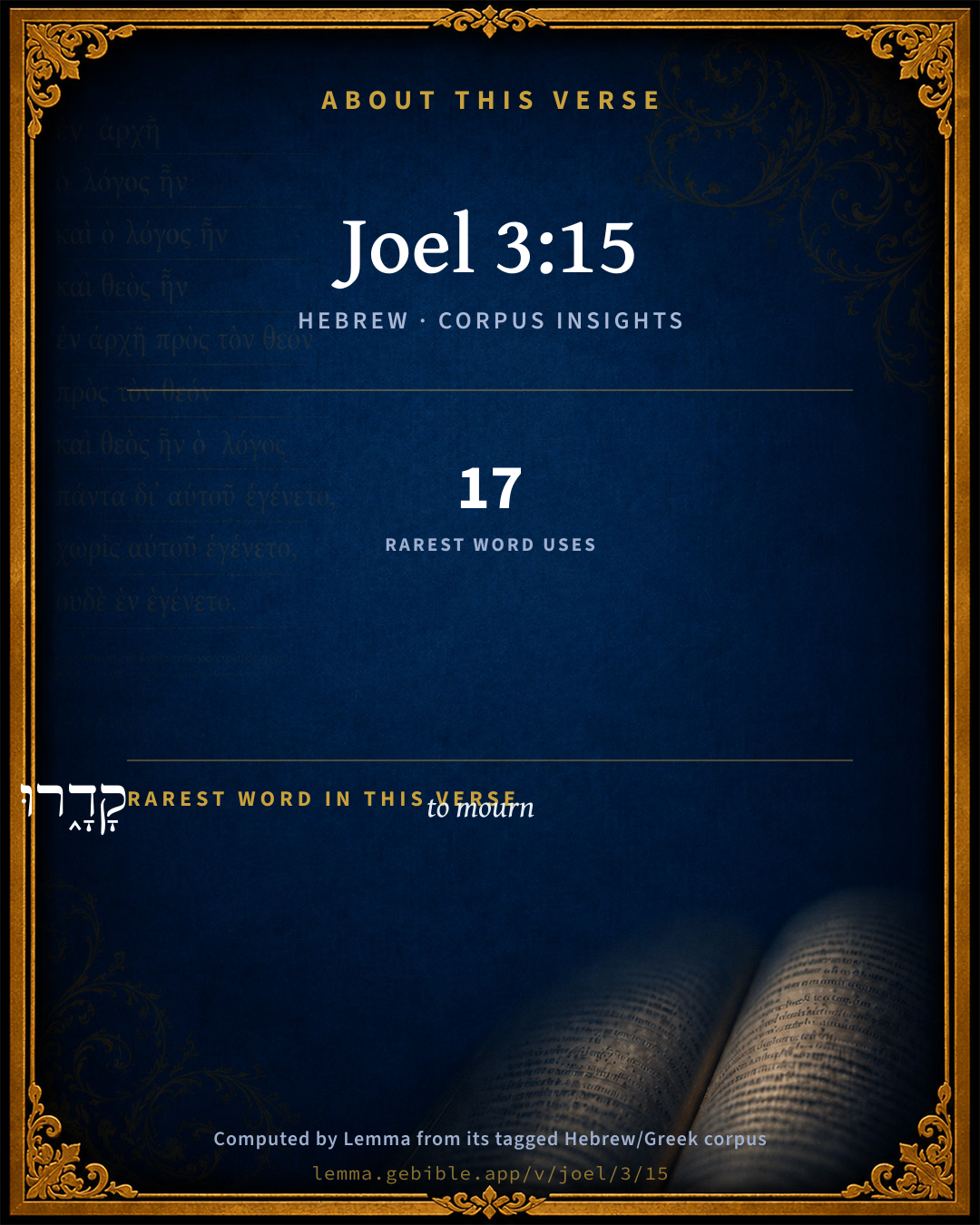
The rarest word here is קָדָ֑רוּ to mourn H6937 — appearing just 17 times in the whole Hebrew Bible.

Shared distinctive vocabulary

קָדָ֑רוּ to mourn H6937 occurs in 17 verses of the Hebrew Bible. Also found in:

Grammatical profile

  • 2 verbs
  • 4 nouns

Verb forms

  • קָדָ֑רוּ Qal · Perfect
  • אָסְפ֥וּ Qal · Perfect

Hebrew & Septuagint length

In English translation the verse runs 13 words from the Hebrew and 15 from the Septuagint (LXX English) — closely comparable.

A rough comparison of the two English renderings, which tokenize alike — not a word-level alignment.

Word counts can differ between the Hebrew and the Greek without any difference in meaning — e.g. the Hebrew direct-object marker אֵת has no separate Greek word, and Greek often adds the article ὁ.

Cross-references

6

Topical passages linked to Joel 3:15 in the Treasury of Scripture Knowledge — connected by theme and wording, ordered by reader-vote popularity; previews shown in the World English Bible.

  • Joel 2:10 The earth quakes before them. The heavens tremble. The sun and the moon are darkened, And the stars withdraw their shining.
  • Joel 2:31 The sun will be turned into darkness, And the moon into blood, Before the great and terrible day of Yahweh comes.
  • Matthew 24:29 But immediately after the oppression of those days, the sun will be darkened, the moon will not give its light, the stars will fall from the sky, and the powers of the heavens will be shaken;
  • Luke 21:25–26 There will be signs in the sun, moon, and stars; and on the earth anxiety of nations, in perplexity for the roaring of the sea and the waves;
  • Isaiah 13:10 For the stars of the sky and the constellations of it shall not give their light; the sun shall be darkened in its going forth, and the moon shall not cause its light to shine.
  • Revelation 6:12–13 I saw when he opened the sixth seal, and there was a great earthquake. The sun became black as sackcloth made of hair, and the whole moon became as blood.

Cross-references courtesy of OpenBible.info (CC BY 4.0).

Hebrew and Greek witnesses Masoretic Hebrew ↔ Greek Septuagint

The same verse in the two great witnesses to the Old Testament, shown verse-for-verse.

These are two independent witnesses, not word-aligned to each other, and the Septuagint is shown in lemma (dictionary) form.

Hebrew Joel 3:15 Masoretic · Westminster Leningrad Codex

שֶׁ֥מֶשׁ וְיָרֵ֖חַ קָדָ֑רוּ וְכוֹכָבִ֖ים אָסְפ֥וּ נָגְהָֽם

The sun and the moon are darkened, And the stars withdraw their shining."

World English Bible · Public Domain

Greek LXX Joel 3:15 Septuagint · lemma form
The sun and the moon shall be darkened, and the stars shall withdraw their light.

LXX2012 (modern English Septuagint) · Public Domain

Hebrew: Westminster Leningrad Codex (CC BY 4.0). Greek: Septuagint (public domain); English from LXX2012 (modern English Septuagint) (Public Domain). How the Septuagint differs from the Hebrew →

Commentary

Notes on Joel 3:15 from classic Christian and Jewish commentators (each source and its license shown beneath its notes). The classic Christian expositions comment on the surrounding passage and are grouped to its opening verse, so a note may address several verses; the Jewish commentaries on the Tanakh (Rashi and others) are per-verse, so they appear only where the commentator wrote on this verse.

Lemma curates 59 commentaries, every one of them public domain or Creative Commons licensed, each selected and text-cleaned for this edition rather than reprinted as found. About our sources →

Trapp's Complete Commentary

John Trapp

Joe 3:15 The sun and the moon shall be darkened, and the stars shall withdraw their shining.

Ver. 15. The sun and the moon shall be darkened] he sets this note, "Signs which shall go before the last judgment," Mat 24:29 Luk 21:25. {See Trapp on "Joe 2:13"} The prophets, by such forms of speech, use to decipher greatest calamities when all things look dark; as it fareth also with them that are under spiritual desertion, Isa 50:10, who yet are exhorted there to "trust in the name of the Lord, and stay upon their God"; to cast the anchor of hope, as Paul and his company did in the shipwreck, Act 27:20, when they saw neither sun nor moon for many days together, and no small tempest lay upon them; all hope that they should be saved being taken away.

John Trapp, A Commentary or Exposition upon All the Books of the Old and New Testament (1647–1656) — public domain. Text from a community e-Sword module.

Keil & Delitzsch

C. F. Keil & F. Delitzsch

"Sun and moon have become black, and the stars have withdrawn their shining. Joe 3:16. And Jehovah roars out of Zion, and He thunders out of Jerusalem; and heaven and earth quake: but Jehovah is a refuge to His people, and a stronghold to the sons of Israel. Joe 3:17. And ye will perceive that I Jehovah am your God, dwelling upon Zion, my holy mountain: and Jerusalem will be a sanctuary, and strangers will not pass through it any more." On the forebodings of the judgment in Joe 3:15, see at Joe 2:10. Out of Zion, the place of His throne, will Jehovah cause His thunder-voice to sound, will roar like a lion which is rushing upon its prey (Hos 5:14; Amo 3:4), so that heaven and earth tremble in consequence. But it is only to His enemies that He is terrible; to His people, the true Israel, He is a refuge and strong tower. From the fact that He only destroys His enemies, and protects His own people, the latter will learn that He is their God, and dwells upon Zion in His sanctuary, i.e., that He there completes His kingdom, that He purifies Jerusalem of all foes, all the ungodly through the medium of the judgment, and makes it a holy place which cannot be trodden any more by strangers, by Gentiles, or by the unclean of either Gentiles or Israelites (Isa 35:8), but will be inhabited only by the righteous (Isa 60:21; Zac 14:21), who, as Rev 21:27 affirms, are written in the Lamb's book of life. For Zion or Jerusalem is of course not the Jerusalem of the earthly Palestine, but the sanctified and glorified city of the living God, in which the Lord will be eternally united with His redeemed, sanctified, and glorified church. We are forbidden to think of the earthly Jerusalem or the earthly Mount Zion, not only by the circumstance that the gathering of all the heathen nations takes place in the valley of Jehoshaphat, i.e., in a portion of the valley of the Kidron, which is a pure impossibility, but also by the description which follows of the glorification of Judah.

Keil & Delitzsch — Biblical Commentary on the Old Testament (1861–1891) — public domain (CC PDM 1.0). Text via the HelloAO Bible API. (Old Testament only.)

Jamieson, Fausset & Brown

Robert Jamieson, A. R. Fausset & David Brown

(See on Joe 2:10; Joe 2:30).

Jamieson, Fausset & Brown — Commentary Critical and Explanatory on the Whole Bible (1871) — public domain (CC PDM 1.0). Text via the HelloAO Bible API.

Adam Clarke's Commentary

Verse 15. The sun and the moon shall be darkened] High and mighty states shall be eclipsed, and brought to ruin, and the stars - petty states, princes, and governors-shall withdraw their shining; withhold their influence and tribute from the kingdoms to which they have belonged, and set up themselves as independent governors.

Adam Clarke's Commentary on the Bible (1810–1826) — public domain. Text from a community e-Sword/MySword module.

John Calvin's Commentaries

I have already explained this verse in chapter 2: the Prophet, as we then stated, describes in these words the terrible judgment of God, in order to shake off the indifference of men, who carelessly hear and despise all threatening, except the Lord storms their hearts. These figurative expressions then are intended to awaken the ungodly, and to make them know that it is a serious matter when the Lord proclaims his judgment. Let us now go on with the passage —

John Calvin's Commentaries (1540-1563) — public domain. Text from the Calvin Translation Society English edition (1840s-50s) via the Christian Classics Ethereal Library (ccel.org). Calvin's coverage is partial (roughly two-thirds of the Bible); uncommented books and verses are honest gaps, never fabricated. The 19th-century editor's footnotes and remarks are omitted so the notes are faithfully Calvin's own voice.

The Cambridge Bible for Schools and Colleges

gen. ed. J. J. S. Perowne

15. The sun and the moon are black; and the stars withdraw their shining] Preternatural signs of the approaching ‘day.’ The words are repeated verbatim from Joe_2:10 b.

The Cambridge Bible for Schools and Colleges (gen. ed. J. J. S. Perowne; Cambridge University Press, 1878–1918) — public domain. Text from a community e-Sword module.

John Gill's Exposition

The sun and moon shall be darkened,.... Both the politic and ecclesiastic state of antichrist shall be ruined and destroyed; it shall "fare" with Rome Papal as it did with Rome Pagan, at the time of its dissolution; see Rev 6:12;

and the stars shall withdraw their shining: antichristian princes and nobles in the civil state, and the clergy of all ranks in the church state, shall lose their glory.

John Gill's Exposition of the Whole Bible (1746–1763) — public domain (CC PDM 1.0). Text via the HelloAO Bible API.

Albert Barnes' Notes on the Bible

The sun and the moon shall be darkened - This may be, either that they shall be outshone by the brightness of the glory of Christ, or that they themselves shall undergo a change, whereof the darkness at the Crucifixion was an image. An ancient writer says ; “As in the dispensation of the Cross the sun failing, there was darkness over all the earth, so when the ‘sign of the Son of man’ appeareth in heaven in the Day of Judgment, the light of the sun and moon and stars shall fail, consumed, as it were by the great might of that sign.” And as the failure of the light of the sun at our Lord’s Passion betokened the shame of nature at the great sin of man, so, at the Day of Judgment, it sets before us the awfulness of God’s judgments, as though “it dared not behold the severity of Him who judgeth and returneth every man’s work upon his own head;” as though “every creature, in the sufferings of others, feared the judgment on itself.”

Albert Barnes' Notes on the Bible (1834–1885) — public domain. Text from a community e-Sword/MySword module.

Haydock's Catholic Bible Commentary

Shining. All shall be amazed at the fall of Cambyses, chap. ii. 30., and Ezechiel xxviii. 30. A storm shall overwhelm his army. (Calmet)

George Leo Haydock (1774–1849), Haydock's Catholic Family Bible and Commentary, 1859 edition — public domain. Excludes Psalms (Douay-Rheims chapter numbering differs from Protestant) and Deuterocanonical books (Catholic canon only).

Matthew Poole's English Annotations

See Joe 2:10. When God doth in the valley of decision punish any of the kingdoms which persecuted and oppressed his church, the punishment shall be so great as to darken the glory of such kingdoms, it shall be to the utter overthrow of those kingdoms and governments; and so it was effected on Babylon by the Mede and Persian; so on this by the Grecians, and on them by their intestine wars, and by the Romans at last on these and on the murderers of Messiah.

Matthew Poole's English Annotations on the Holy Bible (1683–1685) — public domain. Text from a community e-Sword/MySword module.

The Pulpit Commentary

Vers. 15-17. These verses picture the accompaniments of the judgment, yet not the judgment itself.

The sun and the moon shall be darkened, and the stars shall withdraw their shining. The densely packed masses are already in the valley of decision, awaiting the judgment about to be executed upon them. But before the judgment actually bursts upon them, and in preparation for it, the sky is overcast; darkness, as a portent of the approaching storm, envelops them; the lights of heaven are put out. The pitchy darkness of a night in which neither moon nor stars appear is sufficiently dismal and awful; still more terrible, if possible, is darkness in the daytime, when the light of the sun is turned into blackness. The first accompaniment of the storm is addressed to the eye, and consists in the extinguishing of the greater light which rules the day, and the lesser lights which rule the night. The next accompaniment of the coming tempest is addressed to the ear, and consists in the voice of the Lord rolling in terrific peals along the heavens the voice of the Lord like the roaring of a lion ready to pounce upon its prey: the utterance of the Divine voice when the God of glory thundereth. The third accompaniment is yet more awe-inspiring., consisting in a convulsion that pervades both earth and sky; the whole frame of nature shakes; the earthquake"s shock, so frightful to bird and beast and man, has a corresponding agitation in the heavens.

Vers. 15-17. That day the fear of the wicked, the hope of the just.

These verses picture the dread accompaniments of the time and place of the destruction of the wicked. They give us a glimpse, and a most alarming one, of the final catastrophe.

I THE DAY OF DECISION SHALL BE A DAY OF DARKNESS, Apart from the decision itself and consequent execution of Divine wrath upon the ungodly an execution which, as if baffling the power of words to describe, is left to imagination to conceive the attendant terrors of that day invest it with the blackness of darkness. Not only shall sun and moon withdraw their shining and undergo a total eclipse, but the stars shall frown upon them. The lights of heaven shall be darkened, or those lights shall dwindle before the unspeakable brightness of the glory in which the Judge shall appear, just as the stars pale and disappear in presence of the sun when he rises in splendour above the eastern horizon.

II THAT DAY SHALL BE A DAY OF DREADFULNESS. Dreadful sounds as well as dreadful sights shall augment the terrors of that day. "As the failure of the light of the sun at our Lord"s passion betokened the shame of nature at the great sin of man, so, at the day of judgment, it sets before us the awfulness of God"s judgments, as though it dared not behold the severity of him who judgeth and returneth every man"s work upon his own head;" so the voice of God, when he shall roar out of Zion, shall be a voice of terror. Even when the voice of God speaks words of warning, it is compared to the roaring of a lion, as we read, "The Lord hath roared, who will not fear? the Lord hath spoken, who can but prophesy?" How much more when that terrible voice is no longer a voice of warning, but a voice of wrath?

III THAT DAY SHALL BE A DAY OF DESOLATENESS. The frame of nature shall feel the shock of strong convulsions. The heavens and the earth shall shake, but this shaking is only a prelude to something still more awe-inspiring, even such convulsions as seem to betoken their dissolution. "Nor shall it be a slight shaking of the earth at his coming," says an old writer, "but such that all the dead shall be roused, as it were, from their sleep." And when the day of final decision comes, "the heavens," we are told, "shall pass away with a great voice, and the elements shall melt with fervent heat, the earth also and the works that are therein shall be burned up." Minor judgments are premonitions of, and should be improved as, preparations for the judgment of the great day. "The day of wrath! that dreadful day, When heaven and earth shall pass away, What power shall be the sinner"s stay? Whom shall he trust that dreadful day? "When, shrivelling like a parched scroll, The flaming heavens together roll, And louder yet, and yet more dread, Swells the high trump that wakes the dead; "Oh! on that day, that wrathful day, When man to judgment wakes from clay, Be thou, O Christ, the sinner"s Stay, Though heaven and earth shall pass away.

When God, in punishing his enemies, shakes as it were earth and heaven, causing such changes and commotions as seem to threaten a general upheaval and convulsion of the course of nature, it is not strange if the people of God should be agitated with fears and exercised with apprehensions lest the storm should burst over them. Accordingly, he vouchsafes to them promises to secure them against such fears and fortify them for the ordeal.

I HE IS THE HOPE OF HIS PEOPLE. He comforts his people so that the terrors of a time of great convulsions do not overwhelm them. As God is the Ground and Founder of his people"s hopes, so will he be their Crown and Consummation. He is their Harbour of refuge and their Fortress of safety. Fleeing to him, they shall not only be admitted to, but preserved, in safety. He is their Refuge on earth while the storm of wrath is sweeping over the wicked; he will be their Home in heaven at last. "The saints in the great day shall arrive at the desired haven, shall put to shore after a stormy voyage; they shall go to be ever at home with God to their Father"s house, the house not made with hands.

II HE IS THE HAPPINESS OF HIS PEOPLE. He is the Hope of his people and the Strength of the children of Israel. We are thus taught that while all are not Israel that are called Israel, so all who are really God"s people are the true spiritual Israel; and that all his spiritual promises to Israel in the past apply in the present, and may be claimed by all those who are Israelites indeed. When other men"s hearts fail them, God is the Strength of his people"s hearts and their Portion for ever. When the judgments of God are abroad in the earth, and sinners overtaken by them, God is a present Help to his people; and in that time of terror when the vials of wroth shall be poured out upon the wicked, joy and gladness shall be reserved for the righteous, while the joy of the Lord shall be their strength. Thus, amid all the trials of this mortal life, "in all time of our tribulation; in all time of our wealth; in the hour of death, and in the day of judgment," God is the Hope and Happiness of his people, the Support and Strength of all his true Israel.

III HE IS THE HOLINESS OF HIS PEOPLE. While God is a holy God, heaven a holy place, the angels of God holy angels, even the Church militant is holy, and the redeemed of the Lord a holy people. But in this world the Church is a mixed society; there are tares among the wheat, chaff as well as good grain. It will not always be so. In millennial times, to which the passage points, there shall be higher degrees of holiness, of purity, of prosperity, and peace, than the Church has yet attained; but in heaven alone holiness shall be perfect and happiness complete. Meantime we are encouraged by the promise that God"s presence is enjoyed by his people. He himself is the Source of holiness; the Church on earth, like Zion of old, is made holy by his presence; the place of his people"s habitation, like Jerusalem of old, is a holy place; his people are a holy people. Strangers may force or find an entrance to the Church militant, or earthly Jerusalem, and pollute it; but the Jerusalem that is above, that is, the Church triumphant, shall never be trodden by stranger"s foot, nor entered by anything that defiles or works iniquity. None but the true citizens of Zion shall be there, and so only those that have a right to be there. Even here and now we have the happy consciousness that God, our own God our own "as much as if possessed by none besides, filling all with gladness, yet fully possessed by each, as though there were none besides dwells with us, and in us, while hereafter we shall have "unvarying, blissful, hallowing presence, never withdrawn, never hidden, never shaded, but ever shining upon us."

The Pulpit Commentary (1880–1919), ed. H.D.M. Spence-Jones & Joseph S. Exell — public domain. Text from a community e-Sword module.

Lesson kit

Teaching starters — assembled from the data on this page, not authored interpretation. Every prompt links to the verse data it draws on. Edit before teaching.

Joel, in the Prophets, opens this verse with 6 words (6 distinct Hebrew lemmas). Its most distinctive word is qâdar (“to mourn”). A historical commentator’s framing appears above. Read the whole chapter for the surrounding context.

Discussion questions

  1. What does “to mourn” (qâdar) contribute to the verse as a whole?
  2. How does 1 Kings 18:45, which shares the word «to mourn», read alongside this verse?
  3. The translations on this page render this verse differently — a whole-verse word diff, not a word-by-word alignment. What might account for the different wordings?
  4. «קָדָ֑רוּ» is a Qal Perfect verb. How does that grammatical form shape the action described?
  5. Compare how Trapp's Complete Commentary and Keil & Delitzsch read this verse. Where do they agree or differ?

Things to notice

Reading settings

Reading text

Shown beneath each verse's original-language words.

Old Testament
Old Testament edition

Read the OT as the Masoretic Hebrew (MT) or the Greek Septuagint (LXX).

English shown for the Greek Septuagint (in the Hebrew ↔ Greek comparison).

Comparing translations? Open the Compare panel on any verse page to stack up to four side by side.