
1 Samuel 13:11

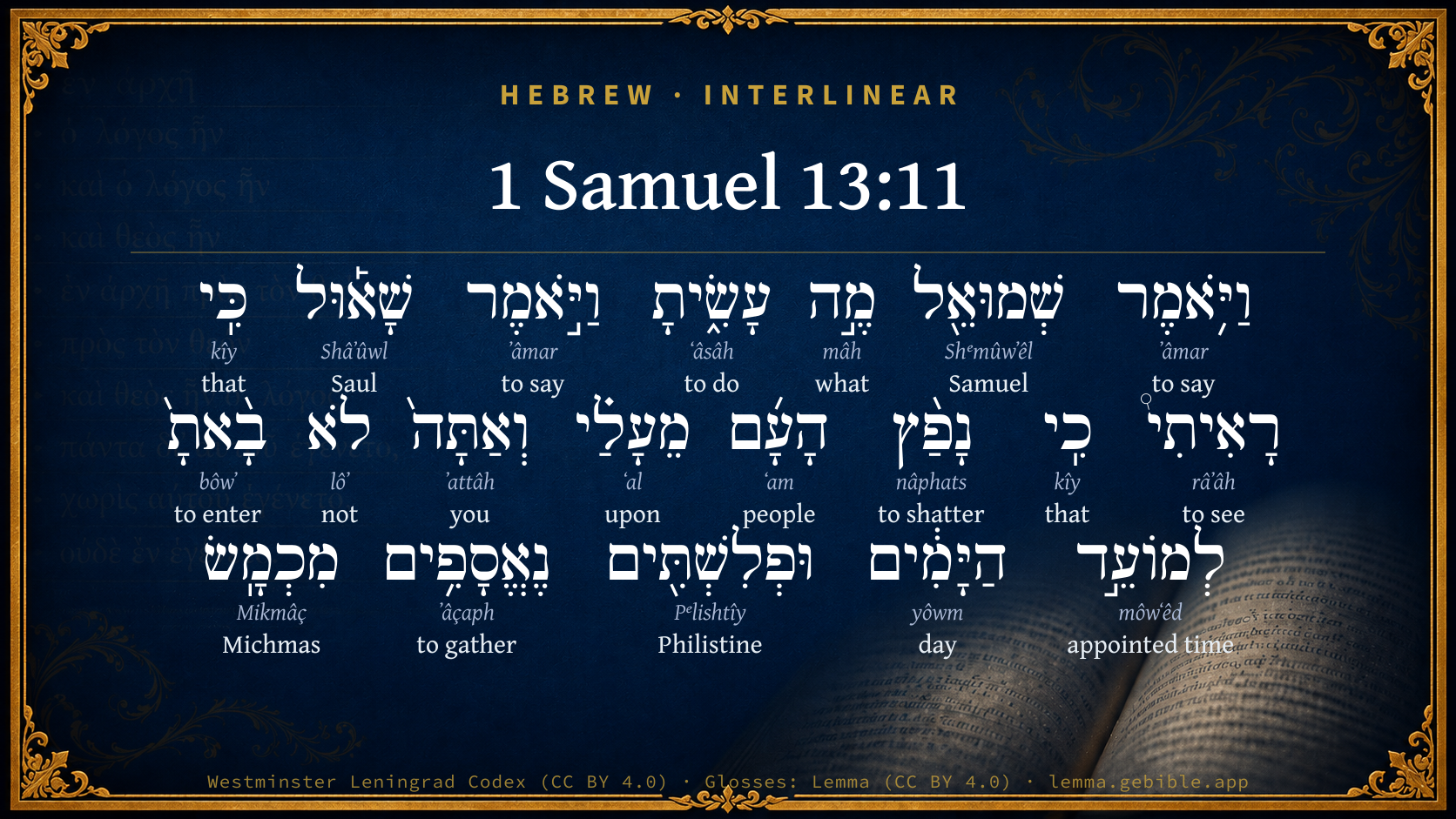
Hebrew (Westminster Leningrad Codex) 1 Samuel 13:11 appears in the Hebrew Old Testament. The text above is from the Westminster Leningrad Codex. Each word links to its Strong’s number, a concise gloss, and parsing drawn from the Open Scriptures Hebrew Bible morphology. Click any word for its full Brown-Driver-Briggs (BDB) entry.
Download image
Cite this verse

1 Samuel 13:11 (World English Bible). Public Domain. Lemma interlinear Bible study tool, https://lemma.gebible.app/v/1-samuel/13/11.

Show BibTeX & RIS
BibTeX
RIS
English Translation
Samuel said, What have you done? Saul said, Because I saw that the people were scattered from me, and that you didn't come within the days appointed, and that the Philistines assembled themselves together at Michmash;
World English Bible · Public Domain
Download a study sheet

One document with this verse’s original text, its word-by-word gloss line, the meaning frame, cross-references with their text, attributed commentary, and full source and license credits — printable, and it pastes into notes with its structure intact.

This verse Autodidact and up

Study sheet (.html) Plain text (.txt)

A passage Seminary Student

Up to 50 verses in one chapter. A passage sheet keeps up to 6 commentary sources and 12 cross-references per verse, in the order this page ranks them, and says so on the sheet whenever that leaves anything out. Ask for a single verse and you get the Autodidact verse sheet above.

Everything on this page stays free to read, with no account — the sheet is a download of what is already on screen, not access to it.

Want to remove ads? Support Godless Engineer
Compare translations 3

The same verse in 3 English versions, stacked beneath the original-language interlinear above. Click any original word for its lexicon entry.

Each is an independent rendering of the whole verse — the interlinear is not word-aligned to these translations.

Highlighted words mark where these versions differ — a whole-verse word diff, not a word-by-word alignment.

  • World English Bible Public Domain
    Samuel said, What have you done? Saul said, Because I saw that the people were scattered from me, and that you didn't come within the days appointed, and that the Philistines assembled themselves together at Michmash;
  • King James Version Public Domain
    And Samuel said, What hast thou done? And Saul said, Because I saw that the people were scattered from me, and that thou camest not within the days appointed, and that the Philistines gathered themselves together at Michmash;
  • unfoldingWord Literal Text CC BY-SA 4.0
    And Samuel said, “What have you done?” And Saul said, “When I saw that the people had scattered from beside me, and you, you had not come by the appointed time of days, and the Philistines were gathering at Michmash,

unfoldingWord Literal Text — © unfoldingWord, licensed CC BY-SA 4.0. Word-aligned USFM3 via Door43 (git.door43.org/unfoldingWord/en_ult).

Versions to compare (up to 4)

3 of 4 selected

Show all 18 translations

Every available English version of this verse, each an independent rendering of the whole verse.

  • World English Bible Public Domain
    Samuel said, What have you done? Saul said, Because I saw that the people were scattered from me, and that you didn't come within the days appointed, and that the Philistines assembled themselves together at Michmash;
  • Berean Standard Bible Public Domain
    “What have you done?” Samuel asked. And Saul replied, “When I saw that the troops were deserting me, and that you did not come at the appointed time and the Philistines were gathering at Michmash,
  • Majority Standard Bible Public Domain
    “What have you done?” Samuel asked. And Saul replied, “When I saw that the troops were deserting me, and that you did not come at the appointed time and the Philistines were gathering at Michmash,
  • King James Version Public Domain
    And Samuel said, What hast thou done? And Saul said, Because I saw that the people were scattered from me, and that thou camest not within the days appointed, and that the Philistines gathered themselves together at Michmash;
  • American Standard Version (1901) Public Domain
    And Samuel said, What hast thou done? And Saul said, Because I saw that the people were scattered from me, and that thou camest not within the days appointed, and that the Philistines assembled themselves together at Michmash;
  • Revised Version (1885) Public Domain
    And Samuel said, What hast thou done? And Saul said, Because I saw that the people were scattered from me, and that thou camest not within the days appointed, and that the Philistines assembled themselves together at Michmash;
  • Geneva Bible (1599) Public Domain
    And Samuel saide, What hast thou done? Then Saul saide, Because I sawe that the people was scattred from me, and that thou camest not within the daies appoynted, and that the Philistims gathered themselues together to Michmash,
  • Douay-Rheims (1899) Public Domain
    And Samuel said to him: What hast thou done? Saul answered: Because I saw that the people slipt from me, and thou wast not come according to the days appointed, and the Philistines were gathered together in Machmas,
  • Young's Literal Translation Public Domain
    and Samuel saith, `What hast thou done?' And Saul saith, `Because I saw that the people were scattered from off me, and thou hadst not come at the appointment of the days, and the Philistines are gathered to Michmash,
  • Literal Standard Version CC BY-SA 4.0
    and Samuel says, “What have you done?” And Saul says, “Because I saw that the people were scattered from off me, and you had not come at the appointment of the days, and the Philistines are gathered to Michmash,
  • Unlocked Literal Bible CC BY-SA 4.0
    Then Samuel said, “What have you done?” Saul replied, “When I saw that the people were leaving me, and that you did not come within the set time, and that the Philistines had assembled at Michmash,
  • unfoldingWord Literal Text CC BY-SA 4.0
    And Samuel said, “What have you done?” And Saul said, “When I saw that the people had scattered from beside me, and you, you had not come by the appointed time of days, and the Philistines were gathering at Michmash,
  • Darby Bible Public Domain
    And Samuel said, What hast thou done? And Saul said, Because I saw that the people were scattered from me, and that thou didst not come within the days appointed, and that the Philistines were assembled at Michmash,
  • World Messianic Bible Public Domain
    Samuel said, “What have you done?” Saul said, “Because I saw that the people were scattered from me, and that you didn’t come within the days appointed, and that the Philistines assembled themselves together at Michmash,
  • Webster's Bible Public Domain
    And Samuel said, What hast thou done? And Saul said, Because I saw that the people were scattered from me, and that thou camest not within the days appointed, and that the Philistines assembled at Michmash;
  • Free Bible Version CC BY-SA 4.0
    “What have you done?” Samuel asked. Saul replied, “Well I saw my men were deserting me, and you hadn't arrived when you said you would, and the Philistines were gathering at Michmash to attack.
  • Bible in Basic English Public Domain
    And Samuel said, What have you done? And Saul said, Because I saw that the people were going away from me, and you had not come at the time which had been fixed, and the Philistines had come together at Michmash;
  • JPS Tanakh (1917) Public Domain
    And Samuel said: 'What hast thou done?' And Saul said: 'Because I saw that the people were scattered from me, and that thou camest not within the days appointed, and that the Philistines assembled themselves together against Michmas;

Literal Standard Version (2020), Covenant Press — licensed CC BY-SA 4.0. Text via the HelloAO Bible API (eBible.org). Unlocked Literal Bible (unfoldingWord) — licensed CC BY-SA 4.0. Text via the HelloAO Bible API (eBible.org). unfoldingWord Literal Text — © unfoldingWord, licensed CC BY-SA 4.0. Word-aligned USFM3 via Door43 (git.door43.org/unfoldingWord/en_ult). Free Bible Version, Dr. Jonathan Gallagher — licensed CC BY-SA 4.0. Text via the HelloAO Bible API (eBible.org).

Word by word

More ways to search: Search by grammar → Find every occurrence → Compare this word →

Practice this passage: Drill this verse → Learn its vocabulary →

מִכְמָֽשׂ
Mikmâç
H4363
“Michmas”
Noun, Proper
Part of Speech
Noun
Type
Proper
Full BDB Definition

Origin: from H3647

TWOT: None

Michmas or Michmash = "hidden" - a city in Benjamin lying near Ramah and approximately 10 miles
  1. וַיֹּ֥אמֶר ʼâmar H559 “and · to say” Conjunction + Verb, Qal, Sequential Imperfect, 3rd Person, Masculine, Singular
  2. שְׁמוּאֵ֖ל Shᵉmûwʼêl H8050 “Samuel” Noun, Proper
  3. מֶ֣ה mâh H4100 “what” Particle, Interrogative
  4. עָשִׂ֑יתָ ʻâsâh H6213 “to do” Verb, Qal, Perfect, 2nd Person, Masculine, Singular
  5. וַיֹּ֣אמֶר ʼâmar H559 “and · to say” Conjunction + Verb, Qal, Sequential Imperfect, 3rd Person, Masculine, Singular
  6. שָׁא֡וּל Shâʼûwl H7586 “Saul” Noun, Proper
  7. כִּֽי kîy H3588 “that” Conjunction
  8. רָאִיתִי֩ râʼâh H7200 “to see” Verb, Qal, Perfect, 1st Person, Common, Singular
  9. כִֽי kîy H3588 “that” Conjunction
  10. נָפַ֨ץ nâphats H5310 “to shatter” Verb, Qal, Perfect, 3rd Person, Masculine, Singular
  11. הָעָ֜ם ʻam H5971 “the · people” Particle, Definite Article + Noun, Common, Masculine, Singular, Absolute
  12. מֵעָלַ֗י ʻal H5921 “from · upon · me” Preposition + Preposition + Suffix, Personal, 1st Person, Common, Singular
  13. וְאַתָּה֙ ʼattâh H859 “and · you” Conjunction + Pronoun, Personal, 2nd Person, Masculine, Singular
  14. לֹא lôʼ H3808 “not” Particle, Negative
  15. בָ֨אתָ֙ bôwʼ H935 “to enter” Verb, Qal, Perfect, 2nd Person, Masculine, Singular
  16. לְמוֹעֵ֣ד môwʻêd H4150 “to/for · appointed time of” Preposition + Noun, Common, Masculine, Singular, Construct
  17. הַיָּמִ֔ים yôwm H3117 “the · days” Particle, Definite Article + Noun, Common, Masculine, Plural, Absolute
  18. וּפְלִשְׁתִּ֖ים Pᵉlishtîy H6430 “and · Philistines” Conjunction + Noun, Gentilic, Masculine, Plural, Absolute
  19. נֶאֱסָפִ֥ים ʼâçaph H622 “gathering” Verb, Niphal, Participle Active, Masculine, Plural, Absolute

About this verse

These counts appear in no published source. They are computed here, from the morphology-tagged text and Lemma’s own curated glosses. What Lemma adds →

20
words
18
distinct lemmas
Historical
section

Notable vocabulary

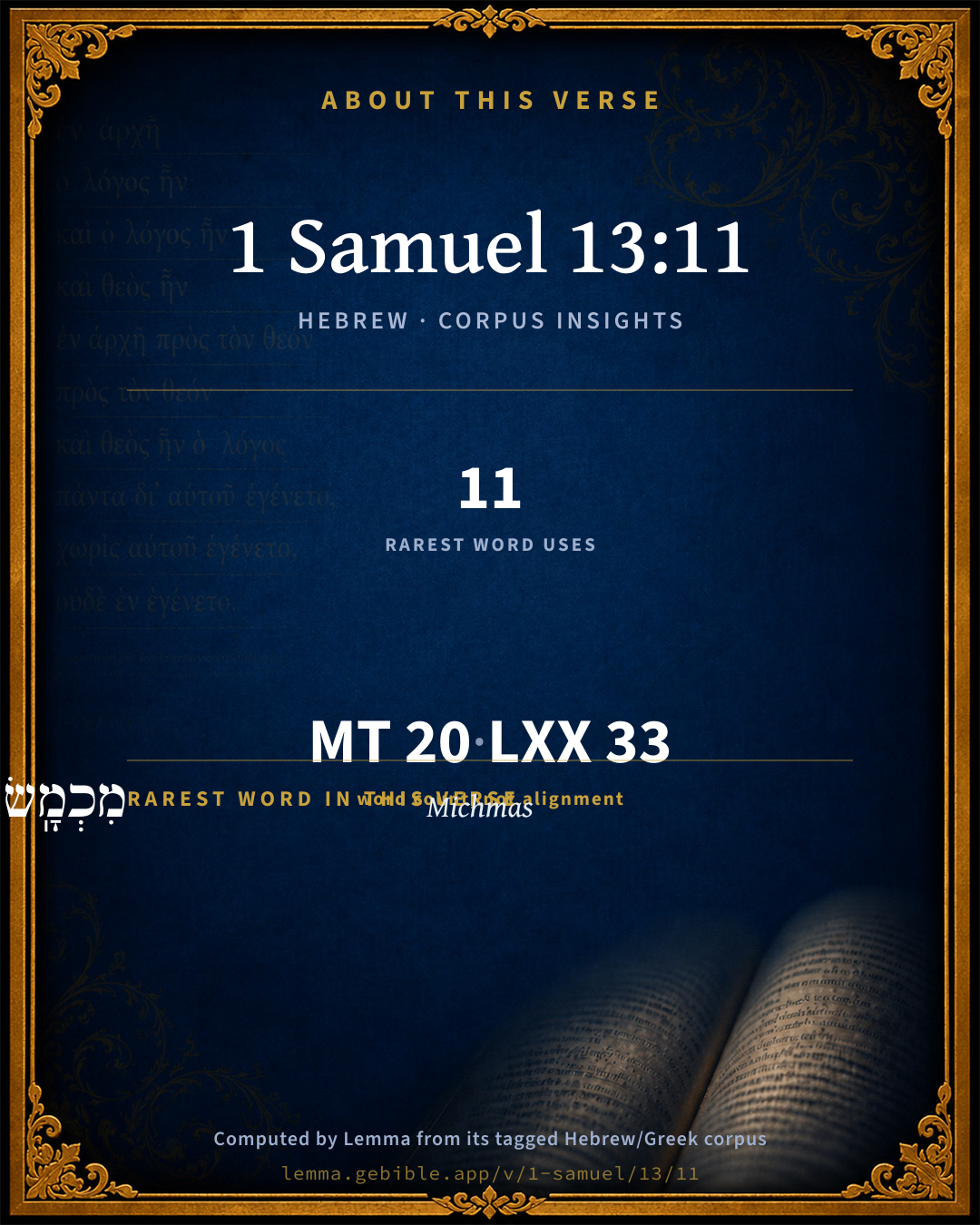
The rarest word here is מִכְמָֽשׂ Michmas H4363 — appearing just 11 times in the whole Hebrew Bible.

Shared distinctive vocabulary

מִכְמָֽשׂ Michmas H4363 occurs in 11 verses of the Hebrew Bible. Also found in:

Grammatical profile

  • 7 verbs
  • 7 nouns
  • 1 pronoun
  • 1 preposition
  • 2 conjunctions
  • 2 particles

Verb forms

  • וַיֹּ֥אמֶר Qal · Sequential Imperfect
  • עָשִׂ֑יתָ Qal · Perfect
  • וַיֹּ֣אמֶר Qal · Sequential Imperfect
  • רָאִיתִי֩ Qal · Perfect
  • נָפַ֨ץ Qal · Perfect
  • בָ֨אתָ֙ Qal · Perfect
  • נֶאֱסָפִ֥ים Niphal · Participle Active

Repetition

Words recur within this verse — often emphatic in Hebrew:

  • וַיֹּ֥אמֶר to say H559 ×2
  • כִּֽי that H3588 ×2

Hebrew & Septuagint length

In English translation the verse runs 36 words from the Hebrew and 43 from the Septuagint (LXX English) — closely comparable.

A rough comparison of the two English renderings, which tokenize alike — not a word-level alignment.

Word counts can differ between the Hebrew and the Greek without any difference in meaning — e.g. the Hebrew direct-object marker אֵת has no separate Greek word, and Greek often adds the article ὁ.

In the original languages it is 20 Hebrew tokens and 33 Greek tokens — but the two are counted differently (Hebrew bundles its prefixes and suffixes into one token; the Greek is in lemma form), so that isn’t a like-for-like length.

Cross-references

11

Topical passages linked to 1 Samuel 13:11 in the Treasury of Scripture Knowledge — connected by theme and wording, ordered by reader-vote popularity; previews shown in the World English Bible.

  • 1 Samuel 13:2 Saul chose him three thousand men of Israel, of which two thousand were with Saul in Michmash and in the Mount of Bethel, and one thousand were with Jonathan in Gibeah of Benjamin: and the rest of the people he sent every man to his tent.
  • 1 Samuel 13:5 The Philistines assembled themselves together to fight with Israel, thirty thousand chariots, and six thousand horsemen, and people as the sand which is on the sea-shore in multitude: and they came up, and encamped in Michmash, eastward of Beth Aven.
  • 1 Samuel 13:16 Saul, and Jonathan his son, and the people who were present with them, abode in Geba of Benjamin: but the Philistines encamped in Michmash.
  • 1 Samuel 13:23 The garrison of the Philistines went out to the pass of Michmash.
  • Genesis 3:13 Yahweh God said to the woman, "What is this you have done?" The woman said, "The serpent deceived me, and I ate."
  • Genesis 4:10 Yahweh said, "What have you done? The voice of your brother's blood cries to me from the ground.
  • 2 Kings 5:25 But he went in, and stood before his master. Elisha said to him, Whence come you, Gehazi? He said, Your servant went no where.
  • Joshua 7:19 Joshua said to Achan, My son, please give glory to Yahweh, the God of Israel, and make confession to him; and tell me now what you have done; don't hide it from me.
  • 1 Samuel 14:5 The one crag rose up on the north in front of Michmash, and the other on the south in front of Geba.
  • 2 Samuel 3:24 Then Joab came to the king, and said, What have you done? behold, Abner came to you; why is it that you have sent him away, and he is quite gone?
  • Isaiah 10:28 He is come to Aiath, he is passed through Migron; at Michmash he lays up his baggage;

Cross-references courtesy of OpenBible.info (CC BY 4.0).

Hebrew and Greek witnesses Masoretic Hebrew ↔ Greek Septuagint

The same verse in the two great witnesses to the Old Testament, shown verse-for-verse.

These are two independent witnesses, not word-aligned to each other, and the Septuagint is shown in lemma (dictionary) form.

Hebrew 1 Samuel 13:11 Masoretic · Westminster Leningrad Codex

וַיֹּ֥אמֶר שְׁמוּאֵ֖ל מֶ֣ה עָשִׂ֑יתָ וַיֹּ֣אמֶר שָׁא֡וּל כִּֽי רָאִיתִי֩ כִֽי נָפַ֨ץ הָעָ֜ם מֵעָלַ֗י וְאַתָּה֙ לֹא בָ֨אתָ֙ לְמוֹעֵ֣ד הַיָּמִ֔ים וּפְלִשְׁתִּ֖ים נֶאֱסָפִ֥ים מִכְמָֽשׂ

Samuel said, What have you done? Saul said, Because I saw that the people were scattered from me, and that you didn't come within the days appointed, and that the Philistines assembled themselves together at Michmash;

World English Bible · Public Domain

Greek LXX 1 Samuel 13:11 Septuagint · lemma form

καί εἶπον σαμουηλ τίς ποιέω καί εἶπον σαούλ ὅτι ὁράω ὡς διασπείρω ὁ λαός ἀπό ἐγώ καί σύ οὐ παραγίγνομαι ὡς διατάσσω ἐν ὁ μαρτύριον ὁ ἡμέρα καί ὁ ἀλλόφυλος συνἄγω εἰς μαχεμας

And Samuel said, What have you done? and Saul said, Because I saw how the people were scattered from me, and you were not present as you purposed according to the set time of the days, and the Philistines were gathered to Machmas.

LXX2012 (modern English Septuagint) · Public Domain

Hebrew: Westminster Leningrad Codex (CC BY 4.0). Greek: Septuagint (public domain); English from LXX2012 (modern English Septuagint) (Public Domain). How the Septuagint differs from the Hebrew →

Targum (Aramaic paraphrase)

1

The Targum is the ancient Jewish Aramaic paraphrase of the Hebrew Scriptures — an interpretive translation, not the Hebrew text itself. Onkelos (literal) and Pseudo-Jonathan (expansive) render the Torah, and Jonathan the Prophets. Coverage is partial: where no permissively-licensed English translation exists for a verse, only the Aramaic is shown. This is verse-level text, not a word-by-word alignment to the Hebrew.

  1. Targum Jonathan Prophets (Joshua–Malachi)
    וַאֲמַר שְׁמוּאֵל מָה עֲבַדְתָּא וַאֲמַר שָׁאוּל אֲרֵי חֲזֵיתִי אֲרֵי אִתְבַּדַר עַמָא מֵעִלַוַי וְאַתְּ לָא אָתֵיתָא לִזְמַן יוֹמִין וּפְלִשְׁתָּאֵי אִתְכַּנָשׁוּ לְמִכְמָשׁ:

    (no public-domain English translation for this verse)

    Targum Jonathan — Aramaic: “Mikraot Gedolot” (public domain). English: “Sefaria Community Translation” (CC0 1.0 (public-domain dedication)); “London "Chaldee Paraphrase," 1871” (public domain). Text via Sefaria.

Commentary

Notes on 1 Samuel 13:11 from classic Christian and Jewish commentators (each source and its license shown beneath its notes). The classic Christian expositions comment on the surrounding passage and are grouped to its opening verse, so a note may address several verses; the Jewish commentaries on the Tanakh (Rashi and others) are per-verse, so they appear only where the commentator wrote on this verse.

Lemma curates 59 commentaries, every one of them public domain or Creative Commons licensed, each selected and text-cleaned for this edition rather than reprinted as found. About our sources →

Trapp's Complete Commentary

John Trapp

1Sa 13:11 And Samuel said, What hast thou done? And Saul said, Because I saw that the people were scattered from me, and [that] thou camest not within the days appointed, and [that] the Philistines gathered themselves together at Michmash;

Ver. 11. What hast thou done?] Samuel saw well what was done; for the peace offering was not yet offered: but to convince him of his great folly, and as a preface to his following doom, he thus questioneth him. See Gen 3:13.

And Saul said.] He should have said as David when he had done amiss, "I have sinned greatly in that I have done; yea, I have done very foolishly." {2Sa 24:10} Pray to the Lord for me, that none of those things that I have deserved come upon me. {Act 8:24} But he palliates {covers} and pleads for his sin, laying all the blame upon others: this is still the guise of hypocrites. Sin and shifting came into the world together. {Gen 3:12-14}

John Trapp, A Commentary or Exposition upon All the Books of the Old and New Testament (1647–1656) — public domain. Text from a community e-Sword module.

The Biblical Illustrator

Joseph S. Exell

1Sa_13:11-12

Because I saw that the people were scattered from me, and that thou camest not within the days appointed.

Principle and expediency

What a solemn and impressive condemnation have we here of that far too common practice--deserting principle to serve expediency. I dont like to tell a lie, someone may say, but if I had not done it I should have lost my situation. I dislike common work on the Sabbath day, but if I did not do it, I could not live. I dont think it right to go to Sunday parties or to play games on Sundays, but I was invited by this or that great person to do it, and I could not refuse him. I ought not to adulterate my goods, and I ought not to give false statements of their value, but every one in my business does it, and I cannot be singular. What do these vindications amount to, but just a confession that from motives of expediency Gods commandment may be set aside? (W. O. Blaikie, D. D.)

Waiting the Lords time

Unbelief is always in a hurry, cannot wait the appointed time, will snatch at unripe fruit, and in deed, if not in words, proclaim itself wiser than God, and better able to determine times and seasons. Faith is a lovely, quiet, waiting grace; and taking its rest on infinite wisdom, and boundless love, whether the Lord gives or denies, cheerfully exclaims, Even so, Father, for so it seemed good in Thy sight. If this be faith, you will readily perceive the need of that prayer, Increase our faith. It is easy for us to blame Saul, but are we sure we should not have made haste under such circumstances? He had waited till the seventh day; Samuel was not come, and the people were scattered from him. Sometimes we think, if I could just see a glimpse of hope--a prospect of an opening--the least sound of a distant moving for my help; but seeing is not believing--believing is hoping for that which we see not; yea, against hope believing in hope. The furnace for faith must be heated to this point, or it is not sufficient to prove that it is real faith. Sense might have waited till the seventh day; but to wait till the close of the seventh day without an appearance of help, yea, with all appearances against it, this required a faith to which poor Saul was a stranger. He would fain have had Samuel come within the time appointed. Samuel would not come until the time, but at the set time he came. The seventh day was not expired, for as soon as ever Sauls unholy sacrifice had been offered, behold, Samuel appeared. The Lord grant us more of this patient waiting upon Him! this assurance that He will come and will not tarry. He who made haste to be everything, shall now be nothing. (Helen Plumptre.)

Awaiting Gods time

Good old Spurstow says that some of the promises are like the almond tree--they blossom hastily in the very earliest spring; but, saith he, there are others which resemble the mulberry tree--they are very slow in putting forth their leaves. Then what is a man to do, if he has a mulberry tree promise, which is late in blossoming? Why, he is to wait till it does blossom; since it is not in his power to hasten it. If the vision tarry, exercise the precious grace called patience, and the appointed time shall surely bring you a rich reward. (C. H. Spurgeon.)

The Biblical Illustrator, edited by Joseph S. Exell (c. 1880s–1900s) — public domain. Text from a community e-Sword module.

Joseph Benson's Commentary

1Sa 13:11-12. I saw that thou camest not — When the seventh day was come, and a good part of it was past, I concluded thou wouldst not come that day. I have not made supplication — Hence it appears that sacrifices were accompanied with solemn prayers. I forced myself — I did it against my own mind and inclination: I offered a burnt-offering lest my enemies should attack me before I had commended myself and my cause to God, and entreated his aid and blessing.

Joseph Benson's Commentary on the Old and New Testaments (1811–1818) — public domain. Text from a community e-Sword module.

Tyndale Open Study Notes

Tyndale Open Resources

13:11 What is this you have done? Samuel’s question was a rebuke, not a request for information (cp. Gen 3:13).

Tyndale Open Study Notes — © Tyndale Open Resources, licensed CC BY-SA 4.0. Text via the HelloAO Bible API.

Geneva Bible (1599)

Geneva Bible translators

Though these causes seem sufficient in man’s judgment: yet because they had not the word of God, they turned to his destruction.

Geneva Bible (1599) marginal notes — public domain. Text via Bolls.life.

Adam Clarke's Commentary

Verse 11. And Saul said] Here he offers three excuses for his conduct:

1. The people were fast leaving his standard.

2. Samuel did not come at the time, למועד lemoed; at the very commencement of the time he did not come, but within that time he did come.

3. The Philistines were coming fast upon him. Saul should have waited out the time; and at all events he should not have gone contrary to the counsel of the Lord.

Adam Clarke's Commentary on the Bible (1810–1826) — public domain. Text from a community e-Sword/MySword module.

Ellicott's Commentary for English Readers

(11) What hast thou done?—The deeper aspects of King Saul’s sin are discussed in Excursus F. On this memorable occasion the king plainly told Samuel that though he would gratefully receive any help which the prophet of the Most High could and would bring him, still, in an emergency like the present, sooner than run any risk, he preferred to act alone, and, if necessary, to go into battle without Divine consecration and blessing. The danger at this juncture was imminent; to ward it off, he considered that the direct Divine intimation which he allowed he had received through Samuel must be disregarded. Acting upon this persuasion, he set it aside, acting according to the ordinary dictates of worldly prudence. He must in his action at Gilgal either have forgotten or disbelieved the story of the Joshua conquest, and of the signal deliverances under the hero Judges, when the Glorious Arm fought by the people, and splendid successes were won in the face of enormous odds through the intervention of no mortal aid.

Saul might have been, and was, a valiant and skilful general, but was no fitting Viceroy of the invisible King in heaven, who required from him before all things the most ardent unquestioning faith.

Saul and his house, it is too clear, would only rule the Israel of God according to the dictates of their own haughty will.

The twice-repeated assertion of Samuel, “Thou hast not kept the commandment of the Lord” (1Sa_13:13-14)—an assertion uncontradicted by Saul—shows us that this whole transaction was an act of overt rebellion against the will of the Eternal.

A Bible Commentary for English Readers, edited by Charles John Ellicott (1878–1897) — public domain. Text from a community e-Sword module.

The Cambridge Bible for Schools and Colleges

gen. ed. J. J. S. Perowne

11. Because I saw, &c.] The situation was critical in the extreme. Saul’s army was hourly melting away. Scarcely ten miles distant was the Philistine host, ready to pour down and crush him. How could he take the field without entreating God’s favour? Was not this sufficient excuse for his conduct?

The Cambridge Bible for Schools and Colleges (gen. ed. J. J. S. Perowne; Cambridge University Press, 1878–1918) — public domain. Text from a community e-Sword module.

John Gill's Exposition

And Samuel said, what hast thou done? This question he put to bring him to a confession of what he had done, otherwise he guessed at it by his countenance; or rather, by the prophetic spirit he was endowed with, he knew it certainly that he had offered the sacrifices without waiting for him:

and Saul said because I saw the people were scattered from me; they were deserting, and he feared, if he stayed any longer, they would all leave him; this was one reason of doing what he did:

and that thou camest not within the days appointed; seven days were appointed, and because the seventh day was come, though it was not gone, he concluded Samuel would not come at all; and that was another reason why he did what he did; and by this would have laid the blame on Samuel, as if he did not keep his time; whereas it was Saul's impatience that hurried him to this action:

and that the Philistines gathered themselves together to Michmash; where his station before was, and from thence he might quickly expect them at Gilgal; and this was another reason why he hastened the sacrifice.

John Gill's Exposition of the Whole Bible (1746–1763) — public domain (CC PDM 1.0). Text via the HelloAO Bible API.

Albert Barnes' Notes on the Bible

Saul had come from Michmash to Gilgal, expecting to gather the force of the whole nation around him. Instead of that, the people fled, leaving him in the exposed plain with only 600 men 1Sa 13:15. The Philistines occupied Michmash, and might at any moment pour down the valley upon Gilgal. Saul’s situation was obviously one of extreme peril. A few hours’ delay might prove fatal to him and his little army. Hence, he “forced” himself, etc.

Albert Barnes' Notes on the Bible (1834–1885) — public domain. Text from a community e-Sword/MySword module.

Matthew Poole's English Annotations

What hast thou done? he suspected that Saul had transgressed, either by his dejected countenance, or some words uttered by him, though not here expressed; but he asks him, that he might be more fitly and certainly informed, and that Saul might be brought to an ingenuous confession of his sin, and true repentance for it.

within the days appointed, i.e. when the seventh day was come, and a good part of it past; whence I concluded thou wouldst not come that day, and that thou hadst forgotten thy appointment, or been hindered by some extraordinary occasion.

Matthew Poole's English Annotations on the Holy Bible (1683–1685) — public domain. Text from a community e-Sword/MySword module.

Whedon's Commentary on the Bible

Daniel D. Whedon

11. What hast thou done — Samuel’s heart sinks within him, and this question is the exclamation of an inward pang. He probably saw remorse and sorrow depicted on the face of the unhappy Saul.

Daniel D. Whedon (gen. ed.), Commentary on the Old and New Testaments (1874–1909) — public domain. Text from a community e-Sword module.

The Pulpit Commentary

What hast thou done? The question implies rebuke, which Saul answers by pleading his danger. Each day"s delay made his small force dwindle rapidly away, and the Philistines might at any hour move down from Michmash upon him at Gilgal and destroy him. But it was the reality of the danger which put his faith and obedience to the trial.

The Pulpit Commentary (1880–1919), ed. H.D.M. Spence-Jones & Joseph S. Exell — public domain. Text from a community e-Sword module.

John Wesley's Explanatory Notes

Camest not - That is, when the seventh day was come, and a good part of it past, whence I concluded thou wouldst not come that day.

John Wesley, Explanatory Notes Upon the Whole Bible (1754–1765) — public domain. Text via the GEBible commentary corpus.

unfoldingWord translationNotes

Door43 World Missions Community

What have you done

Samuel was not really asking a question, but giving a rebuke to Saul. Saul sought to defend his actions even though they were wrong. (See: Rhetorical Question)

Michmash

Michmash is the name of a place. See how you translated this in 1 Samuel 13:02.

translationWords

Samuel

Saul (OT)

Philistines

Gilgal

favor

Yahweh

burnt offering

unfoldingWord translationNotes — © Distant Shores Media and the Door43 World Missions Community, licensed CC BY-SA 4.0. Source: git.door43.org/Door43/en_tn.

Rashi

Rabbi Shlomo Yitzchaki (Rashi)

What have you done? Did I not say to you, "I will go down to you to offer the burnt-offering?" I will offer it up, and not you.

At the appointed day. At the beginning of the [appointed] day.

Rashi on the Tanakh — English translations: “The Judaica Press complete Tanach with Rashi, translated by A. J. Rosenberg” (CC BY 4.0); “Pentateuch with Rashi's commentary by M. Rosenbaum and A.M. Silbermann, 1929-1934” (public domain); “The Metsudah Tanach series, Lakewood, N.J” (CC BY 4.0); and “The Book of Joshua, Metsudah Publications, 1997” (CC BY 4.0). Text via Sefaria.

Lesson kit

Teaching starters — assembled from the data on this page, not authored interpretation. Every prompt links to the verse data it draws on. Edit before teaching.

1 Samuel, in the Historical, opens this verse with 20 words (18 distinct Hebrew lemmas). Its most distinctive word is Mikmâç (“Michmas”). A historical commentator’s framing appears above. Read the whole chapter for the surrounding context.

Discussion questions

  1. What does “Michmas” (Mikmâç) contribute to the verse as a whole?
  2. 1 Samuel 13:2 shares the word «Michmas» with this verse. How do the two illuminate each other?
  3. “to say” occurs 2× in this one verse. What is the effect of the repetition?
  4. The translations on this page render this verse differently — a whole-verse word diff, not a word-by-word alignment. What might account for the different wordings?
  5. The verb «וַיֹּ֥אמֶר» is Qal Sequential Imperfect. How does its form color the action?
  6. Reading how Trapp's Complete Commentary and The Biblical Illustrator read this verse, where do the two commentators agree and where do they part?

Things to notice

Reading settings

Reading text

Shown beneath each verse's original-language words.

Old Testament
Old Testament edition

Read the OT as the Masoretic Hebrew (MT) or the Greek Septuagint (LXX).

English shown for the Greek Septuagint (in the Hebrew ↔ Greek comparison).

Comparing translations? Open the Compare panel on any verse page to stack up to four side by side.