
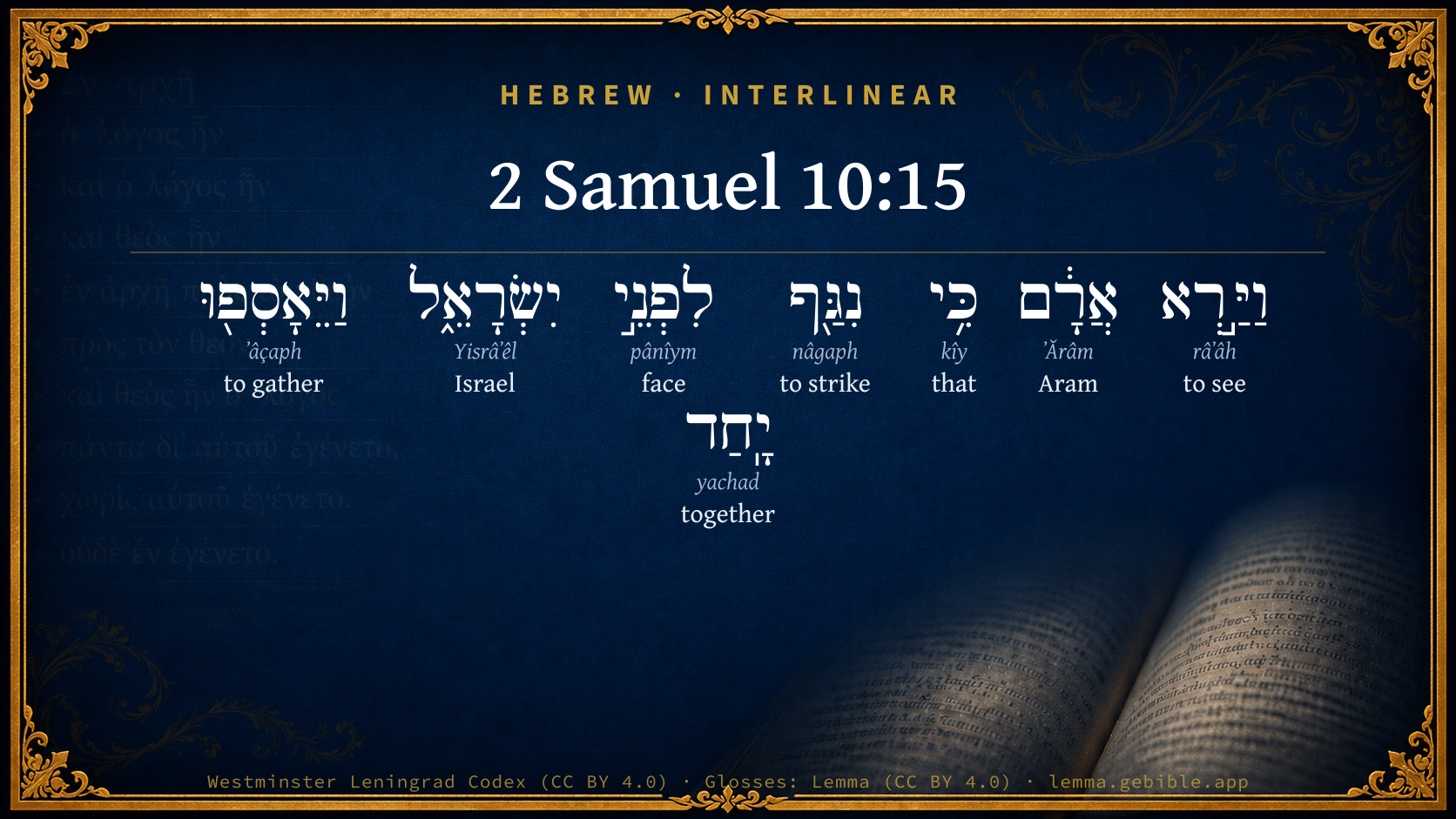
2 Samuel 10:15

Hebrew (Westminster Leningrad Codex) 2 Samuel 10:15 appears in the Hebrew Old Testament. The text above is from the Westminster Leningrad Codex. Each word links to its Strong’s number, a concise gloss, and parsing drawn from the Open Scriptures Hebrew Bible morphology. Click any word for its full Brown-Driver-Briggs (BDB) entry.
Download image
Cite this verse

2 Samuel 10:15 (World English Bible). Public Domain. Lemma interlinear Bible study tool, https://lemma.gebible.app/v/2-samuel/10/15.

Show BibTeX & RIS
BibTeX
RIS
English Translation
When the Syrians saw that they were put to the worse before Israel, they gathered themselves together.
World English Bible · Public Domain
Download a study sheet

One document with this verse’s original text, its word-by-word gloss line, the meaning frame, cross-references with their text, attributed commentary, and full source and license credits — printable, and it pastes into notes with its structure intact.

This verse Autodidact and up

Study sheet (.html) Plain text (.txt)

A passage Seminary Student

Up to 50 verses in one chapter. A passage sheet keeps up to 6 commentary sources and 12 cross-references per verse, in the order this page ranks them, and says so on the sheet whenever that leaves anything out. Ask for a single verse and you get the Autodidact verse sheet above.

Everything on this page stays free to read, with no account — the sheet is a download of what is already on screen, not access to it.

Want to remove ads? Support Godless Engineer
Compare translations 3

The same verse in 3 English versions, stacked beneath the original-language interlinear above. Click any original word for its lexicon entry.

Each is an independent rendering of the whole verse — the interlinear is not word-aligned to these translations.

Highlighted words mark where these versions differ — a whole-verse word diff, not a word-by-word alignment.

  • World English Bible Public Domain
    When the Syrians saw that they were put to the worse before Israel, they gathered themselves together.
  • King James Version Public Domain
    And when the Syrians saw that they were smitten before Israel, they gathered themselves together.
  • unfoldingWord Literal Text CC BY-SA 4.0
    And Aram saw that it had been struck to the face of Israel, and they gathered themselves together.

unfoldingWord Literal Text — © unfoldingWord, licensed CC BY-SA 4.0. Word-aligned USFM3 via Door43 (git.door43.org/unfoldingWord/en_ult).

Versions to compare (up to 4)

3 of 4 selected

Show all 18 translations

Every available English version of this verse, each an independent rendering of the whole verse.

  • World English Bible Public Domain
    When the Syrians saw that they were put to the worse before Israel, they gathered themselves together.
  • Berean Standard Bible Public Domain
    When the Arameans saw that they had been defeated by Israel, they regrouped.
  • Majority Standard Bible Public Domain
    When the Arameans saw that they had been defeated by Israel, they regrouped.
  • King James Version Public Domain
    And when the Syrians saw that they were smitten before Israel, they gathered themselves together.
  • American Standard Version (1901) Public Domain
    And when the Syrians saw that they were put to the worse before Israel, they gathered themselves together.
  • Revised Version (1885) Public Domain
    And when the Syrians saw that they were put to the worse before Israel, they gathered themselves together.
  • Geneva Bible (1599) Public Domain
    And when the Aramites sawe that they were smitten before Israel, they gathered them together.
  • Douay-Rheims (1899) Public Domain
    Then the Syrians seeing that they had fallen before Israel, gathered themselves together.
  • Young's Literal Translation Public Domain
    And Aram seeth that it is smitten before Israel, and they are gathered together;
  • Literal Standard Version CC BY-SA 4.0
    And Aram sees that it is struck before Israel, and they are gathered together;
  • Unlocked Literal Bible CC BY-SA 4.0
    When the Arameans saw that they were being defeated by Israel, they gathered themselves together again.
  • unfoldingWord Literal Text CC BY-SA 4.0
    And Aram saw that it had been struck to the face of Israel, and they gathered themselves together.
  • Darby Bible Public Domain
    And when the Syrians saw that they were routed before Israel, they gathered themselves together.
  • World Messianic Bible Public Domain
    When the Syrians saw that they were defeated by Israel, they gathered themselves together.
  • Webster's Bible Public Domain
    And when the Syrians saw that they were smitten before Israel, they assembled themselves.
  • Free Bible Version CC BY-SA 4.0
    As soon as the Arameans saw they had been defeated by the Israelites they reassembled their forces.
  • Bible in Basic English Public Domain
    And when the Aramaeans saw that Israel had overcome them, they got themselves together.
  • JPS Tanakh (1917) Public Domain
    And when the Arameans saw that they were put to the worse before Israel, they gathered themselves together.

Literal Standard Version (2020), Covenant Press — licensed CC BY-SA 4.0. Text via the HelloAO Bible API (eBible.org). Unlocked Literal Bible (unfoldingWord) — licensed CC BY-SA 4.0. Text via the HelloAO Bible API (eBible.org). unfoldingWord Literal Text — © unfoldingWord, licensed CC BY-SA 4.0. Word-aligned USFM3 via Door43 (git.door43.org/unfoldingWord/en_ult). Free Bible Version, Dr. Jonathan Gallagher — licensed CC BY-SA 4.0. Text via the HelloAO Bible API (eBible.org).

Word by word

More ways to search: Search by grammar → Find every occurrence → Compare this word →

Practice this passage: Drill this verse → Learn its vocabulary →

About this verse

These counts appear in no published source. They are computed here, from the morphology-tagged text and Lemma’s own curated glosses. What Lemma adds →

8
words
8
distinct lemmas
Historical
section

Shared distinctive vocabulary

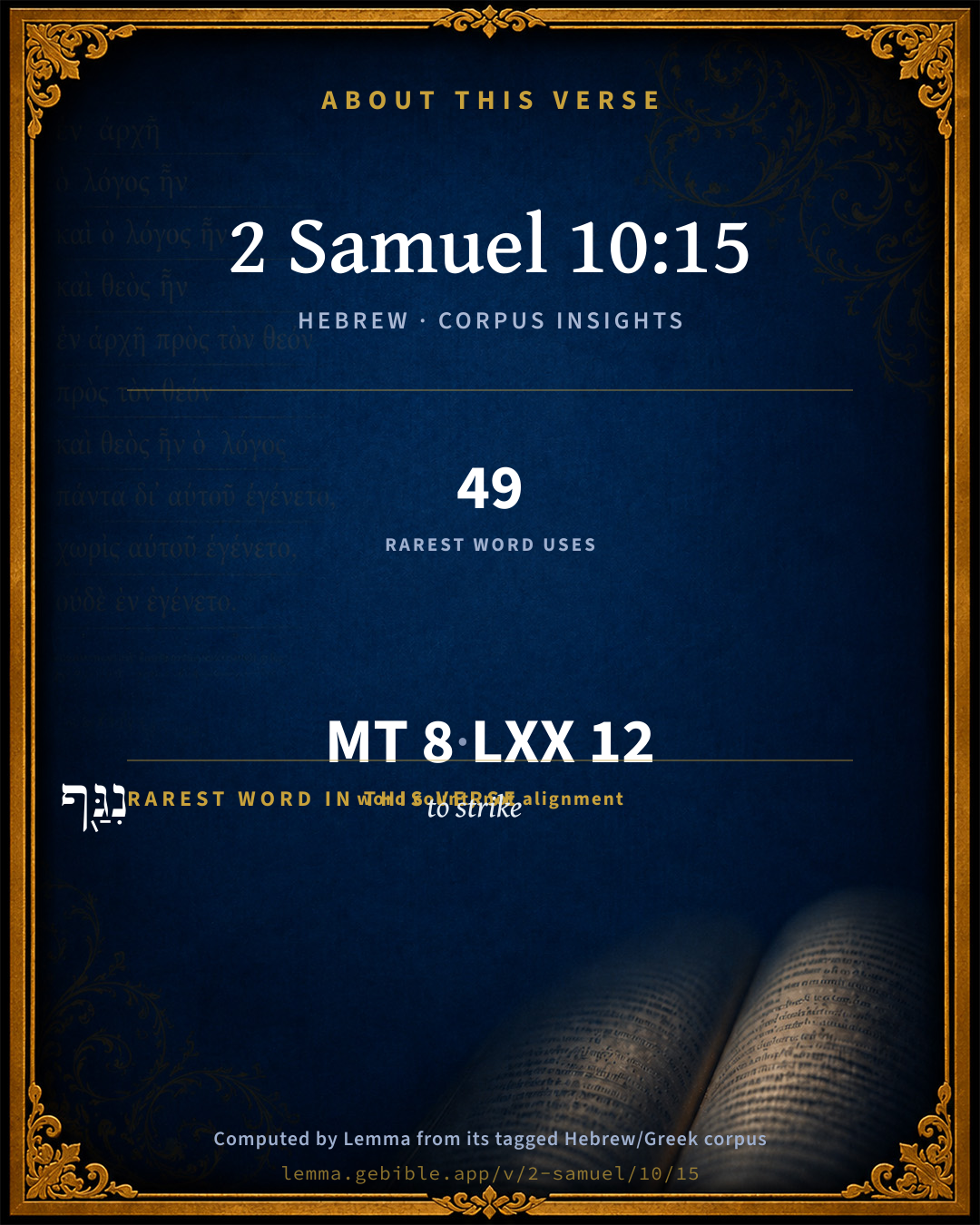
נִגַּ֖ף to strike H5062 occurs in 46 verses of the Hebrew Bible. Also found in:

Grammatical profile

  • 3 verbs
  • 4 nouns
  • 1 conjunction

Verb forms

  • וַיַּ֣רְא Qal · Sequential Imperfect
  • נִגַּ֖ף Niphal · Perfect
  • וַיֵּאָסְפ֖וּ Niphal · Sequential Imperfect

Hebrew & Septuagint length

In English translation the verse runs 17 words from the Hebrew and 15 from the Septuagint (LXX English) — closely comparable.

A rough comparison of the two English renderings, which tokenize alike — not a word-level alignment.

Word counts can differ between the Hebrew and the Greek without any difference in meaning — e.g. the Hebrew direct-object marker אֵת has no separate Greek word, and Greek often adds the article ὁ.

In the original languages it is 8 Hebrew tokens and 12 Greek tokens — but the two are counted differently (Hebrew bundles its prefixes and suffixes into one token; the Greek is in lemma form), so that isn’t a like-for-like length.

Cross-references

5

Topical passages linked to 2 Samuel 10:15 in the Treasury of Scripture Knowledge — connected by theme and wording, ordered by reader-vote popularity; previews shown in the World English Bible.

  • Psalms 2:1 Why do the nations rage, And the peoples plot a vain thing?
  • Isaiah 8:9–10 Make an uproar, O you peoples, and be broken in pieces! And give ear, all you of far countries: gird yourselves, and be broken in pieces! Gird yourselves, and be broken in pieces!
  • Micah 4:11–12 Now many nations have assembled against you, that say, 'Let her be defiled, And let our eye gloat over Zion.'
  • Zechariah 14:2–3 For I will gather all nations against Jerusalem to battle; and the city will be taken, the houses rifled, and the women ravished. half of the city will go out into captivity, and the rest of the people will not be cut off from the city.
  • Revelation 19:19–21 I saw the beast, and the kings of the earth, and their armies, gathered together to make war against him who sat on the horse, and against his army.

Cross-references courtesy of OpenBible.info (CC BY 4.0).

Hebrew and Greek witnesses Masoretic Hebrew ↔ Greek Septuagint

The same verse in the two great witnesses to the Old Testament, shown verse-for-verse.

These are two independent witnesses, not word-aligned to each other, and the Septuagint is shown in lemma (dictionary) form.

Hebrew 2 Samuel 10:15 Masoretic · Westminster Leningrad Codex

וַיַּ֣רְא אֲרָ֔ם כִּ֥י נִגַּ֖ף לִפְנֵ֣י יִשְׂרָאֵ֑ל וַיֵּאָסְפ֖וּ יָֽחַד

When the Syrians saw that they were put to the worse before Israel, they gathered themselves together.

World English Bible · Public Domain

Greek LXX 2 Samuel 10:15 Septuagint · lemma form

καί ὁράω συρία ὅτι πταίω ἔμπροσθεν ἰσραήλ καί συνἄγω ἐπί ὁ αὐτός

And the Syrians saw that they were worsted before Israel, and they gathered themselves together.

LXX2012 (modern English Septuagint) · Public Domain

On this verse, Keil & Delitzsch discusses the Septuagint’s reading. Read the note in Commentary ↓

Hebrew: Westminster Leningrad Codex (CC BY 4.0). Greek: Septuagint (public domain); English from LXX2012 (modern English Septuagint) (Public Domain). How the Septuagint differs from the Hebrew →

Targum (Aramaic paraphrase)

1

The Targum is the ancient Jewish Aramaic paraphrase of the Hebrew Scriptures — an interpretive translation, not the Hebrew text itself. Onkelos (literal) and Pseudo-Jonathan (expansive) render the Torah, and Jonathan the Prophets. Coverage is partial: where no permissively-licensed English translation exists for a verse, only the Aramaic is shown. This is verse-level text, not a word-by-word alignment to the Hebrew.

  1. Targum Jonathan Prophets (Joshua–Malachi)
    וַחֲזוֹ אֱנַשׁ אֲרָם אֲרֵי אִתְבָּרוּ קֳדָם יִשְׂרָאֵל וְאִתְכְּנִישׁוּ כַּחֲדָא:

    (no public-domain English translation for this verse)

    Targum Jonathan — Aramaic: “Mikraot Gedolot” (public domain). English: “Sefaria Community Translation” (CC0 1.0 (public-domain dedication)); “London "Chaldee Paraphrase," 1871” (public domain). Text via Sefaria.

Commentary

Notes on 2 Samuel 10:15 from classic Christian and Jewish commentators (each source and its license shown beneath its notes). The classic Christian expositions comment on the surrounding passage and are grouped to its opening verse, so a note may address several verses; the Jewish commentaries on the Tanakh (Rashi and others) are per-verse, so they appear only where the commentator wrote on this verse.

Lemma curates 59 commentaries, every one of them public domain or Creative Commons licensed, each selected and text-cleaned for this edition rather than reprinted as found. About our sources →

Matthew Henry's Commentary

Here is, 1. A new attempt of the Syrians to recover their lost honour and to check the progress of David's victorious arms. The forces that were lately dispersed rallied again, and gathered themselves together, Sa2 10:15. Even the baffled cause will make head as long as there is any life in it; the enemies of the Son of David do so, Matt, Sa2 22:34; Rev 19:19. These, being conscious of their insufficiency, called in the aid of their allies and dependencies on the other side of the river (Sa2 10:16), and, being thus recruited, they hoped to make their part good against Israel, but they knew not the thoughts of the Lord, for he gathered them as sheaves into the floor; see Mic 4:11-13. 2. The defeat of this attempt by the vigilance and valour of David, who, upon notice of their design, resolved not to stay till they attacked him, but went in person at the head of his army over Jordan (Sa2 10:17), and, in a pitched battle, routed the Syrians (Sa2 10:18), slew 7000 men, who belonged to 700 chariots, and 40,000 other soldiers, horse and foot, as appears by comparing Ch1 19:18. Their general was killed in the battle, and David came home in triumph, no doubt. 3. The consequence of this victory over the Syrians. (1.) David gained several tributaries, Sa2 10:19. The kings, or petty princes, that had been subject to Hadarezer, when they saw how powerful David was, very wisely made peace with Israel, whom they found they could not make war with, and served them, since they were able to give them protection. Thus the promise made to Abraham (Gen 15:18), and repeated to Joshua (Jos 1:4), that the borders of Israel should extend to the river Euphrates, was performed, at length. (2.) The Ammonites lost their old allies: The Syrians feared to help the children of Ammon, not because they had an unrighteous cause (justifying a crime which was a breach of the law of nations), but because they found it was an unsuccessful cause. It is dangerous helping those that have God against them; for, when they fall, their helpers will fall with them.

Jesus Christ, the Son of David, sent his ambassadors, his apostles and ministers, after all his servants the prophets, to the Jewish church and nation; but they treated them shamefully, as Hanun did David's ambassadors, mocked them, abused them, slew them; and it was this that filled the measure of their iniquity, and brought upon them ruin without remedy (Mat 21:35, Mat 21:41, Mat 22:7; compare Ch2 26:16); for Christ takes the affronts and injuries done to his ministers as done to himself and will avenge them accordingly.

Matthew Henry's Commentary on the Whole Bible (1708–1710) — public domain (CC PDM 1.0). Text via the HelloAO Bible API.

Trapp's Complete Commentary

John Trapp

2Sa 10:15 And when the Syrians saw that they were smitten before Israel, they gathered themselves together.

Ver. 15. They gathered themselves together.] That they might be broken in pieces, {Isa 8:9} as all Immanuel’s enemies must.

John Trapp, A Commentary or Exposition upon All the Books of the Old and New Testament (1647–1656) — public domain. Text from a community e-Sword module.

Joseph Benson's Commentary

2Sa 10:15-16. They gathered themselves together — Fearing David would fall upon them for assisting his enemies, they resolved to be beforehand with him, and therefore levied a new army to invade his territories. And Hadarezer — Who was king of Aram Zoba, in Mesopotamia; sent and brought out the Syrians that were beyond the river — That is, beyond Euphrates, which was the bound of his territories eastward, 2Sa 8:3.

Joseph Benson's Commentary on the Old and New Testaments (1811–1818) — public domain. Text from a community e-Sword module.

John Gill's Exposition

And when the Syrians saw that they were smitten before Israel,.... Considered it in their minds, and conversed with one another about it, and fearing what would be the consequence of it:

they gathered themselves together; not only the forces got together again, that fled before Joab, but all the kings of Syria united their forces together, as appears from Sa2 10:19; supposing that David would avenge himself on them for assisting the Ammonites against him; and therefore judged it advisable to raise a large army, that they might be in a condition to receive him.

John Gill's Exposition of the Whole Bible (1746–1763) — public domain (CC PDM 1.0). Text via the HelloAO Bible API.

Haydock's Catholic Bible Commentary

Together, expecting that David would punish them farther. (Menochius)

George Leo Haydock (1774–1849), Haydock's Catholic Family Bible and Commentary, 1859 edition — public domain. Excludes Psalms (Douay-Rheims chapter numbering differs from Protestant) and Deuterocanonical books (Catholic canon only).

Matthew Poole's English Annotations

Partly, to wipe out the stain of cowardice which they had now contracted; partly, to prevent that vengeance which they supposed David would execute upon them for their last attempt; and partly, to shake off the yoke that David had lately put upon them.

Matthew Poole's English Annotations on the Holy Bible (1683–1685) — public domain. Text from a community e-Sword/MySword module.

Keil & Delitzsch

C. F. Keil & F. Delitzsch

The Aramaeans, however, gathered together again after the first defeat, to continue the war; and Hadarezer, the most powerful of the Aramaean kings, sent messengers to Mesopotamia, and summoned it to war. It is very evident, not only from the words "he sent and brought out Aram, which was beyond the river," but also from the fact that Shobach, Hadarezer's general (Shophach according to the Chronicles), was at the head of the Mesopotamian troops, that the Mesopotamian troops who were summoned to help were under the supreme ruler of Hadarezer. This is placed beyond all possible doubt by Sa2 10:19, where the kings who had fought with Hadarezer against the Israelites are called his "servants," or vassals. חילם ויּבאוּ (Sa2 10:16) might be translated "and their army came;" but when we compare with this the חלאמה ויּבא of Sa2 10:17, we are compelled to render it as a proper name (as in the Septuagint, Chaldee, Syriac, and Arabic) - "and they (the men from beyond the Euphrates) came (marched) to Helam" - and to take חילם as a contracted form of חלאם. The situation of this place has not yet been discovered. Ewald supposes it to be connected with the Syrian town Alamatha upon the Euphrates (Ptol. Geogr. v. 15); but this is not to be thought of for a moment, if only because it cannot be supposed that the Aramaeans would fall back to the Euphrates, and wait for the Israelites to follow them thither before they gave them battle; and also on account of Sa2 8:4 and Ch1 18:3, from which it is evident that Helam is to be sought for somewhere in the neighbourhood of Hamath. For חלאמה ויּבא we find אליהם ויּבא, "David came to them" (The Aramaeans), in the Chronicles: so that the author of the Chronicles has omitted the unknown place, unless indeed אליהם has been written by mistake for חלאם.

Keil & Delitzsch — Biblical Commentary on the Old Testament (1861–1891) — public domain (CC PDM 1.0). Text via the HelloAO Bible API. (Old Testament only.)

Kretzmann's Popular Commentary

Paul E. Kretzmann

The Final Defeat of the Syrians

v. 15. And when the Syrians saw that they were smitten before Israel, in the battle near Rabbah, they gathered themselves together, anxious to wipe out the disgrace of their defeat.

v. 16. And Hadarezer, the mightiest Syrian king, sent, and brought out the Syrians that were beyond the river, in Mesopotamia: and they came to Helam, in the neighborhood of Hamath: and Shobach, the captain of the host of Hadarezer, went before them.

v. 17. And when it was told David, he gathered all Israel together, all the men that were trained for warfare, and passed over Jordan, and came to Helam. The importance which David attached to this campaign is seen from the fact that he took command in person, for he had lost none of his military ability. And the Syrians set themselves in array against David and fought with him.

v. 18. And the Syrians fled before Israel, unable to withstand the fury of their attack; and David slew the men of seven hundred chariots of the Syrians, and forty thousand horsemen, and smote Shobach, the captain of their host, who died there, he was so severely wounded that he did not survive the battle.

v. 19. And when all the kings that were servants, vassals, to Hadarezer saw that they were smitten before Israel, they made peace with Israel and served them, became tributary to them together with their former lord. So the Syrians feared to help the children of Ammon any more. "Nothing is here said of the wars with Damascus and Edom, to which Joab turned in the south, while David was gaining his victories in the north, because the narrative is here occupied with the fortunes of Rabbah only because of their connection with those of Uriah. " (Lange. ) Thus Jehovah crowns the work, the battle of those who trust in Him with His blessing and good fortune. The Ammonites experienced what many others have since found out, namely, that those who begin a war without cause will in the end have the greatest misfortune on account of their crime.

Paul E. Kretzmann, Popular Commentary of the Bible (1921–1924) — public domain. Text from a community e-Sword module.

unfoldingWord translationNotes

Door43 World Missions Community

When the Arameans saw that they were being defeated by Israel

This can be stated in active form. AT: "when the Arameans realized that the Israelites were defeating them" (See: Active or Passive)

Hadarezer ... Shobak

These are the names of men. (See: How to Translate Names)

from beyond the Euphrates River

This means the east side of the Euphrates River.

They came to Helam

Here "came to" can be translated as "went to" or "gathered at" (See: Go and Come)

Helam

This is the name of a place. (See: How to Translate Names)

translationWords

Aram

Israel

Euphrates River

commander

head

unfoldingWord translationNotes — © Distant Shores Media and the Door43 World Missions Community, licensed CC BY-SA 4.0. Source: git.door43.org/Door43/en_tn.

Lesson kit

Teaching starters — assembled from the data on this page, not authored interpretation. Every prompt links to the verse data it draws on. Edit before teaching.

2 Samuel, in the Historical, opens this verse with 8 words (8 distinct Hebrew lemmas). Its most distinctive word is nâgaph (“to strike”). A historical commentator’s framing appears above. Read the whole chapter for the surrounding context.

Discussion questions

  1. What does “to strike” (nâgaph) contribute to the verse as a whole?
  2. Exodus 8:2 shares the word «to strike» with this verse. How do the two illuminate each other?
  3. These translations render this verse differently; the difference is in the English rendering, not the original. What questions does that raise?
  4. The verb «וַיַּ֣רְא» is Qal Sequential Imperfect. How does its form color the action?
  5. Reading how Matthew Henry's Commentary and Trapp's Complete Commentary read this verse, where do the two commentators agree and where do they part?

Things to notice

Reading settings

Reading text

Shown beneath each verse's original-language words.

Old Testament
Old Testament edition

Read the OT as the Masoretic Hebrew (MT) or the Greek Septuagint (LXX).

English shown for the Greek Septuagint (in the Hebrew ↔ Greek comparison).

Comparing translations? Open the Compare panel on any verse page to stack up to four side by side.