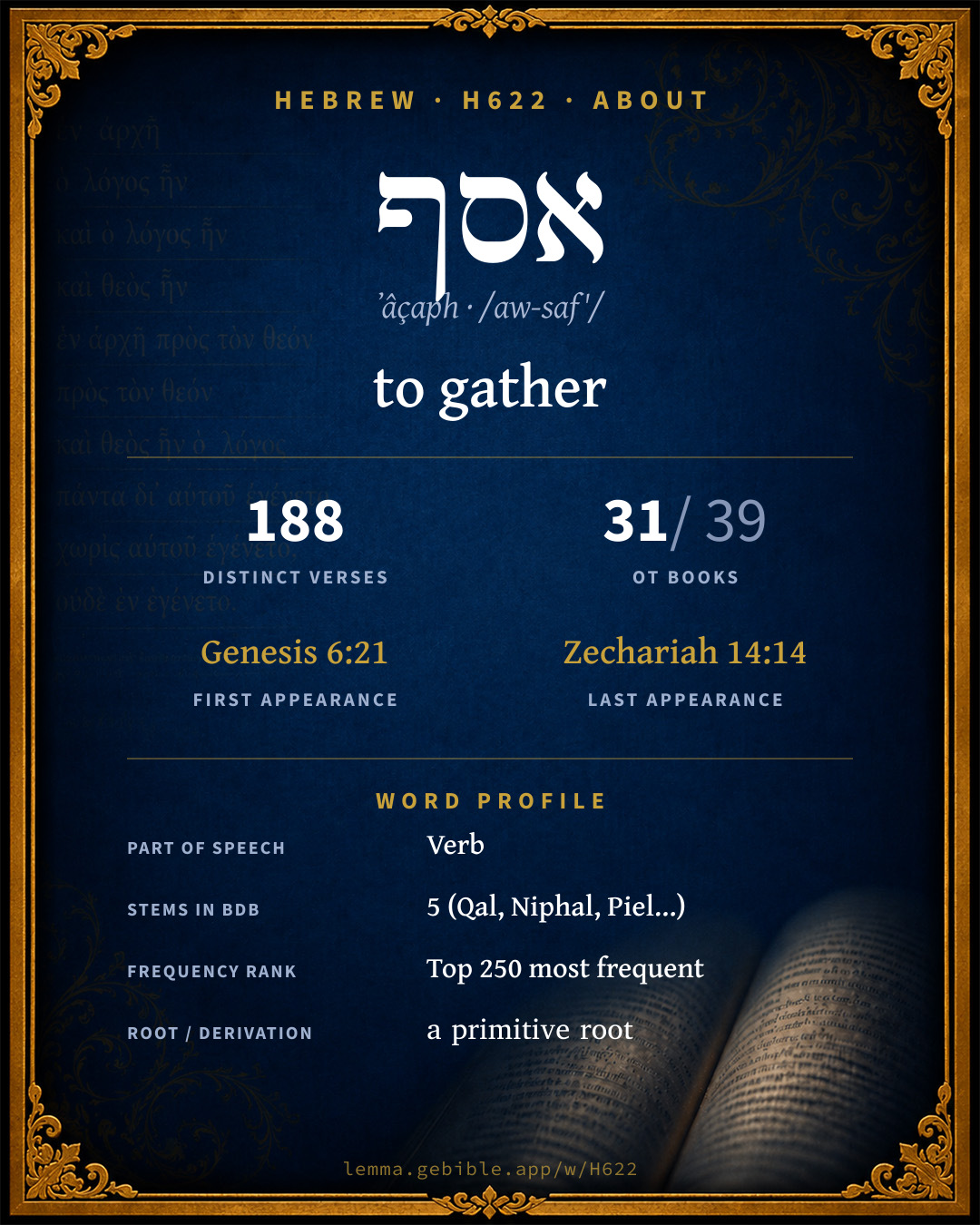
אָסַף
to gather
also: receive, remove, gather in fuller range ↓
Full lexicon entry — Brown-Driver-Briggs (BDB)
From Brown-Driver-Briggs (BDB)
Where this word appears
See every Qal verb in the Hebrew Bible →
Grammar key — what these labels mean
Part of speech
- Verb
- An action or state-of-being word.
Stem
- Qal
- The basic, simple active stem — the plain form of the verb (“he wrote”). Here: ‘gather’
- Niphal
- Usually the simple passive or reflexive of the Qal (“he was written”). Here: ‘assemble’
- Piel
- An intensive or resultative active stem. Here: ‘gather harvest Is 62’
- Pual
- The passive counterpart of the Piel.
- Hiphil
- The causative active stem (“he caused / brought about”).
- Hithpael
- The reflexive or reciprocal stem (the subject acts on itself).
Form
- Sequential Imperfect
- An imperfect with prefixed waw — the standard past-narrative form (waw-consecutive imperfect).
- Perfect
- A completed action or state — Hebrew marks aspect (completeness) more than strict tense (“he wrote”).
- Imperfect
- An incomplete, ongoing, or future action (“he will / would write”).
- Imperative
- A direct command (“write!”).
- Sequential Perfect
- A perfect with prefixed waw continuing a preceding imperfect or command (waw-consecutive perfect).
- Infinitive Construct
- A bound verbal noun, frequently with prepositions (“to write / in writing”).
- Participle Active
- A verbal adjective expressing ongoing or characteristic action (“writing / one who writes”).
- Infinitive Absolute
- An unbound verbal noun, often intensifying or standing in for a finite verb.
- Participle Passive
- A verbal adjective expressing action received (“written”).
- Cohortative
- A first-person volitional form expressing wish or resolve (“let me / let us write”).
- Jussive
- A third- or second-person volitional form expressing wish or command (“let him write”).
State
- Absolute
- The independent form of a noun, not bound to a following word.
- Construct
- A noun bound to a following noun in a possessive / “of” relationship (the construct chain).
Person
- 3rd Person
- The one spoken about (“he / she / it / they”).
- 2nd Person
- The one addressed (“you”).
- 1st Person
- The speaker (“I / we”).
Gender
- Masculine
- Grammatically masculine.
- Common
- Either gender — not distinguished for this form.
- Feminine
- Grammatically feminine.
Number
- Singular
- One.
- Plural
- More than one (in Hebrew, generally three or more).
Every verse where H622 appears in the Book of 2 Chronicles — 12 distinct verses. Click any verse to open its interlinear word-by-word view. Verse text shown in the World English Bible for context — . Each verse’s Hebrew form is shown with its reference; the English is not keyword-highlighted, since the data carries no word-level English alignment. Use “Compare translations” on any verse to read it across multiple English versions. This concordance covers the Hebrew Bible; Septuagint (Greek Old Testament) occurrences are not indexed here.
2 Chronicles
- 2 Chronicles 1:14 וַ/יֶּאֱסֹ֣ף conj + Qal wimpf 3ms Solomon gathered chariots and horsemen: and he had one thousand four hundred chariots, and twelve thousand horsemen, that he placed in the chariot cities, and with the king at Jerusalem.
- 2 Chronicles 12:5 נֶאֶסְפ֥וּ Niphal pf 3cp Now Shemaiah the prophet came to Rehoboam, and to the princes of Judah, who were gathered together to Jerusalem because of Shishak, and said to them, Thus says Yahweh, You have forsaken me, therefore have I also left you in the hand of Shishak.
- 2 Chronicles 24:11 וַ/יַּֽאַסְפוּ conj + Qal wimpf 3mp It was so, that whenever the chest was brought to the king's officers by the hand of the Levites, and when they saw that there was much money, the king's scribe and the chief priest's officer came and emptied the chest, and took it, and carried it to its place again. Thus they did day by day, and gathered money in abundance.
- 2 Chronicles 28:24 וַ/יֶּאֱסֹ֨ף conj + Qal wimpf 3ms Ahaz gathered together the vessels of the house of God, and cut in pieces the vessels of the house of God, and shut up the doors of the house of Yahweh; and he made him altars in every corner of Jerusalem.
- 2 Chronicles 29:4 וַ/יַּֽאַסְפֵ֖/ם conj + Qal wimpf 3ms + sfx pers 3mp He brought in the priests and the Levites, and gathered them together into the broad place on the east,
- 2 Chronicles 29:15 וַ/יַּֽאַסְפ֤וּ conj + Qal wimpf 3mp They gathered their brothers, and sanctified themselves, and went in, according to the commandment of the king by the words of Yahweh, to cleanse the house of Yahweh.
- 2 Chronicles 29:20 וַ/יֶּאֱסֹ֕ף conj + Qal wimpf 3ms Then Hezekiah the king arose early, and gathered the princes of the city, and went up to the house of Yahweh.
- 2 Chronicles 30:3 נֶאֶסְפ֥וּ Niphal pf 3cp For they could not keep it at that time, because the priests had not sanctified themselves in sufficient number, neither had the people gathered themselves together to Jerusalem.
- 2 Chronicles 30:13 וַ/יֵּֽאָסְפ֤וּ conj + Niphal wimpf 3mp There assembled at Jerusalem much people to keep the feast of unleavened bread in the second month, a very great assembly.
- 2 Chronicles 34:9 אָסְפֽוּ Qal pf 3cp They came to Hilkiah the high priest, and delivered the money that was brought into the house of God, which the Levites, the keepers of the threshold, had gathered of the hand of Manasseh and Ephraim, and of all the remnant of Israel, and of all Judah and Benjamin, and of the inhabitants of Jerusalem.
- 2 Chronicles 34:28 אֹֽסִפְ/ךָ֜ וְ/נֶאֱסַפְתָּ֣ Qal ptcp.act ms cs + sfx pers 2ms conj + Niphal wpf 2ms Behold, I will gather you to your fathers, and you shall be gathered to your grave in peace, neither shall your eyes see all the evil that I will bring on this place, and on the inhabitants of it. They brought back word to the king.
- 2 Chronicles 34:29 וַ/יֶּאֱסֹ֕ף conj + Qal wimpf 3ms Then the king sent and gathered together all the elders of Judah and Jerusalem.
About this entry
At a glance — auto-summarized from this page’s data, not written by a person. Every figure links to its source below. This summary describes the numbers; it doesn’t interpret them.
“to gather” is the headline sense of the Hebrew verb אסף (ʼâçaph). Where the King James Version says “gather,” newer translations reach for “and” (unfoldingWord Literal Text); the renderings breakdown has the detail. It appears 188 verses across 31 books of the Hebrew Bible, among its common vocabulary. First canonically at Genesis 6:21, it enters the text early. Across 5 stems, its meaning turns on the binyan (Qal, Niphal). For the data behind this summary, explore the sense tree and the renderings breakdown below.
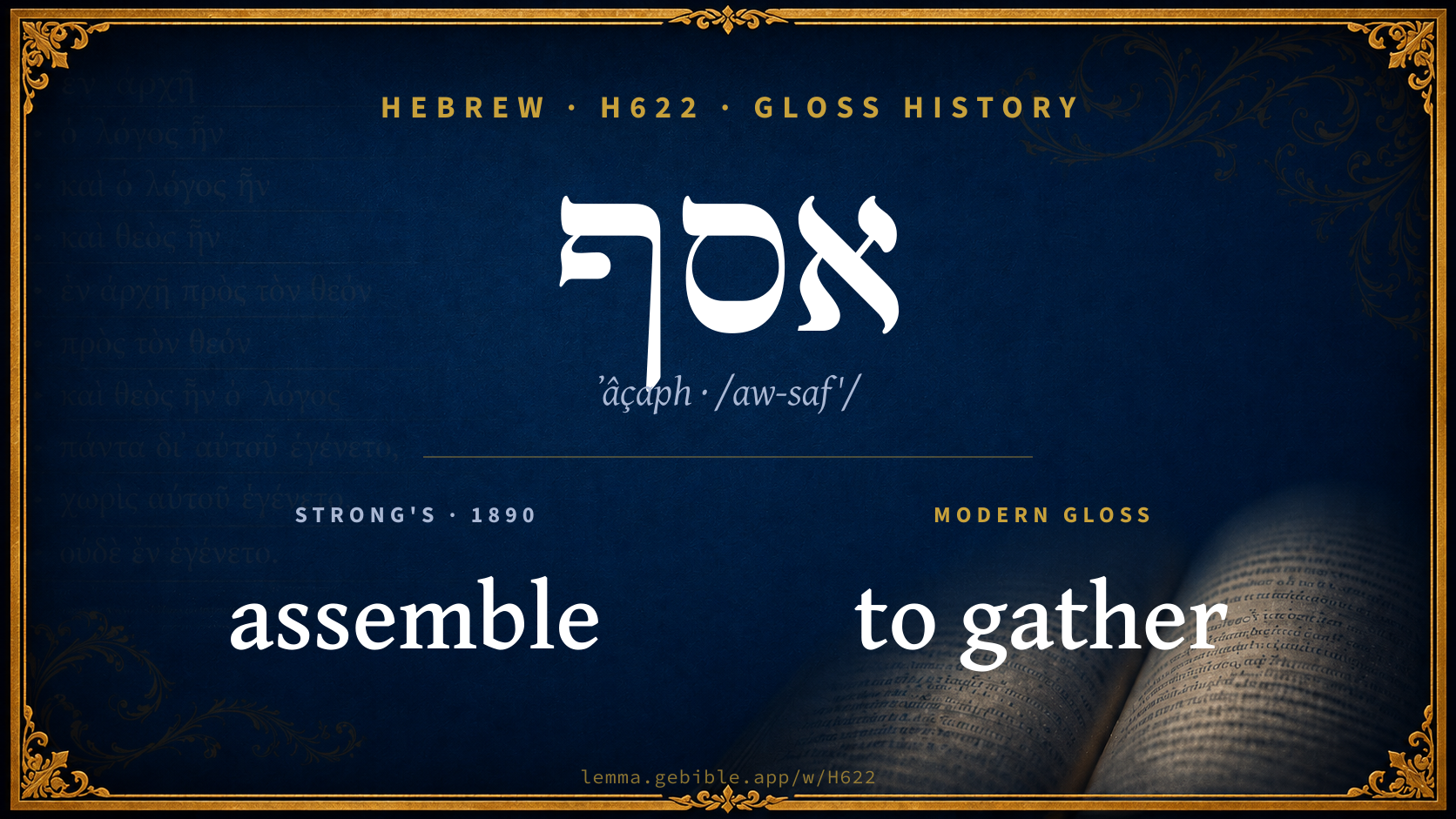
Gloss history
Strong's 1890 vs modern scholarship
About this word
Strong's H622 catalogs a Hebrew word from the Hebrew Old Testament.
These counts are not copied from any lexicon or concordance. They are computed here, from the morphology-tagged Hebrew Old Testament. What Lemma adds →
- 188
- distinct verses
- The word appears in 188 distinct verses.
- 31 / 39
- OT books
- The word appears in 31 of 39 Old Testament books.
- #236
- by frequency
- Top 250 most frequent Hebrew words (rank 236 of 8,640 Hebrew words by occurrence).
View all 188 occurrences in the concordance →
By section of the Old Testament
By traditional corpus
Conventional, traditional groupings — biblical authorship is debated, so this is a traditional corpus grouping, not an authorship claim. Each share is this word’s portion of its verses in that division of the Hebrew canon. Each figure is a share of the word’s 188 distinct verses.
- Prophets (Nevi'im) 102 verses · 54%
- Torah (Pentateuch) 46 verses · 24%
- Writings (Ketuvim) 40 verses · 21%
How translations render this word
Counts come from each version’s own published word-to-Strong’s tagging or interlinear alignment — an approximate guide to how each version renders this word, not a word-level alignment the data otherwise carries. Because each total is that version’s own tagged count, the per-version totals vary from one another and need not match the appearance or distinct-verse counts above. These counts may also differ from a printed concordance because Lemma counts each distinctly tagged rendering and does not collapse phrase taggings into a single head-word total. This is a fixed set of word-tagged versions (KJV, ASV, BSB, ULT) and does not change with the reading translation you choose elsewhere. Each version’s license is shown beside its name below (and on Sources).
- King James Version: Gather 16×, Gathered 14×, Gathered themselves together 11×
- American Standard Version: Gathered 13×, Gather 11×, Gathered themselves together 8×
- Berean Standard Bible: Gathered 18×, Gather 15×, Assembled 9×
- unfoldingWord Literal Text: And 22×, Gathered 19×, Gather 17×
King James Version Public Domain
Renders H622 across 208 tagged occurrences — most commonly:
Plus other, less common renderings. Plus 80 renderings that appear only once — usually multi-word phrases or single function words the recovered tagging swept in, not distinct renderings.
American Standard Version Public Domain
Renders H622 across 207 tagged occurrences — most commonly:
Plus other, less common renderings. Plus 93 renderings that appear only once — usually multi-word phrases or single function words the recovered tagging swept in, not distinct renderings.
Berean Standard Bible Public Domain
Renders H622 across 193 tagged occurrences — most commonly:
Plus other, less common renderings. Plus 95 renderings that appear only once — usually multi-word phrases or single function words the recovered tagging swept in, not distinct renderings. Not rendered by a distinct English word in 7 further occurrences.
unfoldingWord Literal Text CC BY-SA 4.0
Renders H622 across 247 tagged occurrences — most commonly:
Plus other, less common renderings. Plus 88 renderings that appear only once — usually multi-word phrases or single function words the recovered tagging swept in, not distinct renderings.
15 senses and sub-senses in the full BDB
Hebrew verbs can shift meaning by stem (binyan): Qal is the basic action, Niphal is often passive or reflexive, Piel often intensifies or makes it factitive, and Hiphil is typically causative. The senses below are grouped under the stem BDB assigns to each. This entry also uses Pual (the passive of Piel) and Hithpael (reflexive or reciprocal).
What do BDB’s symbols mean?
BDB uses these scholarly abbreviations:
| Symbol | Meaning |
|---|---|
| 𝔊 | the Septuagint (the ancient Greek translation, LXX) |
| 𝔙 | the Vulgate (the Latin translation) |
| 𝔖 | the Syriac version (the Peshitta) |
| 𝔗 | the Targum (the Aramaic translation) |
| ψ | the Psalms |
| √ | root (the underlying root or stem) |
| ‖ | parallel passage (a synonymous or contrasted parallel) |
| † | the dagger: every passage where the word occurs is cited |
The 15 senses and sub-senses the full Brown-Driver-Briggs lexicon distinguishes for this word, in lexicon order (not ranked by frequency), with BDB’s own verbatim wording and sub-sense lettering. Shown in Hebrew script with BDB’s own scholarly abbreviations. The condensed entry is in the Lexicon Entry tab. See also the Forms in the corpus table below.
Qal
- Pf. אָסַף Gn 30:23 +; אָסַפְתָּ ψ 85:4, etc.; Impf. יֶאֱסֹף 2 K 5:3; יַאַסְפֵנִי ψ 27:10, etc.; also וַיֹּסֶף 2 S 6:1; 2 ms. תֹּסֵף ψ 104:29; 1 s. אֹסְפָה Mi 4:6; so prob. (sf.) אֹסִֽפְךָ 1 S 15:6 (read אֹסִפְךָ) v. Köi 382 DrSm; Imv. אֱסֹף Nu 21:16 + אֶסְפָה Nu 11:16; 2 fs. אִסְפִּי Je 10:17; אִסְפוּ ψ 50:5 +; Inf. abs. אָסֹף Je 8:13 + (Hiph., from סוף according to BaNB 73); cstr. אֱסֹף 2 K 5:7 +; אָסְפְּךָ Ex 23:16; אָסְפְּכֶם Lv 23:39; Pt. act. אֹסֵף Nu 19:10; אֹסִפְךָ 2 K 22:20; 2 Ch 34:28 (pointed אֹסִֽפְךָ i.e. Hiph.; cf. Köl.c.); אֹסְפָם ψ 39:7; pass. pl. cstr. אֲסֻפֵי Ez 34:29;— e.g. Genesis 30:23
- 1. gather, collect (a) persons Gn 29:22; 42:17 (sq. אֶל־) Ex 3:16; 4:29; Nu 11:16, 24; 21:16 Jos 2:18 (sq. אֶל־ + ־ה loc.) 24:1 (sq. ־ה loc.; all these JE); 1 S 5:8, 11; 2 K 23:1 (sq. אֶל־) Jo 2:16; Is 11:12 Zp 3:8; Hb 2:6; Ez 11:17 (all ‖ קבץ) +; collect men, people, armies, etc., for fighting Nu 21:23 (E) Ju 11:20; 1 S 17:1 2 S 10:17; 12:29 +; cf. Zc 14:2 (sq. אֶל־ against); (b) once obj. beasts Je 12:9; (c) things, especially fruits of earth Ex 23:10, 16 (Cov’t code) Lv 23:39; 25:3, 20 (H) Dt 11:14; 16:13; 28:38; Is 17:5; Je 40:10, 12; Jb 39:12 ψ 39:7; cf. Ru 2:7 (‖ לקט glean); the quails Nu 11:32(×2); food in gen. (מַאֲכָל) Gn 6:21 (sq. אֶל־); eggs Is 10:14; money 2 K 22:4; 2 Ch 24:11; ashes of red heifer Nu 19:9, 10; chariots 1 K 10:26; 2 Ch 1:14, etc.; of fisherman (בְּמִכְמַרְתּוֹ, in metaph.) Hb 1:15; of collecting wind Pr 30:4 מִי א׳־רוּחַ בְּחָפְנָיו. e.g. Genesis 29:22
- 2. gather an individual into company of others: (a) obj. pers. especially gather to one’s fathers 2 K 22:20 (עַל־אֲבֹתֶיךָ) = 2 Ch 34:28 (אֶל־; both ‖ Niph. of same vb. q.v.); hence also (b) bring, obj. pers. 1 S 14:52 (on form here v. Dr) 2 S 11:27 (both sq. אֶל־), association, responsibility, protection being implied; also of stray ox or sheep Dt 22:2 (sq. אֶל־תּוֹךְ); hence also (c) take up, care for, subj. י׳ ψ 27:10 (cf. perhaps Is 40:11 קבץ); (d) draw up the feet upon the bed (אֶל־) Gn 49:33. e.g. 2 Kings 22:20
- 3. bring up the rear of Is 58:8 כְּבוֹד י׳ יַאַסְפֶ֑ךָ i.e. be thy rear-guard (‖ הָלַךְ לְפָנֶיךָ צִדְקֶ֑ךָ)—52:12 has Pi. מְאְסִּפְכֶם q.v. e.g. Isaiah 58:8
- 4. gather and take away, remove, withdraw 1 S 14:19 (obj. hand), Je 10:17 (bundle, sq. מִן), leper 2 K 5:11 (v. צרע); cf. also א׳ מִצָּרַעַת, remove (set free) a man from leprosy v 3, 6, 7; Gn 30:23; Is 4:1 (reproach), ψ 85:4 (wrath, ‖ הֵשִׁיב), Je 16:5 (peace, sq. מִן), Jo 2:10; 4:15 (light), ψ 26:9 (נֶפֶשׁ) so Ju 18:25; ψ 104:29 (רוּחַ) v. also Jb 34:14 (sq. אֶל־); hence destroy 1 S 15:6 (obj. pers.); pass. אֲסֻפֵי רָעָב destroyed with hunger Ez 34:29; also Inf. abs. Je 8:13; Zp 1:2 (joined with הֵסִיף from סוף, v. Köi. 445; considered Hiph. Inf. abs. by BaNB 73 v. supr.) e.g. 1 Samuel 14:19
Niphal
- Pf. נֶאֱסַף Nu 27:13 + נֶאֶסְפָה Je 48:33 etc.; Impf. יֵאָסֵף Ex 9:19 +; וַיֵּאָ֫סֶף Gn 25:8 +; יֵאָסֵכּ֑וּן ψ 104:22 etc.; Imv. הֵאָסֵף Dt 32:50; הֵאָֽסְפִי Je 47:6; הֵאָֽסְפוּ Gn 49:1 +; Inf. abs. הֵאָסֹף 2 S 17:11 (on form cf. BaNB 74); cstr. הֵאָסֵף Gn 29:7; Nu 12:15; Pt. נֶאֱסָף Gn 49:29; נֶאֱסָפִים 1 S 13:11; Is 13:4; נֶאֱסָפִים Is 57:1;— e.g. Numbers 27:13
- 1. assemble, be gathered, reflex. (a) subj. men Gn 49:1 (‖ קבץ v 2), Is 43:9 (‖ קבץ), 2 Ch 30:3 (sq. לְ) v 13 (sq. acc. loc.), Ezr 3:1; 9:4; Ne 8:1, 13 (all sq. אֶל־) 9:1; 12:28; earlier mostly of assembling for war Gn 34:30 (sq. עַל־), Jos 10:5; Ju 6:33; 9:6; 10:17 (‖ נצעק), 20:11 (sq. אֶל־) v 14 (sq. ־ה loc.), 1 S 13:11 (sq. acc. loc.) +; (b) subj. flocks, etc. Gn 29:3 (pass.; sq. שָׁמָּה) v 7, 8 (all J); fish Nu 11:22 (cf. Hb 1:16 Qal); (c) inanim. subj. herbs Pr 27:25; water 2 S 14:14 (in sim.); bones for burial Je 8:2 cf. 25:33 (bodies of slain) v. also Ez 29:5 (‖ קבץ which Co reads קבר), appar. = compose, arrange for burial. so יֵאָסֵף Jb 27:19; but read prob. יאסִף = יוֹסִף (Ex 5:7), 𝔊 𝔖 Ew De Di Du. e.g. Genesis 49:1
- 2. pass. of Qal 2; (a) be gathered to one’s fathers נֶא׳ אֶל־אֲבוֹהָיו Ju 2:10; elsewhere to one’s people אֶל־עַמָּיו (all P) Gn 25:8, 17; 35:29 (‖ וַיִּגְוַע וַיָּמָת) 49:29, 33 (‖ גוע), Nu 20:24, 26 (‖ מות) 27:13; 31:2; Dt 32:50(×2) (both ‖ מות); also אֶל־קִבְרֹתֶיךָ 2 K 22:20 = 2 Ch 34:28 (both ‖ Qal q.v.); abs. Nu 27:13; (b) be brought in (into association with others, etc.) Nu 12:14, 15 (E) of Miriam, after leprosy; also refl. betake oneself, of Moses 11:30 (E), cf. 2 S 17:13 (both sq. אֶל־); even with inanim. subj. Je 47:6 הֵאָֽסְפִי אֶל־תַּעְרֵךְ (addressed to sword); of man & beast brought home (sq. ־ה loc.) for protection Ex 9:19. e.g. Judges 2:10
- 3. Pass. of Qal 4; be taken away, removed, perish, of men Is 57:1(×2) (‖ אבד); fish Ho 4:3; gladness Is 16:10 Je 48:33 (sq. מִן); also reflex., withdraw itself, of moon Is 60:20 (‖ בוא שׁמשׁ). e.g. Isaiah 57:1
Piel
- Pt. מְאַסֵּף Nu 10:25 +; מְאָֽסְפָיו Is 62:9 (so BD v. Köi201); מְאַסִּפְכֶם Is 52:12;— e.g. Numbers 10:25
- 1. gather harvest Is 62:9 (‖ קבץ); bodies for burial Je 9:21. e.g. Isaiah 62:9
- 2. take in, receive into (sq. בַּיְתָה) Ju 19:15, 18. e.g. Judges 19:15
- 3. as subst. rearguard, rearward Nu 10:25 (P) Jos 6:9, 13 (both E); fig. of God Is 52:12. e.g. Numbers 10:25
Pual
- Pf. וְאֻסַּף (cons.) Is 33:4; Zc 14:14 etc.; Pt. מְאֻסָּף, Ez 38:12—be gathered, of men Is 24:22; Ho 10:10 (sq. עַל against), Ez 38:12; booty Is 33:4; wealth Zc 14:14. e.g. Isaiah 33:4
Hithpael
- Inf. הִתְאַסֵּף Dt 33:5 gather themselves. e.g. Deuteronomy 33:5
Senses from the full Brown-Driver-Briggs lexicon (Brown, Driver, Briggs; Oxford 1906 — public domain), digitized via Sefaria, supplemented by the OpenScriptures HebrewLexicon (CC BY 4.0). Full attribution on Sources.
Word origin
vb. gather, remove (Assyrian esêpu, DlPr 45)—
— Brown-Driver-Briggs (Oxford 1906, public domain), digitized via Sefaria, supplemented by the OpenScriptures HebrewLexicon (CC BY 4.0). See Sources.
Origin: a primitive root
Jastrow Dictionary
A second Hebrew/Aramaic lexicon for comparison, covering Aramaic and post-biblical (Talmudic, Targumic, Midrashic) usage that the biblical-Hebrew BDB does not. Matched by lemma rather than by Strong’s number, so a lemma may carry more than one Jastrow headword (shown separately below), and the entries cover usage well beyond the Bible.
אָסַף
- [to scrape together], to gather, harvest. Snh. III, 3 אוֹסְפֵי שביעית those who harvest the fruits of the Sabbath year (for storage); ib. 26ᵃ אוֹסְפִין (opp. to סוחרין traders in fruits of the Sabbath year).
- 1. to be gathered; to be taken away (by death). Num. R. s. 14 (p. 257ᵈ ed. Amst.) והם נֶאֱסָפִים לשָׁמְעוֹ and they (the people) gather themselves to hear him. Ib. (p. 258ᵃ) בזמן שבעליהם נאספים מהם after their teachers have been taken away from them (when they are dead); Pesik. R. s. 3; Koh. to XII, 11; Tanḥ. B’haãl., 15; a. e. e.g. Ecclesiastes 12:11
- 2. to be picked up. Kidd. IV, 1; v. אֲסוּפִי.
- , mostly הוֹסִיף, v. יָסַף
אֲסַף
- Y. Keth. V, 30ᵇ top לא מסתברא דלא כאספון וכ׳ (read כאספין) it would be unreasonable not to consider students like harvesters, for they work (even) harder.
A Dictionary of the Targumim, the Talmud Babli and Yerushalmi, and the Midrashic Literature (Marcus Jastrow; London, Luzac, 1903) — Public Domain. Digitized via Sefaria. Digitized via Sefaria. Full attribution on Sources.
Forms in the corpus
The 163 distinct written forms H622 takes in the Hebrew Bible, most frequent first — each parse links to that stem’s occurrences in the concordance. Hebrew forms include their vowel points and cantillation, so a single lemma takes many written forms.
The 60 most common forms are shown; 103 rarer forms follow in the full concordance.
Same root — word family
Other BDB entries built from the same root as H622, grouped by Strong’s listed origin. These share a root / origin per the lexicon — not necessarily a shared meaning. Each links to that word’s own entry.
Derived from this word
- אסיף ʼâçîyph H614 harvest
- אסף ʼâçuph H624 storehouse
- אסף ʼôçeph H625 harvest
- אספה ʼăçêphâh H626 gathering
- אפיק ʼâphîyq H650 channel
Proper names from this root
People and places named from this root — a name, not an additional meaning of the word.
Compare all same-root words → Showing 4 of 7 — not the complete family. 1 of the same-root words is a proper name (a person or place). They share a root, not necessarily a meaning.
Septuagint verse parallels
This word appears in 179 verses that also exist in the Greek Old Testament (Septuagint), out of the 188 Hebrew verses it occurs in. You can read those verses in Greek by switching the Old Testament edition to the Septuagint.
Read these verses in the Septuagint
- Genesis 6:21
- Exodus 3:16
- Leviticus 23:39
- Numbers 10:25
- Deuteronomy 11:14
- Joshua 2:18
- Judges 2:10
- Ruth 2:7
- 1 Samuel 5:8
- 2 Samuel 6:1
- 1 Kings 10:26
- 2 Kings 5:3
This is a verse-level parallel only — the same verses exist in both the Hebrew and Greek Old Testaments. No word-level Hebrew↔Greek correspondence is claimed: the data carries no such alignment, so no Greek word is shown as this Hebrew word’s translation. Coverage is not total — the Septuagint omits the deuterocanon and renumbers the Psalms, so some Hebrew verses have no direct Greek parallel.