Isaiah 60:20

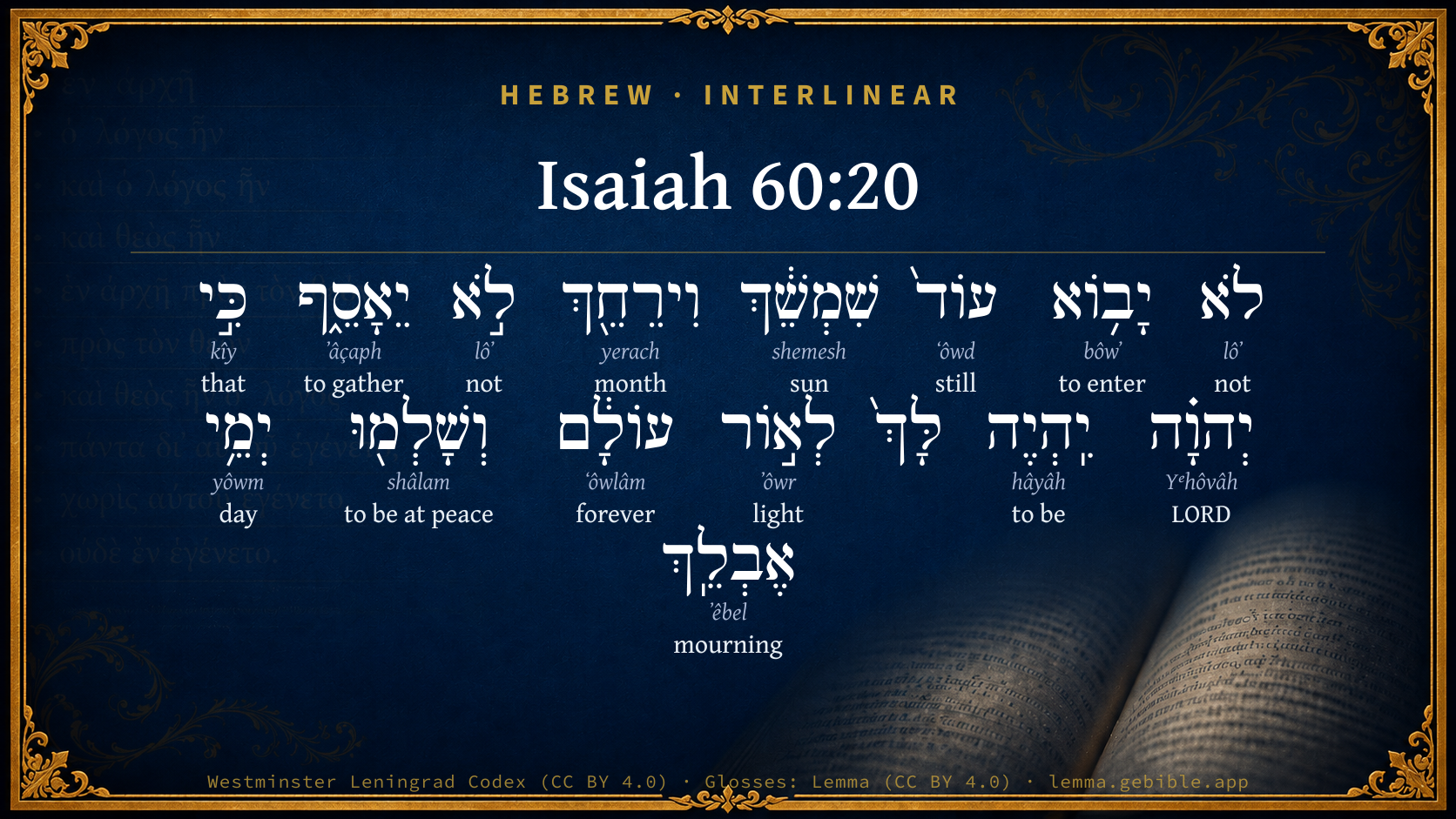
Hebrew (Westminster Leningrad Codex) Isaiah 60:20 appears in the Hebrew Old Testament. The text above is from the Westminster Leningrad Codex. Each word links to its Strong’s number, a concise gloss, and parsing drawn from the Open Scriptures Hebrew Bible morphology. Click any word for its full Brown-Driver-Briggs (BDB) entry.
Download image
Cite this verse

Isaiah 60:20 (World English Bible). Public Domain. Lemma interlinear Bible study tool, https://lemma.gebible.app/v/isaiah/60/20.

Show BibTeX & RIS
BibTeX
RIS
English Translation
Your sun shall no more go down, neither shall your moon withdraw itself; for Yahweh will be your everlasting light, and the days of your mourning shall be ended.
World English Bible · Public Domain
Download a study sheet

One document with this verse’s original text, its word-by-word gloss line, the meaning frame, cross-references with their text, attributed commentary, and full source and license credits — printable, and it pastes into notes with its structure intact.

This verse Autodidact and up

Study sheet (.html) Plain text (.txt)

A passage Seminary Student

Up to 50 verses in one chapter. A passage sheet keeps up to 6 commentary sources and 12 cross-references per verse, in the order this page ranks them, and says so on the sheet whenever that leaves anything out. Ask for a single verse and you get the Autodidact verse sheet above.

Everything on this page stays free to read, with no account — the sheet is a download of what is already on screen, not access to it.

Want to remove ads? Support Godless Engineer
Compare translations 3

The same verse in 3 English versions, stacked beneath the original-language interlinear above. Click any original word for its lexicon entry.

Each is an independent rendering of the whole verse — the interlinear is not word-aligned to these translations.

Highlighted words mark where these versions differ — a whole-verse word diff, not a word-by-word alignment.

  • World English Bible Public Domain
    Your sun shall no more go down, neither shall your moon withdraw itself; for Yahweh will be your everlasting light, and the days of your mourning shall be ended.
  • King James Version Public Domain
    Thy sun shall no more go down; neither shall thy moon withdraw itself: for the LORD shall be thine everlasting light, and the days of thy mourning shall be ended.
  • unfoldingWord Literal Text CC BY-SA 4.0
    Your sun will no longer go in, and your moon will not be assembled, for Yahweh will be to you for a light of eternity, and the days of your mourning will finish.

unfoldingWord Literal Text — © unfoldingWord, licensed CC BY-SA 4.0. Word-aligned USFM3 via Door43 (git.door43.org/unfoldingWord/en_ult).

Versions to compare (up to 4)

3 of 4 selected

Show all 18 translations

Every available English version of this verse, each an independent rendering of the whole verse.

  • World English Bible Public Domain
    Your sun shall no more go down, neither shall your moon withdraw itself; for Yahweh will be your everlasting light, and the days of your mourning shall be ended.
  • Berean Standard Bible Public Domain
    Your sun will no longer set, and your moon will not wane; for the LORD will be your everlasting light, and the days of your sorrow will cease.
  • Majority Standard Bible Public Domain
    Your sun will no longer set, and your moon will not wane; for the LORD will be your everlasting light, and the days of your sorrow will cease.
  • King James Version Public Domain
    Thy sun shall no more go down; neither shall thy moon withdraw itself: for the LORD shall be thine everlasting light, and the days of thy mourning shall be ended.
  • American Standard Version (1901) Public Domain
    Thy sun shall no more go down, neither shall thy moon withdraw itself; for Jehovah will be thine everlasting light, and the days of thy mourning shall be ended.
  • Revised Version (1885) Public Domain
    Thy sun shall no more go down, neither shall thy moon withdraw itself: for the LORD shall be thine everlasting light, and the days of thy mourning shall be ended.
  • Geneva Bible (1599) Public Domain
    Thy sunne shall neuer goe downe, neither shall thy moone be hid: for the Lord shalbe thine euerlasting light, and the dayes of thy sorowe shalbe ended.
  • Douay-Rheims (1899) Public Domain
    Thy sun shall go down no more, and thy moon shall not decrease: for the Lord shall be unto thee for an everlasting light, and the days of thy mourning shall be ended.
  • Young's Literal Translation Public Domain
    Thy sun goeth no more in, And thy moon is not removed, For Jehovah becometh to thee a light age-during. And the days of thy mourning have been completed.
  • Literal Standard Version CC BY-SA 4.0
    Your sun goes in no more, || And your moon is not removed, || For YHWH becomes a continuous light to you. And the days of your mourning have been completed.
  • Unlocked Literal Bible CC BY-SA 4.0
    Your sun will no longer set, nor will your moon withdraw and disappear; for Yahweh will be your everlasting light, and the days of your mourning will be ended.
  • unfoldingWord Literal Text CC BY-SA 4.0
    Your sun will no longer go in, and your moon will not be assembled, for Yahweh will be to you for a light of eternity, and the days of your mourning will finish.
  • Darby Bible Public Domain
    Thy sun shall no more go down, neither shall thy moon withdraw itself; for Jehovah shall be thine everlasting light, and the days of thy mourning shall be ended.
  • World Messianic Bible Public Domain
    Your sun will not go down any more, nor will your moon withdraw itself; for the LORD will be your everlasting light, and the days of your mourning will end.
  • Webster's Bible Public Domain
    Thy sun shall no more go down; neither shall thy moon withdraw itself: for the LORD will be thy everlasting light, and the days of thy mourning shall be ended.
  • Free Bible Version CC BY-SA 4.0
    Your sun will never set, and your moon will never wane, for the Lord will be your everlasting light, and your time of mourning will end.
  • Bible in Basic English Public Domain
    Your sun will never again go down, or your moon keep back her light: for the Lord will be your eternal light, and the days of your sorrow will be ended.
  • JPS Tanakh (1917) Public Domain
    Thy sun shall no more go down, Neither shall thy moon withdraw itself; for the LORD shall be thine everlasting light, and the days of thy mourning shall be ended.

Literal Standard Version (2020), Covenant Press — licensed CC BY-SA 4.0. Text via the HelloAO Bible API (eBible.org). Unlocked Literal Bible (unfoldingWord) — licensed CC BY-SA 4.0. Text via the HelloAO Bible API (eBible.org). unfoldingWord Literal Text — © unfoldingWord, licensed CC BY-SA 4.0. Word-aligned USFM3 via Door43 (git.door43.org/unfoldingWord/en_ult). Free Bible Version, Dr. Jonathan Gallagher — licensed CC BY-SA 4.0. Text via the HelloAO Bible API (eBible.org).

Word by word

More ways to search: Search by grammar → Find every occurrence → Compare this word →

Practice this passage: Drill this verse → Learn its vocabulary →

וִירֵחֵ֖ךְ
yerach
H3391
“and · month · your”
Conjunction + Noun, Common, Masculine, Singular, Construct + Suffix, Personal, 2nd Person, Feminine, Singular
Part of Speech
Conjunction + Noun
Type
Common
Gender
Masculine
Number
Singular
State
Construct
Full BDB Definition

Origin: from a unused root of uncertain signification

TWOT: 913b

month (lunar cycle), moon - month - calendar month
  1. לֹא lôʼ H3808 “not” Particle, Negative
  2. יָב֥וֹא bôwʼ H935 “to enter” Verb, Qal, Imperfect, 3rd Person, Masculine, Singular
  3. עוֹד֙ ʻôwd H5750 “still” Adverb
  4. שִׁמְשֵׁ֔ךְ shemesh H8121 “sun · your” Noun, Common, Both, Singular, Construct + Suffix, Personal, 2nd Person, Feminine, Singular
  5. לֹ֣א lôʼ H3808 “not” Particle, Negative
  6. יֵאָסֵ֑ף ʼâçaph H622 “to gather” Verb, Niphal, Imperfect, 3rd Person, Masculine, Singular
  7. כִּ֣י kîy H3588 “that” Conjunction
  8. יְהוָ֗ה Yᵉhôvâh H3068 “LORD” Noun, Proper
  9. יִֽהְיֶה hâyâh H1961 “to be” Verb, Qal, Imperfect, 3rd Person, Masculine, Singular
  10. לְא֣וֹר ʼôwr H216 “to/for · light of” Preposition + Noun, Common, Both, Singular, Construct
  11. עוֹלָ֔ם ʻôwlâm H5769 “forever” Noun, Common, Masculine, Singular, Absolute
  12. וְשָׁלְמ֖וּ shâlam H7999 “and · to be at peace” Conjunction + Verb, Qal, Sequential Perfect, 3rd Person, Common, Plural
  13. יְמֵ֥י yôwm H3117 “days of” Noun, Common, Masculine, Plural, Construct
  14. אֶבְלֵֽךְ ʼêbel H60 “mourning · your” Noun, Common, Masculine, Singular, Construct + Suffix, Personal, 2nd Person, Feminine, Singular

About this verse

These counts appear in no published source. They are computed here, from the morphology-tagged text and Lemma’s own curated glosses. What Lemma adds →

16
words
14
distinct lemmas
Prophets
section

Notable vocabulary

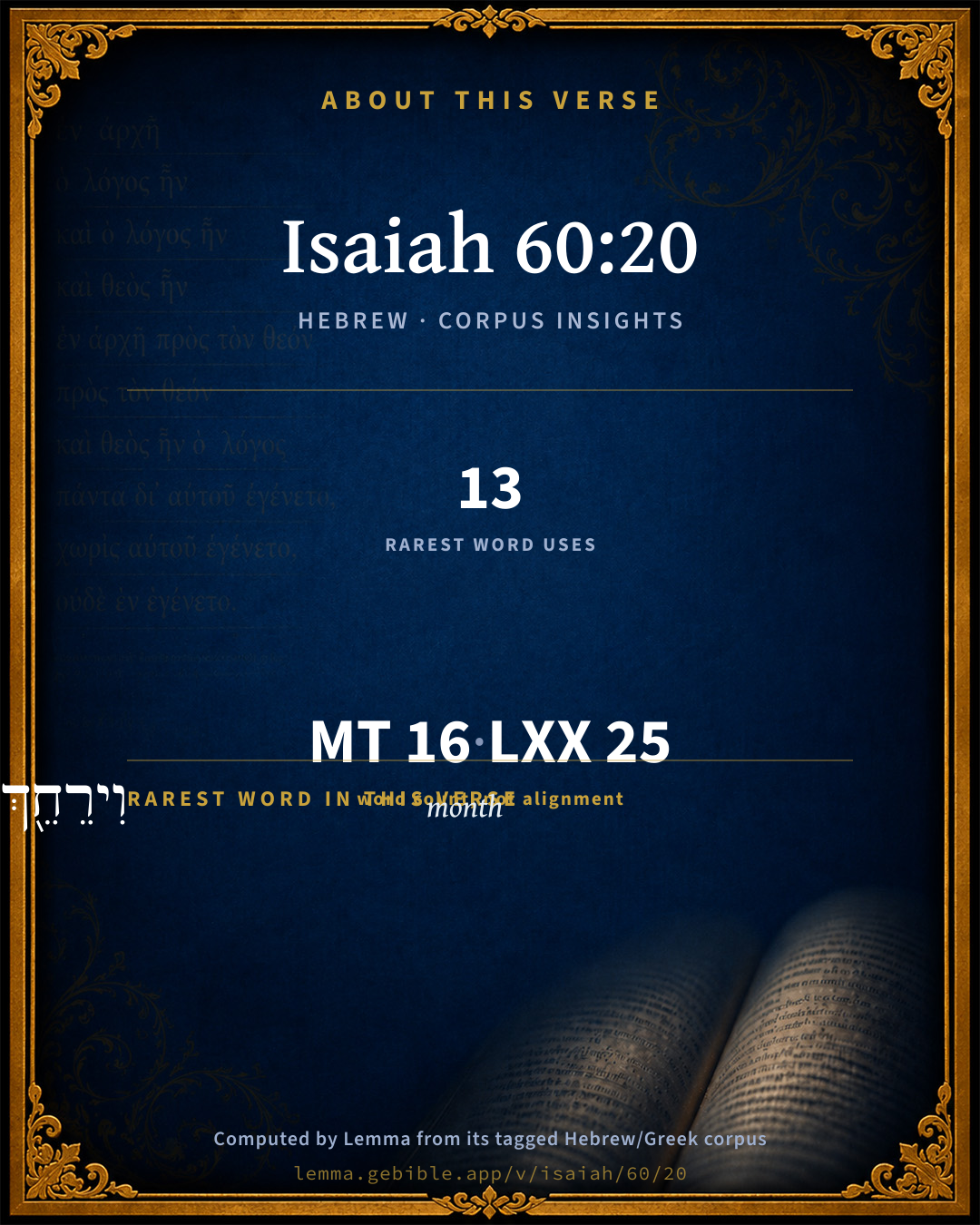
The rarest word here is וִירֵחֵ֖ךְ month H3391 — appearing just 13 times in the whole Hebrew Bible.

Shared distinctive vocabulary

וִירֵחֵ֖ךְ month H3391 occurs in 13 verses of the Hebrew Bible. Also found in:

Grammatical profile

  • 4 verbs
  • 7 nouns
  • 1 preposition
  • 1 conjunction
  • 1 adverb
  • 2 particles

Verb forms

  • יָב֥וֹא Qal · Imperfect
  • יֵאָסֵ֑ף Niphal · Imperfect
  • יִֽהְיֶה Qal · Imperfect
  • וְשָׁלְמ֖וּ Qal · Sequential Perfect

Repetition

A word recurs within this verse — often emphatic in Hebrew:

Hebrew & Septuagint length

In English translation the verse runs 29 words from the Hebrew and 30 from the Septuagint (LXX English) — closely comparable.

A rough comparison of the two English renderings, which tokenize alike — not a word-level alignment.

Word counts can differ between the Hebrew and the Greek without any difference in meaning — e.g. the Hebrew direct-object marker אֵת has no separate Greek word, and Greek often adds the article ὁ.

In the original languages it is 16 Hebrew tokens and 25 Greek tokens — but the two are counted differently (Hebrew bundles its prefixes and suffixes into one token; the Greek is in lemma form), so that isn’t a like-for-like length.

Cross-references

11

Topical passages linked to Isaiah 60:20 in the Treasury of Scripture Knowledge — connected by theme and wording, ordered by reader-vote popularity; previews shown in the World English Bible.

  • Revelation 21:4 He will wipe away from them every tear from their eyes. Death will be no more; neither will there be mourning, nor crying, nor pain, any more. The first things have passed away."
  • Psalms 84:11 For Yahweh God is a sun and a shield. Yahweh will give grace and glory. He withholds no good thing from those who walk blamelessly.
  • Isaiah 35:10 and the ransomed of Yahweh shall return, and come with singing to Zion; and everlasting joy shall be on their heads: they shall obtain gladness and joy, and sorrow and sighing shall flee away.
  • Psalms 27:1 Yahweh is my light and my salvation. Whom shall I fear? Yahweh is the strength of my life. Of whom shall I be afraid?
  • Malachi 4:2 But to you who fear my name shall the sun of righteousness arise with healing in its wings. You will go out, and leap like calves of the stall.
  • Isaiah 30:26 Moreover the light of the moon shall be as the light of the sun, and the light of the sun shall be sevenfold, as the light of seven days, in the day that Yahweh binds up the hurt of his people, and heals the stroke of their wound.
  • Isaiah 25:8 He has swallowed up death forever; and the Lord Yahweh will wipe away tears from off all faces; and the reproach of his people will he take away from off all the earth: for Yahweh has spoken it.
  • Revelation 7:15–17 Therefore they are before the throne of God, they serve him day and night in his temple. He who sits on the throne will spread his tent over them.
  • Isaiah 30:19 For the people shall dwell in Zion at Jerusalem; you shall weep no more; he will surely be gracious to you at the voice of your cry; when he shall hear, he will answer you.
  • Isaiah 65:19 I will rejoice in Jerusalem, and joy in my people; and there shall be heard in her no more the voice of weeping and the voice of crying.
  • Amos 8:9 "It will happen in that day," says the Lord Yahweh, "That I will cause the sun to go down at noon, And I will darken the earth in the clear day.

Cross-references courtesy of OpenBible.info (CC BY 4.0).

Hebrew and Greek witnesses Masoretic Hebrew ↔ Greek Septuagint

The same verse in the two great witnesses to the Old Testament, shown verse-for-verse.

These are two independent witnesses, not word-aligned to each other, and the Septuagint is shown in lemma (dictionary) form.

Hebrew Isaiah 60:20 Masoretic · Westminster Leningrad Codex

לֹא יָב֥וֹא עוֹד֙ שִׁמְשֵׁ֔ךְ וִירֵחֵ֖ךְ לֹ֣א יֵאָסֵ֑ף כִּ֣י יְהוָ֗ה יִֽהְיֶה לָּךְ֙ לְא֣וֹר עוֹלָ֔ם וְשָׁלְמ֖וּ יְמֵ֥י אֶבְלֵֽךְ

Your sun shall no more go down, neither shall your moon withdraw itself; for Yahweh will be your everlasting light, and the days of your mourning shall be ended.

World English Bible · Public Domain

Greek LXX Isaiah 60:20 Septuagint · lemma form

οὐ γάρ δύω ὁ ἥλιος σύ καί ὁ σελήνη σύ οὐ ἐκλείπω εἰμί γάρ κύριος σύ φῶς αἰώνιος καί ἀναπληρόω ὁ ἡμέρα ὁ πένθος σύ

For the sun shall no more set, nor shall the moon be eclipsed; for the Lord shall be your everlasting light, and the days of your mourning shall be completed.

LXX2012 (modern English Septuagint) · Public Domain

On this verse, John Gill's Exposition discusses the Septuagint’s reading. Read the note in Commentary ↓

Hebrew: Westminster Leningrad Codex (CC BY 4.0). Greek: Septuagint (public domain); English from LXX2012 (modern English Septuagint) (Public Domain). How the Septuagint differs from the Hebrew →

Targum (Aramaic paraphrase)

1

The Targum is the ancient Jewish Aramaic paraphrase of the Hebrew Scriptures — an interpretive translation, not the Hebrew text itself. Onkelos (literal) and Pseudo-Jonathan (expansive) render the Torah, and Jonathan the Prophets. Coverage is partial: where no permissively-licensed English translation exists for a verse, only the Aramaic is shown. This is verse-level text, not a word-by-word alignment to the Hebrew.

  1. Targum Jonathan Prophets (Joshua–Malachi)
    לָא תְבַטֵל עוֹד מַלְכוּתִיךְ וִיקָרִיךְ לָא יֶעְדִי אֲרֵי יְיָ יְהֵי לִיךְ לְנֵיהוֹר עֲלָם וְיִשְׁלְמוּן יוֹמֵי אֶבְלַיִךְ:

    Thy kingdom shall cease no more, and thy glory shall not be removed: for the Lord shall be thine everlasting light, and the days of thy mourning shall be ended.

    Targum Jonathan — Aramaic: “Mikraot Gedolot” (public domain). English: “Sefaria Community Translation” (CC0 1.0 (public-domain dedication)); “London "Chaldee Paraphrase," 1871” (public domain). Text via Sefaria.

Commentary

Notes on Isaiah 60:20 from classic Christian and Jewish commentators (each source and its license shown beneath its notes). The classic Christian expositions comment on the surrounding passage and are grouped to its opening verse, so a note may address several verses; the Jewish commentaries on the Tanakh (Rashi and others) are per-verse, so they appear only where the commentator wrote on this verse.

Lemma curates 59 commentaries, every one of them public domain or Creative Commons licensed, each selected and text-cleaned for this edition rather than reprinted as found. About our sources →

Trapp's Complete Commentary

John Trapp

Isa 60:20 Thy sun shall no more go down; neither shall thy moon withdraw itself: for the LORD shall be thine everlasting light, and the days of thy mourning shall be ended.

Ver. 20. Thy sun shall no more go down.] Thy joy shall no man take from thee; thou shalt have a habitual cheerfulness.

John Trapp, A Commentary or Exposition upon All the Books of the Old and New Testament (1647–1656) — public domain. Text from a community e-Sword module.

The Biblical Illustrator

Joseph S. Exell

Isa_60:20

Thy sun shall no more go down

The world of light

I.

THE SOURCE OF THE LIGHT. The Lord. This is true even of the present world. The light which reason sheds on our path is a ray of His kindling. But here, in this world of ours, there are generally intermediate sources through which the light we have is conveyed to us. It does not come directly from God. In the heavenly world, however, it will be different. There, every intermediate agency will be done away, and the light that shines will shine immediately from God. There are four things symbolized in the Bible by this word light, and all that we shall know or possess of each of these four things in heaven, we shall know or possess through Jesus.

1. Knowledge (Psa_119:130).

2. Holiness (Rom_13:12).

3. Happiness (Psa_97:11).

4. Beauty or glory (Joh_17:24). In this lower world we know how true it is that there is no beauty or glory that the eye takes in for which we are not indebted to the light that shines from yonder natural sun. In heaven Jesus is the Sun that shines on all.

II. THE CHARACTER OF THE LIGHT. Three elements of it are mentioned in our text. When we decompose the light of the natural sun, seven rays or colours are the result of the analysis. But these seven we know may be resolved into three--the red, the yellow, and the blue. Thus there is a trinity of rays of elements in the light which the natural sun is pouring forth continually And it is an interesting thing to find that when we come to analyze the light of the heavenly world, the same feature is found to mark it.

1. There is one ray in this light which may be called the continuous ray Thy sun shall no more -o down neither shall thy moon withdraw itself.

2. We have here a perpetual ray. An everlasting light. To speak of the perpetual, as well as the continuous nature of this light, is not a distinction without a difference. You may have light that is continuous for a season even when you know that it cannot be perpetual.

3. The third ray may be characterized as a joyous ray. The days of thy mourning shall be ended. (R. Newton, D. D.)

The saint on earth and in heaven

The words present us with two different views of truth.

I. THEY TELL US OF OUR PRESENT STATE.

1. It is a state of change--vicissitude--perpetual alteration. The sun rises to set; it sets to rise. The moon waxes and wanes.

2. The words point us to our present state of comparative darkness; for the contrast is between the minor light of the sun, the lesser light of the moon, and the glorious light of the Lord.

3. The words present us, too, with a picture of a state of mourning: The days of thy mourning shall be ended.

II. THEY OPEN TO US A GLORIOUS PROSPECT. There are two blessings especially pointed out to us here.

1. Perfect light.

2. Perfect happiness. (J. H. Evans, M. A.)

The present and future state of the people of God

I. THE PRESENT STATE OF THE PEOPLE OF GOD. A state of darkness and of sorrow. To what causes can such experience be ascribed?

1. To their remaining ignorance, and the imperfection of their present views.

2. This may be the case under a sense of the prevalence of sin, and especially of unbelief.

3. They may be in such a situation also, from the Lord withdrawing from them the sensible communications of spiritual light and comfort.

II. THEIR FUTURE STATE. A state of uninterrupted light, of perpetual cessation from sorrow, consequently of endless joy. The Lord shall be the everlasting light of His people.

1. As He will give them a more enlarged capacity of knowing and enjoying Him.

2. He will afford them more perfect discoveries of Himself.

3. He will afford them more enlarged views of His works and ways.

4. He will impart to them the fullest assurance of their interest in His peculiar regard.

5. He will be their everlasting Light. (D. Dickson.)

The eternal day

1. Israel of old had light while all the rest of the world sat in darkness. This typical Church of God abode not in the light continually, its history was chequered with alternate brightness and gloom, repentance and relapse, prosperity and adversity.

2. Another dispensation came; Jesus Christ was born at Bethlehem, a light to lighten the Gentiles, and the glory of Thy people Israel, and the sun shone upon the earth as it had never done before. A visible Church was called out to walk in the light, which Church still exists upon the earth, and from the days of Pentecost until now its sun has never altogether gone down, neither has its moon withdrawn herself. The light has not been always equally clear, but it has been still day.

3. But there is a Church upon the earth which is within the visible Church, and is its central life. I refer to the spiritual Church. This secret Church, this Church mystical, this true body of our Lord Jesus Christ, may claim to have had this text fulfilled in its experience in a far larger sense. If we walk in the light as He is in the light, we have fellowship one with another, and the blood of Jesus Christ, His Son, cleanseth us from all sin. Yet even to the Church spiritual the text has not been fulfilled in its largest conceivable sense, for I fear me that to the most spiritual some darkness comes. Their light is sown, but it has not yet sprung up to its full harvest.

4. We must, therefore, refer to a fourth form of the Church. If we see it not at all in the typical, a little in the visible, very much in the spiritual, we find it all in the Church triumphant. The full triumph of the Church of Christ shall begin in the millennium.

I. THE LIGHT OF THE TRIUMPHANT CHURCH SHALL BE INCESSANT. Thy sun shall no more go down, etc. There will be no intervening nights of darkness, but one long noonday of purity and felicity, the days of her mourning shall be ended. And why will this be?

1. Because the light of heaven is independent of creatures. In heaven the saints will need no teacher. When God sends a true preacher he is a star in Gods right hand, and the Church is bound to value his light, which is the gift of heaven, but we shall need no teachers there; we shall see, not through a glass darkly, but face to face. Up there they need no comforters to succour them in the time of their distress, for God Himself has wiped away all tears from their eyes. Poor saints will not then be dependent upon the alms or the consolations of others, though once their generous friends were like sun and moon to them.

2. Because it is cleared of all clouding elements. Here below in the Church of God, whatever by Gods grace may be our light, errors will arise to cloud it; evil men come in unawares and distract Gods saints. There are none such up yonder. Satan himself shall be shut out.

3. The saints themselves shall be so purified that nothing in them shall darken their light. Here to-day Christ changes not, but we change, and hence our joy departs. It shall not be so there. Notice that the text hints that both the major and the minor necessities of saints will be abundantly supplied. Have you not found sometimes that the Lord Jesus Christ has withdrawn Himself from you? Then your sun has gone down. You ore prospering in business; God gives you all that heart can wish, the moon does not withdraw herself, but the sun has gone, and woe beclouds your spirit. It will never be so in heaven, you shall see your Lord face to face without a veil between, and that eternally. Here, on the ether hand, at times Jesus has shone upon you, and as to spiritual things you have been rich, but then earthly trouble has hovered over you, the moon has withdrawn herself. Not often have both sun and moon been as flesh and blood would have them. True, you have been able to do without the moon in the presence of the sun, but you would have preferred both spiritual and temporal prosperity. Now in heaven all the wants of our nature will be completely supplied.

4. The Church triumphant will be delivered from the vicissitudes of those seasons which cause the going down of sun and moon. I do not refer to slimmer and winter, but to ecclesiastical and temporal arrangements, such as the Sabbath and times of assembly and Church fellowship. It was a glad day for Israel when the trumpets rang out the morning of the Jubilee, for every slave was free, and every debtor found his liabilities discharged. Back came each mans lost inheritance, and the whole nation was glad. With sound of trumpet and of cornet they saluted the rising of the sun on the first day of that Jubilee year; but the jubilee year went by, and lands were mortgaged and forfeited, and slaves fell again into slavery, and bankrupts were again, seized by their creditors. We are coming to a jubilee, of which the trumpets shall sound for ever.

II. THE LIGHT OF THE TRIUMPHANT CHURCH IS EVERLASTING. The Lord shall be thine everlasting light. Why will the perfection and bliss of the saints triumphant never end?

1. Because the God from whom it comes is eternal.

2. The covenant by which the saints stand in heaven is a sure one.

3. The guarantee of that covenant can never fail, seeing it is Christ Himself. Because I live ye shall live also is the great seal set upon the indentures by which we hold our inheritance in the skies.

4. Those who possess heaven are also themselves immortal.

III. THE LIGHT OF THE CHURCH TRIUMPHANT SHALL BE BOUNDLESS. The Lord shall be thine everlasting light. The Lord is infinite. If He is our sun there can be no limit to the light in which we shall rejoice.

1. If God is to be our light, then in every separate believer there will be a perfect light of bliss and holiness. You are aged, you feel also that you are full of infirmities and sins; now, these will all vanish, and that weakened form of yours shall be raised in power. Your ignorance will give place to the light of knowledge, your sin to the light of purity, your sorrow to the light of joy.

2. In addition to your possessing personal light, you will enjoy the closest possible fellowship with God.

3. This glorious light will give us the clearest views of Gospel truth.

4. There, no doubt, we shall understand more of Providence. Here our sun goes down sometimes as to the Divine dealings; we cannot make out what He means; the lines are dark and bending; we thought He would have led us by a straight course, but we wind to and fro in the wilderness. All the happiness which knowledge and understanding can bring to intelligent beings shall be at our feet.

5. There we shall receive the utmost endurable joy. Some have thought the joy of heaven would lie in knowledge; they shall have it. Others have rejoiced in the prospect of continued service; they shall serve Him day and night in His temple. The sweetest thought of heaven to me is rest, and I shall have it, for there remaineth, therefore, a rest for the people of God. Peace! O quiet soul, do you not long for it? You shall have it. Security and a sense of calm! O tempest-tossed one, you shall have them. Strength, power--some have wished for that. You shall be raised in power. Fulness, the filling up of every vacuum! You shall have it; you shall be filled with all the fulness of God.

IV. THE LIGHT OF THE CHURCH TRIUMPHANT IS UNMINGLED. The days of thy mourning shall be ended.

1. The mourning from a persecuting world.

2. There will be no more mourning from the common trials of life.

3. Then shall we be delivered from all mourning caused by our inward sin.

4. We shall be delivered from every kind of mourning as to an absent God, for we shall never grieve Him any more.

5. I find that one version reads it, The days of thy mourning shall be recompensed, and I say this to those who have to mourn more than others: you shall have a recompense. (C. H. Spurgeon.)

The Biblical Illustrator, edited by Joseph S. Exell (c. 1880s–1900s) — public domain. Text from a community e-Sword module.

The Preacher's Complete Homiletical Commentary

Joseph S. Exell (gen. ed.)

EARTHLY DARKNESS AND HEAVENLY LIGHT

Isa_60:20. Thy sun shall no more go down, neither shall thy moon, &c.

No one who is capable of appreciating the higher forms of poetry can refuse to pay a tribute of admiration to this magnificent chapter. It is a rapturous ode congratulating Zion on her restoration to heavenly favour, &c. Much of the chapter can only be interpreted spiritually. The text can never be true of this world. The parallelism of this verse.

I. ON EARTH OUR MOON WITHDRAWS ITSELF.

1. There is great propriety in the figure which makes the light of the moon an emblem of earthly joy. The sun’s light is in a sense his own, not so the moon. As the light of the sun is essential, so are the joys which come direct from God; as the light of the moon is borrowed and reflected, so is the joy that springs from earthly things. The things of earth have no inherent power of giving happiness.

2. There is equal propriety in saying of the “days of our mourning” that the moon withdraws itself. Our troubles come in two ways—

(1.) By the removal of our pleasant things.

(2.) Our pleasant things are left, but the joy of them is gone.

3. Our days of mourning, like the moon’s withdrawing itself, are often sources of the greatest profit. Nothing helps reflection like trouble and sorrow. The loss of earthly joy makes heavenly hopes more bright.

II. ON EARTH OUR SUN GOES DOWN.

1. We may compare the light of the sun to the joy which the soul receives from communion with God. The light of the sun is light from the highest source of light; and the joy of Divine communion is joy from the highest source of joy.

2. On earth the sun of the soul may go down—our heavenly prospect become clouded.

III. FOR THE SINCERE CHRISTIAN, THE OBSCURATIONS THAT OCCASIONALLY TAKE PLACE ON EARTH ARE ONLY TEMPORARY.

1. The causes that lead to the obscuring of our spiritual joys will be removed—clouds, shadow, night, &c. What must it be to be there?

2. And with this highest and purely spiritual glory shall be associated in the sublimest perfection all elements of the happiness that is secondary and subordinate. Ended shall be the hours of earthly anxiety, &c. Upon all the glory there shall be a defence, the defence of immortality. To which of the two worlds are you tending, &c.?—Frederick Greeves, D.D.

Isa_60:20. It is the purpose of God to grant larger manifestations of His grace and more copious outpourings of His Spirit in order to fulfil these delightful prophecies, and bring on even on earth golden days, &c. But the text manifestly points to heaven, as there only can it be completely and for ever verified (Rev_21:23). In this description of heaven we observe two things—

I. THE TOTAL ABSENCE OF ALL THE EVILS WE DEPLORE ON EARTH. Our text tells us what this life is, and what the life to come shall be, and plainly contrasts one state with the other. Now, joy and sorrow are blended; light and darkness are intermixed, &c. We are scarcely aware how necessary these vicissitudes and variations are. We forget that night is as necessary as the day. Morning never breaks so beautifully as after a tempestuous night, &c. These changes are the marks and indications of an imperfect dispensation of things, and they often present serious obstructions to our happiness and repose. We have a sun, but that sun goes down; we have a moon, but that moon withdraws itself; we have light, but that light is clouded and incomplete; we have days upon days, but they are often days of mourning, &c. Heaven, therefore, is beautifully described as exhibiting the total absence of all the evils we deplore, &c. He infirmity of body, &c. They are for ever gone, and if remembered at all, shall be remembered only as a ground of triumph that they are no more, &c.

II. THE PERPETUAL ENJOYMENT OF ALL THE GOOD WE DESIRE. God Himself shall constitute the immediate felicity of His children.

1. Knowledge without obscurity.

2. Holiness without sin.

3. Communion without weariness.

4. Happiness without alloy.

III. THE INFLUENCE THIS PROSPECT SHOULD EXERT.

1. Secure a title to it, and a meetness for it.

2. Guard against the temptations and sins that often embitter the changes of this life.

3. Aim to take as many with you as you Song of Solomon 4. Remember you may be much nearer to it than you expect. What is your hope, &c.?—Samuel Thodey.

Isa_60:20. Never was a picture of national happiness described in more glowing colours than in this verse. It can only be completed in heaven. I. A MELANCHOLY SKETCH OF THE LIFE THAT NOW IS. And is it not a faithful sketch? Let us inquire into—

1. Some of the sources of human calamity. Some suffer from the afflictions—

(1.) Of the mind.

(2.) Body.

(3.) Worldly disappointments.

(4.) Family afflictions.

(5.) Bereavement. Thus days of mourning are allotted to all. The cup goes round.

2. Some of the reasons why these are permitted under the government of a wise, righteous, gracious God. To imbitter sin, to discipline and mature the character, to wean from the world, and conform to Christ.

3. Some of the consolations which the Gospel furnishes under them. Our sorrows are attended by many consolations. We are supported by many promises, &c. II. A DELIGHTFUL ANTICIPATION OP THE LIFE TO COME. In a future life our pains and sorrows cease. When our sorrow ceases positive happiness begins.

1. The presence of God. In this life God blesses us mediately—by channels of mercy, &c.; but in heaven immediately—He Himself will be the source of our bliss.

2. The absence of all sources of disquiet. Sin, sorrow, &c.

3. The communication of happiness suited to our nature.

4. Perpetuity gives the final charm.—S. Thodey.

Isa_60:21. I. The promise. Includes the ultimate prevalence of righteousness. The consequent increase of human enjoyment. II. The security of it. God will accomplish it, for the revelation of His own glory.

Isa_60:22. The growth of God’s kingdom. I. The small proportion which the Church hears to the world. II. The promised enlargement. In numbers and influence. III. The certain and speedy accomplishment of this promise. God will bring it to pass. Will hasten it—in His time.—J. Lyth, D.D.

The Preacher's Complete Homiletical Commentary (gen. ed. Joseph S. Exell; Funk & Wagnalls, c. 1892) — public domain (pre-1929). A full-Bible homiletical/sermon-outline anthology covering 65 of 66 books (2 John is absent from the source module). Text from a community e-Sword module.

Jamieson, Fausset & Brown

Robert Jamieson, A. R. Fausset & David Brown

There shall be no national and spiritual obscuration again as formerly (Joe 2:10; Amo 8:9).

mourning . . . ended-- (Isa 25:8; Rev 21:4).

Jamieson, Fausset & Brown — Commentary Critical and Explanatory on the Whole Bible (1871) — public domain (CC PDM 1.0). Text via the HelloAO Bible API.

The Cambridge Bible for Schools and Colleges

gen. ed. J. J. S. Perowne

20. the days of thy mourning] Cf. ch. Isa_57:18, Isa_61:2.

The Cambridge Bible for Schools and Colleges (gen. ed. J. J. S. Perowne; Cambridge University Press, 1878–1918) — public domain. Text from a community e-Sword module.

John Gill's Exposition

Thy sun shall no more go down,.... This is a different sun from the former; this is the church's sun, and no other than the sun of righteousness, Christ Jesus; who has his risings and settings now, at least, in the apprehensions of his people; he sometimes withdraws himself, and is gone; and then returns again: but so it will not be in this state: the saints shall be for ever with him, and he shall be for ever with them; who will always behold his glory, and be enlightened by him; see Th1 4:16,

neither shall thy moon withdraw itself; or, "shall not be gathered" (i), under a cloud; or "fail" (k), as the Septuagint version; or, "suffer a defect", as the Arabic version; as the moon does when in the wane, or is eclipsed. This may refer to this then present state of the church, which shall not fail; and to the blessings and comforts of it from Christ the sun, which will not cease, the enjoyment of them be ever interrupted. The Targum is,

"thy kingdom shall cease no more, and thy glory shall not be removed;''

and so Maimonides (l) interprets it of the kingdom of the Messiah, that shall endure for ever:

for the Lord shall be thine everlasting light; this is repeated for the confirmation of it:

and the days of thy mourning shall be ended (m); or, "completed"; shall be fully up, and so at an end: or, "shall be recompensed" (n); with an everlasting day of joy and pleasure; there will now be no more sin to distress the saints; no more temptations of Satan to annoy them; no more afflictions either of body or mind to trouble them; no more pain, or crying, or death; and so no more mourning; sorrow and sighing will flee away; all tears will be wiped from their eyes; and everlasting joy be upon their heads; see Rev 21:4.

(i) "non colligetur", Montanus, Vitringa; "vel recolligetur", Vatablus; "occultabitur", Munster, Tigurine version. (k) , Sept. "deficiet", Pagninus. (l) Moreh Nevochim, par. 2. c. 29. p. 263. (m) "completi erunt", Junius & Tremellius, Piscator; "completisunt", Vitringa. (n) "Compensabuntur", Tigurine version.

John Gill's Exposition of the Whole Bible (1746–1763) — public domain (CC PDM 1.0). Text via the HelloAO Bible API.

Albert Barnes' Notes on the Bible

Thy sun shall no more go down - There shall be no total and long night of calamity, error, and sin. This is designed to describe the flourishing and glorious state of the church. It, of course, does not mean that there should be no times of calamity, no period of ignorance, no scenes of persecution; but it means that there should not be total night. Truth should reign on the earth, and there never would be a time when the light of salvation would be extinct. There never would be a time like that when Jerusalem was wholly destroyed, and a long total night came over the land. There never would be a time when the Sun of righteousness would not shine, or when the world would be wholly deprived of the illumination of his beams. The church would be perpetual. It would live through all changes, and survive all revolutions, and to the end of time the light of salvation would shine upon a darkened world. Since the Messiah came the light of revelation has never been wholly withdrawn from the world, nor has there been a period in which total and absolute night has come over all the church of God. But the prophet, probably, referred to far more glorious times than have yet occurred. The period is coming when the light of salvation will shine upon the earth with unclouded and universal splendor, as if the sun having ascended to the meridian should stand there in a blaze of glory age after age; when there shall be no alternation of day and night when the light shall not be obscured by clouds; and when there shall be no eclipse of his glory.

Neither shall thy moon - This language is poetic, and means that there would be no such obscurity in the church as there would be in the world should the sun and moon be withdrawn. Light and beauty unobscured would fill the whole heavens, and the darkness of night would be henceforward unknown.

Withdraw itself - Hebrew, יאסף yē'âsēp - ‘Be collected,’ that is, shall not be withdrawn, or shall not wane. The Septuagint, Οὐκ ἐκλείψει Ouk ekleipsei - ‘Shall not be eclipsed,’ or shall not fail.

The days of thy mourning - (See the notes at Isa 25:8). The description here, therefore, is one of great glory and happiness in the church. That period will yet arrive; and no friend of God and of the happiness of man can think of that time without praying most sincerely that it may soon come, when the Sun of righteousness, in the fullness of his glory, shall ascend to the meridian, and stand there without one obscuring cloud, and pour the splendor of the noontide beams all over a darkened world. Some of the ideas in this chapter, descriptive of the glorious times of the gospel, have been beautifully versified by Pope in his Messiah:

Rise, crown’d with light, imperial Salem, rise!

Exalt thy tow’ry head, and lift thy eyes!

See a long race thy spacious courts adorn;

See future sons and daughters yet unborn,

In crowding ranks on every side arise,

Demanding life, impatient for the skies!

See barbarous nations at thy gates attend,

Walk in thy light, and in thy temple bend:

See thy bright altars throng’d with prostrate kings,

And heap’d with products of Sabcan springs!

For thee Idumea’s spicy forests blow,

And seeds of gold in Ophir’s mountains glow;

See heaven its sparkling portals wide display,

And break upon them in a flood of day!

No more the rising sun shall gild the morn,

Nor evening Cynthia fill her silver horn;

But lost, dissolved in thy superior rays,

One tide of glory, one unclouded blaze,

O’erflow thy courts; the light himself shall shine

Reveal’d, and God’s eternal day be thine!

The seas shall waste, the skies in smoke decay,

Rocks fall to dust, and mountains melt away;

But fix’d his word, his saving power remains;

Thy realm forever lasts, thine own Messiah reigns!

Albert Barnes' Notes on the Bible (1834–1885) — public domain. Text from a community e-Sword/MySword module.

Matthew Poole's English Annotations

Literally he means the Jews’ mourning in Babylon, but especially the uninterrupted happiness of the church: the Hebrew here for

ended signifies recompensed; their days of rejoicing shall abundantly recompense all their days of mourning.

Matthew Poole's English Annotations on the Holy Bible (1683–1685) — public domain. Text from a community e-Sword/MySword module.

The Pulpit Commentary

Thy sun... thy moon. That which is to thee instead of sun and moon Jehovah"s brightness. The days of thy mourning shall be ended. Till the new Jerusalem descends from heaven, (Rev_21:2) and Christ reigns personally over his people, (Rev_22:5) the Church is always, more or less, in a state of mourning. The Bridegroom is; (Mat_9:15) his light shines upon his Church only by snatches; his Church feels itself unworthy of him cold, unloving, stained with sin. Fasting, weeping, and mourning befit such a state of things. But in the final condition of the redeemed their mourning shall be ended, "sorrow and sighing shall have fled away"; (Isa_35:10) God shall have "wiped away all tears from their eyes"; (Rev_21:4) "There shall be no more death"; (Rev_21:4) "no more curse"; (Rev_22:3) "neither sorrow, nor crying; neither shall there be any more pain: for the former things are passed away". (Rev_21:4) The days of mourning shall be ended.

Eternal day.

"Thy sun shall no more go down," etc. We are told in the preceding verse who this sun is. It is God. As the Light of the soul, he shall live for ever. We speak of sun and moon, not only as they exist in nature, but figuratively, as symbolic of joy and gladness to the human heart. Many things are in this sense lights to us here, but their glory is often dimmed, often eclipsed in darkness; but hereafter "the Lord shall be unto thee an everlasting Light, and thy God thy Glory." Night is indispensable to nature here. Its dews and darkness answer numberless purposes of good in the wide creation. And must we not say that the gloom and mystery of life have all a meaning, a Divine intent? and that the spirit of the probationer for eternity is perfected in it? To have all sunshine in a world so stained with sin would argue that God thinks lightly of evil. It is not so. This life of ours has much of gloom; but all its darkness, directly or indirectly, springs from sin. The eclipse is caused by the selfishness of man coming between God and the soul. Will God always cause us to endure so much of darkness? No. But we must wait his time. We must wait his place. We may put off our black dress and dress in bridal robes when, as our text says, "the days of our mourning shall be ended." Light is beautiful. "Surely light is sweet." Think how many golden harvest-fields the all-ripening sun has looked down upon; how many scenes of blest content its rays have rested on. Many of our frames of mind are materially affected by the merry sunshine. The sun not only ripens the corn, it gladdens the heart. But there is a sunshine of the soul not at all connected with this. There are joys which nothing outward can bestow or remove. Yes; there are many miserable hearts on the brightest days. The sunshine cannot replace the smile of a vanished face. Likewise there are many glad hearts on the gloomiest days. Nothing can steal from them the blessedness of being loved and doing good. I would remark, however, that

I THE SUNSHINE OF LIFE IS UNCERTAIN. Do dark days come suddenly on mariners in distant seas, in other zones? So imperceptibly comes sorrow to human hearts. We have no control over the landscape and the heart. Its fairest scenes may be darkened in an hour! Imagine a belated traveller seeing the sun go down. This is so! What sad intelligence may come! What unbidden conjecture may arise! What surmise] What thought may come forth from the chambers of memory! What spoken words what sad scenes may quench the light of joy and gladness in the human countenance! Yes; you have marked this; perhaps your own words may have produced it. How many can bear evidence of this! They will be ready to echo my words when I say, "Let us be very thankful for so much bright sunshine as we have, for the joys which are the rewards and accompaniments of Christian life." Yes; "they will bring hither the timbrel, the pleasant harp, with the psaltery;" they will be glad, but they will rejoice with trembling, for they "know not what a day," etc.

II THE SUNSHINE OF LIFE IS MUCH DEPENDENT ON THE STATE OF OUR SOULS. We may be surrounded by the sweetest natural and the holiest moral associations, and yet sometimes be very sad. It may be at home, or even in the sanctuary of God. A little pebble placed near the eye will intercept the light of the sun; and a little object may keep away from us the smile of God and the sweet sanction of our own conscience. We feel discontented with ourselves, that, having a cross so near to go to, we should yet bear the burden of so many sins; that, having a Friend so near, we should let him share so few of our sorrows. But the cause of this is the explanation of our sadness: we so often love the sins we cherish; we so often forsake the Friend we should make our own. As it is with a sermon, so it is with all the aspects of life, so much hangs on the state of our own soul. But look up higher. The souls that listened where you do, trod the same earth, wept the same tears as you do, they are sad nevermore, for the state of their souls is purer than the purest lake which reflects the overhanging hills; so pure that they consciously and clearly bear the image of him who knew no sin.

III THE SUNSHINE OF HEAVEN WILL BE SOFT AS WELL AS BRIGHT. It is likened to the moon as well as to the sun. Heaven is not only pictured to us by the symbols of the waving palms, and the majestic multitude, and the thrilling anthem, and the reverberating choir, and the glad hosannah! No; there will be soft moonlight as well as sunlight. Much and most of our happiness here is not of the outwardly buoyant and ecstatic character. It is calm and peaceful joy which you crave no vivid image for. This one suits it though the moonlight. Yes; how many voyagers has it lent its soft light to guide amongst the breakers! How many travellers, imperilled by the way, has it kept in safety from the precipice and the watercourse! How many will sing of the beauty as well as the safety it gives] Never did the sleeping city stand out in such calm and stately grandeur. Never did the overhanging worlds glow with a serener or a steadier beauty. We cannot always bear the gaze of the sun; but ask the Indian missionary, and he will tell you the sweet loveliness of the moon. It is a type, then, as I think, of a calmer joy; the blessedness of a being who, no longer vexed with anger, hate, or jealousy, no more burdened with pride, or prejudice, or selfishness, sees and enjoys God in all around and all within him. Who what shall disturb this joy? "Neither shall thy moon withdraw itself.

IV THE SUNSHINE OF HEAVEN WILL BE COMMON TO ALL CHRISTIANS. Some of us here to-day may be for a time walking in darkness, whilst some are rejoicing in the light. There sits the sad widower, and there the joyful husband; there the pensive widow, there the glad wife; there the fatherless orphan, there the fond child. Yea, and deeper are the differences. There is one who, by the grace of God, has just conquered some besetting sin; beside him, one who stilt indulges it. There, one whose commerce with the court of heaven is small; and there, one who, like Enoch, walks with God. There, one who pitches his tabernacle with the open door towards the cross; there, one who has his tent open towards the world. Here are different phases of human experience, different states of physical health, and different degrees of the spiritual life. Consequently the sunshine of one is not the sunshine of all. In heaven it wilt be common. I do not say all will have the same degree of blessedness. I believe they will not. But all will be at rest. There will be no such difference as between sorrow and joy. All will be happy up to the measure of their being; all will participate in a joy of which the sublimest foretastings on earth are but the faintest shadows. Mark, then, the language. "Thy sun shall no more go down." It belongs to thee. We are not of the night, as we are in the night.

V THE SUNSHINE OF HEAVEN SHALL NEVER REST ON GRAVES. "The days of thy mourning shall be ended." I have often thought on the brightest days of the many new tombs which the sun"s light falls on. But a few days since, closed eyes rejoiced in the light as well as mine. Ah! and there are eyes looking on the world which looked on it with them; scenes of sea and land, hill and vale, forest and flood, which photographed themselves on both hearts alike. One is now a clod of the valley. Much of the description of heaven, to inspirit our hearts, rests in what there is not there. And there are no more graves. There is no new tomb for Joseph in the garden of the better country. We shall hear no lamentation for the dead there weeping for her children, because they are not." We shall never, as did the disciples, stand with Jesus at the grave there. No voice will ever say, "Young man, I say unto thee, Arise!" "Lazarus, come forth!" No; there are no graves, neither in the sea nor in the rock; for "the days of thy mourning shall be ended. W.M.S.

Departed grief.

"The days of thy mourning shall be ended.". What a glorious perspective there is in these words! In the fairest skies we are accustomed to expect some clouds to start up from the bed of the sea, or to come suddenly across the blue firmament heralded by some fleecy outrider. Nor do we expect perpetuity of joy in human life. Life is ever the subject of risk and danger. We never part without uncertainty as to meeting again; we never know but our day of glory may set in tears. There comes, too, in time, to us all that "last glance of love which becomes the sharpest pang of sorrow.

I NIGHT. On earth our experience is often that of mourning. We are sorrowful.

1. Over the ravages of sin in ourselves and in the world.

2. Over the contrast between our ideals and our imperfections.

3. Over the influences of mutability and mortality.

4. Over the weakness of our faith and the coldness of our love to Christ.

II MORNING. "Ended." Some things end for a time only. We are liable to them again. Fear returns. Disaffection of friends, awhile ago removed, recommences once more. Pain eased gives place to after-anguish. Friend after friend departs. After one victory over temptation comes another and a fiercer conflict. "Mourning ended." Why? God is our everlasting "Light;" for:

1. We are all righteous. (Ver. 21.) The new nature is perfected in those who have the new name; there is no sorrow where there is no sin.

2. We are all at home. "They shall inherit the land for ever." At last the craving for rest is satisfied. At last what we have so long sought here we shall find there. All here mocks us with a sense of change, disruption, and death. There "thy sun shall no more go down. W.M.S.

The Pulpit Commentary (1880–1919), ed. H.D.M. Spence-Jones & Joseph S. Exell — public domain. Text from a community e-Sword module.

J. A. Alexander on Isaiah

Joseph Addison Alexander

“Thy sun shall set no more, and thy moon shall not be withdrawn; for Jehovah shall be unto thee for an eternal light, and completed the days of thy mourning.” There is no need of supposing any want of consistency between this verse and that before it, nor even that the Prophet gives a new turn to his metaphor. ‘Thy sun shall set no more’ is evidently tantamount to saying, ‘thou shalt no more have a sun that sets or a moon that withdraws herself, because etc.’ The active verb ’asaph’ is used in the same way by Joel, where he says that the stars withdraw their brightness, (i.e., cease to shine). The expression is generic, and may comprehend all failure or decrease of light, whether by setting, waning, or eclipse, or by the temporary intervention of a cloud. The last words of this verse furnish a key to the whole description, by identifying joy with light, and grief with darkness. Compare with this verse Isa 25:8; Zec 14:7; Rev 7:16; Rev 21:4; and with the phrase, days of mourning, Gen 27:41.

Joseph Addison Alexander, The Prophecies of Isaiah (1846–1847; New York: Scribner, 1870–1878) — public domain. Text from a community e-Sword module.

Rashi

Rabbi Shlomo Yitzchaki (Rashi)

neither...be gathered in Heb. יֵאָסֵף, an expression similar to (Joel 2:10) “gathered in (אָסְפוּ) their brightness.” Gathered in their light.

Rashi on the Tanakh — English translations: “The Judaica Press complete Tanach with Rashi, translated by A. J. Rosenberg” (CC BY 4.0); “Pentateuch with Rashi's commentary by M. Rosenbaum and A.M. Silbermann, 1929-1934” (public domain); “The Metsudah Tanach series, Lakewood, N.J” (CC BY 4.0); and “The Book of Joshua, Metsudah Publications, 1997” (CC BY 4.0). Text via Sefaria.

Ibn Ezra

Rabbi Abraham ibn Ezra

Thy sun shall no more go down, etc. That sun will not set, and that moon לא יאסף Shall not withdraw itself. Lit., shall not be gathered; the moon appears dark to the earth, when in conjunction with the sun.

And the days of thy mourning shall be ended. The mourner sits, as it were, in darkness.

Ibn Ezra on the Tanakh — English translations: “Sefaria Community Translation” (CC0 1.0 (public-domain dedication)); “Yalkut, Sifsei Chachomim Chumash, Metsudah Publications, 2009” (CC BY 4.0); and “Commentary of Ibn Ezra on Isaiah - trans. by M. Friedlander, 1873” (public domain). Text via Sefaria.

Lesson kit

Teaching starters — assembled from the data on this page, not authored interpretation. Every prompt links to the verse data it draws on. Edit before teaching.

Isaiah, in the Prophets, opens this verse with 16 words (14 distinct Hebrew lemmas). Its most distinctive word is yerach (“month”). A historical commentator’s framing appears above. Read the whole chapter for the surrounding context.

Discussion questions

  1. What does “month” (yerach) contribute to the verse as a whole?
  2. How does Exodus 2:2, which shares the word «month», read alongside this verse?
  3. What does the repetition of “not” (2× in this one verse) do in this verse?
  4. These translations render this verse differently. What is at stake in choosing one wording over another?
  5. «יָב֥וֹא» is a Qal Imperfect verb. How does that grammatical form shape the action described?
  6. Compare how Trapp's Complete Commentary and The Biblical Illustrator read this verse. Where do they agree or differ?

Things to notice

Reading settings

Reading text

Shown beneath each verse's original-language words.

Old Testament
Old Testament edition

Read the OT as the Masoretic Hebrew (MT) or the Greek Septuagint (LXX).

English shown for the Greek Septuagint (in the Hebrew ↔ Greek comparison).

Comparing translations? Open the Compare panel on any verse page to stack up to four side by side.