Micah 4:11

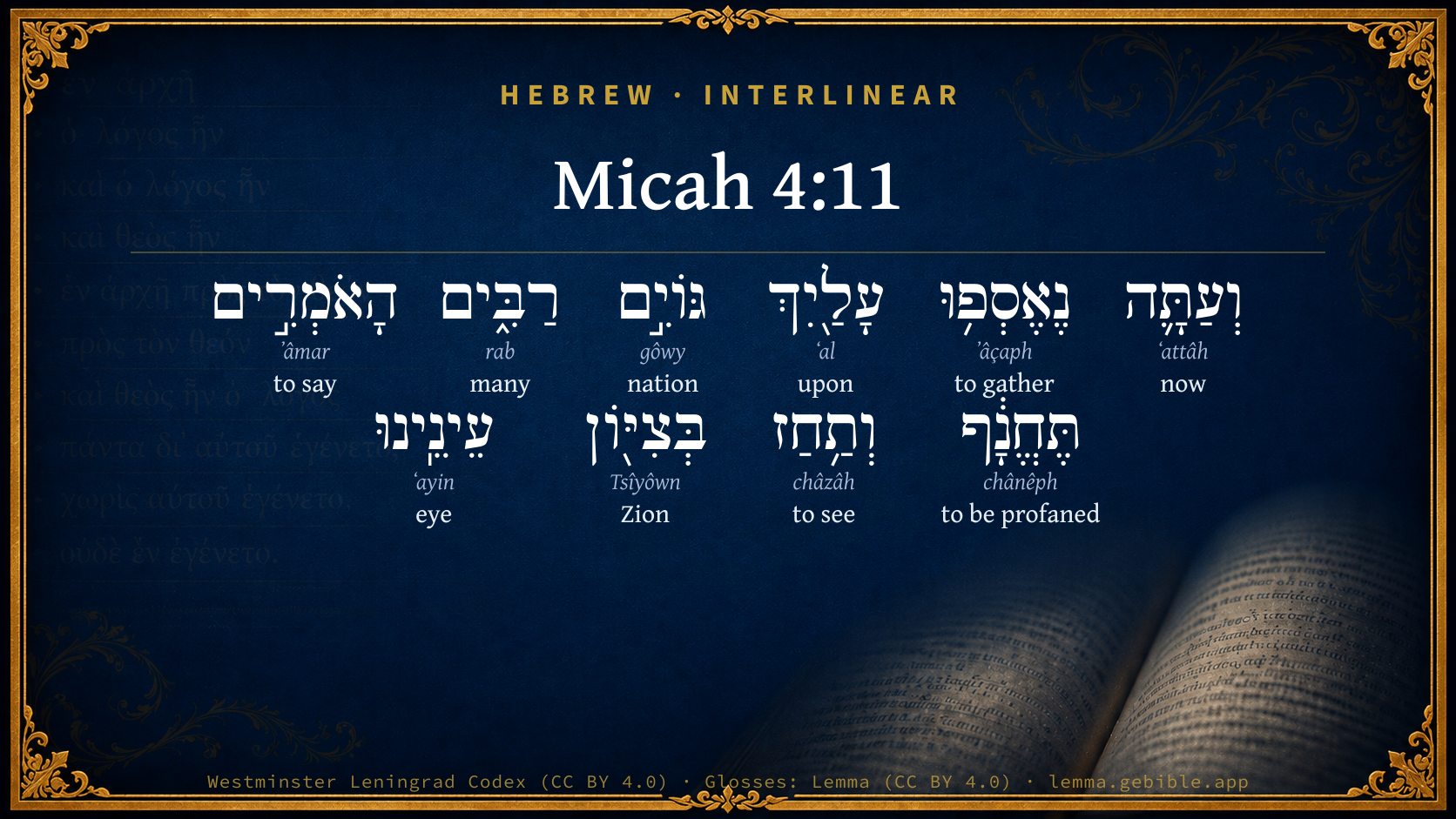
Hebrew (Westminster Leningrad Codex) Micah 4:11 appears in the Hebrew Old Testament. The text above is from the Westminster Leningrad Codex. Each word links to its Strong’s number, a concise gloss, and parsing drawn from the Open Scriptures Hebrew Bible morphology. Click any word for its full Brown-Driver-Briggs (BDB) entry.
Download image
Cite this verse

Micah 4:11 (World English Bible). Public Domain. Lemma interlinear Bible study tool, https://lemma.gebible.app/v/micah/4/11.

Show BibTeX & RIS
BibTeX
RIS
English Translation
Now many nations have assembled against you, that say, 'Let her be defiled, And let our eye gloat over Zion.'
World English Bible · Public Domain
Download a study sheet

One document with this verse’s original text, its word-by-word gloss line, the meaning frame, cross-references with their text, attributed commentary, and full source and license credits — printable, and it pastes into notes with its structure intact.

This verse Autodidact and up

Study sheet (.html) Plain text (.txt)

A passage Seminary Student

Up to 50 verses in one chapter. A passage sheet keeps up to 6 commentary sources and 12 cross-references per verse, in the order this page ranks them, and says so on the sheet whenever that leaves anything out. Ask for a single verse and you get the Autodidact verse sheet above.

Everything on this page stays free to read, with no account — the sheet is a download of what is already on screen, not access to it.

Want to remove ads? Support Godless Engineer
Compare translations 3

The same verse in 3 English versions, stacked beneath the original-language interlinear above. Click any original word for its lexicon entry.

Each is an independent rendering of the whole verse — the interlinear is not word-aligned to these translations.

Highlighted words mark where these versions differ — a whole-verse word diff, not a word-by-word alignment.

  • World English Bible Public Domain
    Now many nations have assembled against you, that say, 'Let her be defiled, And let our eye gloat over Zion.'
  • King James Version Public Domain
    Now also many nations are gathered against thee, that say, Let her be defiled, and let our eye look upon Zion.
  • unfoldingWord Literal Text CC BY-SA 4.0
    But now many nations are assembled against you, those saying, ‘Let her be defiled and let our eyes gaze on Zion.’

unfoldingWord Literal Text — © unfoldingWord, licensed CC BY-SA 4.0. Word-aligned USFM3 via Door43 (git.door43.org/unfoldingWord/en_ult).

Versions to compare (up to 4)

3 of 4 selected

Show all 18 translations

Every available English version of this verse, each an independent rendering of the whole verse.

  • World English Bible Public Domain
    Now many nations have assembled against you, that say, 'Let her be defiled, And let our eye gloat over Zion.'
  • Berean Standard Bible Public Domain
    But now many nations have assembled against you, saying, “Let her be defiled, and let us feast our eyes on Zion.”
  • Majority Standard Bible Public Domain
    But now many nations have assembled against you, saying, “Let her be defiled, and let us feast our eyes on Zion.”
  • King James Version Public Domain
    Now also many nations are gathered against thee, that say, Let her be defiled, and let our eye look upon Zion.
  • American Standard Version (1901) Public Domain
    And now many nations are assembled against thee, that say, Let her be defiled, and let our eye see `our desire' upon Zion.
  • Revised Version (1885) Public Domain
    And now many nations are assembled against thee, that say, Let her be defiled, and let our eye see its desire upon Zion.
  • Geneva Bible (1599) Public Domain
    Nowe also many nations are gathered against thee, saying, Zion shalbe condemned and our eye shall looke vpon Zion.
  • Douay-Rheims (1899) Public Domain
    And now many nations are gathered together against thee, and they say: Let her be stoned: and let our eye look upon Sion.
  • Young's Literal Translation Public Domain
    And now, gathered against thee have been many nations, who are saying: `Let her be defiled, and our eyes look on Zion.'
  • Literal Standard Version CC BY-SA 4.0
    And now, many nations have gathered against you, who are saying: “Let her be defiled, and our eyes look on Zion.”
  • Unlocked Literal Bible CC BY-SA 4.0
    Now many nations are assembled against you; they say, 'Let her be defiled; let our eyes gloat over Zion.'
  • unfoldingWord Literal Text CC BY-SA 4.0
    But now many nations are assembled against you, those saying, ‘Let her be defiled and let our eyes gaze on Zion.’
  • Darby Bible Public Domain
    And now many nations are assembled against thee, that say, Let her be profaned, and let our eye look upon Zion.
  • World Messianic Bible Public Domain
    Now many nations have assembled against you, that say, “Let her be defiled, and let our eye gloat over Zion.”
  • Webster's Bible Public Domain
    Now also many nations are gathered against thee, that say, Let her be defiled, and let our eye look upon Zion.
  • Free Bible Version CC BY-SA 4.0
    Right now many enemies are gathered against you, saying, “Let us attack and violate her, so we can look with gloating over Zion!”
  • Bible in Basic English Public Domain
    And now a number of nations have come together against you, and they say, Let her be made unclean and let our eyes see the fate of Zion.
  • JPS Tanakh (1917) Public Domain
    And now many nations are assembled against thee, that say: 'Let her be defiled, and let our eye gaze upon Zion.'

Literal Standard Version (2020), Covenant Press — licensed CC BY-SA 4.0. Text via the HelloAO Bible API (eBible.org). Unlocked Literal Bible (unfoldingWord) — licensed CC BY-SA 4.0. Text via the HelloAO Bible API (eBible.org). unfoldingWord Literal Text — © unfoldingWord, licensed CC BY-SA 4.0. Word-aligned USFM3 via Door43 (git.door43.org/unfoldingWord/en_ult). Free Bible Version, Dr. Jonathan Gallagher — licensed CC BY-SA 4.0. Text via the HelloAO Bible API (eBible.org).

Word by word

More ways to search: Search by grammar → Find every occurrence → Compare this word →

Practice this passage: Drill this verse → Learn its vocabulary →

תֶּחֱנָ֔ף
chânêph
H2610
“to be profaned”
Verb, Qal, Imperfect, 3rd Person, Feminine, Singular
Part of Speech
Verb
Stem
Qal
Form
Imperfect
Person
3rd Person
Gender
Feminine
Number
Singular
Full BDB Definition

Origin: a primitive root

TWOT: 696

to be profaned, be defiled, be polluted, be corrupt - (Qal) - to be polluted - to be profane, be godless - (Hiphil) - to pollute - to make profane, make godless, cause to be defiled
  1. וְעַתָּ֛ה ʻattâh H6258 “and · now” Conjunction + Adverb
  2. נֶאֶסְפ֥וּ ʼâçaph H622 “to gather” Verb, Niphal, Perfect, 3rd Person, Common, Plural
  3. עָלַ֖יִךְ ʻal H5921 “upon · you” Preposition + Suffix, Personal, 2nd Person, Feminine, Singular
  4. גּוֹיִ֣ם gôwy H1471 “nations” Noun, Common, Masculine, Plural, Absolute
  5. רַבִּ֑ים rab H7227 “many” Adjective, Adjective, Masculine, Plural, Absolute
  6. הָאֹמְרִ֣ים ʼâmar H559 “the · saying” Particle, Definite Article + Verb, Qal, Participle Active, Masculine, Plural, Absolute
  7. וְתַ֥חַז châzâh H2372 “and · to see” Conjunction + Verb, Qal, Jussive, 3rd Person, Feminine, Singular
  8. בְּצִיּ֖וֹן Tsîyôwn H6726 “in/at · Zion” Preposition + Noun, Proper
  9. עֵינֵֽינוּ ʻayin H5869 “eyes · our” Noun, Common, Both, Dual, Construct + Suffix, Personal, 1st Person, Common, Plural

About this verse

These counts appear in no published source. They are computed here, from the morphology-tagged text and Lemma’s own curated glosses. What Lemma adds →

10
words
10
distinct lemmas
Prophets
section

Notable vocabulary

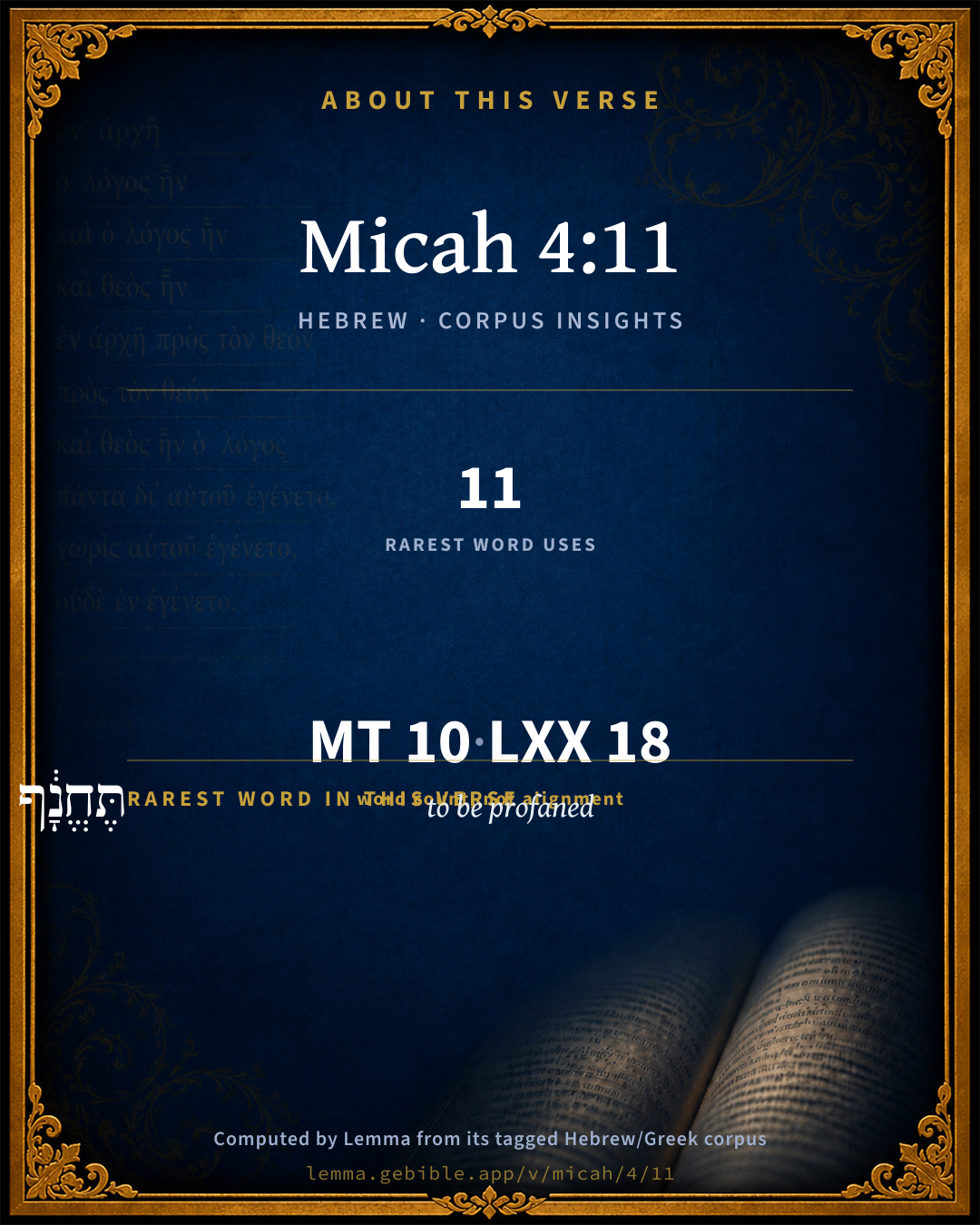
The rarest word here is תֶּחֱנָ֔ף to be profaned H2610 — appearing just 11 times in the whole Hebrew Bible.

Shared distinctive vocabulary

תֶּחֱנָ֔ף to be profaned H2610 occurs in 9 verses of the Hebrew Bible. Also found in:

Grammatical profile

  • 4 verbs
  • 3 nouns
  • 1 adjective
  • 1 preposition
  • 1 adverb

Verb forms

  • נֶאֶסְפ֥וּ Niphal · Perfect
  • הָאֹמְרִ֣ים Qal · Participle Active
  • תֶּחֱנָ֔ף Qal · Imperfect
  • וְתַ֥חַז Qal · Jussive

Hebrew & Septuagint length

In English translation the verse runs 20 words from the Hebrew and 19 from the Septuagint (LXX English) — closely comparable.

A rough comparison of the two English renderings, which tokenize alike — not a word-level alignment.

Word counts can differ between the Hebrew and the Greek without any difference in meaning — e.g. the Hebrew direct-object marker אֵת has no separate Greek word, and Greek often adds the article ὁ.

In the original languages it is 10 Hebrew tokens and 18 Greek tokens — but the two are counted differently (Hebrew bundles its prefixes and suffixes into one token; the Greek is in lemma form), so that isn’t a like-for-like length.

Cross-references

7

Topical passages linked to Micah 4:11 in the Treasury of Scripture Knowledge — connected by theme and wording, ordered by reader-vote popularity; previews shown in the World English Bible.

  • Obadiah 1:12 But don't look down on your brother in the day of his disaster, and don't rejoice over the children of Judah in the day of their destruction. Don't speak proudly in the day of distress.
  • Isaiah 5:25–30 Therefore Yahweh's anger burns against his people, And he has stretched out his hand against them, and has struck them. The mountains tremble, And their dead bodies are as refuse in the midst of the streets. For all this, his anger is not turned away, But his hand is still stretched out.
  • Micah 7:10 Then my enemy will see it, And shame will cover her who said to me, Where is Yahweh your God? Then my enemy will see me and will cover her shame. Now she will be trodden down like the mire of the streets.
  • Isaiah 8:7–8 now therefore, behold, the Lord brings up on them the waters of the River, strong and many, [even] the king of Assyria and all his glory: and it shall come up over all its channels, and go over all its banks;
  • Jeremiah 52:4 It happened in the ninth year of his reign, in the tenth month, in the tenth day of the month, that Nebuchadrezzar king of Babylon came, he and all his army, against Jerusalem, and encamped against it; and they built forts against it round about.
  • Lamentations 2:15–16 All that pass by clap their hands at you; They hiss and wag their head at the daughter of Jerusalem, [saying], Is this the city that men called The perfection of beauty, The joy of the whole earth?
  • Joel 3:2–15 I will gather all nations, And will bring them down into the valley of Jehoshaphat; And I will execute judgment on them there for my people, And for my heritage, Israel, whom they have scattered among the nations. They have divided my land,

Cross-references courtesy of OpenBible.info (CC BY 4.0).

Hebrew and Greek witnesses Masoretic Hebrew ↔ Greek Septuagint

The same verse in the two great witnesses to the Old Testament, shown verse-for-verse.

These are two independent witnesses, not word-aligned to each other, and the Septuagint is shown in lemma (dictionary) form.

Hebrew Micah 4:11 Masoretic · Westminster Leningrad Codex

וְעַתָּ֛ה נֶאֶסְפ֥וּ עָלַ֖יִךְ גּוֹיִ֣ם רַבִּ֑ים הָאֹמְרִ֣ים תֶּחֱנָ֔ף וְתַ֥חַז בְּצִיּ֖וֹן עֵינֵֽינוּ

Now many nations have assembled against you, that say, 'Let her be defiled, And let our eye gloat over Zion.'

World English Bible · Public Domain

Greek LXX Micah 4:11 Septuagint · lemma form

καί νῦν ἐπι συνἄγω ἐπί σύ ἔθνος πολύς ὁ λέγω ἐπιχαίρω καί ἐπιὁράω ἐπί σιων ὁ ὀφθαλμός ἐγώ

And now have many nations gathered against you, saying, We will rejoice, and our eyes shall look upon Sion.

LXX2012 (modern English Septuagint) · Public Domain

On this verse, Keil & Delitzsch discusses the Septuagint’s reading. Read the note in Commentary ↓

Hebrew: Westminster Leningrad Codex (CC BY 4.0). Greek: Septuagint (public domain); English from LXX2012 (modern English Septuagint) (Public Domain). How the Septuagint differs from the Hebrew →

Targum (Aramaic paraphrase)

1

The Targum is the ancient Jewish Aramaic paraphrase of the Hebrew Scriptures — an interpretive translation, not the Hebrew text itself. Onkelos (literal) and Pseudo-Jonathan (expansive) render the Torah, and Jonathan the Prophets. Coverage is partial: where no permissively-licensed English translation exists for a verse, only the Aramaic is shown. This is verse-level text, not a word-by-word alignment to the Hebrew.

  1. Targum Jonathan Prophets (Joshua–Malachi)
    וּכְעַן יִתְכַּנְשׁוּן עֲלָךְ עַמְמִין סַגִיאִין דְאָמְרִין אֵימָתַי תֵיחוֹב וְתֶחֱזֵי בְּמַפְּלַת צִיוֹן עֵינָנָא:

    (no public-domain English translation for this verse)

    Targum Jonathan — Aramaic: “Mikraot Gedolot” (public domain). English: “Sefaria Community Translation” (CC0 1.0 (public-domain dedication)); “London "Chaldee Paraphrase," 1871” (public domain). Text via Sefaria.

Commentary

Notes on Micah 4:11 from classic Christian and Jewish commentators (each source and its license shown beneath its notes). The classic Christian expositions comment on the surrounding passage and are grouped to its opening verse, so a note may address several verses; the Jewish commentaries on the Tanakh (Rashi and others) are per-verse, so they appear only where the commentator wrote on this verse.

Lemma curates 59 commentaries, every one of them public domain or Creative Commons licensed, each selected and text-cleaned for this edition rather than reprinted as found. About our sources →

The Cambridge Bible for Schools and Colleges

gen. ed. J. J. S. Perowne

11–13. Wonderful change in the fortunes of God’s people

11. Now also many nations …] The ‘many nations’ are either the Assyrians (comp. Isa_33:3), or the peoples who after their defeat come to worship at Jerusalem (Mic_4:1-2); but Mic_5:5 is in favour of the former view. They gather together to besiege Jerusalem (comp. Ezekiel 38, 39, Joel 3, Zechariah 12, 14); how fruitlessly, the next two verses declare. ‘Now also’ should rather be And now. There is an implied contrast to the ideal description in Mic_4:1-4; we have already seen that the original draft of chaps. 4, 5. has received various additions, and in order to get a clear connexion, we ought to inclose these inserted passages in parentheses. Thus if we bracket Mic_4:5-10, Mic_4:11 becomes perfectly clear, and the original sequence of thought is restored.

The Cambridge Bible for Schools and Colleges (gen. ed. J. J. S. Perowne; Cambridge University Press, 1878–1918) — public domain. Text from a community e-Sword module.

Trapp's Complete Commentary

John Trapp

Mic 4:11 Now also many nations are gathered against thee, that say, Let her be defiled, and let our eye look upon Zion.

Ver. 11. Now also many nations are gathered, &c.] That is, they shall lie once gathered, when the Babylonians, who are lords of the world, shall muster many nations against thee. Would any man take the Church’s picture, saith Luther? then let him paint a silly poor maid, sitting in a wood or wilderness, compassed about with hungry lions, wolves, boars, and bears, and with all manner of cruel and hurtful beasts and in the midst of a great many furious men assaulting her every moment and minute, for this is her condition in the world.

That say, Let her be defiled] sc. with blood and slaughter. Or, let her be condemned as a hypocrite, let her be stoned as an adulteress; so the Trent translation. Thus they pretend, as Rabshakeh did, that they were sent by God against a hypocritical nation, that had broken their faith with God and men. The like craft and cruelty was used in the Parisian massacre, and gunpowder plot; God and man, said they (in that blind letter, that brought all to light), have agreed to punish the wickedness of this age. Those that would kill a dog give out that he was mad first, saith the French proverb. Whom no man looketh after, Jer 30:17.

And let our eyes look upon Zion] Let us feed our eyes with such a delightful spectacle; and say, as that cruel Charles IX of France did, when he saw the streets strewed with the bodies of the massacred Protestants, and the rivers dyed with their blood, O pulchrum spectaculum! O brave sight! or as the Queen mother of Scotland, when she beheld the dead carcases of her Lutheran subjects, said, that she never saw a goodlier piece of arras {a} in all her days. See the accomplishment of this prophecy in the Lamentations, Psa 137:1-9, and in the Book of Nehemiah.

{a} A rich tapestry fabric, in which figures and scenes are woven in colours. ŒD

John Trapp, A Commentary or Exposition upon All the Books of the Old and New Testament (1647–1656) — public domain. Text from a community e-Sword module.

Joseph Benson's Commentary

Mic 4:11-12. Now also — The time is at hand; many nations are gathered against thee — This may be understood of the Chaldeans and their associates, who pleased themselves with the thoughts of profaning the temple, laying waste the city of Jerusalem, and looking upon it in that condition. Or, it may be understood of the heathen nations round about Jerusalem, who should take occasion to insult the Jews in their calamity, should please themselves with seeing the temple profaned, and should gratify their spite with viewing Jerusalem in a forlorn condition. To look upon an enemy, signifies, in Scripture phrase, to behold his fall with delight. But they know not the thoughts of the Lord — But while they act in such a manner, and take pleasure in insulting over thee in thy calamitous condition, they are altogether ignorant of God’s designs in permitting this, and what is soon to follow, namely, that he will gather them as sheaves into the floor, to be trodden under foot, and broken in pieces, while he will deliver and restore to their own land his people, whose miseries these their enemies now please themselves with the thoughts of beholding.

Joseph Benson's Commentary on the Old and New Testaments (1811–1818) — public domain. Text from a community e-Sword module.

Keil & Delitzsch

C. F. Keil & F. Delitzsch

The daughter Zion, when rescued from Babel, overcomes all hostile powers in the strength of her God. Mic 4:11. "And now many nations have assembled together against thee, who say, Let her be profaned, and let our eyes look upon Zion. Mic 4:12. But they know not the thoughts of Jehovah, and understand not His counsel; for He has gathered them together like sheaves for the threshing-floor. Mic 4:13. Rise up and thresh, O daughter Zion: for I make thy horn iron, and I make thy hoofs brass; and thou wilt crush many nations: and I ban their gain to Jehovah, and their substance to the Lord of the whole earth." With ועתּה, corresponding to עתּה in Mic 4:9, there commences a new scene, which opens to the prophet's mental eye. Many nations have assembled together against the daughter Zion (עליך pointing back to בּת ציּון in Mic 4:10), with the intention of profaning her, and feasting their eyes upon the profaned one. It is the holiness of Zion, therefore, which drives the nations to attack her. תּחנף, let her be or become profaned: not by the sins or bloodguiltiness of her inhabitants (Jer 3:2; Isa 24:5), for this is not appropriate in the mouths of heathen; but through devastation or destruction let her holiness be taken from her. They want to show that there is nothing in her holiness, and to feast their eyes upon the city thus profaned. חזה with ב, to look upon a thing with interest, here with malicious pleasure. On the singular tachaz, followed by the subject in the plural, see Ewald 317, a. To this design on the part of the heathen, the prophet (Mic 4:12) opposes the counsel of the Lord. Whilst the heathen assemble together against Zion, with the intention of profaning her by devastation, the Lord has resolved to destroy them in front of Zion. The destruction which they would prepare for Zion will fall upon themselves, for the Lord gathers them together like sheaves upon the threshing-floor, to thresh, i.e., destroy, them. כּי does not mean "that," but "for." The sentence explains the assertion that they do not understand the counsel of the Lord. כּעמיר, with the generic article, equivalent to "like sheaves." This judgment Zion is to execute upon the heathen. The figurative expression, "Rise up, and thresh," etc., rests upon the oriental custom of threshing out corn with oxen, i.e., of having it trodden out with their hoofs (see Paulsen, Ackerbau der Morgenlnder, 41). In this, of course, only the strength of the hoofs was considered. But as the horn of the ox is a figure frequently used for destructive power (see Deu 33:17; Kg1 22:11; Amo 6:13, etc.), the prophet combines this figure, to strengthen the idea of crushing power, and express the thought that the Lord will equip Zion perfectly with the strength requisite to destroy the nations. והחרמתּי is the first person, and must not be altered into or regarded as the second, as it has been in the lxx and Syriac, and by Jerome. The prophet does not speak in the name of the theocratic nation, as Jerome supposes, but continues to represent Jehovah as speaking, as in אשׂים, with which, however, instead of לי, the noun ליהוה is used, to give greater clearness to the thought that it is Jehovah, the God and Lord of the whole earth, who will destroy the nations that have rebelled against Him and His kingdom, wresting their possessions from them, and taking them back to Himself. For everything laid under the ban belonged to the Lord, as being most holy (Lev 27:28). חיל, property, wealth, the sum and substance of the possessions. Israel is not to enrich itself by plundering the defeated foe, but Jehovah will sanctify the possessions of the heathen to Himself, to whom they belong as Lord of the whole earth, by laying them under the ban: that is to say, He will apply them to the glorification of His kingdom.

There has been a diversity of opinion as to the historical allusion, or the fulfilment of these verses. So much, however, is obvious at the very outset, namely, that they cannot be made to refer to the same event as Mic 4:9, that is to say, to the siege of Jerusalem by the Assyrians, without bringing the prophet into the most striking contradiction to himself. For, since Mic 4:10 predicts not a partial deportation, but the complete carrying away of Israel to Babel, and Mic 4:13 the perfect deliverance of Jerusalem, the people wandering out of Jerusalem into captivity (Mic 4:10) cannot possibly be the enemies who lead it away, beating it utterly before Jerusalem, and banning their possessions to the Lord. There is more to favour the allusion to the victorious conflicts of the Maccabees with the Syrians, for which Theodoret, Calvin, Hengstenberg, and others decide, since these conflicts occurred in the period intervening between the return of the Jews from the Babylonian captivity (Mic 4:10) and the coming of the Messiah (Mic 5:12). But even this allusion corresponds far too little to the words of the promise for us to be able to regard it as correct. Although, for example, the war of the Maccabees was a religious war in the strict sense of the word, since the Syrians, and with them the small neighbouring nations of the Jews, set themselves to attack Judah as the nation of God, and to exterminate Judaism, the gōyı̄m rabbı̄m who have assembled against Zion, and whom the Lord gathers together thither (Mic 4:11, Mic 4:12), point to a much greater even than the attacks made by the Syrians and the surrounding tribes upon Jerusalem in the time of the Maccabees. Gōyı̄, rabbı̄m (many nations) points back to gōyı̄m rabbı̄m and ‛ammı̄m rabbı̄m in Mic 4:2 and Mic 4:3, so that, both here and there, all the nations of the world that are hostile to God are included. Again, the defeat which they suffer before Jerusalem is much greater than the victory which the Maccabees achieved over their enemies. On the other hand, the circumstance that the Babylonian captivity is predicted in Mic 4:10, and the birth of the Messiah in Mic 5:1-2, and that the victorious conflicts of the Maccabees with the Syrians and the heathen neighbours of the Jews lie in the interim between these events, furnishes no sufficient proof that these conflicts must be referred to in Mic 4:11-13, simply because the assumption that, in Mic 4:9 -14, the attacks of the Chaldaeans, the Graeco-Syrians, and the Romans upon Zion are foretold in the order in which they followed one another in history, has no firm basis in the threefold recurrence of ‛attâh (now) in Mic 4:9, Mic 4:11, and Mic 5:1. As an event is introduced with ‛attâh in Mic 5:9, which does not follow the one predicted in Mic 5:8 in chronological sequence, but, on the contrary, the prophet comes back in ve‛attâh from the more remote to the more immediate future, it cannot be inferred from the ‛attâh in Mic 5:1 that the oppression mentioned there must follow the victory over many nations predicted in Mic 4:11-13 in chronological order, or that the siege and capture of Jerusalem by the Romans are referred to in Rom 5:1. Moreover, the proclamation in Rom 5:10 already goes beyond the Chaldaean catastrophe, and the liberation of the Jews from the Chaldaean exile, so that if the ve‛attâh in Rom 5:12 announces a conflict with Zion which will follow the events predicted in Rom 5:9 and Rom 5:10, we must not restrict the conflict to the wars of the Maccabees. We must therefore understand these verses as referring to the events already predicted by Joel (ch. 3), and afterwards by Ezekiel (Ezekiel 38, 39) and Zechariah (Zac 12:1-14), and in Rev 20:8.: i.e., to the last great attack which the nations of the world will make upon the church of the Lord, that has been redeemed from Babel and sanctified, with the design of exterminating the holy city of God from the face of the earth, and to which the attacks of the Syrians, and the rest of the nations surrounding Judah, upon the covenant nation in the times of the Maccabees, furnished but a feeble prelude. This view is favoured by the unmistakeable similarity between our verses and both Joel and Ezekiel.

The נאספוּ עליך גּויים רבּים in Mic 4:11, compared with קבּצם in Mic 4:12, points clearly back to וקבּצתּי את־הגּוים in Joe 3:2, compared with ונקבּצוּ in Mic 4:11; and the figure in Mic 4:12, of the gathering together of the nations like sheaves for the threshing-floor, to the similar figures of the ripening of the harvest and the treading of the full wine-press in Joe 3:13. And the use of gōyı̄m rabbı̄m in Micah is no reason for supposing that it differs in meaning from the kol-haggōyı̄m of Joel, since Micah uses gōyı̄m rabbı̄m in Mic 4:2 and Mic 4:3 for the totality of the nations of the world. Ezekiel, also, simply speaks of gōyı̄m rabbı̄m as assembling together with Gog to attack the mountains of Israel (Eze 38:6, Eze 38:9, Eze 38:15); and in his case also, this attack of the nations upon Jerusalem is appended to the redemption of Israel effected at Babel. Again, the issue of this attack is the same in Micah as in Joel, Ezekiel, and Zechariah, - namely, the complete overthrow of the hostile nations by the people of Israel, who fight in the strength of the Lord, by which Jehovah manifests Himself to all nations as Lord of the whole earth, and proves Himself to be the Holy One (compare Mic 4:13 with Joe 3:12-13, and Eze 38:16; Eze 39:3.). Lastly, a decisive proof of the correctness of this allusion is to be found in the circumstance, that the attack of the nations is directed against Zion, which has now become holy, that it proceeds from hatred and enmity to His holiness, and has for its object the desecration of the city of God. This feature is by no means applicable to Jerusalem and Judah in the time of the Maccabees, but can only apply to the time when Israel, redeemed from Babel, forms a holy church of God, i.e., to the last period of the development of the kingdom of God, which began with Christ, but has not yet reached its fullest manifestation. "From the fact, however, that Zion, when sanctified, is to be delivered out of much greater danger than that from which it will not be delivered in the immediate future, and also that the refined and sanctified Zion will conquer and destroy an incomparably greater hostile force than that to which it will now soon succumb, it follows, in the clearest and most conclusive way, that in the nearest future it must be given up to the power of the world, because it is now unholy" (Caspari). This thought prepares the way for the transition to Mic 5:1, where the prophecy returns to the oppression foretold in Mic 4:9 and Mic 4:10.

Keil & Delitzsch — Biblical Commentary on the Old Testament (1861–1891) — public domain (CC PDM 1.0). Text via the HelloAO Bible API. (Old Testament only.)

Tyndale Open Study Notes

Tyndale Open Resources

4:11-13 gathered against you: While closely tied to the historical assault of Babylon against Jerusalem in 588–586 BC, this oracle also bears on a future in which the idealized and restored Jerusalem of 4:1-5 will be attacked (cp. Rev 20:7-9).

Tyndale Open Study Notes — © Tyndale Open Resources, licensed CC BY-SA 4.0. Text via the HelloAO Bible API.

Jamieson, Fausset & Brown

Robert Jamieson, A. R. Fausset & David Brown

many nations--the subject peoples composing Babylon's armies: and also Edom, Ammon, &c., who exulted in Judah's fall (Lam 2:16; Oba 1:11-13).

defiled--metaphor from a virgin. Let her be defiled (that is, outraged by violence and bloodshed), and let our eye gaze insultingly on her shame and sorrow (Mic 7:10). Her foes desired to feast their eyes on her calamities.

Jamieson, Fausset & Brown — Commentary Critical and Explanatory on the Whole Bible (1871) — public domain (CC PDM 1.0). Text via the HelloAO Bible API.

Adam Clarke's Commentary

Verse 11. Many nations are gathered against thee] The Chaldeans, who were composed of many nations. And, we may add, all the surrounding nations were their enemies; and rejoiced when the Chaldean army had overthrown Jerusalem, destroyed the temple, and led the people away captive.

Let her be defiled] This was their cry and their wish: Let Jerusalem be laid as low as she can be, like a thing defiled and cast away with abhorrence; that their eyes might look upon Zion with scorn, contempt, and exultation.

Adam Clarke's Commentary on the Bible (1810–1826) — public domain. Text from a community e-Sword/MySword module.

John Calvin's Commentaries

The Prophet’s object here is to give some alleviation to the faithful lest they should succumb under their calamities; for, as we have stated, there were most grievous evils approaching, sufficient to overwhelm the minds of the godly. The Prophet then raises up here, with the moat suitable comfort, those who would have otherwise fainted under their calamities; and the sum of the whole is this, — that the faithful were not to be confounded on finding the ungodly proudly triumphing, as they are wont to do, when they seem to have gained their wishes. Since, then, the wicked show a petulant spirit beyond all bounds, the Prophet exhorts the faithful to sustain themselves by God’s promises, and not to care for such insolence. He then subjoins a promise, — that God would assemble all the forces of their enemies, as when one gathers many ears of corn into a bundle, that he may thrash them on the floor. I will come now to the words of the Prophet.

Assemble, he says, against thee do nations, or strong nations: for, by saying, גוים רבים, guim rebim, he intimates one of two things, either that they were strong, or that they were large in number: as to the subject there is no great difference. The Prophet had this in view, — that though the Church of God may be pressed by a great multitude of enemies, it yet ought not to be broken down in mind: for the ungodly, while they cruelly domineer, do not understand the design of God. Assemble, then, against thee do many nations He sets the thing before them, to heal them of terror: for when we are beyond the reach of harm, we, for the most part, too heedlessly despise all dangers; and then, when we come to a real struggle, we tremble, or even fall and become wholly weak. This is the reason why the Prophet sets before the Jews their prospects, and shows that the time was near when they were to endure a siege, as enemies would, on all sides, surround them. Assemble then do nations, and strong or many nations: he shows here that the Jews had no reason to despond, though their enemies would far exceed them in number, and in forces, and in courage, for it was enough for them to be under the protection of God.

Who say, condemned now shall be Zion The verb חנף, chenaph, means to act wickedly and perversely. It may then be literally rendered, ‘profane (scelerata) shall be Zion; and on it shall our eye look:’ but this word is often taken metaphorically for condemnation. The meaning then is, ‘Zion is now condemned:’ and the Prophet, no doubt, intended to intimate here, that the enemies would so triumph, as though Zion were not under the guardianship of God; as when any one, who has rendered himself hateful by his vices, is left and forsaken by his patrons. So, then, the Prophet here arms the faithful against the arrogance of their enemies, that they might not despair, when they found that they were condemned by the consent of all men, and that this was the opinion of all, — that they were forsaken by God.

John Calvin's Commentaries (1540-1563) — public domain. Text from the Calvin Translation Society English edition (1840s-50s) via the Christian Classics Ethereal Library (ccel.org). Calvin's coverage is partial (roughly two-thirds of the Bible); uncommented books and verses are honest gaps, never fabricated. The 19th-century editor's footnotes and remarks are omitted so the notes are faithfully Calvin's own voice.

Ellicott's Commentary for English Readers

(11) Let her be defiled.—The seventy-fourth Psalm records the calamity foreseen by the prophet: “They have cast fire into Thy sanctuary, they have defiled (by casting down) the dwelling-place of Thy Name to the ground.”

Look upon—i.e., contemplate her destruction with pleasure.

A Bible Commentary for English Readers, edited by Charles John Ellicott (1878–1897) — public domain. Text from a community e-Sword module.

John Gill's Exposition

Now also many nations are gathered against thee,.... Which is to be understood, not of Sennacherib's army invading Judea, and besieging Jerusalem, in Hezekiah's time; for that was not threshed, as the phrase is afterwards used, or destroyed by the daughter of Zion, but by an angel from heaven: nor of the Babylonians or Chaldeans, since they succeeded in their attempt, and were the conquerors, and not conquered: rather this respects the times of the Maccabees, as the series of prophecy and history agreeing together shows; in which times many of the neighbouring nations of the Jews gave them a great deal of trouble, and especially Antiochus king of Syria; and many and mighty armies sent by him. The Jews, as Kimchi, Aben Ezra, and Abarbinel (z), interpret this of the armies of Gog and Magog, in the times of their vainly expected Messiah. Some Christian interpreters, with much more probability, understand this passage of the first times of the Gospel, and the opposition made to that and the Christian church, which yet in the issue prevailed; and perhaps it may have reference to the last times, and receive its full accomplishment in the battle at Armageddon, Rev 16:14;

that say, let her be defiled, and let our eye look upon Zion; either defiled with sin; so the Targum,

"that say, when will she sin, and our eye shall behold the fall of Zion?''

as the effect of her sin: or, as others, "let her play the hypocrite" (a); and be condemned as such: or rather, be defiled with slaughter and bloodshed, that they might be delighted with so pleasing a sight, and their eyes might feed with pleasure on an object so agreeable to their wishes.

(z) Mashmiah Jeshuah, fol. 62. 1. (a) "hypocrita fuit", Tigurine version; velut hypocrita damnatur", Tarnovius; "hypocrisi contaminabitur, Cocceius.

John Gill's Exposition of the Whole Bible (1746–1763) — public domain (CC PDM 1.0). Text via the HelloAO Bible API.

Albert Barnes' Notes on the Bible

Now also - (And now.) The prophet had already spoken of the future before them, with this word Now. Then, he distinctly prophesied the captivity to Babylon. Twice more he begins anew; as Holy Scripture, so often, in a mystery, whether speaking of evil or of good, of deliverance or of punishment, uses a threefold form. In these two, no mention is made of the enemy, and so there is some uncertainty. But the course must apparently be either backward or forward. They must either be two nearer futures before the Captivity, or two more distant after it. This second gathering might, in itself, either be that of the Assyrian hosts under Sennacherib out of all the nations subject to him; or that of the many petty nations in the time of the Maccabees, who took advantage of the Syrians’ oppression, to combine to eradicate the Jews (1 Macc. 5:1, 2). If understood of Sennacherib, the prophet, having foretold the entire captivity of the whole people to Babylon, would have prophesied the sudden destruction of a nearer enemy, whose miraculous and instantaneous overthrow should be the earnest of the destruction of Babylon and of their deliverance from it. This would suit well with the description, “He shall gather them as sheaves to the floor,” and would correspond well with the descriptions in Isaiah. On the other hand, whereas this description would suit any other event, in which man gathered his strength against God and was overthrown, the following words, “Arise and thresh, O daughter of Zion,” etc., fit better with the victories of the Maccabees, in which Israel was active, than with the overthrow of Sennacherib, in which they were wholly passive, and God did all for them, as Isaiah and Nahum foretell the same overthrow Isa 10:24-34; Isa 14:24, Isa 14:5; Isa 17:12-14; Isa 29:7-8; Nah 1:10-13. Then also, if the course of the description was backward:

1) the captivity in Babylon

2) the destruction of Sennacherib

There is no earlier event to correspond with “the smiting of the judge of Israel on the cheek” (Mic 5:1-4 in Hebrew). The malice also of the nations gathered against Zion suits better with the abiding character of the petty nations, and of their hereditary envy against Israel and its high claims. To Nineveh and Babylon, Israel was but one little corner of ground, which rounded their territory and connected them with Egypt. They disdained them, even while they sought to subdue them. Micah describes the exultation of petty gratified rivalry.

That say, let her be defiled - The bad have a keen eye for the haltings and inconsistencies and falls of God’s people, for which they are ever on the watch. Like Satan, they are first tempters, then the accusers; first desecrators, then sanctimonious justiciaries. God, in His judgment, leaves what has been inwardly defiled to be outwardly profaned. “If any man defile the temple of God, him shall God destroy; for the temple of God is holy, which temple are ye” 1Co 3:17. “The faithful city had become a harlot” Isa 1:21. “The land had become polluted by its inhabitants” Jer 3:9; Psa 106:38; Isa 24:5. Now it was to be polluted by the enemy. Its seducers ask for the judgment of God. “It has become like us in its deeds; let it no more be distinguished from us by the name of the people of God.”

And let our eye look upon Zion - With pleasure upon its desolation, and feed itself with its misery. : “Where the eye, there love; where the hand, there pain.” “They opened their mouth wide against me: they said, Aha, Aha, our eye hath seen” Psa 35:21. The world hates the Church; Edom, Israel; it cannot be satisfied with beholding its chastisements Mic 7:10; Oba 1:12. The sufferings of the Martyrs were the choice spectacle of the pagan.

Albert Barnes' Notes on the Bible (1834–1885) — public domain. Text from a community e-Sword/MySword module.

Haydock's Catholic Bible Commentary

Sion. Let us enter the sanctuary and plunder it. Cambyses was instigated to fall upon the Jews lately returned, Ezechiel xxxviii. 11. His rapacious designs were frustrated, as those of persecutors will be. (Calmet)

George Leo Haydock (1774–1849), Haydock's Catholic Family Bible and Commentary, 1859 edition — public domain. Excludes Psalms (Douay-Rheims chapter numbering differs from Protestant) and Deuterocanonical books (Catholic canon only).

Matthew Poole's English Annotations

Now, i.e. ere long, the time is near at hand. Many nations; many for number and great for name, mighty in power, all that were at that time confederate with or feudatory to Sennacherib king of Assyria, or else to the king of Babylon.

Are gathered against thee; the present tense for the future, in the prophetic style, to express the certainly and the nearness of the judgment; they will all of them assemble and come up against Judah and Jerusalem, as Sennacherib did when he besieged Jerusalem, or as Nebuchadnezzar did when he took it.

That say; propose it as their design, hope for it as their end, and boast of it as easy.

Let her be defiled; let us use her contemptuously, tread her under foot as a common and polluted thing, let us destroy her with such spite and scorn as a defiled thing deserveth: so the phrase 2Ki 23:8; let her be polluted with blood, and without respect to her former holiness let us enter, sack, and destroy her temple and palaces.

Let our eye look, delighting ourselves in the ruin; let us feed our envious, revengeful eye.

Upon Zion; upon Jerusalem, the royal palace, and the sacred temple, buried in their own rubbish.

Matthew Poole's English Annotations on the Holy Bible (1683–1685) — public domain. Text from a community e-Sword/MySword module.

Whedon's Commentary on the Bible

Daniel D. Whedon

Deliverance of Jerusalem; destruction of the enemy, 11-13.

This picture, like the preceding, starts from the present calamity and ends with a promise of complete victory. For the differences between the two pictures see comments on Mic_4:10.

Now — Calls attention to the present condition in contrast with the future glory.

Many nations — If, as suggested above (on Mic_4:10), this oracle comes from the period of Sennacherib’s invasion, this expression must refer to the Assyrians, whose armies might be called “many nations,” since they were made up of soldiers from many vassal states (compare Isa_10:8, “Are not my princes all of them kings?”).

Thee — Jerusalem.

Defiled — The hostile armies were determined to enter and destroy the holy city, but their very presence there would be, from the standpoint of the devout Jew, a defilement of the city (see on Joe_3:17). All their attempts will be futile, for the thoughts of the enemy are not the thoughts of Jehovah (compare Isa_7:5-7).

Gather them as the sheaves — The cruel treatment of a conquered foe is often likened to the threshing of sheaves (Amo_1:3; 2Sa_12:31). The enemies have come for conquest, but the prophet declares that they have been permitted to gather around the holy city only to make possible a glorious triumph of the chosen people.

Floor — See on Joe_2:24.

Mic_4:13 is an exhortation to the inhabitants of Zion to execute judgment upon the arrogant enemies.

Thresh — The picture of Mic_4:12 is continued; the inhabitants of Zion are likened to the animals whose duty it is to tread out the grain with their hoofs (see on Amo_1:3; Hos_10:11; Deu_25:4).

Hoofs brass — The harder the hoofs the more effective the treading.

Make thine horns iron — This introduces a new figure. With the powerful horns it will pierce and cast down the foe (Deu_33:17). Thus equipped, Jerusalem will have no difficulty in overthrowing the “many nations,” before the latter can do any harm (compare Isa_10:33-34).

I will consecrate — The Hebrew verb form should be understood as an unusual form of the second person, and should be rendered “and thou shalt consecrate.” This reading is supported by nearly all the ancient versions. Israel is not to enrich itself by plundering the defeated foe; all the possessions taken from him are to be consecrated to Jehovah’s use (Lev_27:28; 1Sa_15:21; 1Ki_20:42).

Gain… substance — The two nouns are synonyms and are equivalent to “the sum and substance of their possessions.”

The Lord of the whole earth — As such he is able to help Judah to victory; and as such he has a claim upon the spoil.

Daniel D. Whedon (gen. ed.), Commentary on the Old and New Testaments (1874–1909) — public domain. Text from a community e-Sword module.

The Pulpit Commentary

Vers. 11-13. Rescued from Babylon, Zion overcomes all enemies in the strength of God.

Now also; and now. A new scene is presented in contrast to the view in vers. 1-4. Many nations are gathered against thee. Primarily the Assyrians are meant, (Isa_33:3) whose armies were composed of various nationalities. (Isa_22:6; see below, Mic_5:5) Pusey thinks that the reference is rather to the attacks of petty enemies, e.g. in Maccabean times, and in the Samaritans" opposition to the rebuilding of the temple. Cheyne would place vers. 5-10 in a parenthesis, and connect the present with the ideal description in vers. 1-4. Let her be defiled; i.e. profaned, despoiled of her boasted holiness and inviolability. LXX, epicaroumeya , "we will rejoice." The Vulgate, lapidetur, points to her punishment as an adulteress, which does not suit the context. Let our eye look upon Zion. The heathen anticipate with malicious pleasure the sight of the humiliation of Jerusalem. (comp. Oba_1:12, Oba_1:13)

The Pulpit Commentary (1880–1919), ed. H.D.M. Spence-Jones & Joseph S. Exell — public domain. Text from a community e-Sword module.

John Wesley's Explanatory Notes

Now - The time is at hand. Defiled - Let her be polluted with blood, and let us enter, sack and destroy her temple and palaces. Look - With delight on her destruction.

John Wesley, Explanatory Notes Upon the Whole Bible (1754–1765) — public domain. Text via the GEBible commentary corpus.

unfoldingWord translationNotes

Door43 World Missions Community

General Information:

Jerusalem will defeat her enemies.

Let her be defiled

This can be translated in active form. AT: "Let us defile her" (See: Active or Passive)

let our eyes gloat over Zion

The eye is a synecdoche for the whole person. AT: "let us gloat over Zion" or "let us enjoy watching the invaders destroy Zion" (See: Synecdoche)

for he has gathered them like bundles of grain prepared for the threshing floor

The writer speaks of Yahweh being ready to destroy the nations as if Yahweh were a farmer who has put his bundles of grain on his threshing floor and is now ready to thresh them. (See: Simile)

translationWords

nation

defile

Zion

Yahweh

thresh

unfoldingWord translationNotes — © Distant Shores Media and the Door43 World Missions Community, licensed CC BY-SA 4.0. Source: git.door43.org/Door43/en_tn.

Rashi

Rabbi Shlomo Yitzchaki (Rashi)

who say, “Let her be guilty”—Let Zion be guilty of her sins, and let her iniquity be visited upon her.

and our eyes shall gaze on Zion And our eyes will see in her what we hoped to see her.

Rashi on the Tanakh — English translations: “The Judaica Press complete Tanach with Rashi, translated by A. J. Rosenberg” (CC BY 4.0); “Pentateuch with Rashi's commentary by M. Rosenbaum and A.M. Silbermann, 1929-1934” (public domain); “The Metsudah Tanach series, Lakewood, N.J” (CC BY 4.0); and “The Book of Joshua, Metsudah Publications, 1997” (CC BY 4.0). Text via Sefaria.

Lesson kit

Teaching starters — assembled from the data on this page, not authored interpretation. Every prompt links to the verse data it draws on. Edit before teaching.

Micah, in the Prophets, opens this verse with 10 words (10 distinct Hebrew lemmas). Its most distinctive word is chânêph (“to be profaned”). A historical commentator’s framing appears above. Read the whole chapter for the surrounding context.

Discussion questions

  1. What does “to be profaned” (chânêph) contribute to the verse as a whole?
  2. Numbers 35:33 shares the word «to be profaned» with this verse. How do the two illuminate each other?
  3. The translations on this page render this verse differently — a whole-verse word diff, not a word-by-word alignment. What might account for the different wordings?
  4. The verb «נֶאֶסְפ֥וּ» is Niphal Perfect. How does its form color the action?
  5. Reading how The Cambridge Bible for Schools and Colleges and Trapp's Complete Commentary read this verse, where do the two commentators agree and where do they part?

Things to notice

Reading settings

Reading text

Shown beneath each verse's original-language words.

Old Testament
Old Testament edition

Read the OT as the Masoretic Hebrew (MT) or the Greek Septuagint (LXX).

English shown for the Greek Septuagint (in the Hebrew ↔ Greek comparison).

Comparing translations? Open the Compare panel on any verse page to stack up to four side by side.