
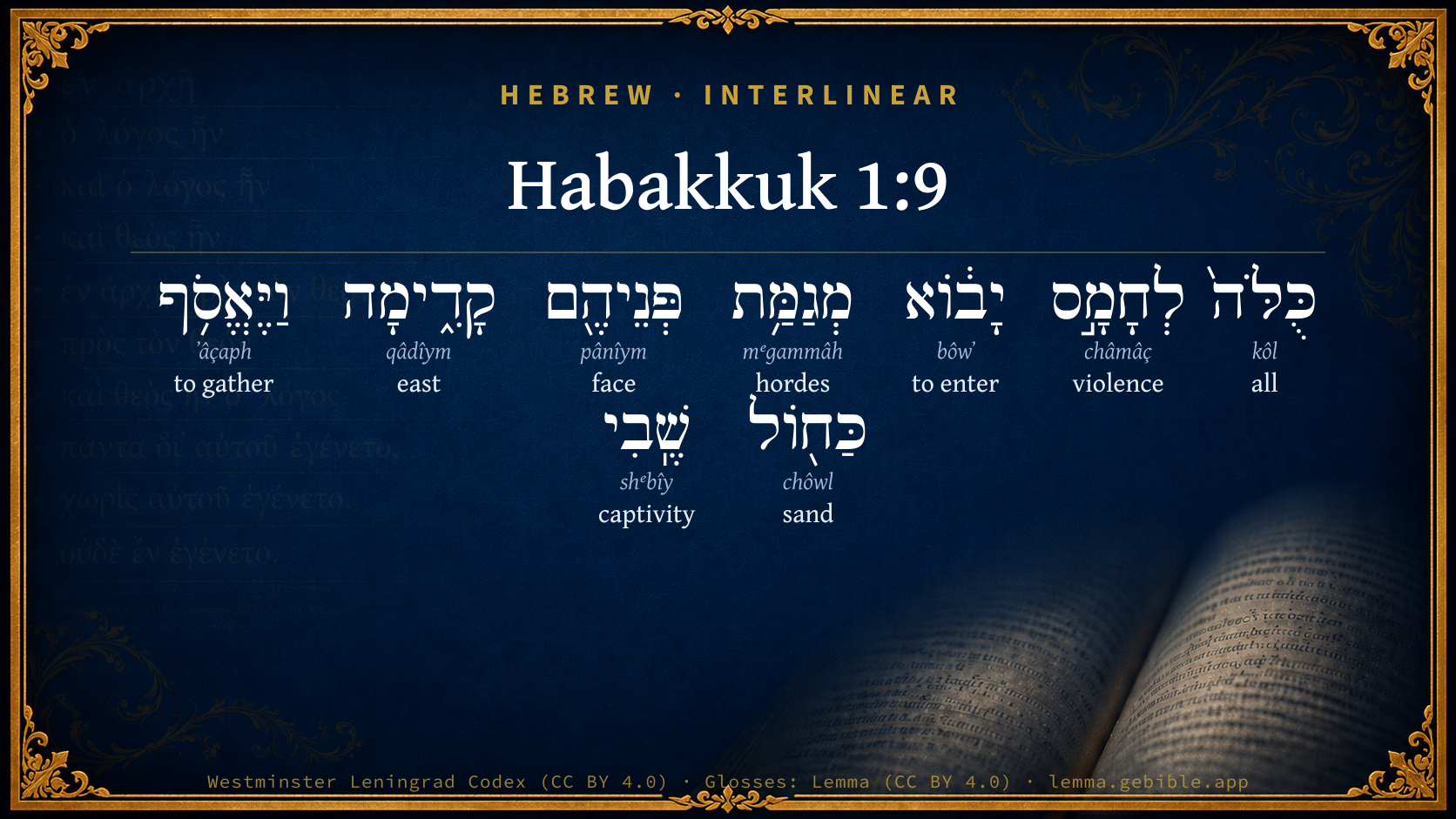
Habakkuk 1:9

Hebrew (Westminster Leningrad Codex) Habakkuk 1:9 appears in the Hebrew Old Testament. The text above is from the Westminster Leningrad Codex. Each word links to its Strong’s number, a concise gloss, and parsing drawn from the Open Scriptures Hebrew Bible morphology. Click any word for its full Brown-Driver-Briggs (BDB) entry.
Download image
Cite this verse

Habakkuk 1:9 (World English Bible). Public Domain. Lemma interlinear Bible study tool, https://lemma.gebible.app/v/habakkuk/1/9.

Show BibTeX & RIS
BibTeX
RIS
English Translation
All of them come for violence. Their hordes face the desert. He gathers prisoners like sand.
World English Bible · Public Domain
Highlights
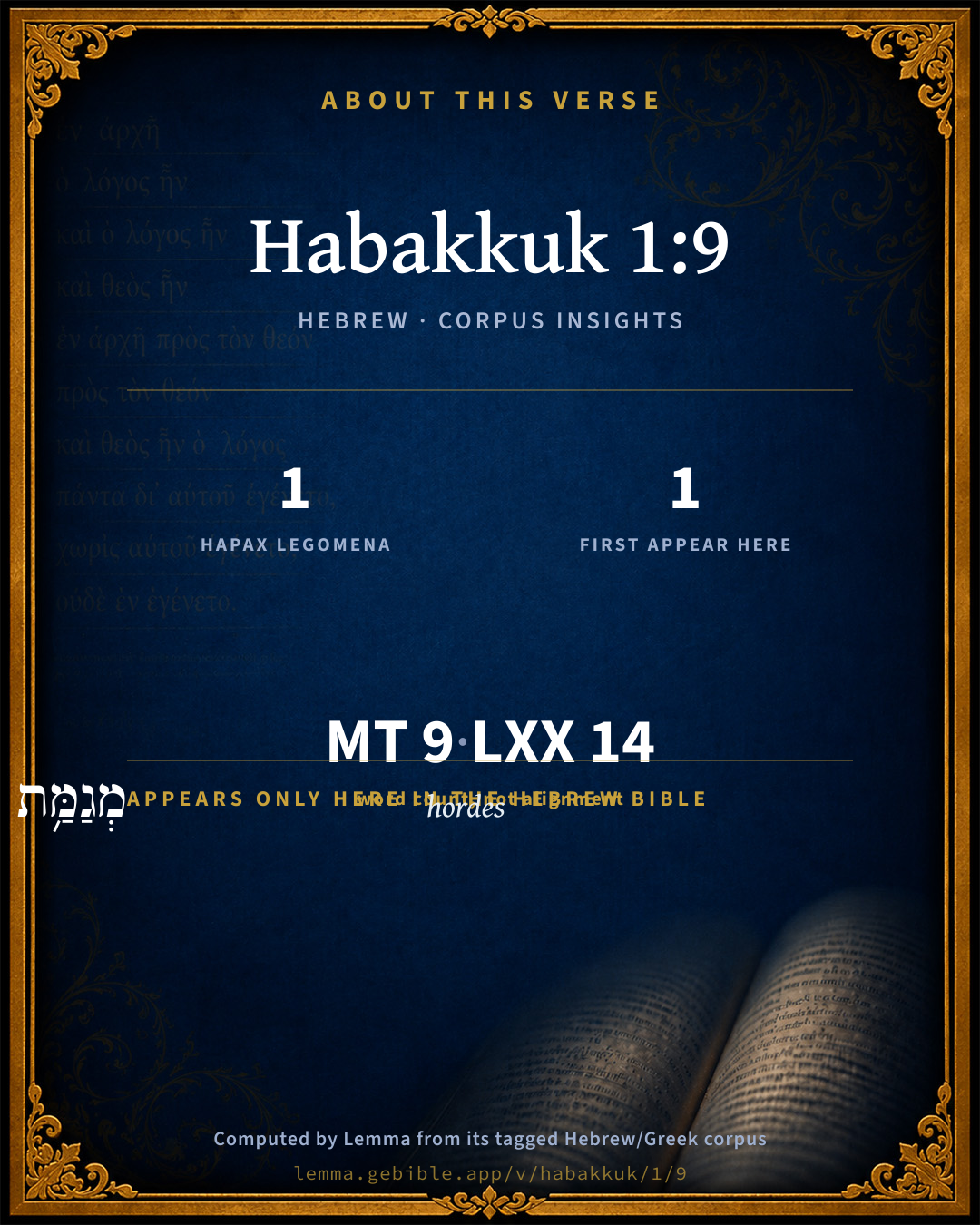
  • 1 hapax legomenon — only here in the Hebrew Bible
  • 1 first appearance in the Hebrew Bible
Full analysis ↓
Download a study sheet

One document with this verse’s original text, its word-by-word gloss line, the meaning frame, cross-references with their text, attributed commentary, and full source and license credits — printable, and it pastes into notes with its structure intact.

This verse Autodidact and up

Study sheet (.html) Plain text (.txt)

A passage Seminary Student

Up to 50 verses in one chapter. A passage sheet keeps up to 6 commentary sources and 12 cross-references per verse, in the order this page ranks them, and says so on the sheet whenever that leaves anything out. Ask for a single verse and you get the Autodidact verse sheet above.

Everything on this page stays free to read, with no account — the sheet is a download of what is already on screen, not access to it.

Want to remove ads? Support Godless Engineer
Compare translations 3

The same verse in 3 English versions, stacked beneath the original-language interlinear above. Click any original word for its lexicon entry.

Each is an independent rendering of the whole verse — the interlinear is not word-aligned to these translations.

Highlighted words mark where these versions differ — a whole-verse word diff, not a word-by-word alignment.

  • World English Bible Public Domain
    All of them come for violence. Their hordes face the desert. He gathers prisoners like sand.
  • King James Version Public Domain
    They shall come all for violence: their faces shall sup up as the east wind, and they shall gather the captivity as the sand.
  • unfoldingWord Literal Text CC BY-SA 4.0
    All of them will come for violence. The direction of their faces eastward, and he gathers captives like the sand.

unfoldingWord Literal Text — © unfoldingWord, licensed CC BY-SA 4.0. Word-aligned USFM3 via Door43 (git.door43.org/unfoldingWord/en_ult).

Versions to compare (up to 4)

3 of 4 selected

Show all 18 translations

Every available English version of this verse, each an independent rendering of the whole verse.

  • World English Bible Public Domain
    All of them come for violence. Their hordes face the desert. He gathers prisoners like sand.
  • Berean Standard Bible Public Domain
    All of them come bent on violence; their hordes advance like the east wind; they gather prisoners like sand.
  • Majority Standard Bible Public Domain
    All of them come bent on violence; their hordes advance like the east wind; they gather prisoners like sand.
  • King James Version Public Domain
    They shall come all for violence: their faces shall sup up as the east wind, and they shall gather the captivity as the sand.
  • American Standard Version (1901) Public Domain
    They come all of them for violence; the set of their faces is forwards; and they gather captives as the sand.
  • Revised Version (1885) Public Domain
    They come all of them for violence; their faces are set eagerly as the east wind; and they gather captives as the sand.
  • Geneva Bible (1599) Public Domain
    They come all to spoyle: before their faces shalbe an Eastwinde, and they shall gather the captiuitie, as the sand.
  • Douay-Rheims (1899) Public Domain
    They shall all come to the prey, their face is like a burning wind: and they shall gather together captives as the sand.
  • Young's Literal Translation Public Domain
    Wholly for violence it doth come in, Their faces swallowing up the east wind, And it doth gather as the sand a captivity.
  • Literal Standard Version CC BY-SA 4.0
    All for violence—he comes in, || Their faces swallowing up the east wind, || And he gathers a captivity as the sand.
  • Unlocked Literal Bible CC BY-SA 4.0
    They all come for violence; their multitudes go like the desert wind, and they gather captives like sand.
  • unfoldingWord Literal Text CC BY-SA 4.0
    All of them will come for violence. The direction of their faces eastward, and he gathers captives like the sand.
  • Darby Bible Public Domain
    They come all of them for violence: the crowd of their faces is forwards, and they gather captives as the sand.
  • World Messianic Bible Public Domain
    All of them come for violence. Their hordes face forward. They gather prisoners like sand.
  • Webster's Bible Public Domain
    They shall come all for violence: their faces shall sup up as the east wind, and they shall gather the captivity as the sand.
  • Free Bible Version CC BY-SA 4.0
    Here they come, all intent on violence. Their armies advance in frontal assault as rapidly as the desert wind, capturing so many prisoners they are like sand.
  • Bible in Basic English Public Domain
    They are coming all of them with force; the direction of their faces is forward, the number of their prisoners is like the sands of the sea.
  • JPS Tanakh (1917) Public Domain
    They come all of them for violence; their faces are set eagerly as the east wind; and they gather captives as the sand.

Literal Standard Version (2020), Covenant Press — licensed CC BY-SA 4.0. Text via the HelloAO Bible API (eBible.org). Unlocked Literal Bible (unfoldingWord) — licensed CC BY-SA 4.0. Text via the HelloAO Bible API (eBible.org). unfoldingWord Literal Text — © unfoldingWord, licensed CC BY-SA 4.0. Word-aligned USFM3 via Door43 (git.door43.org/unfoldingWord/en_ult). Free Bible Version, Dr. Jonathan Gallagher — licensed CC BY-SA 4.0. Text via the HelloAO Bible API (eBible.org).

Word by word

More ways to search: Search by grammar → Find every occurrence → Compare this word →

Practice this passage: Drill this verse → Learn its vocabulary →

מְגַמַּ֥ת
mᵉgammâh
H4041
“hordes of”
Noun, Common, Feminine, Singular, Construct
Part of Speech
Noun
Type
Common
Gender
Feminine
Number
Singular
State
Construct
Full BDB Definition

Origin: from the same as H1571

TWOT: 361b

meaning uncertain; perhaps hordes, accumulation, assembling, eagerness (of Babylonians)
  1. כֻּלֹּה֙ kôl H3605 “all · her” Noun, Common, Masculine, Singular, Construct + Suffix, Personal, 3rd Person, Feminine, Singular
  2. לְחָמָ֣ס châmâç H2555 “to/for · violence” Preposition + Noun, Common, Masculine, Singular, Absolute
  3. יָב֔וֹא bôwʼ H935 “to enter” Verb, Qal, Imperfect, 3rd Person, Masculine, Singular
  4. פְּנֵיהֶ֖ם pânîym H6440 “face(s) · their” Noun, Common, Both, Plural, Construct + Suffix, Personal, 3rd Person, Masculine, Plural
  5. קָדִ֑ימָה qâdîym H6921 “east · toward” Noun, Common, Masculine, Singular, Absolute + Suffix, Demonstrative
  6. וַיֶּאֱסֹ֥ף ʼâçaph H622 “and · to gather” Conjunction + Verb, Qal, Sequential Imperfect, 3rd Person, Masculine, Singular
  7. כַּח֖וֹל chôwl H2344 “like/as the · sand” Preposition, Determined + Noun, Common, Masculine, Singular, Absolute
  8. שֶֽׁבִי shᵉbîy H7628 “captivity” Noun, Common, Both, Singular, Absolute

About this verse

These counts appear in no published source. They are computed here, from the morphology-tagged text and Lemma’s own curated glosses. What Lemma adds →

9
words
9
distinct lemmas
Prophets
section

Notable vocabulary

1 hapax legomenon — a word that appears only here in the entire Hebrew Bible:

  • מְגַמַּ֥ת hordes H4041

First appearance in Scripture

This word makes its first canonical appearance in the Hebrew Bible here:

  • מְגַמַּ֥ת hordes H4041

Shared distinctive vocabulary

כַּח֖וֹל sand H2344 occurs in 23 verses of the Hebrew Bible. Also found in:

Grammatical profile

  • 2 verbs
  • 7 nouns

Verb forms

  • יָב֔וֹא Qal · Imperfect
  • וַיֶּאֱסֹ֥ף Qal · Sequential Imperfect

Hebrew & Septuagint length

In English translation the verse runs 16 words from the Hebrew and 20 from the Septuagint (LXX English) — closely comparable.

A rough comparison of the two English renderings, which tokenize alike — not a word-level alignment.

Word counts can differ between the Hebrew and the Greek without any difference in meaning — e.g. the Hebrew direct-object marker אֵת has no separate Greek word, and Greek often adds the article ὁ.

In the original languages it is 9 Hebrew tokens and 14 Greek tokens — but the two are counted differently (Hebrew bundles its prefixes and suffixes into one token; the Greek is in lemma form), so that isn’t a like-for-like length.

Cross-references

19

Topical passages linked to Habakkuk 1:9 in the Treasury of Scripture Knowledge — connected by theme and wording, ordered by reader-vote popularity; previews shown in the World English Bible.

  • Jeremiah 25:9 behold, I will send and take all the families of the north, says Yahweh, and [I will send] to Nebuchadrezzar the king of Babylon, my servant, and will bring them against this land, and against the inhabitants of it, and against all these nations round about; and I will utterly destroy them, and make them an astonishment, and a hissing, and perpetual desolations.
  • Genesis 41:49 Joseph laid up grain as the sand of the sea, very much, until he stopped counting, for it was without number.
  • Deuteronomy 28:51–52 and shall eat the fruit of your cattle, and the fruit of your ground, until you are destroyed; that also shall not leave you grain, new wine, or oil, the increase of your cattle, or the young of your flock, until they have caused you to perish.
  • Judges 7:12 The Midianites and the Amalekites and all the children of the east lay along in the valley like locusts for multitude; and their camels were without number, as the sand which is on the sea-shore for multitude.
  • Job 29:18 Then I said, 'I shall die in my own house, I shall number my days as the sand.
  • Psalms 139:18 If I would count them, they are more in number than the sand. When I wake up, I am still with you.
  • Isaiah 27:8 In measure, when you send them away, you do contend with them; he has removed [them] with his rough blast in the day of the east wind.
  • Jeremiah 4:7 A lion is gone up from his thicket, and a destroyer of nations; he is on his way, he is gone forth from his place, to make your land desolate, that your cities be laid waste, without inhabitant.
  • Jeremiah 4:11 At that time shall it be said to this people and to Jerusalem, A hot wind from the bare heights in the wilderness toward the daughter of my people, not to winnow, nor to cleanse;
  • Jeremiah 5:15–17 Behold, I will bring a nation on you from far, house of Israel, says Yahweh: it is a mighty nation, it is an ancient nation, a nation whose language you don't know, neither understand what they say.
  • Jeremiah 15:8 Their widows are increased to me above the sand of the seas; I have brought on them against the mother of the young men a destroyer at noonday: I have caused anguish and terrors to fall on her suddenly.
  • Jeremiah 34:22 Behold, I will command, says Yahweh, and cause them to return to this city; and they shall fight against it, and take it, and burn it with fire: and I will make the cities of Judah a desolation, without inhabitant.
  • Ezekiel 17:10 Yes, behold, being planted, shall it prosper? shall it not utterly wither, when the east wind touches it? it shall wither in the beds where it grew.
  • Ezekiel 19:12 But it was plucked up in fury, it was cast down to the ground, and the east wind dried up its fruit: its strong rods were broken off and withered; the fire consumed them.
  • Hosea 1:10 Yet the number of the children of Israel will be as the sand of the sea, which can't be measured nor numbered; and it will come to pass that, in the place where it was said to them, 'You are not my people,' they will be called 'sons of the living God.'
  • Hosea 13:15 Though he is fruitful among his brothers, an east wind will come, The breath of Yahweh coming up from the wilderness; And his spring will become dry, And his fountain will be dried up. He will plunder the storehouse of treasure.
  • Habakkuk 1:6 For, behold, I raise up the Chaldeans, that bitter and hasty nation, that march through the breadth of the earth, to possess dwelling places that are not theirs.
  • Habakkuk 2:5–13 Yes, moreover, wine is treacherous. A haughty man who doesn't stay at home, who enlarges his desire as Sheol, and he is like death, and can't be satisfied, but gathers to himself all nations, and heaps to himself all peoples.
  • Romans 9:27 Isaiah cries concerning Israel, "If the number of the children of Israel are as the sand of the sea, It is the remnant who will be saved;

Cross-references courtesy of OpenBible.info (CC BY 4.0).

Hebrew and Greek witnesses Masoretic Hebrew ↔ Greek Septuagint

The same verse in the two great witnesses to the Old Testament, shown verse-for-verse.

These are two independent witnesses, not word-aligned to each other, and the Septuagint is shown in lemma (dictionary) form.

Hebrew Habakkuk 1:9 Masoretic · Westminster Leningrad Codex

כֻּלֹּה֙ לְחָמָ֣ס יָב֔וֹא מְגַמַּ֥ת פְּנֵיהֶ֖ם קָדִ֑ימָה וַיֶּאֱסֹ֥ף כַּח֖וֹל שֶֽׁבִי

All of them come for violence. Their hordes face the desert. He gathers prisoners like sand.

World English Bible · Public Domain

Greek LXX Habakkuk 1:9 Septuagint · lemma form

συντέλεια εἰς ἀσεβής ἥκω ἀντιἵστημι πρόσωπον αὐτός ἐκ ἐναντίος καί συνἄγω ὡς ἄμμος αἰχμαλωσία

Destruction shall come upon ungodly men, resisting with their adverse front, and he shall gather the captivity as the sand.

LXX2012 (modern English Septuagint) · Public Domain

On this verse, The Pulpit Commentary discusses the Septuagint’s reading. Read the note in Commentary ↓

Hebrew: Westminster Leningrad Codex (CC BY 4.0). Greek: Septuagint (public domain); English from LXX2012 (modern English Septuagint) (Public Domain). How the Septuagint differs from the Hebrew →

Targum (Aramaic paraphrase)

1

The Targum is the ancient Jewish Aramaic paraphrase of the Hebrew Scriptures — an interpretive translation, not the Hebrew text itself. Onkelos (literal) and Pseudo-Jonathan (expansive) render the Torah, and Jonathan the Prophets. Coverage is partial: where no permissively-licensed English translation exists for a verse, only the Aramaic is shown. This is verse-level text, not a word-by-word alignment to the Hebrew.

  1. Targum Jonathan Prophets (Joshua–Malachi)
    כּוּלְהוֹן לַחֲטוֹף אָתָן מִקֳבֵיל אַפֵּיהוֹן דָמָן כְּרוּחַ קָדִים קִידוּמָא וּכְנַשׁ כְּחָלָא שִׁבְיָא:

    (no public-domain English translation for this verse)

    Targum Jonathan — Aramaic: “Mikraot Gedolot” (public domain). English: “Sefaria Community Translation” (CC0 1.0 (public-domain dedication)); “London "Chaldee Paraphrase," 1871” (public domain). Text via Sefaria.

Commentary

Notes on Habakkuk 1:9 from classic Christian and Jewish commentators (each source and its license shown beneath its notes). The classic Christian expositions comment on the surrounding passage and are grouped to its opening verse, so a note may address several verses; the Jewish commentaries on the Tanakh (Rashi and others) are per-verse, so they appear only where the commentator wrote on this verse.

Lemma curates 59 commentaries, every one of them public domain or Creative Commons licensed, each selected and text-cleaned for this edition rather than reprinted as found. About our sources →

Trapp's Complete Commentary

John Trapp

Hab 1:9 They shall come all for violence: their faces shall sup up [as] the east wind, and they shall gather the captivity as the sand.

Ver. 9. They shall come all for violence] That by force and violence they may carry all before them. Fit via vi, Cedit viribus aequum. They are set upon it, and will have it so.

Their faces shall sup up as the east wind] That ventus urens et exsiccans, they shall blast all they look upon; Euroclydon-like, they shall overturn all, Act 27:14. Navigantium pestem, the mariner’s misery, Pliny calleth this wind, for the hurt it doeth by sea. Some read it, their faces shall look towards the east, viz. towards Babylon, whither they carry the booty they get.

And they shall gather the captivity as the sand] So many shall be their captives, and so little accounted for as the dust or sand they tread upon. Thus the Turks carry out of Hungary and other Christian countries near unto them innumerable booties and captives, fifteen thousand at a time. And so the Spaniards, when they had taken the island Hispaniola, in the Indies, within a few months they rid it clean of the inhabitants and natives, while they gathered unto themselves captives and slaves.

John Trapp, A Commentary or Exposition upon All the Books of the Old and New Testament (1647–1656) — public domain. Text from a community e-Sword module.

Tyndale Open Study Notes

Tyndale Open Resources

1:9 The Babylonians indeed took many captives from Judah into exile between 605 and 586 BC (see Dan 1:1-3).

Tyndale Open Study Notes — © Tyndale Open Resources, licensed CC BY-SA 4.0. Text via the HelloAO Bible API.

Geneva Bible (1599)

Geneva Bible translators

For the Jews most feared this wind, because it destroyed their fruits.

They shall be so many in number.

Geneva Bible (1599) marginal notes — public domain. Text via Bolls.life.

Jamieson, Fausset & Brown

Robert Jamieson, A. R. Fausset & David Brown

all for violence--The sole object of all is not to establish just rights, but to get all they can by violence.

their faces shall sup up as the east wind--that is, they shall, as it were, swallow up all before them; so the horse in Job 39:24 is said to "swallow the ground with fierceness and rage." MAURER takes it from an Arabic root, "the desire of their faces," that is, the eager desire expressed by their faces. HENDERSON, with SYMMACHUS and Syriac, translates, "the aspect."

as the east wind--the simoon, which spreads devastation wherever it passes (Isa 27:8). GESENIUS translates, "(is) forwards." The rendering proposed, eastward, as if it referred to the Chaldeans' return home eastward from Judea, laden with spoils, is improbable. Their "gathering the sand" accords with the simoon being meant, as it carries with it whirlwinds of sand collected in the desert.

Jamieson, Fausset & Brown — Commentary Critical and Explanatory on the Whole Bible (1871) — public domain (CC PDM 1.0). Text via the HelloAO Bible API.

Adam Clarke's Commentary

Verse 9. Their faces shall sup up as the east wind] This may be an allusion to those electrical winds which prevail in that country. Mr. Jackson, in his overland journey from India, mentions his having bathed in the Tigris. On his coming out of the river one of those winds passed over him, and, in a moment, carried off every particle of water that was on his body and in his bathing dress. So, the Chaldeans shall leave no substance behind them; their faces, their bare appearance, is the proof that nothing good shall be left.

Shall gather the captivity as the sand.] They shall carry off innumerable captives.

Adam Clarke's Commentary on the Bible (1810–1826) — public domain. Text from a community e-Sword/MySword module.

John Calvin's Commentaries

By saying that they would come to the prey, he means that they would have no trouble or labor, for they would be victorious before they had any contest, or had any war with their enemies. The meaning then is, that the Chaldeans would not come to spend much time in warfare, as when there is a strong power to resist; but that they would only come for the booty, for the Jews would be frightened, and instantly submit themselves. And by these words the Prophet intimates, that there would be neither strength nor courage in a people so refractory: for God thus debilitates the hearts of those who fiercely resist his word. Whenever, then, men become strong against God, he so melts their hearts, that they cannot resist their fellow-mortals; and thus he mocks their confidence, or rather their madness. Lest then the Jews should still harbor any hope from the chance of war, the Prophet says that the Chaldeans would only come for the prey, for all would become subject to them.

He afterwards adds, that the meeting of their faces would be like the oriental wind. The word גמה, gime, means what is opposite; and its derivative signifies meeting or opposition (occursus.) We indeed know that the east wind was very injurious to the land of Judea, that it dried up vegetation, yea, that it consumed as it were the whole produce of the earth. The violence of that wind was also very great. Hence whenever the Prophets wished to express a violent impetuosity, they added this comparison of the east wind. It was therefore the same as though the Prophet had said that the Jews would now in vain flatter themselves; for as soon as they perceived the blowing of the east wind, they would flee away, knowing that they would be wholly unable to stand against it.

Hence follows what is added by the Prophets, He shall gather the captivity like the sand; that is, the king of Babylon shall without any trouble subdue all the people, and collect captives innumerable as the sand; for by the sand of the sea is meant an immense number of men. In short, the Prophet shows that the Jews were already conquered; because their striving and their contest had been with God, whom they had so often and so obstinately provoked; and also, because God had chosen for himself such servants as excelled in quickness, and power, and cruelty. This is the sum of the whole. He afterwards adds—

John Calvin's Commentaries (1540-1563) — public domain. Text from the Calvin Translation Society English edition (1840s-50s) via the Christian Classics Ethereal Library (ccel.org). Calvin's coverage is partial (roughly two-thirds of the Bible); uncommented books and verses are honest gaps, never fabricated. The 19th-century editor's footnotes and remarks are omitted so the notes are faithfully Calvin's own voice.

Ellicott's Commentary for English Readers

(9) Their faces shall sup up as the east wind.—Literally, if we could accept this interpretation, the eagerness of their faces is eastward. The passage, however, is beset with philological difficulties. If the word kâdîmâh could be translated “east wind,” the invading Chaldæan host would be compared to a blast from the east, passing over the land, and leaving it scorched and blighted. The captives (“captivity,” Authorised Version) whom the invader carries off would then be likened to the cloud of dust, sand, &c., which accompanies this withering blast. This gives a good sense. Unfortunately, however, according to all analogy, kâdîmâh must mean either “eastwards” or “forwards.” The meaning of m’gammath (used here only) is probably either “crowd” or “eager desire.” Two plausible renderings are thus presented for our choice—“There is a crowd of their faces pressing forwards;” “Their faces turn eagerly forwards.” For other interpretations, we must refer the Hebrew student to the critical commentaries.

A Bible Commentary for English Readers, edited by Charles John Ellicott (1878–1897) — public domain. Text from a community e-Sword module.

The Cambridge Bible for Schools and Colleges

gen. ed. J. J. S. Perowne

9. they shall come] they come all of them for violence. To rob and harry is their object.

Their faces shall sup up] R.V. paraphrastically: their faces are set eagerly as the east wind. The clause is obscure in sense, and in all likelihood the text is faulty. Two tentative senses have been suggested: (1) the word rendered in A.V. “sup up” has been connected with the term used of the war-horse, Job_39:24, he swalloweth the ground, i.e. appears to do so in his eagerness and swiftness; cf. Gen_14:17, “Let me drink” (the same word). From this sense of swallowing or gulping up might come the more general one of straining or striving after (as in Neo-Heb.), giving some such sense as the striving of their faces is &c. Such a meaning is rather indefinite and flat, and the form of word is not easy to connect with that used in Job_39:24. (2) Others, as Gesen., would connect with the Arab. word signifying a crowd, assemblage, and render: the mass, crowd, of their faces.

as the east wind] The term properly means eastward, but as the spectator when reckoning the quarters of the heavens faced the east, it is supposed that eastwards became equivalent to forwards or onwards. The whole clause would mean: the striving (or, the crowd) of their faces is forwards; the impetuosity and rapidity of their movement being indicated. Such a sense is rather lame, even if it could be legitimately reached.

shall gather the captivity] and they gather captives like the sand. The sand is innumerable, Gen_22:17; Gen_41:49; 2Sa_17:11.

The Cambridge Bible for Schools and Colleges (gen. ed. J. J. S. Perowne; Cambridge University Press, 1878–1918) — public domain. Text from a community e-Sword module.

John Gill's Exposition

They shall come all for violence,.... Or, "the whole of it" (s); the whole army of the Chaldeans, everyone of them; this would be their sole view, not to do themselves justice, as might be pretended, or avenge any injuries or affronts done to them by the Jews; but purely for the sake of spoil and plunder:

their faces shall sup up as the east wind: their countenances will appear so stern and fierce, that their very looks will so frighten, as to cause men to sink and die through terror; just as herbs and plants shrivel up and wither away, when blasted by a nipping east wind. So the Targum,

"the reception or look of their faces is like to a vehement east wind.''

Some render it,

"the look or design of their faces is to the east (t);''

when the Chaldeans were on their march to Judea, their faces were to the west or south west; but then their desire and views were, that when they had got the spoil they came for, as in the preceding clause, to carry it to Babylon, which lay eastward or north east of Judea, and thither their faces looked:

and they shall gather the captivity as the sand; or gather up persons, both in Judea, and in other countries conquered by them, as innumerable as the sand of the sea, and carry them captive into their own land. Captivity is put for captives.

(s) "illa teta", Junius & Tremellius; "sub. gens", Pagninus, Piscator; "totus exercitus", Vatablus; "populus", Calvin. (t) "ad orientem", Pagninus, Montanus, Drusius; "orientem versus", Junius & Tremellius, De Dieu, Burkius; so Abarbinel.

John Gill's Exposition of the Whole Bible (1746–1763) — public domain (CC PDM 1.0). Text via the HelloAO Bible API.

Albert Barnes' Notes on the Bible

They shall come all for violence - “Violence” had been the sin of Judah Hab 1:3-4, and now violence shall be her punishment. It had been ever before the prophet; all were full of it. Now should violence be the very end, one by one, of all the savage horde poured out upon them; they all, each one of them come for violence.

Their faces shall sup up as the east wind - קדומה occurs else only in Eze 11:1, and Eze 11:16 times in Ezek. 40–48 of the ideal city and temple as “Eastwards.” But except in the far-fetched explanation of Abarb (mentioned also by Tanchum) that they ravaged, not to settle but to return home with their booty, “Eastwards” would have no meaning. Yet “forwards” is just as insulated a rendering as that adopted by John and D. Kimchi, A. E. Rashi, Oh. Sip., Sal. B. Mel. Arab Tr. (following Jonathan) “the East-wind; קדומה standing as a metaphor instead of a simile the הbeing regarded as paragogic, as in לילה. So also Symmachus ἄνεμος καύσων anemos kausōn. Jerome: “ventus urens.”) “As at the breath of the burning wind all green things dry up, so at sight of these all shall be wasted.” They shall sweep over everything impetuously, like the east wind, scorching, blackening, blasting, swallowing up all, as they pass over, as the East wind, especially in the Holy Land, sucks up all moisture and freshness.

And they shall gather the captivity - i. e., the captives

As the sand - countless, as the particles which the East wind raises, sweeping over the sand-wastes, where it buries whole caravans in one death.

Albert Barnes' Notes on the Bible (1834–1885) — public domain. Text from a community e-Sword/MySword module.

Haydock's Catholic Bible Commentary

Burning. Hebrew also, "eastern," which is hot, and raises the sand of Arabia so as to be very detrimental. (Calmet) --- Out of 2,000 travellers from Mecca to Aleppo, only twenty-nine escaped such a storm, or kamsin, in that vast desert, August 23, 1813. (Rock. 312.) (Haydock) --- Sand, from various countries, Isaias xx. 4. (Berosus cited [by Josephus,] contra Apion i.)

George Leo Haydock (1774–1849), Haydock's Catholic Family Bible and Commentary, 1859 edition — public domain. Excludes Psalms (Douay-Rheims chapter numbering differs from Protestant) and Deuterocanonical books (Catholic canon only).

Matthew Poole's English Annotations

They, Chaldeans, and in particular these fierce and swift horsemen, shall come all, with one purpose, on the same design, to enrich themselves by making a prey of all.

Their faces shall sup up as the east wind: either thus, their very countenances shall be as blasting, pestiferous, and dangerous as is the east wind in those countries; or thus, all they can sup up, or lay hold on, they will carry eastward; or thus, when you are devoured, they shall set their faces eastward to devour others in those coasts.

They shall gather the captivity; prisoners or captives, called here the captivity, to express the extremity thereof.

As the sand, both for easiness of gathering, and the multitudes of captives gathered.

Matthew Poole's English Annotations on the Holy Bible (1683–1685) — public domain. Text from a community e-Sword/MySword module.

Whedon's Commentary on the Bible

Daniel D. Whedon

9. Their purpose is to rob and to destroy.

For violence — They are without humane feelings; their only object is to do violence.

Their faces shall sup up as the east wind — R.V., “the set of their faces is forwards”; margin, “the eagerness of their faces is towards the east.” A.V. attempts to get from the original the thought that the Chaldeans will devour everything like the destructive east wind (Hos_13:15); R.V., that their faces are set forward and cannot be turned aside; so also margin R.V. The Hebrew is obscure and the English translations all do more or less violence to it. The original has east, “but as the spectator when reckoning the quarters of the heavens faces the east, it is supposed that eastwards became equivalent to forwards or onwards.” The intention of the prophet is evidently to describe the fierceness of the advance, but it is not unlikely that the text has suffered in transmission. Nowack considers the corruption so hopeless that he does not even attempt a restoration; Marti reads, “They advance in the very face of those who rise up against them”; that is, they are without fear or hesitation. Their captives are “as the sand,” which means numberless. The Assyrian kings frequently boast that they took captives and booty “without number.”

The verbs of Hab_1:10-11 should be rendered, with R.V. in Hab_1:10, as present tenses. Kings and princes are objects of mockery to them, fortresses are taken with the greatest ease.

They shall heap dust [“he heapeth up dust”] — Refers to the casting up of embankments, so that the besiegers may be on a level with the defenders behind the walls (2Sa_20:15; Jer_32:24). This is done quickly, and the city falls.

In Hab_1:11 the translation of A.V. is not impossible, but the context favors R.V.: “Then he shall sweep by as a wind, and shall pass over, and be guilty, even he whose might is his god.”

Then — With the fortresses leveled to the ground the victorious army rushes on like a wind to new triumphs.

He passeth over — Irresistibly they sweep through the lands overcoming all obstacles. The two verbs are used together in Isa_8:8, of the onward rush of the Assyrians, likened to an overwhelming flood. The translation of margin R.V., “transgresseth,” is not so suitable.

Be guilty (R.V.) — Through the acts just described, equivalent to “and thus he becometh guilty.” The cruelties and outrages constitute a part of their guilt. Another indictment is implied in the last clause.

Even he whose might is his god (R.V.) — This is not a literal translation, but it expresses the thought of the original: “His success intoxicates him, and in his pride of heart he deifies his own might.” Literally it is, “this his might becometh his god”; the construction is peculiar, and the text may be corrupt. For “and be guilty, even he whose might is his god,” Wellhausen, Nowack, and others read, with some changes in the text, “and he maketh his might to be his god,” which gives good sense.

Daniel D. Whedon (gen. ed.), Commentary on the Old and New Testaments (1874–1909) — public domain. Text from a community e-Sword module.

The Pulpit Commentary

They shall come all for violence. All, every one of the invaders, come for violence to repay that violence of which Habakkuk complained (ver. 2). Septuagint, Sunteleia eijv ajsebeiv hxei, "An end shall come upon the impious;" Vulgate, Omnes ad praedam venient. Their faces shall sup up as the east wind. The word translated "shall sup up" occasions perplexity, being an apax legomenon. The Anglican rendering is virtually supported by other versions, e.g. Symmachus, Chaldee, and Syriac. The Vulgate, too, gives, facies eorum ventus urens, which Jerome explains, "As at the blast of a burning wind all green things dry up, so at the sight of these men all shall be wasted." This is the meaning of the Anglican Version, which, however, might be improved thus: The aspect of their faces is as the east wind. The Revisers have, Their faces are set eagerly as the east wind, which does not seem very intelligible. Other renderings are, "the endeavour," or "desire of their faces is directed to the east," or "forwards." (This rendering has the support of Orelli and others.) "The crowd of their faces," as equivalent to "the multitude of the army" which is not a Hebrew phrase found elsewhere. Septuagint, ajnqesthkotav (agreeing with ajsebeiv in the first clause) proswpoiv aujtwn ejxenantiav, "resisting with their adverse front." The effects of the east wind are often noted in Scripture; e.g. Gen_41:6, Gen_41:23; Hos_13:15. They shall gather the captivity as the sand. "He collects the captives as sand a hyperbolical expression to denote the numbers of captives and the quantity of booty taken. The mention of the east wind brings the thought of the terrible simoom, with its columns of sand.

The Pulpit Commentary (1880–1919), ed. H.D.M. Spence-Jones & Joseph S. Exell — public domain. Text from a community e-Sword module.

John Wesley's Explanatory Notes

For violence - To enrich themselves by making a prey of all. Their faces - Their very countenances shall be as blasting as the east-wind.

John Wesley, Explanatory Notes Upon the Whole Bible (1754–1765) — public domain. Text via the GEBible commentary corpus.

Rashi

Rabbi Shlomo Yitzchaki (Rashi)

come to commit violence to plunder and to spoil.

the eagerness of their faces an expression like (Gen. 24: 17) “Give me to swallow, (הַגְמִיאִינִי) I pray you” and (Job 39:24) “He swallows (יְגַמֶּה) the earth.” He runs swiftly - in a short time a distance of a day’s plowing - as though he had swallowed and drunk the earth that is before him. Here, too, the swallowing of their faces; the swallowing, the longing of their faces resembles the east wind, the fiercest of the winds. So did Jonathan render this.

Rashi on the Tanakh — English translations: “The Judaica Press complete Tanach with Rashi, translated by A. J. Rosenberg” (CC BY 4.0); “Pentateuch with Rashi's commentary by M. Rosenbaum and A.M. Silbermann, 1929-1934” (public domain); “The Metsudah Tanach series, Lakewood, N.J” (CC BY 4.0); and “The Book of Joshua, Metsudah Publications, 1997” (CC BY 4.0). Text via Sefaria.

Lesson kit

Teaching starters — assembled from the data on this page, not authored interpretation. Every prompt links to the verse data it draws on. Edit before teaching.

Habakkuk, in the Prophets, opens this verse with 9 words (9 distinct Hebrew lemmas). Its most distinctive word is mᵉgammâh (“hordes”). A historical commentator’s framing appears above. Read the whole chapter for the surrounding context.

Discussion questions

  1. What does “hordes” (mᵉgammâh) contribute to the verse as a whole?
  2. This verse holds 1 word here found nowhere else in the Hebrew Bible. What might the rare word draw attention to?
  3. The word “hordes” first appears here in Scripture. What is being introduced at this debut?
  4. Genesis 22:17 shares the word «sand» with this verse. How do the two illuminate each other?
  5. The translations on this page render this verse differently — a whole-verse word diff, not a word-by-word alignment. What might account for the different wordings?
  6. The verb «יָב֔וֹא» is Qal Imperfect. How does its form color the action?
  7. Reading how Trapp's Complete Commentary and Tyndale Open Study Notes read this verse, where do the two commentators agree and where do they part?

Things to notice

Reading settings

Reading text

Shown beneath each verse's original-language words.

Old Testament
Old Testament edition

Read the OT as the Masoretic Hebrew (MT) or the Greek Septuagint (LXX).

English shown for the Greek Septuagint (in the Hebrew ↔ Greek comparison).

Comparing translations? Open the Compare panel on any verse page to stack up to four side by side.