
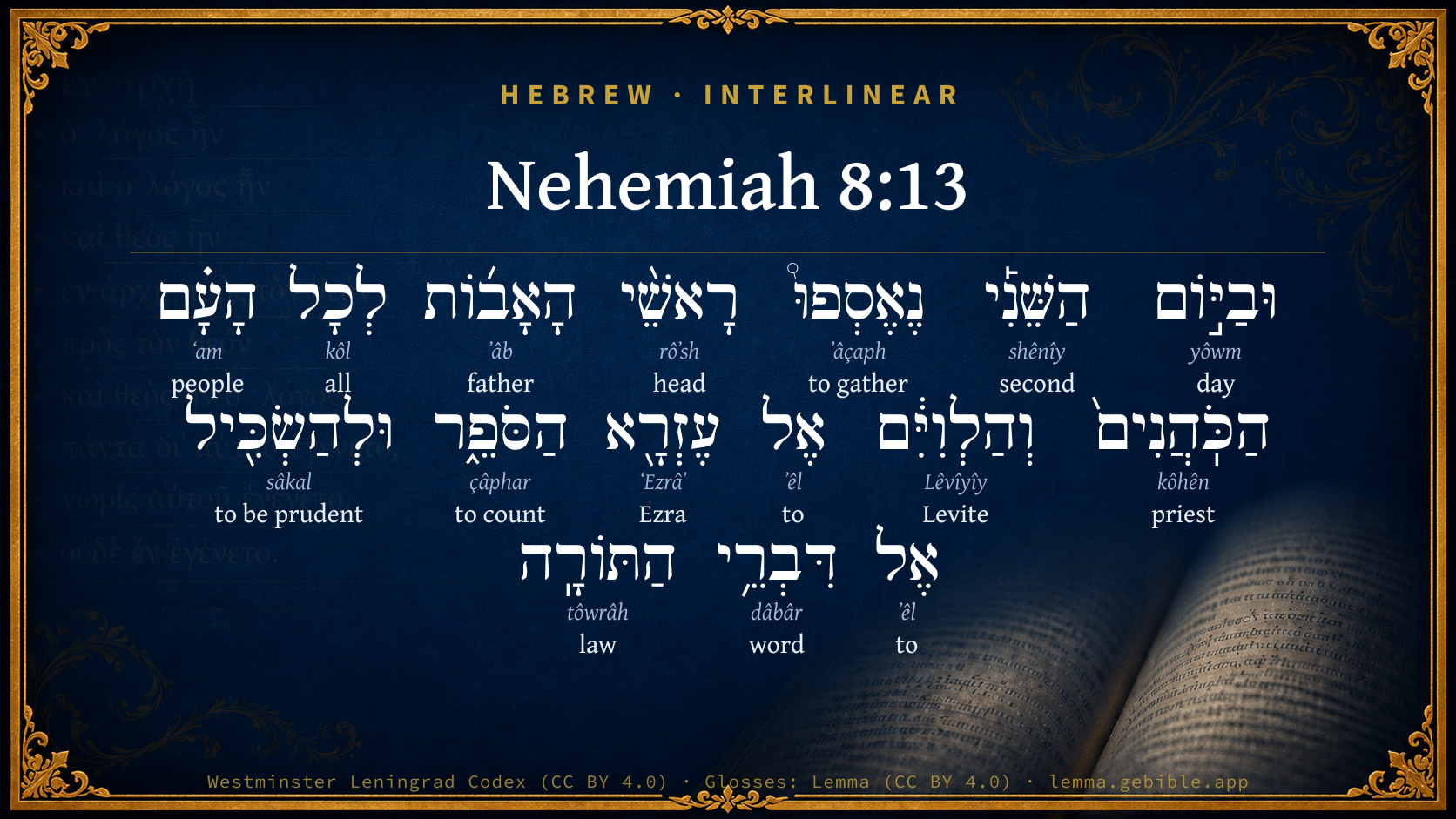
Nehemiah 8:13

Hebrew (Westminster Leningrad Codex) Nehemiah 8:13 appears in the Hebrew Old Testament. The text above is from the Westminster Leningrad Codex. Each word links to its Strong’s number, a concise gloss, and parsing drawn from the Open Scriptures Hebrew Bible morphology. Click any word for its full Brown-Driver-Briggs (BDB) entry.
Download image
Cite this verse

Nehemiah 8:13 (World English Bible). Public Domain. Lemma interlinear Bible study tool, https://lemma.gebible.app/v/nehemiah/8/13.

Show BibTeX & RIS
BibTeX
RIS
English Translation
On the second day were gathered together the heads of fathers' [houses] of all the people, the priests, and the Levites, to Ezra the scribe, even to give attention to the words of the law.
World English Bible · Public Domain
Download a study sheet

One document with this verse’s original text, its word-by-word gloss line, the meaning frame, cross-references with their text, attributed commentary, and full source and license credits — printable, and it pastes into notes with its structure intact.

This verse Autodidact and up

Study sheet (.html) Plain text (.txt)

A passage Seminary Student

Up to 50 verses in one chapter. A passage sheet keeps up to 6 commentary sources and 12 cross-references per verse, in the order this page ranks them, and says so on the sheet whenever that leaves anything out. Ask for a single verse and you get the Autodidact verse sheet above.

Everything on this page stays free to read, with no account — the sheet is a download of what is already on screen, not access to it.

Want to remove ads? Support Godless Engineer
Compare translations 3

The same verse in 3 English versions, stacked beneath the original-language interlinear above. Click any original word for its lexicon entry.

Each is an independent rendering of the whole verse — the interlinear is not word-aligned to these translations.

Highlighted words mark where these versions differ — a whole-verse word diff, not a word-by-word alignment.

  • World English Bible Public Domain
    On the second day were gathered together the heads of fathers' [houses] of all the people, the priests, and the Levites, to Ezra the scribe, even to give attention to the words of the law.
  • King James Version Public Domain
    And on the second day were gathered together the chief of the fathers of all the people, the priests, and the Levites, unto Ezra the scribe, even to understand the words of the law.
  • unfoldingWord Literal Text CC BY-SA 4.0
    And on the second day, the heads of the fathers of all the people, the priests, and the Levites were gathered to Ezra the scribe, even to give attention to the words of the law.

unfoldingWord Literal Text — © unfoldingWord, licensed CC BY-SA 4.0. Word-aligned USFM3 via Door43 (git.door43.org/unfoldingWord/en_ult).

Versions to compare (up to 4)

3 of 4 selected

Show all 18 translations

Every available English version of this verse, each an independent rendering of the whole verse.

  • World English Bible Public Domain
    On the second day were gathered together the heads of fathers' [houses] of all the people, the priests, and the Levites, to Ezra the scribe, even to give attention to the words of the law.
  • Berean Standard Bible Public Domain
    On the second day of the month, the heads of all the families, along with the priests and Levites, gathered around Ezra the scribe to study the words of the Law.
  • Majority Standard Bible Public Domain
    On the second day of the month, the heads of all the families, along with the priests and Levites, gathered around Ezra the scribe to study the words of the Law.
  • King James Version Public Domain
    And on the second day were gathered together the chief of the fathers of all the people, the priests, and the Levites, unto Ezra the scribe, even to understand the words of the law.
  • American Standard Version (1901) Public Domain
    And on the second day were gathered together the heads of fathers' `houses' of all the people, the priests, and the Levites, unto Ezra the scribe, even to give attention to the words of the law.
  • Revised Version (1885) Public Domain
    And on the second day were gathered together the heads of fathers’ houses of all the people, the priests, and the Levites, unto Ezra the scribe, even to give attention to the words of the law.
  • Geneva Bible (1599) Public Domain
    And on the second day the chiefe fathers of all the people, the Priests and the Leuites were gathered vnto Ezra the scribe, that he also might instruct them in the wordes of the Lawe.
  • Douay-Rheims (1899) Public Domain
    And on the second day the chiefs of the families of all the people, the priests, and the Levites were gathered together to Esdras the scribe, that he should interpret to them the words of the law.
  • Young's Literal Translation Public Domain
    And on the second day have been gathered heads of the fathers of all the people, the priests, and the Levites, unto Ezra the scribe, even to act wisely concerning the words of the law.
  • Literal Standard Version CC BY-SA 4.0
    And on the second day have been gathered heads of the fathers of all the people, the priests, and the Levites, to Ezra the scribe, even to act wisely concerning the words of the Law.
  • Unlocked Literal Bible CC BY-SA 4.0
    On the second day the leaders of the ancestors' families from all the people, the priests and the Levites, came together to Ezra the scribe to gain insight from the words of the law.
  • unfoldingWord Literal Text CC BY-SA 4.0
    And on the second day, the heads of the fathers of all the people, the priests, and the Levites were gathered to Ezra the scribe, even to give attention to the words of the law.
  • Darby Bible Public Domain
    And on the second day were gathered together the chief fathers of all the people, the priests, and the Levites, to Ezra the scribe, even to gain wisdom as to the words of the law.
  • World Messianic Bible Public Domain
    On the second day, the heads of fathers’ households of all the people, the priests, and the Levites were gathered together to Ezra the scribe, to study the words of the law.
  • Webster's Bible Public Domain
    And on the second day were assembled the chief of the fathers of all the people, the priests, and the Levites, to Ezra the scribe, even to understand the words of the law.
  • Free Bible Version CC BY-SA 4.0
    The next day family leaders of all the people, as well as the priests and Levites, joined with Ezra the scribe to study the Law in more depth.
  • Bible in Basic English Public Domain
    And on the second day the heads of families of all the people and the priests and the Levites came together to Ezra the scribe, to give attention to the words of the law.
  • JPS Tanakh (1917) Public Domain
    And on the second day were gathered together the heads of fathers' houses of all the people, the priests, and the Levites, unto Ezra the scribe, even to give attention to the words of the Law.

Literal Standard Version (2020), Covenant Press — licensed CC BY-SA 4.0. Text via the HelloAO Bible API (eBible.org). Unlocked Literal Bible (unfoldingWord) — licensed CC BY-SA 4.0. Text via the HelloAO Bible API (eBible.org). unfoldingWord Literal Text — © unfoldingWord, licensed CC BY-SA 4.0. Word-aligned USFM3 via Door43 (git.door43.org/unfoldingWord/en_ult). Free Bible Version, Dr. Jonathan Gallagher — licensed CC BY-SA 4.0. Text via the HelloAO Bible API (eBible.org).

Word by word

More ways to search: Search by grammar → Find every occurrence → Compare this word →

Practice this passage: Drill this verse → Learn its vocabulary →

עֶזְרָ֖א
ʻEzrâʼ
H5830
“Ezra”
Noun, Proper
Part of Speech
Noun
Type
Proper
Full BDB Definition

Origin: a variation of H5833

TWOT: None

Ezra = "help" - the priest and scribe who led the reforms of the returned exiles in Jerusalem; co-worker with Nehemiah - a priest with Zerubbabel - another post-exilic Jew
  1. וּבַיּ֣וֹם yôwm H3117 “and · in/at the · day” Conjunction + Preposition, Determined + Noun, Common, Masculine, Singular, Absolute
  2. הַשֵּׁנִ֡י shênîy H8145 “the · second” Particle, Definite Article + Adjective, Ordinal number, Masculine, Singular, Absolute
  3. נֶאֶסְפוּ֩ ʼâçaph H622 “to gather” Verb, Niphal, Perfect, 3rd Person, Common, Plural
  4. רָאשֵׁ֨י rôʼsh H7218 “heads of” Noun, Common, Masculine, Plural, Construct
  5. הָאָב֜וֹת ʼâb H1 “the · fathers” Particle, Definite Article + Noun, Common, Masculine, Plural, Absolute
  6. לְכָל kôl H3605 “to/for · all of” Preposition + Noun, Common, Masculine, Singular, Construct
  7. הָעָ֗ם ʻam H5971 “the · people” Particle, Definite Article + Noun, Common, Masculine, Singular, Absolute
  8. הַכֹּֽהֲנִים֙ kôhên H3548 “the · priests” Particle, Definite Article + Noun, Common, Masculine, Plural, Absolute
  9. וְהַלְוִיִּ֔ם Lêvîyîy H3881 “and · the · Levites” Conjunction + Particle, Definite Article + Noun, Gentilic, Masculine, Plural, Absolute
  10. אֶל ʼêl H413 “to” Preposition
  11. הַסֹּפֵ֑ר çâphar H5608 “the · scribe” Particle, Definite Article + Noun, Common, Masculine, Singular, Absolute
  12. וּלְהַשְׂכִּ֖יל sâkal H7919 “and · to be prudent” Conjunction + Preposition + Verb, Hiphil, Infinitive Construct
  13. אֶל ʼêl H413 “to” Preposition
  14. דִּבְרֵ֥י dâbâr H1697 “words of” Noun, Common, Masculine, Plural, Construct
  15. הַתּוֹרָֽה tôwrâh H8451 “the · law” Particle, Definite Article + Noun, Common, Feminine, Singular, Absolute

About this verse

These counts appear in no published source. They are computed here, from the morphology-tagged text and Lemma’s own curated glosses. What Lemma adds →

16
words
15
distinct lemmas
Historical
section

Notable vocabulary

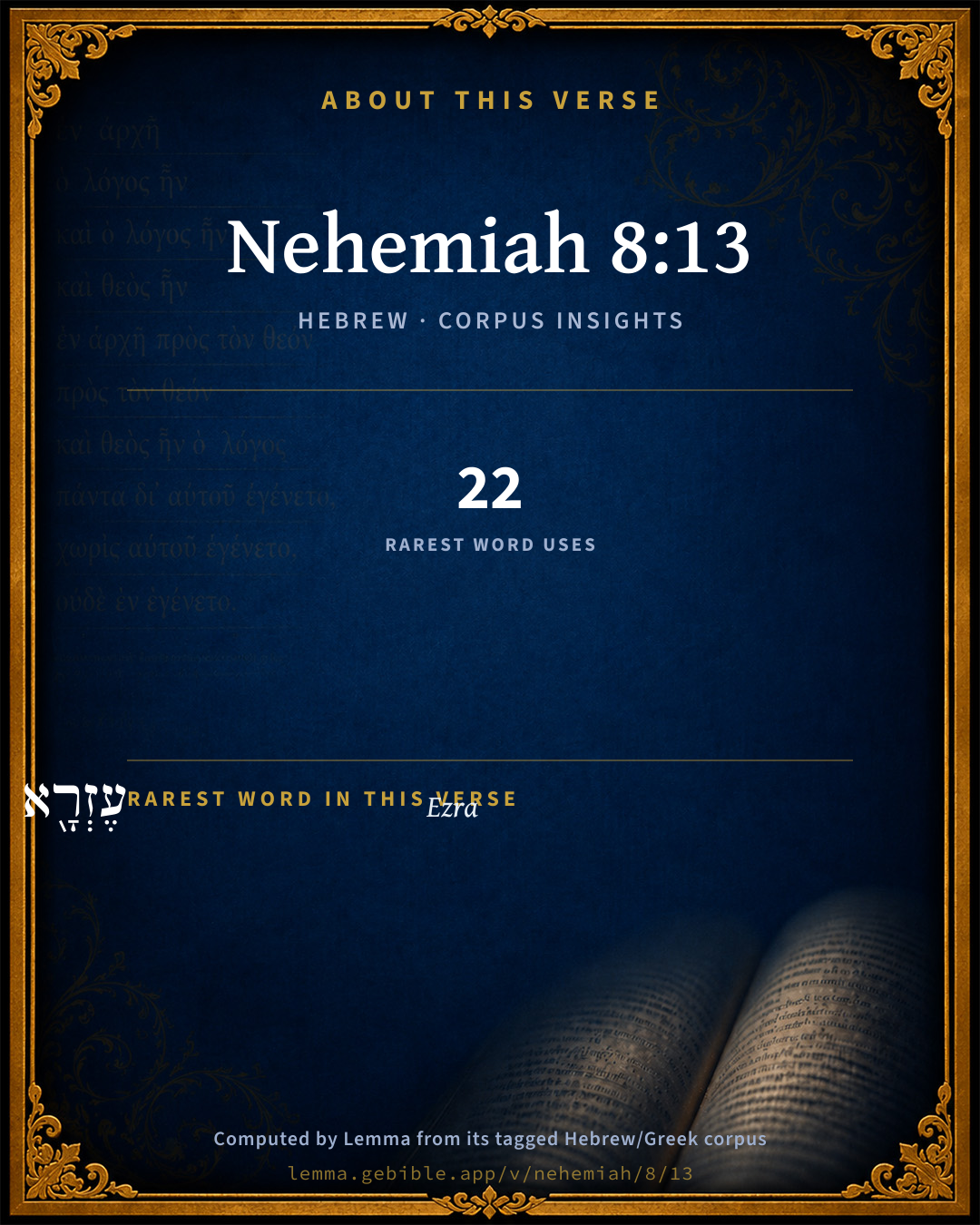
The rarest word here is עֶזְרָ֖א Ezra H5830 — appearing just 22 times in the whole Hebrew Bible.

Shared distinctive vocabulary

עֶזְרָ֖א Ezra H5830 occurs in 22 verses of the Hebrew Bible. Also found in:

Grammatical profile

  • 2 verbs
  • 11 nouns
  • 1 adjective
  • 2 prepositions

Verb forms

  • נֶאֶסְפוּ֩ Niphal · Perfect
  • וּלְהַשְׂכִּ֖יל Hiphil · Infinitive Construct

Repetition

A word recurs within this verse — often emphatic in Hebrew:

  • אֶל to H413 ×2

Cross-references

11

Topical passages linked to Nehemiah 8:13 in the Treasury of Scripture Knowledge — connected by theme and wording, ordered by reader-vote popularity; previews shown in the World English Bible.

  • Proverbs 2:1–6 My son, if you will receive my words, And store up my commandments within you;
  • Proverbs 8:33–34 Hear instruction, and be wise. Don't refuse it.
  • Proverbs 12:1 Whoever loves correction loves knowledge, But he who hates reproof is stupid.
  • 2 Chronicles 30:23 The whole assembly took counsel to keep other seven days; and they kept [other] seven days with gladness.
  • Nehemiah 8:7–8 Also Jeshua, and Bani, and Sherebiah, Jamin, Akkub, Shabbethai, Hodiah, Maaseiah, Kelita, Azariah, Jozabad, Hanan, Pelaiah, and the Levites, caused the people to understand the law: and the people [stood] in their place.
  • Mark 6:33–34 They saw them going, and many recognized him and ran there on foot from all the cities. They arrived before them and came together to him.
  • Luke 19:47–48 He was teaching daily in the temple, but the chief priests and the scribes and the leading men among the people sought to destroy him.
  • Luke 24:32 They said one to another, "Weren't our hearts burning within us, while he spoke to us along the way, and while he opened the Scriptures to us?"
  • Acts 4:1 As they spoke to the people, the priests and the captain of the temple and the Sadducees came to them,
  • Acts 13:42 So when the Jews went out of the synagogue, the Gentiles begged that these words might be preached to them the next Sabbath.
  • 2 Timothy 2:24–25 The Lord's servant must not quarrel, but be gentle towards all, able to teach, patient,

Cross-references courtesy of OpenBible.info (CC BY 4.0).

Hebrew and Greek witnesses Masoretic Hebrew ↔ Greek Septuagint

The same verse in the two great witnesses to the Old Testament, shown verse-for-verse.

These are two independent witnesses, not word-aligned to each other, and the Septuagint is shown in lemma (dictionary) form.

Hebrew Nehemiah 8:13 Masoretic · Westminster Leningrad Codex

וּבַיּ֣וֹם הַשֵּׁנִ֡י נֶאֶסְפוּ֩ רָאשֵׁ֨י הָאָב֜וֹת לְכָל הָעָ֗ם הַכֹּֽהֲנִים֙ וְהַלְוִיִּ֔ם אֶל עֶזְרָ֖א הַסֹּפֵ֑ר וּלְהַשְׂכִּ֖יל אֶל דִּבְרֵ֥י הַתּוֹרָֽה

On the second day were gathered together the heads of fathers' [houses] of all the people, the priests, and the Levites, to Ezra the scribe, even to give attention to the words of the law.

World English Bible · Public Domain

Greek LXX Structure differs

The Septuagint has no separate book of Nehemiah. Its Greek text is the second half of Esdras B (2 Esdras), chapters 11–23; Ezra is the first half (1–10).

A verse-for-verse comparison isn’t shown here because the chapters and verses don’t line up. Switch to the LXX edition with the MT / LXX toggle above to read the Greek directly.

Hebrew: Westminster Leningrad Codex (CC BY 4.0). Greek: Septuagint (public domain); English from a public-domain English Septuagint. How the Septuagint differs from the Hebrew →

Commentary

Notes on Nehemiah 8:13 from classic Christian and Jewish commentators (each source and its license shown beneath its notes). The classic Christian expositions comment on the surrounding passage and are grouped to its opening verse, so a note may address several verses; the Jewish commentaries on the Tanakh (Rashi and others) are per-verse, so they appear only where the commentator wrote on this verse.

Lemma curates 59 commentaries, every one of them public domain or Creative Commons licensed, each selected and text-cleaned for this edition rather than reprinted as found. About our sources →

Matthew Henry's Commentary

We have here,

I. The people's renewed attendance upon the word. They had spent the greatest part of one day in praying and hearing, and yet were so far from being weary of that new moon and sabbath that the next day after, though it was no festival, the chief of them came together again to hear Ezra expound (Neh 8:13), which they found more delightful and gainful than any worldly pleasure or profit whatsoever. Note, The more we converse with the word of God, if we rightly understand it and be affected with it, the more we shall covet to converse with it, and to increase in our acquaintance with it, saying, How sweet are thy words unto my mouth! Those that understand the scriptures well will still be desirous to understand them better. Now the priests and the Levites themselves came with the chief of the people to Ezra, that prince of expositors, to understand the words of the law, or, as it is in the margin, that they might instruct in the words of the law; they came to be taught themselves, that they might be qualified to teach others. Observe, 1. Though, on the first day, Ezra's humility had set them on his right hand and on his left, as teachers with him (Neh 8:4, Neh 8:7), yet now, they being by trial made more sensible than ever of their own deficiencies and his excellencies, on the second day their humility set them at Ezra's feet, as learners of him. 2. Those that would teach others must themselves receive instructions. Priests and Levites must be taught first and then teach.

II. The people's ready obedience to the word, in one particular instance, as soon as they were made sensible of their duty therein. It is probable that Ezra, after the wisdom of his God that was in his hand (Ezr 7:25), when they applied to him for instruction out of the law on the second day of the seventh month, read to them those laws which concerned the feasts of that month, and, among the rest, that of the feast of tabernacles, Lev 23:34; Deu 16:13. Ministers should preach not only that which is true and good, but that which is seasonable, directing to the work of the day in its day. Here is, 1. The divine appointment of the feast of tabernacles reviewed, Neh 8:14, Neh 8:15. They found written in the law a commandment concerning it. Those that diligently search the scriptures will find those things written there which they had forgotten or not duly considered. This feast of tabernacles was a memorial of their dwelling in tents in the wilderness, a representation of our tabernacle state in this world, and a type of the holy joy of the gospel church. The conversion of the nations to the faith of Christ is foretold under the figure of this feast (Zac 14:16); they shall come to keep the feast of tabernacles, as having here no continuing city. This feast was to be proclaimed in all their cities. The people were themselves to fetch boughs of trees (they of Jerusalem fetched them from the mount of Olives) and to make booths, or arbours, of them, in which they were to lodge (as much as the weather would permit) and to make merry during the feast. 2. This appointment religiously observed, Neh 8:16, Neh 8:17. Then we read and hear the word acceptably and profitably when we do according to what is written therein, when what appears to be our duty is revived after it has been neglected. (1.) They observed the ceremony: They sat in booths, which the priests and Levites set up in the courts of the temple; those that had houses of their own set up booths on the roofs of them, or in their courts; and those that had not such conveniences set them up in the streets. This feast had usually been observed (Ch2 5:3; Ezr 3:4), but never with such solemnity as now since Joshua's time, when they were newly settled, as they were now newly re-settled in Canaan. That man loves his house too well that cannot find in his heart to quit it, awhile, in compliance either with an ordinance or with a providence of God. (2.) They minded the substance, else the ceremony, how significant soever, would have been insignificant. [1.] They did it with gladness, with very great gladness, rejoicing in God and his goodness to them. All their holy feasts, but this especially, were to be celebrated with joy, which would be much for the honour of God, and their own encouragement in his service. [2.] They attended the reading and expounding of the word of God during all the days of the feast, v. 18. They improved their leisure for this good work. Spare hours cannot be better spent than in studying the scriptures and conversing with them. At this feast of tabernacles God appointed the law to be read once in seven years. Whether this was that year of release in which that service was to be performed (Deu 31:10, Deu 31:11) does not appear; however they spent all the days of the feast in that good work, and on the eighth day was a solemn assembly, as God had appointed, in which they finished the solemnity the twenty-second day of the month, yet did not separate, for the twenty-fourth day was appointed to be spent in fasting and prayer. Holy joy just not indispose us for godly sorrow any more than godly sorrow for holy joy.

Matthew Henry's Commentary on the Whole Bible (1708–1710) — public domain (CC PDM 1.0). Text via the HelloAO Bible API.

Trapp's Complete Commentary

John Trapp

Neh 8:13 And on the second day were gathered together the chief of the fathers of all the people, the priests, and the Levites, unto Ezra the scribe, even to understand the words of the law.

Ver. 13. And on the second day] The next day after they had heard the law expounded, but were not so well satisfied in some points or cases: they "follow on to know the Lord," Hos 6:3. Divine knowledge is as a great lady, that will not easily be acquainted with us but upon further suit, Pro 2:3-4.

Were gathered together the chief of the fathers, &c.] Aeneas Sylvius was wont to say of knowledge, Popular men should esteem it as silver, noblemen as gold, princes prize it as pearls.

The priests, and Levites] These teachers of others took no scorn to learn from Ezra, that perfect scribe. The wisest here know but in part; because we prophesy but in part, 1Co 13:9; that is, we are taught but imperfectly, and those that should show us the way are themselves to seek; to teach us to run to Ithiel, the arch-prophet, as that great wise man did, Pro 30:1. The greatest part of those things which we know is the least part of the things which we know not, as that father saith.

Unto Ezra the scribe] Who was well instructed to the kingdom of God; and no less ready to throw out of his treasury, &c., Mat 13:52. It is said of Tacitus, that he knew all that he should know of the affairs of the world; and that he was primus in Historia; first in history, and that ex eius ore nil temere excidit he cut up nothing rashly from his mouth. (Scalig.). Think the same of Ezra, and much more; he was an able teacher of the ablest teachers, a sacred oracle, a living library, the argutest and accuratest of men after the prophets; as Austin is said to have been after the apostles, in contemplation and disputation.

Even to understand the words of the law] Which he had the day before expounded; and in some passages whereof they had a desire to be better resolved and satisfied. No man can possibly speak all at once, or deliver the mind of God so clearly and fully, but that there may be place left for cases and queries.

John Trapp, A Commentary or Exposition upon All the Books of the Old and New Testament (1647–1656) — public domain. Text from a community e-Sword module.

Joseph Benson's Commentary

Neh 8:13. On the second day were gathered to him the chief of the fathers, the priests, &c. — Thus manifesting both humility and serious godliness, in that they chose rather to confess their ignorance, in order that they might be instructed, than vainly to pretend to more knowledge than they had, and were more careful to learn and practise their duty than to preserve their reputation with the people. To understand the words of the law — That they might obtain a more perfect knowledge of some things, which they had heard, and partly knew before, and so might instruct the people in them.

Joseph Benson's Commentary on the Old and New Testaments (1811–1818) — public domain. Text from a community e-Sword module.

Whedon's Commentary on the Bible

Daniel D. Whedon

THE FEAST OF TABERNACLES, Neh_8:13-18.

13. The second day — The second day of the month, the next day after the feast of the new moon. So interested had the people become in the reading of the law, that on the very next day after the feast the chief of the fathers, the principal elders and representatives of the nation, met again to continue the study of the law. There were manifest inconveniences in assembling the entire population, men, women, and children, as on the previous day, (Neh_8:2,) and so only the chief representatives came together on the second day. Along with the principal fathers came also the priests and the Levites, for it was important that all of these should know the law. Bertheau and Keil construe the words the priests and the Levites with all the people, as genitive, (with ל,) after chief of the fathers; that is, chief fathers of the priests and of the Levites, as well as of all the people. According to this construction, not all the priests and Levites came, but only their chief elders or representatives. We prefer, however, to construe the words priests and Levites as subjects to the verb were gathered, and to understand that the priests and Levites assembled with the rest, not merely by their principal leaders, but in a body. It need not follow that all the priests and Levites were present, but rather the principal part of them.

Unto Ezra the scribe — Who was profoundly versed in the law, and so capable of instructing all classes of the people.

Even to understand — This states the purpose for which they came to Ezra. The vav, (ו,) translated even, denotes that what follows is an additional and explanatory clause. Its force may be given thus: and (their coming to Ezra was) for the purpose of giving thoughtful attention (השׂכיל) to the words of the law.

Daniel D. Whedon (gen. ed.), Commentary on the Old and New Testaments (1874–1909) — public domain. Text from a community e-Sword module.

Keil & Delitzsch

C. F. Keil & F. Delitzsch

Celebration of the feast of tabernacles. - Neh 8:13 On the second day were gathered together the heads of the houses of all the people, of the priests, and of the Levites to Ezra the scribe, to attend to the words of the law. The infinitive להשׂכּיל may indeed be taken (as by Bertheau) as the continuation of the finite verb, instead of as infinitive absolute (Ewald, 352, c); this is, however, admissible only in cases where the second verb either states what must be done, or further describes the condition of affairs, while להשׂכּיל here states the purpose for which the heads of the people, etc. assembled themselves unto Ezra. Hence we take להשׂכּיל in its usual meaning, and the w before it as explicative. אל השׂכּיל, as in Psa 41:1, expresses taking an attentive interest in anything. They desired to be further and more deeply instructed in the law by Ezra.

Neh 8:14-16

And they found written in the law that the Lord had commanded Moses, that the children of Israel should dwell in booths in the feast of the seventh month; and that they should publish and proclaim in all their cities, and in Jerusalem, saying: "Go forth to the mount, and fetch olive branches, etc. to make booths, as it is written." This statement is not to be understood as saying that the heads of the people sought in the law, fourteen days before the feast, for information as to what they would have to do, that they might prepare for the due celebration of the feast of tabernacles (Bertheau). The text only states that the heads of the people again betook themselves to Ezra on the second day, to receive from him instruction in the law, and that in reading the law they found the precept concerning the celebration of the festival in booths, i.e., they met with this precept, and were thereby induced to celebrate the approaching festival in strict accordance with its directions. The law concerning the feast of tabernacles, of which the essentials are here communicated, is found Lev 23:39-43. In Deu 16:13 they were only commanded to keep the feast with gladness. The particular of dwelling in booths or bowers is taken from Lev 23:43; the further details in Neh 8:15 relate to the carrying out of the direction: "He shall take you on the first day the boughs of goodly trees, branches of palm trees, and the boughs of thick trees, and willows of the brook" (Lev 23:43). Go to the mountain, a woody district, whence branches may be obtained. עלי, state constructive plural of עלה, leaf, foliage, here leafy boughs or branches of trees. זית, the olive, שׁמן עץ, the wild olive (oleaster), the myrtle, the palm, and branches of thick-leaved trees, are here mentioned (the two latter being also named in Leviticus). כּכּתוּב does not relate to the preparation of the booths, but to the precept that the feast should be kept in booths. In Neh 8:16 the accomplishment of the matter is related, presupposing a compliance with the proclamation sent out into all the cities in the land, and indeed so speedy a compliance that the booths were finished by the day of the feast. The object (the branches of Neh 8:15) must be supplied to ויּביאוּ from the context. They made themselves booths, every one upon the roof of his house, and in their courts, and in the courts of the house of God, and in the open space at the water-gate (see on Neh 8:3), and the open space at the gate of Ephraim. On the situation of this gate, see rem. on Neh 3:8. The open space before it must be thought of as within the city walls. On these two public places, booths were probably made by those who had come to Jerusalem, but did not dwell there; while the priests and Levites belonging to other places would build theirs in the courts of the temple.

Neh 8:17

And the whole community that had returned from captivity (comp. Ezr 6:21) made themselves booths and dwelt in booths; for since the days of Joshua the son of Nun unto that day, had not the children of Israel done so. כּן, so, refers to the dwelling in booths; and the words do not tell us that the Israelites had not celebrated this festival since the days of Joshua, that is, since they had taken possession of Canaan: for, according to Ezr 3:4, those who returned from captivity kept this feast in the first year of their return; and a celebration is also mentioned after the dedication of Solomon's temple, Ch2 7:9; Kg1 8:65. The text only states that since the days of Joshua the whole community had not so celebrated it, i.e., had not dwelt in booths. Neither do the words imply that since the days of Joshua to that time no booths at all had been made at the celebration of the feast of tabernacles, but only that this had not been done by the whole congregation. On former occasions, those who came up to Jerusalem may have regarded this precept as non-essential, and contented themselves by keeping the feast with solemn assemblies, sacrifices, and sacrificial feasts, without making booths and dwelling in them for seven days.

Neh 8:18

And the book of the law was read from day to day. ויּקרא with the subject indefinite, while Ramb. and others supply Ezra. The reading of the law was only ordered at that celebration of the feast of tabernacles which occurred during the sabbatical year, Deu 31:10. The last day was the seventh, for the eighth as a עצרת did not belong to the feast of tabernacles; see rem. on Lev 23:36. כּמּשׁפּט like Ch2 4:20, and elsewhere.

Keil & Delitzsch — Biblical Commentary on the Old Testament (1861–1891) — public domain (CC PDM 1.0). Text via the HelloAO Bible API. (Old Testament only.)

Ellicott's Commentary for English Readers

(13) The chief of the fathers.—Not the vast multitude now, as the great feast was not yet.

Even to understand.—To consider, or give attention to: that is, to learn the full meaning of the almost forgotten festival. The dwelling in booths had fallen into disuse.

(13-18) The Feast of Tabernacles.

A Bible Commentary for English Readers, edited by Charles John Ellicott (1878–1897) — public domain. Text from a community e-Sword module.

The Cambridge Bible for Schools and Colleges

gen. ed. J. J. S. Perowne

13–18. The Feast of Tabernacles

13. the second day] i.e. of the month Tisri, cf. Neh_8:2.

the chief of the fathers] R.V. the heads of the fathers’ houses. The leading men of the nation apply to Ezra for further instruction in ‘the law.’ It will be observed that ‘the priests and the Levites’ join in this application with the laymen. Are we to suppose that they too were ignorant of the full contents of ‘the law’? This is possible, if the contents of ‘the law’ had hitherto been chiefly known by oral tradition or by disconnected writings. If this had been the case and Ezra had made himself master of the complete continuous ‘law,’ we shall be able to understand the action of ‘the priests and Levites.’ From the subsequent verses (Neh_8:14-15) it appears that Ezra supplied them not so much with profound interpretations of the Law as with statements relative to its contents and positive enactments.

even to understand] R.V. even to give attention to. The Hebrew word (l’haskîl) denotes intelligent consideration, as in Psa_41:1, ‘Blessed is he that considereth the poor;’ Psa_101:2, ‘I will behave myself wisely in a perfect way’ (marg. ‘give heed unto’); Dan_9:13, ‘have discernment in thy truth.’ The copula, rendered ‘even,’ with the infinitive defines the action of the main verb, as in Isa_44:28, ‘shall perform all my pleasure: even saying (lit. and to say) of Jerusalem, She shall be built.’ This is better than supposing the infinitive to be used for the finite verb = ‘and they gave attention.’

The Cambridge Bible for Schools and Colleges (gen. ed. J. J. S. Perowne; Cambridge University Press, 1878–1918) — public domain. Text from a community e-Sword module.

John Gill's Exposition

And on the second day were gathered together,.... The second day of the month, and of the new year, the day after the feast of blowing of trumpets, and after the law had been read and explained:

the chief of the fathers of all the people: heads of tribes and families: the priests and the Levites; who, though they were instructors of others, needed to be taught themselves, of which they were sensible: and therefore came

unto Ezra the scribe, even to understand the words of the law; some things in it, which, upon reading the day before, they observed had some difficulty in them, and which they did not clearly and thoroughly understand; and therefore applied to Ezra, a ready scribe in the law, for better information, and that they might be better able to teach the people; which was highly commendable in them.

John Gill's Exposition of the Whole Bible (1746–1763) — public domain (CC PDM 1.0). Text via the HelloAO Bible API.

Albert Barnes' Notes on the Bible

To understand - Rather, “to consider.”

Albert Barnes' Notes on the Bible (1834–1885) — public domain. Text from a community e-Sword/MySword module.

Haydock's Catholic Bible Commentary

Law, concerning some difficulties, particularly the manner of keeping the ensuing festival. (Tirinus) --- Thus Christ explained to his disciples what he had spoken to the people. (Haydock)

George Leo Haydock (1774–1849), Haydock's Catholic Family Bible and Commentary, 1859 edition — public domain. Excludes Psalms (Douay-Rheims chapter numbering differs from Protestant) and Deuterocanonical books (Catholic canon only).

Matthew Poole's English Annotations

Choosing rather to confess their ignorance for their edification, than vainly to pretend to more knowledge than they had; wherein they show both true humility and serious godliness, that they were more careful to learn and practise their duty, than to preserve their reputation with the people.

Even to understand the words of the law; that they might more exactly understand the meaning of some things which they had heard before, and so instruct the people in them.

Matthew Poole's English Annotations on the Holy Bible (1683–1685) — public domain. Text from a community e-Sword/MySword module.

The Pulpit Commentary

And on the second day were gathered together the chief of the fathers. At times it is true that "increase of appetite doth grow by what it feeds on." Once let the sweetness of the Divine word be tasted and appreciated, and there springs up in the heart instantly a desire for more a wish to continue in the study a feeling like that of the Psalmist when he said, "Lord, what love have I unto thy law: all the day long is my study in it". (Psa_119:97) The Jews, taught by Ezra in the law of God on the first day of the month, return to him on the second, desirous of hearing more, hungering and thirsting after the word of life, of which they have felt the power and the excellency. To understand. Rather, "to consider," as in Psa_41:1.

Vers. 13-18. An influential congregation.

Account of a smaller gathering than that recorded in the first part of the chapter, but likely from its character to be equally or more fruitful of good.

I THE MEETING CONVENED (ver. 13).

1. The congregation. Select; consisting of the principal heads of houses, priests, and Levites.

2. Their design. To study the law with a view to the better understanding of it.

3. Their teacher. The ablest doctor of the day.

II THE DISCOVERY MADE (vers. 14, 15). The law of the feast of tabernacles. Perhaps, although it had been kept on the first return from Babylon, it had been omitted in recent troublous times, or some important particulars had been neglected for want of instruction in the law. Now they come face to face with the original precepts.

III THE OBEDIENCE RENDERED (vers. 16-18). The chiefs doubtless proclaim the law to the people (ver. 15), and these obey it. So the feast was kept

1. By each and all.

2. With exactness. Such as had not been known since the days of Joshua.

3. With gladness.

4. With daily reading of the book of the law. It was thus a very pleasant and profitable week.

Lessons:

1. The value of well-instructed rulers and ministers of religion. Especially of such as are well instructed in Holy Scripture. An ignorant clergy is one of the greatest evils, and scarcely less a clergy learned in everything but the Bible, the teaching of whose truths is their main business. "They be blind leaders of the blind. And if the blind lead the blind, both shall fall into the ditch." But it is an omen of good when pastors and teachers are diligent students of the word, availing themselves of the assistance of the ablest scholars of the time, and thus becoming "instructed unto the kingdom of heaven," "able to teach others also.

2. The careful student of God"s word is rewarded by important discoveries. He will find truths, precepts, and promises which are new to him, or come with all the freshness and force of a new revelation, to correct his beliefs or his conduct, or to give him new comfort and joy. The Bible is an inexhaustible mine of eternal treasures. It will repay the constant study of a life.

3. A condition of external peace and settlement is eminently favourable to the study and general practice of God"s law. These Jews could turn their serious attention to the instructions and ordinances of their law now that they were safe from the assaults of their enemies. We cannot be too thankful in this view for the quiet times we enjoy, nor too earnest in promoting to the utmost of our power the peace and mutual good will of all nations.

4. God is to be worshipped and his ordinances observed according to his own directions.

5. The celebration of Divine ordinances promotes, and should be with, gladness. The gladness of gratitude for Divine favours, the joy of a good conscience which obedience brings, the joy of mutual love and fellowship, the joy of hope, etc. Happy the people who thus unite in the service of God.

HOMILIES BY W. CLARKSON. Vers. 13-18. Keeping the feast.

"On the second day," the day after the great and affecting assembly of all the citizens, came together a representative company, "the chief of the fathers of all the people" (ver. 13), beside the priests and Levites, to "understand" or consider the law, that they might encourage all the children of Israel to a regular and faithful observance of it. This gathering led at once to

I AN ACT OF REVIVED AND REJOICING OBEDIENCE. For "they found written in the law ... that the children of Israel should dwell in booths in the feast of the seventh month" (ver. 14). They came upon the commandment recorded in Leviticus 23, enjoining the observance of the feast of tabernacles or booths. This must have fallen partially, if not wholly, into disuse, though we know from Ezr_3:4 that this feast was celebrated as late as the time of Zerubbabel. Now, however, under the impulse of Nehemiah"s and Ezra"s faithful ministry, and in the glow of a religious revival, they returned to a complete and hearty observance of the ancient festival. The law required that the sacred feasts should be "proclaimed". (Lev_23:4) Giving a broad sense to the term, they took pains to proclaim it with all particularity. "In all their cities, and in Jerusalem, saying, Go forth unto the mount," etc. (ver. 15). And there was a general and hearty response. "The people went forth, and brought them, and made themselves booths" (ver. 16); "all the congregation of them that were come again out of the captivity made booths, and sat under them" (ver. 17). Moses commanded that once in seven years the law should be read" before all Israel in their hearing". (Deu_31:11) Whether this was the seventh year or not, the injunction of Moses was obeyed. They were in the mood to do all more rather than less that was enjoined, and "day by day, from the first day unto the last day, he (Ezra) read in the book of the law of God" (ver. 18). There had been no such celebration of the feast since the days of Jeshua (ver. 17), "and there was very great gladness." Now we learn from this that

1. It is possible for a nation (or a Church) with the Bible in its keeping to allow plain duties to fall into disregard.

2. That this negligence is due to a blameworthy inattention to the word of God. The Bible is too much on the shelf, too little in the hand.

3. That a return to obedience, especially to a hearty and general (unanimous) obedience, is attended with great gladness of heart.

a. Devout study,

b. earnest obedience,

c. reverent joy these are successive steps in a true revival.

II A COMMEMORATIVE SERVICE. The feast of tabernacles was essentially commemorative. "That your generation may know that I made the children of Israel to dwell in booths when I brought them out," etc. (Lev_23:43) It was well indeed that the children of the captivity should have their attention called to past days of exile. It would do them good, as it did their fathers, to look back and think what God had done unto them and for them. How he had humbled them, and how he had redeemed them. Thus they would think of two things

(1) past sorrows, not to be renewed, from which God had graciously delivered them; and

(2) past sins, never to be repeated, which God had mercifully forgiven them. One thought would lead to thankfulness, and the other to consecration; both to sacred joy. The recalling by our minds of past evils out of which God has led us, and past errors and wrongdoings which he has blotted out, will confirm our hearts in their gratitude and devotion.

III AN OPPORTUNITY OF INSTRUCTION IN SACRED THINGS. Whether the Jews felt bound to observe Deu_31:10, or whether the reading of the law from day to day was optional on their part (the latter is the more probable), we have them associating instruction with ceremonial observance. We should turn all occasions into opportunities of "inquiring the way of the Lord more perfectly," of becoming filled with the knowledge of his will in all wisdom and spiritual understanding... increasing in the knowledge of God". C. (Col_1:9, Col_1:10)

HOMILIES BY R.A. REDFORD Vers. 13-18. Restoration of the feast of tabernacles in its plenitude.

I A NOTABLE INSTANCE OF NEGLECT. The commandment was plainly written, but "since the days of Jeshua the son of Nun the children of Israel had not done so. " How much they lost? gladness, fellowship, help to their remembrance of Divine mercy, food of faith. We should follow the directions of God"s book without question. Much yet to break forth from the written pages.

II An illustration of the DEPENDENCE OF GOD"S PEOPLE ON ONE ANOTHER. The council of "fathers, priests, Levites, and Ezra the scribe gathered together to understand the words of the law." All cannot pursue the same inquiries. The progress of the Church is greatly advanced by the consecration of some to the study of the Scriptures. All councils and conferences should be held with a practical end in view, to understand in order to reformation of life and manners. Much of the deliberation of learned men has failed of God"s blessing because it has been merely speculative or controversial. We can scarcely doubt that Ezra was the leading spirit. One eminent man of God can wonderfully animate and direct his Church in great crises. The true leader will never despise counsel, but be only primus inter pares.

III A TYPICAL REPRESENTATION OF THE BELIEVING LIFE OF GOD"S PEOPLE. The festival in the green booths fetched from the mount.

1. Grateful memory and pilgrim expectation.

2. Free fellowship and happy intercourse, with Jerusalem as the centre. Church life ought to be real root of all other life. We go from our own cities to Jerusalem, and return with the sanctity of the feast, to be distributed over all the common ways and facts of an every-day existence.

3. Consecrated seasons, festival times, needed in all service of God. For the heart must be lifted up that the hands may be kept busy. Function of praise in the life. They of the captivity do well to recognise one another in their freedom. God invites us to turn nature into joy. Consecrate the very trees to him. Rejoice under the open heaven in his loving-kindness. Connect his holy mount with the simple tent that covers our head. He waits not for splendid ritual or temple, but delights in the homely praise of those who spread the beauty of his name over all the earth. R.

The Pulpit Commentary (1880–1919), ed. H.D.M. Spence-Jones & Joseph S. Exell — public domain. Text from a community e-Sword module.

John Wesley's Explanatory Notes

Levites - Chusing rather to confess their ignorance than vainly to pretend to more knowledge than they had: wherein they shew both humility, and serious godliness, that they were more careful to learn their duty than to preserve their reputation.

John Wesley, Explanatory Notes Upon the Whole Bible (1754–1765) — public domain. Text via the GEBible commentary corpus.

unfoldingWord translationNotes

Door43 World Missions Community

On the second day

"On day 2" or "On the next day" (See: Ordinal Numbers)

to gain insight from

The abstract noun "insight" can be expressed as a verb. AT: "to understand" (See: Abstract Nouns)

should live in shelters

These were temporary shelters that people made out of branches and leaves.

the seventh month

"month 7." This is the seventh month of the Hebrew calendar. It is during the last part of September and the first part of October on Western calendars. (See: Ordinal Numbers and Hebrew Months)

They should make a proclamation

"They should announce"

myrtle

a kind of small tree with colorful flowers (See: Translate Unknowns)

shade trees

"leafy trees"

as it is written

This can be translated in active form. AT: "as Moses wrote about it" (See: Active or Passive)

translationWords

day

family

priest

Levi

Ezra

scribe

law

written

Yahweh

command

Moses

Israel

life

refuge

festival

preach

Jerusalem

olive

palm

unfoldingWord translationNotes — © Distant Shores Media and the Door43 World Missions Community, licensed CC BY-SA 4.0. Source: git.door43.org/Door43/en_tn.

Rashi

Rabbi Shlomo Yitzchaki (Rashi)

And on the second day of Rosh Hashanah.

Rashi on the Tanakh — English translations: “The Judaica Press complete Tanach with Rashi, translated by A. J. Rosenberg” (CC BY 4.0); “Pentateuch with Rashi's commentary by M. Rosenbaum and A.M. Silbermann, 1929-1934” (public domain); “The Metsudah Tanach series, Lakewood, N.J” (CC BY 4.0); and “The Book of Joshua, Metsudah Publications, 1997” (CC BY 4.0). Text via Sefaria.

Lesson kit

Teaching starters — assembled from the data on this page, not authored interpretation. Every prompt links to the verse data it draws on. Edit before teaching.

Nehemiah, in the Historical, opens this verse with 16 words (15 distinct Hebrew lemmas). Its most distinctive word is ʻEzrâʼ (“Ezra”). A historical commentator’s framing appears above. Read the whole chapter for the surrounding context.

Discussion questions

  1. The word ʻEzrâʼ carries the sense “Ezra.” How does it shape the verse?
  2. How does Ezra 7:1, which shares the word «Ezra», read alongside this verse?
  3. What does the repetition of “to” (2× in this one verse) do in this verse?
  4. These translations render this verse differently; the difference is in the English rendering, not the original. What questions does that raise?
  5. «נֶאֶסְפוּ֩» is a Niphal Perfect verb. How does that grammatical form shape the action described?
  6. Compare how Matthew Henry's Commentary and Trapp's Complete Commentary read this verse. Where do they agree or differ?

Things to notice

Reading settings

Reading text

Shown beneath each verse's original-language words.

Old Testament
Old Testament edition

Read the OT as the Masoretic Hebrew (MT) or the Greek Septuagint (LXX).

English shown for the Greek Septuagint (in the Hebrew ↔ Greek comparison).

Comparing translations? Open the Compare panel on any verse page to stack up to four side by side.