
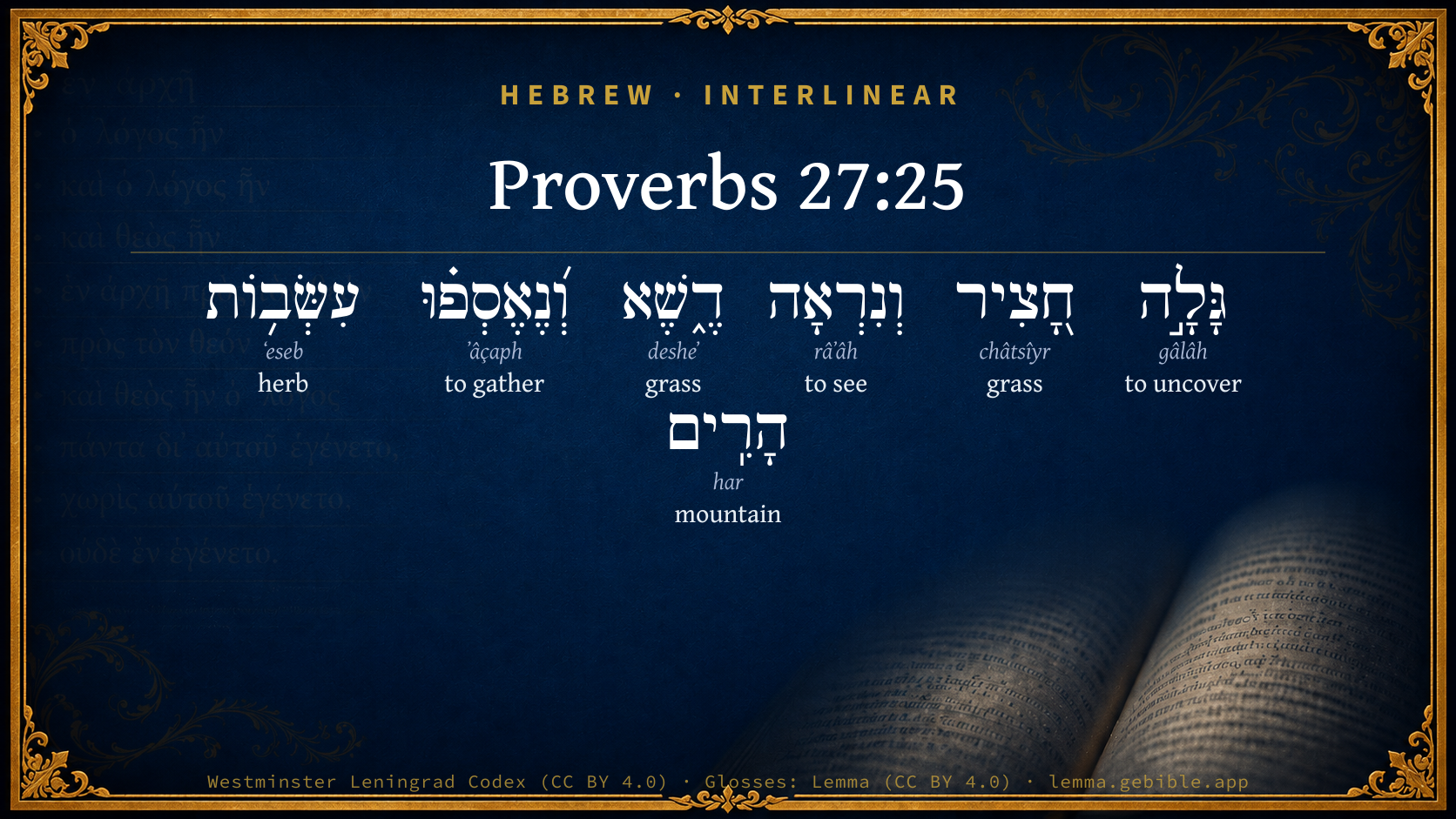
Proverbs 27:25

Hebrew (Westminster Leningrad Codex) Proverbs 27:25 appears in the Hebrew Old Testament. The text above is from the Westminster Leningrad Codex. Each word links to its Strong’s number, a concise gloss, and parsing drawn from the Open Scriptures Hebrew Bible morphology. Click any word for its full Brown-Driver-Briggs (BDB) entry.
Download image
Cite this verse

Proverbs 27:25 (World English Bible). Public Domain. Lemma interlinear Bible study tool, https://lemma.gebible.app/v/proverbs/27/25.

Show BibTeX & RIS
BibTeX
RIS
English Translation
The hay is removed, and the new growth appears, The grasses of the hills are gathered in.
World English Bible · Public Domain
Download a study sheet

One document with this verse’s original text, its word-by-word gloss line, the meaning frame, cross-references with their text, attributed commentary, and full source and license credits — printable, and it pastes into notes with its structure intact.

This verse Autodidact and up

Study sheet (.html) Plain text (.txt)

A passage Seminary Student

Up to 50 verses in one chapter. A passage sheet keeps up to 6 commentary sources and 12 cross-references per verse, in the order this page ranks them, and says so on the sheet whenever that leaves anything out. Ask for a single verse and you get the Autodidact verse sheet above.

Everything on this page stays free to read, with no account — the sheet is a download of what is already on screen, not access to it.

Want to remove ads? Support Godless Engineer
Compare translations 3

The same verse in 3 English versions, stacked beneath the original-language interlinear above. Click any original word for its lexicon entry.

Each is an independent rendering of the whole verse — the interlinear is not word-aligned to these translations.

Highlighted words mark where these versions differ — a whole-verse word diff, not a word-by-word alignment.

  • World English Bible Public Domain
    The hay is removed, and the new growth appears, The grasses of the hills are gathered in.
  • King James Version Public Domain
    The hay appeareth, and the tender grass sheweth itself, and herbs of the mountains are gathered.
  • unfoldingWord Literal Text CC BY-SA 4.0
    The grass disappears, and fresh grass is seen, and the herbs of the mountains are gathered;

unfoldingWord Literal Text — © unfoldingWord, licensed CC BY-SA 4.0. Word-aligned USFM3 via Door43 (git.door43.org/unfoldingWord/en_ult).

Versions to compare (up to 4)

3 of 4 selected

Show all 18 translations

Every available English version of this verse, each an independent rendering of the whole verse.

  • World English Bible Public Domain
    The hay is removed, and the new growth appears, The grasses of the hills are gathered in.
  • Berean Standard Bible Public Domain
    When hay is removed and new growth appears and the grain from the hills is gathered,
  • Majority Standard Bible Public Domain
    When hay is removed and new growth appears and the grass from the hills is gathered,
  • King James Version Public Domain
    The hay appeareth, and the tender grass sheweth itself, and herbs of the mountains are gathered.
  • American Standard Version (1901) Public Domain
    The hay is carried, and the tender grass showeth itself, And the herbs of the mountains are gathered in.
  • Revised Version (1885) Public Domain
    The hay is carried, and the tender grass sheweth itself, and the herbs of the mountains are gathered in.
  • Geneva Bible (1599) Public Domain
    The hey discouereth it selfe, and the grasse appeareth, and the herbes of the mountaines are gathered.
  • Douay-Rheims (1899) Public Domain
    The meadows are open, and the green herbs have appeared, and the hay is gathered out of the mountains.
  • Young's Literal Translation Public Domain
    Revealed was the hay, and seen the tender grass, And gathered the herbs of mountains.
  • Literal Standard Version CC BY-SA 4.0
    The hay was revealed, and the tender grass seen, || And the herbs of mountains gathered.
  • Unlocked Literal Bible CC BY-SA 4.0
    You should know when the hay is gone and the new growth appears, and the time when the grass from the hills is gathered in.
  • unfoldingWord Literal Text CC BY-SA 4.0
    The grass disappears, and fresh grass is seen, and the herbs of the mountains are gathered;
  • Darby Bible Public Domain
    The hay is removed, and the tender grass sheweth itself, and herbs of the mountains are gathered in.
  • World Messianic Bible Public Domain
    The hay is removed, and the new growth appears, the grasses of the hills are gathered in.
  • Webster's Bible Public Domain
    The plant appeareth, and the tender grass showeth itself, and herbs of the mountains are gathered.
  • Free Bible Version CC BY-SA 4.0
    Once the hay is cut, and the new growth begins, and fodder from the mountains is gathered,
  • Bible in Basic English Public Domain
    The grass comes up and the young grass is seen, and the mountain plants are got in.
  • JPS Tanakh (1917) Public Domain
    When the hay is mown, and the tender grass showeth itself, and the herbs of the mountains are gathered in;

Literal Standard Version (2020), Covenant Press — licensed CC BY-SA 4.0. Text via the HelloAO Bible API (eBible.org). Unlocked Literal Bible (unfoldingWord) — licensed CC BY-SA 4.0. Text via the HelloAO Bible API (eBible.org). unfoldingWord Literal Text — © unfoldingWord, licensed CC BY-SA 4.0. Word-aligned USFM3 via Door43 (git.door43.org/unfoldingWord/en_ult). Free Bible Version, Dr. Jonathan Gallagher — licensed CC BY-SA 4.0. Text via the HelloAO Bible API (eBible.org).

Word by word

More ways to search: Search by grammar → Find every occurrence → Compare this word →

Practice this passage: Drill this verse → Learn its vocabulary →

About this verse

These counts appear in no published source. They are computed here, from the morphology-tagged text and Lemma’s own curated glosses. What Lemma adds →

7
words
7
distinct lemmas
Wisdom
section

Notable vocabulary

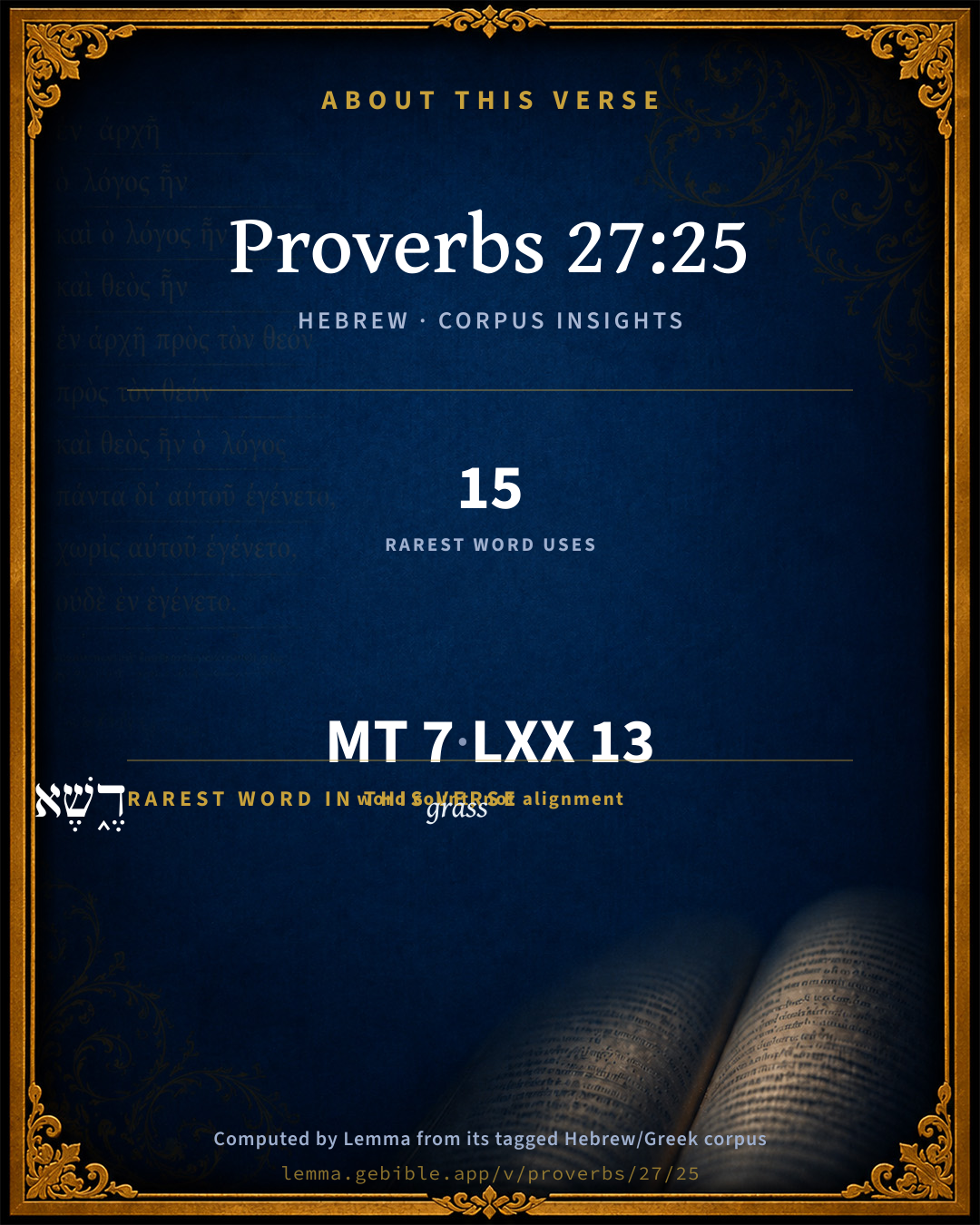
The rarest word here is דֶ֑שֶׁא grass H1877 — appearing just 15 times in the whole Hebrew Bible.

Shared distinctive vocabulary

דֶ֑שֶׁא grass H1877 occurs in 15 verses of the Hebrew Bible. Also found in:

Grammatical profile

  • 3 verbs
  • 4 nouns

Verb forms

  • גָּלָ֣ה Qal · Perfect
  • וְנִרְאָה Niphal · Perfect
  • וְ֝נֶאֶסְפ֗וּ Niphal · Perfect

Hebrew & Septuagint length

In English translation the verse runs 17 words from the Hebrew and 18 from the Septuagint (LXX English) — closely comparable.

A rough comparison of the two English renderings, which tokenize alike — not a word-level alignment.

Word counts can differ between the Hebrew and the Greek without any difference in meaning — e.g. the Hebrew direct-object marker אֵת has no separate Greek word, and Greek often adds the article ὁ.

In the original languages it is 7 Hebrew tokens and 13 Greek tokens — but the two are counted differently (Hebrew bundles its prefixes and suffixes into one token; the Greek is in lemma form), so that isn’t a like-for-like length.

Cross-references

2

Topical passages linked to Proverbs 27:25 in the Treasury of Scripture Knowledge — connected by theme and wording, ordered by reader-vote popularity; previews shown in the World English Bible.

  • Proverbs 10:5 He who gathers in summer is a wise son, But he who sleeps during the harvest is a son who causes shame.
  • Psalms 104:14 He causes the grass to grow for the cattle, And plants for man to cultivate, That he may bring forth food out of the earth:

Cross-references courtesy of OpenBible.info (CC BY 4.0).

Hebrew and Greek witnesses Masoretic Hebrew ↔ Greek Septuagint

The same verse in the two great witnesses to the Old Testament, shown verse-for-verse.

These are two independent witnesses, not word-aligned to each other, and the Septuagint is shown in lemma (dictionary) form.

Hebrew Proverbs 27:25 Masoretic · Westminster Leningrad Codex

גָּלָ֣ה חָ֭צִיר וְנִרְאָה דֶ֑שֶׁא וְ֝נֶאֶסְפ֗וּ עִשְּׂב֥וֹת הָרִֽים

The hay is removed, and the new growth appears, The grasses of the hills are gathered in.

World English Bible · Public Domain

Greek LXX Proverbs 27:25 Septuagint · lemma form

ἐπιμελέομαι ὁ ἐν ὁ πεδίον χλωρός καί κείρω πόα καί συνἄγω χόρτος ὀρεινός

Take care of the herbage in the field, and you shall cut grass, and gather the mountain hay;

LXX2012 (modern English Septuagint) · Public Domain

On this verse, The Pulpit Commentary discusses the Septuagint’s reading. Read the note in Commentary ↓

Hebrew: Westminster Leningrad Codex (CC BY 4.0). Greek: Septuagint (public domain); English from LXX2012 (modern English Septuagint) (Public Domain). How the Septuagint differs from the Hebrew →

Commentary

Notes on Proverbs 27:25 from classic Christian and Jewish commentators (each source and its license shown beneath its notes). The classic Christian expositions comment on the surrounding passage and are grouped to its opening verse, so a note may address several verses; the Jewish commentaries on the Tanakh (Rashi and others) are per-verse, so they appear only where the commentator wrote on this verse.

Lemma curates 59 commentaries, every one of them public domain or Creative Commons licensed, each selected and text-cleaned for this edition rather than reprinted as found. About our sources →

Trapp's Complete Commentary

John Trapp

Pro 27:25 The hay appeareth, and the tender grass sheweth itself, and herbs of the mountains are gathered.

Ver. 25. The hay appeareth, and the tender grass.] And the due time must be taken to take it in for fodder in the hard winter. The earth is alma mater, a bountiful mother, to man and beast. It is, as one well saith, marsupium Domini, the Lord’s great purse. The stars also are God’s storehouses, which he openeth to our profit. {Deu 28:12} Every star is like a purse of gold, saith one, out of which God throws down riches, which good men gather, bad men scramble for. By their influence they make a scatter of corn, hay, fruits of all sorts. And good husbands cut hay, not only in the valleys, where there is great store, but upon the mountains too, as soon as it is ready, lest heat or wet mar it. Note here by the way - (1.) How good the Lord is, that stoops so low as to teach us thrift; (2.) How perfect the Holy Scripture is, that instructs us in these lessor matters also.

John Trapp, A Commentary or Exposition upon All the Books of the Old and New Testament (1647–1656) — public domain. Text from a community e-Sword module.

Joseph Benson's Commentary

Pro 27:25-27. The hay appeareth, and the tender grass — In their proper seasons. These and the following things are mentioned as further arguments and encouragements to persuade to diligence: God invites thee to it by the plentiful provisions wherewith he hath enriched the earth for thy sake. And herbs of the mountains are gathered — Even the most barren parts afford thee their help. The lambs are for thy clothing — By their wool and skins, either actually used for thy clothing, or sold to purchase other clothing for thyself and family; and the goats are the price of thy field — By the sale whereof thou mayest either pay the rent of the field thou hirest, or purchase fields or lands for thyself. Goats might better be spared and sold than sheep, which brought a more certain and constant profit to the owner. And thou shalt have goats’ milk enough for thy food, the food of thy household — Or, if thou choosest rather to keep thy goats, their milk will serve thee for food to thyself and family. In ancient times men used a plain and simple diet, and neither knew nor used that luxury therein which after ages invented.

Joseph Benson's Commentary on the Old and New Testaments (1811–1818) — public domain. Text from a community e-Sword module.

Jamieson, Fausset & Brown

Robert Jamieson, A. R. Fausset & David Brown

The fact that providential arrangements furnish the means of competence to those who properly use them is another motive to diligence (compare Psa 65:9-13).

The hay appeareth--literally, "Grass appeareth" (Job 40:15; Psa 104:14).

Jamieson, Fausset & Brown — Commentary Critical and Explanatory on the Whole Bible (1871) — public domain (CC PDM 1.0). Text via the HelloAO Bible API.

Adam Clarke's Commentary

Verse 25. The hay appeareth] Take care that this be timeously mown, carefully dried, and safely ricked or housed. And when the tender grass and the proper herbs appear in the mountains in the spring, then send forth the lambs, the young of the flock, that they may get suitable pasturage, without too much impoverishing the home fields; for by the sale of the lambs and goats, the price of the field is paid - all the landlord's demands are discharged. Either a certain number of lambs, goats, and other cattle, was given to the landlord; or so much money as so many lambs, &c., were then worth.

Adam Clarke's Commentary on the Bible (1810–1826) — public domain. Text from a community e-Sword/MySword module.

Ellicott's Commentary for English Readers

(25) The hay appeareth.—Or perhaps better, is gone. The quiet succession of the crops and seasons is here described.

Herbs of the mountains—i.e., pasturage.

A Bible Commentary for English Readers, edited by Charles John Ellicott (1878–1897) — public domain. Text from a community e-Sword module.

The Cambridge Bible for Schools and Colleges

gen. ed. J. J. S. Perowne

25. hay] “Heb. grass,” R.V. marg.

appeareth] Rather, is carried.

of the mountains] Com p. Psa_147:8.

The Cambridge Bible for Schools and Colleges (gen. ed. J. J. S. Perowne; Cambridge University Press, 1878–1918) — public domain. Text from a community e-Sword module.

John Gill's Exposition

And thou shalt have goats' milk enough for thy food,.... The word for "goats", in Pro 27:26, signifies he goats, which were sold to buy fields, pay servants or rent, or purchase the necessaries of life; and this here signifies she goats, which were kept for their milk; and which was daily used for food in some countries, and is still in use for the same purpose in some parts of our kingdoms; and in medicine it has been preferred by some physicians above others, next to the milk of women (w): and the diligent husbandman is promised not only plenty of this his own eating, at least a sufficiency of it, but for his family;

for the food of thy household; his wife and children:

and for maintenance for thy maidens: or "the lives" (x) of them, on which they should live; for, though menservants might require strong meat yet the maidens might live upon milk; besides, Athenaeus (y) speaks of most delicious cheese made of goats' milk, called "tromilicus". The design of the whole is to show that a man diligent in his business shall have a sufficiency for himself and his family; and, though it may be but the meaner sort of food and clothing he may get, yet, having food and raiment, he should therewith be content.

(w) Plin. Nat. Hist. l. 28. c. 9. Vid. Scheuehzer. Physic, Sacr. vol. 5. p. 1016. (x) "vitas", Montanus; "ad vitam", Gejerus; "life" is often put for "bread"; or for that by which life is maintained, both in Greek and Latin writers; so in Hesiod. Opera, l. 1. v. 31, 328. and "vita", in Plaut. Stichus, Act. 3. Sc. 2. v. 9. Trinum, Act. 2. Sc. 4. v. 76. (y) Deipnosoph. l. 14. c. 22. p. 658. see also l. 1. c. 8. p 10.

Next: Proverbs Chapter 28

John Gill's Exposition of the Whole Bible (1746–1763) — public domain (CC PDM 1.0). Text via the HelloAO Bible API.

Matthew Poole's English Annotations

The hay appeareth, and the tender grass showeth itself, in their proper seasons. These things may be here mentioned, either,

1. As the matter of his diligence. Take care that thy hay and grass may be well managed, and seasonably gathered, for the use of thy cattle. Or rather,

2. As another argument and encouragement to diligence, because God invites thee to it by the plentiful provisions wherewith he hath enriched the earth for thy sake. Thou needest not compass sea and land for them, for God puts them into thy hand, if thou wilt but receive them.

Herbs of the mountains, even the most barren parts afford thee their help,

are gathered; or, are to be gathered, as such passive verbs are oft used; they are ripe and ready for the gathering. So this clause suits best with the former.

Matthew Poole's English Annotations on the Holy Bible (1683–1685) — public domain. Text from a community e-Sword/MySword module.

Whedon's Commentary on the Bible

Daniel D. Whedon

25. The hay appeareth — חציר, (hhasir.) It may be doubted whether this is a correct translation. Stuart unsatisfactorily gives: “The grass passeth away.” The word also means an enclosure, court yard, encampment, village. It is probable that it means here either an enclosure for flocks or for pasturage. The verse might be translated: “The pasturage is discovered, and the tender grass appears, and the herbs (herbage) of the mountains are gathered.”

Daniel D. Whedon (gen. ed.), Commentary on the Old and New Testaments (1874–1909) — public domain. Text from a community e-Sword module.

The Pulpit Commentary

As ver. 23 commended the rearing of cattle, and ver. 24 supported the injunction by showing its comparative permanence, so this and the following verses discuss the material advantages of such occupation. The hay appeareth; rather, the grass passeth away, is cut and carried. This is the first stage in the agricultural operations described. And the tender grass showeth itself; the aftermath appears. And the herbs of the mountain are gathered; the fodder from off the hills is cut and stored. All these verbs are best taken hypothetically, the following verses forming the apodosis. When all these operations are complete, then crone the results in plenty and comfort. Septuagint, "Have a care of the herbage (clwrwn ) in the plain, and thou shalt cut grass, and gather thou the mountain hay."

The Pulpit Commentary (1880–1919), ed. H.D.M. Spence-Jones & Joseph S. Exell — public domain. Text from a community e-Sword module.

John Wesley's Explanatory Notes

The hay - Another encouragement to diligence; God invites thee to it by the plentiful provisions wherewith he has enriched the earth for thy sake. The mountains - Even the most barren parts afford thee their help.

John Wesley, Explanatory Notes Upon the Whole Bible (1754–1765) — public domain. Text via the GEBible commentary corpus.

Rashi

Rabbi Shlomo Yitzchaki (Rashi)

When the hay is carried away When the hay is carried away in the days of Nissan, the grass becomes visible, and the grasses are gathered to grow (?), then it will be beneficial to you, for you will have the fleece of the lambs for your clothing.

Rashi on the Tanakh — English translations: “The Judaica Press complete Tanach with Rashi, translated by A. J. Rosenberg” (CC BY 4.0); “Pentateuch with Rashi's commentary by M. Rosenbaum and A.M. Silbermann, 1929-1934” (public domain); “The Metsudah Tanach series, Lakewood, N.J” (CC BY 4.0); and “The Book of Joshua, Metsudah Publications, 1997” (CC BY 4.0). Text via Sefaria.

Lesson kit

Teaching starters — assembled from the data on this page, not authored interpretation. Every prompt links to the verse data it draws on. Edit before teaching.

Proverbs, in the Wisdom, opens this verse with 7 words (7 distinct Hebrew lemmas). Its most distinctive word is desheʼ (“grass”). A historical commentator’s framing appears above. Read the whole chapter for the surrounding context.

Discussion questions

  1. What does “grass” (desheʼ) contribute to the verse as a whole?
  2. How does Genesis 1:11, which shares the word «grass», read alongside this verse?
  3. These translations render this verse differently. What is at stake in choosing one wording over another?
  4. «גָּלָ֣ה» is a Qal Perfect verb. How does that grammatical form shape the action described?
  5. Compare how Trapp's Complete Commentary and Joseph Benson's Commentary read this verse. Where do they agree or differ?

Things to notice

Reading settings

Reading text

Shown beneath each verse's original-language words.

Old Testament
Old Testament edition

Read the OT as the Masoretic Hebrew (MT) or the Greek Septuagint (LXX).

English shown for the Greek Septuagint (in the Hebrew ↔ Greek comparison).

Comparing translations? Open the Compare panel on any verse page to stack up to four side by side.