Habakkuk 1:15

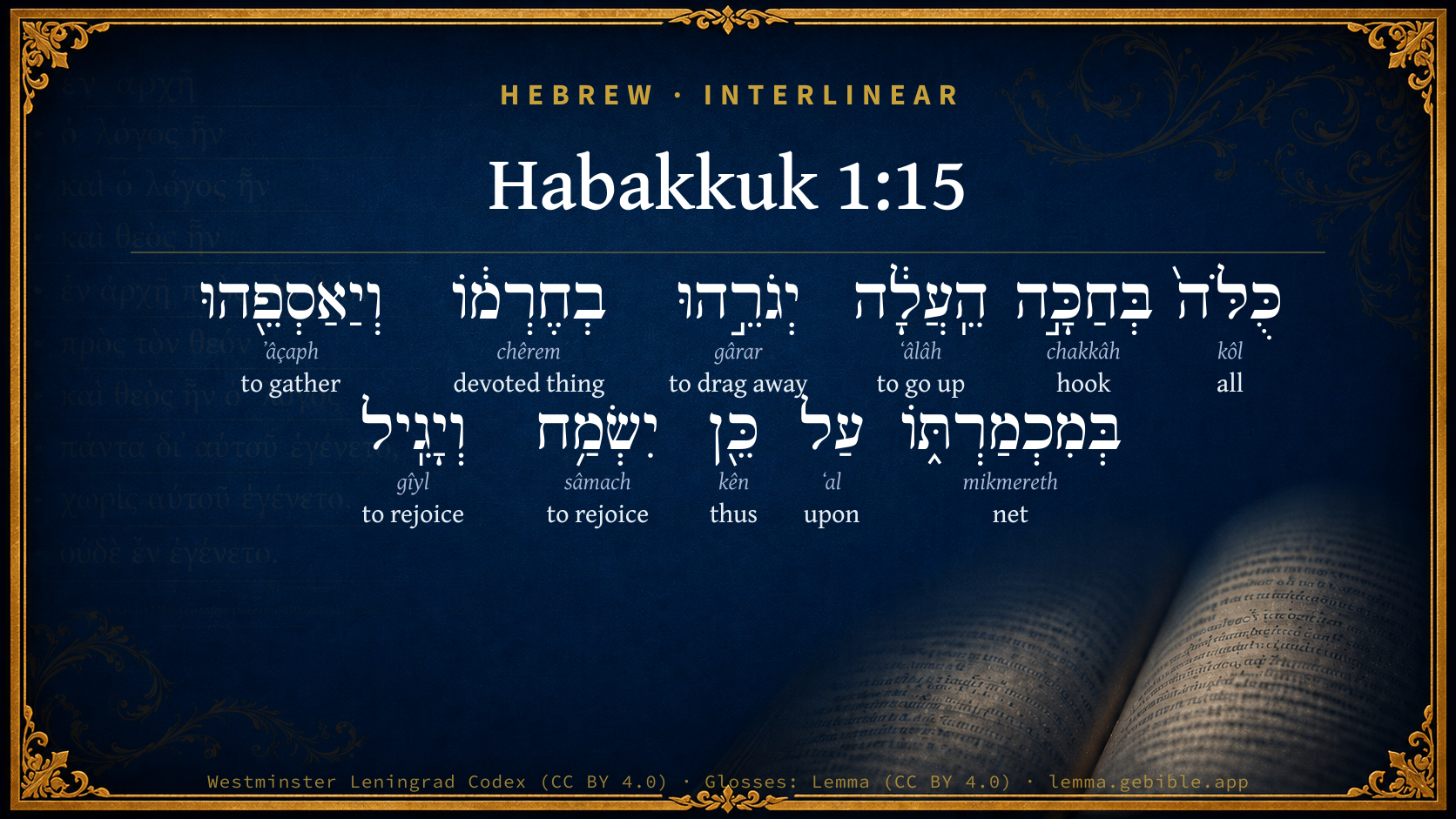
Hebrew (Westminster Leningrad Codex) Habakkuk 1:15 appears in the Hebrew Old Testament. The text above is from the Westminster Leningrad Codex. Each word links to its Strong’s number, a concise gloss, and parsing drawn from the Open Scriptures Hebrew Bible morphology. Click any word for its full Brown-Driver-Briggs (BDB) entry.
Download image
Cite this verse

Habakkuk 1:15 (World English Bible). Public Domain. Lemma interlinear Bible study tool, https://lemma.gebible.app/v/habakkuk/1/15.

Show BibTeX & RIS
BibTeX
RIS
English Translation
He takes up all of them with the hook. He catches them in his net, and gathers them in his dragnet. Therefore he rejoices and is glad.
World English Bible · Public Domain
Download a study sheet

One document with this verse’s original text, its word-by-word gloss line, the meaning frame, cross-references with their text, attributed commentary, and full source and license credits — printable, and it pastes into notes with its structure intact.

This verse Autodidact and up

Study sheet (.html) Plain text (.txt)

A passage Seminary Student

Up to 50 verses in one chapter. A passage sheet keeps up to 6 commentary sources and 12 cross-references per verse, in the order this page ranks them, and says so on the sheet whenever that leaves anything out. Ask for a single verse and you get the Autodidact verse sheet above.

Everything on this page stays free to read, with no account — the sheet is a download of what is already on screen, not access to it.

Want to remove ads? Support Godless Engineer
Compare translations 3

The same verse in 3 English versions, stacked beneath the original-language interlinear above. Click any original word for its lexicon entry.

Each is an independent rendering of the whole verse — the interlinear is not word-aligned to these translations.

Highlighted words mark where these versions differ — a whole-verse word diff, not a word-by-word alignment.

  • World English Bible Public Domain
    He takes up all of them with the hook. He catches them in his net, and gathers them in his dragnet. Therefore he rejoices and is glad.
  • King James Version Public Domain
    They take up all of them with the angle, they catch them in their net, and gather them in their drag: therefore they rejoice and are glad.
  • unfoldingWord Literal Text CC BY-SA 4.0
    All of them, he brings up with a hook. He drags him with his net, and he gathers him with his dragnet. Therefore he rejoices and exults.

unfoldingWord Literal Text — © unfoldingWord, licensed CC BY-SA 4.0. Word-aligned USFM3 via Door43 (git.door43.org/unfoldingWord/en_ult).

Versions to compare (up to 4)

3 of 4 selected

Show all 18 translations

Every available English version of this verse, each an independent rendering of the whole verse.

  • World English Bible Public Domain
    He takes up all of them with the hook. He catches them in his net, and gathers them in his dragnet. Therefore he rejoices and is glad.
  • Berean Standard Bible Public Domain
    The foe pulls all of them up with a hook; he catches them in his dragnet, and gathers them in his fishing net; so he rejoices gladly.
  • Majority Standard Bible Public Domain
    The foe pulls all of them up with a hook; he catches them in his dragnet, and gathers them in his fishing net; so he rejoices gladly.
  • King James Version Public Domain
    They take up all of them with the angle, they catch them in their net, and gather them in their drag: therefore they rejoice and are glad.
  • American Standard Version (1901) Public Domain
    He taketh up all of them with the angle, he catcheth them in his net, and gathereth them in his drag: therefore he rejoiceth and is glad.
  • Revised Version (1885) Public Domain
    He taketh up all of them with the angle, he catcheth them in his net, and gathereth them in his drag: therefore he rejoiceth and is glad.
  • Geneva Bible (1599) Public Domain
    They take vp all with the angle: they catch it in their net, and gather it in their yarne, whereof they reioyce and are glad.
  • Douay-Rheims (1899) Public Domain
    He lifted up all them with his hook, he drew them in his drag, and gathered them into his net: for this he will be glad and rejoice.
  • Young's Literal Translation Public Domain
    Each of them with a hook he hath brought up, He doth catch it in his net, and gathereth it in his drag, Therefore he doth joy and rejoice.
  • Literal Standard Version CC BY-SA 4.0
    He has brought up each of them with a hook, || He catches it in his net, and gathers it in his dragnet, || Therefore he delights and rejoices.
  • Unlocked Literal Bible CC BY-SA 4.0
    He brings all of them up with a fishhook; he drags men away in his fishnet; he gathers them together in his dragnet; so he rejoices and he is glad.
  • unfoldingWord Literal Text CC BY-SA 4.0
    All of them, he brings up with a hook. He drags him with his net, and he gathers him with his dragnet. Therefore he rejoices and exults.
  • Darby Bible Public Domain
    He taketh up all of them with the hook, he catcheth them in his net, and gathereth them into his drag; therefore he rejoiceth and is glad:
  • World Messianic Bible Public Domain
    He takes up all of them with the hook. He catches them in his net and gathers them in his dragnet. Therefore he rejoices and is glad.
  • Webster's Bible Public Domain
    They take up all of them with the angle, they catch them in their net, and gather them in their drag: therefore they rejoice and are glad.
  • Free Bible Version CC BY-SA 4.0
    They drag everyone up with hooks, they pull them out with nets, catching them in dragnets. Then they happily celebrate.
  • Bible in Basic English Public Domain
    He takes them all up with his hook, he takes them in his net, getting them together in his fishing-net: for which cause he is glad and full of joy.
  • JPS Tanakh (1917) Public Domain
    They take up all of them with the angle, they catch them in their net, and gather them in their drag; therefore they rejoice and exult.

Literal Standard Version (2020), Covenant Press — licensed CC BY-SA 4.0. Text via the HelloAO Bible API (eBible.org). Unlocked Literal Bible (unfoldingWord) — licensed CC BY-SA 4.0. Text via the HelloAO Bible API (eBible.org). unfoldingWord Literal Text — © unfoldingWord, licensed CC BY-SA 4.0. Word-aligned USFM3 via Door43 (git.door43.org/unfoldingWord/en_ult). Free Bible Version, Dr. Jonathan Gallagher — licensed CC BY-SA 4.0. Text via the HelloAO Bible API (eBible.org).

Word by word

More ways to search: Search by grammar → Find every occurrence → Compare this word →

Practice this passage: Drill this verse → Learn its vocabulary →

בְּחַכָּ֣ה
chakkâh
H2443
“in/at · hook”
Preposition + Noun, Common, Feminine, Singular, Absolute
Part of Speech
Preposition + Noun
Type
Common
Gender
Feminine
Number
Singular
State
Absolute
Full BDB Definition

Origin: probably from H2442

TWOT: 693c

hook, angle, hook fastened in jaw, fish hook
  1. כֻּלֹּה֙ kôl H3605 “all · her” Noun, Common, Masculine, Singular, Construct + Suffix, Personal, 3rd Person, Feminine, Singular
  2. הֵֽעֲלָ֔ה ʻâlâh H5927 “to go up” Verb, Hiphil, Perfect, 3rd Person, Masculine, Singular
  3. יְגֹרֵ֣הוּ gârar H1641 “to drag away · him” Verb, Qal, Imperfect, 3rd Person, Masculine, Singular + Suffix, Personal, 3rd Person, Masculine, Singular
  4. בְחֶרְמ֔וֹ chêrem H2764 “in/at · devoted thing · his” Preposition + Noun, Common, Masculine, Singular, Construct + Suffix, Personal, 3rd Person, Masculine, Singular
  5. וְיַאַסְפֵ֖הוּ ʼâçaph H622 “and · to gather · him” Conjunction + Verb, Qal, Imperfect, 3rd Person, Masculine, Singular + Suffix, Personal, 3rd Person, Masculine, Singular
  6. בְּמִכְמַרְתּ֑וֹ mikmereth H4365 “in/at · net · his” Preposition + Noun, Common, Feminine, Singular, Construct + Suffix, Personal, 3rd Person, Masculine, Singular
  7. עַל ʻal H5921 “upon” Preposition
  8. כֵּ֖ן kên H3651 “thus” Particle, Demonstrative
  9. יִשְׂמַ֥ח sâmach H8055 “to rejoice” Verb, Qal, Imperfect, 3rd Person, Masculine, Singular
  10. וְיָגִֽיל gîyl H1523 “and · to rejoice” Conjunction + Verb, Qal, Imperfect, 3rd Person, Masculine, Singular

About this verse

These counts appear in no published source. They are computed here, from the morphology-tagged text and Lemma’s own curated glosses. What Lemma adds →

11
words
11
distinct lemmas
Prophets
section

Notable vocabulary

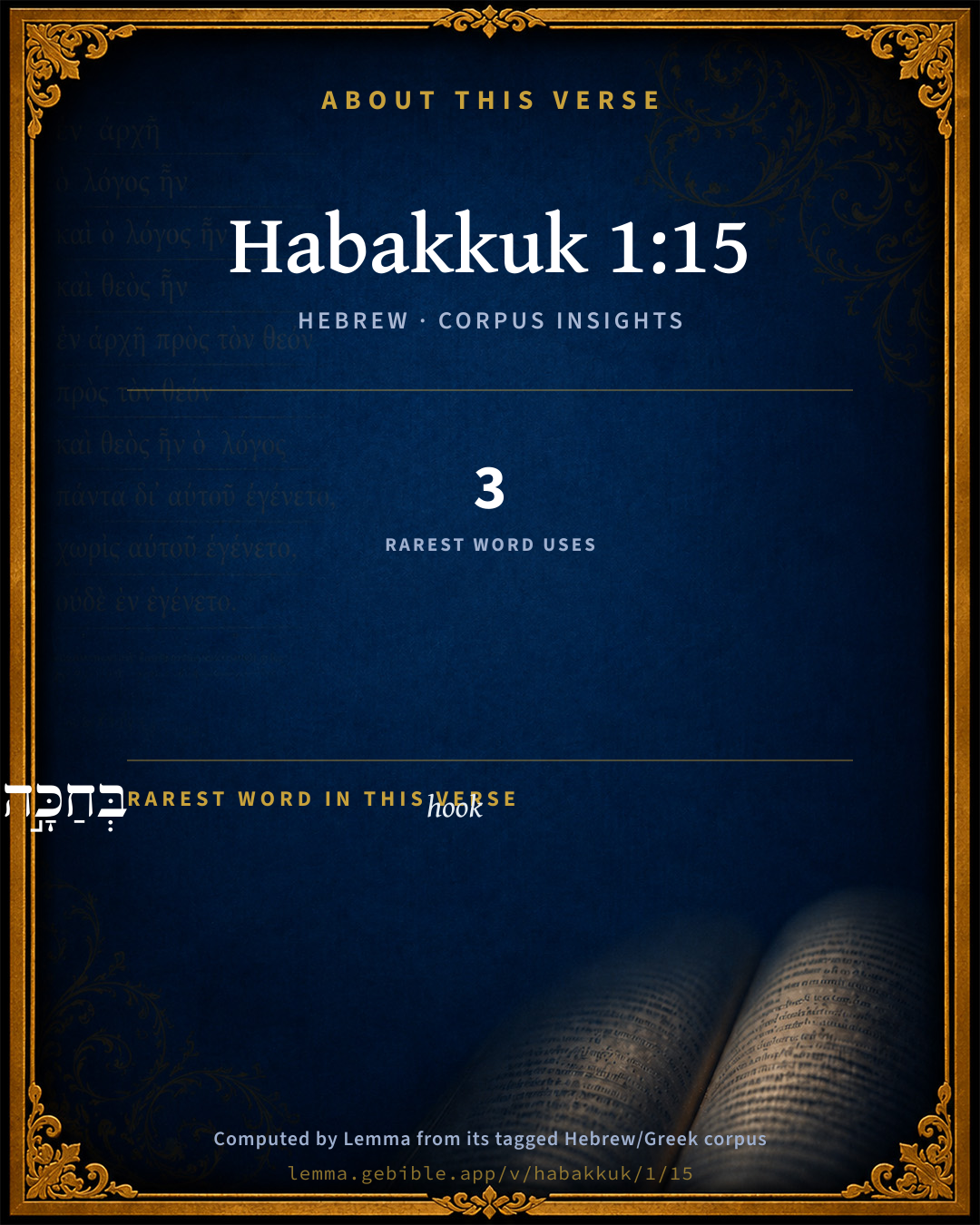
The rarest word here is בְּחַכָּ֣ה hook H2443 — appearing just 3 times in the whole Hebrew Bible.

Shared distinctive vocabulary

בְּחַכָּ֣ה hook H2443 occurs in 3 verses of the Hebrew Bible. Also found in:

Grammatical profile

  • 5 verbs
  • 4 nouns
  • 1 preposition
  • 1 particle

Verb forms

  • הֵֽעֲלָ֔ה Hiphil · Perfect
  • יְגֹרֵ֣הוּ Qal · Imperfect
  • וְיַאַסְפֵ֖הוּ Qal · Imperfect
  • יִשְׂמַ֥ח Qal · Imperfect
  • וְיָגִֽיל Qal · Imperfect

Hebrew & Septuagint length

In English translation the verse runs 27 words from the Hebrew and 29 from the Septuagint (LXX English) — closely comparable.

A rough comparison of the two English renderings, which tokenize alike — not a word-level alignment.

Word counts can differ between the Hebrew and the Greek without any difference in meaning — e.g. the Hebrew direct-object marker אֵת has no separate Greek word, and Greek often adds the article ὁ.

Cross-references

14

Topical passages linked to Habakkuk 1:15 in the Treasury of Scripture Knowledge — connected by theme and wording, ordered by reader-vote popularity; previews shown in the World English Bible.

  • Jeremiah 16:16 Behold, I will send for many fishermen, says Yahweh, and they shall fish them up; and afterward I will send for many hunters, and they shall hunt them from every mountain, and from every hill, and out of the clefts of the rocks.
  • Amos 4:2 The Lord Yahweh has sworn by his holiness that behold, "The days shall come on you that they will take you away with hooks, And the last of you with fish hooks.
  • Psalms 10:9 He lurks in secret as a lion in his ambush. He lies in wait to catch the helpless. He catches the helpless, when he draws him in his net.
  • John 21:6–11 He said to them, "Cast the net on the right side of the boat, and you will find some." They cast it therefore, and now they weren't able to draw it in for the multitude of fish.
  • Isaiah 19:8 The fishermen shall lament, and all those who cast angle into the Nile shall mourn, and those who spread nets on the waters shall languish.
  • Jeremiah 50:11 Because you are glad, because you rejoice, O you who plunder my heritage, because you are wanton as a heifer that treads out [the grain], and neigh as strong horses;
  • Lamentations 2:15–16 All that pass by clap their hands at you; They hiss and wag their head at the daughter of Jerusalem, [saying], Is this the city that men called The perfection of beauty, The joy of the whole earth?
  • Ezekiel 25:6 For thus says the Lord Yahweh: Because you have clapped your hands, and stamped with the feet, and rejoiced with all the despite of your soul against the land of Israel;
  • Ezekiel 26:2 Son of man, because Tyre has said against Jerusalem, Aha, she is broken: the gate of the peoples; she is turned to me; I shall be replenished, now that she is laid waste:
  • Ezekiel 29:4–5 I will put hooks in your jaws, and I will cause the fish of your rivers to stick to your scales; and I will bring you up out of the midst of your rivers, with all the fish of your rivers which stick to your scales.
  • Ezekiel 35:15 As you did rejoice over the inheritance of the house of Israel, because it was desolate, so will I do to you: you shall be desolate, Mount Seir, and all Edom, even all of it; and they shall know that I am Yahweh.
  • Matthew 17:27 But, lest we cause them to stumble, go to the sea, and cast a hook, and take up the first fish that comes up. When you have opened its mouth, you will find a stater coin. Take that, and give it to them for me and you."
  • Luke 5:5–10 Simon answered him, "Master, we worked all night, and took nothing; but at your word I will let down the net."
  • Revelation 11:10 Those who dwell on the earth rejoice over them, and they will be glad. They will give gifts to one another, because these two prophets tormented those who dwell on the earth.

Cross-references courtesy of OpenBible.info (CC BY 4.0).

Hebrew and Greek witnesses Masoretic Hebrew ↔ Greek Septuagint

The same verse in the two great witnesses to the Old Testament, shown verse-for-verse.

These are two independent witnesses, not word-aligned to each other, and the Septuagint is shown in lemma (dictionary) form.

Hebrew Habakkuk 1:15 Masoretic · Westminster Leningrad Codex

כֻּלֹּה֙ בְּחַכָּ֣ה הֵֽעֲלָ֔ה יְגֹרֵ֣הוּ בְחֶרְמ֔וֹ וְיַאַסְפֵ֖הוּ בְּמִכְמַרְתּ֑וֹ עַל כֵּ֖ן יִשְׂמַ֥ח וְיָגִֽיל

He takes up all of them with the hook. He catches them in his net, and gathers them in his dragnet. Therefore he rejoices and is glad.

World English Bible · Public Domain

Greek LXX Habakkuk 1:15 Septuagint · lemma form

συντέλεια ἐν ἄγκιστρον ἀνασπάω καί ἕλκω αὐτός ἐν ἀμφίβληστρον καί συνἄγω αὐτός ἐν ὁ σαγήνα αὐτός ἕνεκεν οὗτος εὐφραίνω καί χαίρω ὁ καρδία αὐτός

He has brought up destruction with a hook, and drawn one with a casting net, and caught another in his drags: therefore shall his heart rejoice and be glad.

LXX2012 (modern English Septuagint) · Public Domain

On this verse, The Pulpit Commentary discusses the Septuagint’s reading. Read the note in Commentary ↓

Hebrew: Westminster Leningrad Codex (CC BY 4.0). Greek: Septuagint (public domain); English from LXX2012 (modern English Septuagint) (Public Domain). How the Septuagint differs from the Hebrew →

Targum (Aramaic paraphrase)

1

The Targum is the ancient Jewish Aramaic paraphrase of the Hebrew Scriptures — an interpretive translation, not the Hebrew text itself. Onkelos (literal) and Pseudo-Jonathan (expansive) render the Torah, and Jonathan the Prophets. Coverage is partial: where no permissively-licensed English translation exists for a verse, only the Aramaic is shown. This is verse-level text, not a word-by-word alignment to the Hebrew.

  1. Targum Jonathan Prophets (Joshua–Malachi)
    כּוּלְהוֹן דָמָן לְצַיָדִין דְאָחֵיד נוּנָא בְּחַכְּתָא כָנֵישׁ לֵיהּ בְּחָרְמֵיהּ וְרָמֵי לֵיהּ בִּמְצַדְתֵּיהּ עַל כֵּן חָדַי וְדָאִיץ:

    (no public-domain English translation for this verse)

    Targum Jonathan — Aramaic: “Mikraot Gedolot” (public domain). English: “Sefaria Community Translation” (CC0 1.0 (public-domain dedication)); “London "Chaldee Paraphrase," 1871” (public domain). Text via Sefaria.

Commentary

Notes on Habakkuk 1:15 from classic Christian and Jewish commentators (each source and its license shown beneath its notes). The classic Christian expositions comment on the surrounding passage and are grouped to its opening verse, so a note may address several verses; the Jewish commentaries on the Tanakh (Rashi and others) are per-verse, so they appear only where the commentator wrote on this verse.

Lemma curates 59 commentaries, every one of them public domain or Creative Commons licensed, each selected and text-cleaned for this edition rather than reprinted as found. About our sources →

Trapp's Complete Commentary

John Trapp

Hab 1:15 They take up all of them with the angle, they catch them in their net, and gather them in their drag: therefore they rejoice and are glad.

Ver. 15. They take up all of them with the angle] No less than all will serve their turns or satisfy their ambition; as we read of Alexander, who wept that there was but one world for him to conquer; Julius Caesar, who would be aut Caesar, aut nullus; either Caesar or nothing, this Nebuchadnezzar in the text, fitly compared to a greedy fisherman, who could wish to enclose and catch all the fishes in the river. Covetousness is boundless; and ambition rideth without reins. The curse of unsatisfiableness, the disease of a spiritual dropsy, is upon all carnal hearts; so that though one man should engross a monopoly of all the wealth in the world, and heap up his hoards and his honours to the stars, yet would his heart be as hungry after more as if he had nothing.

Therefore they rejoice and are glad] This is worse than all the rest, that they please and applaud themselves in their wickedness, that they hug and stroke themselves on the head, as Doeg did, Psa 52:2, and those Sodomites, Isa 3:9. This shows that men are arrived at that dead and dedolent disposition spoken of Eph 4:19, and are even straddling over hell’s mouth, which gapeth for them.

John Trapp, A Commentary or Exposition upon All the Books of the Old and New Testament (1647–1656) — public domain. Text from a community e-Sword module.

unfoldingWord translationNotes

Door43 World Missions Community

General Information:

Habakkuk continues speaking to Yahweh about the Chaldeans.

He brings ... he continually slaughter

In Hab 1:15-17 the singular pronoun "he" and "his" refer to a Babylonian solider who represents all of the Babylonian soldiers. These pronouns can be stated as plural. AT: "They bring ... they continually slaughter" (See: First, Second, or Third Person and Synecdoche)

all of them ... drags men away ... gathers them

Here "them" and "men" refer to people in general. This can be stated in first person to include Habakkuk as one of the people. AT: "all of us ... drags us away ... gathers us" (See: First, Second, or Third Person)

He brings all of them up with a fishhook ... in his dragnet

Habakkuk speaks of the Chaldeans conquering people easily as if the people were fish that the Chaldeans catch with fishhooks and fishnets. (See: Metaphor)

fishhook ... fishnet ... dragnet

tools used to catch fish

he sacrifices to his net and burns incense to his dragnet

Habakkuk speaks of the weapons that the Chaldeans use to conquer people and nations as if the weapons were fishing nets that they use to catch fish. AT: "they offer sacrifices and burn incense to the weapons that they use in battle" (See: Metaphor)

Will he therefore keep emptying his net, and will he continually slaughter the nations without mercy?

Habakkuk asks this question because he is frustrated and wants to know how long Yahweh will allow the Chaldeans to continue to destroy people and nations. AT: "Will you therefore let them empty their fishing nets and continue to slaughter the nations while they feel no compassion?" (See: Assumed Knowledge and Implicit Information)

keep emptying his net

Habakkuk speaks of the Chaldeans preparing to conquer more nations as if they were fishermen who empty their nets so that they can use them to catch more fish. (See: Metaphor)

translationWords

joy

sacrifice

incense

nation

compassion

unfoldingWord translationNotes — © Distant Shores Media and the Door43 World Missions Community, licensed CC BY-SA 4.0. Source: git.door43.org/Door43/en_tn.

Jamieson, Fausset & Brown

Robert Jamieson, A. R. Fausset & David Brown

they take up all of them--all kinds of fishes, that is, men, as captives, and all other prey that comes in their way.

with the angle--that is, the hook. Some they take up as with the hook, one by one; others in shoals, as in a "net" and "drag" or enclosing net.

therefore--because of their successes.

they rejoice--They glory in their crimes because attended with success (compare Hab 1:11).

Jamieson, Fausset & Brown — Commentary Critical and Explanatory on the Whole Bible (1871) — public domain (CC PDM 1.0). Text via the HelloAO Bible API.

The Cambridge Bible for Schools and Colleges

gen. ed. J. J. S. Perowne

15. They take up … angle] He taketh up … with the hook; he sweepeth them into (or, with) his net.

they rejoice] he rejoiceth and exulteth. The Chaldean is compared to the fisher, who rejoices over the successful haul of his net. He drags men and nations indiscriminately into his power, and is dead to all their higher sensibilities and all that is human in them.

The Cambridge Bible for Schools and Colleges (gen. ed. J. J. S. Perowne; Cambridge University Press, 1878–1918) — public domain. Text from a community e-Sword module.

John Gill's Exposition

They take up all of them with the angle,.... The prophet continues the metaphor of fishing, and observes the different ways of taking fish; which is to be applied to the case he is speaking of: as fishermen take all they can with their angles, so "they" or "he", for it is in the singular number, Nebuchadnezzar and his army, take up all out of the sea of the world; are ambitious of getting all kingdoms and nations of the world under their power and dominion; particularly all Judea, and all the inhabitants of it, good and bad, without any distinction; for all were fish which came to their net: this may design the artful and alluring methods they first made use of to get the people into their hands, by making covenants with them, and drawing them into making of presents, and paying of tribute:

they catch them in their net, and gather them in their drag; with the angle the fisherman catches fish one by one, but with the net great numbers; and what he misses by throwing the net, he gets by using the drag; all which may be expressive of the ways and methods used by the king of Babylon and his army, both in the times of Jeconiah, and of Zedekiah; under the former he used the net, and carried off large numbers, and with them the royal family and great substance, but left many behind; under the latter he came and swept away all, drained the land of its riches and its inhabitants:

therefore they rejoice and are glad; as fishermen do when they have good sport; so these people rejoiced in their own success, and in the calamities of their neighbours.

John Gill's Exposition of the Whole Bible (1746–1763) — public domain (CC PDM 1.0). Text via the HelloAO Bible API.

Albert Barnes' Notes on the Bible

They take up all of them - (literally “he taketh up all of it”) the whole race as though it were one,

With an angle; they catch them - literally, he sweepeth it away

In their (his) net - One fisherman is singled out who partly by wiles (as by the bait of “an angle”), partly by violence (the net or drag) sweeps away and gathers as his own the whole kind. Nebuchadnezzar and the Chaldaeans are herein a faint image of Satan, who casts out his baits and his nets in the stormy sea of this life, taking some by individual craft, sweeping others in whole masses, to do evil; and whoso hath no ruler, and will not have Christ to reign over him Luk 19:4, he allures, hurries, drags away as his prey. Jerome: “Adam clave to his hook, and he drew him forth out of Paradise with his net; and covered him with his drags, his varied and manifold deceits and guiles. And “by one many became sinners,” and in Adam we ‘all died,’ and all saints afterward were with him alike cast out of Paradise. And because he deceived the first man, he ceaseth not daily to slay the whole human race.”

Albert Barnes' Notes on the Bible (1834–1885) — public domain. Text from a community e-Sword/MySword module.

Matthew Poole's English Annotations

They; either more generally oppressors every where, or else particularly the Chaldeans.

Take up; draw them out slily and craftily, when they are taken by his bait.

All of them without distinction, all alike, good or bad.

With the angle: it may refer to the delight these oppressors took in these courses, or to the more private way of destroying.

They catch them in their net; another method of the Chaldean rapine, like catching of fish, not singly and one by one, but destroying many together.

And gather them; as if they could never have enough, these Chaldeans do, fisher-like, drive men into their nets and snares. In their drag: this is a third way of destroying fish. The Chaldeans would use all ways to devour the Jews.

Therefore they, the greedy and cruel Chaldeans, rejoice, both in their own gain and in the Jews’ ruin.

And are glad: it is doubled to show the certainty of the thing, and probably to intimate the double joy they took in their prosperous oppression.

Matthew Poole's English Annotations on the Holy Bible (1683–1685) — public domain. Text from a community e-Sword/MySword module.

Whedon's Commentary on the Bible

Daniel D. Whedon

15. So far as the prophet can see, Jehovah looks with favor upon their conquests, for they are successful in all their undertakings. The Chaldean armies are personified as a fisherman who makes extraordinary hauls and rejoices greatly in his success.

Daniel D. Whedon (gen. ed.), Commentary on the Old and New Testaments (1874–1909) — public domain. Text from a community e-Sword module.

The Pulpit Commentary

They take up all men with the angle; he bringeth up all together with the hook (Amo_4:2) The net. Any kind of net. Septuagint, amfiblhstnon," cast net." The drag (saghnh). The large drag net. At their own pleasure, unhindered, the Chaldeans make whole nations their prey, their fishing implements being their armies, with which they gather unto themselves countries, peoples, and booty.

The Pulpit Commentary (1880–1919), ed. H.D.M. Spence-Jones & Joseph S. Exell — public domain. Text from a community e-Sword module.

John Wesley's Explanatory Notes

They - The Chaldeans draw out all alike, good or bad. In their net - Destroying many together. And gather - As if they could never have enough, they drive men into their nets.

John Wesley, Explanatory Notes Upon the Whole Bible (1754–1765) — public domain. Text via the GEBible commentary corpus.

Rashi

Rabbi Shlomo Yitzchaki (Rashi)

He takes all of them up with the fishhook This wicked man takes up all people with his fishhook.

catches them an expression of (Prov. 6:8) “Gathers (אָגְרָה) her food in the harvest,” and (Joel 1: 17) “Granaries (מַמְּגֻרוֹת) are demolished.”

Rashi on the Tanakh — English translations: “The Judaica Press complete Tanach with Rashi, translated by A. J. Rosenberg” (CC BY 4.0); “Pentateuch with Rashi's commentary by M. Rosenbaum and A.M. Silbermann, 1929-1934” (public domain); “The Metsudah Tanach series, Lakewood, N.J” (CC BY 4.0); and “The Book of Joshua, Metsudah Publications, 1997” (CC BY 4.0). Text via Sefaria.

Lesson kit

Teaching starters — assembled from the data on this page, not authored interpretation. Every prompt links to the verse data it draws on. Edit before teaching.

Habakkuk, in the Prophets, opens this verse with 11 words (11 distinct Hebrew lemmas). Its most distinctive word is chakkâh (“hook”). A historical commentator’s framing appears above. Read the whole chapter for the surrounding context.

Discussion questions

  1. The word chakkâh carries the sense “hook.” How does it shape the verse?
  2. How does Job 41:1, which shares the word «hook», read alongside this verse?
  3. The translations on this page render this verse differently — a whole-verse word diff, not a word-by-word alignment. What might account for the different wordings?
  4. «הֵֽעֲלָ֔ה» is a Hiphil Perfect verb. How does that grammatical form shape the action described?
  5. Compare how Trapp's Complete Commentary and unfoldingWord translationNotes read this verse. Where do they agree or differ?

Things to notice

Reading settings

Reading text

Shown beneath each verse's original-language words.

Old Testament
Old Testament edition

Read the OT as the Masoretic Hebrew (MT) or the Greek Septuagint (LXX).

English shown for the Greek Septuagint (in the Hebrew ↔ Greek comparison).

Comparing translations? Open the Compare panel on any verse page to stack up to four side by side.