
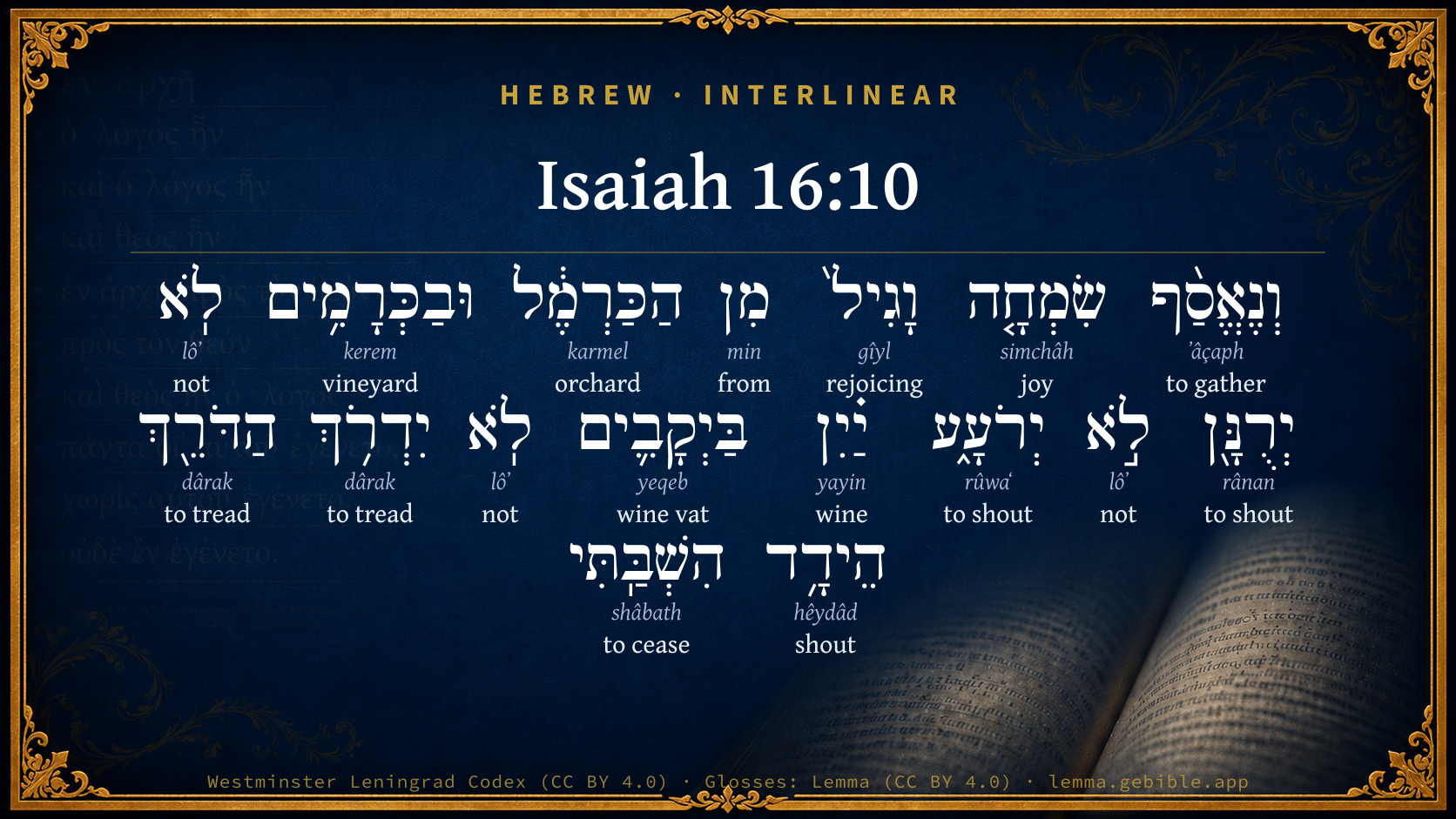
Isaiah 16:10

Hebrew (Westminster Leningrad Codex) Isaiah 16:10 appears in the Hebrew Old Testament. The text above is from the Westminster Leningrad Codex. Each word links to its Strong’s number, a concise gloss, and parsing drawn from the Open Scriptures Hebrew Bible morphology. Click any word for its full Brown-Driver-Briggs (BDB) entry.
Download image
Cite this verse

Isaiah 16:10 (World English Bible). Public Domain. Lemma interlinear Bible study tool, https://lemma.gebible.app/v/isaiah/16/10.

Show BibTeX & RIS
BibTeX
RIS
English Translation
Gladness is taken away, and joy out of the fruitful field; and in the vineyards there shall be no singing, neither joyful noise: nobody shall tread out wine in the presses; I have made the [vintage] shout to cease.
World English Bible · Public Domain
Download a study sheet

One document with this verse’s original text, its word-by-word gloss line, the meaning frame, cross-references with their text, attributed commentary, and full source and license credits — printable, and it pastes into notes with its structure intact.

This verse Autodidact and up

Study sheet (.html) Plain text (.txt)

A passage Seminary Student

Up to 50 verses in one chapter. A passage sheet keeps up to 6 commentary sources and 12 cross-references per verse, in the order this page ranks them, and says so on the sheet whenever that leaves anything out. Ask for a single verse and you get the Autodidact verse sheet above.

Everything on this page stays free to read, with no account — the sheet is a download of what is already on screen, not access to it.

Want to remove ads? Support Godless Engineer
Compare translations 3

The same verse in 3 English versions, stacked beneath the original-language interlinear above. Click any original word for its lexicon entry.

Each is an independent rendering of the whole verse — the interlinear is not word-aligned to these translations.

Highlighted words mark where these versions differ — a whole-verse word diff, not a word-by-word alignment.

  • World English Bible Public Domain
    Gladness is taken away, and joy out of the fruitful field; and in the vineyards there shall be no singing, neither joyful noise: nobody shall tread out wine in the presses; I have made the [vintage] shout to cease.
  • King James Version Public Domain
    And gladness is taken away, and joy out of the plentiful field; and in the vineyards there shall be no singing, neither shall there be shouting: the treaders shall tread out no wine in their presses; I have made their vintage shouting to cease.
  • unfoldingWord Literal Text CC BY-SA 4.0
    And gladness is gathered, and rejoicing, from the agricultural land. And in the vineyards, it is not sung; one does not shout joyfully. In the presses, the treader does not tread wine. “I have made shouting cease.”

unfoldingWord Literal Text — © unfoldingWord, licensed CC BY-SA 4.0. Word-aligned USFM3 via Door43 (git.door43.org/unfoldingWord/en_ult).

Versions to compare (up to 4)

3 of 4 selected

Show all 18 translations

Every available English version of this verse, each an independent rendering of the whole verse.

  • World English Bible Public Domain
    Gladness is taken away, and joy out of the fruitful field; and in the vineyards there shall be no singing, neither joyful noise: nobody shall tread out wine in the presses; I have made the [vintage] shout to cease.
  • Berean Standard Bible Public Domain
    Joy and gladness are removed from the orchard; no one sings or shouts in the vineyards. No one tramples the grapes in the winepresses; I have put an end to the cheering.
  • Majority Standard Bible Public Domain
    Joy and gladness are removed from the orchard; no one sings or shouts in the vineyards. No one tramples the grapes in the winepresses; I have put an end to the cheering.
  • King James Version Public Domain
    And gladness is taken away, and joy out of the plentiful field; and in the vineyards there shall be no singing, neither shall there be shouting: the treaders shall tread out no wine in their presses; I have made their vintage shouting to cease.
  • American Standard Version (1901) Public Domain
    And gladness is taken away, and joy out of the fruitful field; and in the vineyards there shall be no singing, neither joyful noise: no treader shall tread out wine in the presses; I have made the `vintage' shout to cease.
  • Revised Version (1885) Public Domain
    And gladness is taken away, and joy out of the fruitful field; and in the vineyards there shall be no singing, neither joyful noise: no treader shall tread out wine in the presses; I have made the vintage shout to cease.
  • Geneva Bible (1599) Public Domain
    And gladnes is taken away, and ioy out of the plentifull fielde: and in the vineyardes shall be no singing nor shouting for ioy: the treader shall not tread wine in the wine presses: I haue caused the reioycing to cease.
  • Douay-Rheims (1899) Public Domain
    And gladness and joy shall be taken away from Carmel, and there shall be no rejoicing nor shouting in the vineyards. He shall not tread out wine in the press that was wont to tread it out: the voice of the treaders I have taken away.
  • Young's Literal Translation Public Domain
    And removed have been gladness and joy from the fruitful field, And in vineyards they sing not, nor shout, Wine in the presses treadeth not the treader, Shouting I have caused to cease.
  • Literal Standard Version CC BY-SA 4.0
    And gladness and joy have been removed from the fruitful field, || And they do not sing in vineyards, nor shout, || The treader does not tread wine in the presses, || I have caused shouting to cease.
  • Unlocked Literal Bible CC BY-SA 4.0
    Gladness and joy are taken away from the fruit tree groves; and there is no singing, or shouts in the vineyards. No one treads out wine in the presses, for I have put an end to the shouts of the one who treads.
  • unfoldingWord Literal Text CC BY-SA 4.0
    And gladness is gathered, and rejoicing, from the agricultural land. And in the vineyards, it is not sung; one does not shout joyfully. In the presses, the treader does not tread wine. “I have made shouting cease.”
  • Darby Bible Public Domain
    And joy and gladness is taken away out of the fruitful field; and in the vineyards there is no singing, neither is there shouting: the treaders tread out no wine in the presses, I have made the cry [of the winepress] to cease.
  • World Messianic Bible Public Domain
    Gladness is taken away, and joy out of the fruitful field; and in the vineyards there will be no singing, neither joyful noise. Nobody will tread out wine in the presses. I have made the shouting stop.
  • Webster's Bible Public Domain
    And gladness is taken away, and joy from the plentiful field; and in the vineyards there shall be no singing, neither shall there be shouting: the treaders shall tread out no wine in their presses; I have made their vintage-shouting to cease.
  • Free Bible Version CC BY-SA 4.0
    Joy and happiness are gone. Nobody celebrates in the harvest fields or the vineyards; nobody shouts happily. Nobody treads grapes in the winepresses. I have stopped their cheering.
  • Bible in Basic English Public Domain
    And all joy is gone; no longer are they glad for the fertile field; and in the vine-gardens there are no songs or sounds of joy: the crushing of grapes has come to an end, and its glad cry has been stopped.
  • JPS Tanakh (1917) Public Domain
    And gladness and joy are taken away out of the fruitful field; and in the vineyards there shall be no singing, neither shall there be shouting; no treader shall tread out wine in the presses; I have made the vintage shout to cease.

Literal Standard Version (2020), Covenant Press — licensed CC BY-SA 4.0. Text via the HelloAO Bible API (eBible.org). Unlocked Literal Bible (unfoldingWord) — licensed CC BY-SA 4.0. Text via the HelloAO Bible API (eBible.org). unfoldingWord Literal Text — © unfoldingWord, licensed CC BY-SA 4.0. Word-aligned USFM3 via Door43 (git.door43.org/unfoldingWord/en_ult). Free Bible Version, Dr. Jonathan Gallagher — licensed CC BY-SA 4.0. Text via the HelloAO Bible API (eBible.org).

Word by word

More ways to search: Search by grammar → Find every occurrence → Compare this word →

Practice this passage: Drill this verse → Learn its vocabulary →

הֵידָ֥ד
hêydâd
H1959
“shout”
Noun, Common, Masculine, Singular, Absolute
Part of Speech
Noun
Type
Common
Gender
Masculine
Number
Singular
State
Absolute
Full BDB Definition

Origin: from an unused root (meaning to shout)

TWOT: 471a

a shout, cheer, shouting - shouting - shout (of the foe)
  1. וְנֶאֱסַ֨ף ʼâçaph H622 “and · to gather” Conjunction + Verb, Niphal, Sequential Perfect, 3rd Person, Masculine, Singular
  2. שִׂמְחָ֤ה simchâh H8057 “joy” Noun, Common, Feminine, Singular, Absolute
  3. וָגִיל֙ gîyl H1524 “and · rejoicing” Conjunction + Noun, Common, Masculine, Singular, Absolute
  4. מִן min H4480 “from” Preposition
  5. הַכַּרְמֶ֔ל karmel H3759 “the · orchard” Particle, Definite Article + Noun, Common, Masculine, Singular, Absolute
  6. וּבַכְּרָמִ֥ים kerem H3754 “and · in/at the · vineyards” Conjunction + Preposition, Determined + Noun, Common, Both, Plural, Absolute
  7. לֹֽא lôʼ H3808 “not” Particle, Negative
  8. יְרֻנָּ֖ן rânan H7442 “to shout” Verb, Pual, Imperfect, 3rd Person, Masculine, Singular
  9. לֹ֣א lôʼ H3808 “not” Particle, Negative
  10. יְרֹעָ֑ע rûwaʻ H7321 “to shout” Verb, Polal, Imperfect, 3rd Person, Masculine, Singular
  11. יַ֗יִן yayin H3196 “wine” Noun, Common, Masculine, Singular, Absolute
  12. בַּיְקָבִ֛ים yeqeb H3342 “in/at the · wine vats” Preposition, Determined + Noun, Common, Masculine, Plural, Absolute
  13. לֹֽא lôʼ H3808 “not” Particle, Negative
  14. יִדְרֹ֥ךְ dârak H1869 “to tread” Verb, Qal, Imperfect, 3rd Person, Masculine, Singular
  15. הַדֹּרֵ֖ךְ dârak H1869 “the · treading” Particle, Definite Article + Verb, Qal, Participle Active, Masculine, Singular, Absolute
  16. הִשְׁבַּֽתִּי shâbath H7673 “to cease” Verb, Hiphil, Perfect, 1st Person, Common, Singular

About this verse

These counts appear in no published source. They are computed here, from the morphology-tagged text and Lemma’s own curated glosses. What Lemma adds →

17
words
14
distinct lemmas
Prophets
section

Notable vocabulary

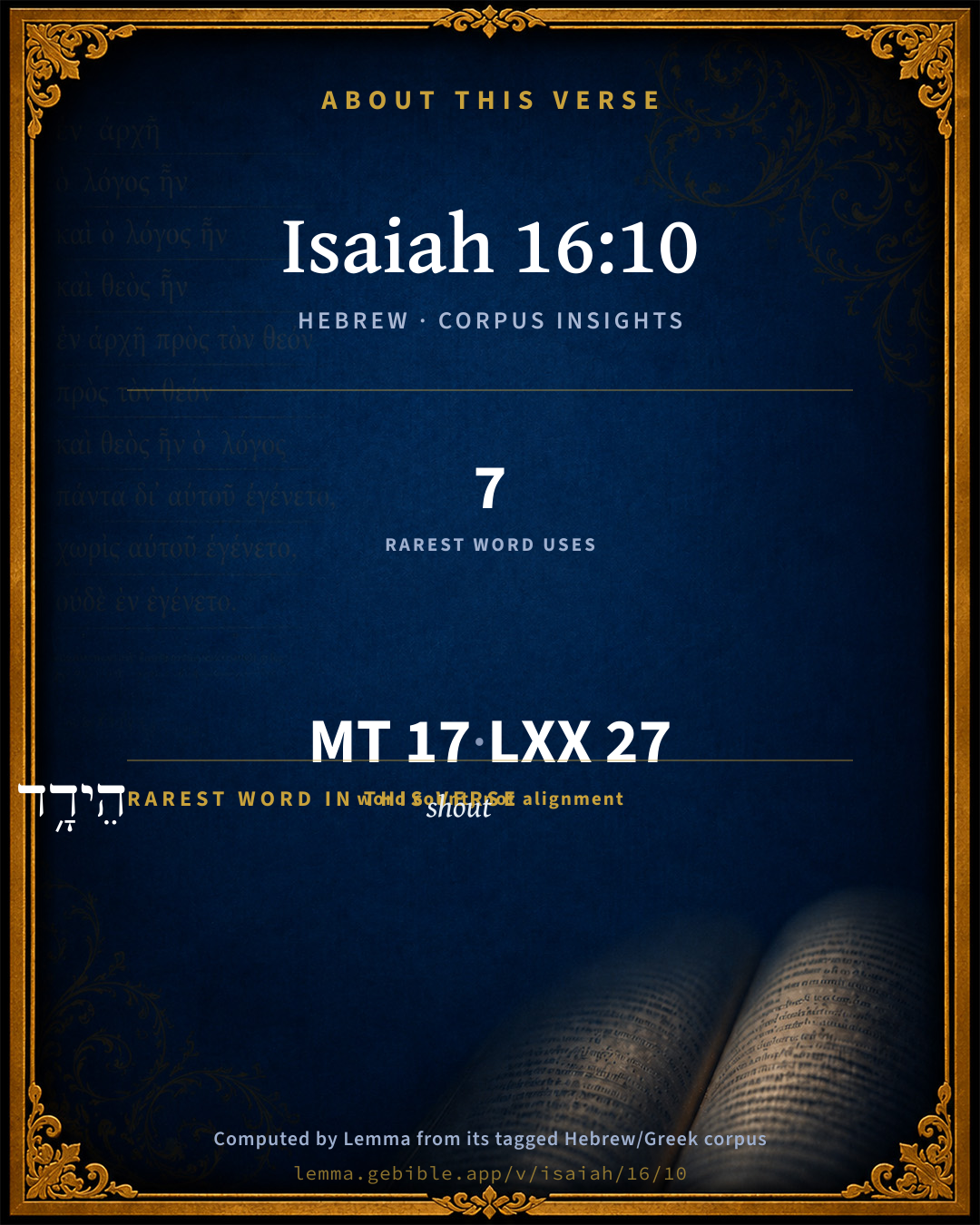
The rarest word here is הֵידָ֥ד shout H1959 — appearing just 7 times in the whole Hebrew Bible.

Shared distinctive vocabulary

הֵידָ֥ד shout H1959 occurs in 5 verses of the Hebrew Bible. Also found in:

Grammatical profile

  • 6 verbs
  • 7 nouns
  • 1 preposition
  • 3 particles

Verb forms

  • וְנֶאֱסַ֨ף Niphal · Sequential Perfect
  • יְרֻנָּ֖ן Pual · Imperfect
  • יְרֹעָ֑ע Polal · Imperfect
  • יִדְרֹ֥ךְ Qal · Imperfect
  • הַדֹּרֵ֖ךְ Qal · Participle Active
  • הִשְׁבַּֽתִּי Hiphil · Perfect

Repetition

Words recur within this verse — often emphatic in Hebrew:

  • יִדְרֹ֥ךְ to tread H1869 ×2
  • לֹֽא not H3808 ×3

Hebrew & Septuagint length

In English translation the verse runs 39 words from the Hebrew and 27 from the Septuagint (LXX English) — the Septuagint runs noticeably shorter here. See the side-by-side →

A rough comparison of the two English renderings, which tokenize alike — not a word-level alignment.

Word counts can differ between the Hebrew and the Greek without any difference in meaning — e.g. the Hebrew direct-object marker אֵת has no separate Greek word, and Greek often adds the article ὁ.

In the original languages it is 17 Hebrew tokens and 27 Greek tokens — but the two are counted differently (Hebrew bundles its prefixes and suffixes into one token; the Greek is in lemma form), so that isn’t a like-for-like length.

Cross-references

9

Topical passages linked to Isaiah 16:10 in the Treasury of Scripture Knowledge — connected by theme and wording, ordered by reader-vote popularity; previews shown in the World English Bible.

  • Jeremiah 48:33 Gladness and joy is taken away from the fruitful field and from the land of Moab; and I have caused wine to cease from the wine presses: none shall tread with shouting; the shouting shall be no shouting.
  • Judges 9:27 They went out into the field, and gathered their vineyards, and trod [the grapes], and held festival, and went into the house of their god, and did eat and drink, and cursed Abimelech.
  • Amos 5:11 Forasmuch therefore as you trample on the poor, And take taxes from him of wheat: You have built houses of hewn stone, But you will not dwell in them. You have planted pleasant vineyards, But you shall not drink their wine.
  • Amos 5:17 In all vineyards there will be wailing; For I will pass through the midst of you," says Yahweh.
  • Job 24:11 They make oil within the walls of these men. They tread wine presses, and suffer thirst.
  • Isaiah 24:7–9 The new wine mourns, the vine languishes, all the merry-hearted do sigh.
  • Isaiah 32:10 For days beyond a year shall you be troubled, you careless women; for the vintage shall fail, the harvest shall not come.
  • Habakkuk 3:17–18 For though the fig tree doesn't flourish, Nor fruit be in the vines; The labor of the olive fails, The fields yield no food; The flocks are cut off from the fold, And there is no herd in the stalls:
  • Zephaniah 1:13 Their wealth will become a spoil, and their houses a desolation. Yes, they will build houses, but won't inhabit them. They will plant vineyards, but won't drink their wine.

Cross-references courtesy of OpenBible.info (CC BY 4.0).

Hebrew and Greek witnesses Masoretic Hebrew ↔ Greek Septuagint

The same verse in the two great witnesses to the Old Testament, shown verse-for-verse.

Here the Septuagint runs noticeably shorter than the Hebrew — LXX2012 (modern English Septuagint) 27 words vs World English Bible 39. A rough length comparison of the two English translations, not a word-level alignment — read both below.

These are two independent witnesses, not word-aligned to each other, and the Septuagint is shown in lemma (dictionary) form.

Hebrew Isaiah 16:10 Masoretic · Westminster Leningrad Codex

וְנֶאֱסַ֨ף שִׂמְחָ֤ה וָגִיל֙ מִן הַכַּרְמֶ֔ל וּבַכְּרָמִ֥ים לֹֽא יְרֻנָּ֖ן לֹ֣א יְרֹעָ֑ע יַ֗יִן בַּיְקָבִ֛ים לֹֽא יִדְרֹ֥ךְ הַדֹּרֵ֖ךְ הֵידָ֥ד הִשְׁבַּֽתִּי

Gladness is taken away, and joy out of the fruitful field; and in the vineyards there shall be no singing, neither joyful noise: nobody shall tread out wine in the presses; I have made the [vintage] shout to cease.

World English Bible · Public Domain

Greek LXX Isaiah 16:10 Septuagint · lemma form

καί αἴρω εὐφροσύνη καί ἀγαλλίαμα ἐκ ὁ ἀμπελών σύ καί ἐν ὁ ἀμπελών σύ οὐ μή εὐφραίνω καί οὐ μή πατέω οἶνος εἰς ὁ ὑπολήνιον παύω γάρ

And gladness and rejoicing shall be taken away from the vineyards; and they shall not at all tread wine into the vats; for the vintage has ceased.

LXX2012 (modern English Septuagint) · Public Domain

On this verse, Adam Clarke's Commentary discusses the Septuagint’s reading. Read the note in Commentary ↓

Hebrew: Westminster Leningrad Codex (CC BY 4.0). Greek: Septuagint (public domain); English from LXX2012 (modern English Septuagint) (Public Domain). How the Septuagint differs from the Hebrew →

Targum (Aramaic paraphrase)

1

The Targum is the ancient Jewish Aramaic paraphrase of the Hebrew Scriptures — an interpretive translation, not the Hebrew text itself. Onkelos (literal) and Pseudo-Jonathan (expansive) render the Torah, and Jonathan the Prophets. Coverage is partial: where no permissively-licensed English translation exists for a verse, only the Aramaic is shown. This is verse-level text, not a word-by-word alignment to the Hebrew.

  1. Targum Jonathan Prophets (Joshua–Malachi)
    וְתִתְכְּנֵישׁ בִיעַ וְחֶדְוָה מִן כַּרְמְלָא וּבְכַרְמַיָא לָא יְדוּצוּן וְלָא יְחַיְכוּן וַחֲמַר בְּמַעְצְרַיָא לָא יַעְצְרוּן עָצוֹרִין עָצוֹר אַבְטֵלִית:

    And joy is taken away and gladness out of the fruitful field, and in the vineyards they shall not rejoice, neither shall they play sport; in the vats the treaders shall not tread out the wine; the treading of grapes I have made to cease.

    Targum Jonathan — Aramaic: “Mikraot Gedolot” (public domain). English: “Sefaria Community Translation” (CC0 1.0 (public-domain dedication)); “London "Chaldee Paraphrase," 1871” (public domain). Text via Sefaria.

Commentary

Notes on Isaiah 16:10 from classic Christian and Jewish commentators (each source and its license shown beneath its notes). The classic Christian expositions comment on the surrounding passage and are grouped to its opening verse, so a note may address several verses; the Jewish commentaries on the Tanakh (Rashi and others) are per-verse, so they appear only where the commentator wrote on this verse.

Lemma curates 59 commentaries, every one of them public domain or Creative Commons licensed, each selected and text-cleaned for this edition rather than reprinted as found. About our sources →

Trapp's Complete Commentary

John Trapp

Isa 16:10 And gladness is taken away, and joy out of the plentiful field; and in the vineyards there shall be no singing, neither shall there be shouting: the treaders shall tread out no wine in [their] presses; I have made [their vintage] shouting to cease.

Ver. 10. And gladness is taken away.] Laetitia - i.e., quicquid laetificum erat, All matter of mirth is removed. Heb., Gathered up, or gathered in, as your harvest also is to your hand by the enemy.

John Trapp, A Commentary or Exposition upon All the Books of the Old and New Testament (1647–1656) — public domain. Text from a community e-Sword module.

Jamieson, Fausset & Brown

Robert Jamieson, A. R. Fausset & David Brown

gladness--such as is felt in gathering a rich harvest. There shall be no harvest or vintage owing to the desolation; therefore no "gladness."

Jamieson, Fausset & Brown — Commentary Critical and Explanatory on the Whole Bible (1871) — public domain (CC PDM 1.0). Text via the HelloAO Bible API.

Adam Clarke's Commentary

Verse 10. Neither shall there be shouting - "An end is put to the shouting"] The Septuagint read השבת hishbeth, passive, and in the third person; rightly, for God is not the speaker in this place. The rendering of the Septuagint is πεπαυται γαρ κελευσμα, "the cry ceaseth;" which last word, necessary to the rendering of the Hebrew and to the sense, is supplied by MSS. Pachom. and I. D. II., having been lost out of the other copies.

Adam Clarke's Commentary on the Bible (1810–1826) — public domain. Text from a community e-Sword/MySword module.

Ellicott's Commentary for English Readers

(10) Out of the plentiful field.—Literally, out of the Carmel, one of Isaiah’s favourite words, as in Isa_10:18; Isa_29:17. The word for “shouting” is the hedad of the previous verse. In the words, “I have made . . .” Jehovah speaks as declaring that the work of desolation, though wrought by human hands, is yet His. The prophet, while he weeps in true human pity, is taught not to forget that the desolation is a righteous punishment.

A Bible Commentary for English Readers, edited by Charles John Ellicott (1878–1897) — public domain. Text from a community e-Sword module.

The Cambridge Bible for Schools and Colleges

gen. ed. J. J. S. Perowne

10. (Jer_48:33) shouting and vintage shouting are entirely different words; the first may be translated by joyful noise as in R.V.

the treaders shall tread out no wine] i.e. there shall be none treading wine. In the last clause—“I have stilled”—the voice of Jehovah is again heard; some critics, however, read “is stilled.”

The Cambridge Bible for Schools and Colleges (gen. ed. J. J. S. Perowne; Cambridge University Press, 1878–1918) — public domain. Text from a community e-Sword module.

John Gill's Exposition

And gladness is taken away, and joy out of the plentiful field,.... Or "is gathered" (h), though their harvest was not; all cause of joy and gladness was removed; a plentiful field being foraged, trampled upon, and destroyed by the enemy, and left desolate without any to manure it:

and in the vineyards there shall be no singing; as there used to be by the men that gathered the grapes, and trod the wine presses; but now there would be no men in the vineyards, there being no grapes to gather or tread, as follows:

the treaders shall tread out no wine in their presses; the way in those times and countries being for men to tread the grapes, and the wine out of them, with their feet, in vats or vessels, and not in presses with screws and weights, as now:

I have made their vintage shouting to cease; by suffering the enemy to come in among them, which had destroyed their vintage, and so prevented their shouting, and spoiled their song.

(h) "colligetur", Montanus; "ad verbum, collectum est", Vatablus.

John Gill's Exposition of the Whole Bible (1746–1763) — public domain (CC PDM 1.0). Text via the HelloAO Bible API.

Albert Barnes' Notes on the Bible

And gladness ... - The gladness and joy that was commonly felt in the field producing a rich and luxuriant harvest.

Out of the plentiful field - Hebrew, ‘From Carmel;’ but Carmel means a fruitful field as well as the mountain of that name (see the note at Isa 10:18).

I have made their vintage shouting to cease - That is, by the desolation that has come upon the land. The vineyards are destroyed; and of course the shout of joy in the vintage is no more heard.

Albert Barnes' Notes on the Bible (1834–1885) — public domain. Text from a community e-Sword/MySword module.

Haydock's Catholic Bible Commentary

Carmel. This name is often taken to signify a fair and fruitful hill or field, such as Mount Carmel is. (Challoner) --- It means, "the vine of God." (Calmet)

George Leo Haydock (1774–1849), Haydock's Catholic Family Bible and Commentary, 1859 edition — public domain. Excludes Psalms (Douay-Rheims chapter numbering differs from Protestant) and Deuterocanonical books (Catholic canon only).

Matthew Poole's English Annotations

The treaders: in those times they used to squeeze out the juice of their grapes by treading them with their feet, in vessels appointed for that use, Jdg 9:27; Neh 13:15.

Matthew Poole's English Annotations on the Holy Bible (1683–1685) — public domain. Text from a community e-Sword/MySword module.

The Pulpit Commentary

The plentiful field; Hebrew, Carmel. The word carmel seems to designate "garden," or "orchard ground" generally, without reference to the degree of fertility. It is generally rendered by our translators "fruitful field," which is right, if we regard "fruitful" as equivalent to "fruit-producing." No singing... no shouting. Those who have heard the vintage-songs in the north of Italy and elsewhere will appreciate the sadness of this silence. The treaders shall tread out no wine in their presses. Wine-presses were in or near the vineyards. They consisted of two vats, or two reservoirs cut in the rock, one above the other, with a passage of communication between them. The grapes were placed in the upper vat or reservoir, and were crushed by the naked feet of the vintagers. Sometimes as many as seven persons "trod the wine-press" together (Wilkinson, "Ancient Egyptians," vol. 1. p. 45). It was usual for them to sing as they trod. (Jer_25:30 Jer_48:33) I have made their vintage shouting to cease. The prophet is the mouthpiece of God. Accidentally, as it were, he here betrays the personality which is behind him. It is not he, but God, who has caused the invasion which has reduced the vintagers to silence.

HOMILIES BY W.M. STATHAM Ver. 10. A harvest failure.

"I have made their vintage shouting to cease." Why? Because the harvest is fallen. In the vineyards there is no shouting, for all the fruits are blighted and withered. Thus is it with every harvest which is evil. Men expect much, and lo! it often comes to nothing. The glory departs if God is forgotten.

I WE LIVE FOR THE FUTURE. Few live in the present hour alone. Some amass property, looking forward to days of retirement and ease; some go to far-away fields of war to gather the laurels of victory, and to win what the world calls fame; and some seek stores of intellectual wealth, so as to secure the far-off coronet of scholarship and learned renown. But the harvest fails. Jealousy and envy do their work; and the ambassador is recalled, or the mind becomes feeble; through weariness or weakness the anticipated victory becomes a defeat. Somehow or other, either through events with out or experience within, when God does not live in the heart and his glory is forgotten, the vintage fails.

II WE LOOK FOR JOY IN HARVEST. That is the time for music and joy, or, as the prophet says, for singing and shouting. It is a time of stretched-out branches and purple groves. And God intended us to have joy in harvest. All innocent pursuits end in blessing, if we seek first the kingdom of God and his righteousness. But if not, then there is dullness and gloom and failure; for the Lord of harvest is not there. The vintage fails, because he is the true Vine, and we are the branches, and every branch separated from him is cut down and withered.

III WE LOOK FOR FRUIT AS WELL AS LEAFAGE. That is a remarkable sentence, "The treaders shall tread out no wine in their presses." Nothing but leaves! What a significant sentence! Everything seemed to promise well. There was the tender green of spring and the rich foliage of summer, but no blossoms hide under the luxuriant foliage. So it is with all mere convictions and resolves, with all passing sensations and excited feelings. We need ever to remember that the end of religion is fruit.

Fruitful service, fruitful sacrifice. And without these, whatever else there be, the vintage fails. W.M.S.

The Pulpit Commentary (1880–1919), ed. H.D.M. Spence-Jones & Joseph S. Exell — public domain. Text from a community e-Sword module.

John Wesley's Explanatory Notes

Treaders - In those times they used to squeeze out the juice of their grapes by treading them with their feet.

John Wesley, Explanatory Notes Upon the Whole Bible (1754–1765) — public domain. Text via the GEBible commentary corpus.

Keil & Delitzsch

C. F. Keil & F. Delitzsch

The prophet, to whose favourite words and favourite figures Carmel belongs, both as the name of a place and as the name of a thing, now proceeds with his picture, and is plunged still more deeply into mourning. "And joy is taken away, and the rejoicing of the garden-land; and there is no exulting, no shouting in the vineyards: the treader treads out no wine in the presses; I put an end to the Hedad. Therefore my bowels sound for Moab like a harp, and my inside for Kir-heres." It is Jehovah who says "I put an end;" and consequently the words, "My bowels sound like a harp," or, as Jeremiah expresses it (Jer 48:36), like flutes, might appear to be expressive of the feelings of Jehovah. And the Scriptures do not hesitate to attribute mē‛ayim (viscera) to God (e.g., Isa 63:15; Jer 31:20). But as the prophet is the sympathizing subject throughout the whole of the prophecy, it is better, for the sake of unity, to take the words in this instance also as expressing the prophet's feelings. Just as the hand or plectrum touches the strings of the harp, so that they vibrate with sound; so did the terrible things that he had heard Jehovah say concerning Moab touch the strings of his inward parts, and cause them to resound with notes of pain. By the bowels, or rather entrails (viscera), the heart, liver, and kidneys are intended - the highest organs of the Psyche, and the sounding-board, as it were, of those "hidden sounds" which exist in every man. God conversed with the prophet "in the spirit;" but what passed there took the form of individual impressions in the domain of the soul, in which impressions the bodily organs of the psychical life sympathetically shared. Thus the prophet saw in the spirit the purpose of God concerning Moab, in which he could not and would not make any change; but it threw his soul into all the restlessness of pain.

Keil & Delitzsch — Biblical Commentary on the Old Testament (1861–1891) — public domain (CC PDM 1.0). Text via the HelloAO Bible API. (Old Testament only.)

J. A. Alexander on Isaiah

Joseph Addison Alexander

“And taken away is joy and gladness from the fruitful field, and in the vineyards shall no (more) be sung, no (more) be shouted: wine in the presses shall the treader not tread; the cry have stilled (or caused to cease).” The English Version, on the other hand, by using the expression no wine, seems to imply that the treading of the grapes would not be followed by its usual result, whereas the meaning is that the grapes would not be trodden at all. The same version needlessly puts treaders in the plural. The idiomatic combination of the verb and its participle or derivative noun, is not uncommon in Hebrew. The ancient mode of treading grapes is still preserved in some of the monuments of Egypt.

Joseph Addison Alexander, The Prophecies of Isaiah (1846–1847; New York: Scribner, 1870–1878) — public domain. Text from a community e-Sword module.

Rashi

Rabbi Shlomo Yitzchaki (Rashi)

from the fruitful field Heb. כַּרְמֶל. That is a place of a forest and grain fields.

no shout Heb. יְרֹעָע, an expression of a shout of (תְּרוּעַת) joy.

the shout have I abolished the voice of those assembled to lay the beam to press the grapes.

Rashi on the Tanakh — English translations: “The Judaica Press complete Tanach with Rashi, translated by A. J. Rosenberg” (CC BY 4.0); “Pentateuch with Rashi's commentary by M. Rosenbaum and A.M. Silbermann, 1929-1934” (public domain); “The Metsudah Tanach series, Lakewood, N.J” (CC BY 4.0); and “The Book of Joshua, Metsudah Publications, 1997” (CC BY 4.0). Text via Sefaria.

Ibn Ezra

Rabbi Abraham ibn Ezra

The gladness is gathered, to be taken away from them and given to others; it will leave them.

The Karmel. A part of which belonged to Moab.

ירועע He will shout. Comp. תרועה blowing the trumpet (Lev. 23:24); ירועע is Polel of a verb הידד.

ע״ו Hedad. The hedad is pleasant, when it is heard at the wine press, at the time when the wine is produced; but its effect is of an opposite character, when it is heard in the midst of the fresh fruits and corn.

Ibn Ezra on the Tanakh — English translations: “Sefaria Community Translation” (CC0 1.0 (public-domain dedication)); “Yalkut, Sifsei Chachomim Chumash, Metsudah Publications, 2009” (CC BY 4.0); and “Commentary of Ibn Ezra on Isaiah - trans. by M. Friedlander, 1873” (public domain). Text via Sefaria.

Lesson kit

Teaching starters — assembled from the data on this page, not authored interpretation. Every prompt links to the verse data it draws on. Edit before teaching.

Isaiah, in the Prophets, opens this verse with 17 words (14 distinct Hebrew lemmas). Its most distinctive word is hêydâd (“shout”). The Greek Septuagint runs shorter here. A historical commentator’s framing appears above. Read the whole chapter for the surrounding context.

Discussion questions

  1. How does “shout” (hêydâd) shape what this verse is saying?
  2. How does Isaiah 16:9, which shares the word «shout», read alongside this verse?
  3. What does the repetition of “to tread” (2× in this one verse) do in this verse?
  4. The Septuagint runs shorter here than the Hebrew. What might account for the difference?
  5. These translations render this verse differently; the difference is in the English rendering, not the original. What questions does that raise?
  6. «וְנֶאֱסַ֨ף» is a Niphal Sequential Perfect verb. How does that grammatical form shape the action described?
  7. Compare how Trapp's Complete Commentary and Jamieson, Fausset & Brown read this verse. Where do they agree or differ?

Things to notice

Reading settings

Reading text

Shown beneath each verse's original-language words.

Old Testament
Old Testament edition

Read the OT as the Masoretic Hebrew (MT) or the Greek Septuagint (LXX).

English shown for the Greek Septuagint (in the Hebrew ↔ Greek comparison).

Comparing translations? Open the Compare panel on any verse page to stack up to four side by side.