Numbers 27:13

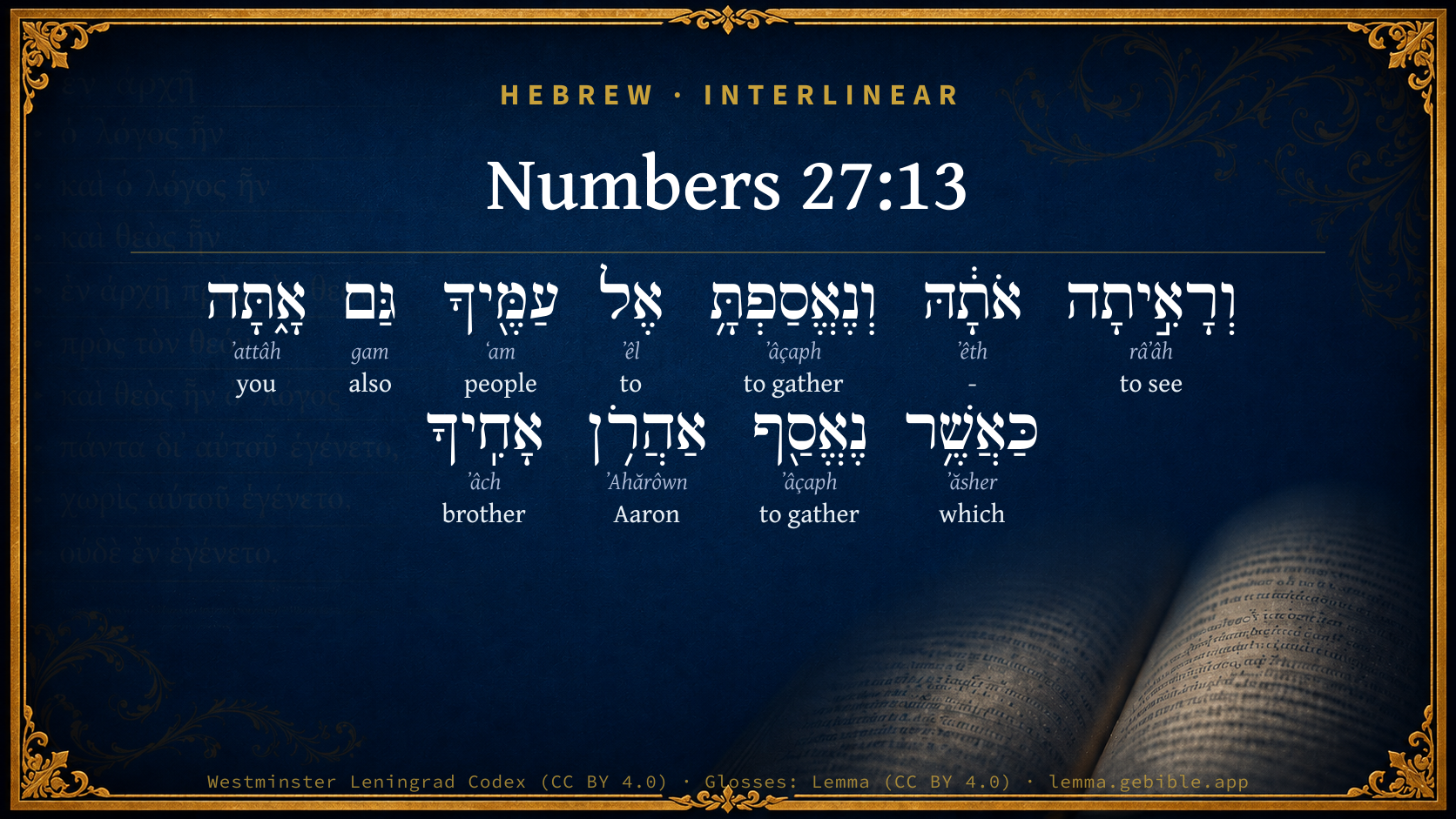
Hebrew (Westminster Leningrad Codex) Numbers 27:13 appears in the Hebrew Old Testament. The text above is from the Westminster Leningrad Codex. Each word links to its Strong’s number, a concise gloss, and parsing drawn from the Open Scriptures Hebrew Bible morphology. Click any word for its full Brown-Driver-Briggs (BDB) entry.
Download image
Cite this verse

Numbers 27:13 (World English Bible). Public Domain. Lemma interlinear Bible study tool, https://lemma.gebible.app/v/numbers/27/13.

Show BibTeX & RIS
BibTeX
RIS
English Translation
When you have seen it, you also shall be gathered to your people, as Aaron your brother was gathered;
World English Bible · Public Domain
Download a study sheet

One document with this verse’s original text, its word-by-word gloss line, the meaning frame, cross-references with their text, attributed commentary, and full source and license credits — printable, and it pastes into notes with its structure intact.

This verse Autodidact and up

Study sheet (.html) Plain text (.txt)

A passage Seminary Student

Up to 50 verses in one chapter. A passage sheet keeps up to 6 commentary sources and 12 cross-references per verse, in the order this page ranks them, and says so on the sheet whenever that leaves anything out. Ask for a single verse and you get the Autodidact verse sheet above.

Everything on this page stays free to read, with no account — the sheet is a download of what is already on screen, not access to it.

Want to remove ads? Support Godless Engineer
Compare translations 3

The same verse in 3 English versions, stacked beneath the original-language interlinear above. Click any original word for its lexicon entry.

Each is an independent rendering of the whole verse — the interlinear is not word-aligned to these translations.

Highlighted words mark where these versions differ — a whole-verse word diff, not a word-by-word alignment.

  • World English Bible Public Domain
    When you have seen it, you also shall be gathered to your people, as Aaron your brother was gathered;
  • King James Version Public Domain
    And when thou hast seen it, thou also shalt be gathered unto thy people, as Aaron thy brother was gathered.
  • unfoldingWord Literal Text CC BY-SA 4.0
    And you shall see it and be gathered to your people, also you, just as Aaron your brother was gathered,

unfoldingWord Literal Text — © unfoldingWord, licensed CC BY-SA 4.0. Word-aligned USFM3 via Door43 (git.door43.org/unfoldingWord/en_ult).

Versions to compare (up to 4)

3 of 4 selected

Show all 18 translations

Every available English version of this verse, each an independent rendering of the whole verse.

  • World English Bible Public Domain
    When you have seen it, you also shall be gathered to your people, as Aaron your brother was gathered;
  • Berean Standard Bible Public Domain
    After you have seen it, you too will be gathered to your people, as your brother Aaron was;
  • Majority Standard Bible Public Domain
    After you have seen it, you too will be gathered to your people, as your brother Aaron was;
  • King James Version Public Domain
    And when thou hast seen it, thou also shalt be gathered unto thy people, as Aaron thy brother was gathered.
  • American Standard Version (1901) Public Domain
    And when thou hast seen it, thou also shalt be gathered unto thy people, as Aaron thy brother was gathered;
  • Revised Version (1885) Public Domain
    And when thou hast seen it, thou also shalt be gathered unto thy people, as Aaron thy brother was gathered:
  • Geneva Bible (1599) Public Domain
    And when thou hast seene it, thou shalt be gathered vnto thy people also, as Aaron thy brother was gathered.
  • Douay-Rheims (1899) Public Domain
    And when thou shalt have seen it, thou also shalt go to thy people, as thy brother Aaron is gone:
  • Young's Literal Translation Public Domain
    and thou hast seen it, and thou hast been gathered unto thy people, also thou, as Aaron thy brother hath been gathered,
  • Literal Standard Version CC BY-SA 4.0
    and you have seen it, and you have been gathered to your people, also you, as your brother Aaron has been gathered,
  • Unlocked Literal Bible CC BY-SA 4.0
    After you have seen it, you, too, must be gathered to your people, like Aaron your brother.
  • unfoldingWord Literal Text CC BY-SA 4.0
    And you shall see it and be gathered to your people, also you, just as Aaron your brother was gathered,
  • Darby Bible Public Domain
    And when thou hast seen it, thou also shalt be gathered unto thy peoples, as Aaron thy brother was gathered,
  • World Messianic Bible Public Domain
    When you have seen it, you also shall be gathered to your people, as Aaron your brother was gathered;
  • Webster's Bible Public Domain
    And when thou hast seen it, thou also shalt be gathered to thy people, as Aaron thy brother was gathered.
  • Free Bible Version CC BY-SA 4.0
    After you have seen it, you will also join your forefathers in death, just as your brother Aaron did,
  • Bible in Basic English Public Domain
    And when you have seen it, you will be put to rest with your people, as your brother Aaron was:
  • JPS Tanakh (1917) Public Domain
    And when thou hast seen it, thou also shalt be gathered unto thy people, as Aaron thy brother was gathered;

Literal Standard Version (2020), Covenant Press — licensed CC BY-SA 4.0. Text via the HelloAO Bible API (eBible.org). Unlocked Literal Bible (unfoldingWord) — licensed CC BY-SA 4.0. Text via the HelloAO Bible API (eBible.org). unfoldingWord Literal Text — © unfoldingWord, licensed CC BY-SA 4.0. Word-aligned USFM3 via Door43 (git.door43.org/unfoldingWord/en_ult). Free Bible Version, Dr. Jonathan Gallagher — licensed CC BY-SA 4.0. Text via the HelloAO Bible API (eBible.org).

Word by word

More ways to search: Search by grammar → Find every occurrence → Compare this word →

Practice this passage: Drill this verse → Learn its vocabulary →

וְנֶאֱסַפְתָּ֥
ʼâçaph
H622
“and · to gather”
Conjunction + Verb, Niphal, Sequential Perfect, 2nd Person, Masculine, Singular
Part of Speech
Conjunction + Verb
Stem
Niphal
Form
Sequential Perfect
Person
2nd Person
Gender
Masculine
Number
Singular
Full BDB Definition

Origin: a primitive root

TWOT: 140

to gather, receive, remove, gather in - (Qal) - to gather, collect - to gather (an individual into company of others) - to bring up the rear - to gather and take away, remove, withdraw - (Niphal) - to assemble, be gathered - (passive of Qal 1a2) - to be gathered to one's fathers - to be brought in or into (association with others) - (passive of Qal 1a4) - to be taken away, removed, perish - (Piel) - to gather (harvest) - to take in, receive into - rearguard, rearward (substantive) - (Pual) to be gathered - (Hithpael) to gather oneself or themselves
  1. וְרָאִ֣יתָה râʼâh H7200 “and · to see” Conjunction + Verb, Qal, Sequential Perfect, 2nd Person, Masculine, Singular
  2. אֹתָ֔הּ ʼêth H853 “- · her” Particle, Direct Object + Suffix, Personal, 3rd Person, Feminine, Singular
  3. אֶל ʼêl H413 “to” Preposition
  4. עַמֶּ֖יךָ ʻam H5971 “peoples · your” Noun, Common, Masculine, Plural, Construct + Suffix, Personal, 2nd Person, Masculine, Singular
  5. גַּם gam H1571 “also” Particle, Accusative
  6. אָ֑תָּה ʼattâh H859 “you” Pronoun, Personal, 2nd Person, Masculine, Singular
  7. כַּאֲשֶׁ֥ר ʼăsher H834 “like/as · which” Preposition + Particle, Relative
  8. נֶאֱסַ֖ף ʼâçaph H622 “to gather” Verb, Niphal, Perfect, 3rd Person, Masculine, Singular
  9. אַהֲרֹ֥ן ʼAhărôwn H175 “Aaron” Noun, Proper
  10. אָחִֽיךָ ʼâch H251 “brother · your” Noun, Common, Masculine, Singular, Construct + Suffix, Personal, 2nd Person, Masculine, Singular

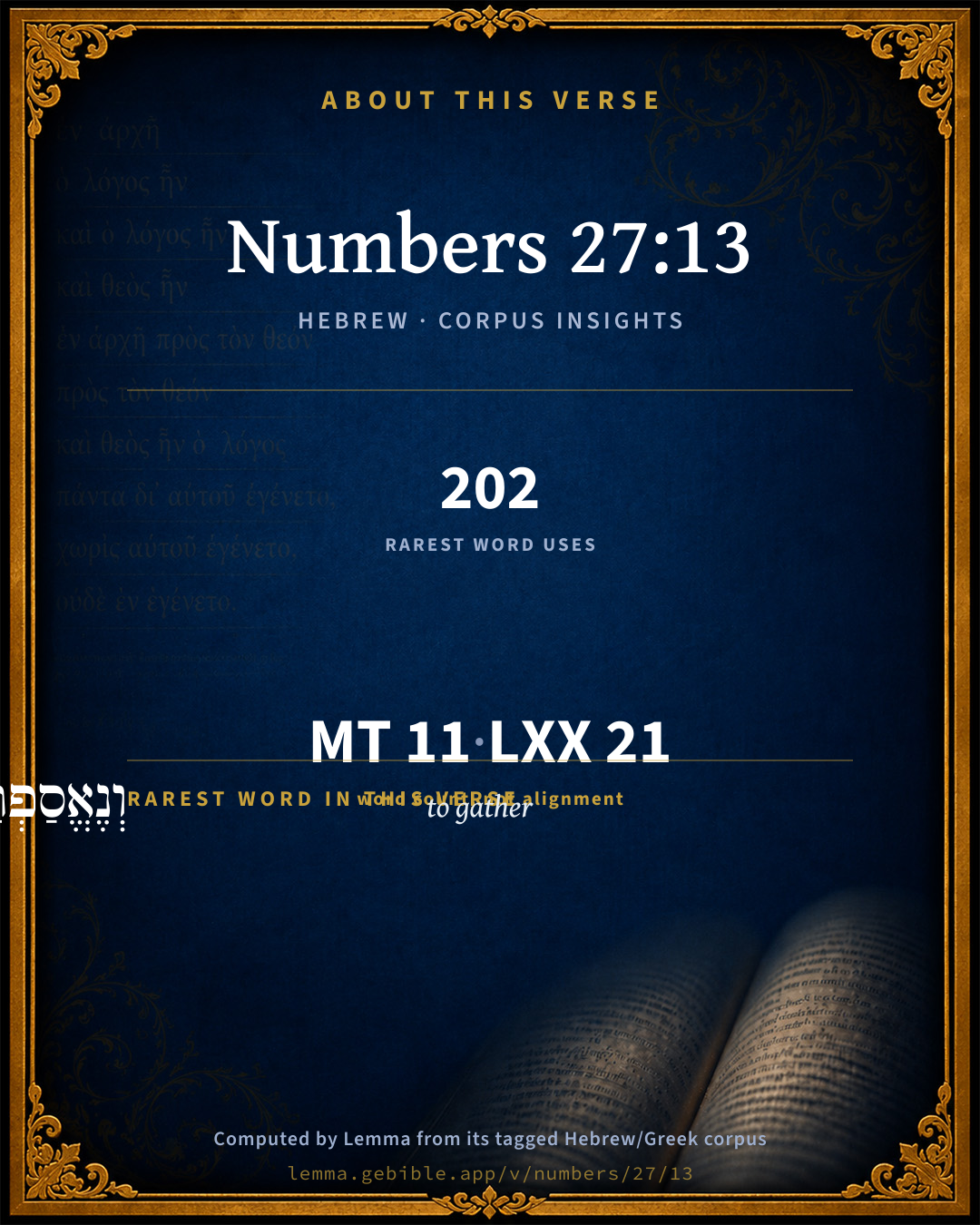
About this verse

These counts appear in no published source. They are computed here, from the morphology-tagged text and Lemma’s own curated glosses. What Lemma adds →

11
words
10
distinct lemmas
Pentateuch
section

Grammatical profile

  • 3 verbs
  • 3 nouns
  • 1 pronoun
  • 1 preposition
  • 3 particles

Verb forms

  • וְרָאִ֣יתָה Qal · Sequential Perfect
  • וְנֶאֱסַפְתָּ֥ Niphal · Sequential Perfect
  • נֶאֱסַ֖ף Niphal · Perfect

Repetition

A word recurs within this verse — often emphatic in Hebrew:

  • וְנֶאֱסַפְתָּ֥ to gather H622 ×2

Hebrew & Septuagint length

In English translation the verse runs 19 words from the Hebrew and 25 from the Septuagint (LXX English) — closely comparable.

A rough comparison of the two English renderings, which tokenize alike — not a word-level alignment.

Word counts can differ between the Hebrew and the Greek without any difference in meaning — e.g. the Hebrew direct-object marker אֵת has no separate Greek word, and Greek often adds the article ὁ.

In the original languages it is 11 Hebrew tokens and 21 Greek tokens — but the two are counted differently (Hebrew bundles its prefixes and suffixes into one token; the Greek is in lemma form), so that isn’t a like-for-like length.

Cross-references

7

Topical passages linked to Numbers 27:13 in the Treasury of Scripture Knowledge — connected by theme and wording, ordered by reader-vote popularity; previews shown in the World English Bible.

  • Numbers 31:2 Avenge the children of Israel of the Midianites: afterward you shall be gathered to your people.
  • Deuteronomy 10:6 (The children of Israel traveled from Beeroth Bene Jaakan to Moserah. There Aaron died, and there he was buried; and Eleazar his son ministered in the priest's office in his place.
  • Genesis 25:8 Abraham gave up the spirit, and died in a good old age, an old man, and full of years, and was gathered to his people.
  • Genesis 25:17 These are the years of the life of Ishmael: one hundred thirty-seven years. He gave up the spirit and died, and was gathered to his people.
  • Numbers 20:24–28 Aaron shall be gathered to his people; for he shall not enter into the land which I have given to the children of Israel, because you rebelled against my word at the waters of Meribah.
  • Numbers 33:38 Aaron the priest went up into Mount Hor at the commandment of Yahweh, and died there, in the fortieth year after the children of Israel were come out of the land of Egypt, in the fifth month, on the first day of the month.
  • Deuteronomy 32:50 and die on the mountain where you go up, and be gathered to your people, as Aaron your brother died on Mount Hor, and was gathered to his people:

Cross-references courtesy of OpenBible.info (CC BY 4.0).

Hebrew and Greek witnesses Masoretic Hebrew ↔ Greek Septuagint

The same verse in the two great witnesses to the Old Testament, shown verse-for-verse.

These are two independent witnesses, not word-aligned to each other, and the Septuagint is shown in lemma (dictionary) form.

Hebrew Numbers 27:13 Masoretic · Westminster Leningrad Codex

וְרָאִ֣יתָה אֹתָ֔הּ וְנֶאֱסַפְתָּ֥ אֶל עַמֶּ֖יךָ גַּם אָ֑תָּה כַּאֲשֶׁ֥ר נֶאֱסַ֖ף אַהֲרֹ֥ן אָחִֽיךָ

When you have seen it, you also shall be gathered to your people, as Aaron your brother was gathered;

World English Bible · Public Domain

Greek LXX Numbers 27:13 Septuagint · lemma form

καί ὁράω αὐτός καί προςτίθημι πρός ὁ λαός σύ καί σύ καθά προςτίθημι ἀαρών ὁ ἀδελφός σύ ἐν ωρ ὁ ὄρος

And you shall see it, and you also shall be added to your people, as Aaron your brother was added to them in mount Or:

LXX2012 (modern English Septuagint) · Public Domain

Hebrew: Westminster Leningrad Codex (CC BY 4.0). Greek: Septuagint (public domain); English from LXX2012 (modern English Septuagint) (Public Domain). How the Septuagint differs from the Hebrew →

Targum (Aramaic paraphrase)

2

The Targum is the ancient Jewish Aramaic paraphrase of the Hebrew Scriptures — an interpretive translation, not the Hebrew text itself. Onkelos (literal) and Pseudo-Jonathan (expansive) render the Torah, and Jonathan the Prophets. Coverage is partial: where no permissively-licensed English translation exists for a verse, only the Aramaic is shown. This is verse-level text, not a word-by-word alignment to the Hebrew.

  1. Targum Onkelos Torah (Genesis–Deuteronomy)
    וְתֶחֱזֵי יָתָהּ וְתִתְכְנֵּשׁ לְעַמָיךְ אַף אָתְּ כְּמָא דִי אִתְכְּנִישׁ אַהֲרֹן אָחוּךְ

    (no public-domain English translation for this verse)

    Targum Onkelos — Aramaic: “Onkelos Genesis” (public domain); “Onkelos Exodus” (public domain); “Onkelos Leviticus” (public domain); “Onkelos Numbers” (public domain); “Onkelos Deuteronomy” (public domain). English: “Sefaria Community Translation” (CC0 1.0 (public-domain dedication)); “J.W. Etheridge. The Targums of Onkelos and Jonathan Ben Uzziel on the Pentateuch. London: Longmans, Green, 1862” (public domain). Text via Sefaria.

  2. Targum Pseudo-Jonathan Torah (Genesis–Deuteronomy)
    וְתֶחֱמֵי יָתָהּ וְתִתְכְּנֵישׁ לְעַמָךְ לְחוֹד אַנְתְּ הֵיכְמָא דְאִתְכְּנֵישׁ אַהֲרן אָחוּךְ

    And thou shalt see it, but thou thyself self shalt be gathered to thy people, as Aharon thy brother hath been gathered:

    Targum Pseudo-Jonathan — Aramaic: “Targum Jonathan on Genesis” (public domain); “Targum Jonathan on Exodus” (public domain); “Targum Jonathan on Leviticus” (public domain); “Targum Jonathan on Numbers” (public domain); “Targum Jonathan on Deuteronomy” (public domain). English: “The Targum of Jonathan ben Uzziel, trans. J. W. Etheridge, London, 1862” (public domain). Text via Sefaria.

Commentary

Notes on Numbers 27:13 from classic Christian and Jewish commentators (each source and its license shown beneath its notes). The classic Christian expositions comment on the surrounding passage and are grouped to its opening verse, so a note may address several verses; the Jewish commentaries on the Tanakh (Rashi and others) are per-verse, so they appear only where the commentator wrote on this verse.

Lemma curates 59 commentaries, every one of them public domain or Creative Commons licensed, each selected and text-cleaned for this edition rather than reprinted as found. About our sources →

Trapp's Complete Commentary

John Trapp

Num 27:13 And when thou hast seen it, thou also shalt be gathered unto thy people, as Aaron thy brother was gathered.

Ver. 13. Gathered unto thy people.] To that great panegyris, "the general assembly and church of the firstborn in heaven"; {Heb 12:23} to that glorious amphitheatre, where the saints shall see and say, Iδου ο Pετρος, και ο Pαυλος, &c., as Chrysostom hath it; Look, yonder is Peter, and that is Paul, &c.; we shall "sit down with Abraham, Isaac, and Jacob"; have communion with them, not only as godly men, but as Abraham, Isaac, and Jacob.

John Trapp, A Commentary or Exposition upon All the Books of the Old and New Testament (1647–1656) — public domain. Text from a community e-Sword module.

Joseph Benson's Commentary

Num 27:13. Thou shalt be gathered unto thy people — Moses must die; but death does not cut him off; it only gathers him to his people, brings him to rest with the holy patriarchs that were gone before him. Abraham, Isaac, and Jacob were his people, the people of his choice, and to them death gathered him.

Joseph Benson's Commentary on the Old and New Testaments (1811–1818) — public domain. Text from a community e-Sword module.

Ellicott's Commentary for English Readers

(13) Gathered unto thy people.—See Gen_25:8, and Note. In the case of Moses, as in that of Abraham, the expression cannot be understood in reference to the place of his burial.

A Bible Commentary for English Readers, edited by Charles John Ellicott (1878–1897) — public domain. Text from a community e-Sword module.

The Cambridge Bible for Schools and Colleges

gen. ed. J. J. S. Perowne

13. as Aaron thy brother] See Num_20:23-29 (P ).

The Cambridge Bible for Schools and Colleges (gen. ed. J. J. S. Perowne; Cambridge University Press, 1878–1918) — public domain. Text from a community e-Sword module.

John Gill's Exposition

For ye rebelled against my commandment the desert of Zin,.... Both Moses and Aaron, which was the reason why they were not suffered to go into the land of Canaan, but died a little before the children of Israel came into it: what their sin was, called here a rebelling against the commandment of the Lord; See Gill on Num 20:12, and is next suggested:

in the strife of the congregation, to sanctify me before their eyes; when the congregation of Israel strove against the Lord for want of water, they did not sanctify the Lord by believing in him; but expressed some degree of diffidence before the congregation about fetching water out of the rock, or questioning whether the Lord would give it to such a rebellious people, though they had his order for it:

that is the water of Meribah in Kadesh, in the wilderness of Zin; so called to distinguish it from another Meribah, or water of strife, at Rephidim, Exo 17:7.

John Gill's Exposition of the Whole Bible (1746–1763) — public domain (CC PDM 1.0). Text via the HelloAO Bible API.

Haydock's Catholic Bible Commentary

People, in limbo. (Menochius) --- He was not buried in the grave of his ancestors, but on some part of Mount Abarim, called Nebo, Deuteronomy xxxiv. 1, 6. (Haydock) --- Moses, hoping that this sentence of exclusion from the promised land might be only a threat, had earnestly besought God to let him enter. But being forbidden to speak of the matter any more, he understood that it was as irrevocable as an oath, Deuteronomy iii. 26., and iv. 21. He turned, therefore, his whole solicitude to obtain of God some one, who might enjoy the honour and happiness of conducting the people, and putting them in possession of God’s promises. He regards not flesh and blood on this occasion, (Philo, de caritate.; Salien,) but sets a noble pattern for all ecclesiastical superiors to imitate. (Du Hamel)

George Leo Haydock (1774–1849), Haydock's Catholic Family Bible and Commentary, 1859 edition — public domain. Excludes Psalms (Douay-Rheims chapter numbering differs from Protestant) and Deuterocanonical books (Catholic canon only).

Matthew Poole's English Annotations

Gathered unto thy people; of which phrase see Gen 15:15; 25:8.

Matthew Poole's English Annotations on the Holy Bible (1683–1685) — public domain. Text from a community e-Sword/MySword module.

Whedon's Commentary on the Bible

Daniel D. Whedon

13. Thou also shalt be gathered unto thy people — The people of Moses were not the living generation, but the tenants of the grave. This announcement was made, “that he might go forward to his death with the fullest consciousness, and might set his house in order; that is to say, might finish as much as he could while still alive, and provide as much as possible what would make up after his death for the absence of his own person, upon which the whole house of Israel was now so dependent.” — Baumgarten. For the account of his death on the same summit, see Deu_32:48-52; Deu_34:1-8.

Daniel D. Whedon (gen. ed.), Commentary on the Old and New Testaments (1874–1909) — public domain. Text from a community e-Sword module.

John Wesley's Explanatory Notes

Thou shalt be gathered unto thy people - Moses must die: but death does not cut him off; it only gathers him to his people, brings him to rest with the holy patriarchs that were gone before him. Abraham, Isaac and Jacob were his people, the people of his choice, and to them death gathered him.

John Wesley, Explanatory Notes Upon the Whole Bible (1754–1765) — public domain. Text via the GEBible commentary corpus.

Rashi

Rabbi Shlomo Yitzchaki (Rashi)

כאשר נאסף אהרן אחיך [THOU SHALT BE GATHERED TO THY PEOPLE] AS AARON THY BROTHER WAS GATHERED — From this it is evident that Moses longed for a death similar to that of Aaron (cf. Rashi on Numbers 20:26). — Another explanation: you will die as he died (in the wilderness) because you are no better than he (Midrash Tanchuma, Pinchas 9). — Such indeed is suggested by (Deuteronomy 32:50. 51): “[and die … as Aaron thy brother died …] because you sanctified me not”. Thus it follows, if ye (both of you) had sanctified me your time would not have yet come to depart this life and you would not have died in the wilderness (Sifrei Bamidbar 137:1). In every passage where it writes about their death you will find that it writes about their offence. Because a decree had been made against the generation of the wilderness (those who left Egypt) that they should die in the wilderness on account of the sin that they did not have faith in God, therefore Moses requested that the nature of his offence should be stated in the Torah, so that people might not say, “He, too, was one of those “rebels”. A parable: It may be compared to the case of two women who were punished by the Court; one was an immoral woman and one had merely eaten unripe figs of the sabbatical year’s growth. The latter, therefore, requested that the nature of her offence might be made public, and they did so by proclamation. So, too, here: wherever it mentions their death it mentions also their misdeed, in order to make it known that there was only this single sin in them (Tanchuma 4:6:10 on חקת; Yoma 86b; cf. Sifrei Bamidbar 137:2).

Rashi on the Tanakh — English translations: “The Judaica Press complete Tanach with Rashi, translated by A. J. Rosenberg” (CC BY 4.0); “Pentateuch with Rashi's commentary by M. Rosenbaum and A.M. Silbermann, 1929-1934” (public domain); “The Metsudah Tanach series, Lakewood, N.J” (CC BY 4.0); and “The Book of Joshua, Metsudah Publications, 1997” (CC BY 4.0). Text via Sefaria.

Lesson kit

Teaching starters — assembled from the data on this page, not authored interpretation. Every prompt links to the verse data it draws on. Edit before teaching.

Numbers, in the Pentateuch, opens this verse with 11 words (10 distinct Hebrew lemmas). Its most distinctive word is ʼâçaph (“to gather”). A historical commentator’s framing appears above. Read the whole chapter for the surrounding context.

Discussion questions

  1. What does “to gather” (ʼâçaph) contribute to the verse as a whole?
  2. How does Numbers 31:2, which shares this passage’s theme, read alongside this verse?
  3. What does the repetition of “to gather” (2× in this one verse) do in this verse?
  4. These translations render this verse differently. What is at stake in choosing one wording over another?
  5. «וְרָאִ֣יתָה» is a Qal Sequential Perfect verb. How does that grammatical form shape the action described?
  6. Compare how Trapp's Complete Commentary and Joseph Benson's Commentary read this verse. Where do they agree or differ?

Things to notice

Reading settings

Reading text

Shown beneath each verse's original-language words.

Old Testament
Old Testament edition

Read the OT as the Masoretic Hebrew (MT) or the Greek Septuagint (LXX).

English shown for the Greek Septuagint (in the Hebrew ↔ Greek comparison).

Comparing translations? Open the Compare panel on any verse page to stack up to four side by side.