
Numbers 19:9

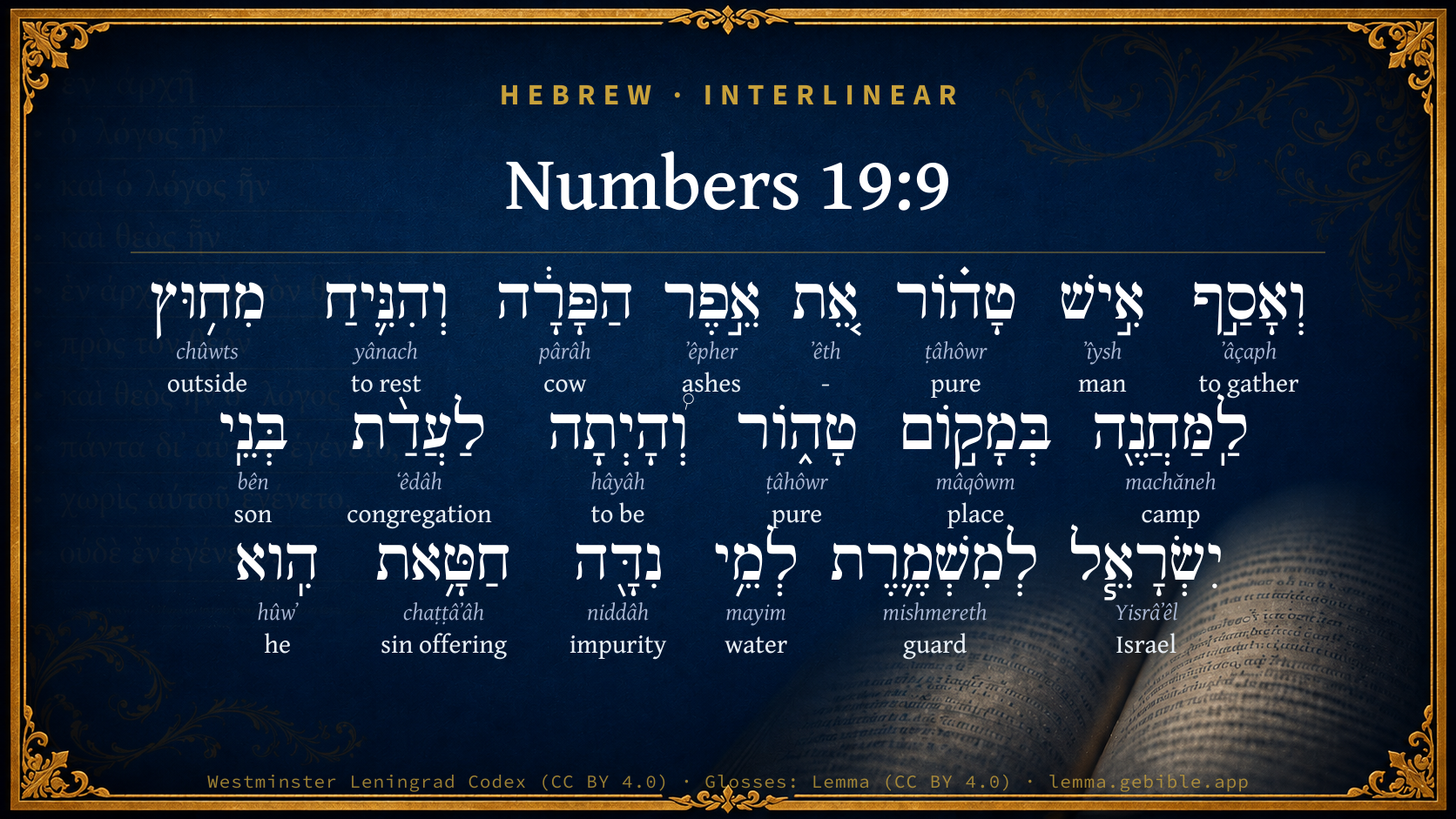
Hebrew (Westminster Leningrad Codex) Numbers 19:9 appears in the Hebrew Old Testament. The text above is from the Westminster Leningrad Codex. Each word links to its Strong’s number, a concise gloss, and parsing drawn from the Open Scriptures Hebrew Bible morphology. Click any word for its full Brown-Driver-Briggs (BDB) entry.
Download image
Cite this verse

Numbers 19:9 (World English Bible). Public Domain. Lemma interlinear Bible study tool, https://lemma.gebible.app/v/numbers/19/9.

Show BibTeX & RIS
BibTeX
RIS
English Translation
A man who is clean shall gather up the ashes of the heifer, and lay them up outside of the camp in a clean place; and it shall be kept for the congregation of the children of Israel for a water for impurity: it is a sin-offering.
World English Bible · Public Domain
Download a study sheet

One document with this verse’s original text, its word-by-word gloss line, the meaning frame, cross-references with their text, attributed commentary, and full source and license credits — printable, and it pastes into notes with its structure intact.

This verse Autodidact and up

Study sheet (.html) Plain text (.txt)

A passage Seminary Student

Up to 50 verses in one chapter. A passage sheet keeps up to 6 commentary sources and 12 cross-references per verse, in the order this page ranks them, and says so on the sheet whenever that leaves anything out. Ask for a single verse and you get the Autodidact verse sheet above.

Everything on this page stays free to read, with no account — the sheet is a download of what is already on screen, not access to it.

Want to remove ads? Support Godless Engineer
Compare translations 3

The same verse in 3 English versions, stacked beneath the original-language interlinear above. Click any original word for its lexicon entry.

Each is an independent rendering of the whole verse — the interlinear is not word-aligned to these translations.

Highlighted words mark where these versions differ — a whole-verse word diff, not a word-by-word alignment.

  • World English Bible Public Domain
    A man who is clean shall gather up the ashes of the heifer, and lay them up outside of the camp in a clean place; and it shall be kept for the congregation of the children of Israel for a water for impurity: it is a sin-offering.
  • King James Version Public Domain
    And a man that is clean shall gather up the ashes of the heifer, and lay them up without the camp in a clean place, and it shall be kept for the congregation of the children of Israel for a water of separation: it is a purification for sin.
  • unfoldingWord Literal Text CC BY-SA 4.0
    And a clean man shall gather the ashes of the cow and place outside of the camp in a clean place. And it shall be for the congregation of the sons of Israel for preservation, for water of impurity. It a sin offering.

unfoldingWord Literal Text — © unfoldingWord, licensed CC BY-SA 4.0. Word-aligned USFM3 via Door43 (git.door43.org/unfoldingWord/en_ult).

Versions to compare (up to 4)

3 of 4 selected

Show all 18 translations

Every available English version of this verse, each an independent rendering of the whole verse.

  • World English Bible Public Domain
    A man who is clean shall gather up the ashes of the heifer, and lay them up outside of the camp in a clean place; and it shall be kept for the congregation of the children of Israel for a water for impurity: it is a sin-offering.
  • Berean Standard Bible Public Domain
    Then a man who is ceremonially clean is to gather up the ashes of the heifer and store them in a ceremonially clean place outside the camp. They must be kept by the congregation of Israel for preparing the water of purification; this is for purification from sin.
  • Majority Standard Bible Public Domain
    Then a man who is ceremonially clean is to gather up the ashes of the heifer and store them in a ceremonially clean place outside the camp. They must be kept by the congregation of Israel for preparing the water of purification; this is for purification from sin.
  • King James Version Public Domain
    And a man that is clean shall gather up the ashes of the heifer, and lay them up without the camp in a clean place, and it shall be kept for the congregation of the children of Israel for a water of separation: it is a purification for sin.
  • American Standard Version (1901) Public Domain
    And a man that is clean shall gather up the ashes of the heifer, and lay them up without the camp in a clean place; and it shall be kept for the congregation of the children of Israel for a water for impurity: it is a sin-offering.
  • Revised Version (1885) Public Domain
    And a man that is clean shall gather up the ashes of the heifer, and lay them up without the camp in a clean place, and it shall be kept for the congregation of the children of Israel for a water of separation: it is a sin offering.
  • Geneva Bible (1599) Public Domain
    And a man, that is cleane, shall take vp the ashes of the kow, and put them without the hoste in a cleane place: and it shalbe kept for the Congregation of the children of Israel for a sprinkling water: it is a sinne offring.
  • Douay-Rheims (1899) Public Domain
    And a man that is clean shall gather up the ashes of the cow, and shall pour them forth without the camp in a most clean place, that they may be reserved for the multitude of the children of Israel, and for a water of aspersion: because the cow was burnt for sin.
  • Young's Literal Translation Public Domain
    `And a clean man hath gathered the ashes of the cow, and hath placed at the outside of the camp, in a clean place, and it hath become to the company of the sons of Israel a charge for waters of separation -- it `is' a `cleansing';
  • Literal Standard Version CC BY-SA 4.0
    And a clean man has gathered the ashes of the cow, and has placed [them] at the outside of the camp in a clean place, and it has become a charge for the congregation of the sons of Israel for waters of separation—it [is for] sin;
  • Unlocked Literal Bible CC BY-SA 4.0
    Someone who is clean must gather up the heifer's ashes and put them outside the camp in a clean place. These ashes must be kept for the community of the people of Israel. They will mix the ashes with water for purification from sin, since the ashes were from a sin offering.
  • unfoldingWord Literal Text CC BY-SA 4.0
    And a clean man shall gather the ashes of the cow and place outside of the camp in a clean place. And it shall be for the congregation of the sons of Israel for preservation, for water of impurity. It a sin offering.
  • Darby Bible Public Domain
    And a clean man shall gather the ashes of the heifer, and deposit them outside the camp in a clean place, and it shall be kept for the assembly of the children of Israel for a water of separation: it is a purification for sin.
  • World Messianic Bible Public Domain
    “A man who is clean shall gather up the ashes of the heifer, and lay them up outside of the camp in a clean place; and it shall be kept for the congregation of the children of Israel for use in water for cleansing impurity. It is a sin offering.
  • Webster's Bible Public Domain
    And a man that is clean shall gather the ashes of the heifer, and lay them without the camp in a clean place, and it shall be kept for the congregation of the children of Israel, for a water of separation: it is a purification for sin.
  • Free Bible Version CC BY-SA 4.0
    Then a man who is clean shall collect the ashes of the cow and keep them in a clean place outside the camp. They are to be kept by the Israelites to prepare the water of purification which is for purifying from sin.
  • Bible in Basic English Public Domain
    Then let a man who is clean take the dust of the burned cow and put it outside the tent-circle in a clean place, where it is to be kept for the children of Israel and used in making the water which takes away what is unclean: it is a sin-offering.
  • JPS Tanakh (1917) Public Domain
    And a man that is clean shall gather up the ashes of the heifer, and lay them up without the camp in a clean place, and it shall be kept for the congregation of the children of Israel for a water of sprinkling; it is a purification from sin.

Literal Standard Version (2020), Covenant Press — licensed CC BY-SA 4.0. Text via the HelloAO Bible API (eBible.org). Unlocked Literal Bible (unfoldingWord) — licensed CC BY-SA 4.0. Text via the HelloAO Bible API (eBible.org). unfoldingWord Literal Text — © unfoldingWord, licensed CC BY-SA 4.0. Word-aligned USFM3 via Door43 (git.door43.org/unfoldingWord/en_ult). Free Bible Version, Dr. Jonathan Gallagher — licensed CC BY-SA 4.0. Text via the HelloAO Bible API (eBible.org).

Word by word

More ways to search: Search by grammar → Find every occurrence → Compare this word →

Practice this passage: Drill this verse → Learn its vocabulary →

אֵ֣פֶר
ʼêpher
H665
“ashes of”
Noun, Common, Masculine, Singular, Construct
Part of Speech
Noun
Type
Common
Gender
Masculine
Number
Singular
State
Construct
Full BDB Definition

Origin: from an unused root meaning to bestrew

TWOT: 150a

ashes - (CLBL) worthlessness (figuratively)
  1. וְאָסַ֣ף ʼâçaph H622 “and · to gather” Conjunction + Verb, Qal, Sequential Perfect, 3rd Person, Masculine, Singular
  2. אִ֣ישׁ ʼîysh H376 “man” Noun, Common, Masculine, Singular, Absolute
  3. טָה֗וֹר ṭâhôwr H2889 “pure” Adjective, Adjective, Masculine, Singular, Absolute
  4. אֵ֚ת ʼêth H853 “-” Particle, Direct Object
  5. הַפָּרָ֔ה pârâh H6510 “the · cow” Particle, Definite Article + Noun, Common, Feminine, Singular, Absolute
  6. וְהִנִּ֛יחַ yânach H3240 “and · to rest” Conjunction + Verb, Hiphil, Sequential Perfect, 3rd Person, Masculine, Singular
  7. מִח֥וּץ chûwts H2351 “from · outside” Preposition + Noun, Common, Masculine, Singular, Absolute
  8. לַֽמַּחֲנֶ֖ה machăneh H4264 “to/for the · camp” Preposition, Determined + Noun, Common, Both, Singular, Absolute
  9. בְּמָק֣וֹם mâqôwm H4725 “in/at · place” Preposition + Noun, Common, Masculine, Singular, Absolute
  10. טָה֑וֹר ṭâhôwr H2889 “pure” Adjective, Adjective, Masculine, Singular, Absolute
  11. וְ֠הָיְתָה hâyâh H1961 “and · to be” Conjunction + Verb, Qal, Sequential Perfect, 3rd Person, Feminine, Singular
  12. לַעֲדַ֨ת ʻêdâh H5712 “to/for · congregation of” Preposition + Noun, Common, Feminine, Singular, Construct
  13. בְּנֵֽי bên H1121 “sons of” Noun, Common, Masculine, Plural, Construct
  14. יִשְׂרָאֵ֧ל Yisrâʼêl H3478 “Israel” Noun, Proper
  15. לְמִשְׁמֶ֛רֶת mishmereth H4931 “to/for · guard” Preposition + Noun, Common, Feminine, Singular, Absolute
  16. לְמֵ֥י mayim H4325 “to/for · water(s) of” Preposition + Noun, Common, Masculine, Plural, Construct
  17. נִדָּ֖ה niddâh H5079 “impurity” Noun, Common, Feminine, Singular, Absolute
  18. חַטָּ֥את chaṭṭâʼâh H2403 “sin offering” Noun, Common, Feminine, Singular, Absolute
  19. הִֽוא hûwʼ H1931 “he” Pronoun, Personal, 3rd Person, Feminine, Singular

About this verse

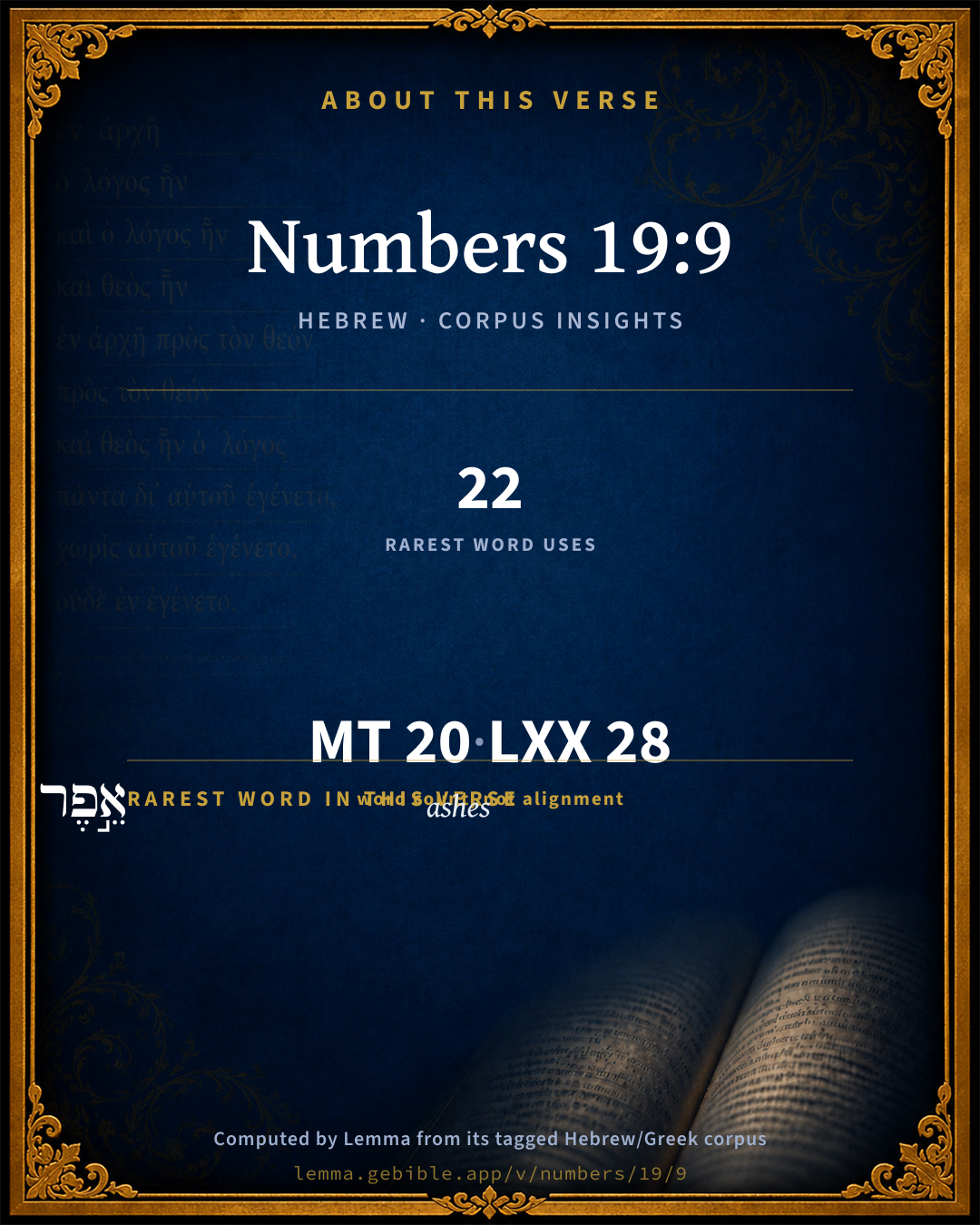
These counts appear in no published source. They are computed here, from the morphology-tagged text and Lemma’s own curated glosses. What Lemma adds →

20
words
19
distinct lemmas
Pentateuch
section

Notable vocabulary

The rarest word here is אֵ֣פֶר ashes H665 — appearing just 22 times in the whole Hebrew Bible.

Shared distinctive vocabulary

אֵ֣פֶר ashes H665 occurs in 22 verses of the Hebrew Bible. Also found in:

Grammatical profile

  • 3 verbs
  • 13 nouns
  • 2 adjectives
  • 1 pronoun
  • 1 particle

Verb forms

  • וְאָסַ֣ף Qal · Sequential Perfect
  • וְהִנִּ֛יחַ Hiphil · Sequential Perfect
  • וְ֠הָיְתָה Qal · Sequential Perfect

Repetition

A word recurs within this verse — often emphatic in Hebrew:

  • טָה֗וֹר pure H2889 ×2

Hebrew & Septuagint length

In English translation the verse runs 47 words from the Hebrew and 45 from the Septuagint (LXX English) — closely comparable.

A rough comparison of the two English renderings, which tokenize alike — not a word-level alignment.

Word counts can differ between the Hebrew and the Greek without any difference in meaning — e.g. the Hebrew direct-object marker אֵת has no separate Greek word, and Greek often adds the article ὁ.

In the original languages it is 20 Hebrew tokens and 28 Greek tokens — but the two are counted differently (Hebrew bundles its prefixes and suffixes into one token; the Greek is in lemma form), so that isn’t a like-for-like length.

Cross-references

13

Topical passages linked to Numbers 19:9 in the Treasury of Scripture Knowledge — connected by theme and wording, ordered by reader-vote popularity; previews shown in the World English Bible.

  • Numbers 19:13 Whoever touches a dead person, the body of a man who has died, and doesn't purifies himself, defiles the tent of Yahweh; and that soul shall be cut off from Israel: because the water for impurity was not sprinkled on him, he shall be unclean; his uncleanness is yet on him.
  • Hebrews 9:13 For if the blood of goats and bulls, and the ashes of a heifer sprinkling those who have been defiled, sanctify to the cleanness of the flesh:
  • Numbers 19:20–21 But the man who shall be unclean, and shall not purify himself, that soul shall be cut off from the midst of the assembly, because he has defiled the sanctuary of Yahweh: the water for impurity has not been sprinkled on him; he is unclean.
  • Leviticus 15:20 "'Everything that she lies on in her impurity shall be unclean. Everything also that she sits on shall be unclean.
  • Numbers 6:12 He shall separate to Yahweh the days of his separation, and shall bring a male lamb a year old for a trespass offering; but the former days shall be void, because his separation was defiled.
  • Numbers 8:7 Thus shall you do to them, to cleanse them: sprinkle the water of cleansing on them, let them shave their whole bodies with a razor, and let them wash their clothes, and cleanse themselves.
  • Numbers 9:13 But the man who is clean, and is not on a journey, and fails to keep the Passover, that soul shall be cut off from his people. Because he didn't offer the offering of Yahweh in its appointed season, that man shall bear his sin.
  • Numbers 19:18 and a clean person shall take hyssop, and dip it in the water, and sprinkle it on the tent, and on all the vessels, and on the persons who were there, and on him who touched the bone, or the slain, or the dead, or the grave:
  • Numbers 31:23–24 everything that may abide the fire, you shall make to go through the fire, and it shall be clean; nevertheless it shall be purified with the water for impurity: and all that doesn't withstand the fire you shall make to go through the water.
  • Zechariah 13:1 "In that day there will be a spring opened to the house of David and to the inhabitants of Jerusalem, for sin and for uncleanness.
  • 2 Corinthians 5:21 For him who knew no sin he made to be sin on our behalf; so that in him we might become the righteousness of God.
  • 2 Corinthians 7:1 Having therefore these promises, beloved, let us cleanse ourselves from all defilement of flesh and spirit, perfecting holiness in the fear of God.
  • Hebrews 7:26 For such a high priest was fitting for us: holy, guiltless, undefiled, separated from sinners, and made higher than the heavens;

Cross-references courtesy of OpenBible.info (CC BY 4.0).

Hebrew and Greek witnesses Masoretic Hebrew ↔ Greek Septuagint

The same verse in the two great witnesses to the Old Testament, shown verse-for-verse.

These are two independent witnesses, not word-aligned to each other, and the Septuagint is shown in lemma (dictionary) form.

Hebrew Numbers 19:9 Masoretic · Westminster Leningrad Codex

וְאָסַ֣ף אִ֣ישׁ טָה֗וֹר אֵ֚ת אֵ֣פֶר הַפָּרָ֔ה וְהִנִּ֛יחַ מִח֥וּץ לַֽמַּחֲנֶ֖ה בְּמָק֣וֹם טָה֑וֹר וְ֠הָיְתָה לַעֲדַ֨ת בְּנֵֽי יִשְׂרָאֵ֧ל לְמִשְׁמֶ֛רֶת לְמֵ֥י נִדָּ֖ה חַטָּ֥את הִֽוא

A man who is clean shall gather up the ashes of the heifer, and lay them up outside of the camp in a clean place; and it shall be kept for the congregation of the children of Israel for a water for impurity: it is a sin-offering.

World English Bible · Public Domain

Greek LXX Numbers 19:9 Septuagint · lemma form

καί συνἄγω ἄνθρωπος καθαρός ὁ σποδός ὁ δάμαλις καί ἀποτίθημι ἔξω ὁ παρεμβολή εἰς τόπος καθαρός καί εἰμί ὁ συναγωγή υἱός ἰσραήλ εἰς διατήρησις ὕδωρ ῥαντισμός ἅγνισμα εἰμί

And a clean man shall gather up the ashes of the heifer, and lay them up in a clean place outside the camp; and they shall be for the congregation of the children of Israel to keep: it is the water of sprinkling, a purification.

LXX2012 (modern English Septuagint) · Public Domain

On this verse, The Cambridge Bible for Schools and Colleges discusses the Septuagint’s reading. Read the note in Commentary ↓

Hebrew: Westminster Leningrad Codex (CC BY 4.0). Greek: Septuagint (public domain); English from LXX2012 (modern English Septuagint) (Public Domain). How the Septuagint differs from the Hebrew →

Targum (Aramaic paraphrase)

2

The Targum is the ancient Jewish Aramaic paraphrase of the Hebrew Scriptures — an interpretive translation, not the Hebrew text itself. Onkelos (literal) and Pseudo-Jonathan (expansive) render the Torah, and Jonathan the Prophets. Coverage is partial: where no permissively-licensed English translation exists for a verse, only the Aramaic is shown. This is verse-level text, not a word-by-word alignment to the Hebrew.

  1. Targum Onkelos Torah (Genesis–Deuteronomy)
    וְיִכְנוֹשׁ גְבַר דְכֵי יָת קִטְמָא דְתוֹרְתָא וְיַצְנַע לְמִבָּרָא לְמַשְׁרִיתָא בַּאֲתַר דְכֵי וּתְהֵי לִכְנִשְׁתָּא דִבְנֵי יִשְׂרָאֵל לְמַטָּרָא לְמֵי אַדָיוּתָא חַטָאתָא הִיא

    (no public-domain English translation for this verse)

    Targum Onkelos — Aramaic: “Onkelos Genesis” (public domain); “Onkelos Exodus” (public domain); “Onkelos Leviticus” (public domain); “Onkelos Numbers” (public domain); “Onkelos Deuteronomy” (public domain). English: “Sefaria Community Translation” (CC0 1.0 (public-domain dedication)); “J.W. Etheridge. The Targums of Onkelos and Jonathan Ben Uzziel on the Pentateuch. London: Longmans, Green, 1862” (public domain). Text via Sefaria.

  2. Targum Pseudo-Jonathan Torah (Genesis–Deuteronomy)
    וִיכְנוֹשׁ גְבַר כָּהִין דְכֵי יַת קִטְמָא דְתוֹרָתָא בְּקָלָל דְפָחַר מַקַף מְגוּפַת שְׁיַיע וִיפַלֵג יַת קִטְמָא לִתְלַת חוּלְקִין חֲדָא יָהִיב בְּחֵיל וַחֲדָא בְּטַוַור מִשְׁחָא וְחָדָא מִפְלַג לְכָל מַטְרַת לֵיוָאֵי וּתְהֵי לִכְנִישְׁתָּא דִבְנֵי יִשְרָאֵל לְמוֹי אַדְיוּתָא בְּרַם שִׁיבוּק חוֹבַת עֵיגְלָא הִיא

    And a man, a priest who is clean, shall gather up the ashes of the heifer in an earthenware receptacle, its opening covered round about with clay; and shall divide the ashes into three portions, of which one shall be placed within the wall (of Jerusalem), another in the Mount of Olives, and the third portion be in the custody of the Levites; and it shall be for the congregation of Israel, for the Water of Sprinkling: it is the heifer (immolated) for the remission of sins.

    Targum Pseudo-Jonathan — Aramaic: “Targum Jonathan on Genesis” (public domain); “Targum Jonathan on Exodus” (public domain); “Targum Jonathan on Leviticus” (public domain); “Targum Jonathan on Numbers” (public domain); “Targum Jonathan on Deuteronomy” (public domain). English: “The Targum of Jonathan ben Uzziel, trans. J. W. Etheridge, London, 1862” (public domain). Text via Sefaria.

Commentary

Notes on Numbers 19:9 from classic Christian and Jewish commentators (each source and its license shown beneath its notes). The classic Christian expositions comment on the surrounding passage and are grouped to its opening verse, so a note may address several verses; the Jewish commentaries on the Tanakh (Rashi and others) are per-verse, so they appear only where the commentator wrote on this verse.

Lemma curates 59 commentaries, every one of them public domain or Creative Commons licensed, each selected and text-cleaned for this edition rather than reprinted as found. About our sources →

Trapp's Complete Commentary

John Trapp

Num 19:9 And a man [that is] clean shall gather up the ashes of the heifer, and lay [them] up without the camp in a clean place, and it shall be kept for the congregation of the children of Israel for a water of separation: it [is] a purification for sin.

Ver. 9. And a man that is clean.] Hereby is meant the Gentile purified by faith, as one well observeth. The gathering of the ashes, is the applying of the merits of Christ, and laying hold of the mystery of his kingdom. The laying up of the ashes imports that the Christian accounts Christ’s merits his chief treasure. The clean place is the clean heart. Without the camp, notes, that the Gentiles were strangers from the commonwealth of Israel, &c. These ashes kept for the congregation, show the fulness of Christ’s merits for all his people. When he saith, it is to make a water of separation, it notes that our sins separate betwixt us and our God. But "now in Christ Jesus, we who sometimes were far off, are made nigh by his blood." {Eph 2:13}

John Trapp, A Commentary or Exposition upon All the Books of the Old and New Testament (1647–1656) — public domain. Text from a community e-Sword module.

Joseph Benson's Commentary

Num 19:9. A man shall gather up the ashes — The ashes of the heifer were separated as well as they could be from the ashes of the wood wherewith it was burned, were pounded and sifted, and laid up for the use of the congregation as there was occasion, not only for that generation, but for posterity; for the ashes of this one heifer, the Jews tell us, were sufficient to season as many vessels of water as the people of Israel would need for many ages. Nay, they say this one served till the captivity, near one thousand years, and that there never was another heifer burned fill the time of Ezra. But to this tradition of theirs, grounded probably on the silence of ancient records, there seems to be no good reason to give credit, since, in the latter ages of their church, when they had more full records, they find an account of eight burned between Ezra’s time and the destruction of the second temple, which was only a space of about five hundred years. In the sacrifice of the body and blood of Christ, however, offered only once for all, we have an inexhaustible fund of merit, to which, by faith, his church may have recourse from generation to generation, for the purification of their consciences from dead works.

Joseph Benson's Commentary on the Old and New Testaments (1811–1818) — public domain. Text from a community e-Sword module.

Tyndale Open Study Notes

Tyndale Open Resources

19:9 The purpose of the ceremony of burning the red heifer was to produce ashes. These were collected and deposited in a purified place outside the camp until the Israelites needed them in the water for the purification ceremony to remove such defilement as coming into contact with a corpse (19:11-22).

Tyndale Open Study Notes — © Tyndale Open Resources, licensed CC BY-SA 4.0. Text via the HelloAO Bible API.

Geneva Bible (1599)

Geneva Bible translators

Or, the water of separation because they that were separate for their uncleanness, were sprinkled therewith and made clean, Num. 8:7. It is also called holy water, because [it] was ordained to an holy use, Num. 1:17.

Geneva Bible (1599) marginal notes — public domain. Text via Bolls.life.

Adam Clarke's Commentary

Verse 9. For a water of separation] That is, the ashes were to be kept, in order to be mixed with water, Nu 19:17, and sprinkled on those who had contracted any legal defilement.

Adam Clarke's Commentary on the Bible (1810–1826) — public domain. Text from a community e-Sword/MySword module.

The Cambridge Bible for Schools and Colleges

gen. ed. J. J. S. Perowne

9. it shall be kept] i.e. the ashes, for which the Heb. word is singular, not plural.

a water of impurity] i.e. a water for the removal of impurity. Cf. ‘water of sin’ (Num_8:7). The word niddâh, ‘impurity,’ signifies something loathsome or abominable.

it is a sin-offering] The cow (not the water) could be called a sin-offering because it was burnt; but, since the ashes are the object of chief importance, the word hattâ’th (‘sin-offering’) must be understood in the more general sense of ‘something which removes sin.’ LXX. ἅγνισμα.

The Cambridge Bible for Schools and Colleges (gen. ed. J. J. S. Perowne; Cambridge University Press, 1878–1918) — public domain. Text from a community e-Sword module.

John Gill's Exposition

And a man that is clean shall gather up the ashes of the heifer,.... A man, a clean priest, as the Targum of Jonathan; in later times great care was taken that the priest concerned in the burning of the red cow should be pure; he was separated from his own house seven days before the time, and every day he was sprinkled with the blood of all sin offerings then offered, that it might be sure he was free from any pollution by a grave, or a dead body; and for the same reason they made a causeway on double arches from the temple to the mount of Olives, over the valley of Kidron, lest any unseen grave should be in the way; and when he came thither he was obliged to wash or dip himself, as before observed (m); and so he that gathered up the ashes was to be clean from all ceremonial pollution: the Jews say (n), that they pounded the ashes; if there were any black coal in them or bone, they did not leave it in them, but sifted them in stone sieves; and not the ashes of the heifer only they took, but the ashes of the cedar wood, &c. mixed with them; and these they put, as the Targum of Jonathan says, into an earthen vessel enclosed in a covering of clay:

and lay them up without the camp in a clean place; they were divided into three parts, according to the Targum of Jonathan, one part was put in the Chel (or the enclosure of the court of the tabernacle), another in the mount of Olives, and the third part was divided among all the wards of the Levites, with which the Misnah (o) agrees; Jarchi makes mention of the same division, and of the use of each; that the wards had was without the court, that the citizens might take of it, and all that needed to be purified; that in the mount of Olives was for the priests, to sanctify other heifers with it; and that in the Chel was for a reserve:

and it shall be kept for a reserve for the congregation of Israel; as ashes may be kept a long time, if well taken care of, because they are not subject to any corruption or putrefaction; and so was, as Bishop Patrick observes from Dr. Jackson, a figure of the everlasting efficacy of Christ's blood: and, according to the Jews, these ashes of the first heifer must last more than a thousand years; for they say (p) the second that was burnt was in the time of Ezra, though they reckon seven more afterwards before the destruction of the second temple, in all nine; and the tenth they expect in the days of the Messiah, which are past; he, being come, has put an end to this type by fulfilling it in himself: and the use of them was

for a water of separation; being put into water, and mixed with it, was for the cleansing of such as were separated from others for their uncleanness, and was a purification of them for it, as follows:

it is a purification for sin: or "it is sin" (q), not an offering for sin, properly speaking; the heifer, whose ashes they were, not being sacrificed in the tabernacle, nor on the altar, and wanted other rites; yet it answered the purposes of a sin offering, and its ashes in water were typical of the blood of Christ, which purges the conscience from dead works, when this only purified to the sanctifying of the flesh, Heb 9:13; and is the fountain set open for sin and uncleanness, Zac 13:1; where both the words are used which are here, and in the preceding clause: ashes are known to be of a cleansing nature, and so a fit emblem of spiritual purification by Christ; and the duration of them of the perpetuity of it.

(m) Misn. Parah, c. 3. sect. 1. 6. 7. (n) Ib. sect. 11. (o) lbid. (p) Ib. sect. 5. (q) "peccatum ipsa", Montanus; "peccatum enim est", Tigurine version.

John Gill's Exposition of the Whole Bible (1746–1763) — public domain (CC PDM 1.0). Text via the HelloAO Bible API.

Albert Barnes' Notes on the Bible

Water of separation - In Num 8:7, the water of purification from sin is the “water of purifying.” So that which was to remedy a state of legal separation is here called “water of separation.”

Albert Barnes' Notes on the Bible (1834–1885) — public domain. Text from a community e-Sword/MySword module.

Matthew Poole's English Annotations

For the congregation of the children of Israel, i.e. for their use, and therefore in a fit place or places, whence any of them might easily procure it.

For a water, or, to the water, i.e. to be put to the water, or mixed with it.

Of separation, i.e. appointed for the cleansing of them that are in a state of separation, who for their uncleanness separated from the congregation. Either the heifer thus managed, or the water thus made and sprinkled,

is a purification for sin, Heb. a sin, i.e. a kind of an offering for sin, or rather a mean for the expiation or cleansing of sin. The name of sin is sometimes given to the punishment of sin, and sometimes to the sacrifice or offering for sin.

Matthew Poole's English Annotations on the Holy Bible (1683–1685) — public domain. Text from a community e-Sword/MySword module.

Whedon's Commentary on the Bible

Daniel D. Whedon

9. Ashes… water of separation — The chief ingredient of this water.

Purification for sin — The writer of the Epistle to the Hebrews strongly hints that this process did not work a real inward cleansing of the nature when he says, “How much more shall the blood of Christ… purge your conscience from dead (sinful) works to serve the living God.” Heb_9:13-14.

Daniel D. Whedon (gen. ed.), Commentary on the Old and New Testaments (1874–1909) — public domain. Text from a community e-Sword module.

The Pulpit Commentary

For a water of separation, i.e., a water which should remedy the state of legal separation due to the defilement of death, just as in chapter 8 the water of purification from sin is called the water of sin.

The Pulpit Commentary (1880–1919), ed. H.D.M. Spence-Jones & Joseph S. Exell — public domain. Text from a community e-Sword module.

John Wesley's Explanatory Notes

For a water - Or, to the water, that is, to be put to the water, or mixed with it. Of separation - Appointed for the cleansing of them that are in a state of separation, who for their uncleanness are separated from the congregation. It is a purification for sin - Hebrew. a sin, that is, an offering for sin, or rather a mean for expiation or cleansing of sin. And this was a type of that purification for sin, which our Lord Jesus made by his death.

John Wesley, Explanatory Notes Upon the Whole Bible (1754–1765) — public domain. Text via the GEBible commentary corpus.

unfoldingWord translationNotes

Door43 World Missions Community

Someone who is clean

Being acceptable to God and fit to do sacred work is spoken of as being clean. (See: Metaphor)

These ashes must be kept

This can be stated in active form. AT: "You must keep these ashes" (See: Active or Passive)

in a clean place

Being acceptable to God is spoken of as being clean. (See: Metaphor)

He will remain unclean

Being unacceptable to God or unfit to do any sacred work is spoken of as not being clean. (See: Metaphor)

translationWords

clean

cow

ash

people group

Israel

pure

sin

sin offering

law, laws

alien

unfoldingWord translationNotes — © Distant Shores Media and the Door43 World Missions Community, licensed CC BY-SA 4.0. Source: git.door43.org/Door43/en_tn.

Rashi

Rabbi Shlomo Yitzchaki (Rashi)

והניח מחוץ למחנה AND HE SHALL LAY THEM UP WITHOUT THE CAMP — He divided it (the ashes) into three portions: one he placed on Mount Olivet, another was divided between all the priestly divisions, and the other he placed in the חיל (the space that surrounded the Temple area) (Sifrei Bamidbar 124:1; Mishnah Parah 3:11). That portion given to the priestly divisions was outside the forecourt, so that the inhabitants of the cities and anyone who required to be cleansed might take of it; as for that which was on the Mount of Olives, the High Priests purified themselves by means of it for preparing other “red cows”, whilst that which was in the space surrounding the Temple area was placed there to be kept for all times by special enactment of Scripture, as it is said, “and it shall be kept for the congregation of the children of Israel" (cf. Tosefta Parah 3 8).

למי נדה FOR WATERS OF נדה — i.e. for waters of sprinkling (or casting); similar are, (Lamentations 3:53) “and they cast (וידו) a stone upon me”; (Zechariah 2:4) “to cast down (לידות) the horns of the nations”, both of which are expressions denoting “casting”.

חטאת הוא IT IS A PURIFICATION FROM SIN — This, according to its literal meaning, is an expression denoting “purification”, but from the point of view of the Halachot to which it is to be subject Scripture terms it a חטאת, “sin-offering”, to state by so doing that it is similar to holy things — that it is prohibited for any other use (cf. Sifrei Bamidbar 124:2; Menachot 51b).

Rashi on the Tanakh — English translations: “The Judaica Press complete Tanach with Rashi, translated by A. J. Rosenberg” (CC BY 4.0); “Pentateuch with Rashi's commentary by M. Rosenbaum and A.M. Silbermann, 1929-1934” (public domain); “The Metsudah Tanach series, Lakewood, N.J” (CC BY 4.0); and “The Book of Joshua, Metsudah Publications, 1997” (CC BY 4.0). Text via Sefaria.

Lesson kit

Teaching starters — assembled from the data on this page, not authored interpretation. Every prompt links to the verse data it draws on. Edit before teaching.

Numbers, in the Pentateuch, opens this verse with 20 words (19 distinct Hebrew lemmas). Its most distinctive word is ʼêpher (“ashes”). A historical commentator’s framing appears above. Read the whole chapter for the surrounding context.

Discussion questions

  1. How does “ashes” (ʼêpher) shape what this verse is saying?
  2. How does Genesis 18:27, which shares the word «ashes», read alongside this verse?
  3. What does the repetition of “pure” (2× in this one verse) do in this verse?
  4. The translations on this page render this verse differently — a whole-verse word diff, not a word-by-word alignment. What might account for the different wordings?
  5. «וְאָסַ֣ף» is a Qal Sequential Perfect verb. How does that grammatical form shape the action described?
  6. Compare how Trapp's Complete Commentary and Joseph Benson's Commentary read this verse. Where do they agree or differ?

Things to notice

Reading settings

Reading text

Shown beneath each verse's original-language words.

Old Testament
Old Testament edition

Read the OT as the Masoretic Hebrew (MT) or the Greek Septuagint (LXX).

English shown for the Greek Septuagint (in the Hebrew ↔ Greek comparison).

Comparing translations? Open the Compare panel on any verse page to stack up to four side by side.