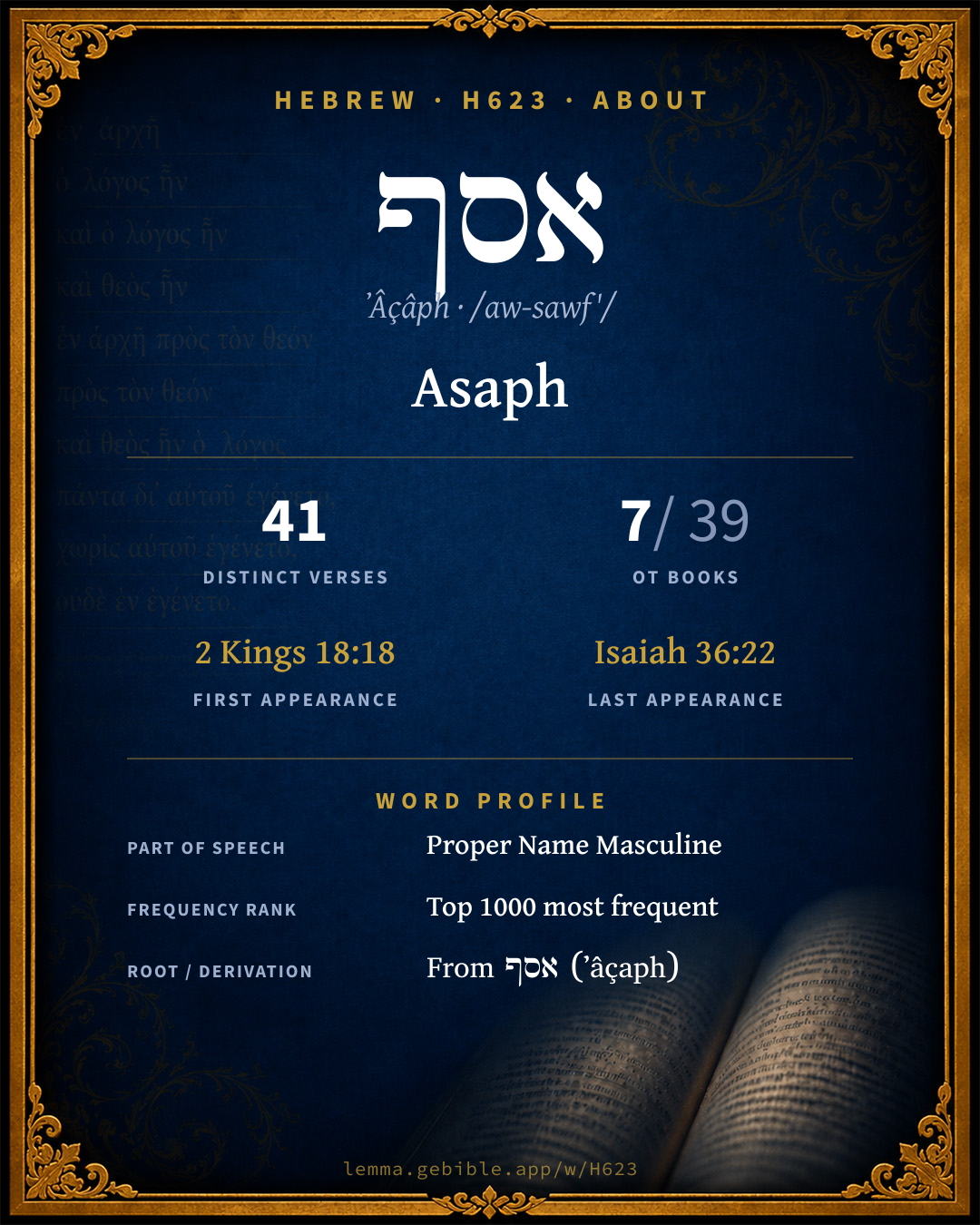
אָסָף
Asaph
BDB lists 4 entries for ‘Asaph’ fuller range ↓
Full lexicon entry — Brown-Driver-Briggs (BDB)
From Brown-Driver-Briggs (BDB)
Where this word appears
Grammar key — what these labels mean
Part of speech
- Noun
- A naming word — a person, place, thing, or idea.
Noun type
- Proper
- A name of a specific person, place, or people (e.g. Abraham, Zion, Israel).
Every verse where H623 appears — 41 distinct verses across 7 books. Click any verse to open its interlinear word-by-word view. Verse text shown in the World English Bible for context — . Each verse’s Hebrew form is shown with its reference; the English is not keyword-highlighted, since the data carries no word-level English alignment. Use “Compare translations” on any verse to read it across multiple English versions. This concordance covers the Hebrew Bible; Septuagint (Greek Old Testament) occurrences are not indexed here.
2 Kings 2 verses
- 2 Kings 18:18 אָסָ֖ף n Proper When they had called to the king, there came out to them Eliakim the son of Hilkiah, who was over the household, and Shebnah the scribe, and Joah the son of Asaph the recorder.
- 2 Kings 18:37 אָסָ֧ף n Proper Then came Eliakim the son of Hilkiah, who was over the household, and Shebna the scribe, and Joah the son of Asaph the recorder, to Hezekiah with their clothes torn, and told him the words of Rabshakeh.
1 Chronicles 12 verses
- 1 Chronicles 6:39 אָסָ֔ף אָסָ֥ף n Proper n Proper His brother Asaph, who stood on his right hand, even Asaph the son of Berechiah, the son of Shimea,
- 1 Chronicles 9:15 אָסָֽף n Proper and Bakbakkar, Heresh, and Galal, and Mattaniah the son of Mica, the son of Zichri, the son of Asaph,
- 1 Chronicles 15:17 אָסָ֖ף n Proper So the Levites appointed Heman the son of Joel; and of his brothers, Asaph the son of Berechiah; and of the sons of Merari their brothers, Ethan the son of Kushaiah;
- 1 Chronicles 15:19 אָסָ֖ף n Proper So the singers, Heman, Asaph, and Ethan, [were appointed] with cymbals of brass to sound aloud;
- 1 Chronicles 16:5 אָסָ֥ף וְ/אָסָ֖ף n Proper conj + n Proper Asaph the chief, and second to him Zechariah, Jeiel, and Shemiramoth, and Jehiel, and Mattithiah, and Eliab, and Benaiah, and Obed-edom, and Jeiel, with psalteries and with harps; and Asaph with cymbals, sounding aloud;
- 1 Chronicles 16:7 אָסָ֖ף n Proper Then on that day David first ordained to give thanks to Yahweh, by the hand of Asaph and his brothers.
- 1 Chronicles 16:37 לְ/אָסָ֖ף prep + n Proper So he left there, before the ark of the covenant of Yahweh, Asaph and his brothers, to minister before the ark continually, as every day's work required;
- 1 Chronicles 25:1 אָסָף֙ n Proper Moreover, David and the captains of the host set apart for the service certain of the sons of Asaph, and of Heman, and of Jeduthun, who should prophesy with harps, with psalteries, and with cymbals: and the number of those who did the work according to their service was:
- 1 Chronicles 25:2 אָסָ֗ף אָסָ֑ף אָסָ֔ף n Proper n Proper n Proper of the sons of Asaph: Zaccur, and Joseph, and Nethaniah, and Asharelah, the sons of Asaph, under the hand of Asaph, who prophesied after the order of the king.
- 1 Chronicles 25:6 אָסָ֥ף n Proper All these were under the hands of their father for song in the house of Yahweh, with cymbals, psalteries, and harps, for the service of the house of God; Asaph, Jeduthun, and Heman being under the order of the king.
- 1 Chronicles 25:9 לְ/אָסָ֖ף prep + n Proper Now the first lot came forth for Asaph to Joseph: the second to Gedaliah; he and his brothers and sons were twelve:
- 1 Chronicles 26:1 אָסָֽף n Proper For the divisions of the doorkeepers: of the Korahites, Meshelemiah the son of Kore, of the sons of Asaph.
2 Chronicles 5 verses
- 2 Chronicles 5:12 לְ/אָסָ֡ף prep + n Proper also the Levites who were the singers, all of them, even Asaph, Heman, Jeduthun, and their sons and their brothers, arrayed in fine linen, with cymbals and psalteries and harps, stood at the east end of the altar, and with them one hundred twenty priests sounding with trumpets;)
- 2 Chronicles 20:14 אָסָ֑ף n Proper Then on Jahaziel the son of Zechariah, the son of Benaiah, the son of Jeiel, the son of Mattaniah, the Levite, of the sons of Asaph, came the Spirit of Yahweh in the midst of the assembly;
- 2 Chronicles 29:13 אָסָ֔ף n Proper and of the sons of Elizaphan, Shimri and Jeuel; and of the sons of Asaph, Zechariah and Mattaniah;
- 2 Chronicles 29:30 וְ/אָסָ֣ף conj + n Proper Moreover Hezekiah the king and the princes commanded the Levites to sing praises to Yahweh with the words of David, and of Asaph the seer. They sang praises with gladness, and they bowed their heads and worshiped.
- 2 Chronicles 35:15 אָסָ֜ף וְ/אָסָ֞ף n Proper conj + n Proper The singers the sons of Asaph were in their place, according to the commandment of David, and Asaph, and Heman, and Jeduthun the king's seer; and the porters were at every gate: they didn't need to depart from their service; for their brothers the Levites prepared for them.
Ezra 2 verses
- Ezra 2:41 אָסָ֔ף n Proper The singers: the children of Asaph, one hundred twenty-eight.
- Ezra 3:10 אָסָף֙ n Proper When the builders laid the foundation of the temple of Yahweh, they set the priests in their clothing with trumpets, and the Levites the sons of Asaph with cymbals, to praise Yahweh, after the order of David king of Israel.
Nehemiah 6 verses
- Nehemiah 2:8 אָסָף֩ n Proper and a letter to Asaph the keeper of the king's forest, that he may give me timber to make beams for the gates of the castle which appertains to the house, and for the wall of the city, and for the house that I shall enter into. The king granted me, according to the good hand of my God on me.
- Nehemiah 7:44 אָסָ֔ף n Proper The singers: the children of Asaph, one hundred forty-eight.
- Nehemiah 11:17 אָסָ֜ף n Proper and Mattaniah the son of Mica, the son of Zabdi, the son of Asaph, who was the chief to begin the thanksgiving in prayer, and Bakbukiah, the second among his brothers; and Abda the son of Shammua, the son of Galal, the son of Jeduthun.
- Nehemiah 11:22 אָסָף֙ n Proper The overseer also of the Levites at Jerusalem was Uzzi the son of Bani, the son of Hashabiah, the son of Mattaniah, the son of Mica, of the sons of Asaph, the singers, over the business of the house of God.
- Nehemiah 12:35 אָסָֽף n Proper and certain of the priests' sons with trumpets: Zechariah the son of Jonathan, the son of Shemaiah, the son of Mattaniah, the son of Micaiah, the son of Zaccur, the son of Asaph;
- Nehemiah 12:46 וְ/אָסָ֖ף conj + n Proper For in the days of David and Asaph of old there was a chief of the singers, and songs of praise and thanksgiving to God.
Psalms 12 verses
- Psalms 50:1 לְ/אָ֫סָ֥ף prep + n Proper The Mighty One, God, Yahweh, speaks, And calls the earth from sunrise to sunset.
- Psalms 73:1 לְ/אָ֫סָ֥ף prep + n Proper Surely God is good to Israel, To those who are pure in heart.
- Psalms 74:1 לְ/אָ֫סָ֥ף prep + n Proper God, why have you rejected us forever? Why does your anger smolder against the sheep of your pasture?
- Psalms 75:1 לְ/אָסָ֣ף prep + n Proper We give thanks to you, God, We give thanks, for your Name is near. Men tell about your wondrous works.
- Psalms 76:1 לְ/אָסָ֣ף prep + n Proper In Judah, God is known. His name is great in Israel.
- Psalms 77:1 לְ/אָסָ֥ף prep + n Proper My cry goes to God! Indeed, I cry to God for help, And for him to listen to me.
- Psalms 78:1 לְ/אָ֫סָ֥ף prep + n Proper Hear my law, my people. Turn your ears to the words of my mouth.
- Psalms 79:1 לְ/אָ֫סָ֥ף prep + n Proper God, the nations have come into your inheritance. They have defiled your holy temple. They have laid Jerusalem in heaps.
- Psalms 80:1 לְ/אָסָ֣ף prep + n Proper Hear us, Shepherd of Israel, You who lead Joseph like a flock, You who sit above the cherubim, shine forth.
- Psalms 81:1 לְ/אָסָֽף prep + n Proper Sing aloud to God, our strength! Make a joyful shout to the God of Jacob!
- Psalms 82:1 לְ/אָ֫סָ֥ף prep + n Proper God presides in the great assembly. He judges among the gods.
- Psalms 83:1 לְ/אָסָֽף prep + n Proper God, don't keep silent. Don't keep silent, And don't be still, God.
Isaiah 2 verses
- Isaiah 36:3 אָסָ֖ף n Proper Then came forth to him Eliakim the son of Hilkiah, who was over the household, and Shebna the scribe, and Joah, the son of Asaph, the recorder.
- Isaiah 36:22 אָסָ֧ף n Proper Then came Eliakim the son of Hilkiah, who was over the household, and Shebna the scribe, and Joah, the son of Asaph, the recorder, to Hezekiah with their clothes torn, and told him the words of Rabshakeh.
About this entry
At a glance — auto-summarized from this page’s data, not written by a person. Every figure links to its source below. This summary describes the numbers; it doesn’t interpret them.
At its core, אסף (ʼÂçâph) means “Asaph.” Scripture first uses it in 2 Kings 18:18. It appears 41 verses across 7 books of the Hebrew Bible, among its moderately common vocabulary. The word gravitates to 1 Chronicles (29%), then Psalms and Nehemiah. Each statement above links to its evidence; the full detail follows below.
Gloss history
Strong's 1890 vs modern scholarship
About this word
Strong's H623 catalogs a Hebrew word from the Hebrew Old Testament.
These counts are not copied from any lexicon or concordance. They are computed here, from the morphology-tagged Hebrew Old Testament. What Lemma adds →
- 41
- distinct verses
- The word appears in 41 distinct verses.
- 7 / 39
- OT books
- The word appears in 7 of 39 Old Testament books.
- #796
- by frequency
- Top 1000 most frequent Hebrew words (rank 796 of 8,640 Hebrew words by occurrence).
View all 41 occurrences in the concordance →
Most concentrated in
- 1 Chronicles 12 verses 29%
- Psalms 12 verses 29%
- Nehemiah 6 verses 15%
By section of the Old Testament
By traditional corpus
Conventional, traditional groupings — biblical authorship is debated, so this is a traditional corpus grouping, not an authorship claim. Each share is this word’s portion of its verses in that division of the Hebrew canon. Each figure is a share of the word’s 41 distinct verses.
- Writings (Ketuvim) 37 verses · 90%
- Prophets (Nevi'im) 4 verses · 10%
How translations render this word
Counts come from each version’s own published word-to-Strong’s tagging or interlinear alignment — an approximate guide to how each version renders this word, not a word-level alignment the data otherwise carries. Because each total is that version’s own tagged count, the per-version totals vary from one another and need not match the appearance or distinct-verse counts above. These counts may also differ from a printed concordance because Lemma counts each distinctly tagged rendering and does not collapse phrase taggings into a single head-word total. This is a fixed set of word-tagged versions (KJV, ASV, BSB, ULT) and does not change with the reading translation you choose elsewhere. Each version’s license is shown beside its name below (and on Sources).
- King James Version: Asaph 43×
- American Standard Version: Asaph 33×
- Berean Standard Bible: Asaph 40×, Asaph’s 3×
- unfoldingWord Literal Text: Asaph 39×
King James Version Public Domain
Renders H623 across 46 tagged occurrences — most commonly:
Plus 3 renderings that appear only once — usually multi-word phrases or single function words the recovered tagging swept in, not distinct renderings.
American Standard Version Public Domain
Renders H623 across 34 tagged occurrences — most commonly:
Plus 1 rendering that appears only once — usually multi-word phrases or single function words the recovered tagging swept in, not distinct renderings.
Berean Standard Bible Public Domain
Renders H623 across 45 tagged occurrences — most commonly:
Plus 2 renderings that appear only once — usually multi-word phrases or single function words the recovered tagging swept in, not distinct renderings. Not rendered by a distinct English word in 1 further occurrence.
unfoldingWord Literal Text CC BY-SA 4.0
Renders H623 across 40 tagged occurrences — most commonly:
Plus 1 rendering that appears only once — usually multi-word phrases or single function words the recovered tagging swept in, not distinct renderings.
Senses in the full BDB
What do BDB’s symbols mean?
BDB uses these scholarly abbreviations:
| Symbol | Meaning |
|---|---|
| 𝔊 | the Septuagint (the ancient Greek translation, LXX) |
| 𝔙 | the Vulgate (the Latin translation) |
| 𝔖 | the Syriac version (the Peshitta) |
| 𝔗 | the Targum (the Aramaic translation) |
| ψ | the Psalms |
| √ | root (the underlying root or stem) |
| ‖ | parallel passage (a synonymous or contrasted parallel) |
| † | the dagger: every passage where the word occurs is cited |
The 3 senses and sub-senses the full Brown-Driver-Briggs lexicon distinguishes for this word, in lexicon order (not ranked by frequency), with BDB’s own verbatim wording and sub-sense lettering. Shown in Hebrew script with BDB’s own scholarly abbreviations. The condensed entry is in the Lexicon Entry tab. See also the Forms in the corpus table below.
- 1. father of יוֹאָח the recorder 2 K 18:18, 37 = Is 36:3, 22. e.g. 2 Kings 18:18
- 2. one of David’s chief musicians, a Levite, son of Berechiah 1 Ch 6:24(×2) (‖ הֵימָן v 18, אֵיתָן v 29 vid. these names); 15:17 (‖ Heman & Ethan, all called) הַמְשֹׁרֲרִים v 19, v. also 16:5(×2), 7 cf. v 37 (‖ Heman & Jeduthun v 41, 42); 25:9, named with Heman & Jeduthun also 25:6; 2 Ch 5:12; 35:15; ψ 50. 73–83 are ascribed to Asaph; cf. also בִּימֵי דָוִיד וְאָסָף Ne 12:46; he is called also הַחֹזֶה 2 Ch 29:30, cf. אָסָף הַנִּבָּא עַל־יְדֵי הַמֶּלֶךְ 1 Ch 25:2; repeated mention is made also of sons of Asaph בְּנֵי־אָסָף, sons, descendants, and pupils, or those who sang and played after his manner 1 Ch 25:1 (‖ Heman & Jeduthun) v 2(×2); called הַמְשֹׁרֲרִים 2 Ch 35:15; Ezr 2:41; Ne 7:44; 11:22, cf. Ezr 3:10; performing service of purification, Hezekiah’s time 2 Ch 29:13, one of them prophesying 2 Ch 20:14;—1 Ch 26:1 for בְּנֵי אָסָף read בְּנֵי אֶבְיָסָף, cf. 9:19; on זִכְרִי 9:15, זַבְדִּי Ne 11:17, זַכּוּר 12:35, called בֶּן־אָסָף, v. these names. e.g. 1 Chronicles 6:24
- 3. keeper of king’s park Ne 2:8. e.g. Nehemiah 2:8
Senses from the full Brown-Driver-Briggs lexicon (Brown, Driver, Briggs; Oxford 1906 — public domain), digitized via Sefaria, supplemented by the OpenScriptures HebrewLexicon (CC BY 4.0). Full attribution on Sources.
Word origin
n.pr.m. (gatherer, cf. Ph. n.pr.f. אספת)
— Brown-Driver-Briggs (Oxford 1906, public domain), digitized via Sefaria, supplemented by the OpenScriptures HebrewLexicon (CC BY 4.0). See Sources.
Derived from אסף (ʼâçaph) (H622) — to gather.
Jastrow Dictionary
A second Hebrew/Aramaic lexicon for comparison, covering Aramaic and post-biblical (Talmudic, Targumic, Midrashic) usage that the biblical-Hebrew BDB does not. Matched by lemma rather than by Strong’s number, so a lemma may carry more than one Jastrow headword (shown separately below), and the entries cover usage well beyond the Bible.
אָסַף
- [to scrape together], to gather, harvest. Snh. III, 3 אוֹסְפֵי שביעית those who harvest the fruits of the Sabbath year (for storage); ib. 26ᵃ אוֹסְפִין (opp. to סוחרין traders in fruits of the Sabbath year).
- 1. to be gathered; to be taken away (by death). Num. R. s. 14 (p. 257ᵈ ed. Amst.) והם נֶאֱסָפִים לשָׁמְעוֹ and they (the people) gather themselves to hear him. Ib. (p. 258ᵃ) בזמן שבעליהם נאספים מהם after their teachers have been taken away from them (when they are dead); Pesik. R. s. 3; Koh. to XII, 11; Tanḥ. B’haãl., 15; a. e. e.g. Ecclesiastes 12:11
- 2. to be picked up. Kidd. IV, 1; v. אֲסוּפִי.
- , mostly הוֹסִיף, v. יָסַף
אֲסַף
- Y. Keth. V, 30ᵇ top לא מסתברא דלא כאספון וכ׳ (read כאספין) it would be unreasonable not to consider students like harvesters, for they work (even) harder.
A Dictionary of the Targumim, the Talmud Babli and Yerushalmi, and the Midrashic Literature (Marcus Jastrow; London, Luzac, 1903) — Public Domain. Digitized via Sefaria. Digitized via Sefaria. Full attribution on Sources.
Forms in the corpus
The 19 distinct written forms H623 takes in the Hebrew Bible, most frequent first — each parse links to that state’s occurrences in the concordance. Hebrew forms include their vowel points and cantillation, so a single lemma takes many written forms.
| Form | Parsing | Example | Uses |
|---|---|---|---|
| לְ/אָ֫סָ֥ף | Noun, Proper | Psalms 50:1 | 6 |
| אָסָ֔ף | Noun, Proper | Ezra 2:41 | 5 |
| אָסָ֖ף | Noun, Proper | 1 Chronicles 15:17 | 5 |
| אָסָ֥ף | Noun, Proper | 1 Chronicles 6:39 | 3 |
| אָסָֽף | Noun, Proper | 1 Chronicles 9:15 | 3 |
| אָסָף֙ | Noun, Proper | Ezra 3:10 | 3 |
| לְ/אָסָ֣ף | Noun, Proper | Psalms 75:1 | 3 |
| אָסָ֑ף | Noun, Proper | 1 Chronicles 25:2 | 2 |
| אָסָ֜ף | Noun, Proper | 2 Chronicles 35:15 | 2 |
| אָסָ֧ף | Noun, Proper | 2 Kings 18:37 | 2 |
| וְ/אָסָ֖ף | Noun, Proper | 1 Chronicles 16:5 | 2 |
| לְ/אָסָ֖ף | Noun, Proper | 1 Chronicles 16:37 | 2 |
| לְ/אָסָֽף | Noun, Proper | Psalms 81:1 | 2 |
| אָסָ֗ף | Noun, Proper | 1 Chronicles 25:2 | 1 |
| אָסָף֩ | Noun, Proper | Nehemiah 2:8 | 1 |
| וְ/אָסָ֞ף | Noun, Proper | 2 Chronicles 35:15 | 1 |
| וְ/אָסָ֣ף | Noun, Proper | 2 Chronicles 29:30 | 1 |
| לְ/אָסָ֡ף | Noun, Proper | 2 Chronicles 5:12 | 1 |
| לְ/אָסָ֥ף | Noun, Proper | Psalms 77:1 | 1 |
Same root — word family
Other BDB entries built from the same root as H623, grouped by Strong’s listed origin. These share a root / origin per the lexicon — not necessarily a shared meaning. Each links to that word’s own entry.
Derives from
Shares the same root
- אסיף ʼâçîyph H614 harvest
- אסף ʼâçuph H624 storehouse
- אסף ʼôçeph H625 harvest
- אספה ʼăçêphâh H626 gathering
- אפיק ʼâphîyq H650 channel
Compare all same-root words → Showing 4 of 7 — not the complete family. They share a root, not necessarily a meaning.
Bible dictionary
Public-domain dictionary articles matched to this entry by name (Asaph). A biblical name can be shared by more than one person or place, so an article may treat several.
Easton's Bible Dictionary · M. G. Easton, 1897
Convener, or collector. (1.) A Levite; one of the leaders of David's choir (1 Chr. 6:39). Psalms 50 and 73-83 inclusive are attributed to him. He is mentioned along with David as skilled in music, and a "seer" (2 Chr. 29:30). The "sons of Asaph," mentioned in 1 Chr. 25:1, 2 Chr. 20:14, and Ezra 2:41, were his descendants, or more probably a class of poets or singers who recognized him as their master.
(2.) The "recorder" in the time of Hezekiah (2 Kings 18:18, 37).
(3.) The "keeper of the king's forest," to whom Nehemiah requested from Artaxerxes a "letter" that he might give him timber for the temple at Jerusalem (Neh. 2:8).
Smith's Bible Dictionary · William Smith, 1863
(collector of the people).
+ A Levite, son of Berechiah, one of the leaders of David's choir. (1 Chronicles 6:39) Psalms 50 and 73-83 are attributed to him; and he was in after times celebrated as a seer as well as a musical composer. (2 Chronicles 29:30; Nehemiah 12:46) (B.C. 1050.) + The father or ancestor of Joah, the chronicler to the kingdom of Judah in the reign of Hezekiah, (2 Kings 18:18,37; Isaiah 36:3,22) probably the same as the preceding. + The keeper of the royal forest or "paradise" of Artaxerxes, (Nehemiah 2:8) a Jew, in high office at the court of Persia. (B.C. 536.) + Ancestor of Mattaniah, the conductor of the temple-choir after the return from Babylon. (1 Chronicles 9:16; Nehemiah 11:17) Most probably the same as 1 and 2.
Hitchcock's Bible Names Dictionary · Roswell D. Hitchcock, 1869
who gathers together
Classic public-domain reference works; full attribution on Sources.
Septuagint verse parallels
This word appears in 35 verses that also exist in the Greek Old Testament (Septuagint), out of the 41 Hebrew verses it occurs in. You can read those verses in Greek by switching the Old Testament edition to the Septuagint.
Read these verses in the Septuagint
This is a verse-level parallel only — the same verses exist in both the Hebrew and Greek Old Testaments. No word-level Hebrew↔Greek correspondence is claimed: the data carries no such alignment, so no Greek word is shown as this Hebrew word’s translation. Coverage is not total — the Septuagint omits the deuterocanon and renumbers the Psalms, so some Hebrew verses have no direct Greek parallel.