
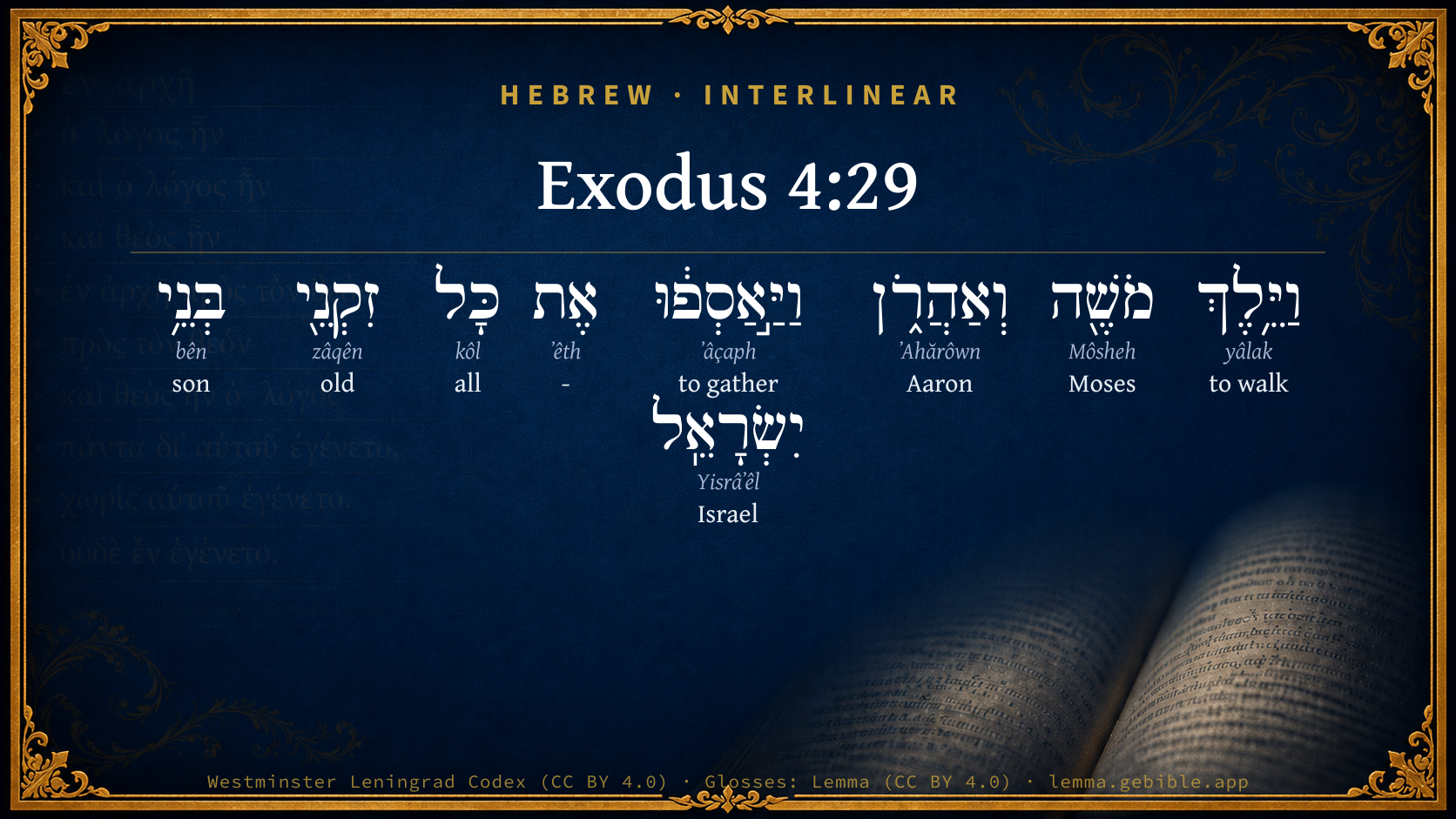
Exodus 4:29

Hebrew (Westminster Leningrad Codex) Exodus 4:29 appears in the Hebrew Old Testament. The text above is from the Westminster Leningrad Codex. Each word links to its Strong’s number, a concise gloss, and parsing drawn from the Open Scriptures Hebrew Bible morphology. Click any word for its full Brown-Driver-Briggs (BDB) entry.
Download image
Cite this verse

Exodus 4:29 (World English Bible). Public Domain. Lemma interlinear Bible study tool, https://lemma.gebible.app/v/exodus/4/29.

Show BibTeX & RIS
BibTeX
RIS
English Translation
Moses and Aaron went and gathered together all the elders of the children of Israel.
World English Bible · Public Domain
Download a study sheet

One document with this verse’s original text, its word-by-word gloss line, the meaning frame, cross-references with their text, attributed commentary, and full source and license credits — printable, and it pastes into notes with its structure intact.

This verse Autodidact and up

Study sheet (.html) Plain text (.txt)

A passage Seminary Student

Up to 50 verses in one chapter. A passage sheet keeps up to 6 commentary sources and 12 cross-references per verse, in the order this page ranks them, and says so on the sheet whenever that leaves anything out. Ask for a single verse and you get the Autodidact verse sheet above.

Everything on this page stays free to read, with no account — the sheet is a download of what is already on screen, not access to it.

Want to remove ads? Support Godless Engineer
Compare translations 3

The same verse in 3 English versions, stacked beneath the original-language interlinear above. Click any original word for its lexicon entry.

Each is an independent rendering of the whole verse — the interlinear is not word-aligned to these translations.

Highlighted words mark where these versions differ — a whole-verse word diff, not a word-by-word alignment.

  • World English Bible Public Domain
    Moses and Aaron went and gathered together all the elders of the children of Israel.
  • King James Version Public Domain
    And Moses and Aaron went and gathered together all the elders of the children of Israel:
  • unfoldingWord Literal Text CC BY-SA 4.0
    And Moses and Aaron went, and they gathered all of the elders of the sons of Israel.

unfoldingWord Literal Text — © unfoldingWord, licensed CC BY-SA 4.0. Word-aligned USFM3 via Door43 (git.door43.org/unfoldingWord/en_ult).

Versions to compare (up to 4)

3 of 4 selected

Show all 18 translations

Every available English version of this verse, each an independent rendering of the whole verse.

  • World English Bible Public Domain
    Moses and Aaron went and gathered together all the elders of the children of Israel.
  • Berean Standard Bible Public Domain
    Then Moses and Aaron went and assembled all the elders of the Israelites,
  • Majority Standard Bible Public Domain
    Then Moses and Aaron went and assembled all the elders of the Israelites,
  • King James Version Public Domain
    And Moses and Aaron went and gathered together all the elders of the children of Israel:
  • American Standard Version (1901) Public Domain
    And Moses and Aaron went and gathered together all the elders of the children of Israel:
  • Revised Version (1885) Public Domain
    And Moses and Aaron went and gathered together all the elders of the children of Israel:
  • Geneva Bible (1599) Public Domain
    So went Moses and Aaron, and gathered all the Elders of the children of Israel.
  • Douay-Rheims (1899) Public Domain
    And they came together, and they assembled all the ancients of the children of Israel.
  • Young's Literal Translation Public Domain
    And Moses goeth -- Aaron also -- and they gather all the elders of the sons of Israel,
  • Literal Standard Version CC BY-SA 4.0
    And Moses goes—Aaron also—and they gather all the elderly of the sons of Israel,
  • Unlocked Literal Bible CC BY-SA 4.0
    Then Moses and Aaron went and gathered together all the elders of the Israelites.
  • unfoldingWord Literal Text CC BY-SA 4.0
    And Moses and Aaron went, and they gathered all of the elders of the sons of Israel.
  • Darby Bible Public Domain
    And Moses and Aaron went and gathered all the elders of the children of Israel;
  • World Messianic Bible Public Domain
    Moses and Aaron went and gathered together all the elders of the children of Israel.
  • Webster's Bible Public Domain
    And Moses and Aaron went, and assembled all the elders of the children of Israel:
  • Free Bible Version CC BY-SA 4.0
    Moses and Aaron traveled to Egypt. There they had all the Israelite elders gather together.
  • Bible in Basic English Public Domain
    Then Moses and Aaron went and got together all the chiefs of the children of Israel:
  • JPS Tanakh (1917) Public Domain
    And Moses and Aaron went and gathered together all the elders of the children of Israel.

Literal Standard Version (2020), Covenant Press — licensed CC BY-SA 4.0. Text via the HelloAO Bible API (eBible.org). Unlocked Literal Bible (unfoldingWord) — licensed CC BY-SA 4.0. Text via the HelloAO Bible API (eBible.org). unfoldingWord Literal Text — © unfoldingWord, licensed CC BY-SA 4.0. Word-aligned USFM3 via Door43 (git.door43.org/unfoldingWord/en_ult). Free Bible Version, Dr. Jonathan Gallagher — licensed CC BY-SA 4.0. Text via the HelloAO Bible API (eBible.org).

Word by word

More ways to search: Search by grammar → Find every occurrence → Compare this word →

Practice this passage: Drill this verse → Learn its vocabulary →

About this verse

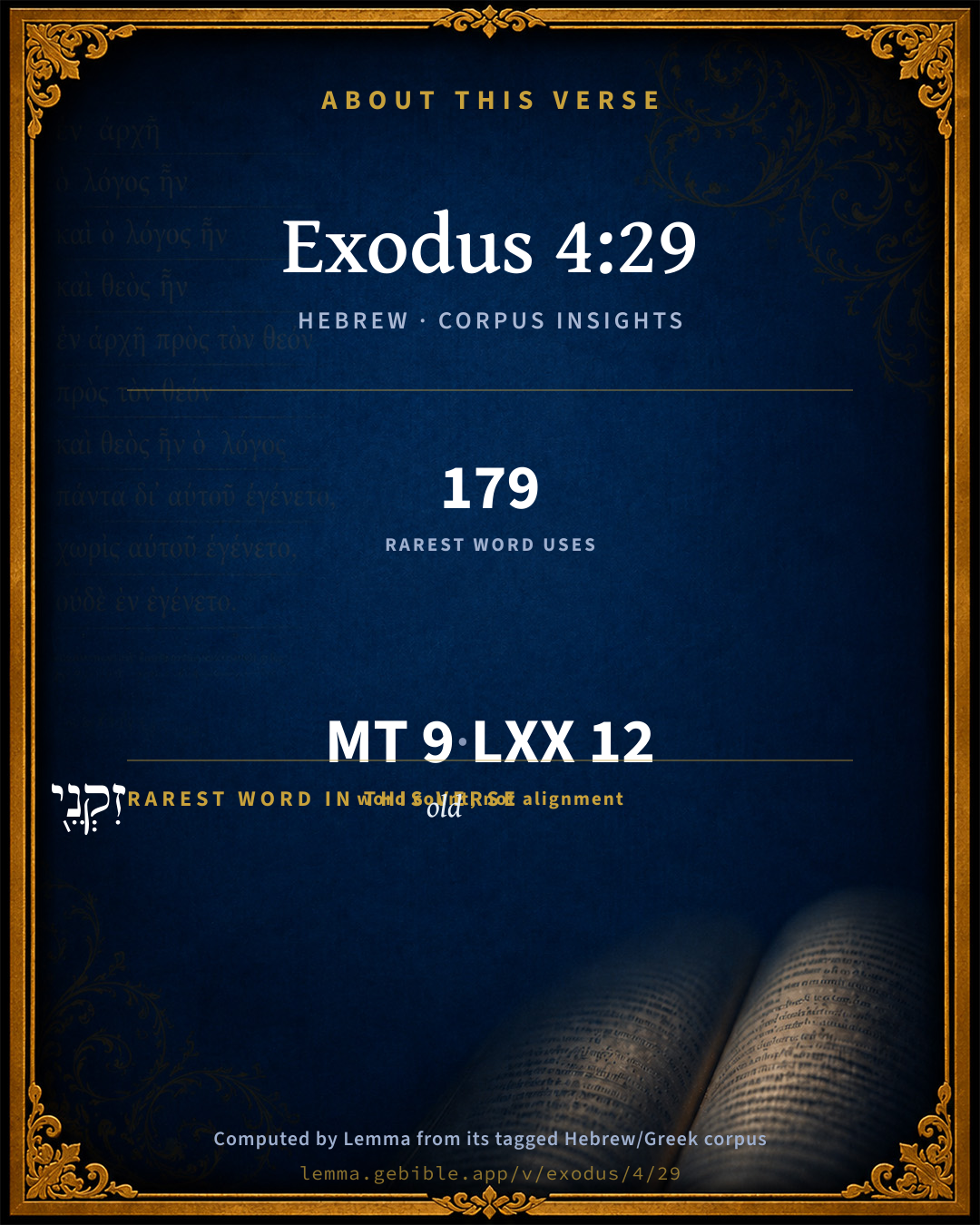
These counts appear in no published source. They are computed here, from the morphology-tagged text and Lemma’s own curated glosses. What Lemma adds →

9
words
9
distinct lemmas
Pentateuch
section

Grammatical profile

  • 2 verbs
  • 5 nouns
  • 1 adjective
  • 1 particle

Verb forms

  • וַיֵּ֥לֶךְ Qal · Sequential Imperfect
  • וַיַּ֣אַסְפ֔וּ Qal · Sequential Imperfect

Hebrew & Septuagint length

In English translation the verse runs 15 words from the Hebrew and 14 from the Septuagint (LXX English) — closely comparable.

A rough comparison of the two English renderings, which tokenize alike — not a word-level alignment.

Word counts can differ between the Hebrew and the Greek without any difference in meaning — e.g. the Hebrew direct-object marker אֵת has no separate Greek word, and Greek often adds the article ὁ.

In the original languages it is 9 Hebrew tokens and 12 Greek tokens — but the two are counted differently (Hebrew bundles its prefixes and suffixes into one token; the Greek is in lemma form), so that isn’t a like-for-like length.

Cross-references

3

Topical passages linked to Exodus 4:29 in the Treasury of Scripture Knowledge — connected by theme and wording, ordered by reader-vote popularity; previews shown in the World English Bible.

  • Exodus 3:16 Go, and gather the elders of Israel together, and tell them, 'Yahweh, the God of your fathers, the God of Abraham, of Isaac, and of Jacob, has appeared to me, saying, "I have surely visited you, and seen that which is done to you in Egypt;
  • Exodus 24:1 He said to Moses, "Come up to Yahweh, you, and Aaron, Nadab, and Abihu, and seventy of the elders of Israel; and worship from a distance.
  • Exodus 24:11 He didn't lay his hand on the nobles of the children of Israel. They saw God, and ate and drank.

Cross-references courtesy of OpenBible.info (CC BY 4.0).

Hebrew and Greek witnesses Masoretic Hebrew ↔ Greek Septuagint

The same verse in the two great witnesses to the Old Testament, shown verse-for-verse.

These are two independent witnesses, not word-aligned to each other, and the Septuagint is shown in lemma (dictionary) form.

Hebrew Exodus 4:29 Masoretic · Westminster Leningrad Codex

וַיֵּ֥לֶךְ מֹשֶׁ֖ה וְאַהֲרֹ֑ן וַיַּ֣אַסְפ֔וּ אֶת כָּל זִקְנֵ֖י בְּנֵ֥י יִשְׂרָאֵֽל

Moses and Aaron went and gathered together all the elders of the children of Israel.

World English Bible · Public Domain

Greek LXX Exodus 4:29 Septuagint · lemma form

πορεύομαι δέ μωυσῆς καί ααρων καί συνἄγω ὁ γερουσία ὁ υἱός ἰσραήλ

And Moses and Aaron went and gathered the elders of the children of Israel.

LXX2012 (modern English Septuagint) · Public Domain

On this verse, Ellicott's Commentary for English Readers discusses the Septuagint’s reading. Read the note in Commentary ↓

Hebrew: Westminster Leningrad Codex (CC BY 4.0). Greek: Septuagint (public domain); English from LXX2012 (modern English Septuagint) (Public Domain). How the Septuagint differs from the Hebrew →

Targum (Aramaic paraphrase)

2

The Targum is the ancient Jewish Aramaic paraphrase of the Hebrew Scriptures — an interpretive translation, not the Hebrew text itself. Onkelos (literal) and Pseudo-Jonathan (expansive) render the Torah, and Jonathan the Prophets. Coverage is partial: where no permissively-licensed English translation exists for a verse, only the Aramaic is shown. This is verse-level text, not a word-by-word alignment to the Hebrew.

  1. Targum Onkelos Torah (Genesis–Deuteronomy)
    וַאֲזַל משֶׁה וְאַהֲרֹן וּכְנָשׁוּ יָת כָּל סָבֵי בְּנֵי יִשְׂרָאֵל:

    (no public-domain English translation for this verse)

    Targum Onkelos — Aramaic: “Onkelos Genesis” (public domain); “Onkelos Exodus” (public domain); “Onkelos Leviticus” (public domain); “Onkelos Numbers” (public domain); “Onkelos Deuteronomy” (public domain). English: “Sefaria Community Translation” (CC0 1.0 (public-domain dedication)); “J.W. Etheridge. The Targums of Onkelos and Jonathan Ben Uzziel on the Pentateuch. London: Longmans, Green, 1862” (public domain). Text via Sefaria.

  2. Targum Pseudo-Jonathan Torah (Genesis–Deuteronomy)
    וַאֲזַל משֶׁה וְאַהֲרן וּכְנָשׁוּ יַת כָּל סָבֵי בְּנֵי יִשְרָאֵל

    And Mosheh and Aharon went, and gathered together all the elders of the sons of Israel.

    Targum Pseudo-Jonathan — Aramaic: “Targum Jonathan on Genesis” (public domain); “Targum Jonathan on Exodus” (public domain); “Targum Jonathan on Leviticus” (public domain); “Targum Jonathan on Numbers” (public domain); “Targum Jonathan on Deuteronomy” (public domain). English: “The Targum of Jonathan ben Uzziel, trans. J. W. Etheridge, London, 1862” (public domain). Text via Sefaria.

Commentary

Notes on Exodus 4:29 from classic Christian and Jewish commentators (each source and its license shown beneath its notes). The classic Christian expositions comment on the surrounding passage and are grouped to its opening verse, so a note may address several verses; the Jewish commentaries on the Tanakh (Rashi and others) are per-verse, so they appear only where the commentator wrote on this verse.

Lemma curates 59 commentaries, every one of them public domain or Creative Commons licensed, each selected and text-cleaned for this edition rather than reprinted as found. About our sources →

Trapp's Complete Commentary

John Trapp

Exo 4:29 And Moses and Aaron went and gathered together all the elders of the children of Israel:

Ver. 29. And Moses and Aaron.] So Zerubbabel and Jehoshua; Paul and Barnabas; the other disciples "by two and two"; {Mar 6:7} the two faithful witnesses; {Rev 11:3} both for more authority, and for mutual help and comfort.

John Trapp, A Commentary or Exposition upon All the Books of the Old and New Testament (1647–1656) — public domain. Text from a community e-Sword module.

The Biblical Illustrator

Joseph S. Exell

Exo_4:29-30

Gathered together all the elders.

The first interview of Moses and Aaron with the elders of Israel, and the welcome they received

I. They acted upon the Divine suggestion. All Christian work should be undertaken according to the Divine suggestion, and in harmony with the Divine will. God generally tells men how to work as well as what to do. If we were left to mark out our own methods of toil, we should often involve both ourselves and the enterprise entrusted to us in great danger.

II. They spake according to the Divine dictation. Great workers require to be taught by God. In this consists their safety and success. A man who speaks to the world the messages of God will always be listened to.

III. They succeeded according to Divine intimation. Thus Moses and Aaron awakened--

1. Faith.

2. Hope.

3. Devotion--of Israel.

Moses had previously said that Israel would not believe him. We mistake our missions. We cannot form an estimate of success. If we act and speak according to the instruction of God we must succeed. (J. S. Exell, M. A.)

Lessons

1. Declaring of Gods will is suitably united to the assembling of His people.

2. Gods spokesmen made by Him are fittest to declare his mind to His people.

3. The words of Jehovah only, which He hath spoken to His servants, must be given to His assembly.

4. God may give His mind more immediately to one servant than to another (to Moses).

5. Gods stupendous works must be done, as well as His words spoken, to His people.

6. Gods congregation are the first subject to whom His words and works are sent. (G. Hughes, B. D.)

The gathering of the elders

The gathering of the elders of the children of Israel may point to no more than a family and tribal organization which was not known or used by the Egyptians for the purposes of government, but only used among the Israelites themselves for their religious and ritual teaching. But it would be contrary to most oriental experience to suppose so. It has been the custom of most eastern rulers, as of the Turks to-day, to recognize all proper governmental organizations among a subject people. It was even a large part of the wisdom of the politic Romans. The general government, indeed, extends its power to the individual, and is not slow to do so. But it is both convenient to have an opportunity for the respondent superior principle in law to work, and politic to have thus a hold upon the more generous feelings of the subject classes. The heads of the subject, tribe, or people are made responsible for, collection (or at least the payment) of tribute, and for the preservation of a certain law and order, and are the ready subjects of extortion on very slight pretences. On the other hand, their brethren of inferior order take pride in them, and serve them, and through them the general government, with much less driving. A pretty fair example of this in modern times can be seen in the Turkish recognition of the various religious bodies within its domains. Perhaps it is the best of modern illustrations. (Prof. Isaac H. Hall.)

The Biblical Illustrator, edited by Joseph S. Exell (c. 1880s–1900s) — public domain. Text from a community e-Sword module.

The Preacher's Complete Homiletical Commentary

Joseph S. Exell (gen. ed.)

MAIN HOMILETICS OF THE PARAGRAPH.—Exo_4:29-31

THE FIRST INTERVIEW OF MOSES AND AARON WITH THE ELDERS OF ISRAEL, AND THE WELCOME THEY RECEIVED

I. They acted upon the Divine suggestion. “And Moses and Aaron went and gathered together all the Elders of the Children of Israel.” This is what God told them to do. All Christian work should be undertaken according to the Divine suggestion, and in harmony with the Divine will. God generally tells men how to work as well as what to do. If we were left to mark out our own methods of toil, we should often involve both ourselves and the enterprise entrusted to us in great danger.

II. They spake according to the Divine dictation. “And Aaron spake all the words which the Lord had spoken unto Moses.” In a great mission the sayings of a man are as important as his doings: hence these must be divinely directed Great workers require to be taught by God. In this consists their safety and success. A man who speaks to the world the messages of God will always be listened to.

III. They succeeded according to Divine intimation. “And the people believed: and when they heard that the Lord had visited the Children of Israel, and that he had looked upon their affliction, then they bowed their heads and worshipped.” Thus Moses and Aaron awakened the—

(1). Faith;

(2). Hope;

(3). Direction—of Israel. Moses had previously said that Israel would not believe him. We mistake our missions. We cannot form an estimate of success. If we act and speak according to the instruction of God, we must succeed.

SUGGESTIVE COMMENTS ON THE VERSES

Exo_4:29. The declaring of God’s will is suitably united to the assembling of His people.

God’s spokesmen made by Him are the best to declare His mind to His people.

God may unfold His mind more fully to one servant than to another.

Exo_4:30-31. The faith of the people should closely follow upon the word of God ministered, and by His works confirmed.

All professed believers receive not God’s word with the same faith.

God’s gracious visitation of His Church, and providential sight of its afflictions are made known by His servants, and are welcome to them.

The tidings of God’s visiting love and redeeming providence must affect God’s Israel.

Worship is the most suitable return to God for His redemption.

HUMAN AND DIVINE ATTITUDES

I. The attitudes predicated of the people:—

1. Their belief.

2. Their reference.

3. Their devotion.

II. The attitudes predicated of God:—

1. He saw the affliction of Israel.

2. Visited Israel.

The Preacher's Complete Homiletical Commentary (gen. ed. Joseph S. Exell; Funk & Wagnalls, c. 1892) — public domain (pre-1929). A full-Bible homiletical/sermon-outline anthology covering 65 of 66 books (2 John is absent from the source module). Text from a community e-Sword module.

The Annotated Bible

Arno C. Gaebelein

3. Moses and Aaron in Egypt

CHAPTERS 4:29-5:23 Before the Elders and Before Pharaoh

1. Before the elders of Israel (Exo 4:29-31)

2. Before Pharaoh, and his answer (Exo 5:1-4)

3. The increased oppression (Exo 5:5-19)

4. Israel ‘s complaint and Moses’ prayer (Exo 5:20-23)

The people were willing and believed. Notice they believed after the signs were done. Faith was followed by worship. It is almost a constitutional thing with the Jew to see first and then believe. Compare with Joh 20:26-29.

Then the messengers of God appeared before Pharaoh. This must have been in his capital Zoan (Psa 78:43). Jehovah made of Pharaoh seven demands. They are found in Exo 5:1; Exo 7:16; Exo 8:1; Exo 8:20; Exo 9:1; Exo 9:13; Exo 10:3. Satan’s power now becomes more fully manifested. Israel is Jehovah’s people and He must have His chosen ones out of Egypt and fully delivered. The objects of his love and grace must be completely freed from the miserable slavery of sin and Satan. The typical application as to man’s condition as a sinner is so well known that we need not to follow it in detail.

Pharaoh’s attitude is that of defiance, though he spoke the truth when he said, “I know not Jehovah.” The threat of coming judgments is disbelieved. His answer was increased burdens marked by the most awful cruelty. It was Satan’s rage through Pharaoh in anticipation of Jehovah’s intervention in the redemption of His people. As far as Israel is concerned this will yet be repeated during the great tribulation. Then Satan’s wrath will be great, for he knows his time is short and the Lord will deliver the remnant of Israel (Rev 12:12-17). It is the same in the individual experience. Satan will not let his victims go. When sin and the power of the flesh is felt, then comes the conflict and Satan’s rage.

What discouragement for the poor slaves in Egypt ! They had rejoiced in faith and worshipped because Jehovah’s servants had announced deliverance, and now a darker night had settled upon them; but it was only the harbinger of the glad dawn of the redemption. They murmured while Moses, deeply perplexed, turned to the Lord in prayer. Moses was a great man of prayer. He cast his burden upon the Lord.

Arno C. Gaebelein, The Annotated Bible (1913–1922) — public domain. Text from a community e-Sword module.

Tyndale Open Study Notes

Tyndale Open Resources

4:29–7:7 In this section, the Lord offered to rescue the Israelites. The people initially gave a favorable response but ultimately faced a crisis of faith.

Tyndale Open Study Notes — © Tyndale Open Resources, licensed CC BY-SA 4.0. Text via the HelloAO Bible API.

Jamieson, Fausset & Brown

Robert Jamieson, A. R. Fausset & David Brown

Moses and Aaron went--towards Egypt, Zipporah and her sons having been sent back. (Compare Exo 18:2).

gathered . . . all the elders--Aaron was spokesman, and Moses performed the appointed miracles--through which "the people" (that is, the elders) believed (Kg1 17:24; Jos 3:2) and received the joyful tidings of the errand on which Moses had come with devout thanksgiving. Formerly they had slighted the message and rejected the messenger. Formerly Moses had gone in his own strength; now he goes leaning on God, and strong only through faith in Him who had sent him. Israel also had been taught a useful lesson, and it was good for both that they had been afflicted.

Next: Exodus Chapter 5

Jamieson, Fausset & Brown — Commentary Critical and Explanatory on the Whole Bible (1871) — public domain (CC PDM 1.0). Text via the HelloAO Bible API.

Ellicott's Commentary for English Readers

THE RETURN TO EGYPT.

(29) Moses and Aaron went.—The two brothers returned together from the Sinaitic region to Egypt. No particulars of the journey are narrated, nor can we even tell what was the route which they followed. On their arrival, they at once set themselves to carry out the charge committed to them (Exo_3:16). The Israelites in Egypt, though suffering under severe oppression, had an organisation of their own, jurisdiction attaching probably to the heads of tribes, or of chief families. (Comp. Num_1:4-16.) These persons are here called “elders,” which the LXX. render τὴν γερουσίαν, “the senate.” Moses and Aaron could have no power to convoke them; but they invited them to a conference, and the elders came.

A Bible Commentary for English Readers, edited by Charles John Ellicott (1878–1897) — public domain. Text from a community e-Sword module.

The Cambridge Bible for Schools and Colleges

gen. ed. J. J. S. Perowne

Exodus 29-31. Execution of the commands given in Exo_3:16, Exo_4:2-9.

The Cambridge Bible for Schools and Colleges (gen. ed. J. J. S. Perowne; Cambridge University Press, 1878–1918) — public domain. Text from a community e-Sword module.

John Gill's Exposition

And Aaron spake all the words which the Lord had spoken unto Moses,.... As Moses had related to him, being his mouth and spokesman:

and did the signs in the sight of the people; not Aaron, but Moses, and these were the turning of his rod into a serpent, and the serpent into a rod again; putting his hand into and out of his bosom, when it was leprous, and then doing the same when it was well again; and taking water out of the river, and changing it into blood, which he did for the confirmation of his mission.

John Gill's Exposition of the Whole Bible (1746–1763) — public domain (CC PDM 1.0). Text via the HelloAO Bible API.

Albert Barnes' Notes on the Bible

All the elders - The Israelites retained their own national organization; their affairs were administered by their own elders, who called a public assembly Exo 4:31 to hear the message brought by Moses and Aaron.

Albert Barnes' Notes on the Bible (1834–1885) — public domain. Text from a community e-Sword/MySword module.

Matthew Poole's English Annotations

All of them whom they could easily and quickly bring together, or all that were in those parts. Of those elders, see Exo 3:16; 24:1,9; Num 11:16.

Matthew Poole's English Annotations on the Holy Bible (1683–1685) — public domain. Text from a community e-Sword/MySword module.

Whedon's Commentary on the Bible

Daniel D. Whedon

29-31. Gathered… the elders — This points to an organization of the people under chiefs of their own, and their reverent acceptance of Moses and Aaron shows that they had not forgotten the God and the covenant of their fathers, although their faith was by no means ready for the impending conflict.

Elders — See note on Exo_6:13-19.

Daniel D. Whedon (gen. ed.), Commentary on the Old and New Testaments (1874–1909) — public domain. Text from a community e-Sword module.

The Pulpit Commentary

Vers. 29-31. Moses seems to have parted with Zipporah and his children in Horeb, and to have sent them back to Jethro, (Exo_18:2) perhaps because they might have interfered with the work which he had to do, perhaps because he thought Egypt would be no pleasant residence for them during the coming struggle. He journeyed onward from Horeb with Aaron for his sole companion, and had abundant time for taking counsel with him, and exercising the influence over him which high intellect and education combined will always give to their possessor. The journey from Horeb to Goshen occupied probably some weeks. On arriving in Goshen, the two brothers, in obedience to the divine command, (Exo_3:16) proceeded at once to "gather together all the elders of Israel that is, all these who exercised local authority over their countrymen in the various districts which they inhabited. Through the mouth of Aaron, Moses declared all that had been revealed to him at the burning bush and subsequently, exhibiting at the same time the credentials which proved him an ambassador from God, i.e. the three miracles which he had been empowered to work at any moment. (Exo_4:2-8) The elders, being themselves convinced, summoned an assembly of the people, as is implied though not expressed in ver. 30; and the people, having heard the words of Aaron and seen the signs, were also convinced, and bowing their heads, worshipped the God whose ambassadors had appeared before them.

On the elders of Israel, see note upon Exo_3:16. It is clear that the Israelitish nation, though in bondage to the Egyptians, had a certain internal organisation of its own, and possessed a set of native officers. These were probably the hereditary heads of families. Moses and Aaron could have no authority to gather these persons together; but they issued an invitation, and it was accepted. The "elders" came to the meeting.

Vers. 29-31. The blessing on obedience.

Moses and Aaron, on their return to Egypt in company, carried out exactly the Divine directions, doing neither less nor more. They summoned the elders as commanded; (Exo_3:16) they delivered God"s message to them (ib.); they wrought the signs which they had been told to work; (Exo_4:17) they severally kept to their appointed offices; and the result was complete success so far. The elders and people hearkened unto them, believed, gave in their unqualified assent and consent to all that was put before them. And this was according to the promise of God, "they shall hearken to thy voice". (Exo_3:18) Moses had disbelieved the promise, and exclaimed, "Behold, they will not believe me, nor hearken unto my voice"; (Exo_4:1) but Moses was now proved mistaken. "The foolishness of God is wiser than men". (1Co_1:25) God knew better than Moses; he was faithful; he kept his word. As Moses and Aaron had been true to him, and followed exactly his commands, so he proved himself true to them, and amply rewarded their obedience. Moses and Aaron were from this time the accepted leaders of the nation.

Vers. 29-31. Preaching and faith.

I THE WORD SPOKEN.

1. Should be the Word of God. The preacher is not set to deliverhis own speculations, but to convey a message.

2. Should be exhibited with its appropriate evidence.

3. Should be declared to all.

II THE WORD BELIEVED. The people

1. Appreciated the value of the word.

2. Believed the word.

3. Worshipped; a token of gratitude, submission, and obedience. J.O.

The Pulpit Commentary (1880–1919), ed. H.D.M. Spence-Jones & Joseph S. Exell — public domain. Text from a community e-Sword module.

unfoldingWord translationNotes

Door43 World Missions Community

in the sight of the people

"before the people" or "in the presence of the people"

had observed the Israelites

"saw the Israelites" or "was concerned about the Israelites"

they bowed their heads

Possible meanings are 1) "they bowed their heads in awe" or 2) "they bowed down low in reverence." (See: Symbolic Action)

translationWords

elder

Israel

sign

believe

oppress

bow

worship

unfoldingWord translationNotes — © Distant Shores Media and the Door43 World Missions Community, licensed CC BY-SA 4.0. Source: git.door43.org/Door43/en_tn.

Lesson kit

Teaching starters — assembled from the data on this page, not authored interpretation. Every prompt links to the verse data it draws on. Edit before teaching.

Exodus, in the Pentateuch, opens this verse with 9 words (9 distinct Hebrew lemmas). Its most distinctive word is zâqên (“old”). A historical commentator’s framing appears above. Read the whole chapter for the surrounding context.

Discussion questions

  1. The word zâqên carries the sense “old.” How does it shape the verse?
  2. How does Exodus 3:16, which shares this passage’s theme, read alongside this verse?
  3. The translations on this page render this verse differently — a whole-verse word diff, not a word-by-word alignment. What might account for the different wordings?
  4. «וַיֵּ֥לֶךְ» is a Qal Sequential Imperfect verb. How does that grammatical form shape the action described?
  5. Compare how Trapp's Complete Commentary and The Biblical Illustrator read this verse. Where do they agree or differ?

Things to notice

Reading settings

Reading text

Shown beneath each verse's original-language words.

Old Testament
Old Testament edition

Read the OT as the Masoretic Hebrew (MT) or the Greek Septuagint (LXX).

English shown for the Greek Septuagint (in the Hebrew ↔ Greek comparison).

Comparing translations? Open the Compare panel on any verse page to stack up to four side by side.