
Numbers 11:32

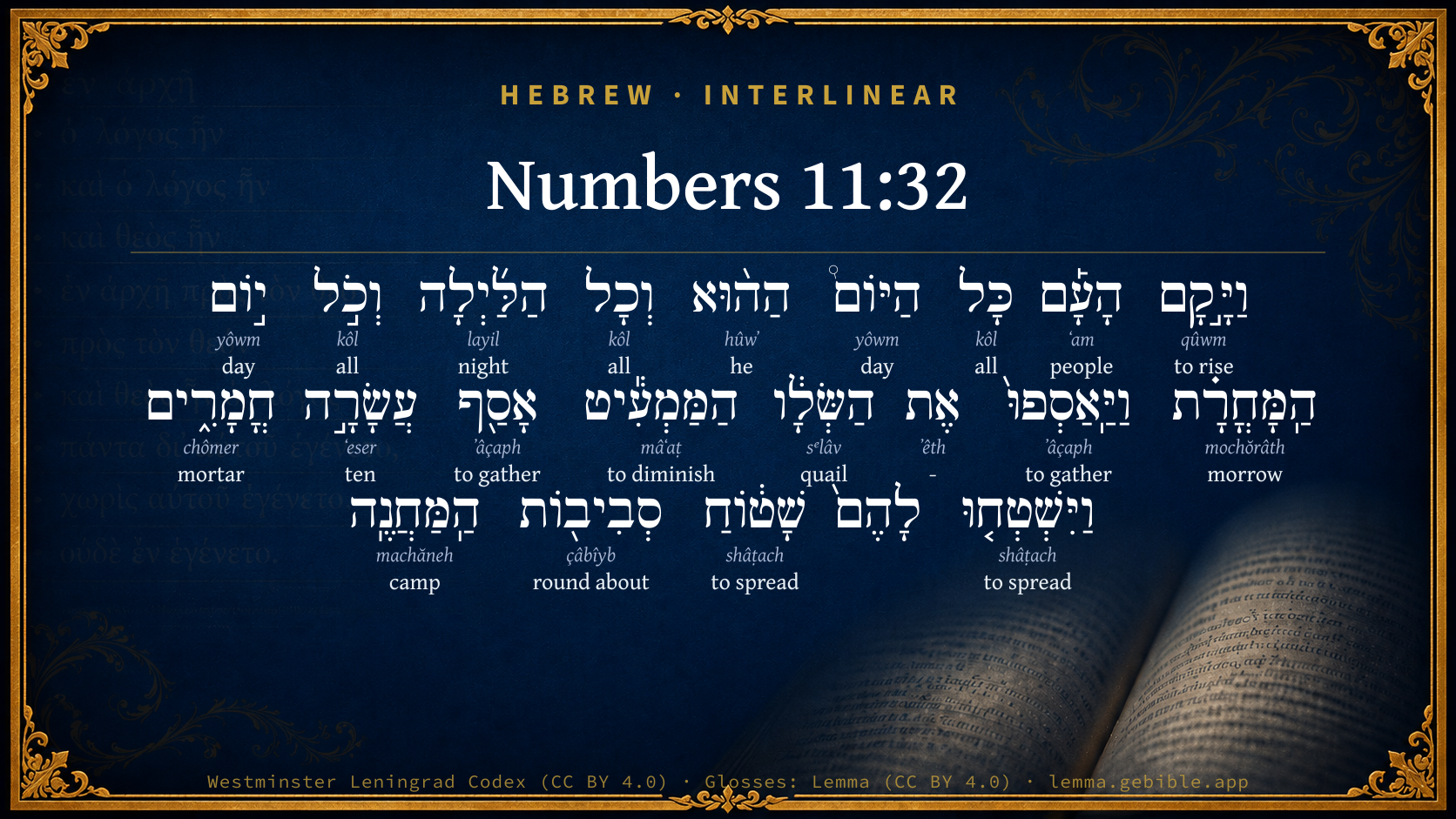
Hebrew (Westminster Leningrad Codex) Numbers 11:32 appears in the Hebrew Old Testament. The text above is from the Westminster Leningrad Codex. Each word links to its Strong’s number, a concise gloss, and parsing drawn from the Open Scriptures Hebrew Bible morphology. Click any word for its full Brown-Driver-Briggs (BDB) entry.
Download image
Cite this verse

Numbers 11:32 (World English Bible). Public Domain. Lemma interlinear Bible study tool, https://lemma.gebible.app/v/numbers/11/32.

Show BibTeX & RIS
BibTeX
RIS
English Translation
The people rose up all that day, and all the night, and all the next day, and gathered the quails: he who gathered least gathered ten homers: and they spread them all abroad for themselves round about the camp.
World English Bible · Public Domain
Highlights
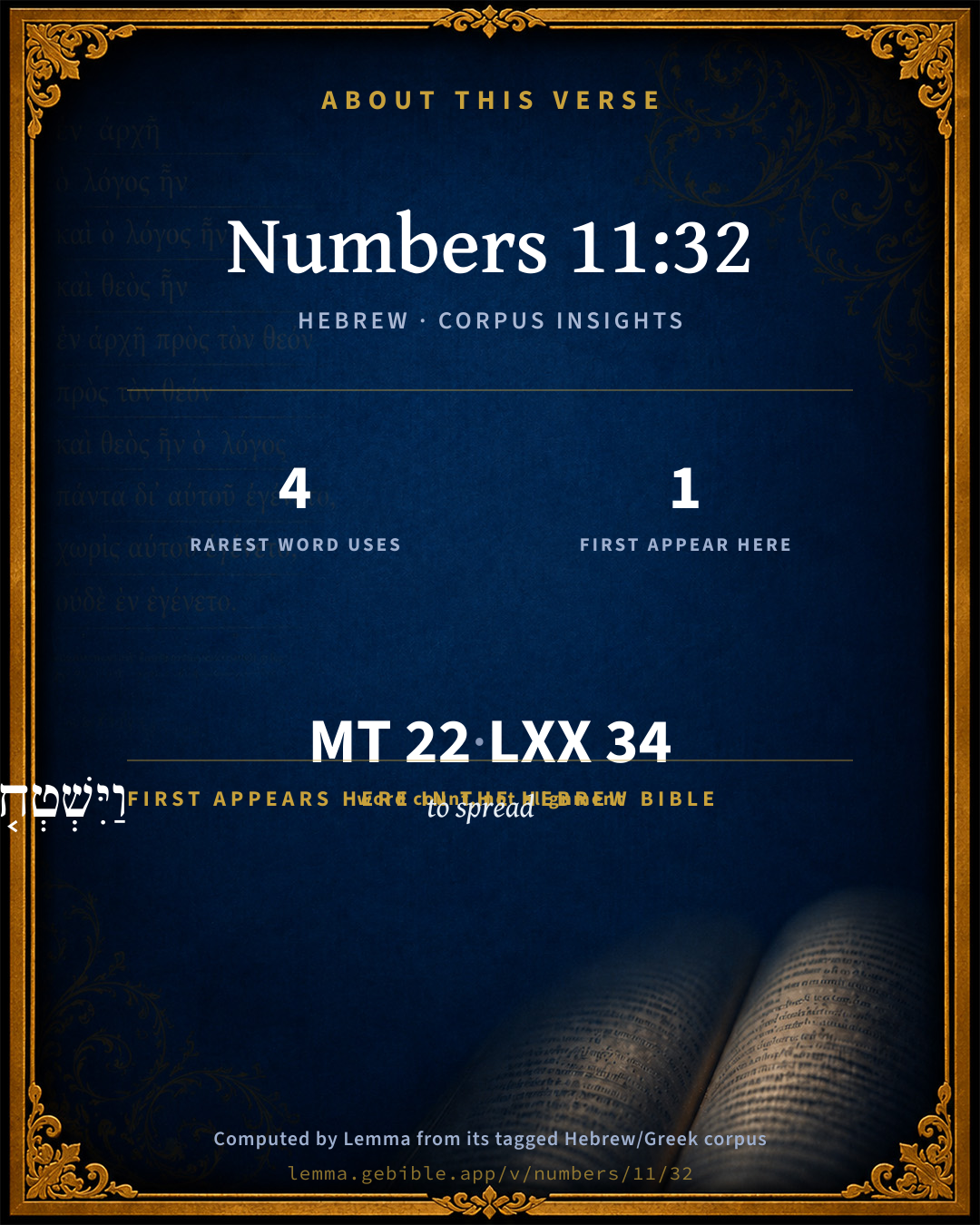
  • 1 first appearance in the Hebrew Bible
Full analysis ↓
Download a study sheet

One document with this verse’s original text, its word-by-word gloss line, the meaning frame, cross-references with their text, attributed commentary, and full source and license credits — printable, and it pastes into notes with its structure intact.

This verse Autodidact and up

Study sheet (.html) Plain text (.txt)

A passage Seminary Student

Up to 50 verses in one chapter. A passage sheet keeps up to 6 commentary sources and 12 cross-references per verse, in the order this page ranks them, and says so on the sheet whenever that leaves anything out. Ask for a single verse and you get the Autodidact verse sheet above.

Everything on this page stays free to read, with no account — the sheet is a download of what is already on screen, not access to it.

Want to remove ads? Support Godless Engineer
Compare translations 3

The same verse in 3 English versions, stacked beneath the original-language interlinear above. Click any original word for its lexicon entry.

Each is an independent rendering of the whole verse — the interlinear is not word-aligned to these translations.

Highlighted words mark where these versions differ — a whole-verse word diff, not a word-by-word alignment.

  • World English Bible Public Domain
    The people rose up all that day, and all the night, and all the next day, and gathered the quails: he who gathered least gathered ten homers: and they spread them all abroad for themselves round about the camp.
  • King James Version Public Domain
    And the people stood up all that day, and all that night, and all the next day, and they gathered the quails: he that gathered least gathered ten homers: and they spread them all abroad for themselves round about the camp.
  • unfoldingWord Literal Text CC BY-SA 4.0
    And the people rose all that day and all the night and all the day of the next day, and they gathered the quail. The one making little gathered ten homers. And spreading, they spread for them around the camp.

unfoldingWord Literal Text — © unfoldingWord, licensed CC BY-SA 4.0. Word-aligned USFM3 via Door43 (git.door43.org/unfoldingWord/en_ult).

Versions to compare (up to 4)

3 of 4 selected

Show all 18 translations

Every available English version of this verse, each an independent rendering of the whole verse.

  • World English Bible Public Domain
    The people rose up all that day, and all the night, and all the next day, and gathered the quails: he who gathered least gathered ten homers: and they spread them all abroad for themselves round about the camp.
  • Berean Standard Bible Public Domain
    All that day and night, and all the next day, the people stayed up gathering the quail. No one gathered less than ten homers, and they spread them out all around the camp.
  • Majority Standard Bible Public Domain
    All that day and night, and all the next day, the people stayed up gathering the quail. No one gathered less than ten homers, and they spread them out all around the camp.
  • King James Version Public Domain
    And the people stood up all that day, and all that night, and all the next day, and they gathered the quails: he that gathered least gathered ten homers: and they spread them all abroad for themselves round about the camp.
  • American Standard Version (1901) Public Domain
    And the people rose up all that day, and all the night, and all the next day, and gathered the quails: he that gathered least gathered ten homers: and they spread them all abroad for themselves round about the camp.
  • Revised Version (1885) Public Domain
    And the people rose up all that day, and all the night, and all the next day, and gathered the quails: he that gathered least gathered ten homers: and they spread them all abroad for themselves round about the camp.
  • Geneva Bible (1599) Public Domain
    Then the people arose, al that day, and all the night, and all the next day, and gathered the quailes: he that gathered the least, gathered ten Homers full, and they spred them abroade for their vse round about the hoste.
  • Douay-Rheims (1899) Public Domain
    The people therefore rising up all that day, and night, and the next day, gathered together of quails, he that did least, ten cores: and they dried them round about the camp.
  • Young's Literal Translation Public Domain
    And the people rise all that day, and all the night, and all the day after, and gather the quails -- he who hath least hath gathered ten homers -- and they spread them out for themselves round about the camp.
  • Literal Standard Version CC BY-SA 4.0
    And the people rise all that day, and all the night, and all the day after, and gather the quails—he who has least has gathered ten homers—and they spread them out for themselves around the camp.
  • Unlocked Literal Bible CC BY-SA 4.0
    The people were busy gathering quail all that day, all the night, and all the next day. No one gathered less than ten homers of quail. They shared the quail all through the camp.
  • unfoldingWord Literal Text CC BY-SA 4.0
    And the people rose all that day and all the night and all the day of the next day, and they gathered the quail. The one making little gathered ten homers. And spreading, they spread for them around the camp.
  • Darby Bible Public Domain
    And the people rose up all that day, and the whole night, and all the next day, and they gathered the quails: he that gathered little gathered ten homers; and they spread them abroad for themselves round about the camp.
  • World Messianic Bible Public Domain
    The people rose up all that day, and all of that night, and all the next day, and gathered the quails. He who gathered least gathered ten homers; and they spread them all out for themselves around the camp.
  • Webster's Bible Public Domain
    And the people stood up all that day, and all that night, and all the next day, and they gathered the quails: he that gathered least gathered ten homers: and they spread them all abroad for themselves around the camp.
  • Free Bible Version CC BY-SA 4.0
    All through that day and night, and all through the next day, the people went on collecting the quail. Everyone collected at least ten homers, and they spread them out to dry all around the camp.
  • Bible in Basic English Public Domain
    And all that day and all night and the day after, the people were taking up the birds; the smallest amount which anyone got was ten homers: and they put them out all round the tents.
  • JPS Tanakh (1917) Public Domain
    And the people rose up all that day, and all the night, and all the next day, and gathered the quails; he that gathered least gathered ten heaps; and they spread them all abroad for themselves round about the camp.

Literal Standard Version (2020), Covenant Press — licensed CC BY-SA 4.0. Text via the HelloAO Bible API (eBible.org). Unlocked Literal Bible (unfoldingWord) — licensed CC BY-SA 4.0. Text via the HelloAO Bible API (eBible.org). unfoldingWord Literal Text — © unfoldingWord, licensed CC BY-SA 4.0. Word-aligned USFM3 via Door43 (git.door43.org/unfoldingWord/en_ult). Free Bible Version, Dr. Jonathan Gallagher — licensed CC BY-SA 4.0. Text via the HelloAO Bible API (eBible.org).

Word by word

More ways to search: Search by grammar → Find every occurrence → Compare this word →

Practice this passage: Drill this verse → Learn its vocabulary →

הַשְּׂלָ֔ו
sᵉlâv
H7958
“the · quail”
Particle, Definite Article + Noun, Common, Feminine, Singular, Absolute
Part of Speech
Particle + Noun
Type
Common
Gender
Feminine
Number
Singular
State
Absolute
Full BDB Definition

Origin: by orthographical variation from H7951 through the idea of sluggishness

TWOT: 2265

quail
  1. וַיָּ֣קָם qûwm H6965 “and · to rise” Conjunction + Verb, Qal, Sequential Imperfect, 3rd Person, Masculine, Singular
  2. הָעָ֡ם ʻam H5971 “the · people” Particle, Definite Article + Noun, Common, Masculine, Singular, Absolute
  3. כָּל kôl H3605 “all of” Noun, Common, Masculine, Singular, Construct
  4. הַיּוֹם֩ yôwm H3117 “the · day” Particle, Definite Article + Noun, Common, Masculine, Singular, Absolute
  5. הַה֨וּא hûwʼ H1931 “the · he” Particle, Definite Article + Pronoun, Personal, 3rd Person, Masculine, Singular
  6. וְכָל kôl H3605 “and · all of” Conjunction + Noun, Common, Masculine, Singular, Construct
  7. הַלַּ֜יְלָה layil H3915 “the · night” Particle, Definite Article + Noun, Common, Masculine, Singular, Absolute
  8. וְכֹ֣ל kôl H3605 “and · all of” Conjunction + Noun, Common, Masculine, Singular, Construct
  9. י֣וֹם yôwm H3117 “day of” Noun, Common, Masculine, Singular, Construct
  10. הַֽמָּחֳרָ֗ת mochŏrâth H4283 “the · morrow” Particle, Definite Article + Noun, Common, Feminine, Singular, Absolute
  11. וַיַּֽאַסְפוּ֙ ʼâçaph H622 “and · to gather” Conjunction + Verb, Qal, Sequential Imperfect, 3rd Person, Masculine, Plural
  12. אֶת ʼêth H853 “-” Particle, Direct Object
  13. הַמַּמְעִ֕יט mâʻaṭ H4591 “the · diminishing” Particle, Definite Article + Verb, Hiphil, Participle Active, Masculine, Singular, Absolute
  14. אָסַ֖ף ʼâçaph H622 “to gather” Verb, Qal, Perfect, 3rd Person, Masculine, Singular
  15. עֲשָׂרָ֣ה ʻeser H6235 “ten” Adjective, Cardinal number, Masculine, Singular, Absolute
  16. חֳמָרִ֑ים chômer H2563 “mortar” Noun, Common, Masculine, Plural, Absolute
  17. וַיִּשְׁטְח֤וּ shâṭach H7849 “and · to spread” Conjunction + Verb, Qal, Sequential Imperfect, 3rd Person, Masculine, Plural
  18. שָׁט֔וֹחַ shâṭach H7849 “to spread” Verb, Qal, Infinitive Absolute
  19. סְבִיב֖וֹת çâbîyb H5439 “surroundings of” Noun, Common, Both, Plural, Construct
  20. הַֽמַּחֲנֶֽה machăneh H4264 “the · camp” Particle, Definite Article + Noun, Common, Both, Singular, Absolute

About this verse

These counts appear in no published source. They are computed here, from the morphology-tagged text and Lemma’s own curated glosses. What Lemma adds →

22
words
16
distinct lemmas
Pentateuch
section

Notable vocabulary

The rarest word here is הַשְּׂלָ֔ו quail H7958 — appearing just 4 times in the whole Hebrew Bible.

First appearance in Scripture

This word makes its first canonical appearance in the Hebrew Bible here:

  • וַיִּשְׁטְח֤וּ to spread H7849

Shared distinctive vocabulary

הַשְּׂלָ֔ו quail H7958 occurs in 4 verses of the Hebrew Bible. Also found in:

Grammatical profile

  • 6 verbs
  • 12 nouns
  • 1 adjective
  • 1 pronoun
  • 1 preposition
  • 1 particle

Verb forms

  • וַיָּ֣קָם Qal · Sequential Imperfect
  • וַיַּֽאַסְפוּ֙ Qal · Sequential Imperfect
  • הַמַּמְעִ֕יט Hiphil · Participle Active
  • אָסַ֖ף Qal · Perfect
  • וַיִּשְׁטְח֤וּ Qal · Sequential Imperfect
  • שָׁט֔וֹחַ Qal · Infinitive Absolute

Repetition

Words recur within this verse — often emphatic in Hebrew:

  • כָּל all H3605 ×3
  • הַיּוֹם֩ day H3117 ×2
  • וַיַּֽאַסְפוּ֙ to gather H622 ×2
  • וַיִּשְׁטְח֤וּ to spread H7849 ×2

Hebrew & Septuagint length

In English translation the verse runs 39 words from the Hebrew and 35 from the Septuagint (LXX English) — closely comparable.

A rough comparison of the two English renderings, which tokenize alike — not a word-level alignment.

Word counts can differ between the Hebrew and the Greek without any difference in meaning — e.g. the Hebrew direct-object marker אֵת has no separate Greek word, and Greek often adds the article ὁ.

In the original languages it is 22 Hebrew tokens and 34 Greek tokens — but the two are counted differently (Hebrew bundles its prefixes and suffixes into one token; the Greek is in lemma form), so that isn’t a like-for-like length.

Cross-references

2

Topical passages linked to Numbers 11:32 in the Treasury of Scripture Knowledge — connected by theme and wording, ordered by reader-vote popularity; previews shown in the World English Bible.

  • Ezekiel 45:11 The ephah and the bath shall be of one measure, that the bath may contain the tenth part of a homer, and the ephah the tenth part of a homer: the measure of it shall be after the homer.
  • Exodus 16:36 Now an omer is the tenth part of an ephah.

Cross-references courtesy of OpenBible.info (CC BY 4.0).

Hebrew and Greek witnesses Masoretic Hebrew ↔ Greek Septuagint

The same verse in the two great witnesses to the Old Testament, shown verse-for-verse.

These are two independent witnesses, not word-aligned to each other, and the Septuagint is shown in lemma (dictionary) form.

Hebrew Numbers 11:32 Masoretic · Westminster Leningrad Codex

וַיָּ֣קָם הָעָ֡ם כָּל הַיּוֹם֩ הַה֨וּא וְכָל הַלַּ֜יְלָה וְכֹ֣ל י֣וֹם הַֽמָּחֳרָ֗ת וַיַּֽאַסְפוּ֙ אֶת הַשְּׂלָ֔ו הַמַּמְעִ֕יט אָסַ֖ף עֲשָׂרָ֣ה חֳמָרִ֑ים וַיִּשְׁטְח֤וּ לָהֶם֙ שָׁט֔וֹחַ סְבִיב֖וֹת הַֽמַּחֲנֶֽה

The people rose up all that day, and all the night, and all the next day, and gathered the quails: he who gathered least gathered ten homers: and they spread them all abroad for themselves round about the camp.

World English Bible · Public Domain

Greek LXX Numbers 11:32 Septuagint · lemma form

καί ἀναἵστημι ὁ λαός ὅλος ὁ ἡμέρα καί ὅλος ὁ νύξ καί ὅλος ὁ ἡμέρα ὁ ἐπαύριον καί συνἄγω ὁ ὀρτυγομήτρα ὁ ὁ ὀλίγος συνἄγω δέκα κόρος καί ψύχω ἑαυτοῦ ψυγμός κύκλος ὁ παρεμβολή

And the people rose up all the day, and all the night, and all the next day, and gathered quails; he that gathered least, gathered ten measures; and they refreshed themselves round about the camp.

LXX2012 (modern English Septuagint) · Public Domain

On this verse, Haydock's Catholic Bible Commentary discusses the Septuagint’s reading. Read the note in Commentary ↓

Hebrew: Westminster Leningrad Codex (CC BY 4.0). Greek: Septuagint (public domain); English from LXX2012 (modern English Septuagint) (Public Domain). How the Septuagint differs from the Hebrew →

Targum (Aramaic paraphrase)

2

The Targum is the ancient Jewish Aramaic paraphrase of the Hebrew Scriptures — an interpretive translation, not the Hebrew text itself. Onkelos (literal) and Pseudo-Jonathan (expansive) render the Torah, and Jonathan the Prophets. Coverage is partial: where no permissively-licensed English translation exists for a verse, only the Aramaic is shown. This is verse-level text, not a word-by-word alignment to the Hebrew.

  1. Targum Onkelos Torah (Genesis–Deuteronomy)
    וְקָם עַמָא כָּל יוֹמָא הַהוּא וְכָל לֵילְיָא וְכָל יוֹמָא דְבַתְרוֹהִי וּכְנָשׁוּ יָת שְׂלָיו דְאַזְעַר כְּנַשׁ עַשְׂרָא דְגוֹרִין וּשְׁטָחוּ לְהוֹן מַשְׁטִיחִין סְחוֹר סְחוֹר לְמַשְׁרִיתָא

    (no public-domain English translation for this verse)

    Targum Onkelos — Aramaic: “Onkelos Genesis” (public domain); “Onkelos Exodus” (public domain); “Onkelos Leviticus” (public domain); “Onkelos Numbers” (public domain); “Onkelos Deuteronomy” (public domain). English: “Sefaria Community Translation” (CC0 1.0 (public-domain dedication)); “J.W. Etheridge. The Targums of Onkelos and Jonathan Ben Uzziel on the Pentateuch. London: Longmans, Green, 1862” (public domain). Text via Sefaria.

  2. Targum Pseudo-Jonathan Torah (Genesis–Deuteronomy)
    וְקָמוּ מְחַסְרֵי הֵימְנוּתָא דִי בְּעַמָא כָּל יוֹמָא הַהוּא וְכָל לֵילְיָא וְכָל יוֹמָא דְבַתְרוֹי וּכְנָשׁוּ יַת סַלְוֵי דִקְטִיעַ וּדְחַגִיר כְּנַשׁ עַשְרָא כִּרְוַויַן וּשְׁטָחוּ לְהוֹן מַשְׁטִיחִין חִזְרָנוּת מַשְׁרִיתָא

    And they who had been wanting in faith arose: and all that day, and all the night, and all the day that followed, they gathered the quails; even he who was lame and infirm gathered ten korin, and they spread them abroad round about the camps.

    Targum Pseudo-Jonathan — Aramaic: “Targum Jonathan on Genesis” (public domain); “Targum Jonathan on Exodus” (public domain); “Targum Jonathan on Leviticus” (public domain); “Targum Jonathan on Numbers” (public domain); “Targum Jonathan on Deuteronomy” (public domain). English: “The Targum of Jonathan ben Uzziel, trans. J. W. Etheridge, London, 1862” (public domain). Text via Sefaria.

Commentary

Notes on Numbers 11:32 from classic Christian and Jewish commentators (each source and its license shown beneath its notes). The classic Christian expositions comment on the surrounding passage and are grouped to its opening verse, so a note may address several verses; the Jewish commentaries on the Tanakh (Rashi and others) are per-verse, so they appear only where the commentator wrote on this verse.

Lemma curates 59 commentaries, every one of them public domain or Creative Commons licensed, each selected and text-cleaned for this edition rather than reprinted as found. About our sources →

Trapp's Complete Commentary

John Trapp

Num 11:32 And the people stood up all that day, and all [that] night, and all the next day, and they gathered the quails: he that gathered least gathered ten homers: and they spread [them] all abroad for themselves round about the camp.

Ver. 32. And they spread them.] They fed without fear, {Jdg 1:12} though foretold they should pay dear for these murdering morsels; {Num 11:20} that which they ate being sauced, and that which they drank being spiced, with the bitter wrath of God. {Job 20:23}

They gathered the quails.] Which they might the more easily do, if that be true which some {a} write, that the Arabian Gulf breedeth great store of quails, which fly low usually, so as they may easily be taken up with one’s hand.

{a} Drusius.

John Trapp, A Commentary or Exposition upon All the Books of the Old and New Testament (1647–1656) — public domain. Text from a community e-Sword module.

Joseph Benson's Commentary

Num 11:32. All that night and all next day — Some at the one time, and some at the other, and some, through greediness or diffidence, at both times. Ten homers — That is, ten ass-loads: which, if it seem incredible, consider, 1st, That the gatherers here were not all the people, which could not be without great inconvenience, but some on the behalf of all, while the rest were exercised about other necessary things. Therefore, the meaning is not, that every Israelite had so much for his share, but that every collector gathered so much for the family or others by whom he was appointed. 2d, That the people did not gather for their present use only, but for a good while to come; and being distrustful of God’s goodness, it is not strange if they gathered much more than they needed. 3d, That the word rendered homers, may signify heaps, as it doth Exo 8:14; Jdg 15:16;

Hab 3:15; and ten is often put for many, and so the sense is, that every one gathered several heaps. If yet the number seem incredible, it must be further known, 4th, That heathen and other authors affirm, in those eastern and southern countries, quails are innumerable, so that in one part of Italy, within the compass of five miles, there were taken about a hundred thousand of them every day for a month together. And Athenæus relates, that in Egypt, a country prodigiously populous, they were in such plenty, that all those vast numbers of people could not consume them, but were forced to salt and keep them for future use. They spread them — That so they might dry, salt, and preserve them for future use, according to what they had seen in Egypt.

Joseph Benson's Commentary on the Old and New Testaments (1811–1818) — public domain. Text from a community e-Sword module.

Rashi

Rabbi Shlomo Yitzchaki (Rashi)

הממעיט means, HE THAT GATHERED LEAST of all — the indolent and the lame. אסף עשרה חמרים GATHERED TEN HOMERS (Numbers 11:32) (Sifrei Bamidbar 98).

וישטחו means, they spread them out in numerous layers (Sifrei Bamidbar 98; Yoma 75b).

Rashi on the Tanakh — English translations: “The Judaica Press complete Tanach with Rashi, translated by A. J. Rosenberg” (CC BY 4.0); “Pentateuch with Rashi's commentary by M. Rosenbaum and A.M. Silbermann, 1929-1934” (public domain); “The Metsudah Tanach series, Lakewood, N.J” (CC BY 4.0); and “The Book of Joshua, Metsudah Publications, 1997” (CC BY 4.0). Text via Sefaria.

Geneva Bible (1599)

Geneva Bible translators

Of Homer, read Lev. 27:16, also it signifieth an heap, as Exod. 8:14; Judg. 15:16.

Geneva Bible (1599) marginal notes — public domain. Text via Bolls.life.

Jamieson, Fausset & Brown

Robert Jamieson, A. R. Fausset & David Brown

people stood up--rose up in eager haste--some at one time, others at another; some, perhaps through avidity, both day and night.

ten homers--ten asses' loads; or, "homers" may be used indefinitely (as in Exo 8:14; Jdg 15:16); and "ten" for many: so that the phrase "ten homers" is equivalent to "great heaps." The collectors were probably one or two from each family; and, being distrustful of God's goodness, they gathered not for immediate consumption only, but for future use. In eastern and southern seas, innumerable quails are often seen, which, when weary, fall down, covering every spot on the deck and rigging of vessels; and in Egypt they come in such myriads that the people knock them down with sticks.

spread them all abroad for themselves round about the camp--salted and dried them for future use, by the simple process to which they had been accustomed in Egypt.

Jamieson, Fausset & Brown — Commentary Critical and Explanatory on the Whole Bible (1871) — public domain (CC PDM 1.0). Text via the HelloAO Bible API.

Adam Clarke's Commentary

Verse 32. The people stood up, c.] While these immense flocks were flying at this short distance from the ground, fatigued with the strong wind and the distance they had come, they were easily taken by the people and as various flocks continued to succeed each other for two days and a night, enough for a month's provision might be collected in that time. If the quails had fallen about the tents, there was no need to have stood up two days and a night in gathering them; but if they were on the wing, as the text seems to suppose, it was necessary for them to use despatch, and avail themselves of the passing of these birds whilst it continued. See Harmer, and See Clarke on Ex 16:13.

And they spread them all abroad] Maillet observes that birds of all kinds come to Egypt for refuge from the cold of a northern winter; and that the people catch them, pluck, and bury them in the burning sand for a few minutes, and thus prepare them for use. This is probably what is meant by spreading them all abroad round the camp.

Some authors think that the word שלוים salvim, rendered quails in our translation, should be rendered locusts. There is no need of this conjecture; all difficulties are easily resolved without it. The reader is particularly referred to the note on See Clarke on Ex 16:13.

Adam Clarke's Commentary on the Bible (1810–1826) — public domain. Text from a community e-Sword/MySword module.

Ellicott's Commentary for English Readers

(32) Ten homers.—The homer, which was equal to ten ephahs, or a hundred omers, appears to have contained between five and six bushels, according to the Rabbinists, but according to Josephus about double that quantity.

A Bible Commentary for English Readers, edited by Charles John Ellicott (1878–1897) — public domain. Text from a community e-Sword module.

The Cambridge Bible for Schools and Colleges

gen. ed. J. J. S. Perowne

32. ten homers] Rather more than 100 bushels. The ḥomer which was = 10 ephahs or baths must be distinguished from omer (Exo_16:16 &c. only) which was = 1/10 ephah.

spread them all abroad] They spread out the quails to cure them by drying them in the sun. Vulg. siccaverunt. This is mentioned by Herodotus (ii. 77) as a habit of the ancient Egyptians.

The Cambridge Bible for Schools and Colleges (gen. ed. J. J. S. Perowne; Cambridge University Press, 1878–1918) — public domain. Text from a community e-Sword module.

John Gill's Exposition

And the people stood up all that day,.... The day on which they fell in the morning:

and all that night; the night following:

and all the next day; after that, even the space of thirty six hours:

and they gathered the quails; not took them flying, as the Jewish writers suggest, before observed, but from the earth where they fell, in order to lay them up as a provision for time to come; or otherwise, had they taken them only for present use, they would not have been so long in gathering them; but they seemed greedy of them, and therefore took up all they could, or knew what to do with:

he that gathered least gathered ten homers; or so many ass loads, as some interpret it; the words for an ass and an homer being near the same: an homer in measure is the same with the "cor", and held ten ephahs; and, according to Bishop Cumberland (y), contained seventy five wine gallons, seven pints, and somewhat more, which must hold a vast quantity of quails; though not the measure, but the number of fowls, is commonly given. Some render the word "heaps", as in Exo 8:14; and is supposed better to agree with locusts; but then it will be difficult to assign a reason why the number of them should be given, since heaps might be greater or lesser:

and they spread them all abroad for themselves round about the camp; according to some, they were taken alive, and put into cages, which were hung round the camp, so that all places were full of them, in which they were kept, and used as they wanted them; but they seem rather, be they what they will, to be dead, and to be spread about to be dried in the sun, being salted; and so the Vulgate Latin version renders the word, "and they dried them" (z); and agrees both with quails, which, according to some writers (a), used to be salted for food for time to come; and with locusts, on which the inhabitants of some parts of Ethiopia always lived, as Pliny (b) says, being hardened in smoke, and with salt, and was their food for the year round. And this custom was used in Arabia; for Leo Africanus (c) relates, that the people of Arabia Deserta, and of Lybia, reckon the coming of the locusts an happy omen; for either boiled, or dried with the sun, they beat them into meal (or powder) and eat them: and of the Nasamones, a people in Africa, it is said (d), that they hunt locusts, and dry them in the sun, and grind them, and then, sprinkling milk upon them, sup them up.

(y) Of Scripture Weights, &c. p. 86. (z) So the word is used in Misn. Sabbat, c. 22. sect. 4. for spreading things in the sun to dry them. (a) Athenaeus, Hipparchus, & Hesychius apud Bochart, Hierozoic. par. 2. l. 1. c. 15. col. 107. (b) Nat. Hist. l. 6. c. 30. (c) Descriptio Africae, l. 9. p. 769. (d) Herodot. Melpomene, sive, l. 4. c. 172.

John Gill's Exposition of the Whole Bible (1746–1763) — public domain (CC PDM 1.0). Text via the HelloAO Bible API.

Haydock's Catholic Bible Commentary

Cores. Hebrew, "Chomarim," each of contained 100 gomers. One gomer was the daily allowance of manna for each person, and of course their must have been sufficient quails for one hundred days. But Moses tells us that each one collected at least ten times that quantity, or as much has he could eat for 1,000 days. Bochart therefore supposes, that only each family, of ten people, gathered so much: or the Hebrew should be rendered heaps, as the core, or chomer, is not a proper measure for birds, but for corn and liquors. The Septuagint, Syriac, &c., have "heaps." We need not have recourse to a new creation of these birds, as their numbers are very surprising. (Pliny, [Natural History?] x. 23.) In Italy above 100,000 have been caught in one day, within the space of 5,000 paces. (Blond.) The Psalmist compares the number brought on this occasion, to the dust, or to the sand of the sea-shore, Psalm lxxvii. 27. --- Dried them in the sun, having first salted them, as the Egyptians did. (Calmet) (Athenæus.) --- Many quails are found in Egypt, and around the Arabian Gulf. (Josephus, [Antiquities?] iii.) (Du Hamel)

George Leo Haydock (1774–1849), Haydock's Catholic Family Bible and Commentary, 1859 edition — public domain. Excludes Psalms (Douay-Rheims chapter numbering differs from Protestant) and Deuterocanonical books (Catholic canon only).

Matthew Poole's English Annotations

Stood up, or rather rose up, which word is oft used for attempting or beginning to do any business.

All night; some at one time, and some at the other, and some, through their greediness or diffidence, at both times.

Ten homers, i.e. ten ass loads; which if it seem incredible, you must consider,

1. That the gatherers here were not all the people, which could not be without great confusion and other inconveniences; but some on the behalf of all, possibly one for each family, or the like, while the rest were exercised about other necessary things. So the meaning is not that every Israelite had so much for his share, but that every collector gathered so much for the family or others by whom he was intrusted.

2. That the people did not gather for their present use only, but for a good while to come, as we shall see; and being greedy and distrustful of God’s goodness, it is not strange if they gathered much more than they needed.

3. That the word rendered homers may signify heaps, as it doth Exo 8:14; Jdg 15:16; Hab 3:15, and ten is oft put for many; and so the sense is, that every one gathered several heaps. If yet the number seems incredible, it must be further known,

4. That heathen and other authors affirm, that in those eastern and southern countries quails are innumerable, so that in one part of Italy, within the compass of five miles, there were taken about a hundred thousand of them every day for a month together; and that sometimes they fly so thick over the sea, that being weary they fall into ships, sometimes in such numbers that they sink them with their weight, as Varro and Solinus affirm. And Athenaeus relates, that in Egypt, a country prodigiously populous, as all agree, they were in such plenty, that all those vast numbers of people could not consume them, but were forced to salt and keep them for their future use. So that there is no need at all that God should create innumerable quails for this purpose; which yet if it were affirmed he did, atheists and antiscripturists have no occasion of triumph, since they must either own the creation of the world, which is a far greater miracle, or ascribe the production of the world to a casual jumble of atoms, which is more senseless and ridiculous than all the fables of the poets.

Spread them all abroad, that so they may dry them, and salt them, and preserve them for their future use, according to what they had seen and learned in Egypt.

Matthew Poole's English Annotations on the Holy Bible (1683–1685) — public domain. Text from a community e-Sword/MySword module.

The Pulpit Commentary

And the people stood up...next day. A statement which shows us how greedy the people were, and how inordinately eager to supply themselves with an abundance of animal food. They were so afraid of losing any of the birds that they stayed up all night in order to collect them; probably they only ceased gathering and began to cat when the available supply was spent. Ten homers. It is difficult to calculate the capacity of the homer, especially as it may have varied from age to age. If it contained ten ephahs, as seems to be implied in Eze_45:11, and if the estimate of the Rabbinists (which is less than that of Josephus) be correct that the ephah held nearly four and a half gallons of liquid measure, then half a million of men must have collected more quails apiece than would have filled a 450 gallon tub. No doubt the total number was something enormous, and far above anything that could have been supplied by natural agencies. The gift of quails, like that of manna, was one of the gifts of nature proper to that region Divinely multiplied and extended, so as to show forth in the most striking way the boundless power and beneficence of God. They spread them all abroad. In order to dry them in the sun, as the Egyptians used to do with fish (Herod., 2:77), and as the South Americans do with beef. Flesh thus cured does not need salt, which the Israelites would not have in sufficient quantities.

The Pulpit Commentary (1880–1919), ed. H.D.M. Spence-Jones & Joseph S. Exell — public domain. Text from a community e-Sword module.

John Wesley's Explanatory Notes

Stood up - Or rather rose up, which word is often used for beginning to do any business. All that night - Some at one time, and some at the other, and some, through greediness or diffidence, at both times. Ten homers - That is, ten ass loads: which if it seem incredible, you must consider,

1. That the gatherers here were not all the people, which could not be without great inconveniences, but some on the behalf of all, while the rest were exercised about other necessary things. So the meaning is not, that every Israelite had so much for his share, but that every collector gathered so much for the family, or others by whom he was intrusted.

2. That the people did not gather for their present use only, but for a good while to come, and being greedy and distrustful of God's goodness, it is not strange if they gathered much more than they needed.

3. That the word, rendered homers, may signify heaps, as it doth, Exod. viii, 14 Judg. xv, 16 Hab. iii, 15, and ten, is often put for many, and so the sense is, that every one gathered several heaps. If yet the number seems incredible, it must be farther known,

4. That Heathen and other authors affirm, in those eastern and southern countries quails are innumerable, so that in one part of Italy, within the compass of five miles, there were taken about an hundred thousand of them every day for a month together. And Atheneus relates, that in Egypt, a country prodigiously populous, they were in such plenty, that all those vast numbers of people could not consume them, but were forced to salt and keep them for future use. They spread them - That so they might dry, salt and preserve them for future use, according to what they had seen in Egypt.

John Wesley, Explanatory Notes Upon the Whole Bible (1754–1765) — public domain. Text via the GEBible commentary corpus.

Lesson kit

Teaching starters — assembled from the data on this page, not authored interpretation. Every prompt links to the verse data it draws on. Edit before teaching.

Numbers, in the Pentateuch, opens this verse with 22 words (16 distinct Hebrew lemmas). Its most distinctive word is sᵉlâv (“quail”). A historical commentator’s framing appears above. Read the whole chapter for the surrounding context.

Discussion questions

  1. How does “quail” (sᵉlâv) shape what this verse is saying?
  2. This is the first place “to spread” appears in Scripture (first appears here). What does its debut here establish?
  3. How does Exodus 16:13, which shares the word «quail», read alongside this verse?
  4. What does the repetition of “all” (3× in this one verse) do in this verse?
  5. The translations on this page render this verse differently — a whole-verse word diff, not a word-by-word alignment. What might account for the different wordings?
  6. «וַיָּ֣קָם» is a Qal Sequential Imperfect verb. How does that grammatical form shape the action described?
  7. Compare how Trapp's Complete Commentary and Joseph Benson's Commentary read this verse. Where do they agree or differ?

Things to notice

Reading settings

Reading text

Shown beneath each verse's original-language words.

Old Testament
Old Testament edition

Read the OT as the Masoretic Hebrew (MT) or the Greek Septuagint (LXX).

English shown for the Greek Septuagint (in the Hebrew ↔ Greek comparison).

Comparing translations? Open the Compare panel on any verse page to stack up to four side by side.