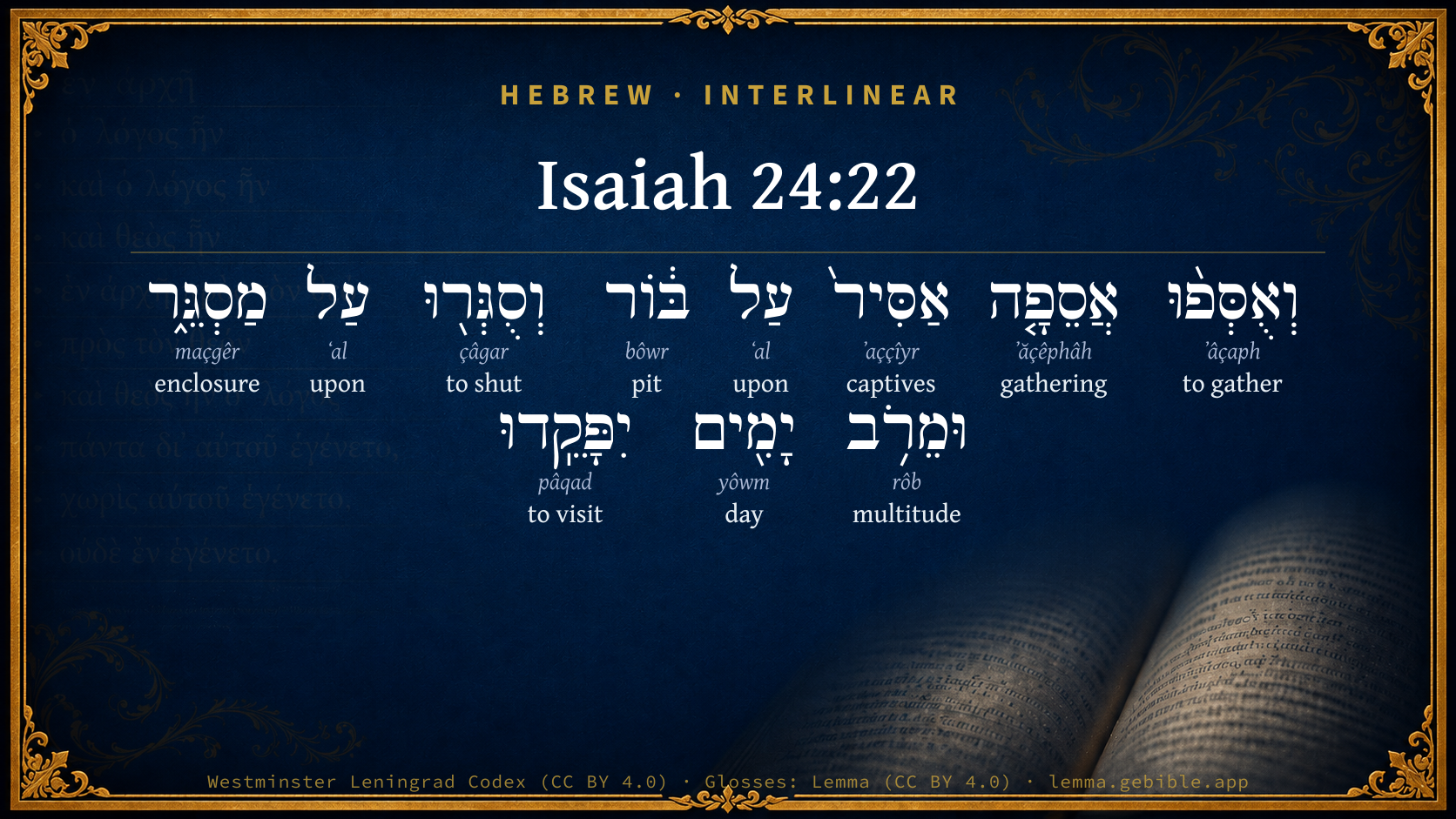
Isaiah 24:22

Hebrew (Westminster Leningrad Codex) Isaiah 24:22 appears in the Hebrew Old Testament. The text above is from the Westminster Leningrad Codex. Each word links to its Strong’s number, a concise gloss, and parsing drawn from the Open Scriptures Hebrew Bible morphology. Click any word for its full Brown-Driver-Briggs (BDB) entry.
Download image
Cite this verse

Isaiah 24:22 (World English Bible). Public Domain. Lemma interlinear Bible study tool, https://lemma.gebible.app/v/isaiah/24/22.

Show BibTeX & RIS
BibTeX
RIS
English Translation
They shall be gathered together, as prisoners are gathered in the pit, and shall be shut up in the prison; and after many days shall they be visited.
World English Bible · Public Domain
Highlights
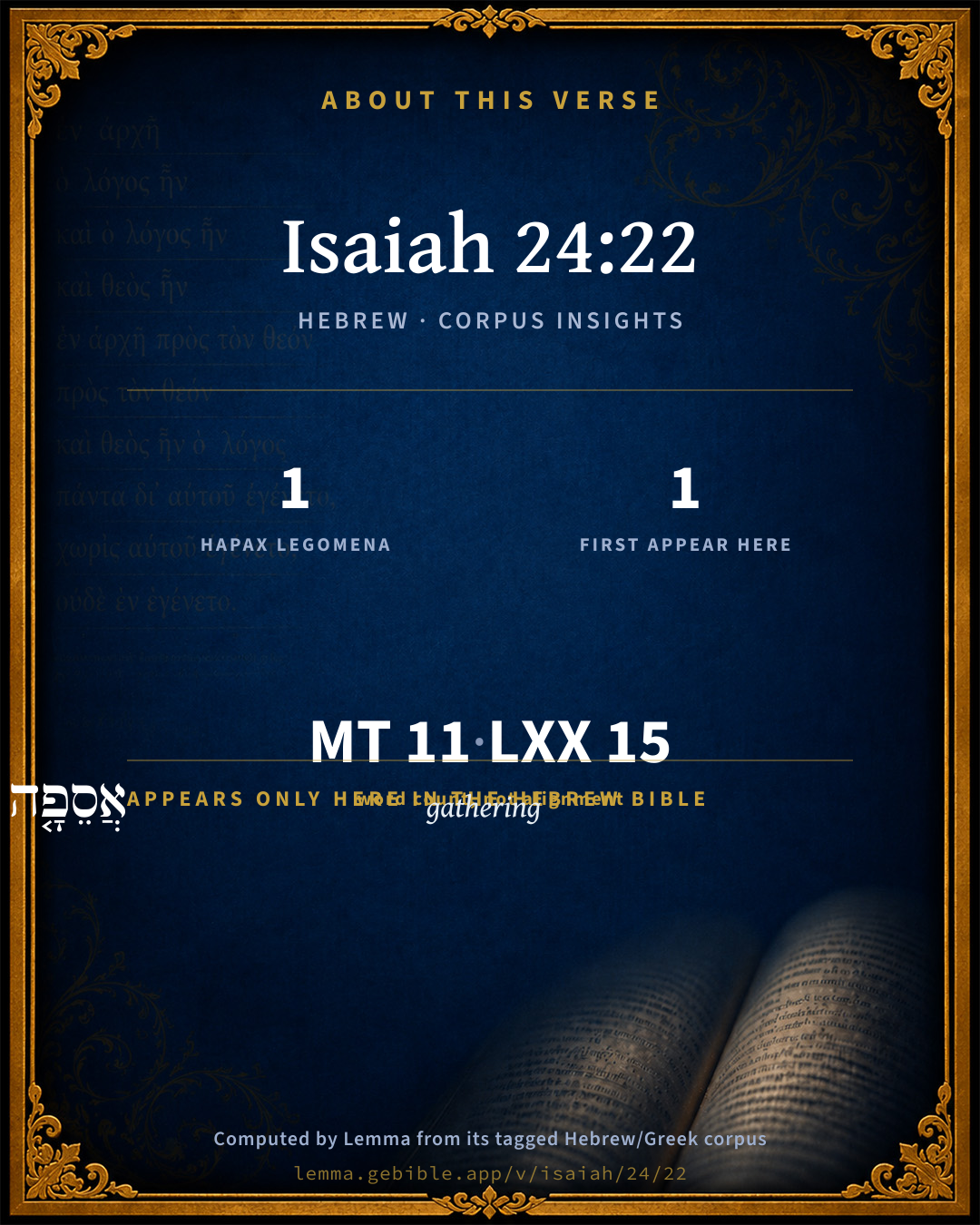
  • 1 hapax legomenon — only here in the Hebrew Bible
  • 1 first appearance in the Hebrew Bible
Full analysis ↓
Download a study sheet

One document with this verse’s original text, its word-by-word gloss line, the meaning frame, cross-references with their text, attributed commentary, and full source and license credits — printable, and it pastes into notes with its structure intact.

This verse Autodidact and up

Study sheet (.html) Plain text (.txt)

A passage Seminary Student

Up to 50 verses in one chapter. A passage sheet keeps up to 6 commentary sources and 12 cross-references per verse, in the order this page ranks them, and says so on the sheet whenever that leaves anything out. Ask for a single verse and you get the Autodidact verse sheet above.

Everything on this page stays free to read, with no account — the sheet is a download of what is already on screen, not access to it.

Want to remove ads? Support Godless Engineer
Compare translations 3

The same verse in 3 English versions, stacked beneath the original-language interlinear above. Click any original word for its lexicon entry.

Each is an independent rendering of the whole verse — the interlinear is not word-aligned to these translations.

Highlighted words mark where these versions differ — a whole-verse word diff, not a word-by-word alignment.

  • World English Bible Public Domain
    They shall be gathered together, as prisoners are gathered in the pit, and shall be shut up in the prison; and after many days shall they be visited.
  • King James Version Public Domain
    And they shall be gathered together, as prisoners are gathered in the pit, and shall be shut up in the prison, and after many days shall they be visited.
  • unfoldingWord Literal Text CC BY-SA 4.0
    And they will be gathered a gathering, a prisoner in a pit, and they will be shut up in a prison. And after an abundance of days they will be visited.

unfoldingWord Literal Text — © unfoldingWord, licensed CC BY-SA 4.0. Word-aligned USFM3 via Door43 (git.door43.org/unfoldingWord/en_ult).

Versions to compare (up to 4)

3 of 4 selected

Show all 18 translations

Every available English version of this verse, each an independent rendering of the whole verse.

  • World English Bible Public Domain
    They shall be gathered together, as prisoners are gathered in the pit, and shall be shut up in the prison; and after many days shall they be visited.
  • Berean Standard Bible Public Domain
    They will be gathered together like prisoners in a pit. They will be confined to a dungeon and punished after many days.
  • Majority Standard Bible Public Domain
    They will be gathered together like prisoners in a pit. They will be confined to a dungeon and punished after many days.
  • King James Version Public Domain
    And they shall be gathered together, as prisoners are gathered in the pit, and shall be shut up in the prison, and after many days shall they be visited.
  • American Standard Version (1901) Public Domain
    And they shall be gathered together, as prisoners are gathered in the pit, and shall be shut up in the prison; and after many days shall they be visited.
  • Revised Version (1885) Public Domain
    And they shall be gathered together, as prisoners are gathered in the pit, and shall be shut up in the prison, and after many days shall they be visited.
  • Geneva Bible (1599) Public Domain
    And they shall be gathered together, as the prisoners in the pit: and they shall be shut vp in the prison, and after many daies shall they be visited.
  • Douay-Rheims (1899) Public Domain
    And they shall be gathered together as in the gathering of one bundle into the pit, and they shall be shut up there in prison: and after many days they shall be visited.
  • Young's Literal Translation Public Domain
    And they have been gathered -- A gathering of bound ones in a pit, And shut up they have been in a prison, And after a multitude of days are inspected.
  • Literal Standard Version CC BY-SA 4.0
    And they have been gathered—A gathering of bound ones in a pit, || And they have been shut up in a prison, || And after a multitude of days are inspected.
  • Unlocked Literal Bible CC BY-SA 4.0
    They will be gathered together, prisoners in a pit, and will be shut up in a prison; and after many days they will be punished.
  • unfoldingWord Literal Text CC BY-SA 4.0
    And they will be gathered a gathering, a prisoner in a pit, and they will be shut up in a prison. And after an abundance of days they will be visited.
  • Darby Bible Public Domain
    And they shall be brought together, [as] an assemblage of prisoners for the pit, and shall be shut up in prison, and after many days shall they be visited.
  • World Messianic Bible Public Domain
    They will be gathered together, as prisoners are gathered in the pit, and will be shut up in the prison; and after many days they will be visited.
  • Webster's Bible Public Domain
    And they shall be gathered, as prisoners are gathered in the pit, and shall be shut up in the prison, and after many days shall they be visited.
  • Free Bible Version CC BY-SA 4.0
    They will be brought together, prisoners in a pit. They will be imprisoned, and eventually they will be punished.
  • Bible in Basic English Public Domain
    And they will be got together, like prisoners in the prison-house; and after a long time they will have their punishment.
  • JPS Tanakh (1917) Public Domain
    And they shall be gathered together, as prisoners are gathered in the dungeon, and shall be shut up in the prison, and after many days shall they be punished.

Literal Standard Version (2020), Covenant Press — licensed CC BY-SA 4.0. Text via the HelloAO Bible API (eBible.org). Unlocked Literal Bible (unfoldingWord) — licensed CC BY-SA 4.0. Text via the HelloAO Bible API (eBible.org). unfoldingWord Literal Text — © unfoldingWord, licensed CC BY-SA 4.0. Word-aligned USFM3 via Door43 (git.door43.org/unfoldingWord/en_ult). Free Bible Version, Dr. Jonathan Gallagher — licensed CC BY-SA 4.0. Text via the HelloAO Bible API (eBible.org).

Word by word

More ways to search: Search by grammar → Find every occurrence → Compare this word →

Practice this passage: Drill this verse → Learn its vocabulary →

About this verse

These counts appear in no published source. They are computed here, from the morphology-tagged text and Lemma’s own curated glosses. What Lemma adds →

11
words
10
distinct lemmas
Prophets
section

Notable vocabulary

1 hapax legomenon — a word that appears only here in the entire Hebrew Bible:

  • אֲסֵפָ֤ה gathering H626

First appearance in Scripture

This word makes its first canonical appearance in the Hebrew Bible here:

  • אֲסֵפָ֤ה gathering H626

Shared distinctive vocabulary

אַסִּיר֙ captives H616 occurs in 4 verses of the Hebrew Bible. Also found in:

Grammatical profile

  • 3 verbs
  • 6 nouns
  • 2 prepositions

Verb forms

  • וְאֻסְּפ֨וּ Pual · Sequential Perfect
  • וְסֻגְּר֖וּ Pual · Sequential Perfect
  • יִפָּקֵֽדוּ Niphal · Imperfect

Repetition

A word recurs within this verse — often emphatic in Hebrew:

Hebrew & Septuagint length

In English translation the verse runs 28 words from the Hebrew and 25 from the Septuagint (LXX English) — closely comparable.

A rough comparison of the two English renderings, which tokenize alike — not a word-level alignment.

Word counts can differ between the Hebrew and the Greek without any difference in meaning — e.g. the Hebrew direct-object marker אֵת has no separate Greek word, and Greek often adds the article ὁ.

In the original languages it is 11 Hebrew tokens and 15 Greek tokens — but the two are counted differently (Hebrew bundles its prefixes and suffixes into one token; the Greek is in lemma form), so that isn’t a like-for-like length.

Cross-references

9

Topical passages linked to Isaiah 24:22 in the Treasury of Scripture Knowledge — connected by theme and wording, ordered by reader-vote popularity; previews shown in the World English Bible.

  • Zechariah 9:11 As for you also, Because of the blood of your covenant, I have set free your prisoners from the pit in which is no water.
  • Isaiah 42:22 But this is a people robbed and plundered; they are all of them snared in holes, and they are hid in prison-houses: they are for a prey, and none delivers; for a spoil, and none says, Restore.
  • Jeremiah 38:6–13 Then took they Jeremiah, and cast him into the dungeon of Malchijah the king's son, that was in the court of the guard: and they let down Jeremiah with cords. In the dungeon there was no water, but mire; and Jeremiah sank in the mire.
  • Joshua 10:16–17 These five kings fled, and hid themselves in the cave at Makkedah.
  • Joshua 10:22–26 Then said Joshua, Open the mouth of the cave, and bring forth those five kings to me out of the cave.
  • Isaiah 2:19 Men shall go into the caves of the rocks, And into the holes of the earth, From before the terror of Yahweh, And from the glory of his majesty, When he arises to shake the earth mightily.
  • Isaiah 10:4 They shall only bow down under the prisoners, and shall fall under the slain. For all this his anger is not turned away, but his hand is stretched out still.
  • Isaiah 24:17 Fear, and the pit, and the snare, are on you, O inhabitant of the earth.
  • Ezekiel 38:8 After many days you shall be visited: in the latter years you shall come into the land that is brought back from the sword, that is gathered out of many peoples, on the mountains of Israel, which have been a continual waste; but it is brought forth out of the peoples, and they shall dwell securely, all of them.

Cross-references courtesy of OpenBible.info (CC BY 4.0).

Hebrew and Greek witnesses Masoretic Hebrew ↔ Greek Septuagint

The same verse in the two great witnesses to the Old Testament, shown verse-for-verse.

These are two independent witnesses, not word-aligned to each other, and the Septuagint is shown in lemma (dictionary) form.

Hebrew Isaiah 24:22 Masoretic · Westminster Leningrad Codex

וְאֻסְּפ֨וּ אֲסֵפָ֤ה אַסִּיר֙ עַל בּ֔וֹר וְסֻגְּר֖וּ עַל מַסְגֵּ֑ר וּמֵרֹ֥ב יָמִ֖ים יִפָּקֵֽדוּ

They shall be gathered together, as prisoners are gathered in the pit, and shall be shut up in the prison; and after many days shall they be visited.

World English Bible · Public Domain

Greek LXX Isaiah 24:22 Septuagint · lemma form

καί συνἄγω καί ἀποκλείω εἰς ὀχύρωμα καί εἰς δεσμωτήριον διά πολύς γενεά ἐπισκοπή εἰμί αὐτός

And they shall gather the multitude thereof into prisons, and they shall shut them into a strong hold: after many generations they shall be visited.

LXX2012 (modern English Septuagint) · Public Domain

Hebrew: Westminster Leningrad Codex (CC BY 4.0). Greek: Septuagint (public domain); English from LXX2012 (modern English Septuagint) (Public Domain). How the Septuagint differs from the Hebrew →

Targum (Aramaic paraphrase)

1

The Targum is the ancient Jewish Aramaic paraphrase of the Hebrew Scriptures — an interpretive translation, not the Hebrew text itself. Onkelos (literal) and Pseudo-Jonathan (expansive) render the Torah, and Jonathan the Prophets. Coverage is partial: where no permissively-licensed English translation exists for a verse, only the Aramaic is shown. This is verse-level text, not a word-by-word alignment to the Hebrew.

  1. Targum Jonathan Prophets (Joshua–Malachi)
    וְיִכְנְשׁוּנוּן מִכְנַשׁ לְבֵית אַסִירֵי וִיעַנְגוּנוּן לְבֵית עַגְנָה וּמַסְגֵי יוֹמִין יֵעוּל דָכְרָנֵיהוֹן:

    And they shall be utterly gathered for the prison, and they shall be shut up in the dungeon, and after many days they shall be remembered.

    Targum Jonathan — Aramaic: “Mikraot Gedolot” (public domain). English: “Sefaria Community Translation” (CC0 1.0 (public-domain dedication)); “London "Chaldee Paraphrase," 1871” (public domain). Text via Sefaria.

Commentary

Notes on Isaiah 24:22 from classic Christian and Jewish commentators (each source and its license shown beneath its notes). The classic Christian expositions comment on the surrounding passage and are grouped to its opening verse, so a note may address several verses; the Jewish commentaries on the Tanakh (Rashi and others) are per-verse, so they appear only where the commentator wrote on this verse.

Lemma curates 59 commentaries, every one of them public domain or Creative Commons licensed, each selected and text-cleaned for this edition rather than reprinted as found. About our sources →

Trapp's Complete Commentary

John Trapp

Isa 24:22 And they shall be gathered together, [as] prisoners are gathered in the pit, and shall be shut up in the prison, and after many days shall they be visited.

Ver. 22. And they shall be gathered together, &c.] Id quod de poenis Iudaeorum intelligimus, saith an interpreter - that is, This we understand to be the punishment of the obstinate Jews, whose bodies after death were clapped up close prisoners in the grave, their souls held fast in hell till the last day; when after many days they shall be visited, i.e., in the whole man punished with eternal torments. Caveamus, si sapimus, a destinata peccandi malitia. Origen was certainly out when he argued from his text, that the damned in hell should after a time be visited, that is, delivered. There are that begin the promise at these words,

And after many days shall they be visited,] i.e., In mercy and favour {as Isa 23:17} through Christ. This gracious visitation began in Israel, {Luk 1:68} and then came abroad to the Gentiles also. {Act 15:14-17}

John Trapp, A Commentary or Exposition upon All the Books of the Old and New Testament (1647–1656) — public domain. Text from a community e-Sword module.

Keil & Delitzsch

C. F. Keil & F. Delitzsch

Isa 24:22 announces the preliminary punishment of both angelic and human princes: 'asēphâh stands in the place of a gerundive, like taltēlâh in Isa 22:17. The connection of the words 'asēphâh 'assir is exactly the same as that of taltēlâh gâbēr in Isa 22:17 : incarceration after the manner of incarcerating prisoners; 'âsaph, to gather together (Isa 10:14; Isa 33:4), signifies here to incarcerate, just as in Gen 42:17. Both verbs are construed with ‛al, because the thrusting is from above downwards, into the pit and prison (‛al embraces both upon or over anything, and into it, e.g., Sa1 31:4; Job 6:16; see Hitzig on Nah 3:12). We may see from Pe2 2:4 and Jde 1:6 how this is to be understood. The reference is to the abyss of Hades, where they are reserved in chains of darkness unto the judgment of the great day. According to this parallel, yippâkedu (shall be visited) ought apparently to be understood as denoting a visitation in wrath (like Isa 29:6; Eze 38:8; compare pâkad followed by an accusative in Isa 26:21, also Isa 26:14, and Psa 59:6; niphkad, in fact, is never used to signify visitation in mercy), and therefore as referring to the infliction of the final punishment. Hitzig, however, understands it as relating to a visitation of mercy; and in this he is supported by Ewald, Knobel, and Luzzatto. Gesenius, Umbreit, and others, take it to indicate a citation or summons, though without any ground either in usage of speech or actual custom. A comparison of Isa 23:17 in its relation to Isa 23:15

(Note: Cf., Targ., Saad., "they will come into remembrance again.")

favours the second explanation, as being relatively the most correct; but the expression is intentionally left ambiguous. So far as the thing itself is concerned, we have a parallel in Rev 20:1-3 and Rev 20:7-9 : they are visited by being set free again, and commencing their old practice once more; but only (as Isa 24:23 affirms) to lose again directly, before the glorious and triumphant might of Jehovah, the power they have temporarily reacquired. What the apocalyptist of the New Testament describes in detail in Rev 20:4, Rev 20:11., and Rev 21:1, the apocalyptist of the Old Testament sees here condensed into one fact, viz., the enthroning of Jehovah and His people in a new Jerusalem, at which the silvery white moon (lebânâh) turns red, and the glowing sun (chammâh) turns pale; the two great lights of heaven becoming (according to a Jewish expression) "like a lamp at noonday" in the presence of such glory. Of the many parallels to Isa 24:23 which we meet with in Isaiah, the most worthy of note are Isa 11:10 to the concluding clause, "and before His elders is glory" (also Isa 4:5), and Isa 1:26 (cf., Isa 3:14), with reference to the use of the word zekēnim (elders). Other parallels are Isa 30:26, for chammâh and lebânâh; Isa 1:29, for châphēr and bōsh; Isa 33:22, for mâlak; Isa 10:12, for "Mount Zion and Jerusalem." We have already spoken at Isa 1:16 of the word neged (Arab. Ne'gd, from nâgad, njd, to be exalted; vid., opp. Arab. gâr, to be pressed down, to sink), as applied to that which stands out prominently and clearly before one's eyes. According to Hofmann (Schriftbeweis, i. 320-1), the elders here, like the twenty-four presbuteroi of the Apocalypse, are the sacred spirits, forming the council of God, to which He makes known His will concerning the world, before it is executed by His attendant spirits the angels. But as we find counsellors promised to the Israel of the new Jerusalem in Isa 1:26, in contrast with the bad zekēnim (elders) which it then possessed (Isa 3:14), such as it had at the glorious commencement of its history; and as the passage before us says essentially the same with regard to the zekēnim as we find in Isa 4:5 with regard to the festal meetings of Israel (vid., Isa 30:20 and Isa 32:1); and still further, as Rev 20:4 (cf., Mat 19:28) is a more appropriate parallel to the passage before us than Rev 4:4, we may assume with certainty, at least with regard to this passage, and without needing to come to any decision concerning Rev 4:4, that the zekēnim here are not angels, but human elders after God's own heart. These elders, being admitted into the immediate presence of God, and reigning together with Him, have nothing but glory in front of them, and they themselves reflect that glory.

Keil & Delitzsch — Biblical Commentary on the Old Testament (1861–1891) — public domain (CC PDM 1.0). Text via the HelloAO Bible API. (Old Testament only.)

Tyndale Open Study Notes

Tyndale Open Resources

24:22 put in prison . . . punished: See also 2 Pet 2:4; Rev 9:2, 11; 17:8.

Tyndale Open Study Notes — © Tyndale Open Resources, licensed CC BY-SA 4.0. Text via the HelloAO Bible API.

Geneva Bible (1599)

Geneva Bible translators

Not with his rods, as verse 21, but shall be comforted.

Geneva Bible (1599) marginal notes — public domain. Text via Bolls.life.

Jamieson, Fausset & Brown

Robert Jamieson, A. R. Fausset & David Brown

in the pit--rather, "for the pit" [HORSLEY]. "In the dungeon" [MAURER]. Image from captives thrust together into a dungeon.

prison--that is, as in a prison. This sheds light on the disputed passage, Pe1 3:19, where also the prison is figurative: The "shutting up" of the Jews in Jerusalem under Nebuchadnezzar, and again under Titus, was to be followed by a visitation of mercy "after many days"--seventy years in the case of the former--the time is not yet elapsed in the case of the latter. HORSLEY takes "visited" in a bad sense, namely, in wrath, as in Isa 26:14; compare Isa 29:6; the punishment being the heavier in the fact of the delay. Probably a double visitation is intended, deliverance to the elect, wrath to hardened unbelievers; as Isa 24:23 plainly contemplates judgments on proud sinners, symbolized by the "sun" and "moon."

Jamieson, Fausset & Brown — Commentary Critical and Explanatory on the Whole Bible (1871) — public domain (CC PDM 1.0). Text via the HelloAO Bible API.

Ellicott's Commentary for English Readers

(22) As prisoners are gathered in the pit . . .—The imagery is drawn from the deep underground dungeons of Eastern prisons (Jer_38:6), which are here the symbol of the abyss of Hades, in which the rebel powers of earth and heaven await the final judgment (2Pe_2:4; Jud_1:6).

After many days shall they be visited.—The verb is the same as that translated “punish” in the previous verse, but does not in itself involve the idea of punishing, and in some of its forms is used of visiting in mercy. Interpreters have, according to their previous bias, assigned this or that meaning to it. Probably the prophet used it in a neutral sense, drawing his imagery from the custom of Eastern kings, who, after leaving their enemies in prison for an appointed time, came to inspect them, and to award punishment or pardon according to their deserts. In such a company there might be “prisoners of hope” (Zec_9:12), waiting with eager expectation for the coming of the king. The passage is interesting in the history of Christian doctrine, as having furnished to Origen and his followers an argument in favour of the ultimate restitution of all created spirits.

A Bible Commentary for English Readers, edited by Charles John Ellicott (1878–1897) — public domain. Text from a community e-Sword module.

The Cambridge Bible for Schools and Colleges

gen. ed. J. J. S. Perowne

22. after many days shall they be visited] See Judges 6, “reserved in everlasting chains, under darkness, unto the judgment of the great day” (cf. 2Pe_2:4); and the following passages from the book of Enoch (ch. 18:14, 16). “This … place … serves as a prison for the stars of heaven and the host of heaven … And he was wroth with them and bound them unto the time when their guilt should be complete in the year of the secret.” (See also Enoch Isa_21:6.) It is true that the verb “visited” may bear a favourable sense, and many commentators prefer that sense here. But this is opposed both to the tenor of the passage and the analogy of eschatological representations.

The Cambridge Bible for Schools and Colleges (gen. ed. J. J. S. Perowne; Cambridge University Press, 1878–1918) — public domain. Text from a community e-Sword module.

John Gill's Exposition

Then the moon shall be confounded, and the sun ashamed,.... Either literally understood; and the meaning is, that they shall be darkened, their light being eclipsed by the superior light of Christ, the sun of righteousness; see Mat 24:29 the New Jerusalem church state, which is referred to, will have no need of the light of the sun, or of the moon, Christ being the light thereof, Rev 21:23 figuratively it may be interpreted of the kings and great men of the earth, as Aben Ezra; whose glory will be outshone by the transcendent lustre and glory of Christ, the King of saints. The Targum paraphrases it of idolaters thus,

"and they shall be confounded that worship the moon, and they shall be ashamed that worship the sun;''

perhaps this may have reference to the fourth vial, which shall be poured out upon the pope and his clergy, Rev 16:8,

when the Lord of hosts shall reign in Mount Zion, and in Jerusalem; who is no other than the Lord Jesus Christ, the true Jehovah, the Lord of hosts or armies, of the sun, moon, and stars, the host of heaven, and of the heavenly host of angels, and of men on earth; who was King from eternity, and reigned during the Old Testament dispensation; came a King into this world, though his kingdom was not of it, nor was with observation: upon his ascension to heaven was made and declared Lord and Christ; and now rules in the hearts of his people by his Spirit and grace, and whose spiritual reign will more manifestly appear in the latter day; but here it is to be understood of his reign on earth, which will be personal, visible, and glorious, and in a different manner from what it now is, when he will be King over all the earth. Zion and Jerusalem, where he will reign, may be literally understood as the chief place of his residence during this state, the spot of ground where he was most despised and ill treated; see Zac 14:4 or mystically, the church in the New Jerusalem state, Rev 21:2 here he will reign,

and before his ancients gloriously: or, "in glory"; in his own glory, both as God and as man, and Mediator; and in his Father's glory, and in the glory of his holy angels, in which he will come and appear; and therefore his appearing is called a glorious one, Luk 9:26, Tit 2:13 and this "before his ancients", the ancient patriarchs both before the flood, as Adam, Abel, &c. and after the flood, as Abraham, Isaac, Jacob, and others; the old Jewish church, the prophets and saints of the Old Testament dispensation; the apostles and elders of the Gospel churches under the New; the four and twenty elders, the representatives of the Gospel churches, so often spoken of in the book of the Revelation; very probably with reference to this text; and all the saints, in all ages, who will now be raised from the dead, and live and reign with him; these are his ancients, who are loved with an everlasting love, chosen in him before the foundation of the world, with whom a covenant was made in him, and grace given to them in him, before the world began; in the midst and presence of these he will reign, and they shall behold his glory; yea, these shall appear in glory; for so the words may be construed, "before his ancients", who are "glory", or "in glory" (b); for they shall appear with him in glory, both in soul and body, having the glory of God upon them, Col 3:4.

(b) "et coram senibus suis, gloria", Pagninus, Montanus.

Next: Isaiah Chapter 25

John Gill's Exposition of the Whole Bible (1746–1763) — public domain (CC PDM 1.0). Text via the HelloAO Bible API.

Albert Barnes' Notes on the Bible

And they shall be gathered together - That is, those who occupy posts of honor and influence in the ecclesiastical and civil polity of the land. “As prisoners.” Margin, as in the Hebrew, ‘With the gathering of prisoners.’ The reference is to the custom of collecting captives taken in war, and chaining them together by the hands and feet, and thrusting them in large companies into a prison.

In the pit - Margin, ‘Dungeon.’ The sense is, that he rulers of the land should be made captive, and treated as prisoners of war. This was undoubtedly true in the captivity under Nebuchadnezzar. The people were assembled; were regarded as captives; and were conveyed together to a distant land.

And shall be shut up in the prison - Probably this is not intended to be taken literally, but to denote that they would be as secure as if they were shut up in prison. Their prison-house would be Babylon, where they were enclosed as in a prison seventy years.

And after many days - If this refers, as I have supposed, to the captivity at Babylon, then these ‘many days’ refer to the period of seventy years.

Shall they be visited - Margin, ‘Found wanting.’ The word used here (פקד pâqad) may be used either in a good or bad sense, either to visit for the purpose of reviewing, numbering, or aiding; or to visit for the purpose of punishing. It is probably, in the Scriptures, most frequently used in the latter sense (see 1Sa 15:2; Job 31:14; Job 35:15; Psa 89:33; Isa 26:14; Jer 9:24). But it is often used in the sense of taking account of, reviewing, or mustering as a military host (see Num 1:44; Num 3:39; 1Ki 20:15; Isa 13:4). In this place it may be taken in either of these senses, as may be best supposed to suit the connection. To me it seems that the connection seems to require the idea of a visitation for the purpose of relief or of deliverance; and to refer to the fact that at the end of that time there would be a reviewing, a mustering, an enrollment of those who should have been carried away to their distant prison-house, to ascertain how many remained, and to marshal them for their return to the land of their fathers (see the books of Ezra and Nehemiah). The word here used has sometimes the sense expressed in the margin, ‘found wanting’ (compare 1Sa 20:6; 1Sa 25:15; Isa 38:10); but such a sense does not suit the connection here. I regard the verse as an indication of future mercy and deliverance. They would be thrown into prison, and treated as captives of war; but after a long time they would be visited by the Great Deliverer of their nation, their covenant-keeping God, and reconducted to the land of their fathers.

Albert Barnes' Notes on the Bible (1834–1885) — public domain. Text from a community e-Sword/MySword module.

Haydock's Catholic Bible Commentary

Visited. Hence Origen (Prin. iii. 6., &c.) took occasion to assert, that the damned would one day be released, though the Scripture so often declares the contrary. The prophet speaks of the future liberation of the Jews; (Calmet) or he intimates that after many days, yea throughout eternity, the reprobate will still be punished. (Menochius)

George Leo Haydock (1774–1849), Haydock's Catholic Family Bible and Commentary, 1859 edition — public domain. Excludes Psalms (Douay-Rheims chapter numbering differs from Protestant) and Deuterocanonical books (Catholic canon only).

Matthew Poole's English Annotations

They shall be gathered together, by God’s special providence, in order to their punishment, as the following words show. And thus the unbelieving Jews were generally gathered together at Jerusalem, to their solemn feast, when Titus came and besieged, and after some time took and destroyed them; which was a very remarkable hand of God, as Josephus and other historians observed. And I know nothing to the contrary but this very thing may be meant in this place, it being confessed that divers passages of this chapter concern the times of the Messiah.

Shall be shut up in the prison; as malefactors, which are taken in several places, are usually brought to one common prison, where they are reserved in order to their trial and punishment.

Shall they be visited; either,

1. In judgment, as visiting is oft used. So the sense is, After they have been punished with long imprisonment, and tormented with expectation and fear, they shall be brought forth to receive condign punishment. Or rather,

2. In mercy. And so the sense may be either,

1. After the Jews shall have suffered many and grievous things from the Assyrians, Chaldeans, Persians, and others, at last their Messiah and Deliverer shall come into the world, he. Or,

2. After the unbelieving and apostate Jews shall have been shut up in unbelief and in great tribulations for many ages together, they shall be convinced of their sin in crucifying their Messiah, and brought home to God and Christ by true repentance.

Matthew Poole's English Annotations on the Holy Bible (1683–1685) — public domain. Text from a community e-Sword/MySword module.

The Pulpit Commentary

In the pit; literally, in a dungeon. Mr. Cheyne suggests that sheol, or "hell," is meant; but the context points to some narrower confinement. In the prison; rather, in prison. (comp. 2Pe_2:4 Jud_1:6) After many days. In the Revelation (Rev_20:2) Satan is bound "a thousand years;" i.e. an indefinite term. The imprisonment of the present passage is scarcely the same, but it is analogous. God"s purposes require sometimes long periods of inaction. Shall they be visited; or, published. The word is the same as that translated "punish" in ver. 21. "Visiting" for good is scarcely to be thought of.

The Pulpit Commentary (1880–1919), ed. H.D.M. Spence-Jones & Joseph S. Exell — public domain. Text from a community e-Sword module.

John Wesley's Explanatory Notes

Gathered - By God's special providence, in order to their punishment. And thus the unbelieving Jews were generally gathered together at Jerusalem, to their solemn feast, when Titus came and besieged, and destroyed them. Shut up - As malefactors, which are taken in several places, are usually brought to one common prison. After - After the apostate Jews shall have been shut up in unbelief, and in great tribulations for many ages together, they shall be convinced of their sin in crucifying the Messiah, and brought home to God and Christ by true repentance.

John Wesley, Explanatory Notes Upon the Whole Bible (1754–1765) — public domain. Text via the GEBible commentary corpus.

J. A. Alexander on Isaiah

Joseph Addison Alexander

“And they shall be gathered with a gathering as prisoners in a pit, and shall be shut up in a dungeon, and after many days they shall be visited.” The sense of the first clause evidently is that they shall be imprisoned. The persons meant are the principalities and powers of the verse preceding. There are two interpretations of the verb visited. According to one it means they shall be punished, or at least brought forth to judgment. The other is, they shall be visited in mercy.

Joseph Addison Alexander, The Prophecies of Isaiah (1846–1847; New York: Scribner, 1870–1878) — public domain. Text from a community e-Sword module.

Rashi

Rabbi Shlomo Yitzchaki (Rashi)

And they shall be gathered a gathering that is to their detriment, i.e., to bring a prisoner into a dungeon prepared for him, those sentenced to Gehinnom to be brought into Gehinnom.

and they shall be shut up in the prison They are the seven compartments of Gehinnom.

and [sins] of many days shall be visited [upon them] Sins of many days shall be visited upon them. This is what the Kalir (R. Eleazar son of R. Kalir in his final liturgical poem for Parshath Zachor) established: “From many days to be counted, to reckon their reckonings.”

Rashi on the Tanakh — English translations: “The Judaica Press complete Tanach with Rashi, translated by A. J. Rosenberg” (CC BY 4.0); “Pentateuch with Rashi's commentary by M. Rosenbaum and A.M. Silbermann, 1929-1934” (public domain); “The Metsudah Tanach series, Lakewood, N.J” (CC BY 4.0); and “The Book of Joshua, Metsudah Publications, 1997” (CC BY 4.0). Text via Sefaria.

Ibn Ezra

Rabbi Abraham ibn Ezra

באסיר ═ אסיר As a prisoner. As prisoners are gathered, etc. As people who are brought to the prison to be shut in are often left there for a long time before they are visited to be supplied with their food. The idea contained in this simile is, that this evil will last a long time. יפקדו they shall be visited, may also be compared with ומימים רבים תפקד and after many years thou wilt be visited (Ez. 38:8), and explained in an evil sense.

Ibn Ezra on the Tanakh — English translations: “Sefaria Community Translation” (CC0 1.0 (public-domain dedication)); “Yalkut, Sifsei Chachomim Chumash, Metsudah Publications, 2009” (CC BY 4.0); and “Commentary of Ibn Ezra on Isaiah - trans. by M. Friedlander, 1873” (public domain). Text via Sefaria.

Lesson kit

Teaching starters — assembled from the data on this page, not authored interpretation. Every prompt links to the verse data it draws on. Edit before teaching.

Isaiah, in the Prophets, opens this verse with 11 words (10 distinct Hebrew lemmas). Its most distinctive word is ʼăçêphâh (“gathering”). A historical commentator’s framing appears above. Read the whole chapter for the surrounding context.

Discussion questions

  1. How does “gathering” (ʼăçêphâh) shape what this verse is saying?
  2. 1 word here appears nowhere else in the Hebrew Bible. Why might the author reach for such rare wording?
  3. This is the first place “gathering” appears in Scripture (first appears here). What does its debut here establish?
  4. How does Psalms 79:11, which shares the word «captives», read alongside this verse?
  5. What does the repetition of “upon” (2× in this one verse) do in this verse?
  6. The translations on this page render this verse differently — a whole-verse word diff, not a word-by-word alignment. What might account for the different wordings?
  7. «וְאֻסְּפ֨וּ» is a Pual Sequential Perfect verb. How does that grammatical form shape the action described?
  8. Compare how Trapp's Complete Commentary and Keil & Delitzsch read this verse. Where do they agree or differ?

Things to notice

  • 1 word in this verse appears nowhere else in the Hebrew Bible.
  • 1 word makes its first canonical appearance in Scripture here.
  • This verse counts 11 Hebrew ↔ 15 Greek words.
  • These translations choose different wording for 8 words in this verse.
  • “upon” occurs 2× in this single verse.

Reading settings

Reading text

Shown beneath each verse's original-language words.

Old Testament
Old Testament edition

Read the OT as the Masoretic Hebrew (MT) or the Greek Septuagint (LXX).

English shown for the Greek Septuagint (in the Hebrew ↔ Greek comparison).

Comparing translations? Open the Compare panel on any verse page to stack up to four side by side.