
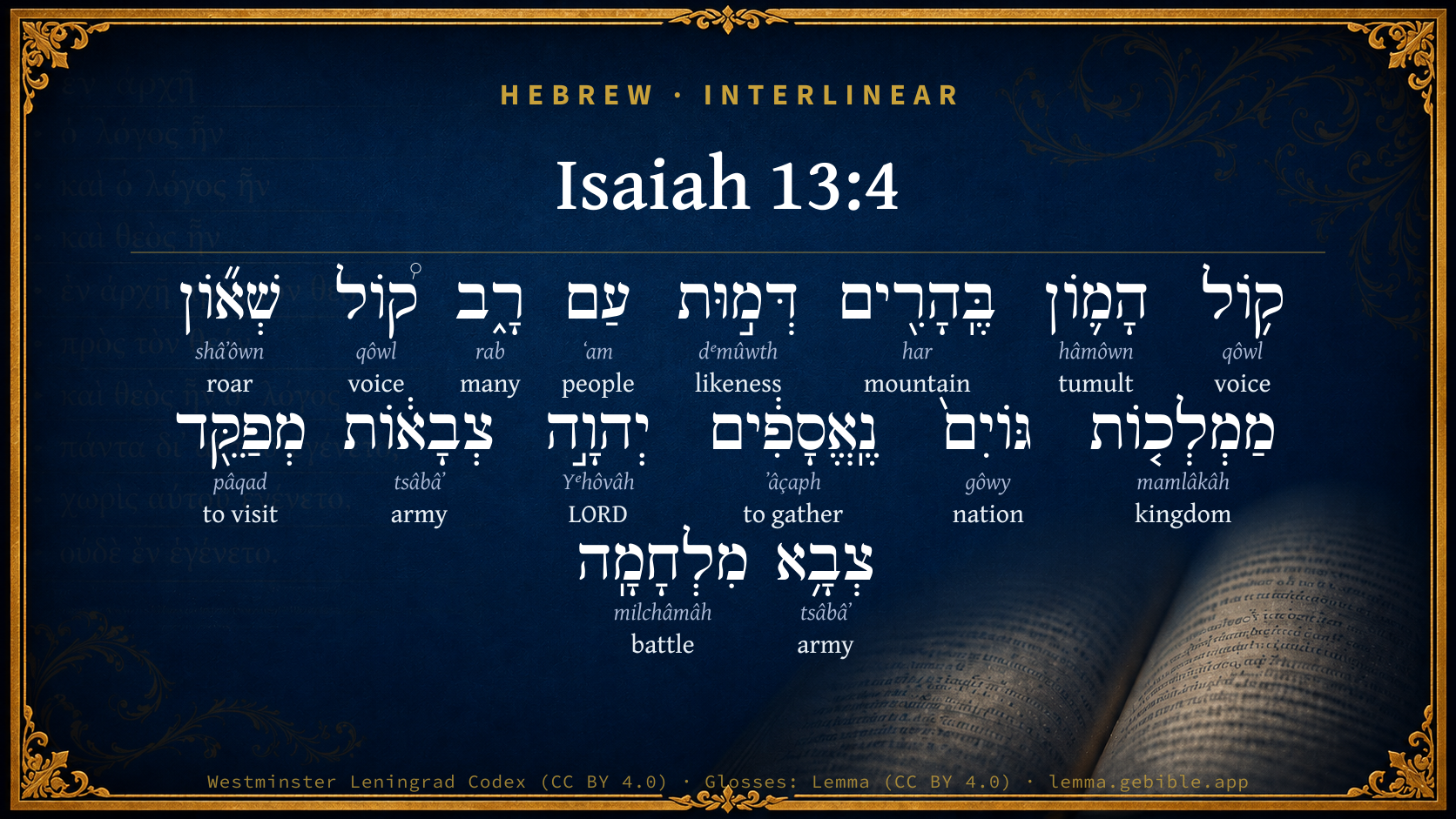
Isaiah 13:4

Hebrew (Westminster Leningrad Codex) Isaiah 13:4 appears in the Hebrew Old Testament. The text above is from the Westminster Leningrad Codex. Each word links to its Strong’s number, a concise gloss, and parsing drawn from the Open Scriptures Hebrew Bible morphology. Click any word for its full Brown-Driver-Briggs (BDB) entry.
Download image
Cite this verse

Isaiah 13:4 (World English Bible). Public Domain. Lemma interlinear Bible study tool, https://lemma.gebible.app/v/isaiah/13/4.

Show BibTeX & RIS
BibTeX
RIS
English Translation
The noise of a multitude in the mountains, as of a great people! the noise of a tumult of the kingdoms of the nations gathered together! Yahweh of Hosts is mustering the host for the battle.
World English Bible · Public Domain
Download a study sheet

One document with this verse’s original text, its word-by-word gloss line, the meaning frame, cross-references with their text, attributed commentary, and full source and license credits — printable, and it pastes into notes with its structure intact.

This verse Autodidact and up

Study sheet (.html) Plain text (.txt)

A passage Seminary Student

Up to 50 verses in one chapter. A passage sheet keeps up to 6 commentary sources and 12 cross-references per verse, in the order this page ranks them, and says so on the sheet whenever that leaves anything out. Ask for a single verse and you get the Autodidact verse sheet above.

Everything on this page stays free to read, with no account — the sheet is a download of what is already on screen, not access to it.

Want to remove ads? Support Godless Engineer
Compare translations 3

The same verse in 3 English versions, stacked beneath the original-language interlinear above. Click any original word for its lexicon entry.

Each is an independent rendering of the whole verse — the interlinear is not word-aligned to these translations.

Highlighted words mark where these versions differ — a whole-verse word diff, not a word-by-word alignment.

  • World English Bible Public Domain
    The noise of a multitude in the mountains, as of a great people! the noise of a tumult of the kingdoms of the nations gathered together! Yahweh of Hosts is mustering the host for the battle.
  • King James Version Public Domain
    The noise of a multitude in the mountains, like as of a great people; a tumultuous noise of the kingdoms of nations gathered together: the LORD of hosts mustereth the host of the battle.
  • unfoldingWord Literal Text CC BY-SA 4.0
    The sound of a multitude in the mountains, like a numerous people! The sound of an uproar of kingdoms, nations being gathered! Yahweh of Armies is mustering an army of battle.

unfoldingWord Literal Text — © unfoldingWord, licensed CC BY-SA 4.0. Word-aligned USFM3 via Door43 (git.door43.org/unfoldingWord/en_ult).

Versions to compare (up to 4)

3 of 4 selected

Show all 18 translations

Every available English version of this verse, each an independent rendering of the whole verse.

  • World English Bible Public Domain
    The noise of a multitude in the mountains, as of a great people! the noise of a tumult of the kingdoms of the nations gathered together! Yahweh of Hosts is mustering the host for the battle.
  • Berean Standard Bible Public Domain
    Listen, a tumult on the mountains, like that of a great multitude! Listen, an uproar among the kingdoms, like nations gathered together! The LORD of Hosts is mobilizing an army for war.
  • Majority Standard Bible Public Domain
    Listen, a tumult on the mountains, like that of a great multitude! Listen, an uproar among the kingdoms, like nations gathered together! The LORD of Hosts is mobilizing an army for war.
  • King James Version Public Domain
    The noise of a multitude in the mountains, like as of a great people; a tumultuous noise of the kingdoms of nations gathered together: the LORD of hosts mustereth the host of the battle.
  • American Standard Version (1901) Public Domain
    The noise of a multitude in the mountains, as of a great people! the noise of a tumult of the kingdoms of the nations gathered together! Jehovah of hosts is mustering the host for the battle.
  • Revised Version (1885) Public Domain
    The noise of a multitude in the mountains, like as of a great people! the noise of a tumult of the kingdoms of the nations gathered together! the LORD of hosts mustereth the host for the battle.
  • Geneva Bible (1599) Public Domain
    The noyse of a multitude is in the mountaines, like a great people: a tumultuous voyce of the kingdomes of the nations gathered together: the Lord of hostes nombreth the hoste of the battell.
  • Douay-Rheims (1899) Public Domain
    The noise of a multitude in the mountains, as it were of many people, the noise of the sound of kings, of nations gathered together: the Lord of hosts hath given charge to the troops of war.
  • Young's Literal Translation Public Domain
    A voice of a multitude in the mountains, A likeness of a numerous people, A voice of noise from the kingdoms of nations who are gathered, Jehovah of Hosts inspecting a host of battle!
  • Literal Standard Version CC BY-SA 4.0
    A voice of a multitude in the mountains, || A likeness of a numerous people, || A voice of noise from the kingdoms of nations who are gathered, || YHWH of Hosts inspecting a host of battle!
  • Unlocked Literal Bible CC BY-SA 4.0
    The noise of a multitude in the mountains, as of many people! The noise of a tumult of the kingdoms like many nations gathered together! Yahweh of hosts is mustering the army for the battle.
  • unfoldingWord Literal Text CC BY-SA 4.0
    The sound of a multitude in the mountains, like a numerous people! The sound of an uproar of kingdoms, nations being gathered! Yahweh of Armies is mustering an army of battle.
  • Darby Bible Public Domain
    The noise of a multitude on the mountains, as of a great people; a tumultuous noise of the kingdoms of nations assembled together: Jehovah of hosts mustereth the host of the battle.
  • World Messianic Bible Public Domain
    The noise of a multitude is in the mountains, as of a great people; the noise of an uproar of the kingdoms of the nations gathered together! The LORD of Hosts is mustering the army for the battle.
  • Webster's Bible Public Domain
    The noise of a multitude in the mountains, as of a great people; a tumultuous noise of the kingdoms of nations assembled: the LORD of hosts mustereth the host of the battle.
  • Free Bible Version CC BY-SA 4.0
    A noise comes from the mountains, sounding like that of a huge crowd! It's the roaring sound from the kingdoms, from nations gathering together! The Lord Almighty is calling up an army for war.
  • Bible in Basic English Public Domain
    The noise of great numbers in the mountains, like the noise of a strong people! The noise of the kingdoms of the nations meeting together! The Lord of armies is numbering his forces for war.
  • JPS Tanakh (1917) Public Domain
    Hark, a tumult in the mountains, like as of a great people! Hark, the uproar of the kingdoms of the nations gathered together! The LORD of hosts mustereth the host of the battle.

Literal Standard Version (2020), Covenant Press — licensed CC BY-SA 4.0. Text via the HelloAO Bible API (eBible.org). Unlocked Literal Bible (unfoldingWord) — licensed CC BY-SA 4.0. Text via the HelloAO Bible API (eBible.org). unfoldingWord Literal Text — © unfoldingWord, licensed CC BY-SA 4.0. Word-aligned USFM3 via Door43 (git.door43.org/unfoldingWord/en_ult). Free Bible Version, Dr. Jonathan Gallagher — licensed CC BY-SA 4.0. Text via the HelloAO Bible API (eBible.org).

Word by word

More ways to search: Search by grammar → Find every occurrence → Compare this word →

Practice this passage: Drill this verse → Learn its vocabulary →

שְׁא֞וֹן
shâʼôwn
H7588
“roar of”
Noun, Common, Masculine, Singular, Construct
Part of Speech
Noun
Type
Common
Gender
Masculine
Number
Singular
State
Construct
Full BDB Definition

Origin: from H7582

TWOT: 2301c

roar, din, crash, uproar - roar (of water) - uproar (of revellers)
  1. ק֥וֹל qôwl H6963 “voice of” Noun, Common, Masculine, Singular, Construct
  2. הָמ֛וֹן hâmôwn H1995 “tumult” Noun, Common, Masculine, Singular, Absolute
  3. בֶּֽהָרִ֖ים har H2022 “in/at the · mountains” Preposition, Determined + Noun, Common, Masculine, Plural, Absolute
  4. דְּמ֣וּת dᵉmûwth H1823 “likeness of” Noun, Common, Feminine, Singular, Construct
  5. עַם ʻam H5971 “people” Noun, Common, Masculine, Singular, Absolute
  6. רָ֑ב rab H7227 “many” Adjective, Adjective, Masculine, Singular, Absolute
  7. ק֠וֹל qôwl H6963 “voice of” Noun, Common, Masculine, Singular, Construct
  8. מַמְלְכ֤וֹת mamlâkâh H4467 “kingdoms of” Noun, Common, Feminine, Plural, Construct
  9. גּוֹיִם֙ gôwy H1471 “nations” Noun, Common, Masculine, Plural, Absolute
  10. נֶֽאֱסָפִ֔ים ʼâçaph H622 “gathering” Verb, Niphal, Participle Active, Masculine, Plural, Absolute
  11. יְהוָ֣ה Yᵉhôvâh H3068 “LORD” Noun, Proper
  12. צְבָא֔וֹת tsâbâʼ H6635 “armies” Noun, Common, Both, Plural, Absolute
  13. מְפַקֵּ֖ד pâqad H6485 “visiting” Verb, Piel, Participle Active, Masculine, Singular, Absolute
  14. צְבָ֥א tsâbâʼ H6635 “army of” Noun, Common, Both, Singular, Construct
  15. מִלְחָמָֽה milchâmâh H4421 “battle” Noun, Common, Feminine, Singular, Absolute

About this verse

These counts appear in no published source. They are computed here, from the morphology-tagged text and Lemma’s own curated glosses. What Lemma adds →

16
words
14
distinct lemmas
Prophets
section

Notable vocabulary

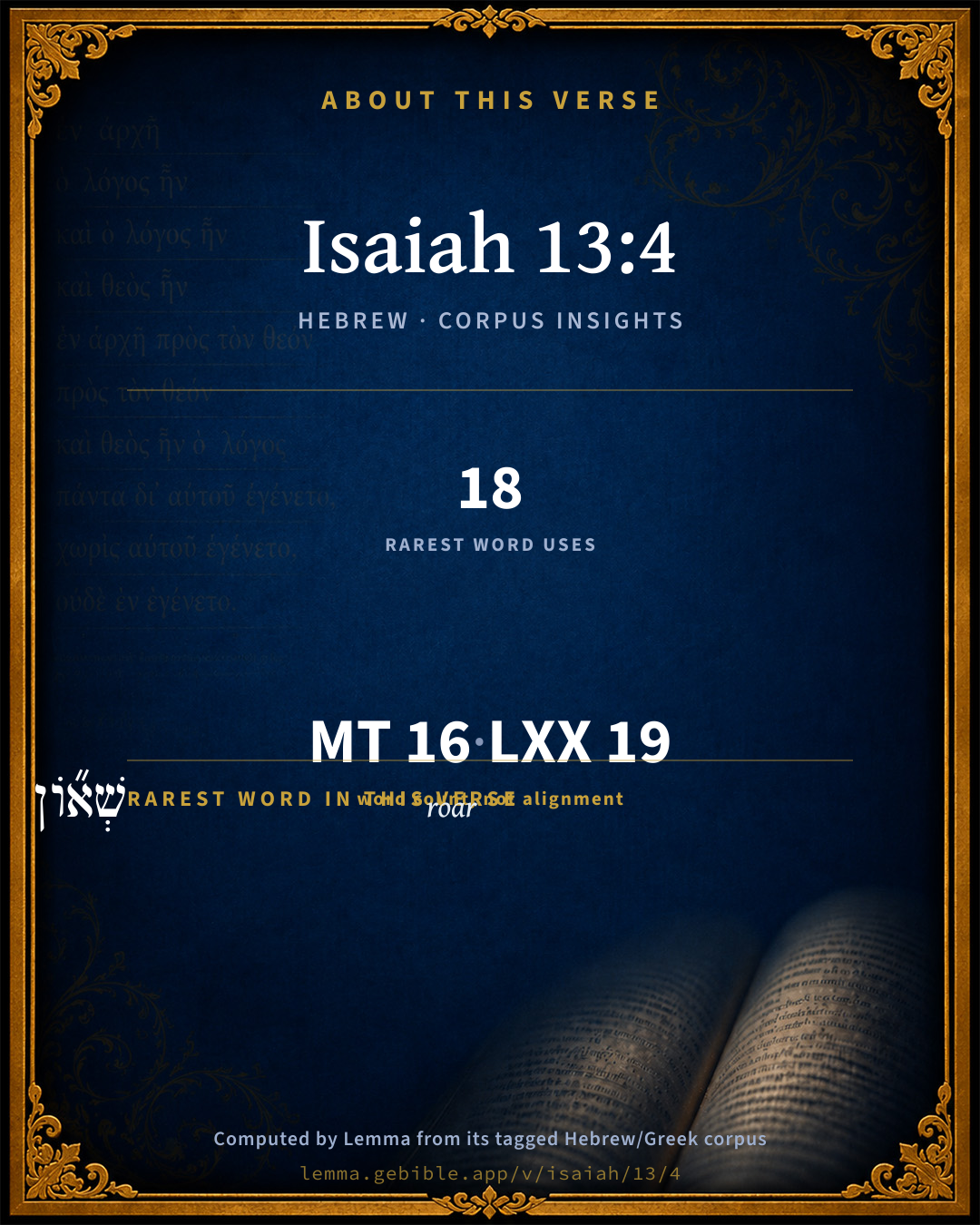
The rarest word here is שְׁא֞וֹן roar H7588 — appearing just 18 times in the whole Hebrew Bible.

Shared distinctive vocabulary

שְׁא֞וֹן roar H7588 occurs in 16 verses of the Hebrew Bible. Also found in:

Grammatical profile

  • 2 verbs
  • 13 nouns
  • 1 adjective

Verb forms

  • נֶֽאֱסָפִ֔ים Niphal · Participle Active
  • מְפַקֵּ֖ד Piel · Participle Active

Repetition

Words recur within this verse — often emphatic in Hebrew:

  • ק֥וֹל voice H6963 ×2
  • צְבָא֔וֹת army H6635 ×2

Hebrew & Septuagint length

In English translation the verse runs 36 words from the Hebrew and 34 from the Septuagint (LXX English) — closely comparable.

A rough comparison of the two English renderings, which tokenize alike — not a word-level alignment.

Word counts can differ between the Hebrew and the Greek without any difference in meaning — e.g. the Hebrew direct-object marker אֵת has no separate Greek word, and Greek often adds the article ὁ.

In the original languages it is 16 Hebrew tokens and 19 Greek tokens — but the two are counted differently (Hebrew bundles its prefixes and suffixes into one token; the Greek is in lemma form), so that isn’t a like-for-like length.

Cross-references

17

Topical passages linked to Isaiah 13:4 in the Treasury of Scripture Knowledge — connected by theme and wording, ordered by reader-vote popularity; previews shown in the World English Bible.

  • Joel 3:14 Multitudes, multitudes in the valley of decision! For the day of Yahweh is near, in the valley of decision.
  • Ezekiel 38:3–23 and say, Thus says the Lord Yahweh: Behold, I am against you, Gog, prince of Rosh, Meshech, and Tubal:
  • Joel 2:1–11 Blow you the trumpet in Zion, And sound an alarm in my holy mountain! Let all the inhabitants of the land tremble, For the day of Yahweh comes, For it is close at hand:
  • Joel 2:25 I will restore to you the years that the swarming locust has eaten, The great locust, the grasshopper, and the caterpillar, My great army, which I sent among you.
  • Revelation 19:11–21 I saw the heaven opened, and behold, a white horse, and he who sat on it is called Faithful and True. In righteousness he judges and makes war.
  • Isaiah 10:5–6 Ho Assyrian, the rod of my anger, the staff in whose hand is my indignation!
  • Isaiah 22:1–9 The burden of the valley of vision. What ails you now, that you are wholly gone up to the housetops?
  • Isaiah 45:1–2 Thus says Yahweh to his anointed, to Cyrus, whose right hand I have held, to subdue nations before him, and I will loose the loins of kings; to open the doors before him, and the gates shall not be shut:
  • Jeremiah 50:2–3 Declare you among the nations and publish, and set up a standard; publish, and don't conceal: say, Babylon is taken, Bel is disappointed, Merodach is dismayed; her images are disappointed, her idols are dismayed.
  • Jeremiah 50:14–15 Set yourselves in array against Babylon round about, all you who bend the bow; shoot at her, spare no arrows: for she has sinned against Yahweh.
  • Jeremiah 50:21–46 Go up against the land of Merathaim, even against it, and against the inhabitants of Pekod: kill and utterly destroy after them, says Yahweh, and do according to all that I have commanded you.
  • Jeremiah 51:6–25 Flee out of the midst of Babylon, and save every man his life; don't be cut off in her iniquity: for it is the time of Yahweh's vengeance; he will render to her a recompense.
  • Jeremiah 51:27–28 Set up a standard in the land, blow the trumpet among the nations, prepare the nations against her, call together against her the kingdoms of Ararat, Minni, and Ashkenaz: appoint a marshal against her; cause the horses to come up as the rough canker-worm.
  • Zechariah 14:1–3 Behold, a day of Yahweh comes, when your spoil will be divided in your midst.
  • Zechariah 14:13–14 It will happen in that day, that a great panic from Yahweh will be among them; and they will lay hold everyone on the hand of his neighbor, and his hand will rise up against the hand of his neighbor.
  • Revelation 9:7–19 The shapes of the locusts were like horses prepared for war. On their heads were something like golden crowns, and their faces were like people's faces.
  • Revelation 18:8 Therefore in one day her plagues will come: death, mourning, and famine; and she will be utterly burned with fire; for the Lord God who has judged her is strong.

Cross-references courtesy of OpenBible.info (CC BY 4.0).

Hebrew and Greek witnesses Masoretic Hebrew ↔ Greek Septuagint

The same verse in the two great witnesses to the Old Testament, shown verse-for-verse.

These are two independent witnesses, not word-aligned to each other, and the Septuagint is shown in lemma (dictionary) form.

Hebrew Isaiah 13:4 Masoretic · Westminster Leningrad Codex

ק֥וֹל הָמ֛וֹן בֶּֽהָרִ֖ים דְּמ֣וּת עַם רָ֑ב ק֠וֹל שְׁא֞וֹן מַמְלְכ֤וֹת גּוֹיִם֙ נֶֽאֱסָפִ֔ים יְהוָ֣ה צְבָא֔וֹת מְפַקֵּ֖ד צְבָ֥א מִלְחָמָֽה

The noise of a multitude in the mountains, as of a great people! the noise of a tumult of the kingdoms of the nations gathered together! Yahweh of Hosts is mustering the host for the battle.

World English Bible · Public Domain

Greek LXX Isaiah 13:4 Septuagint · lemma form

φωνή ἔθνος πολύς ἐπί ὁ ὄρος ὅμοιος ἔθνος πολύς φωνή βασιλεύς καί ἔθνος συνἄγω κύριος σαβαωθ ἐντέλλομαι ἔθνος ὁπλομάχος

A voice of many nations on the mountains, even like to that of many nations; a voice of kings and nations gathered together: the Lord of hosts has given command to a warlike nation,

LXX2012 (modern English Septuagint) · Public Domain

Hebrew: Westminster Leningrad Codex (CC BY 4.0). Greek: Septuagint (public domain); English from LXX2012 (modern English Septuagint) (Public Domain). How the Septuagint differs from the Hebrew →

Targum (Aramaic paraphrase)

1

The Targum is the ancient Jewish Aramaic paraphrase of the Hebrew Scriptures — an interpretive translation, not the Hebrew text itself. Onkelos (literal) and Pseudo-Jonathan (expansive) render the Torah, and Jonathan the Prophets. Coverage is partial: where no permissively-licensed English translation exists for a verse, only the Aramaic is shown. This is verse-level text, not a word-by-word alignment to the Hebrew.

  1. Targum Jonathan Prophets (Joshua–Malachi)
    קַל הֲמוֹן בְּטוּרַיָא דְמוּת עַם סַגִי קַל אִתְרְגוּשַׁת מַלְכְּוָן עַמְמַיָא דְמִתְכַּנְשִׁין יְיָ צְבָאוֹת מְמַנֵי מַשִׁרְיָן בִּקְרָבָא:

    There is a voice of a multitude in the mountains, like as of a great people: the voice of the tumultuous assembly of kings, of nations being assembled, the Lord of hosts is mustering the armies for battle.

    Targum Jonathan — Aramaic: “Mikraot Gedolot” (public domain). English: “Sefaria Community Translation” (CC0 1.0 (public-domain dedication)); “London "Chaldee Paraphrase," 1871” (public domain). Text via Sefaria.

Commentary

Notes on Isaiah 13:4 from classic Christian and Jewish commentators (each source and its license shown beneath its notes). The classic Christian expositions comment on the surrounding passage and are grouped to its opening verse, so a note may address several verses; the Jewish commentaries on the Tanakh (Rashi and others) are per-verse, so they appear only where the commentator wrote on this verse.

Lemma curates 59 commentaries, every one of them public domain or Creative Commons licensed, each selected and text-cleaned for this edition rather than reprinted as found. About our sources →

Trapp's Complete Commentary

John Trapp

Isa 13:4 The noise of a multitude in the mountains, like as of a great people; a tumultuous noise of the kingdoms of nations gathered together: the LORD of hosts mustereth the host of the battle.

Ver. 4. The noise of the multitude.] The Medes that come against Babylon are both numerous and streperous, as is here graphically described by an elegant hypotyposis. {a}

The Lord of hosts mustereth the host of the battle.] No marvel, then, that the forces are so many and mighty, for if he but stamp with his foot, all creatures are up in arms immediately.

{a} Vivid description of a scene, event, or situation, bringing it, as it were, before the eyes of the hearer or reader.

John Trapp, A Commentary or Exposition upon All the Books of the Old and New Testament (1647–1656) — public domain. Text from a community e-Sword module.

Joseph Benson's Commentary

Isa 13:4-5. The noise of a multitude in the mountains — No sooner had the Almighty given the command, than the multitude assembles to his banners; like as a great people — Not rude and barbarous; but well- disciplined, regular, and veteran troops, such as are wont to be furnished by a great and powerful people; of the kingdoms of nations — Cyrus’s army was made up of different nations besides the Medes and Persians. The Lord of hosts — The God of armies; mustereth the host of the battle — He raises the soldiers, brings them together, puts them in order, reviews them, keeps an exact account of them, sees that they be all in their respective posts, and gives them their necessary orders. The expressions are noble, and contain a lively description of that terror which the appearance of a hostile army strikes into the beholders. They come from a far country — Many of Cyrus’s auxiliary forces came from very distant countries: see Jer 50:41; Jer 51:27-28. The prophet adds this as an aggravation of the judgment. From the end of heaven — This is not to be understood strictly and properly, but popularly and hyperbolically, as such expressions are commonly used, both in sacred and profane authors. Even the Lord, and the weapons of his indignation — The Medes and Persians, who were but a rod in God’s hand, and the instruments of his anger, as was said of the Assyrian, Isa 10:5. To destroy the whole land — Namely, of Babylon, of which he is now speaking.

Joseph Benson's Commentary on the Old and New Testaments (1811–1818) — public domain. Text from a community e-Sword module.

Jamieson, Fausset & Brown

Robert Jamieson, A. R. Fausset & David Brown

the mountains--namely, which separate Media and Assyria, and on one of which the banner to rally the hosts is supposed to be reared.

tumultuous noise--The Babylonians are vividly depicted as hearing some unwonted sound like the din of a host; they try to distinguish the sounds, but can only perceive a tumultuous noise.

nations--Medes, Persians, and Armenians composed Cyrus' army.

Jamieson, Fausset & Brown — Commentary Critical and Explanatory on the Whole Bible (1871) — public domain (CC PDM 1.0). Text via the HelloAO Bible API.

Adam Clarke's Commentary

Verse 4. Of the battle - "For the battle."] The Bodleian MS. has למלחמה lemilchamah. Cyrus's army was made up of many different nations. Jeremiah calls it an "assembly of great nations from the north country," Jer 50:9. And afterwards mentions the kingdoms of "Ararat, Minni, and Ashchenaz, (i.e. Armenia, Corduene, Pontus or Phrygia, Vitring.,) with the kings of the Medes," Jer 51:27-28. See Xenophon. Cyrop.

Adam Clarke's Commentary on the Bible (1810–1826) — public domain. Text from a community e-Sword/MySword module.

Ellicott's Commentary for English Readers

(4) The noise of a multitude . . .—The prophet hears, as it were, the tramp of the armies gathering on the mountains north of Babylonia (possibly the Zagros range, or the plateau of Iran, or the mountains of Armenia; but the prophet’s geography was probably vague) before they descend to the plain, and march against the haughty city. (Comp. Jer_51:27.)

A Bible Commentary for English Readers, edited by Charles John Ellicott (1878–1897) — public domain. Text from a community e-Sword module.

The Cambridge Bible for Schools and Colleges

gen. ed. J. J. S. Perowne

4. Already the prophet seems to hear from afar the din of the gathering multitude.

The noise of a multitude] Better as an exclamation, Hark, a tumult. And so in the next clause, Hark, the uproar of … The “mountains” are those beyond the Zagros range, N.E. of Babylonia, where the territory of the Medes lay. To understand them as “ideal barriers” (Cheyne) weakens the poetry of the passage.

The Cambridge Bible for Schools and Colleges (gen. ed. J. J. S. Perowne; Cambridge University Press, 1878–1918) — public domain. Text from a community e-Sword module.

John Gill's Exposition

The noise of a multitude in the mountains, like as of a great people,.... That is, like the noise of a very numerous people; this noise was heard either on the mountains of Media, where they flocked in vast numbers to the standard set; or on the mountains upon the borders of Chaldea, when the army under Cyrus was marching towards Babylon:

a tumultuous noise of the kingdoms of nations gathered together; for Cyrus's army consisted of several kingdoms and nations; for besides the thirty thousand Persians he brought with him into Media, where he was made general of the Medes also, and was sent with the joint forces of both nations against Babylon, the kingdoms of Ararat, Minni, and Ashchenaz, were prepared, gathered together, and called forth against it, Jer 51:27,

the Lord of hosts mustereth the host of the battle; or the warlike army: it was the Lord, that has the armies of heaven and earth at his command, who in his providence caused such a numerous army to be formed, directed them where to march, and put them in battle array, and gave them the victory.

John Gill's Exposition of the Whole Bible (1746–1763) — public domain (CC PDM 1.0). Text via the HelloAO Bible API.

Albert Barnes' Notes on the Bible

The noise of a multitude in the mountains - The prophet here represents himself as hearing the confused tumult of the nations assembling to the standard reared on the mountains Isa 13:2. This is a highly beautiful figure - a graphic and vivid representation of the scene before him. Nations are seen to hasten to the elevated banner, and to engage in active preparations for the mighty war. The sound is that of a tumult, an excited multitude hastening to the encampment, and preparing for the conquest of Babylon.

Like as of a great people - Hebrew, ‘The likeness of a great people.’ That is, such a confused and tumultuous sound as attends a great multitude when they collect together.

A tumultuous noise - Hebrew, ‘The voice of the tumultuous noise of the kingdoms of nations gathered together.’

The Lord of hosts - Yahweh, the God of hosts, or armies (note Isa 1:9).

Mustereth - Collects; puts in military array. Over all this multitude of nations, hastening with confused sounds and tumult like the noise of the sea, putting themselves in military array, God, unseen, presides, and prepares them for his own great designs. It is not easy to conceive a more sublime image than these mighty hosts of war, unconscious of the hand that directs them, and of the God that presides over them, moving as he wills, and accomplishing his plans.

Albert Barnes' Notes on the Bible (1834–1885) — public domain. Text from a community e-Sword/MySword module.

Haydock's Catholic Bible Commentary

Kings. Darius styles himself king of the Medes and Persians, Daniel vi. 12. Many princes and nations composed his army.

George Leo Haydock (1774–1849), Haydock's Catholic Family Bible and Commentary, 1859 edition — public domain. Excludes Psalms (Douay-Rheims chapter numbering differs from Protestant) and Deuterocanonical books (Catholic canon only).

Matthew Poole's English Annotations

The kingdoms of nations; the Medes and Persians, and other nations which served under them in this war; of which see Jer 25:14; 27:7; 50:41.

Matthew Poole's English Annotations on the Holy Bible (1683–1685) — public domain. Text from a community e-Sword/MySword module.

Whedon's Commentary on the Bible

Daniel D. Whedon

4. Noise of a multitude — No sooner summoned than aroused. Armies in the mountains gather instantly. The noise of preparation sounds afar.

In the mountains — The Median mountains.

Kingdoms of nations — Medes, Persians, Armenians, possibly also Parthians, if the vision be of prophetic space, not of time, which, judging from the next verse, is probable.

Daniel D. Whedon (gen. ed.), Commentary on the Old and New Testaments (1874–1909) — public domain. Text from a community e-Sword module.

The Pulpit Commentary

The noise of a multitude in the mountains. I do not know why Isaiah should not have been "thinking of his geography" (Cheyne). As soon as the Greeks knew anything of the Persians, they knew of them as a mountain people, and attributed their valor and their handy habits to the physical character of their country (Herod., 9. ad fin.). Jeremiah connects the invading army which destroyed Babylon with mountains, when he derives it from. Ararat, (comp. Gen_8:4) Minni (Armenia), and Ashchenaz. (Jer_51:27) At any rate, the mention of "mountains" here is very appropriate, both Media and Persia being, in the main, mountainous countries. A great people; or, much people not necessarily of one nation only. The host of the battle; rather, a host of war; i.e. a multitude of men, armed and prepared for war.

The Pulpit Commentary (1880–1919), ed. H.D.M. Spence-Jones & Joseph S. Exell — public domain. Text from a community e-Sword module.

John Wesley's Explanatory Notes

Nations - The Medes and Persians and other nations, which served under them in this war.

John Wesley, Explanatory Notes Upon the Whole Bible (1754–1765) — public domain. Text via the GEBible commentary corpus.

Keil & Delitzsch

C. F. Keil & F. Delitzsch

The command of Jehovah is quickly executed. The great army is already coming down from the mountains. "Hark, a rumbling on the mountains after the manner of a great people; hark, a rumbling of kingdoms of nations met together! Jehovah of hosts musters an army, those that have come out of a distant land, from the end of the heaven: Jehovah and His instruments of wrath, to destroy the whole earth." Kōl commences an interjectional sentence, and thus becomes almost an interjection itself (compare Isa 52:8; Isa 66:6, and on Gen 4:10). There is rumbling on the mountains (Isa 17:12-13), for there are the peoples of Eran, and in front the Medes inhabiting the mountainous north-western portion of Eran, who come across the lofty Shahu (Zagros), and the ranges that lie behind it towards the Tigris, and descend upon the lowlands of Babylon; and not only the peoples of Eran, but the peoples of the mountainous north of Asia generally (Jer 51:27) - an army under the guidance of Jehovah, the God of hosts of spirits and stars, whose wrath it will execute over the whole earth, i.e., upon the world-empire; for the fall of Babel is a judgment, and accompanied with judgments upon all the tribes under Babylonian rule.

Keil & Delitzsch — Biblical Commentary on the Old Testament (1861–1891) — public domain (CC PDM 1.0). Text via the HelloAO Bible API. (Old Testament only.)

J. A. Alexander on Isaiah

Joseph Addison Alexander

The Prophet, in his own person, now describes the enemies of Babylon who had just been summoned, as actually on their way. He hears a confused noise, which he soon finds to be that of confederated nations forming the army of Jehovah against Babylon. “The voice (or sound) of a multitude in the mountains the likeness of much people! the sound of a tumult of kingdoms of nations gathered (or gathering themselves). Jehovah of Hosts mustering (i.e., inspecting and numbering) a host of battle (i.e., a military host).” The absence of verbs adds greatly to the vividness of the description. The sentence really consists of a series of exclamations, describing the impressions made successively upon the senses of an eye and ear-witness. By the mountains some suppose Media to be meant, to which others add Armenia and the other hilly countries from which Cyrus drew his forces. This supposes the movement here described to be that of the levy or conscription. But it seems more natural to understand it, as most writers do, of the actual advance of the invaders. The mountains then will be those dividing Babylonia from Media or Persia.

The expression ‘likeness of much people’ some refer to the indistinct view of a great multitude approaching from a distance. The reference to ‘sound before and afterwards’, makes the reference of this clause to the sense of sight improbable. It is commonly agreed that there is here a direct reference to the mixture of nations in the army of Cyrus. Besides the Persians and the Medes, Xenophon speaks of the Armenians, and Jeremiah adds the names of other nations (Jer 50:9; Jer 51:27).

Most interpreters suppose the event here predicted to be subsequent in date to the overthrow of Croesus, while some refer it to the first attack of Cyrus upon Babylonia, recorded in the third book of the Cyropedia. But these distinctions seem to rest upon a false view of the passage as a description of particular marches, battles, etc., rather than a generic picture of the whole series of events which ended in the downfall of Babylon. For a just view of the principles on which such prophecies should be explained, with particular reference to that before us, see Stuart on the Apocalypse, vol. 2, p. 143.

The title Jehovah of Hosts, may here seem to be used unequivocally, in the sense of God of Battles, on account of the obvious allusion to the word host following. But as this explanation of the title is not justified by scriptural usage, (see above Isa 1:9) it is better to understand the words as meaning that the Lord of the Hosts of Heaven is now mustering a host on earth. He who controls the hosts of heaven is now engaged in mustering a host of war, (i.e., an army). The substitution of the present for the participle in the English Version (mustereth) and most others greatly impairs the force and uniformity of the expression by converting a lively exclamation into a dispassionate assertion.

Joseph Addison Alexander, The Prophecies of Isaiah (1846–1847; New York: Scribner, 1870–1878) — public domain. Text from a community e-Sword module.

unfoldingWord translationNotes

Door43 World Missions Community

The noise of a multitude in the mountains, as of many people

The words "there is" are understood. The phrases "multitude" and "many people" mean the same thing. AT: "There is the noise of many people in the mountains" or "There is the noise of a great crowd of people in the mountains" (See: Ellipsis)

The noise of a tumult of the kingdoms like many nations gathered together

The words "there is" are understood. The words "kingdoms" and "nations" here refer to the same thing. AT: "There is the noisy commotion of many kingdoms gathered together" (See: Ellipsis)

is mustering

"is gathering"

from way over the horizon

"from places far beyond the horizon" or "from very distant places"

his instruments of judgment

The soldiers that God is sending to attack Babylon are spoken of as if they were weapons. "Judgment" represents punishment because God has judged Babylon. AT: "the army that he will use to punish Babylon" (See: Metaphor and Metonymy)

translationWords

people group

kingdom

nation

Yahweh of hosts

judge

unfoldingWord translationNotes — © Distant Shores Media and the Door43 World Missions Community, licensed CC BY-SA 4.0. Source: git.door43.org/Door43/en_tn.

Ibn Ezra

Rabbi Abraham ibn Ezra

קול המון A resounding voice. It is the nature of mountains to echo the sound of words uttered by any person, and this echo is alluded to by the expression קול המון. The root of המון is המה resound; comp. הומה being in an uproar (1 Kings 1:41). The prophet explains also what this noise among the kingdoms of the heathen people signifies; Cyrus, the king of Persia, and Darius, the king of Media, became allies in a war against Babylon; this is distinctly stated in Daniel.

מפקד He is appointing officers, or, he is causing to number; comp. פקודים number. The word מפקד governs two accusatives.

Ibn Ezra on the Tanakh — English translations: “Sefaria Community Translation” (CC0 1.0 (public-domain dedication)); “Yalkut, Sifsei Chachomim Chumash, Metsudah Publications, 2009” (CC BY 4.0); and “Commentary of Ibn Ezra on Isaiah - trans. by M. Friedlander, 1873” (public domain). Text via Sefaria.

Lesson kit

Teaching starters — assembled from the data on this page, not authored interpretation. Every prompt links to the verse data it draws on. Edit before teaching.

Isaiah, in the Prophets, opens this verse with 16 words (14 distinct Hebrew lemmas). Its most distinctive word is shâʼôwn (“roar”). A historical commentator’s framing appears above. Read the whole chapter for the surrounding context.

Discussion questions

  1. The word shâʼôwn carries the sense “roar.” How does it shape the verse?
  2. How does Psalms 40:2, which shares the word «roar», read alongside this verse?
  3. What does the repetition of “voice” (2× in this one verse) do in this verse?
  4. These translations render this verse differently. What is at stake in choosing one wording over another?
  5. «נֶֽאֱסָפִ֔ים» is a Niphal Participle Active verb. How does that grammatical form shape the action described?
  6. Compare how Trapp's Complete Commentary and Joseph Benson's Commentary read this verse. Where do they agree or differ?

Things to notice

Reading settings

Reading text

Shown beneath each verse's original-language words.

Old Testament
Old Testament edition

Read the OT as the Masoretic Hebrew (MT) or the Greek Septuagint (LXX).

English shown for the Greek Septuagint (in the Hebrew ↔ Greek comparison).

Comparing translations? Open the Compare panel on any verse page to stack up to four side by side.