
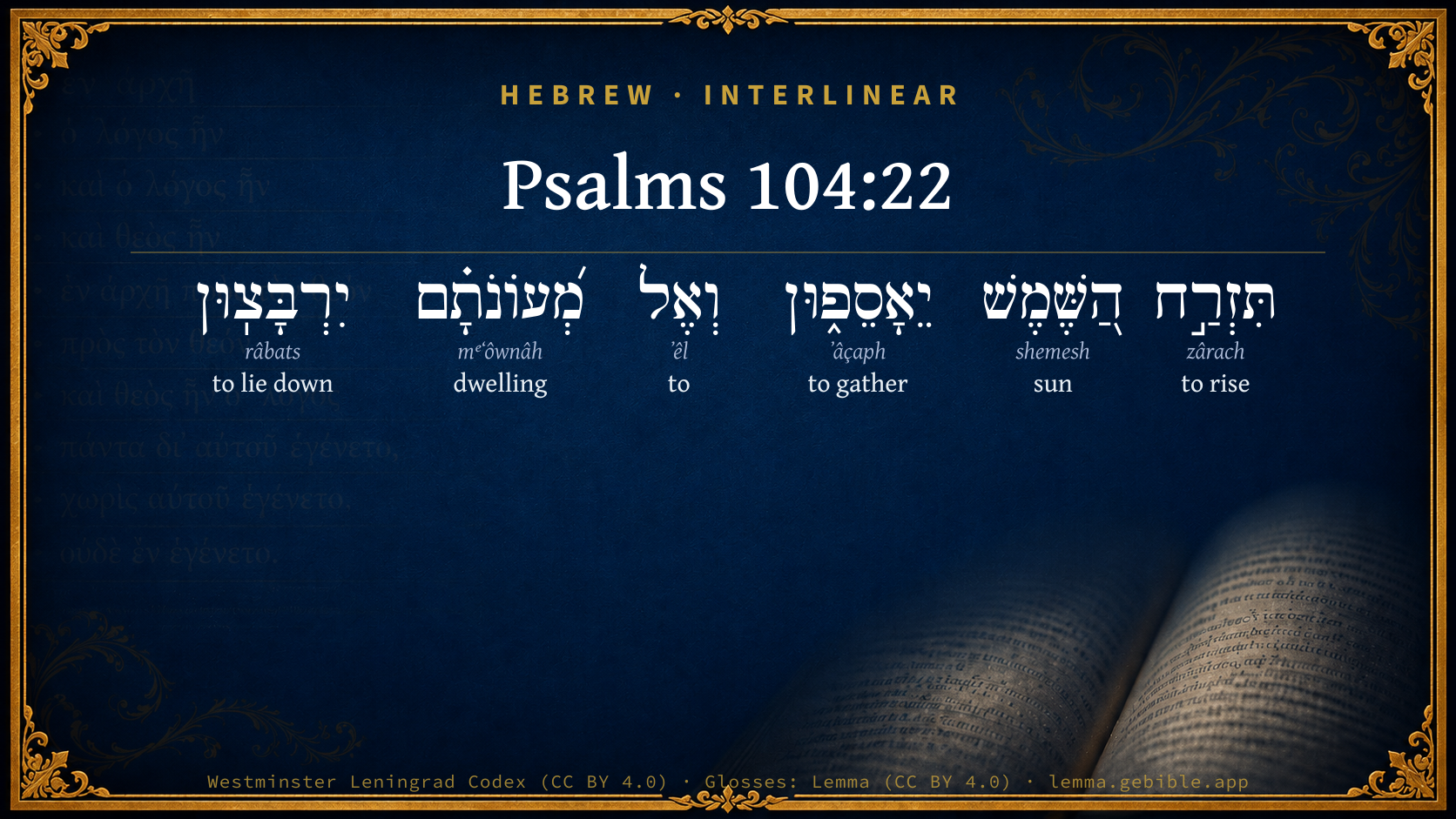
Psalms 104:22

Hebrew (Westminster Leningrad Codex) Psalms 104:22 appears in the Hebrew Old Testament. The text above is from the Westminster Leningrad Codex. Each word links to its Strong’s number, a concise gloss, and parsing drawn from the Open Scriptures Hebrew Bible morphology. Click any word for its full Brown-Driver-Briggs (BDB) entry.
Download image
Cite this verse

Psalms 104:22 (World English Bible). Public Domain. Lemma interlinear Bible study tool, https://lemma.gebible.app/v/psalms/104/22.

Show BibTeX & RIS
BibTeX
RIS
English Translation
The sun rises, and they steal away, And lay down in their dens.
World English Bible · Public Domain
Download a study sheet

One document with this verse’s original text, its word-by-word gloss line, the meaning frame, cross-references with their text, attributed commentary, and full source and license credits — printable, and it pastes into notes with its structure intact.

This verse Autodidact and up

Study sheet (.html) Plain text (.txt)

A passage Seminary Student

Up to 50 verses in one chapter. A passage sheet keeps up to 6 commentary sources and 12 cross-references per verse, in the order this page ranks them, and says so on the sheet whenever that leaves anything out. Ask for a single verse and you get the Autodidact verse sheet above.

Everything on this page stays free to read, with no account — the sheet is a download of what is already on screen, not access to it.

Want to remove ads? Support Godless Engineer
Compare translations 3

The same verse in 3 English versions, stacked beneath the original-language interlinear above. Click any original word for its lexicon entry.

Each is an independent rendering of the whole verse — the interlinear is not word-aligned to these translations.

Highlighted words mark where these versions differ — a whole-verse word diff, not a word-by-word alignment.

  • World English Bible Public Domain
    The sun rises, and they steal away, And lay down in their dens.
  • King James Version Public Domain
    The sun ariseth, they gather themselves together, and lay them down in their dens.
  • unfoldingWord Literal Text CC BY-SA 4.0
    The sun rises, they retreat, and lie down in their dens.

unfoldingWord Literal Text — © unfoldingWord, licensed CC BY-SA 4.0. Word-aligned USFM3 via Door43 (git.door43.org/unfoldingWord/en_ult).

Versions to compare (up to 4)

3 of 4 selected

Show all 18 translations

Every available English version of this verse, each an independent rendering of the whole verse.

  • World English Bible Public Domain
    The sun rises, and they steal away, And lay down in their dens.
  • Berean Standard Bible Public Domain
    The sun rises, and they withdraw; they lie down in their dens.
  • Majority Standard Bible Public Domain
    The sun rises, and they withdraw; they lie down in their dens.
  • King James Version Public Domain
    The sun ariseth, they gather themselves together, and lay them down in their dens.
  • American Standard Version (1901) Public Domain
    The sun ariseth, they get them away, And lay them down in their dens.
  • Revised Version (1885) Public Domain
    The sun ariseth, they get them away, and lay them down in their dens.
  • Geneva Bible (1599) Public Domain
    When the sunne riseth, they retire, and couche in their dennes.
  • Douay-Rheims (1899) Public Domain
    The sun ariseth, and they are gathered together: and they shall lie down in their dens.
  • Young's Literal Translation Public Domain
    The sun riseth, they are gathered, And in their dens they crouch.
  • Literal Standard Version CC BY-SA 4.0
    The sun rises, they are gathered, || And they crouch in their dens.
  • Unlocked Literal Bible CC BY-SA 4.0
    When the sun rises, they retreat and sleep in their dens.
  • unfoldingWord Literal Text CC BY-SA 4.0
    The sun rises, they retreat, and lie down in their dens.
  • Darby Bible Public Domain
    The sun ariseth, they retreat, and lay them down in their dens.
  • World Messianic Bible Public Domain
    The sun rises, and they steal away, and lie down in their dens.
  • Webster's Bible Public Domain
    The sun ariseth, they collect, and lay themselves down in their dens.
  • Free Bible Version CC BY-SA 4.0
    When the sun rises they return to their dens to rest.
  • Bible in Basic English Public Domain
    The sun comes up, and they come together, and go back to their secret places to take their rest.
  • JPS Tanakh (1917) Public Domain
    The sun ariseth, they slink away, and couch in their dens.

Literal Standard Version (2020), Covenant Press — licensed CC BY-SA 4.0. Text via the HelloAO Bible API (eBible.org). Unlocked Literal Bible (unfoldingWord) — licensed CC BY-SA 4.0. Text via the HelloAO Bible API (eBible.org). unfoldingWord Literal Text — © unfoldingWord, licensed CC BY-SA 4.0. Word-aligned USFM3 via Door43 (git.door43.org/unfoldingWord/en_ult). Free Bible Version, Dr. Jonathan Gallagher — licensed CC BY-SA 4.0. Text via the HelloAO Bible API (eBible.org).

Word by word

More ways to search: Search by grammar → Find every occurrence → Compare this word →

Practice this passage: Drill this verse → Learn its vocabulary →

About this verse

These counts appear in no published source. They are computed here, from the morphology-tagged text and Lemma’s own curated glosses. What Lemma adds →

6
words
6
distinct lemmas
Wisdom
section

Notable vocabulary

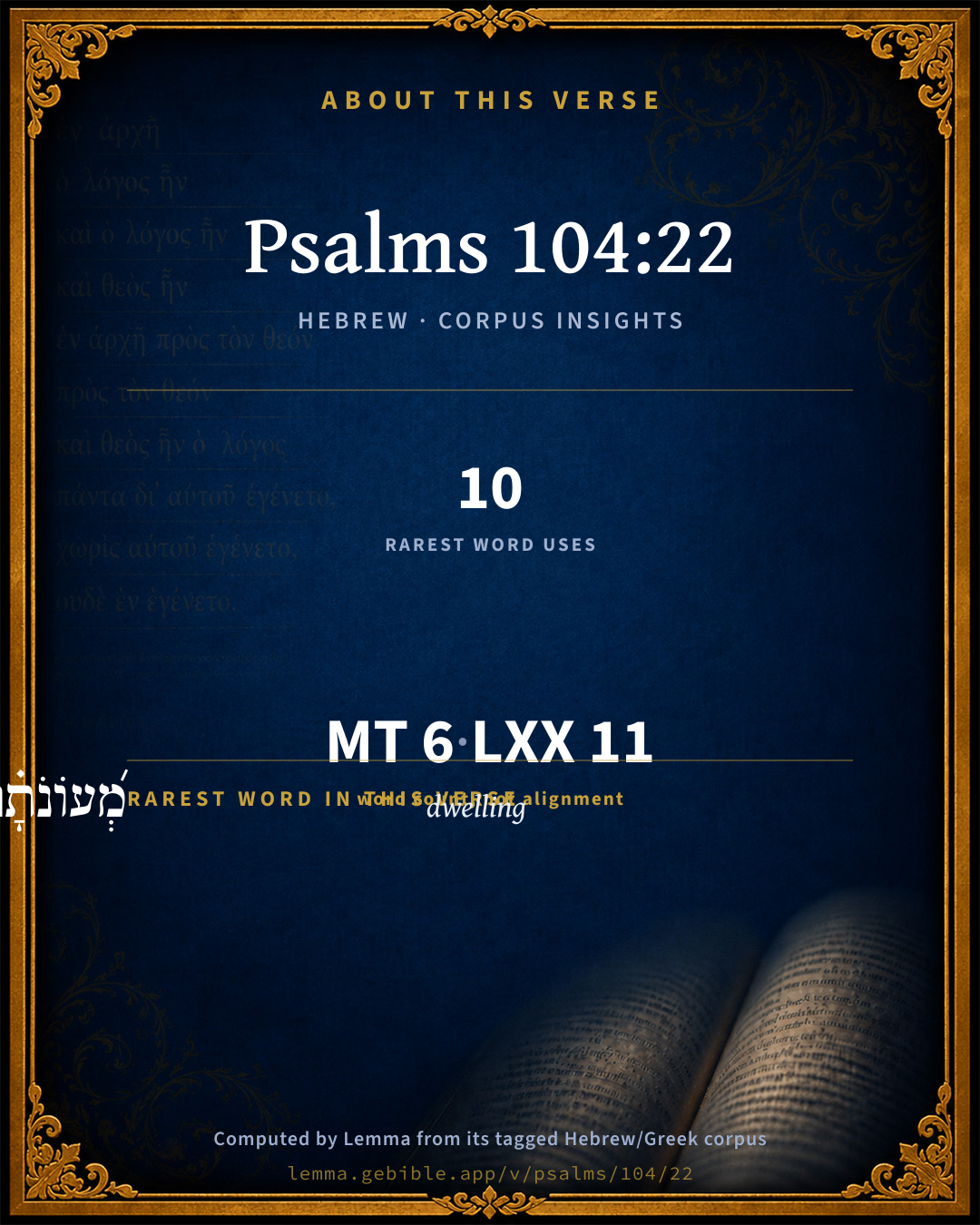
The rarest word here is מְ֝עוֹנֹתָ֗ם dwelling H4585 — appearing just 10 times in the whole Hebrew Bible.

Shared distinctive vocabulary

מְ֝עוֹנֹתָ֗ם dwelling H4585 occurs in 10 verses of the Hebrew Bible. Also found in:

Grammatical profile

  • 3 verbs
  • 2 nouns
  • 1 preposition

Verb forms

  • תִּזְרַ֣ח Qal · Imperfect
  • יֵאָסֵפ֑וּן Niphal · Imperfect
  • יִרְבָּצֽוּן Qal · Imperfect

Hebrew & Septuagint length

In English translation the verse runs 13 words from the Hebrew and 16 from the Septuagint (LXX English) — closely comparable.

A rough comparison of the two English renderings, which tokenize alike — not a word-level alignment.

Word counts can differ between the Hebrew and the Greek without any difference in meaning — e.g. the Hebrew direct-object marker אֵת has no separate Greek word, and Greek often adds the article ὁ.

In the original languages it is 6 Hebrew tokens and 11 Greek tokens — but the two are counted differently (Hebrew bundles its prefixes and suffixes into one token; the Greek is in lemma form), so that isn’t a like-for-like length.

Cross-references

4

Topical passages linked to Psalms 104:22 in the Treasury of Scripture Knowledge — connected by theme and wording, ordered by reader-vote popularity; previews shown in the World English Bible.

  • Job 37:8 Then the animals take cover, And remain in their dens.
  • Job 24:13–17 "These are of those who rebel against the light; They don't know the ways of it, Nor abide in the paths of it.
  • Nahum 3:17 Your guards are like the locusts, and your officials like the swarms of locusts, which settle on the walls on a cold day, but when the sun appears, they flee away, and their place is not known where they are.
  • John 3:20 For everyone who does evil hates the light, and doesn't come to the light, lest his works would be exposed.

Cross-references courtesy of OpenBible.info (CC BY 4.0).

Hebrew and Greek witnesses Masoretic Hebrew ↔ Greek Septuagint

The same verse in the two great witnesses to the Old Testament, shown verse-for-verse.

You’re reading Greek Psalm 103 (Hebrew Psalm 104). The Septuagint counts the superscription, so verse numbers can differ from the Hebrew — chapter-level alignment, not verse-by-verse. Numbering follows Rahlfs.

These are two independent witnesses, not word-aligned to each other, and the Septuagint is shown in lemma (dictionary) form.

Hebrew Psalms 104:22 Masoretic · Westminster Leningrad Codex

תִּזְרַ֣ח הַ֭שֶּׁמֶשׁ יֵאָסֵפ֑וּן וְאֶל מְ֝עוֹנֹתָ֗ם יִרְבָּצֽוּן

The sun rises, and they steal away, And lay down in their dens.

World English Bible · Public Domain

Greek LXX Greek Psalm 103:22 Septuagint · lemma form

ἀνατέλλω ὁ ἥλιος καί συνἄγω καί ἐν ὁ μάνδρα αὐτός κοιτάζομαι

The sun arises, and they shall be gathered together, and shall lie down in their dens.

LXX2012 (modern English Septuagint) · Public Domain

Hebrew: Westminster Leningrad Codex (CC BY 4.0). Greek: Septuagint (public domain); English from LXX2012 (modern English Septuagint) (Public Domain). How the Septuagint differs from the Hebrew →

Commentary

Notes on Psalms 104:22 from classic Christian and Jewish commentators (each source and its license shown beneath its notes). The classic Christian expositions comment on the surrounding passage and are grouped to its opening verse, so a note may address several verses; the Jewish commentaries on the Tanakh (Rashi and others) are per-verse, so they appear only where the commentator wrote on this verse.

Lemma curates 59 commentaries, every one of them public domain or Creative Commons licensed, each selected and text-cleaned for this edition rather than reprinted as found. About our sources →

Trapp's Complete Commentary

John Trapp

Psa 104:22 The sun ariseth, they gather themselves together, and lay them down in their dens.

Ver. 22. They yather themselves toyether] viz. Into their dens and lurking holes, smitten with fear of light and of men. A sweet providence, but little considered.

John Trapp, A Commentary or Exposition upon All the Books of the Old and New Testament (1647–1656) — public domain. Text from a community e-Sword module.

Joseph Benson's Commentary

Psa 104:22-23. The sun ariseth — For as he knows the time of his going down, so, thanks be to God, he knows the proper time of his rising, and then the wild beasts gather themselves together — Or, rather, withdraw themselves, or retire, as יאספו, jeaseephu, may be rendered; and lay them down in their dens — Which is a great mercy to mankind, who can now go forth with security and confidence, and perform unmolested the task assigned them by their Maker. Thus, “when the light of truth and righteousness shineth, error and iniquity fly away before it, and the roaring lion himself departeth for a time. Then the Christian goeth forth to the work of his salvation, and to his labour of love, until the evening of old age warns him to prepare for his last repose, in faith of a joyful resurrection.” — Horne.

Joseph Benson's Commentary on the Old and New Testaments (1811–1818) — public domain. Text from a community e-Sword module.

J. A. Alexander on Psalms

Joseph Addison Alexander

22. (Psa 104:22) The sun rises—they are gathered—and in their dens lie down. The first clause may also be translated, let the sun rise, they are gathered, or paraphrased in more accordance with our idiom, when the sun rises they are gathered; but neither of these constructions is so striking and poetical as the exact version, first above given. Gathered, i.e. called in from their wanderings and dispersions. The word translated dens means abodes or homes, and is a cognate form to that in Ps. xc. 1; but the form here used is specially applied to the lairs or resting-places of wild beasts, not only here but in Amo 3:4. The last verb is also one appropriated to the lying down of animals. See above, on Psa 23:2. The construction is a pregnant one: they lie down to (or) into their dens, i.e. go into them and lie down.

Joseph Addison Alexander, The Psalms Translated and Explained (1850) — public domain. Text from a community e-Sword module.

Adam Clarke's Commentary

Verse 22. The sun ariseth] The dawn of day is the warning for man to arise and betake himself to his work; and is the warning to them to retire to their dens.

Adam Clarke's Commentary on the Bible (1810–1826) — public domain. Text from a community e-Sword/MySword module.

John Calvin's Commentaries

22. The sun shall rise The Psalmist continues to prosecute the same subject, showing that God so distributes the successions of time, as that the day belongs properly to man. Did not God put a restraint upon so many wild beasts which are hostile to us, the human race would soon become extinct. As wild beasts since the fall of man may seem to be born to do us hurt, and to rend and tear in pieces all whom they meet with, this savage cruelty must be kept under check by the providence of God. And in order to keep them shut up within their dens, the only means which he employs is to inspire them with terror, simply by the light of the sun. This instance of divine goodness, the prophet commends the more on account of its necessity; for were it otherwise, men would have no liberty to go forth to engage in the labors and business of life. Man being thus protected by the light against the violence and injuries of wild beasts, in this is to be seen the unparalleled goodness of God, who in so fatherly a manner has provided for his convenience and welfare.

John Calvin's Commentaries (1540-1563) — public domain. Text from the Calvin Translation Society English edition (1840s-50s) via the Christian Classics Ethereal Library (ccel.org). Calvin's coverage is partial (roughly two-thirds of the Bible); uncommented books and verses are honest gaps, never fabricated. The 19th-century editor's footnotes and remarks are omitted so the notes are faithfully Calvin's own voice.

Ellicott's Commentary for English Readers

(22) Lay them down.—With sunrise all is changed. The Wild animals, with their savage instincts, give way to man with his orderly habits and arranged duties. The curse of labour, on which the account in Genesis dwells, is here entirely out of sight, and instead there appears the “poetry of labour.” And if all sense of the primal curse has disappeared, the later curse, which lies so heavy on the modern generations of overworked men,

“Who make perpetual moan,

Still from one labour to another thrown,”

has not appeared. The day brings only healthy toil, and the evening happy rest.

A Bible Commentary for English Readers, edited by Charles John Ellicott (1878–1897) — public domain. Text from a community e-Sword module.

The Cambridge Bible for Schools and Colleges

gen. ed. J. J. S. Perowne

22. they gather themselves together] Better as R.V., they get them away.

The Cambridge Bible for Schools and Colleges (gen. ed. J. J. S. Perowne; Cambridge University Press, 1878–1918) — public domain. Text from a community e-Sword module.

John Gill's Exposition

The sun ariseth, they gather themselves together,.... Having gone some one way, some another, seeking their prey; but upon the sun's rising gather together in order to return from whence they came, abhorring the light of the sun, as some creatures do, and fearing being hunted and taken by men, the fear of whom is still in some measure upon the beasts of the field, Gen 9:2. So wicked men do not care for the light of the day, nor do false teachers choose to come to the light of the word; these owls and bats, these, as Tertullian calls them; and Satan himself chooses to set upon persons when they are in darkness, and in melancholy and disconsolate frames; and is afraid of believers, when they put on the armour of light, especially the shield of faith, and resist him with it, then he flees from them.

And lay them down in their dens; for rest and safety, and to feed themselves and young ones with the ravin they bring with them; see Sol 4:8.

John Gill's Exposition of the Whole Bible (1746–1763) — public domain (CC PDM 1.0). Text via the HelloAO Bible API.

Albert Barnes' Notes on the Bible

The sun ariseth - A new scene in this endless variety of incidents in a world full of life and beauty. The psalmist sees the light break in the east, and the sun appear above the horizon - and the whole scene is changed. The animals that had gone forth at night are seen to return again to their hiding-places, and man in his turn Psa 104:23 is seen to go forth to his daily toil.

They gather themselves together - Though scattered in the night, when light returns, they all bend their steps to the places where they are accustomed to repose in the daytime. The scene is most beautiful. At night they sally forth for their prey; when the morning light returns, they all retrace their steps to the places in dens and caverns where they pass the day, and there they repose in silence until night returns again.

Albert Barnes' Notes on the Bible (1834–1885) — public domain. Text from a community e-Sword/MySword module.

Matthew Poole's English Annotations

Or rather, they retire or betake themselves; for the lions do not commonly go in companies to one place, but severally, each to his own den.

Matthew Poole's English Annotations on the Holy Bible (1683–1685) — public domain. Text from a community e-Sword/MySword module.

The Treasury of David

Charles H. Spurgeon

Ver. 22. The sun ariseth. Every evening has its morning to make the day. Were it not that we have seen the sun rise so often we should think it the greatest of miracles, and the most amazing of blessings.

They gather themselves together, and lay them down in their dens. Thus they are out of man's way, and he seldom encounters them unless he desires to do so. The forest's warriors retire to their quarters when the morning's drum is heard, finding in the recesses of their dens a darkness suitable for their slumbers; there they lay them down and digest their food, for God has allotted even to them their portion of rest and enjoyment. There was one who in this respect was poorer than lions and foxes, for he had not where to lay his head: all were provided for except their incarnate Provider. Blessed Lord, thou hast stooped beneath the conditions of the brutes to lift up worse than brutish men!

It is very striking how the Lord controls the fiercest of animals far more readily than the shepherd manages his sheep. At nightfall they separate and go forth each one upon the merciful errand of ending the miseries of the sickly and decrepit among grass eating animals. The younger of these animals being swift of foot easily escape them and are benefited by the exercise, and for the most part only those are overtaken and killed to whom life would have been protracted agony. So far lions are messengers of mercy, and are as much sent of God as the sporting dog is sent by man on his errands. But these mighty hunters must not always be abroad, they must be sent back to their lairs when man comes upon the scene. Who shall gather these ferocious creatures and shut them in? Who shall chain them down and make them harmless? The sun suffices to do it. He is the true lion tamer. They gather themselves together as though they were so many sheep, and in their own retreats they keep themselves prisoners till returning darkness gives them another leave to range. By simply majestic means the divine purposes are accomplished. In like manner even the devils are subject unto our Lord Jesus, and by the simple spread of the light of the gospel these roaring demons are chased out of the world. No need for miracles or displays of physical power, the Sun of Righteousness arises, and the devil and the false gods, and superstitions and errors of men, all seek their hiding places in the dark places of the earth among the moles and the bats.

Ver. 22. The sun ariseth...they lay them down in their dens. As wild beasts since the fall of man may seem to be born to do us hurt, and to rend and tear in pieces all whom they meet with, this savage cruelty must be kept under check by the providence of God. And in order to keep them shut up within their dens, the only means which he employs is to inspire them with terror, simply by the light of the sun. This instance of divine goodness, the prophet commends the more on account of its necessity; for were it otherwise, men would have no liberty to go forth to engage in the labours and business of life. John Calvin.

Ver. 22. From the effect of sunrise on the beasts of prey, exhibit the influence of Divine Grace on our evil passions. C.A.D.

Psalms 104:23*

Charles H. Spurgeon's The Treasury of David (1869–1885) — public domain. Psalms only. Text from a community e-Sword/MySword module.

Whedon's Commentary on the Bible

Daniel D. Whedon

22. The sun ariseth—The signal for the wild beasts to retire, and for man to go forth.

Daniel D. Whedon (gen. ed.), Commentary on the Old and New Testaments (1874–1909) — public domain. Text from a community e-Sword module.

The Pulpit Commentary

Vers. 22, 23. The sun ariseth. Bright beams of light flame up the eastern sky; and earth basks in the sun"s smile. But it is a signal to the lions and the other wild beasts to withdraw. They gather themselves together, and lay them down in their dens. Hiding themselves from the eye of day, and retreating into places where they are safe. Then it is the turn of humanity to reappear. Humanity wakes up; and man goeth forth auto his work and to his labour uutil the evening; i.e. man proceeds to his appointed task, which is "work once a curse, (Gen_3:17-19) now a blessing. (Eph_4:28)

The psalm of creation: the sixth day the creation of man.

We ask

I WHY DID GOD CREATE MAN? Many think that life is not worth living. Existence is so much pure misfortune. The denial of the Christian faith and hopeless pessimism seem ever to go together. But a preliminary question may be asked Why did God create anything?

II WE REPLY:

1. God is love, and one necessity of such nature is that he should find objects on which to lavish that love. It cannot remain unexercised. Creation, therefore, seemed to be a necessity of love.

2. But another need is that such love should meet with response. Love yearns for response, to be met by an answering love. But this involved the necessity of the creation of beings who should not be moved by mere instinct, but should possess mind, intelligence, and the capacity of love. Hence was requisite something more than any of the already created inhabitants of the seas, the air, or the land, could supply. A different, a higher being had to be brought into existence; man was needed, since he only could render the response the heart of the Creator desired. All other creatures could obey the laws of their being; man could love the Law giver.

3. And yet another craving of the Divine love, as of all like pure love, is for worthy response. It cannot bear that the response it yearns for should be given to inferior objects; it desires to be chosen and preferred above all these. But such worthy response of deliberate choice can only be made when counter objects of attraction are present. Therefore, that such choice may be possible for us, we are placed in a world where all around us are myriad lures and baits appealing to all sides of our nature, and many of them with mighty power. Hence is it that the love of his people is so precious in his esteem, for it means that they have turned their backs upon all these rivals of God, and have given to him the love he asks for and deserves.

4. And even this low is capable of enhancement in his esteem. It is so when, as with Job, it clings to God in spite of sorest trial and distress; when the man is in the very depths, when to all outward appearance everything is lost and thrown away by such clinging to God; when it has to hang on by naked faith, as at some time or other it has had to do in all God"s saints, and with some of them, as in the martyr ages, it has had to be always so. But love like that, oh how precious is it! how grateful to the heart of God! We can understand somewhat of this when some dear child of ours, rather than grieve or disappoint us, has readily endured persecution and pain. What do we not think of that child? What proof of our love will we withhold from him?

5. But such proof of our love, or of that of God, cannot be given unless there has been the previous trial. And that is why we are placed in a world of trial, often cruel, prolonged, and severe. We are thus given the opportunity of winning the highest prizes of the kingdom of God. Hence man has to go "forth to his work, and to his labour until the evening" Life is no child"s play for him, no place of mere sensuous enjoyment. If he chooses to make it so, he shuts himself out of the kingdom of God. No cross, no crown. Only so can we win back the image of God in which we were first created. This is "the prize of our high calling. S.C.

The Pulpit Commentary (1880–1919), ed. H.D.M. Spence-Jones & Joseph S. Exell — public domain. Text from a community e-Sword module.

Rashi

Rabbi Shlomo Yitzchaki (Rashi)

When the sun rises they gather in into the secret places and hide there from the sons of men; then every man goes forth to his work.

Rashi on the Tanakh — English translations: “The Judaica Press complete Tanach with Rashi, translated by A. J. Rosenberg” (CC BY 4.0); “Pentateuch with Rashi's commentary by M. Rosenbaum and A.M. Silbermann, 1929-1934” (public domain); “The Metsudah Tanach series, Lakewood, N.J” (CC BY 4.0); and “The Book of Joshua, Metsudah Publications, 1997” (CC BY 4.0). Text via Sefaria.

Lesson kit

Teaching starters — assembled from the data on this page, not authored interpretation. Every prompt links to the verse data it draws on. Edit before teaching.

Psalms, in the Wisdom, opens this verse with 6 words (6 distinct Hebrew lemmas). Its most distinctive word is mᵉʻôwnâh (“dwelling”). A historical commentator’s framing appears above. Read the whole chapter for the surrounding context.

Discussion questions

  1. How does “dwelling” (mᵉʻôwnâh) shape what this verse is saying?
  2. How does Deuteronomy 33:27, which shares the word «dwelling», read alongside this verse?
  3. The translations on this page render this verse differently — a whole-verse word diff, not a word-by-word alignment. What might account for the different wordings?
  4. «תִּזְרַ֣ח» is a Qal Imperfect verb. How does that grammatical form shape the action described?
  5. Compare how Trapp's Complete Commentary and Joseph Benson's Commentary read this verse. Where do they agree or differ?

Things to notice

Reading settings

Reading text

Shown beneath each verse's original-language words.

Old Testament
Old Testament edition

Read the OT as the Masoretic Hebrew (MT) or the Greek Septuagint (LXX).

English shown for the Greek Septuagint (in the Hebrew ↔ Greek comparison).

Comparing translations? Open the Compare panel on any verse page to stack up to four side by side.