
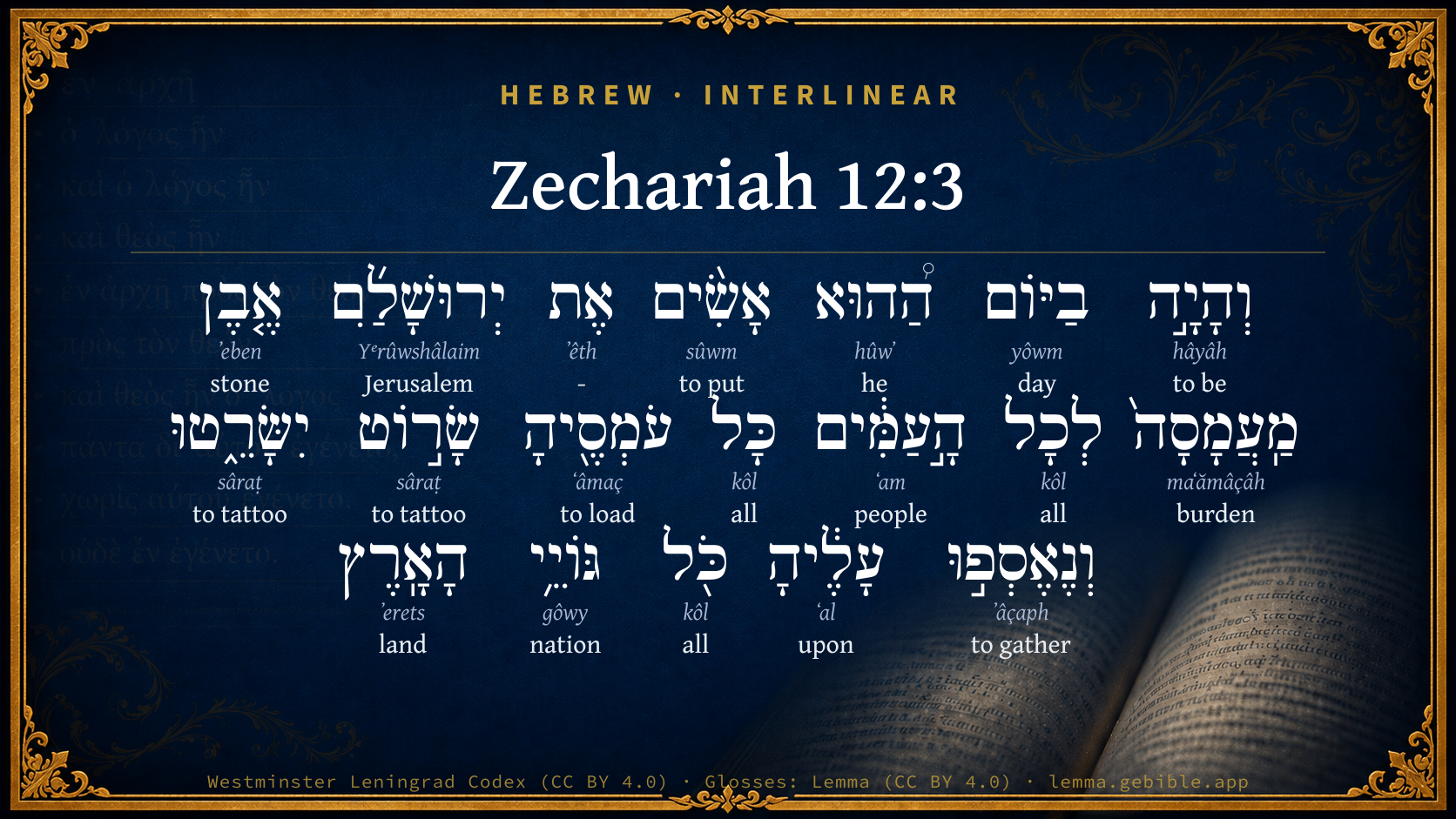
Zechariah 12:3

Hebrew (Westminster Leningrad Codex) Zechariah 12:3 appears in the Hebrew Old Testament. The text above is from the Westminster Leningrad Codex. Each word links to its Strong’s number, a concise gloss, and parsing drawn from the Open Scriptures Hebrew Bible morphology. Click any word for its full Brown-Driver-Briggs (BDB) entry.
Download image
Cite this verse

Zechariah 12:3 (World English Bible). Public Domain. Lemma interlinear Bible study tool, https://lemma.gebible.app/v/zechariah/12/3.

Show BibTeX & RIS
BibTeX
RIS
English Translation
It will happen in that day, that I will make Jerusalem a burdensome stone for all the peoples. All who burden themselves with it will be severely wounded, and all the nations of the earth will be gathered together against it.
World English Bible · Public Domain
Highlights
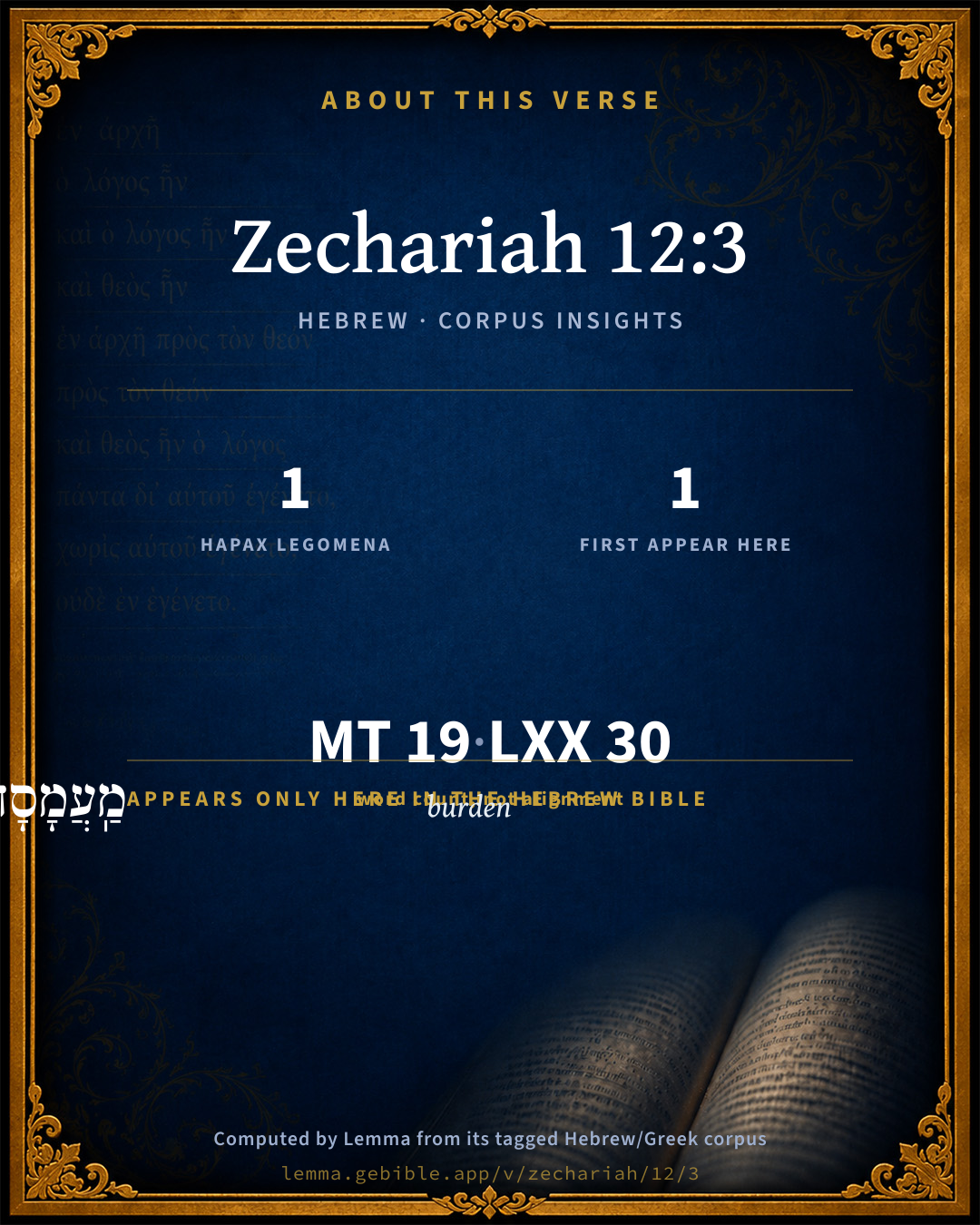
  • 1 hapax legomenon — only here in the Hebrew Bible
  • 1 first appearance in the Hebrew Bible
Full analysis ↓
Download a study sheet

One document with this verse’s original text, its word-by-word gloss line, the meaning frame, cross-references with their text, attributed commentary, and full source and license credits — printable, and it pastes into notes with its structure intact.

This verse Autodidact and up

Study sheet (.html) Plain text (.txt)

A passage Seminary Student

Up to 50 verses in one chapter. A passage sheet keeps up to 6 commentary sources and 12 cross-references per verse, in the order this page ranks them, and says so on the sheet whenever that leaves anything out. Ask for a single verse and you get the Autodidact verse sheet above.

Everything on this page stays free to read, with no account — the sheet is a download of what is already on screen, not access to it.

Want to remove ads? Support Godless Engineer
Compare translations 3

The same verse in 3 English versions, stacked beneath the original-language interlinear above. Click any original word for its lexicon entry.

Each is an independent rendering of the whole verse — the interlinear is not word-aligned to these translations.

Highlighted words mark where these versions differ — a whole-verse word diff, not a word-by-word alignment.

  • World English Bible Public Domain
    It will happen in that day, that I will make Jerusalem a burdensome stone for all the peoples. All who burden themselves with it will be severely wounded, and all the nations of the earth will be gathered together against it.
  • King James Version Public Domain
    And in that day will I make Jerusalem a burdensome stone for all people: all that burden themselves with it shall be cut in pieces, though all the people of the earth be gathered together against it.
  • unfoldingWord Literal Text CC BY-SA 4.0
    On that day, I will make Jerusalem a heavy stone for all the peoples. Anyone trying to lift that stone will hurt himself very much, and all the nations of the earth will gather against that city.

unfoldingWord Literal Text — © unfoldingWord, licensed CC BY-SA 4.0. Word-aligned USFM3 via Door43 (git.door43.org/unfoldingWord/en_ult).

Versions to compare (up to 4)

3 of 4 selected

Show all 18 translations

Every available English version of this verse, each an independent rendering of the whole verse.

  • World English Bible Public Domain
    It will happen in that day, that I will make Jerusalem a burdensome stone for all the peoples. All who burden themselves with it will be severely wounded, and all the nations of the earth will be gathered together against it.
  • Berean Standard Bible Public Domain
    On that day, when all the nations of the earth gather against her, I will make Jerusalem a heavy stone for all the peoples; all who would heave it away will be severely injured.
  • Majority Standard Bible Public Domain
    On that day, when all the nations of the earth gather against her, I will make Jerusalem a heavy stone for all the peoples; all who would heave it away will be severely injured.
  • King James Version Public Domain
    And in that day will I make Jerusalem a burdensome stone for all people: all that burden themselves with it shall be cut in pieces, though all the people of the earth be gathered together against it.
  • American Standard Version (1901) Public Domain
    And it shall come to pass in that day, that I will make Jerusalem a burdensome stone for all the peoples; all that burden themselves with it shall be sore wounded; and all the nations of the earth shall be gathered together against it.
  • Revised Version (1885) Public Domain
    And it shall come to pass in that day, that I will make Jerusalem a burdensome stone for all the peoples; all that burden themselves with it shall be sore wounded; and all the nations of the earth shall be gathered together against it.
  • Geneva Bible (1599) Public Domain
    And in that day will I make Ierusalem an heauie stone for all people: all that lift it vp, shall be torne, though all the people of the earth be gathered together against it.
  • Douay-Rheims (1899) Public Domain
    And it shall come to pass in that day, that I will make Jerusalem a burdensome stone to all people: all that shall lift it up shall be rent and torn, and all the kingdoms of the earth shall be gathered together against her.
  • Young's Literal Translation Public Domain
    And it hath come to pass, in that day, I make Jerusalem a burdensome stone to all the peoples, All loading it are completely pressed down, And gathered against it have been all nations of the earth.
  • Literal Standard Version CC BY-SA 4.0
    And it has come to pass in that day, || I make Jerusalem a burdensome stone to all the peoples, || All loading it are completely pressed down, || And gathered against it have been all nations of the earth.
  • Unlocked Literal Bible CC BY-SA 4.0
    On that day, I will make Jerusalem a heavy stone for all the peoples. Anyone trying to lift that stone will hurt himself very much, and all the nations of the earth will gather against that city.
  • unfoldingWord Literal Text CC BY-SA 4.0
    On that day, I will make Jerusalem a heavy stone for all the peoples. Anyone trying to lift that stone will hurt himself very much, and all the nations of the earth will gather against that city.
  • Darby Bible Public Domain
    And it shall come to pass in that day [that] I will make Jerusalem a burdensome stone unto all peoples: all that burden themselves with it shall certainly be wounded, and all the nations of the earth shall be assembled together against it.
  • World Messianic Bible Public Domain
    It will happen in that day that I will make Jerusalem a burdensome stone for all the peoples. All who burden themselves with it will be severely wounded, and all the nations of the earth will be gathered together against it.
  • Webster's Bible Public Domain
    And in that day will I make Jerusalem a burdensome stone for all people: all that burden themselves with it shall be cut in pieces, though all the people of the earth be assembled against it.
  • Free Bible Version CC BY-SA 4.0
    On that day I will make Jerusalem like a heavy rock to all peoples. Anyone who tries to lift the rock will injure themselves badly. All the nations will join together to attack Jerusalem.
  • Bible in Basic English Public Domain
    And it will come about in that day that I will make Jerusalem a stone of great weight for all the peoples; all those who take it up will be badly wounded; and all the nations of the earth will come together against it.
  • JPS Tanakh (1917) Public Domain
    And it shall come to pass in that day, that I will make Jerusalem a stone of burden for all the peoples; all that burden themselves with it shall be sore wounded; and all the nations of the earth shall be gathered together against it.

Literal Standard Version (2020), Covenant Press — licensed CC BY-SA 4.0. Text via the HelloAO Bible API (eBible.org). Unlocked Literal Bible (unfoldingWord) — licensed CC BY-SA 4.0. Text via the HelloAO Bible API (eBible.org). unfoldingWord Literal Text — © unfoldingWord, licensed CC BY-SA 4.0. Word-aligned USFM3 via Door43 (git.door43.org/unfoldingWord/en_ult). Free Bible Version, Dr. Jonathan Gallagher — licensed CC BY-SA 4.0. Text via the HelloAO Bible API (eBible.org).

Word by word

More ways to search: Search by grammar → Find every occurrence → Compare this word →

Practice this passage: Drill this verse → Learn its vocabulary →

מַֽעֲמָסָה֙
maʻămâçâh
H4614
“burden”
Noun, Common, Feminine, Singular, Absolute
Part of Speech
Noun
Type
Common
Gender
Feminine
Number
Singular
State
Absolute
Full BDB Definition

Origin: from H6006

TWOT: 1643a

load, burden
  1. וְהָיָ֣ה hâyâh H1961 “and · to be” Conjunction + Verb, Qal, Sequential Perfect, 3rd Person, Masculine, Singular
  2. בַיּוֹם yôwm H3117 “in/at the · day” Preposition, Determined + Noun, Common, Masculine, Singular, Absolute
  3. הַ֠הוּא hûwʼ H1931 “the · he” Particle, Definite Article + Pronoun, Personal, 3rd Person, Masculine, Singular
  4. אָשִׂ֨ים sûwm H7760 “to put” Verb, Qal, Imperfect, 1st Person, Common, Singular
  5. אֶת ʼêth H853 “-” Particle, Direct Object
  6. יְרוּשָׁלִַ֜ם Yᵉrûwshâlaim H3389 “Jerusalem” Noun, Proper
  7. אֶ֤בֶן ʼeben H68 “stone of” Noun, Common, Feminine, Singular, Construct
  8. לְכָל kôl H3605 “to/for · all of” Preposition + Noun, Common, Masculine, Singular, Construct
  9. הָ֣עַמִּ֔ים ʻam H5971 “the · peoples” Particle, Definite Article + Noun, Common, Masculine, Plural, Absolute
  10. כָּל kôl H3605 “all of” Noun, Common, Masculine, Singular, Construct
  11. עֹמְסֶ֖יהָ ʻâmaç H6006 “loading · her” Verb, Qal, Participle Active, Masculine, Plural, Construct + Suffix, Personal, 3rd Person, Feminine, Singular
  12. שָׂר֣וֹט sâraṭ H8295 “to tattoo” Verb, Qal, Infinitive Absolute
  13. יִשָּׂרֵ֑טוּ sâraṭ H8295 “to tattoo” Verb, Niphal, Imperfect, 3rd Person, Masculine, Plural
  14. וְנֶאֶסְפ֣וּ ʼâçaph H622 “and · to gather” Conjunction + Verb, Niphal, Sequential Perfect, 3rd Person, Common, Plural
  15. עָלֶ֔יהָ ʻal H5921 “upon · her” Preposition + Suffix, Personal, 3rd Person, Feminine, Singular
  16. כֹּ֖ל kôl H3605 “all of” Noun, Common, Masculine, Singular, Construct
  17. גּוֹיֵ֥י gôwy H1471 “nations of” Noun, Common, Masculine, Plural, Construct
  18. הָאָֽרֶץ ʼerets H776 “the · land” Particle, Definite Article + Noun, Common, Both, Singular, Absolute

About this verse

These counts appear in no published source. They are computed here, from the morphology-tagged text and Lemma’s own curated glosses. What Lemma adds →

19
words
16
distinct lemmas
Prophets
section

Notable vocabulary

1 hapax legomenon — a word that appears only here in the entire Hebrew Bible:

  • מַֽעֲמָסָה֙ burden H4614

First appearance in Scripture

This word makes its first canonical appearance in the Hebrew Bible here:

  • מַֽעֲמָסָה֙ burden H4614

Shared distinctive vocabulary

שָׂר֣וֹט to tattoo H8295 occurs in 2 verses of the Hebrew Bible. Also found in:

Grammatical profile

  • 6 verbs
  • 10 nouns
  • 1 pronoun
  • 1 preposition
  • 1 particle

Verb forms

  • וְהָיָ֣ה Qal · Sequential Perfect
  • אָשִׂ֨ים Qal · Imperfect
  • עֹמְסֶ֖יהָ Qal · Participle Active
  • שָׂר֣וֹט Qal · Infinitive Absolute
  • יִשָּׂרֵ֑טוּ Niphal · Imperfect
  • וְנֶאֶסְפ֣וּ Niphal · Sequential Perfect

Repetition

Words recur within this verse — often emphatic in Hebrew:

  • לְכָל all H3605 ×3
  • שָׂר֣וֹט to tattoo H8295 ×2

Hebrew & Septuagint length

In English translation the verse runs 41 words from the Hebrew and 45 from the Septuagint (LXX English) — closely comparable.

A rough comparison of the two English renderings, which tokenize alike — not a word-level alignment.

Word counts can differ between the Hebrew and the Greek without any difference in meaning — e.g. the Hebrew direct-object marker אֵת has no separate Greek word, and Greek often adds the article ὁ.

In the original languages it is 19 Hebrew tokens and 30 Greek tokens — but the two are counted differently (Hebrew bundles its prefixes and suffixes into one token; the Greek is in lemma form), so that isn’t a like-for-like length.

Cross-references

31

Topical passages linked to Zechariah 12:3 in the Treasury of Scripture Knowledge — connected by theme and wording, ordered by reader-vote popularity; previews shown in the World English Bible.

  • Matthew 21:44 He who falls on this stone will be broken to pieces, but on whoever it will fall, it will scatter him as dust."
  • Zechariah 14:2–4 For I will gather all nations against Jerusalem to battle; and the city will be taken, the houses rifled, and the women ravished. half of the city will go out into captivity, and the rest of the people will not be cut off from the city.
  • Daniel 2:34–35 You saw until a stone was cut out without hands, which struck the image on its feet that were of iron and clay, and broke them in pieces.
  • Luke 20:18 "Everyone who falls on that stone will be broken to pieces, But it will crush whomever it falls on to dust."
  • Isaiah 66:14–16 You shall see [it], and your heart shall rejoice, and your bones shall flourish like the tender grass: and the hand of Yahweh shall be known toward his servants; and he will have indignation against his enemies.
  • Ezekiel 38:1–23 The word of Yahweh came to me, saying,
  • Zechariah 13:1 "In that day there will be a spring opened to the house of David and to the inhabitants of Jerusalem, for sin and for uncleanness.
  • Zechariah 14:6 It will happen in that day, that there will not be light, cold, or frost.
  • Zechariah 12:11 In that day there will be a great mourning in Jerusalem, like the mourning of Hadadrimmon in the valley of Megiddon.
  • Isaiah 60:12 For that nation and kingdom that will not serve you shall perish; yes, those nations shall be utterly wasted.
  • Daniel 2:44–45 In the days of those kings shall the God of heaven set up a kingdom which shall never be destroyed, nor shall the sovereignty of it be left to another people; but it shall break in pieces and consume all these kingdoms, and it shall stand forever.
  • Joel 3:8–16 And I will sell your sons and your daughters into the hands of the children of Judah, And they will sell them to the men of Sheba, To a faraway nation, For Yahweh has spoken it."
  • Obadiah 1:18 The house of Jacob will be a fire, the house of Joseph a flame, and the house of Esau for stubble. They will burn among them, and devour them. There will not be any remaining to the house of Esau." Indeed, Yahweh has spoken.
  • Micah 4:11–13 Now many nations have assembled against you, that say, 'Let her be defiled, And let our eye gloat over Zion.'
  • Micah 5:8 The remnant of Jacob will be among the nations, In the midst of many peoples, Like a lion among the animals of the forest, Like a young lion among the flocks of sheep; Who, if he goes through, treads down and tears in pieces, And there is no one to deliver.
  • Micah 5:15 I will execute vengeance in anger, And wrath on the nations that didn't listen."
  • Micah 7:15–17 "As in the days of your coming forth out of the land of Egypt, I will show them marvelous things."
  • Habakkuk 2:17 For the violence done to Lebanon will overwhelm you, and the destruction of the animals, which made them afraid; because of men's blood, and for the violence done to the land, to every city and to those who dwell in them.
  • Zephaniah 3:19 Behold, at that time I will deal with all those who afflict you, and I will save those who are lame, and gather those who were driven away. I will give them praise and honor, whose shame has been in all the earth.
  • Haggai 2:22 I will overthrow the throne of kingdoms. I will destroy the strength of the kingdoms of the nations. I will overthrow the chariots, and those who ride in them. The horses and their riders will come down, everyone by the sword of his brother.
  • Zechariah 2:8–9 For thus says Yahweh of hosts: 'For honor he has sent me to the nations which plundered you; for he who touches you touches the apple of his eye.
  • Zechariah 10:3–5 My anger is kindled against the shepherds, And I will punish the male goats; For Yahweh of Hosts has visited his flock, the house of Judah, And will make them as his horse in the battle that he is proud of.
  • Zechariah 12:4 In that day," says Yahweh, "I will strike every horse with terror, and his rider with madness; and I will open my eyes on the house of Judah, and will strike every horse of the peoples with blindness.
  • Zechariah 12:6 In that day I will make the chieftains of Judah like a pan of fire among wood, and like a flaming torch among sheaves; and they will devour all the surrounding peoples, on the right hand and on the left; and Jerusalem will yet again dwell in their own place, even in Jerusalem.
  • Zechariah 12:8–9 In that day Yahweh will defend the inhabitants of Jerusalem. He who is feeble among them at that day will be like David, and the house of David will be like God, like the angel of Yahweh before them.
  • Zechariah 14:8–9 It will happen in that day, that living waters will go out from Jerusalem; half of them toward the eastern sea, and half of them toward the western sea; in summer and in winter will it be.
  • Zechariah 14:13 It will happen in that day, that a great panic from Yahweh will be among them; and they will lay hold everyone on the hand of his neighbor, and his hand will rise up against the hand of his neighbor.
  • Revelation 16:14 for they are spirits of demons, performing signs; which go forth to the kings of the whole inhabited earth, to gather them together for the war of that great day of God, the Almighty.
  • Revelation 17:12–14 The ten horns that you saw are ten kings who have received no kingdom as yet, but they receive authority as kings, with the beast, for one hour.
  • Revelation 19:19–21 I saw the beast, and the kings of the earth, and their armies, gathered together to make war against him who sat on the horse, and against his army.
  • Revelation 20:8–9 and he will come out to deceive the nations which are in the four corners of the earth, Gog and Magog, to gather them together to the war; the number of whom is as the sand of the sea.

Cross-references courtesy of OpenBible.info (CC BY 4.0).

Hebrew and Greek witnesses Masoretic Hebrew ↔ Greek Septuagint

The same verse in the two great witnesses to the Old Testament, shown verse-for-verse.

These are two independent witnesses, not word-aligned to each other, and the Septuagint is shown in lemma (dictionary) form.

Hebrew Zechariah 12:3 Masoretic · Westminster Leningrad Codex

וְהָיָ֣ה בַיּוֹם הַ֠הוּא אָשִׂ֨ים אֶת יְרוּשָׁלִַ֜ם אֶ֤בֶן מַֽעֲמָסָה֙ לְכָל הָ֣עַמִּ֔ים כָּל עֹמְסֶ֖יהָ שָׂר֣וֹט יִשָּׂרֵ֑טוּ וְנֶאֶסְפ֣וּ עָלֶ֔יהָ כֹּ֖ל גּוֹיֵ֥י הָאָֽרֶץ

It will happen in that day, that I will make Jerusalem a burdensome stone for all the peoples. All who burden themselves with it will be severely wounded, and all the nations of the earth will be gathered together against it.

World English Bible · Public Domain

Greek LXX Zechariah 12:3 Septuagint · lemma form

καί εἰμί ἐν ὁ ἡμέρα ἐκεῖνος τίθημι ὁ ἰερουσαλήμ λίθος καταπατέω πᾶς ὁ ἔθνος πᾶς ὁ καταπατέω αὐτός ἐνπαίζω ἐνπαίζω καί ἐπι συνἄγω ἐπί αὐτός πᾶς ὁ ἔθνος ὁ γῆ

And it shall come to pass in that day that I will make Jerusalem a trodden stone to all the nations: every one that tramples on it shall utterly mock at it, and all the nations of the earth shall be gathered together against it.

LXX2012 (modern English Septuagint) · Public Domain

On this verse, The Pulpit Commentary discusses the Septuagint’s reading. Read the note in Commentary ↓

Hebrew: Westminster Leningrad Codex (CC BY 4.0). Greek: Septuagint (public domain); English from LXX2012 (modern English Septuagint) (Public Domain). How the Septuagint differs from the Hebrew →

Targum (Aramaic paraphrase)

1

The Targum is the ancient Jewish Aramaic paraphrase of the Hebrew Scriptures — an interpretive translation, not the Hebrew text itself. Onkelos (literal) and Pseudo-Jonathan (expansive) render the Torah, and Jonathan the Prophets. Coverage is partial: where no permissively-licensed English translation exists for a verse, only the Aramaic is shown. This is verse-level text, not a word-by-word alignment to the Hebrew.

  1. Targum Jonathan Prophets (Joshua–Malachi)
    וִיהֵי בְעִדָנָא הַהִיא אֲשַׁוֵי יַת יְרוּשְׁלֵם אֶבֶן תַּקְלָא לְכָל עַמְמַיָא כָּל אֶנְסָהָא אִתְבְּזָזָא יִתְבַּזְזוּן וְיִתְכַּנְשׁוּ עֲלָהּ כָּל עַמְמֵי אַרְעָא:

    (no public-domain English translation for this verse)

    Targum Jonathan — Aramaic: “Mikraot Gedolot” (public domain). English: “Sefaria Community Translation” (CC0 1.0 (public-domain dedication)); “London "Chaldee Paraphrase," 1871” (public domain). Text via Sefaria.

Commentary

Notes on Zechariah 12:3 from classic Christian and Jewish commentators (each source and its license shown beneath its notes). The classic Christian expositions comment on the surrounding passage and are grouped to its opening verse, so a note may address several verses; the Jewish commentaries on the Tanakh (Rashi and others) are per-verse, so they appear only where the commentator wrote on this verse.

Lemma curates 59 commentaries, every one of them public domain or Creative Commons licensed, each selected and text-cleaned for this edition rather than reprinted as found. About our sources →

Trapp's Complete Commentary

John Trapp

Zec 12:3 And in that day will I make Jerusalem a burdensome stone for all people: all that burden themselves with it shall be cut in pieces, though all the people of the earth be gathered together against it.

Ver. 3. I will make Jerusalem a burdensome stone] Such a stone as that wherewith the woman brake Abimelech’s brain pan, at the tower of Thebez, Jdg 9:53. He had slain all his brethren upon one stone, Jdg 9:5, he receives, therefore, his death’s wound by a stone; and that by the hand of a woman, which was his greatest grief. The like death befell Pyrrhus, King of Epirotes, slain at the siege of Argos, with a tile thrown by a woman from the wall. So was Earl Simon Mountfort, that bloody persecutor of the Albigenses in France. A woman discharged an engine at him from the walls of Toulouse, and by a stone parted his head from his shoulders. The virgin daughter of Zion shall do as much as all this comes to for her besiegers, though all the people of the earth be gathered together against her. For what reason? she hath a strong champion; that, in maintaining her quarrel, will dash them to pieces, and grind them to powder, Luk 20:18. They are no more able to stand before him than a glass bottle before a cannon shot. Hence her confidence, her laughing and shaking her head by way of derision at her stoutest enemies, Isa 37:22. She knows that all that burden themselves with her shall be cut in pieces. Haman’s wife could tell so much. If Mordecai, said she, be of the seed of the Jews, before whom thou hast begun to fall, thou shalt not prevail against him, but shalt surely fall before him, Est 6:13. A Jew may fall before a Persian, and get up and prevail; but if a Persian, or whosoever of the Gentiles, begin to fall before a Jew, he can neither stay nor rise. There is an invisible hand of omnipotence that strikes in for his own, and confounds their opposites. That little stone, cut out without hands (Christ’s human nature is called a tabernacle not made with hands, not of this building, Heb 9:11, that is, not by an ordinary course of generation), smiteth the four mighty monarchies, and crumbleth them to crattle, Dan 2:34. Jerome upon this text (and after him other interpreters, both ancient and modern) tell us that the Holy Ghost here alludeth to a certain exercise or game used much among the Jews, namely, to take up a great round stone for the trial of a man’s strength; lifting it up from the ground, sometimes to the knees, sometimes to their navels, sometimes to their breasts, and sometimes as high as their heads, or above their heads. At which sport many times they did grievously hurt themselves, or, at least, make cuts and scars in their flesh. See Lev 21:5, where the same word is used. The Church’s enemies shall strive, and try who shall do her most harm; but the stoutest of them all shall be fooled and foiled in the end. The irreparable ruin of Rome is graphically described and even set forth to the eye {Rev 18:21} by a notable gradation. An angel, a mighty angel, taketh a stone, a great stone, which he not only casteth, but thrusteth into the bottom of the sea, whence it cannot be buoyed up. This angel might well be Luther (with his book de Captivitate Babylonica; confer Jer 51:63), whom God strangely preserved from the rage of Rome and hell; like as he did from that deadly danger by the fall of a stone, whereof Mr Fox writeth thus: "Upon a time," saith he, "when Luther was sitting in a certain place upon a stool studying, a great stone there was in the vault over his head where he sat; which being staid miraculously so long as he was sitting, as soon as he was up immediately fell upon the place where he sat, able to have crushed him in pieces, if it had lit upon him." But no malice of man or devil could antedate his end a minute, while his Master had work for him to do; as the two witnesses could not be killed till their business was despatched, Rev 11:7.

John Trapp, A Commentary or Exposition upon All the Books of the Old and New Testament (1647–1656) — public domain. Text from a community e-Sword module.

Joseph Benson's Commentary

Zec 12:3. I will make Jerusalem a burdensome stone — Jerusalem is here compared to a stone of great weight, which, being too heavy for those who attempted to lift it up, or remove it, falls back upon them and crushes them to pieces. St. Jerome, in a note on the place, speaks of an exercise, which, he says, was common in Palestine, and throughout all Judea, in his days, in which the young men, who were ambitious to show their strength, used to lift up stones of enormous weight, as high as they could, some to their knees, others to their navel, their shoulders, and even their heads; and some placed them on the top of their heads, with their hands erect and joined together. In this exercise, it is evident, they must have been in great danger of the stone’s falling upon them and bruising them, or even crushing them to pieces. Mr. Lowth, who quotes this passage from Jerome, remarks that, to the same sense, Christ saith, Mat 21:44, On whomsoever this stone shall fall, it will grind him to powder. All that burden themselves with it shall be cut in pieces — All that undertake to contend with Jerusalem shall be either destroyed or greatly injured, as men will have their flesh torn or bruised that let a heavy stone fall upon them. Though all the people of the earth be gathered together against it — It is obvious, that by all, here is meant only many people, as it is expressed Eze 38:6; Eze 38:9; Eze 38:15, Thou, and many people with thee.

Joseph Benson's Commentary on the Old and New Testaments (1811–1818) — public domain. Text from a community e-Sword module.

Whedon's Commentary on the Bible

Daniel D. Whedon

Zec_12:3 reiterates in a different figure the thought of Zec_12:2, that Jerusalem will prove the destruction of the nations that attack it.

A burdensome stone — Some see here an allusion to a custom spoken of by Jerome as existing in the cities of Palestine in his days. Young men were accustomed to test their strength by lifting and throwing heavy round stones. If the prophecy is as late as Marti would make it these practices may have been known in Jerusalem at the time (compare 2Ma_4:12-15), but if the prophecy is much older a Palestinian author could hardly have known them. Guided partly by a belief in an earlier date and partly by the fact that the stone in this passage is not a round stone, for the people will cut themselves on it, others believe that the author has in mind the use of stones in the erection of buildings. “In vain should all the nations round about seek to fit the stone Jerusalem into any of the political structures which they might seek to erect.” Whatever the basis of the figure, the prophet means to say that any attack upon Jerusalem will prove disastrous to those who undertake it.

All people — Better, R.V., “all the peoples.” The surrounding nations (compare last clause, Zec_12:2; Zec_12:6).

Daniel D. Whedon (gen. ed.), Commentary on the Old and New Testaments (1874–1909) — public domain. Text from a community e-Sword module.

Tyndale Open Study Notes

Tyndale Open Resources

12:3 Jerusalem will be an immovable rock that cuts and gashes those who attempt to conquer and control it, because the city was founded by the Lord, who loves it more than any other city of Israel (Ps 87:1-2). In Zechariah, imagery involving a stone is associated with the Temple (Zech 3:9; 4:7; 10:4).

Tyndale Open Study Notes — © Tyndale Open Resources, licensed CC BY-SA 4.0. Text via the HelloAO Bible API.

Jamieson, Fausset & Brown

Robert Jamieson, A. R. Fausset & David Brown

(Compare Zac 14:4, Zac 14:6-9, Zac 14:13). JEROME states it was a custom in Palestine to test the strength of youths by their lifting up a massive stone; the phrase, "burden themselves with it," refers to this custom. Compare Mat 21:44 : The Jews "fell" on the rock of offense, Messiah, and were "broken"; but the rock shall fall on Antichrist, who "burdens himself with it" by his assault on the restored Jews, and "grind him to powder."

all . . . people of . . . earth--The Antichristian confederacy against the Jews shall be almost universal.

Jamieson, Fausset & Brown — Commentary Critical and Explanatory on the Whole Bible (1871) — public domain (CC PDM 1.0). Text via the HelloAO Bible API.

Adam Clarke's Commentary

Verse 3. A burdensome stone] Probably referring to that stone which was thrown on the breast of a culprit adjudged to lose his life by stoning, by which the whole region of the thorax, heart, lungs, liver, &c., was broken to pieces.

Adam Clarke's Commentary on the Bible (1810–1826) — public domain. Text from a community e-Sword/MySword module.

John Calvin's Commentaries

Zechariah adds here another metaphor, which is very apposite; for when the ungodly made war against the holy city, the object was not to reduce it only to subjection, or to impose a tribute or a tax, or simply to rule over it, — what then? to cut it off entirely and obliterate its name. Since then such a cruelty would instigate enemies to assail the holy city, the Prophet here interposes and declares that it would be to them a most burdensome stone. He thus compares the enemies of Jerusalem to a man who attempts to take up a stone when he is too weak to do so. He then injures his own strength; for when a man tries to do what is too much for him, he loosens some of his joints, or breaks his sinews. The Prophet then means, that though many nations conspired against Jerusalem, and made every effort to overthrow it, they should yet at length find it to be a weight far too heavy for them: they should therefore break or lacerate their own arms, for their sinews would be broken by over-exertion. Some explain the last clause more frigidly, “In tearing he will be torn,” as when any one takes up a rough stone, he tears his own hands. But the Prophet, I have no doubt, meant to set forth something more serious; and each clause would thus correspond much better; for as we have said, the object of the ungodly was to remove Jerusalem, so as not to leave a stone upon a stone: but God declares here that it would be too heavy a burden, so that they would find their own strength broken in attempting inconsiderately to remove what could not be transferred from its own place.

Now the reason for this prophecy is, because God was the founder of Jerusalem, as it is said,

“Its foundations are in the holy mountains, love does the Lord the gates of Sion,” (Psalm 87:1,2;)

and again it is said,

“Jehovah in the midst of her, she shall not be moved.” (Psalm 46:5.)

We must also remember what we have observed in the last verse: for though the heavens are in continual motion, they yet retain their positions, and do not fall into disorder; but were the heavens and the earth blended together, still Jerusalem, founded by God’s hand and exempt from the common lot of men, and whose condition was peculiar, would remain firm and unchangeable. We hence see why the Prophet says, that there would be no other issue to the ungodly, while attempting to overthrow Jerusalem, than to wound and tear themselves.

He then adds, And assemble against them shall all nations. This, as we have said, was added in order to show, that though enemies flocked together from every quarter, God would yet be superior to them. This clause then contains an amplification, to encourage the faithful to continue in their hope with invincible constancy, though they saw themselves surrounded by hosts of enemies. It afterwards follows —

John Calvin's Commentaries (1540-1563) — public domain. Text from the Calvin Translation Society English edition (1840s-50s) via the Christian Classics Ethereal Library (ccel.org). Calvin's coverage is partial (roughly two-thirds of the Bible); uncommented books and verses are honest gaps, never fabricated. The 19th-century editor's footnotes and remarks are omitted so the notes are faithfully Calvin's own voice.

Ellicott's Commentary for English Readers

(3) A burdensome stone.—In lifting which the builders might lacerate themselves: meaning that those who should endeavour to build Jerusalem into the fabric of their own dominion should injure themselves in the attempt. But some (as Jerome) suppose the figure to be borrowed from some such athletic sport as “lifting the weight;” while others take the expression in a more general sense, as referring merely to a weight which is too heavy to be borne.

A Bible Commentary for English Readers, edited by Charles John Ellicott (1878–1897) — public domain. Text from a community e-Sword module.

The Cambridge Bible for Schools and Colleges

gen. ed. J. J. S. Perowne

3. a burdensome stone] because, as it immediately follows, it proves too heavy for every one who attempts to lift it, and slipping from his grasp wounds and lacerates him. There may possibly be a reference to the custom, if indeed it existed so early as the time of Zechariah, which Jerome describes as prevailing in Palestine in his days. “It is the custom,” he says, “in the cities of Palestine, and to the present day throughout all Judæa the ancient practice is observed, that in villages, towns and forts round stones of very great weight are placed, at which the youth are wont to exercise themselves, and according to their differing strength to lift them, some to the knees, others to the navel, others to the shoulders and head; some exhibiting the greatness of their strength, raise the weight above their head with both their hands straight up.”

cut in pieces] sore wounded, R. V.

The Cambridge Bible for Schools and Colleges (gen. ed. J. J. S. Perowne; Cambridge University Press, 1878–1918) — public domain. Text from a community e-Sword module.

John Gill's Exposition

And in that day will I make Jerusalem a burdensome stone for all people,.... The Targum renders it "a stone of offence"; at which they shall stumble and fall; but it seems to design the immovableness of the state and condition of Jerusalem, that those who attempt to remove her out of her place, or to make any alteration in her happy circumstances, will not be able to do it, Psa 125:1. Jerom makes mention of a custom in the cities of Palestine, and which continued to his times throughout all Judea, that large, huge, round stones, used to be placed in the towns and villages, which the youths exercised themselves with, by trying to lift them up as high as they could, by which they showed their strength; and the same ancient writer observes that a like custom obtained in Greece; for he says he himself saw in the tower at Athens, by the image of Minerva, a globe of brass, of at very great weight, which he, through the weakness of his body, could not move; and asking the meaning of it, he was told that the strength of wrestlers was tried by it; and no man might be admitted a combatant, until it was known, by the lifting up of that weight, with whom he should be matched; and the throwing of the "discus" was an ancient military exercise, as old as the times of Homer, who speaks (z) of it; and is mentioned by Latin writers, as appears from some lines of Martial (a); see the Apocrypha:

"In like manner also Judas gathered together all those things that were lost by reason of the war we had, and they remain with us,'' (2 Maccabees 2:14)

and this, as it tried the strength of men, so it was sometimes dangerous to themselves, or to bystanders, lest it should fall upon their heads: and as it was usual to defend themselves and oppress enemies by casting stones at them, so young men used to exercise themselves by lifting up and casting large stones; to which Virgil (b) sometimes refers; and it is well known that Abimelech was killed even by a woman casting a piece of a millstone upon his head, Jdg 9:53 and such heavy stones, and the lifting of them up, in order to cast them, may he alluded to here:

all that burden themselves with it shall be cut in pieces; all that attempt to unsettle and remove it shall be pressed down with the weight of it, and be utterly destroyed: or, "shall be torn to pieces" (c); as men's hands are cut and torn with rough and heavy stones, The Targum is,

"all that injure her shall be consumed;''

which gives the sense of the passage:

though all the people of the earth be gathered together against it; so safe and secure will the people of God be; he being a wall of fire round about them, and the glory in the midst of them.

(z) Iliad. 2. & 23. (a) "Splendida cum volitent Spartani pondera disci Este procul pueri; sit se nel ille nocens." ---Epigr. l. 14. Ep. 157. (b) "Certabant Troes contra defendere saxis." ---Aeneid. l. 9. "Mijaculis, illi certent defendere saxis." --Aeneid. l. 10. --Vid. Lydium de Re Militari, l. 5. c. 2. p. 178, 179. & Menochium de Republica Hebr. l. 6. col. 555, 556. (c) "incidendo incidentur", Montanus, Burkius; "lacerando lacerabuntur", Pagninus, Cocceius.

John Gill's Exposition of the Whole Bible (1746–1763) — public domain (CC PDM 1.0). Text via the HelloAO Bible API.

Albert Barnes' Notes on the Bible

I will make Jerusalem a burdensome stone to all nations - What is “a stone to all nations?” It is not a rock or anything in its own nature immovable, but a “stone,” a thing rolled up and down, moved, lifted, displaced, piled on others, in every way at the service and command of people, to do with it what they willed. So they thought of that “stone cut out without hands” Dan 2:45; that “tried stone and sure foundation, laid in Zion” Isa 28:16; that “stone” which, God said in Zechariah, “I have laid” Zec 3:9; of which our Lord says, “the stone, which the builders rejected, is become the head of the corner” Luk 20:17; “whosoever shall fall on this stone shall be broken, but on whomsoever it shall fall, it will grind him to powder” Mat 21:44; Luk 20:18. The Church, built on the stone, seems a thing easily annihilated; ten persecutions in succession strove to efface it; Diocletian erected a monument, commemorating that the Christian name was blotted out . It survived; he perished.

The image may have been suggested by the custom, so widely prevailing in Judaea, of trying the relative strength of young men, by lifting round stones selected for that end .

Jerome: “The meaning then is, I will place, Jerusalem to all nations like a very heavy stone to be lifted up. They will lift it up, and according to their varied strength, will waste it; but it must needs be, that, while it is lifted, in the very strain of lifting the weight, that most heavy stone should leave some scission or rasure on the bodies of those who lift it. Of the Church it may be interpreted thus; that all persecutors, who fought against the house of the Lord, are inebriated with that cup, which Jeremiah gives to all nations, to drink and be inebriated and fall and vomit and be mad. Whosoever would uplift the stone shall lift it, and in the anger of the Lord, whereby He chastens sinners, will hold it in his hands; but he himself will not go unpunished, the sword of the Lord fighting against him.”

All that burden themselves with it will be cut to pieces - More exactly, “scarified, lacerated;” shall bear the scars. “Though” (rather, “and”) “all the people (peoples, nations) of the earth shall be gathered together against it.” The prophet marshals them all against Jerusalem, only to say how they should perish before it. So in Joel God says, “I will also gather all nations, and will bring them down to the valley of Jehoshaphat” , speaking of that last closing strife of antichrist against God. Wars against Israel had either been petty, though anti-theistic, wars of neighboring petty nations, pitting their false gods against the True, or one, though world-empire wielded by a single will. The more God made Himself known, the fiercer the opposition. The Gospel claiming “obedience to the faith among all nations” Rom 1:5, provoked universal rebellion. Herod and Pontius Pilate became friends through rejection of Christ; the Roman Caesar and the Persian Sapor, Goths and Vandals, at war with one another, were one in persecuting Christ and the Church. Yet in vain.

Albert Barnes' Notes on the Bible (1834–1885) — public domain. Text from a community e-Sword/MySword module.

Haydock's Catholic Bible Commentary

Stone. It was customary to have such huge stones for people to try their strength. (St. Jerome) --- Ruptures and wounds were frequently the consequence, Ecclesiasticus vi. 22. The nations which attacked God’s people, paid dear for their victory. (Calmet) --- All fight against the Church; (Menochius) yet she prevails. (Haydock)

George Leo Haydock (1774–1849), Haydock's Catholic Family Bible and Commentary, 1859 edition — public domain. Excludes Psalms (Douay-Rheims chapter numbering differs from Protestant) and Deuterocanonical books (Catholic canon only).

Matthew Poole's English Annotations

In that day; in the times of the heathens afflicting the church, from the repair of Jerusalem till Christ’s coming in the flesh, and in succeeding times since; but the day of the full accomplishment of this prophecy is a day known to the Lord. A burdensome stone; too heavy for them, though many join together to remove it.

For all people; though all people of this known world should burden themselves with her. Shall be cut in pieces: they would be crushed to pieces, as a man that falls under a weighty and massy stone.

Though all the people of the earth be gathered together against it: many nations have been confederate, now if you would suppose all through the whole world in league against Jerusalem, yet they could not stand under the weight of his displeasure, who is provoked by such attempts, he would grind them to powder.

Matthew Poole's English Annotations on the Holy Bible (1683–1685) — public domain. Text from a community e-Sword/MySword module.

The Pulpit Commentary

A burdensome stone. Jerusalem shall prove to all the nations that attack it a weight not only too heavy to lift, but one which, itself remaining unhurt, shall wound and injure those who attempt to carry it. Jerome supposes here an allusion to a custom in the towns of Palestine, which prevailed to his day (and, indeed, in Syria even now), of placing round stones of great weight at certain distances, by lifting which the youths tested their bodily strength. But we do not know that this custom existed in Zechariah"s time, and the nations are not gathered together for amusement or display of strength, but for hostile attack. Septuagint, liyon katapatoumenon , "a stone trodden down," which reminds one of Luk_21:24, Ierousalhnh upo eynwn . Shall be cut in pieces; i.e. by the sharp edges of the stone, or, as the Revised Version, shall be sore wounded. Though; rather, and; Septuagint, kai episunacyhsontai : Vulgate, et colligentur. All the people (peoples) of the earth. This indicates that the struggle spoken of is no mere local conflict, waged in Maccabean or other times, but the great battle of the world against the Church, which shall rage in the Messianic era.

The Pulpit Commentary (1880–1919), ed. H.D.M. Spence-Jones & Joseph S. Exell — public domain. Text from a community e-Sword module.

John Wesley's Explanatory Notes

In that day - The day of the full accomplishment of this prophecy is a day known to the Lord. A burdensome stone - Too heavy for them, though many join together to remove it.

John Wesley, Explanatory Notes Upon the Whole Bible (1754–1765) — public domain. Text via the GEBible commentary corpus.

Rashi

Rabbi Shlomo Yitzchaki (Rashi)

a stone of burden A stone of burden placed upon men by order of the ruler, to carry it and to load it on their shoulders. It is very heavy, to the extent that all who bear it become gashed.

Rashi on the Tanakh — English translations: “The Judaica Press complete Tanach with Rashi, translated by A. J. Rosenberg” (CC BY 4.0); “Pentateuch with Rashi's commentary by M. Rosenbaum and A.M. Silbermann, 1929-1934” (public domain); “The Metsudah Tanach series, Lakewood, N.J” (CC BY 4.0); and “The Book of Joshua, Metsudah Publications, 1997” (CC BY 4.0). Text via Sefaria.

Lesson kit

Teaching starters — assembled from the data on this page, not authored interpretation. Every prompt links to the verse data it draws on. Edit before teaching.

Zechariah, in the Prophets, opens this verse with 19 words (16 distinct Hebrew lemmas). Its most distinctive word is maʻămâçâh (“burden”). A historical commentator’s framing appears above. Read the whole chapter for the surrounding context.

Discussion questions

  1. The word maʻămâçâh carries the sense “burden.” How does it shape the verse?
  2. 1 word here appears nowhere else in the Hebrew Bible. Why might the author reach for such rare wording?
  3. This is the first place “burden” appears in Scripture (first appears here). What does its debut here establish?
  4. How does Leviticus 21:5, which shares the word «to tattoo», read alongside this verse?
  5. What does the repetition of “all” (3× in this one verse) do in this verse?
  6. These translations render this verse differently; the difference is in the English rendering, not the original. What questions does that raise?
  7. «וְהָיָ֣ה» is a Qal Sequential Perfect verb. How does that grammatical form shape the action described?
  8. Compare how Trapp's Complete Commentary and Joseph Benson's Commentary read this verse. Where do they agree or differ?

Things to notice

  • 1 word in this verse appears nowhere else in the Hebrew Bible.
  • 1 word makes its first canonical appearance in Scripture here.
  • This verse counts 19 Hebrew ↔ 30 Greek words.
  • These translations choose different wording for 26 words in this verse.
  • “all” occurs 3× in this single verse.

Reading settings

Reading text

Shown beneath each verse's original-language words.

Old Testament
Old Testament edition

Read the OT as the Masoretic Hebrew (MT) or the Greek Septuagint (LXX).

English shown for the Greek Septuagint (in the Hebrew ↔ Greek comparison).

Comparing translations? Open the Compare panel on any verse page to stack up to four side by side.