
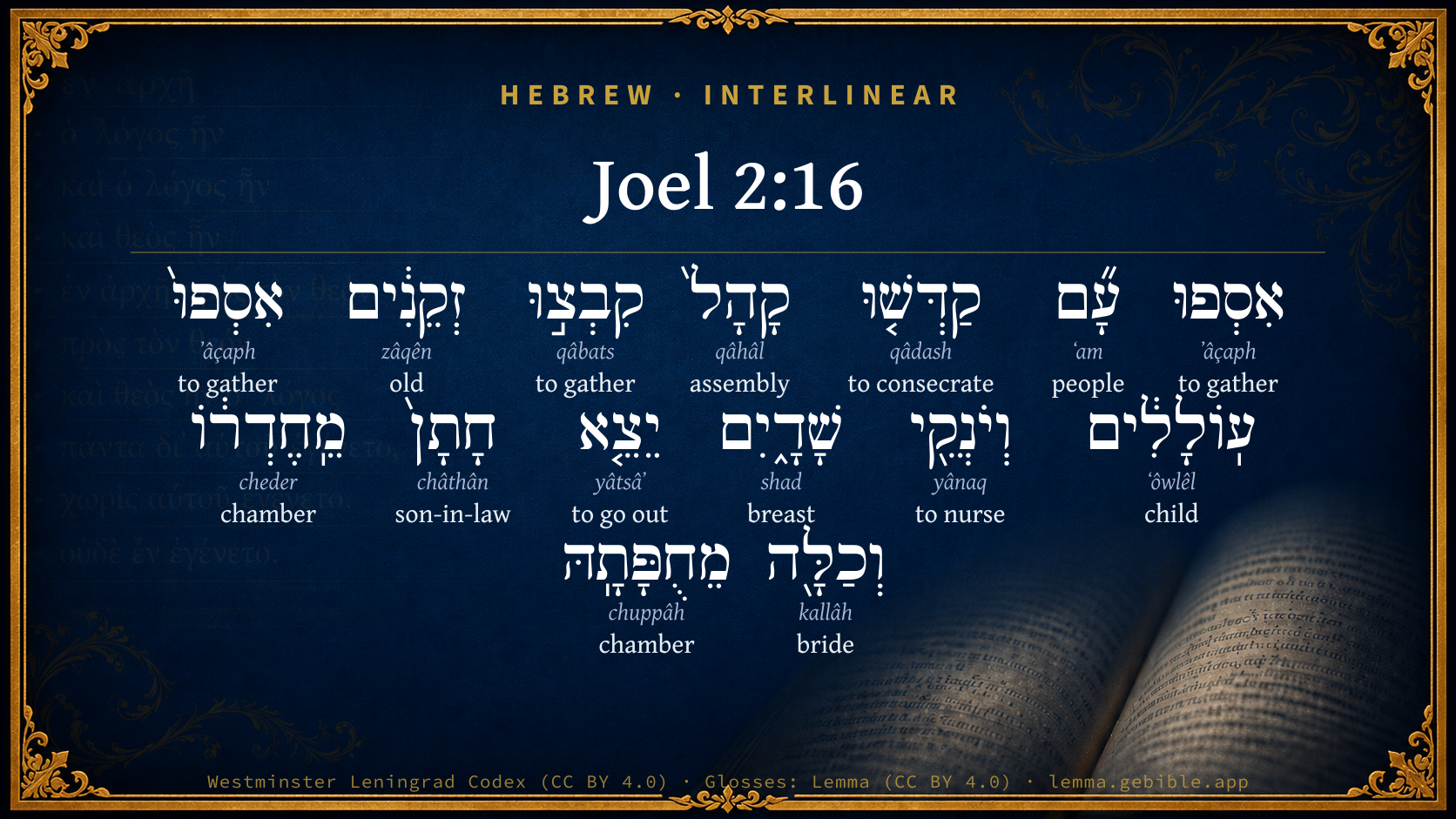
Joel 2:16

Hebrew (Westminster Leningrad Codex) Joel 2:16 appears in the Hebrew Old Testament. The text above is from the Westminster Leningrad Codex. Each word links to its Strong’s number, a concise gloss, and parsing drawn from the Open Scriptures Hebrew Bible morphology. Click any word for its full Brown-Driver-Briggs (BDB) entry.
Download image
Cite this verse

Joel 2:16 (World English Bible). Public Domain. Lemma interlinear Bible study tool, https://lemma.gebible.app/v/joel/2/16.

Show BibTeX & RIS
BibTeX
RIS
English Translation
Gather the people. Sanctify the assembly. Assemble the elders. Gather the children, and those who suck the breasts. Let the bridegroom go forth from his room, And the bride out of her chamber.
World English Bible · Public Domain
Download a study sheet

One document with this verse’s original text, its word-by-word gloss line, the meaning frame, cross-references with their text, attributed commentary, and full source and license credits — printable, and it pastes into notes with its structure intact.

This verse Autodidact and up

Study sheet (.html) Plain text (.txt)

A passage Seminary Student

Up to 50 verses in one chapter. A passage sheet keeps up to 6 commentary sources and 12 cross-references per verse, in the order this page ranks them, and says so on the sheet whenever that leaves anything out. Ask for a single verse and you get the Autodidact verse sheet above.

Everything on this page stays free to read, with no account — the sheet is a download of what is already on screen, not access to it.

Want to remove ads? Support Godless Engineer
Compare translations 3

The same verse in 3 English versions, stacked beneath the original-language interlinear above. Click any original word for its lexicon entry.

Each is an independent rendering of the whole verse — the interlinear is not word-aligned to these translations.

Highlighted words mark where these versions differ — a whole-verse word diff, not a word-by-word alignment.

  • World English Bible Public Domain
    Gather the people. Sanctify the assembly. Assemble the elders. Gather the children, and those who suck the breasts. Let the bridegroom go forth from his room, And the bride out of her chamber.
  • King James Version Public Domain
    Gather the people, sanctify the congregation, assemble the elders, gather the children, and those that suck the breasts: let the bridegroom go forth of his chamber, and the bride out of her closet.
  • unfoldingWord Literal Text CC BY-SA 4.0
    Gather the people, consecrate the congregation, assemble the elders, gather the children and the ones sucking the breasts. May the bridegroom come out from his chamber and the bride from her room.

unfoldingWord Literal Text — © unfoldingWord, licensed CC BY-SA 4.0. Word-aligned USFM3 via Door43 (git.door43.org/unfoldingWord/en_ult).

Versions to compare (up to 4)

3 of 4 selected

Show all 18 translations

Every available English version of this verse, each an independent rendering of the whole verse.

  • World English Bible Public Domain
    Gather the people. Sanctify the assembly. Assemble the elders. Gather the children, and those who suck the breasts. Let the bridegroom go forth from his room, And the bride out of her chamber.
  • Berean Standard Bible Public Domain
    Gather the people, sanctify the congregation, assemble the aged, gather the children, even those nursing at the breast. Let the bridegroom leave his room, and the bride her chamber.
  • Majority Standard Bible Public Domain
    Gather the people, sanctify the congregation, assemble the aged, gather the children, even those nursing at the breast. Let the bridegroom leave his room, and the bride her chamber.
  • King James Version Public Domain
    Gather the people, sanctify the congregation, assemble the elders, gather the children, and those that suck the breasts: let the bridegroom go forth of his chamber, and the bride out of her closet.
  • American Standard Version (1901) Public Domain
    gather the people, sanctify the assembly, assemble the old men, gather the children, and those that suck the breasts; let the bridegroom go forth from his chamber, and the bride out of her closet.
  • Revised Version (1885) Public Domain
    gather the people, sanctify the congregation, assemble the old men, gather the children, and those that suck the breasts: let the bridegroom go forth of his chamber, and the bride out of her closet.
  • Geneva Bible (1599) Public Domain
    Gather the people: sanctifie the congregation, gather the elders: assemble the children, and those that sucke the breastes: let the bridegrome go forth of his chamber, and the bride out of her bride chamber.
  • Douay-Rheims (1899) Public Domain
    Gather together the people, sanctify the church, assemble the ancients, gather together the little ones, and them that suck at the breasts: let the bridegroom go forth from his bed, and the bride out of her bride chamber.
  • Young's Literal Translation Public Domain
    Gather the people, sanctify an assembly, Assemble the aged, Gather infants and sucklings of the breasts, Go out let a bridegroom from his inner chamber, And a bride out of her closet.
  • Literal Standard Version CC BY-SA 4.0
    Gather the people, sanctify an assembly, || Assemble the aged, || Gather infants and sucklings of the breasts, || Let a bridegroom go out from his inner chamber, || And a bride out of her closet.
  • Unlocked Literal Bible CC BY-SA 4.0
    Gather the people, call for the holy assembly. Assemble the elders, gather the children and the nursing infants. Let the bridegrooms come out of their rooms, and the brides out of their bridal chambers.
  • unfoldingWord Literal Text CC BY-SA 4.0
    Gather the people, consecrate the congregation, assemble the elders, gather the children and the ones sucking the breasts. May the bridegroom come out from his chamber and the bride from her room.
  • Darby Bible Public Domain
    gather the people, hallow the congregation, assemble the elders, gather the children, and those that suck the breasts; let the bridegroom go forth from his chamber, and the bride from her closet.
  • World Messianic Bible Public Domain
    Gather the people. Sanctify the assembly. Assemble the elders. Gather the children, and those who nurse from breasts. Let the bridegroom go out of his room, and the bride out of her chamber.
  • Webster's Bible Public Domain
    Gather the people, sanctify the congregation, assemble the elders, gather the children, and those that suck the breasts: let the bridegroom go forth from his chamber, and the bride out of her closet.
  • Free Bible Version CC BY-SA 4.0
    Gather the people together: the elders, the children, even the babies. Let the bridegroom leave his room; let the bride leave her room.
  • Bible in Basic English Public Domain
    Get the people together, make the mass of the people holy, send for the old men, get together the children and babies at the breast: let the newly married man come out of his room and the bride from her tent.
  • JPS Tanakh (1917) Public Domain
    Gather the people, sanctify the congregation, assemble the elders, gather the children, and those that suck the breasts; let the bridegroom go forth from his chamber, and the bride out of her pavilion.

Literal Standard Version (2020), Covenant Press — licensed CC BY-SA 4.0. Text via the HelloAO Bible API (eBible.org). Unlocked Literal Bible (unfoldingWord) — licensed CC BY-SA 4.0. Text via the HelloAO Bible API (eBible.org). unfoldingWord Literal Text — © unfoldingWord, licensed CC BY-SA 4.0. Word-aligned USFM3 via Door43 (git.door43.org/unfoldingWord/en_ult). Free Bible Version, Dr. Jonathan Gallagher — licensed CC BY-SA 4.0. Text via the HelloAO Bible API (eBible.org).

Word by word

More ways to search: Search by grammar → Find every occurrence → Compare this word →

Practice this passage: Drill this verse → Learn its vocabulary →

מֵחֻפָּתָֽהּ
chuppâh
H2646
“from · chamber · her”
Preposition + Noun, Common, Feminine, Singular, Construct + Suffix, Personal, 3rd Person, Feminine, Singular
Part of Speech
Preposition + Noun
Type
Common
Gender
Feminine
Number
Singular
State
Construct
Full BDB Definition

Origin: from H2645

TWOT: 710b

chamber, room, canopy, closet - canopy - chamber - divine protection (figuratively)
  1. אִסְפוּ ʼâçaph H622 “gather” Verb, Qal, Imperative, 2nd Person, Masculine, Plural
  2. עָ֞ם ʻam H5971 “people” Noun, Common, Masculine, Singular, Absolute
  3. קַדְּשׁ֤וּ qâdash H6942 “consecrate” Verb, Piel, Imperative, 2nd Person, Masculine, Plural
  4. קָהָל֙ qâhâl H6951 “assembly” Noun, Common, Masculine, Singular, Absolute
  5. קִבְצ֣וּ qâbats H6908 “gather” Verb, Qal, Imperative, 2nd Person, Masculine, Plural
  6. זְקֵנִ֔ים zâqên H2205 “old” Adjective, Adjective, Masculine, Plural, Absolute
  7. אִסְפוּ֙ ʼâçaph H622 “gather” Verb, Qal, Imperative, 2nd Person, Masculine, Plural
  8. עֽוֹלָלִ֔ים ʻôwlêl H5768 “children” Noun, Common, Masculine, Plural, Absolute
  9. וְיֹנְקֵ֖י yânaq H3243 “and · nursing” Conjunction + Verb, Qal, Participle Active, Masculine, Plural, Construct
  10. שָׁדָ֑יִם shad H7699 “breasts” Noun, Common, Masculine, Dual, Absolute
  11. יֵצֵ֤א yâtsâʼ H3318 “to go out” Verb, Qal, Jussive, 3rd Person, Masculine, Singular
  12. חָתָן֙ châthân H2860 “son-in-law” Noun, Common, Masculine, Singular, Absolute
  13. מֵֽחֶדְר֔וֹ cheder H2315 “from · chamber · his” Preposition + Noun, Common, Masculine, Singular, Construct + Suffix, Personal, 3rd Person, Masculine, Singular
  14. וְכַלָּ֖ה kallâh H3618 “and · bride” Conjunction + Noun, Common, Feminine, Singular, Absolute

About this verse

These counts appear in no published source. They are computed here, from the morphology-tagged text and Lemma’s own curated glosses. What Lemma adds →

15
words
14
distinct lemmas
Prophets
section

Notable vocabulary

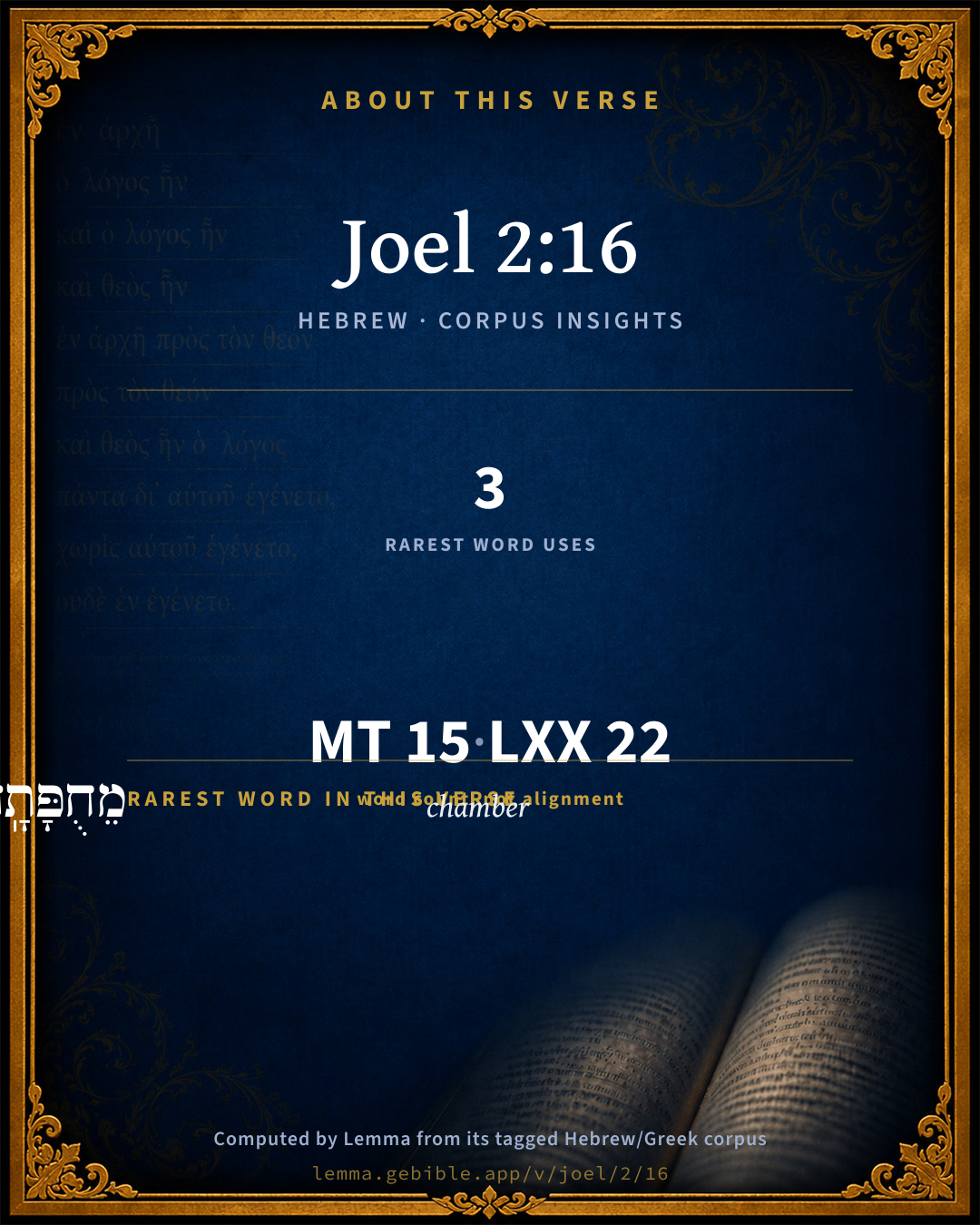
The rarest word here is מֵחֻפָּתָֽהּ chamber H2646 — appearing just 3 times in the whole Hebrew Bible.

Shared distinctive vocabulary

מֵחֻפָּתָֽהּ chamber H2646 occurs in 3 verses of the Hebrew Bible. Also found in:

Grammatical profile

  • 6 verbs
  • 8 nouns
  • 1 adjective

Verb forms

  • אִסְפוּ Qal · Imperative
  • קַדְּשׁ֤וּ Piel · Imperative
  • קִבְצ֣וּ Qal · Imperative
  • אִסְפוּ֙ Qal · Imperative
  • וְיֹנְקֵ֖י Qal · Participle Active
  • יֵצֵ֤א Qal · Jussive

Repetition

A word recurs within this verse — often emphatic in Hebrew:

  • אִסְפוּ to gather H622 ×2

Hebrew & Septuagint length

In English translation the verse runs 33 words from the Hebrew and 30 from the Septuagint (LXX English) — closely comparable.

A rough comparison of the two English renderings, which tokenize alike — not a word-level alignment.

Word counts can differ between the Hebrew and the Greek without any difference in meaning — e.g. the Hebrew direct-object marker אֵת has no separate Greek word, and Greek often adds the article ὁ.

In the original languages it is 15 Hebrew tokens and 22 Greek tokens — but the two are counted differently (Hebrew bundles its prefixes and suffixes into one token; the Greek is in lemma form), so that isn’t a like-for-like length.

Cross-references

19

Topical passages linked to Joel 2:16 in the Treasury of Scripture Knowledge — connected by theme and wording, ordered by reader-vote popularity; previews shown in the World English Bible.

  • 2 Chronicles 20:13 All Judah stood before Yahweh, with their little ones, their wives, and their children.
  • 2 Chronicles 29:5 and said to them, Hear me, you Levites; now sanctify yourselves, and sanctify the house of Yahweh, the God of your fathers, and carry forth the filthiness out of the holy place.
  • 1 Corinthians 7:5 Don't deprive one another, unless it is by consent for a season, that you may give yourselves to fasting and prayer, and may be together again, that Satan doesn't tempt you because of your lack of self-control.
  • Exodus 19:10 Yahweh said to Moses, "Go to the people, and sanctify them today and tomorrow, and let them wash their garments,
  • Exodus 19:22 Let the priests also, who come near to Yahweh, sanctify themselves, lest Yahweh break forth on them."
  • 1 Samuel 16:5 He said, Peaceably; I am come to sacrifice to Yahweh: sanctify yourselves, and come with me to the sacrifice. He sanctified Jesse and his sons, and called them to the sacrifice.
  • Joel 1:14 Sanctify a fast. Call a solemn assembly. Gather the elders, And all the inhabitants of the land, to the house of Yahweh, your God, And cry to Yahweh.
  • Exodus 19:15 He said to the people, "Be ready by the third day. Don't have sexual relations with a woman."
  • Deuteronomy 29:10–11 You stand this day all of you before Yahweh your God; your heads, your tribes, your elders, and your officers, even all the men of Israel,
  • Joshua 7:13 Up, sanctify the people, and say, Sanctify yourselves against tomorrow: for thus says Yahweh, the God of Israel, There is a devoted thing in the midst of you, Israel; you can not stand before your enemies, until you take away the devoted thing from among you.
  • 2 Chronicles 29:23–24 They brought near the male goats for the sin-offering before the king and the assembly; and they laid their hands on them:
  • 2 Chronicles 30:17 For there were many in the assembly who had not sanctified themselves: therefore the Levites had the charge of killing the Passovers for everyone who was not clean, to sanctify them to Yahweh.
  • 2 Chronicles 30:19 who sets his heart to seek God, Yahweh, the God of his fathers, though not [cleansed] according to the purification of the sanctuary.
  • 2 Chronicles 35:6 Kill the Passover, and sanctify yourselves, and prepare for your brothers, to do according to the word of Yahweh by Moses.
  • Job 1:5 It was so, when the days of their feasting had run their course, that Job sent and sanctified them, and rose up early in the morning, and offered burnt offerings according to the number of them all. For Job said, "It may be that my sons have sinned, and renounced God in their hearts." Thus did Job continually.
  • Psalms 19:5 Which is as a bridegroom coming out of his chamber, Like a strong man rejoicing to run his course.
  • Jonah 3:7–8 He made a proclamation and published through Nineveh by the decree of the king and his nobles, saying, "Let neither man nor animal, herd nor flock, taste anything; let them not feed, nor drink water;
  • Zechariah 12:11–14 In that day there will be a great mourning in Jerusalem, like the mourning of Hadadrimmon in the valley of Megiddon.
  • Matthew 9:15 Jesus said to them, "Can the friends of the bridegroom mourn, as long as the bridegroom is with them? But the days will come when the bridegroom will be taken away from them, and then they will fast.

Cross-references courtesy of OpenBible.info (CC BY 4.0).

Hebrew and Greek witnesses Masoretic Hebrew ↔ Greek Septuagint

The same verse in the two great witnesses to the Old Testament, shown verse-for-verse.

These are two independent witnesses, not word-aligned to each other, and the Septuagint is shown in lemma (dictionary) form.

Hebrew Joel 2:16 Masoretic · Westminster Leningrad Codex

אִסְפוּ עָ֞ם קַדְּשׁ֤וּ קָהָל֙ קִבְצ֣וּ זְקֵנִ֔ים אִסְפוּ֙ עֽוֹלָלִ֔ים וְיֹנְקֵ֖י שָׁדָ֑יִם יֵצֵ֤א חָתָן֙ מֵֽחֶדְר֔וֹ וְכַלָּ֖ה מֵחֻפָּתָֽהּ

Gather the people. Sanctify the assembly. Assemble the elders. Gather the children, and those who suck the breasts. Let the bridegroom go forth from his room, And the bride out of her chamber.

World English Bible · Public Domain

Greek LXX Joel 2:16 Septuagint · lemma form

συνἄγω λαός ἁγιάζω ἐκκλησία ἐκλέγω πρεσβύτερος συνἄγω νήπιος θηλάζω μαστός ἐκἔρχομαι νυμφίος ἐκ ὁ κοιτών αὐτός καί νύμφη ἐκ ὁ παστός αὐτός

gather the people, sanctify the congregation, assemble the elders, gather the infants at the breast: let the bridegroom go forth of his chamber, and the bride out of her closet.

LXX2012 (modern English Septuagint) · Public Domain

Hebrew: Westminster Leningrad Codex (CC BY 4.0). Greek: Septuagint (public domain); English from LXX2012 (modern English Septuagint) (Public Domain). How the Septuagint differs from the Hebrew →

Targum (Aramaic paraphrase)

1

The Targum is the ancient Jewish Aramaic paraphrase of the Hebrew Scriptures — an interpretive translation, not the Hebrew text itself. Onkelos (literal) and Pseudo-Jonathan (expansive) render the Torah, and Jonathan the Prophets. Coverage is partial: where no permissively-licensed English translation exists for a verse, only the Aramaic is shown. This is verse-level text, not a word-by-word alignment to the Hebrew.

  1. Targum Jonathan Prophets (Joshua–Malachi)
    כְּנָשׁוּ עַמָא זַמִינוּ קְהָלָא כְּנוּשׁוּ סָבַיָא אַיְתוּ טָלַיָא וְיַנְקֵי חַדְיָא יִפּוֹק חֲתָנָא מֵאִידְרוֹן בֵּית מִשְׁכְּבֵיהּ וְכַלָתָא מִבֵּית גְנוּנָהָא:

    (no public-domain English translation for this verse)

    Targum Jonathan — Aramaic: “Mikraot Gedolot” (public domain). English: “Sefaria Community Translation” (CC0 1.0 (public-domain dedication)); “London "Chaldee Paraphrase," 1871” (public domain). Text via Sefaria.

Commentary

Notes on Joel 2:16 from classic Christian and Jewish commentators (each source and its license shown beneath its notes). The classic Christian expositions comment on the surrounding passage and are grouped to its opening verse, so a note may address several verses; the Jewish commentaries on the Tanakh (Rashi and others) are per-verse, so they appear only where the commentator wrote on this verse.

Lemma curates 59 commentaries, every one of them public domain or Creative Commons licensed, each selected and text-cleaned for this edition rather than reprinted as found. About our sources →

Trapp's Complete Commentary

John Trapp

Joe 2:16 Gather the people, sanctify the congregation, assemble the elders, gather the children, and those that suck the breasts: let the bridegroom go forth of his chamber, and the bride out of her closet.

Ver. 16. Gather the people, sanctify the congregation, &c.] Let the priests, God’s ministers, see to it, that the people come together; and for the better too, as much as in them lies. For they are to the people in place of watchmen, of sentinels, of ambassadors, and in Christ’s own stead, who seems to say unto them, as Psa 50:5, "Gather my saints together unto me, those that have made a covenant with me by sacrifice," that they may meet me with entreaties of peace, disarm mine indignation conceived against them, and quench the flame thereof with their tears; not quench the spirit in their teachers by their crossness and backwardness to business of this nature.

Assemble the elders] Whether for age, as Job 15:10, or for place of authority, as Jos 7:6 1Sa 15:30 Rth 4:4. These must be chief doers and most forward at fasts, as was Joshua, Jehoshaphat, the King of Nineveh, Ezra, &c. For, 1. They are most guilty in regard of their years and their office, which either addeth two wings to their sins, viz., example and scandal, whereby facile volant, non facile violant, they soar much higher, and fly much farther; 2. Their presence, counsel, and countenance may be a great furtherance to the work. See Eze 46:10. The prince in the midst of the people, when they go in shall go in; and when they go forth shall go forth. A. Lapide saith, that the elder sort are to meet, because they are least lustful and more prayerful. It should be so, I confess; but how many old goats are there abroad that even hang over hell, which gapeth for them? and as the canker soonest entereth into the white rose, so doth corruption easily creep into the white head. He was a rare old man of whom we read, that being tempted to sin said, Nay: lest he should stain his white head.

Gather the children, and those that suck the breasts] For they are Church members, and to them also pertain the public dangers and calamities; out of which times and cases, children and novices are not to be tied to these austerities of religion (as our Saviour showeth, Mat 9:17), as little, as new wine is to be put into old vessels. Add hereunto, that the parents might by the sight of their poor children (subject to God’s wrath by their default) be brought to a farther sense of their own sinfulness; and moved by their cries and laments ut ferventius orent, et plorent, to cry and pray more earnestly, Eph 2:3 Rom 5:12.

Let the bridegroom go forth of his chamber] The newly married man was by the law allowed to cheer up his wife, Deu 24:5, and therefore exempted from warfare and other public employments abroad, Deu 20:7, and the wedding day is called the "day of the rejoicing of a man’s heart," Son 3:11. They were wont to have a week of feasting at such times, Gen 29:27. Fulfil her week, sc. of banquet and bride’s ale, as they call it. And it is noted as an absurd thing in Samson’s wife, that she wept all the seven days of such a feast, when mirth was so much in season, Jdg 14:17. But is it a time for men to hang their hearts upon the merry pin when God calls them to hang up their harps upon the willow trees? when the sword is sharpened to make a sore slaughter, when it is furbished and glittereth, and contemneth the rod (i.e. lesser and lighter judgments that usually forerun it), should we then make mirth? Eze 21:10. Should men eat, and drink, and marry, and be merry, when tomorrow they may look to die, and are already stumbling in the valley of the shadow of death? Such a thing the old world may do, buried in security, and to be shortly therefore buried in one universal grave of waters. But holy Noah was vexed at it; and Ambrose thinks (not without reason) that during the time of the Deluge, all the while that he was in the ark, he came as little at his wife as Uriah did while the ark and Judah and Israel abode in tents, and Joab and the host encamped in the fields, 2Sa 11:11. Nehemiah, though a great courtier, and the king’s cupbearer, could not but be sad when it went ill with the Church; all comforts then were but Ichabods to him, he had no joy of them, Neh 2:2-3. Sorrow at such a time is better than laughter; for by the sadness of the countenance the heart is made better, Ecc 7:3. The mad world is a perfect stranger to the truth of this sacred position, as having so far banished sadness, that they are professed enemies to seriousness; and stick not to light a candle at the devil (as they say), for sinful lightsomeness. But woe be to such mad mirthmongers, saith our Saviour, Luk 6:25, and after him St James, Jas 5:1; Jas 5:5, and before them both, the prophet Isaiah, Isa 22:12-14, and the prophet Amos, Amo 6:4; Amo 6:6. What so lawful as the use of the marriage bed? Heb 13:4; and for whom more lawful than for the bridegroom and bride? Yet in a common calamity, and in a day of restraint (as a fast day is called, Joe 2:15), married couples must abstain, 1Co 7:5, where the apostle speaketh of a public fast, as Peter Martyr observeth. Hence, Zec 8:19, they separated themselves at such a time. And it is spoken of as a foul sin, Isa 58:3, "Behold, in the day of your fast ye find pleasure." All sensual delights, though never so lawful at other times, must be then suspended and laid aside; as music, mirth, perfumes, Dan 6:18, brave apparel, Exo 33:4, all ornaments of the body, soft lying, 2Sa 12:16, all cheerfulness and outward joy, Jdg 20:26 1Sa 7:8. The Roman censor punished one that showed himself out of a window with a garland upon his head in the time of the second Punic war.

John Trapp, A Commentary or Exposition upon All the Books of the Old and New Testament (1647–1656) — public domain. Text from a community e-Sword module.

Tyndale Open Study Notes

Tyndale Open Resources

2:16 bridegroom . . . and the bride: Newlyweds were exempt from most civic duties in ancient Israel (Deut 24:5; Luke 14:20), but in this emergency, everyone would be summoned to the Temple to cry out to God.

Tyndale Open Study Notes — © Tyndale Open Resources, licensed CC BY-SA 4.0. Text via the HelloAO Bible API.

Geneva Bible (1599)

Geneva Bible translators

That as all have sinned, so all may show forth signs of their repentance, that men seeing the children which are not free from God’s wrath, might be the more lively touched with the consideration of their own sins.

Geneva Bible (1599) marginal notes — public domain. Text via Bolls.life.

Jamieson, Fausset & Brown

Robert Jamieson, A. R. Fausset & David Brown

sanctify the congregation--namely, by expiatory rites and purification with water [CALVIN], (Exo 19:10, Exo 19:22). MAURER translates, "appoint a solemn assembly," which would be a tautological repetition of Joe 2:15.

elders . . . children--No age was to be excepted (Ch2 20:13).

bridegroom--ordinarily exempted from public duties (Deu 24:5; compare Co1 7:5, Co1 7:29).

closet--or, nuptial bed, from a Hebrew root "to cover," referring to the canopy over it.

Jamieson, Fausset & Brown — Commentary Critical and Explanatory on the Whole Bible (1871) — public domain (CC PDM 1.0). Text via the HelloAO Bible API.

Adam Clarke's Commentary

Verse 16. Gather the children] Let all share in the humiliation, for all must feel the judgment, should it come. Let no state nor condition among the people be exempted. The elders, the young persons, the infants, the bridegroom, and the bride; let all leave their houses, and go to the temple of God.

Adam Clarke's Commentary on the Bible (1810–1826) — public domain. Text from a community e-Sword/MySword module.

John Calvin's Commentaries

Proclaim, he says, a meeting עצרה otsare is not properly an assembly, but the deed itself: hence also the word is transferred to festivals. Proclaim, then, a meeting, call the people, sanctify the assembly. The word, sanctify, seems to be taken here in a sense different from what it had been before. The people, in order to engage in holy services, performed those rites, as it is well known, by which they cleansed themselves from their pollutions. No one entered the temple without washing; and no one offered a sacrifice without abstaining from an intercourse with his wife. The Prophet then alludes to these legal purgations when he says Sanctify the assembly.

He afterwards adds, Bring together the old, gather the young sucking the breasts. With regard to the old, we have said before that they are separately named, because they ought to have taken the lead by their example; and further a greater guilt belonged to them, for we know that it is a duty incumbent on the old to govern others, and, as it were, to hold the reins. But when the old themselves become dissolute, and restrain not the lusts of the young, they are doubly culpable before God. It is no wonder then that the Prophet bids here the old to be called; for it became them to be the leaders of others in confessing their repentance. But what follows seems strange. He would have the young, sucking the breasts, to be assembled. Why are these brought in as involved in guilt? Besides, the people were to own their repentance; and yet infants are without understanding and knowledge; so that they could not humble themselves before God. It must, then, have been a mockery and a vain show; nay, the Prophet seems to encourage the people in hypocrisy by bidding young infants to assemble together with men and women. To this I answer, that children ought to have been brought together, that those grown up and advanced in years might through them perceive what they deserved; for the wrath of God, we know, reached to the very infants, yea, and to brute animals: when God puts forth his hand to punish any people, neither asses nor oxen are exempt from the common scourge. Since, then, God’s wrath comes upon brute animals and upon young infants, it is no wonder that the Lord bids all to come forth publicly and to make a confession of repentance; and we see the same to have been the case with brute animals; and when, if the Lord grants, we shall come to the Prophet Jonah, we shall then speak on this subject. The Ninevites, when they proclaimed a fast, not only abstained themselves from meat and drink, but constrained also their oxen and horses to do the same. Why? Because the very elements were involved, as it were, with them in the same guilt: “Lord, we have polluted the earth; whatever we possess we have also polluted by our sins; the oxen the horses, and the asses, are in themselves innocent, but they have contracted contagion from our vices: that we may therefore obtain mercy, we not only offer ourselves suppliantly before thy face, but we bring also our oxen and horses; for if thou exercises the fullest severity against us, thou wilt destroy whatever is in our possession.” So also now, when the Prophet bids infants to be brought before God, it is done on account of their parents. Infants were in themselves innocent with regard to the crimes of which he speaks; but yet the Lord could have justly destroyed the infants together with those of advanced age. It is then no wonder that in order to pacify God’s wrath the very infants are summoned with the rest: but as I have already said, the reason is on account of their parents, that the parents themselves might perceive what they deserved before God, and that they might the more abhor their sins by observing that God would take vengeance on their children, except he was pacified. For they ought to have reasoned from the less to the greater: “See, if God exercises his own right towards us, there is destruction not only hanging over us, but also over our children; if they are guilty through our crimes, what can we say of ourselves, who are the authors of these evils? The whole blame belongs to us; then severe and dreadful will be God’s vengeance on us, except we be reconciled to him.”

We now then perceive why infants were called, together with their parents; not that they might confess their penitence, as that was not compatible with their age, but that their parents might be more moved, and that such a sight might touch their feelings, and that dread might also seize them on seeing that their children were doomed to die with them for no other reason, but that by their contagion and wickedness they had infected the whole land and everything that the Lord had bestowed on them.

He afterwards subjoins, Let the bridegroom go from his closet, or recess, and the bride from her chamber. It is the same as though the Prophet had bidden every joy to cease among the people; for it was of itself no evil to celebrate nuptials; but it behooved the people to abstain from every rejoicing on seeing the wrath of God now suspended over them. Hence, things in themselves lawful ought for a time to be laid aside when God appears angry with us; for it is no season for nuptials or for joyful feasts, when God’s wrath is kindled, when the darkness of death spreads all around. No wonder, then, that the Prophet bids the bridegroom and the bride to come forth from their chamber, that is, to cast aside every joy, and to defer their nuptials to a more suitable time, and now to undergo their delights, for the Lord appeared armed against all. It would have been then to provoke, as it were, His wrath, to indulge heedlessly in pleasures, when he wished not only to terrify, but almost to frighten to death those who had sinned; for when the Lord threatens vengeance, what else is indifference but a mockery of his power? “I have called you to weeping and wailing; but ye have said, ‘We will feast:’ as I live, saith the Lord, this iniquity shall never be blotted out.” We see how extremely displeased the Lord appears there to be with those who, having been called to weeping and fasting, did yet indulge themselves in their pleasures; for such, as I have said, altogether laugh to scorn the power of God. The Prophet’s exhortation ought then to be noticed, when he bids the bridegroom and the bride to leave their nuptials, and to put on the same mournful appearance as the rest of the people. He thus shook off heedlessness from all, since God had appeared with tokens of his wrath. This is the sum of the whole.

John Calvin's Commentaries (1540-1563) — public domain. Text from the Calvin Translation Society English edition (1840s-50s) via the Christian Classics Ethereal Library (ccel.org). Calvin's coverage is partial (roughly two-thirds of the Bible); uncommented books and verses are honest gaps, never fabricated. The 19th-century editor's footnotes and remarks are omitted so the notes are faithfully Calvin's own voice.

The Cambridge Bible for Schools and Colleges

gen. ed. J. J. S. Perowne

16. An expansion of the injunctions contained in the rest of Joe_1:14 a.

sanctify an assembly] i.e. hold a sacred religious meeting.

gather the elders] the old men (R.V. marg.). All are to take part in the great public act of national humiliation and supplication, neither old men nor children are to be excepted; even the newly married bride and bridegroom, who might deem themselves entitled to claim exemption from such duties (cf. Deu_24:5), are to come forth from their retirement for the purpose.

closet] rather, pavilion; the idea suggested by ‘closet’ is too modern. The reference is no doubt to the special nuptial tent (cf. 2Sa_16:22), still, in Arabia, erected for the consummation of a marriage. In Arabic a common phrase for ‘to marry a wife’ is ‘to build over her’ (sc. a tent, with reference to this custom). The later bridal bed, with its canopy, appears to be a survival of the more primitive ‘tent’[40]. Ḥuppâh is a rare word in Hebrew: in Psa_19:5 it is spoken of also as the bridegroom’s. Here ḥéder (‘chamber’), in the parallel clause, appears to be merely a poetical synonym of it[41].

[40] See W. R. Smith, Marriage and Kinship in Early Arabia, pp. 167–170, 291; Wellhausen’s essay, Die Ehe bei den Arabern in the Göttingen Nachrichten, 1893, No. 11, p. 444 f.; and Levy’s Neuhebr. Wörterbuch, s. v. נִּנּוּן (1:348), and חוּפָּה (2:92).

[41] Cf. Jdg_14:18, where החדֵרה should probably be read for החרסה, “before he went into the bride-chamber”

The Cambridge Bible for Schools and Colleges (gen. ed. J. J. S. Perowne; Cambridge University Press, 1878–1918) — public domain. Text from a community e-Sword module.

John Gill's Exposition

Gather the people,.... The common people, all the inhabitants of the land, Joe 1:14; summon them to meet together in the temple, in order to humble themselves before God for their sins, and implore his mercy, and seek his face to remove his judgments, or avert them:

sanctify the congregation; see that they are sanctified and prepared for a fast, as the law directs in such cases; that they may be clean and free from all ceremonial impurities; that their bodies and clothes be washed, and that they abstain from their wives, and from all lawful pleasures, as well as sinful ones:

assemble the elders; both in age and authority; that they, by their presence and example, might influence others to attend such a service:

gather the children and those that suck the breast; who were involved in the common calamity and distress, were obliged to fasting and whose cries might affect parents, and engage them the more to humiliation and repentance for their sins, which brought such, miseries, not only upon themselves, but upon their tender infants; and they might think their cries would move the pity and compassion of God; all which is suggested in the note of Kimchi:

let the bridegroom go forth of his chamber, and the bride out of her closet; where they are adorning themselves and preparing for an interview with each other; or where they are enjoying each other's embraces and the pleasures of the matrimonial state. The sense is, let them put off their nuptial robes, and deny themselves their lawful pleasures, and betake themselves to fasting mourning, and prayer; see Co1 7:5. This refers to a custom among the Jews at the time of espousals when the bridegroom and bride were introduced into the nuptial chamber, where the marriage was completed; and, according to the Jewish writes it was not finished before: the blessing of the bridegroom and bride did not complete the marriage but the bringing of them into the chamber did; and then they were said to he married, though as yet they had not cohabited and then, and not before a man might enjoy his wife (x): and the marriage chamber was nothing else but a linen cloth or garment spread upon four poles over the head of the bridegroom and bride; this they called (y); the word is here rendered a "closet" and the same with the "chamber"; and their leaving and coming out of this signifies their abstaining from the lawful enjoyment of each other, which now they had a right unto.

(x) Maimon. Hilchot Ishot, c. 10. sect. 2, 4. Schulchan Aruch, par. 2. Eben Hezer, c. 55. sect. 2, 3. (y) R. Elias Levita, Tishbi in p. 119.

John Gill's Exposition of the Whole Bible (1746–1763) — public domain (CC PDM 1.0). Text via the HelloAO Bible API.

Albert Barnes' Notes on the Bible

Sanctify the congregation - o: “Do what in you lies, by monishing, exhorting, threatening, giving the example of a holy life, that the whole people present itself holy before its God” , “lest your prayers be hindered, and a little leaven corrupt the whole lump.”

Assemble the elders - o: “The judgment concerned all; all then were to join in seeking mercy from God. None were on any pretence to be exempted; not the oldest, whose strength was decayed, or the youngest, who might seem not yet of strength.” The old also are commonly freer from sin and more given to prayer.

Gather the children - o: “He Who feedeth the young ravens when they cry, will not neglect the cry of poor children. He assigns as a reason, why it were fitting to spare Nineveh, the “six-score thousand persons that could not discern between their right hand and their left” Jon 4:11. The sight of them who were involved in their parents’ punishment could not but move the parents to greater earnestness. So when Moab and Ammon 2Ch 20:1-4, 2Ch 20:13, a great multitude, came against Jehoshaphat, he proclaimed a fast throughout all Judah, and Judah gathered themselves together to ask help of the Lord; even out of all the cities of Judah, they came to seek the Lord. And all Judah was standing before the Lord, their little ones also, their wives, and their children.” So it is described in the book of Judith, how “with great vehemency did they humble their souls, both they and their wives and their children - and every man and woman and the little children - fell before the temple, and cast ashes upon their heads and spread out their sackcloth before the Face of the Lord” (Judith 4:9-11).

Let the bridegroom go forth - He says not even, the married, or the newly married, he who had taken a new wife, but he uses the special terms of the marriage-day, “bridegroom” and “bride.” The new-married man was, during a year, exempted from going out to war, or from any duties which might “press upon him” Deu 24:5. But nothing was to free from this common affliction of sorrow. Even the just newly married, although it were the very day of the bridal, were to leave the marriage-chamber and join in the common austerity of repentance. It was mockery of God to spend in delights time consecrated by Him to sorrow. He says, “In that day did the Lord God of hosts call to weeping, and to mourning, and to baldness, and to girding with sackcloth. And behold joy and gladness - surely this iniquity shall not be purged from you until ye die, saith the Lord God of Hosts” Isa 22:12-14. Whence, in times of fasting or prayer, the Apostle suggests the giving up of pure pleasures, “that ye may give yourselves to fasting and prayer” 1Co 7:5.

: “He then who, by chastisement in food and by fasting and alms, says that he is doing acts of repentance, in vain doth he promise this in words, unless he “go forth out of his chamber” and fulfill a holy and pure fast by a chaste penitence.”

Albert Barnes' Notes on the Bible (1834–1885) — public domain. Text from a community e-Sword/MySword module.

Haydock's Catholic Bible Commentary

Sanctify. Let all make themselves ready to appear. --- Ones. Their cries would make an impression on men, and prevail on God to shew mercy, Judith iv. 9.

George Leo Haydock (1774–1849), Haydock's Catholic Family Bible and Commentary, 1859 edition — public domain. Excludes Psalms (Douay-Rheims chapter numbering differs from Protestant) and Deuterocanonical books (Catholic canon only).

Matthew Poole's English Annotations

Gather the people, assemble the elders: see Joe 1:14.

Gather the children; though they understand little what is done, yet their cries under the affliction of a fast ascend, God hears, and with pity looks on their tears.

And those that suck the breasts; let your fast be most universal, spare not sucking children, bring them with you; their tears and cries may perhaps move the congregation to greater mourning and earnest supplication to God for mercy, or will be a fit object to present unto the God of mercy to move him to show mercy. So the Ninevites, Jon 3:7,8.

Let the bridegroom go forth of his chamber; let the new-married man leave the mirth of the nuptials, and lay aside his bravery awhile, and afflict himself with the rest.

And the bride out of her closet, or chamber, in which with the virgins she adorned herself or caressed them. That these may more earnestly seek the Lord, let them at this season forbear lawful delights.

Matthew Poole's English Annotations on the Holy Bible (1683–1685) — public domain. Text from a community e-Sword/MySword module.

The Pulpit Commentary

Elders and children.

The occasion is serious. National disaster seems imminent. What shall be done to turn away Divine anger? Let the people be summoned to meet in solemn assembly, and by fasts and prayers let them address themselves to the Divine compassion. And that it may be a truly national and popular act of religion, let no class, no sex, no age, be omitted from the summons, or exempted from the exercises of devotion and intercession. Thus ciders and children are, upon Divine authority, associated in holy services.

I OLD AND YOUNG ARE ALIKE PARTAKERS OF THE DIVINE BOUNTY, ALIKE OBJECTS OF DIVINE CARE.

II OLD AND YOUNG ARE ALIKE POSSESSED OF SPIRITUAL CAPACITIES AND FACULTIES. It is sometimes taken for granted that children, because of imperfect knowledge and undeveloped intellect, are incapable of any serious part in the religious exercises of the Church. But intelligence is relative. Is not the "grey barbarian lower than the Christian child"? Is not the full-grown man but a babe when compared with heavenly intelligences? Faith is often stronger and prayer is often more genuine in the child than in the adult.

III OLD AND YOUNG ARE ALIKE NECESSARY TO THE COMPLETENESS OF SOCIAL LIFE. It has often and justly been said, that a community without children would be scarcely human. Providence has so ordered society that those of all ages should live together in mutual intercourse. And no religion can afford to leave out of sight those who are growing up to be the men and women of the next generation. It would indeed be unwise, even ruinous, to so adapt the language and the thoughts in prayer, praise, or meditation to the capacities of the young, as to estrange the mature and intellectual from the services of the Church. Yet there must be milk for babes, as well as meat for strong men. The admonition of the text should reach the ears especially of Christian ministers, "Gather the children. T.

The Pulpit Commentary (1880–1919), ed. H.D.M. Spence-Jones & Joseph S. Exell — public domain. Text from a community e-Sword module.

John Wesley's Explanatory Notes

The children - Though they understand little what is done, yet their cities ascend, and God with pity looks on their tears. These that suck - Their cries and tears may perhaps move the congregation to more earnest supplication to God for mercy. So the Ninevites, Jonah iii, 7, 8. The bridegroom - Let the new married man leave the mirth of the nuptials and afflict himself with the rest.

John Wesley, Explanatory Notes Upon the Whole Bible (1754–1765) — public domain. Text via the GEBible commentary corpus.

Rashi

Rabbi Shlomo Yitzchaki (Rashi)

assemble the elders Heb. קִבְצוּ. This is of the form of (I Kings 18:19) “Send and gather (קְבֹץ) for me,” an expression which is weak and light.

Rashi on the Tanakh — English translations: “The Judaica Press complete Tanach with Rashi, translated by A. J. Rosenberg” (CC BY 4.0); “Pentateuch with Rashi's commentary by M. Rosenbaum and A.M. Silbermann, 1929-1934” (public domain); “The Metsudah Tanach series, Lakewood, N.J” (CC BY 4.0); and “The Book of Joshua, Metsudah Publications, 1997” (CC BY 4.0). Text via Sefaria.

Lesson kit

Teaching starters — assembled from the data on this page, not authored interpretation. Every prompt links to the verse data it draws on. Edit before teaching.

Joel, in the Prophets, opens this verse with 15 words (14 distinct Hebrew lemmas). Its most distinctive word is chuppâh (“chamber”). A historical commentator’s framing appears above. Read the whole chapter for the surrounding context.

Discussion questions

  1. How does “chamber” (chuppâh) shape what this verse is saying?
  2. How does Psalms 19:5, which shares the word «chamber», read alongside this verse?
  3. What does the repetition of “to gather” (2× in this one verse) do in this verse?
  4. These translations render this verse differently; the difference is in the English rendering, not the original. What questions does that raise?
  5. «אִסְפוּ» is a Qal Imperative verb. How does that grammatical form shape the action described?
  6. Compare how Trapp's Complete Commentary and Tyndale Open Study Notes read this verse. Where do they agree or differ?

Things to notice

Reading settings

Reading text

Shown beneath each verse's original-language words.

Old Testament
Old Testament edition

Read the OT as the Masoretic Hebrew (MT) or the Greek Septuagint (LXX).

English shown for the Greek Septuagint (in the Hebrew ↔ Greek comparison).

Comparing translations? Open the Compare panel on any verse page to stack up to four side by side.