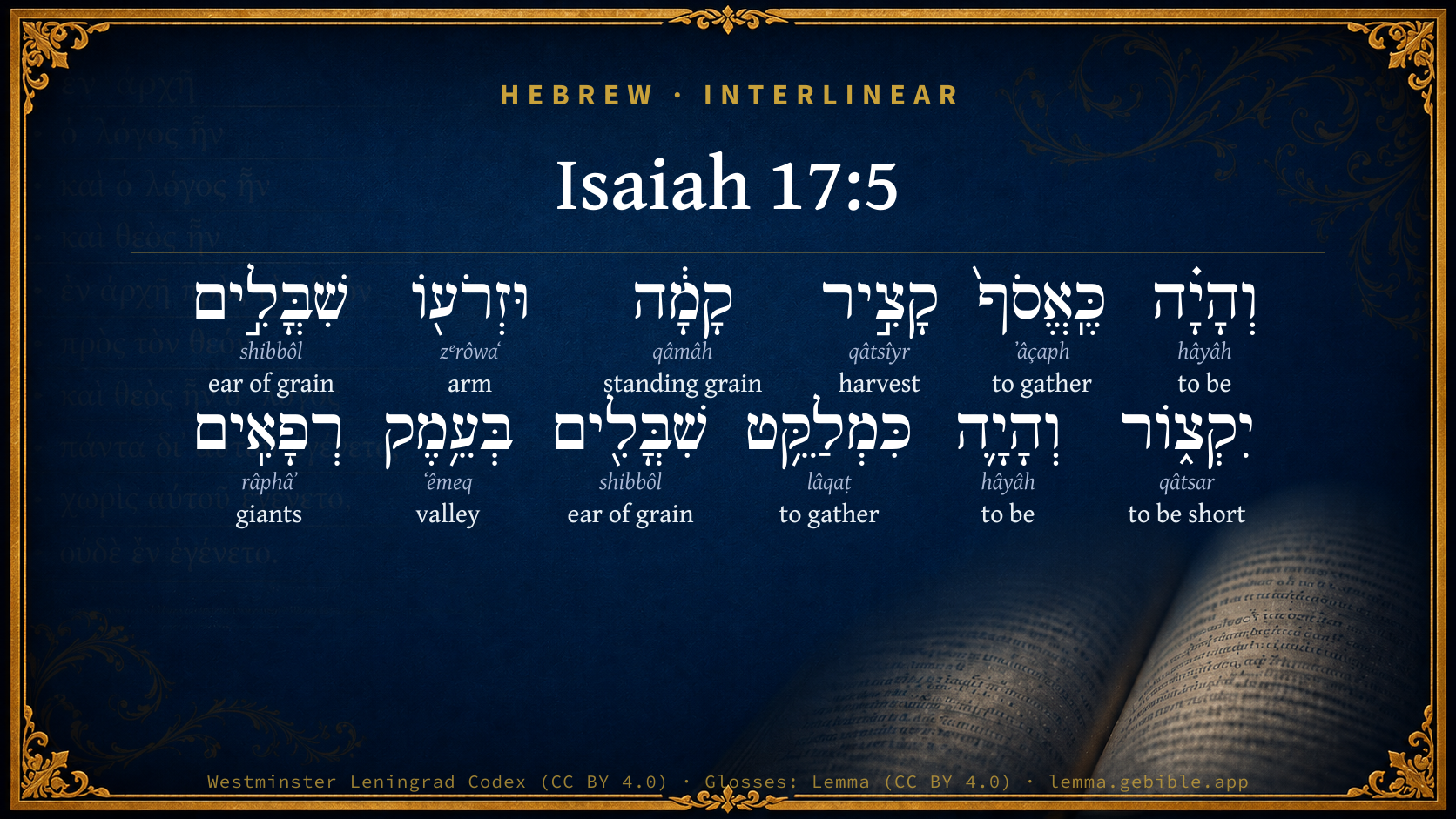
Isaiah 17:5

Hebrew (Westminster Leningrad Codex) Isaiah 17:5 appears in the Hebrew Old Testament. The text above is from the Westminster Leningrad Codex. Each word links to its Strong’s number, a concise gloss, and parsing drawn from the Open Scriptures Hebrew Bible morphology. Click any word for its full Brown-Driver-Briggs (BDB) entry.
Download image
Cite this verse

Isaiah 17:5 (World English Bible). Public Domain. Lemma interlinear Bible study tool, https://lemma.gebible.app/v/isaiah/17/5.

Show BibTeX & RIS
BibTeX
RIS
English Translation
It shall be as when the harvester gathers the standing grain, and his arm reaps the ears; yes, it shall be as when one gleans ears in the valley of Rephaim.
World English Bible · Public Domain
Download a study sheet

One document with this verse’s original text, its word-by-word gloss line, the meaning frame, cross-references with their text, attributed commentary, and full source and license credits — printable, and it pastes into notes with its structure intact.

This verse Autodidact and up

Study sheet (.html) Plain text (.txt)

A passage Seminary Student

Up to 50 verses in one chapter. A passage sheet keeps up to 6 commentary sources and 12 cross-references per verse, in the order this page ranks them, and says so on the sheet whenever that leaves anything out. Ask for a single verse and you get the Autodidact verse sheet above.

Everything on this page stays free to read, with no account — the sheet is a download of what is already on screen, not access to it.

Want to remove ads? Support Godless Engineer
Compare translations 3

The same verse in 3 English versions, stacked beneath the original-language interlinear above. Click any original word for its lexicon entry.

Each is an independent rendering of the whole verse — the interlinear is not word-aligned to these translations.

Highlighted words mark where these versions differ — a whole-verse word diff, not a word-by-word alignment.

  • World English Bible Public Domain
    It shall be as when the harvester gathers the standing grain, and his arm reaps the ears; yes, it shall be as when one gleans ears in the valley of Rephaim.
  • King James Version Public Domain
    And it shall be as when the harvestman gathereth the corn, and reapeth the ears with his arm; and it shall be as he that gathereth ears in the valley of Rephaim.
  • unfoldingWord Literal Text CC BY-SA 4.0
    And it will be like a harvester gathering standing grain, and his arm reaps heads. And it will be like the gleaning of heads in the Valley of the Raphaites.

unfoldingWord Literal Text — © unfoldingWord, licensed CC BY-SA 4.0. Word-aligned USFM3 via Door43 (git.door43.org/unfoldingWord/en_ult).

Versions to compare (up to 4)

3 of 4 selected

Show all 18 translations

Every available English version of this verse, each an independent rendering of the whole verse.

  • World English Bible Public Domain
    It shall be as when the harvester gathers the standing grain, and his arm reaps the ears; yes, it shall be as when one gleans ears in the valley of Rephaim.
  • Berean Standard Bible Public Domain
    as the reaper gathers the standing grain and harvests the ears with his arm, as one gleans heads of grain in the Valley of Rephaim.
  • Majority Standard Bible Public Domain
    as the reaper gathers the standing grain and harvests the ears with his arm, as one gleans heads of grain in the Valley of Rephaim.
  • King James Version Public Domain
    And it shall be as when the harvestman gathereth the corn, and reapeth the ears with his arm; and it shall be as he that gathereth ears in the valley of Rephaim.
  • American Standard Version (1901) Public Domain
    And it shall be as when the harvestman gathereth the standing grain, and his arm reapeth the ears; yea, it shall be as when one gleaneth ears in the valley of Rephaim.
  • Revised Version (1885) Public Domain
    And it shall be as when the harvestman gathereth the standing corn, and his arm reapeth the ears; yea, it shall be as when one gleaneth ears in the valley of Rephaim.
  • Geneva Bible (1599) Public Domain
    And it shalbe as when the haruest man gathereth the corne, and reapeth the eares with his arme, and he shall be as he that gathereth the eares in the valley of Rephaim.
  • Douay-Rheims (1899) Public Domain
    And it shall be as when one gathereth in the harvest that which remaineth, and his arm shall gather the ears of corn: and it shall be as he that seeketh ears in the vale of Raphaim.
  • Young's Literal Translation Public Domain
    And it hath come to pass, As the gathering by the reaper of the standing corn, And his arm the ears reapeth, And it hath come to pass, As the gathering of the ears in the valley of Rephaim,
  • Literal Standard Version CC BY-SA 4.0
    And it has come to pass, || As the gathering of the standing grain by the reaper, || And his arm reaps the ears, || And it has come to pass, || As the gathering of the ears in the Valley of Rephaim,
  • Unlocked Literal Bible CC BY-SA 4.0
    It will be as when a harvester gathers the standing grain, and his arm reaps the heads of grain. It will be as when one gleans heads of grain in the Valley of Rephaim.
  • unfoldingWord Literal Text CC BY-SA 4.0
    And it will be like a harvester gathering standing grain, and his arm reaps heads. And it will be like the gleaning of heads in the Valley of the Raphaites.
  • Darby Bible Public Domain
    And it shall be as when the reaper gathereth the corn, and reapeth the ears with his arm; yea, it shall be as he that gathereth ears in the valley of Rephaim.
  • World Messianic Bible Public Domain
    It will be like when the harvester gathers the wheat, and his arm reaps the grain. Yes, it will be like when one gleans grain in the valley of Rephaim.
  • Webster's Bible Public Domain
    And it shall be as when the harvest-man gathereth the corn, and reapeth the ears with his arm; and it shall be as he that gathereth ears in the valley of Rephaim.
  • Free Bible Version CC BY-SA 4.0
    It will look as empty as fields after reapers have harvested the grain, gathering up the grain in their arms. It will be like when people pick the heads of grain in the Valley of Rephaim.
  • Bible in Basic English Public Domain
    And it will be like a man cutting the growth of his grain, pulling together the heads of the grain with his arm; even as when they get in the grain in the valley of Rephaim.
  • JPS Tanakh (1917) Public Domain
    And it shall be as when the harvestman gathereth the standing corn, and reapeth the ears with his arm; yea, it shall be as when one gleaneth ears in the valley of Rephaim.

Literal Standard Version (2020), Covenant Press — licensed CC BY-SA 4.0. Text via the HelloAO Bible API (eBible.org). Unlocked Literal Bible (unfoldingWord) — licensed CC BY-SA 4.0. Text via the HelloAO Bible API (eBible.org). unfoldingWord Literal Text — © unfoldingWord, licensed CC BY-SA 4.0. Word-aligned USFM3 via Door43 (git.door43.org/unfoldingWord/en_ult). Free Bible Version, Dr. Jonathan Gallagher — licensed CC BY-SA 4.0. Text via the HelloAO Bible API (eBible.org).

Word by word

More ways to search: Search by grammar → Find every occurrence → Compare this word →

Practice this passage: Drill this verse → Learn its vocabulary →

קָמָ֔ה
qâmâh
H7054
“standing grain”
Noun, Common, Feminine, Singular, Absolute
Part of Speech
Noun
Type
Common
Gender
Feminine
Number
Singular
State
Absolute
Full BDB Definition

Origin: act part of H6965

TWOT: 1999b

standing grain
  1. וְהָיָ֗ה hâyâh H1961 “and · to be” Conjunction + Verb, Qal, Sequential Perfect, 3rd Person, Masculine, Singular
  2. כֶּֽאֱסֹף֙ ʼâçaph H622 “like/as · to gather” Preposition + Verb, Qal, Infinitive Construct
  3. קָצִ֣יר qâtsîyr H7105 “harvest” Noun, Common, Masculine, Singular, Absolute
  4. וּזְרֹע֖וֹ zᵉrôwaʻ H2220 “and · arm · his” Conjunction + Noun, Common, Both, Singular, Construct + Suffix, Personal, 3rd Person, Masculine, Singular
  5. שִׁבֳּלִ֣ים shibbôl H7641 “ears of grain” Noun, Common, Feminine, Plural, Absolute
  6. יִקְצ֑וֹר qâtsar H7114 “to be short” Verb, Qal, Imperfect, 3rd Person, Masculine, Singular
  7. וְהָיָ֛ה hâyâh H1961 “and · to be” Conjunction + Verb, Qal, Sequential Perfect, 3rd Person, Masculine, Singular
  8. כִּמְלַקֵּ֥ט lâqaṭ H3950 “like/as · gathering” Preposition + Verb, Piel, Participle Active, Masculine, Singular, Absolute
  9. שִׁבֳּלִ֖ים shibbôl H7641 “ears of grain” Noun, Common, Feminine, Plural, Absolute
  10. בְּעֵ֥מֶק ʻêmeq H6010 “in/at · valley of” Preposition + Noun, Common, Masculine, Singular, Construct
  11. רְפָאִֽים râphâʼ H7497 “giants” Noun, Proper

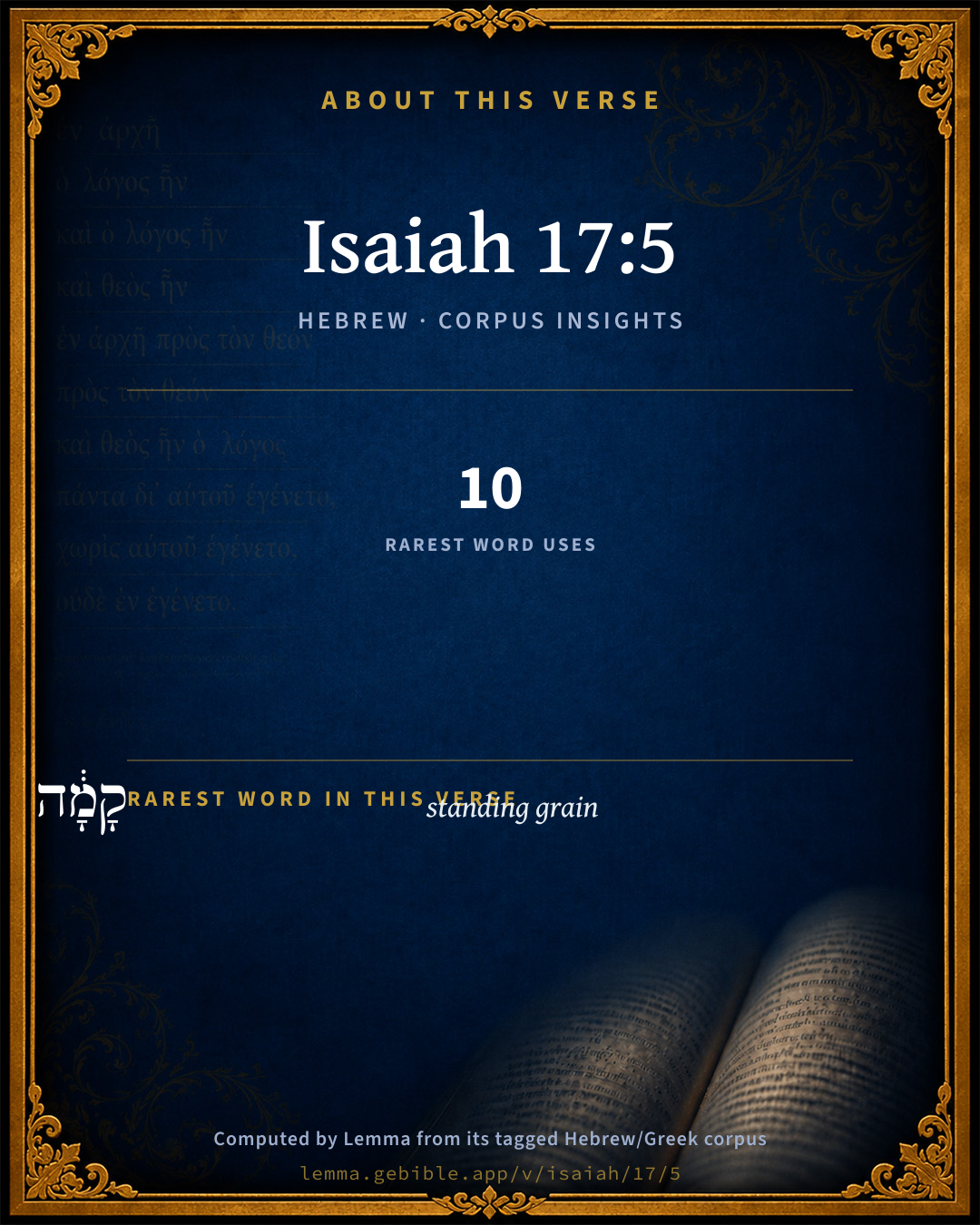
About this verse

These counts appear in no published source. They are computed here, from the morphology-tagged text and Lemma’s own curated glosses. What Lemma adds →

12
words
10
distinct lemmas
Prophets
section

Notable vocabulary

The rarest word here is קָמָ֔ה standing grain H7054 — appearing just 10 times in the whole Hebrew Bible.

Shared distinctive vocabulary

קָמָ֔ה standing grain H7054 occurs in 8 verses of the Hebrew Bible. Also found in:

Grammatical profile

  • 5 verbs
  • 7 nouns

Verb forms

  • וְהָיָ֗ה Qal · Sequential Perfect
  • כֶּֽאֱסֹף֙ Qal · Infinitive Construct
  • יִקְצ֑וֹר Qal · Imperfect
  • וְהָיָ֛ה Qal · Sequential Perfect
  • כִּמְלַקֵּ֥ט Piel · Participle Active

Repetition

Words recur within this verse — often emphatic in Hebrew:

  • וְהָיָ֗ה to be H1961 ×2
  • שִׁבֳּלִ֣ים ear of grain H7641 ×2

Hebrew & Septuagint length

In English translation the verse runs 31 words from the Hebrew and 32 from the Septuagint (LXX English) — closely comparable.

A rough comparison of the two English renderings, which tokenize alike — not a word-level alignment.

Word counts can differ between the Hebrew and the Greek without any difference in meaning — e.g. the Hebrew direct-object marker אֵת has no separate Greek word, and Greek often adds the article ὁ.

Cross-references

12

Topical passages linked to Isaiah 17:5 in the Treasury of Scripture Knowledge — connected by theme and wording, ordered by reader-vote popularity; previews shown in the World English Bible.

  • Matthew 13:30 Let both grow together until the harvest, and in the harvest time I will tell the reapers, "First, gather up the darnel, and bind them in bundles to burn them; but gather the wheat into my barn."'"
  • Jeremiah 51:33 For thus says Yahweh of hosts, the God of Israel: The daughter of Babylon is like a threshing floor at the time when it is trodden; yet a little while, and the time of harvest shall come for her.
  • Joel 3:13 Put in the sickle; For the harvest is ripe. Come, tread, for the winepress is full, The vats overflow, for their wickedness is great."
  • 2 Samuel 5:18 Now the Philistines had come and spread themselves in the valley of Rephaim.
  • Revelation 14:15–20 Another angel came out from the temple, crying with a loud voice to him who sat on the cloud, "Send forth your sickle, and reap; for the hour to reap has come; for the harvest of the earth is ripe!"
  • 2 Samuel 5:22 The Philistines came up yet again, and spread themselves in the valley of Rephaim.
  • Matthew 13:39–42 The enemy who sowed them is the devil. The harvest is the end of the age, and the reapers are angels.
  • Joshua 15:8 and the border went up by the valley of the son of Hinnom to the side of the Jebusite southward (the same is Jerusalem); and the border went up to the top of the mountain that lies before the valley of Hinnom westward, which is at the uttermost part of the valley of Rephaim northward;
  • Isaiah 17:11 In the day of your planting you hedge it in, and in the morning you make your seed to blossom; but the harvest flees away in the day of grief and of desperate sorrow.
  • Jeremiah 9:22 Speak, Thus says Yahweh, The dead bodies of men shall fall as dung on the open field, and as the handful after the harvester; and none shall gather [them].
  • Hosea 6:11 "Also, Judah, there is a harvest appointed for you, When I restore the fortunes of my people.
  • Joshua 18:16 and the border went down to the uttermost part of the mountain that lies before the valley of the son of Hinnom, which is in the valley of Rephaim northward; and it went down to the valley of Hinnom, to the side of the Jebusite southward, and went down to En Rogel;

Cross-references courtesy of OpenBible.info (CC BY 4.0).

Hebrew and Greek witnesses Masoretic Hebrew ↔ Greek Septuagint

The same verse in the two great witnesses to the Old Testament, shown verse-for-verse.

These are two independent witnesses, not word-aligned to each other, and the Septuagint is shown in lemma (dictionary) form.

Hebrew Isaiah 17:5 Masoretic · Westminster Leningrad Codex

וְהָיָ֗ה כֶּֽאֱסֹף֙ קָצִ֣יר קָמָ֔ה וּזְרֹע֖וֹ שִׁבֳּלִ֣ים יִקְצ֑וֹר וְהָיָ֛ה כִּמְלַקֵּ֥ט שִׁבֳּלִ֖ים בְּעֵ֥מֶק רְפָאִֽים

It shall be as when the harvester gathers the standing grain, and his arm reaps the ears; yes, it shall be as when one gleans ears in the valley of Rephaim.

World English Bible · Public Domain

Greek LXX Isaiah 17:5 Septuagint · lemma form

καί εἰμί ὅς τρόπος ἐάν τις συνἄγω ἀμητός ἵστημι καί σπέρμα στάχυς ἐν ὁ βραχίων αὐτός ἀμάω καί εἰμί ὅς τρόπος ἐάν τις συνἄγω στάχυς ἐν φάραγξ στερεός

And it shall be as if one should gather standing corn, and reap the grain of the ears; and it shall be as if one should gather ears in a rich valley;

LXX2012 (modern English Septuagint) · Public Domain

On this verse, Haydock's Catholic Bible Commentary discusses the Septuagint’s reading. Read the note in Commentary ↓

Hebrew: Westminster Leningrad Codex (CC BY 4.0). Greek: Septuagint (public domain); English from LXX2012 (modern English Septuagint) (Public Domain). How the Septuagint differs from the Hebrew →

Targum (Aramaic paraphrase)

1

The Targum is the ancient Jewish Aramaic paraphrase of the Hebrew Scriptures — an interpretive translation, not the Hebrew text itself. Onkelos (literal) and Pseudo-Jonathan (expansive) render the Torah, and Jonathan the Prophets. Coverage is partial: where no permissively-licensed English translation exists for a verse, only the Aramaic is shown. This is verse-level text, not a word-by-word alignment to the Hebrew.

  1. Targum Jonathan Prophets (Joshua–Malachi)
    וִיהֵי כְּמִכְנַשׁ חָצֵד קָמָה וְדַרְעֵיהּ שׁוּבְּלִין יַחֲצוֹד וִיהֵי כִמְלַקֵט שׁוּבְּלִין בְּמֵישַׁר גִבָּרַיָא:

    And it shall be, as when one gathereth the standing harvest, and reapeth the ears with his arm; and it shall be as one that is gathering ears in the valley of giants.

    Targum Jonathan — Aramaic: “Mikraot Gedolot” (public domain). English: “Sefaria Community Translation” (CC0 1.0 (public-domain dedication)); “London "Chaldee Paraphrase," 1871” (public domain). Text via Sefaria.

Commentary

Notes on Isaiah 17:5 from classic Christian and Jewish commentators (each source and its license shown beneath its notes). The classic Christian expositions comment on the surrounding passage and are grouped to its opening verse, so a note may address several verses; the Jewish commentaries on the Tanakh (Rashi and others) are per-verse, so they appear only where the commentator wrote on this verse.

Lemma curates 59 commentaries, every one of them public domain or Creative Commons licensed, each selected and text-cleaned for this edition rather than reprinted as found. About our sources →

Trapp's Complete Commentary

John Trapp

Isa 17:5 And it shall be as when the harvestman gathereth the corn, and reapeth the ears with his arm; and it shall be as he that gathereth ears in the valley of Rephaim.

Ver. 5. And it shall be as when the harvest man.] Their utter captivity is set forth by three lively similitudes, for better assurance, a very small remnant only left in the land. This by some ancients is alleged to show how few shall be saved - surely not one of ten thousand, said Simeon. And before him Chrysostom, {a} How many, think you, shall be saved in this city of Antioch? Though there be so many thousands of you, yet there cannot be found a hundred that shall enter into God’s kingdom, and I doubt much of those too, &c.

In the valley of Rephaim.] Which was nigh to Jerusalem. {Jos 15:8} Nam similitudine populari propheta utitur. {b}

{a} Hom. iv. Ad Pop. Antioch.

{b} Jun.

John Trapp, A Commentary or Exposition upon All the Books of the Old and New Testament (1647–1656) — public domain. Text from a community e-Sword module.

The Preacher's Complete Homiletical Commentary

Joseph S. Exell (gen. ed.)

DIMINUTIONS AND CHANGES OF LIFE

Isa_17:5-7. And it shall be as when the harvestman, &c.

God’s visitations of judgment are the subject of the prophet’s burdens (Isa_17:1). So the text. Adversities and sorrows set in. Blessings gone, except a few. “Two or three berries,” &c.

I. The various illustrations of the text.

1. In the adverse changes of life. Many who were rich and prosperous are now poor. All gone, except two or three berries. Some so through their own folly, &c.; others by the allotment of Providence, sickness, &c. (H. E. I., 4403–4406, 4975–4986).

2. In the failure of bodily health and vigour. Once strong and robust, &c.; now left but a few berries, &c.

3. In the bereavements of kindred and friends. Once a crowd of them—parents, brothers, sisters, children—but they have gone, one after another.

4. In the powers and capacities for useful activity. Once active, useful, but now frailty and weakness have superseded. This is distressing to the sensitive, &c. Pushed aside by another generation.

5. It will apply to times and seasons of probation. How wise was old Barzillai! (2Sa_19:31). The indications of age, &c. (Ecc_12:1). Few years left, &c., or even days.

II. The uses we should make of the subject.

1. It should impress us with the vanity of earthly things. All fleeting, all retiring; like the seasons, like streams.

2. The folly of earthly-mindedness. How extreme! Grasping shadows, resting on the moving wave, building castles in the air, &c.

3. The necessity of wisely using our opportunities. For the best ends. Working while it is day—now, while we have light and life.

4. Seeking a fitness for the world of the future (Heb_10:34; Heb_11:3-16).

5. Believing and devotional confidence in God.

Application:—Christ is ever the same. In all His offices, work, and graciousness, He is without a shadow of turning.—Jabez Burns, D.D.: 150 Sketches of Sermons, pp. 296, 297.

This striking passage depicts the process of God’s judgments upon Israel. We may take it as suggestive—

I. Of the sweeping destructiveness of calamities in human life (Isa_17:5). How often has the picture been realised!—

1. In the history of nations. The process of the depopulation and misery with which Israel was threatened, may be imagined from the view given in chap. Isa_3:1-8. Modern parallels may easily be found, the wars of the Roses, the plague of London, &c.

2. In the social calamities of families. One after another is broken up, one relationship after another is severed, until only an “outmost” branch is left as a remnant. Widow, orphans, friendless. Such are those who remain to tell the tale.

3. In the physical calamities of individuals.

4. In the degradation of the soul through the deceitfulness of sin. In some extreme cases, what a sad undermining of character and destruction of capacity do we behold.

II. Of the hopefulness of human life even when it is at its worst (Isa_17:6). Though the reaper has made sure work, yet enough remains to give hope. There is here true gospel, suggesting such thoughts as these:—

1. Begin at the point of your ability, however low it may be. Every man is rightly expected to make use of whatever power he has. If it is only sight, or only hearing, or only one hand, one talent out of ten, he must use it. The loss of the other nine will not excuse his neglect of the one he has.

2. Beginning thus low down, yet in earnest, we have the assurance of improvement and progress. We have abundant illustration of this in the history of the “remnant” that was left in Israel (2Ch_30:11; 2Ch_34:6; 2Ch_34:9, &c.). We see here an encouragement for every sinner who will awake, though late, to the true purposes of life. Redemption is the favourite work of God. He is on the side of feeble, struggling men, and delights to encourage and help “the remnant” which is spared (H. E. I., 934–941, 956, 958, 2368, 4790–4792; P. D., 474). The very purpose for which Christ came into the world was to help the struggling, to save the lost. Those who have been brought down to the extremity of need and the verge of despair may find friendship and help in Him (H. E. I., 928, 929).—William Manning.

The Preacher's Complete Homiletical Commentary (gen. ed. Joseph S. Exell; Funk & Wagnalls, c. 1892) — public domain (pre-1929). A full-Bible homiletical/sermon-outline anthology covering 65 of 66 books (2 John is absent from the source module). Text from a community e-Sword module.

Tyndale Open Study Notes

Tyndale Open Resources

17:5 The valley of Rephaim was a fertile valley in Judah; however, it looked bare after each harvest.

Tyndale Open Study Notes — © Tyndale Open Resources, licensed CC BY-SA 4.0. Text via the HelloAO Bible API.

Geneva Bible (1599)

Geneva Bible translators

As the abundance of corn doth not fear the harvest men that should cut it down: no more shall the multitude of Israel make the enemies to shrink, whom God shall appoint to destroy them.

Which valley was plentiful and fertile.

Geneva Bible (1599) marginal notes — public domain. Text via Bolls.life.

Jamieson, Fausset & Brown

Robert Jamieson, A. R. Fausset & David Brown

harvestman, &c.--The inhabitants and wealth of Israel shall be swept away, and but few left behind just as the husbandman gathers the corn and the fruit, and leaves only a few gleaning ears and grapes (Kg2 18:9-11).

with his arm--He collects the standing grain with one arm, so that he can cut it with the sickle in the other hand.

Rephaim--a fertile plain at the southwest of Jerusalem toward Beth-lehem and the country of the Philistines (Sa2 5:18-22).

Jamieson, Fausset & Brown — Commentary Critical and Explanatory on the Whole Bible (1871) — public domain (CC PDM 1.0). Text via the HelloAO Bible API.

Adam Clarke's Commentary

Verse 5. As when the harvestman gathereth - "As when one gathereth"] That is, the king of Assyria shall sweep away the whole body of the people, as the reaper strippeth off the whole crop of corn; and the remnant shall be no more in proportion than the scattered ears left to the gleaner. The valley of Rephaim near Jerusalem was celebrated for its plentiful harvest; it is here used poetically for any fruitful country. One MS., and one ancient edition, has באסף beesoph, "IN gathering," instead of כאסף keesoph, "AS the gathering."

Adam Clarke's Commentary on the Bible (1810–1826) — public domain. Text from a community e-Sword/MySword module.

Ellicott's Commentary for English Readers

(5) And it shall be as when the harvestman gathereth the corn.—The work of devastation is described under another image. The conqueror shall plunder the cities of Israel as the reaper cuts off the ears of corn. With his usual Dantesque vividness the prophet localises the imagery. The valley of Rephaim, or, as in Jos_15:8; Jos_18:16, “of the giants,” lay to the south-west of Jerusalem in the direction of Bethlehem. It was famous for its fertility, and was often on that account attacked by the Philistines, who came to carry off its crops (2Sa_23:13). The prophet had looked on the reaper’s work and had seen in it a parable of that of the Assyrian invader.

A Bible Commentary for English Readers, edited by Charles John Ellicott (1878–1897) — public domain. Text from a community e-Sword module.

The Cambridge Bible for Schools and Colleges

gen. ed. J. J. S. Perowne

5. The succeeding pictures are exceedingly graphic,—an evidence of Isaiah’s intense interest in rural life. The reaper gathers the stalks of wheat with one hand and with the other cuts off the ears close to the head.

and it shall be … Rephaim] Render as R.V. and it shall be as when one gleaneth ears, &c. See Rth_2:2; Rth_2:7; Rth_2:15 ff. The clause might perhaps be read as the beginning of Isa_17:6; one simile passing insensibly into another. The “valley of Rephaim,” (=“valley of the giants,”) Jos_15:8; Jos_18:16 (cf. 2Sa_5:18; 2Sa_5:22; 2Sa_23:13),—a fertile plain to the south of Jerusalem where Isaiah had watched the reapers and gleaners at work.

The Cambridge Bible for Schools and Colleges (gen. ed. J. J. S. Perowne; Cambridge University Press, 1878–1918) — public domain. Text from a community e-Sword module.

John Gill's Exposition

And it shall be as when the harvestman gathereth the corn,.... The "standing" corn, as in the Hebrew text: "and reapeth the ears with his arm"; or "his arm reaps the ears" (o); that is, with one hand he gathers the standing corn into his fist, and then reaps it with his other arm; and just so it should be with the people of Israel: they were like a field of standing corn, for number, beauty, and glory; the Assyrian was like a harvestman, who laid hold upon them, and cut them down, as thick and as numerous as they were, just as a harvestman cuts down the corn, and with as much ease and quick dispatch; they being no more able to stand before him than a field of corn before the reaper! this was done both by Tilgathpilneser, Kg2 15:29 and by Shalmaneser, Kg2 17:6 kings of Assyria:

and it shall be as he that gathereth ears in the valley of Rephaim; the Targum renders it,

"the valley of giants.''

and so it is translated, Jos 15:8 mention is made of it in Sa2 5:18 it was a valley not far from Jerusalem, as Josephus (p) says; who also calls it the valley of the giants: it is thought to have been a very fruitful place, where the ears of corn were very large and heavy, and so great care was taken in gathering and gleaning that none be lost: wherefore, as the former simile signifies the carrying off the people of Israel in great numbers by the above kings, this may signify, as some have thought, either the picking up of those that fled without, or the gleaning of them in after times by Esarhaddon, Ezr 4:2.

(o) "et brachium ejus spicas demeteret", Junius & Tremellius; "demetit", Piscator, &c. (p) Antiqu. l. 7. c. 4. sect. 1.

John Gill's Exposition of the Whole Bible (1746–1763) — public domain (CC PDM 1.0). Text via the HelloAO Bible API.

Albert Barnes' Notes on the Bible

And it shall be ... - This is the other figure by which the prophet sets forth the calamities that were coming upon Ephraim - an image designed to denote the fact that the inhabitants and wealth of the land would be collected and removed, as the farmer gathers his harvest, and leaves only that which is inaccessible in the upper boughs of the tree, or the gleanings in the field.

As when the harvest-man gathereth the corn - The wheat, the barley, etc.; for so the word “corn” - now applied by us almost exclusively to maizes means in the Scriptures. The sense in this passage is plain. As the farmer cuts down and collects his grain and removes it from the harvest field, so the enemies of Ephraim would come and remove the people and their wealth to a distant land. This received a complete fulfillment when the ten tribes were removed by the Assyrians to a distant land. This was done by Tiglath-pileser 2Ki 15:29, and by Shalmaneser 2Ki 17:6.

And reapeth the ears with his arm - As he collects the standing grain with one arm so that he can cut it with the sickle in the other hand. The word rendered ‘reapeth’ (קצר qâtsar) means here “to collect together” as a reaper does the standing grain in his arm. The word rendered ‘ears’ (שׁבלים shı̂bălı̂ym) means here rather the spires or stalks of standing grain.

In the valley of Rephaim - The valley of Rephaim is mentioned in 2Sa 5:18, 2Sa 5:22; 2Sa 23:13; 1Ch 11:15; 1Ch 14:9. The name means ‘the Giants;’ but why it was given to it is now unknown. In passing from Bethlehem to Jerusalem, it lies on the left, and descends gradually to the southwest, until it contracts in that direction into a deeper and narrower valley, called wady el-Werd, which unites further on with wady Ahmed, and finds its way to the Mediterranean. The plain extends nearly to Jerusalem, and is terminated by a slight rocky ridge forming the brow of the valley of Hinnom (see Josephus, “Ant.” vii. 4. 1; viii. 12. 4; also Robinson’s “Bib. Researches,” vol. i. pp. 323, 324). It seem to have been distinguished for its fertility, and is used here to denote a fertile region in general.

Albert Barnes' Notes on the Bible (1834–1885) — public domain. Text from a community e-Sword/MySword module.

Haydock's Catholic Bible Commentary

Raphaim. Near Jerusalem, 3 Kings xxiii. 13. Septuagint, "of stones." (Calmet) --- It will be equally difficult to find any men left in the kingdom of Israel. (Haydock)

George Leo Haydock (1774–1849), Haydock's Catholic Family Bible and Commentary, 1859 edition — public domain. Excludes Psalms (Douay-Rheims chapter numbering differs from Protestant) and Deuterocanonical books (Catholic canon only).

Matthew Poole's English Annotations

Reapeth the ears with his arm; taking care, as far as may be, that all may be gathered in, and nothing left. So shall the whole body of the ten tribes be carried away captive, some few gleanings only being left of them, as it is in the harvest.

The valley of Rephaim; a very fruitful place near Jerusalem, Jos 15:8; 18:16.

Matthew Poole's English Annotations on the Holy Bible (1683–1685) — public domain. Text from a community e-Sword/MySword module.

Whedon's Commentary on the Bible

Daniel D. Whedon

5. Harvestman gathereth the corn — The figure used here denotes that the people and wealth of Israel are collected and removed by the Assyrian, just as the husbandman gathers the wheat or barley in his arm to reap down with his sickle; a common fact observable every season in the Valley of Rephaim, near Jerusalem, just south of the city, veering westward of Bethlehem: the largest area of harvest land in the vicinity.

Daniel D. Whedon (gen. ed.), Commentary on the Old and New Testaments (1874–1909) — public domain. Text from a community e-Sword module.

The Pulpit Commentary

As when the harvestman gathereth the corn. Death is the "harvestman" here, and gathers the Israelites by shocks, or sheaves, into his garner. A great depopulation appears in 2Ki_17:25, where we learn that lions so multiplied in the land as to become a terror to the few inhabitants. Reapeth the ears. Mr. Cheyne well remarks that the "ears" only were reaped, the stalk being cut close under the ear. This was the practice also in Egypt (Rawlinson," Hist. of Ancient Egypt," vol. 1. p. 162). In the valley of Rephaim. The valley of Rephaim was the scene of David"s double victory over the Philistines, related in 2Sa_5:17-25. It is disputed whether it lay north or south of Jerusalem; but the connection with Bethlehem (2Sa_23:13-17) and with the cave of Adullam seem decisive in favor of a southern position. A "valley," however (emek), suitable for the cultivation of corn, in this direction, has yet to be discovered.

The Pulpit Commentary (1880–1919), ed. H.D.M. Spence-Jones & Joseph S. Exell — public domain. Text from a community e-Sword module.

John Wesley's Explanatory Notes

Gathereth - Taking care, as far as may be, that all may be gathered in, and nothing left. So shall the whole body of the ten tribes be carried away captive, some few gleanings only being left. Rephaim - A very fruitful place near Jerusalem.

John Wesley, Explanatory Notes Upon the Whole Bible (1754–1765) — public domain. Text via the GEBible commentary corpus.

J. A. Alexander on Isaiah

Joseph Addison Alexander

“And it shall be like the gathering of (or as one gathers) the harvest, the standing corn, and his arm reaps the ears. And it shall be like one collecting ears in the valley of Rephaim.” The first verb is not to be rendered he shall be (i.e., Israel, or the king of Assyria), but to be construed impersonally, it shall be or come to pass. The valley of Rephaim or the Giants extends from Jerusalem to the south-west in the direction of Bethlehem. It is here mentioned as a spot near to Jerusalem and well known to the people, for the purpose of giving a specific character to the general description or allusion of the first clause. There is no proof that it was remarkable either for fertility or barrenness. Some of the commentators represent it as now waste; but Robinson speaks of it, en passant, as "the cultivated valley or plain of Rephaim." (Palestine I 323.)

Joseph Addison Alexander, The Prophecies of Isaiah (1846–1847; New York: Scribner, 1870–1878) — public domain. Text from a community e-Sword module.

Rashi

Rabbi Shlomo Yitzchaki (Rashi)

And it shall be like gathering the harvest of the standing grain Just as at the time of the harvest, the reaper gathers the bundle of the standing grain in his one hand and with his other arm he reaps the ears, so will Sennacherib uproot and exile everyone, and even the gleanings that fall at the time of harvest he will gather and carry it off. That is to say that even those who flee will not escape his hand, and they will gather them [var. and he will gather them] [like one who gathers ears].

in the valley of Rephaim That is the valley that is before Jerusalem. In the Book of Joshua (15:8, 18:16) you will find that the valley of Rephaim adjoins Jerusalem.

Rashi on the Tanakh — English translations: “The Judaica Press complete Tanach with Rashi, translated by A. J. Rosenberg” (CC BY 4.0); “Pentateuch with Rashi's commentary by M. Rosenbaum and A.M. Silbermann, 1929-1934” (public domain); “The Metsudah Tanach series, Lakewood, N.J” (CC BY 4.0); and “The Book of Joshua, Metsudah Publications, 1997” (CC BY 4.0). Text via Sefaria.

Ibn Ezra

Rabbi Abraham ibn Ezra

And it shall be, the first time., that of King Phul.

כאסף קציר As when the harvestman gathereth the corn. הקוצר the harvestman, must be supplied before קציר.

And it shall be, the second time. The king of Assyria came twice against the land of Israel.

In the valley of Rephaim. A place where the harvest was bad, thin and meagre.

Ibn Ezra on the Tanakh — English translations: “Sefaria Community Translation” (CC0 1.0 (public-domain dedication)); “Yalkut, Sifsei Chachomim Chumash, Metsudah Publications, 2009” (CC BY 4.0); and “Commentary of Ibn Ezra on Isaiah - trans. by M. Friedlander, 1873” (public domain). Text via Sefaria.

Lesson kit

Teaching starters — assembled from the data on this page, not authored interpretation. Every prompt links to the verse data it draws on. Edit before teaching.

Isaiah, in the Prophets, opens this verse with 12 words (10 distinct Hebrew lemmas). Its most distinctive word is qâmâh (“standing grain”). A historical commentator’s framing appears above. Read the whole chapter for the surrounding context.

Discussion questions

  1. What does “standing grain” (qâmâh) contribute to the verse as a whole?
  2. Exodus 22:6 shares the word «standing grain» with this verse. How do the two illuminate each other?
  3. “to be” occurs 2× in this one verse. What is the effect of the repetition?
  4. These translations render this verse differently; the difference is in the English rendering, not the original. What questions does that raise?
  5. The verb «וְהָיָ֗ה» is Qal Sequential Perfect. How does its form color the action?
  6. Reading how Trapp's Complete Commentary and The Preacher's Complete Homiletical Commentary read this verse, where do the two commentators agree and where do they part?

Things to notice

Reading settings

Reading text

Shown beneath each verse's original-language words.

Old Testament
Old Testament edition

Read the OT as the Masoretic Hebrew (MT) or the Greek Septuagint (LXX).

English shown for the Greek Septuagint (in the Hebrew ↔ Greek comparison).

Comparing translations? Open the Compare panel on any verse page to stack up to four side by side.