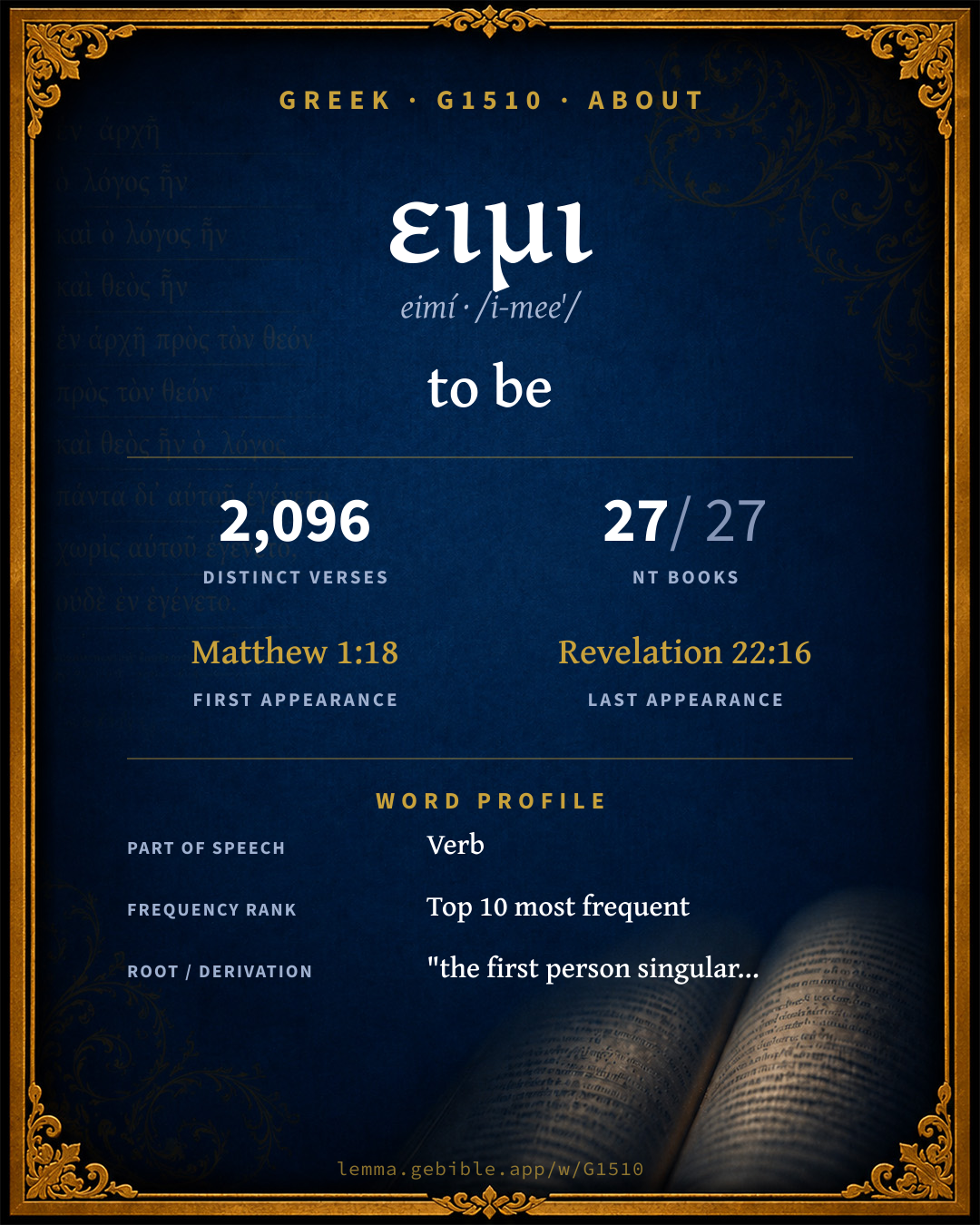
εἰμί
to be
Full lexicon entry — Thayer's Greek Lexicon
From Thayer's Greek Lexicon
Where this word appears
See every Present-tense verb in the Greek New Testament →
Grammar key — what these labels mean
Part of speech
- Verb
- An action or state-of-being word.
Tense
- Present
- Ongoing or general action in present time (imperfective aspect).
- Imperfect
- Continuous or repeated action in past time (“was writing”).
- Future
- Action expected in future time.
Voice
- Active
- The subject performs the action.
- Middle deponent
- Middle in form but active in meaning.
- Middle
- The subject acts on or for itself, or with special interest in the action.
Mood
- Indicative
- States a fact or asks a factual question (the mood of reality).
- Infinitive
- A verbal noun (“to write”), unmarked for person or number.
- Participle
- A verbal adjective (“writing,” “having written”).
- Subjunctive
- Expresses probability, purpose, or possibility (the mood of contingency).
- Imperative
- Expresses a command or request.
- Optative
- Expresses a wish or a remote possibility.
Case
- Nominative
- The case of the subject (and the predicate nominative).
- Genitive
- The case of source, possession, or “of” — answers “whose / from what.”
- Accusative
- The case of the direct object and of extent.
- Dative
- The case of the indirect object, means, or location — “to / for / with / in.”
Person
- 3rd person
- The one spoken about (“he / she / it / they”).
- 1st person
- The speaker (“I / we”).
- 2nd person
- The one addressed (“you”).
Gender
- Masculine
- Grammatically masculine.
- Feminine
- Grammatically feminine.
- Neuter
- Grammatically neuter.
Number
- Singular
- One.
- Plural
- More than one.
Page 2 of 2 — showing verses 201–357 of 357 distinct verses where G1510 appears in the Book of John. Click any verse to open its interlinear word-by-word view. Verse text shown in the World English Bible for context — . Each verse’s Greek form is shown with its reference; the English is not keyword-highlighted, since the data carries no word-level English alignment. Use “Compare translations” on any verse to read it across multiple English versions. This concordance covers the Greek New Testament; Septuagint (Greek Old Testament) occurrences of this word are not indexed here.
John
- John 10:13 ἐστιν pres act ind 3sg The hired hand flees because he is a hired hand, and doesn't care for the sheep.
- John 10:14 εἰμι pres act ind 1sg I am the good shepherd. I know my own, and I'm known by my own;
- John 10:16 ἔστιν pres act ind 3sg I have other sheep, which are not of this fold. I must bring them also, and they will hear my voice. They will become one flock with one shepherd.
- John 10:21 ἔστιν pres act ind 3sg Others said, "These are not the sayings of one possessed by a demon. It isn't possible for a demon to open the eyes of the blind, is it?"
- John 10:22 ἦν impf act ind 3sg It was the Feast of the Dedication at Jerusalem.
- John 10:24 εἶ pres act ind 2sg The Jews therefore came around him and said to him, "How long will you hold us in suspense? If you are the Christ, tell us plainly."
- John 10:26 ἐστὲ pres act ind 2pl But you don't believe, because you are not of my sheep, as I told you.
- John 10:29 ἐστιν pres act ind 3sg My Father, who has given them to me, is greater than all. No one is able to snatch them out of my Father's hand.
- John 10:30 ἐσμεν pres act ind 1pl I and the Father are one."
- John 10:33 ὢν pres act ptcp nom sg masc The Jews answered him, "We don't stone you for a good work, but for blasphemy: because you, being a man, make yourself God."
- John 10:34 ἔστιν ἐστε pres act ind 3sg pres act ind 2pl Jesus answered them, "Isn't it written in your law, 'I said, you are gods?'
- John 10:36 εἰμι pres act ind 1sg Do you say of him whom the Father sanctified and sent into the world, 'You blaspheme,' because I said, 'I am the Son of God?'
- John 10:40 ἦν impf act ind 3sg He went away again beyond the Jordan into the place where John was baptizing at first, and there he stayed.
- John 10:41 ἦν impf act ind 3sg Many came to him. They said, "John indeed did no sign, but everything that John said about this man is true."
- John 11:1 Ἦν impf act ind 3sg Now a certain man was sick, Lazarus from Bethany, of the village of Mary and her sister, Martha.
- John 11:2 ἦν impf act ind 3sg It was that Mary who had anointed the Lord with ointment, and wiped his feet with her hair, whose brother, Lazarus, was sick.
- John 11:4 ἔστιν pres act ind 3sg But when Jesus heard it, he said, "This sickness is not to death, but for the glory of God, that God's Son may be glorified by it."
- John 11:6 ἦν impf act ind 3sg When therefore he heard that he was sick, he stayed two days in the place where he was.
- John 11:9 εἰσίν pres act ind 3pl Jesus answered, "Aren't there twelve hours of daylight? If a man walks in the day, he doesn't stumble, because he sees the light of this world.
- John 11:10 ἔστιν pres act ind 3sg But if a man walks in the night, he stumbles, because the light isn't in him."
- John 11:15 ἤμην impf mid ind 1sg I am glad for your sakes that I was not there, so that you may believe. Nevertheless, let's go to him."
- John 11:18 ἦν impf act ind 3sg Now Bethany was near Jerusalem, about fifteen stadia away.
- John 11:21 ἦς impf act ind 2sg Therefore Martha said to Jesus, "Lord, if you would have been here, my brother wouldn't have died.
- John 11:25 εἰμι pres act ind 1sg Jesus said to her, "I am the resurrection and the life. He who believes in me, though he die, yet will he live.
- John 11:27 εἶ pres act ind 2sg She said to him, "Yes, Lord. I have come to believe that you are the Christ, God's Son, he who comes into the world."
- John 11:30 ἦν impf act ind 3sg Now Jesus had not yet come into the village, but was in the place where Martha met him.
- John 11:31 ὄντες pres act ptcp nom pl masc Then the Jews who were with her in the house, and were consoling her, when they saw Mary, that she rose up quickly and went out, followed her, saying, "She is going to the tomb to weep there."
- John 11:32 ἦν ἦς impf act ind 3sg impf act ind 2sg Therefore when Mary came to where Jesus was, and saw him, she fell down at his feet, saying to him, "Lord, if you would have been here, my brother wouldn't have died."
- John 11:38 ἦν impf act ind 3sg Jesus therefore, again groaning in himself, came to the tomb. Now it was a cave, and a stone lay against it.
- John 11:39 ἐστιν pres act ind 3sg Jesus said, "Take away the stone." Martha, the sister of him who was dead, said to him, "Lord, by this time there is a stench, for he has been dead four days."
- John 11:49 ὢν pres act ptcp nom sg masc But a certain one of them, Caiaphas, being high priest that year, said to them, "You know nothing at all,
- John 11:51 ὢν pres act ptcp nom sg masc Now he didn't say this of himself, but being high priest that year, he prophesied that Jesus would die for the nation,
- John 11:55 ἦν impf act ind 3sg Now the Passover of the Jews was at hand. Many went up from the country to Jerusalem before the Passover, to purify themselves.
- John 11:57 ἔστιν pres act ind 3sg Now the chief priests and the Pharisees had commanded that if anyone knew where he was, he should report it, that they might seize him.
- John 12:1 ἦν impf act ind 3sg Then six days before the Passover, Jesus came to Bethany, where Lazarus was, who had been dead, whom he raised from the dead.
- John 12:2 ἦν impf act ind 3sg So they made him a supper there. Martha served, but Lazarus was one of those who sat at the table with him.
- John 12:6 ἦν impf act ind 3sg Now he said this, not because he cared for the poor, but because he was a thief, and having the money box, used to steal what was put into it.
- John 12:9 ἐστιν pres act ind 3sg A large crowd therefore of the Jews learned that he was there, and they came, not for Jesus' sake only, but that they might see Lazarus also, whom he had raised from the dead.
- John 12:14 ἐστιν pres act ind 3sg Jesus, having found a young donkey, sat on it. As it is written,
- John 12:16 ἦν impf act ind 3sg His disciples didn't understand these things at first, but when Jesus was glorified, then they remembered that these things were written about him, and that they had done these things to him.
- John 12:17 ὢν pres act ptcp nom sg masc The multitude therefore that was with him when he called Lazarus out of the tomb, and raised him from the dead, was testifying about it.
- John 12:20 Ἦσαν impf act ind 3pl Now there were certain Greeks among those that went up to worship at the feast.
- John 12:26 εἰμὶ ἔσται pres act ind 1sg fut mid.dep ind 3sg If anyone serves me, let him follow me. Where I am, there will my servant also be. If anyone serves me, the Father will honor him.
- John 12:31 ἐστὶν pres act ind 3sg Now is the judgment of this world. Now the prince of this world will be cast out.
- John 12:34 ἐστιν pres act ind 3sg The multitude answered him, "We have heard out of the law that the Christ remains forever. How do you say, 'The Son of Man must be lifted up?' Who is this Son of Man?"
- John 12:35 ἐστιν pres act ind 3sg Jesus therefore said to them, "Yet a little while the light is with you. Walk while you have the light, that darkness doesn't overtake you. He who walks in the darkness doesn't know where he is going.
- John 12:50 ἐστιν pres act ind 3sg I know that his commandment is eternal life. The things therefore which I speak, even as the Father has said to me, so I speak."
- John 13:5 ἦν impf act ind 3sg Then he poured water into the basin, and began to wash the disciples' feet, and to wipe them with the towel that was wrapped around him.
- John 13:10 ἔστιν ἐστε pres act ind 3sg pres act ind 2pl Jesus said to him, "Someone who has bathed only needs to have his feet washed, but is completely clean. You are clean, but not all of you."
- John 13:11 ἐστε pres act ind 2pl For he knew him who would betray him, therefore he said, "You are not all clean."
- John 13:13 εἰμὶ pres act ind 1sg You call me, 'Teacher' and 'Lord.' You say so correctly, for so I am.
- John 13:16 ἔστιν pres act ind 3sg Most assuredly I tell you, a servant is not greater than his lord, neither one who is sent greater than he who sent him.
- John 13:17 ἐστε pres act ind 2pl If you know these things, blessed are you if you do them.
- John 13:19 εἰμι pres act ind 1sg From now on, I tell you before it happens, that when it happens, you may believe that I AM.
- John 13:23 ἦν impf act ind 3sg One of his disciples, whom Jesus loved, was at the table, leaning against Jesus' breast.
- John 13:24 ἐστιν pres act ind 3sg Simon Peter therefore beckoned to him, and said to him, "Tell us who it is of whom he speaks."
- John 13:25 ἐστιν pres act ind 3sg He, leaning back, as he was, on Jesus' breast, asked him, "Lord, who is it?"
- John 13:26 ἐστιν pres act ind 3sg Jesus therefore answered, "It is he to whom I will give this piece of bread when I have dipped it." So when he had dipped the piece of bread, he gave it to Judas, the son of Simon Iscariot.
- John 13:30 ἦν impf act ind 3sg Therefore, having received that morsel, he went out immediately. It was night.
- John 13:33 εἰμί pres act ind 1sg Little children, I will be with you a little while longer. You will seek me, and as I said to the Jews, 'Where I am going, you can't come,' so now I tell you.
- John 13:35 ἐστε pres act ind 2pl By this everyone will know that you are my disciples, if you have love for one another."
- John 14:2 εἰσίν pres act ind 3pl In my Father's house are many mansions. If it weren't so, I would have told you. I am going to prepare a place for you.
- John 14:3 εἰμὶ ἦτε pres act ind 1sg pres act subj 2pl If I go and prepare a place for you, I will come again, and will receive you to myself; that where I am, you may be there also.
- John 14:6 εἰμι pres act ind 1sg Jesus said to him, "I am the way, the truth, and the life. No one comes to the Father, except through me.
- John 14:9 εἰμι pres act ind 1sg Jesus said to him, "Have I been with you such a long time, and do you not know me, Philip? He who has seen me has seen the Father. How do you say, 'Show us the Father?'
- John 14:10 ἐστιν pres act ind 3sg Don't you believe that I am in the Father, and the Father in me? The words that I tell you, I speak not from myself; but the Father who lives in me does his works.
- John 14:16 ᾖ pres act subj 3sg I will pray to the Father, and he will give you another Counselor, that he may be with you forever,--
- John 14:17 ἔσται fut mid.dep ind 3sg the Spirit of truth, whom the world can't receive; for it doesn't see him, neither knows him. You know him, for he lives with you, and will be in you.
- John 14:21 ἐστιν pres act ind 3sg One who has my commandments, and keeps them, that person is one who loves me. One who loves me will be loved by my Father, and I will love him, and will reveal myself to him."
- John 14:24 ἔστιν pres act ind 3sg He who doesn't love me doesn't keep my words. The word which you hear isn't mine, but the Father's who sent me.
- John 14:28 ἐστιν pres act ind 3sg You heard how I told you, 'I go away, and I come to you.' If you loved me, you would have rejoiced, because I said 'I am going to my Father;' for the Father is greater than I.
- John 15:1 εἰμι ἐστιν pres act ind 1sg pres act ind 3sg "I am the true vine, and my Father is the farmer.
- John 15:3 ἐστε pres act ind 2pl You are already pruned clean because of the word which I have spoken to you.
- John 15:5 εἰμι pres act ind 1sg I am the vine. You are the branches. He who remains in me, and I in him, the same bears much fruit, for apart from me you can do nothing.
- John 15:11 ᾖ pres act subj 3sg I have spoken these things to you, that my joy may remain in you, and that your joy may be made full.
- John 15:12 ἐστὶν pres act ind 3sg "This is my commandment, that you love one another, even as I have loved you.
- John 15:14 ἐστε pres act ind 2pl You are my friends, if you do whatever I command you.
- John 15:19 ἦτε ἐστέ impf act ind 2pl pres act ind 2pl If you were of the world, the world would love its own. But because you are not of the world, since I chose you out of the world, therefore the world hates you.
- John 15:20 ἔστιν pres act ind 3sg Remember the word that I said to you: 'A servant is not greater than his lord.' If they persecuted me, they will also persecute you. If they kept my word, they will keep yours also.
- John 15:27 ἐστε pres act ind 2pl You will also testify, because you have been with me from the beginning.
- John 16:4 ἤμην impf mid ind 1sg But I have told you these things, so that when the time comes, you may remember that I told you about them. I didn't tell you these things from the beginning, because I was with you.
- John 16:15 ἐστιν pres act ind 3sg All things whatever the Father has are mine; therefore I said that he takes of mine, and will declare it to you.
- John 16:17 ἐστιν pres act ind 3sg Some of his disciples therefore said to one another, "What is this that he says to us, 'A little while, and you won't see me, and again a little while, and you will see me;' and, 'Because I go to the Father?'"
- John 16:18 ἐστιν pres act ind 3sg They said therefore, "What is this that he says, 'A little while?' We don't know what he is saying."
- John 16:24 ᾖ pres act subj 3sg Until now, you have asked nothing in my name. Ask, and you will receive, that your joy may be made full.
- John 16:32 εἰμὶ ἐστιν pres act ind 1sg pres act ind 3sg Behold, the time is coming, yes, and has now come, that you will be scattered, everyone to his own place, and you will leave me alone. Yet I am not alone, because the Father is with me.
- John 17:3 ἐστιν pres act ind 3sg This is eternal life, that they should know you, the only true God, and him whom you sent, Jesus Christ.
- John 17:5 εἶναι pres act inf Now, Father, glorify me with your own self with the glory which I had with you before the world existed.
- John 17:6 ἦσαν impf act ind 3pl I revealed your name to the people whom you have given me out of the world. They were yours, and you have given them to me. They have kept your word.
- John 17:7 εἰσίν pres act ind 3pl Now they have known that all things whatever you have given me are from you,
- John 17:9 εἰσίν pres act ind 3pl I pray for them. I don't pray for the world, but for those whom you have given me, for they are yours.
- John 17:10 ἐστιν pres act ind 3sg All things that are mine are yours, and yours are mine, and I am glorified in them.
- John 17:11 εἰμὶ εἰσίν ὦσιν pres act ind 1sg pres act ind 3pl pres act subj 3pl I am no more in the world, but these are in the world, and I am coming to you. Holy Father, keep them through your name which you have given me, that they may be one, even as we are.
- John 17:12 ἤμην impf mid ind 1sg While I was with them in the world, I kept them in your name. Those whom you have given me I have kept. None of them is lost, except the son of destruction, that the Scripture might be fulfilled.
- John 17:14 εἰσὶν εἰμὶ pres act ind 3pl pres act ind 1sg I have given them your word. The world hated them, because they are not of the world, even as I am not of the world.
- John 17:16 εἰσὶν εἰμὶ pres act ind 3pl pres act ind 1sg They are not of the world even as I am not of the world.
- John 17:17 ἐστιν pres act ind 3sg Sanctify them in your truth. Your word is truth.
- John 17:19 ὦσιν pres act subj 3pl For their sakes I sanctify myself, that they themselves also may be sanctified in truth.
- John 17:21 ὦσιν ὦσιν pres act subj 3pl pres act subj 3pl that they may all be one; even as you, Father, are in me, and I in you, that they also may be one in us; that the world may believe that you sent me.
- John 17:22 ὦσιν pres act subj 3pl The glory which you have given me, I have given to them; that they may be one, even as we are one;
- John 17:23 ὦσιν pres act subj 3pl I in them, and you in me, that they may be perfected into one; that the world may know that you sent me, and loved them, even as you loved me.
- John 17:24 εἰμὶ ὦσιν pres act ind 1sg pres act subj 3pl Father, I desire that they also whom you have given me be with me where I am, that they may see my glory, which you have given me, for you loved me before the foundation of the world.
- John 17:26 ᾖ pres act subj 3sg I made known to them your name, and will make it known; that the love with which you loved me may be in them, and I in them."
- John 18:1 ἦν impf act ind 3sg When Jesus had spoken these words, he went out with his disciples over the brook Kidron, where was a garden, into which he and his disciples entered.
- John 18:5 εἰμι pres act ind 1sg They answered him, "Jesus of Nazareth." Jesus said to them, "I AM." Judas also, who betrayed him, was standing with them.
- John 18:6 εἰμι pres act ind 1sg When therefore he said to them, "I AM," they went backward, and fell to the ground.
- John 18:8 εἰμι pres act ind 1sg Jesus answered, "I told you that I AM. If therefore you seek me, let these go their way,"
- John 18:10 ἦν impf act ind 3sg Simon Peter therefore, having a sword, drew it, and struck the high priest's servant, and cut off his right ear. The servant's name was Malchus.
- John 18:13 ἦν ἦν impf act ind 3sg impf act ind 3sg and led him to Annas first, for he was father-in-law to Caiaphas, who was high priest that year.
- John 18:14 ἦν impf act ind 3sg Now it was Caiaphas who advised the Jews that it was expedient that one man should perish for the people.
- John 18:15 ἦν impf act ind 3sg Simon Peter followed Jesus, as did another disciple. Now that disciple was known to the high priest, and entered in with Jesus into the court of the high priest;
- John 18:17 εἶ εἰμί pres act ind 2sg pres act ind 1sg Then the maid who kept the door said to Peter, "Are you also one of this man's disciples?" He said, "I am not."
- John 18:18 ἦν ἦν impf act ind 3sg impf act ind 3sg Now the servants and the officers were standing there, having made a fire of coals, for it was cold. They were warming themselves. Peter was with them, standing and warming himself.
- John 18:25 Ἦν εἶ εἰμί impf act ind 3sg pres act ind 2sg pres act ind 1sg Now Simon Peter was standing and warming himself. They said therefore to him, "You aren't also one of his disciples, are you?" He denied it, and said, "I am not."
- John 18:26 ὢν pres act ptcp nom sg masc One of the servants of the high priest, being a relative of him whose ear Peter had cut off, said, "Didn't I see you in the garden with him?"
- John 18:28 ἦν impf act ind 3sg They led Jesus therefore from Caiaphas into the Praetorium. It was early, and they themselves didn't enter into the Praetorium, that they might not be defiled, but might eat the Passover.
- John 18:30 ἦν impf act ind 3sg They answered him, "If this man weren't an evildoer, we wouldn't have delivered him up to you."
- John 18:33 εἶ pres act ind 2sg Pilate therefore entered again into the Praetorium, called Jesus, and said to him, "Are you the King of the Jews?"
- John 18:35 εἰμι pres act ind 1sg Pilate answered, "I'm not a Jew, am I? Your own nation and the chief priests delivered you to me. What have you done?"
- John 18:36 ἔστιν ἦν ἔστιν pres act ind 3sg impf act ind 3sg pres act ind 3sg Jesus answered, "My Kingdom is not of this world. If my Kingdom were of this world, then my servants would fight, that I wouldn't be delivered to the Jews. But now my Kingdom is not from here."
- John 18:37 εἶ εἰμι ὢν pres act ind 2sg pres act ind 1sg pres act ptcp nom sg masc Pilate therefore said to him, "Are you a king then?" Jesus answered, "You say that I am a king. For this reason I have been born, and for this reason I have come into the world, that I should testify to the truth. Everyone who is of the truth listens to my voice."
- John 18:38 ἐστιν pres act ind 3sg Pilate said to him, "What is truth?" When he had said this, he went out again to the Jews, and said to them, "I find no basis for a charge against him.
- John 18:39 ἔστιν pres act ind 3sg But you have a custom, that I should release someone to you at the Passover. Therefore do you want me to release to you the King of the Jews?"
- John 18:40 ἦν impf act ind 3sg Then they all shouted again, saying, "Not this man, but Barabbas!" Now Barabbas was a robber.
- John 19:9 εἶ pres act ind 2sg He entered into the Praetorium again, and said to Jesus, "Where are you from?" But Jesus gave him no answer.
- John 19:11 ἦν impf act ind 3sg Jesus answered, "You would have no power at all against me, unless it were given to you from above. Therefore he who delivered me to you has greater sin."
- John 19:12 εἶ pres act ind 2sg At this, Pilate was seeking to release him, but the Jews cried out, saying, "If you release this man, you aren't Caesar's friend! Everyone who makes himself a king speaks against Caesar!"
- John 19:14 ἦν ἦν impf act ind 3sg impf act ind 3sg Now it was the Preparation Day of the Passover, at about the sixth hour. He said to the Jews, "Behold, your King!"
- John 19:19 ἦν impf act ind 3sg Pilate wrote a title also, and put it on the cross. There was written, "JESUS OF NAZARETH, THE KING OF THE JEWS."
- John 19:20 ἦν ἦν impf act ind 3sg impf act ind 3sg Therefore many of the Jews read this title, for the place where Jesus was crucified was near the city; and it was written in Hebrew, in Latin, and in Greek.
- John 19:21 εἰμι pres act ind 1sg The chief priests of the Jews therefore said to Pilate, "Don't write, 'The King of the Jews,' but, 'he said, I am King of the Jews.'"
- John 19:23 ἦν impf act ind 3sg Then the soldiers, when they had crucified Jesus, took his garments and made four parts, to every soldier a part; and also the coat. Now the coat was without seam, woven from the top throughout.
- John 19:24 ἔσται fut mid.dep ind 3sg Then they said to one another, "Let's not tear it, but cast lots for it to decide whose it will be," that the Scripture might be fulfilled, which says, "They parted my garments among them. For my cloak they cast lots." Therefore the soldiers did these things.
- John 19:31 ἦν ἦν impf act ind 3sg impf act ind 3sg Therefore the Jews, because it was the Preparation Day, so that the bodies wouldn't remain on the cross on the Sabbath (for that Sabbath was a special one), asked of Pilate that their legs might be broken, and that they might be taken away.
- John 19:35 ἐστιν pres act ind 3sg He who has seen has testified, and his testimony is true. He knows that he tells the truth, that you may believe.
- John 19:38 ὢν pres act ptcp nom sg masc After these things, Joseph of Arimathaea, being a disciple of Jesus, but secretly for fear of the Jews, asked of Pilate that he might take away Jesus' body. Pilate gave him permission. He came therefore and took away his body.
- John 19:40 ἐστὶν pres act ind 3sg So they took Jesus' body, and bound it in linen cloths with the spices, as the custom of the Jews is to bury.
- John 19:41 ἦν impf act ind 3sg Now in the place where he was crucified there was a garden. In the garden a new tomb in which no man had ever yet been laid.
- John 19:42 ἦν impf act ind 3sg Then because of the Jews' Preparation Day (for the tomb was near at hand) they laid Jesus there.
- John 20:1 οὔσης pres act ptcp gen sg fem Now on the first day of the week, Mary Magdalene went early, while it was still dark, to the tomb, and saw the stone taken away from the tomb.
- John 20:7 ἦν impf act ind 3sg and the cloth that had been on his head, not lying with the linen cloths, but rolled up in a place by itself.
- John 20:14 ἐστιν pres act ind 3sg When she had said this, she turned around and saw Jesus standing, and didn't know that it was Jesus.
- John 20:15 ἐστιν pres act ind 3sg Jesus said to her, "Woman, why are you weeping? Who are you looking for?" She, supposing him to be the gardener, said to him, "Sir, if you have carried him away, tell me where you have laid him, and I will take him away."
- John 20:19 Οὔσης ἦσαν pres act ptcp gen sg fem impf act ind 3pl When therefore it was evening, on that day, the first day of the week, and when the doors were locked where the disciples were assembled, for fear of the Jews, Jesus came and stood in the midst, and said to them, "Peace be to you."
- John 20:24 ἦν impf act ind 3sg But Thomas, one of the twelve, called Didymus, wasn't with them when Jesus came.
- John 20:26 ἦσαν impf act ind 3pl After eight days again his disciples were inside, and Thomas was with them. Jesus came, the doors being locked, and stood in the midst, and said, "Peace be to you."
- John 20:30 ἔστιν pres act ind 3sg Therefore Jesus did many other signs in the presence of his disciples, which are not written in this book;
- John 20:31 ἐστιν pres act ind 3sg but these are written, that you may believe that Jesus is the Christ, the Son of God, and that believing you may have life in his name.
- John 21:2 ἦσαν impf act ind 3pl Simon Peter, Thomas called Didymus, Nathanael of Cana in Galilee, and the sons of Zebedee, and two others of his disciples were together.
- John 21:4 ἐστίν pres act ind 3sg But when day had already come, Jesus stood on the beach, yet the disciples didn't know that it was Jesus.
- John 21:7 ἐστιν ἐστιν ἦν pres act ind 3sg pres act ind 3sg impf act ind 3sg That disciple therefore whom Jesus loved said to Peter, "It's the Lord!" So when Simon Peter heard that it was the Lord, he wrapped his coat around him (for he was naked), and threw himself into the sea.
- John 21:8 ἦσαν impf act ind 3pl But the other disciples came in the little boat (for they were not far from the land, but about two hundred cubits away), dragging the net full of fish.
- John 21:11 ὄντων pres act ptcp gen pl masc Simon Peter went up, and drew the net to land, full of great fish, one hundred fifty-three; and even though there were so many, the net wasn't torn.
- John 21:12 εἶ ἐστιν pres act ind 2sg pres act ind 3sg Jesus said to them, "Come and eat breakfast." None of the disciples dared inquire of him, "Who are you?" knowing that it was the Lord.
- John 21:18 ἦς impf act ind 2sg Most assuredly I tell you, when you were young, you dressed yourself, and walked where you wanted to. But when you are old, you will stretch out your hands, and another will dress you, and carry you where you don't want to go."
- John 21:20 ἐστιν pres act ind 3sg Then Peter, turning around, saw a disciple following. This was the disciple whom Jesus sincerely loved, the one who had also leaned on Jesus' breast at the supper and asked, "Lord, who is going to betray You?"
- John 21:24 ἐστιν ἐστίν pres act ind 3sg pres act ind 3sg This is the disciple who testifies about these things, and wrote these things. We know that his witness is true.
About this entry
At a glance — auto-summarized from this page’s data, not written by a person. Every figure links to its source below. This summary describes the numbers; it doesn’t interpret them.
“to be” is the headline sense of the Greek verb ειμι (eimí). Translators differ — “am” in the King James Version, then “is” (Berean Standard Bible), as the renderings breakdown shows. With 2,096 verses in 27 books, it is one of the most common word in the Greek New Testament. First canonically at Matthew 1:18, it enters the text early. It clusters with ει, ειην and ειναι under a shared root. The sections below give every sense, occurrence, and version rendering.
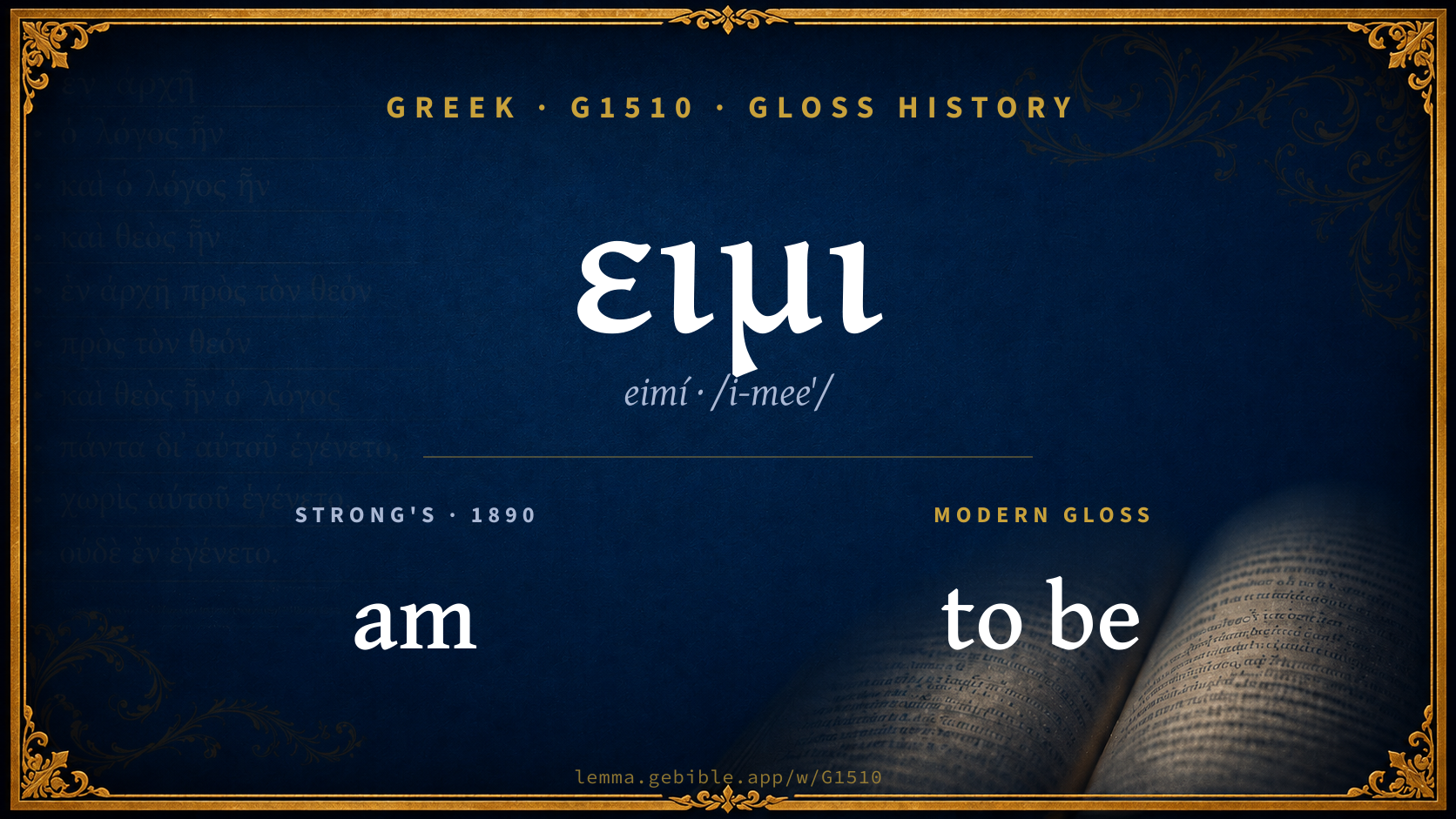
Gloss history
Strong's 1890 vs modern scholarship
About this word
Strong's G1510 catalogs a Greek word from the Greek New Testament.
These counts are not copied from any lexicon or concordance. They are computed here, from the morphology-tagged Greek New Testament. What Lemma adds →
- 2,096
- distinct verses
- The word appears in 2,096 distinct verses.
- 27 / 27
- NT books
- The word appears in 27 of 27 New Testament books.
- #6
- by frequency
- Top 10 most frequent Greek words (rank 6 of 5,347 Greek words by occurrence).
View all 2,096 occurrences in the concordance →
By section of the New Testament
By traditional corpus
Conventional, traditional groupings — biblical authorship is debated, so this is a traditional corpus grouping, not an authorship claim. Some books belong to more than one corpus (Luke is in both the Gospels and the Lukan corpus, and so on), so these shares overlap and need not total 100%. Each figure is a share of the word’s 2,096 distinct verses.
- Gospels 1,097 verses · 52%
- Lukan (Luke–Acts) 567 verses · 27%
- Johannine 514 verses · 25%
- Pauline corpus 484 verses · 23%
- General (Catholic) Epistles 133 verses · 6%
- Revelation 81 verses · 4%
- Hebrews 48 verses · 2%
How translations render this word
Counts come from each version’s own published word-to-Strong’s tagging or interlinear alignment — an approximate guide to how each version renders this word, not a word-level alignment the data otherwise carries. Because each total is that version’s own tagged count, the per-version totals vary from one another and need not match the appearance or distinct-verse counts above. These counts may also differ from a printed concordance because Lemma counts each distinctly tagged rendering and does not collapse phrase taggings into a single head-word total. This is a fixed set of word-tagged versions (KJV, ASV, BSB, ULT) and does not change with the reading translation you choose elsewhere. Each version’s license is shown beside its name below (and on Sources).
- King James Version: Am 82×, I am 44×, Is 6×
- American Standard Version: Am 75×, I am 45×, We were 6×
- Berean Standard Bible: Is 651×, Was 240×, Are 233×
- unfoldingWord Literal Text: Is 789×, Are 272×, Was 248×
King James Version Public Domain
Renders G1510 across 140 tagged occurrences — most commonly:
Plus 3 renderings that appear only once — usually multi-word phrases or single function words the recovered tagging swept in, not distinct renderings. Not rendered by a distinct English word in 6 further occurrences.
American Standard Version Public Domain
Renders G1510 across 154 tagged occurrences — most commonly:
Plus 7 renderings that appear only once — usually multi-word phrases or single function words the recovered tagging swept in, not distinct renderings. Not rendered by a distinct English word in 1 further occurrence.
Berean Standard Bible Public Domain
Renders G1510 across 2,237 tagged occurrences — most commonly:
Plus other, less common renderings. Plus 167 renderings that appear only once — usually multi-word phrases or single function words the recovered tagging swept in, not distinct renderings. Not rendered by a distinct English word in 169 further occurrences.
unfoldingWord Literal Text CC BY-SA 4.0
Renders G1510 across 2,561 tagged occurrences — most commonly:
Plus other, less common renderings. Plus 65 renderings that appear only once — usually multi-word phrases or single function words the recovered tagging swept in, not distinct renderings.
Senses in Thayer's
The 1 sense Thayer's distinguishes for this word, in lexicon order (not ranked by frequency or importance). The full entry — with sub-senses — is in the Lexicon Entry tab.
- to be, to exist, to happen, to be present
Word origin
Origin: "the first person singular present indicative; a prolonged form of a primary and defective verb"
Forms in the corpus
The 70 distinct written forms G1510 takes in the Greek New Testament, most frequent first — each parse links to that tense’s occurrences in the concordance.
The 60 most common forms are shown; 10 rarer forms follow in the full concordance.
Same root — word family
Other Thayer's entries built from the same root as G1510, grouped by Strong’s listed origin. These share a root / origin per the lexicon — not necessarily a shared meaning. Each links to that word’s own entry.
Derived from this word
- ει eî G1488 you are
- ειην eíēn G1498 to be
- ειναι eînai G1511 to be
- εισι eisí G1526 are
- εσμεν esmén G2070 we are
- εστε esté G2075 you are
- εστι estí G2076 he is
- εστω éstō G2077 let be
- ην ēn G2258 was
- ητω ḗtō G2277 let be
- ισθι ísthi G2468 be
- ω ō G5600 to be
- ων ṓn G5607 being
Proper names from this root
People and places named from this root — a name, not an additional meaning of the word.
Compare all same-root words → Showing 4 of 15 — not the complete family. 1 of the same-root words is a proper name (a person or place). They share a root, not necessarily a meaning.
Septuagint usage
The same Greek word ειμι appears 5,347 times in the Greek Old Testament (Septuagint), across 4,423 verses in 38 books.
- 5,347
- LXX occurrences
- Tagged occurrences of this Greek word in the Septuagint.
- 4,423
- verses
- Distinct Septuagint verses containing this word.
- 38 / 39
- OT books
- The word appears in 38 of the 39 Old Testament books.
Sample Septuagint occurrences
- Genesis 1:2 εἰμί
- Exodus 1:5 εἰμί
- Leviticus 1:8 εἰμί
- Numbers 1:4 εἰμί
- Deuteronomy 1:10 εἰμί
- Joshua 1:4 εἰμί
- Judges 1:7 εἰμί
- Ruth 1:2 εἰμί
- 1 Samuel 1:1 εἰμί
- 2 Samuel 1:8 εἰμί
- 1 Kings 1:2 εἰμί
- 2 Kings 1:3 εἰμί
Septuagint occurrences (same lexeme)
Every verse where the same Strong’s number (G1510) appears in the Greek Septuagint — showing the first 50 of 4,423. Verse text shown in the World English Bible for context; the Greek form is the matched word — the English is not keyword-highlighted.
- Genesis 1:2 εἰμί Now the earth was formless and empty. Darkness was on the surface of the deep. God's Spirit was hovering over the surface of the waters.
- Genesis 1:6 εἰμί God said, "Let there be an expanse in the midst of the waters, and let it divide the waters from the waters."
- Genesis 1:7 εἰμί God made the expanse, and divided the waters which were under the expanse from the waters which were above the expanse, and it was so.
- Genesis 1:14 εἰμί God said, "Let there be lights in the expanse of sky to divide the day from the night; and let them be for signs, and for seasons, and for days and years;
- Genesis 1:15 εἰμί and let them be for lights in the expanse of sky to give light on the earth," and it was so.
- Genesis 1:29 εἰμί God said, "Behold, I have given you every herb yielding seed, which is on the surface of all the earth, and every tree, which bears fruit yielding seed. It will be your food.
- Genesis 2:5 εἰμί No plant of the field was yet in the earth, and no herb of the field had yet sprung up; for Yahweh God had not caused it to rain on the earth. There was not a man to till the ground,
- Genesis 2:11 εἰμί The name of the first is Pishon: this is the one which flows through the whole land of Havilah, where there is gold;
- Genesis 2:12 εἰμί and the gold of that land is good. There is aromatic resin and the onyx stone.
- Genesis 2:18 εἰμί Yahweh God said, "It is not good that the man should be alone; I will make him a helper suitable for him."
- Genesis 2:24 εἰμί Therefore a man will leave his father and his mother, and will join with his wife, and they will be one flesh.
- Genesis 2:25 εἰμί They were both naked, the man and his wife, and were not ashamed.
- Genesis 3:1 εἰμί Now the serpent was more subtle than any animal of the field which Yahweh God had made. He said to the woman, "Yes, has God said, 'You shall not eat of any tree of the garden?'"
- Genesis 3:3 εἰμί but of the fruit of the tree which is in the midst of the garden, God has said, 'You shall not eat of it, neither shall you touch it, lest you die.'"
- Genesis 3:5 εἰμί for God knows that in the day you eat it, your eyes will be opened, and you will be like God, knowing good and evil."
- Genesis 3:6 εἰμί When the woman saw that the tree was good for food, and that it was a delight to the eyes, and that the tree was to be desired to make one wise, she took of the fruit of it, and ate; and she gave some to her husband with her, and he ate.
- Genesis 3:7 εἰμί Both of their eyes were opened, and they knew that they were naked. They sewed fig leaves together, and made themselves aprons.
- Genesis 3:9 εἰμί Yahweh God called to the man, and said to him, "Where are you?"
- Genesis 3:10 εἰμί The man said, "I heard your voice in the garden, and I was afraid, because I was naked; and I hid myself."
- Genesis 3:11 εἰμί God said, "Who told you that you were naked? Have you eaten from the tree that I commanded you not to eat from?"
- Genesis 3:19 εἰμί By the sweat of your face will you eat bread until you return to the ground, for out of it you were taken. For you are dust, and to dust you shall return."
- Genesis 4:2 εἰμί Again she gave birth, to Cain's brother Abel. Abel was a keeper of sheep, but Cain was a tiller of the ground.
- Genesis 4:8 εἰμί Cain said to Abel, his brother, "Let's go into the field." It happened, when they were in the field, that Cain rose up against Abel, his brother, and killed him.
- Genesis 4:9 εἰμί Yahweh said to Cain, "Where is Abel, your brother?" He said, "I don't know. Am I my brother's keeper?"
- Genesis 4:12 εἰμί From now on, when you till the ground, it won't yield its strength to you. You shall be a fugitive and a wanderer in the earth."
- Genesis 4:14 εἰμί Behold, you have driven me out this day from the surface of the ground. I will be hidden from your face, and I will be a fugitive and a wanderer in the earth. It will happen that whoever finds me will kill me."
- Genesis 4:17 εἰμί Cain knew his wife. She conceived, and gave birth to Enoch. He built a city, and called the name of the city, after the name of his son, Enoch.
- Genesis 4:20 εἰμί Adah gave birth to Jabal, who was the father of those who dwell in tents and have cattle.
- Genesis 4:21 εἰμί His brother's name was Jubal, who was the father of all who handle the harp and pipe.
- Genesis 4:22 εἰμί Zillah also gave birth to Tubal Cain, the forger of every cutting instrument of brass and iron. Tubal Cain's sister was Naamah.
- Genesis 5:32 εἰμί Noah was five hundred years old, and Noah became the father of Shem, Ham, and Japheth.
- Genesis 6:2 εἰμί that God's sons saw that men's daughters were beautiful, and they took for themselves wives of all that they chose.
- Genesis 6:3 εἰμί Yahweh said, "My Spirit will not strive with man forever, because he also is flesh; yet will his days be one hundred twenty years."
- Genesis 6:4 εἰμί The Nephilim were in the earth in those days, and also after that, when God's sons came to men's daughters. They bore children to them: the same were the mighty men who were of old, men of renown.
- Genesis 6:9 εἰμί This is the history of the generations of Noah. Noah was a righteous man, blameless among the people of his time. Noah walked with God.
- Genesis 6:12 εἰμί God saw the earth, and saw that it was corrupt, for all flesh had corrupted their way on the earth.
- Genesis 6:17 εἰμί I, even, I do bring the flood of waters on this earth, to destroy all flesh having the breath of life from under the sky. Everything that is in the earth will die.
- Genesis 6:19 εἰμί Of every living thing of all flesh, you shall bring two of every sort into the ark, to keep them alive with you. They shall be male and female.
- Genesis 6:21 εἰμί Take with you of all food that is eaten, and gather it to you; and it will be for food for you, and for them."
- Genesis 7:6 εἰμί Noah was six hundred years old when the flood of waters came on the earth.
- Genesis 7:15 εἰμί They went to Noah into the ark, by pairs of all flesh with the breath of life in them.
- Genesis 7:19 εἰμί The waters prevailed exceedingly on the earth. All the high mountains that were under the whole sky were covered.
- Genesis 7:22 εἰμί All in whose nostrils was the breath of the spirit of life, of all that was on the dry land, died.
- Genesis 7:23 εἰμί Every living thing was destroyed that was on the surface of the ground, including man, cattle, creeping things, and birds of the sky. They were destroyed from the earth. Only Noah was left, and those who were with him in the ark.
- Genesis 8:1 εἰμί God remembered Noah, all the animals, and all the cattle that were with him in the ark; and God made a wind to pass over the earth. The waters subsided.
- Genesis 8:9 εἰμί but the dove found no place to rest her foot, and she returned to him into the ark; for the waters were on the surface of the whole earth. He put forth his hand, and took her, and brought her to him into the ark.
- Genesis 8:17 εἰμί Bring forth with you every living thing that is with you of all flesh, including birds, cattle, and every creeping thing that creeps on the earth; that they may breed abundantly in the earth, and be fruitful, and multiply on the earth."
- Genesis 9:2 εἰμί The fear of you and the dread of you will be on every animal of the earth, and on every bird of the sky. Everything that the ground teems with, and all the fish of the sea are delivered into your hand.
- Genesis 9:3 εἰμί Every moving thing that lives will be food for you. As the green herb, I have given everything to you.
- Genesis 9:11 εἰμί I will establish my covenant with you; neither will all flesh be cut off any more by the waters of the flood; neither will there any more be a flood to destroy the earth."
These are occurrences of the same Greek lexeme (G1510) in the Septuagint — not a translation of any one Hebrew word. The store carries no word-level Hebrew↔Greek alignment, so no Hebrew original is asserted here. Counts come from the recovered LXX Strong's tagging — high-frequency vocabulary is well covered, while rare or late forms may be untagged — so they reflect tagged occurrences and may slightly undercount.