
John 17:10

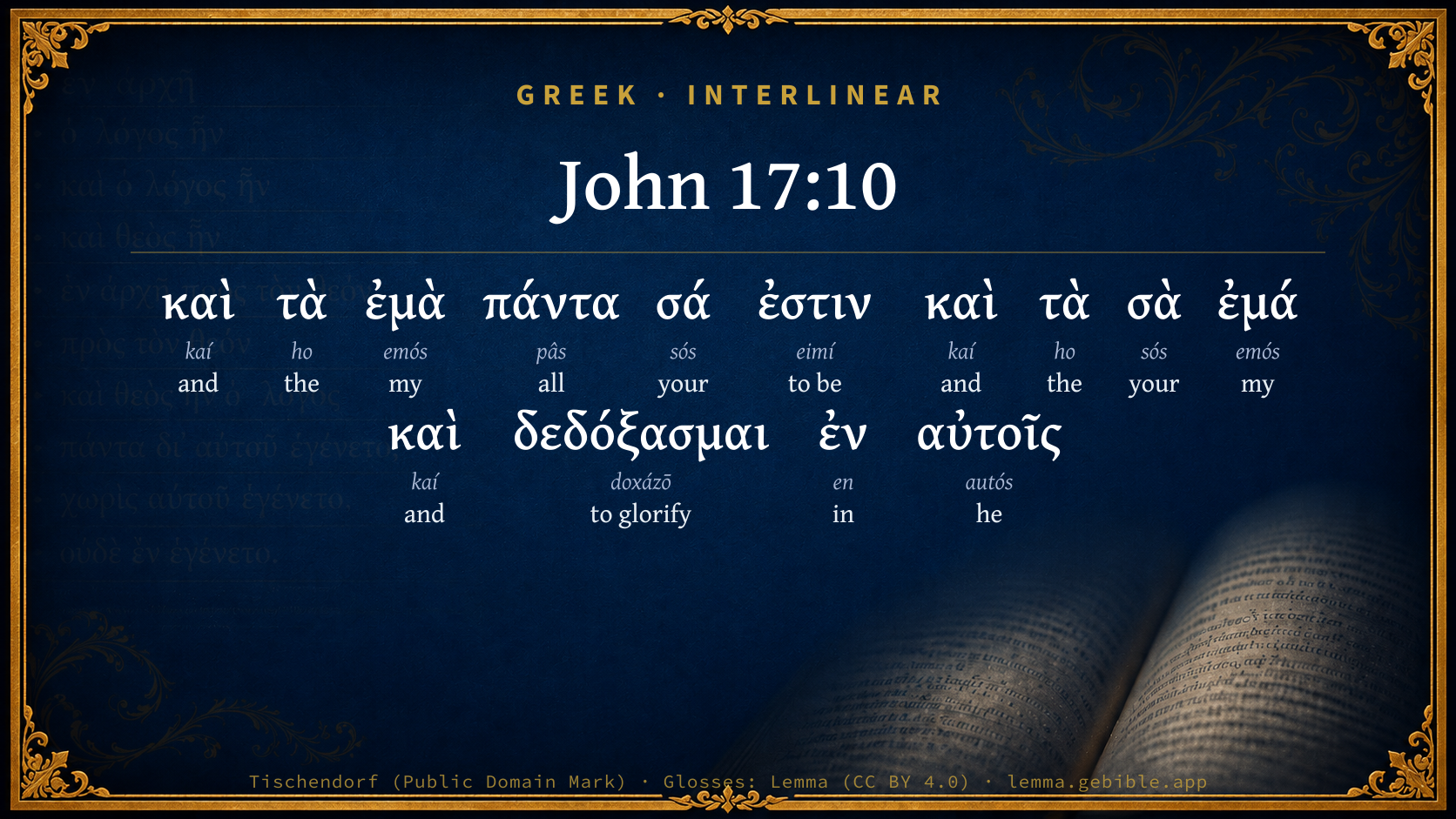
Greek (Tischendorf 8th ed.) John 17:10 appears in the Greek New Testament. The text above is from the Tischendorf 8th edition. Each word links to its Strong’s number and a concise gloss. Click any word for its full Thayer’s Greek Lexicon entry.
Download image
Cite this verse

John 17:10 (World English Bible). Public Domain. Lemma interlinear Bible study tool, https://lemma.gebible.app/v/john/17/10.

Show BibTeX & RIS
BibTeX
RIS
English Translation
All things that are mine are yours, and yours are mine, and I am glorified in them.
World English Bible · Public Domain
Download a study sheet

One document with this verse’s original text, its word-by-word gloss line, the meaning frame, cross-references with their text, attributed commentary, and full source and license credits — printable, and it pastes into notes with its structure intact.

This verse Autodidact and up

Study sheet (.html) Plain text (.txt)

A passage Seminary Student

Up to 50 verses in one chapter. A passage sheet keeps up to 6 commentary sources and 12 cross-references per verse, in the order this page ranks them, and says so on the sheet whenever that leaves anything out. Ask for a single verse and you get the Autodidact verse sheet above.

Everything on this page stays free to read, with no account — the sheet is a download of what is already on screen, not access to it.

Want to remove ads? Support Godless Engineer
Compare translations 3

The same verse in 3 English versions, stacked beneath the original-language interlinear above. Click any original word for its lexicon entry.

Each is an independent rendering of the whole verse — the interlinear is not word-aligned to these translations.

Highlighted words mark where these versions differ — a whole-verse word diff, not a word-by-word alignment.

  • World English Bible Public Domain
    All things that are mine are yours, and yours are mine, and I am glorified in them.
  • King James Version Public Domain
    And all mine are thine, and thine are mine; and I am glorified in them.
  • unfoldingWord Literal Text CC BY-SA 4.0
    And all my things are yours, and your things mine, and I am glorified in them.

unfoldingWord Literal Text — © unfoldingWord, licensed CC BY-SA 4.0. Word-aligned USFM3 via Door43 (git.door43.org/unfoldingWord/en_ult).

Versions to compare (up to 4)

3 of 4 selected

Show all 19 translations

Every available English version of this verse, each an independent rendering of the whole verse.

  • World English Bible Public Domain
    All things that are mine are yours, and yours are mine, and I am glorified in them.
  • Berean Standard Bible Public Domain
    All I have is Yours, and all You have is Mine; and in them I have been glorified.
  • Majority Standard Bible Public Domain
    All I have is Yours, and all You have is Mine; and in them I have been glorified.
  • King James Version Public Domain
    And all mine are thine, and thine are mine; and I am glorified in them.
  • American Standard Version (1901) Public Domain
    and all things that are mine are thine, and thine are mine: and I am glorified in them.
  • Revised Version (1885) Public Domain
    and all things that are mine are thine, and thine are mine: and I am glorified in them.
  • Geneva Bible (1599) Public Domain
    And al mine are thine, and thine are mine, and I am glorified in them.
  • Douay-Rheims (1899) Public Domain
    And all my things are thine, and thine are mine; and I am glorified in them.
  • Young's Literal Translation Public Domain
    and all mine are Thine, and Thine `are' mine, and I have been glorified in them;
  • Literal Standard Version CC BY-SA 4.0
    and all Mine are Yours, and Yours [are] Mine, and I have been glorified in them;
  • Unlocked Literal Bible CC BY-SA 4.0
    Everything that is mine is yours, and yours is mine, and I am glorified in them.
  • unfoldingWord Literal Text CC BY-SA 4.0
    And all my things are yours, and your things mine, and I am glorified in them.
  • Darby Bible Public Domain
    (and all that is mine is thine, and [all] that is thine mine,) and I am glorified in them.
  • World Messianic Bible Public Domain
    All things that are mine are yours, and yours are mine, and I am glorified in them.
  • Webster's Bible Public Domain
    And all mine are thine, and thine are mine; and I am glorified in them.
  • Free Bible Version CC BY-SA 4.0
    All who belong to me are yours, and those who belong to you are mine, and I have been glorified through them.
  • Bible in Basic English Public Domain
    (All mine are yours, and yours are mine) and I have glory in them.
  • Text-Critical English NT CC BY 4.0
    All who are mine are also yoʋrs, and all who are yoʋrs are also mine, and I have been glorified in them.
  • Tyndale New Testament (1534) Public Domain
    And all myne are thyne and thyne are myne and I am glorified in them.

Literal Standard Version (2020), Covenant Press — licensed CC BY-SA 4.0. Text via the HelloAO Bible API (eBible.org). Unlocked Literal Bible (unfoldingWord) — licensed CC BY-SA 4.0. Text via the HelloAO Bible API (eBible.org). unfoldingWord Literal Text — © unfoldingWord, licensed CC BY-SA 4.0. Word-aligned USFM3 via Door43 (git.door43.org/unfoldingWord/en_ult). Free Bible Version, Dr. Jonathan Gallagher — licensed CC BY-SA 4.0. Text via the HelloAO Bible API (eBible.org).

Word by word

More ways to search: Search by grammar → Find every occurrence → Compare this word →

Practice this passage: Drill this verse → Learn its vocabulary →

About this verse

These counts appear in no published source. They are computed here, from the morphology-tagged text and Lemma’s own curated glosses. What Lemma adds →

14
words
9
distinct lemmas
Gospels
section

Shared distinctive vocabulary

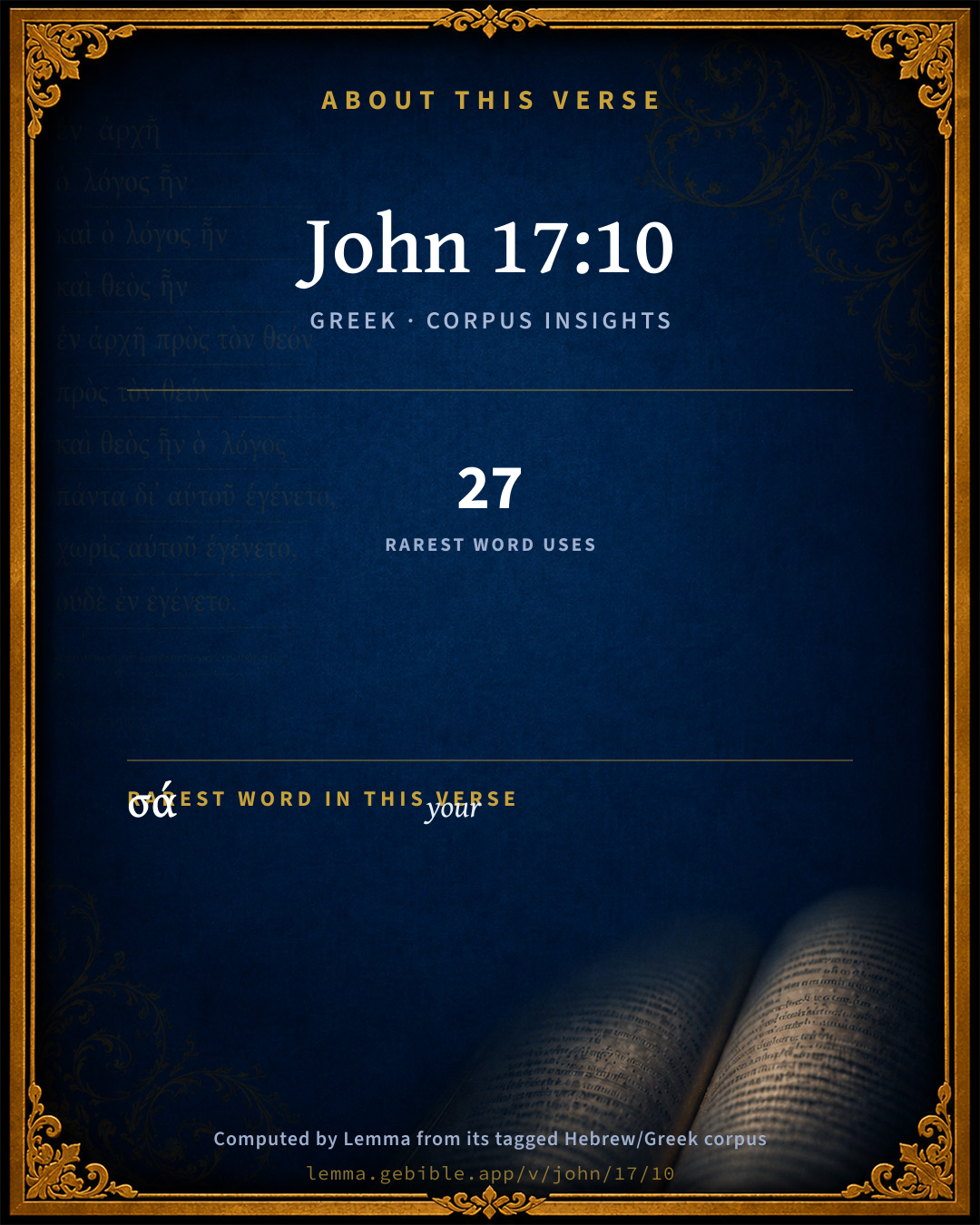
σά your G4674 occurs in 24 verses of the Greek New Testament. Also found in:
Repetition

Words recur within this verse:

Cross-references

16

Topical passages linked to John 17:10 in the Treasury of Scripture Knowledge — connected by theme and wording, ordered by reader-vote popularity; previews shown in the World English Bible.

  • John 10:30 I and the Father are one."
  • 1 Peter 2:9 But you are a chosen race, a royal priesthood, a holy nation, a people for God's own possession, that you may show forth the excellencies of him who called you out of darkness into his marvelous light:
  • Revelation 5:8–14 Now when he had taken the book, the four living creatures and the twenty-four elders fell down before the Lamb, each one having a harp, and golden bowls full of incense, which are the prayers of the saints.
  • 2 Thessalonians 1:10 when he comes to be glorified in his saints, and to be admired among all those who have believed (because our testimony to you was believed) in that day.
  • 1 Corinthians 3:21–23 Therefore let no one boast in men. For all things are yours,
  • John 16:14–15 He will glorify me, for he will take from what is mine, and will declare it to you.
  • Colossians 1:15–19 who is the image of the invisible God, the firstborn of all creation.
  • Colossians 2:9 For in him all the fullness of the Godhead dwells bodily,
  • John 5:23 that all may honor the Son, even as they honor the Father. He who doesn't honor the Son doesn't honor the Father who sent him.
  • Philippians 1:20 according to my earnest expectation and hope, that I will in no way be disappointed, but with all boldness, as always, now also Christ will be magnified in my body, whether by life, or by death.
  • Philippians 2:9–11 Therefore God also highly exalted him, and gave to him the name which is above every name;
  • 2 Thessalonians 1:12 that the name of our Lord Jesus may be glorified in you, and you in him, according to the grace of our God and the Lord Jesus Christ.
  • John 11:4 But when Jesus heard it, he said, "This sickness is not to death, but for the glory of God, that God's Son may be glorified by it."
  • Acts 19:17 This became known to all, both Jews and Greeks, who lived at Ephesus. Fear fell on them all, and the name of the Lord Jesus was magnified.
  • Galatians 1:24 And they glorified God in me.
  • John 12:23 Jesus answered them, "The time has come for the Son of Man to be glorified.

Cross-references courtesy of OpenBible.info (CC BY 4.0).

Commentary

Notes on John 17:10 from classic Christian and Jewish commentators (each source and its license shown beneath its notes). The classic Christian expositions comment on the surrounding passage and are grouped to its opening verse, so a note may address several verses; the Jewish commentaries on the Tanakh (Rashi and others) are per-verse, so they appear only where the commentator wrote on this verse.

Lemma curates 59 commentaries, every one of them public domain or Creative Commons licensed, each selected and text-cleaned for this edition rather than reprinted as found. About our sources →

The Biblical Illustrator

Joseph S. Exell

Joh_17:10

All Mine are Thine, and Thine are Mine

I.

THE SAME NAMES AND TITLES: Jehovah (Heb_1:10); God Rom_9:11; 1Ti_3:16).

II. THE SAME NATURE AND ESSENCE: I and My Father are one.

III. THE SAME PROPERTIES: Eternity (Joh_1:1); omnipotence, as seen in Christs miracles; omniscience: He knew what was in man; omnipresence: Lo, I am with you alway.

IV. THE SAME WORKS (Joh_5:17; Joh_5:19).

V. THE SAME WILL AND PURPOSE (Mat_26:39).

VI. THE SAME PROPRIETY IN ALL THE GODLY (Joh_8:16; Joh_20:17).

VII. THE SAME POWER FOR THE PRESERVATION OF CHRISTIANS (Joh_10:28-30). (D. Burgess.)

I am glorified in them.--

Christ glorified in His disciples

I. BY THEIR DELIVERANCE FROM CONDEMNATION AND THEIR ACCEPTANCE WITH GOD THROUGH HIS MERIT.

II. BY THE CHANGE WHICH HE HAS EFFECTED IN THEIR CHARACTER.

III. BY THEIR CONFIDENCE WHICH HE HAS GAINED.

IV. BY THEIR CONTENTMENT AND RESIGNATION TO HIS WILL.

V. BY THEIR OBEDIENCE TO HIS LAWS AND THEIR GRADUAL IMPROVEMENT IN PRACTICAL PIETY.

VI. BY THEIR PUBLIC PROFESSION OF HIS GOSPEL AND THEIR ZEAL IN DIFFUSING IT. (Congregational Remembrancer.)

Christ glorified in His people

I. BY THE DERIVATION OF ALL THEIR EXCELLENCIES FROM HIM.

II. IN THEIR HOLY WALK.

III. BY THE CHEERFULNESS OF THEIR LIVES.

IV. BY THEIR READINESS TO SUFFER FOR HIS SAKE.

V. IN THEIR PROFESSION OF HIS NAME.

VI. BY THEIR EXERTIONS TO PROMOTE HIS CAUSE. (W. Jay.)

Christ glorified in His saints

I. AS THE PURCHASE OF HIS BLOOD. As the fruit of His soul-travail they indicate the success of His redeeming work.

II. AS THE TROPHIES OF HIS POWER. Having been rescued from the thraldom of sin and brought into His kingdom, they attest the all-conquering might of His love.

III. AS THE CREATIONS OF HIS GRACE. Being renewed in the spirit of their minds and recreated after His image, they reveal in their moral likeness to Him the beauty of holiness that is in Him.

IV. AS THE SUBJECTS OF HIS EMPIRE. In their willing subjection to His throne they proclaim the gentle character of His rule.

V. AS THE PREACHERS OF HIS GOSPEL. In the testimonies they afford by their lips and lives that Christ is exalted they show forth His glory before men. (T. Whitelaw, D. D.)

Christ glorified in His disciples

I. We glorify Christ BY FAITH. Now, faith hath a double office, which

1. Accepts Christ. When men slight the offers of Christ which God makes to them, they dishonour Him exceedingly (Act_4:11; Mt 1Pe_2:7).

2. Presents Christ. In all our endeavours to God we must build our acceptance on the merits of Christ (Joh_14:1).

II. BY HOLINESS. Every Christian should walk so as remembering that Christs honour lieth at stake.

1. For the manner; your practice should be elevated according to the height of your privileges in Christ. A Christian should do more than a man (1Co_3:3). We expect that he should go faster that rides on horseback than he that goes on foot. There should be a singularity of holy life.

2. For the principle; Christ must be honoured. You must make Him the principle of your obedience to God (Php_4:13; Gal_2:20.)

3. For the end; you must make His interest the great end of your lives Php_1:21; Rom_14:7-8).

4. For the motive; gratitude to Christ (2Co_5:14).

III. IN OUR ENJOYMENTS. When we think of our title to anything, think, This I have by gift, be it justification, sanctification, glorification, comfort of the creatures. Whatever privilege we look upon as ours, we must see Christ in it (1Co_1:22-23).

IV. BY DOING AND SUFFERING FOR THE ADVANCEMENT OF HIS INTEREST AND KINGDOM (2Co_5:13). Let glory to Christ be written, though it be with our blood; only with these cautions:

1. We must think ourselves to be honoured by this service, how grievous, disgraceful, and troublesome soever it be (2Co_5:9).

2. There must be a sense of your unworthiness (Luk_17:10).

3. You must ascribe all to Christs glory; as Joab, when he had conquered Rabbah, sent for David to take the honour: so must we do for Christ (1Co_15:10; 1 Chronicles 29:1.4):

V. BY BEING ZEALOUS FOR HIS INSTITUTIONS; then you honour Christ, by giving the wisdom and power of a lawgiver to Him (Mat_15:6).

VI. BY TAKING SOME SOLEMN TIME TO MEDITATE ON AND ADMIRE THE EXCELLENCY OF HIS PERSON AND THE FULNESS OF HIS REDEMPTION. In heaven this will be our great work (Rev_4:10-11). (T. Manton, D. D.)

Christ glorified in the disciples

It is not difficult to see how the Son was glorified in them. They had been His faithful and devoted followers in all His wanderings; they had forsaken all that they might be His disciples; they had seen His miracles, heard and received His words, and believed that He came forth from the Father. They had suffered the loss of all earthly things for His names sake; they were the depositaries of His truth; they had stood forth alone with Him against nearly all the world; after His ascension they were to manifest forth His glory to all the world, and under Him to go forth to subjugate that world which He, in His death, had actually conquered. And what they did and how they glorified Him after His departure we know well from the inspired record of their labours. (T. Alexander, M. A.)

The apologetic Christ

1. He was glorified in them; made known by them, by their words and lives, as Jesus the Saviour, as the anointed King, and in the beauty of His character and in the grandeur of His Person.

2. Wonderful praise coming from such a source. Yet it was not uncommon for Christ to speak words of commendation. He praised the centurion, the woman of Canaan, the woman who anointed Him in Bethany. And here He praises all His apostles.

3. But who were the men of whom Christ said this? Men of influence, of wealth, of learning? If not these, surely they were great saints. On the contrary, Christ rebuked them again and again for their little faith, for their ambition, for their mistakes and wrong purposes. Wonderful words of praise to say of men who in a few hours would forsake Christ, and deny Him.

4. Yet the Christ who praised these men was Truth itself, and could not flatter nor be deceived. It is manifest, therefore

(1) That Christ sees in His people more than others see in them. The most unpopular man in Jericho was Zaccheus, but Christ associated with him, and declared, Salvation has come to this house, and that he was a son of Abraham. The Christ, so pitiful and kind, sees more in His people than do others. They see their faults; Christ sees their virtues.

(2) And He sees far more in them than they see in themselves. Abraham, standing before God, said of Himself, I am but dust and ashes. But God said, He is My friend. I am not worthy that Thou shouldst come under my roof, said the centurion; but Christ said of him, I have not found so great faith, no, not in Israel. These apostles had their faults. One of them, so oppressed with feelings of unworthiness, bade Christ Depart from me, for I am a sinful man; but Christ said to him, Blessed art thou, Simon, son of Jonas. Christ is not only the pitiful and tender and loving Christ; He makes every allowance for His people; He remembers they are dust, and speaks to them and of them apologetically. (D. F. Sprigg, D. D.)

The Biblical Illustrator, edited by Joseph S. Exell (c. 1880s–1900s) — public domain. Text from a community e-Sword module.

Tyndale Open Study Notes

Tyndale Open Resources

17:10 Just as the Son brings glory to the Father (17:1, 4-5), the disciples bring the Son glory (17:22). The love and obedience that brought glory to God in Jesus’ life become features of his disciples’ lives.

Tyndale Open Study Notes — © Tyndale Open Resources, licensed CC BY-SA 4.0. Text via the HelloAO Bible API.

Bengel's Gnomon

Johann Albrecht Bengel

Joh 17:10. Τὰ ἐμὰ, all things that are Mine) and all persons that are Mine.—σά ἐστι, are Thine) are “from Thee” (Joh 17:7), and are referred back by Me to Thee.—ἐμὰ, Mine) because Thou hast given them to Me.—δεδόξασμαι, I am glorified) They have shown themselves of such a character as that I should be glorified in them; they have recognised My glory: i.e. they believe that all things which are Mine are Thine, and Thine Mine.—ἐν αὐτοῖς, in them) in their case. So ἐν αὐτοῖς, in their case, ch. Joh 15:24.

Bengel's Gnomon of the New Testament — English translation (T&T Clark, Edinburgh, 1860) — public domain. Text from a community e-Sword module.

Meyer's Critical & Exegetical Commentary

Heinrich August Wilhelm Meyer

Joh_17:10. Καὶ τὰ ἐμὰ πάντα … ἐμά] is parenthetic (on καί parentheticum, see Fritzsche, ad Rom. I. 13, p. 35), and καὶ δεδόξ. ἐν αὐτοῖς is still in connection with ὅτι, Joh_17:9, containing a second ground of the intercession.

As regards the above parenthesis, when Jesus prayed ὅτι σοί εἰσι, Joh_17:9, His glance was extended from this concrete relation to the category, to the general reciprocal community of property, which, in matters relating to His work, exists between Him, the Son and plenipotentiary of the Father, and the Father. Both have the same work, the same aim, the same means, the same power, the same grace and truth, etc., in common; neither has and works separate from the other, and for Himself; God in Christ, and He in God. Comp. on Joh_16:15. Luther aptly remarks: It would not yet be so much if He simply said: All that is mine is Thine; for that every one can say …; but this is much greater, that He inverts the relation, and says: All that is Thine is mine; this no creature can say in reference to God.

δεδόξ. ἐν αὐτ.] I am glorified in them, in their person and activity, in so far as they are bearers and furtherers of my glory and knowledge upon earth, so precious and important, then, that I pray for them. What is already begun, and is certainly to be further accomplished in the near future, Jesus views, speaking in the perfect with prophetic anticipation, as completed and actually existing (Kühner, II. p. 72), and ἐν denotes the relation resting on, contained in them, as in Joh_13:31-32, Joh_14:13.

Meyer — Critical and Exegetical Commentary on the New Testament — English translation by Peter Christie, edited by Frederick Crombie (T&T Clark, 1880) — public domain. Text from a community e-Sword module.

Expositor's Greek Testament

ed. W. Robertson Nicoll

Joh 17:10 . καὶ τὰ ἐμὰ πὰντα σὰ ἐστι , καὶ τὰ σὰ ἐμά , the community of property and therefore of interest is unlimited, absolute; extending not only to the persons of the disciples, but to all that Christ has spoken and done on earth. καὶ δεδόξασμαι ἐν αὐτοῖς , “and I have been glorified in them,” i.e. , in the disciples. In them it had been manifested that Christ was the messenger of God and had the words of eternal life.

The Expositor's Greek Testament, edited by W. Robertson Nicoll (1897–1910) — public domain. Text from a community e-Sword module.

Jamieson, Fausset & Brown

Robert Jamieson, A. R. Fausset & David Brown

all mine are thine, and thine are mine--literally, "All My things are Thine and Thy things are Mine." (On this use of the neuter gender, see on Joh 6:37-40). Absolute COMMUNITY OF PROPERTY between the Father and the Son is here expressed as nakedly as words can do it. (See on Joh 17:5).

Jamieson, Fausset & Brown — Commentary Critical and Explanatory on the Whole Bible (1871) — public domain (CC PDM 1.0). Text via the HelloAO Bible API.

Adam Clarke's Commentary

Verse 10. I am glorified in them.] Christ speaks of the things which were not, but which should be, as though they were. He anticipates the glorifying of his name by the successful preaching of the apostles.

Adam Clarke's Commentary on the Bible (1810–1826) — public domain. Text from a community e-Sword/MySword module.

John Calvin's Commentaries

10. And all things that are mine are thine. The object of the former clause is to show that the Father will assuredly listen to him. “I do not,” says he, “plead with thee for any but those whom thou acknowledgest to be thine, for I have nothing separated from thee, and therefore I shall not meet with a refusal.” In the second clause, and thine are mine, he shows that he has good reason for caring about the elect; for they are his in consequence of their being his Father’s. All these things are spoken for the confirmation of our faith. We must not seek salvation anywhere else than in Christ. But we shall not be satisfied with having Christ, if we do not know that we possess God in him. We must therefore believe that there is such a unity between the Father and the Son as makes it impossible that they shall have anything separate from each other.

And I am glorified in them. This is connected with the second clause of the verse, and thine are mine; for it follows that it is reasonable that he, for his part, should promote their salvation; and this is a most excellent testimony for confirming our faith, that Christ never will cease to care for our salvation, since he is glorified in us.

John Calvin's Commentaries (1540-1563) — public domain. Text from the Calvin Translation Society English edition (1840s-50s) via the Christian Classics Ethereal Library (ccel.org). Calvin's coverage is partial (roughly two-thirds of the Bible); uncommented books and verses are honest gaps, never fabricated. The 19th-century editor's footnotes and remarks are omitted so the notes are faithfully Calvin's own voice.

Ellicott's Commentary for English Readers

(10) And all mine are thine, and thine are mine.—Better, And all My things are Thine, and Thy things are Mine. The Authorised version leaves the impression that the pronouns are masculine, and that persons are exclusively meant; whereas the words are all-inclusive, and assert absolute community in all things between the Father and the Son.

And I am glorified in them.—The division of verses is unfortunate, as the last words of this verse are closely connected with the last words of Joh_17:9, and the general assertion which intervenes is a parenthesis. The thought is, “For they are Thine (and all My things are Thine, and Thy things are Mine), and I am glorified in them.” The fact that Christ is glorified in them forms, then, a second reason for His special prayer for them. The tense is perfect. Its accomplishment is already in part realised (Joh_17:6-8; comp. Joh_15:8), and is more fully to be realised in that future of the Spirit’s work which all through this chapter is regarded as present. (Comp. Note on Joh_16:14.)

A Bible Commentary for English Readers, edited by Charles John Ellicott (1878–1897) — public domain. Text from a community e-Sword module.

The Cambridge Bible for Schools and Colleges

gen. ed. J. J. S. Perowne

10. all mine are thine] Better, all things that are Mine are Thine. The statement does not refer to persons only, but continues and amplifies the reason with which Joh_17:9 concludes; ‘Because they are Thine, and all My things are Thine.’ There should be no full stop at the end of Joh_17:9.

thine are mine] Or, the things that are Thine are Mine. The statement is made conversely to insist on the perfect union between the Father and the Son.

I am glorified] Better, I have been glorified; have been and still am.

in them] As the vine is glorified in its branches and fruit. They are the vehicles and monuments of the glory. Comp. 1Th_2:20.

The Cambridge Bible for Schools and Colleges (gen. ed. J. J. S. Perowne; Cambridge University Press, 1878–1918) — public domain. Text from a community e-Sword module.

John Gill's Exposition

And all mine are thine, and thine are mine,.... Christ is speaking not of things but of persons; otherwise all the perfections of his nature as God, and all the works he did, and doctrines he taught as man, were of his Father; as all the perfections of his Father, his nature, his names, his works, his worship, were his; the same that belongs to the one belongs to the other: but persons are here meant, and these the elect of God, particularly the apostles, who were his and his Father's; belonged to them both by election, covenant transactions, redemption, and efficacious grace in conversion; which mutual interest arises from an union in nature, an agreement in covenant, and a conjunction in operation:

and I am glorified in them: or by them, they ascribing all divine perfections, works and worship to him; attributing the whole of their salvation to him, and giving him all the glory of it; believing in him; walking worthy of him, in their lives and conversations; suffering patiently and cheerfully for his sake; and abiding by his Gospel and ordinances; and he will be glorified by them, and in them hereafter, and that to all eternity.

John Gill's Exposition of the Whole Bible (1746–1763) — public domain (CC PDM 1.0). Text via the HelloAO Bible API.

Trapp's Complete Commentary

John Trapp

10 And all mine are thine, and thine are mine; and I am glorified in them.

Ver. 10. And I am glorified in them] It will be a singular prop to our prayers, if we so carry ourselves, that Christ in his daily intercession may give this testimony of us to the Father. He undertakes for us, as it were, and gives his word, that we, being mindful of our reconciliation by him, shall shun sin by his grace, and not provoke him as before. This should cause us to live so as Christ may have credit by us, and we may have courage to come to God by Christ.

John Trapp, A Commentary or Exposition upon All the Books of the Old and New Testament (1647–1656) — public domain. Text from a community e-Sword module.

Haydock's Catholic Bible Commentary

And all mine are thine, and thine are mine. They must needs be equal, says St. Augustine, to whom equally belong all things, and all persons; on which words St. John Chrysostom also says, (hom. lxxxi.) Do you see the equality? (Witham) --- And all mine are thine, and thine are mine: as if he said: whatever thou hast given to me remains still thine, for mine are thine; and whatever is thine, is likewise mine, for thine are all mine. (St. John Chrysostom, hom. lxxx. in Joan.)

George Leo Haydock (1774–1849), Haydock's Catholic Family Bible and Commentary, 1859 edition — public domain. Excludes Psalms (Douay-Rheims chapter numbering differs from Protestant) and Deuterocanonical books (Catholic canon only).

Matthew Poole's English Annotations

In the Greek the adjectives are of the neuter gender, so as the sense is not, All my friends, or all my disciples, are thine also; but, All my things are thine, and all thy things are mine; which is no more than he hath before often said. Christ and his Father have all things common, neither of them have any thing that is not the other’s: they are one, and they agree in one; they have the same essence, the same will, the same attributes, the same friends.

And I am (saith our Saviour) glorified, or made glorious, in them, by their owning, receiving, and embracing me, and accepting me as their Saviour. So as this verse containeth two arguments more, enforcing his petition on the behalf of his elect:

1. His Father’s propriety in them, as well as his.

2. Their love to him, and the glory which redounded to him from their faith and holiness.

Matthew Poole's English Annotations on the Holy Bible (1683–1685) — public domain. Text from a community e-Sword/MySword module.

Whedon's Commentary on the Bible

Daniel D. Whedon

10. Thine are mine—Language which no created being could use.

Daniel D. Whedon (gen. ed.), Commentary on the Old and New Testaments (1874–1909) — public domain. Text from a community e-Sword module.

The Pulpit Commentary

And all things that are mine are thine; whether they be these souls, or these powers that I wield, or these words that I utter, or these works that I do, all are thine. This statement is in perfect harmony with all his teaching, and is not incompatible with the reverential sentiment that any servant of God might utter; but he adds words to show that the union between him and the Father is much closer than this, and quite unique. And thine are mine. Luther observed, "No creature could say this." Perhaps he went too far, because we are taught to believe that all things are ours," etc., and the panta covers much. (see 1Co_3:21) In the full confidence of filial relation we can believe it true that the heavenly Father says to every one of his veritable children, All that I have is thine." Here the words must not be drawn out of their connection; it is human souls who are of God, and are therefore Christ"s. The dogmatic lesson is that every one who has heard and learned of the Father does come to him. Such an assurance gives a sublime hope to the world, and I (have been and) am glorified in them. Once more the Divine Savior rejoices in the victory he has won in securing the faith of the disciples. How much he loved and trusted them!

The Pulpit Commentary (1880–1919), ed. H.D.M. Spence-Jones & Joseph S. Exell — public domain. Text from a community e-Sword module.

John Wesley's Explanatory Notes

All things that are mine are thine, and that are thine are mine - These are very high and strong expressions, too grand for any mere creature to use; as implying that all things whatsoever, inclusive of the Divine nature, perfections, and operations, are the common property of the Father and the Son. And this is the original ground of that peculiar property, which both the Father and the Son have in the persons who were given to Christ as Mediator; according to what is said in the close of the verse, of his being glorified by them; namely, believing in him, and so acknowledging his glory.

John Wesley, Explanatory Notes Upon the Whole Bible (1754–1765) — public domain. Text via the GEBible commentary corpus.

Burkitt's Expository Notes on the New Testament

William Burkitt

We may understand this two ways;

1. Of all persons; all my friends, all my disciples, are thine as well as mine.

Thence learn, that the Father and the Son have a like share and property in all believers.

2. The words in the original, being of the neuter gender, signify, all thy things are mine, and all my things are thine.

Christ and his Father are one, and they agree in one; they have the same essence and nature, the same attributes and will; Christ hath all things that the Father hath, willeth all things that the Father willeth, and doeth all things that the Father doeth; he is therefore really and essentially God. It followeth, And I am glorified in them: that is, I am made glorious by their owning and receiving me, by their believing in me, and accepting of me for their Lord and Saviour.

Thence note, that the Lord Jesus Christ is eminently glorified in and by all those that believe in him, and belong unto him.

William Burkitt's Expository Notes on the New Testament (1700–1703) — public domain. Text from a community e-Sword module.

The People's New Testament

B. W. Johnson

10. I am glorified in them. Christ's glory here upon the earth is manifested by his disciples.

B. W. Johnson's The People's New Testament with Notes (1889–1891) — public domain. Electronic text from the Christian Classics Ethereal Library (CCEL) ThML edition.

Cambridge Greek Testament for Schools and Colleges

10. τὰ ἐμά. All things that are Mine are Thine and Thine are Mine. This does not refer to persons only; it continues and also amplifies ὅτι σοί εἰσιν. The double mode of statement insists on the perfect union between the Father and the Son: what follows shews the perfect union between Christ and believers. Christ is glorified in them as the vine in its branches and fruit: they are the vehicles and monuments of the glory (1Th 2:20). Δεδόξασμαι, ‘I have been and still am glorified.’

Cambridge Greek Testament for Schools and Colleges (Cambridge University Press, 1896; 21 vols, various authors incl. Carr, Maclear, Plummer, Farrar, Lumby, Moule, M. R. James, Simcox) — public domain. Text from a community e-Sword module.

Alford’s Greek Testament

Henry Alford

10.] Compare ch. 16:15 and note. “It were not so much if He had only said, ‘All Mine is Thine;’ for that we may all say, that all we have is God’s. But this is a far greater thing, that He inverts this and says, ‘All Thine is Mine.’ This can no creature say before God.” Luther, Stier, v. 418, edn. 2.

The E. V.,—‘All Mine are Thine,’ &c.,—gives the erroneous impression that persons only are meant, whereas it is all things, in the widest meaning,—the Godhead itself included,—of which this is asserted.

ἐν αὐτοῖς, not ‘by their means,’ but in them; by that ἐγὼ ἐν αὐτοῖς of ver. 23, the life of the vine in the branches; so that the fruit of the branches is the glory of the vine, by the sap of the vine living in the branches. All this again is proleptic.

Henry Alford, The Greek Testament (1849–1861) — public domain. Text from a community e-Sword module.

International Critical Commentary

10. καὶ τὰ ἐμὰ πάντα σά ἐστιν. So He had said before; see on 16:15.

καὶ τὰ σὰ ἐμά. This goes further than the preceding clause. Meyer cites Luther’s comment: “This no creature can say in reference to God.”

καὶ δεδόξασμαι ἐν αὐτοῖς. The apostles were Jesus’ own men, not only because the Father “gave” them to Him, when they were chosen, not only because all that belonged to the

Father belonged to Him, but for the additional reason that He had been “glorified” in them. He was “glorified” in the physical miracle of the Raising of Lazarus (11:4), much more in the spiritual miracle of the faith of the Eleven. They exhibited and continued to exhibit (note the perfect tense δεδόξασμαι) the power of the message which He brought. So Paul said of his Thessalonian converts ὑμεῖς γάρ ἐστε ἡ δόξα ἡμῶν (1Th 2:20). Cf. 2Th 1:10 of the future “glorification” of Christ in His saints.

Through misunderstanding of the meaning, for δεδόξασμαι D has ἐδόξασάς με (cf. v. 1).

International Critical Commentary — older volumes (1896–1929), various authors — public domain. Text from a community e-Sword module.

Vincent's Word Studies in the New Testament

Marvin R. Vincent

All mine [τα εμα παντα] . All things that are mine. So Rev.

Marvin R. Vincent, Word Studies in the New Testament (1887–1900) — public domain. Text from a community e-Sword/MySword module.

Lesson kit

Teaching starters — assembled from the data on this page, not authored interpretation. Every prompt links to the verse data it draws on. Edit before teaching.

John, in the Gospels, opens this verse with 14 words (9 distinct Greek lemmas). Its most distinctive word is sós (“your”). A historical commentator’s framing appears above. Read the whole chapter for the surrounding context.

Discussion questions

  1. What does “your” (sós) contribute to the verse as a whole?
  2. Matthew 7:3 shares the word «your» with this verse. How do the two illuminate each other?
  3. “and” occurs 3× in this one verse. What is the effect of the repetition?
  4. These translations render this verse differently. What is at stake in choosing one wording over another?
  5. Reading how The Biblical Illustrator and Tyndale Open Study Notes read this verse, where do the two commentators agree and where do they part?

Things to notice

  • These translations choose different wording for 2 words in this verse.
  • “and” occurs 3× in this single verse.
  • 9 distinct Greek lemmas span 14 words in this verse.

Reading settings

Reading text

Shown beneath each verse's original-language words.

Old Testament
Old Testament edition

Read the OT as the Masoretic Hebrew (MT) or the Greek Septuagint (LXX).

English shown for the Greek Septuagint (in the Hebrew ↔ Greek comparison).

Comparing translations? Open the Compare panel on any verse page to stack up to four side by side.